



3,942 products added recently
Page 5 - Space Lesson Plans
Ignite your students' imagination with lesson plans that delve into astronomy and space exploration. Covering topics from the solar system to deep space phenomena, these resources include engaging activities and multimedia elements. Use them to inspire awe and curiosity about the cosmos.

 Show filters

I WONDER - When Was The First Space Station Launched Into Space
Space, Earth and Environmental Sciences, Science, Grade 6, 7, 8, 9, 10, 11, 12, Lesson Plans, Teacher Tools
Video Introduction An amazing video designed for the students to learn more about space facts. I WONDER - When Was The First Space Station Launched Into Space | Animated Video Lesson Do you like reading about space? If yes, what is your favorite topic? What do you know about our solar system? What is the smallest planet in our solar system? What is the biggest planet in our solar system? What is the hottest planet in our solar system? And what is the coldest one? Do you think there are aliens? If yes, what do you think they look like? What do they eat and how they speak to each other? Where do they live? What is a galaxy? And what is a milky way? Have you recently saw a shooting star? If yes, tell us more about it, like when did it happen and where? What is a blackhole? Can a blackhole gets bigger by time? Do you like counting the stars? What do you think a star is made of? I WONDER - When Was The First Space Station Launched Into Space | Animated Video Lesson The video is perfect for encouraging the researching skills for the students, while learning more about the fantastic space. I WONDER - When Was The First Space Station Launched Into Space | Animated Video Lesson This friendly designed video is suitable for students at school, homeschooling, and as a group activity. Format Available in MP4 format.
Author Educational Voice
Tags When Was The First Space Station Launched Into Space, When Was The First Space Station Launched Into Space Video, Space Station, Space Station Facts, Space Station Facts For Kids, Space Station Video

I WONDER - When Was The First Moon Landing | Animated Video Lesson
Space, Earth and Environmental Sciences, Science, Grade 4, 5, 6, 7, 8, 9, 10, Lesson Plans, Teacher Tools
Video Introduction An amazing video designed for the students to learn more about space facts. I WONDER - When Was The First Moon Landing | Animated Video Lesson Do you like reading about space? If yes, what is your favorite topic? What do you know about our solar system? What is the smallest planet in our solar system? What is the biggest planet in our solar system? What is the hottest planet in our solar system? And what is the coldest one? Do you think there are aliens? If yes, what do you think they look like? What do they eat and how they speak to each other? Where do they live? What is a galaxy? And what is a milky way? Have you recently saw a shooting star? If yes, tell us more about it, like when did it happen and where? What is a blackhole? Can a blackhole gets bigger by time? Do you like counting the stars? What do you think a star is made of? I WONDER - When Was The First Moon Landing | Animated Video Lesson The video is perfect for encouraging the researching skills for the students, while learning more about the fantastic space. I WONDER - When Was The First Moon Landing | Animated Video Lesson This friendly designed video is suitable for students at school, homeschooling, and as a group activity. Format Available in MP4 format.
Author Educational Voice
Tags When Was The First Moon Landing, When Was The First Moon Landing Video, First Moon Landing, First Moon Landing Facts, First Moon Landing Facts For Kids, First Moon Landing Video, First Moon Landing Video For Kids
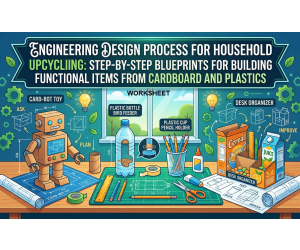
Engineering Design Process for Household Upcycling
Science, Basic Science, Inventors, Theories, Earth and Environmental Sciences, Earth Sciences, Environmental Science, Geology, Space, STEM, Homeschool Curriculum, Grade 3, 4, 5, 6, 7, 8, Worksheets & Printables, Workbooks, Worksheets, Word Searches, Teacher Tools, Assessments, Lesson Plans, Quizzes and Tests, Quizzes, Tests
Transform your students from consumers into creators with this complete, no-prep STEM curriculum! Are you looking for an engaging, hands-on project that teaches real-world engineering skills without breaking the budget? Dive into the "Engineering Design Process for Household Upcycling," a comprehensive, project-based learning (PBL) unit designed to turn everyday trash like cardboard boxes and plastic bottles into functional, load-bearing items. This isn't just another recycling craft. This rigorous curriculum guides 4th, 5th, and 6th-grade students through the authentic Engineering Design Process (EDP) . They will learn the material science of polymers and cardboard, draft orthographic blueprints, and apply principles of physics to build amazing items like a passive phone amplifier, a modular storage unit, a self-watering planter, and even a kinetic wind turbine! What's Included in This 35-Page All-in-One PDF? Part 1: In-Depth Instructional Text (Teacher's Guide): A detailed guide explaining the core concepts of material science, structural engineering, and each step of the EDP (Ask, Imagine, Plan, Create, Test, Improve) in the context of upcycling. Part 2: Printable Student Workbook (10 Worksheets): Ten carefully scaffolded worksheets that reinforce learning. Activities cover everything from blueprint basics and advanced joinery to data collection, troubleshooting, and a final capstone design challenge. Part 3: Teacher Resources & Visuals: Classroom Anchor Charts: Professional diagrams of the Engineering Design Process, a Material Science Matrix, and the Anatomy of a Blueprint. Comprehensive Answer Key: Complete answers for every knowledge check and worksheet question, saving you valuable prep time. Project Reflection Rubrics: Guidance for assessing student understanding and encouraging a growth mindset during the testing and iteration phases. This unit is perfect for STEM/STEAM labs, Earth Day activities, sustainability lessons, gifted and talented programs, or any teacher looking to integrate meaningful, hands-on engineering challenges into their classroom. Keywords: STEM, STEAM, Engineering Design Process, Project-Based Learning (PBL), Upcycling, Recycling Project, Earth Day, Sustainability, 4th Grade Science, 5th Grade Science, 6th Grade STEM, Middle School Engineering, Hands-On Learning, Critical Thinking, Cardboard Engineering, Plastic Bottle Projects, Printable Workbook, No-Prep, Homeschool Curriculum, After-School Club. Why Parents/Schools Love It: Turns Trash into Treasure (Zero-Cost Materials): This curriculum brilliantly uses common household waste like cardboard and plastic bottles, making it an incredibly affordable and accessible hands-on experience for any school or family. Teaches Authentic 21st-Century Skills: It goes far beyond simple crafts, teaching the real, iterative Engineering Design Process. Students learn critical thinking, problem-solving, spatial reasoning, and resilience in the face of failure. Comprehensive & "Print-and-Go": This is a complete, all-in-one unit. With an instructional guide, student worksheets, visual aids, and a full answer key, teachers can implement a high-quality engineering project with minimal prep time. Fosters Environmental Consciousness: The curriculum is built on a foundation of sustainability. It empowers students to see waste as a resource, teaching them practical ways to have a positive impact on their environment. Highly Engaging for All Learners: The hands-on building process and the creation of genuinely functional items (like a phone stand or a self-watering planter) capture students' imagination and provide a tangible sense of accomplishment. Target Audience : Based on the content's complexity, language, and stated goals, target: Grade Levels: 4th, 5th, and 6th Grade . The content is perfectly scaffolded for this upper-elementary to early-middle school range. Educator Types: Classroom Teachers (Grades 4-6) STEM/STEAM Lab Teachers Science Teachers Homeschooling Parents After-School Program Coordinators Gifted and Talented (GATE) Program Instructors Copyright/Terms of Use: This Book was copyrighted by Syed Hammad Rizvi. This resource is for personal and single classroom use only. You may not alter, redistribute, or sell any part of this resource. In other words, you may not put it on the Internet where it could be publicly found and downloaded. If you want to share this resource with colleagues, please purchase additional licenses from Teachsimple. Thank you for respecting these terms of use. This product is happily brought to you by Syed Hammad Rizvi
Author Creative Book Store
Rating
Tags STEM, STEAM, Engineering, EngineeringForKids, Upcycling, RecyclingProject, ProjectBasedLearning, HandsOnLearning, MaterialScience, EnvironmentalEducation

Space Space Space Gr. 1-3
Science, Earth and Environmental Sciences, Space, Grade 1, 2, Teacher Tools, Lesson Plans
Space Space Space Gr. 1-3: An Engaging Teaching Resource Space Space Space Gr. 1-3 is designed to simplify and explain the vast mysteries of the Universe to Grade 1, Grade 2 and Grade 3 students. It serves as an excellent introduction to space science and astronomy. Coverage of Wide Range of Topics This comprehensive resource package covers a diverse range of topics which include: The Universe The Solar System The Sun, The Moon, Other Moons Stars, Comets and Constellations. Innovative Learning Tools Included! Task Cards: These encourage independent learning among students by presenting compelling questions about various cosmic concepts. Journal Word Cards: The Journal Word Cards enhance a student's creative writing abilities using new terms related to space science. Hands-On Activities: This feature refines skills in Math & Language Arts by encouraging student engagement within these core subjects through unique astronomical contexts." Fosters Foundation for Advanced Studies & Ease-of-use on Digital Devices! "Space Space Space Gr. 1-3", offers an easy-to-use PDF file format ensuring simple accessibility on most digital devices without sacrificing print quality if hard copies are required. This product lays groundwork for more advanced studies – fostering an appreciation for Earth Science from a young age that can permeate throughout subsequent school years. Versatility in Teaching! This product performs wonderfully during whole group instruction periods or small group activities where individual knowledge gaps could be addressed more meticulously. It comes with an all-inclusive teacher and student section complete with reading passages, activities, word search task cards, a quiz , and an answer key making it an invaluable asset in any Grade 1-3 educator's toolkit.
Author Classroom Complete Press
Tags PDF
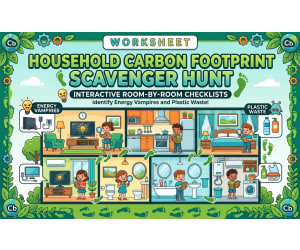
Household Carbon Footprint Scavenger Hunt
Science, Earth and Environmental Sciences, Environmental Science, Earth Sciences, Geology, Theories, Basic Science, Technology, Engineering, Space, Grade 3, 4, 5, 6, 7, 8, 9, Worksheets & Printables, Workbooks, Worksheets, Word Searches, Teacher Tools, Assessments, Lesson Plans, Quizzes and Tests, Quizzes, Tests
Transform your students into real-life Eco-Detectives! Are you looking for a hands-on, engaging, and impactful environmental science activity that goes beyond a standard worksheet? This Household Carbon Footprint Scavenger Hunt turns learning about climate change into a fun, actionable mission that empowers students to make a real difference, right in their own homes. This comprehensive, no-prep resource tackles two of the biggest "invisible" contributors to a household's carbon footprint: Energy Vampires (devices draining standby power) and Single-Use Plastics . By turning abstract concepts into a tangible hunt, students will develop critical thinking, data collection, and problem-solving skills aligned with Next Generation Science Standards (NGSS) . Perfect for Earth Day , a unit on environmental science, project-based learning (PBL), or a meaningful distance learning assignment, this scavenger hunt gets kids moving, observing, and collaborating with their families to create a more sustainable home. What's Included in this 38-Page PDF Resource: Part 1: Educator's Scientific Guide: A detailed 10-page introduction for the teacher or parent, explaining the science behind phantom power and the lifecycle of plastics in clear, easy-to-understand terms. Part 2: The Student Workbook (19 pages): Vocabulary Mission Briefing: Ensures students understand key terms before they begin. 8 Unique Room-by-Room Checklists: Students audit the Kitchen, Living Room, Bedroom, Bathroom, Laundry Room, and Home Office, hunting for culprits. 2 Action Plan Worksheets: Guides students to synthesize their data and create realistic, actionable plans for reducing energy and plastic waste. Part 3: Teacher Resources & Visuals (9 pages): 3 High-Quality Visual Aids: Concept maps and charts, perfect for classroom projection or as print-outs. Step-by-Step Teacher Implementation Guide: Includes pre-hunt prep, safety protocols, and tips for facilitating a powerful post-hunt reflection. Comprehensive Answer Key: A complete key with evaluation rubrics to make grading simple and objective. Give your students the gift of eco-agency, not eco-anxiety. Download today and empower the next generation of environmental stewards! Keywords: Earth Day, Carbon Footprint, Environmental Science, Scavenger Hunt, Project-Based Learning, At-Home Activity, Distance Learning, 3rd Grade, 4th Grade, 5th Grade, NGSS, Climate Change, Energy Conservation, Plastic Waste, Recycling, STEM, Go Green. Why Parents/Schools Love It: Turns Abstract Concepts into a Fun Game: It transforms the overwhelming idea of "climate change" into a tangible "scavenger hunt" for "energy vampires," making learning active, memorable, and incredibly engaging for kids. Empowers Students with Actionable Solutions: Instead of causing eco-anxiety, this resource gives children a sense of agency. By unplugging a charger or choosing a reusable bottle, they see an immediate, positive impact they can make. Comprehensive & No-Prep: This is a complete, ready-to-go resource. With a detailed teacher guide, student workbooks, visual aids, and an answer key, it saves educators and parents valuable preparation time. Strengthens the Home-School Connection: It's the perfect project to send home. The activity encourages students to collaborate with their families, bringing environmental education from the classroom to the living room. Builds Real-World Science Skills: Students aren't just memorizing facts; they are acting like real scientists—observing, collecting data (on their checklists), analyzing findings, and proposing solutions (in their action plans), directly aligning with NGSS practices. Target Student Audience : Based on a complete analysis of the language, concepts, and tasks in the workbook: Primary Target: 3rd Grade (8-9 years old). The PDF explicitly mentions this grade level, and the content is perfectly aligned with their cognitive abilities (the concrete operational stage). The tasks involve reading, counting, identification, and simple written responses. Secondary Target: 4th Grade and 5th Grade. This activity is still highly relevant and engaging for these students. They can complete it with more independence and provide more detailed, analytical responses in the action plan sections. Possible Niche Target: Advanced 2nd Graders (with significant parent/teacher guidance) or Middle School Special Education students who benefit from hands-on, concrete learning activities. Copyright/Terms of Use: This Book was copyrighted by Syed Hammad Rizvi. This resource is for personal and single classroom use only. You may not alter, redistribute, or sell any part of this resource. In other words, you may not put it on the Internet where it could be publicly found and downloaded. If you want to share this resource with colleagues, please purchase additional licenses from Teachsimple. Thank you for respecting these terms of use. This product is happily brought to you by Syed Hammad Rizvi
Author Creative Book Store
Rating
Tags EarthDay, TeacherResources, EnvironmentalScience, STEM, Homeschool, ScavengerHunt, DigitalDownload, Printable, CarbonFootprint, EarthDayActivities
I WONDER - Do Stars Orbit Planets | Animated Video Lesson
Space, Earth and Environmental Sciences, Science, Grade 4, 5, 6, 7, 8, 9, 10, Lesson Plans, Teacher Tools
Video Introduction An amazing video designed for the students to learn more about space facts. I WONDER - Do Stars Orbit Planets | Animated Video Lesson Do you like reading about space? If yes, what is your favorite topic? What do you know about our solar system? What is the smallest planet in our solar system? What is the biggest planet in our solar system? What is the hottest planet in our solar system? And what is the coldest one? Do you think there are aliens? If yes, what do you think they look like? What do they eat and how they speak to each other? Where do they live? What is a galaxy? And what is a milky way? Have you recently saw a shooting star? If yes, tell us more about it, like when did it happen and where? What is a blackhole? Can a blackhole gets bigger by time? Do you like counting the stars? What do you think a star is made of? I WONDER - Do Stars Orbit Planets | Animated Video Lesson The video is perfect for encouraging the researching skills for the students, while learning more about the fantastic space. I WONDER - Do Stars Orbit Planets | Animated Video Lesson This friendly designed video is suitable for students at school, homeschooling, and as a group activity. Format Available in MP4 format.
Author Educational Voice
Tags Do Stars Orbit Planets, Do Stars Orbit Planets Video, Orbit, Space Orbit, Space Orbits, Orbits Facts, Orbits Facts For Kids, Orbits Video, Orbits Video For Kids, Planet

I WONDER - What Is An Aurora | Animated Video Lesson
Space, Earth and Environmental Sciences, Science, Grade 4, 5, 6, 7, 8, 9, 10, Lesson Plans, Teacher Tools
Video Introduction An amazing video designed for the students to learn more about space facts. I WONDER - What Is An Aurora | Animated Video Lesson Do you like reading about space? If yes, what is your favorite topic? What do you know about our solar system? What is the smallest planet in our solar system? What is the biggest planet in our solar system? What is the hottest planet in our solar system? And what is the coldest one? Do you think there are aliens? If yes, what do you think they look like? What do they eat and how they speak to each other? Where do they live? What is a galaxy? And what is a milky way? Have you recently saw a shooting star? If yes, tell us more about it, like when did it happen and where? What is a blackhole? Can a blackhole gets bigger by time? Do you like counting the stars? What do you think a star is made of? I WONDER - What Is An Aurora | Animated Video Lesson The video is perfect for encouraging the researching skills for the students, while learning more about the fantastic space. I WONDER - What Is An Aurora | Animated Video Lesson This friendly designed video is suitable for students at school, homeschooling, and as a group activity. Format Available in MP4 format.
Author Educational Voice
Tags What Is An Aurora, What Is An Aurora Video, Aurora, Aurora Facts, Aurora Facts For Kids, Aurora Video, Aurora Video For Kids, Space, Space Facts, Space Video

Galaxies & The Universe: Measuring Distance in the Universe - FLASH-PC
Science, Earth and Environmental Sciences, Space, Common Core, Grade 5, 6, 7, 8, Teacher Tools, Lesson Plans
The Galaxies & The Universe: Measuring Distance in the Universe - FLASH-PC An engaging teaching resource crafted to ignite astronomical curiosity within students. Perfect for grade levels 5 through 8, this digital tool presents a comprehensive approach towards studying galaxies and the Universe. Engaging Different Learning Styles Educators consistently strive to make science more appealing. This toolkit combines detailed reading material with practical learning activities, such as: Text Passages: Provides an in-depth explanation of complex concepts about distance measurement in astronomy. Interactive Exercises: Encourages inquiry-based learning before and after reading enhancing critical thinking skills. Beyond Traditional Teaching Tools This educational kit extends beyond traditional text-based information by incorporating dynamic elements like: Vocabulary flashcards , Interactive activities, Video clips showcasing celestial phenomena, Immersive audio segments, Educational Standards Alignment The Galaxies & The Universe: Measuring Distance in the Universe - FLASH-PC toolkit aligns impeccably with Common Core State Standards. It also embraces Bloom's Taxonomy principles of differentiated cognitive skill development. Versatile Classroom Application Suitable for diverse classroom scenarios— be it group lessons around computer screens within traditional settings or individualized comprehensive homework assignments at home. It’s your ticket into transforming your Astronomy teachings! Dare to take students' understanding beyond textbooks using this complete educational toolkit! Helping them discover our immeasurable universe—all while gaining valuable knowledge that will boost their performance in Science classes. And the best part—no additional software installation required. Perfect for modern educators desiring swift transitions between subjects or lesson plans.
Author Classroom Complete Press
Tags Software (PC)
I WONDER - What Are The Seasons Like On Uranus | Animated Video
Space, Earth and Environmental Sciences, Science, Grade 3, 4, 5, 6, 7, 8, 9, Lesson Plans, Teacher Tools
Video Introduction An amazing video designed for the students to learn more about space facts. I WONDER - What Are The Seasons Like On Uranus | Animated Video Lesson Have you ever thought about travelling to space?! Join us with this amazing video about The Moon Ganymede. Can you name any three facts about The Moon Ganymede? How amazing is space! Let's discover some amazing facts about planets and moons! Do you know that we have two kinds of planets in our solar system? Can you name the planets based upon their core type? I WONDER - What Are The Seasons Like On Uranus | Animated Video Lesson The video is perfect for encouraging the researching skills for the students, while learning more about the fantastic space. I WONDER - What Are The Seasons Like On Uranus | Animated Video Lesson This friendly designed video is suitable for students at school, homeschooling, and as a group activity. Format Available in MP4 format.
Author Educational Voice
Rating
Tags What Are The Seasons Like On Uranus, Uranus, Uranus Facts, Uranus Video, Uranus Video For Kids, Uranus Facts For Kids, Uranus Seasons, Uranus Seasons Facts, Uranus Seasons Video

Space Travel & Technology: Living in Space Gr. 5-8
Science, Earth and Environmental Sciences, Space, Grade 5, 6, 7, 8, Teacher Tools, Lesson Plans
Space Travel & Technology: Living in Space Gr. 5-8 A dedicated teaching resource for grades 5 to 8 focused on the enthralling subject of space travel, technology and 'Living in Space'. Key Features: Enriches learning experiences and fosters imagination. Puts students into various roles such as scientists, engineers, astronauts and leaders. Suitable for remedial learners featuring simplified language and vocabulary. Notable content: Incorporates detailed reading passages designed to foster understanding about life beyond Earth. Includes a variety of student activities along with test preparation content aimed at enhancing comprehension and improving testing skills simultaneously. Note:This resource includes visually appealing color mini posters for effective whole-class use adding vibrancy into each session making it engagingly interactive. The Space Travel & Technology: Living in Space Gr. 5-8 curriculum is strictly aligned with State Standards meeting educational guidelines whilst adhering to Bloom's Taxonomy objectives. It seamlessly integrates STEM initiatives promoting practical exercises stimulating interest among young learners. Navigating this Resource: Experience an easy-to-navigate PDF file that brings convenience during classroom instructions or assigning homework while encouraging independent learning amongst your students. Use this comprehensive literature to enhance your lesson plan as you lift your students' knowledge and curiosity about the captivating universe of space travel technology.
Author Classroom Complete Press
Tags PDF
I WONDER - How Can Space Probes Help With Space Exploration
Space, Earth and Environmental Sciences, Science, Grade 6, 7, 8, 9, 10, 11, 12, Lesson Plans, Teacher Tools
Video Introduction An amazing video designed for the students to learn more about space facts. I WONDER - How Can Space Probes Help With Space Exploration | Animated Video Lesson Do you like reading about space? If yes, what is your favorite topic? What do you know about our solar system? What is the smallest planet in our solar system? What is the biggest planet in our solar system? What is the hottest planet in our solar system? And what is the coldest one? Do you think there are aliens? If yes, what do you think they look like? What do they eat and how they speak to each other? Where do they live? What is a galaxy? And what is a milky way? Have you recently saw a shooting star? If yes, tell us more about it, like when did it happen and where? What is a blackhole? Can a blackhole gets bigger by time? Do you like counting the stars? What do you think a star is made of? I WONDER - How Can Space Probes Help With Space Exploration | Animated Video Lesson The video is perfect for encouraging the researching skills for the students, while learning more about the fantastic space. I WONDER - How Can Space Probes Help With Space Exploration | Animated Video Lesson This friendly designed video is suitable for students at school, homeschooling, and as a group activity. Format Available in MP4 format.
Author Educational Voice
Tags How Can Space Probes Help With Space Exploration, How Can Space Probes Help With Space Exploration Video, Space Probes, Space Probes Facts, Space Probes Facts For Kids, Space Probes Video, Space Exploration

I WONDER - How Do Rockets Launch Into Space | Animated Video Lesson
Space, Earth and Environmental Sciences, Science, Grade 6, 7, 8, 9, 10, 11, 12, Lesson Plans, Teacher Tools
Video Introduction An amazing video designed for the students to learn more about space facts. I WONDER - How Do Rockets Launch Into Space | Animated Video Lesson Do you like reading about space? If yes, what is your favorite topic? What do you know about our solar system? What is the smallest planet in our solar system? What is the biggest planet in our solar system? What is the hottest planet in our solar system? And what is the coldest one? Do you think there are aliens? If yes, what do you think they look like? What do they eat and how they speak to each other? Where do they live? What is a galaxy? And what is a milky way? Have you recently saw a shooting star? If yes, tell us more about it, like when did it happen and where? What is a blackhole? Can a blackhole gets bigger by time? Do you like counting the stars? What do you think a star is made of? I WONDER - How Do Rockets Launch Into Space | Animated Video Lesson The video is perfect for encouraging the researching skills for the students, while learning more about the fantastic space. I WONDER - How Do Rockets Launch Into Space | Animated Video Lesson This friendly designed video is suitable for students at school, homeschooling, and as a group activity. Format Available in MP4 format.
Author Educational Voice
Tags How Do Rockets Launch Into Space, How Do Rockets Launch Into Space Video, Rockets, Rocket, Rockets Facts, Rocket Science, Rockets Facts For Kids, Rockets Video, Rockets Video For Kids

I WONDER - How Does An Eclipse Affect Animals | Animated Video Lesson
Space, Earth and Environmental Sciences, Science, Animals, Life Sciences, Grade 4, 5, 6, 7, 8, 9, 10, Lesson Plans, Teacher Tools
Video Introduction An amazing video designed for the students to learn more about space facts. I WONDER - How Does An Eclipse Affect Animals | Animated Video Lesson Do you like reading about space? If yes, what is your favorite topic? What do you know about our solar system? What is the smallest planet in our solar system? What is the biggest planet in our solar system? What is the hottest planet in our solar system? And what is the coldest one? Do you think there are aliens? If yes, what do you think they look like? What do they eat and how they speak to each other? Where do they live? What is a galaxy? And what is a milky way? Have you recently saw a shooting star? If yes, tell us more about it, like when did it happen and where? What is a blackhole? Can a blackhole gets bigger by time? Do you like counting the stars? What do you think a star is made of? I WONDER - How Does An Eclipse Affect Animals | Animated Video Lesson The video is perfect for encouraging the researching skills for the students, while learning more about the fantastic space. I WONDER - How Does An Eclipse Affect Animals | Animated Video Lesson This friendly designed video is suitable for students at school, homeschooling, and as a group activity. Format Available in MP4 format.
Author Educational Voice
Tags How Does An Eclipse Affect Animals, How Does An Eclipse Affect Animals Video, The Eclipse Affect Animals, The Eclipse Affect Animals Video, Eclipse, Eclipse Facts, Animals, Animals Facts
I WONDER - Do Astronauts Exercise In Space | Animated Video Lesson
Space, Earth and Environmental Sciences, Science, Grade 6, 7, 8, 9, 10, 11, 12, Lesson Plans, Teacher Tools
Video Introduction An amazing video designed for the students to learn more about space facts. I WONDER - Do Astronauts Exercise In Space | Animated Video Lesson Do you like reading about space? If yes, what is your favorite topic? What do you know about our solar system? What is the smallest planet in our solar system? What is the biggest planet in our solar system? What is the hottest planet in our solar system? And what is the coldest one? Do you think there are aliens? If yes, what do you think they look like? What do they eat and how they speak to each other? Where do they live? What is a galaxy? And what is a milky way? Have you recently saw a shooting star? If yes, tell us more about it, like when did it happen and where? What is a blackhole? Can a blackhole gets bigger by time? Do you like counting the stars? What do you think a star is made of? I WONDER - Do Astronauts Exercise In Space | Animated Video Lesson The video is perfect for encouraging the researching skills for the students, while learning more about the fantastic space. I WONDER - Do Astronauts Exercise In Space | Animated Video Lesson This friendly designed video is suitable for students at school, homeschooling, and as a group activity. Format Available in MP4 format.
Author Educational Voice
Tags Do Astronauts Exercise In Space, Do Astronauts Exercise In Space Video, Astronauts, Astronauts Facts, Astronaut, Astronauts Facts For Kids, Astronauts Video, Astronauts Video For Kids, Space

I WONDER - How Many Moons Does Jupiter Have | Animated Video Lesson
Space, Earth and Environmental Sciences, Science, Grade 4, 5, 6, 7, 8, 9, 10, Lesson Plans, Teacher Tools
Video Introduction An amazing video designed for the students to learn more about space facts. I WONDER - How Many Moons Does Jupiter Have | Animated Video Lesson Do you like reading about space? If yes, what is your favorite topic? What do you know about our solar system? What is the smallest planet in our solar system? What is the biggest planet in our solar system? What is the hottest planet in our solar system? And what is the coldest one? Do you think there are aliens? If yes, what do you think they look like? What do they eat and how they speak to each other? Where do they live? What is a galaxy? And what is a milky way? Have you recently saw a shooting star? If yes, tell us more about it, like when did it happen and where? What is a blackhole? Can a blackhole gets bigger by time? Do you like counting the stars? What do you think a star is made of? I WONDER - How Many Moons Does Jupiter Have | Animated Video Lesson The video is perfect for encouraging the researching skills for the students, while learning more about the fantastic space. I WONDER - How Many Moons Does Jupiter Have | Animated Video Lesson This friendly designed video is suitable for students at school, homeschooling, and as a group activity. Format Available in MP4 format.
Author Educational Voice
Tags How Many Moons Does Jupiter Have, How Many Moons Does Jupiter Have Video, Jupiter, Jupiter Facts, Jupiter Facts For Kids, Jupiter Video, Jupiter Video For Kids, Planet, Planets, Planets Facts

I WONDER - How Were Constellations Used In The Past | Animated Video
Space, Earth and Environmental Sciences, Science, History: World, History, Social Studies, History: Ancient, Grade 6, 7, 8, 9, 10, 11, 12, Lesson Plans, Teacher Tools
Video Introduction An amazing video designed for the students to learn more about space facts. I WONDER - How Were Constellations Used In The Past | Animated Video Lesson Do you like reading about space? If yes, what is your favorite topic? What do you know about our solar system? What is the smallest planet in our solar system? What is the biggest planet in our solar system? What is the hottest planet in our solar system? And what is the coldest one? Do you think there are aliens? If yes, what do you think they look like? What do they eat and how they speak to each other? Where do they live? What is a galaxy? And what is a milky way? Have you recently saw a shooting star? If yes, tell us more about it, like when did it happen and where? What is a blackhole? Can a blackhole gets bigger by time? Do you like counting the stars? What do you think a star is made of? I WONDER - How Were Constellations Used In The Past | Animated Video Lesson The video is perfect for encouraging the researching skills for the students, while learning more about the fantastic space. I WONDER - How Were Constellations Used In The Past | Animated Video Lesson This friendly designed video is suitable for students at school, homeschooling, and as a group activity. Format Available in MP4 format.
Author Educational Voice
Tags How Were Constellations Used In The Past, How Were Constellations Used In The Past Video, Constellation, Constellations, Constellations Facts, Constellations Facts For Kids, Constellations Video, Constellations Video For Kids

I WONDER - How Big Is The International Space Station | Animated Video
Space, Earth and Environmental Sciences, Science, Grade 4, 5, 6, 7, 8, 9, 10, Lesson Plans, Teacher Tools
Video Introduction An amazing video designed for the students to learn more about space facts. I WONDER - How Big Is The International Space Station | Animated Video Lesson Do you like reading about space? If yes, what is your favorite topic? What do you know about our solar system? What is the smallest planet in our solar system? What is the biggest planet in our solar system? What is the hottest planet in our solar system? And what is the coldest one? Do you think there are aliens? If yes, what do you think they look like? What do they eat and how they speak to each other? Where do they live? What is a galaxy? And what is a milky way? Have you recently saw a shooting star? If yes, tell us more about it, like when did it happen and where? What is a blackhole? Can a blackhole gets bigger by time? Do you like counting the stars? What do you think a star is made of? I WONDER - How Big Is The International Space Station | Animated Video Lesson The video is perfect for encouraging the researching skills for the students, while learning more about the fantastic space. I WONDER - How Big Is The International Space Station | Animated Video Lesson This friendly designed video is suitable for students at school, homeschooling, and as a group activity. Format Available in MP4 format.
Author Educational Voice
Tags How Big Is The International Space Station, How Big Is The International Space Station Video, International Space Station, International Space Station Facts, International Space Station Facts For Kids, International Space Station Video
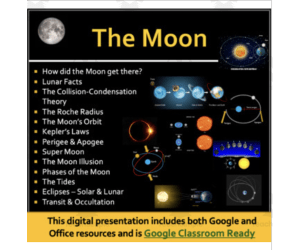
The Moon - Origin, Orbits, and Influences -Senior Earth & Space Lesson
Science, Earth and Environmental Sciences, Space, Grade 10, 11, 12, Teacher Tools, Lesson Plans
The Moon - Origin, Orbits, and Influences - This three-day senior Earth and Space lesson package includes the lesson (student and teacher versions of the presentation), an auto-graded Exit Ticket, EIGHT videos, and a student lesson handout as a document. The presentation is fun and applicable with many opportunities for inquiry-based learning and discussion. The presentation covers a lot of content and is meant to be delivered over a three-day stretch. This lesson includes both Office and Google formats for ALL resources. The presentation is in PowerPoint and Google Slides while all documents contain Word and Google Doc versions. Your resource is perfect for distance learning and integrates seamlessly with Google Classroom as I've included a link that will automatically create a copy of the resources and put them directly into your Google Drive with one click. Download--> Open --> Click --> Assign to your students Having both options allows you to use either without worrying about formatting issues as all the work has already been done for you. It safeguards you in case your department or school decides to go Google 100% and allows you as well as your students to access everything no matter where you are or what kind of equipment is being used. In order, the lesson covers: How did the Moon get there? Lunar Facts The Collision-Condensation Theory The Roche Radius The Moon’s Orbit Kepler’s Laws Perigee & Apogee Super Moon The Moon Illusion Phases of the Moon The Tides Eclipses – Solar & Lunar Transit & Occultation Included in the lesson package is: Google and Office versions of each resource The teacher version of the presentation The student version of the presentation Auto-graded Exit Ticket EIGHT videos embedded into the presentation Student lesson handout The student version of the presentation contains multiple blanks that need to be filled in throughout the lesson. These blanks are conveniently underlined and bolded on the teacher copy. I have found this to be the most effective means of keeping my students engaged and active without having them write everything out. This also leaves more time for discussion and activities. This lesson can also be found within the Earth and Space - Space Unit Bundle which includes: Lesson 1 - The Big Bang Theory Lesson 2 - Celestial Objects Lesson 3 - Astronomical Distances and Measurements Lesson 4 - Electromagnetic Spectrum and Radiation Lesson 5 - Stars - Classification and Spectroscopy Lesson 6 - Earth’s Position In The Celestial Sphere Lesson 7 - Our Solar System - From The Sun to The Oort Cloud Lesson 8 - Kepler’s Laws of Planetary Motion Lesson 9 - The Moon - Origin, Orbits, and Influences Also, please visit my blog Teach With Fergy for my thoughts on teaching, learning, and everything in between.
Author Teach With Fergy
Tags Lunar Facts , The Collision-Condensation Theory, The Roche Radius , The Moon’s Orbit , Kepler’s Laws , Perigee & Apogee , Eclipses – Solar & Lunar

Solar System: Constellations - FLASH-PC
Science, Earth and Environmental Sciences, Space, Common Core, Grade 5, 6, 7, 8, Teacher Tools, Lesson Plans
Solar System: Constellations - FLASH-PC A comprehensive digital teaching resource for Grades 5 to 8 Science educators focusing on Astronomy. This tool allows an engaging exploration of the Solar System and Constellations. Begins with thought-provoking 'before you read' questions. Contains detailed and easy-to-understand information about the solar system. Post-reading Questions: Carefully designed for consolidating understanding, enhancing retention, and building critical thinking skills. Included Printable Resources Purposefully designed materials that can be used within whole groups or small groups, or assigned as homework tasks based on individual learning needs. Astronomy Vocabulary Flashcards : Bolsters language proficiency related to Astronomy terms, fostering confidence among learners while significantly improving scientific communication skills. Multimedia Elements: Incorporation of video clips and audio files catering effectively to visual and auditory learners alike. They bring life to theoretical concepts by ensuring sensory engagement - a smart method for retaining complex scientific terminologies! The product aligns with Common Core State Standards (CCSS), making it apt for both traditional classroom settings as well as homeschooling environments. Ease-of-navigation is assured due to its single-access file point design – convenience at your fingertips! Closing Note This product is more than just a teaching resource; it's an educational journey into the universe that ensures every step of learning about our celestial neighborhood is captivating as well as illuminating. So hop onboard this cosmic ride with your students today!
Author Classroom Complete Press
Tags Software (PC)
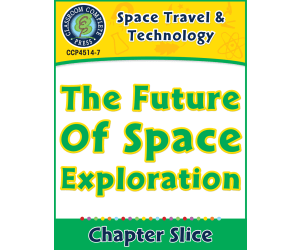
Space Travel & Technology: The Future of Space Exploration Gr. 5-8
Science, Earth and Environmental Sciences, Space, Common Core, Grade 5, 6, 7, 8, Teacher Tools, Lesson Plans
Space Travel & Technology: The Future of Space Exploration Gr. 5-8 This educational resource provides a vivid picture of the exciting frontiers of space travel and technological advancement in astronomy. It invites students from Grade 5 to Grade 8 to board on a hypothetical shuttle mission to the International Space Station, offering an immersion into the world of scientists, engineers, and astronauts who are at the helm of humanity's journey back to the moon and eventually towards Mars. This teaching tool is particularly suitable for remedial students as it presents complex science concepts about space exploration in simplified language and vocabulary; this makes those concepts more understandable and appealing. It consists primarily of: Reading passages: filled with relevant information, Student activities: engaging tasks designed for hands-on learning experience, TTest preparations:a practical approach for academic progress checks, posters : these could potentially inspire budding astronomers. The material can be appropriately used in various settings such as whole-class group discussions or small group activities—making it versatile for classroom scenarios or home schooling. "As educators utilize this resource in their pedagogy, they play a pivotal role in igniting young minds' curiosity about what unfolds beyond our familiar earthly confines." This educational tool aligns with State Standards, built upon Bloom's Taxonomy principles,and integrated with STEM-driven contents. It aims not only to impart basic subject-matter knowledge but also endorse: Analytical thinking, A solution-oriented mindset,and technological competence—the skills core,the future scientific pioneers need. Note: The product contains one file which is accessible through PDF format—a common file type ensuring usability across different systems, gadgets, and software platforms. Having just one consolidated product file means less clutter,easing navigation within your teaching resources'
Author Classroom Complete Press
Tags PDF

Space: The Final Frontier Gr. 4-6
Science, Earth and Environmental Sciences, Space, Grade 4, 5, Teacher Tools, Lesson Plans
Space: The Final Frontier Gr. 4-6 Space: The Final Frontier Gr. 4-6 is a comprehensive teaching resource, designed to inspire and educate students about the universe beyond our planet. Suited for learners in grades 4 through 6, this offering explores the captivating world of space and fosters an understanding of complex topics such as galaxies, planets, solar systems, and gravity. The subjects tackled in this resource come under Science - Astronomy, specifically making it an enriching addition to your curriculum. The structure begins with lecture-style content melded with engaging assignments and activities oriented towards building up a solid foundation of knowledge about key space-related concepts. A Balanced Approach To Learning! This unit doesn't stick to just theory! It dives into fun-filled activities centered on aspects like: Space exploration techniques. The logarithms behind how rockets work. Making parachutes. Egg splat competitions! Brimming With Activities! The unit is equipped with a vast reproducible student Activity Handbook filled with relevant assignments guaranteed to bring out the inner astronaut in your students while sparking their interest in Earth Science. Crossword puzzles for vocabulary building are included too, A variety of reading passages on topical themes, Last but not least word searches intended at reinforcing memory recall functions among learners, Included Exam & Answer Keys The package also contains an exam that covers everything covered during the unit study along while providing teachers convenient access to answer keys helping maintain objectivity during assessments while saving precious time! Flexibility & Format Whether you're implementing this plan across a whole class or adapting it for smaller groups, or even individual study-time outside school hours, flexibility is at its core. The resource is available as a PDF download, which means integrating Space: The Final Frontier Gr. 4-6 into your science repertoire has never been easier! This robust yet hassle-free platform introduces practicality into lesson planning – serving as an exciting yet comprehensive launchpad propelling each student on their unique journey of discovery into the boundless realms of space.
Author Classroom Complete Press
Tags PDF

I WONDER - Who Is Peggy Whitson | Animated Video Lesson
Space, Earth and Environmental Sciences, Science, Grade 6, 7, 8, 9, 10, 11, 12, Lesson Plans, Teacher Tools
Video Introduction An amazing video designed for the students to learn more about space facts. I WONDER - Who Is Peggy Whitson | Animated Video Lesson Do you like reading about space? If yes, what is your favorite topic? What do you know about our solar system? What is the smallest planet in our solar system? What is the biggest planet in our solar system? What is the hottest planet in our solar system? And what is the coldest one? Do you think there are aliens? If yes, what do you think they look like? What do they eat and how they speak to each other? Where do they live? What is a galaxy? And what is a milky way? Have you recently saw a shooting star? If yes, tell us more about it, like when did it happen and where? What is a blackhole? Can a blackhole gets bigger by time? Do you like counting the stars? What do you think a star is made of? I WONDER - Who Is Peggy Whitson | Animated Video Lesson The video is perfect for encouraging the researching skills for the students, while learning more about the fantastic space. I WONDER - Who Is Peggy Whitson | Animated Video Lesson This friendly designed video is suitable for students at school, homeschooling, and as a group activity. Format Available in MP4 format.
Author Educational Voice
Tags Who Is Peggy Whitson, Who Is Peggy Whitson Video, Peggy Whitson, Peggy Whitson Facts, Peggy Whitson Facts For Kids, Peggy Whitson Video, Peggy Whitson Video For Kids, Space, Space Video For Kids
I WONDER - When Do Eclipses Happen | Animated Video Lesson
Space, Earth and Environmental Sciences, Science, Grade 4, 5, 6, 7, 8, 9, 10, Lesson Plans, Teacher Tools
Video Introduction An amazing video designed for the students to learn more about space facts. I WONDER - When Do Eclipses Happen | Animated Video Lesson Do you like reading about space? If yes, what is your favorite topic? What do you know about our solar system? What is the smallest planet in our solar system? What is the biggest planet in our solar system? What is the hottest planet in our solar system? And what is the coldest one? Do you think there are aliens? If yes, what do you think they look like? What do they eat and how they speak to each other? Where do they live? What is a galaxy? And what is a milky way? Have you recently saw a shooting star? If yes, tell us more about it, like when did it happen and where? What is a blackhole? Can a blackhole gets bigger by time? Do you like counting the stars? What do you think a star is made of? I WONDER - When Do Eclipses Happen | Animated Video Lesson The video is perfect for encouraging the researching skills for the students, while learning more about the fantastic space. I WONDER - When Do Eclipses Happen | Animated Video Lesson This friendly designed video is suitable for students at school, homeschooling, and as a group activity. Format Available in MP4 format.
Author Educational Voice
Tags When Do Eclipses Happen, When Do Eclipses Happen Video, Eclipses, Eclipse, Eclipses Facts, Eclipses Facts For Kids, Eclipses Video, Eclipses Video For Kids, Solar Eclipse, Lunar Eclipse
I WONDER - Does The Universe Have A Center | Animated Video Lesson
Space, Earth and Environmental Sciences, Science, Grade 6, 7, 8, 9, 10, 11, 12, Lesson Plans, Teacher Tools
Video Introduction An amazing video designed for the students to learn more about space facts. I WONDER - Does The Universe Have A Center | Animated Video Lesson Do you like reading about space? If yes, what is your favorite topic? What do you know about our solar system? What is the smallest planet in our solar system? What is the biggest planet in our solar system? What is the hottest planet in our solar system? And what is the coldest one? Do you think there are aliens? If yes, what do you think they look like? What do they eat and how they speak to each other? Where do they live? What is a galaxy? And what is a milky way? Have you recently saw a shooting star? If yes, tell us more about it, like when did it happen and where? What is a blackhole? Can a blackhole gets bigger by time? Do you like counting the stars? What do you think a star is made of? I WONDER - Does The Universe Have A Center | Animated Video Lesson The video is perfect for encouraging the researching skills for the students, while learning more about the fantastic space. I WONDER - Does The Universe Have A Center | Animated Video Lesson This friendly designed video is suitable for students at school, homeschooling, and as a group activity. Format Available in MP4 format.
Author Educational Voice
Tags Does The Universe Have A Center, Does The Universe Have A Center Video, The Universe, Universe Facts, Universe Facts For Kids, Universe Video, Universe Videos For Kids, Space, Space Video