



3,984 products added recently
Page 132 - Popular Lesson Plans
Explore a curated selection of popular lesson plans that have proven successful in classrooms. Covering various subjects and topics, these resources provide innovative ideas and activities. Use them to refresh your curriculum and engage your students with tried-and-true methods.

 Show filters


Geometry: Shapes - FLASH-MAC
Math, Geometry, Grade 1, 2, Teacher Tools, Lesson Plans
Geometry: Shapes - FLASH-MAC An engaging teaching resource dedicated to aiding educators in effectively imparting fundamental geometry knowledge about shapes to students. This product, designed for first and second graders, is a comprehensive instructional tool that integrates various elements of mathematics curriculum into one effective package. Key Features: A single zip file compatible with Mac software. Pre- assessment materials to gauge the students' understanding level of the topic. A carefully crafted lesson plan outlining efficient teaching methods. The standout feature is the real-world word problems incorporated into this product. These activities delve deeper into practical applications of geometry, instilling a significant understanding among students and enhancing their problem-solving capacities. In addition, learning activities are complemented by handy tools: A teacher guide offering step-by-step instructions on usage. Printables offering added flexibility. Extra fun additions like memory match game, board game and spinner game which turn standard lessons into intriguing game studied scenarios. In line with diversity consideration - the product offers Spanish voice over and text options. The learning process culminates with SMART Response assessment – a great way to measure learning outcomes after input from this excellent educational tool. All in all Geometry: Shapes - FLASH-MAC is an effective math-teaching asset embodying much-needed versatility while focusing on productive academic achievement. It's your perfect partner on this journey!</h4
Author Classroom Complete Press
Tags Math Worksheet, Geometry, Shapes Activity, 3D Shapes, Solid Figures
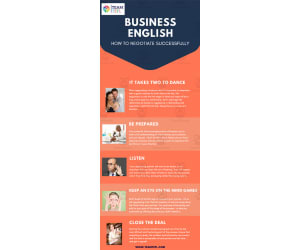
Negotiations Lesson Plan | Business English Level 3
ELA, Language Development, ESL, Grade 10, 11, 12, Teacher Tools, Lesson Plans
Business English ESL EFL ELL TEFL lesson plan about Negotiations. It is ideal for older students and adult education. Students will learn how to negotiate a deal, barter and close a deal. They will learn vital vocabulary and gain confidence on their English speaking journey. This business English lesson plan includes: A warmer Closed exercises Open exercise Group activity Revision Role-play Negotiation scenarios This lesson can also be accessed through Google Apps. There are exercises for students to complete in this lesson. Answer key included. This resource is a part of our level 3 series for intermediate and advanced ESL students. All of the TEAM TEFL Business English lessons are available on Teach Simple. You can see the table of contents for all three levels below: Business English Level 1 contents TELEPHONE SKILLS LETTERS & EMAILS CUSTOMER SERVICE SOCIAL MEDIA BRANDING SETTING TARGETS WORK ENVIRONMENT SALES PRESENTATIONS MEETINGS Business English Level 2 contents LETTERS & EMAILS CUSTOMER SERVICE ADVERTISING NEGOTIATIONS SOCIAL MEDIA SETTING TARGETS MARKETING LEADERSHIP MARKET RESEARCH WORK ENVIRONMENT HOW TO WRITE A C.V ENVIRONMENTAL ISSUES BUSINESS IDIOMS Business English Level 3 contents ADVERTISING SALES MEETINGS COMPUTERS & TECHNOLOGY CULTURAL DIFFERENCES INTERVIEWS MONEY & FINANCE PRESENTATIONS MEDIA IMPACT BUSINESS IDIOMS NEGOTIATIONS LEADERSHIP INVESTMENTS
Author TEAM TEFL
Tags Lesson Plan, ESL, EFL, Communication, Adult Education

Skunk Facts | Interactive Science Lesson | Micro-Learning Deck
Science, Life Sciences, Animals, Grade 6, 7, 8, 9, Teacher Tools, Lesson Plans
Engage middle school students with this informative slideshow on skunks. Ideal for whole group direct instruction or independent learning, this interactive science lesson dives into details on the unique defense mechanisms and habits of these iconic mammals. The deck begins with a short video to introduce key concepts. An accompanying reading passage that can be listened to builds knowledge on skunk behavior, diet, habitat and more. Higher order thinking is developed through a close reading activity and quick write prompt that checks for understanding. Approximately 10 slides long, this self-contained mini-unit on skunks is perfect for a science bell ringer or homework. The mixed media appeal to visual, auditory and reading/writing learners. Teachers of 6th - 9th grade will appreciate the complete informational text lesson that peaks curiosity about wildlife through focused research.
Author Teach Me This
Tags Science Lesson, Zoology, Interactive, Skunk Facts, Habitats, Interactive Science Lessons
I WONDER - How Did Pangolins Get Their Name | Animated Video Lesson
STEM, Animals, Life Sciences, Science, Biology, Grade 1, 2, 3, 4, 5, 6, 7, 8, Lesson Plans, Teacher Tools
Video Introduction Animal kingdoms are full of fascinating wonders to learn. This video is designed for the students to learn more about animals in different countries. I WONDER - How Did Pangolins Get Their Name | Animated Video Lesson Do you like animals? what is your favorite one? Do you own a pet? If yes, tell us more about it, like what its name? And what do you like most about it? What are the animal kingdoms? Can you write down the characteristics of each animal class like mammals, birds, reptiles, amphibian, fish and mollusks. Do you know that some animals can sing, can you name any of them? What is the largest and the smallest mammal in the world? What is the largest and the smallest bird in the world? What is the largest and the smallest fish in the world? I WONDER - How Did Pangolins Get Their Name | Animated Video Lesson The video is perfect for encouraging the researching skills for the students, while learning more about these fantastic animals. I WONDER - How Did Pangolins Get Their Name | Animated Video Lesson This friendly designed video is suitable for students at school, homeschooling, and as a group activity. Format Available in MP4 format.
Author Educational Voice
Tags How Did Pangolins Get Their Name, How Did Pangolins Get Their Name Video, Pangolins, Pangolin, Pangolins Facts, Pangolins Facts For Kids, Pangolins Video, Pangolins Video For Kids

Multiply by Two Task Cards - Multiplication Facts 2
Math, Multiplication and Division, Multiplication, Early Math, Numbers, Not Grade Specific, Activities, Centers, Worksheets & Printables, Task Cards, Teacher Tools, Assessments, Lesson Plans
Ready to make multiplication a breeze? With these 102 task cards (and 17 worksheets), your students will be multiplying like pros—without even realizing they’re working hard. This resource is perfect for teachers who want to make math fun and easy to integrate into any lesson. Ways to Use: Warm-Up Fun: Start your lesson with a few task cards to get students’ brains in gear. Partner Quizzes: Pair students up and let them challenge each other to solve the cards, boosting both teamwork and math skills. Independent Practice: Hand out worksheets for individual practice, allowing students to work at their own pace. Classroom Games: Turn the task cards into a competitive game—first to answer correctly gets a point! Homework Helper: Send a worksheet home to reinforce skills after class. Advantages: Multiplication Mastery: Focuses on multiplying by 2, with facts from 1 to 10—this is the foundation for all other multiplication! Time-Saver: Pre-made task cards and worksheets save you precious lesson-planning time. Student Engagement: Keeps kids on their toes with variety and humor, so they won’t even realize they’re learning. Track Progress: Easily track student growth and pinpoint which facts need more attention. Stress-Free Learning: Less stress, more fun—because multiplication should never feel like a punishment! Get this resource now and watch your students conquer multiplication while laughing all the way through!
Author Ponder Palette Plazza
Tags Multiplication, Task Cards, Multiplication Practice, Multiplication Facts 2, Fact 2, Math Task Cards, Math Worksheets, Multiply By Two, Numbers

Famous Musicians Reading Comprehension: Bowie, Beethoven & Lady Gaga - Engaging ESL & English Worksheets & Lesson Plans
ELA, Creative Arts, Art, Language Development, ESL, Music, Not Grade Specific, Lesson Plans, Teacher Tools
Famous Musicians Reading Comprehension: Bowie, Beethoven & Lady Gaga - Engaging ESL & English Worksheets & Lesson Plans A teaching resource that offers the perfect fusion of music and language learning. It examines the lives and influences of three iconic individuals from diverse musical genres – David Bowie, Beethoven, and Lady Gaga. An excellent method to enhance your students' critical thinking abilities while developing their language skills. The Bundle: Lesson Plans and More! The bundle is equipped with comprehensive lesson plans for these three artists. Guarantee a vibrant exploration into the worlds of classical music, rock 'n' roll, and contemporary pop culture. Covers musicians’ backgrounds vividly Highlights unique styles Delineates undeniable impact on world music Focused Lessons: Group or Paired Work Settings: Stimulating discussions about each artist. Vocabulary-building exercises: Relevant to each artist's era or style. Reading comprehension activities: To ensure understanding of each musician’s life. Multimedia Learning enhancement: Inclusion of video content Social Issues: Promoting Meaningful Conversations This resource incorporates important social issues such as Lady Gaga's advocacy— making way for meaningful dialogues within classrooms that encourages student presentations promoting people not just to learn but think critically as well. Honing Writing Skills Through Practice : Writing practice serves as another crucial part in this curriculum — learners absorb the knowledge while practicing written discourse, thus improving writing fluency. An All-Around Teaching Resource This bundle is flexible enough for use in both homework and whole class instruction, suitable not just for public school classes but homeschool settings alike. Ideal for Language Arts classes covering subjects like ESL (English as a Second Language) lessons or even Music discussion hours. Teach Beyond Reading: Holistic Learning Approach Improve your students' linguistic abilities while familiarizing them with legendary musicians across different epochs. Enjoy the fusion of music and language with Famous Musicians Reading Comprehension: Bowie, Beethoven & Lady Gaga teaching resource!
Author The Laughing Linguist
Tags Music History, Famous Musicians, Reading Comprehension, Critical Thinking, Vocabulary-building
I WONDER - Who Invented Concrete | Animated Video Lesson
History: Europe, History, Social Studies, History: Ancient, Inventors, Basic Science, Science, Grade 5, 6, 7, 8, 9, 10, 11, Lesson Plans, Teacher Tools
Video Introduction An amazing video designed for the students to learn more about history. I WONDER - Who Invented Concrete | Animated Video Lesson Do you like history? Which topic do you really enjoy about history? Have you ever read an interesting fact about the Vikings? If yes, can you mention them? What do you like most about the Victorian era? Can you name all the Tudors? Have you ever wondered how people used to live in ancient Japan and ancient China? Do you know any interesting facts about ancient Egyptians and the Pharaohs? Have you ever visited South America? What do you know about Incas and Aztecs? Celtic culture was really one of a kind, can you name any of the places that Celts used to live in? Imagine yourself living during the ancient Roman empire, how your life will look like? Ancient Greece was an amazing place to live in. What do you know about ancient Greek life? I WONDER - Who Invented Concrete | Animated Video Lesson The video is perfect for encouraging the researching skills for the students, while learning more about history. I WONDER - Who Invented Concrete | Animated Video Lesson This friendly designed video is suitable for students at school, homeschooling, and as a group activity. Format Available in MP4 format.
Author Educational Voice
Tags Who Invented Concrete, Who Invented Concrete Video, Concrete, Concrete Facts, Concrete Invention, History Of Concrete, Concrete Facts For Kids, History Of Concrete Facts, History Of Concrete Video

I WONDER - What Did Ancient People Think Of The Aurora Borealis
Geography, Social Studies, Earth Sciences, Earth and Environmental Sciences, Science, Grade 4, 5, 6, 7, 8, 9, 10, Lesson Plans, Teacher Tools
Video Introduction An amazing video designed for the students to learn more about famous places in different countries. I WONDER - What Did Ancient People Think Of The Aurora Borealis | Animated Video Lesson What do you know about this place? Do you know in which part of the world it is? Have you ever visited this place? If yes, can you tell us more about your adventure, and what do you like the most about this place? Do you like reading about Geography? What is your favorite country in the whole world? If you are going on a trip where it will be? Which country? What you are going to see there? Does this country has a famous place to visit? I WONDER - What Did Ancient People Think Of The Aurora Borealis | Animated Video Lesson The activity is perfect for encouraging the researching skills for the students, while learning more about this fantastic place. I WONDER - What Did Ancient People Think Of The Aurora Borealis | Animated Video Lesson This friendly designed video is suitable for students at school, homeschooling, and as a group activity. Format Available in MP4 format.
Author Educational Voice
Tags What Did Ancient People Think Of The Aurora Borealis, What Did Ancient People Think Of The Aurora Borealis Video, Aurora Borealis, Aurora Borealis Facts, Aurora Borealis Video, Aurora Borealis Video For Kids

Let's Be Friends Gr. K-1
Social Studies, Geography, Grade 1, Teacher Tools, Lesson Plans
Let's Be Friends Gr. K-1: An Integrated Resource for Social Studies Teaching The Let's Be Friends Gr. K-1 is a comprehensive teaching tool, developed to enable educators in delivering social studies lessons in an engaging and inventive manner. This resource highlights understanding and respect for diversities and commonalities among individuals - a fundamental aspect of social studies. With this unit, teachers gain access to multiple materials which aim to cultivate empathy, interaction, and friendships among learners. The package features: Songs about friendship:'The Friend Song', 'We Are Best Friends', 'I'm Your Friend','I can Be A Good Friend'. These tunes have been tailored specifically for young learners, facilitating enjoyable yet meaningful learning. An interactive big book - Let's Be Friends!This isn't your ordinary book; it is one that the students design! By integrating provided illustrations with dialogue balloons into their books complete with colouring instructions, every pupil gets a chance to create their own personalized book. A myriad of matching gamesand reading passages encourage active participation from the students either during group activities or individual home tasks. All resources are offered on an easy-to-use PDF format fitting for conventional school teachers or homeschoolers exploring geography and interpersonal relations as per grade 1 level study material. Tailored Instruction That Engages Students Comprehensive lessons that Inform And Hold Interest! The Let’s be Friends Gr.K-1 unit proves beneficial whether you’re leading whole-group instruction or moderating small-group discussions. Navigate through engaging class experiences where dialogues about friendship are complemented by the melody of songs; narrations from well-written stories turn into fascinating coloring projects! So let's be friends, and watch as your students delve into the world with newfound understanding.
Author Classroom Complete Press
Tags PDF
I WONDER - Where Was Golf Invented | Animated Video Lesson
Sports, P.E. & Health, Grade 1, 2, 3, 4, 5, 6, 7, 8, Lesson Plans, Teacher Tools
Video Introduction An amazing video designed for the students to learn more about sports in different countries. I WONDER - Where Was Golf Invented | Animated Video Lesson What is your favorite sport? Tell us more about it. Who is your favorite athlete? Or what is your favorite team? Do you know who invented basketball? When basketball has been invented? Can you tell us where is the first time it has been played? Have you ever played soccer or football? If yes, tell us what was your position: A goal keeper, midfield player, or a defender? Do you like watching golf? If yes who is your favorite player? Can you name the differences between tennis and ping pong? Have you ever played volleyball on the beach? When it has been officially recognized by the Olympics? Do you like watching Formula 1 races? If yes, who is your favorite team or driver? Have you ever tried to play handball? If yes tell us more. Do you like watching people skiing or surfing? I WONDER - Where Was Golf Invented | Animated Video Lesson The video is perfect for encouraging the researching skills for the students, while learning more about this sport. I WONDER - Where Was Golf Invented | Animated Video Lesson This friendly designed video is suitable for students at school, homeschooling, and as a group activity. Format Available in MP4 format.
Author Educational Voice
Rating
Tags Where Was Golf Invented, Where Was Golf Invented Video, Golf, Golf Facts, Golf Video, Golf Facts For Kids, Golf Video For Kids, Sport, Sports, Sports Facts

I WONDER - How Is A Sedimentary Rock Formed | Animated Video Lesson
Geography, Social Studies, Grade 4, 5, 6, 7, 8, 9, 10, Lesson Plans, Teacher Tools
Video Introduction An amazing video designed for the students to learn more about famous places in different countries. I WONDER - How Is A Sedimentary Rock Formed | Animated Video Lesson What do you know about this place? Do you know in which part of the world it is? Have you ever visited this place? If yes, can you tell us more about your adventure, and what do you like the most about this place? Do you like reading about Geography? What is your favorite country in the whole world? If you are going on a trip where it will be? Which country? What you are going to see there? Does this country has a famous place to visit? I WONDER - How Is A Sedimentary Rock Formed | Animated Video Lesson The activity is perfect for encouraging the researching skills for the students, while learning more about this fantastic place. I WONDER - How Is A Sedimentary Rock Formed | Animated Video Lesson This friendly designed video is suitable for students at school, homeschooling, and as a group activity. Format Available in MP4 format.
Author Educational Voice
Tags How Is A Sedimentary Rock Formed, How Is A Sedimentary Rock Formed Video, Sedimentary Rock, Sedimentary Rock Video, Sedimentary Rock Facts, Sedimentary Rock Facts For Kids, Sedimentary Rock Video For Kids

I WONDER - How Long Have Crocodiles Existed | Animated Video
Animals, Life Sciences, Science, History: Ancient, History, Social Studies, History: World, Grade 4, 5, 6, 7, 8, 9, 10, Lesson Plans, Teacher Tools
Video Introduction An amazing video designed for the students to learn more about dinosaurs in different countries. I WONDER - How Long Have Crocodiles Existed | Animated Video Lesson Do you like dinosaurs? what is your favorite one? Do you own a pet? If yes, tell us more about it, like what its name? And what do you like most about it? Do you think that your pet has been evolved from a dinosaur? Can you write down the characteristics of your favourite dinosaur like it's shape, their rivals, where did it use to live and what was their favourite food? What is the largest and the smallest dinosaur that ever found? Why is the T-rex is so famous? Have you ever read any interesting facts about it? Can you name any of the carnivores or herbivores dinosaurs? I WONDER - How Long Have Crocodiles Existed | Animated Video Lesson The video is perfect for encouraging the researching skills for the students, while learning more about dinosaurs. I WONDER - How Long Have Crocodiles Existed | Animated Video Lesson This friendly designed video is suitable for students at school, homeschooling, and as a group activity. Format Available in MP4 format.
Author Educational Voice
Rating
Tags How Long Have Crocodiles Existed, How Long Have Crocodiles Existed Video, Crocodiles, Crocodiles Facts, Crocodiles Video, Crocodiles Facts For Kids, Crocodiles Video For Kids, Dinosaurs, Dinosaur
I WONDER - Was The Giganotosaurus Clever | Animated Video Lesson
History: World, History, Social Studies, History: Ancient, Animals, Life Sciences, Science, Grade 4, 5, 6, 7, 8, 9, 10, Lesson Plans, Teacher Tools
Video Introduction An amazing video designed for the students to learn more about dinosaurs in different countries. I WONDER - Was The Giganotosaurus Clever | Animated Video Lesson Do you like dinosaurs? what is your favorite one? Do you own a pet? If yes, tell us more about it, like what its name? And what do you like most about it? Do you think that your pet has been evolved from a dinosaur? Can you write down the characteristics of your favourite dinosaur like it's shape, their rivals, where did it use to live and what was their favourite food? What is the largest and the smallest dinosaur that ever found? Why is the T-rex is so famous? Have you ever read any interesting facts about it? Can you name any of the carnivores or herbivores dinosaurs? I WONDER - Was The Giganotosaurus Clever | Animated Video Lesson The video is perfect for encouraging the researching skills for the students, while learning more about dinosaurs. I WONDER - Was The Giganotosaurus Clever | Animated Video Lesson This friendly designed video is suitable for students at school, homeschooling, and as a group activity. Format Available in MP4 format.
Author Educational Voice
Rating
Tags Was The Giganotosaurus Clever, Was The Giganotosaurus Clever Video, Giganotosaurus, Giganotosaurus Facts, Giganotosaurus Video, Giganotosaurus Video For Kids, Giganotosaurus Facts For Kids
Atoms, Molecules & Elements: What Are Elements? Gr. 5-8
Science, Life Sciences, Biology, Grade 5, 6, 7, 8, Teacher Tools, Lesson Plans
Atoms, Molecules & Elements: What Are Elements? Gr. 5-8 A gripping teaching resource for educators that desire to engender a love for science in their pupils. Specially designed for grade ranges 5 to 8, this content plunges into the intriguing and hidden universe of atoms, molecules, and elements. Utilizing simple language and vocabulary, this product presents complex scientific concepts in an understandable format ideal for remedial learners. Included in the lesson plan is guidance on labeling various parts of an atom, thereby providing learners with a detailed understanding of its structure at a basic but comprehensive level. Exciting Student Experience In the subsequent sections of the lesson plan, students explore what makes up compounds while functioning as fledgling scientists! This immersive experience is designed to pique their interest in science while imparting essential knowledge about compound structures. Included are engaging hands-on activities within this package, students have the chance to probe into the mysteries housed within our universe's most fundamental building blocks by exploring patterns in periodic tables. Broadening Access To Science Basics The resource expands access to atomic science and chemistry basics through engaging hooks like exploring popular elements like calcium (Ca), chlorine (Cl), and helium (He); setting aside intimidation typically associated with these subjects. The learning materials feature varied tools that cater diverse learning styles: - Reading passages: These aid progression comprehension; - Student activities: For interactive learning; - Crosswords and word searches: Specially created for linguistic learners; - Colorful mini posters: Ideal for visual-oriented learners. The resource is thus perfectly suited not just for whole class instruction but also small group work or even homework tasks. Benchmarked By Bloom's Taxonomy Standards This ensures rigorous development of cognitive skills in alignment with STEM initiatives making sure your instruction material aligns with your State Standards while remaining sufficiently challenging. Ease Of Use Exclusively available in PDF format, this brings convenience and adaptability to any learning environment – be it classrooms or homes! Equip yourself with Atoms, Molecules & Elements: What Are Elements? Gr. 5-8 – an irreplaceable teaching instrument to throw light on the unknown domains of atoms, molecules, and elements for young budding scientists in your classrooms or homeschools. Happy learning!
Author Classroom Complete Press
Tags PDF

Lesson 8.3 - Chemical Reactions
Science, Chemistry, Grade 6, 7, 8, 9, 10, 11, 12, Lesson Plans, Teacher Tools
Lesson 8.3 - Chemical Reactions This package is designed to enhance the teaching and understanding of four major chemical reactions— synthesis, decomposition, single replacement, and double replacement. This educational resource is vital for public school educators and homeschoolers teaching Science focusing on Chemistry from Grade 6 through Grade 12. Inclusions in the Package: Fully-loaded Notes: Two versions of worksheets (A & B) are provided. Version 'A' has blanks to promote active learning while 'B' version has filled-out data for those who may be absent or require assistance. Practice Sheet: : Also available in two different versions ('A' & 'B'), helping students apply their knowledge by identifying types of chemical reactions through illustrations and equations. Including a ppt on Objectives & Starter Questions, it presents primary learning goals this lesson targets with sample introductory questions promoting class discussions or homework assignment. Absolute Standards Adherence: : The product strictly adheres to the 2016 Indiana State Standards for Integrated Chemistry & Physics relating specifically to particle diagrams representation, mathematical expression of chemical changes along with differentiation between synthesis, decomposition combustion single replacement double reactions. Editability & File Formats: All materials related to Lesson 8.3 - Chemical Reactions come as .docx files (Word documents) or .pptx files (PowerPoint presentations). Both these file types are editable ensuring flexibility according based your specific needs requirements . You also have access PDF versions documents preserve original formatting if printing distribution becomes necessary. Suggestions: Love teaching science? Consider purchasing the entire Unit 8 bundle which includes all three lessons, a binder divider, test, and quiz. It's comprehensive and cost-effective for your chemistry students. Acknowledgement: Your tool is only as good as you make it! So dive in, take advantage of this educational resource and make chemistry come alive in your classroom!
Author Integrated Chemistry and Physics
Tags Chemical Reactions, Synthesis, Decomposition, Single Replacement, Double Replacement

I WONDER - How Big Is Mumbai | Animated Video Lesson
Geography, Social Studies, Grade 3, 4, 5, 6, 7, 8, 9, Lesson Plans, Teacher Tools
Video Introduction An amazing video designed for the students to learn more about famous places in different countries. I WONDER - How Big Is Mumbai | Animated Video Lesson What do you know about this place? Do you know in which part of the world it is? Have you ever visited this place? If yes, can you tell us more about your adventure, and what do you like the most about this place? Do you like reading about Geography? What is your favorite country in the whole world? If you are going on a trip where it will be? Which country? What you are going to see there? Does this country has a famous place to visit? I WONDER - How Big Is Mumbai | Animated Video Lesson The activity is perfect for encouraging the researching skills for the students, while learning more about this fantastic place. I WONDER - How Big Is Mumbai | Animated Video Lesson This friendly designed video is suitable for students at school, homeschooling, and as a group activity. Format Available in MP4 format.
Author Educational Voice
Tags How Big Is Mumbai, How Big Is Mumbai Video, Mumbai, Mumbai Facts, Mumbai Facts For Kids, Mumbai Video, Mumbai Video For Kids, India, India Facts, India Video

All About Block Based Coding | Animated Coding Video Lesson
Science, Technology, Computer Science, Grade 9, 10, 11, 12, Lesson Plans, Teacher Tools
Introduce high school students to block-based coding with this 3-minute animated video lesson. Students journey inside a computer to discover what code is and how it powers real-world technology. Viewers learn the basics of coding languages and block coding systems in an engaging, easy-to-understand way. Use this video to kick off a coding unit, help struggling students, or provide extra support to visual learners. Implement it for whole-class instruction, small groups, or as a homework supplement. The vivid images and clear narration aimed at grades 9-12 make foundational computer science concepts stick. Whether for introduction or review, this animated lesson creatively builds coding comprehension.
Author Educational Voice
Tags Science Video, Computer Lesson, Coding Lesson, Computer Science, Block Based Coding

Native Plant Vs. Invasive Species Sorting Maps
Science, Life Sciences, Nature & Plants, Earth and Environmental Sciences, Earth Sciences, Environmental Science, Geology, Basic Science, Inventors, Theories, Homeschool Curriculum, Grade 3, 4, 5, 6, 7, 8, Worksheets & Printables, Workbooks, Worksheets, Word Searches, Teacher Tools, Lesson Plans, Quizzes and Tests, Quizzes, Tests
Transform your students from passive observers into active ecological detectives! This comprehensive, no-prep ecology unit on Native Plants vs. Invasive Species is designed to make complex environmental science concepts accessible, engaging, and unforgettable for elementary and middle school students. Say goodbye to "green-wall" blindness! This resource moves beyond simple plant identification and dives deep into the why —why native plants are ecosystem heroes and how invasive species disrupt the delicate balance of nature. Through a compelling blend of theory, real-world case studies (like Monarchs & Milkweed, Kudzu, and Garlic Mustard), and hands-on visual sorting activities, students will build a foundational understanding of their local ecosystems. This isn't just a set of worksheets; it's a complete pedagogical toolkit designed to foster critical thinking, scientific observation, and a sense of environmental stewardship. Perfect for your Earth Day unit, life science curriculum, or any time you want to connect students with the natural world in their own backyards. WHAT'S INCLUDED (34 Pages): Part 1: In-Depth Educator's Guide (Chapters 1-4) Foundations of Ecology: Clear explanations of Co-evolution, Native, Non-Native, and Invasive Species. Compelling Case Studies: Flora that Helps (Oak, Milkweed) and Flora that Harms (Garlic Mustard, Kudzu). Classroom Implementation Guide: Step-by-step instructions for a seamless teaching experience, from abstract concepts to concrete outdoor activities. Key Vocabulary & Glossary: A perfect student reference sheet or spelling list. Part 2: Engaging Student Workbook (10 Worksheets) 10 scaffolded, fill-in-the-blank worksheets covering key topics like: The Foundation of Local Ecology Pollinator Pathways & Food Webs The Root of the Matter – Soil Security Woodland, Wetland, and Backyard Ecosystems Mechanisms of Invasion & Restoration Strategies A final "Design a Native Oasis" capstone project! Part 3: Visuals & Teacher Resources Printable Classroom Posters/Anchor Charts: Flora Classification Mind Map, Ecosystem Impact Comparison Chart (Helps vs. Harms), and a Field Identification Flowchart. Comprehensive Answer Key: Detailed answers for worksheet. Teacher Implementation Guide: Includes a pedagogical framework, suggested lesson sequencing (4-Day plan), and differentiation strategies for both emerging and advanced learners. Keywords: Native Plants, Invasive Species, Ecology, Ecosystem, Biodiversity, Food Web, Lesson Plan, Worksheet, Activity, 4th Grade Science, 5th Grade Science, 3rd Grade, 6th Grade, NGSS, STEM, Environmental Science, Earth Day, Printable, Digital, Homeschool, Life Science, Plant Unit. Why Parents/Schools Love It: Turns Abstract Science into Concrete Action: It masterfully bridges the gap between textbook theory and the real world, equipping students to identify plants and ecological issues in their own schoolyards and parks. Fosters Critical Thinking, Not Rote Memorization: Instead of just learning plant names, students analyze relationships, cause-and-effect, and ecosystem functions, developing true scientific literacy. Comprehensive & Teacher-Friendly: This is a complete, "plug-and-play" unit with a teacher's guide, lesson plans, differentiation strategies, student worksheets, visuals, and a full answer key, saving educators dozens of hours of prep time. Engaging for Multiple Learning Styles: The curriculum appeals to visual learners (charts, maps), kinesthetic learners (sorting activities), and narrative learners (compelling case studies), ensuring the entire class stays engaged. Promotes Real Environmental Stewardship: The ultimate goal of this unit is to empower a new generation of informed environmentalists who understand and value their local biodiversity, making it a lesson with a lasting impact. Target Student Audience : Based on the content's language, concepts, and structure, primary target audience is: Sweet Spot: 4th and 5th Grade Students. The document explicitly mentions "fourth-grade student" and the cognitive development of nine-to-ten-year-olds. The concepts (e.g., allelopathy, keystone species) are challenging but presented in a scaffolded way that is perfect for this age group. Expanded Range: 3rd to 6th Grade. The material can be easily adapted. For 3rd graders, you can focus more on the visual sorting and the core "helper vs. harmer" concepts. For 6th graders, you can use the "For Advanced Learners" suggestions and expand on the research and restoration project ideas. Other Markets: This is also an excellent resource for homeschooling co-ops , environmental clubs , nature centers , and after-school STEM programs . Copyright/Terms of Use: This Book was copyrighted by Syed Hammad Rizvi. This resource is for personal and single classroom use only. You may not alter, redistribute, or sell any part of this resource. In other words, you may not put it on the Internet where it could be publicly found and downloaded. If you want to share this resource with colleagues, please purchase additional licenses from Teachsimple. Thank you for respecting these terms of use. This product is happily brought to you by Syed Hammad Rizvi
Author Creative Book Store
Rating
Tags LifeScience, ScienceLesson, STEM, STEAMEducation, ScienceForKids, FoodWeb, EnvironmentalEducation, ScienceActivities, EnvironmentalScience, Ecosystem
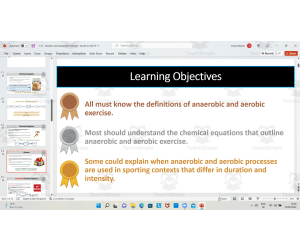
Aerobic and Anaerobic Energy Systems
Science, Life Sciences, Human Body, Grade 8, 9, 10, 11, Teacher Tools, Lesson Plans
The Aerobic and Anaerobic Energy Systems: A Comprehensive Teaching Resource Taking teaching to another level, the Aerobic and Anaerobic Energy Systems is a detailed educational resource that explores the complex but fascinating realm of energy systems in our bodies. This PowerPoint Lesson Presentation is crafted to thoroughly review both aerobic and anaerobic energy systems, immersing learners in integral concepts related to these biological marvels. Detailed and Dynamic Education Tool The platform contains 32 comprehensive slides. It commences with basic definitions for aerobic and anaerobic exercise, establishing a potent foundation from the start. This dynamic tool further broadens upon this base knowledge by excavating deeper into essential facets such as their fuel sources, byproducts, overall energy yield. Notably provided are supporting chemical equations that visually manifest how these reactions transpire on a molecular scale. Real-World Applicability An important feature is its dedication toward real-world application. The System offers valuable insights on when either process dominates during varying sporting events based on factors like duration and intensity; ensuring everyone comprehends basic terms while also understanding how they function chemically whilst being able to apply this awareness within different athletic situations. Learner-Centric Approach This teaching source proficiently caters all educators regardless of your preferred setting - whether you're conducting sessions with larger classroom groups or smaller study circles or even if you'd like your learners to delve deeper into human biology from home. Suitable for Middle Schoolers&High schoolers: Perfectly fit for Grades between 8-11 without overwhelming any learner. All Platforms Compatibility: It's a Microsoft PowerPoint -based resource ensuring easy usage across multiple devices, irrespective of traditional or virtual classrooms. In essence, the Aerobic and Anaerobic Energy Systems is an all-inclusive, user-friendly teaching aid – a seamless union of expertly curated data with practical applications that will without question enhance students' interest and understanding regarding the topic.
Author The PE Tutor
Tags Teaching, Energy Systems, Aerobic Exercise, Anaerobic Exercise, Human Biology
I Wonder - Is The Brain Working When We Sleep | Animated Video Lesson
Human Body, Life Sciences, Science, Biology, STEM, Grade 3, 4, 5, 6, 7, 8, 9, Lesson Plans, Teacher Tools
Video Overview The human body is full of fascinating wonders to learn. This video is created to help the students recognize the anatomy and the job of the human body. I WONDER - Is The Brain Working When We Sleep | Animated Video Lesson Every part and organ in our human body is vital so let's see how important they are. Have you ever imagined how we look like if we didn't have a skeleton? Did you know that because we have our amazing muscles we can stand! Do you know how many teeth do we have? Have you ever wondered about the food journey inside our body? Can you name all the glands in our body? Why do we have skin? Our nervous system is really good at sending signals. Can you tell us more about it? Are you really good at Mathematics, painting, or any other thing? You should really thank your brain about it! The famous five senses are really doing a great work? Can you explain how every sense works? I WONDER - Is The Brain Working When We Sleep | Animated Video Lesson The video is perfect for encouraging the researching skills for the students, while learning more about our fantastic human body. I WONDER - Is The Brain Working When We Sleep | Animated Video Lesson This friendly designed video is suitable for students at school, homeschooling, and as a group activity. Format Available in MP4 format.
Author Educational Voice
Tags Is The Brain Working When We Sleep, Is The Brain Working When We Sleep Video, Brain, Brain Facts, Brain Facts For Kids, Brain Video, Brain Video For Kids, Human Body, Human Body Facts
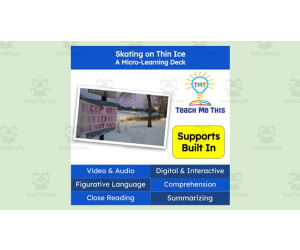
Skating on Thin Ice | Figurative Language Activity | Micro-Learning Deck
ELA, Reading, Reading Comprehension, Grade 4, 5, 6, 7, Teacher Tools, Lesson Plans
Skating on Thin Ice | Figurative Language Lesson Deck for Educators This informative PowerPoint resource helps teachers creatively engage upper elementary and middle school students in learning about the figurative language term "skating on thin ice." Through an introductory video lesson, reading passage with audio, comprehension activities, and quick writing prompts, learners will better understand this common idiom and how figurative language is used. Educators can implement this versatile 20-slide deck in various ways - as an introductory whole-group lesson, small group remediation, independent learning, bell work, or homework. The materials are designed for grades 4-7 language arts or reading classes. This resource provides a complete micro-learning experience to help students comprehend and apply their knowledge of figurative language.
Author Teach Me This
Tags Skating On Thin Ice, Figurative, Language, Comprehension Lesson, Reading Activity

I WONDER - Can Owls Live In The Desert | Animated Video Lesson
STEM, Biology, Life Sciences, Science, Animals, Grade 1, 2, 3, 4, 5, 6, 7, 8, Lesson Plans, Teacher Tools
Video Introduction Animal kingdoms are full of fascinating wonders to learn. This video is designed for the students to learn more about animals in different countries. I WONDER - Can Owls Live In The Desert | Animated Video Lesson Do you like animals? what is your favorite one? Do you own a pet? If yes, tell us more about it, like what its name? And what do you like most about it? What are the animal kingdoms? Can you write down the characteristics of each animal class like mammals, birds, reptiles, amphibian, fish and mollusks. Do you know that some animals can sing, can you name any of them? What is the largest and the smallest mammal in the world? What is the largest and the smallest bird in the world? What is the largest and the smallest fish in the world? I WONDER - Can Owls Live In The Desert | Animated Video Lesson The video is perfect for encouraging the researching skills for the students, while learning more about these fantastic animals. I WONDER - Can Owls Live In The Desert | Animated Video Lesson This friendly designed video is suitable for students at school, homeschooling, and as a group activity. Format Available in MP4 format.
Author Educational Voice
Tags Can Owls Live In The Desert, Can Owls Live In The Desert Video, Owls, Owl, Owls Facts, Owls Facts For Kids, Owls Video, Owls Video For Kids, Owl Facts, Owl Video
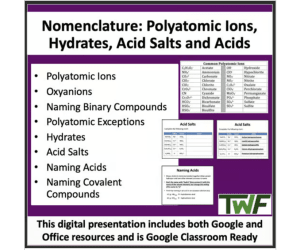
Nomenclature-Polyatomics & Covalent Compounds- Senior Chemistry Lesson
Science, Chemistry, Grade 10, 11, 12, Teacher Tools, Lesson Plans
Nomenclature-Polyatomics & Covalent Compounds - Senior Chemistry Lesson Your lesson covers the nomenclature of polyatomic compounds and covalent compounds. In order, the lesson teaches about; Polyatomic Ions, Oxyanions, Naming Binary Compounds, Polyatomic Exceptions, Hydrates, Acid Salts, Naming Acids, and Naming Covalent Compounds. Your lesson includes the teacher and student version of the presentation, an auto-graded exit ticket, and a student lesson handout so the students can record the notes on a more condensed medium. This lesson is designed to be your go-to resource, whether you're in a traditional classroom or a virtual one. With both a teacher version and a student version, it seamlessly fits into your lesson plans, making learning engaging and adaptable. Assessment made easy We've included an auto-graded Exit Ticket and a quiz with an answer key because I know you don't have an excess of time. I know you don't, because I don't and I know I'll do whatever I can to reduce my grading time. Whether you use PowerPoint or Google Slides, prefer Word or Google Docs, this lesson has you covered. This lesson comes in both Office and Google formats for your convenience. The student version of the presentation has strategically placed blanks for them to fill in as you're teaching. It keeps them active and engaged, encourages discussion, and leaves more time for those "aha" moments.
Author Teach With Fergy
Tags Chemistry Lesson, Valence Electrons, Ionic Bonding, Multivalent Ions, Ions, Nomenclature, Polyatomic Ions, Oxyanions, Hydrates
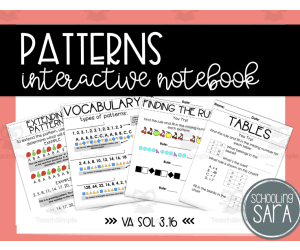
Patterns Math Interactive Notebook (VA SOL 3.16)
Math, Patterns, Grade 2, 3, 4, Teacher Tools, Lesson Plans
This product covers the 2016 Virginia (VA) Standards of Learning (SOL) 3.16: The student will identify, describe, create, and extend patterns found in objects, pictures, numbers and tables. (note that this will also work for the 2023 VA SOL 3.PFA.1: The student will identify, describe, extend, and create increasing and decreasing patterns (limited to addition and subtraction of whole numbers), including those in context, using various representations.) It contains notes pages on identifying patterns, the different types of patterns, extending patterns, repeating patterns, growing (or increasing and decreasing) patterns, and table patterns. Students are asked to identify the rules, fill in missing numbers, or replicate patterns throughout the unit to build a better understanding of the topic. There are practice pages for each topic, with an answer key included. The notes pages come in two sizes. The first size is a full-page size. You can print them as-is, or you can print them two to a pages. This is what I do as it saves on paper and the sheets will fit in a notebook. The second size is formatted to fit on a standard composition notebook page. Additionally, there are two links included in the pdf: one which opens a digital version of the notes, and another that opens a slide show version, optimized for a projector or interactive board. In both cases, which you click the link, you will be prompted to make a copy, which you can then use with Google Slides or download and use with Keynote or PowerPoint. What's included? Patterns Vocabulary Identifying Patterns Types of Patterns Extending Patterns Finding the Rule of Repeating Patterns Finding the Rule of Growing Patterns (sometimes referred to as "increasing/decreasing" patterns) Missing Item Patterns Patterns Quick Check Input/Output Tables Input/Output Tables Quick Check For more no and low-prep activities, check these out: October No-Prep Math Activities No Prep Spiral Math Daily Review and Quizzes Comparing Money Practice 1 Identifying Money Practice Area and Perimeter Digital Activity Counting Money Practice
Author SchoolingSara
Tags Patterns, Math Education, Interactive Notebook, Virginia SOL 316, Digital Learning