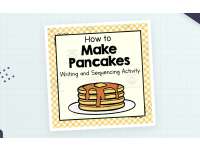
How to Make Pancakes | Writing and Sequencing Activity



- Grades
- Grades 1–3, Elementary
- Pages
- 111
- File type
- Preparation
- Print ready


- Subject
- ELA, Writing
- Topic
- writing activity, sequence of events
- Resource types
- Activities
- Preparation
- Print ready
- Standards
- CCSS.RI.1.1 CCSS.RI.1.2 +7
About this resource
What's inside this resource
Product description
From the author
This cross-curricular resource uses students’ interest in pancakes to creatively teach emerging writers the basics of crafting step-by-step “how-to” explanations. The materials are designed to break down the cooking process into simple, engaging sequences that appeal to young students. Various printable templates guide children to color, cut out, organize, and describe the methodology for mixing up and cooking delicious pancakes.
The curriculum includes two anchor charts explaining the key traits of procedural writing and common transitional words to cement understanding. A sample how-to paragraph models the desired format, while two leveled editing checklists provide developmentally-appropriate guidance for revising student work. Additionally, teachers receive a set of vivid sequencing cards demonstrating the pancake making procedure as well as individual vocabulary word cards that can be displayed or matched to corresponding images.
Primary workbook-style templates prompt students to identify the necessary kitchen tools, ingredients, safety considerations, and chronological steps required to complete the task. Extensions encourage students to describe favorite pancake toppings, invent new recipes, or craft narratives around pancake characters. A final draft pancake stack provides the entertaining possibility of actually frying up the breakfast treat in class once the process has been clearly mapped.
With opportunities to strengthen fine motor skills through coloring, organizing logical sequences, copying transition words, controlled writing practice, and crafting pancake-inspired stories, students gain confidence applying core procedural writing techniques to a delicious topic that feeds imagination. The cross-disciplinary focus creatively integrates science and literacy learning through hands-on engagement centered around a beloved breakfast food.
This resource allows flexible implementation ranging from whole group pancake demonstrations to individual student work. Both emerging and early writers will be eager to dive into the thematic printables and activities built around a favorite classroom treat.
Check Out More How-To Writing Units!
- How to Rake Leaves: Informational Writing and Sequencing Activity
- How to Make Pancakes: Informational Writing and Sequencing Activity
- How to Make Lemonade: Informational Writing and Sequencing Activity
- How to Make a Valentine: Informational Writing and Sequencing Activity
- How to Grow a Plant: Informational Writing and Sequencing Activity
- How to Cook a Turkey: Informational Writing and Sequencing Activity
Check out other resources from my store: Simply Schoolgirl!
I can be contacted for questions and concerns at simplyschoolgirl1@gmail.com
Related resources
More resources teachers may find useful
24 related resources were found using this product's title, contributor, categories and tags.
In the classroom
Teaching tips & learning objectives

Learning objectives
Sequence the steps of making pancakes in the correct order using picture cards.
Use transition words (first, then, next, finally, and similar) to signal the order of steps in how-to writing.
Write an original set of how-to instructions for making pancakes, following a step-by-step booklet format.

Teaching tips
Play one of the four linked YouTube videos before starting the unit to build background knowledge of the actual pancake-making process.
Use the two leveled 'Warm Buttery Breakfast' model texts to show students what more-detailed versus simpler how-to writing looks like before they draft their own.
Have students color, cut, and store the black-and-white sequencing cards in a small ziplock bag or envelope, per the packet's own instructions, so the set can be reused as a sorting center.

Skills covered
Sequential/procedural writing — students write the steps of a familiar process in order, supported by picture cards and a step-numbered booklet format.
Transition-word use — students select and apply beginning, middle, and ending transition words (first of all, then, finally) to connect steps in their writing.
Picture-based sequencing — students color, cut, and physically order a six-step picture-card set before translating that order into written steps.
Good to know
Questions teachers ask about this resource
Are there different versions of the sequencing cards for different skill levels?
Yes — the six-step picture sequence appears in a full-color version, a version with blank space for students to add their own captions, and a plain black-and-white cut-apart set meant to be stored in a bag or envelope for reuse.
Do students have to write their own steps, or can the booklet be pre-filled?
Both options are included: a guided 7-step booklet already states each step ('Step 1: Find a pancake recipe' through 'Step 7: Add butter and syrup, then eat!'), and a matching blank version leaves the same seven steps empty for students to write themselves.

No reviews yet
Downloaded this resource? Tell other teachers how it went.
Curriculum
Standards, concepts & topics
Standards
 Standards
- CCSS.RI.1.1 — Ask and answer questions about key details in a text.
- CCSS.RI.1.2 — Identify the main topic and retell key details of a text.
- CCSS.RI.2.1 — Ask and answer such questions as who, what, where, when, why, and how to demonstrate understanding of key details in a text
- CCSS.RI.2.2 — Identify the main topic of a multiparagraph text as well as the focus of specific paragraphs within the text.
- CCSS.RI.3.1 — Ask and answer questions to demonstrate understanding of a text, referring explicitly to the text as the basis for the answers.
- CCSS.RI.3.2 — Determine the main idea of a text; recount the key details and explain how they support the main idea
- CCSS.W.1.3 — Write narratives in which they recount two or more appropriately sequenced events, include some details regarding what happened, use temporal words to signal event order, and provide some sense of closure.
- CCSS.W.2.3 — Write narratives in which they recount a wellelaborated event or short sequence of events, include details to describe actions, thoughts, and feelings, use temporal words to signal event order, and provide a sense of closure.
- CCSS.W.3.3 — Write narratives to develop real or imagined experiences or events using effective technique, descriptive details, and clear event sequences. a. Establish a situation and introduce a narrator and/or characters; organize an event sequence that unfolds naturally. b. Use dialogue and descriptions of actions, thoughts, and feelings to develop experiences and events or show the response of characters to situations. c. Use temporal words and phrases to signal event order. d. Provide a sense of closure.
Core concepts
 Core concepts
how-to writing
sequencing
transition words
procedural text
 Topics
Explore more
Categories this resource belongs to
Explore related searches
More to explore
You may also like