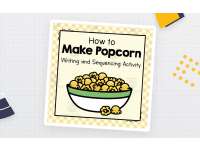
How to Make Popcorn | Writing and Sequencing Activity

- Grades
- Grades 1–3, Elementary
- Pages
- 99
- File type
- Preparation
- Print ready


- Subject
- ELA, Writing
- Topic
- writing activity, language arts
- Resource types
- Activities
- Preparation
- Print ready
- Standards
- CCSS.RI.1.1 CCSS.RI.1.2 +7
About this resource
What's inside this resource
This cross-curricular resource uses students' interest in popcorn to teach early writers fundamentals of crafting step-by-step "how-to" explanations. The materials creatively break down the process into simple sequences designed to motivate young students. Various printable templates guide children to color, cut out, organize, and describe the methodology for popping this popular snack.
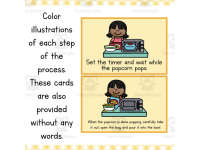
The packet incorporates two leveled writing checklists suitable for kindergarten through early elementary grades to reinforce core instructional writing skills. A sample how-to paragraph models the format while a popcorn-themed sequencing word bank introduces key transition vocabulary. Vivid pictorial cards demonstrate necessary tools and steps while corresponding word cards allow for matching games or displays.
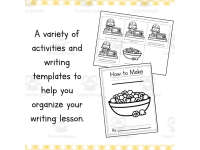
Primary workbook-style templates encourage students to enumerate or depict the tools, ingredients, safety considerations, and chronological actions required to pop popcorn. Extensions guide students to describe favorite movie snacks, tailor recipes, or invent new varieties of popcorn. A final draft popcorn bag template offers the possibility of designing customized packaging if classroom cooking facilities permit.
With opportunities to grow fine motor skills, sequence events, practice transitional phrases, apply controlled writing, and craft snack-inspired narratives, students gain confidence applying fundamental how-to writing techniques to an appetizing topic that stimulates imagination. The cross-disciplinary focus creatively integrates science and literacy learning through hands-on engagement centered around a beloved snack.
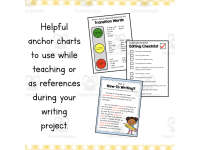
This educational product equips teachers with abundant resources to guide students through crafting procedural "how-to" texts using the fun example of making popcorn. Two colorful anchor charts define the key ingredients of quality procedural writing and offer transition words to sequence steps. Editing checklists, provided at two levels, enable learners to self-evaluate work before publishing final drafts.
A sample "How to Make Popcorn" models conventions like imperatives, chronological order and materials lists. Sequencing tasks with accompanying illustration cards ─ available with and without text ─ reinforce ordering of popping steps. Writing templates scaffold multiple angles, from brainstorming needed tools to recounting personal experiences making the tasty snack. Budding authors draft procedural passages within primary-lined booklets showcasing pictures to color. Final publications shine with the option to cut out mini popcorn buckets demonstrating the delicious outcome!
Check Out More How-To Writing Units!
- How to Make Gingerbread: Informational Writing and Sequencing Activity
- How to Make Pancakes: Informational Writing and Sequencing Activity
- How to Make Lemonade: Informational Writing and Sequencing Activity
- How to Carve a Pumpkin: Informational Writing and Sequencing Activity
- How to Wash a Car: Informational Writing and Sequencing Activity
- How to Built a Snowman: Informational Writing and Sequencing Activity
- How to Make Apple Pie: Informational Writing and Sequencing Activity
- How to Make a Rootbeer Float: Informational Writing and Sequencing Activity
Check out other resources from my store: Simply Schoolgirl!
I can be contacted for questions and concerns at simplyschoolgirl1@gmail.com
Related resources
More resources teachers may find useful
24 related resources were found using this product's title, contributor, categories and tags.


In the classroom
Teaching tips & learning objectives

Learning objectives
Sequence the steps of a process (making microwave popcorn) in the correct order.
Write a how-to (expository) piece that explains each step of a process using transition words.
Use an editing checklist matched to their writing stage to review and revise a finished piece.

Teaching tips
Match the editing checklist to each student's stage — the 'Early Writer' checklist for beginning writers and the 'Experienced Writer' checklist for more advanced ones (pages 8-9) — rather than using one checklist for the whole class.
Read the two versions of the 'Buttery Kernels' sample writing (pages 14-15) aloud before students draft their own, since the shorter version models the same five steps with simpler sentences.
Choose one final-draft format per class rather than assigning all of them — the booklet, blank book, and flip book (pages 66-101) all cover the same content, just in different assembled shapes.

Skills covered
Sequential/procedural writing — students write a how-to piece describing the popcorn-making process in order, modeled by the two-length 'Buttery Kernels' sample (pages 14-15).
Transition-word usage — students use words like 'first,' 'meanwhile,' and 'last but not least' to signal order in their writing (pages 6, 41-57).
Sequencing — students color, cut, and arrange picture cards showing the popcorn-making steps in the correct order (pages 63-65).
Self-editing — students check their draft against a stage-appropriate checklist covering spelling, punctuation, and organization (pages 8-9).
Good to know
Questions teachers ask about this resource
What's the difference between the two 'Buttery Kernels' sample texts?
Both model the same five-step popcorn process, but one uses fuller sentences and more description while the other uses shorter, simpler sentences — so a teacher can choose the version that matches a class's writing level.
How many different final-draft formats does the pack include?
Three: a staple-together booklet, a blank book, and a flip book, each built around the same finished how-to writing so a teacher can pick whichever assembly style fits the classroom.

No reviews yet
Downloaded this resource? Tell other teachers how it went.
Curriculum
Standards, concepts & topics
Standards
 Standards
- CCSS.RI.1.1 — Ask and answer questions about key details in a text.
- CCSS.RI.1.2 — Identify the main topic and retell key details of a text.
- CCSS.RI.2.1 — Ask and answer such questions as who, what, where, when, why, and how to demonstrate understanding of key details in a text
- CCSS.RI.2.2 — Identify the main topic of a multiparagraph text as well as the focus of specific paragraphs within the text.
- CCSS.RI.3.1 — Ask and answer questions to demonstrate understanding of a text, referring explicitly to the text as the basis for the answers.
- CCSS.RI.3.2 — Determine the main idea of a text; recount the key details and explain how they support the main idea
- CCSS.W.1.3 — Write narratives in which they recount two or more appropriately sequenced events, include some details regarding what happened, use temporal words to signal event order, and provide some sense of closure.
- CCSS.W.2.3 — Write narratives in which they recount a wellelaborated event or short sequence of events, include details to describe actions, thoughts, and feelings, use temporal words to signal event order, and provide a sense of closure.
- CCSS.W.3.3 — Write narratives to develop real or imagined experiences or events using effective technique, descriptive details, and clear event sequences. a. Establish a situation and introduce a narrator and/or characters; organize an event sequence that unfolds naturally. b. Use dialogue and descriptions of actions, thoughts, and feelings to develop experiences and events or show the response of characters to situations. c. Use temporal words and phrases to signal event order. d. Provide a sense of closure.
Core concepts
 Core concepts
sequencing
how-to writing
transition words
self-editing
 Topics
Explore more
Categories this resource belongs to
Explore related searches
More to explore
You may also like