



3,928 products added recently
Page 3 - Other Experiments
Introduce your students to a range of unique experiments that cover unconventional topics and methods. This collection includes interdisciplinary projects, environmental studies, and innovative demonstrations. By integrating these experiments into your lessons, you can broaden students' horizons and spark curiosity.

 Show filters


GHS Pictogram Clipart – Glitter Design for Chemistry Classrooms & Craf
Common Core, Science, STEM, Chemistry, Physics, Life Sciences, Earth and Environmental Sciences, Technology, Basic Science, Resources for Teachers, Homeschool Templates, Homeschool Curriculum, Grade 10, 11, 12, Classroom Decor, Bulletin Boards, Posters, Teacher Tools, Word Walls, Door Decor, Experiments, Activities, Labs, Worksheets & Printables
GHS Pictogram Cliparts Glitter Design for Chemistry Classrooms, Crafts and Materials PNG If you’ve ever found the standard GHS (Globally Harmonized System) pictograms a bit too plain or uninspiring for your teaching materials, you’re not alone. That’s exactly why I decided to redesign them with a fresh twist. These 18 cliparts—9 in portrait and 9 in landscape format—combine the clarity of the official hazard symbols with a visually striking glitter effect. The colors remain true to the original system (red border, black symbol), but the glitter gives them a unique and eye-catching feel. I created each of these cliparts by hand in Procreate, with the classroom in mind. They’re still clearly recognizable as hazard pictograms, but they add a touch of design that fits beautifully into worksheets, posters, or digital resources. Ways you might use these in your classroom or materials: – Labeling chemical containers in a more engaging way – Gluing into student chemistry notebooks to support safety topics – Decorating posters or bulletin boards about lab safety rules – Enhancing worksheets or lab instructions visually – Adding to PowerPoint, Keynote, or Genially presentations – Integrating into digital learning platforms or safety training resources – Using them in flashcards for visual reinforcement Since you’ll receive both portrait and landscape versions (in PNG format with transparent backgrounds), you can easily adjust them to your layout or format. Whether you're printing or working digitally, the designs remain sharp and flexible. These glitter-style symbols were made to support safety awareness while also respecting visual design preferences—especially for teachers or students who appreciate a bit more flair in their materials. Usage rights: You may use the cliparts both privately and commercially within educational content, as long as your own contribution is clearly visible. Please do not resell the graphics individually. Wishing you lots of creativity while designing your materials, – Heike from @Lernfitness Did You Know? I teach with a certified therapy dog, and together we create a positive and welcoming learning environment. 🐶
Author Lernfitness
Rating
Tags Teaching Materials, Classroom Decorations, Decorative Elements, Cliparts, Illustrations, GHS, Science, Lab, Chemistry, Pictograms

Mutations – Lab Station Activity
Science, Life Sciences, Biology, Grade 9, 10, 11, 12, Labs, Experiments, Activities
This fully editable Lab Station Activity on Mutations is meant to get your students out of their seats and engaged in the content. This activity was designed for High School Biology students. Each station not only offers a unique opportunity to test your students' knowledge (offer an opinion, answer questions based on a video or reading, draw, etc.) but also provides a fantastic learning opportunity where your kids are learning through assessment. Each station comes with a description card while some also contain more detailed instructions, a reading, questions to answer, etc. Students are equipped with a recording sheet (passport) to write their answers. There is almost no prep for you. Simply print the cards, lay them out around the room and you're all set. An answer key is also provided where applicable. This lab activity covers: - Mutations Overview - Small-scale Mutations - Missense Mutations - Nonsense Mutations - Silent Mutations - Frameshift Mutations - Large-scale Mutations - Causes - Mutagens ---------------------------------------------- Bonus Activities: To ensure your students don't have any downtime between stations, your lab also includes a 10-word word scramble and word search, both with an answer key. You can use them as part of their mark, as a bonus so it's not mandatory, etc. However you choose to use it, it will ensure that your students are always busy and never idle. Note: For stronger classes, I give the word scramble and for weaker ones, the word search. ----------------------------------------------- How do the Lab Stations work? Each station is specially designed to be a unique complement to the material while at the same time, provide a valuable learning experience. Below is an overview of how each station works. In your activity , each will be tailored to the specific content. Station 1: Get Hands-On – using their creative skills, students are required to draw or build. Station 2: Research – using a classroom computer or their own device, students must research a specific question/issue surrounding the topic. Station 3: Explain yourself – students write down an opinion to a question in paragraph form. Station 4: Rest Station - students can use this time to catch up on work they didn't have time to complete at a previous station or prepare themselves for an upcoming one. Station 5 - Applicability reading – students read a short passage from an article, website, etc. which directly connects the classroom content to a real life application. Station 6: Test your knowledge – students answer 5 multiple choice questions then provide a written explanation for how/why they came to their conclusions. Station 7: Learn from the expert – using a classroom computer or their own device, students must watch a short video clip and answer the associated questions. They may stop, rewind and restart as often as they like during the time frame. Station 8 - Rest Station. Station 9: Become the question master – Students must create 2 multiple-choice questions, 2 true/false questions and 1 short answer question. Students must also supply the answers. ------------------------------- You might also be interested in my other lab station activities Biology: • Cell and the Cell Theory • The Human Digestive System • The Circulatory System • The Human Respiratory System • Mitosis and the Cell Cycle • Cellular Respiration and Photosynthesis • Photosynthesis • Cancer: Cell Division Gone Wrong - Volume I • Cancer: Cell Division Gone Wrong - Volume II • Cell Membrane and Transport • Hearing and the Human Ear • The Human Eye • Genetic Material: DNA and RNA • The Nervous System • Energy Flow In Ecosystems • DNA Manipulation and GMOs • Transcription and Translation • Cellular Respiration • Thermoregulation • Proteins and Nucleic Acids • Mutations Coming Soon: - Excretory system - Endocrine system - Carbohydrates and Lipids - Meiosis Ecology and the Environment: • Ecosystems • The Classification of Living Things • Biodiversity and Invasive Species • The Carbon and Water Cycle • Climate Change • Photosynthesis • Cellular Respiration and Photosynthesis • Ecological Succession • Plant Sexual and Asexual Reproduction • Earth's Seasons • Interactions Within Ecosystems • Physical and Behavioral Adaptations Physics: • Newton's Three Laws of Motion • Kinetic and Gravitational Potential Energy • Current Electricity and Circuit Diagrams • Static Electricity • Light Optics and the Production of Light • Sound, Sound Energy and Speed • One and Two-Dimensional Motion • Uniform Acceleration • How Planes Fly • Refraction • Friction • Energy and Its Forms • Density and Buoyancy • Electricity Production Coming Soon: - Calculating average speed, velocity, and displacement - Work = F x d - Renewable energy sources - Nonrenewable energy sources - Projectile Motion - Momentum, Conservation of Momentum and Impulse - Power - The Doppler Effect and Supersonic Travel Space Science: • The Life and Death of Stars • The Moon and its Phases • Life In Space • Our Solar System • Solar and Lunar Eclipse • Earth's Seasons • Asteroids, Comets and Meteors Chemistry: • Atomic Model, Notation and Atoms • Chemical Reactions and Balancing Equations • Molecular and Ionic Compounds • Physical and Chemical Properties & Changes • Acids, Bases, and Neutralization Reactions • The Periodic Table • Single and Double Displacement Reactions • Balancing Chemical Equations • Synthesis, Decomposition and Combustion Reactions • Atomic Theory, Atomic Structure and Isotopes • Types of Bonds and Intermolecular Forces • The Mole/Avogadro's Number • Density and Buoyancy • The Particle Theory and the Classification of Matter Coming Soon: - Periodic table group properties General Science: • The Scientific Method and Science Skills These station cards are meant to be used as a lab activity but can also be utilized in a review task before a test or a quiz. Used either way, your students will love it! I know mine do and I'm telling you from first-hand experience as I've used this activity in my own class. Thank you for your interest in my products. If you have any questions, please send me an email - devon@teachwithfergy.com
Author Teach With Fergy
Tags Mutations, Mutagens, DNA, Cancer
Science Action Labs Science Fun: Activities to Encourage Students to Think and Solve Problems
Literature, Grade 4, 5, 6, 7, 8, Labs, Experiments, Activities
Science Action Labs Science Fun: Activities to Encourage Students to Think and Solve Problems This amazing resource is a practical teaching tool designed for educators, both in traditional classroom settings and homeschool environments. Geared towards students from Grades 4 up to Grade 8, this comprehensive collection of science labs aims at making learning more engaging. Overview: Diverse suite of activities for exploring scientific principles. Ranging from experiments like Spinning Science, Gravity Sci-Fun, Building a Better Boomerang to Static Electricity experiments . Boosts curiosity & encourages problem-solving through real-world applications. The unique lab activities equipped with supporting literature can really help in enhancing subject understanding by creating perfect balance between theory and practice. Bonuses: Fosters higher-order thinking skills Promotes active participation Makes learning process immersive & fun-focused The Offering: In a downloadable PDF format with 64 ready-to-print pages - just download, print, distribute! Versatile usage; from individual worksheets for reinforcement or review purposes or structured as part of group classes where discussion becomes part of the learning process. This offering truly brings flexibility right into your classroom or home! In Summary: If you're looking at enriching science materials aimed at promoting conceptual understanding over rote memorization - look no further than 'Science Action Labs Science Fun: Activities to Encourage Students To Think And Solve Problems'. A worthy addition indeed!
Author Classroom Complete Press
Tags Fun Activities, Science Labs, Reverse Technology, Gravity Science Fun, Problem Solving

Culture Lesson: Cultural Norms and Avoiding Stereotypes Worksheets
Social Studies, Psychology, Life Studies, Grade 5, 6, 7, Worksheets & Printables, Worksheets, Activities, Experiments, Lesson Plans, Teacher Tools
Do you want your students in grades 5-7 to learn how to become global citizens who can respect a variety of cultural norms and comprehend cross-cultural differences? Are you looking for a fun way to bring all of these ideas to life? Check out this ready-to-go lesson for your class. This 5-Page PDF is ready to print for your social studies classroom. It includes clear teacher instructions for a fun class simulation where half of your students will act out a new "class norm" (five options are provided such as not raising your hand to ask a question) that the other half of your class won't be expecting. While the simulation is happening, everyone will be working on a three page reading comprehension task. Students will read about cultural norms from around the world (slurping noodles when eating in Japan or nodding one's head to say "no" in Bulgaria). They will imagine how not knowing about the cultural norms in a place where they are travelling could lead to accidental misunderstandings. Students are also taught a simple definition of the concept of stereotypes, and they will think of how they are different from cultural norms. Finally, there is a 1-page reflection with prompts- perfect for after a class discussion. Teacher Instructions: 1. Split your class in two and talk to only one half. 2. Tell them that they will have a new “class cultural norm.” Pick one from the provided ideas. 3. When the whole class is reunited, pass out the reading page & worksheets. Students read about cultural norms and answer the questions. 4. As they work, the selected half will enact their new norm, which will confuse the other half of the class. 5. Once the point has been made, let the other half in on the secret. 6. Have a discussion about cultural norms and give students time to write a reflection about this lesson.
Author Grace Under Pressure
Tags Culture, Stereotypes, Cultural, Culture Worksheets, Cross Culture, Travel, Norms, Cultural Norms, Class Simulation, Simulation

Life and Death of Stars – Lab Station Activity
Science, Earth and Environmental Sciences, Space, Grade 8, 9, 10, Labs, Experiments, Activities
Life and Death of Stars Lab Station Activity Dive into the life cycle of stars with this engaging lab station activity . Students will rotate through 9 stations, each offering a unique way to explore concepts like stellar life cycles, types of stars, the H-R diagram, stellar nucleosynthesis, and more. Activities range from creative tasks to research questions to knowledge checks. Word scrambles and searches ensure students stay busy. Almost no prep required - just print and go. Covers key ideas in stellar astronomy through varied formats for enhanced engagement and learning. Useful as an introductory or review activity for middle and high school physical science and physics. Provides an exciting hands-on complement to any unit on space science.
Author Teach With Fergy
Tags Stars, Life Cycle, Elements, Astronomy, Lab Station, Stars Activity

Nervous System – Lab Station Activity
Science, Life Sciences, Biology, Grade 8, 9, 10, 11, 12, Labs, Experiments, Activities
This fully editable Lab Station on The Nervous System is meant to get your students out of their seats and engaged in the content. Each station not only offers a unique opportunity to test your students knowledge (offer an opinion, answer questions based on a video or reading, draw, etc.), but also provides a fantastic learning opportunity where your kids are learning through assessment. Each station comes with a description card while some also contain more detailed instructions, a reading, questions to answer, etc. Students are equipped with a recording sheet (passport) to write their answers. There is almost no prep for you. Simply print the cards, lay them out around the room and you're all set. An answer key is also provided where applicable. This lab activity covers: - Structure, Parts and Functions of the Nervous System - Structure, Types and Functions of the Neuron - Reflex Arc - Nerve Signal Transmission and Action Potential - The Schwann Cell and Action Potential - Sodium-Potassium Pump - Neurotransmitters and its Functions ---------------------------------------------- Bonus Activities: To ensure your students don’t have any downtime between stations, your lab also includes a 10-word word scramble and word search, both with an answer key. You can use them as part of their mark, as a bonus so it’s not mandatory, etc. However you choose to use it, it will ensure that your students are always busy and never idle. Note: For stronger classes, I give the word scramble and for weaker ones, the word search. ----------------------------------------------- How do the Lab Stations work? Each station is specially designed to be a unique complement to the material while at the same time, provide a valuable learning experience. Below is an overview of how each station works. In your activity , each will be tailored to the specific content. Station 1: Get Hands-On – using their creative skills, students are required to draw or build. Station 2: Research – using a classroom computer or their own device, students must research a specific question/issue surrounding the topic. Station 3: Explain yourself – students write down an opinion to a question in paragraph form. Station 4: Rest Station - students can use this time to catch up on work they didn't have time to complete at a previous station or prepare themselves for an upcoming one. Station 5 - Applicability reading – students read a short passage from an article, website, etc. which directly connects the classroom content to a real life application. Station 6: Test your knowledge – students answer 5 multiple choice questions then provide a written explanation for how/why they came to their conclusion. Station 7: Learn from the expert – using a classroom computer or their own device, students must watch a short video clip and answer the associated questions. They may stop, rewind and restart as often as they like during the time frame. Station 8 - Rest Station. Station 9: Become the question master – Students must create 2 multiple-choice questions, 2 true/false questions and 1 short answer question. Students must also supply the answers. ------------------------------- You might also be interested in my other lab station activities Biology: • Cell and the Cell Theory • The Human Digestive System • The Circulatory System • The Human Respiratory System • Mitosis and the Cell Cycle • Cellular Respiration and Photosynthesis • Photosynthesis • Cancer: Cell Division Gone Wrong - Volume I • Cancer: Cell Division Gone Wrong - Volume II • Cell Membrane and Transport • Hearing and the Human Ear • The Human Eye • Genetic Material: DNA and RNA • The Nervous System • Energy Flow In Ecosystems Ecology and the Environment: • Ecosystems • The Classification of Living Things • Biodiversity and Invasive Species • The Carbon and Water Cycle • Climate Change • Photosynthesis • Cellular Respiration and Photosynthesis • Ecological Succession • Plant Sexual and Asexual Reproduction • Earth's Seasons • Interactions Within Ecosystems Physics: • Newton's Three Laws of Motion • Kinetic and Gravitational Potential Energy • Current Electricity and Circuit Diagrams • Static Electricity • Light Optics and the Production of Light • Sound, Sound Energy and Speed • One and Two-Dimensional Motion • Uniform Acceleration • How Planes Fly • Refraction • Friction • Energy and Its Forms • Density and Buoyancy Space Science: • The Life and Death of Stars • The Moon and its Phases • Life In Space • Our Solar System • Solar and Lunar Eclipse • Earth's Seasons • Asteroids, Comets and Meteors Chemistry: • Atomic Model, Notation and Atoms • Chemical Reactions and Balancing Equations • Molecular and Ionic Compounds • Physical and Chemical Properties & Changes • Acids, Bases, and Neutralization Reactions • The Periodic Table • Single and Double Displacement Reactions • Balancing Chemical Equations • Synthesis, Decomposition and Combustion Reactions • Atomic Theory, Atomic Structure and Isotopes • Types of Bonds and Intermolecular Forces • The Mole/Avogadro's Number • Density and Buoyancy These station cards are meant to be used as a lab activity but can also be utilized in a review task before a test or a quiz. Used either way, your students will love it! I know mine do and I'm telling you from first-hand experience as I've used this activity in my own class. Thank you for your interest in my products. If you have any questions, please send me an email - devon@teachwithfergy.com
Author Teach With Fergy
Tags Nervous, System, Neurons, Disorders, Lab Station, Nervous System Activity, Nervous System Lab, Nervous System Activities, Nervous System Activities Middle School
Science Action Labs Sound & Light
Science, Physics, Grade 4, 5, 6, 7, 8, Labs, Experiments, Activities
Science Action Labs Sound & Light An exceptional educational resource aimed especially at students in Grades 4-8, focusing predominantly on engaging physical science subtopics. This easy-to-use workbook captivates the minds of budding learners, stimulating their imagination and curiosity through hands-on experience with sound and light concepts. Participatory learning is favored over mere observation. Students engage in entertaining experiments using commonplace objects like mirrors and flashlights to unpack complex scientific principles in a digestible manner. By interacting with sound waves and light as reflected or emitted from these objects, young minds gain better comprehension of scientific theories. Sir Isaac Newton's wisdom is celebrated throughout the pages of this book. Simplified explanations grounded in his concepts build understanding while additional nuggets of information further enrich knowledge, fostering a lighthearted yet potent educational environment for the pupils. Encouragement is key — plentiful doses are offered while confidently guiding learners on their journey. Versatile Usage The Science Action Labs Sound & Light primarily serves classroom usage during whole-group instruction, but also can work effectively for smaller group engagement - such as after-school science clubs or other similar activities. It even supports homeschooling parents looking to reinforced their current curriculum effectively. Instructor’s Asset For added convenience, this tool includes a single manageable PDF file containing 64 print-ready pages formatted for standard paper sizes . This becomes ideal when preparing assignments or practical sessions need to be straightforward! Besides serving as worksheets that underpin knowledge gained during teaching sessions, these materials could also support homework assignments; thus linking school-based learning into home-time follow-up tuning perfectly. In Summary: The Science Action Labs Sound & Light translates abstract scientific theories into tangible understanding via active tasks. Because truly, nothing embeds learning quite like doing!
Author Classroom Complete Press
Tags Action Labs, Science Labs, Sound, Light, Science Worksheet

Let's Investigate! Hands-On Science - Grades 3-4
, Grade 3, 4, Activities, Experiments, Teacher Tools, Lesson Plans
Let's Investigate! Hands-On Science - Grades 3-4 An engaging teaching resource designed to help students delve into the fascinating world of science, "Let's Investigate! Hands-On Science - Grades 3-4" comes as a handy PDF with 64 ready-to-print pages, fulfilling your needs for accessible and easily implemented lesson plans. This compelling resource aims at igniting curiosity in third and fourth-grade students as they explore key concepts across: Physical science Earth science Life science. The activities provided are not merely informative; they also ensure that learning is fun and exciting for every student involved. Meticulously Prepared Activities - Learning Made Fun Each activity within the book has been meticulously prepared to stretch young minds beyond standard classroom discussions. With clear, step-by-step instructions paired with guided questions, students can comfortably engage in independent learning while their critical thinking skills are honed. A Treasure Trove of Knowledge To enrich every nugget of scientific knowledge gained from these activities, our book also contains intriguing facts paired with smart extension activities– all aimed at keeping curiosity at its peak among learners. Aids Educators Too The Activity Guide situated at the back of this product furnishes necessary background details on each activity along with essential teaching tips which are crucial instruments in maximizing a student’s understanding. This softcopy resource proves beneficial both to learners but also educators because: The flexibility it provides makes it dynamic for group-based learning or even individual homework assignments catering varied student dynamics. Works effortlessly with existing curriculum structures, augmenting the overall class sessions. Conclusion An invaluable tool teaming with knowledge; Let's Investigate! Hands-On Science - Grades 3-4 emerges as a potent resource towards understanding nature via observational experiments and interactive assignments. It aids in developing observation skills along with promoting critical thinking abilities among Grade 3 & Grade 4 pupils.
Author Classroom Complete Press
Tags Hands-on Science, Let's Investigate, Science Experiments, Watch An Eruption, Catch A Rainbow
Calculating Average Speed, Velocity, and Displacement – Lab Station Activity
Science, Physics, Grade 7, 8, 9, 10, Labs, Experiments, Activities
Calculating Average Speed, Velocity, and Displacement Lab Station Activity This editable high school physics lab station activity allows students to get out of their seats and actively engage with content on average speed, velocity, and displacement. The stations offer unique opportunities to test knowledge through hands-on tasks like drawing, answering questions based on videos, and more. Students are equipped with a recording sheet to document their work. The activity covers topics like scalar vs vector quantities, distance vs displacement, velocity, GPS and speedometers. Bonus word scramble and word search activities ensure students stay busy. An answer key is provided. Use the stations as a lab activity or test prep. With little prep required besides printing, the lab stations provide a valuable learning experience for students to complement your average speed and velocity instruction.
Author Teach With Fergy
Tags Speed, Velocity, Displacement, Physics, Lab Station, Speed Activity, Distance And Displacement Lab Activity Answer Key, Distance And Displacement Lab Answer Key

Meteorology – Lab Station Activity
Science, Earth and Environmental Sciences, Environmental Science, Grade 8, 9, 10, Labs, Experiments, Activities
Engage middle and high school science students with this interactive Meteorology Lab Station Activity. Students will rotate through 9 stations to test their knowledge of weather concepts like convection cells, jet streams, global warming, and more. At each station, students will get hands-on with drawing models, conducting research, answering discussion questions, watching videos, and even creating their own quiz questions. Recording sheets are provided for students to document their learning. This self-guided activity requires almost no prep - just print, set up, and students will stay engaged as they move through the stations. Use this as a review, reinforcement, or assessment for your weather and climate curriculum. Suitable for physical science and environmental science classrooms. Fully customizable Word and PDF documents included.
Author Teach With Fergy
Tags Scientist, Weather, Storms, Meteorology, Lab Station, Mymeteorologylab, Meteorology Lab Report

Circulatory System – Lab Station Activity
Science, Life Sciences, Human Body, Grade 8, 9, 10, 11, Labs, Experiments, Activities
This fully editable Lab Station Activity on the Circulatory System is meant to get your kids out of their seats and engaged in the content. Each station not only offers a unique opportunity to test your students knowledge (offer an opinion, answer questions based on a video or reading, draw, etc.), but also provides a fantastic learning opportunity where your kids are learning through assessment. Each station comes with a description card while some also contain more detailed instructions, a reading, questions to answer, etc. Students are equipped with a recording sheet (passport) to write their answers. There is almost no prep for you. Simply print the cards, lay them out around the room and you're all set. An answer key is also provided where applicable. These station cards are meant to be used as a lab activity but can also be utilized in a review task before a test or a quiz. Used either way, your students will love it! I know mine do and I'm telling you from first-hand experience as I've used this activity in my own class, This lab activity covers: - Circulatory System - Circulatory System Disorders - Prevention of Cardiac Disorders ---------------------------------------------- Bonus Activities: To ensure your students don't have any downtime between stations, your lab also includes a 10-word word scramble and word search, both with an answer key. You can use them as part of their mark, as a bonus so it's not mandatory, etc. However you choose to use it, it will ensure that your students are always busy and never idle. Note: For stronger classes I give the word scramble and for weaker ones, the word search. ---------------------------------------------- How do the Lab Stations work? Each station is specially designed to be a unique complement to the material while at the same time, provide a valuable learning experience. Below is an overview of how each station works. In your activity , each will be tailored to the specific content. Station 1: Get Hands-On – using their creative skills, students are required to draw or build. Station 2: Research – using a classroom computer or their own device, students must research a specific question/issue surrounding the topic. Station 3: Explain yourself – students write down an opinion to a question in paragraph form. Station 4: Rest Station - students can use this time to catch up on work they didn't have time to complete at a previous station or prepare themselves for an upcoming one. Station 5 - Applicability reading – students read a short passage from an article, website, etc. which directly connects the classroom content to a real life application. Station 6: Test your knowledge – students answer 5 multiple choice questions then provide a written explanation for how/why they came to their conclusions. Station 7: Learn from the expert – using a classroom computer or their own device, students must watch a short video clip and answer the associated questions. They may stop, rewind and restart as often as they like during the time frame. Station 8 - Rest Station. Station 9: Become the question master – Students must create 2 multiple-choice questions, 2 true/false questions and 1 short answer question. Students must also supply the answers. ------------------------------- You might also be interested in my other lab station activities Physics: • Newton's Three Laws of Motion • Kinetic and Gravitational Potential Energy • Current Electricity and Circuit Diagrams • Static Electricity • Light Optics and the Production of Light • Sound, Sound Energy and Speed • One and Two-Dimensional Motion • Uniform Acceleration • How Planes Fly • Refraction • Friction • Energy and Its Forms • Density and Buoyancy • Electricity Production • Calculating Average Speed, Velocity, and Displacement • Mass, Volume, Density, & Buoyancy • Work and Energy • Renewable Energy • Plate Tectonics • The Rock Cycle • Natural Disasters • Pressure, Volume, and Temperature • Forces • Power • Liquids and Gases • Fossils and Geologic Time • Earthquakes and Volcanoes Coming Soon: - Work = F x d - Nonrenewable energy sources - Projectile Motion - Momentum, Conservation of Momentum and Impulse - The Doppler Effect and Supersonic Travel General Science: • The Scientific Method and Science Skills • The Different Types of Clouds • Meteorology Biology: • Cell and the Cell Theory • The Human Digestive System • The Circulatory System • The Human Respiratory System • Mitosis and the Cell Cycle • Cellular Respiration and Photosynthesis • Photosynthesis • Cancer: Cell Division Gone Wrong - Volume I • Cancer: Cell Division Gone Wrong - Volume II • Cell Membrane and Transport • Hearing and the Human Ear • The Human Eye • Genetic Material: DNA and RNA • The Nervous System • Energy Flow In Ecosystems • DNA Manipulation and GMOs • Transcription and Translation • Cellular Respiration • Thermoregulation • Proteins and Nucleic Acids • Mutations • Meiosis • DNA, Genes, Chromosomes, and Alleles • Genetic Disorders • Fats • Reproductive Technologies • Muscular and Skeletal System • Integumentary System Coming Soon: - Excretory system - Endocrine system - Carbohydrates and Lipids Chemistry: • Atomic Model, Notation and Atoms • Chemical Reactions and Balancing Equations • Molecular and Ionic Compounds • Physical and Chemical Properties & Changes • Acids, Bases, and Neutralization Reactions • The Periodic Table • Single and Double Displacement Reactions • Balancing Chemical Equations • Synthesis, Decomposition and Combustion Reactions • Atomic Theory, Atomic Structure and Isotopes • Types of Bonds and Intermolecular Forces • The Mole/Avogadro's Number • Density and Buoyancy • The Particle Theory and the Classification of Matter • Pure Substances and Mixtures • Solutions and Mechanical Mixtures Coming Soon: - Periodic table group properties Ecology and the Environment: • Ecosystems • The Classification of Living Things • Biodiversity and Invasive Species • The Carbon and Water Cycle • Climate Change • Photosynthesis • Cellular Respiration and Photosynthesis • Ecological Succession • Plant Sexual and Asexual Reproduction • Earth's Seasons • Interactions Within Ecosystems • Physical and Behavioral Adaptations Space Science: • The Life and Death of Stars • The Moon and its Phases • Life In Space • Our Solar System • Solar and Lunar Eclipse • Earth's Seasons • Asteroids, Comets and Meteors These station cards are meant to be used as a lab activity but can also be utilized in a review task before a test or a quiz. Used either way, your students will love it! I know mine do and I'm telling you from first-hand experience as I've used this activity in my own class. Thank you for your interest in my products. If you have any questions, please send me an email - devon@teachwithfergy.com
Author Teach With Fergy
Tags Circulatory, System, Body, Health, Lab Stations, Lab 11 The Circulatory System, Circulatory System Lesson Plans High School, Circulatory System Word Search Answer Key, Circulatory System Activities For Middle School

Ecological Succession – Lab Station Activity
Science, Life Sciences, Biology, Grade 6, 7, 8, 9, 10, Labs, Experiments, Activities
This fully editable Lab Station on Ecological Succession is meant to get your students out of their seats and engaged in the content. Each station not only offers a unique opportunity to test your students' knowledge (offer an opinion, answer questions based on a video or reading, draw, etc.), but also provides a fantastic learning opportunity where your kids are learning through assessment. Each station comes with a description card while some also contain more detailed instructions, a reading, questions to answer, etc. Students are equipped with a recording sheet (passport) to write their answers. There is almost no prep for you. Simply print the cards, lay them out around the room and you're all set. An answer key is also provided where applicable. This lab activity covers: - Primary Succession - Secondary Succession - The Role of Forest Fires in an Ecosystem - Pond Succession ---------------------------------------------- Bonus Activities: To ensure your students don’t have any downtime between stations, your lab also includes a 10-word word scramble and word search, both with an answer key. You can use them as part of their mark, as a bonus so it’s not mandatory, etc. However you choose to use it, it will ensure that your students are always busy and never idle. Note: For stronger classes, I give the word scramble and for weaker ones, the word search. ---------------------------------------------- How do the Lab Stations work? Each station is specially designed to be a unique complement to the material while at the same time, provide a valuable learning experience. Below is an overview of how each station works. In your activity , each will be tailored to the specific content. Station 1: Get Hands-On – using their creative skills, students are required to draw or build. Station 2: Research – using a classroom computer or their own device, students must research a specific question/issue surrounding the topic. Station 3: Explain yourself – students write down an opinion to a question in paragraph form. Station 4: Rest Station - students can use this time to catch up on work they didn't have time to complete at a previous station or prepare themselves for an upcoming one. Station 5 - Applicability reading – students read a short passage from an article, website, etc. which directly connects the classroom content to a real life application. Station 6: Test your knowledge – students answer 5 multiple choice questions then provide a written explanation for how/why they came to their conclusions. Station 7: Learn from the expert – using a classroom computer or their own device, students must watch a short video clip and answer the associated questions. They may stop, rewind and restart as often as they like during the time frame. Station 8 - Rest Station. Station 9: Become the question master – Students must create 2 multiple-choice questions, 2 true/false questions and 1 short answer question. Students must also supply the answers. ------------------------------- You might also be interested in my other lab station activities Ecology and the Environment: • Ecosystems • The Classification of Living Things • Biodiversity and Invasive Species • The Carbon and Water Cycle • Climate Change • Photosynthesis • Cellular Respiration and Photosynthesis • Ecological Succession • Plant Sexual and Asexual Reproduction • Earth's Seasons • Interactions Within Ecosystems Biology: • Cell and the Cell Theory • The Human Digestive System • The Circulatory System • The Human Respiratory System • Mitosis and the Cell Cycle • Cellular Respiration and Photosynthesis • Photosynthesis • Cancer: Cell Division Gone Wrong - Volume I • Cancer: Cell Division Gone Wrong - Volume II • Cell Membrane and Transport • Hearing and the Human Ear • The Human Eye • Genetic Material: DNA and RNA • The Nervous System • Energy Flow In Ecosystems Physics: • Newton's Three Laws of Motion • Kinetic and Gravitational Potential Energy • Current Electricity and Circuit Diagrams • Static Electricity • Light Optics and the Production of Light • Sound, Sound Energy and Speed • One and Two-Dimensional Motion • Uniform Acceleration • How Planes Fly • Refraction • Friction • Energy and Its Forms • Density and Buoyancy Space Science: • The Life and Death of Stars • The Moon and its Phases • Life In Space • Our Solar System • Solar and Lunar Eclipse • Earth's Seasons • Asteroids, Comets and Meteors Chemistry: • Atomic Model, Notation and Atoms • Chemical Reactions and Balancing Equations • Molecular and Ionic Compounds • Physical and Chemical Properties & Changes • Acids, Bases, and Neutralization Reactions • The Periodic Table • Single and Double Displacement Reactions • Balancing Chemical Equations • Synthesis, Decomposition and Combustion Reactions • Atomic Theory, Atomic Structure and Isotopes • Types of Bonds and Intermolecular Forces • The Mole/Avogadro's Number • Density and Buoyancy These station cards are meant to be used as a lab activity but can also be utilized in a review task before a test or a quiz. Used either way, your students will love it! I know mine do and I'm telling you from first-hand experience as I've used this activity in my own class. Thank you for your interest in my products. If you have any questions, please send me an email - devon@teachwithfergy.com
Author Teach With Fergy
Tags Forest, Fire, Ecosystem, Soil, Ecology, Ecological Succession Lesson Plan

Liquids and Gases – Lab Station Activity
Science, Physics, Grade 6, 7, 8, 9, Labs, Experiments, Activities
Liquids and Gases – Lab Station Activity is a valuable educational resource designed to enhance classroom learning for middle and high school students, especially those studying physical science. This affirmative lab activity engages students with an in-depth examination of Earth's biomes, promoting student movement and interaction. What sets this comprehensive resource apart is its coverage of critical topics like: Biome Types, Aquatic areas, Grasslands, Forests, Deserts, Tundra, etc., Beyond passive learning, different stations offer tasks that engage students actively, teaching them through the process of doing. The task may range from"drawing", or"constructing at one station", to developing their own comprehension testing queries at another. The way these stations function: Drawing or Construction tasks which require creativity. Involves research where children can look into pre-set questions about relevant subjects using either classroom computers or personal devices. , Inclusion of writing activities where participants express their formulated opinions cohesively in paragraphs form. . To counterbalance workload: We've got rest stations designed for reviewing prior content or preparing for future sections. More so there are real-life-based activity sections that lean into reading articles. Testing: The curriculum is reinforced with multiple-choice quizzes. Media-based Learning: Includes video content with corresponding questionnaires to further grasp comprehension level. Create your own Quiz Station: This exciting station allows students to both answer pre-set quiz questions and devise their student quizzes by creating multiple choice true/false queries alongside short response questions! For an elevated learning experience, word scramble and word search games have been cleverly interposed between activities; this sustains learner engagement and eradicates classroom monotony. Finally, Liquids and Gases – Lab Station Activity accounts for teachers' convenience too! Without requiring any elaborate preparations or setup hassles, even fully ready to print when needed! With its interactive nature, this lab activity could be easily incorporated into whole group studies, small group explorations, pair work or given as homework assignments. This makes it is versatile enough useful whether you're a public school teacher looking to provide engaging instruction or a homeschooler seeking varied resources.
Author Teach With Fergy
Tags Liquids, Gases, Lab Activity, Ecosystems, Hands-on Learning
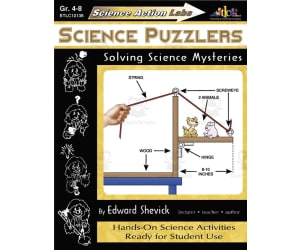
Science Action Labs Science Puzzlers: Solving Science Mysteries
, Grade 4, 5, 6, 7, 8, Labs, Experiments, Activities
Discover the Excitement of Science with 'Science Action Labs Science Puzzlers: Solving Science Mysteries' This enthralling resource is perfect for students in grades 4 through 8. It transcends traditional teaching methods to introduce exciting, hands-on labs that stimulate curiosity and critical thinking. Mysteries Awaiting Resolution With a new puzzle on every page to solve, young minds are exposed to a variety of scientific themes, including magnetism, gravity, balance and prediction-making. This comprehensive package contains 64 quick-print PDF pages, filled with unique science scenarios. This allows educators to easily tailor their teaching approaches according to student capabilities and interests. An Engaging Fusion of Fun and Learning! This amazing resource draws parallels between unraveling mystery plotlines like a seasoned detective while learning complex science concepts. All activities make use of simple household or classroom materials—perfect for group instruction or small group collaborations. Fosters open discussions about hypotheses Encourages sharing insights A Perfectly Flexible Resource for Modern Education Demands A key benefit of these labs is they cater well for solo explorers too! The puzzles function as excellent tasks not just inside the classroom but also outside it as engaging homework assignments. Homeschool Friendly! Educators directing homeschooling programs will find this resource extremely valuable. It brings scientific principles from textbooks into practical applications within our daily world – making scientific learning much more accessible! Note:All exercises promote student-led investigation leading toward direct observations followed by credible inference making - establishing a concrete base of understanding one concept at a time! A flexible teaching tool that adapts to diverse learners without compromising on the practical essence pivotal for grasping complex science concepts. An Invigorating Learning Experience With this comprehensive teaching tool, educators can not only teach, but also instill a love of learning – and there is no greater thrill than solving mysteries while learning!
Author Classroom Complete Press
Tags Science Lab, Action Lab, Science Puzzlers, Solving Mysteries, Activity

Genotype and Phenotype – Lab Station Activity
Science, Life Sciences, Biology, Grade 8, 9, 10, 11, Labs, Experiments, Activities
Genotype and Phenotype Lab Station Activity This fully editable teaching resource for high school biology students focuses on concepts related to Genotypes and Phenotypes. These include: Dominance Co-dominance Incomplete dominance Single gene inheritance Punnett squares Sex linkage. The lab station activity comprises engaging reading assignments and questions that stimulate critical thinking. These can be performed individually or in small groups. The real-world relevance of the hands-on stations enhances the understanding of these biological concepts. The Eight Unique Stations: The teaching resource includes eight distinct stations that involve various tasks aimed at promoting independent thinking over mere memorization. To give an example, "The Get Hands-On station" requires students to draw or build something based on their knowledge, while "The Research" station has them using digital tools for further study. Other stations entail articulating opinions in writing on subject-related issues or developing multiple-choice and short-answer questions. Bonus Activities: Apart from the main tasks, we also provide two bonus activities: a word scramble and a word search. These serve as fillers during downtime between station transitions. Ease of Preparation for Instructors: All it takes is printing out cards and arranging them around your classroom. Where necessary, an answer key is provided making it easy for educators to assess student's performance. In Summary, The Genotype and Phenotype Lab Station Activity promotes immersive exploration of essential biological concepts. It nurtures skills such as critical thinking and creativity while promoting active student participation. This resource is aptly designed for grades 8 through 11 biology lessons.
Author Teach With Fergy
Tags Genotype, Phenotype, Lab Activity, Biology, Genetics

Science Action Labs Health Science: Hands-On Science Activities Ready for Student Use
, Grade 1, 2, 3, Labs, Experiments, Activities
Science Action Labs Health Science: Hands-On Science Activities Ready for Student Use With a noteworthy focus on guided discovery and active learning, the Science Action Labs Health Science workbook provides elementary educators with a wealth of hands-on science activities. This printable resource, packed with eye-catching illustrations and easy-to-follow instructions, is designed to foster students' natural curiosity about their own bodies and health heroes such as doctors, nurses, etc. Covered Topics & Experiments This teaching tool covers a plethora of topics related to human biology and healthcare. Students will have the opportunity to engage in simple experiments aimed at unveiling fascinating facts about their eyes, ears, brain and other parts of the body including muscles, heart, bones etc. Beyond just physical elements this resource also anchors ample information concerning various health heroes contributing significantly in our society such as nurses or notable scientists who made groundbreaking discoveries. Versatility & Practicality Balancing instructional relevance with engaging practicality makes this workbook highly versatile for different educational settings. Teachers can utilize the content within it for whole group demonstrations during science lessons or assign individual tasks applicable to small-groups as part of interactive learning stations. Moreover parents who homeschool can use these exercises into their curriculum providing abundant scientific knowledge comprehensively supporting individualized student exploration. Creative Writing Exercises & Review Quizzes An added advantage is that learning does not stop after an experiment's completion! Each activity comes paired with creative writing exercises constituting an effective method reinforcing acquired knowledge while enhancing literary skills at same time. This 64-page PDF document catering Grade levels 1 through 3 presents educational material appropriately scaled to be challenging yet achievable rendering it ideal choice facilitating fascinating first encounter young minds have understanding intricacies bodies careful balance theory practice resulting forever love subject matter!
Author Classroom Complete Press
Tags Science, Action Labs, Health Science, Hands-on, Worksheets

Magnetic Fields – Lab Station Activity
Science, Physics, Grade 10, 11, 12, Labs, Experiments, Activities
This fully editable Lab Station Activity on Magnetic Fields is meant to get your students out of their seats and engaged in the content. This activity was designed for high school physical science students. Each station not only offers a unique opportunity to test your students' knowledge (offer an opinion, answer questions based on a video or reading, draw, etc.) but also provides a fantastic learning opportunity where your kids are learning through assessment. Each station comes with a description card while some also contain more detailed instructions, a reading, questions to answer, etc. Students are equipped with a recording sheet (passport) to write their answers. There is almost no prep for you. Simply print the cards, lay them out around the room and you're all set. An answer key is also provided where applicable. No prep, no formatting, no issues. Simply download, print (or upload to your class site) and you're all set. This resource is fully editable for your convenience This resource covers the following topics: •Magnet Fields •Law of Magnetic Poles •Permanent vs. Temporary Magnets •Earth’s Magnetic Field •Oersted’s Principal •The Right-Hand Rule •Magnetism and Electricity •Solenoids •Electromagnetism and Electromagnetic Induction •Faraday’s and Lenz’s Laws •Conventional Current and Electron Flow How do the Lab Stations work? Each station is specially designed to be a unique complement to the material while at the same time, provide a valuable learning experience. Below is an overview of how each station works. In your activity , each will be tailored to the specific content. Station 1: Get Hands-On – using their creative skills, students are required to draw or build. Station 2: Research – using a classroom computer or their own device, students must research a specific question/issue surrounding the topic. Station 3: Explain yourself – students write down an opinion to a question in paragraph form. Station 4: Rest Station - students can use this time to catch up on work they didn't have time to complete at a previous station or prepare themselves for an upcoming one. Station 5 - Applicability reading – students read a short passage from an article, website, etc. which directly connects the classroom content to a real-life application. Station 6: Test your knowledge – students answer 5 multiple choice questions than provide a written explanation for how/why they came to their conclusions. Station 7: Learn from the expert – using a classroom computer or their own device, students must watch a short video clip and answer the associated questions. They may stop, rewind and restart as often as they like during the time frame. Station 8 - Rest Station. Station 9: Become the question master – Students must create 2 multiple-choice questions, 2 true/false questions and 1 short answer question. Students must also supply the answers. ------------------------------- You might also be interested in my other lab station activities Physics: • Newton's Three Laws of Motion • Kinetic and Gravitational Potential Energy • Current Electricity and Circuit Diagrams • Static Electricity • Light Optics and the Production of Light • Sound, Sound Energy and Speed • One and Two-Dimensional Motion • Uniform Acceleration • How Planes Fly • Refraction • Friction • Energy and Its Forms • Density and Buoyancy • Electricity Production • Calculating Average Speed, Velocity, and Displacement • Mass, Volume, Density, & Buoyancy • Work and Energy • Renewable Energy • Plate Tectonics • The Rock Cycle • Natural Disasters • Pressure, Volume, and Temperature • Forces • Power • Liquids and Gases • Fossils and Geologic Time • Earthquakes and Volcanoes • Watersheds • Momentum, Conservation of Momentum, and Impulse • Nonrenewable Energy Sources • Projectile Motion • Magnetic Fields Coming Soon: - Work = F x d - The Doppler Effect and Supersonic Travel Biology: • Cell and the Cell Theory • The Human Digestive System • The Circulatory System • The Human Respiratory System • Mitosis and the Cell Cycle • Cellular Respiration and Photosynthesis • Photosynthesis • Cancer: Cell Division Gone Wrong - Volume I • Cancer: Cell Division Gone Wrong - Volume II • Cell Membrane and Transport • Hearing and the Human Ear • The Human Eye • Genetic Material: DNA and RNA • The Nervous System • Energy Flow In Ecosystems • DNA Manipulation and GMOs • Transcription and Translation • Cellular Respiration • Thermoregulation • Proteins and Nucleic Acids • Mutations • Meiosis • DNA, Genes, Chromosomes, and Alleles • Genetic Disorders • Fats • Reproductive Technologies • Muscular and Skeletal System • Integumentary System • Carbohydrates and Lipids Coming Soon: - Excretory system - Endocrine system General Science: • The Scientific Method and Science Skills • The Different Types of Clouds • Meteorology Chemistry: • Atomic Model, Notation and Atoms • Chemical Reactions and Balancing Equations • Molecular and Ionic Compounds • Physical and Chemical Properties & Changes • Acids, Bases, and Neutralization Reactions • The Periodic Table • Single and Double Displacement Reactions • Balancing Chemical Equations • Synthesis, Decomposition and Combustion Reactions • Atomic Theory, Atomic Structure and Isotopes • Types of Bonds and Intermolecular Forces • The Mole/Avogadro's Number • Density and Buoyancy • The Particle Theory and the Classification of Matter • Pure Substances and Mixtures • Solutions and Mechanical Mixtures Coming Soon: - Periodic table group properties Ecology and the Environment: • Ecosystems • The Classification of Living Things • Biodiversity and Invasive Species • The Carbon and Water Cycle • Climate Change • Photosynthesis • Cellular Respiration and Photosynthesis • Ecological Succession • Plant Sexual and Asexual Reproduction • Earth's Seasons • Interactions Within Ecosystems • Physical and Behavioral Adaptations Space Science: • The Life and Death of Stars • The Moon and its Phases • Life In Space • Our Solar System • Solar and Lunar Eclipse • Earth's Seasons • Asteroids, Comets and Meteors These station cards are meant to be used as a lab activity but can also be utilized in a review task before a test or a quiz. Used either way, your students will love it! I know mine do and I'm telling you from first-hand experience as I've used this activity in my own class. ***************************** For free resources, useful teaching tips, and tools, please visit my blog - TeachScienceWithFergy.com If you have any questions please feel free to send me an email - devon@teachwithfergy.com
Author Teach With Fergy
Tags Magnetic, Field, Solenoids, Electron, Lab Station

Synthesis, Decomposition, and Combustion – Lab Station Activity
Science, Chemistry, Grade 7, 8, 9, 10, Labs, Experiments, Activities
Synthesis, Decomposition, and Combustion – Lab Station Activity Immerse your students in the fascinating world of chemistry using the Synthesis, Decomposition, and Combustion Lab Station Activity . This educational resource is perfect for teachers looking to actively engage their students in learning about the human digestive system . Designed specifically for grade 7-10 science and chemistry students. Interactive Learning Stations This interactive lab activity combines education with assessment. Your students journey through each of nine uniquely designed stations. Each station comes with a comprehensive description card that provokes discussions, challenging questions or creative tasks such as drawing or building artefacts relevant to digestion study. Simplicity at Its Best! One prime advantage for educators using this resource is its simplicity, requiring minimal preparation on your part. Just print and lay out the included descriptions cards before class. A Variety of Exciting Activities Variety offered by strategic exercises encourages self-learning. 'Rest station' allows learners reflection time between intense cognitive exercises. Bonus activities like exciting word scrambles ensure idle time is eliminated from your classroom. Note: You can use these lab-based learning resources either during actual lessons experimenting inside laboratory conditions or outside labs like review tasks before tests etc., Teachers have successfully employed these versatile tools within whole-group settings while others assign them as homework. In conclusion - With this thoroughly researched lab station activity on synthesis decomposition & combustion aspects of Human Digestive System hands-on illustrations insightful context reviews based games quizzes etc., expect strengthened understanding amongst children regarding organs disorders associated with digestion!
Author Teach With Fergy
Tags Chemistry Lab, Interactive Learning, Digestion, Synthesis, Decomposition

10 Plant Experiments for Elementary School
Nature & Plants, Life Sciences, Science, Grade 3, 4, 5, Labs, Experiments, Activities
🌱 Bring Science to Life with Hands-On Plant Experiments! Make your next science unit unforgettable! These 10 fun and simple plant experiments help students explore how light, water, and soil affect plant growth —all through easy, hands-on discovery. Perfect for Grades 4–5 , this low-prep science lesson keeps curiosity blooming and engagement high. ✅ What’s Included: 10 easy-to-follow plant experiments Step-by-step teacher and student instructions Printable observation & reflection worksheet Answer key for quick grading Materials list (uses items you already have!) 🌿 How It Works: Students rotate through experiment stations to explore plant science concepts in small groups. They’ll: Watch seeds sprout See how celery absorbs colored water Discover how plants bend toward light Predict, observe, and record results It’s perfect for centers, science labs, or Earth Day activities , and easily adapts for whole-group instruction or independent learning. 📚 Standards & Skills: Scientific inquiry and experimentation Making predictions and observations Recording and interpreting data NGSS-aligned for elementary plant science 💡 Why Teachers Love It: ⭐ “My students were totally engaged—simple setup, big results!” ⭐ “Perfect mix of fun and real science skills!” ⭐ “So easy to prep—everything’s ready to go!” This ready-to-use lesson helps you teach real science while sparking student curiosity and teamwork. ⭐ Bring excitement to your science lessons—watch your students explore, experiment, and grow!
Author Bright Classroom Ideas Marketplace
Rating
Tags Plant, Experiment, Lab, Biology, Botany, Elementary, Grade 4, Grade 5
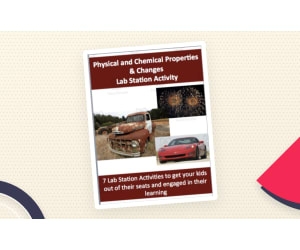
Physical and Chemical Properties – Lab Station Activity
Science, Chemistry, Grade 7, 8, 9, 10, Labs, Experiments, Activities
Physical and Chemical Properties Lab Station Activity engages students as they rotate through 9 stations testing their knowledge of matter's physical and chemical properties. Students get hands-on drawing atoms, researching questions, watching videos, answering multiple choice questions and more. Covers key concepts like states of matter, qualitative vs quantitative properties, physical and chemical changes, and energy transformations. The activity comes with station description cards, detailed instructions, articles, video links, and recording sheets. Questions assess student learning and bonus scramble and word search activities ensure no downtime. This versatile resource works for whole group, small groups, or independent lab work. Easy to print and implement with no prep required. Applicable for middle and high school chemistry and physical science classrooms.
Author Teach With Fergy
Tags Physical, Chemical, Properties, States Of Matter, Lab Stations, Physical And Chemical Changes Lab High School, Lab Chemical And Physical Changes Worksheet, Physical And Chemical Changes Lab Middle School, Physical And Chemical Changes Activities For Middle School

Momentum, Conservation of Momentum, and Impulse – Lab Station Activity
Science, Physics, Grade 9, 10, 11, 12, Labs, Experiments, Activities
Momentum, Conservation of Momentum, and Impulse Lab Station Activity Bring physics concepts to life and get students engaged with this editable high school lab station activity . Students will rotate through 9 stations, each offering a unique hands-on opportunity to demonstrate understanding of momentum, conservation of momentum, and impulse. Activities range from drawing and explaining to answering video questions and completing knowledge checks. Recording sheets provided for students to document conclusions. Addressing key NGSS standards HS-PS2-2 and HS-PS2-3, topics covered include momentum, conservation of momentum, impulse, crumple zones, billiards, and types of collisions. Contains bonus vocabulary puzzles to prevent downtime between stations. This self-directed experience needs almost no teacher prep - simply print, set up, and students are ready to learn. Edit files to fit your specific needs. Check the preview for even more lab station activities spanning science disciplines.
Author Teach With Fergy
Tags Momentum, Conservation, Impulse, Inertia, Lab Station, Impulse Activity, Momentum Labs Physics, Momentum And Conservation Of Momentum Answer Key, Momentum Lab, Conservation Of Momentum Lab, Momentum Physics Labs

Science Action Labs Water Science: Active Science with Water
, Grade 4, 5, 6, 7, 8, Labs, Experiments, Activities
Science Action Labs Water Science: Active Science with Water This enriching resource is designed primarily for students from grade 4 to grade 8, studying general science. It provides a hands-on approach that allows students to actively participate in conducting experiments and investigating various aspects of water. This method cultivates a deeper understanding and appreciation for this integral part of our life and environment. The resource comes in a convenient PDF format, consisting of 64 print-ready pages packed with diverse activities. These activities are designed not only to be educational but also stimulating, fostering excitement as learners explore the following topics: Exploring water pressure Examining buoyancy and surface tension Investigating weather impacts on water The dynamic nature of these resources triggers interest in students while enhancing their critical thinking skills through problem-solving scenarios provided by the experiments . Beyond just Textbooks Theory....Active Learning Alternative! This covers fundamental aspects that stimulate student inquiry about everything related to Hydroscience from natural weather phenomena to physical properties like buoyancy, breaks free from conventional passive learning methodologies. No Significant Prep Work Required! An added benefit? The clear directions accompanying the activities ensure that minimal preparation is necessary on part of the teacher - an important advantage when juggling busy schedules! In conclusion, Educators seeking versatile resources that encourage experiential learning will value investments like Science Action Labs Water Science: Active Science with Water. Its versatility enhances your teaching strategy, ensuring productive exploration time during your assigned science periods while ensuring practical learner experiences they won't soon forget! .
Author Classroom Complete Press
Tags Ice Cube Science, Chemistry Of Water, Water Conservation, Purifying Polluted Water, Science Labs

Scientific Method - Lab Station Activity
Science, Basic Science, Grade 6, 7, 8, 9, Labs, Experiments, Activities
Scientific Method - Lab Station Activity This lab station activity allows students to apply their understanding of the scientific method by moving around the classroom and working with peers. Stations focus on creating hypotheses and procedures, identifying variables, analyzing data and drawing conclusions, and formulating testable questions. The varied format facilitates unique learning and assessment opportunities. Typically 2-3 stations are graded per group in a 30-minute timeframe. Stations work well for introducing or reviewing the scientific method in middle and high school science classrooms. This general science resource can be adapted for use in chemistry, physics, biology, and other branches when customized hypotheses and testable questions are generated.
Author Teach With Fergy
Tags Lab Safety, Science Safety, Classroom Lab Safety, Lab Safety Lab Station, Lab Station Activity
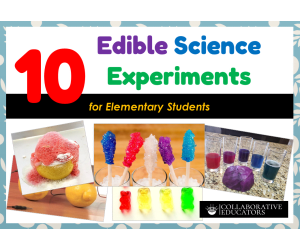
10 Edible Science Experiments for Elementary Students
Chemistry, Science, Grade 1, 2, 3, 4, 5, Labs, Experiments, Activities
Prepare yourselves for some incredibly entertaining science! "Edible Science Experiments for Elementary Explorers," this book, is your pass to a delicious journey. Do you wish to witness a rainbow that is (almost) edible? We have it. Consider creating enormous gummy bears. Simple as pie. You can even produce real butter and shake cream. That's cool, isn't it? There are ten incredible experiments within. You can find items in your kitchen for each one. The steps are quite easy. We give you detailed instructions. And you know what? The majority of the outcomes are yours to keep! You'll learn cool stuff too. Like why some liquids float and others sink. Or how mixing things can make bubbles. Science doesn't have to be boring. This book proves it! So grab your grown-up, put on your apron, and let's get started. You'll be a science whiz in no time. And you'll have some tasty treats along the way. It's science you can taste! Let the edible experiments begin!
Author Bright Classroom Ideas Marketplace
Rating
Tags Science, Chemistry, Lab, Elementary, Experiment