



3,879 products added recently
Page 9 - High School Games
Bring interactive learning to your high school classroom with games that support advanced concepts. This collection includes simulations, debates, and problem-solving challenges across subjects like science, math, and social studies. By integrating these games into your lessons, you can enhance engagement and deepen understanding.

 Show filters


Assessments: Romeo and Juliet (ACT)
ELA, Literature, Grade 8, 9, 10, 11, 12, Activities, Games, Teacher Tools, Assessments
Assessments: Romeo and Juliet (ACT) - A valuable teaching resource This educational tool is expertly designed for educators in both public schools or homeschooling scenarios. It effectively tests students' understanding of Shakespeare's famed play, 'Romeo and Juliet', making it an inclusive study aid suitable for grades 8 through 12 under the umbrella of Language Arts & Literature. Main Contents of the Product: The primary feature being quizzes based on each ACT of the play. Besides standard assessments, it includes a creative blend of passage translations, comprehension checks, and enriching references to specific literary devices. Promotes interest in key figures of speech such as soliloquies, oxymorons, foreshadowing techniques, double ententes, puns dramatic irony and mythological allusions. Each quiz based on an ACT comprises seven thought-provoking passages for translation along with ten multiple-choice questions designed to gauge teens' understanding over plot specifics. These assessment elements serve to not only evaluate learning outcomes but also nurture critical thinking skills among students. Versatility Beyond Testing Assessments: Romeo and Juliet (ACT), aside from its conventional testing function,bears potential as interactive learning activities. It can seamlessly be adapted into popular review games like Jeopardy or Who Wants to be a Millionaire?. The resource syncs well into a range of applications from homework assignments or group studies; providing opportunity for whole class participation ensuring education while entertaining. Ease-of-Use with Word Document File Type The purchased product comes in Word document file type facilitating easy modifications as per individual student needs or learning preferences. This provision is instrumental in saving time for busy educators without compromising delivery of quality education. Conclusion The key takeaway? With Assessments: Romeo and Juliet (ACT), educators gain access to a versatile tool crafted with diverse classroom needs at its core – the epitome of teaching empowerment!
Author The Education Lab
Tags Assessment, Literature, Shakespeare, Quizzes, Critical Thinking

NO PRINT Gamer-ticulation Digital Dots and Boxes Articulation
Special Resources, Speech Therapy, Grade 4, 5, 6, 7, 8, 9, 10, 11, 12, Activities, Games
NO PRINT Gamer-ticulation Digital Dots and Boxes Articulation The NO PRINT Gamer-ticulation Digital Dots and Boxes Articulation excels as a teaching tool for educators eager to engage older students in intensive speech therapy sessions. This interactive PDF game relies on an appealing video-gamer theme and the all familiar dots-and-boxes format adored by students, ensuring high-intensity, fun-filled articulation practices. In spite of being a digital product, it emanates the charm of navigating an old-fashioned pencil-and-paper game. Players employ annotation tools for drawing lines between the dots while simultaneously speaking targeted words as per their individual phonemes. The outcome is an enthralling synergy of learning and play that can easily pull off 100+ trials in one session. This resource allows for 51 target words for initial, medial, and final positions with 13 different phoneme options offered per board—ensuring huge variety! Perfect for whole classrooms or individualized speech therapy sessions on small groups or even single individuals; its digital form factor ensures easy integration within homework assignments as well. Beyond the basic interaction aspects via annotation tools, it also offers customizability elements: Facilitators can personalize this interactive experience by typing in winner’s names at endgame or incorporating focus-target words on blank board games using fillable blanks within each file—thus providing flexibility according to learner requirements. Suitable from Fourth Grade onwards till Twelfth Grade Adequate range from fourth grade onwards till twelfth grade makes this tool effective across broader academic spectrum particularly focusing on higher grades where engagement compounded with productivity is critical towards effective learning outcomes not only in Speech Therapy but other Special Learning Resources requirements as well, thus offering substantial utility via game-type learning resources accessible through simple PDF files. Indispensable for Progressive Education All these benefits consolidated render the NO PRINT Gamer-ticulation Digital Dots and Boxes Articulation resource to be not only useful but indispensable for every progressive educator who desires to diversify their teaching toolbox.
Author Intrepid Speech Therapy Materials
Tags Interactive Game, Speech Therapy, Digital Resource, Articulation Practice, Engagement

Who Said It: Shakespeare or...? Classroom Card Game
ELA, Literature, Grade 8, 9, 10, 11, 12, Activities, Games
Who Said It: Shakespeare or...? Classroom Card Game This innovative teaching resource is specially designed for educators who wish to immerse students in the fascinating world of language arts. Primarily focusing on the enduring words of English playwright, William Shakespeare, it offers an exciting method to study literature. Crafted for Grades 8 through 12, this classroom card game bridges classical and contemporary communication. The primary objective? Sparking pupils’ interest in Shakespeare's unique use of language while drawing direct comparisons with modern pop culture references. An Engaging Learning Resource A Fun Educational Tool : Use the game to enrich your language arts curriculum or as a point of discussion. Play-based Learning : Group activities significantly enhance learning outcomes and foster critical thinking. Informed Choices : Move from guesswork based on intuition towards informed answers backed by knowledge indicating active learning. A Twist to Routine Assignments Perfect for small study groups & homework assignments that focus on engagement over humdrum drilling techniques. Think bite-sized trivia loaded with vital lessons! Dare we say this is more than a quick filler exercise—it offers hours loaded with linguistic explorations. The Gameplay Process Your task starts by presenting 'Who said it: Shakespeare or...?', followed by a quote which needs correct attribution. Students then deduce if they think William Shakespeare himself, or famous individuals like Batman, Justin Bieber,Tupac Shakur, Taylor Swift among others, made the remark; thus linking Bard’s England with today’s global milieu. Note: This tool’s digital PDF format ensures it's easily printed and always game ready. Growth in appreciation for how words transcend the centuries is an expected outcome! Shakespeare or...? It's up to them to decide!
Author Fairways and Chalkboards
Tags Language Arts, Shakespeare, Classroom Game, Literature Study, Critical Thinking
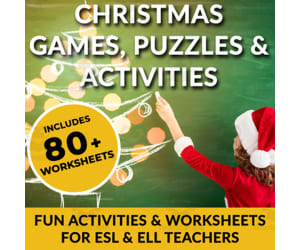
Ultimate Christmas Activity Bundle: ESL & ELL-Friendly Games, Puzzles, and Worksheets for Festive Fun & Learning
ELA, Language Development, ESL, Grade 2, 3, 4, 5, 6, 7, 8, 9, 10, 11, Activities, Games
Delight your ESL or ELL students this festive season with our fun-filled Christmas Reading Activity and Game Bundle! Packed with an array of engaging, no-prep, and low-prep activities, these printable resources will help you and your students dive into the holiday spirit while enhancing their language skills. Bundle features: • Printable Christmas Cards - ready-to-use cards for students to write heartfelt messages and share with family, friends, or classmates. Also serves as charming wall art or personalized cards from you to your students. • Christmas Flashcards - 15 themed flashcards in large, medium, and small sizes for versatile flashcard games and activities. • Differentiated Christmas Crosswords - three-level crossword puzzles that reveal a hidden Christmas idiom upon completion. • Christmas-themed Conversation Starters - printable prompts to boost students' speaking confidence, fluency, and communication skills. • Xmas Grammar & Vocab Worksheets - a double-sided worksheet packed with activities to improve all 4 key language skills, vocabulary, and grammar. • Print & Cut-out Christmas Wall Art - a festive 'Merry Christmas' banner to brighten your classroom. • Maze Games - entertaining Christmas maze activities for younger learners. • Print & Cut-out Christmas Card Activity - creative cut-outs for students to design unique and beautiful Christmas cards. • Christmas Spot the Difference - five worksheets with accompanying writing activities. • Walk & Talk Quote Activity - thought-provoking quotes for paired discussions around the classroom, perfect for older students. • Listen & Draw - a speaking and listening activity that fosters clear communication and collaboration between students. You can find a Christmas reading worksheet here: Santa Claus Reading Comprehension Worksheet Or, discover my full store here: The Laughing Linguist Homepage
Author The Laughing Linguist
Tags Christmas, Xmas, Games, Activities, ESL, Puzzles, Worksheets, Fun Christmas, Christmas Games, Christmas Bundle

Country Study on China - Guess Who Game Cards on famous Chinese people
Social Studies, Geography, History, History: Asian, Grade 7, 8, 9, 10, 11, 12, Activities, Games
Country Study on China - Guess Who Game Cards on famous Chinese people This Teaching Resource is a fun Guess Who Game PDF (1 slide, 15 cards) on Famous Chinese People. This Printable Resource can be great for Geography, Asian History and Social Studies Classes. Suitable Learners for this kind of lesson are students from 7th Grade to 12th Grade. This Geography + Social Studies Guess Who Game on Famous People from China (Country Study) aims to introduce learners to China and its most famous Chinese People (leaders, writers, thinkers, actors, martial artists etc.). Little Preparation is needed for this Social Studies + Geography Activity. Some of the Chinese People selected for this Geography + Social Studies + Asian History Country Study on China are: Confucius (Founder of Confucianism) Sun-Tzu (thinker and military strategist; author of "The Art of War") Wu Cheng En (author of "The Journey to the West") Xi Jinping (Chinese President) Liu Cixin (Sci Fi Author of "The Three Body Problem" Jackie Chan (Actor) Bruce Lee (Martial Artist) and many more! A very fun and engaging way to play this "Guess Who on Famous People from China" (country study on China) game can be the following: all Learners sit on the floor in a circle every Learner has a Flash Card on their face every Learner/player asks a question about their Flash Card 's famous Chinese character This Social Studies + Geography Country Study on China PDF Printable Teaching Resource (1 slide, 15 cards for 15 Famous People from China) can be great for learners from 7th grade to 12th grade to introduce China and its Culture through its most important and celebrated people. Learning with Alan is a Brand New Teaching Resource/Educational Material Store whose aim is to help Teachers, Educators and Tutors to achieve their teaching objectives while creating a fun and stimulating environment. Never Forget! If you want to browse more of my Teaching Resources, click here Learning with Alan!
Author Learning with Alan
Tags Asia, China, Guess Who, Game, Cards, Printable, Geography, Chinese, Social Studies, Asian History

Landform Formation Taboo Game
Social Studies, Geography, Grade 9, 10, 11, 12, Activities, Games
Landform Formation Taboo Game Support your students’ learning with this Landform Formation Taboo Game. This resource was specifically designed to provide students with an interactive and engaging way to learn more about and review landform formations. This game was crafted for your high school geography students. How to Use The Landform Formation Taboo Game: Once you have completed instruction for yourLandforms unit , you are ready to set this game up. You will print the cards on cardstock to avoid transparency through the paper. Cut them out and have them prepared as a deck. There are 3 pages of cards with 9 cards per page. There will be 27 cards available for this game. Some of the topics included are plate tectonics, convection flow, Epicentre, Ring of Fire, and ice erosion. Taboo is a word guessing game where the objective of the game is for a player to have their partners guess the word on the player's card without using the word itself or five additional words listed on the card. You can have students play this in small teams or split the class into 2 teams. I usually play this as a whole class and only split the class into 2 teams. I usually give each team 2 minutes per turn, but you can modify this to your liking. Full game details are included in this resource. This game is provided in PDF form and an editable Word document. I hope you enjoy! Here are links to similar resources in my store: Choosing Reliable Sources Lesson One Point Perspective Art Lesson Friendly Letter Writing Template Google Classroom Etiquette Rules Presentation Positive Self-Affirmations Lesson Fluids Unit Check Out More Resources from My Store: Resource Garden
Author Resource Garden
Tags Landforms, Formations, Landform Formation, Social Studies Game, Small Group, Partner Game, Taboo Game, Geography
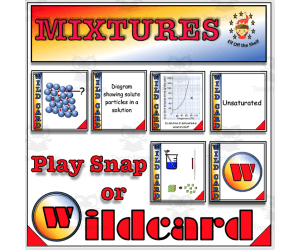
Mixtures - Solutions, Suspensions, Dissolving and Saturated Solutions - Wildcard and Snap Card Games for Middle School
Science, Chemistry, Grade 5, 6, 7, 8, 9, Activities, Games
A great way to consolidate learning on mixtures including solutions, suspensions, dissolving, solubility and saturated solutions with this pack of cards which can be used to play two games – wildcard and snap. So much fun, students don’t even realise they are learning! Prior Knowledge Required > Elements and compounds are pure substance and mixtures are not. > Meaning of the terms solute, solvent, solution, soluble and insoluble. > Particle theory to explain why stirring, temperature and particle size affect the rate of dissolving. > Particle theory to explain dissolving, suspensions and saturated solutions. > Extracting information from solubility curves; What You Get > 661 Zip file playing cards > Animated PowerPoint with instructions for playing wildcard and snap See more Elf Off the Shelf resources on this topic and many others
Author Elf off the Shelf Resources
Tags Saturated Solution, Dissolving, Solute, Solvent, Mixtures

ESL - ELL Taboo Speaking Game, House and Home Vocabulary
ELA, Language Development, ESL, Grade 6, 7, 8, 9, 10, 11, 12, Games, Activities
Introducing the ESL - ELL Taboo Speaking Game: House and Home Vocabulary This excellent language learning resource enriches language proficiency and is designed to promote interactive engagement. With a particular focus on 'House and Home Vocabulary', it provides students with essential conversational terminology needed for daily living scenarios. As an engaging speaking activity , TABOO offers an innovative platform for relative challenges to strengthen the English prowess of ESL students while boosting their vocabulary too. About The Game The game includes 30 carefully crafted TABOO game cards, available both in color and black-and-white versions. It adapts effortlessly across different stages of learner’s journey. The player's main task is to guide their teammate into guessing the word displayed at the top of each card. However, certain taboo words are off-limits when providing clues. This rule adds a fun challenge yet helping beginner-level learners master new phrases as they construct sentences with these taboo words. Points are scored when team members successfully guess each word through accurate hints provided by their teammates. Note:An alternative way that limits clues to just 15 words maximum can spice up things between rounds or classes. Versatility Of The Product The product comes in multiple file types making it versatile for whole group activities or smaller breakout group tasks whether across Grade 6 or Grade 12 Language Arts classes or homeschooling sessions focusing on ESL subtopics. Such engaging activities often significantly enhance learning outcomes besides maintaining student interest throughout sessions. Involving Experiential Learning TEaching should not only be aimed at imparting knowledge rather creating an experiential-rich environment makes it more meaningful! The ESL - ELL Taboo Speaking Game goes beyond instruction, providing young minds with just the right fun to learning ratio.
Author Love Learning Languages
Tags ESL, ELL, Taboo Game, House Vocabulary, Speaking Activity, Esl Speaking Games

Smart Cookie Game-Part 2 (2022 Version)
Special Resources, Social Skills, Grade 4, 5, 6, 7, 8, 9, 10, 11, 12, Activities, Games
In this Smart Cookie game (2022 version), students try and race each other to be the first one to guess the answer based on one at a time clues after one at a time clicks via Presentation mode on Google Slides. This is based on the wildly popular game Smart A** but more applicable and relevant to elementary-high schoolers. I have included many references to popular t.v. shows and famous people the students born after 2001 would know. This is a trivial pursuit-like game but more fun and students feel more successful. It is just for fun and perfect for Zoom, an ice breaker or indoor recess but they might even learn something! There are 3 categories; Who Am I?, Where Am I?, and What Am I? There are 42 slides for each category. Use in Presentation mode for your class. There are answer sheets at the end for each card so the Game Leader can reference quickly and keep track of the cards used. This is in PowerPoint so the completed cards will turn black after being used for easy game play. In this new 2022 version there are all new cards for each category!
Author Jennifer Moyer Taylor
Tags Games, Brain Breaks, Fun Stuff, All Subjects, Trivia, Smart Cookie Trivia, Smart Cookie Math

What Doesn't Belong? - AP Psychology Review Game
Social Studies, History, Psychology, Grade 10, 11, 12, Games, Activities
This resource is a What Doesn't Belong? - AP Psychology Review Game. There are 2 pages worth of terms related to Neuroscience. Words are grouped into fours. Students will analyze the words and determine which one doesn't belong in that group.
Author Skinner's Box
Tags Vocabulary, Terms, Psychology, Review Game, Which Word Doesn't Belong Worksheets, Which One Doesn't Belong Game For Adults, Which One Doesn't Belong Worksheet

Space Board Game Activity
Science, Earth and Environmental Sciences, Space, Grade 2, 3, 4, 5, 6, 7, 8, 9, Games, Activities
Activity Introduction An amazing activity designed for the students to learn more about famous places in different countries. Space Board Game Do you like reading about space? If yes, what is your favorite topic? What do you know about our solar system? What is the smallest planet in our solar system? What is the biggest plant in our solar system? What is the hottest plant in our solar system? And what is the coldest one? Do you think there are aliens? If yes, what do you think they look like? What do they eat and how they speak to each other? Where do they live? What is a galaxy? And what is a milky way? Have you recently saw a shooting star? If yes, tell us more about it, like when did it happen and where? What is a blackhole? Can a blackhole gets bigger by time? Do you like counting the stars? What do you think a star is made of? Space Board Game Activity The activity is perfect for encouraging the researching skills for the students, while learning more about this fantastic place. Space This friendly designed worksheet is suitable for students at school, homeschooling, and as a group activity. Instructions Print the first page and laminate it. Cut out the spacemen and glue them to cardboard to make them sturdier. Next, give one to each player. Roll the dice then start going around the board until you reach the finish. Each planet has a question you can find on page 2, and the stars have some slightly harder questions for players to answer. Format Available in a PDF format.
Author Educational Voice
Tags Space Board Game Activity, Space Board Game, Space Board Activity, Space, Space Facts, Space Facts For Kids, Planet, Planets, Stars, Stars Facts
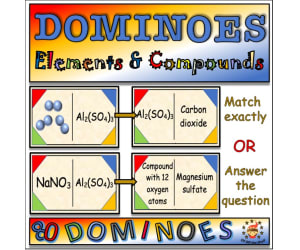
Elements and Compounds Dominoes - Middle School Science
Science, Chemistry, Grade 6, 7, 8, 9, Activities, Games
Elements and Compounds Dominoes - Middle School Science A teaching resource targeted at 6th to 9th-grade educators, the Elements and Compounds Dominoes provides an in-depth understanding of the fundamentals of chemistry like elements, compounds, atoms, and molecules. About the Game The game is composed of 80 dominoes, which feature questions and answers related to various topics instead of numbers. It encourages learners to explore atomic combinations that form different types of molecules from elements or compounds. Additionally, it familiarizes students with elemental symbols derived from either English or Latin names. Unique Learning Approach This product distinguishes itself through intensive chemical formulae explorations. It guides students on interpreting brackets; naming compounds ending in special suffixes like 'ide'; how many atoms are contained in each compound based on a representative symbol. Suitable for whole-group sessions: Promotes cooperative learning dynamics. In small group activities:Fosters focused peer-to-peer interaction. Serves as a homework exercise: Potentiates independent self-learning. The rules are clear and precise—explaining how matches should be recognized whether through matching names with symbols or circuit diagrams . If a challenge arises over incorrect matches, provisions have been made for verification purposes. Aiding PowerPoint Animation, A complementary PowerPoint animation is included covering all necessary rules—making it easy even for first-time players while maintaining educational value. Bring your student's understanding beyond routine textbooks by utilizing this interactive yet informative resource. Through this fun game, students will grasp key chemistry concepts—an innovative approach that can easily replace monotonous lectures and provide a novel dimension that excites as much as it enlightens.
Author Elf off the Shelf Resources
Tags Chemistry, Middle School, Elements, Compounds, Atoms, Domino Element

VR Game Design Activity
Science, Technology, Grade 3, 4, 5, 6, 7, 8, 9, Games, Activities
Activity Introduction An amazing activity designed for the students to learn more about STEM. VR Game Design Do you like STEM subjects? what is your favorite one? Have you ever tried to plant a seed? If yes, tell us more about it. Or have you ever tried to invent something? If yes, tell us more about it. And how do you think it will help us? Have you ever seen a microorganism under a microscope? What was it? And how it looked like? Mathematics is a marvelous subject. Let' sharpen our brains and solve some equations. Do you like timetable tricks? What is your favorite one? Do you know how to code? Have you ever created an app or a game before? If yes, how was it like? VR Game Design Activity The activity is perfect for encouraging the researching skills for the students, while learning more about this fantastic topic. VR Game Design This friendly designed worksheet is suitable for students at school, homeschooling, and as a group activity. Instructions Design an interactive VR game , then add some labels for the player. Next, describe how it works, the equipment or controls you use to play, the goal of your game , and who your game is designed for. Format Available in a PDF format.
Author Educational Voice
Tags VR Game Design Activity, VR Facts, VR Facts For Kids, VR Game Design, Game Design, Game Design Facts, Game Design Facts For Kids, Technology, Technology Facts, Technology Facts For Kids

White Light, Dispersion and Colour Filters Dominoes Game for Middle School
Science, Physics, Grade 5, 6, 7, 8, 9, Games, Activities
The White Light, Dispersion and Colour Filters Dominoes Game for Middle School The White Light, Dispersion and Colour Filters Dominoes Game for Middle School is an innovative teaching resource designed to enhance student understanding of complex scientific concepts. This enjoyable and engaging tool focuses on aiding middle school students (Grade 5, Grade 6, Grade 7, Grade 8, and Grade 9) in mastering the foundational concepts related to the dispersion of light. Instead of traditional numbers or dots, these dominoes feature statements and questions on key topics such as white light dispersion, the order of colours in the spectrum and how colour filters operate. Prior knowledge needed to grasp this game includes awareness about primary (red, green, blue ) and secondary colours (magenta cyan & yellow )of light. Likewise knowing that any two primary colours when mixed give a secondary colour strengthens the comprehension further. If all three primaries are mixed it gives white light. Cleverly integrating symbols or descriptions within sketches or circuit diagrams prompts playful matches during domino play sessions; thereby ushering in visual learning. The game also trains learners' observational skills by instilling that any object only reflects its own collinear while absorbing all other types. About Resource Content: The resource contains ninety dominos along with an animated PowerPoint presentation detailing gameplay rules ensuring teachers can quickly grasp this new pedagogical concept for their science classes. In gameplay, if players spot a wrong match, they have the opportunity to challenge it promoting critical thinking. This product creatively bridges learning gaps by turning typical class assignments into interactive group activities thereby making physics more approachable. Versatility: One could use this versatile tool individually for homework assignments as well as collectively within small specific learning groups inside classrooms catalyzing collaborative learning. They come in multiple file types providing ease across different digital formats ensuring convenience at every step. In conclusion, educators seeking fresh perspectives towards theoretical physics teachings would appreciate the White Light, Dispersion and Colour Filters Dominoes Game as it leads the way through scientific exploration in a non-traditional yet profoundly impactful manner.
Author Elf off the Shelf Resources
Tags White Light, Dispersion, Colour Filters, Dominoes Game, Middle School

Alliance System Game – WWI Alliances Activity
Social Studies, History, History: World, Grade 9, 10, Activities, Games
This is an Alliance System Game for World War I. National Curriculum Standard: Learners will be able to describe and explain conditions and motivations that contribute to conflict, cooperation, and interdependence among groups, societies, and nations. Specific Objective: To understand how the Alliance System led to World War I. Materials: Alliance System Activity Worksheet Procedure: You may want to start the lecture on World War I by explaining some of the more general reasons why it happened, such as the rise of imperialism, the industrial revolution, nationalism, and even militarism. Then explain how the competition between European powers and their need for protection led to the formation of certain alliances, the Triple Entente and the Triple Alliance. Then explain how even though the main alliances were explicit, some of the smaller alliances were not. Tell the students they will see how having unclear or secretive alliances is eventually going to lead to WWI. Then get the activity started. Distribute the worksheet below and explain all the rules listed on it. You may want to read it together with them and explain the rules. Feel free to delete or add more countries depending on your class size. Depending on class size also, assign countries to pairs or individuals. One thing you want to emphasize about the rules is that they have to choose their alliance very carefully. Weakest nations may not want to ask most powerful nations because their likelihood of rejection is very high. After the activity is over, ask students how the alliance system led to WWI. Then you may want to continue the lecture explaining how a small event such as the assassination of Franz Ferdinand led to WWI. (When Austria declared war on Serbia, it wasn’t altogether clear that Russia would get involved precisely because the alliances were not that clear. As you continue the lecture, also let students know that when Germany passed through the little country of Belgium they may not have anticipated Great Britain to get involved. That’s why Woodrow Wilson proposed “No more secret alliances” as part of his Fourteen Points later.)
Author Creative Educator
Rating
Tags Alliance System Game, World War I, Social Studies Game, Whole Group, Government, Politics, Lecture, European Powers, Franz Ferdinand, Wwi Alliances, The Alliance System, World War 1 Activity, Wwi Simulation Game, Secret Alliances Ww1, How Does Alliances Contribute To Ww1, What Was Alliances In Ww1, Alliance System World War 1, The Alliances In Ww1, Alliance World War 1, Alliances Wwi, What Alliances Were In Ww1, World War 1 Lesson Plans Middle School, Alliances Leading To Ww1, Ww1 Alliance System, World War 1 Activities High School, What Is Alliances In Ww1, What Is An Alliance System, Alliance System In Ww1, What Is Alliance System, Wwi Game, Secret Alliances In Ww1, What Are Alliances In Ww1, World War 1 Activity High School

Childhood Game Narrative Essay
ELA, Writing, Creative Writing, Grade 6, 7, 8, 9, 10, 11, 12, Games, Activities
The Childhood Game Narrative Essay The Childhood Game Narrative Essay is a comprehensive teaching resource, designed to nurture creativity in your students. Over a week, this assignment allows students to reflect on their cherished childhood games and transform those memories into meaningful narrative writing. The exercises are perfectly suited for enriching language arts lessons with thought-provoking content and fostering imaginative storytelling skills. This product caters to diverse learning styles as it can be used during whole group instruction or within small group settings, or assigned as individual homework tasks for deep personal engagement. Product Details: Suitable For Grades 6-12 English Language Arts This product has been expertly crafted for English Language Arts classrooms (Grade 6-12). Clear instructions accompany each task along-with user-friendly materials that structure the writing process from inception to culmination - including brainstorming sessions, drafting assignments, peer editing opportunities down till final polishing touches on the narrative content. All-Inclusive PDF Bundle Everything needed is bundled into one comprehensive PDF set up ready-to-go that educators will appreciate for its user-friendliness without needing any additional preparation or external sources. In this package you'll find: A Childhood Game Narrative Essay Assignment Sheet providing clear rationale behind essay guidelines alongwith step-by-step directions. A Planning Activity aiding students' recollection of their favorite childhood games whilst pondering over corresponding narrative elements. A unique Narrative Planning Worksheet innovatively designed; ideal especially to guide those who struggle with idea generation process. Peer Editing Worksheets equipped with a beneficial collaboration assessment rubric promoting cohesive learning Two different grading rubrics offering variety catering needs across different classroom sizes and settings In conclusion, The Childhood Game Narrative Essay is a distinctive teaching tool combining personal reflection with structured creative writing practice aligned directly with curriculum standards. An invaluable addition for any language arts classroom - fitting the needs of not just public school teachers but also learning centers and homeschoolers looking to bring an innovative touch whilst nurturing creative writing skills.
Author The Language of Educational Art, LLC
Tags Creative Writing, Narrative Essay, Childhood Games, Storytelling Skills, Language Arts