



3,972 products added recently
Page 51 - 5th Grade Assessments
Support your fifth-grade students as they prepare for the next stage of their education with assessments that cover advanced concepts. This collection includes comprehensive tests in math, language arts, and science. By utilizing these tools, you can address learning gaps and reinforce strengths.

 Show filters

Candy Reading Comprehension Passages and Questions Formal Assessments
ELA, Language Development, Resources for Teachers, Vocabulary, Spelling, Reading Comprehension, Reading, Common Core, Grade 2, 3, 4, 5, Teacher Tools, Centers, Activities, Assessments, Tests, Quizzes and Tests, Quizzes, Word Problems, Worksheets & Printables, Writing Prompts
Themed Reading Comprehension Passages Series - Candy This reading comprehension series is built for grades 2 to 5 and keeps things simple, clear, and easy to use. Every title follows a fun, kid-friendly theme and comes with two passage levels, one written for grades 2 to 3 and a more challenging version for grades 4 to 5. Students then work through a mix of follow-up pages that check understanding in different ways: multiple-choice questions, short written responses, scrambled words, a quick summary, and a theme-based word problem. Answer keys are included, so prep stays minimal. Each resource also comes in nine classroom-friendly formats, so you can choose what fits your setup: print or digital, editable or ready to go, and even self-grading options. Because the layout stays consistent, it is easy to plug into whole-class lessons, small groups, literacy centers, morning work, fast finisher tubs, sub plans, or home learning. It is a straightforward way to build comprehension, practice reading skills in context, and strengthen written responses without adding extra steps for you. Candy Lesson List Note: This product has titles different to those in the rest of the themed series. 1. Candy Types 2. Candy Flavors 3. Candy Shapes and Colors 4. Candy Ingredients 5. Candy Fun Facts FORMAL ASSESSMENT VERSION Formal, test-style pages for quick grading, progress checks, and clear results. Other versions are available in the links list below or in the full catalog. How to Use These Lessons Perfect for: Morning work or early-finisher bins Guided reading blocks or comprehension warmups Literacy centers or small-group rotations Holiday/seasonal review lessons Independent stations, sub plans, or take-home enrichment More Candy Themed Products CROSSWORDS WORDSEARCHES MAZES FULL CATALOG OF DOWNLOAD LINKS HERE Themed Reading Links Addition Animals Around the Home Birthday FORMATS: -FORMAL ASSESSMENT VERSION -PRESENTABLE PDF -PPT -SLIDES - PDF -FILLABLE PDF -WORD -FORMS -DOCS SUPPLEMENTARY MATERIALS (COMING SOON): -VISUAL READING PASSAGE VIDEO -GUIDED LEARNING VIDEO -LESSON PLANS Candy FORMATS: -FORMAL ASSESSMENT VERSION -PRESENTABLE PDF -PPT -SLIDES -PDF -FILLABLE PDF -WORD -FORMS -DOCS SUPPLEMENTARY MATERIALS (COMING SOON): -VISUAL READING PASSAGE VIDEO -GUIDED LEARNING VIDEO -LESSON PLANS Christmas Cinco de Mayo Clothes Colors Days and Months Division Earth Day Easter Easy Mazes Fall Father's Day Food Geography (Set 1) Geography (Set 2) Geography (Set 3) Graduation Health History (Set 1) History (Set 2) History (Set 3) Human Body Kindness Life Skills Mother's Day Multiplication Science (Set 1) Science (Set 2) Science (Set 3) Shapes Social Skills Spring Sports St. Patrick's Day Subtraction Summer Thanksgiving Transport Valentine's Day Winter Free One Lesson Themes Chinese New Year Lunar New Year Halloween Pink Shirt Day Independence Day Juneteenth President's Day Groundhog Day Readings in Depth Structure Each resource is built around a focused sub-theme within the broader topic. Students read two leveled passages (Grades 2–3 and Grades 4–5), then move through a short, consistent sequence of activities that checks understanding and keeps momentum: multiple-choice, brief written responses, a scrambled-words review, a compact summary task, and a light theme-linked word problem. The flow is predictable for students, but varied enough to feel fresh across topics. Each completed resource includes: Two differentiated reading passages (lower and upper level) A multiple-choice comprehension page Short written-response questions A scrambled-words or quick vocabulary check A brief summary activity A simple, theme-connected word problem Answer keys for fast marking and easy self-checking Nine classroom-friendly formats, including print, editable, digital, and self-grading options Themes Included These readings span a wide range of age-appropriate, high-interest topics, such as: Seasons and celebrations Real-world science and nature Community, character, and life skills Everyday high-frequency themes students already enjoy Each title connects to familiar experiences while strengthening comprehension, vocabulary in context, and clear written expression. Easy extensions (optional): Read twice: first for gist, second to highlight key details Write two “right there” questions and swap with a partner Create a 3-bullet fact list or mini mind map Turn the summary into a 3-sentence retell using sequence words Add one extra math question connected to the topic Compare the two levels: what details appear in both? Differentiation tips: Pre-teach 2–3 key words with quick examples Offer sentence starters for written responses Use partner reading: one reads aloud, one tracks evidence Allow highlighting or underlining before answering questions Provide a shorter chunking option for students who need breaks Encourage confident readers to justify answers with a quoted detail For similar downloads and other frees, do check out Cored Group on TeachSimple.
Author Cored Education
Rating
Tags Vocabulary, Spelling, Candy, Candy Activities, Writing Prompts, Word Problems, Reading Comprehension, Candy Reading, Candy Passages, Reading Passages
Free Reading Passage: Objects in the Sky (Word)
ELA, Reading, Reading Comprehension, Science, Earth and Environmental Sciences, Earth Sciences, Common Core, ESL, Language Development, Vocabulary, Grade 2, 3, 4, Worksheets & Printables, Worksheets, Activities, Assessments, Teacher Tools, Tests, Quizzes and Tests
Free Reading Passage on Objects in the Sky for Earth Science What's inside this free product? Science Reading Comprehension Passage40 : Objects in the Sky Independent Word Version: This is the independent Word version containingone lesson with full answer keys. Word files are fully editable and formatted for that very purpose. Product Info: 3 PAGES (US English with Answers) Word Version Teaching Duration: Approximately 90 Minutes Science Reading Comprehension Outline: Targeted for students in 3rd and 4th grades, these reading passages are enhanced with illustrations and graphs to elucidate critical points. Each lesson aligns with the Common Core State Standards, allowing you to integrate science reading practice effortlessly, knowing that minimal preparation is needed on your part. Each passage comes with a variety of questions in different formats, including multiple-choice formats, data analysis, and fill-in-the-blanks. The topics covered strike a balance between engaging content and core curriculum-based science subjects. Versatile in application, these lessons are suitable for a variety of settings such as whole-class instruction, morning activities, independent desk work, small group discussions, contingency plans for substitute teachers, homework assignments, or even special holiday-themed tasks. FULL CATALOG OF DOWNLOAD LINKS HERE Grade 3/4 Links: Physical Science Part 1 - Properties of Objects and Materials Google Docs/Slides/Forms PDF PPT Word Free Supplementary Pack Accompanying Videos Physical Science Part 2 - Position and Motion of Objects Google Docs/Slides/Forms PDF PPT Word Free Supplementary Pack Accompanying Videos Physical Science Part 3 - Light, Heat, Electricity, Magnetism Google Docs/Slides/Forms PDF PPT Word Free Supplementary Pack Accompanying Videos Life Science Part 1 - Characteristics of Organisms Google Docs/Slides/Forms PDF PPT Word Free Supplementary Pack Accompanying Videos Life Science Part 2 - Life Cycles of Organisms Google Docs/Slides/Forms PDF PPT Word Free Supplementary Pack Accompanying Videos Life Science Part 3 - Organisms and Environments Google Docs/Slides/Forms PDF PPT Word Free Supplementary Pack Accompanying Videos Earth Science Part 1 - Properties of Earth Materials Google Docs/Slides/Forms PDF PPT Word Free Supplementary Pack Accompanying Videos Earth Science Part 2 - Changes in the Earth and Sky Google Docs/Slides/Forms PDF PPT Word Free Supplementary Pack Accompanying Videos Earth Science Part 3 - Objects in the Sky Google Docs/Slides/Forms PDF PPT Word Free Supplementary Pack Accompanying Videos For similar products and other frees, do check out Cored Group on TeachSimple .
Author Cored Education
Tags Science, Elementary, Reading, Comprehension, Vocabulary, Answers, Physics, Physical Science, Ccss, Common Core
Hovercraft Reading Comprehension Passage - Cored Ed Encyclopedia
ELA, Reading Comprehension, Reading, Pre-Reading, Language Development, History, Social Studies, Science, Physics, Technology, Grade 2, 3, 4, 5, Worksheets & Printables, Worksheets, Teacher Tools, Centers, Activities, Writing Prompts, Assessments, Quizzes and Tests, Quizzes, Lesson Plans
This hovercraft reading comprehension with lesson plan includes: Visualization (on the front cover) Start your lesson by taking a minute to think and share something about the topic. Read the script aloud (slowly), perhaps prepare some music or sound effects. Student close their eyes and let their imaginations wander. Students open their eyes, read the question aloud and give them a few minutes to complete. Ask a few students to share or keep answers until the end to compare with what they learn in the passage. Quick pause—thousands of Cored Education products are included with your TeachSimple membership. Download links and encyclopedia index available here. Pre-Reading Trivia Students will write down one thing they already know about the subject and then read five more facts and discuss. These facts are fun, and the students will enjoy learning about the subject before reading more. Give 1 minute for students to write what they already know (no pressure—best guess is fine). Read the five facts together. After each fact, do ask a student for their opinion, was it surprising? Set a purpose by asking students to highlight/underline one fact they want to learn more about during the reading. Reading Passage The text is a high-interest reading passage with set paragraphs, roughly three to four paragraphs long. It contains a variety of themes about the topic, anywhere from history to technology. The passage is between 250 and 350 words in length. First, ask students to look at the headings and see what they’ll learn about today. What do they know about the topic/heading? First read options: Teacher read-aloud (best for support). Partner reading (paragraph by paragraph). While reading, students underline important details, and vocabulary words they think may come up in the questions section. Mixed Questions The first question page contains four multiple-choice questions, each with a choice of four answers, and three written response questions that require a sentence or two from the student. Students complete the mcqs first independently, then review quickly as a class. For the 3 written responses, try to get students giving the answer with some form of evidence: “I think ___ because the text says ___.” If students get stuck, send them back to check the passage. Vocabulary Questions Practice seven key words from the text in this section across two activities. First section is scrambled words where students will unscramble three words given a clue for each. The second section is a word to meaning matching activity. Before starting, have some students read out words they underlined in the passage. Ask students to say the word and read aloud the sentence(s) around each word. Ask students to do scrambled words and the matching exercise in pairs then go through answers as a class. For the scrambled spelling task, get four pairs to come up to the board and write the words for extra practice with the other student reading out the clue. For the matching task, prompt students to give full sentences: “I matched ___ with ___ because ___.” Creative Writing In this question, the student will be required to write a five to eight sentence paragraph on a question related to the topic. Before starting, ask students write down 3 key ideas they are going to include in their piece. Ask students for ideas to share around the class to help those struggling. Pro writing expectations: 5–8 sentences At least 2 facts or details from the passage At least 2 vocabulary words from the previous page Students read their paragraphs while classmates listen for facts and vocabulary words. Extension Activities This page is optional for fast finishers or to take home. There are several activities, each one requiring a different skill. Do some, do none, do all, completely optional - but you will feel reassured knowing every possibility is planned for. Includes summary writting question and additional facts. Answer Key There are answers for the multiple-choice questions, written response questions have sample answers, vocabulary answers and if there is a summary question then a sample summary will be provided as well. Lesson Plan Included Customized lesson plan for this lesson is included. Lesson Snapshot Title: Hovercraft Genre: Nonfiction (informational text) Subject: Science / Engineering (transportation) Primary Topic: How hovercraft ride on air and where they’re used Estimated Guided Reading Level (A–Z): Q What This Lesson Teaches Best Explains how a hovercraft rides on a “cushion of air trapped underneath,” instead of sitting in water. Describes why the air cushion reduces rubbing so the craft can slide over water, sand, or flat grass. Gives a brief invention history (an 1870s patented idea, then a smarter 1950s improvement to stop air leaking). Shows how design changes improved performance, including the flexible “skirt” for obstacles and choppy water. Connects hovercraft to real-world uses today (ferries, rescue missions, military landings, racing/recreation) and notes challenges like wind and waves. Learning Goals Students will describe how a hovercraft is like a boat, a small airplane, and a moving fan. Students will explain how an air cushion helps a hovercraft slide with very little rubbing. Students will describe how Christopher Cockerell improved hovercraft by reducing air leaking in the 1950s. Students will identify the SR.N1 and tell what happened when it was shown to the public on June 11, 1959. Students will explain how the flexible “skirt” helped hovercraft handle obstacles and choppy water. Students will list at least two places or jobs hovercraft can do today, using text evidence. Key Vocabulary From the Text patented — legally protected an invention idea. pressure — pushing force of trapped air underneath. flexible — able to bend without breaking. obstacles — things in the way that block movement. ferries — boats that carry people across a route. FULL CATALOG OF DOWNLOAD LINKS AND ENCYCLOPEDIA INDEX HERE
Author Cored Education
Rating
Tags Vocabulary, Reading Comprehension, Reading Passages, Lesson Plans, Ela Lesson Plans, Reading Comprehension Lesson Plans, Pre-reading, Science Lesson Plans, Physics, Technology
Reading Comprehension Passages Nonfiction Set 1 - Technology: Fillable
ELA, Reading, Reading Comprehension, Common Core, ESL, Language Development, Spelling, Vocabulary, Creative Writing, Writing, Grade 2, 3, Worksheets & Printables, Worksheets, Assessments, Teacher Tools, Tests, Quizzes and Tests, Writing Prompts
Reading Comprehension Passages Nonfiction Set 1 Snapshot Title: Title not stated (collection that includes “Talking in Code”) Genre: Nonfiction (informational articles + comprehension practice) Subject: Reading (Informational Text) / Social Studies Primary Topic: Navajo code talkers and secret wartime communication Estimated Guided Reading Level (A–Z): N What This Teaches Best Explaining how and why a solution was created to solve a real-world problem (the Marines needed a secret code). Comparing two approaches using details (code talkers passing messages in minutes vs. a code machine taking hours). Learning domain vocabulary in context (reservation, unbreakable, corresponded, communicate). Noticing how nonfiction builds understanding with explanations and examples (like “wol-la-chee” representing the letter A). Learning Goals Students will identify the main topic and key details about Navajo code talkers. Students will explain the problem the Marines faced and how it was solved. Students will compare the code talkers to a code machine using text evidence. Students will define important domain words using context from the article. Students will summarize the article in their own words using key details. Key Vocabulary From the Text dilemma — a difficult problem needing a solution. reservation — public land set apart for a special purpose. unbreakable — very strong; cannot be broken. communicate — share information with others. corresponded — matched or connected to something. Passages Include 1.Talking in Code: How the Navajo code talkers helped during WWII. 2.Power From the Sun: How does solar power work? 3.Roller Coasters: The science behind roller coasters. 4.The History of Cars: Who invented the car? Find out in this article. 5.The History of Ferries: Where is the oldest ferry service in the world? 6.The History of Helicopters: The advantages and disadvantages of helicopters. Additional File: History of Cars: Design a Car Printable FILLABLE PDF VERSION Worksheet-style pages, but with type-in answer boxes so students can complete and save their work digitally. Other versions are available in the links list below or in the full catalog. FULL CATALOG OF DOWNLOAD LINKS HERE For similar downloads and other frees, do check out Cored Group on TeachSimple.
Author Cored Education
Rating
Tags Elementary, Reading, Comprehension, Vocabulary, Answers, Common Core, Spelling, Writing, Passages, Reading Comprehension Assessment

Science Reading on Ocean Exploration and Natural Resources (Word)
ELA, Reading, Reading Comprehension, Common Core, ESL, Language Development, Vocabulary, Earth and Environmental Sciences, Science, Grade 5, 6, 7, Assessments, Teacher Tools, Tests, Quizzes and Tests, Worksheets, Worksheets & Printables
Reading Passages on Ocean Exploration and Natural Resources for Earth Science Ocean Exploration and Natural Resources: Reading Passages Earth Science - Gauge the depth of your students' grasp on scientific subjects using this meticulously crafted science reading worksheet collection. Featuring captivating passages coupled with questions meticulously aligned to the CCSS, this reading ensemble promises both engagement and rigor. As a testament to its comprehensive coverage, it delves into intriguing subjects such as natural resources, the mysteries of ocean exploration, and the abundant resources within our oceans. Such a resourceful pack is poised to be an indispensable asset in any educational setting. Furthermore, these worksheets not only foster critical thinking but also ignite a sense of wonder about the vast world of marine science and our planet's precious resources. What's inside? Part 2 - Ocean Exploration & Natural Resources Reading Passage 1: Natural Resources Reading Passage 2: Ocean Exploration Reading Passage 3: Ocean Resources Product Info: 25 PAGES (Word Version: US English with Answers) Teaching Duration: 2 Weeks Science Reading Comprehension Outline: Introducing a comprehensive resource tailored for 5th and 6th graders, this product offers enriching reading passages supplemented with illustrative pictures and graphs to clarify key concepts. Aligned with the Common Core State Standards (CCSS), it offers a hassle-free approach to teaching, given that the bulk of the preparation is already done for you. The passages present a diverse set of questions – from multiple choice to data analysis and fill-in-the-blanks. This ensures a rich blend of high-interest content and fundamental curriculum-based science themes. With its versatility, you can seamlessly integrate these lessons into various classroom settings, whether it's whole class discussions, morning exercises, independent desk tasks, small group engagements, contingency plans for substitute teachers, regular homework assignments, or even themed activities for holidays. FULL CATALOG OF DOWNLOAD LINKS HERE Grade 5/6 Links: Physical Science Part 1 - Physical and Chemical Properties Google Docs/Slides/Forms PDF PPT Word Free Supplementary Pack Accompanying Videos Physical Science Part 2 - Motion and Energy Google Docs/Slides/Forms PDF PPT Word Free Supplementary Pack Accompanying Videos Physical Science Part 3 - Electricity and Magnets Google Docs/Slides/Forms PDF PPT Word Free Supplementary Pack Accompanying Videos Life Science Part 1 - Cells, Reproduction and Genetics Google Docs/Slides/Forms PDF PPT Word Free Supplementary Pack Accompanying Videos Life Science Part 2 - Human Body Systems Google Docs/Slides/Forms PDF PPT Word Free Supplementary Pack Accompanying Videos Life Science Part 3 - Plant Parts and Ecosystems Google Docs/Slides/Forms PDF PPT Word Free Supplementary Pack Accompanying Videos Earth Science Part 1 - Plate Tectonics and Rock Cycle Google Docs/Slides/Forms PDF PPT Word Free Supplementary Pack Accompanying Videos Earth Science Part 2 - Ocean Exploration and Natural Resources Google Docs/Slides/Forms PDF PPT Word Free Supplementary Pack Accompanying Videos Earth Science Part 3 - Weather and Solar System Google Docs/Slides/Forms PDF PPT Word Free Supplementary Pack Accompanying Videos For similar products and other frees, do check out Cored Group on TeachSimple .
Author Cored Education
Rating
Tags Science, Elementary, Reading, Comprehension, Vocabulary, Answers, Physics, Printables, Earth Science

Math Fact Fluency Mastery Sheets
Math, Addition and Subtraction, Addition, Subtraction, Algebra, Calculus, Decimals, Fractions, Measurements, Multiplication and Division, Grade 1, 2, 3, 4, 5, 6, 7, 8, Worksheets & Printables, Workbooks, Worksheets, Writing Prompts, Word Searches, Teacher Tools, Assessments, Lesson Plans, Graphic Organizers, Presentations
The Math Facts Fluency Mastery Sheets-PRO (Professional Edition) is a complete (53 page) digital PDF resource that includes a variety of structured worksheets, instructional strategies, visual aids, & answer keys to help students build automaticity in addition, subtraction, multiplication, and division. This Professional Edition of the Math Facts Fluency Mastery Sheets were specifically designed to help students practice math fact fluency from basic facts (0-5) to advanced operations (6-12) including, regrouping; fact families; mixed operations; & timed drills. The Math Facts Fluency Mastery Sheets have been specifically designed to provide scaffolded modules that allow students to progress from concrete to abstract materials. Included are: number lines, arrays, part-part-whole diagrams; multiplication tables; and real-world word problems all of which support Elementary Math Standards. Finally, each of the 53 pages includes a baseline assessment; progress monitoring chart; implementation instructions for parents/teachers; and full answer keys to make grading easy. The Math Facts Fluency Mastery Sheets provide an ideal way to provide students with 5-10 minutes daily of deliberate practice for increasing their math fluency, eliminating finger counting, reducing cognitive load while preparing them for multi-digit math, fractions, and algebra. The Math Facts Fluency Mastery Sheets are perfect for use in the classroom, homeschooling; tutoring; & intervention groups in order to increase students' confidence in math and speed through deliberate practice. Why Parents and Schools Appreciate It Tested Method With No Guesswork – The clear mastery pattern, leveled practice exercises, timed benchmarks and answer keys enable teachers and parents to assess children's progress in minutes with absolutely no preparation. Fast Pain-Free Confidence – All kids can go from counting on fingers to having graduated to automatic recall in 5 to 10 minutes a day therefore reducing 'math anxiety' and allowing their brain to be focused on solving word problems or doing advanced maths Multi-Sensory Visual Aids – Abstract mathematics become concrete with the aid of using arrays, number lines, fact family charts, and other concrete models making it easier for visual learners, ESL students/learners, and students in the Special Education Program. Flexible Usage – Used in the classroom, homeschool, tutor (school breaks), summer review etc., has parent implementation ideas along with ability to track data for the benefit of school administration. Professional Quality – 53 pages of printable resources inclusive of strategies to enhance student learning outcomes that will be visible in report cards and standardized tests. Target Audience of the Resource (Based on a Study of the Complete Resource) : A resource that targets students in Grade 1–4 grades. (Most aligned to students in grades 2–3.) Addition Fundamentals (0 to 5) + Advanced Addition (6 to 12) + Addition Basics (0 to 5). Used by kindergarten/first grade students through second grade. Advanced Subtraction (up to four-digit regrouping) + Multiplication Foundations (0 to 5) . Used by second and third grade students. Multiplication Mastery (6 to 12) + Division Basics (1 through to 5) + Division Mastery (6 through to 12) + Mixed Operations Used by students in fourth and fifth grades. Therefore, it can be used to remediate fourth-grade students or to enrich first-grade students, but since this early mastery resource is based on developing fact fluency, it is ideally positioned for students in second or third grades. Copyright/Terms of Use This book was published copyright owned by Syed Hammad Rizvi for personal/single classroom use only; any alteration, redistribution or sale of this resource in any format including digital would constitute an infringement of copyright law. You are welcome to use this resource in your own classroom, but cannot share with another teacher unless you purchase additional rights through Teachsimple. Thank you for honoring these terms of use! Syed Hammad Rizvi is happy to provide this resource.
Author Creative Book Store
Rating
Tags MathFactFluency, MathFluency, ElementaryMath, MathWorksheets, MathMastery, AdditionSubtractionMultiplicationDivision, TimedMathDrills, MathFacts, FactFamilies, MathFactFluencyWorksheets
Adjectives Practice Questions - Grammar Grade 5-6 (Forms)
ELA, Language Development, ESL, Grammar, Common Core, Resources for Teachers, Grade 5, 6, 7, Quizzes and Tests, Teacher Tools, Tests, Assessments, Centers, Activities
Adjectives Grammar Practice MCQS ELA MCQS Overview: In this series of lessons, students will embark on an engaging journey to master the language arts skills that make communication effective and expressive. These lessons are designed to help students recognize, understand, and apply key grammar, vocabulary, and writing conventions in both their writing and speech. Each lesson builds upon the previous one, providing a structured blend of direct instruction, interactive group activities, and independent practice. With engaging tasks and thought-provoking questions, students will explore sentence structure, word choice, punctuation, and grammar rules to strengthen their understanding of English language conventions. Accompanied by free supplementary materials covering all topics, this series ensures a well-rounded and enjoyable learning experience. Through practice and exploration, students will develop the skills needed to analyze language, construct clear sentences, and express themselves with confidence. Adjectives Overview: Includes: Demonstrative Adjectives Quantitative Adjectives Predicative Adjectives Interrogative Adjectives Degrees of Comparison Forms Version This is the Forms editable and self grading version. This download is available in GOOGLE Docs, GOOGLE Forms, GOOGLE Slides. PDF, PPT, WORD, check the links below for more details. FULL CATALOG OF DOWNLOAD LINKS HERE Grade 5/6 Links: Capitalization & Punctuation Google Docs Google Forms Google Slides PDF PPT Word Free Supplementary Materials Pack Adjectives Google Docs Google Forms Google Slides PDF PPT Word Free Supplementary Materials Pack Nouns Google Docs Google Forms Google Slides PDF PPT Word Free Supplementary Materials Pack Pronouns Google Docs Google Forms Google Slides PDF PPT Word Free Supplementary Materials Pack Verbs Google Docs Google Forms Google Slides PDF PPT Word Free Supplementary Materials Pack Prefixes & Suffixes Google Docs Google Forms Google Slides PDF PPT Word Free Supplementary Materials Pack Sentence Structure Google Docs Google Forms Google Slides PDF PPT Word Free Supplementary Materials Pack Subject Verb Agreement Google Docs Google Forms Google Slides PDF PPT Word Free Supplementary Materials Pack Tenses Google Docs Google Forms Google Slides PDF PPT Word Free Supplementary Materials Pack Context Clues Google Docs Google Forms Google Slides PDF PPT Word Free Supplementary Materials Pack Defining Words Google Docs Google Forms Google Slides PDF PPT Word Free Supplementary Materials Pack Fill in the Blanks Google Docs Google Forms Google Slides PDF PPT Word Free Supplementary Materials Pack Homophones Google Docs Google Forms Google Slides PDF PPT Word Free Supplementary Materials Pack Synonyms Google Docs Google Forms Google Slides PDF PPT Word Free Supplementary Materials Pack ELA Review Questions Overview Questions have three answer choices. There are a handful of pictures on each test for aesthetic purposes, as well as a review sheet covering most of the topics covered in the product. Introduction or Example Sheet Each topic will include an introduction or example sheet to go through first with your students. Full Answer Keys Full answer keys and sample responses are provided so no matter how busy you are, you know you're covered! In the Supplementary Pack Interactive Ice Breakers: Engaging warm-up activities that introduce students to key ELA concepts, such as quick capitalization corrections and punctuation challenges. Guided Practice: Structured teacher-led exercises that reinforce grammar and punctuation rules, helping students identify and apply them correctly in sentences. Group and Partner Tasks: Collaborative activities where students work together to edit sentences, correct capitalization, and improve punctuation through peer discussion and teamwork. Independent Worksheets: Carefully designed worksheets that provide focused practice, allowing students to apply learned concepts and refine their skills independently. Exit Tasks: Quick assessments at the end of each lesson, prompting students to reflect on what they’ve learned and apply their knowledge in writing and editing tasks. For More Like This For similar downloads and other frees, do check out Cored Group on TeachSimple.
Author Cored Education
Tags Elementary, Answers, Ccss, Common Core, Grammar, Tests, Assessment, Grade 5, Grade 6, Digital Centers

Florida (FAST) ELA Practice Test for Grade 5
ELA, Grade 5, Assessments, Teacher Tools, Tests, Quizzes and Tests, Worksheets & Printables
Florida (FAST) ELA Practice Test for Grade 5 Looking for a Florida FAST Grade 5 ELA Reading practice test that truly prepares your students for success? This full-length FAST ELA practice test with answer key and student answer sheet helps build stamina, deepen comprehension, and boost confidence before test day. What’s Included ✅ Full 38-question Grade 5 ELA practice test (literary, informational, poetry) ✅ Student answer sheet for realistic test simulation ✅ Teacher guide + complete answer key with explanations ✅ Florida B.E.S.T. standards alignment (ELA.5.R.1, ELA.5.R.2, ELA.5.R.3, ELA.5.V.1) ✅ Multiple question types: MC, EBSR, and multi-select ✅ Printable, no-prep format How It Works in the Classroom This Florida FAST ELA Reading practice test Grade 5 is designed to mirror real testing conditions: Use as a full-length mock FAST exam (90 minutes) Assign for test prep, review, or progress monitoring Break into sections for centers or small group instruction Use answer key to analyze data and reteach skills Perfect for independent work or sub plans The structured format (shown clearly on the student answer sheet on page 1) helps students practice bubbling, pacing, and test-taking strategies. Standards & Learning Goals Aligned to Florida B.E.S.T. Standards: 📘 ELA.5.R.1 – Literary analysis (theme, character, POV) 📗 ELA.5.R.2 – Informational text (structure, central idea, argument) 📙 ELA.5.R.3 – Cross-genre analysis & figurative language ✏️ ELA.5.V.1 – Vocabulary, morphology, and context Students will practice: Identifying theme, central idea, and author’s purpose Answering evidence-based questions (EBSR) Analyzing figurative language and tone Comparing ideas across multiple texts and genres Why Teachers Love It ⭐ No prep—just print and go ⭐ Mirrors real FAST format for authentic test practice ⭐ Builds confidence with rigorous, standards-aligned questions ⭐ Includes detailed answer explanations for easy grading + reteaching ⭐ Supports data-driven instruction and student growth tracking Take the stress out of test prep with this Florida FAST Grade 5 ELA Reading practice test . Give your students the targeted practice they need to succeed—download now and watch their confidence grow!
Author Bright Classroom Ideas Marketplace
Rating
Tags Florida, Fast, State Test, Ela
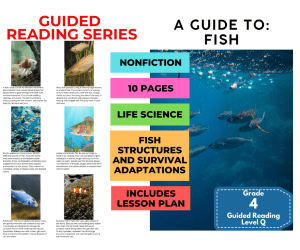
A Guide to Fish: Guided Reading Level Q with Lesson Plan
ELA, Resources for Teachers, Reading Comprehension, Reading, Science, Language Development, Life Sciences, Earth and Environmental Sciences, Pre-Reading, Vocabulary, Grade 3, 4, 5, Worksheets & Printables, Worksheets, Teacher Tools, Centers, Activities, Literacy Readers, Quizzes, Quizzes and Tests, Assessments, Lesson Plans
This A Guide to Fish (level q) guided reading book with lesson plan includes: Guided Reading Color Label (front cover x1) This is a quick way to match the book’s demands to what students can generally handle.. The overall goal is to use the level/color to pick books for several smaller groups. To qualify for a certain level, a student is expected to read a book from that level with about 90–94% accuracy. If a student is consistently accurate and understands, move up a level. If the student is struggling at that level, drop down and add more support. Each student will improve at completely different rates, but it is generally one of the best ways to check progress across the class. DOWNLOAD THE CATALOG TO VIEW ALL GUIDED READING BOOKS AVAILABLE (SORTED LEVELS A-Z) Pre-Reading Question (x1) Teacher asks the prompt aloud, can be while showing the cover or first page. Students share what they already know, or make educated guesses from the cover. Prompt them to use the target vocabulary. Write some of their responses on the board to look back at during the reading. Vocabulary Words (x5) Introduce the five words, best doing it one at a time. Start by saying it, while students repeat and then see if anyone knows what it means before reading further. Read through the meaning and try to briefly connect each word to a picture or gesture so it’s meaningful. Ask students to flip through the book pages and point to where they see each of the vocabulary words. While reading the book pause upon coming across one of the vocab words or read the sentence twice to make sure students understand the word has appeared. Optional: Ask students to raise hands whenever they see/hear one of the new words. Guided Reading Pages (x10) Check the book snapshot (below) for: primary topic - do you need to prep extra reading or intro materials on this? what is taught best - decide on 1-2 bullets to focus on, use the prompt or words provided here for best results. learning goals - what you are checking for students to be able to do after the session, elicit answers using prompts or words provided. key vocabulary (see section above). questions overview - so you know what is coming up and if you need to prep extra materials to assist understanding. Run the lesson You may have already looked at a few of the pages together, but you can show them some of the pictures again first to set meaning. Depending on how much time you have and how familiar your students are with guided reading class, you may want to read the book aloud first with the group first. Students whisper or partner read, while you listen in. If time, do it as a group, one student reading a page each. Use the guided page’s prompts to coach: “Check the picture / does it make sense?” “Point under the words / try the first sound” “Reread the sentence smoothly”. Try to focus more on one student per session (rotating every time), so you can work out if they are ready to move up or need to move down a level. Comprehension Questions (back cover x3) This is your way to check that students didn’t just say the words, but actually understood the text. First, let students answer by pointing to the page/picture and saying a short sentence. After any answer, follow with: “Show me where you found that in the text.” In bigger groups, have partners answer first (10–20 seconds), then call on 2–3 students to share. Differentiation tips: Emerging speakers/struggling readers: oral + pointing On-level: oral in a full sentence Higher: one written sentence or draw + label Book Snapshot Title: A Guide to: Fish Genre: Nonfiction (informational) Subject: Life Science Primary Topic: Fish structures and survival adaptations Estimated Guided Reading Level (A–Z): Q What This Book Teaches Best Explains how gills help fish breathe by extracting oxygen from water and releasing carbon dioxide. Describes how a fish’s streamlined shape and fins support efficient movement, stability, steering, and turning. Introduces the lateral line as a sensory system that detects vibrations and pressure changes to help fish navigate and find prey. Compares freshwater and saltwater habitats and explains how fish maintain the right internal balance of salt and water. Shows multiple survival strategies such as bioluminescence, camouflage, cartilaginous skeletons, and schooling (“safety in numbers”). Learning Goals Explain how fish breathe using gills and what happens as water passes over gill filaments. Describe how fins and a streamlined body shape help fish move, steer, and turn in water. Identify what the lateral line does and how it helps fish survive (navigation and finding prey). Compare how freshwater fish and saltwater fish manage water and salt in their bodies. Explain at least two survival adaptations described in the text (camouflage, bioluminescence, schooling). Describe what “cartilaginous fish” are and what the text says cartilage allows them to do. Key Vocabulary From the Text vertebrates — animals that have a backbone. specialized — made for a specific job or purpose. filaments — thin, threadlike parts of the gills. bioluminescence — the ability to make your own light. cartilaginous — having a skeleton made of cartilage, not hard bone. Discussion Prompts Pre-reading question: What body parts or behaviors might help fish survive in different kinds of water? Comprehension questions: What does the text explain that gills do for a fish? Comprehension questions: How does the lateral line help fish, according to the text? Comprehension questions: Why does the text say swimming in a school can help fish survive? Printing Tips 1. Best Printing Method (Recommended) “Booklet” Printing (Best if Available) If your printer or PDF viewer supports Booklet Printing , use this. Settings to use: Print mode: Booklet Paper size: Letter or A4 (either works) Orientation: Landscape Print on both sides: Yes Flip on: Short edge Scaling: Fit to printable area Booklet subset: First test: Front sides only Then: Back sides only This will automatically: Pair pages correctly Put the cover on the outside Align everything for folding After printing, fold in half and staple along the spine . 2. If “Booklet” Printing Is NOT Available You can still print this correctly with manual duplex printing . Step-by-step: Open the PDF. Choose Print . Set: Orientation: Landscape Pages per sheet: 1 Print on both sides: Yes Flip on: Short edge Print all pages . Because each PDF page already contains two facing book pages, the result will still fold cleanly into a book. Thousands of Cored Education products are included with your TeachSimple membership. Download links and encyclopedia index available here.
Author Cored Education
Rating
Tags Reading Comprehension, Reading Passages, Reading, Guided Reading, Guided Reading Lesson Plan, Guided Reading Activity, Pre-reading, Science Lesson Plans, Life Science, Earth Science
Virginia SOL Reading Practice Test for Grade 8
ELA, Grade 8, Assessments, Teacher Tools, Tests, Quizzes and Tests, Worksheets & Printables
Virginia SOL Reading Practice Test for Grade 8 Help your students master the test with this 8th Grade Virginia SOL Reading Practice Test designed to mirror the rigor and structure of the real exam! This comprehensive SOL reading test prep resource builds critical thinking, vocabulary, and reading comprehension skills across multiple text types. What’s Included Full-length Grade 8 Virginia SOL Reading Practice Test (45 questions) 3 complex, high-interest passages: Historical informational text (Reconstruction) Science & ethics argumentative text (Genetic Engineering) Literary fiction passage (“The Space Between Words”) Vocabulary in context section (roots, prefixes, figurative language) Detailed Answer Key with SOL standards and skill alignment Teacher’s Guide with rationales, teaching strategies, and intervention ideas Standards alignment for: SOL 8.4 (Vocabulary & Word Analysis) SOL 8.5 (Fiction Comprehension) SOL 8.6 (Informational & Argumentative Text) Scoring guide with performance levels (Advanced to Needs Support) Class data tracking sheet for easy progress monitoring How It Works in the Classroom This SOL reading test prep resource is flexible and easy to implement: Full-length test simulation for realistic practice Small group reteaching and targeted intervention Independent practice or homework Test prep rotations or review days Sub plans or assessment days According to the teacher guide (page 3), the test can be completed in one sitting or split into sections, with a total suggested time of 63–79 minutes for all four sections. Standards & Learning Goals Aligned to Virginia SOL standards: 8.4 – Vocabulary (roots, affixes, connotation, figurative language) 8.5 – Literary analysis (theme, symbolism, point of view, tone) 8.6 – Informational & argumentative text (central idea, claims, evidence, synthesis) Students will: Analyze complex texts across genres Strengthen vocabulary and word analysis skills Evaluate arguments and synthesize information across texts Build stamina and confidence with SOL-style questions Why Teachers Love It ✅ Print-and-go – zero prep required ✅ Mirrors the real SOL test format and rigor ✅ Includes detailed rationales and teaching supports ✅ Helps identify skill gaps with built-in data tracking ✅ Supports differentiation and intervention ✅ Saves valuable planning time Looking for a rigorous, standards-aligned 8th grade reading SOL test prep resource? This complete practice test will help your students feel confident, prepared, and ready to succeed—add it to your test prep toolkit today!
Author Bright Classroom Ideas Marketplace
Rating
Tags Virginia, Sol, State Test, Reading
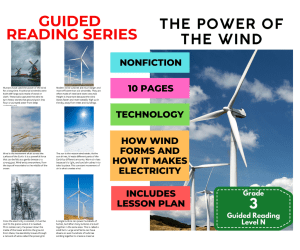
Guided Reading Level N - The Power of the Wind (with Lesson Plan)
ELA, Resources for Teachers, Reading Comprehension, Reading, Social Studies, Geography, Earth and Environmental Sciences, Science, Physics, Technology, Grade 2, 3, 4, Worksheets & Printables, Worksheets, Teacher Tools, Centers, Activities, Literacy Readers, Quizzes, Quizzes and Tests, Assessments, Lesson Plans
This Guided Reading Book - The Power of the Wind (Level N) with lesson plan includes: Guided Reading Color Label (front cover x1) This is a quick way to match the book’s demands to what students can generally handle.. The overall goal is to use the level/color to pick books for several smaller groups. To qualify for a certain level, a student is expected to read a book from that level with about 90–94% accuracy. If a student is consistently accurate and understands, move up a level. If the student is struggling at that level, drop down and add more support. Each student will improve at completely different rates, but it is generally one of the best ways to check progress across the class. DOWNLOAD THE CATALOG TO VIEW ALL GUIDED READING BOOKS AVAILABLE (SORTED LEVELS A-Z) Pre-Reading Question (x1) Teacher asks the prompt aloud, can be while showing the cover or first page. Students share what they already know, or make educated guesses from the cover. Prompt them to use the target vocabulary. Write some of their responses on the board to look back at during the reading. Vocabulary Words (x5) Introduce the five words, best doing it one at a time. Start by saying it, while students repeat and then see if anyone knows what it means before reading further. Read through the meaning and try to briefly connect each word to a picture or gesture so it’s meaningful. Ask students to flip through the book pages and point to where they see each of the vocabulary words. While reading the book pause upon coming across one of the vocab words or read the sentence twice to make sure students understand the word has appeared. Optional: Ask students to raise hands whenever they see/hear one of the new words. Guided Reading Pages (x10) Check the book snapshot (below) for: primary topic - do you need to prep extra reading or intro materials on this? what is taught best - decide on 1-2 bullets to focus on, use the prompt or words provided here for best results. learning goals - what you are checking for students to be able to do after the session, elicit answers using prompts or words provided. key vocabulary (see section above). questions overview - so you know what is coming up and if you need to prep extra materials to assist understanding. Run the lesson You may have already looked at a few of the pages together, but you can show them some of the pictures again first to set meaning. Depending on how much time you have and how familiar your students are with guided reading class, you may want to read the book aloud first with the group first. Students whisper or partner read, while you listen in. If time, do it as a group, one student reading a page each. Use the guided page’s prompts to coach: “Check the picture / does it make sense?” “Point under the words / try the first sound” “Reread the sentence smoothly”. Try to focus more on one student per session (rotating every time), so you can work out if they are ready to move up or need to move down a level. Comprehension Questions (back cover x3) This is your way to check that students didn’t just say the words, but actually understood the text. First, let students answer by pointing to the page/picture and saying a short sentence. After any answer, follow with: “Show me where you found that in the text.” In bigger groups, have partners answer first (10–20 seconds), then call on 2–3 students to share. Differentiation tips: Emerging speakers/struggling readers: oral + pointing On-level: oral in a full sentence Higher: one written sentence or draw + label Book Snapshot Title: The Power of the Wind Genre: Nonfiction (informational science text) Subject: Science (Energy/Earth Science) Primary Topic: How wind forms and how it makes electricity Estimated Guided Reading Level (A–Z): N What This Book Teaches Best Defines wind as the movement of air across Earth’s surface and describes wind as a breeze or a strong gust. Explains the cause of wind : the sun heats Earth unevenly, warm air rises, and cool air moves in to replace it. Shows how people have used wind over time, comparing traditional windmills (grinding grain, pumping water) to modern wind turbines. Describes how a wind turbine works, including blades spinning a shaft connected to a generator that makes electricity. Connects wind energy to sustainability by explaining wind farms , offshore wind farms , and wind energy as a clean, renewable resource. Learning Goals Students will explain what wind is using details from the text. Students will describe how the sun’s heating of Earth helps create wind. Students will describe how traditional windmills used wind to help people. Students will explain how wind turbines change wind’s motion into electricity. Students will describe what a wind farm is and why offshore wind farms can capture strong winds. Students will explain why wind energy is described as renewable and clean in the text. Key Vocabulary From the Text movement — going from one place to another. gust — a short, strong burst of wind. turbines — big machines with blades that spin in wind. generator — a machine that makes electricity. renewable — can be used again and won’t run out. Discussion Prompts Pre-reading question: Where have you seen wind do work, like moving something or making power? Comprehension questions: What does the text say creates wind? Comprehension questions: How did traditional windmills use wind to help people? Comprehension questions: How does a wind turbine turn wind into electricity, according to the text? Printing Tips 1. Best Printing Method (Recommended) “Booklet” Printing (Best if Available) If your printer or PDF viewer supports Booklet Printing , use this. Settings to use: Print mode: Booklet Paper size: Letter or A4 (either works) Orientation: Landscape Print on both sides: Yes Flip on: Short edge Scaling: Fit to printable area Booklet subset: First test: Front sides only Then: Back sides only This will automatically: Pair pages correctly Put the cover on the outside Align everything for folding After printing, fold in half and staple along the spine . 2. If “Booklet” Printing Is NOT Available You can still print this correctly with manual duplex printing . Step-by-step: Open the PDF. Choose Print . Set: Orientation: Landscape Pages per sheet: 1 Print on both sides: Yes Flip on: Short edge Print all pages . Because each PDF page already contains two facing book pages, the result will still fold cleanly into a book. Thousands of Cored Education products are included with your TeachSimple membership. Download links and encyclopedia index available here.
Author Cored Education
Rating
Tags Reading Comprehension, Reading Passages, Reading, Guided Reading, Guided Reading Lesson Plan, Guided Reading Activity, Pre-reading, Geography, Science Lesson Plans, Technology

Capitalization and Punctuation Questions Grade 5-6 (Presentable PDF)
ELA, Language Development, ESL, Grammar, Common Core, Resources for Teachers, Grade 5, 6, 7, Worksheets & Printables, Worksheets, Quizzes and Tests, Teacher Tools, Tests, Assessments
Capitalization and Punctuation Grammar Practice MCQS Snapshot Title: Capitalization & Punctuation Practice Worksheets Grade 5-6 Genre: Instructional Nonfiction / Conventions Workbook Subject: Reading Primary Topic: Applying capitalization and punctuation conventions What This Teaches Best Reinforcing capitalization of proper nouns, months, days, places, and names in sentence context. Practicing punctuation with commas, quotation marks, possessive nouns, dates, and end punctuation. Asking students to choose correctly written sentences, which strengthens editing and proofreading habits. Using short, familiar sentence examples that focus attention on conventions rather than long passage reading. Providing six worksheets plus an answers section for extended review. Learning Goals Students will identify sentences that use capitalization correctly. Students will apply commas, quotation marks, and end punctuation in context. Students will recognize correct capitalization of proper nouns and dates. Students will revise sentences to fix punctuation and capitalization errors. Students will explain why a sentence is written correctly or incorrectly. Key Vocabulary proper — correctly named and special. capitalized — written with a capital letter. commas — marks that separate words or parts. quotation — words showing someone’s exact speech. possessive — shows that something belongs to someone. Common Core Alignment CCSS.ELA-LITERACY.L.4.3b — Choose punctuation for effect. CCSS.ELA-LITERACY.L.5.2a — Use punctuation to separate items in a series. CCSS.ELA-LITERACY.L.6.2a — Use punctuation, including commas and dashes, to set off nonrestrictive or parenthetical elements. The punctuation practice in this workbook directly supports these conventions skills. Capitalization and Punctuation Overview: Includes: Using Commas Using Quotations Using Possessive Nouns Using Dates Open/Close an Email PRESENTABLE PDF VERSION Run it like a slide show straight from a PDF, with no PowerPoint or extra software needed, just open, project, and teach. Other versions are available in the links list below or in the full catalog. FULL CATALOG OF DOWNLOAD LINKS HERE ELA Review Questions Overview Each set of review questions includes three answer choices. Each test also features a few pictures to keep the pages visually appealing, along with a review sheet that covers most of the skills and concepts included in the resource. Introduction or Example Sheet Every topic comes with an introduction or example sheet that you can go over with your students before they begin. Full Answer Keys Complete answer keys and sample responses are included, so you have everything you need ready to go. In the Supplementary Pack Interactive Ice Breakers Fun warm-up activities help introduce key ELA skills, including quick capitalization fixes and punctuation challenges. Guided Practice Teacher-led activities give students structured support as they review grammar and punctuation rules and practice applying them in sentences. Group and Partner Tasks Students work together to edit sentences, correct capitalization, and improve punctuation through discussion and teamwork. Independent Worksheets Focused worksheets give students the chance to practice on their own and build confidence with the skills they’ve learned. Exit Tasks Quick end-of-lesson activities help students reflect on their learning and apply their skills in writing and editing. For More Like This For similar resources and free downloads, visit Cored Group on TeachSimple.
Author Cored Education
Rating
Tags Elementary, Answers, Ccss, Common Core, Grammar, Tests, Test Prep, Assessment, Grade 5, Grade 6
Illinois (IAR) ELA Practice Test for Grade 5
ELA, Grade 5, Assessments, Teacher Tools, Tests, Quizzes and Tests, Worksheets & Printables
Illinois (IAR) ELA Practice Test for Grade 5 Prepare your students for success with this Grade 5 IAR ELA Practice Test Bundle ! This comprehensive, standards-aligned resource mirrors the Illinois Assessment of Readiness and gives students meaningful practice with reading comprehension, evidence-based responses, and text-based writing. What’s Included ✅ Full-length Grade 5 IAR ELA practice test (35 questions) ✅ 4 engaging, authentic-style passages : Realistic fiction (“The Map”) Informational article (“The Surprising Intelligence of Crows”) Poetry (“What the River Knows”) Paired passages (historical fiction + nonfiction on the Dust Bowl) ✅ Two Evidence-Based Selected Response (Part A / Part B) question pairs ✅ Short constructed-response writing task (paired passage analysis) ✅ Language & vocabulary section (grammar, idioms, context clues, word relationships) ✅ Complete Answer Key with detailed rationales + standards alignment ✅ Quick-grade sheet + 2-point writing rubric with sample response ✅ Teacher’s Guide with pacing, differentiation, and reteaching strategies How It Works in the Classroom This Grade 5 IAR ELA practice test is designed for flexible and effective instruction: Use as a full-length test simulation (~110 minutes) to build stamina and confidence Assign one passage at a time for weekly skill-based practice Use as a diagnostic assessment to guide small group instruction Incorporate into centers, intervention blocks, or test-prep rotations Review responses together using detailed rationales for reteaching and discussion Standards & Learning Goals Aligned to Grade 5 Illinois Learning Standards (Common Core ELA) . Students will practice: Reading Literature & Informational Texts (theme, inference, main idea, text structure) Evidence-Based Responses (Part A / Part B EBSR questions) Paired Passage Analysis & Writing (integrating information across texts) Vocabulary & Language Skills (idioms, context clues, grammar, conventions) Critical thinking and close reading strategies Why Teachers Love It ⭐ Closely mirrors the format, rigor, and expectations of the real IAR assessment ⭐ Includes high-quality, original passages students won’t find online ⭐ Makes grading easy with clear answer explanations and quick-score sheets ⭐ Supports data-driven instruction with built-in standards tracking ⭐ Saves time with a no-prep, print-and-go format (test + answer key + teacher guide) Perfect for test prep, progress monitoring, literacy centers, and intervention ! Download this Grade 5 IAR ELA Practice Test Bundle today to give your students the targeted practice they need to build confidence, strengthen skills, and perform their best on test day!
Author Bright Classroom Ideas Marketplace
Rating
Tags Illinois, Iar, State Test, Ela

TikTok Algorithm & Content Calendar Mapping
Technology, Science, Computer Science, Engineering, Business, Life Studies, Career, Leadership, Research, Finance, Homeschool Curriculum, Grade 7, 8, 9, 10, 11, 12, Worksheets & Printables, Workbooks, Worksheets, Word Searches, Teacher Tools, Assessments, Lesson Plans, Quizzes and Tests, Quizzes, Tests
Are your students spending hours scrolling TikTok? It's time to transform their passive consumption into a powerful, career-building skill! This comprehensive, 43-page project-based learning unit demystifies the TikTok algorithm and empowers students to think like professional digital strategists. Move beyond random posting and teach the data-driven science behind viral content. This isn't just a worksheet packet; it's a complete, academically rigorous curriculum designed for high school students. It treats TikTok as a serious case study in modern marketing, audience psychology, and behavioral economics. Students will transition from being casual creators to strategic digital architects, capable of planning, executing, and analyzing a 30-day content campaign. What's Included in This 43-Page All-in-One Unit: Part 1: Core Theory & Case Studies (10 Pages): In-depth chapters covering the architecture of the TikTok algorithm, the 4 phases of audio lifecycles (Inception, Acceleration, Apex, Decay), strategic content pillars, the 70/20/10 risk model, and real-world case studies. Part 2: The Student Workbook (21 Pages): Ten detailed worksheets guide students through practical application. They will analyze trending audio, calculate velocity, identify algorithmic triggers, define their niche, establish content pillars, build a 30-day posting calendar, and learn to iterate based on performance data. Part 3: Teacher Resources & Visuals (12 Pages): High-Contrast Diagrams: Perfect for classroom projection, breaking down the audio lifecycle, content matrix, and distribution feedback loop. Comprehensive Answer Key: Detailed, expected answers for every worksheet to make grading clear and objective. Teacher Implementation Guide: A step-by-step guide with pre-teaching strategies, classroom activities, discussion prompts, and advice for overcoming common student roadblocks. This resource is perfect for project-based learning and ready to print or use digitally. Equip your students with the 21st-century media literacy and marketing skills they need to succeed in the digital economy. Perfect for: High School Marketing & Business Classes Media Literacy & Digital Citizenship Units Career and Technical Education (CTE) Courses Journalism & Communications Entrepreneurship Programs Keywords: TikTok Marketing, Social Media Strategy, Digital Literacy, Algorithm, Content Calendar, Project-Based Learning (PBL), High School Business, CTE, Media Studies, 21st Century Skills, Content Creation, Viral Trends, Marketing Curriculum. Why Parents/Schools Love It: Turns Screen Time into Skill Time: It transforms a platform students already use for entertainment into a rigorous academic exercise, teaching critical thinking and analytical skills. Teaches In-Demand 21st-Century Skills: Students learn the fundamentals of digital marketing, data analysis, strategic planning, and content creation—skills that are highly valuable in college and future careers. 100% Turnkey & No-Prep: This is a complete, ready-to-go unit. With a teacher's guide, answer keys, and student worksheets, educators can implement it immediately without hours of prep work. Highly Engaging & Relevant: By using TikTok, a platform students are passionate about, this curriculum guarantees high student engagement and makes abstract concepts (like data analysis) tangible and exciting. Promotes Digital Citizenship: The unit encourages students to think ethically and critically about the content they create and consume, fostering responsible behavior in the digital world. Target Student Audience : Based on the academic language ("sociological study," "algorithmic architecture") and the direct mention on page 1, target: Grades: 9th to 12th Grade . While designed with 9th graders in mind, the complexity of the strategic concepts makes it perfectly suitable and challenging for students up to grade 12, especially in advanced marketing or business courses. Classes: Marketing, Business, Media Studies, Digital Literacy, Communications, Entrepreneurship, and Career & Technical Education (CTE) electives. Copyright/Terms of Use: This Book was copyrighted by Syed Hammad Rizvi. This resource is for personal and single classroom use only. You may not alter, redistribute, or sell any part of this resource. In other words, you may not put it on the Internet where it could be publicly found and downloaded. If you want to share this resource with colleagues, please purchase additional licenses from TpT. Thank you for respecting these terms of use. This product is happily brought to you by Syed Hammad Rizvi Are your students spending hours scrolling TikTok? It's time to transform their passive consumption into a powerful, career-building skill! This comprehensive, 43-page project-based learning unit demystifies the TikTok algorithm and empowers students to think like professional digital strategists. Move beyond random posting and teach the data-driven science behind viral content. This isn't just a worksheet packet; it's a complete, academically rigorous curriculum designed for high school students. It treats TikTok as a serious case study in modern marketing, audience psychology, and behavioral economics. Students will transition from being casual creators to strategic digital architects, capable of planning, executing, and analyzing a 30-day content campaign. What's Included in This 43-Page All-in-One Unit: Part 1: Core Theory & Case Studies (10 Pages): In-depth chapters covering the architecture of the TikTok algorithm, the 4 phases of audio lifecycles (Inception, Acceleration, Apex, Decay), strategic content pillars, the 70/20/10 risk model, and real-world case studies. Part 2: The Student Workbook (21 Pages): Ten detailed worksheets guide students through practical application. They will analyze trending audio, calculate velocity, identify algorithmic triggers, define their niche, establish content pillars, build a 30-day posting calendar, and learn to iterate based on performance data. Part 3: Teacher Resources & Visuals (12 Pages): High-Contrast Diagrams: Perfect for classroom projection, breaking down the audio lifecycle, content matrix, and distribution feedback loop. Comprehensive Answer Key: Detailed, expected answers for every worksheet to make grading clear and objective. Teacher Implementation Guide: A step-by-step guide with pre-teaching strategies, classroom activities, discussion prompts, and advice for overcoming common student roadblocks. This resource is perfect for project-based learning and ready to print or use digitally. Equip your students with the 21st-century media literacy and marketing skills they need to succeed in the digital economy. Perfect for: High School Marketing & Business Classes Media Literacy & Digital Citizenship Units Career and Technical Education (CTE) Courses Journalism & Communications Entrepreneurship Programs Keywords: TikTok Marketing, Social Media Strategy, Digital Literacy, Algorithm, Content Calendar, Project-Based Learning (PBL), High School Business, CTE, Media Studies, 21st Century Skills, Content Creation, Viral Trends, Marketing Curriculum. Why Parents/Schools Love It: Turns Screen Time into Skill Time: It transforms a platform students already use for entertainment into a rigorous academic exercise, teaching critical thinking and analytical skills. Teaches In-Demand 21st-Century Skills: Students learn the fundamentals of digital marketing, data analysis, strategic planning, and content creation—skills that are highly valuable in college and future careers. 100% Turnkey & No-Prep: This is a complete, ready-to-go unit. With a teacher's guide, answer keys, and student worksheets, educators can implement it immediately without hours of prep work. Highly Engaging & Relevant: By using TikTok, a platform students are passionate about, this curriculum guarantees high student engagement and makes abstract concepts (like data analysis) tangible and exciting. Promotes Digital Citizenship: The unit encourages students to think ethically and critically about the content they create and consume, fostering responsible behavior in the digital world. Target Student Audience : Based on the academic language ("sociological study," "algorithmic architecture") and the direct mention on page 1, target: Grades: 9th to 12th Grade . While designed with 9th graders in mind, the complexity of the strategic concepts makes it perfectly suitable and challenging for students up to grade 12, especially in advanced marketing or business courses. Classes: Marketing, Business, Media Studies, Digital Literacy, Communications, Entrepreneurship, and Career & Technical Education (CTE) electives. Copyright/Terms of Use: This Book was copyrighted by Syed Hammad Rizvi. This resource is for personal and single classroom use only. You may not alter, redistribute, or sell any part of this resource. In other words, you may not put it on the Internet where it could be publicly found and downloaded. If you want to share this resource with colleagues, please purchase additional licenses from Teachsimple. Thank you for respecting these terms of use. This product is happily brought to you by Syed Hammad Rizvi
Author Creative Book Store
Rating
Tags TikTokAlgorithm, TikTokMarketing, ContentStrategy, SocialMediaMarketing, DigitalMarketing, ContentCalendar, ViralMarketing, TrendingAudio, SocialMediaStrategy, BusinessTeacher

Verbs Practice Questions - Grade 3-4 Grammar (Presentable PDF)
ELA, Language Development, ESL, Grammar, Common Core, Resources for Teachers, Grade 3, 4, Worksheets & Printables, Worksheets, Quizzes and Tests, Teacher Tools, Tests, Assessments, Quizzes
Verbs Grammar Practice MCQS Snapshot Title: Parts of Speech: Verbs Genre: Nonfiction / Educational Workbook Subject: Language Arts Primary Topic: Identifying action, helping, and linking verbs This workbook contains a review sheet, five practice worksheets, and answer keys focused on verb types and correct verb usage for Grades 3–4. What This Teaches Best Defines action verbs, helping verbs, and linking verbs with examples. Helps students identify verbs within complete sentences. Gives focused practice distinguishing action, helping, and linking verbs. Reinforces correct verb forms through editing and sentence-choice tasks. Includes simple past forms of irregular verbs for added verb-form practice. These teaching strengths are shown in the review sheet and in Worksheets 1–5. Learning Goals Students will explain the difference between action, helping, and linking verbs. Students will identify the verb in a sentence. Students will classify verbs as action, helping, or linking. Students will choose verb forms that make sentences correct and complete. Students will correct mistakes in sentences that misuse verbs. Students will use simple past forms of common irregular verbs accurately. These goals reflect the review-sheet definitions and the worksheet task sequence. Key Vocabulary From the Text action — something a person or thing can do helping — a verb that helps the main verb auxiliary — another word for helping linking — connects the subject to more information mood — the feeling or purpose a verb helps show All five words appear in the review sheet text. Common Core Alignment L.3.1d — Form and use regular and irregular verbs. L.3.1e — Form and use regular and irregular simple verb tenses. L.4.1b — Form and use the progressive verb tenses. Verbs Overview: Includes: Action Verbs Helping Verbs Linking Verbs Correcting Mistakes PRESENTABLE PDF VERSION Run it like a slide show straight from a PDF, with no PowerPoint or extra software needed, just open, project, and teach. Other versions are available in the links list below or in the full catalog. FULL CATALOG OF DOWNLOAD LINKS HERE For similar downloads and other frees, do check out Cored Group on TeachSimple.
Author Cored Education
Rating
Tags Elementary, Answers, Ccss, Common Core, Grammar, Tests, Test Prep, Assessment, Grade 3, Grade 4
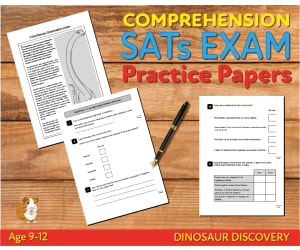
Close Reading Comprehension Practice Papers (Dinosaur Discovery) 9-12 years
ELA, Reading, Grade 4, 5, 6, Teacher Tools, Assessments
Close Reading Comprehension Practice Papers (Dinosaur Discovery) for Ages 9-12 This reading comprehension resource provides lively practice papers for students ages 9-12 to build key reading skills. Students will carefully read informational texts about dinosaurs and answer comprehension questions that require them to identify key details, make inferences using text evidence, and explain vocabulary. The content and question types mirror those found on standardized exams. Using varied informational dinosaur texts, these practice papers can be implemented whole-group, small-group, partner, or individual work to provide reading comprehension practice. Suggested answers are included to support self or teacher review. With a focus on close reading, this resource builds skills for standardized testing and develops critical thinking, vocabulary, and comprehension abilities.
Author Guinea Pig Education
Tags Close Reading, Understanding Texts, Comprehension, Test, English

Edgar A. Poe & Stephen King: Gothic vs. Modern Horror Reading Passage
ELA, Literature, Reading, Writing, Research, Resources for Teachers, High School, Homeschool Resources, Teacher Tools, Assessments, Quizzes and Tests, Lesson Plans, Worksheets & Printables, Writing Prompts
As a homeschool mom navigating the world of high school literature with my ninth-grade daughter, I understand the challenge of finding resources that truly engage teens while building critical thinking skills. This Edgar Allan Poe & Stephen King: Gothic vs Modern Horror Reading Passage, Q & A, and 5 Note-Taking Sheets is a comprehensive teaching resource transforms the study of horror literature into an exciting exploration of how two master storytellers — Edgar Allan Poe and Stephen King — have shaped our understanding of fear across different eras. When my daughter first read The Tell-Tale Heart , she was captivated by Poe's psychological intensity, but it was not until we compared it to Stephen King's modern approach that she truly grasped how literature evolves while maintaining timeless themes. This Edgar Allan Poe & Stephen King: Gothic vs Modern Horror Reading Passage, Q & A, and 5 Note-Taking Sheets resource bridges that gap, helping students/homeschoolers understand not just what these authors wrote, but why their techniques remain so powerfully effective today. The beauty of this comparison lies in how it makes classic Gothic literature accessible through the lens of contemporary horror that students/homeschoolers already recognize and appreciate. INCLUDED IN THIS RESOURCE: Comprehensive 4-page reading passage comparing Gothic and modern horror techniques 20 thought-provoking critical analysis passage questions A detailed answer key with guided answers for easy grading 5 note-taking sheets designed for different learning styles and approaches TOPICS COVERED: Psychological horror techniques and unreliable narrators in both Gothic and modern contexts Environmental symbolism and how physical settings reflect character psychology Evolution of horror themes from 19th-century Gothic to contemporary suburban fears Comparative analysis of how isolation, obsession, and evil function across different literary periods What I love most about this Edgar Allan Poe & Stephen King: Gothic vs Modern Horror Reading Passage, Q & A, and 5 Note-Taking Sheets is how it sets up our high schoolers/homeschoolers for the kind of thinking they will need in college — without making them feel overwhelmed right now. I have watched my daughter grow from someone who used to skim through reading assignments to a homeschooler who actually gets excited about discussing why certain scenes give her chills. The analytical skills she has developed through comparing these two masters of horror have carried over into every other subject we tackle. When she encounters complex texts in college, she will not be starting from scratch — she will already know how to dig deeper, ask the right questions, and make connections between different time periods and writing styles. That is the real gift we can give our kids: not just knowledge, but the confidence to think critically about whatever they encounter next. If you and your students/homeschoolers enjoyed this resource, please leave a review. Thank you for your support! Tina - Big Easy Homeschooling Mom
Author Homeschool with Big Easy Homeschooling Mom
Rating
Tags Edgar Allan Poe, Stephen King, Gothic Vs. Modern Horror, Gothic Horror Vs Modern Horror Teaching Resources, Psychological Horror Analysis, Homeschool Literature Resources, American Literature Teaching Materials, Edgar Allan Poe Stephen King Thematic Analysis Teaching Materials, Homeschool English Curriculum Gothic Modern Horror Comparison, Psychological Horror Literature Teaching Resources High School
Homophones Supplementary Materials Grade 5-6 (PDF)
ELA, Language Development, ESL, Common Core, Resources for Teachers, Vocabulary, Grade 5, 6, 7, Worksheets & Printables, Worksheets, Quizzes and Tests, Teacher Tools, Tests, Assessments, Lesson Plans
Homophones Supplementary Materials Note: This download DOES NOT include the tests themselves. You can still make use of these materials without them but they are recommended. Download in a format of your choice in the "Links" section below. In the Supplementary Pack Interactive Ice Breakers: Engaging warm-up activities that introduce students to key ELA concepts, such as quick capitalization corrections and punctuation challenges. Guided Practice: Structured teacher-led exercises that reinforce grammar and punctuation rules, helping students identify and apply them correctly in sentences. Group and Partner Tasks: Collaborative activities where students work together to edit sentences, correct capitalization, and improve punctuation through peer discussion and teamwork. Independent Worksheets: Carefully designed worksheets that provide focused practice, allowing students to apply learned concepts and refine their skills independently. Exit Tasks: Quick assessments at the end of each lesson, prompting students to reflect on what they’ve learned and apply their knowledge in writing and editing tasks. Links sent, scent, cent accept, except, eccept thru, through, threw, here, ear, hear bored, board, bord they're, their, there day's, days, daze horse, hoarse, oars Google Docs Google Forms Google Slides PDF PPT Word FULL CATALOG OF DOWNLOAD LINKS HERE Grade 5/6 Links: Capitalization & Punctuation Google Docs Google Forms Google Slides PDF PPT Word Free Supplementary Materials Pack Adjectives Google Docs Google Forms Google Slides PDF PPT Word Free Supplementary Materials Pack Nouns Google Docs Google Forms Google Slides PDF PPT Word Free Supplementary Materials Pack Pronouns Google Docs Google Forms Google Slides PDF PPT Word Free Supplementary Materials Pack Verbs Google Docs Google Forms Google Slides PDF PPT Word Free Supplementary Materials Pack Prefixes & Suffixes Google Docs Google Forms Google Slides PDF PPT Word Free Supplementary Materials Pack Sentence Structure Google Docs Google Forms Google Slides PDF PPT Word Free Supplementary Materials Pack Subject Verb Agreement Google Docs Google Forms Google Slides PDF PPT Word Free Supplementary Materials Pack Tenses Google Docs Google Forms Google Slides PDF PPT Word Free Supplementary Materials Pack Context Clues Google Docs Google Forms Google Slides PDF PPT Word Free Supplementary Materials Pack Defining Words Google Docs Google Forms Google Slides PDF PPT Word Free Supplementary Materials Pack Fill in the Blanks Google Docs Google Forms Google Slides PDF PPT Word Free Supplementary Materials Pack Homophones Google Docs Google Forms Google Slides PDF PPT Word Free Supplementary Materials Pack Synonyms Google Docs Google Forms Google Slides PDF PPT Word Free Supplementary Materials Pack ELA Review Questions Overview Questions have three answer choices. There are a handful of pictures on each test for aesthetic purposes, as well as a review sheet covering most of the topics covered in the product. Introduction or Example Sheet Each topic will include an introduction or example sheet to go through first with your students. Full Answer Keys Full answer keys and sample responses are provided so no matter how busy you are, you know you're covered! For More Like This For similar downloads and other frees, do check out Cored Group on TeachSimple.
Author Cored Education
Tags Elementary, Answers, Ccss, Common Core, Tests, Test Prep, Assessment, Grade 5, Grade 6, Vocabulary

Reading Comprehension Nonfiction Set 1 Sample: Elephant Seals (Word)
ELA, Reading, Reading Comprehension, Common Core, ESL, Language Development, Vocabulary, Writing, Grade 6, 7, Worksheets & Printables, Worksheets, Assessments, Teacher Tools, Tests, Quizzes and Tests
Reading Comprehension Passages Nonfiction Set 1 Overview Reading comprehension lessons, especially written for Grade 6-7, providing the chance to read interesting and engaging passages. Each lesson has a mix of questions to check understanding, a vocabulary or spelling activity to help remember key language introduced, and a writing exercise. Full answer keys are provided. Passage Included 3.Elephant Seals: Fact: Elephant Seals spend 2 months a year on the beach! Word Version This is the Word editable version. This download is available in GOOGLE Docs, GOOGLE Forms, GOOGLE Slides. PDF, PPT, WORD. FULL CATALOG OF DOWNLOAD LINKS HERE Grade 6/7 Links Fiction Set 1 Google Docs Google Forms Google Slides PDF PPT Word Guided Reading Materials Fiction Set 2 Google Docs Google Forms Google Slides PDF PPT Word Guided Reading Materials Nonfiction Set 1 Google Docs Google Forms Google Slides PDF PPT Word Guided Reading Materials Nonfiction Set 2 Google Docs Google Forms Google Slides PDF PPT Word Guided Reading Materials Reading Passages Overview Each passage is especially written for Grade 6/7 students, including key vocabulary required for this age group. Topics are varied and are accompanied by colorful graphics. Topics are meant to educate, yet entertain the modern student. The majority of these short stories contain an important message - a way of developing these young learners further. Mixed Questions The mixed questions section of each lesson includes a variation of five to six comprehension, vocabulary and Math questions. In addition, key reading strategies are frequently covered including cause & effect, summarizing, compare & contrast and making conclusions. Mixed questions require a written response (no MCQ's), full answers and example responses appear at the end of the lesson. Spelling & Vocab Each reading passage contains a variety of words and phrases designed for Grade 6/7 students. Spelling and vocab activities provide the opportunity to build fluency with these words. Activities provide clues to help assist students. Vocabulary activities include extra questions where students must write a synonym, an antonym or a sentence using a certain word. Writing Prompts Writing prompts are designed to continue the theme or lessons learned in the story. Students are persuaded to write in a variety of ways and each prompt includes several cues to help. The main focus in this product, is the student. Prompts will require the student to relate to past experiences and encourage them to discuss feelings and ways to improve. Full Answer Keys Full answer keys and sample responses are provided so no matter how busy you are, you know you're covered! Mixed question answers provide evidence from the text, Math questions contain the relevant workings. Answers are designed for use by the teacher, but also suitable as a handout to the student. For More Like This For similar downloads and other frees, do check out Cored Group on TeachSimple.
Author Cored Education
Tags Elementary, Reading, Comprehension, Vocabulary, Answers, Ccss, Common Core, Spelling, Writing, Passages
Guided Reading Level H - Gravity Made Simple
ELA, Resources for Teachers, Reading Comprehension, Reading, Science, Pre-Reading, Language Development, Vocabulary, Physics, Earth and Environmental Sciences, Kindergarten, Grade 1, 2, Worksheets & Printables, Worksheets, Teacher Tools, Centers, Activities, Literacy Readers, Quizzes, Quizzes and Tests, Assessments
This Guided Reading Book - Gravity Made Simple (Level H) includes: Guided Reading Color Label (front cover x1) This is a quick way to match the book’s demands to what students can generally handle.. The overall goal is to use the level/color to pick books for several smaller groups. To qualify for a certain level, a student is expected to read a book from that level with about 90–94% accuracy. If a student is consistently accurate and understands, move up a level. If the student is struggling at that level, drop down and add more support. Each student will improve at completely different rates, but it is generally one of the best ways to check progress across the class. DOWNLOAD THE CATALOG TO VIEW ALL GUIDED READING BOOKS AVAILABLE (SORTED LEVELS A-Z) Pre-Reading Question (x1) Teacher asks the prompt aloud, can be while showing the cover or first page. Students share what they already know, or make educated guesses from the cover. Prompt them to use the target vocabulary. Write some of their responses on the board to look back at during the reading. Vocabulary Words (x5) Introduce the five words, best doing it one at a time. Start by saying it, while students repeat and then see if anyone knows what it means before reading further. Read through the meaning and try to briefly connect each word to a picture or gesture so it’s meaningful. Ask students to flip through the book pages and point to where they see each of the vocabulary words. While reading the book pause upon coming across one of the vocab words or read the sentence twice to make sure students understand the word has appeared. Optional: Ask students to raise hands whenever they see/hear one of the new words. Guided Reading Pages (x10) Check the book snapshot (below) for: primary topic - do you need to prep extra reading or intro materials on this? what is taught best - decide on 1-2 bullets to focus on, use the prompt or words provided here for best results. learning goals - what you are checking for students to be able to do after the session, elicit answers using prompts or words provided. key vocabulary (see section above). questions overview - so you know what is coming up and if you need to prep extra materials to assist understanding. Run the lesson You may have already looked at a few of the pages together, but you can show them some of the pictures again first to set meaning. Depending on how much time you have and how familiar your students are with guided reading class, you may want to read the book aloud first with the group first. Students whisper or partner read, while you listen in. If time, do it as a group, one student reading a page each. Use the guided page’s prompts to coach: “Check the picture / does it make sense?” “Point under the words / try the first sound” “Reread the sentence smoothly”. Try to focus more on one student per session (rotating every time), so you can work out if they are ready to move up or need to move down a level. Comprehension Questions (back cover x3) This is your way to check that students didn’t just say the words, but actually understood the text. First, let students answer by pointing to the page/picture and saying a short sentence. After any answer, follow with: “Show me where you found that in the text.” In bigger groups, have partners answer first (10–20 seconds), then call on 2–3 students to share. Differentiation tips: Emerging speakers/struggling readers: oral + pointing On-level: oral in a full sentence Higher: one written sentence or draw + label Book Snapshot Title: Gravity Made Simple Genre: Nonfiction (informational) Subject: Science (Physical Science / Earth & Space Science) Primary Topic: How gravity works on Earth and in space Estimated Guided Reading Level (A–Z): H What This Book Teaches Best Gravity is a hidden, always-active force that pulls things toward Earth’s center. Gravity keeps objects on Earth’s surface—without it, things would float away. Gravity keeps the air close to Earth, forming the atmosphere that living things need to breathe. Gravity works in space too: Earth’s pull keeps the Moon in an orbit, and the Moon’s gravity affects ocean tides. Mass and gravity connect: more mass means a stronger gravitational pull, and weight measures gravity’s pull. Learning Goals Explain what gravity is and what it does to objects on Earth. Describe what happens when an object is dropped, according to the text. Tell how gravity helps keep objects (and air) close to Earth. Describe how Earth’s gravity affects the Moon’s orbit. Explain how the Moon’s gravity is connected to tides along the coast. Use the text to explain how mass relates to gravitational pull. Key Vocabulary From the Text gravity — a force that pulls things toward Earth. atmosphere — the thick layer of air around Earth. orbit — the path something takes around a planet. mass — how much matter is inside an object. tides — ocean water rising and falling along the coast. Discussion Prompts Pre-reading question: What do you think happens when you drop an object? Comprehension questions: What does the book say happens when an object is dropped? Comprehension questions: What does Earth’s pull do for the Moon’s path around Earth? Comprehension questions: What does the book say causes tides along the coast? Printing Tips 1. Best Printing Method (Recommended) “Booklet” Printing (Best if Available) If your printer or PDF viewer supports Booklet Printing , use this. Settings to use: Print mode: Booklet Paper size: Letter or A4 (either works) Orientation: Landscape Print on both sides: Yes Flip on: Short edge Scaling: Fit to printable area Booklet subset: First test: Front sides only Then: Back sides only This will automatically: Pair pages correctly Put the cover on the outside Align everything for folding After printing, fold in half and staple along the spine . 2. If “Booklet” Printing Is NOT Available You can still print this correctly with manual duplex printing . Step-by-step: Open the PDF. Choose Print . Set: Orientation: Landscape Pages per sheet: 1 Print on both sides: Yes Flip on: Short edge Print all pages . Because each PDF page already contains two facing book pages, the result will still fold cleanly into a book. Thousands of Cored Education products are included with your TeachSimple membership. Download links and encyclopedia index available here.
Author Cored Education
Rating
Tags Vocabulary, Reading Comprehension, Reading Passages, Leveled Reading, Nonfiction, Reading, Guided Reading, Gravity, Physics, Earth Science

Reading Comprehension Passages Fiction Set 3 - Food (Fillable PDF)
ELA, Reading, Reading Comprehension, Common Core, Spelling, Language Development, Vocabulary, Writing, Children’s Literature, Literature, Grade 2, 3, Worksheets & Printables, Worksheets, Assessments, Teacher Tools, Quizzes and Tests, Tests, Writing Prompts, Centers, Activities
Reading Comprehension Passages Fiction Set 3 Snapshot Title: Title not stated Genre: Fiction (short story collection) Subject: Reading Primary Topic: Food-themed stories for comprehension practice Estimated Guided Reading Level (A–Z): O What This Teaches Best Trying new things (theme/lesson): A student refuses banana muffins, then tries one and likes it. Sequencing and procedural text in narrative form: One story walks through cookie-baking steps with time and temperature details (measure, mix, roll, cut, bake, cool). Everyday problem/solution: Characters solve small problems (boredom during summer; fitting a garden into a small space; choosing one pizza everyone likes). Character feelings and motivations: Students can track wants and emotions that drive actions (hungry and impatient; confused but excited; bored then creative; busy but valuing family time). Built-in literacy practice pages connected to the stories (with a few check points): Most questions/vocabulary tasks refer directly to story details, but one story ends with “blueberry muffin” after describing banana muffins, and one question asks which language Dad uses even though the story only says he is “translating for the Brazilian government.” Learning Goals Students will recount key events from a story in order using text details. Students will describe a character’s problem and explain how it is solved. Students will describe characters’ feelings or motivations and point to words/actions that show them. Students will identify cause-and-effect relationships (what happened and why) within a story. Students will use context clues to figure out the meaning of unfamiliar words from the stories. Students will explain how a routine or tradition shapes events in a story. Passages Include 1.Happy Birthday Mrs. B: Mrs. Barber has cooked something special for the class. 2.Sophie's Own Garden: Grandma buys Sophie some garden supplies. 3.Lunchtime: Kasey has a surprise for her lunch. 4.Cindy's Tea Party: Cindy invites some special friends to her tea party. 5.My Saturdays: Anything better than baking cookies on a Saturday? 6.Friday Night Pizza: Read about the Webster Family Special in this story. FILLABLE PDF VERSION Worksheet-style pages, but with type-in answer boxes so students can complete and save their work digitally. Other versions are available in the links list below or in the full catalog. FULL CATALOG OF DOWNLOAD LINKS HERE For similar downloads and other frees, do check out Cored Group on TeachSimple.
Author Cored Education
Rating
Tags Elementary, Reading, Comprehension, Vocabulary, Answers, Spelling, Writing, Passages, Reading Centers, Reading Comprehension Assessments

"Progressive Era No. 2", Regents US History Short Essays
Social Studies, ELA, History, History: USA, Writing, Formal Writing, Grade 10, 11, 12, Assessments, DBQ's, Rubrics
Progressive Era No. 2, Regents US History Short Essays This resource helps students develop historical document analysis skills for the updated New York State Regents US History exam. The short essay tasks promote critical thinking by having students examine primary sources in context, identify relationships between events, analyze bias and reliability, and construct evidence-based arguments. The product contains two sets of stimulus-based short essay questions modeled on the state prototype. Each set includes primary source documents and accompanying prompts. Assigning these throughout the year is an effective way to prepare 12th grade students for the skills tested on Part II of the Regents exam. Teachers can use the sets for individual practice or collaborative analysis during which students give each other feedback. Answer keys with scoring rubrics are provided.
Author Innovation Assessments LLC
Tags New York State, Dbq, Frameworks, Regents Exam, Short Essay, Progressive Era Essay
FREE Reading Comprehension: Human-Environment Interaction Fillable PDF
Science, ELA, Reading, Reading Comprehension, Strategies, Resources for Teachers, Common Core, Language Development, Earth and Environmental Sciences, Environmental Science, Grade 6, 7, 8, 9, 10, Writing Prompts, Worksheets & Printables, Centers, Activities, Teacher Tools, Assessments, Quizzes and Tests, Quizzes, Tests, Literacy Readers
Reading Comprehension Passage and Questions for Middle School: Human-Environment Interaction (Fillable PDF) This engaging middle school reading comprehension resource explores human-environment interaction and how people and places shape each other. Students learn how communities depend on natural resources, adapt to local environmental conditions, and modify the land to meet human needs. The passage examines real-world examples such as raised homes in flood-prone areas, farming, roads, cities, renewable and nonrenewable resources, deforestation, desertification, pollution, natural hazards, and climate change . It also introduces the idea of sustainability by showing how human needs can be balanced with protecting ecosystems and resources for the future. This passage is designed to bridge the gap between science and literacy by strengthening reading comprehension while sparking scientific curiosity in middle school students. It blends English Language Arts skills with accurate science content, helping students build background knowledge, understand key concepts, use evidence from the text, and explain scientific ideas clearly. This resource supports science classroom practice while also reinforcing important literacy skills such as main idea, vocabulary, comprehension, and summarizing. Ideal for interdisciplinary learning in ELA and Science. Suitable for Grade 9 review, too! Student Tasks for The Passage: 10 multiple-choice questions targeting main idea, key details, science concepts, comparison, and real-world applications 10 True/False statements to check understanding and address common misconceptions 5 text-based short-answer questions that require students to explain important ideas from the passage 5 vocabulary matching items with clear, student-friendly definitions 1 summary prompt that asks students to condense the central ideas accurately Full answer key for every section This passage is designed as a fillable PDF , which means students can type their answers directly into the document on any computer or tablet . Each page includes highlighted text fields that show them exactly where to type! Available Formats for this Resource PDF Word Docs Google Docs Product Details Length: 7 pages total Grades: 6–8, also suitable for Grade 9 review Use cases: close reading, stations, homework, intervention, test prep, and sub plans Standards support: Reinforces informational-text skills and supports NGSS-style sense-making by helping students read scientific explanations, connect evidence to key concepts, interpret real-world examples, and explain cause-and-effect relationships in science. FULL CATALOG OF DOWNLOADING LINKS HERE Other Science Reading Collections and Topics You May Find in the Store: 1. Astronomy & Space Science 2. Volcanoes, Rocks, & Mountains 3. Rock Cycle, Soil, & Sinkholes 4. Mars, Glaciers, & Antarctica 5. Water Cycle, Acid Rain, & Wastewater 6. Insects, Animals, & Ecosystems 7. Bioluminescence & Insects 8. Animal Skin, Cats, & T. Rex 9. Human Body and Senses 10. Health & Applied Bioscience 11. Waves, Light, & Imaging 12. Electricity & Energy 13. Motion & Materials 14. Chemistry and Materials Science 15. Electromagnetism 16. Acids and Bases 17. Gas Laws 18. Biotechnology 19. Periodic Trends 20. Protists and Fungi 21. Microevolution 22. Blood 23. Chemical Bonding 24. Magnets 25. Muscles 26. Nuclear Chemistry 27. Electromagnetic Devices 28. Epigenetics 29. The Law of Conservation of Mass 30. Atomic Models 31. Isotopes and Ions 32. Light 33. Human-Environment Interaction 34. Theory of Evolution 35. Photosynthesis 36. Origins of Life and Early Earth 37. Gene Expression and Regulation 38. Thermochemistry 39. Allergies 40. Coevolution 41. Birth to Adulthood 42. Cells 43. Entropy and Free Energy 44. The Human Brain 45. Mixtures and Solutions 46. Invertebrates 47. Zoo Animals 48. Biochemistry 49. Animal Behavior 50. Population Ecology ...and many more engaging science reading passages that cover intriguing and important topics designed to spark curiosity and support student learning. Use this passage to reinforce ELA skills in science, to add literacy to your lessons, and to support independent work. The passages strengthen main idea, evidence use, vocabulary in context, inference, cause and effect, and summary writing. With ready-to-use assessments and complete answer keys, you can provide focused practice that is simple to run and fast to review.
Author Middle & High School - CORED Education
Rating
Tags Reading Comprehension, Reading Strategies, ELA, Centers, Reading Passage, Assessments, Vocabulary, Environmental Science, Geography, CCSS

Supplementary Materials for Weather and Solar System (PDF)
ELA, Reading, Reading Comprehension, Science, Earth and Environmental Sciences, Earth Sciences, Common Core, Grade 5, 6, 7, Assessments, Teacher Tools, Tests, Quizzes and Tests, Quizzes, Worksheets & Printables
Supplementary Materials for Weather and Solar System Each classroom is different and with that in mind, this free supplementary pack of questions gives teachers the opportunity to give early finishers some extra questions, or can be used for homework/holiday work. Each question is based on the topic of the reading lesson already covered, however, not all answers can be found in the text. What's inside? Questions for Part 3 - Weather & Solar System Reading Passage 1: Earth Moon and Sun Reading Passage 2: Weather Measurement Causes and Changes Reading Passage 3: Classification of the Sun and Other Stars Reading Passage 4: Inner and Outer Solar System Product Info: 12 PAGES (PDF Version: US English with Answers) Teaching Duration: 2 Weeks Science Reading Comprehension Outline: Introducing a comprehensive resource tailored for 5th and 6th graders, this product offers enriching reading passages supplemented with illustrative pictures and graphs to clarify key concepts. Aligned with the Common Core State Standards (CCSS), it offers a hassle-free approach to teaching, given that the bulk of the preparation is already done for you. The passages present a diverse set of questions – from multiple choice to data analysis and fill-in-the-blanks. This ensures a rich blend of high-interest content and fundamental curriculum-based science themes. With its versatility, you can seamlessly integrate these lessons into various classroom settings, whether it's whole class discussions, morning exercises, independent desk tasks, small group engagements, contingency plans for substitute teachers, regular homework assignments, or even themed activities for holidays. FULL CATALOG OF DOWNLOAD LINKS HERE Grade 5/6 Links: Physical Science Part 1 - Physical and Chemical Properties Google Docs/Slides/Forms PDF PPT Word Free Supplementary Pack Accompanying Videos Physical Science Part 2 - Motion and Energy Google Docs/Slides/Forms PDF PPT Word Free Supplementary Pack Accompanying Videos Physical Science Part 3 - Electricity and Magnets Google Docs/Slides/Forms PDF PPT Word Free Supplementary Pack Accompanying Videos Life Science Part 1 - Cells, Reproduction and Genetics Google Docs/Slides/Forms PDF PPT Word Free Supplementary Pack Accompanying Videos Life Science Part 2 - Human Body Systems Google Docs/Slides/Forms PDF PPT Word Free Supplementary Pack Accompanying Videos Life Science Part 3 - Plant Parts and Ecosystems Google Docs/Slides/Forms PDF PPT Word Free Supplementary Pack Accompanying Videos Earth Science Part 1 - Plate Tectonics and Rock Cycle Google Docs/Slides/Forms PDF PPT Word Free Supplementary Pack Accompanying Videos Earth Science Part 2 - Ocean Exploration and Natural Resources Google Docs/Slides/Forms PDF PPT Word Free Supplementary Pack Accompanying Videos Earth Science Part 3 - Weather and Solar System Google Docs/Slides/Forms PDF PPT Word Free Supplementary Pack Accompanying Videos For similar products and other frees, do check out Cored Group on TeachSimple .
Author Cored Education
Rating
Tags Science, Elementary, Reading, Comprehension, Vocabulary, Answers, Ccss, Common Core, Earth Science