



3,911 products added recently
Page 92 - Elementary Lesson Plans
Support your elementary students with lesson plans that cover a broad range of subjects and skills. These resources are designed to promote cognitive, social, and emotional growth. Incorporate them into your teaching to provide a well-rounded education that meets the needs of all your students.

 Show filters


Where in the U.S.?
Social Studies, Geography, Grade 4, 5, 6, Teacher Tools, Lesson Plans
Where in the U.S. - A Powerful Educational Resource This digital toolkit, Where in the U.S., is specially designed to enhance students' understanding of American geography. It serves as a complete tool for educators and aids in laying a strong foundation for social studies in young minds. What Awaits Inside? Puzzles: Exciting interdisciplinary puzzles that require reasoning and understanding. Activities: Engaging activities built around geographical aspects of the United States. Quizzes: Comprehensive quizzes to reinforce knowledge and ensure effective learning. Versatility at its Best! The beauty of "Where in the U.S?" Included Resources A downloadable product file encompassing all necessary resources to aid interactivity during sessions. An elaborate answer key for immediate feedback and progress tracking. A detailed reference map aiding both instruction and assessment . The valuable features within 'Where in the U.S.', make every classroom session an immersive experience whilst boosting learners' critical thinking prowess – thus highlighting geography's vital place within education curriculums! .
Author Classroom Complete Press
Tags PDF

I WONDER - Why Do Leopards Have Spots | Animated Video Lesson
Animals, Life Sciences, Science, Grade 3, 4, 5, 6, 7, 8, 9, Lesson Plans, Teacher Tools
Video Introduction Animal kingdoms are full of fascinating wonders to learn. This video is designed for the students to learn more about animals in different countries. I WONDER - Why Do Leopards Have Spots | Animated Video Lesson Pets are really great companions for humans. Have you ever had a pet at your house? If yes, tell us more about it. Do you know how many types of birds do we have on Earth? Can you name some of these types? Can you think of some characteristics that mammals have and why they are different from the other types of animals? Do you think humans are mammals? I WONDER - Why Do Leopards Have Spots | Animated Video Lesson The video is perfect for encouraging the researching skills for the students, while learning more about these fantastic animals. I WONDER - Why Do Leopards Have Spots | Animated Video Lesson This friendly designed video is suitable for students at school, homeschooling, and as a group activity. Format Available in MP4 format.
Author Educational Voice
Rating
Tags Why Do Leopards Have Spots, Leopards, Leopard, Leopards Facts, Leopards Video, Leopards Video For Kids, Leopards Facts For Kids, Leopards Spots, Spots Of Leopards Facts, Leopard Pattern
Born Worker: Full Lesson Plan w/ PowerPoints & Graphic Organizers
ELA, Reading, Grade 5, 6, 7, 8, Lesson Plans, Teacher Tools
Born Worker: Comprehensive Reading Lesson Plan This resource provides educators with everything needed to teach a complete reading lesson on the Gary Soto text Born Worker. The pack includes a full lesson plan, graphic organizers , worksheets, answer keys, PowerPoint presentations, and more. Teachers can use the materials for whole-group instruction, small reading groups, or as independent practice. The supplemental resources help students analyze plot, characterization, figurative language, theme, and other literary elements. Written for grades 5-8, all materials are offered as customizable Word and PDF files.
Author Quality Teaching Products
Tags Born Worker, Reading Lesson Plan, Graphic Organizer, Reading Worksheet, Fiction Text, Born Worker By Gary Soto Summary

I WONDER - What Is A Polar Ice Cap | Animated Video Lesson
Geography, Social Studies, Grade 1, 2, 3, 4, 5, 6, 7, 8, Lesson Plans, Teacher Tools
Video Introduction An amazing video designed for the students to learn more about famous places in different countries. I WONDER - What Is A Polar Ice Cap | Animated Video Lesson What do you know about this place? Do you know in which part of the world it is? Have you ever visited this place? If yes, can you tell us more about your adventure, and what do you like the most about this place? Do you like reading about Geography? What is your favorite country in the whole world? If you are going on a trip where it will be? Which country? What you are going to see there? Does this country has a famous place to visit? I WONDER - What Is A Polar Ice Cap | Animated Video Lesson The activity is perfect for encouraging the researching skills for the students, while learning more about this fantastic place. I WONDER - What Is A Polar Ice Cap | Animated Video Lesson This friendly designed video is suitable for students at school, homeschooling, and as a group activity. Format Available in MP4 format.
Author Educational Voice
Tags What Is A Polar Ice Cap, What Is A Polar Ice Cap Video, Polar Ice Cap, Polar Ice Cap Facts, Polar Ice Cap Facts For Kids, Polar Ice Cap Video, Polar Ice Cap Video For Kids, Ice Cap, Ice Caps

I WONDER - What Is An Isosceles Trapezoid | Animated Video Lesson
STEM, Geometry, Math, Grade 4, 5, 6, 7, 8, Lesson Plans, Teacher Tools
Video Introduction An amazing video designed for the students to learn more about STEM. I WONDER - What Is An Isosceles Trapezoid | Animated Video Lesson Do you like STEM subjects? what is your favorite one? Have you ever tried to plant a seed? If yes, tell us more about it. Or have you ever tried to invent something? If yes, tell us more about it. And how do you think it will help us? Have you ever seen a microorganism under a microscope? What was it? And how it looked like? Mathematics is a marvelous subject. Let' sharpen our brains and solve some equations. Do you like timetable tricks? What is your favorite one? Do you know how to code? Have you ever created an app or a game before? If yes, how was it like? I WONDER - What Is An Isosceles Trapezoid | Animated Video Lesson The video is perfect for encouraging the researching skills for the students, while learning more about this fantastic topic. I WONDER - What Is An Isosceles Trapezoid | Animated Video Lesson This friendly designed video is suitable for students at school, homeschooling, and as a group activity. Format Available in MP4 format.
Author Educational Voice
Tags What Is An Isosceles Trapezoid, What Is An Isosceles Trapezoid Video, Isosceles Trapezoid, Isosceles Trapezoid Facts, Isosceles Trapezoid Facts For Kids, Isosceles Trapezoid Video, Isosceles Trapezoid Video For Kids
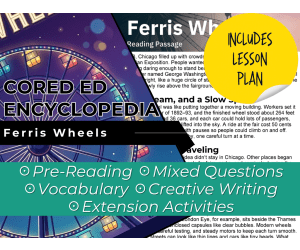
Ferris Wheels Reading Comprehension Passage - Cored Ed Encyclopedia
ELA, Reading Comprehension, Reading, Science, Technology, Language Development, Social Studies, History, Pre-Reading, Writing, Grade 2, 3, 4, 5, Worksheets & Printables, Worksheets, Teacher Tools, Centers, Activities, Writing Prompts, Assessments, Quizzes and Tests, Quizzes, Lesson Plans
This Ferris wheels reading comprehension with lesson plan includes: Visualization (on the front cover) Start your lesson by taking a minute to think and share something about the topic. Read the script aloud (slowly), perhaps prepare some music or sound effects. Student close their eyes and let their imaginations wander. Students open their eyes, read the question aloud and give them a few minutes to complete. Ask a few students to share or keep answers until the end to compare with what they learn in the passage. Quick pause—thousands of Cored Education products are included with your TeachSimple membership. Download links and encyclopedia index available here. Pre-Reading Trivia Students will write down one thing they already know about the subject and then read five more facts and discuss. These facts are fun, and the students will enjoy learning about the subject before reading more. Give 1 minute for students to write what they already know (no pressure—best guess is fine). Read the five facts together. After each fact, do ask a student for their opinion, was it surprising? Set a purpose by asking students to highlight/underline one fact they want to learn more about during the reading. Reading Passage The text is a high-interest reading passage with set paragraphs, roughly three to four paragraphs long. It contains a variety of themes about the topic, anywhere from history to technology. The passage is between 250 and 350 words in length. First, ask students to look at the headings and see what they’ll learn about today. What do they know about the topic/heading? First read options: Teacher read-aloud (best for support). Partner reading (paragraph by paragraph). While reading, students underline important details, and vocabulary words they think may come up in the questions section. Mixed Questions The first question page contains four multiple-choice questions, each with a choice of four answers, and three written response questions that require a sentence or two from the student. Students complete the mcqs first independently, then review quickly as a class. For the 3 written responses, try to get students giving the answer with some form of evidence: “I think ___ because the text says ___.” If students get stuck, send them back to check the passage. Vocabulary Questions Practice seven key words from the text in this section across two activities. First section is scrambled words where students will unscramble three words given a clue for each. The second section is a word to meaning matching activity. Before starting, have some students read out words they underlined in the passage. Ask students to say the word and read aloud the sentence(s) around each word. Ask students to do scrambled words and the matching exercise in pairs then go through answers as a class. For the scrambled spelling task, get four pairs to come up to the board and write the words for extra practice with the other student reading out the clue. For the matching task, prompt students to give full sentences: “I matched ___ with ___ because ___.” Creative Writing In this question, the student will be required to write a five to eight sentence paragraph on a question related to the topic. Before starting, ask students write down 3 key ideas they are going to include in their piece. Ask students for ideas to share around the class to help those struggling. Pro writing expectations: 5–8 sentences At least 2 facts or details from the passage At least 2 vocabulary words from the previous page Students read their paragraphs while classmates listen for facts and vocabulary words. Extension Activities This page is optional for fast finishers or to take home. There are several activities, each one requiring a different skill. Do some, do none, do all, completely optional - but you will feel reassured knowing every possibility is planned for. Includes summary writting question and additional facts. Answer Key There are answers for the multiple-choice questions, written response questions have sample answers, vocabulary answers and if there is a summary question then a sample summary will be provided as well. Lesson Plan Included Customized lesson plan for this lesson is included. Lesson Snapshot Title: Ferris Wheels Genre: Nonfiction (Informational Text) Subject: Social Studies (History) / Science & Technology / Reading (Informational Text) Primary Topic: Origins, design, and purpose of Ferris wheels Estimated Guided Reading Level (A–Z): P What This Lesson Teaches Best Explains the origin story of the first Ferris wheel at the 1893 Chicago world’s fair and why people wanted a daring new attraction. Uses clear facts and measurements (about 264 feet/80 meters , 36 cars , ride cost and time) to build informational reading skills. Shows how Ferris wheels spread to new places and why they’re also called “observation wheels” (because looking is part of the fun). Compares past and present Ferris wheels, including modern wheels built for slow sightseeing like the London Eye with enclosed capsules. Highlights how modern wheels rely on strong steel, careful testing, and steady motors for smooth turns. Learning Goals Students will describe why the 1893 world’s fair crowd wanted something “brand-new” to see. Students will identify key details about the first Ferris wheel (height, number of cars, ride time, and cost). Students will explain why Ferris wheels are also called “observation wheels” using evidence from the text. Students will describe how Ferris wheels spread to other places after Chicago, including the example in Vienna. Students will compare how some Ferris wheels are designed for thrills versus slow sightseeing today. Key Vocabulary From the Text Exposition — a huge fair where inventions and exhibits are shown. engineer — a person who designs and builds things. fairgrounds — the area where a fair is held. capsules — closed pods that carry riders on a wheel. skyline — the outline of a city’s buildings against the sky. FULL CATALOG OF DOWNLOAD LINKS AND ENCYCLOPEDIA INDEX HERE
Author Cored Education
Rating
Tags Vocabulary, Reading Comprehension, Reading Passages, Lesson Plans, Ela Lesson Plans, Reading Comprehension Lesson Plans, Pre-reading, Science Lesson Plans, Social Studies Lesson Plans, History
I WONDER - What Is A Robux | Animated Video Lesson
Computer Science, Technology, Science, Grade 4, 5, 6, 7, 8, 9, 10, Lesson Plans, Teacher Tools
Video Introduction An amazing video designed for the students to learn more about STEM. I WONDER - What Is A Robux | Animated Video Lesson Plants world is really fascinating! Do you know that some flowers eat insects? Some other plants like to grow on walls can you mention any? Do you know what is the difference between fungicide and pesticide? If yes, Can you tell us more about it? What is nuclear energy? Is it safe to use it? Do you think it is a clean energy? Have you ever read about potential energy? If yes, tell us what it is? Do you think that potential energy can be converted into another form of energy? How it happens? I WONDER - What Is A Robux | Animated Video Lesson The video is perfect for encouraging the researching skills for the students, while learning more about this fantastic topic. I WONDER - What Is A Robux | Animated Video Lesson This friendly designed video is suitable for students at school, homeschooling, and as a group activity. Format Available in MP4 format.
Author Educational Voice
Rating
Tags What Is A Robux, Robux, Robux Facts, Robux Video, Robux Video For Kids, Robux Facts For Kids, Roblox, Roblox Facts, Roblox Video, Roblox Video For Kids

I WONDER - What Is Tower Bridge London | Animated Video Lesson
History: Europe, History, Social Studies, History: British, Geography, Grade 3, 4, 5, 6, 7, 8, 9, Lesson Plans, Teacher Tools
Video Introduction An amazing video designed for the students to learn more about history. I WONDER - What Is Tower Bridge London | Animated Video Lesson Do you like history? Which topic do you really enjoy about history? Have you ever read an interesting fact about the Vikings? If yes, can you mention them? What do you like most about the Victorian era? Can you name all the Tudors? Have you ever wondered how people used to live in ancient Japan and ancient China? Do you know any interesting facts about ancient Egyptians and the Pharaohs? Have you ever visited South America? What do you know about Incas and Aztecs? Celtic culture was really one of a kind, can you name any of the places that Celts used to live in? Imagine yourself living during the ancient Roman empire, how your life will look like? Ancient Greece was an amazing place to live in. What do you know about ancient Greek life? I WONDER - What Is Tower Bridge London | Animated Video Lesson The video is perfect for encouraging the researching skills for the students, while learning more about history. I WONDER - What Is Tower Bridge London | Animated Video Lesson This friendly designed video is suitable for students at school, homeschooling, and as a group activity. Format Available in MP4 format.
Author Educational Voice
Tags What Is Tower Bridge London, What Is Tower Bridge London Video, Tower Bridge London, Tower Bridge London Facts, Tower Bridge London Video, Tower Bridge London Facts For Kids, Tower Bridge London Video For Kids

Data Analysis & Probability: Pictographs - Practice the Skill 2 - PC Software
Math, Graphing, Common Core, Kindergarten, Preschool, Grade 1, 2, Teacher Tools, Lesson Plans
Data Analysis & Probability: Pictographs - Practice the Skill 2 - PC Software An exceptional teaching resource particularly designed for educators, tailored to assist in teaching the concept of Data Analysis and Probability using pictographs. An innovative way to engage students with real-time practice and skill-building activities. This software incorporates exercises that prompt students to answer specific questions based on a given pictograph. Subsequently, it assists young learners in understanding vital math concepts such as graphing and probability through hands-on experience and visual learning aids. Multilingual: This tool offers content in both English and Spanish, increasing its accessibility across diverse classrooms or homeschool settings. Inclusive Math Tools: Enhanced computational skills among students while working on these activities are promised by this software's included math tools. Standards Respecting:The software aligns with Common Core State Standards making it not only suitable for regular classrooms but also prepares children for standardised state tests. Following NCTM guidelines ensures quality education inline with global standards. The entire package comes enclosed within a single zip file which contains PC software that’s easy-to-use — allowing users hassle-free access wherever they want it implemented; comprehensive studies or individual homework tasks or even tutoring smaller groups separately are all catered for effectively. All said and done, This interactive asset promises not just impactful learning outcomes among youngsters but also affords educators an effective means of delivering math lessons in an engaging manner without straying from curriculum norms.
Author Classroom Complete Press
Tags Digital Math, Digital Graphs, Pictographs, Math Lesson, Math Skills

Short Vowels Decodable Books + Video Lessons + Activity Packs
Special Resources, ELA, Special Education Needs (SEN), Language Development, Pre-Reading, Phonics, Spelling, Kindergarten, Preschool, Grade 1, 2, Literacy Readers, Teacher Tools, Presentations, Lesson Plans
This is a set of ten lessons for struggling readers to help them develop reading fluency. The lessons cover short vowel words with and without a consonant blend. It includes 10 lessons, 10 decodable Reading Books, 10 matching PowerPoint presentations of the books + 10 packs of worksheets - a pack to support each book. This 10-week curriculum focuses on short vowel sounds and is designed for struggling readers. It includes 10 decodable reading books, each with only 10 new words per book to prevent cognitive overload. This pack is designed for children who have already learned to blend words with a short vowel sound, with both three and four sounds, but have not yet attained reading fluency. We study the ten words in each vowel sound, five each week, and then practice by using the activity pack. The child becomes very familiar with these five words. The child can then be given the next reading book and, to his/her great surprise, can read the book quite fluently without having to decode nearly every word. This gives the child an enormous boost. The process seems, in my experience, to help the child learn what is needed, once they can sound out words _ it helps them to learn how to store the words in the long-term memory, and I find it gets easier and easier as we go through the programme. The worksheets provide multi-sensory activities to help the child develop: Flashcards of the relevant words for each sound Phonemic awareness Strengthen consonant blends, which these children often find hard Tracking skills, which are again poor for many of these children Word differentiation - we tackle confusion words head-on (e.g. big/pig) Comprehension - as reading becomes more fluent, we can now build comprehension Fun print and go games And much, much more! The systematic, repetitive nature of this program makes it suitable for students with special needs, including those with dyslexia, cerebral palsy, or general learning disabilities. Ideal for small groups or one-on-one instruction, it helps develop reading fluency, phonetic awareness, and early writing skills. Teachers praise the simple download-and-print format that allows students worldwide to benefit. After completing this introductory short vowels pack, students can progress to more advanced phonics. This pack is followed by our decodable readers and PowerPoints, which continue in the same way: https://teachsimple.com/product/phonic-readers-matching-worksheets-and-powerpoint-pack-1-ck
Author Lilibette's Resources
Rating
Tags Learn To Read Programme, Fluency, Struggling Readers, Dyslexia, Special Needs, Phonics, Decodable Reading Books, Reading Fluency, Short Vowels
Number & Operations: Counting & Ordering Objects - PC Software
Math, Numbers, Kindergarten, Preschool, Grade 1, 2, Teacher Tools, Lesson Plans
Number & Operations: Counting & Ordering Objects - PC Software This is a comprehensive tool designed for educators focusing on subjects like counting, ordering objects, and a broader scope of number operations. This resource is valuable for teachers at the preschool, kindergarten, G1, and G2 levels.. Real-World Application Methods & Lesson Plans: The teaching aid integrates practical methods and offers specially crafted lesson plans that make learners confident in numerical abilities. It further includes mathematical tools to supplement these lessons. Focused Learning Activities: The software incorporates memory match games and spinner games to keep students engaged while learning math concepts. Timed Drill activities: Integral for regular assessment of progress. SMART Response techniques:This helps show students areas needing improvement setting refocusing points for their efforts. Inclusive Language Support & Hands-on Tools: The software provides English voiceover and text as well as Spanish alternatives. Also available are physical printable resources when needed in the classroom or homework assignments. The whole package comes in an easy downloadable zip file compatible with PCs - enabling more time focus on enhancing math curriculum objectives. Note: This resource can be effectively deployed in any size of educational context—whether it be large scale classes or individualized instruction sessions at home leading to insightful learning experiences. e
Author Classroom Complete Press
Tags Counting, Ordering Objects, Grouping, Math Lesson, Operations Lesson
Geometry: Decomposing Geometric Shapes - Practice the Skill 3 - FLASH-MAC
Math, Geometry, Common Core, Grade 1, 2, Teacher Tools, Lesson Plans
Geometry: Decomposing Geometric Shapes - Practice the Skill 3 - FLASH-MAC Constructed for educators teaching Grade 1 and Grade 2, this innovative software helps demystify the concept of Decomposing Geometric Shapes in the subject area of Math. It is ideal for anyone following a curriculum built around Common Core State Standards, STEM initiatives or written to NCTM, delivering a comprehensive understanding of Geometry and more specifically, decomposing geometric shapes. This lesson plan's deeper objective: - asks students to identify faces, sides, and corners in various figures. - Complete with math tools for ease and comprehensive learning outcomes; it fully arms teachers with multiple methods of assessment that go beyond the traditional answer key. - This could function as an integral part of whole group instruction or even small group learning opportunities where real-time observations are possible. To create a more engaging experience: Incorporated into this resource are practice skill timed drill activities. This activity not only promotes learning but also adds an entertaining dimension that encourages students' eagerness to participate and boosts their confidence as they improve. Note:The inherent flexibility comes from its Spanish voice-over option coupled with English text; paving the way for thorough inclusivity while personalizing learning based on individual language proficiency levels. The FLASH-MAC software file type ensures seamless integration into your digital curriculum setup making it both practical and convenient for use at home or within school confines. Whether you want students to tackle additional work as homework assignments or need focused material supporting math centers,this product has you covered. Heralding clarity rare among computational subjects like Geometry, this tool encourages skill development using practical methodologies. In doing so, it nurtures inquisitiveness leading to a well-rounded comprehension among young learners.
Author Classroom Complete Press
Tags Software (Mac)

I WONDER - Did The Oviraptor Have Feathers | Animated Video Lesson
History: Ancient, History, Social Studies, History: World, Animals, Life Sciences, Science, Grade 4, 5, 6, 7, 8, 9, 10, Lesson Plans, Teacher Tools
Video Introduction An amazing video designed for the students to learn more about dinosaurs in different countries. I WONDER - Did The Oviraptor Have Feathers | Animated Video Lesson Do you like dinosaurs? what is your favorite one? Do you own a pet? If yes, tell us more about it, like what its name? And what do you like most about it? Do you think that your pet has been evolved from a dinosaur? Can you write down the characteristics of your favourite dinosaur like it's shape, their rivals, where did it use to live and what was their favourite food? What is the largest and the smallest dinosaur that ever found? Why is the T-rex is so famous? Have you ever read any interesting facts about it? Can you name any of the carnivores or herbivores dinosaurs? I WONDER - Did The Oviraptor Have Feathers | Animated Video Lesson The video is perfect for encouraging the researching skills for the students, while learning more about dinosaurs. I WONDER - Did The Oviraptor Have Feathers | Animated Video Lesson This friendly designed video is suitable for students at school, homeschooling, and as a group activity. Format Available in MP4 format.
Author Educational Voice
Rating
Tags Did The Oviraptor Have Feathers, Did The Oviraptor Have Feathers Video, Oviraptor, Oviraptor Facts, Oviraptor Video, Oviraptor Video For Kids, Oviraptor Facts For Kids, Dinosaur, Dinosaurs

I WONDER - What Job Do Veins Do | Animated Video Lesson
Human Body, Life Sciences, Science, Biology, STEM, Grade 6, 7, 8, 9, 10, 11, 12, Lesson Plans, Teacher Tools
Video Overview The human body is full of fascinating wonders to learn. This video is created to help the students recognize the anatomy and the job of the human body. I WONDER - What Job Do Veins Do | Animated Video Lesson Every part and organ in our human body is vital so let's see how important they are. Have you ever imagined how we look like if we didn't have a skeleton? Did you know that because we have our amazing muscles we can stand! Do you know how many teeth do we have? Have you ever wondered about the food journey inside our body? Can you name all the glands in our body? Why do we have skin? Our nervous system is really good at sending signals. Can you tell us more about it? Are you really good at Mathematics, painting, or any other thing? You should really thank your brain about it! The famous five senses are really doing a great work? Can you explain how every sense works? I WONDER - What Job Do Veins Do | Animated Video Lesson The video is perfect for encouraging the researching skills for the students, while learning more about our fantastic human body. I WONDER - What Job Do Veins Do | Animated Video Lesson This friendly designed video is suitable for students at school, homeschooling, and as a group activity. Format Available in MP4 format.
Author Educational Voice
Tags What Job Do Veins Do, What Job Do Veins Do Video, Veins, Vein, Veins Facts, Veins Facts For Kids, Veins Video, Veins Video For Kids, Arteries, Arteries Facts

I WONDER - What Food Are Carbohydrates | Animated Video Lesson
Human Body, Life Sciences, Science, Biology, STEM, Grade 1, 2, 3, 4, 5, 6, 7, 8, Lesson Plans, Teacher Tools
Video Overview The human body is full of fascinating wonders to learn. This video is created to help the students recognize the anatomy and the job of the human body. I WONDER - What Food Are Carbohydrates | Animated Video Lesson Every part and organ in our human body is vital so let's see how important they are. Have you ever imagined how we look like if we didn't have a skeleton? Did you know that because we have our amazing muscles we can stand! Do you know how many teeth do we have? Have you ever wondered about the food journey inside our body? Can you name all the glands in our body? Why do we have skin? Our nervous system is really good at sending signals. Can you tell us more about it? Are you really good at Mathematics, painting, or any other thing? You should really thank your brain about it! The famous five senses are really doing a great work? Can you explain how every sense works? I WONDER - What Food Are Carbohydrates | Animated Video Lesson The video is perfect for encouraging the researching skills for the students, while learning more about our fantastic human body. I WONDER - What Food Are Carbohydrates | Animated Video Lesson This friendly designed video is suitable for students at school, homeschooling, and as a group activity. Format Available in MP4 format.
Author Educational Voice
Tags What Food Are Carbohydrates, What Food Are Carbohydrates Video, Carbohydrates, Carbohydrate, Carbohydrates Facts, Carbohydrates Facts For Kids, Carbohydrates Video, Carbohydrates Video For Kids
Circulatory,Digestive & Reproductive Systems: The Digestive System - Mouth to Stomach - FLASH-PC
Science, Life Sciences, Human Body, Common Core, Grade 5, 6, 7, 8, Teacher Tools, Lesson Plans
The Circulatory, Digestive & Reproductive Systems: The Digestive System - Mouth to Stomach - FLASH-PC is an invaluable teaching resource, designed to enhance students' comprehension of the circulatory, digestive, and reproductive systems. This product focuses specifically on the journey from the mouth to the stomach within the digestive system. Suitable for grades 5 through 8, this software-based learning tool combines interactive activities with reading passages that align with Common Core State Standards. Built around a science curriculum framework and incorporating aspects of human body studies as sub-subjects, it ticks all boxes for comprehensive educational content. Main Features: 'Before You Read' questions that spark curiosity and engagement in learners before they delve into any new text based content. 'After You Read' queries intended to underscore their understanding after interaction with readings. Vocabulary flashcards offered as part of this package utilizabke independently or in peer-learning context. An assortment of video and audio resources accompany textual materials. This resource conducts pedagogy into diverse digital domains too! An assortment of video audio resources accompany textual materials amplifying student engagement by presenting information across different modalities. Note: Despite its rich features serving differentiated instruction styles (individualized or whole group), it doesn’t compromise on simplicity; bells-and-whistles are kept low-key so educators can focus on equipping students with solid foundations about body function intricacies. All-in-all Circulatory,Digestive & Reproductive Systems: The Digestive System - Mouth To Stomach - FLASH-PC integrates state-of-the-art software technology into conventional lesson planning practices at schools but can also be effectively employed for home-schooling purposes. Any educator aiming at delivering information-packed yet engaging lessons in human biology would find this resource useful.
Author Classroom Complete Press
Tags Software (PC)
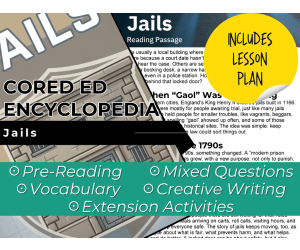
Jails Reading Comprehension Passage - Cored Ed Encyclopedia
ELA, Reading Comprehension, Reading, Pre-Reading, Language Development, Vocabulary, History, Social Studies, Law, Spelling, Grade 2, 3, 4, 5, Worksheets & Printables, Worksheets, Teacher Tools, Centers, Activities, Writing Prompts, Assessments, Quizzes and Tests, Quizzes, Lesson Plans
This Jails reading comprehension with lesson plan includes: Visualization (on the front cover) Start your lesson by taking a minute to think and share something about the topic. Read the script aloud (slowly), perhaps prepare some music or sound effects. Student close their eyes and let their imaginations wander. Students open their eyes, read the question aloud and give them a few minutes to complete. Ask a few students to share or keep answers until the end to compare with what they learn in the passage. Quick pause—thousands of Cored Education products are included with your TeachSimple membership. Download links and encyclopedia index available here. Pre-Reading Trivia Students will write down one thing they already know about the subject and then read five more facts and discuss. These facts are fun, and the students will enjoy learning about the subject before reading more. Give 1 minute for students to write what they already know (no pressure—best guess is fine). Read the five facts together. After each fact, do ask a student for their opinion, was it surprising? Set a purpose by asking students to highlight/underline one fact they want to learn more about during the reading. Reading Passage The text is a high-interest reading passage with set paragraphs, roughly three to four paragraphs long. It contains a variety of themes about the topic, anywhere from history to technology. The passage is between 250 and 350 words in length. First, ask students to look at the headings and see what they’ll learn about today. What do they know about the topic/heading? First read options: Teacher read-aloud (best for support). Partner reading (paragraph by paragraph). While reading, students underline important details, and vocabulary words they think may come up in the questions section. Mixed Questions The first question page contains four multiple-choice questions, each with a choice of four answers, and three written response questions that require a sentence or two from the student. Students complete the mcqs first independently, then review quickly as a class. For the 3 written responses, try to get students giving the answer with some form of evidence: “I think ___ because the text says ___.” If students get stuck, send them back to check the passage. Vocabulary Questions Practice seven key words from the text in this section across two activities. First section is scrambled words where students will unscramble three words given a clue for each. The second section is a word to meaning matching activity. Before starting, have some students read out words they underlined in the passage. Ask students to say the word and read aloud the sentence(s) around each word. Ask students to do scrambled words and the matching exercise in pairs then go through answers as a class. For the scrambled spelling task, get four pairs to come up to the board and write the words for extra practice with the other student reading out the clue. For the matching task, prompt students to give full sentences: “I matched ___ with ___ because ___.” Creative Writing In this question, the student will be required to write a five to eight sentence paragraph on a question related to the topic. Before starting, ask students write down 3 key ideas they are going to include in their piece. Ask students for ideas to share around the class to help those struggling. Pro writing expectations: 5–8 sentences At least 2 facts or details from the passage At least 2 vocabulary words from the previous page Students read their paragraphs while classmates listen for facts and vocabulary words. Extension Activities This page is optional for fast finishers or to take home. There are several activities, each one requiring a different skill. Do some, do none, do all, completely optional - but you will feel reassured knowing every possibility is planned for. Includes summary writting question and additional facts. Answer Key There are answers for the multiple-choice questions, written response questions have sample answers, vocabulary answers and if there is a summary question then a sample summary will be provided as well. Lesson Plan Included Customized lesson plan for this lesson is included. Lesson Snapshot Title: Jails Genre: Nonfiction (informational text) Subject: Social Studies (Civics) / Reading (Informational Text) Primary Topic: What jails are and how they differ from prisons Estimated Guided Reading Level (A–Z): S What This Lesson Teaches Best Explains what a jail is and why people may be there for a short time (waiting for a court date or serving short sentences). Uses history to show how jails were used long ago (England, 1166) and why the spelling “gaol” appeared. Clarifies the difference between “jail” and “prison” in formal American and Canadian English (pretrial custody/shorter sentences vs. longer sentences). Connects jails to community routines and civic values (rules, safety checks, fairness, harm prevention, justice). Builds understanding of how word choice and definitions matter when discussing systems and government roles (counties vs. state/federal). Learning Goals Describe what a jail is and give two reasons people may be held there. Explain how early jails in England were used and what “gaol” means in the passage. Explain what changed in the 1790s in the United States, according to the text. Compare a jail and a prison using details from the passage. Identify examples of routines and rules in jails and explain why they matter. Key Vocabulary From the Text booking — recording a new person in jail. cells — small rooms where people are held. trial — a court process to decide a case. convicted — found guilty of a crime. reform — help someone change for the better. FULL CATALOG OF DOWNLOAD LINKS AND ENCYCLOPEDIA INDEX HERE
Author Cored Education
Rating
Tags Vocabulary, Reading Comprehension, Reading Passages, Lesson Plans, Ela Lesson Plans, Reading Comprehension Lesson Plans, Pre-reading, Social Studies Lesson Plans, History, Jails
Number & Operations: Base-Ten & Place Value - Practice the Skill 1 - MAC Software
Math, Place Value, Common Core, Kindergarten, Preschool, Grade 1, 2, Teacher Tools, Lesson Plans
Number & Operations: Base-Ten & Place Value - Practice the Skill 1 - MAC Software This software resource provides teachers and homeschooling parents with an effective tool for teaching students about the foundational concepts of base-ten and place value. It's designed for preschoolers through to second graders, enhancing number sense systematically. Interactive Learning: The program engages students with base-ten blocks counting drills, stimulating mathematical thinking. Bilingual Friendly: With English and Spanish voice over options, it addresses diverse language needs in multilingual classrooms. Versatile Usage: Teachers can use this software in various settings – whole or small groups or even assign as individual homework. The software also comes with additional math tools designed to enrich student learning experiences further. Compliance with Common Core State Standards, STEM initiatives, and NCTM directives ensure alignment with national education guidelines. Tech-Savvy Design: The product is digitally ready for MAC users requiring minimal setup time (one zip file provided), offering easy navigation on its interactive platform. In conclusion, Number & Operations: Base-Ten & Place Value - Practice the Skill 1 – MAC Software highlights that understanding place value is crucial in primary grades’ mathematics education. Its unique approach promises a pathway towards mathematical proficiency among young learners. .</div
Author Classroom Complete Press
Tags Math Skill, Operations, Place Value, Base-ten, Digital Math
I WONDER - How Big Are Wind Farms | Animated Video Lesson
Environmental Science, Earth and Environmental Sciences, Science, Earth Sciences, Grade 4, 5, 6, 7, 8, 9, 10, Lesson Plans, Teacher Tools
Video Introduction An amazing video designed for the students to learn more about STEM. I WONDER - How Big Are Wind Farms | Animated Video Lesson Do you like STEM subjects? what is your favorite one? Have you ever tried to plant a seed? If yes, tell us more about it. Or have you ever tried to invent something? If yes, tell us more about it. And how do you think it will help us? Have you ever seen a microorganism under a microscope? What was it? And how it looked like? Mathematics is a marvelous subject. Let' sharpen our brains and solve some equations. Do you like timetable tricks? What is your favorite one? Do you know how to code? Have you ever created an app or a game before? If yes, how was it like? I WONDER - How Big Are Wind Farms | Animated Video Lesson The video is perfect for encouraging the researching skills for the students, while learning more about this fantastic topic. I WONDER - How Big Are Wind Farms | Animated Video Lesson This friendly designed video is suitable for students at school, homeschooling, and as a group activity. Format Available in MP4 format.
Author Educational Voice
Tags How Big Are Wind Farms, How Big Are Wind Farms Video, Wind Farms, Wind Farm, Wind Farms Facts, Wind Farms Facts For Kids, Wind Farms Video, Wind Farms Video For Kids

I WONDER - How Was JAVA Named | Animated Video Lesson
STEM, Computer Science, Technology, Science, Grade 6, 7, 8, 9, 10, 11, 12, Lesson Plans, Teacher Tools
Video Introduction An amazing video designed for the students to learn more about STEM. I WONDER - How Was JAVA Named | Animated Video Lesson Do you like STEM subjects? what is your favorite one? Have you ever tried to plant a seed? If yes, tell us more about it. Or have you ever tried to invent something? If yes, tell us more about it. And how do you think it will help us? Have you ever seen a microorganism under a microscope? What was it? And how it looked like? Mathematics is a marvelous subject. Let' sharpen our brains and solve some equations. Do you like timetable tricks? What is your favorite one? Do you know how to code? Have you ever created an app or a game before? If yes, how was it like? I WONDER - How Was JAVA Named | Animated Video Lesson The video is perfect for encouraging the researching skills for the students, while learning more about this fantastic topic. I WONDER - How Was JAVA Named | Animated Video Lesson This friendly designed video is suitable for students at school, homeschooling, and as a group activity. Format Available in MP4 format.
Author Educational Voice
Tags How Was JAVA Named, How Was JAVA Named Video, JAVA, JAVA Facts, JAVA Facts For Kids, JAVA Video, JAVA Video For Kids, Coding, Coding Facts, Coding Video
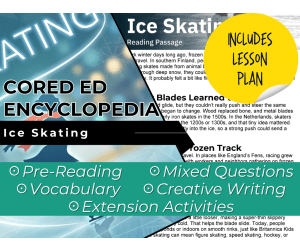
Ice Skating Reading Comprehension Passage - Cored Ed Encyclopedia
ELA, Reading Comprehension, Reading, Language Development, History, Social Studies, Science, Physics, Sports, P.E. & Health, Grade 2, 3, 4, 5, Worksheets & Printables, Worksheets, Teacher Tools, Centers, Activities, Writing Prompts, Assessments, Quizzes and Tests, Quizzes, Lesson Plans
This Ice Skating reading comprehension with lesson plan includes: Visualization (on the front cover) Start your lesson by taking a minute to think and share something about the topic. Read the script aloud (slowly), perhaps prepare some music or sound effects. Student close their eyes and let their imaginations wander. Students open their eyes, read the question aloud and give them a few minutes to complete. Ask a few students to share or keep answers until the end to compare with what they learn in the passage. Quick pause—thousands of Cored Education products are included with your TeachSimple membership. Download links and encyclopedia index available here. Pre-Reading Trivia Students will write down one thing they already know about the subject and then read five more facts and discuss. These facts are fun, and the students will enjoy learning about the subject before reading more. Give 1 minute for students to write what they already know (no pressure—best guess is fine). Read the five facts together. After each fact, do ask a student for their opinion, was it surprising? Set a purpose by asking students to highlight/underline one fact they want to learn more about during the reading. Reading Passage The text is a high-interest reading passage with set paragraphs, roughly three to four paragraphs long. It contains a variety of themes about the topic, anywhere from history to technology. The passage is between 250 and 350 words in length. First, ask students to look at the headings and see what they’ll learn about today. What do they know about the topic/heading? First read options: Teacher read-aloud (best for support). Partner reading (paragraph by paragraph). While reading, students underline important details, and vocabulary words they think may come up in the questions section. Mixed Questions The first question page contains four multiple-choice questions, each with a choice of four answers, and three written response questions that require a sentence or two from the student. Students complete the mcqs first independently, then review quickly as a class. For the 3 written responses, try to get students giving the answer with some form of evidence: “I think ___ because the text says ___.” If students get stuck, send them back to check the passage. Vocabulary Questions Practice seven key words from the text in this section across two activities. First section is scrambled words where students will unscramble three words given a clue for each. The second section is a word to meaning matching activity. Before starting, have some students read out words they underlined in the passage. Ask students to say the word and read aloud the sentence(s) around each word. Ask students to do scrambled words and the matching exercise in pairs then go through answers as a class. For the scrambled spelling task, get four pairs to come up to the board and write the words for extra practice with the other student reading out the clue. For the matching task, prompt students to give full sentences: “I matched ___ with ___ because ___.” Creative Writing In this question, the student will be required to write a five to eight sentence paragraph on a question related to the topic. Before starting, ask students write down 3 key ideas they are going to include in their piece. Ask students for ideas to share around the class to help those struggling. Pro writing expectations: 5–8 sentences At least 2 facts or details from the passage At least 2 vocabulary words from the previous page Students read their paragraphs while classmates listen for facts and vocabulary words. Extension Activities This page is optional for fast finishers or to take home. There are several activities, each one requiring a different skill. Do some, do none, do all, completely optional - but you will feel reassured knowing every possibility is planned for. Includes summary writting question and additional facts. Answer Key There are answers for the multiple-choice questions, written response questions have sample answers, vocabulary answers and if there is a summary question then a sample summary will be provided as well. Lesson Plan Included Customized lesson plan for this lesson is included. Lesson Snapshot Title: Ice Skating Genre: Nonfiction (informational text) Subject: Reading (Informational Text) / Science Primary Topic: How ice skating began and why blades glide Estimated Guided Reading Level (A–Z): R What This Lesson Teaches Best Explains how ice skating was first used for winter travel long ago (frozen lakes and rivers as “the easiest way to travel”). Describes how skates changed over time (from animal bones to wood to metal blades) and why sharpened edges mattered for control. Shows how skating shifted from travel to organized sport, including races, rules, championships, and the Olympic stage. Introduces a simple science idea for why skates glide: a super-thin slippery surface layer where ice molecules are a little looser. Uses text features (section headings) to chunk information and support comprehension. Learning Goals Identify the main idea and key details about how ice skating began and changed over time. Describe the difference between early bone skates and later skates with sharpened metal edges. Explain how sharpened edges helped skaters push, steer, and move with control. Explain, using the text, why a skate blade can slide well on ice. Describe how skating became an organized sport with rules, championships, and worldwide attention. Key Vocabulary From the Text blades — thin metal parts of skates that touch the ice. edges — sharpened sides that help a skate grip ice. molecules — tiny pieces that make up ice. championships — contests to find winners in a sport. standards — agreed rules that keep things consistent. FULL CATALOG OF DOWNLOAD LINKS AND ENCYCLOPEDIA INDEX HERE
Author Cored Education
Rating
Tags Vocabulary, Reading Comprehension, Reading Passages, Lesson Plans, Ela Lesson Plans, Reading Comprehension Lesson Plans, Pre-reading, History, P.e. Lesson Plans, Sports
I WONDER - What Did Viking Women Do | Animated Video Lesson
History: Ancient, History, Social Studies, History: Europe, History: British, History: Canada, History: USA, Grade 3, 4, 5, 6, 7, 8, 9, Lesson Plans, Teacher Tools
Video Introduction An amazing video designed for the students to learn more about history. I WONDER - What Did Viking Women Do | Animated Video Lesson Do you like history? Which topic do you really enjoy about history? Have you ever read an interesting fact about the Vikings? If yes, can you mention them? What do you like most about the Victorian era? Can you name all the Tudors? Have you ever wondered how people used to live in ancient Japan and ancient China? Do you know any interesting facts about ancient Egyptians and the Pharaohs? Have you ever visited South America? What do you know about Incas and Aztecs? Celtic culture was really one of a kind, can you name any of the places that Celts used to live in? Imagine yourself living during the ancient Roman empire, how your life will look like? Ancient Greece was an amazing place to live in. What do you know about ancient Greek life? I WONDER - What Did Viking Women Do | Animated Video Lesson The video is perfect for encouraging the researching skills for the students, while learning more about history. I WONDER - What Did Viking Women Do | Animated Video Lesson This friendly designed video is suitable for students at school, homeschooling, and as a group activity. Format Available in MP4 format.
Author Educational Voice
Tags What Did Viking Women Do, What Did Viking Women Do Video, Viking Women, Viking Women Facts, Viking Women Facts For Kids, Viking Women Video, Viking Women Video For Kids, Viking

I WONDER - What Is Humidity | Animated Video Lesson
Earth and Environmental Sciences, Science, Environmental Science, Earth Sciences, Grade 4, 5, 6, 7, 8, 9, 10, Lesson Plans, Teacher Tools
Video Introduction An amazing activity designed for the students to learn more about STEM. I WONDER - What Is Humidity | Animated Video Lesson Do you like STEM subjects? what is your favorite one? Have you ever tried to plant a seed? If yes, tell us more about it. Or have you ever tried to invent something? If yes, tell us more about it. And how do you think it will help us? Have you ever seen a microorganism under a microscope? What was it? And how it looked like? Mathematics is a marvelous subject. Let' sharpen our brains and solve some equations. Do you like timetable tricks? What is your favorite one? Do you know how to code? Have you ever created an app or a game before? If yes, how was it like? I WONDER - What Is Humidity | Animated Video Lesson The video is perfect for encouraging the researching skills for the students, while learning more about this fantastic topic. I WONDER - What Is Humidity | Animated Video Lesson This friendly designed video is suitable for students at school, homeschooling, and as a group activity. Format Available in MP4 format.
Author Educational Voice
Tags What Is Humidity, What Is Humidity Video, Humidity, Humidity Facts, Humidity Facts For Kids, Humidity Facts Video, Weather, Climate, Weather Facts, Weather Facts For Kids
Galaxies & The Universe: Introduction to the Universe - FLASH-PC
Science, Earth and Environmental Sciences, Space, Common Core, Grade 5, 6, 7, 8, Teacher Tools, Lesson Plans
Galaxies and the Universe: Introduction to the Universe - FLASH-PC An essential teaching resource designed to simplify complex astronomy concepts for Grade 5 through Grade 8 students. It's compatible with PC software and aims at creating a comprehensive, interactive environment that fosters curiosity about cosmic entities. Tailored Educational Content This educational content is geared towards introducing students to the colossal expanse of galaxies and universe. The materials are Informed by Common Core State Standards, guaranteeing they meet designated learning outcomes. Follows Bloom's Taxonomy, which promotes varied levels of thinking skills among students. Robust Reading Passages With Galaxies & The Universe: Introduction to the Universe FLASH-PC, educators receive robust reading passages that have been carefully crafted for optimum comprehension. This approach ensures students grasp core concepts while stimulating a deep interest in studying astronomy. Also included are 'before you read' and 'after you read' questions with each passage. Sterling Features Incorporated: Appealing printables and vocabulary flash cards – promoting hands-on involvement while expanding scientific terminologies. An integration of audio-video components along with interactive activities offers immersive experiences solidifying comprehension through visualizations combined with auditory reinforcements. Apt For Various Settings: Equally suited to both public-school teachers as well as homeschoolers alike. Whether implemented in whole group classes or smaller study circles or even assigned as out-of-class assignments. In summary, the "Galaxies & The Universe: Introduction to the Universe FLASH-PC" emerges as an effective tool responding adeptly to evolving instructional methods within educational landscapes today. It provides a streamlined blend of theory information supplemented by not just active but interactive learning tools fostering holistic student growth within astronomical sciences.
Author Classroom Complete Press
Tags Software (PC)