



3,922 products added recently
Page 6 - Pre Reading Lesson Plans
Boost your students' reading success with pre-reading lesson plans that activate prior knowledge and set purposes for reading. These activities help students make connections and predict content. Use these strategies to improve engagement and understanding of texts across subjects.

 Show filters


Guided Reading Activities with Lesson Plans: Fiction Set 7 - Sports
ELA, Reading, Reading Comprehension, Common Core, ESL, Language Development, Pre-Reading, Vocabulary, Resources for Teachers, Grade 2, 3, Worksheets & Printables, Worksheets, Teacher Tools, Lesson Plans, Activities
Guided Reading Activities with Lesson Plans Fiction Set 7 Note: This download DOES NOT include the passages themselves. If you have not already done so, download in a format of your choice in the "reading links" section below. Overview The perfect companion materials for Cored Education reading comprehension downloads. This collection of guided reading lessons includes a wide array of engaging themes that aim to foster comprehension, vocabulary development, and creative thinking. Each lesson is crafted to be interactive and immersive, making learning enjoyable while promoting essential literacy skills. The lessons are designed for students to actively engage with both the material and the world around them, creating connections to their personal experiences while developing key skills. Includes Guided Reading Materials For: 1.Catch It, Dan 2.Feeling Left Out 3.Ian's Friday Nights 4.Aimee's Dilemma 5.A Great Team 6.Ana's Swimming Party 7.Touchdown Pythons 8.Sam's Passion 9.Where's My Board 10.Lacey the Runner Reading Links: This is the guided reading materials version and DOES NOT include the passages themselves. The passages related to this download are available here in GOOGLE Docs, GOOGLE Forms, GOOGLE Slides. PDF, PPT, WORD. Google Docs Google Forms Google Slides PDF PPT Word Details Pre-reading Discussions Each lesson begins with pre-reading questions that help activate prior knowledge and engage students in the theme of the lesson. This allows students to make personal connections with the content before diving into the reading material. Vocabulary Development Every lesson includes vocabulary exploration that introduces key terms students will encounter in the reading. These words are essential for understanding the passage, and activities encourage students to apply the new vocabulary in context. Comprehension Check After the reading, the lessons provide comprehension questions (typically multiple-choice) that assess students’ understanding of the story. These questions help students reflect on key events, characters, and concepts within the text, reinforcing their comprehension. Creative Writing Prompts To foster creativity, the lessons include writing activities that challenge students to apply what they've learned in imaginative ways. These prompts allow students to practice creative expression while reinforcing the lesson’s theme. Discussion Topics Each lesson ends with wrap-up discussion questions that encourage students to think critically and engage in group conversations. These discussions can enhance social learning and deepen understanding by connecting the lesson's content to broader real-world applications. Theme-Based Learning The themes (e.g., winter, nature walks, photography, flowers) are universally appealing and offer opportunities for cross-curricular connections with science, art, and environmental studies. This makes the lessons versatile for a wide range of teaching contexts. Student-Centered Approach The activities are designed to be interactive and student-driven, allowing them to explore the content through discussions, hands-on vocabulary practice, and personal reflections. This promotes active learning and keeps students engaged. FULL CATALOG OF DOWNLOAD LINKS HERE Grade 2/3 Links Fiction Set 1 - Nature Google Docs Google Forms Google Slides PDF PPT Word Guided Reading Materials Fiction Set 2 - Animals Google Docs Google Forms Google Slides PDF PPT Word Guided Reading Materials Fiction Set 3 - Food Google Docs Google Forms Google Slides PDF PPT Word Guided Reading Materials Fiction Set 4 - School Google Docs Google Forms Google Slides PDF PPT Word Guided Reading Materials Fiction Set 5 - Friends Google Docs Google Forms Google Slides PDF PPT Word Guided Reading Materials Fiction Set 6 - Family Google Docs Google Forms Google Slides PDF PPT Word Guided Reading Materials Fiction Set 7 - Sports Google Docs Google Forms Google Slides PDF PPT Word Guided Reading Materials Nonfiction Set 1 - Technology Google Docs Google Forms Google Slides PDF PPT Word Guided Reading Materials Nonfiction Set 2 - Nutrition Google Docs Google Forms Google Slides PDF PPT Word Guided Reading Materials Nonfiction Set 3 - Animals Google Docs Google Forms Google Slides PDF PPT Word Guided Reading Materials Reading Passages Overview Each passage is especially written for Grade 2-3 students, including key vocabulary required for this age group. Topics are varied and are accompanied by colorful graphics. Topics are meant to educate, yet entertain the modern student. These passages are perfect for the modern classroom. Whereas textbooks can become outdated in no time, any changes to technology or the world will result in updates to this product. Mixed Questions The mixed questions section of each lesson includes a variation of fivecomprehension, vocabulary and math questions. In addition, key reading strategies are frequently covered including cause & effect, summarizing, compare & contrast and making conclusions. Three of the questions will be MCQs and two will require a written response of some kind. Full answers and example responses appear at the end of the lesson. Spelling & Vocab Each reading passage contains a variety of words and phrases designed for Grade 2-3 students. Spelling and vocab activities provide the opportunity to build fluency with these words. As it can become quite mundane doing the same activities over and over, each lesson in a set will contain a different spelling and vocab activity . Writing Prompts Writing prompts are designed to continue the theme or lessons learned in the story. Students are persuaded to write in a variety of ways and each prompt includes several cues to help. As with the spelling/vocab section, writing prompts will vary. This includes research pieces, reading responses, poetry and creative writing prompts. Full Answer Keys Full answer keys and sample responses are provided so no matter how busy you are, you know you're covered! Mixed question answers provide evidence from the text, math questions contain the relevant workings. Answers are designed for use by the teacher, but also suitable as a handout to the student. Additional File One lesson will have an additional file. This is something fun to extend the lesson with. For similar downloads and other frees, do check out Cored Group on TeachSimple.
Author Cored Education
Tags Elementary, Reading, Comprehension, Vocabulary, Answers, Ccss, Guided Reading, Guided Reading Activity, Guided Reading Lesson Plans, Guided Reading Lesson Plan
All About X - Letter of the Week Unit
ELA, Language Development, Pre-Reading, Kindergarten, Teacher Tools, Lesson Plans
All About X - Letter of the Week Unit This "letter X" bundle for preschoolers teaches letter recognition, letter formation, letter sounds, and using letter sounds in words in memorable and fun ways! With dozens of worksheets, handwriting practice, crafts, activity pages, games, and more to choose from, you can easily create engaging letter of the week lesson plans. Sort through options like mazes, paper bag puppets, bingo, matching activities, word cards, and classroom posters to design small group, whole class, or individualized instruction. Using consistent, high-quality letter curriculum throughout the year helps preschoolers master skills. If also needing numbers and colors resources, this teaching store has similar products so you can utilize the same successful approach across topics!
Author Simply Schoolgirl
Tags Letter Of The Week, Alphabet Games, Preschool, Kindergarten, Phonics, Mazes, Games, Printables, Handwriting, Worksheets
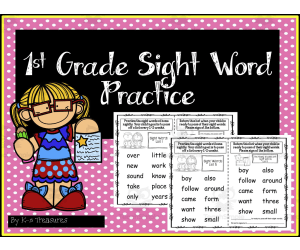
First Grade Sight Words - 100 Words to Practice and Learn
ELA, Language Development, Pre-Reading, Reading, Spelling, Vocabulary, Grade 1, 2, Worksheets & Printables, Worksheets, Lesson Plans, Teacher Tools
This list includes 10 take home sight word sheets for a total of 100 First Grade words. 100 FIRST GRADE FRY Sight Words! 10 PAGES INCLUDED! For children to learn how to read, sight words are important for kids to master. Practicing and reading sight words account for seventy five percent of words that children read. The Fry Sight words are words that are most often used and begins with the first one hundred words for Kindergarten.Using these words often to practice reading is essential to their skills and to improve in their reading comprehension. These words are often not easy to sound out like most CVC words, so recognizing them and memorizing these words is the most helpful to enhance a child's reading skills. You can find the first 100 words here which include some of the following words as an example: over knew take only little me work back give most very after things our man good think help where great say This list includes the second one hundred words for First Grade. There are different sight words for each grade level and the words build on each other. Students will recognize the previous words and continue to add more words to their memory as they practice them over and over. This list is mainly used for first and second grade students. It is intended to be used not only in the classroom, but to be used at home for practice with an adult. Then, it can be signed by a parent or guardian of the child and passed off at school. A total of 13 pages for students to practice and pass off once the students have mastered each word. Have parents sign the page once students are ready to pass them off with their teacher.
Author K-5 Treasures
Tags Sight Words, List Of Words, Reading, 1st Grade Reading, First Grade Sight Words, First Grade Reading, 1st Grade Sight Words, FRY Sight Words, 2nd Grade Sight Words, Second Grade Sight Words
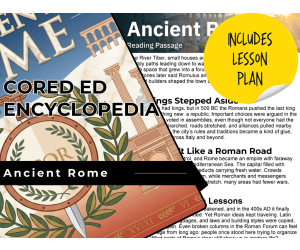
Ancient Rome Reading Comprehension Passage - Cored Ed Encyclopedia
ELA, Language Development, Reading Comprehension, Reading, Social Studies, History, History: Ancient, Writing, Pre-Reading, Vocabulary, Grade 2, 3, 4, 5, Worksheets & Printables, Worksheets, Teacher Tools, Centers, Activities, Writing Prompts, Assessments, Quizzes and Tests, Quizzes, Lesson Plans
This ancient Rome reading comprehension with lesson plan includes: Visualization (on the front cover) Start your lesson by taking a minute to think and share something about the topic. Read the script aloud (slowly), perhaps prepare some music or sound effects. Student close their eyes and let their imaginations wander. Students open their eyes, read the question aloud and give them a few minutes to complete. Ask a few students to share or keep answers until the end to compare with what they learn in the passage. Quick pause—thousands of Cored Education products are included with your TeachSimple membership. Download links and encyclopedia index available here. Pre-Reading Trivia Students will write down one thing they already know about the subject and then read five more facts and discuss. These facts are fun, and the students will enjoy learning about the subject before reading more. Give 1 minute for students to write what they already know (no pressure—best guess is fine). Read the five facts together. After each fact, do ask a student for their opinion, was it surprising? Set a purpose by asking students to highlight/underline one fact they want to learn more about during the reading. Reading Passage The text is a high-interest reading passage with set paragraphs, roughly three to four paragraphs long. It contains a variety of themes about the topic, anywhere from history to technology. The passage is between 250 and 350 words in length. First, ask students to look at the headings and see what they’ll learn about today. What do they know about the topic/heading? First read options: Teacher read-aloud (best for support). Partner reading (paragraph by paragraph). While reading, students underline important details, and vocabulary words they think may come up in the questions section. Mixed Questions The first question page contains four multiple-choice questions, each with a choice of four answers, and three written response questions that require a sentence or two from the student. Students complete the mcqs first independently, then review quickly as a class. For the 3 written responses, try to get students giving the answer with some form of evidence: “I think ___ because the text says ___.” If students get stuck, send them back to check the passage. Vocabulary Questions Practice seven key words from the text in this section across two activities. First section is scrambled words where students will unscramble three words given a clue for each. The second section is a word to meaning matching activity. Before starting, have some students read out words they underlined in the passage. Ask students to say the word and read aloud the sentence(s) around each word. Ask students to do scrambled words and the matching exercise in pairs then go through answers as a class. For the scrambled spelling task, get four pairs to come up to the board and write the words for extra practice with the other student reading out the clue. For the matching task, prompt students to give full sentences: “I matched ___ with ___ because ___.” Creative Writing In this question, the student will be required to write a five to eight sentence paragraph on a question related to the topic. Before starting, ask students write down 3 key ideas they are going to include in their piece. Ask students for ideas to share around the class to help those struggling. Pro writing expectations: 5–8 sentences At least 2 facts or details from the passage At least 2 vocabulary words from the previous page Students read their paragraphs while classmates listen for facts and vocabulary words. Extension Activities This page is optional for fast finishers or to take home. There are several activities, each one requiring a different skill. Do some, do none, do all, completely optional - but you will feel reassured knowing every possibility is planned for. Includes summary writting question and additional facts. Answer Key There are answers for the multiple-choice questions, written response questions have sample answers, vocabulary answers and if there is a summary question then a sample summary will be provided as well. Lesson Plan Included Customized lesson plan for this lesson is included. Lesson Snapshot Title: Ancient Rome Genre: Nonfiction (informational reading passage) Subject: Social Studies (Ancient Civilizations) / Reading (Informational Text) Primary Topic: From early settlement to empire and lasting influence Estimated Guided Reading Level (A–Z): S Support pages noted in the PDF: visualization prompt, pre-reading trivia, mixed questions, vocabulary activities, creative writing prompt, extension activities + “final facts,” and an answer key (some “final facts” add details not stated in the passage). What This Lesson Teaches Best How early life near the Tiber River and a busy meeting space (a forum) helped a town form and grow. How Rome changed its government from kings to a republic, including the role of the Roman Senate and citizen voting in assemblies. How roads, alliances, and shared rules/traditions helped Rome spread across Italy and beyond. How Rome became an empire connected around the Mediterranean Sea , including aqueducts for fresh water and public gathering places like the Colosseum . How Rome’s ideas continued even after the western empire fell, with laws and building styles reused and ruins like the Roman Forum reminding people of the past. Learning Goals Students will describe how the passage explains the early growth of Rome from river paths into a forum. Students will identify what happened in 509 BC and name the new form of government described. Students will explain how the passage connects roads, alliances, and shared rules/traditions to Rome’s expansion. Students will describe what changed in 27 BC when Augustus took control, using details from the text. Students will explain, using the passage, what aqueducts carried and why crowds gathered in major public places. Students will describe what happened to the western empire in the 400s AD and how Roman ideas continued afterward. Key Vocabulary From the Text republic — a government citizens vote in. Senate — a group that debates important choices. empire — many lands under one ruler. aqueducts — long channels that carry fresh water. provinces — faraway areas ruled as part of an empire. FULL CATALOG OF DOWNLOAD LINKS AND ENCYCLOPEDIA INDEX HERE
Author Cored Education
Rating
Tags Vocabulary, Reading Comprehension, Reading Passages, Lesson Plans, Ela Lesson Plans, Reading Comprehension Lesson Plans, Pre-reading, History, Ancient History Lesson Plans, History Lesson Plans

Phonic Worksheets for Early Years/Intervention - Growing Bundle
Special Resources, ELA, Special Education Needs (SEN), Language Development, Pre-Reading, Phonics, Reading, Spelling, Kindergarten, Preschool, Grade 1, 2, Teacher Tools, Lesson Plans, Worksheets & Printables, Worksheets, Activities, Games
This is a pack of Bumper Pack of 14 (to date) books of phonic worksheets for the digraphs: L blends, CK, SH, CH, TH, OO, EE, OR, AR, A-E, I-E, O-E, U-E, AI and EA especially designed for those with special needs, including those with dyslexia or who may be suspected of being dyslexic but will work equally well with young learners in Kindergarten/EYFS/Y1. These sheets are LETRS and UK GOV requirements aligned. These worksheets also align with the most popular phonic programmes, including RWI and Letters and Sounds. What is included? PDF's of worksheets each covering the sounds: L Blends. CK, SH, CH, TH, OO, EE, OR, AR, A-E, I-E, O-E, U-E, AI and EA, all following my special method devised as I privately tutor children of all ages with profound special needs. Over 180+ Worksheets: Your phonics lessons covered! Tracking, fluency triangles, spelling, reading, games, comprehension exercises....and more! Some sounds contain print-and-go games to make learning fun. AR and A-E each contain a board game. Who are these worksheets for? I have written them for pupils who struggle with processing information - especially sounds. This includes children who are DYSLEXIC or have ANY other kind of processing disorder. Such children may have failed with other methods of teaching phonics. Such pupils need activities that: ·are highly structured - one tiny step at a time building on the one before using only a limited number of words to start with and only using words that the child has already learnt to sound out, with no nasty surprises. ·Have only a little on each pageas these pupils tire easily. What makes these worksheets special? I have a powerful three-step process which I use with my special needs pupils, which is worked out over the course of the 12 worksheets: 1. See it!where we focus on becoming aware of the new sound in words. This involves first hearing the new sound in words and then seeing it in words (tracking). 2. Sound-it-out!Having learnt to see the new sound in words, we learn to sound out these words to read and write them. We begin by usingsound-it-out boxesfor reading and spelling which help the child to segment the word prior to blending the sounds together. Once the child can read and write individual words, we work on fluency by building familiarity with the common words in the new sound family. Once the child can sound the words out to read and spell confidently, we move on to recognising them/using them in longer reading and dictation passages, as soon as the child is able. I provide 2 reading passages with comprehension exercises and one dictation passage, with a page in the workbook dedicated to it, with room for a picture, which again cements understanding. 3. Write it! Incorporated into the above two steps, we constantly write the new sound. This adds a multi-sensory dimension to our work - we see with our eyes, we sound it with our mouth parts and voice, and then we move by writing. All three steps work together to help the child feel in control of his/her learning and to become a successful, confident learner. We finish each sound (except the Consonant L-Blends) with a dictation which culminates our work before we move on to the next sound. I try to give this a week after we finish the book, to act as revision. The dictation: Read this passage to your pupil, who should write it. Have the child read his/her work and check for errors. Make sure the writing is completely accurate before saying the child has finished, including full stops and capital letters correctly used. Flashcards are included in most books. Phonic Games are also included for AR and A-E to make learning more fun! What is included? 10 PDFs totalling 150 + worksheets each covering the sounds: CK, SH, CH, TH, OO, EE, OR, AR, A-E, I-E, O-E, U-E, AI and EA, 2 PDF games for AR and A-E in full colour and black and white
Author Lilibette's Resources
Tags Phonic Worksheets, Phonic Games, Speical Needs, Special Needs, Ee Phonics, Or Phonics, Ar Phonics, A-e Phonics, Split Digraph Phonics
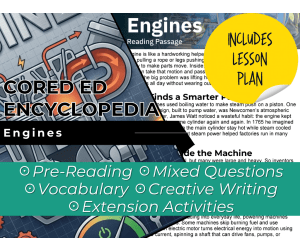
Engines Reading Comprehension Passage - Cored Ed Encyclopedia
ELA, Reading Comprehension, Reading, Science, Technology, Pre-Reading, Language Development, Physics, History, Social Studies, Grade 2, 3, 4, 5, Worksheets & Printables, Worksheets, Teacher Tools, Centers, Activities, Writing Prompts, Assessments, Quizzes and Tests, Quizzes, Lesson Plans
This engines reading comprehension with lesson plan includes: Visualization (on the front cover) Start your lesson by taking a minute to think and share something about the topic. Read the script aloud (slowly), perhaps prepare some music or sound effects. Student close their eyes and let their imaginations wander. Students open their eyes, read the question aloud and give them a few minutes to complete. Ask a few students to share or keep answers until the end to compare with what they learn in the passage. Quick pause—thousands of Cored Education products are included with your TeachSimple membership. Download links and encyclopedia index available here. Pre-Reading Trivia Students will write down one thing they already know about the subject and then read five more facts and discuss. These facts are fun, and the students will enjoy learning about the subject before reading more. Give 1 minute for students to write what they already know (no pressure—best guess is fine). Read the five facts together. After each fact, do ask a student for their opinion, was it surprising? Set a purpose by asking students to highlight/underline one fact they want to learn more about during the reading. Reading Passage The text is a high-interest reading passage with set paragraphs, roughly three to four paragraphs long. It contains a variety of themes about the topic, anywhere from history to technology. The passage is between 250 and 350 words in length. First, ask students to look at the headings and see what they’ll learn about today. What do they know about the topic/heading? First read options: Teacher read-aloud (best for support). Partner reading (paragraph by paragraph). While reading, students underline important details, and vocabulary words they think may come up in the questions section. Mixed Questions The first question page contains four multiple-choice questions, each with a choice of four answers, and three written response questions that require a sentence or two from the student. Students complete the mcqs first independently, then review quickly as a class. For the 3 written responses, try to get students giving the answer with some form of evidence: “I think ___ because the text says ___.” If students get stuck, send them back to check the passage. Vocabulary Questions Practice seven key words from the text in this section across two activities. First section is scrambled words where students will unscramble three words given a clue for each. The second section is a word to meaning matching activity. Before starting, have some students read out words they underlined in the passage. Ask students to say the word and read aloud the sentence(s) around each word. Ask students to do scrambled words and the matching exercise in pairs then go through answers as a class. For the scrambled spelling task, get four pairs to come up to the board and write the words for extra practice with the other student reading out the clue. For the matching task, prompt students to give full sentences: “I matched ___ with ___ because ___.” Creative Writing In this question, the student will be required to write a five to eight sentence paragraph on a question related to the topic. Before starting, ask students write down 3 key ideas they are going to include in their piece. Ask students for ideas to share around the class to help those struggling. Pro writing expectations: 5–8 sentences At least 2 facts or details from the passage At least 2 vocabulary words from the previous page Students read their paragraphs while classmates listen for facts and vocabulary words. Extension Activities This page is optional for fast finishers or to take home. There are several activities, each one requiring a different skill. Do some, do none, do all, completely optional - but you will feel reassured knowing every possibility is planned for. Includes summary writting question and additional facts. Answer Key There are answers for the multiple-choice questions, written response questions have sample answers, vocabulary answers and if there is a summary question then a sample summary will be provided as well. Lesson Plan Included Customized lesson plan for this lesson is included. Lesson Snapshot Title: Engines Genre: Nonfiction (Informational Text) Subject: Science (Physical Science/Technology) / Reading (Informational Text) Primary Topic: How engines turn energy into motion Estimated Guided Reading Level (A–Z): P What This Lesson Teaches Best Explains the core idea that an engine turns energy into motion , using heat, fuel, or electricity to make parts move. Builds understanding of how steam engines work (boiling water makes steam push a piston) and how designs became more efficient (Watt’s separate condenser idea). Describes internal combustion engines and the four-step cycle (take in, squeeze, burn/push, exhaust) that repeats. Connects parts and motion: pistons moving back-and-forth can turn a crankshaft to keep rotation going. Introduces electric motors as another way to change energy into motion using magnetism and current to spin a shaft. Learning Goals Students will explain how an engine changes energy into motion using heat, fuel, or electricity. Students will describe how steam can push a piston in an early steam engine. Students will explain why a separate condenser made a steam engine design more efficient. Students will identify how an internal combustion engine makes motion by burning fuel inside a chamber. Students will list the four repeated steps of a four-stroke engine as stated in the passage. Students will describe how an electric motor uses magnetism and current to spin a shaft. Key Vocabulary From the Text piston — a part pushed by steam or hot gases. condenser — a part that cools steam somewhere else. combustion — burning fuel to make hot gases. crankshaft — a part that keeps turning as pistons move. magnetism — a force used with current to make a shaft spin. FULL CATALOG OF DOWNLOAD LINKS AND ENCYCLOPEDIA INDEX HERE
Author Cored Education
Rating
Tags Vocabulary, Reading Comprehension, Reading Passages, Lesson Plans, Ela Lesson Plans, Reading Comprehension Lesson Plans, Pre-reading, Science Lesson Plans, Technology, Physics

IRREGULAR NOUNS | SINGULAR PLURAL COLOR IMAGES/PICTURES
Special Resources, ELA, Special Education Needs (SEN), Speech Therapy, Language Development, Pre-Reading, ESL, Grammar, Vocabulary, Kindergarten, Preschool, Grade 1, 2, Teacher Tools, Lesson Plans, Worksheets & Printables, Flashcards
Irregular Nouns | Singular Plural Color Images/Pictures is an insightful 20-page PDF resource aimed at enriching the learning process for Preschool to 2nd grade students. With singular and plural forms displayed side-by-side for easy viewing, this educational tool helps teach the vital English language arts topic of irregular nouns. The colorful images keep young students engaged while the innovative green and red borderlines allow for sorting when printed. Teachers can use this versatile resource for whole-class, small group, or individual activities to hone grammar skills. The multi-modal engagement also encourages linguistic acquisition during spoken and written lessons. Overall, this intuitive visual aid functions effectively across various teaching approaches. By blending engagement and usefulness, Irregular Nouns | Singular Plural Color Images/Pictures meets pedagogical goals while appealing to young learners.
Author WORDS ASIDE
Tags Grammar, Oral Communication, Writing, Irregular Nouns, Exceptions, Centers, Task Cards, Stations, Screen, Words Aside, Color Plural, Nouns Pictures, Nouns Images
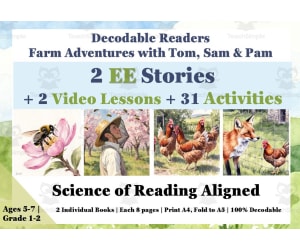
EE: 2 Decodable Reading Books + 2 Video Lessons + 31 Worksheets SOR
Special Resources, ELA, Special Education Needs (SEN), Language Development, Pre-Reading, Phonics, Spelling, Kindergarten, Preschool, Homeschool Curriculum, Grade 1, 2, Literacy Readers, Teacher Tools, Lesson Plans, Presentations
2 EE Decodable Readers, 2 Video Lessons & 31 Worksheets: Farm Adventures Complete Teaching Pack | Part of Advanced Phonics Reading Programme Master EE with 2 decodable readers, 2 optional video lessons, and 31 differentiated practice worksheets! This extensive teaching pack features farm stories that children will love, along with targeted phonics activities that reinforce learning. These books presume that a child can already decode words with a CK ending and OO (moon/look). What's Included 2 systematic/levelled decodable readers focusing on EE 2 carefully taught optional video lessons - no distracting music - these are serious lessons and can be used by home educators and teachers alike - to give extra support to struggling readers Word lists for pre-reading practice at the beginning of each book Differentiated worksheets for phonics reinforcement: Word sorting activities Sound isolation exercises Reading comprehension exercises Sentence writing practice Phonics pattern recognition tasks 100% decodable text with carefully controlled vocabulary Science of reading-aligned instruction Beloved characters: Tom, Sam, Pam, Gran, and the farm animals Beautiful watercolour illustrations Print-and-go format for easy classroom use Why Teachers Love This Complete Pack Real stories PLUS targeted practice! These aren't just decodable readers—you get everything you need to teach EE systematically. The differentiated worksheets provide multiple opportunities for students to apply their learning, while the engaging farm stories provide ample practice of decoding, word recognition and reading comprehension. They help you to target a child's precise needs to ensure progress. The optional video lessons give even nervous parents the help they need to teach! Designed With Carefully Controlled vocabulary: The EE sound is introduced systematically across the stories, with CK words revisited throughout. Worksheets reinforce the same vocabulary, providing an opportunity for mastery. Perfect For Explicit phonics instruction following the science of reading principles All students who are ready to learn EE and have already learned CK, OO Children who need a slower pace, or not Small group intervention or whole class instruction Literacy centres and independent practice Homework assignments that reinforce classroom learning Structured literacy programmes Ages 5-7 or Grade 1-2 Skills Addressed Decoding EE in isolation and context Reading fluency with controlled decodable text Phonics, pattern recognition and application Phonemic awareness through targeted activities Reading comprehension with engaging stories Writing practice using the taught phonics pattern Sight word introduction and practice How to Use This Complete Pack Introduce the sound EE comprehensively Use worksheets for guided practice and skill reinforcement Practice word lists before reading stories Have students read the decodable stories, pointing to each word Return to the worksheets for independent practice or assessment Reread the stories to build fluency This complete pack provides everything you need to teach OO effectively—no additional materials required!
Author Lilibette's Resources
Rating
Tags Learn To Read Programme, Fluency, Struggling Readers, Dyslexia, Special Needs, Phonics, Decodable Reading Books, Reading Fluency, Homeschool Curriculum, Ee Vowel Team
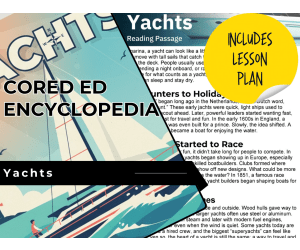
Yachts Reading Comprehension Passage - Cored Ed Encyclopedia
ELA, Language Development, Reading Comprehension, Reading, Science, History, Social Studies, Technology, Engineering, Pre-Reading, Grade 2, 3, 4, 5, Worksheets & Printables, Worksheets, Teacher Tools, Centers, Activities, Writing Prompts, Assessments, Quizzes and Tests, Quizzes, Lesson Plans
This yachts reading comprehension with lesson plan includes: Visualization (on the front cover) Start your lesson by taking a minute to think and share something about the topic. Read the script aloud (slowly), perhaps prepare some music or sound effects. Student close their eyes and let their imaginations wander. Students open their eyes, read the question aloud and give them a few minutes to complete. Ask a few students to share or keep answers until the end to compare with what they learn in the passage. Quick pause—thousands of Cored Education products are included with your TeachSimple membership. Download links and encyclopedia index available here. Pre-Reading Trivia Students will write down one thing they already know about the subject and then read five more facts and discuss. These facts are fun, and the students will enjoy learning about the subject before reading more. Give 1 minute for students to write what they already know (no pressure—best guess is fine). Read the five facts together. After each fact, do ask a student for their opinion, was it surprising? Set a purpose by asking students to highlight/underline one fact they want to learn more about during the reading. Reading Passage The text is a high-interest reading passage with set paragraphs, roughly three to four paragraphs long. It contains a variety of themes about the topic, anywhere from history to technology. The passage is between 250 and 350 words in length. First, ask students to look at the headings and see what they’ll learn about today. What do they know about the topic/heading? First read options: Teacher read-aloud (best for support). Partner reading (paragraph by paragraph). While reading, students underline important details, and vocabulary words they think may come up in the questions section. Mixed Questions The first question page contains four multiple-choice questions, each with a choice of four answers, and three written response questions that require a sentence or two from the student. Students complete the mcqs first independently, then review quickly as a class. For the 3 written responses, try to get students giving the answer with some form of evidence: “I think ___ because the text says ___.” If students get stuck, send them back to check the passage. Vocabulary Questions Practice seven key words from the text in this section across two activities. First section is scrambled words where students will unscramble three words given a clue for each. The second section is a word to meaning matching activity. Before starting, have some students read out words they underlined in the passage. Ask students to say the word and read aloud the sentence(s) around each word. Ask students to do scrambled words and the matching exercise in pairs then go through answers as a class. For the scrambled spelling task, get four pairs to come up to the board and write the words for extra practice with the other student reading out the clue. For the matching task, prompt students to give full sentences: “I matched ___ with ___ because ___.” Creative Writing In this question, the student will be required to write a five to eight sentence paragraph on a question related to the topic. Before starting, ask students write down 3 key ideas they are going to include in their piece. Ask students for ideas to share around the class to help those struggling. Pro writing expectations: 5–8 sentences At least 2 facts or details from the passage At least 2 vocabulary words from the previous page Students read their paragraphs while classmates listen for facts and vocabulary words. Extension Activities This page is optional for fast finishers or to take home. There are several activities, each one requiring a different skill. Do some, do none, do all, completely optional - but you will feel reassured knowing every possibility is planned for. Includes summary writting question. Answer Key There are answers for the multiple-choice questions, written response questions have sample answers, vocabulary answers and if there is a summary question then a sample summary will be provided as well. Lesson Plan Included Customized lesson plan for this lesson is included. Lesson Snapshot Title: Yachts Genre: Nonfiction (informational text) Subject: Social Studies (history of technology) / Informational Reading Primary Topic: What yachts are, their history, and how they changed Estimated Guided Reading Level (A–Z): Q What This Lesson Teaches Best Describes what a yacht can look and sound like at a marina, and explains that yachts may move by sails or by a motor beneath the deck. Explains how people use yachts for pleasure, such as cruising along a coast, spending a night onboard, or racing across open water, and notes that many yachts have a cabin where someone can sleep and stay dry. Traces how the word “yacht” began in Netherlands from a Dutch word meaning “hunt,” and how early yachts were quick ships used to chase pirates and scout ahead before becoming boats for travel and fun. Shows how yacht racing grew in Europe in the 1600s and how a race in 1851 helped launch the America’s Cup, influencing yacht designs for speed and handling. Explains how yachts changed over time (new materials like fiberglass, larger yachts using steel or aluminum, and engines arriving from steam to modern fuel engines), including very large “superyachts” that may need a hired crew. Learning Goals Students will identify two ways yachts can be powered using details from the text. Students will describe what the passage says people do on yachts for pleasure. Students will explain how the meaning and use of “yacht” changed over time in the passage. Students will describe how racing influenced yacht design, using the passage’s examples. Students will describe at least two changes in yacht materials or engines mentioned in the text. Key Vocabulary From the Text marina — a place where boats dock. cabin — a room where someone can sleep and stay dry. hulls — the outer bodies of boats. fiberglass — a newer material used instead of wood. crew — a hired group to run a yacht. FULL CATALOG OF DOWNLOAD LINKS AND ENCYCLOPEDIA INDEX HERE
Author Cored Education
Rating
Tags Vocabulary, Reading Comprehension, Reading Passages, Lesson Plans, Ela Lesson Plans, Reading Comprehension Lesson Plans, Pre-reading, History Lesson Plans, Science Lesson Plans, Engineering
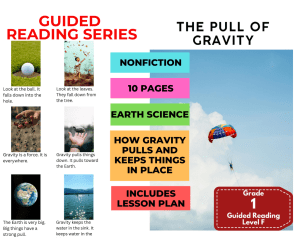
The Pull of Gravity: Guided Reading Level F with Lesson Plan
ELA, Resources for Teachers, Reading Comprehension, Reading, Science, Language Development, Vocabulary, Physics, Earth and Environmental Sciences, Pre-Reading, Kindergarten, Grade 1, 2, Worksheets & Printables, Worksheets, Teacher Tools, Centers, Activities, Literacy Readers, Quizzes, Quizzes and Tests, Assessments, Lesson Plans
This The Pull of Gravity (level f) guided reading book with lesson plan includes: Guided Reading Color Label (front cover x1) This is a quick way to match the book’s demands to what students can generally handle.. The overall goal is to use the level/color to pick books for several smaller groups. To qualify for a certain level, a student is expected to read a book from that level with about 90–94% accuracy. If a student is consistently accurate and understands, move up a level. If the student is struggling at that level, drop down and add more support. Each student will improve at completely different rates, but it is generally one of the best ways to check progress across the class. DOWNLOAD THE CATALOG TO VIEW ALL GUIDED READING BOOKS AVAILABLE (SORTED LEVELS A-Z) COMPANION VIDEO NOW AVAILABLE (EMBEDDED AFTER PREVIEW PICTURES IN PRODUCT DESCRIPTION) Pre-Reading Question (x1) The teacher says the question aloud, either while showing the cover or the first page. Students share what they already know or make sensible guesses based on the cover. Encourage them to use the target vocabulary where possible. Write a few of their ideas on the board so you can return to them during or after the reading. Vocabulary Words (x5) Introduce the five words one at a time. Say each word aloud, have students repeat it, and then ask if anyone already knows what it means. Read the meaning together and briefly connect each word to a picture, action, or gesture so it feels more memorable. Ask students to flip through the book and point to any pages where they spot the vocabulary words. While reading, pause when one of the words appears, or reread the sentence so students clearly notice and understand it in context. Optional: Ask students to raise their hands whenever they see or hear one of the new words. Guided Reading Pages (x10) Check the book snapshot below for: Primary topic — decide whether students need a quick introduction or extra background first. What this lesson teaches best — choose 1–2 key points to focus on during the session. Learning goals — keep in mind what students should be able to understand or say by the end. Key vocabulary — review and reinforce these throughout the lesson. Questions overview — look ahead so you know what students will be asked and whether any extra support is needed. Run the lesson You may already have looked at a few pages together, but it can help to revisit some of the pictures first to build meaning. Depending on your time and how confident the group is with guided reading, you may want to read the whole book aloud to them first. Students can then whisper-read or partner-read while you listen in. If time allows, you can also read as a group, with each student taking a page. Use the guided reading prompts to support them, such as: “Check the picture—does it make sense?” “Point under the words.” “Try the first sound.” “Reread the sentence smoothly.” It can be helpful to focus more closely on one student each session, rotating over time, so you can better judge whether they are ready to move up or may need more support at their current level. Comprehension Questions (back cover x3) This is where you check that students understood the text, not just the words on the page. Start by letting students answer by pointing to a page or picture and saying a short sentence. After they respond, follow up with: “Show me where you found that in the text.” In larger groups, let partners discuss their answer first for 10–20 seconds, then invite 2–3 students to share. Differentiation tips Emerging speakers / struggling readers: oral response + pointing On-level: oral response in a full sentence Higher: one written sentence or a drawing with labels Lesson Snapshot Title: The Pull of Gravity Genre: Nonfiction (informational) Subject: Science (Physical Science) Primary Topic: How gravity pulls things and helps keep them in place Estimated Guided Reading Level (A–Z): F What This Lesson Teaches Best Explains that gravity is a force and that it is all around us. Shows that gravity pulls things down and toward the Earth. Uses simple, everyday examples like a ball, leaves, water, rocks, sand, and air to show gravity in action. Helps students understand that larger objects, like Earth, have a stronger pull. Introduces the idea that gravity is also in space and helps pull the moon. Learning Goals Students will identify that gravity is a force found everywhere. Students will describe how gravity pulls things down and toward the Earth. Students will give examples from the text of things gravity pulls or keeps in place. Students will explain what the text says about Earth’s strong pull. Students will answer questions about gravity using details from the book. Key Vocabulary From the Text gravity — a pull that makes things go down force — a push or a pull toward — moving closer to something space — the place above Earth mountain — a very high hill of land Discussion Prompts Pre-reading question: What do you think makes things fall down to the ground? Comprehension question: What does the book say gravity is? Comprehension question: What does gravity pull things toward? Comprehension question: Name one thing the book says gravity keeps in place. 1. Best Printing Method (Recommended) Booklet printing is the best option if your printer or PDF viewer supports it. This method usually places the pages in the correct order automatically and makes folding much easier. Settings to use: Print mode: Booklet Paper size: Letter or A4 Orientation: Landscape Print on both sides: Yes Flip on: Short edge Scaling: Fit to printable area Booklet subset: First, print front sides only Then, print back sides only This will automatically: Pair the pages correctly Place the cover on the outside Help everything line up properly for folding After printing, fold the pages in half and staple along the spine. 2. If “Booklet” Printing Is Not Available You can still print the book correctly by using manual duplex printing . Step-by-step: Open the PDF. Click Print . Use these settings: Orientation: Landscape Pages per sheet: 1 Print on both sides: Yes Flip on: Short edge Print all pages. Since each PDF page already contains two facing book pages, the pages should still fold neatly into a book. Thousands of Cored Education products are included with your TeachSimple membership. Download links and encyclopedia index available here.
Author Cored Education
Rating
Tags Reading Comprehension, Reading Passages, Reading, Guided Reading, Guided Reading Lesson Plan, Guided Reading Activity, Pre-reading, Science Lesson Plans, Earth Science, Physics
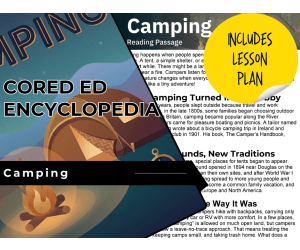
Camping Reading Comprehension Passage - Cored Ed Encyclopedia
ELA, Language Development, Reading Comprehension, Reading, Writing, Pre-Reading, Vocabulary, Geography, Social Studies, History, Grade 2, 3, 4, 5, Worksheets & Printables, Worksheets, Teacher Tools, Centers, Activities, Writing Prompts, Assessments, Quizzes and Tests, Quizzes, Lesson Plans
This camping reading comprehension with lesson plan includes: Visualization (on the front cover) Start your lesson by taking a minute to think and share something about the topic. Read the script aloud (slowly), perhaps prepare some music or sound effects. Student close their eyes and let their imaginations wander. Students open their eyes, read the question aloud and give them a few minutes to complete. Ask a few students to share or keep answers until the end to compare with what they learn in the passage. COMPANION VIDEO NOW AVAILABLE (EMBEDDED AFTER PREVIEW PICTURES IN PRODUCT DESCRIPTION) Quick pause—thousands of Cored Education products are included with your TeachSimple membership. Download links and encyclopedia index available here. Pre-Reading Trivia Students will write down one thing they already know about the subject and then read five more facts and discuss. These facts are fun, and the students will enjoy learning about the subject before reading more. Give 1 minute for students to write what they already know (no pressure—best guess is fine). Read the five facts together. After each fact, do ask a student for their opinion, was it surprising? Set a purpose by asking students to highlight/underline one fact they want to learn more about during the reading. Reading Passage The text is a high-interest reading passage with set paragraphs, roughly three to four paragraphs long. It contains a variety of themes about the topic, anywhere from history to technology. The passage is between 250 and 350 words in length. First, ask students to look at the headings and see what they’ll learn about today. What do they know about the topic/heading? First read options: Teacher read-aloud (best for support). Partner reading (paragraph by paragraph). While reading, students underline important details, and vocabulary words they think may come up in the questions section. Mixed Questions The first question page contains four multiple-choice questions, each with a choice of four answers, and three written response questions that require a sentence or two from the student. Students complete the mcqs first independently, then review quickly as a class. For the 3 written responses, try to get students giving the answer with some form of evidence: “I think ___ because the text says ___.” If students get stuck, send them back to check the passage. Vocabulary Questions Practice seven key words from the text in this section across two activities. First section is scrambled words where students will unscramble three words given a clue for each. The second section is a word to meaning matching activity. Before starting, have some students read out words they underlined in the passage. Ask students to say the word and read aloud the sentence(s) around each word. Ask students to do scrambled words and the matching exercise in pairs then go through answers as a class. For the scrambled spelling task, get four pairs to come up to the board and write the words for extra practice with the other student reading out the clue. For the matching task, prompt students to give full sentences: “I matched ___ with ___ because ___.” Creative Writing In this question, the student will be required to write a five to eight sentence paragraph on a question related to the topic. Before starting, ask students write down 3 key ideas they are going to include in their piece. Ask students for ideas to share around the class to help those struggling. Pro writing expectations: 5–8 sentences At least 2 facts or details from the passage At least 2 vocabulary words from the previous page Students read their paragraphs while classmates listen for facts and vocabulary words. Extension Activities This page is optional for fast finishers or to take home. There are several activities, each one requiring a different skill. Do some, do none, do all, completely optional - but you will feel reassured knowing every possibility is planned for. Includes summary writting question and additional facts. Answer Key There are answers for the multiple-choice questions, written response questions have sample answers, vocabulary answers and if there is a summary question then a sample summary will be provided as well. Lesson Plan Included Customized lesson plan for this lesson is included. Lesson Snapshot Title: Camping Genre: Nonfiction (informational text with headings) Subject: Reading (Informational Text) / Social Studies Primary Topic: How camping began, changed, and stays respectful Estimated Guided Reading Level (A–Z): N What This Lesson Teaches Best Explains what camping is and what campers might notice at night (lantern glow, smell of pine, owls, cooler air). Builds background knowledge about how camping shifted from travel/work to a fun hobby in the late 1800s. Uses a chronological structure with time markers (late 1800s, 1894, 1901, 1908, after World War I, 1960s) to show change over time. Introduces environmental responsibility through a “leave-no-trace approach,” including keeping camps small and taking trash home. Gives practice with text features (section headings) to locate information efficiently. Learning Goals Students will describe what camping is using details from the passage. Students will explain why people slept outside long ago and how camping later became a hobby. Students will identify key events and dates from the passage (1894, 1901, 1908, after World War I, 1960s). Students will use headings to find information about camping’s history, campgrounds, and “leave-no-trace.” Students will compare different ways people camp (backpacks vs. car/RV) based on the passage. Students will explain what the passage says a leave-no-trace approach means. Key Vocabulary From the Text shelter — a place that protects you. lantern — a light you can carry. demanded — needed or required. commercial — run as a business. approach — a way of doing something. FULL CATALOG OF DOWNLOAD LINKS AND ENCYCLOPEDIA INDEX HERE
Author Cored Education
Rating
Tags Vocabulary, Reading Comprehension, Reading Passages, Lesson Plans, Ela Lesson Plans, Reading Comprehension Lesson Plans, Pre-reading, Social Studies Lesson Plans, Geography, History
Gunpowder Reading Comprehension Passage - Cored Ed Encyclopedia
ELA, Reading Comprehension, Reading, Science, Technology, Pre-Reading, Language Development, History, Social Studies, Physics, Grade 2, 3, 4, 5, Worksheets & Printables, Worksheets, Teacher Tools, Centers, Activities, Writing Prompts, Assessments, Quizzes and Tests, Quizzes, Lesson Plans
This gunpowder reading comprehension with lesson plan includes: Visualization (on the front cover) Start your lesson by taking a minute to think and share something about the topic. Read the script aloud (slowly), perhaps prepare some music or sound effects. Student close their eyes and let their imaginations wander. Students open their eyes, read the question aloud and give them a few minutes to complete. Ask a few students to share or keep answers until the end to compare with what they learn in the passage. Quick pause—thousands of Cored Education products are included with your TeachSimple membership. Download links and encyclopedia index available here. Pre-Reading Trivia Students will write down one thing they already know about the subject and then read five more facts and discuss. These facts are fun, and the students will enjoy learning about the subject before reading more. Give 1 minute for students to write what they already know (no pressure—best guess is fine). Read the five facts together. After each fact, do ask a student for their opinion, was it surprising? Set a purpose by asking students to highlight/underline one fact they want to learn more about during the reading. Reading Passage The text is a high-interest reading passage with set paragraphs, roughly three to four paragraphs long. It contains a variety of themes about the topic, anywhere from history to technology. The passage is between 250 and 350 words in length. First, ask students to look at the headings and see what they’ll learn about today. What do they know about the topic/heading? First read options: Teacher read-aloud (best for support). Partner reading (paragraph by paragraph). While reading, students underline important details, and vocabulary words they think may come up in the questions section. Mixed Questions The first question page contains four multiple-choice questions, each with a choice of four answers, and three written response questions that require a sentence or two from the student. Students complete the mcqs first independently, then review quickly as a class. For the 3 written responses, try to get students giving the answer with some form of evidence: “I think ___ because the text says ___.” If students get stuck, send them back to check the passage. Vocabulary Questions Practice seven key words from the text in this section across two activities. First section is scrambled words where students will unscramble three words given a clue for each. The second section is a word to meaning matching activity. Before starting, have some students read out words they underlined in the passage. Ask students to say the word and read aloud the sentence(s) around each word. Ask students to do scrambled words and the matching exercise in pairs then go through answers as a class. For the scrambled spelling task, get four pairs to come up to the board and write the words for extra practice with the other student reading out the clue. For the matching task, prompt students to give full sentences: “I matched ___ with ___ because ___.” Creative Writing In this question, the student will be required to write a five to eight sentence paragraph on a question related to the topic. Before starting, ask students write down 3 key ideas they are going to include in their piece. Ask students for ideas to share around the class to help those struggling. Pro writing expectations: 5–8 sentences At least 2 facts or details from the passage At least 2 vocabulary words from the previous page Students read their paragraphs while classmates listen for facts and vocabulary words. Extension Activities This page is optional for fast finishers or to take home. There are several activities, each one requiring a different skill. Do some, do none, do all, completely optional - but you will feel reassured knowing every possibility is planned for. Includes summary writting question and additional facts. Answer Key There are answers for the multiple-choice questions, written response questions have sample answers, vocabulary answers and if there is a summary question then a sample summary will be provided as well. Lesson Plan Included Customized lesson plan for this lesson is included. Lesson Snapshot Title: Gunpowder Genre: Nonfiction (informational text) Subject: Science Primary Topic: How gunpowder was discovered and used over time Estimated Guided Reading Level (A–Z): Q What This Lesson Teaches Best Explains how gunpowder began in China during the Tang dynasty when alchemists mixed ingredients while searching for a life-lasting “elixir.” Identifies the three main powders in gunpowder—charcoal, sulfur, and saltpeter (also called potassium nitrate)—and describes what saltpeter adds to help burning. Describes how gunpowder behaves differently in an open pile versus a tight tube, leading to a strong push of hot gas. Traces how “fire medicine” was used first for celebrations and signals, then developed into fire arrows, bombs, fire lances, and hand cannons by the late 1200s. Shows how ideas travel as gunpowder and stories about rockets reached Europe, and how uses expanded to quarrying rock and digging tunnels, not only fighting. Learning Goals Students will describe how the text says gunpowder was discovered during the Tang dynasty in China. Students will identify the three main powders in gunpowder and explain what saltpeter adds to the burning process. Students will compare what happens when gunpowder burns in an open pile versus in a tight tube. Students will explain how “fire medicine” changed from signals and celebrations to fire arrows and later weapons over time. Students will describe two non-celebration uses of the powder mentioned in the text (quarrying rock and digging tunnels). Students will explain what the author means by “Ideas travel,” using the example of gunpowder reaching Europe. Key Vocabulary From the Text alchemists — people who mixed ingredients while searching for an “elixir.” elixir — a life-lasting drink they searched for. charcoal — powder from burned wood. sulfur — one of the three main powders. saltpeter — a mineral also called potassium nitrate. Discussion Prompts Pre-reading question: What do you think might happen if a powder burns very fast? Comprehension questions: How did the mixture get the name huoyao, or “fire medicine”? Comprehension questions: What role does saltpeter play when a tiny grain is lit? Comprehension questions: How did the uses of “fire medicine” change from celebrations to later tools or weapons? FULL CATALOG OF DOWNLOAD LINKS AND ENCYCLOPEDIA INDEX HERE
Author Cored Education
Rating
Tags Vocabulary, Reading Comprehension, Reading Passages, Lesson Plans, Ela Lesson Plans, Reading Comprehension Lesson Plans, Pre-reading, Science Lesson Plans, Social Studies Lesson Plans, History

All About W - Letter of the Week Unit
ELA, Language Development, Pre-Reading, Kindergarten, Teacher Tools, Lesson Plans
All About the Letter W - Preschool Letter of the Week Unit This comprehensive letter W curriculum resource for preschool makes teaching engaging and easy. With dozens of worksheets, crafts , games, and activities, you can easily create memorable letter W lessons. Students will have fun learning letter recognition, letter formation, letter sounds, and using the letter in words through matching games, dot painting, puppets, bingo, and more. Use the materials for whole group, small group, or individual practice. Consistent with other letter of the week units for a cohesive preschool language arts curriculum. Top-quality clipart and photos throughout. Suitable for classrooms, co-ops, or homeschools. This thoughtfully designed letter W resource saves prep time while making preschool language arts exciting.
Author Simply Schoolgirl
Tags Letter Of The Week, Handwriting Worksheets, Preschool, Kindergarten, Phonics, Games, Crafts, Activities, Displays, Visuals

Tad and Tom: Beginner Reader - Fry Sight Words
ELA, Language Development, Pre-Reading, Reading, Preschool, Grade 1, Teacher Tools, Lesson Plans, Activities
Tad and Tom: Beginner Reader - Fry Sight Words is a 12-page booklet that dives into a charming adventure story featuring sight words and blended words. As Tad and Tom embark on an exciting tale, students will strengthen reading skills. Comprehension pages allow further enrichment. This resource is perfect for centers , small groups, or homework. Use it for week-long lessons or reinforcing sight word mastery and reading comprehension. Available in color or black and white for back-to-back printing to save paper. This is one booklet in a beginner reader series that also covers Tim and Tai, Dax and Gab, and Meg and Ann. An optional 5-day lesson plan is included to introduce sight words, reinforce with games, practice blended words, use reading strategies, and complete comprehension pages. Extend the lesson as needed to boost kindergarten and first grade reading fluency.
Author The Kinder Lady
Tags Comprehension, Read In Kindergarten, Fluency, Emergent Readers, Kindergarten Readers, First Grade, Frys Sight Words

Skateboarding Reading Comprehension Passage - Cored Ed Encyclopedia
ELA, Language Development, Reading Comprehension, Reading, Pre-Reading, Writing, Sports, P.E. & Health, Technology, Science, Grade 2, 3, 4, 5, Worksheets & Printables, Worksheets, Teacher Tools, Centers, Activities, Writing Prompts, Assessments, Quizzes and Tests, Quizzes, Lesson Plans
This skateboarding reading comprehension includes: Visualization (on the front cover) Start your lesson by taking a minute to think and share something about the topic. Read the script aloud (slowly), perhaps prepare some music or sound effects. Student close their eyes and let their imaginations wander. Students open their eyes, read the question aloud and give them a few minutes to complete. Ask a few students to share or keep answers until the end to compare with what they learn in the passage. Quick pause—thousands of Cored Education products are included with your TeachSimple membership. Download links and encyclopedia index available here. Pre-Reading Trivia Students will write down one thing they already know about the subject and then read five more facts and discuss. These facts are fun, and the students will enjoy learning about the subject before reading more. Give 1 minute for students to write what they already know (no pressure—best guess is fine). Read the five facts together. After each fact, do ask a student for their opinion, was it surprising? Set a purpose by asking students to highlight/underline one fact they want to learn more about during the reading. Reading Passage The text is a high-interest reading passage with set paragraphs, roughly three to four paragraphs long. It contains a variety of themes about the topic, anywhere from history to technology. The passage is between 250 and 350 words in length. First, ask students to look at the headings and see what they’ll learn about today. What do they know about the topic/heading? First read options: Teacher read-aloud (best for support). Partner reading (paragraph by paragraph). While reading, students underline important details, and vocabulary words they think may come up in the questions section. Mixed Questions The first question page contains four multiple-choice questions, each with a choice of four answers, and three written response questions that require a sentence or two from the student. Students complete the mcqs first independently, then review quickly as a class. For the 3 written responses, try to get students giving the answer with some form of evidence: “I think ___ because the text says ___.” If students get stuck, send them back to check the passage. Vocabulary Questions Practice seven key words from the text in this section across two activities. First section is scrambled words where students will unscramble three words given a clue for each. The second section is a word to meaning matching activity. Before starting, have some students read out words they underlined in the passage. Ask students to say the word and read aloud the sentence(s) around each word. Ask students to do scrambled words and the matching exercise in pairs then go through answers as a class. For the scrambled spelling task, get four pairs to come up to the board and write the words for extra practice with the other student reading out the clue. For the matching task, prompt students to give full sentences: “I matched ___ with ___ because ___.” Creative Writing In this question, the student will be required to write a five to eight sentence paragraph on a question related to the topic. Before starting, ask students write down 3 key ideas they are going to include in their piece. Ask students for ideas to share around the class to help those struggling. Pro writing expectations: 5–8 sentences At least 2 facts or details from the passage At least 2 vocabulary words from the previous page Students read their paragraphs while classmates listen for facts and vocabulary words. Extension Activities This page is optional for fast finishers or to take home. There are several activities, each one requiring a different skill. Do some, do none, do all, completely optional - but you will feel reassured knowing every possibility is planned for. Includes summary writting question. Answer Key There are answers for the multiple-choice questions, written response questions have sample answers, vocabulary answers and if there is a summary question then a sample summary will be provided as well. Lesson Plan Included Customized lesson plan for this lesson is included. Lesson Snapshot Title: Skateboarding Genre: Nonfiction (informational text) Subject: Social Studies (history/culture) / Physical Education (sports) Primary Topic: How skateboarding began and evolved Estimated Guided Reading Level (A–Z): R What This Lesson Teaches Best How skateboarding started in California when surfers tried “sidewalk surfing” using boards and roller-skate wheels. How a problem (hard wheels and injury worries) led to a decline around 1966, and how a new solution helped the sport return. How new technology (polyurethane wheels that gripped and rolled smoothly) changed what riders could do and how safe it felt. How places to ride shaped new styles, from parks with banks/curves to pools, then street spots like curbs, stairs, and rails. How a timeline of key decades/years (1940s–50s, 1960s, 1970s, 1980s, 1995, Tokyo 2020/2021) shows the sport’s growth into major events. Learning Goals Describe why skateboarding began and what early riders used to make boards roll. Explain why skateboarding “nearly disappeared” around 1966 using details from the text. Identify how polyurethane wheels changed riding and why turns felt more controllable. Describe how skate parks and empty swimming pools helped create vertical skating and half-pipes. Explain how street-style skateboarding grew and name major events mentioned in the passage. Key Vocabulary From the Text polyurethane — a wheel material that grips and rolls smoothly. contests — competitions where people try to win. controllable — easy to control and not scary. vertical — going up steeply, like riding up walls. debut — first time something appears in an event. FULL CATALOG OF DOWNLOAD LINKS AND ENCYCLOPEDIA INDEX HERE
Author Cored Education
Rating
Tags Vocabulary, Reading Comprehension, Reading Passages, Reading, Creative Writing, Reading Strategies, Writing Prompts, Lesson Plans, Sports, Skateboarding

Whales Reading Comprehension Passage - Cored Ed Encyclopedia
ELA, Language Development, Reading Comprehension, Reading, Pre-Reading, Science, Animals, Life Sciences, Vocabulary, Writing, Grade 2, 3, 4, 5, Worksheets & Printables, Worksheets, Teacher Tools, Centers, Activities, Writing Prompts, Assessments, Quizzes and Tests, Quizzes, Lesson Plans
This whales reading comprehension with lesson plan includes: Visualization (on the front cover) Start your lesson by taking a minute to think and share something about the topic. Read the script aloud (slowly), perhaps prepare some music or sound effects. Student close their eyes and let their imaginations wander. Students open their eyes, read the question aloud and give them a few minutes to complete. Ask a few students to share or keep answers until the end to compare with what they learn in the passage. Quick pause—thousands of Cored Education products are included with your TeachSimple membership. Download links and encyclopedia index available here. Pre-Reading Trivia Students will write down one thing they already know about the subject and then read five more facts and discuss. These facts are fun, and the students will enjoy learning about the subject before reading more. Give 1 minute for students to write what they already know (no pressure—best guess is fine). Read the five facts together. After each fact, do ask a student for their opinion, was it surprising? Set a purpose by asking students to highlight/underline one fact they want to learn more about during the reading. Reading Passage The text is a high-interest reading passage with set paragraphs, roughly three to four paragraphs long. It contains a variety of themes about the topic, anywhere from history to technology. The passage is between 250 and 350 words in length. First, ask students to look at the headings and see what they’ll learn about today. What do they know about the topic/heading? First read options: Teacher read-aloud (best for support). Partner reading (paragraph by paragraph). While reading, students underline important details, and vocabulary words they think may come up in the questions section. Mixed Questions The first question page contains four multiple-choice questions, each with a choice of four answers, and three written response questions that require a sentence or two from the student. Students complete the mcqs first independently, then review quickly as a class. For the 3 written responses, try to get students giving the answer with some form of evidence: “I think ___ because the text says ___.” If students get stuck, send them back to check the passage. Vocabulary Questions Practice seven key words from the text in this section across two activities. First section is scrambled words where students will unscramble three words given a clue for each. The second section is a word to meaning matching activity. Before starting, have some students read out words they underlined in the passage. Ask students to say the word and read aloud the sentence(s) around each word. Ask students to do scrambled words and the matching exercise in pairs then go through answers as a class. For the scrambled spelling task, get four pairs to come up to the board and write the words for extra practice with the other student reading out the clue. For the matching task, prompt students to give full sentences: “I matched ___ with ___ because ___.” Creative Writing In this question, the student will be required to write a five to eight sentence paragraph on a question related to the topic. Before starting, ask students write down 3 key ideas they are going to include in their piece. Ask students for ideas to share around the class to help those struggling. Pro writing expectations: 5–8 sentences At least 2 facts or details from the passage At least 2 vocabulary words from the previous page Students read their paragraphs while classmates listen for facts and vocabulary words. Extension Activities This page is optional for fast finishers or to take home. There are several activities, each one requiring a different skill. Do some, do none, do all, completely optional - but you will feel reassured knowing every possibility is planned for. Includes summary writting question. Answer Key There are answers for the multiple-choice questions, written response questions have sample answers, vocabulary answers and if there is a summary question then a sample summary will be provided as well. Lesson Plan Included Customized lesson plan for this lesson is included. Lesson Snapshot Title: Whales Genre: Nonfiction (informational text) Subject: Life Science / Informational Reading Primary Topic: Whales as mammals, feeding types, fossils, human impacts Estimated Guided Reading Level (A–Z): Q What This Lesson Teaches Best Whales are mammals that breathe air with lungs through blowholes , so they must surface as part of everyday life. Whales can have two different feeding tools : baleen plates that strain food like krill, or sharp teeth used to grab fish or squid. Fossils provide evidence that early whale relatives were land mammals and changed over millions of years to live in the ocean. Human activity affects whales today (fishing gear tangles, ships strike, and loud noise can fill the water where whales communicate), and scientists use tracking tools to help protect them. Learning Goals Students will explain why whales rise to the surface using details about breathing and blowholes. Students will compare how baleen whales and toothed whales get food, using evidence from the text. Students will describe what fossils show about where whales came from long ago. Students will identify one modern problem that can make whale communication harder, based on the passage. Students will describe at least one way scientists track whales to protect them, using details from the text. Key Vocabulary From the Text blowholes — nostrils on top of a whale’s head. baleen — mouth plates that strain tiny food from water. krill — tiny sea creatures baleen whales hold onto. streamlined — shaped to move smoothly through water. fossils — old remains in rock that give clues. FULL CATALOG OF DOWNLOAD LINKS AND ENCYCLOPEDIA INDEX HERE
Author Cored Education
Rating
Tags Vocabulary, Reading Comprehension, Reading Passages, Lesson Plans, Ela Lesson Plans, Reading Comprehension Lesson Plans, Pre-reading, Science Lesson Plans, Life Science, Animals

Baseball Reading Comprehension Passage - Cored Ed Encyclopedia
ELA, Language Development, Reading Comprehension, Reading, Social Studies, Writing, Vocabulary, History, Geography, Pre-Reading, Grade 2, 3, 4, 5, Worksheets & Printables, Worksheets, Teacher Tools, Centers, Activities, Writing Prompts, Assessments, Quizzes and Tests, Quizzes, Lesson Plans
This baseball reading comprehension with lesson plan includes: Visualization (on the front cover) Start your lesson by taking a minute to think and share something about the topic. Read the script aloud (slowly), perhaps prepare some music or sound effects. Student close their eyes and let their imaginations wander. Students open their eyes, read the question aloud and give them a few minutes to complete. Ask a few students to share or keep answers until the end to compare with what they learn in the passage. COMPANION VIDEO NOW AVAILABLE (EMBEDDED AFTER PREVIEW PICTURES IN PRODUCT DESCRIPTION) Quick pause—thousands of Cored Education products are included with your TeachSimple membership. Download links and encyclopedia index available here. Pre-Reading Trivia Students will write down one thing they already know about the subject and then read five more facts and discuss. These facts are fun, and the students will enjoy learning about the subject before reading more. Give 1 minute for students to write what they already know (no pressure—best guess is fine). Read the five facts together. After each fact, do ask a student for their opinion, was it surprising? Set a purpose by asking students to highlight/underline one fact they want to learn more about during the reading. Reading Passage The text is a high-interest reading passage with set paragraphs, roughly three to four paragraphs long. It contains a variety of themes about the topic, anywhere from history to technology. The passage is between 250 and 350 words in length. First, ask students to look at the headings and see what they’ll learn about today. What do they know about the topic/heading? First read options: Teacher read-aloud (best for support). Partner reading (paragraph by paragraph). While reading, students underline important details, and vocabulary words they think may come up in the questions section. Mixed Questions The first question page contains four multiple-choice questions, each with a choice of four answers, and three written response questions that require a sentence or two from the student. Students complete the mcqs first independently, then review quickly as a class. For the 3 written responses, try to get students giving the answer with some form of evidence: “I think ___ because the text says ___.” If students get stuck, send them back to check the passage. Vocabulary Questions Practice seven key words from the text in this section across two activities. First section is scrambled words where students will unscramble three words given a clue for each. The second section is a word to meaning matching activity. Before starting, have some students read out words they underlined in the passage. Ask students to say the word and read aloud the sentence(s) around each word. Ask students to do scrambled words and the matching exercise in pairs then go through answers as a class. For the scrambled spelling task, get four pairs to come up to the board and write the words for extra practice with the other student reading out the clue. For the matching task, prompt students to give full sentences: “I matched ___ with ___ because ___.” Creative Writing In this question, the student will be required to write a five to eight sentence paragraph on a question related to the topic. Before starting, ask students write down 3 key ideas they are going to include in their piece. Ask students for ideas to share around the class to help those struggling. Pro writing expectations: 5–8 sentences At least 2 facts or details from the passage At least 2 vocabulary words from the previous page Students read their paragraphs while classmates listen for facts and vocabulary words. Extension Activities This page is optional for fast finishers or to take home. There are several activities, each one requiring a different skill. Do some, do none, do all, completely optional - but you will feel reassured knowing every possibility is planned for. Includes summary writting question and additional facts. Answer Key There are answers for the multiple-choice questions, written response questions have sample answers, vocabulary answers and if there is a summary question then a sample summary will be provided as well. Lesson Plan Included Customized lesson plan for this lesson is included. Lesson Snapshot Title: Baseball Genre: Nonfiction (informational passage) Subject: Physical Education / Social Studies (Sports history) / Reading (Informational Text) Primary Topic: How baseball works and how it spread Estimated Guided Reading Level (A–Z): S What This Lesson Teaches Best Clear explanation of how a baseball game works (bases in a diamond, two teams, innings, outs, extra innings). How shared written rules helped organize the modern game (clubs writing rules; later standards like nine innings and a 90-foot base path). A brief timeline of key turning points using dates and evidence (1845 rules, 1869 first all-professional team, 1903 World Series, 1872 introduction in Japan). How baseball changed as it grew (teams traveling, paid players, big leagues forming, some leagues using timing rules). How baseball spread beyond its early American home (popularity across parts of the Americas and East Asia). Learning Goals Identify key parts of a baseball game described in the passage (bases, teams, innings, outs, extra innings). Explain how keeping shared rules helped baseball become more organized. Describe the “safer idea” included in the 1845 rules. Describe what it meant for baseball to turn “professional,” using details from the text. Retell the passage’s key dates in order and explain what happened at each date. Describe how the passage shows baseball spreading to new places and continuing to change. Key Vocabulary From the Text inning — part of the game when teams take turns playing. outs — times when a player is put out. standards — agreed-upon rules that many people follow. professional — paid to play as a job. leagues — organized groups of teams that play each other. FULL CATALOG OF DOWNLOAD LINKS AND ENCYCLOPEDIA INDEX HERE
Author Cored Education
Rating
Tags Vocabulary, Reading Comprehension, Reading Passages, Lesson Plans, Ela Lesson Plans, Reading Comprehension Lesson Plans, Pre-reading, History, History Lesson Plans, Social Studies Lesson Plans

Guided Reading Activities and Lesson Plans Fiction Set 3 - Friends
ELA, Reading, Reading Comprehension, Common Core, ESL, Language Development, Pre-Reading, Vocabulary, Resources for Teachers, Grade 4, 5, Worksheets & Printables, Worksheets, Lesson Plans, Teacher Tools
Guided Reading Activities with Lesson Plans Fiction Set 3 Note: This download DOES NOT include the passages themselves. If you have not already done so, download in a format of your choice in the "reading links" section below. Includes Guided Reading Materials For: 1.A Friend's Promise 2.The Rumor 3.Finishing Together 4.Seniors Acting 5.Funland 6.Back to School Reading Links: This is the guided reading materials version and DOES NOT include the passages themselves. The passages related to this download are available here in GOOGLE Docs, GOOGLE Forms, GOOGLE Slides. PDF, PPT, WORD. Google Docs Google Forms Google Slides PDF PPT Word Browse the Complete Cored Catalog — 2,000+ Resources Included Reading Passages Each reading passage has been written specifically for students in Grades 4–5, using vocabulary and language that match their age and ability level. The collection covers a wide range of engaging topics, supported by colorful visuals that help bring the content to life. Every lesson is designed to build knowledge while keeping students interested and motivated to read. These resources are also designed with flexibility in mind. Unlike traditional textbooks that can quickly become outdated, lessons can be updated over time to reflect changes in technology, discoveries, and the world around us. Mixed Questions Every lesson includes a variety of questions that help students think more deeply about what they have read. The question section combines reading comprehension, vocabulary, and math skills, while also regularly reinforcing important reading strategies such as cause and effect, summarizing, compare and contrast, and drawing conclusions. Most lessons include a mix of multiple-choice and written-response questions, giving students opportunities to explain their thinking as well as select answers. Complete answer keys and sample responses are provided at the end of each lesson for quick and easy reference. Spelling & Vocabulary Each passage introduces students to useful words and phrases appropriate for Grades 4–5. To help build confidence and word knowledge, every lesson includes a spelling or vocabulary activity. Rather than repeating the same task throughout the collection, activities vary from lesson to lesson to keep practice fresh and engaging. Activities may include spelling challenges, sentence matching, decoding activities, mixed-up text exercises, and other vocabulary-building tasks connected directly to the reading. Writing Prompts Each lesson includes a writing activity that extends the ideas, themes, or topics explored in the passage. Students are encouraged to write in a variety of formats, with prompts providing helpful guidance and ideas to get them started. Writing tasks vary throughout the collection and may include creative writing, research activities, personal responses, poetry, opinion writing, and other engaging assignments. Full Answer Keys Complete answer keys and sample responses are included with every lesson, making planning and marking quicker and easier. Reading comprehension answers include evidence and support from the text, while math-based questions show the relevant working where appropriate. The answer keys are designed primarily for teachers but can also be shared with students when needed. Just for Fun Each lesson finishes with an optional extension activity called Just for Fun . These bonus activities provide an enjoyable way to extend learning beyond the main lesson and often encourage creativity, discussion, or independent thinking. They are completely optional, giving you the flexibility to use the activities that best suit your students and classroom needs. For similar downloads and other frees, do check out Cored Group on TeachSimple.
Author Cored Education
Rating
Tags Elementary, Reading, Comprehension, Vocabulary, Answers, Ccss, Guided Reading, Guided Reading Activity, Guided Reading Lesson Plans, Guided Reading Lesson Plan
Guided Reading Level G - Amazing Inventions (with Lesson Plan)
ELA, Resources for Teachers, Reading Comprehension, Reading, Science, Engineering, Technology, Language Development, Pre-Reading, Vocabulary, Grade 1, 2, 3, Worksheets & Printables, Worksheets, Teacher Tools, Centers, Activities, Literacy Readers, Quizzes, Quizzes and Tests, Assessments, Lesson Plans
This Guided Reading Book - Amazing Inventions (Level G) with lesson plan includes: Guided Reading Color Label (front cover x1) This is a quick way to match the book’s demands to what students can generally handle.. The overall goal is to use the level/color to pick books for several smaller groups. To qualify for a certain level, a student is expected to read a book from that level with about 90–94% accuracy. If a student is consistently accurate and understands, move up a level. If the student is struggling at that level, drop down and add more support. Each student will improve at completely different rates, but it is generally one of the best ways to check progress across the class. DOWNLOAD THE CATALOG TO VIEW ALL GUIDED READING BOOKS AVAILABLE (SORTED LEVELS A-Z) Pre-Reading Question (x1) Teacher asks the prompt aloud, can be while showing the cover or first page. Students share what they already know, or make educated guesses from the cover. Prompt them to use the target vocabulary. Write some of their responses on the board to look back at during the reading. Vocabulary Words (x5) Introduce the five words, best doing it one at a time. Start by saying it, while students repeat and then see if anyone knows what it means before reading further. Read through the meaning and try to briefly connect each word to a picture or gesture so it’s meaningful. Ask students to flip through the book pages and point to where they see each of the vocabulary words. While reading the book pause upon coming across one of the vocab words or read the sentence twice to make sure students understand the word has appeared. Optional: Ask students to raise hands whenever they see/hear one of the new words. Guided Reading Pages (x10) Check the book snapshot (below) for: primary topic - do you need to prep extra reading or intro materials on this? what is taught best - decide on 1-2 bullets to focus on, use the prompt or words provided here for best results. learning goals - what you are checking for students to be able to do after the session, elicit answers using prompts or words provided. key vocabulary (see section above). questions overview - so you know what is coming up and if you need to prep extra materials to assist understanding. Run the lesson You may have already looked at a few of the pages together, but you can show them some of the pictures again first to set meaning. Depending on how much time you have and how familiar your students are with guided reading class, you may want to read the book aloud first with the group first. Students whisper or partner read, while you listen in. If time, do it as a group, one student reading a page each. Use the guided page’s prompts to coach: “Check the picture / does it make sense?” “Point under the words / try the first sound” “Reread the sentence smoothly”. Try to focus more on one student per session (rotating every time), so you can work out if they are ready to move up or need to move down a level. Comprehension Questions (back cover x3) This is your way to check that students didn’t just say the words, but actually understood the text. First, let students answer by pointing to the page/picture and saying a short sentence. After any answer, follow with: “Show me where you found that in the text.” In bigger groups, have partners answer first (10–20 seconds), then call on 2–3 students to share. Differentiation tips: Emerging speakers/struggling readers: oral + pointing On-level: oral in a full sentence Higher: one written sentence or draw + label Book Snapshot Title: Amazing Inventions Genre: Nonfiction (informational text) Subject: Science/Technology + Reading (Informational Text) Primary Topic: Inventions and how they help people Estimated Guided Reading Level (A–Z): G What This Book Teaches Best Introduces common inventions (wheel, lightbulb, telephone, computer, camera, airplane, refrigerator, clock, robot) and what each one does. Explains how inventions help people in everyday life (moving heavy things, seeing in the dark, connecting over distances, doing work quickly, keeping food cold, telling time, doing chores). Builds understanding of technology as something that changes, with “new things… invented every day to help people.” Supports describing key details from short informational passages paired with clear photos. Learning Goals Identify several inventions named in the book and tell what each helps people do. Describe how a wheel helps move heavy things from place to place. Explain how a lightbulb helps people see when it is dark outside. Tell how a telephone connects people who are far apart. Describe one way computers help people work quickly and what they can do. Explain what the book says about technology changing and new inventions helping people. Key Vocabulary From the Text invention — something made for the first time to help people. electricity — power that runs lights and machines. distances — how far apart places are. refrigerator — a machine that keeps food cold. sensors — parts that help a machine notice what is around it. Discussion Prompts Pre-reading question: What inventions do you use, and how do they help you? Comprehension questions: How do wheels help move heavy things from place to place? Comprehension questions: What does a lightbulb help people do when it is dark outside? Comprehension questions: What does the book say about new technology and how it helps people? Printing Tips 1. Best Printing Method (Recommended) “Booklet” Printing (Best if Available) If your printer or PDF viewer supports Booklet Printing , use this. Settings to use: Print mode: Booklet Paper size: Letter or A4 (either works) Orientation: Landscape Print on both sides: Yes Flip on: Short edge Scaling: Fit to printable area Booklet subset: First test: Front sides only Then: Back sides only This will automatically: Pair pages correctly Put the cover on the outside Align everything for folding After printing, fold in half and staple along the spine . 2. If “Booklet” Printing Is NOT Available You can still print this correctly with manual duplex printing . Step-by-step: Open the PDF. Choose Print . Set: Orientation: Landscape Pages per sheet: 1 Print on both sides: Yes Flip on: Short edge Print all pages . Because each PDF page already contains two facing book pages, the result will still fold cleanly into a book. Thousands of Cored Education products are included with your TeachSimple membership. Download links and encyclopedia index available here.
Author Cored Education
Rating
Tags Reading Comprehension, Reading Passages, Reading, Guided Reading, Guided Reading Lesson Plan, Guided Reading Activity, Pre-reading, Science Lesson Plans, Technology, Engineering

NURSERY RHYMES Gr. K-2
ELA, Language Development, Pre-Reading, Preschool, Grade 1, Teacher Tools, Lesson Plans
NURSERY RHYMES Gr. K-2 The NURSERY RHYMES Gr. K-2 is a comprehensive teaching resource designed to immerse students in the fun world of poetry and rhyme. Specifically tailored for children from Kindergarten up to Grade 1, this package blends education with creativity, fostering an engaging learning environment. Focus on Pre-Reading Skills This curriculum was specifically developed for Language Arts classes, centering on Pre-Reading skills. The lesson plans are accompanied by appealing illustrations that stir children's curiosity while underlining vital concepts. Fosters engagement across diverse learning areas such as mathematics Promotes creative thinking, phonic awareness Incorporating matching exercises, reading techniques and word development. PDF Format Convenience It’s available in a handy PDF format which permits teachers to print multiple copies or project it onto screens for whole-class or group activities without compromising image quality – an optimal tool for visual learners. Incorporation of Popular Nursery Rhymes Including 13 popular nursery rhymes into different tasks encourages classroom involvement while boosting their brainstorming skills —a key component in nurturing proactive learners. Students' direct interaction with the material aids in better information retention compared traditional teaching strategies making them more equipped as they progress through grades. Homeschooler-friendly Resource This NURSERY RHYMES Gr. K-2 resource is also beneficial to homeschoolers —making it a fundamental part of every educator's collections whether they teach at schools or at home.
Author Classroom Complete Press
Tags PDF

CVC Word Families for Beginning Readers: Stamp it, Make it, Trace it, and Write it
ELA, Language Development, Pre-Reading, Phonics, Reading, Kindergarten, Grade 1, Teacher Tools, Centers, Activities, Lesson Plans, Worksheets, Worksheets & Printables
This CVC unit is engaging for students as they practice reading and learning the short vowel sounds while students cut and make the words, trace the words, write the words, and stamp out the words. Reading short vowel / rhyming words is an introduction to reading. Repetitive practice of reading these words is also another fundamental practice to help students read. In this unit, students will practice word families that have the same ending. Teach students that word families rhyme and only have a different beginning sound. For each word family, students will practice making, tracing, writing, or stamping six different words. Some of the words are proper nouns or names given to people or pets. There are also nonsensical words that are not real. The purpose of these words is to teach how to sound out words only within the same word family. File contains the following word family worksheets : ad, an, at, ed, en, et, in, ip, it, og, op, ot, ug, un, ut. It also includes all the letters needed to cut out for the "make it" worksheets . What's included for the word families: Short a at family (mat, fat, cat, sat, hat, and pat) an family (fan, ran, man, can, tan, and pan) ad family (mad, sad, bad, dad, had, and pad) Short e ed family (Ned, bed, Ted, red, ped, and ded) en family (ten, men, den, Ben, hen, and pen) et family (set, met, bet, let, get, and pet) Short i in family (bin, win, sin, fin, tin, and pin) ip family (hip, rip, tip, lip, zip, and sip) it family (bit, kit, fit, sit, hit, and pit) Short o og family (log, hog, dog, bog, fog, and jog) op family (hop, top, pop, cop, bop, and mop) ot family (lot, hot, rot, dot, pot, and got) Short u ug family (dug, rug, bug, hug, mug, and jug) un family (run, sun, nun, fun, pun, and bun) ut family (but, cut, nut, hut, rut, and gut) For a list of other phonics and grammar activities, click on the following links: CVC Word Families for Beginning Readers: Stamp it, Make it, Trace it, and Write it CVC Words | Short Vowel Phonics | Word Families for K- 2nd Grade Phonics for 1st and 2nd Grade: Help Students Learn Long A Words: AY, AI, A_E, EIGH, EY, and EA Phonics for 1st and 2nd Grade: Help Students Learn Long E Words: EE, EA, E_E, and Y Phonics for 1st and 2nd Grade: Help Students Learn Long I Words: I_E, IE, IGH, and Y Phonics for 1st and 2nd Grade: Help Students Learn Long O Words: O_E, OA, OW, OE, and OUGH Phonics for 1st and 2nd Grade: Help Students Learn Long U Words: U_E, EW, OO, UE, UI and OU Phonics / Digraphs for 1st and 2nd Grade: Beginning, Middle, and Ending Sounds Phonics / Digraphs for 1st -2nd: Ending Sounds: CK, NG, SH, TH, and NK Phonics / Digraphs for 1st and 2nd Grade: Beginning Sounds: SH, TH, WH and PH Phonics: R-Controlled Words for 1st and 2nd Grade and Early Readers
Author K-5 Treasures
Tags Word Families, Phonics, Beginning Reading, Rhyming Words, Short Vowel Words, Short Vowels, Reading Strategies, Word Family, Cvc Words, Cvc Activities

DNA: Guided Reading Level N with Lesson Plan
ELA, Resources for Teachers, Reading Comprehension, Reading, Science, Life Sciences, Language Development, Technology, Pre-Reading, Vocabulary, Grade 2, 3, 4, Worksheets & Printables, Worksheets, Teacher Tools, Centers, Activities, Literacy Readers, Quizzes, Quizzes and Tests, Assessments, Lesson Plans
This DNA (level n) guided reading book with lesson plan includes: Guided Reading Color Label (front cover x1) This is a quick way to match the book’s demands to what students can generally handle.. The overall goal is to use the level/color to pick books for several smaller groups. To qualify for a certain level, a student is expected to read a book from that level with about 90–94% accuracy. If a student is consistently accurate and understands, move up a level. If the student is struggling at that level, drop down and add more support. Each student will improve at completely different rates, but it is generally one of the best ways to check progress across the class. DOWNLOAD THE CATALOG TO VIEW ALL GUIDED READING BOOKS AVAILABLE (SORTED LEVELS A-Z) Pre-Reading Question (x1) Teacher asks the prompt aloud, can be while showing the cover or first page. Students share what they already know, or make educated guesses from the cover. Prompt them to use the target vocabulary. Write some of their responses on the board to look back at during the reading. Vocabulary Words (x5) Introduce the five words, best doing it one at a time. Start by saying it, while students repeat and then see if anyone knows what it means before reading further. Read through the meaning and try to briefly connect each word to a picture or gesture so it’s meaningful. Ask students to flip through the book pages and point to where they see each of the vocabulary words. While reading the book pause upon coming across one of the vocab words or read the sentence twice to make sure students understand the word has appeared. Optional: Ask students to raise hands whenever they see/hear one of the new words. Guided Reading Pages (x10) Check the book snapshot (below) for: primary topic - do you need to prep extra reading or intro materials on this? what is taught best - decide on 1-2 bullets to focus on, use the prompt or words provided here for best results. learning goals - what you are checking for students to be able to do after the session, elicit answers using prompts or words provided. key vocabulary (see section above). questions overview - so you know what is coming up and if you need to prep extra materials to assist understanding. Run the lesson You may have already looked at a few of the pages together, but you can show them some of the pictures again first to set meaning. Depending on how much time you have and how familiar your students are with guided reading class, you may want to read the book aloud first with the group first. Students whisper or partner read, while you listen in. If time, do it as a group, one student reading a page each. Use the guided page’s prompts to coach: “Check the picture / does it make sense?” “Point under the words / try the first sound” “Reread the sentence smoothly”. Try to focus more on one student per session (rotating every time), so you can work out if they are ready to move up or need to move down a level. Comprehension Questions (back cover x3) This is your way to check that students didn’t just say the words, but actually understood the text. First, let students answer by pointing to the page/picture and saying a short sentence. After any answer, follow with: “Show me where you found that in the text.” In bigger groups, have partners answer first (10–20 seconds), then call on 2–3 students to share. Differentiation tips: Emerging speakers/struggling readers: oral + pointing On-level: oral in a full sentence Higher: one written sentence or draw + label Book Snapshot Title: DNA Genre: Nonfiction (informational science text) Subject: Life Science Primary Topic: DNA as genetic instructions in living things Estimated Guided Reading Level (A–Z): N What This Book Teaches Best Explains DNA as a “secret code” that gives living things instructions to grow and function. Teaches where DNA is kept : DNA is in cells, and a nucleus holds DNA safely inside almost every cell. Describes DNA’s shape as a long, twisted ladder called a double helix , and connects the shape to holding genetic information. Introduces the idea of a genetic code made of four special chemicals whose order works like letters forming sentences the body can “read.” Builds understanding of similarities and differences in living things , including shared DNA across animals and small DNA differences that make individuals unique. Learning Goals Students can explain what the book says DNA does for living things (instructions to grow and function). Students can describe where DNA is found in the body (in cells, held in the nucleus). Students can describe the shape of DNA using details from the text (a long, twisted ladder/double helix). Students can explain how the book describes the genetic code (four chemicals acting like letters in an alphabet). Students can describe ways DNA relates to traits and differences (physical traits, unique codes, identical twins). Students can explain why DNA makes a copy before a cell divides (so new cells have the same instructions). Key Vocabulary From the Text molecule — a tiny thing that carries important information. microscope — a tool to see things too small to see. nucleus — a cell’s control center that holds DNA safely. helix — a twisted shape like a ladder. genetic — related to the body’s DNA code and information. Discussion Prompts Pre-reading question: What do you think a “secret code” inside living things might help them do? Comprehension questions: Where does the book say DNA is kept inside almost every cell? Comprehension questions: What does the book compare the shape of DNA to, and what do scientists call that shape? Comprehension questions: Why does the book say DNA makes an exact copy of itself before a cell divides? Printing Tips 1. Best Printing Method (Recommended) “Booklet” Printing (Best if Available) If your printer or PDF viewer supports Booklet Printing , use this. Settings to use: Print mode: Booklet Paper size: Letter or A4 (either works) Orientation: Landscape Print on both sides: Yes Flip on: Short edge Scaling: Fit to printable area Booklet subset: First test: Front sides only Then: Back sides only This will automatically: Pair pages correctly Put the cover on the outside Align everything for folding After printing, fold in half and staple along the spine . 2. If “Booklet” Printing Is NOT Available You can still print this correctly with manual duplex printing . Step-by-step: Open the PDF. Choose Print . Set: Orientation: Landscape Pages per sheet: 1 Print on both sides: Yes Flip on: Short edge Print all pages . Because each PDF page already contains two facing book pages, the result will still fold cleanly into a book. Thousands of Cored Education products are included with your TeachSimple membership. Download links and encyclopedia index available here.
Author Cored Education
Rating
Tags Reading Comprehension, Reading Passages, Reading, Guided Reading, Guided Reading Lesson Plan, Guided Reading Activity, Pre-reading, Science Lesson Plans, Life Science, Technology

Short vowel 'a': Phonics Lessons for Struggling Readers + Books
ELA, Language Development, Pre-Reading, Phonics, Spelling, Kindergarten, Preschool, Grade 1, 2, Literacy Readers, Teacher Tools, Presentations, Lesson Plans
Short Vowel 'a' Reading Program for Struggling Readers This comprehensive phonics program focuses on the short vowel 'a' sound and is designed for struggling readers who need additional support in developing reading fluency. The package includes two decodable reading books, two matching PowerPoint presentations, four video lessons and over twenty supporting activities spread across two weeks of instruction. The program uses a systematic, incremental approach that teaches just 10 words from the same phonics family over two weeks. This focused method allows students to thoroughly master each word through repeated practice in reading and writing exercises. The multisensory activities address common challenges such as poor word recall, letter confusion, difficulty recognising previously decoded words, and text tracking problems. Order, Outline and Steps Each lesson strengthens phonemic awareness while gradually moving students from individual word recognition to sentence reading and longer paragraphs. Video lessons are simple with no distractions to prevent cognitive overload The worksheets are intentionally brief to prevent fatigue and maintain concentration in students with processing difficulties. The reading books exclusively use studied words along with carefully selected sight words, ensuring students encounter familiar vocabulary that builds confidence. Supporting activities include tracking exercises, phonemic awareness practice, rhyming activities, sentence building, and two educational games. Words learned in previous lessons carry over to subsequent books, helping students develop fluent reading skills. The program also introduces a wider vocabulary of decodable words at a controlled pace, allowing reading skills to progress while maintaining student success. Who is the Short Vowel 'a' Reading Program for Struggling Readers for? This resource is particularly beneficial for students with dyslexia, general learning difficulties, cerebral palsy, or other conditions affecting phonological processing and word recall. The structured, cumulative nature of the lessons reduces mental overload while building essential reading skills. With this programme, you can help a non-reader today! What is included: Full teaching instructions 4 teaching videos (2 per week) Flashcards 10 packs of activities and worksheets 10 reading books 10 games Full teaching instructions What next? This is a sample of the first five vowels lesson. The next four vowels should be studied before moving on to the 'Jack Stories', starting with CK.
Author Lilibette's Resources
Rating
Tags Learn To Read Programme, Fluency, Struggling Readers, Dyslexia, Special Needs, Poor Auditory Processing, Auditory Prcoessing, Phonics, Decodable Reading Books, Homeschool Curriculum
Water Reading Comprehension Passage - Cored Ed Encyclopedia
ELA, Language Development, Reading Comprehension, Reading, Pre-Reading, Science, Technology, Physics, Earth and Environmental Sciences, Earth Sciences, Grade 2, 3, 4, 5, Worksheets & Printables, Worksheets, Teacher Tools, Centers, Activities, Writing Prompts, Assessments, Quizzes and Tests, Quizzes, Lesson Plans
This water reading comprehension with lesson plan includes: Visualization (on the front cover) Start your lesson by taking a minute to think and share something about the topic. Read the script aloud (slowly), perhaps prepare some music or sound effects. Student close their eyes and let their imaginations wander. Students open their eyes, read the question aloud and give them a few minutes to complete. Ask a few students to share or keep answers until the end to compare with what they learn in the passage. Quick pause—thousands of Cored Education products are included with your TeachSimple membership. Download links and encyclopedia index available here. Pre-Reading Trivia Students will write down one thing they already know about the subject and then read five more facts and discuss. These facts are fun, and the students will enjoy learning about the subject before reading more. Give 1 minute for students to write what they already know (no pressure—best guess is fine). Read the five facts together. After each fact, do ask a student for their opinion, was it surprising? Set a purpose by asking students to highlight/underline one fact they want to learn more about during the reading. Reading Passage The text is a high-interest reading passage with set paragraphs, roughly three to four paragraphs long. It contains a variety of themes about the topic, anywhere from history to technology. The passage is between 250 and 350 words in length. First, ask students to look at the headings and see what they’ll learn about today. What do they know about the topic/heading? First read options: Teacher read-aloud (best for support). Partner reading (paragraph by paragraph). While reading, students underline important details, and vocabulary words they think may come up in the questions section. Mixed Questions The first question page contains four multiple-choice questions, each with a choice of four answers, and three written response questions that require a sentence or two from the student. Students complete the mcqs first independently, then review quickly as a class. For the 3 written responses, try to get students giving the answer with some form of evidence: “I think ___ because the text says ___.” If students get stuck, send them back to check the passage. Vocabulary Questions Practice seven key words from the text in this section across two activities. First section is scrambled words where students will unscramble three words given a clue for each. The second section is a word to meaning matching activity. Before starting, have some students read out words they underlined in the passage. Ask students to say the word and read aloud the sentence(s) around each word. Ask students to do scrambled words and the matching exercise in pairs then go through answers as a class. For the scrambled spelling task, get four pairs to come up to the board and write the words for extra practice with the other student reading out the clue. For the matching task, prompt students to give full sentences: “I matched ___ with ___ because ___.” Creative Writing In this question, the student will be required to write a five to eight sentence paragraph on a question related to the topic. Before starting, ask students write down 3 key ideas they are going to include in their piece. Ask students for ideas to share around the class to help those struggling. Pro writing expectations: 5–8 sentences At least 2 facts or details from the passage At least 2 vocabulary words from the previous page Students read their paragraphs while classmates listen for facts and vocabulary words. Extension Activities This page is optional for fast finishers or to take home. There are several activities, each one requiring a different skill. Do some, do none, do all, completely optional - but you will feel reassured knowing every possibility is planned for. Includes summary writting question. Answer Key There are answers for the multiple-choice questions, written response questions have sample answers, vocabulary answers and if there is a summary question then a sample summary will be provided as well. Lesson Plan Included Customized lesson plan for this lesson is included. Lesson Snapshot Title: Water Genre: Nonfiction (informational text) Subject: Science (Earth & Physical Science) / Informational Reading Primary Topic: Water cycle, where water is found, and H₂O Estimated Guided Reading Level (A–Z): R What This Lesson Teaches Best Explains how water changes state and moves around Earth (puddle → vapor → clouds → rain/snow). Builds background knowledge about where Earth’s water is found (oceans, glaciers/ice caps, lakes/rivers, underground aquifers, air as vapor). Introduces key science ideas about what water is made of (hydrogen + oxygen; water as a compound; H₂O; molecule). Highlights an important property of water: when it freezes, it expands and floats , allowing fish to swim below lake ice. Connects science to real life by describing how people move and clean water (pipes, filters, treatment) and why keeping water clean matters. Learning Goals Students will explain what happens to some puddle water when it shrinks in the sun. Students will describe at least three places water is found on Earth or in living things, using details from the text. Students will identify what scientists learned in the late 1700s about what water is made from. Students will explain why ice can float on liquid water, based on the passage. Students will describe one way people make water safer to drink that is stated in the text. Key Vocabulary From the Text vapor — water as an invisible gas in the air. glaciers — large masses of ice that store fresh water. aquifers — underground places where water is stored. compound — something made from two different gases joined together. molecule — a tiny particle that makes up water (H₂O). FULL CATALOG OF DOWNLOAD LINKS AND ENCYCLOPEDIA INDEX HERE
Author Cored Education
Rating
Tags Vocabulary, Reading Comprehension, Reading Passages, Lesson Plans, Ela Lesson Plans, Reading Comprehension Lesson Plans, Pre-reading, Science Lesson Plans, Technology, Earth Science