



3,947 products added recently
Page 17 - Human Body Lesson Plans
Explore the intricacies of the human body with lesson plans that make anatomy accessible and engaging. Covering systems like circulatory, respiratory, and digestive, these resources use models and experiments to illustrate functions. Incorporate them to promote health awareness and curiosity about how our bodies work.

 Show filters


Synovial Joints
Science, Life Sciences, Human Body, Grade 9, 10, Teacher Tools, Lesson Plans
Synovial Joints: Teaching Resource Synovial Joints is a comprehensive teaching resource specifically designed to empower educators in expanding students' knowledge about the intricate structure of synovial joints in the human body. Primarily targeted towards grade 9 and 10 learners studying science, especially those focusing on anatomy, this innovative tool assists teachers by turning complicated scientific concepts into comprehensible sections. Resource Description: The Synovial Joints resource is an enriching PowerPoint lesson plan encompassing a series of 22 well-structured slides dense with vital information. Each slide cleverly breaks down the complex learning objective into simplified learning checkpoints for ease of understanding and retention by students. The step-by-step progression within the lesson effectively helps students to first familiarize themselves with: The components of a synovial joint The specific role each element plays within various synovial joints How each component's functionality influences diverse sporting scenarios (for advanced learners) Tailored Teaching Styles: Given its easy-to-grasp format, Synovial Joints cater flexibly towards various teaching styles and student engagement methods. The lesson can be: Utilized as a focal point for whole-group discussions or divided for small group study sessions, followed by comprehensive reviews. Rpurposed parts of it as independent assignments or homework tasks enhancing learner’s personal growth outside class hours. In presenting well-researched content vividly through Microsoft PowerPoint slides, Synovial Joints ensures that educators provide their learners with pertinent insights engagingly without compromising on factual accuracy and depth - ensuring that every student advances their prowess in dissecting anatomy-related concepts one slide at a time.
Author The PE Tutor
Tags Synovial Joints, Anatomy, Science, Teaching Resource, PowerPoint
Types of Freely Movable Joints
Science, Life Sciences, Human Body, P.E. & Health, Physical Education, Grade 9, 10, Teacher Tools, Lesson Plans
Full PowerPoint Lesson Presentation reviewing the types of freely movable joints in the body; hinge & ball and socket. Learning Objectives: All must know examples of hinge and ball & socket joints. Most should know the types of movement possible at joints around the body. Some could be able to analyze joint movement during sporting actions.
Author The PE Tutor
Tags Joints, Skeleton, Human Biology, Anatomy, Ball And Socket, Most Freely Movable Joint, Movable Joints
Planes and Axes of Movement in the Body
Science, Life Sciences, Human Body, Grade 8, 9, 10, 11, Teacher Tools, Lesson Plans
Planes and Axes of Movement in the Body Teaching Resource The Planes and Axes of Movement in the Body teaching resource is expertly crafted to deliver insightful knowledge on precisely how the human body moves. This resource carefully delves into the subject of biomechanics, a perfect addition to science lessons for Grade 8 through Grade 11 students. What's Included? A complete PowerPoint Lesson Presentation comprising 23 slides. This well-thought-out presentation aims to guide students in their understanding of crucial concepts such as defining and labeling the three planes - sagittal, frontal, and transverse - together with their corresponding axes of movement. Educational Aims: This excellent educational tool seeks to meet diverse learning objectives: All learners should understand what biomechanics entails. Learners must also be able to correctly define and identify these three planes alongside their corresponding axes. More proficient or advanced learners have an added task – making connections between theoretical aspects of these anatomical principles with practical real-world applications in sports for more holistic understanding. Versatile Application: This material lends itself to versatile use making it an ideal teaching companion. Engage your entire class in active learning during whole-group instruction or stimulate insightful discussions within small groups during cooperative learning sessions. Alternatively, educators can incorporate it as part of an individual study task or homework assignment providing flexibility in its implementation. In Conclusion, Overall, Planes and Axes Movement in the Body is invaluable for educators aiming at offering their students concise yet extensive education on human body movements while enriching their understanding about how our bodies mechanically operate whether at rest or play.
Author The PE Tutor
Tags Biomechanics, Planes, Axes, Movement, Body

Spirometer Tracing
Science, Life Sciences, Human Body, Grade 9, 10, 11, Teacher Tools, Lesson Plans
Spirometer Tracing - A Comprehensive Teaching Resource Spirometer Tracing is an engaging teaching resource for grade 9 to 11 science teachers. Understanding spirometry, traces and insights they provide about a sportsperson's breathing patterns during physical exertion forms the basis of this content. The resource comprises of a robust 19-slide PowerPoint Lesson Presentation designed for interactive classroom lessons. It can serve as a primary instruction guide or supplement existing curriculum . At-home educators or tutors can also make good use of this resource. Brief Overview: Total Lung Capacity Tidal Volume Expiratory Reserve Volume Inspiratory Reserve Volume Residual Volume This structured lesson plan begins with fundamental concepts at the heart of spirometry tracing, moving up towards more complex scientific knowledge about human body functions and capabilities specific to respiration. Learner Proficiency Goals: All learners should understand basic spirometry terms and concepts Moderate learners should be able to draw their own spirometer trace labeling key components independently Note: Intriguingly certain advanced learners would even be able to comprehend and explain changes in an athlete's spirometer based on the nature of his/her activity. To summarize,, Spirometer Tracing offers modular objectives; it caters both foundational clarity as well as higher demand intellectual curiosity among students. Thus, making it versatile enough for whole class teaching, small group discussions or take-home assignments depending on individual learning styles.
Author The PE Tutor
Tags Spirometry, Respiratory Function, Tracing, Lung Capacity, Physical Exertion
Anatomical Terminology Unit
Science, Life Sciences, Human Body, Grade 9, 10, 11, 12, Lesson Plans, Teacher Tools
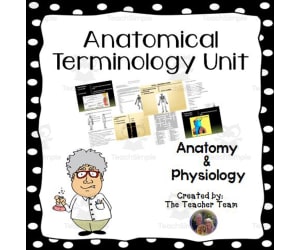
Our Anatomical Terminology Unit for Anatomy and Physiology as well as Biology includes PowerPoints, Cornell-style editable note taking system (great for AVID schools!), labs, writing assignment, test with answers, crossword puzzle for early finishers, and a suggested daily teaching planner. Please Note: This product is designed to be used in conjunction with an Anatomy text that a teacher would have in their classroom. In addition, another tool that is utilized in this product is “The Anatomy Coloring Book” by Kapit and Elson. If an Anatomy text is not available, the Internet can also be used as a source for supplemental reading. It is great for any level student from English Learner - EL - to more advanced students. Terms covered include anterior, posterior, proximal, distal, etc., as well as body cavities and body systems.
Author The Teacher Team
Tags Physiology, Anatomical Terms, Human Body, Anatomy Unit, Bundle
Fitness Testing Methods
Science, Life Sciences, Human Body, Grade 7, 8, 9, 10, 11, Teacher Tools, Lesson Plans
Fitness Testing Methods: An Efficient Resource for Education Fitness Testing Methods is a highly efficient teaching resource developed for educators in public schools and homeschoolers. It is structured to cater to students from grades 7 through 11, focusing on scientific study involving the human body. Learning Delivery Format The learning material is delivered as a comprehensive Microsoft PowerPoint presentation comprising of an expansive 30-slide lesson plan built around various fitness tests, making it both substantial and versatile. Educational Objectives Helping students appreciate why completing a fitness test battery is essential. Showcasing how different types of fitness tests target all components of personal fitness like strength, speed, agility or flexibility etc., are performed . Promoting understanding about benefits and limitations associated with each test - knowledge which fits perfectly with what most learners should ideally comprehend. Versatility and Applicability The teaching resource can be seamlessly deployed across various settings; from whole class instructions to smaller student groups focused on personalized attention. It can also serve efficiently when assigned as homework promoting independent learning among students. In summation: Whether you're an educator seeking to refine your testing techniques during physical education classes or aiming supplement classroom lessons on human physiology; Fitness Testing Methods delivers substance in simplicity—enhancing the educational experience inside or outside typical school environments.
Author The PE Tutor
Tags Fitness Tests, Personal Fitness, Teaching Resource, Physical Education, Human Physiology

Types of movement a skeleton can produce
Science, Life Sciences, Human Body, Grade 8, 9, 10, 11, Teacher Tools, Lesson Plans
Discovering the Wonders of Human Body Movement with "Types of Movement a Skeleton Can Produce" Immerse in a comprehensive exploration into human body movement with our teaching resource, "Types of Movement a Skeleton Can Produce". Crafted meticulously to elucidate the fascinating process behind skeletal articulations and their implications in sports, this resource provides a full-fledged 26 slide Microsoft PowerPoint lesson plan. This lesson plan pivots around discerning movements that major joints in our body can perform. Packed with scientific depth yet cloaked in simplicity, it unveils the complex mechanics of our body's movements such as: Flexion Extension Abduction Adduction Rotation Aimed at Students from Grades 8-11 The key learning objectives presented are designated for students between Grade 8-11. From this meticulous assignment on joint actions at major junctions within our bodies, students will secure firm foundation that smoothens their journey into deeper realms of not just human anatomy but various other sub-fields within science. Moreover, it doesn't stop here! A majority will learn how to associate these joint actions with sports activities. Armed with better comprehension about their physical abilities might help future athletes enhance their performance. As for its integration into your curriculum : flexibility is king! Be it whole group instruction during classroom time aiming to unsnarl intricate concepts or small group engagement nurturing collaborative learning opportunities. Or assign it as homework for self-paced study or even distribute as review material preceding exams! Let’s unravel the magic under our skin using “Types Of Movement A Skeleton Can Produce”, because understanding how we move is indeed an imperative step towards grasping what makes us truly human!
Author The PE Tutor
Tags Skeletal Articulations, Joint Actions, Human Anatomy, Sports Activities, Movement Types

Eyes and Ears: Full Day Substitute Plans
Science, Life Sciences, Human Body, Grade 4, Teacher Tools, Lesson Plans
Eyes and Ears: Full Day Substitute Plans is a comprehensive teaching resource designed to alleviate the stress of planning for substitute teachers and homeschoolers. The activities within require fundamental classroom supplies, ensuring smooth transitions for any educational scenario. The elements of this resource consist: A.M and P.M large group messages for students. Fiction and Non-fiction reader response papers. An amalgamation of science, reading, math, and writing lessons on ears and eyes. A Skills Builder page to practice grade level common core standard skills. Morning Messages : These ice-breakers allow substitutes to establish rapport at the start of the day. Each session engages students from 30-45 minutes. Reading Activities : Fiction & ; Non - fiction reader response forms let students reflect on their understanding following independent reading sessions. Promoting comprehension about plot, characters setting,and vocabulary. Science Experiments : Interdisciplinary learning combines science,reading,and writing into engaging lessons about earsand eyes,hearing lossand vision loss. This element also includes hands - on experiences such as exercises in sign language and Braille servant as eye - openers towards deafness & ; blindness issues respectively. >> Multiplication Problems : Creative spin towards practicing multiplication problems by creating worlds largest problem themselves! Skills Builder : Practice 4th-grade level math and language arts common core standard skills. Activity Grid: : This grid details each activity 's objectives, methods of implementation required materials,and corresponding Common Core Standards. This teaching resource, licensed under Common Creative Commons Attribution-NonCommercial-ShareAlike 3.0 Unported License, caters to Grade 4 Science curriculum with a focus on the Human Body. All materials come bundled as an easy-to-use PDF for immediate utilization.
Author Subplanners by Jean Snowden
Tags Substitute Plans, Interdisciplinary Learning, Reading Responses, Science Exploration, Math Skills
Gaseous Exchange in The Body
Science, Life Sciences, Human Body, Grade 9, 10, Teacher Tools, Lesson Plans
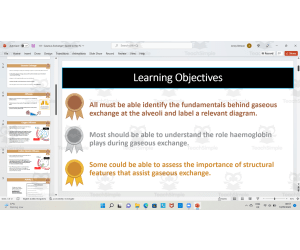
Gaseous Exchange in The Body What is it? Gaseous Exchange in The Body is an educational resource that focuses on the diffusion process, which facilitates gaseous exchange within the human body. This comprehensive package offers a 21-slide PowerPoint presentation lesson, perfect for Grade 9 and Grade 10 science classes. Learning Goals Basic Principles: Every student must grasp the basic principles of gaseous exchange at alveoli and accurately label a corresponding diagram. Hemoglobin's Role: Many are expected to comprehend the central role that haemoglobin plays during this process. Evaluation & Analysis: Lastly, a select number could analyze and evaluate the significance of structural features that aid gaseous exchange. Versatility of Use This innovative teaching tool can be employed for whole group instruction during classroom sessions or utilized for smaller guided study groups focused on detailed discussions or peer tutoring sessions with more individualized learning experiences. Tech-Ready Format The Microsoft PowerPoint format affords seamless integration into any class settings—be it an interactive whiteboard demonstration or remote-learning environment—thus making it adaptable even in diverse learning scenarios such as traditional schooling or homeschooling arrangements. Fostering Critical Thought Gaseous Exchange in The Body isn't just about delivering content; it's also designed with an aim towards fostering critical thought around complex scientific phenomena like these bodily processes. This methodology-based module crosses boundaries offering valuable insights applicable universally across all areas encompassed under general ‘Science’. In conclusion, Gaseasou Exchange In The Body provides a visually appealing yet content-rich experience guaranteed to spark interest and curiosity among young learners keen on deciphering the workings of their own bodies from a biological standpoint.
Author The PE Tutor
Tags Gaseous Exchange, Alveoli, Diffusion Process, Haemoglobin, Structural Features