



3,890 products added recently
Page 45 - Science Lesson Plan Template
Enhance your science instruction with a flexible lesson plan template designed for educators. This tool helps you structure objectives, materials, procedures, and assessments efficiently. Use it to create organized and impactful science lessons that cater to your students' needs.

 Show filters

I WONDER - What Are Solar Winds | Animated Video Lesson
Space, Earth and Environmental Sciences, Science, Grade 6, 7, 8, 9, 10, 11, 12, Lesson Plans, Teacher Tools
Video Introduction An amazing video designed for the students to learn more about space facts. I WONDER - What Are Solar Winds | Animated Video Lesson Do you like reading about space? If yes, what is your favorite topic? What do you know about our solar system? What is the smallest planet in our solar system? What is the biggest planet in our solar system? What is the hottest planet in our solar system? And what is the coldest one? Do you think there are aliens? If yes, what do you think they look like? What do they eat and how they speak to each other? Where do they live? What is a galaxy? And what is a milky way? Have you recently saw a shooting star? If yes, tell us more about it, like when did it happen and where? What is a blackhole? Can a blackhole gets bigger by time? Do you like counting the stars? What do you think a star is made of? I WONDER - What Are Solar Winds | Animated Video Lesson The video is perfect for encouraging the researching skills for the students, while learning more about the fantastic space. I WONDER - What Are Solar Winds | Animated Video Lesson This friendly designed video is suitable for students at school, homeschooling, and as a group activity. Format Available in MP4 format.
Author Educational Voice
Tags What Are Solar Winds, What Are Solar Winds Video, Solar Winds, Solar Winds Facts, Solar Wind, Solar Winds Facts For Kids, Solar Winds Video, Solar Winds Video For Kids, Space, Space Video
I WONDER - Why Is Recycling Plastic Important | Animated Video Lesson
Environmental Science, Earth and Environmental Sciences, Science, Grade 6, 7, 8, 9, 10, 11, 12, Lesson Plans, Teacher Tools
Video Introduction An amazing video designed for the students to learn more about STEM. I WONDER - Why Is Recycling Plastic Important | Animated Video Lesson Do you like STEM subjects? what is your favorite one? Have you ever tried to plant a seed? If yes, tell us more about it. Or have you ever tried to invent something? If yes, tell us more about it. And how do you think it will help us? Have you ever seen a microorganism under a microscope? What was it? And how it looked like? Mathematics is a marvelous subject. Let' sharpen our brains and solve some equations. Do you like timetable tricks? What is your favorite one? Do you know how to code? Have you ever created an app or a game before? If yes, how was it like? I WONDER - Why Is Recycling Plastic Important | Animated Video Lesson The video is perfect for encouraging the researching skills for the students, while learning more about this fantastic topic. I WONDER - Why Is Recycling Plastic Important | Animated Video Lesson This friendly designed video is suitable for students at school, homeschooling, and as a group activity. Format Available in MP4 format.
Author Educational Voice
Tags Why Is Recycling Plastic Important, Why Is Recycling Plastic Important Video, Recycling Plastic, Recycling Plastic Facts, Recycling Plastic Facts For Kids, Recycling Plastic Video, Recycling Plastic Video For Kids

I WONDER - How Smart Are Octopi | Animated Video Lesson
STEM, Biology, Life Sciences, Science, Animals, Grade 1, 2, 3, 4, 5, 6, 7, 8, Lesson Plans, Teacher Tools
Video Introduction Animal kingdoms are full of fascinating wonders to learn. This video is designed for the students to learn more about animals in different countries. I WONDER - How Smart Are Octopi | Animated Video Lesson Do you like animals? what is your favorite one? Do you own a pet? If yes, tell us more about it, like what its name? And what do you like most about it? What are the animal kingdoms? Can you write down the characteristics of each animal class like mammals, birds, reptiles, amphibian, fish and mollusks. Do you know that some animals can sing, can you name any of them? What is the largest and the smallest mammal in the world? What is the largest and the smallest bird in the world? What is the largest and the smallest fish in the world? I WONDER - How Smart Are Octopi | Animated Video Lesson The video is perfect for encouraging the researching skills for the students, while learning more about these fantastic animals. I WONDER - How Smart Are Octopi | Animated Video Lesson This friendly designed video is suitable for students at school, homeschooling, and as a group activity. Format Available in MP4 format.
Author Educational Voice
Tags How Smart Are Octopi, How Smart Are Octopi Video, Octopi, Octopi Facts, Octopi Facts For Kids, Octopi Video, Octopi Video For Kids, Smart Octopi, Smart Octopus, Smart Octopi Video
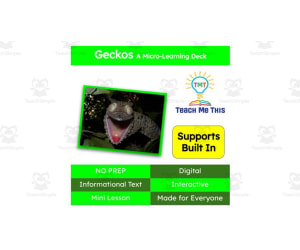
Geckos | Interactive Science Lesson | Micro-Learning Deck
Science, Life Sciences, Animals, Grade 4, 5, 6, 7, Teacher Tools, Lesson Plans
This micro-learning deck is the perfect accessory to your Science instruction! This digital slideshow presents Geckos. Within this slideshow, you will receive: -Video Lesson -Reading Passage w/ Audio -Close Reading -Quick Write The informational texts included in this resource alongside the informal assessments will keep your students engaged from beginning to end.
Author Teach Me This
Tags Interactive Science, Geckos, Mating Habits, Tropical Habitats, Digital Science

Weather Topic Resources Bumper BUNDLE!
Science, Earth and Environmental Sciences, Earth Sciences, Preschool, Grade 1, 2, Teacher Tools, Lesson Plans, Presentations, Activities, Projects, Worksheets & Printables, Worksheets
Here is a bumper collection of resources to help you to teach WEATHER to ages 5 to 8. The bumper weather pack includes: 1. Over 50 pages of weather resources and lesson ideas plus supporting worksheets and puzzles to aid learning, covering: General weather activities It is suitable for single or mixed-age group classes. These are ideas that I have used to teach about weather with my KS1 classes over many years. It is a topic I always love to teach and about which I get excited! The ideas in this pack are * Tried and tested in KS1 classrooms * Provide all the resources you need in one place for a super project on Weather! Objectives: The ideas in this pack can be used to teach the Weather element of the Science and Geography UK National Curriculum but can be used with any curriculum. Contents: The activities are listed under these headings: Introduction to the Topic Weather Activities (General Intro) Cross-curricula Weather Activities Rain Activities Wind Activities Ice and Snow Activities The Sun Activities Weather and Nature Activities Weather Charts- with differentiated charts and symbols if needed Design Symbols Weather Diarytemplate Weather Sayings Weather Word Mat Draw the Weather Beaufort Scale Weather Puzzles What is the weather like today Hot and Cold What shall I wear today? It’s Windy It’s Raining General Puzzles January Brings the Snow Poem Plentiful cross-curricular links are suggested to help planning. The pack includes puzzle sheets to reinforce learning and make learning fun. 2. Mini Clouds Project including Activity ideas linked to Science, Geography, English and Art 3. Clouds PowerPoint A 29-slide presentation helping pupils to learn about clouds. 4. 25 Weather vocabulary flashcards, phonetically coded Use for: Writing tasks Science activities (groups weather by season/kind - e.g. heat/cold/wind etc...) Word Walls Literacy Centers Pocket Charts Dictionary work Seasons and Weather PowerPoint This 57-slide PowerPoint takes KS1 children through the seasons, starting with summer. They will: Learn what changes to look out for across the four seasons Learn that days get shorter and longer throughout the year How this affects the weather How the seasons affect us: what we wear/what we do How the seasons affect plants and animals Bright photos and simple explanation makes it accessible to all abilities in the class and will engage even reluctant learners. Simple text for children to read on each slide. More information is provided for the teacher to read, if desired, in PDF form or under each slide. Simply click when ready to progress to the next slide. All animations occur automatically. Make your weather topic come alive with this bumper pack! What is included? 1 50-page PDF of weather activities and puzzles 1 PDF of 25 flashcards 1 PDF of lesson ideas to learn about clouds 1 PowerPoint about clouds 1 PowerPoint about the seasons and weather 1 PDF with narration notes fo the above PowerPoint
Author Lilibette's Resources
Tags Weather, Science, Geography, Clouds, Seasons And Weather, Seasons, Weather Topic, Weather Project, Weather Worksheets, Weather Lesson Ideas

I WONDER - Are Chickens Intelligent | Animated Video Lesson
STEM, Biology, Life Sciences, Science, Animals, Grade 1, 2, 3, 4, 5, 6, 7, 8, Lesson Plans, Teacher Tools
Video Introduction Animal kingdoms are full of fascinating wonders to learn. This video is designed for the students to learn more about animals in different countries. I WONDER - Are Chickens Intelligent | Animated Video Lesson Do you like animals? what is your favorite one? Do you own a pet? If yes, tell us more about it, like what its name? And what do you like most about it? What are the animal kingdoms? Can you write down the characteristics of each animal class like mammals, birds, reptiles, amphibian, fish and mollusks. Do you know that some animals can sing, can you name any of them? What is the largest and the smallest mammal in the world? What is the largest and the smallest bird in the world? What is the largest and the smallest fish in the world? I WONDER - Are Chickens Intelligent | Animated Video Lesson The video is perfect for encouraging the researching skills for the students, while learning more about these fantastic animals. I WONDER - Are Chickens Intelligent | Animated Video Lesson This friendly designed video is suitable for students at school, homeschooling, and as a group activity. Format Available in MP4 format.
Author Educational Voice
Tags Are Chickens Intelligent, Are Chickens Intelligent Video, Chickens, Chicken, Chickens Facts, Chickens Facts For Kids, Chickens Video, Chickens Video For Kids, Chicken Facts, Chicken Video

I WONDER - How Big Is The Biggest Rocket | Animated Video Lesson
Space, Earth and Environmental Sciences, Science, Grade 6, 7, 8, 9, 10, 11, 12, Lesson Plans, Teacher Tools
Video Introduction An amazing video designed for the students to learn more about space facts. I WONDER - How Big Is The Biggest Rocket | Animated Video Lesson Do you like reading about space? If yes, what is your favorite topic? What do you know about our solar system? What is the smallest planet in our solar system? What is the biggest planet in our solar system? What is the hottest planet in our solar system? And what is the coldest one? Do you think there are aliens? If yes, what do you think they look like? What do they eat and how they speak to each other? Where do they live? What is a galaxy? And what is a milky way? Have you recently saw a shooting star? If yes, tell us more about it, like when did it happen and where? What is a blackhole? Can a blackhole gets bigger by time? Do you like counting the stars? What do you think a star is made of? I WONDER - How Big Is The Biggest Rocket | Animated Video Lesson The video is perfect for encouraging the researching skills for the students, while learning more about the fantastic space. I WONDER - How Big Is The Biggest Rocket | Animated Video Lesson This friendly designed video is suitable for students at school, homeschooling, and as a group activity. Format Available in MP4 format.
Author Educational Voice
Tags How Big Is The Biggest Rocket, How Big Is The Biggest Rocket Video, The Biggest Rocket, The Biggest Rocket Facts, The Biggest Rocket Facts For Kids, The Biggest Rocket Video, The Biggest Rocket Video For Kids

Cellular Hydration & Electrolyte Balances
Math, Money, Measurements, Science, Physics, Life Sciences, Biology, Human Body, Statistics, Percentages, Grade 6, 7, 8, 9, 10, 11, 12, Worksheets & Printables, Workbooks, Worksheets, Word Searches, Teacher Tools, Quizzes and Tests, Quizzes, Tests, Assessments, Lesson Plans
Transform your math and science classroom into a high-stakes sports science lab! Ever have students ask, "When will I ever use this in real life?" This comprehensive, cross-curricular unit is the definitive answer, bridging the gap between abstract mathematical concepts and the tangible, high-interest world of athletic performance. This no-prep resource, "The Mathematics of Athletic Recovery," challenges students to step into the role of a sports scientist. They will learn the critical biology behind hydration and electrolyte balance and then apply mathematical skills to solve real-world problems for student-athletes. This isn't just another worksheet; it's a deep dive into the practical application of math and science. WHAT'S INCLUDED (45 Pages): Phase 1: The Foundational Text (11 pages): An engaging, textbook-style introduction to the science of sweat, electrolytes (Sodium, Potassium, Magnesium), and the dangers of improper hydration. It introduces the core formulas and the "Golden Ratio" of recovery. Phase 2: Student Workbook (21 pages): Ten progressively challenging math worksheets that guide students from basic conversions to complex, multi-step word problems. Students will calculate sweat rates, electrolyte deficits, replenishment ratios, and formulate custom recovery plans for various athletes and scenarios. Phase 3: Visuals & Teacher Resources (13 pages): High-Quality Visual Aids: Three professional SVG diagrams perfect for projection or as anchor charts, illustrating electrolyte depletion, the 40:8:1 recovery ratio, and the Sodium-Potassium pump. Comprehensive Answer Key: Complete solutions for all 10 worksheets. Full Teacher Implementation Guide: Includes core objectives, a suggested 3-day pacing guide, discussion points, differentiation strategies (for scaffolding and rigor), and guidance on addressing common student misconceptions. KEY MATH & SCIENCE CONCEPTS COVERED: Mathematics: Ratios, Proportions, Unit Conversions (Metric & Customary), Percentages, Multi-step Word Problems, Basic Algebra, Data Analysis. Health & Science: Cellular Hydration, Homeostasis, Osmosis, Key Electrolytes (Na+, K+, Mg2+), Muscular Function, and the science of athletic recovery. PERFECT FOR: Middle School Math Classes (Grades 7-9) High School Health, Biology, or Physical Education Classes Applied Mathematics Courses Homeschooling Curriculum Engaging Project for Student-Athletes Emergency Sub Plans Empower your students to see math and science in action! This unit not only builds critical thinking and calculation skills but also teaches valuable lessons about health and physiology. Download now and show your students how math powers champions! Why Parents/Schools Love It: Real-World Application: It directly answers the age-old student question, "Why do we need to learn this?" by connecting math to the high-interest topic of sports, making learning relevant and memorable. Promotes Critical Thinking: Instead of simple plug-and-chug problems, this unit requires students to analyze complex scenarios, select the correct formulas, and execute multi-step calculations, just like a real scientist. Truly Cross-Curricular: It seamlessly integrates core Math standards with essential Health and Life Science concepts (biology, physiology), reinforcing learning across multiple subjects. Comprehensive and Teacher-Friendly: This is a complete, "no-prep" unit. With a detailed lesson, 10 worksheets, professional visuals, an answer key, and a full implementation guide, it saves teachers valuable planning time. Engages All Learners: The theme of athletic performance is highly motivating for student-athletes and sports fans, providing a powerful hook to capture the interest of students who might otherwise be disengaged from math. Target Student Classes : Based on the content and the explicit mention in the Teacher's Guide, target: Primary Target: Middle School (Grades 7, 8, and 9) . The mathematical concepts (ratios, percentages, multi-step problems) are a perfect fit for the 8th-grade curriculum and are excellent for enrichment in 7th grade or review in 9th grade. Secondary Target: High School (Grades 9-11) . This resource is exceptionally well-suited for: General or Applied Math courses. Biology classes studying homeostasis and cellular transport. Health and Physical Education (PE) classes. Introductory Sports Medicine or Kinesiology electives. Copyright/Terms of Use: This Book was copyrighted by Syed Hammad Rizvi. This resource is for personal and single classroom use only. You may not alter, redistribute, or sell any part of this resource. In other words, you may not put it on the Internet where it could be publicly found and downloaded. If you want to share this resource with colleagues, please purchase additional licenses from Teachsimple. Thank you for respecting these terms of use. This product is happily brought to you by Syed Hammad Rizvi
Author Creative Book Store
Rating
Tags Math, Science, Health, Biology, STEM, STEAM, PhysicalEducation, RealWorldMath, AppliedMath, SportsScience

Lesson Plan on Climate Change
Earth Sciences, Earth and Environmental Sciences, Science, Environmental Science, Grade 9, 10, 11, 12, Lesson Plans, Teacher Tools, Worksheets & Printables, Activities
Looking for a clear, engaging lesson on climate change? This 90-minute class is just what you need. It uses a short YouTube video to explain global warming and climate change in a simple way your students will understand. The lesson includes real facts and figures, group discussions, and a worksheet that helps learners stay focused. Students will learn the difference between global warming and climate change. They will see how rising temperatures, melting ice, and extreme weather affect people around the world. The worksheet includes vocabulary, video questions, and a reflection activity. The lesson ends with a short quiz or exit ticket. It also encourages students to think about real ways they can take action. This resource is great for Grades 9–12. It’s ready to use in class or online. No prep needed. Just print the worksheet or share it digitally. If you want to teach climate change with impact and clarity, this lesson will help you do it. Simple. Effective. Powerful.
Author Bright Classroom Ideas Marketplace
Rating
Tags Climate, Change, Environment, Earth, Lesson, Plan

I WONDER - What Is The Ph Scale | Animated Video Lesson
Chemistry, Science, STEM, Grade 6, 7, 8, 9, 10, 11, 12, Lesson Plans, Teacher Tools
Video Introduction An amazing video designed for the students to learn more about STEM. I WONDER - What Is The Ph Scale | Animated Video Lesson Do you like STEM subjects? what is your favorite one? Have you ever tried to plant a seed? If yes, tell us more about it. Or have you ever tried to invent something? If yes, tell us more about it. And how do you think it will help us? Have you ever seen a microorganism under a microscope? What was it? And how it looked like? Mathematics is a marvelous subject. Let' sharpen our brains and solve some equations. Do you like timetable tricks? What is your favorite one? Do you know how to code? Have you ever created an app or a game before? If yes, how was it like? I WONDER - What Is The Ph Scale | Animated Video Lesson The video is perfect for encouraging the researching skills for the students, while learning more about this fantastic topic. I WONDER - What Is The Ph Scale | Animated Video Lesson This friendly designed video is suitable for students at school, homeschooling, and as a group activity. Format Available in MP4 format.
Author Educational Voice
Tags What Is The Ph Scale, What Is The Ph Scale Video, Ph Scale, Ph Scale Facts, Ph Scale Facts For Kids, Ph Scale Video, Ph Scale Video For Kids, Chemistry, Chemistry Video, Chemistry Video For Kids

I WONDER - Is Eating Too Many Carbohydrates Bad | Animated Video
Human Body, Life Sciences, Science, Biology, STEM, Grade 1, 2, 3, 4, 5, 6, 7, 8, Lesson Plans, Teacher Tools
Video Overview The human body is full of fascinating wonders to learn. This video is created to help the students recognize the anatomy and the job of the human body. I WONDER - Is Eating Too Many Carbohydrates Bad | Animated Video Lesson Every part and organ in our human body is vital so let's see how important they are. Have you ever imagined how we look like if we didn't have a skeleton? Did you know that because we have our amazing muscles we can stand! Do you know how many teeth do we have? Have you ever wondered about the food journey inside our body? Can you name all the glands in our body? Why do we have skin? Our nervous system is really good at sending signals. Can you tell us more about it? Are you really good at Mathematics, painting, or any other thing? You should really thank your brain about it! The famous five senses are really doing a great work? Can you explain how every sense works? I WONDER - Is Eating Too Many Carbohydrates Bad | Animated Video Lesson The video is perfect for encouraging the researching skills for the students, while learning more about our fantastic human body. I WONDER - Is Eating Too Many Carbohydrates Bad | Animated Video Lesson This friendly designed video is suitable for students at school, homeschooling, and as a group activity. Format Available in MP4 format.
Author Educational Voice
Tags Is Eating Too Many Carbohydrates Bad, Is Eating Too Many Carbohydrates Bad Video, Carbohydrates, Carbohydrate, Carbohydrates Facts, Carbohydrates Facts For Kids, Carbohydrates Video, Carbohydrates Video For Kids

I WONDER - Where Did The Brachiosaurus Live | Animated Video Lesson
History: Ancient, History, Social Studies, History: World, Animals, Life Sciences, Science, Grade 4, 5, 6, 7, 8, 9, 10, Lesson Plans, Teacher Tools
Video Introduction An amazing video designed for the students to learn more about dinosaurs in different countries. I WONDER - Where Did The Brachiosaurus Live | Animated Video Lesson Do you like dinosaurs? what is your favorite one? Do you own a pet? If yes, tell us more about it, like what its name? And what do you like most about it? Do you think that your pet has been evolved from a dinosaur? Can you write down the characteristics of your favourite dinosaur like it's shape, their rivals, where did it use to live and what was their favourite food? What is the largest and the smallest dinosaur that ever found? Why is the T-rex is so famous? Have you ever read any interesting facts about it? Can you name any of the carnivores or herbivores dinosaurs? I WONDER - Where Did The Brachiosaurus Live | Animated Video Lesson The video is perfect for encouraging the researching skills for the students, while learning more about dinosaurs. I WONDER - Where Did The Brachiosaurus Live | Animated Video Lesson This friendly designed video is suitable for students at school, homeschooling, and as a group activity. Format Available in MP4 format.
Author Educational Voice
Rating
Tags Where Did The Brachiosaurus Live, Where Did The Brachiosaurus Live Video, Brachiosaurus, Brachiosaurus Video, Brachiosaurus Facts, Brachiosaurus Video For Kids, Brachiosaurus Facts For Kids, Dinosaurs

Classification & Adaptation: A Case Study: The Koala and Its Adaptations Gr. 5-8
Science, Life Sciences, Biology, Grade 5, 6, 7, 8, Teacher Tools, Lesson Plans
Classification & Adaptation: A Case Study: The Koala and Its Adaptations Gr. 5-8 This engaging teaching resource is tailored for students in grades 5 to 8. It delves into the captivating world of biology, specifically focusing on the sphere of animal adaptation through an intimate exploration of the survival mechanisms adopted by the koala bear. This teaching aid encourages students to consider pressing questions such as: What distinguishes warm-blooded and cold-blooded animals? How are vertebrates different from invertebrates? BLOOM's Taxonomy Concepts In trying to answer these fundamental scientific inquiries, students will come face-to-face with concepts that make up BLOOM's taxonomy like comprehension, application, analysis and synthesis. The Core Subject – The Koala Bear The core of this resource a detailed case study about one of Australia's most iconic fauna – The Koala Bear. Students learn about this unique creature and its remarkable adaptations for survival in intricate environmental conditions. Educational Activities Included "How Important Are Thumbs?" "The Lake Habitat Thermometer" "A Day in the Life of a Paleontologist!" Apart from enlightening reading passages that simplify complex scientific concepts, this valuable resource also contains hands-on activities that facilitate practical understanding application. Educational Standards Alignment & Student Guide Additions This bundle conforms with your State’s educational standards ensuring relevance while aligning with STEM initiatives guarantees rigor in critical thinking and problem-solving skills development. Its simplified language makes learning enjoyable even to remedial students. Instruction Modes Educators can utilize this vital source material for various instruction modes including: Whole-class teaching Small group sessions Homework assignments fostering independent thought processes among learners. The addition of a student guide adds flexibility into usage possibilities. For educators keen on enhancing their grade 5-8 wards' scientific acumen, "Classification & Adaptation: A Case Study: The Koala and Its Adaptations Gr. 5-8" is an invaluable partner for the journey of comprehension, analysis, synthesis and evaluation of every learning endeavor.
Author Classroom Complete Press
Tags PDF

Energy: Sound Energy and Waves
Science, Physics, Common Core, Grade 5, 6, 7, 8, Teacher Tools, Lesson Plans
Energy: Sound Energy and Waves Product Description This teaching resource, titled 'Energy: Sound Energy and Waves,' acts as a comprehensive guide to dispelling the complexities of understanding energy concepts. This chapter is a slice from an extensive lesson plan focusing on energy. Main Features: Covers various forms of energy such as mechanical, thermal, sound, and light energies. Uses easy-to-understand language suitable for remedial students without compromising educational rigor. Incorporates practical experiences through student activities attached to each reading passage. Including vivid color mini posters promoting visual learning. This resource goes beyond conventional textbooks by discussing wider aspects of potential energies and their transformations. It prepares students with deep contextual understanding regarding how different types of energy convert from one form to another. Potential Uses: Ideal for whole-group classroom instruction led by primary teachers. Easily adapted for homeschooling lessons or individual study sessions. Note: The content is aligned with Common Core State Standards grade requirements whilst embracing Bloom's Taxonomy principles making it easily integrated into existing curriculums no matter if the pedagogy style is traditional or modern like STEM initiatives. Specific Target Audience This product is designed specifically for 5th-8th graders studying physics under science disciplines but affordable only digitally as a PDF file making this product environmentally friendly which encourages paper-free academic culture among the learners too.
Author Classroom Complete Press
Tags PDF

Water Purification Filter Engineering Specs
Science, Earth and Environmental Sciences, Earth Sciences, Environmental Science, Geology, Life Sciences, Human Body, Nature & Plants, Technology, Engineering, Grade 6, 7, 8, 9, 10, 11, 12, Worksheets & Printables, Workbooks, Worksheets, Word Searches, Writing Prompts, Teacher Tools, Lesson Plans, Quizzes and Tests, Quizzes, Tests
Transform your science class into a real-world engineering challenge with this comprehensive, hands-on STEM project! This all-inclusive resource guides students through the process of designing, blueprinting, building, and testing a functional DIY survival water filter using sand, charcoal, and gravel. Perfect for engaging middle school and high school students in Physics, Chemistry, Earth Science, and Environmental Science, this project-based learning (PBL) unit makes abstract scientific principles tangible and exciting. Students will move beyond theory to apply concepts like mechanical filtration, chemical adsorption, fluid dynamics, and the engineering design process to solve a critical survival problem. This No-Prep/Low-Prep Resource is Packed with Value and Includes: Part 1: The Engineering Guide (10 Pages): A detailed, student-facing "textbook" that professionally explains the core science. Topics include the physics of macroscopic filtration (sand/gravel), the chemistry of purification (activated charcoal), pyrolysis, adsorption vs. absorption, and iterative design principles. Part 2: The Student Workbook (19 Pages): Ten distinct, ready-to-print worksheets that reinforce key concepts. These worksheets cover everything from material properties and volumetric calculations to flow-rate dynamics and blueprinting schematics. Questions include fill-in-the-blanks, calculations, and critical thinking short answers. Part 3: Visuals & Teacher Resources (13 Pages): Everything you need to guide students and assess their work with ease! High-Quality Schematics: Clear diagrams illustrating filter stratification, the adsorption process, and the iterative engineering design loop. Perfect for anchor charts! Comprehensive Answer Key: A complete, detailed answer key for all 10 worksheets, including ideal responses for short-answer questions. Advanced Assessment Guides: Includes model calculations and analytical short answer benchmarks to help you grade with confidence. This isn't just a craft; it's a rigorous academic exercise that challenges students to think like engineers. Watch their engagement soar as they create a life-saving device from scratch. Ideal for your next STEM unit, Earth Day activity, or as an unforgettable sub-plan. Download today and bring the engineering of survival to your classroom! Keywords: STEM, STEAM, Project-Based Learning (PBL), Water Filter Project, Engineering Design Process, DIY Survival, Environmental Science, Earth Science, Chemistry, Physics, High School Science, Middle School Science, Hands-On Lab, Workbook, Worksheets, Answer Key, Homeschool, No Prep. Why Parents/Schools Love It: Truly Multi-Disciplinary (STEM/STEAM): This single project masterfully integrates core principles from Physics (flow rate), Chemistry (adsorption), Earth Science (sedimentation), and Engineering (design, testing, iteration), providing immense educational value. Promotes Critical Thinking & Problem Solving: Students don't just follow instructions; they must calculate ratios, troubleshoot failures like "channeling," analyze data, and iterate on their designs, just like real engineers. Makes Abstract Science Concrete: Concepts like "surface area" and "molecular bonding" can be hard to grasp. This project makes them tangible as students see how a larger surface area of charcoal leads to cleaner water. Comprehensive & Teacher-Friendly: This is a "business in a box." With a student guide, 10 worksheets, diagrams, and a full, detailed answer key, it saves teachers dozens of hours of preparation time. Target Student Classes : After analyzing the vocabulary (e.g., tortuosity, pyrolysis, van der Waals forces, effluent ), the mathematical calculations (volume of a cylinder, ratios), and the depth of the scientific concepts, targeting the following students: Primary Target: Grades 9-12 (High School). This resource is perfectly suited for courses in: Environmental Science Earth Science Chemistry (concepts of adsorption, chemical properties) Physics (fluid dynamics, pressure) Engineering or STEM Elective courses. Secondary Target: Grades 7-8 (Advanced/Gifted) . An advanced or honors middle school science class could absolutely handle and benefit from this challenge. It would be an excellent capstone project for a physical or earth science unit. Copyright/Terms of Use: This Book was copyrighted by Syed Hammad Rizvi. This resource is for personal and single classroom use only. You may not alter, redistribute, or sell any part of this resource. In other words, you may not put it on the Internet where it could be publicly found and downloaded. If you want to share this resource with colleagues, please purchase additional licenses from Teachsimple. Thank you for respecting these terms of use. This product is happily brought to you by Syed Hammad Rizvi
Author Creative Book Store
Rating
Tags STEM, STEAM, Engineering, Science, WaterFilter, WaterPurification, DIYWaterFilter, SurvivalSkills, EnvironmentalScience, EarthScience

I WONDER - How Fast Could The Giganotosaurus Run | Animated Video
History: Ancient, History, Social Studies, History: World, Life Sciences, Science, Animals, Grade 4, 5, 6, 7, 8, 9, 10, Lesson Plans, Teacher Tools
Video Introduction An amazing video designed for the students to learn more about dinosaurs in different countries. I WONDER - How Fast Could The Giganotosaurus Run | Animated Video Lesson Do you like dinosaurs? what is your favorite one? Do you own a pet? If yes, tell us more about it, like what its name? And what do you like most about it? Do you think that your pet has been evolved from a dinosaur? Can you write down the characteristics of your favourite dinosaur like it's shape, their rivals, where did it use to live and what was their favourite food? What is the largest and the smallest dinosaur that ever found? Why is the T-rex is so famous? Have you ever read any interesting facts about it? Can you name any of the carnivores or herbivores dinosaurs? I WONDER - How Fast Could The Giganotosaurus Run | Animated Video Lesson The video is perfect for encouraging the researching skills for the students, while learning more about dinosaurs. I WONDER - How Fast Could The Giganotosaurus Run | Animated Video Lesson This friendly designed video is suitable for students at school, homeschooling, and as a group activity. Format Available in MP4 format.
Author Educational Voice
Rating
Tags How Fast Could The Giganotosaurus Run, How Fast Could The Giganotosaurus Run Video, Giganotosaurus, Giganotosaurus Facts, Giganotosaurus Video, Giganotosaurus Video For Kids, Giganotosaurus Facts For Kids

I WONDER - Do Chemical Reaction Affect Energy | Animated Video Lesson
Chemistry, Science, Physics, STEM, Grade 6, 7, 8, 9, 10, 11, 12, Lesson Plans, Teacher Tools
Video Introduction An amazing video designed for the students to learn more about STEM. I WONDER - Do Chemical Reaction Affect Energy | Animated Video Lesson Do you like STEM subjects? what is your favorite one? Have you ever tried to plant a seed? If yes, tell us more about it. Or have you ever tried to invent something? If yes, tell us more about it. And how do you think it will help us? Have you ever seen a microorganism under a microscope? What was it? And how it looked like? Mathematics is a marvelous subject. Let' sharpen our brains and solve some equations. Do you like timetable tricks? What is your favorite one? Do you know how to code? Have you ever created an app or a game before? If yes, how was it like? I WONDER - Do Chemical Reaction Affect Energy | Animated Video Lesson The video is perfect for encouraging the researching skills for the students, while learning more about this fantastic topic. I WONDER - Do Chemical Reaction Affect Energy | Animated Video Lesson This friendly designed video is suitable for students at school, homeschooling, and as a group activity. Format Available in MP4 format.
Author Educational Voice
Tags Do Chemical Reaction Affect Energy, Do Chemical Reaction Affect Energy Video, Chemical Reaction, Chemical Reaction Facts, Chemical Reaction Facts For Kids, Chemical Reaction Video, Energy, Energy Facts
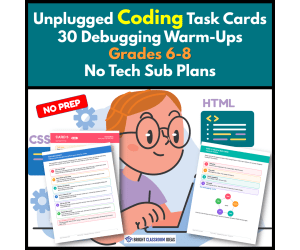
Unplugged Coding Task Cards | 30 Debugging WarmUps Grades 6-8 |No Tech
Winter, Seasons, Holiday & Seasonal, Computer Science, Technology, Science, Grade 6, 7, 8, Centers, Activities, Lesson Plans, Teacher Tools, Task Cards, Worksheets & Printables
Find the Bug: Python Debugging Warm-Ups | Grades 6–8 Python debugging task cards give middle school students meaningful practice finding, explaining, and fixing real coding errors. With 30 Python 3 debugging challenges, students learn to read output and tracebacks, compare actual results to the goal, test their thinking, and refine their code. What’s Included This resource includes six separate PDF files : Teacher Guide – 6 pages How to use the resource Teacher questioning script Standards alignment Scope and sequence Two-week pacing option Student Reference – 2 pages How to read a bug card Debugging cycle 8-step debugging checklist Recording Pages – 2 pages Student response sheets Bug type tracking Debugging progress tracker 30 Python Bug Cards – 30 pages 30 ready-to-use Python debugging challenges 6 bug types 3 difficulty levels One card per page Answer Key – 10 pages Correct fixes Explanation of what went wrong Misconception behind each bug Alternate valid fixes where appropriate Six Bug Types Covered Order and Flow — running lines before they can work Loops and range() — incorrect counting, starting, stopping, and stepping Loop Control — infinite loops, break, and continue Booleans and Logic — operators, conditions, elif, and, and or Variables and Types — initialization, assignment, casting, and data types Lists and Indexing — zero-based indexing, mutation, and aliasing How It Works in the Classroom Use these Python debugging task cards as flexible, low-prep practice throughout your middle school computer science or Python programming instruction. ⭐ Bell-Ringers Project one card or hand out a printed copy as students enter. About 6 minutes to work independently or with a partner Follow with a short class discussion One card per day provides approximately six weeks of debugging practice ⭐ Stations Print and laminate the cards and place them at a station with the response sheet. Students identify the bug Explain why it is wrong Write a corrected line Self-check when appropriate Five cards make a comfortable 15-minute station rotation. ⭐ Sub Plans This resource can also work as a ready-to-go substitute activity. Students can complete the cards using the printed checklist and recording pages. No login, devices, or prior computer science knowledge are required. ⭐ Teach Debugging as a Process Each card follows the same basic structure: Goal → Code → What Really Happens → Find It → Explain It → Fix It → Test Students are encouraged to compare expected and actual output rather than simply hunt for a line that "looks wrong." Standards & Learning Goals Students practice: Systematically testing and refining programs Decomposing problems into manageable parts Reading Python errors and tracebacks Comparing expected and actual output Tracing variables and loop behavior Testing boundary cases Working with conditions and Boolean logic Understanding Python data types Debugging lists, indexing, mutation, and aliasing Explaining why a fix works This resource is aligned to CSTA 2-AP-17 and 2-AP-13 , with additional connections to CSTA 2-AP-11, 2-AP-12, 2-AP-19, and 2-AP-16 , plus CCSS.MATH.PRACTICE.MP6 and MP8 . The student reference also provides an 8-step debugging checklist , including reading the full error, stating the goal, comparing output, checking starting values, counting loop passes, checking types, testing boundaries, and checking indentation. Why Teachers Love It ⭐ Misconception-focused answer key The answer key doesn't just give the correction—it identifies the misconception behind each bug, making it easier to conference with struggling students. ⭐ Real Python 3 practice Every card shows what Python actually prints or reports when the broken code runs, including real tracebacks. ⭐ No guessing required Students learn to use evidence from output, errors, and code behavior to locate bugs. ⭐ Three levels of difficulty Cards progress from bugs visible on a careful first read to more subtle problems that require tracing or testing. ⭐ Built-in differentiation Pull specific groups of cards for targeted reteaching by bug type. ⭐ Low-prep and flexible Use it for bell-ringers, stations, sub plans, reteaching, or extra debugging practice. ⭐ Students track their own progress The included debugging tracker lets students record which cards they've solved and identify the bug types they find most challenging. ⭐ Works with or without devices The cards are complete on paper, while students who can run the snippets can use the experience to deepen their debugging practice. Give your students repeated, structured practice with Python debugging —without having to create dozens of broken-code examples yourself! Use these 30 task cards for warm-ups, stations, targeted reteaching, or substitute plans and help students develop the debugging habits that transfer to real programming. Download Find the Bug and turn everyday Python errors into valuable learning opportunities! 🐍💻
Author Bright Classroom Ideas Marketplace
Rating
Tags Code, Coding, Technology, Computer, Python, Debug, Debugging, No Tech, Unplugged

Animal Science Unit | All About Penguins | Learning about Animals
Science, Life Sciences, Animals, Kindergarten, Preschool, Grade 1, 2, Lesson Plans, Teacher Tools
Animal Science Unit | All About Penguins Dive into learning about penguins with this expansive collection of resources for preK-2nd grade. Students will love discovering facts about penguins through real photos, nonfiction readings, crafts , worksheets, and more. Differentiated materials make these versatile resources perfect for whole group, small group, or independent study. The unit covers penguin habitats, behaviors, physical traits, life cycles, and more through various activities like articulated paper crafts , sorting games based on adaptations, comprehension articles and questions, writing templates for animal reports, and adorable penguin masks or bag puppets. Educators will appreciate discussion questions, project ideas, related media, and additional teacher resources to support a multi-faceted animal science unit that engages a wide range of learners.
Author Simply Schoolgirl
Tags Zoology, Birds, Antarctica, Animals Of Antarctica, Animal Adaptations, Penguin Crafts, Penguin Activities, Penguin Projects, Penguin Worksheets, Penguin Lesson

Simple Machines: Levers
Science, Technology, Engineering, Common Core, Grade 5, 6, 7, 8, Teacher Tools, Lesson Plans
Simple Machines: Levers This teaching resource presents a detailed overview of levers, forming an integral part of the simple machines curriculum. Main Features: Can be used in whole-group instruction or small group activities. Suits homeschooling needs as it aligns perfectly with existing curricula. Begins with basic concepts such as force, motion, and work. Covers various types of simple machines like inclined planes, wedges, screws, pulleys and wheels and axles. In-Depth Coverage: The depth provided to compound machines is a key feature - multi-functional devices we use daily are explored in detail. Color Mini Posters: These serve great visual aids that cement new knowledge while brightening up lessons. Hands-On Activities: Listed here are practical activities aimed at boosting understanding through application. Skill Reinforcement Activities: Included also are crossword puzzles and word searches targeting skill reinforcement while imbibing fun into learning. Evaluation Through Quizzes A final quiz assesses comprehension ensuring no student is left behind after completing this chapter slice . Note: Simple Machines: Levers meets Common Core State Standards guaranteeing quality content that balances both homeschooler's needs or public school systems' criterias. It's designed for grades 5 through 8 making for an ideal resource across science-related lesson plans. In essence,"Simple Machines: Levers", ensures comprehensive STEM education keeping students engaged while rendering complex topics accessible and understandable.
Author Classroom Complete Press
Tags PDF
I WONDER - Are There Different Types of Galaxies | Animated Video
Space, Earth and Environmental Sciences, Science, Grade 1, 2, 3, 4, 5, 6, 7, 8, Lesson Plans, Teacher Tools
Video Introduction An amazing video designed for the students to learn more about space facts. I WONDER - Are There Different Types of Galaxies | Animated Video Lesson Do you like reading about space? If yes, what is your favorite topic? What do you know about our solar system? What is the smallest planet in our solar system? What is the biggest planet in our solar system? What is the hottest planet in our solar system? And what is the coldest one? Do you think there are aliens? If yes, what do you think they look like? What do they eat and how they speak to each other? Where do they live? What is a galaxy? And what is a milky way? Have you recently saw a shooting star? If yes, tell us more about it, like when did it happen and where? What is a blackhole? Can a blackhole gets bigger by time? Do you like counting the stars? What do you think a star is made of? I WONDER - Are There Different Types of Galaxies | Animated Video Lesson The video is perfect for encouraging the researching skills for the students, while learning more about the fantastic space. I WONDER - Are There Different Types of Galaxies | Animated Video Lesson This friendly designed video is suitable for students at school, homeschooling, and as a group activity. Format Available in MP4 format.
Author Educational Voice
Tags Are There Different Types Of Galaxies, Are There Different Types Of Galaxies Video, Different Types Of Galaxies, Types Of Galaxies, Galaxies, Galaxy, Galaxies Facts, Galaxies Facts For Kids, Galaxies Video

Please Pass the Protein: Insects as a Food Source: A Cross-Curricular Unit
Science, Life Sciences, Human Body, Grade 5, 6, Teacher Tools, Lesson Plans
Please Pass the Protein: Insects as a Food Source – A Cross-Curricular Unit Educators looking to stimulate student interest in unique cultural practices will greatly benefit from Please Pass the Protein: Insects as a Food Source – A Cross-Curricular Unit. This well-rounded resource provides an in-depth look into entomophagy, the eating of insects for nutrition that is common in several cultures around the world. Designed for Grade 5 and Grade 6 curriculum standards, this instrument incorporates science and human body studies to help pupils comprehend the nutritional value of insects. The explanation of how assorted cultures incorporate bugs into their diets not just promotes scientific learning but also nurtures an enlighten perception towards diverse dietary customs. Learning Materials: An easy-to-download PDF file consisting of eight printable pages providing detailed information about this less discussed subject by illustrating how various countries consume insect delicacies. A series of cross-curricular worksheets designed to prompt immersive engagement from each student. These well-thought-out worksheets push scholars to actively interact with content and implement their fresh knowledge over multiple areas. A collection of supplementary activity ideas suited for reinforcing crucial lessons or expanding education beyond conventional classroom surroundings at home or within smaller study groups betting on better recall and broader conceptual understanding. Possible Learning Scenarios: Whole group discussions uncovering collective viewpoints; Small group activities advocating closer interactions; Solo studies enabling self-paced digestion of information / wisdom; or even... Hall homework assignments bridging classroom learning with after-school revisions smoothly; In essence, Please Pass The Protein presents an innovative break from standard lesson deliverables yet sticks strictly to academic guidelines - enabling teachers to strike a balance between presenting stimulating content while remaining committed to pedagogical standards. It's time you brought Please Pass the Protein: Insects as a Food Source – A Cross-Curricular Unit into your educational arsenal for an engaging and global twist.
Author Classroom Complete Press
Tags Science Activity, Reading Passage, Insects, Graphic Organizers, Vocabulary Worksheet
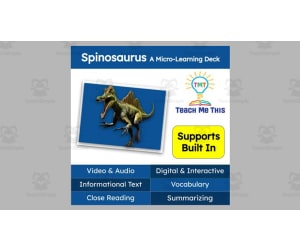
Spinosaurus | Interactive Science Lesson | Micro-Learning Deck
Science, Life Sciences, Animals, Grade 6, 7, 8, 9, Teacher Tools, Lesson Plans
Spinosaurus | Interactive Lesson for Science Educators Transport students back in time with this interactive Spinosaurus lesson for middle school science classes. This digital slideshow dives into the life and anatomy of the Spinosaurus, bringing this prehistoric creature to life. Educators can implement this resource in a variety of ways - use it to introduce a new unit on dinosaurs, facilitate a small group lesson on ancient animals, or assign it as an at-home learning activity. The deck includes informative video footage, reading passages with audio for diverse learners, close reading questions, and writing prompts to boost engagement and comprehension. With vivid images alongside informal assessments, this Spinosaurus resource will captivate students' curiosity about the past.
Author Teach Me This
Tags Spinosaurus, Interactive, Science, Reading Passage, Vocabulary

I WONDER - Where Did The Carontaurus Live | Animated Video Lesson
History: Ancient, History, Social Studies, History: World, Animals, Life Sciences, Science, Grade 4, 5, 6, 7, 8, 9, 10, Lesson Plans, Teacher Tools
Video Introduction An amazing video designed for the students to learn more about dinosaurs in different countries. I WONDER - Where Did The Carontaurus Live | Animated Video Lesson Do you like dinosaurs? what is your favorite one? Do you own a pet? If yes, tell us more about it, like what its name? And what do you like most about it? Do you think that your pet has been evolved from a dinosaur? Can you write down the characteristics of your favourite dinosaur like it's shape, their rivals, where did it use to live and what was their favourite food? What is the largest and the smallest dinosaur that ever found? Why is the T-rex is so famous? Have you ever read any interesting facts about it? Can you name any of the carnivores or herbivores dinosaurs? I WONDER - Where Did The Carontaurus Live | Animated Video Lesson The video is perfect for encouraging the researching skills for the students, while learning more about dinosaurs. I WONDER - Where Did The Carontaurus Live | Animated Video Lesson This friendly designed video is suitable for students at school, homeschooling, and as a group activity. Format Available in MP4 format.
Author Educational Voice
Rating
Tags Where Did The Carontaurus Live, Where Did The Carontaurus Live Video, Carontaurus, Carontaurus Facts, Carontaurus Facts For Kids, Carontaurus Video, Carontaurus Video For Kids, Dinosaur