



3,904 products added recently
Page 48 - Social Studies Lesson Plans
Enrich your social studies curriculum with lesson plans that bring history, geography, and cultures to life. These resources offer projects and discussions that connect past and present. Incorporate them to help students understand societal structures and their roles within them.

 Show filters


Mount Rushmore: Historic Monuments Series
Social Studies, History, History: USA, Grade 4, 5, 6, 7, 8, Teacher Tools, Lesson Plans
Mount Rushmore: Historic Monuments Series A critical teaching resource, explicitly tailored for Grade 4 to Grade 8 students. This comprehensive guide encompasses significant moments in American history and honors the indomitable spirit of democracy. The focus is primarily on one of its most recognizable landmarks - Mount Rushmore. The material is conveniently arranged into a single PDF file consisting of 34 pages, just awaiting application in your classes. It thoroughly inspects aspects related to Mount Rushmore: The original thought process by Doane Robinson as a homage to Western heroes, Gutzon Borglum's courageous vision that breathed life into it. Fascinating narrations interwoven through this resource are sure to pique the interest and engagement of young learners with their mix of history, politics, personalities, and resilience. Social Studies Curriculum: History - USA This unique teaching aid streamlines the comprehension and appreciation for Mount Rushmore's role in American culture and historical narrative- all excellently represented within the world's greatest figures chiseled on a mountain face. Ideal for various settings like whole classroom groups or smaller teams; flexibility remains at its core enabling adaptation based on different teaching methodologies or students' learning preferences. Besides classwork, portions could also be delegated as homework assignments empowering students with independent acquisition at their rhythm. "Mount Rushmore: Historic Monuments Series" This series transcends beyond an ordinary lesson plan; it fuels educators like you with inspiration to influence pupils not just about magnificent structures but also regarding timeless values symbolized by four eminent American Presidents ingrained on Mount Rushmourne. Utilize this rich resource to ignite your students' fascination about America's iconic monuments and cultivate their affection towards lifelong learning.
Author Classroom Complete Press
Tags Social Studies, U.S. History, Historical Monuments, Mount Rushmore, Reading Passage

I WONDER - What Can We Learn From Sedimentary Rocks | Animated Video
Geography, Social Studies, Earth Sciences, Earth and Environmental Sciences, Science, Grade 4, 5, 6, 7, 8, 9, 10, Lesson Plans, Teacher Tools
Video Introduction An amazing video designed for the students to learn more about famous places in different countries. I WONDER - What Can We Learn From Sedimentary Rocks | Animated Video Lesson What do you know about this place? Do you know in which part of the world it is? Have you ever visited this place? If yes, can you tell us more about your adventure, and what do you like the most about this place? Do you like reading about Geography? What is your favorite country in the whole world? If you are going on a trip where it will be? Which country? What you are going to see there? Does this country has a famous place to visit? I WONDER - What Can We Learn From Sedimentary Rocks | Animated Video Lesson The activity is perfect for encouraging the researching skills for the students, while learning more about this fantastic place. I WONDER - What Can We Learn From Sedimentary Rocks | Animated Video Lesson This friendly designed video is suitable for students at school, homeschooling, and as a group activity. Format Available in MP4 format.
Author Educational Voice
Tags What Can We Learn From Sedimentary Rocks, What Can We Learn From Sedimentary Rocks Video, Sedimentary Rocks, Sedimentary Rock, Sedimentary Rocks Facts, Sedimentary Rocks Facts For Kids, Sedimentary Rocks Video

Teaching Ancient Asia & Insect Life Cycles | Social Studies Unit
Social Studies, History, History: Asian, Grade 3, 4, 5, 6, Lesson Plans, Teacher Tools
This resource is a 3-week social studies unit for Teaching Ancient Asia & Insect Life Cycles. You will find lesson plans , assessments, group project ideas and so much more. This cross-curricular unit seamlessly weaves social studies and science together in one all while students apply reading and math concepts as well.
Author Anyone Can Learn
Tags History Lesson Plans, Social Studies, Ancient Asia, Insect Life Cycles, Group Project

Iraq War (2003-2010): The Fall of Baghdad Gr. 5-8
Social Studies, History, History: USA, Grade 5, 6, 7, 8, Teacher Tools, Lesson Plans
The Iraq War (2003-2010): The Fall of Baghdad Gr. 5-8 This engaging, informative teaching tool is designed specifically for Grade 5 to 8 students. It dives into the nuanced history of Iraq's turmoil and instability from the years of 2003 to 2010, concentrating on the military operation that led to the collapse of dictator Saddam Hussein's regime. Usage Educators can use this resource in various ways such as whole-class discussions or individual assignments. Students can be involved in interactive activities like creating a poster promoting tourism in Iraq, blending creativity with learning about Iraqi culture and geography. Geographical Understanding and Key Themes This teaching tool includes map activities highlighting events leading up to both the Persian Gulf War and subsequently, the war in Iraq. Pertinent themes like world terrorism are also addressed within this plan - emphasizing how fear surrounding weapons of mass destruction escalated these conflicts. Bloom’s Taxonomy Inspired Activities This resource was originally written following Bloom’s Taxonomy - an educational framework that categorizes learning skills. Each activity presents its own unique challenges aimed at stimulating critical-thinking among students while enriching their knowledge base simultaneously. Traditional Tasks & Convenience for Teachers In addition, there are more traditional tasks such as hands-on activities, quizzes and word searches; aiming not just at testing existing knowledge but also making learning irresistible by incorporating elements typically associated with play into it. An included answer key provides convenience by reducing extra prep-work necessary on teacher’s part when grading completed assignments. All told within one downloadable PDF that includes 27 ready-to-print pages full of enriching education resources carefully crafted around reliable historical information about the Iraq War and its profound effects. Fitted not only for public school teachers but also homeschoolers, this resource aims to foster a deep, intellectual understanding in students in an approachable manner.
Author Classroom Complete Press
Tags Iraq War, Baghdad, Reading Passage, Social Studies, History Assessment
I WONDER - Why Did Castles Have Towers | Animated Video
History: African, History, Social Studies, History: Ancient, History: British, History: Asian, History: Europe, History: World, Grade 6, 7, 8, 9, 10, 11, 12, Lesson Plans, Teacher Tools
Video Introduction An amazing video designed for the students to learn more about history. I WONDER - Why Did Castles Have Towers | Animated Video Lesson Do you like history? Which topic do you really enjoy about history? Have you ever read an interesting fact about the Vikings? If yes, can you mention them? What do you like most about the Victorian era? Can you name all the Tudors? Have you ever wondered how people used to live in ancient Japan and ancient China? Do you know any interesting facts about ancient Egyptians and the Pharaohs? Have you ever visited South America? What do you know about Incas and Aztecs? Celtic culture was really one of a kind, can you name any of the places that Celts used to live in? Imagine yourself living during the ancient Roman empire, how your life will look like? Ancient Greece was an amazing place to live in. What do you know about ancient Greek life? I WONDER - Why Did Castles Have Towers | Animated Video Lesson The video is perfect for encouraging the researching skills for the students, while learning more about history. I WONDER - Why Did Castles Have Towers | Animated Video Lesson This friendly designed video is suitable for students at school, homeschooling, and as a group activity. Format Available in MP4 format.
Author Educational Voice
Tags Why Did Castles Have Towers, Why Did Castles Have Towers Video, Castles Towers, Castles Towers Facts, Castles Towers Video, Castles Towers Facts For Kids, Castles Towers Video For Kids, Castles

All About The Petra | Geographical Wonders Video Lesson
Social Studies, Geography, Not Grade Specific, Lesson Plans, Teacher Tools
Get ready for an enthralling digital adventure with the "All About The Petra: Geographical Wonders Video Lesson"! This digital resource, designed especially for educators, offers a marvelous way to pique students' interest in geography by exploring the breathtaking ancient city of Petra. In this top-notch 10-minute animated video lesson, your learners will be exposed to important geographical concepts such as landforms and natural wonders while uncovering the rich history behind awe-inspiring sites like Petra. Boasting lively visuals and well-researched content, this video is perfect for sparking imagination and curiosity among budding geographers. Ideal for use as a supplementary tool or review material in middle-grade geography lessons that focus on landmarks and landforms worldwide, the "All About The Petra: Geographical Wonders Video Lesson" is an indispensable part of any educator's digital resources collection. Don't miss out on this amazing chance to give your students a fresh viewpoint on one of Earth's most magnificent wonders – head over to TeachSimple.com and download it now!
Author Educational Voice
Tags Petra, Arabia, Social Studies Lesson, Geography Lesson, Artifacts
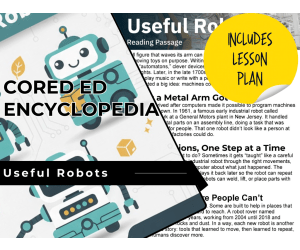
Useful Robots Reading Comprehension Passage - Cored Ed Encyclopedia
ELA, Language Development, Reading Comprehension, Reading, Pre-Reading, History, Social Studies, Technology, Science, Earth and Environmental Sciences, Grade 2, 3, 4, 5, Worksheets & Printables, Worksheets, Teacher Tools, Centers, Activities, Writing Prompts, Assessments, Quizzes and Tests, Quizzes, Lesson Plans
This useful robots reading comprehension with lesson plan includes: Visualization (on the front cover) Start your lesson by taking a minute to think and share something about the topic. Read the script aloud (slowly), perhaps prepare some music or sound effects. Student close their eyes and let their imaginations wander. Students open their eyes, read the question aloud and give them a few minutes to complete. Ask a few students to share or keep answers until the end to compare with what they learn in the passage. Quick pause—thousands of Cored Education products are included with your TeachSimple membership. Download links and encyclopedia index available here. Pre-Reading Trivia Students will write down one thing they already know about the subject and then read five more facts and discuss. These facts are fun, and the students will enjoy learning about the subject before reading more. Give 1 minute for students to write what they already know (no pressure—best guess is fine). Read the five facts together. After each fact, do ask a student for their opinion, was it surprising? Set a purpose by asking students to highlight/underline one fact they want to learn more about during the reading. Reading Passage The text is a high-interest reading passage with set paragraphs, roughly three to four paragraphs long. It contains a variety of themes about the topic, anywhere from history to technology. The passage is between 250 and 350 words in length. First, ask students to look at the headings and see what they’ll learn about today. What do they know about the topic/heading? First read options: Teacher read-aloud (best for support). Partner reading (paragraph by paragraph). While reading, students underline important details, and vocabulary words they think may come up in the questions section. Mixed Questions The first question page contains four multiple-choice questions, each with a choice of four answers, and three written response questions that require a sentence or two from the student. Students complete the mcqs first independently, then review quickly as a class. For the 3 written responses, try to get students giving the answer with some form of evidence: “I think ___ because the text says ___.” If students get stuck, send them back to check the passage. Vocabulary Questions Practice seven key words from the text in this section across two activities. First section is scrambled words where students will unscramble three words given a clue for each. The second section is a word to meaning matching activity. Before starting, have some students read out words they underlined in the passage. Ask students to say the word and read aloud the sentence(s) around each word. Ask students to do scrambled words and the matching exercise in pairs then go through answers as a class. For the scrambled spelling task, get four pairs to come up to the board and write the words for extra practice with the other student reading out the clue. For the matching task, prompt students to give full sentences: “I matched ___ with ___ because ___.” Creative Writing In this question, the student will be required to write a five to eight sentence paragraph on a question related to the topic. Before starting, ask students write down 3 key ideas they are going to include in their piece. Ask students for ideas to share around the class to help those struggling. Pro writing expectations: 5–8 sentences At least 2 facts or details from the passage At least 2 vocabulary words from the previous page Students read their paragraphs while classmates listen for facts and vocabulary words. Extension Activities This page is optional for fast finishers or to take home. There are several activities, each one requiring a different skill. Do some, do none, do all, completely optional - but you will feel reassured knowing every possibility is planned for. Includes summary writting question. Answer Key There are answers for the multiple-choice questions, written response questions have sample answers, vocabulary answers and if there is a summary question then a sample summary will be provided as well. Lesson Plan Included Customized lesson plan for this lesson is included. Lesson Snapshot Title: Useful Robots Genre: Nonfiction (Informational passage) Subject: Science & Technology (Engineering/Robotics) Primary Topic: How robots developed and help people Estimated Guided Reading Level (A–Z): P Support pages included: Pre-reading trivia, mixed questions, vocabulary activities, creative writing prompt, extension activities, and an answer key. QA notes on support pages: Support content generally matches the passage; however, the support pages use “automaton” (singular) while the passage uses “automata” (plural), and an extension prompt suggests “hills,” which is not stated in the passage (the passage names rocks and dust). What This Lesson Teaches Best Robots have a history: Explains that long ago people created “automata” that moved using steam, air, water, or falling weights. Modern robots and factory work: Describes an early industrial robot, Unimate, working in 1961 at a General Motors plant handling hot metal parts that were tough and dangerous for people. How robots learn repeatable motions: Shows how a person can guide a robot’s movements while sensors send signals to a computer that stores a pattern to repeat the job. Robots go where people can’t: Highlights the rover Opportunity exploring Mars for years (2004–2018) and sending back clues from rocks and dust. Big idea across time: Connects early moving devices to today’s robots as tools that learned to move, repeat, and help humans discover more. Learning Goals Students will explain what “automata” were and what powered them. Students will describe why Unimate’s factory job mattered for people. Students will identify how a robot can be “taught” motions and then repeat them. Students will summarize how robots can help in places that are risky, far away, or hard to reach. Students will use details from the text to tell what Opportunity did on Mars and what it sent back. Key Vocabulary From the Text automata — moving devices from long ago; not thinking machines. program — give a machine instructions to do a job. industrial — related to factories and making things. sensors — parts that notice and send signals to a computer. rover — a robot vehicle that travels to explore places. FULL CATALOG OF DOWNLOAD LINKS AND ENCYCLOPEDIA INDEX HERE
Author Cored Education
Rating
Tags Vocabulary, Reading Comprehension, Reading Passages, Lesson Plans, Ela Lesson Plans, Reading Comprehension Lesson Plans, Pre-reading, Science Lesson Plans, Technology, History

Iraq War (2003-2010) Gr. 5-8
Social Studies, History, History: USA, Grade 5, 6, 7, 8, Teacher Tools, Lesson Plans
The Iraq War (2003-2010) Gr. 5-8 This interactive resource provides an in-depth understanding of the complex military operation of the Iraq War, from 2003 to 2010, specifically curated for students from grade 5 to grade 8. Covers vital historical events inclusive of unstable conditions in Iraq and anti-war sentiments in the United States. Engages students actively with tasks such as crafting tourism posters for war-torn Iraq and geographical map exercises relating to strategic locations during this period. Draws parallels between strategies used during Operation Iraqi Freedom and those employed during the Persian Gulf War. Learners' Engagement An exercise focuses on fostering creativity among learners by prompting them to write poems about wartime experiences. Educational Alignment & Enrichment The curriculum aligns seamlessly with State Standards and adheres strictly to Bloom's Taxonomy guidelines. It offers a wider perspective on world history for middle school learners, enhancing their academic interest through: Social studies focusing primarily on USA History which is integrated neatly within accessible PDF lesson plans. A bonus feature including extra engaging activities such as crossword puzzles & word searches aiding recall enhancement and comprehension effectively, Concluding this comprehensive learning package is a quick comprehension quiz coupled with an answer key facilitating self-evaluation.
Author Classroom Complete Press
Tags PDF

I WONDER - When Did The Giganotosaurus Roam The Earth | Animated Video
Animals, Life Sciences, Science, History: Ancient, History, Social Studies, History: World, Grade 4, 5, 6, 7, 8, 9, 10, Lesson Plans, Teacher Tools
Video Introduction An amazing video designed for the students to learn more about dinosaurs in different countries. I WONDER - When Did The Giganotosaurus Roam The Earth | Animated Video Lesson Do you like dinosaurs? what is your favorite one? Do you own a pet? If yes, tell us more about it, like what its name? And what do you like most about it? Do you think that your pet has been evolved from a dinosaur? Can you write down the characteristics of your favourite dinosaur like it's shape, their rivals, where did it use to live and what was their favourite food? What is the largest and the smallest dinosaur that ever found? Why is the T-rex is so famous? Have you ever read any interesting facts about it? Can you name any of the carnivores or herbivores dinosaurs? I WONDER - When Did The Giganotosaurus Roam The Earth | Animated Video Lesson The video is perfect for encouraging the researching skills for the students, while learning more about dinosaurs. I WONDER - When Did The Giganotosaurus Roam The Earth | Animated Video Lesson This friendly designed video is suitable for students at school, homeschooling, and as a group activity. Format Available in MP4 format.
Author Educational Voice
Rating
Tags When Did The Giganotosaurus Roam The Earth, When Did The Giganotosaurus Roam The Earth Video, Giganotosaurus, Giganotosaurus Video, Giganotosaurus Facts, Giganotosaurus Video For Kids, Giganotosaurus Facts For Kids

Maine State Unit Study (Capital, Bird, Flower, Flag, Animal)
Social Studies, Geography, Grade 2, 3, 4, Lesson Plans, Teacher Tools
Maine State Unit Study: A Comprehensive Educator's Resource The Maine State Unit Study is an all-inclusive resource ideal for educators aiming to explore the geographical features, rich tales of history, and vibrant culture of this unique state. This extensive five-day study plan includes a wide array of topics like the state capital, bird, flower, flag and iconic animal. A Multi-Disciplinary Approach This resource employs an integrated approach incorporating Art (drawing & coloring ), English language arts (reading comprehension exercises) as well as geography that examines the political and physical aspects of Maine including its fauna & flora. Specially designed for ease across different education settings - both traditional classrooms or homeschool environments - it places great emphasis on adaptability catering to learners between second grade through fourth grade. LOW PREP Tool with Diverse Elements A well-compiled blend of videos and interactive notebook pieces showcasing various facets under study - including but not limited to Maine State's symbols embodied by cards in either color or B&W format. Daily worksheets along with interactive tools guiding student discussions aimed at encouraging in-depth research into subjects relating to this distinctive region in America. Includes fulfilling core subject requirements engaging students with geography content similar to social studies also focusing on integrative language art tasks such as reading passages improving grammar skills; additional resources curated painstakingly for exploring scientific aspects tied up with local climate; historical elements triggering insightful essays fostering writing skills congruent with the overall theme centered around the study topic. Note: This tool has been made available in PDF format for seamless integration whether your need is discussion guides; thought-provoking activities enhancing social studies efforts; detailed informative sources supplementing history lessons or just fun education activities in general! Versatility Personified The kit not only simplifies lesson planning but also ensures an engaging experience by leveraging customize-friendly features that are adaptable to varying student age, learning styles and comprehension levels. Your educational journey studying Maine State can take shape through individual research tasks; small group assignments or even class-wide activities. In Summary: Everything needed for a successful unit on the study of Maine state is included in this resource. It positions educators with a complete teaching tool:a balance of subject-specific offerings, from geography through social studies bridging across language arts.
Author Heather Huhman
Tags Maine State, Geography, History, Culture, Symbols
Antarctica: Location Gr. 5-8
Social Studies, Geography, Grade 5, 6, 7, 8, Teacher Tools, Lesson Plans
Antarctica: Location Gr. 5-8 Antarctica: Location Gr. 5-8 is a detailed teaching resource designed for educators and parents, focusing on the geography and climate of the South Pole for grade 5 to 8 students. An Educational Journey to Antarctica This product allows students to explore the harsh climate of Antarctica without leaving their classroom or home. They will learn all about its unique terrain, atmospheric conditions, ice formations, and magnetic field. Ice Formations: Students will understand how elements contribute towards creating surface ice that's two miles thick! Magnetic Field: Gain in-depth understanding of this natural phenomenon. A Practical Approach to Learning & Fun Activities The guide encourages interactive learning with activities like plotting research stations on a map of Antarctica - adding fun while strengthening geographic awareness. The Intersection Of Science And Geography Budding scientists can emulate Antarctic researchers by studying how transportation solutions are devised in a land that lacks conventional roads or highways! Beyond Climate Study Terrain Exploration: Lessons also include exploration features such as the active volcano Mt.Erebus – comparing it with other global volcanoes like Mt.St.Helens & Mt.Vesuvius! Educational Standards Compliance & Convenient Features This PDF contains 41 pages packed with information that aligns perfectly with State Standards and Five Themes of Geography curriculum guidelines. Included maps, crossword puzzles, word search activities and quizzes promote group discussions inside classrooms while serving as homework assignments, adding dynamic learning elements for students outside class. Answer keys are included to provide solutions - a handy tool for educators ensuring seamless teaching flow despite complex topics. Catering to Diverse Learning Styles This resource combines geography and social studies with fun, immersive lessons designed for different learning styles, making it an ideal choice of study guide for Grades 5 to 8.
Author Classroom Complete Press
Tags Antartica, Climate, Geography Activity, Reading Passage, Comprehension

World Political Leaders: George W. Bush (United States) Gr. 5-8
Social Studies, Government, Grade 5, 6, 7, 8, Teacher Tools, Lesson Plans
World Political Leaders: George W. Bush (United States) Gr. 5-8 This comprehensive teaching resource is designed for students in the 5th to 8th grades. It covers the lives and impacts of some of the most significant world political leaders from the past century. With firm roots in robust educational standards, including Bloom's Taxonomy, it aims to bridge any gap between complex global concepts and young students' understanding. Notable U.S Presidents: George W. Bush and Ronald Reagan This chapter focuses on two notable U.S presidents—George W. Bush and Ronald Reagan—and their individual impacts on international politics. Students will explore crucial themes such as: Bush's war on terrorism Reagan's strategic maneuvers during the Cold War era Vicente Fox & International Relations The lesson extends beyond American borders into Mexico, providing a context for learners about Vicente Fox’s diplomatic role at an international summit involving George W. Bush and Fidel Castro. The Iron Lady: Margaret Thatcher Moving across continents into Europe, students will delve deeper into British politics by studying Margaret Thatcher’s pivotal role in dismantling apartheid in South Africa. Russian Leadership:Mikhail Gorbachev A comparative analysis involves studying Mikhail Gorbachev who was awarded with a Nobel Peace Prize post his tenure as the Soviet Union leader. Nelson Mandela & Fight for Equal Rights: An intricate analysis of Nelson Mandela's tireless struggle for equal rights among all citizens takes place - an historical moment that resonated globally. Dalai Lama:Spiritual Guide & Political Leader A discussion on the Dalai Lama includes both his role as the reincarnated spiritual guide within Buddhism and as Tibet’s head of state. Engaging Activities & Evaluation: The learning journey is interspersed with diverse activities such as writing tasks, crossword puzzles, and word search activities. It also includes a comprehension quiz with an answer key for evaluating student progress. Available in PDF format, this dynamic lesson plan serves as an engaging educational tool for group study sessions, individual exploration or even captivating homework assignments when teaching about global leaders and their impact on world history within the context of social studies.
Author Classroom Complete Press
Tags PDF

Political Spectrum Left to Right Political Party Research & Lesson
Social Studies, Government, Research, Grade 8, 9, 10, 11, 12, Worksheets & Printables, Worksheets, Lesson Plans, Activities
Want to teach your students about the political spectrum, but don't know where to start? This comprehensive lesson introduces the idea of the political spectrum (left vs. right), the basic values for each side, and common political values in any region. Here is a simple introduction to the political spectrum and political beliefs that can apply to any country or region. It includes: - A handout that shows the names of left and right kinds of government (Communist, Socialist, Liberal, Moderate, Conservative, Right Wing, Fascist) and their main beliefs about the economy, social programs, moral issues, values, progress, and human nature. - A sorting task (cut and paste) of political beliefs on crime and punishment, social programs, the economy, abortion, guns, freedom of expression and more. Students cut out the 12 statements and sort 6 to the left and 6 to the right. Then they try to think of (or research) some beliefs that would fall more to the centre. - A research graphic organizer for local political parties (municipal, state/provincial or federal in any country). The teacher can assign what level of government students should research. Then they find 2-3 local political parties at that level and see their stance on issues like the economy, moral issues, social programs, progress, and crime. Finally, they can decided where on the political spectrum they think each party should fall. - A reflection with questions to get students thinking about this way of classifying political parties. Does it sow division or create harmony? Does it apply accurately to the parties they researched? Does it match well with their own personal beliefs? What's Included: 5 page PDF: Title Page, Handout, Cut and Paste Activity, Local Political Party Research, Reflection Grades to Use With: This lesson is designed for students in grades 7-12, high school special education, or adult education classes. If you find this political lesson useful, check out my other lessons! Search for Grace Under Pressure .
Author Grace Under Pressure
Tags Politics, Critical Thinking, Political Spectrum, Government, Party Research, Reflection, Civics, Political Parties, Teaching, Government Lesson

I WONDER - Does Venice Have Roads | Animated Video Lesson
Geography, Social Studies, Grade 2, 3, 4, 5, 6, 7, 8, Lesson Plans, Teacher Tools
Video Introduction An amazing video designed for the students to learn more about famous places in different countries. I WONDER - Does Venice Have Roads | Animated Video Lesson What do you know about this place? Do you know in which part of the world it is? Have you ever visited this place? If yes, can you tell us more about your adventure, and what do you like the most about this place? Do you like reading about Geography? What is your favorite country in the whole world? If you are going on a trip where it will be? Which country? What you are going to see there? Does this country has a famous place to visit? I WONDER - Does Venice Have Roads | Animated Video Lesson The activity is perfect for encouraging the researching skills for the students, while learning more about this fantastic place. I WONDER - Does Venice Have Roads | Animated Video Lesson This friendly designed video is suitable for students at school, homeschooling, and as a group activity. Format Available in MP4 format.
Author Educational Voice
Tags Does Venice Have Roads, Does Venice Have Roads Video, Venice Roads, Venice Roads Facts, Venice Roads Facts For Kids, Venice Roads Video, Venice Roadsvideo For Kids, Venice, Venice Video

Which Country Gave George Washington An Honorary Citizenship
Biographies, Social Studies, Grade 4, 5, 6, 7, 8, 9, 10, Lesson Plans, Teacher Tools
Video Introduction An amazing video designed for the students to learn more about famous people in different countries. I WONDER - Which Country Gave George Washington An Honorary Citizenship | Animated Video Lesson Do you know this person? How much do you know about him/her? Who is your idol? Why did you choose this person? Tell us more about him/her? Who is your favorite athlete? Or what is your favorite team? Have you recently heard a story about a famous person? Who was this person? Can you tell us more about him/her. Who is your favorite president, king, or queen? Why you chose that person? In your country, who are the most famous people? What did they do? Can you tell us more about them. What is your favorite invention? Who invented it? Who is your favorite artist? What is the most famous thing he/she have done? What is the most enjoyable you have read before? Who wrote it? I WONDER - Which Country Gave George Washington An Honorary Citizenship | Animated Video Lesson The video is perfect for encouraging the researching skills for the students, while learning more about this fantastic place. I WONDER - Which Country Gave George Washington An Honorary Citizenship | Animated Video Lesson This friendly designed video is suitable for students at school, homeschooling, and as a group activity. Format Available in MP4 format.
Author Educational Voice
Rating
Tags Which Country Gave George Washington An Honorary Citizenship, Which Country Gave George Washington An Honorary Citizenship Video, George Washington, George Washington Video, George Washington Facts

Embracing Cultural Diversity: Japan: A Cross-Curricular Lesson Plan
Social Studies, Geography, Grade 5, 6, Teacher Tools, Lesson Plans
Embracing Cultural Diversity: Japan: A Cross-Curricular Lesson Plan "Embracing Cultural Diversity: Japan" is a unique educational tool aimed at promoting cultural appreciation and understanding among young learners. This resource strives to eliminate the segregation of cultures by arming students with knowledge and insights into different cultures, starting with an in-depth look at the fascinating Japanese culture. A Comprehensive Guide on Japanese Culture The lesson plan provides an engaging informational text offering profound insights into Japanese history and traditions. This comprehensive guide is perfect for educators etching to introduce their students to global cultures through a captivating journey into Japan's rich history and unique customs. Making Learning Interactive & Fun The plan includes several extension ideas intended to make learning interactive while achieving curriculum objectives across various disciplines. The hands-on activities incorporated are informative yet enjoyable stimulating creativity among learners. The cross-curricular activities help enhance comprehension skills, reinforce understanding about Japanese culture, encourage active engagement, and promote thorough knowledge retention. This downloadable PDF file aligns well with teachers' methodology whether it be whole group instruction or small group sessions; equally effective if assigned as homework activity enhancing independent learning skills among pupils. Ideal for Social Studies Classes Focusing on Geography Subtopics Crafted primarily for 5th & 6th-grade Social Studies classes studying Geography subtopics, this lesson plan offers more than just geographical lessons. It imparts life-long values of respect & appreciation towards diverse cultures thereby shaping today's learners into responsible global citizens of tomorrow.
Author Classroom Complete Press
Tags PDF
I WONDER - Are All Deserts Hot | Animated Video Lesson
Earth Sciences, Earth and Environmental Sciences, Science, Geography, Social Studies, Grade 4, 5, 6, 7, 8, 9, 10, Lesson Plans, Teacher Tools
Video Introduction An amazing video designed for the students to learn more about famous phenomena in different countries. I WONDER - Are All Deserts Hot | Animated Video Lesson What do you know about this phenomenon? Where it happens? When it happens? What are the safety measures that we should take to be safe during this phenomenon? Are there any other places in the world that experienced this phenomenon? If yes, tell us more about them. Why do you think it happens? Do you like reading about Geography? What is your favorite country in the whole world? I WONDER - Are All Deserts Hot | Animated Video Lesson The video is perfect for encouraging the researching skills for the students, while learning more about this fantastic phenomenon. I WONDER - Are All Deserts Hot | Animated Video Lesson The video is perfect for encouraging the researching skills for the students, while learning more about this fantastic phenomenon. Format Available in a PDF format.
Author Educational Voice
Rating
Tags Are All Deserts Hot, Are All Deserts Hot Video, Deserts, Deserts Facts, Deserts Video, Deserts Video For Kids, Deserts Facts For Kids, Hot Deserts, Cold Deserts, Desert

I WONDER - What Activities Can You Do In Alaska | Animated Video
Geography, Social Studies, Grade 2, 3, 4, 5, 6, 7, 8, Lesson Plans, Teacher Tools
Video Introduction An amazing video designed for the students to learn more about famous places in different countries. I WONDER - What Activities Can You Do In Alaska | Animated Video Lesson What do you know about this place? Do you know in which part of the world it is? Have you ever visited this place? If yes, can you tell us more about your adventure, and what do you like the most about this place? Do you like reading about Geography? What is your favorite country in the whole world? If you are going on a trip where it will be? Which country? What you are going to see there? Does this country has a famous place to visit? I WONDER - What Activities Can You Do In Alaska | Animated Video Lesson The activity is perfect for encouraging the researching skills for the students, while learning more about this fantastic place. I WONDER - What Activities Can You Do In Alaska | Animated Video Lesson This friendly designed video is suitable for students at school, homeschooling, and as a group activity. Format Available in MP4 format.
Author Educational Voice
Tags What Activities Can You Do In Alaska, What Activities Can You Do In Alaska Video, Alaska, Alaska Facts For Kids, Alaska Facts, Alaska Video, Alaska Video For Kids, USA, USA Facts, USA Video

I WONDER - How Long Did The Brontosaurus Live | Animated Video Lesson
History: Ancient, History, Social Studies, History: World, Animals, Life Sciences, Science, Grade 4, 5, 6, 7, 8, 9, 10, Lesson Plans, Teacher Tools
Video Introduction An amazing video designed for the students to learn more about dinosaurs in different countries. I WONDER - How Long Did The Brontosaurus Live | Animated Video Lesson Do you like dinosaurs? what is your favorite one? Do you own a pet? If yes, tell us more about it, like what its name? And what do you like most about it? Do you think that your pet has been evolved from a dinosaur? Can you write down the characteristics of your favourite dinosaur like it's shape, their rivals, where did it use to live and what was their favourite food? What is the largest and the smallest dinosaur that ever found? Why is the T-rex is so famous? Have you ever read any interesting facts about it? Can you name any of the carnivores or herbivores dinosaurs? I WONDER - How Long Did The Brontosaurus Live | Animated Video Lesson The video is perfect for encouraging the researching skills for the students, while learning more about dinosaurs. I WONDER - How Long Did The Brontosaurus Live | Animated Video Lesson This friendly designed video is suitable for students at school, homeschooling, and as a group activity. Format Available in MP4 format.
Author Educational Voice
Rating
Tags How Long Did The Brontosaurus Live, How Long Did The Brontosaurus Live Video, Brontosaurus, Brontosaurus Facts, Brontosaurus Video, Brontosaurus Video For Kids, Brontosaurus Facts For Kids
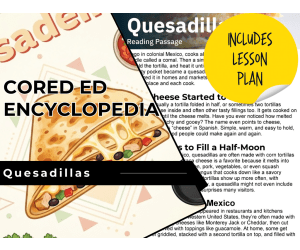
Quesadillas Reading Comprehension Passage - Cored Ed Encyclopedia
ELA, Language Development, Reading Comprehension, Reading, Pre-Reading, Social Studies, Writing, Strategies, Geography, Vocabulary, Grade 2, 3, 4, 5, Worksheets & Printables, Worksheets, Teacher Tools, Centers, Activities, Writing Prompts, Assessments, Quizzes and Tests, Quizzes, Lesson Plans
This quesadillas reading comprehension includes: Visualization (on the front cover) Start your lesson by taking a minute to think and share something about the topic. Read the script aloud (slowly), perhaps prepare some music or sound effects. Student close their eyes and let their imaginations wander. Students open their eyes, read the question aloud and give them a few minutes to complete. Ask a few students to share or keep answers until the end to compare with what they learn in the passage. Quick pause—thousands of Cored Education products are included with your TeachSimple membership. Download links and encyclopedia index available here. Pre-Reading Trivia Students will write down one thing they already know about the subject and then read five more facts and discuss. These facts are fun, and the students will enjoy learning about the subject before reading more. Give 1 minute for students to write what they already know (no pressure—best guess is fine). Read the five facts together. After each fact, do ask a student for their opinion, was it surprising? Set a purpose by asking students to highlight/underline one fact they want to learn more about during the reading. Reading Passage The text is a high-interest reading passage with set paragraphs, roughly three to four paragraphs long. It contains a variety of themes about the topic, anywhere from history to technology. The passage is between 250 and 350 words in length. First, ask students to look at the headings and see what they’ll learn about today. What do they know about the topic/heading? First read options: Teacher read-aloud (best for support). Partner reading (paragraph by paragraph). While reading, students underline important details, and vocabulary words they think may come up in the questions section. Mixed Questions The first question page contains four multiple-choice questions, each with a choice of four answers, and three written response questions that require a sentence or two from the student. Students complete the mcqs first independently, then review quickly as a class. For the 3 written responses, try to get students giving the answer with some form of evidence: “I think ___ because the text says ___.” If students get stuck, send them back to check the passage. Vocabulary Questions Practice seven key words from the text in this section across two activities. First section is scrambled words where students will unscramble three words given a clue for each. The second section is a word to meaning matching activity. Before starting, have some students read out words they underlined in the passage. Ask students to say the word and read aloud the sentence(s) around each word. Ask students to do scrambled words and the matching exercise in pairs then go through answers as a class. For the scrambled spelling task, get four pairs to come up to the board and write the words for extra practice with the other student reading out the clue. For the matching task, prompt students to give full sentences: “I matched ___ with ___ because ___.” Creative Writing In this question, the student will be required to write a five to eight sentence paragraph on a question related to the topic. Before starting, ask students write down 3 key ideas they are going to include in their piece. Ask students for ideas to share around the class to help those struggling. Pro writing expectations: 5–8 sentences At least 2 facts or details from the passage At least 2 vocabulary words from the previous page Students read their paragraphs while classmates listen for facts and vocabulary words. Extension Activities This page is optional for fast finishers or to take home. There are several activities, each one requiring a different skill. Do some, do none, do all, completely optional - but you will feel reassured knowing every possibility is planned for. Includes summary writting question. Answer Key There are answers for the multiple-choice questions, written response questions have sample answers, vocabulary answers and if there is a summary question then a sample summary will be provided as well. Lesson Plan Included Customized lesson plan for this lesson is included. Lesson Snapshot Title: Quesadillas Genre: Nonfiction (informational passage with support pages) Subject: Reading (Informational Text) / Social Studies (Culture & Food Traditions) Primary Topic: How quesadillas began and changed by place Estimated Guided Reading Level (A–Z): Q What This Lesson Teaches Best How foods and traditions change as people share them in different places (homes, markets, restaurants, and around the world). Comparing regional variations (corn vs. flour tortillas; different cheeses and fillings in different parts of Mexico and the U.S.). Building vocabulary and background knowledge about cooking tools and ingredients (comal, Oaxaca cheese, huitlacoche, guacamole). Identifying main ideas and key details across sections with headings (history/origin, filling choices, spreading beyond Mexico). Learning Goals Students can explain how the passage says a quesadilla is made (tortilla, filling, folded, heated). Students can describe how quesadillas changed in different places using details from the text. Students can compare quesadillas in different regions mentioned (central/southern Mexico, northern Mexico, Mexico City, Southwestern United States). Students can identify the main idea of each section heading and support it with one detail. Students can use key vocabulary from the passage when discussing the topic. Key Vocabulary From the Text colonial — from the time when a country was ruled by another comal — a flat griddle for heating and cooking tortillas Oaxaca — a place in Mexico named in the passage huitlacoche — a corn fungus used as a savory filling guacamole — a topping served with some quesadillas Discussion Prompts Pre-reading question: What foods have you seen change in different places or families? Comprehension questions: According to the passage, what is a quesadilla and how is it cooked? Comprehension questions: What are two different fillings or cheeses the passage says people use? Comprehension questions: How does the passage explain quesadillas changing as they spread beyond Mexico? FULL CATALOG OF DOWNLOAD LINKS AND ENCYCLOPEDIA INDEX HERE
Author Cored Education
Rating
Tags Vocabulary, Reading Comprehension, Reading Passages, Reading, Creative Writing, Reading Strategies, Writing Prompts, Lesson Plans, Quesadillas, Social Studies

Civil War on Sunday (Magic Tree House #21 Lesson Plan, Videos, Activities)
Social Studies, ELA, History, History: USA, Reading, Reading Comprehension, Grammar, Literature, Language Development, Vocabulary, Spelling, Writing, Grade 1, 2, 3, Lesson Plans, Teacher Tools
Civil War on Sunday Novel Study for Grades 1-3 Transport students back in time with this 5-day novel study for Civil War on Sunday, part of the beloved Magic Tree House series. Through reading comprehension questions, vocabulary builders, creative writing prompts, geography activities, arts and crafts projects, and more, young learners will strengthen literacy skills and deepen their knowledge of the American Civil War era. Ideal for whole class, small group, or independent study, this versatile cross-curricular resource can be customized for different ages and learning styles. Bring history to life while fostering a passion for reading with this engaging novel companion.
Author Heather Huhman
Tags Civil War On Sunday, Civil War, Magic Tree House, Book Companion, Novel Study, Civil War Lesson Plans For High School
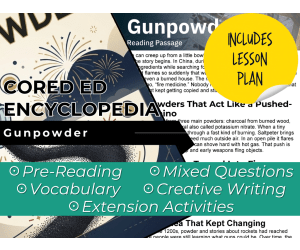
Gunpowder Reading Comprehension Passage - Cored Ed Encyclopedia
ELA, Reading Comprehension, Reading, Science, Technology, Pre-Reading, Language Development, History, Social Studies, Physics, Grade 2, 3, 4, 5, Worksheets & Printables, Worksheets, Teacher Tools, Centers, Activities, Writing Prompts, Assessments, Quizzes and Tests, Quizzes, Lesson Plans
This gunpowder reading comprehension with lesson plan includes: Visualization (on the front cover) Start your lesson by taking a minute to think and share something about the topic. Read the script aloud (slowly), perhaps prepare some music or sound effects. Student close their eyes and let their imaginations wander. Students open their eyes, read the question aloud and give them a few minutes to complete. Ask a few students to share or keep answers until the end to compare with what they learn in the passage. Quick pause—thousands of Cored Education products are included with your TeachSimple membership. Download links and encyclopedia index available here. Pre-Reading Trivia Students will write down one thing they already know about the subject and then read five more facts and discuss. These facts are fun, and the students will enjoy learning about the subject before reading more. Give 1 minute for students to write what they already know (no pressure—best guess is fine). Read the five facts together. After each fact, do ask a student for their opinion, was it surprising? Set a purpose by asking students to highlight/underline one fact they want to learn more about during the reading. Reading Passage The text is a high-interest reading passage with set paragraphs, roughly three to four paragraphs long. It contains a variety of themes about the topic, anywhere from history to technology. The passage is between 250 and 350 words in length. First, ask students to look at the headings and see what they’ll learn about today. What do they know about the topic/heading? First read options: Teacher read-aloud (best for support). Partner reading (paragraph by paragraph). While reading, students underline important details, and vocabulary words they think may come up in the questions section. Mixed Questions The first question page contains four multiple-choice questions, each with a choice of four answers, and three written response questions that require a sentence or two from the student. Students complete the mcqs first independently, then review quickly as a class. For the 3 written responses, try to get students giving the answer with some form of evidence: “I think ___ because the text says ___.” If students get stuck, send them back to check the passage. Vocabulary Questions Practice seven key words from the text in this section across two activities. First section is scrambled words where students will unscramble three words given a clue for each. The second section is a word to meaning matching activity. Before starting, have some students read out words they underlined in the passage. Ask students to say the word and read aloud the sentence(s) around each word. Ask students to do scrambled words and the matching exercise in pairs then go through answers as a class. For the scrambled spelling task, get four pairs to come up to the board and write the words for extra practice with the other student reading out the clue. For the matching task, prompt students to give full sentences: “I matched ___ with ___ because ___.” Creative Writing In this question, the student will be required to write a five to eight sentence paragraph on a question related to the topic. Before starting, ask students write down 3 key ideas they are going to include in their piece. Ask students for ideas to share around the class to help those struggling. Pro writing expectations: 5–8 sentences At least 2 facts or details from the passage At least 2 vocabulary words from the previous page Students read their paragraphs while classmates listen for facts and vocabulary words. Extension Activities This page is optional for fast finishers or to take home. There are several activities, each one requiring a different skill. Do some, do none, do all, completely optional - but you will feel reassured knowing every possibility is planned for. Includes summary writting question and additional facts. Answer Key There are answers for the multiple-choice questions, written response questions have sample answers, vocabulary answers and if there is a summary question then a sample summary will be provided as well. Lesson Plan Included Customized lesson plan for this lesson is included. Lesson Snapshot Title: Gunpowder Genre: Nonfiction (informational text) Subject: Science Primary Topic: How gunpowder was discovered and used over time Estimated Guided Reading Level (A–Z): Q What This Lesson Teaches Best Explains how gunpowder began in China during the Tang dynasty when alchemists mixed ingredients while searching for a life-lasting “elixir.” Identifies the three main powders in gunpowder—charcoal, sulfur, and saltpeter (also called potassium nitrate)—and describes what saltpeter adds to help burning. Describes how gunpowder behaves differently in an open pile versus a tight tube, leading to a strong push of hot gas. Traces how “fire medicine” was used first for celebrations and signals, then developed into fire arrows, bombs, fire lances, and hand cannons by the late 1200s. Shows how ideas travel as gunpowder and stories about rockets reached Europe, and how uses expanded to quarrying rock and digging tunnels, not only fighting. Learning Goals Students will describe how the text says gunpowder was discovered during the Tang dynasty in China. Students will identify the three main powders in gunpowder and explain what saltpeter adds to the burning process. Students will compare what happens when gunpowder burns in an open pile versus in a tight tube. Students will explain how “fire medicine” changed from signals and celebrations to fire arrows and later weapons over time. Students will describe two non-celebration uses of the powder mentioned in the text (quarrying rock and digging tunnels). Students will explain what the author means by “Ideas travel,” using the example of gunpowder reaching Europe. Key Vocabulary From the Text alchemists — people who mixed ingredients while searching for an “elixir.” elixir — a life-lasting drink they searched for. charcoal — powder from burned wood. sulfur — one of the three main powders. saltpeter — a mineral also called potassium nitrate. Discussion Prompts Pre-reading question: What do you think might happen if a powder burns very fast? Comprehension questions: How did the mixture get the name huoyao, or “fire medicine”? Comprehension questions: What role does saltpeter play when a tiny grain is lit? Comprehension questions: How did the uses of “fire medicine” change from celebrations to later tools or weapons? FULL CATALOG OF DOWNLOAD LINKS AND ENCYCLOPEDIA INDEX HERE
Author Cored Education
Rating
Tags Vocabulary, Reading Comprehension, Reading Passages, Lesson Plans, Ela Lesson Plans, Reading Comprehension Lesson Plans, Pre-reading, Science Lesson Plans, Social Studies Lesson Plans, History
I WONDER - Who Discovered X-rays | Animated Video Lesson
Biographies, Social Studies, Grade 4, 5, 6, 7, 8, 9, 10, Lesson Plans, Teacher Tools
Video Introduction An amazing video designed for the students to learn more about famous people in different countries. I WONDER - Who Discovered X-rays | Animated Video Lesson Do you know this person? How much do you know about him/her? Who is your idol? Why did you choose this person? Tell us more about him/her? Who is your favorite athlete? Or what is your favorite team? Have you recently heard a story about a famous person? Who was this person? Can you tell us more about him/her. Who is your favorite president, king, or queen? Why you chose that person? In your country, who are the most famous people? What did they do? Can you tell us more about them. What is your favorite invention? Who invented it? Who is your favorite artist? What is the most famous thing he/she have done? What is the most enjoyable you have read before? Who wrote it? I WONDER - Who Discovered X-rays | Animated Video Lesson The video is perfect for encouraging the researching skills for the students, while learning more about this fantastic place. I WONDER - Who Discovered X-rays | Animated Video Lesson This friendly designed video is suitable for students at school, homeschooling, and as a group activity. Format Available in MP4 format.
Author Educational Voice
Rating
Tags Who Discovered X-rays, Who Discovered X-rays Video, X-rays, Wilhelm Rontgen, Wilhelm Rontgen Video, Wilhelm Rontgen Facts, Wilhelm Rontgen Facts For Kids, Wilhelm Rontgen Video For Kids
I WONDER - What Was The Globe Theatre | Animated Video Lesson
History: Ancient, History, Social Studies, History: British, History: Europe, Grade 4, 5, 6, 7, 8, 9, 10, Lesson Plans, Teacher Tools
Video Introduction An amazing video designed for the students to learn more about history. I WONDER - What Was The Globe Theatre | Animated Video Lesson Do you like history? Which topic do you really enjoy about history? Have you ever read an interesting fact about the Vikings? If yes, can you mention them? What do you like most about the Victorian era? Can you name all the Tudors? Have you ever wondered how people used to live in ancient Japan and ancient China? Do you know any interesting facts about ancient Egyptians and the Pharaohs? Have you ever visited South America? What do you know about Incas and Aztecs? Celtic culture was really one of a kind, can you name any of the places that Celts used to live in? Imagine yourself living during the ancient Roman empire, how your life will look like? Ancient Greece was an amazing place to live in. What do you know about ancient Greek life? I WONDER - What Was The Globe Theatre | Animated Video Lesson The video is perfect for encouraging the researching skills for the students, while learning more about history. I WONDER - What Was The Globe Theatre | Animated Video Lesson This friendly designed video is suitable for students at school, homeschooling, and as a group activity. Format Available in MP4 format.
Author Educational Voice
Tags What Was The Globe Theatre, What Was The Globe Theatre Video, The Globe Theatre, The Globe Theatre History, The Globe Theatre Video, The Globe Theatre Facts, The Globe Theatre Facts For Kids