



Page 53 - Social Studies Lesson Plans
Enrich your social studies curriculum with lesson plans that bring history, geography, and cultures to life. These resources offer projects and discussions that connect past and present. Incorporate them to help students understand societal structures and their roles within them.

 Show filters


World Electoral Processes: Parliamentary System of Government Gr. 5-8
Social Studies, Government, Grade 5, 6, 7, 8, Teacher Tools, Lesson Plans
World Electoral Processes: Parliamentary System of Government Gr. 5-8 A comprehensive teaching resource ideally available for public school teachers and homeschoolers. It is designed to deepen students' understanding of various forms of government in clear, graspable terms. This pivotal component, part of the broader lesson plan 'World Electoral Processes', simplifies complex concepts about differing governmental systems structures and operating procedures. Different Government Systems Explored Democratic Governments: details how these governments operate. Presidential Governments:: focuses on the unique characteristics defining them. Parliamentary Governments:: explicates shared powers with legislatures and law-passing procedures different than presidential systems. Countries under Dictatorial Rule:: revealing facts about military dictator leadership provides a broadened perspective on power dynamics. Intriguing historical snippets provide context as learners delve into antiquity to understand primordial voting systems crucial for subsequent lessons. Pupil Engagement & Interactive Learning Pupils can navigate through distinctive concepts, simulate real-world legislative proceedings by delivering short statements like true parliamentarians and thereby become well-grounded on global electoral processes. The lesson plan also contains interactive elements such as crossword puzzles, comprehension quizzes and writing tasks that reinforce content understanding while fueling expressive abilities in a manner that spurs active participation. Suffrage & Voter Eligibility Prerequisites An insightful section exploring suffrage elucidates voter eligibility prerequisites necessary for comprehending civic responsibilities during elections — an essential aspect shaping our democratic society's future fabric contributes significantly towards responsible citizenship. Comprehensive Answer Key A provision of an answer key facilitates straightforward feedback aiding in efficient understanding checks across varied formats. This resource also aligns with State Standards and Bloom's Taxonomy, suggesting its use within whole-class settings, small breakout groups or even individual assignments - including homework tasks. This flexible approach gradually familiarizes students with world electoral processes through diverse avenues, enhancing learning experiences and solidifying detailed knowledge of government systems.
Author Classroom Complete Press
Tags PDF
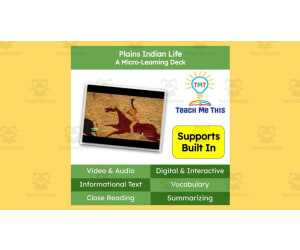
Plains Indian Life | Reading Comprehension Deck | Interactive Lesson
Social Studies, History, History: USA, Grade 6, 7, 8, Teacher Tools, Lesson Plans
This reading comprehension deck is the perfect accessory to your Social Studies instruction! This digital slideshow presents Plains Indian Life. Within this slideshow, you will receive: -Video Lesson -Reading Passage w/ Audio -Close Reading -Quick Write The informational texts included in this resource alongside the informal assessments will keep your students engaged from beginning to end.
Author Teach Me This
Tags Indian Life, Great Plains, Informational Text, Interactive Lesson, Close Reading

Willing's Raid | Reading Comprehension Deck | Interactive Lesson
Social Studies, History, History: World, Grade 8, 9, 10, Teacher Tools, Lesson Plans
This reading comprehension deck is the perfect accessory to your Social Studies instruction! This digital slideshow presents Willing's Raid. Within this slideshow, you will receive: -Video Lesson -Reading Passage w/ Audio -Close Reading -Quick Write The informational texts included in this resource alongside the informal assessments will keep your students engaged from beginning to end.
Author Teach Me This
Tags John Willing, Informational Text, Close Reading, Social Studies Lesson, American Revolution

Advertising Gr. 5-7
Life Studies, Social Studies, Economics, Grade 5, 6, Teacher Tools, Lesson Plans
Advertising Gr. 5-7: Distinctive Teaching Resources Advertising Gr. 5-7 distinguishes itself through its unmatched functionality and streamlined structure. This unique teaching resource explores the fascinating world of advertising, enabling students in grades 5 to 7 to deepen their understanding of promotional techniques and their economic impacts. Fundamentals for Fun Learning Students are introduced to the basics of advertising with comprehensive notes designed for handouts or projection systems. The information is concise yet informative, making it easy to understand at a level perfect for middle school pupils studying Life Studies. The “Just the Facts” section lays a strong foundation with essential details that can become focal points for various assignments—an asset most educators will find invaluable when designing lesson plans. The student task sheets highlight fun alongside effective learning strategies—achieving an equilibrium between enjoyment and knowledge acquisition. Promoting Teamwork via Group Projects To enhance teamwork skills while enriching knowledge on marketing tactics, "Group project" engages students on group tasks related to exciting advertising topics - sure to ignite curiosity amongst young learners. This resource is intentionally designed with teachers in mind; it seamlessly fits into large-group instruction scenarios as well as smaller tutoring situations alike. It can also serve as homework assignments encouraging independent learning outside school hours. Included Social Studies Lesson This award-winning product includes a high-quality Social Studies lesson comprising reading passages, crossword puzzles that evoke critical thinking skills, word searches along with prompt activities specifically created by seasoned educators—a key accompaniment fitted accurately to every exercise providing instructors smooth ease during tuition sessions. The resource is stored conveniently in PDF format—for immediate access anytime post-purchase on any device compatible with such files. In conclusion, Advertising Gr. 5-7 delivers a balanced blend of understanding theory and gaining practical exposure to the economic influence of advertising—a key ally in closing the comprehension gaps many students encounter at this phase. This resource aids teachers in molding knowledgeable minds ready to explore further and ask relevant questions about our dynamic business environment.
Author Classroom Complete Press
Tags PDF

I WONDER - What Does The Sphinx Represent | Animated Video Lesson
History: African, History, Social Studies, History: Ancient, Geography, Grade 4, 5, 6, 7, 8, 9, 10, Lesson Plans, Teacher Tools
Video Introduction An amazing video designed for the students to learn more about history. I WONDER - What Does The Sphinx Represent | Animated Video Lesson Do you like history? Which topic do you really enjoy about history? Have you ever read an interesting fact about the Vikings? If yes, can you mention them? What do you like most about the Victorian era? Can you name all the Tudors? Have you ever wondered how people used to live in ancient Japan and ancient China? Do you know any interesting facts about ancient Egyptians and the Pharaohs? Have you ever visited South America? What do you know about Incas and Aztecs? Celtic culture was really one of a kind, can you name any of the places that Celts used to live in? Imagine yourself living during the ancient Roman empire, how your life will look like? Ancient Greece was an amazing place to live in. What do you know about ancient Greek life? I WONDER - What Does The Sphinx Represent | Animated Video Lesson The video is perfect for encouraging the researching skills for the students, while learning more about history. I WONDER - What Does The Sphinx Represent | Animated Video Lesson This friendly designed video is suitable for students at school, homeschooling, and as a group activity. Format Available in MP4 format.
Author Educational Voice
Rating
Tags What Does The Sphinx Represent, What Does The Sphinx Represent Video, The Sphinx, The Sphinx Facts, The Sphinx Video, The Sphinx Facts For Kids, The Sphinx Video For Kids, Egypt
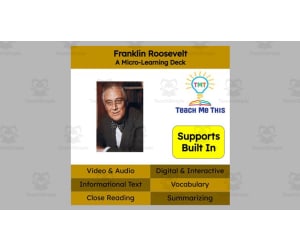
Franklin Roosevelt | Reading Comprehension Deck | Interactive Lesson
Social Studies, Biographies, Grade 6, 7, 8, Teacher Tools, Lesson Plans
Engage students and enhance Social Studies instruction with this informative Franklin Roosevelt reading comprehension lesson. Designed for whole group or individual assignments, this interactive digital slideshow presents an overview of Franklin Roosevelt's life and presidency. Students will watch a focused video lesson detailing key events, read or listen to a leveled passage with close reading questions, analyze a primary source image, and complete a quick write reflection. Meeting grade 6-8 standards, the varied informal assessments and opportunities for analysis boost engagement and learning. Presented in an accessible PowerPoint, this turnkey resource easily integrates into U.S. History units on the Great Depression or World War II. Suitable for whole class instruction or independent work, this reading lesson enhances student literacy and deepens understanding of a complex time in America's story.
Author Teach Me This
Tags American Presidents, Biographies, Interactive Lesson, Franklin Roosevelt, Comprehension

45' Lesson on Memorial Day - Worksheet & Activities | Grade 1
History, Social Studies, Grade 1, Lesson Plans, Teacher Tools, Worksheets & Printables
45' Lesson on Memorial Day - Worksheet & Activities | Grade 1 Make Memorial Day meaningful and age-appropriate with these Grade 1 Memorial Day Activities ! This engaging, no-prep resource helps young learners understand heroes, symbols, and respect through hands-on activities, writing, and discussion. What’s Included ✅ Memorial Day student worksheet packet with engaging, hands-on activities ✅ Activities include: Coloring (American flag) Tracing words (FLAG, HERO) Word search & matching Counting, sorting, and circling Drawing and writing prompts Thank-you card activity ✅ Complete Answer Key : Quick grading format Clear guidance for open-ended responses Matches each activity one-to-one ✅ Detailed 45-minute Lesson Plan : Step-by-step teaching guide Vocabulary, objectives, and materials Discussion questions and sensitivity notes Differentiation strategies for all learners How It Works in the Classroom This Grade 1 Memorial Day activity pack is simple and flexible: Use as a complete 45-minute lesson with built-in structure and pacing Assign worksheets during independent practice, centers, or morning work Spread activities across multiple days for thematic learning Pair with a read-aloud or class discussion about heroes and gratitude Use the included moment of silence activity to build respectful classroom routines Standards & Learning Goals Aligned to Grade 1 Social Studies and ELA skills Students will: Understand the meaning of Memorial Day in simple terms Identify national symbols (flag, stars, soldiers) Build vocabulary: hero, brave, honor, flag Practice early literacy skills (tracing, word recognition, writing) Develop fine motor skills through coloring and drawing Show respect and gratitude through discussion and reflection Why Teachers Love It ⭐ Perfect for introducing Memorial Day in a developmentally appropriate way ⭐ Combines social studies + ELA + hands-on activities ⭐ Includes a done-for-you lesson plan (no prep needed!) ⭐ Easy to use for centers, whole group, or sub plans ⭐ Supports all learners with differentiation and visual activities ⭐ Makes grading simple with a clear, quick-answer key ⭐ Encourages meaningful conversations about heroes, kindness, and gratitude Download these Grade 1 Memorial Day activities today to create a meaningful, engaging, and easy-to-teach lesson your students will remember!
Author Bright Classroom Ideas Marketplace
Rating
Tags Memorial Day, Lesson, Plan, Worksheet
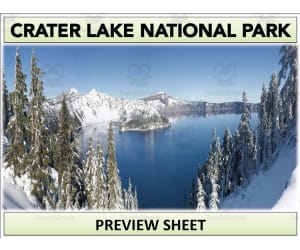
Crater Lake National Park Geography Unit
Social Studies, Geography, Grade 6, 7, 8, 9, Teacher Tools, Lesson Plans
Crater Lake National Park Geography Unit provides middle school students with comprehensive resources to study this iconic landmark from start to finish. The informative PowerPoint presentation guides learners through key details about the park's history, geography, wildlife, and climate. Supplementary materials like reading passages, QR code video links, worksheets, posters, and project instructions allow for flexible implementation in whole group, small group, or independent settings. This content-rich interdisciplinary unit brings Crater Lake to life through interactive maps, images, texts, and activities at an accessible grade 7-8 reading level. Educators seeking an engaging Crater Lake National Park teaching resource will appreciate the thorough lesson materials created by an experienced teacher.
Author Mr Gray History
Tags Geography Unit, Geography Project, Crater Lake, National Park, Landmarks, Reading Materials, Wildlife, Climate, Park History, Are There Sharks In Crater Lake

Jugglers Reading Comprehension Passage - Cored Ed Encyclopedia
ELA, Reading Comprehension, Reading, Language Development, History, Social Studies, Geography, Pre-Reading, Vocabulary, Spelling, Grade 2, 3, 4, 5, Worksheets & Printables, Worksheets, Teacher Tools, Centers, Activities, Writing Prompts, Assessments, Quizzes and Tests, Quizzes, Lesson Plans
This Jugglers reading comprehension with lesson plan includes: Visualization (on the front cover) Start your lesson by taking a minute to think and share something about the topic. Read the script aloud (slowly), perhaps prepare some music or sound effects. Student close their eyes and let their imaginations wander. Students open their eyes, read the question aloud and give them a few minutes to complete. Ask a few students to share or keep answers until the end to compare with what they learn in the passage. Quick pause—thousands of Cored Education products are included with your TeachSimple membership. Download links and encyclopedia index available here. Pre-Reading Trivia Students will write down one thing they already know about the subject and then read five more facts and discuss. These facts are fun, and the students will enjoy learning about the subject before reading more. Give 1 minute for students to write what they already know (no pressure—best guess is fine). Read the five facts together. After each fact, do ask a student for their opinion, was it surprising? Set a purpose by asking students to highlight/underline one fact they want to learn more about during the reading. Reading Passage The text is a high-interest reading passage with set paragraphs, roughly three to four paragraphs long. It contains a variety of themes about the topic, anywhere from history to technology. The passage is between 250 and 350 words in length. First, ask students to look at the headings and see what they’ll learn about today. What do they know about the topic/heading? First read options: Teacher read-aloud (best for support). Partner reading (paragraph by paragraph). While reading, students underline important details, and vocabulary words they think may come up in the questions section. Mixed Questions The first question page contains four multiple-choice questions, each with a choice of four answers, and three written response questions that require a sentence or two from the student. Students complete the mcqs first independently, then review quickly as a class. For the 3 written responses, try to get students giving the answer with some form of evidence: “I think ___ because the text says ___.” If students get stuck, send them back to check the passage. Vocabulary Questions Practice seven key words from the text in this section across two activities. First section is scrambled words where students will unscramble three words given a clue for each. The second section is a word to meaning matching activity. Before starting, have some students read out words they underlined in the passage. Ask students to say the word and read aloud the sentence(s) around each word. Ask students to do scrambled words and the matching exercise in pairs then go through answers as a class. For the scrambled spelling task, get four pairs to come up to the board and write the words for extra practice with the other student reading out the clue. For the matching task, prompt students to give full sentences: “I matched ___ with ___ because ___.” Creative Writing In this question, the student will be required to write a five to eight sentence paragraph on a question related to the topic. Before starting, ask students write down 3 key ideas they are going to include in their piece. Ask students for ideas to share around the class to help those struggling. Pro writing expectations: 5–8 sentences At least 2 facts or details from the passage At least 2 vocabulary words from the previous page Students read their paragraphs while classmates listen for facts and vocabulary words. Extension Activities This page is optional for fast finishers or to take home. There are several activities, each one requiring a different skill. Do some, do none, do all, completely optional - but you will feel reassured knowing every possibility is planned for. Includes summary writting question and additional facts. Answer Key There are answers for the multiple-choice questions, written response questions have sample answers, vocabulary answers and if there is a summary question then a sample summary will be provided as well. Lesson Plan Included Customized lesson plan for this lesson is included. Lesson Snapshot Title: Jugglers Genre: Nonfiction (informational text) Subject: Reading (Informational Text) / Social Studies / Arts Primary Topic: Juggling across history and repeating patterns Estimated Guided Reading Level (A–Z): S What This Lesson Teaches Best Traces juggling through time and places (ancient Egypt, China, Greece/Rome, Europe, and today). Uses a historical example (an Egyptian tomb painting) to explain evidence of early juggling and what it suggests about audiences. Highlights performance skills jugglers show—control, timing, courage—and how crowds can understand the act “without any words.” Explains change over time: juggling’s reputation in Europe after the Roman Empire weakened, and how modern circuses brought it into the spotlight. Emphasizes the repeating pattern at the heart of juggling (throw, wait, catch, repeat) and connects it to learning rhythm with patience. Learning Goals Describe what the Egyptian tomb painting shows and why the passage calls it an early picture of toss juggling. Explain how juggling was used to impress or amaze people in different cultures mentioned in the text. Describe how some people in Europe viewed jugglers later and explain what the skill did instead of disappearing. Identify the basic juggling pattern named in the passage and explain why it matters. Compare where a juggler might perform today (stage, circus ring, sidewalk) and explain what stays the same. Key Vocabulary From the Text tomb — a place where someone is buried. audiences — groups of people watching a performance. festivals — celebrations with events and crowds. rhythm — a steady beat or timing pattern. wrongdoing — doing something people believe is wrong. FULL CATALOG OF DOWNLOAD LINKS AND ENCYCLOPEDIA INDEX HERE
Author Cored Education
Rating
Tags Vocabulary, Reading Comprehension, Reading Passages, Lesson Plans, Ela Lesson Plans, Reading Comprehension Lesson Plans, Pre-reading, Social Studies Lesson Plans, History, Geography

I WONDER - What Is An Iceberg | Animated Video Lesson
Geography, Social Studies, Grade 1, 2, 3, 4, 5, 6, 7, 8, Lesson Plans, Teacher Tools
Video Introduction An amazing video designed for the students to learn more about famous places in different countries. I WONDER - What Is An Iceberg | Animated Video Lesson What do you know about this place? Do you know in which part of the world it is? Have you ever visited this place? If yes, can you tell us more about your adventure, and what do you like the most about this place? Do you like reading about Geography? What is your favorite country in the whole world? If you are going on a trip where it will be? Which country? What you are going to see there? Does this country has a famous place to visit? I WONDER - What Is An Iceberg | Animated Video Lesson The activity is perfect for encouraging the researching skills for the students, while learning more about this fantastic place. I WONDER - What Is An Iceberg | Animated Video Lesson This friendly designed video is suitable for students at school, homeschooling, and as a group activity. Format Available in MP4 format.
Author Educational Voice
Tags What Is An Iceberg, What Is An Iceberg Video, Iceberg, Iceberg Video, Iceberg Facts, Iceberg Facts For Kids, Iceberg Video For Kids, Polar Regions, Polar Regions Facts, Polar Regions Video
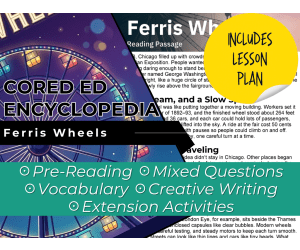
Ferris Wheels Reading Comprehension Passage - Cored Ed Encyclopedia
ELA, Reading Comprehension, Reading, Science, Technology, Language Development, Social Studies, History, Pre-Reading, Writing, Grade 2, 3, 4, 5, Worksheets & Printables, Worksheets, Teacher Tools, Centers, Activities, Writing Prompts, Assessments, Quizzes and Tests, Quizzes, Lesson Plans
This Ferris wheels reading comprehension with lesson plan includes: Visualization (on the front cover) Start your lesson by taking a minute to think and share something about the topic. Read the script aloud (slowly), perhaps prepare some music or sound effects. Student close their eyes and let their imaginations wander. Students open their eyes, read the question aloud and give them a few minutes to complete. Ask a few students to share or keep answers until the end to compare with what they learn in the passage. Quick pause—thousands of Cored Education products are included with your TeachSimple membership. Download links and encyclopedia index available here. Pre-Reading Trivia Students will write down one thing they already know about the subject and then read five more facts and discuss. These facts are fun, and the students will enjoy learning about the subject before reading more. Give 1 minute for students to write what they already know (no pressure—best guess is fine). Read the five facts together. After each fact, do ask a student for their opinion, was it surprising? Set a purpose by asking students to highlight/underline one fact they want to learn more about during the reading. Reading Passage The text is a high-interest reading passage with set paragraphs, roughly three to four paragraphs long. It contains a variety of themes about the topic, anywhere from history to technology. The passage is between 250 and 350 words in length. First, ask students to look at the headings and see what they’ll learn about today. What do they know about the topic/heading? First read options: Teacher read-aloud (best for support). Partner reading (paragraph by paragraph). While reading, students underline important details, and vocabulary words they think may come up in the questions section. Mixed Questions The first question page contains four multiple-choice questions, each with a choice of four answers, and three written response questions that require a sentence or two from the student. Students complete the mcqs first independently, then review quickly as a class. For the 3 written responses, try to get students giving the answer with some form of evidence: “I think ___ because the text says ___.” If students get stuck, send them back to check the passage. Vocabulary Questions Practice seven key words from the text in this section across two activities. First section is scrambled words where students will unscramble three words given a clue for each. The second section is a word to meaning matching activity. Before starting, have some students read out words they underlined in the passage. Ask students to say the word and read aloud the sentence(s) around each word. Ask students to do scrambled words and the matching exercise in pairs then go through answers as a class. For the scrambled spelling task, get four pairs to come up to the board and write the words for extra practice with the other student reading out the clue. For the matching task, prompt students to give full sentences: “I matched ___ with ___ because ___.” Creative Writing In this question, the student will be required to write a five to eight sentence paragraph on a question related to the topic. Before starting, ask students write down 3 key ideas they are going to include in their piece. Ask students for ideas to share around the class to help those struggling. Pro writing expectations: 5–8 sentences At least 2 facts or details from the passage At least 2 vocabulary words from the previous page Students read their paragraphs while classmates listen for facts and vocabulary words. Extension Activities This page is optional for fast finishers or to take home. There are several activities, each one requiring a different skill. Do some, do none, do all, completely optional - but you will feel reassured knowing every possibility is planned for. Includes summary writting question and additional facts. Answer Key There are answers for the multiple-choice questions, written response questions have sample answers, vocabulary answers and if there is a summary question then a sample summary will be provided as well. Lesson Plan Included Customized lesson plan for this lesson is included. Lesson Snapshot Title: Ferris Wheels Genre: Nonfiction (Informational Text) Subject: Social Studies (History) / Science & Technology / Reading (Informational Text) Primary Topic: Origins, design, and purpose of Ferris wheels Estimated Guided Reading Level (A–Z): P What This Lesson Teaches Best Explains the origin story of the first Ferris wheel at the 1893 Chicago world’s fair and why people wanted a daring new attraction. Uses clear facts and measurements (about 264 feet/80 meters , 36 cars , ride cost and time) to build informational reading skills. Shows how Ferris wheels spread to new places and why they’re also called “observation wheels” (because looking is part of the fun). Compares past and present Ferris wheels, including modern wheels built for slow sightseeing like the London Eye with enclosed capsules. Highlights how modern wheels rely on strong steel, careful testing, and steady motors for smooth turns. Learning Goals Students will describe why the 1893 world’s fair crowd wanted something “brand-new” to see. Students will identify key details about the first Ferris wheel (height, number of cars, ride time, and cost). Students will explain why Ferris wheels are also called “observation wheels” using evidence from the text. Students will describe how Ferris wheels spread to other places after Chicago, including the example in Vienna. Students will compare how some Ferris wheels are designed for thrills versus slow sightseeing today. Key Vocabulary From the Text Exposition — a huge fair where inventions and exhibits are shown. engineer — a person who designs and builds things. fairgrounds — the area where a fair is held. capsules — closed pods that carry riders on a wheel. skyline — the outline of a city’s buildings against the sky. FULL CATALOG OF DOWNLOAD LINKS AND ENCYCLOPEDIA INDEX HERE
Author Cored Education
Rating
Tags Vocabulary, Reading Comprehension, Reading Passages, Lesson Plans, Ela Lesson Plans, Reading Comprehension Lesson Plans, Pre-reading, Science Lesson Plans, Social Studies Lesson Plans, History

Africa: Regions Gr. 5-8
Social Studies, Geography, Grade 5, 6, 7, 8, Teacher Tools, Lesson Plans
Africa: Regions Gr. 5-8 A comprehensive teaching resource tailored for students in grades 5-8, focusing on the detailed study of various geographies and cultures throughout Africa. Included are special features of Africa such as the Sahara Desert, well known for its stunning landscapes, ancient history and contemporary cities bustling with vibrant societies. Pivotal Features: Places emphasis on engaging students in active learning about Africa's nation-states and their capitals. Encourages critical thinking while enhancing geographical literacy through categorization tasks within a structured graphic organizer. Goes beyond geographical knowledge by introducing significant elements of African cultural diversity, with special attention to tribes like Masai located in Eastern Africa. Adds an environmental education dimension by encouraging students to explore endangered African wildlife ecosystems through independent research assignments about threatened species across the continent, advocating for biodiversity conservation awareness. Additional Resources: An array of maps centered around water bodies across Africa designed specifically to stimulate map reading skills whilst imparting understanding about collective resources dependencies over regions. Creative tasks such as designing pamphlets about why camels are native to deserts that break down complex geographical themes into engaging sections.. Riveting descriptions that bring alive renowned natural wonders like Nile Valley and Serengeti Plains are also included. This educational compendium can be easily adapted and fits seamlessly within your instruction strategy meeting varied needs whether implemented during whole-group instructions or assigned during smaller breakout sessions or as homework activities. The document is aligned with State Standards and the Five Themes Of Geography. Also provided are crosswords ,word search puzzle,a comprehension quiz followed by an answer key providing assessments pathways ensuring fruitful student engagement. In a nutshell, Africa: Regions Gr. 5-8 stands firm in its commitment to versatile, fact-based, and intriguing learning experiences that ignite the geographical curiosities of young minds while fostering a deep understanding and appreciation of African diversity.
Author Classroom Complete Press
Tags PDF

Economy & Globalization: International Commercial Law Gr. 5-8
Social Studies, Economics, Grade 5, 6, 7, 8, Teacher Tools, Lesson Plans
Economy & Globalization: International Commercial Law Gr. 5-8 The teaching resource Economy & Globalization: International Commercial Law Gr. 5-8 is a cutting-edge educational tool designed specifically for grade 5-8 students, and serves as an indispensable learning aid for educators in public schools as well as homeschooled children. This resource provides an insightful understanding of the global economy and demonstrates the interdependence of disparate nations to coexist. It dives deep into lively discussions about nationalization versus privatization in correlation with today's global economic landscape. Evolution of Currency: The teaching resource fleshes out the evolution of currency, permitting students to explore historical events like bartering systems and metal money to today's modern trade currencies. Action Based Learning: Incorporates practical exercises such as reenactments depicting people's economic hardships during significant historical periods like the Great Depression. Promotes interactive panel discussions on subjects like international immigration policy contributing substantially towards open-ended debates helping students garner a nuanced perspective on world events. Creative Thinking Stimulation: The product encourages budding entrepreneurs by tasking them with designing their own multinational company including writing a compelling business plan. Takes learners further by engaging them in case study assignments concerning controversial topics such as outsourcing, equipping them with skills required for teaming up in research projects or conducting individual data analysis at more advanced levels Educators can fuel classroom debates using this comprehensive guide that discusses whether globalization trends have been beneficial or detrimental worldwide. This dynamic instruction tool revolves around hands-on activities both within group settings or independently at home. Key Features: This teaching resource adheres to state standards and is in line with Bloom’s Taxonomy guidelines. Provides hands-on activities, quizzes, crossword puzzles, word searches along with a reliable answer key. The learning material offered in a universal PDF format is perfect for social studies with a precise focus on economics. It strikes an essential balance between theoretical knowledge and real-world application.
Author Classroom Complete Press
Tags PDF
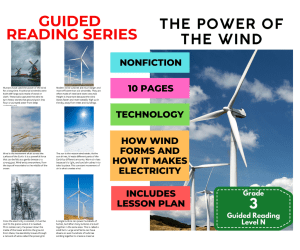
Guided Reading Level N - The Power of the Wind (with Lesson Plan)
ELA, Resources for Teachers, Reading Comprehension, Reading, Social Studies, Geography, Earth and Environmental Sciences, Science, Physics, Technology, Grade 2, 3, 4, Worksheets & Printables, Worksheets, Teacher Tools, Centers, Activities, Literacy Readers, Quizzes, Quizzes and Tests, Assessments, Lesson Plans
This Guided Reading Book - The Power of the Wind (Level N) with lesson plan includes: Guided Reading Color Label (front cover x1) This is a quick way to match the book’s demands to what students can generally handle.. The overall goal is to use the level/color to pick books for several smaller groups. To qualify for a certain level, a student is expected to read a book from that level with about 90–94% accuracy. If a student is consistently accurate and understands, move up a level. If the student is struggling at that level, drop down and add more support. Each student will improve at completely different rates, but it is generally one of the best ways to check progress across the class. DOWNLOAD THE CATALOG TO VIEW ALL GUIDED READING BOOKS AVAILABLE (SORTED LEVELS A-Z) Pre-Reading Question (x1) Teacher asks the prompt aloud, can be while showing the cover or first page. Students share what they already know, or make educated guesses from the cover. Prompt them to use the target vocabulary. Write some of their responses on the board to look back at during the reading. Vocabulary Words (x5) Introduce the five words, best doing it one at a time. Start by saying it, while students repeat and then see if anyone knows what it means before reading further. Read through the meaning and try to briefly connect each word to a picture or gesture so it’s meaningful. Ask students to flip through the book pages and point to where they see each of the vocabulary words. While reading the book pause upon coming across one of the vocab words or read the sentence twice to make sure students understand the word has appeared. Optional: Ask students to raise hands whenever they see/hear one of the new words. Guided Reading Pages (x10) Check the book snapshot (below) for: primary topic - do you need to prep extra reading or intro materials on this? what is taught best - decide on 1-2 bullets to focus on, use the prompt or words provided here for best results. learning goals - what you are checking for students to be able to do after the session, elicit answers using prompts or words provided. key vocabulary (see section above). questions overview - so you know what is coming up and if you need to prep extra materials to assist understanding. Run the lesson You may have already looked at a few of the pages together, but you can show them some of the pictures again first to set meaning. Depending on how much time you have and how familiar your students are with guided reading class, you may want to read the book aloud first with the group first. Students whisper or partner read, while you listen in. If time, do it as a group, one student reading a page each. Use the guided page’s prompts to coach: “Check the picture / does it make sense?” “Point under the words / try the first sound” “Reread the sentence smoothly”. Try to focus more on one student per session (rotating every time), so you can work out if they are ready to move up or need to move down a level. Comprehension Questions (back cover x3) This is your way to check that students didn’t just say the words, but actually understood the text. First, let students answer by pointing to the page/picture and saying a short sentence. After any answer, follow with: “Show me where you found that in the text.” In bigger groups, have partners answer first (10–20 seconds), then call on 2–3 students to share. Differentiation tips: Emerging speakers/struggling readers: oral + pointing On-level: oral in a full sentence Higher: one written sentence or draw + label Book Snapshot Title: The Power of the Wind Genre: Nonfiction (informational science text) Subject: Science (Energy/Earth Science) Primary Topic: How wind forms and how it makes electricity Estimated Guided Reading Level (A–Z): N What This Book Teaches Best Defines wind as the movement of air across Earth’s surface and describes wind as a breeze or a strong gust. Explains the cause of wind : the sun heats Earth unevenly, warm air rises, and cool air moves in to replace it. Shows how people have used wind over time, comparing traditional windmills (grinding grain, pumping water) to modern wind turbines. Describes how a wind turbine works, including blades spinning a shaft connected to a generator that makes electricity. Connects wind energy to sustainability by explaining wind farms , offshore wind farms , and wind energy as a clean, renewable resource. Learning Goals Students will explain what wind is using details from the text. Students will describe how the sun’s heating of Earth helps create wind. Students will describe how traditional windmills used wind to help people. Students will explain how wind turbines change wind’s motion into electricity. Students will describe what a wind farm is and why offshore wind farms can capture strong winds. Students will explain why wind energy is described as renewable and clean in the text. Key Vocabulary From the Text movement — going from one place to another. gust — a short, strong burst of wind. turbines — big machines with blades that spin in wind. generator — a machine that makes electricity. renewable — can be used again and won’t run out. Discussion Prompts Pre-reading question: Where have you seen wind do work, like moving something or making power? Comprehension questions: What does the text say creates wind? Comprehension questions: How did traditional windmills use wind to help people? Comprehension questions: How does a wind turbine turn wind into electricity, according to the text? Printing Tips 1. Best Printing Method (Recommended) “Booklet” Printing (Best if Available) If your printer or PDF viewer supports Booklet Printing , use this. Settings to use: Print mode: Booklet Paper size: Letter or A4 (either works) Orientation: Landscape Print on both sides: Yes Flip on: Short edge Scaling: Fit to printable area Booklet subset: First test: Front sides only Then: Back sides only This will automatically: Pair pages correctly Put the cover on the outside Align everything for folding After printing, fold in half and staple along the spine . 2. If “Booklet” Printing Is NOT Available You can still print this correctly with manual duplex printing . Step-by-step: Open the PDF. Choose Print . Set: Orientation: Landscape Pages per sheet: 1 Print on both sides: Yes Flip on: Short edge Print all pages . Because each PDF page already contains two facing book pages, the result will still fold cleanly into a book. Thousands of Cored Education products are included with your TeachSimple membership. Download links and encyclopedia index available here.
Author Cored Education
Rating
Tags Reading Comprehension, Reading Passages, Reading, Guided Reading, Guided Reading Lesson Plan, Guided Reading Activity, Pre-reading, Geography, Science Lesson Plans, Technology

World of 100 Lesson Plan
Social Studies, Geography, Not Grade Specific, Teacher Tools, Lesson Plans
This resource is a World of 100 Lesson Plan. It comes with detailed instructions for how to successfully implement this lesson. Students will watch an engaging video about Earth's population and complete the worksheet based on the video.
Author The Social Studies Doctor
Tags Geography Lesson Plan, Social Studies, Planet, Earth, Population

Biscayne Bay National Park Geography Unit
Social Studies, Geography, Grade 6, 7, 8, 9, Teacher Tools, Lesson Plans
Biscayne Bay National Park Geography Unit The Biscayne Bay National Park Geography Unit serves as a prime educational resource crafted specifically for students at the middle school level. This unit is designed to greatly enrich students' understanding about this iconic landmark with activities that will span the full arc of a unit study. Content Overview In terms of content, the selection inside this comprehensive geography package is both diverse and in-depth. Within the downloadable zip file are: Seven PDFs Six JPEG files One PowerPoint presentation All aimed at facilitating thorough study of Biscayne Bay National Park. A Dynamic Approach to Learning What makes learning truly dynamic with this unit are materials such as presentations and preview sheets that come in both PDF and JPEG formats. To fortify independent student research, there are QR codes on each sheet linking students to videos about the park. Several worksheets facilitate structured class assignment or homework tasking while stimulating engagement through varied formats like crossword puzzles (containing an answer key). An Interactive Approach If you opt for an interactive approach -- whether it's whole group discussions, small group projects or one-on-one teacher-student instruction -- large and small image sets accompany park reading materials to add visual interest when completing projects. To provide clear guidance on navigating through these rich resources effectively, a full PowerPoint presentation is included. Further appeal lies within its flexibility in usage; educators can seamlessly weave these resources into their curriculum planning whether it's for classroom teaching arrangements or remote education set-ups prevalent among homeschoolers today. The unit also extends beyond purely academic scope by encouraging creative expression among students through tools such as poster and booklet instructions that inspire personal initiatives on crafting tangible outputs from their gathered knowledge. In Conclusion In summary, Biscayne Bay National Park Geography Unit provides not only essential geographic knowledge but also lends itself well into various implementation scenarios - whole class instruction, small groups collaborations or individual assignments – thereby proving a versatile asset perfect for enhancing lessons in Social Studies particularly geared towards geography topics.
Author Mr Gray History
Tags Biscayne Bay, National Park, Geography, Middle School, Unit

I WONDER - When Was Bronze Discovered | Animated Video Lesson
History: Ancient, History, Social Studies, History: African, History: Asian, History: Europe, History: World, Chemistry, Science, Grade 4, 5, 6, 7, 8, 9, 10, Lesson Plans, Teacher Tools
Video Introduction An amazing video designed for the students to learn more about history. I WONDER - When Was Bronze Discovered | Animated Video Lesson Do you like history? Which topic do you really enjoy about history? Have you ever read an interesting fact about the Vikings? If yes, can you mention them? What do you like most about the Victorian era? Can you name all the Tudors? Have you ever wondered how people used to live in ancient Japan and ancient China? Do you know any interesting facts about ancient Egyptians and the Pharaohs? Have you ever visited South America? What do you know about Incas and Aztecs? Celtic culture was really one of a kind, can you name any of the places that Celts used to live in? Imagine yourself living during the ancient Roman empire, how your life will look like? Ancient Greece was an amazing place to live in. What do you know about ancient Greek life? I WONDER - When Was Bronze Discovered | Animated Video Lesson The video is perfect for encouraging the researching skills for the students, while learning more about history. I WONDER - When Was Bronze Discovered | Animated Video Lesson This friendly designed video is suitable for students at school, homeschooling, and as a group activity. Format Available in MP4 format.
Author Educational Voice
Tags When Was Bronze Discovered, When Was Bronze Discovered Video, Bronze, Bronze Facts, Bronze Facts For Kids, Bronze Video, Bronze Video For Kids, The Discovery Of Bronze, The Discovery Of Bronze Video
Korean War: Major Battles Gr. 5-8
Social Studies, History, History: USA, Grade 5, 6, 7, 8, Teacher Tools, Lesson Plans
The Korean War: Major Battles Gr. 5-8: A valuable teaching resource that focuses on a crucial period of modern history, providing academic assets designed effectively to stimulate learning and critical thinking in students from grade 5 to grade 8. This instructional tool offers an in-depth understanding of the first major conflict of the Cold War era — The Korean War, notably referred to as 'the Forgotten War.' It presents an opportunity for learners explore the geographic characteristics and realities of North and South Korea, facilitating them an understanding not merely about the locations but also about their influence by this war. In addition, students are provided with insights into post-World War II frictions between superpowers such as the United States and Russia. They will uncover how significant personalities like President Harry S. Truman, Joseph Stalin, and Kim Il-Sung were majorly involved in steering this historic contest. New Explore Feature: With this pioneering feature at your fingertips you can lead your pupils on a historical journey through South Korea during primary battles against brave North Korean forces giving them first-hand comprehension for what U.S troops endured during some of history's most intense engagements. Learners have an option to explore diverse weaponry utilized throughout this global affair while understanding why UN forces triumphed over their North Korean counterpart particularly with reference air superiority. Educators can now make use interactive quizzes crossword puzzles and word searches included within each sliced chapter extracted from the more extensive lesson plan "Korean War"; all tailor-made according to Bloom's Taxonomy. Your exclusive package includes one ready-to-print PDF comprising full-bodied 29 pages packed with worthwhile information aimed at enrichening learners' knowledge base around pivotal era in world history. Total Compliance: Perfectly aligned with State Standards focused around History: USA under Social Studies subjects category , it’s easy-to-incorporate into home or classroom teaching irrespective of lesson size - making Korean War: Major Battles Gr. 5-8 an essential tool in educators toolkit who aim to instill their students with a clear understanding of world history and its long-lasting effects.
Author Classroom Complete Press
Tags Korean War, United Nations, Geography Assessment, Social Studies, Dictionary, Famous Battles Of The Korean War, Important Battles Of The Korean War

I WONDER - When Was king Tutankhamun's Tomb Discovered
History: Ancient, History, Social Studies, History: African, Grade 6, 7, 8, 9, 10, 11, 12, Lesson Plans, Teacher Tools
Video Introduction An amazing video designed for the students to learn more about history. I WONDER - When Was king Tutankhamun's Tomb Discovered | Animated Video Lesson Do you like history? Which topic do you really enjoy about history? Have you ever read an interesting fact about the Vikings? If yes, can you mention them? What do you like most about the Victorian era? Can you name all the Tudors? Have you ever wondered how people used to live in ancient Japan and ancient China? Do you know any interesting facts about ancient Egyptians and the Pharaohs? Have you ever visited South America? What do you know about Incas and Aztecs? Celtic culture was really one of a kind, can you name any of the places that Celts used to live in? Imagine yourself living during the ancient Roman empire, how your life will look like? Ancient Greece was an amazing place to live in. What do you know about ancient Greek life? I WONDER - When Was king Tutankhamun's Tomb Discovered | Animated Video Lesson The video is perfect for encouraging the researching skills for the students, while learning more about history. I WONDER - When Was king Tutankhamun's Tomb Discovered | Animated Video Lesson This friendly designed video is suitable for students at school, homeschooling, and as a group activity. Format Available in MP4 format.
Author Educational Voice
Tags When Was King Tutankhamun's Tomb Discovered, When Was King Tutankhamun's Tomb Discovered Video, Tutankhamun's Tomb, Tutankhamun's Tomb Facts, Tutankhamun's Tomb Facts For Kids, Tutankhamun's Tomb Video
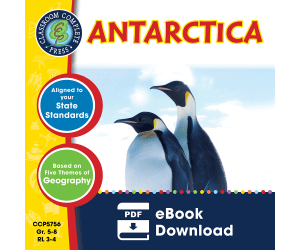
Antarctica Gr. 5-8
Social Studies, History, History: World, Grade 5, 6, 7, 8, Teacher Tools, Lesson Plans
Antarctica Gr. 5-8 Antarctica Gr. 5-8, is an exciting educational resource designed to deepen students' understanding of the South Pole's captivating ecology and geography. By immersing pupils into the world of Antarctic scientists, they explore the harsh climate, unending ice fields and dynamic magnetic field. Diverse Learning Activities Vivid facts blended with engaging activities allows students to map out research stations across Antarctica. The curriculum fosters a scientific mindset with temperature studies revealing two miles thick ice surfaces owing to extreme coldness. A unique atmospheric study from an Antarctic viewpoint offers students a fresh perspective on earth science. Mobility in Focus Inspire your learners to think beyond traditional transportation means by exploring how scientists navigate through these icy landscapes. Furthermore, comparing Antarcticas active volcano – Mt Eribus – with other globally recognized ones like St Helens and Vesuvius adds more depth into the study. Aligned With Academic Standards Besides regular geographical elements, Antarctica Gr.5-8 proudly aligns itself with State Standards along with Five Themes Of Geography, supplementing learning process by adding crossword puzzles and word searches for reinforcing knowledge while enhancing cognitive skills. Versatile Application & Enhanced Engagement This teaching aid offers teachers valuable flexibility in its application as it can be used for both whole group instruction or small group work or even as insightful homework assignments ensuring progress across different learning environments. Captivating Look Into World History And Geographical Studies Specially crafted for grade five through eight learners, it closely aligns itself to state standards and core learning objectives such as World History under Social Studies substructures. It includes maps that help foster spatial thinking skills, comprehensive quizzes for information retention and a dedicated answer key for accurate evaluation. Format & Accessibility Antarctica Gr 5-8, packaged as a user-friendly PDF, emerges as a comprehensive lesson plan to stimulate and challenge young minds in the realm of social studies while keeping learning fun and accessible at all times.
Author Classroom Complete Press
Tags PDF

Foreign Policy Unit & Simulation (Slides, simulation sheets, worksheets+)
Social Studies, History, History: USA, Government, Grade 7, 8, 9, 10, 11, 12, Lesson Plans, Teacher Tools
Engaging Foreign Policy Unit and Simulation for Secondary Students\nThis foreign policy unit equips secondary teachers with an engaging resource to help students understand the interconnectedness of the world. It examines the various tools countries use to influence global events, from diplomacy to military intervention. The unit includes an informative slide deck explaining key foreign policy concepts, embedded videos, and a simulation activity inspired by real-world events. Students take on roles of world leaders and use negotiation, threats, or force to achieve their goals. Supporting materials provide implementation guidance and worksheets like a Crash Course viewing guide. With over 40 pages of compelling content, this unit offers an outstanding value. It has everything needed to teach an illuminating unit on foreign policy and how nations interact on the global stage.
Author Ed Dynamic
Tags Foreign Policy, Simulation, Global Issues, World Leaders, Negotiation

I WONDER - What Is Petra | Animated Video Lesson
Geography, Social Studies, History, History: Asian, History: Ancient, Grade 4, 5, 6, 7, 8, 9, 10, Lesson Plans, Teacher Tools
Video Introduction An amazing video designed for the students to learn more about famous places in different countries. I WONDER - What Is Petra | Animated Video Lesson What do you know about this place? Do you know in which part of the world it is? Have you ever visited this place? If yes, can you tell us more about your adventure, and what do you like the most about this place? Do you like reading about Geography? What is your favorite country in the whole world? If you are going on a trip where it will be? Which country? What you are going to see there? Does this country has a famous place to visit? I WONDER - What Is Petra | Animated Video Lesson The activity is perfect for encouraging the researching skills for the students, while learning more about this fantastic place. I WONDER - What Is Petra | Animated Video Lesson This friendly designed video is suitable for students at school, homeschooling, and as a group activity. Format Available in MP4 format.
Author Educational Voice
Rating
Tags What Is Petra, What Is Petra Video, Petra, Petra Facts, Petra Video, Petra Facts For Kids, Petra Video For Kids, Jordan, Jordan Video, Jordan Facts
I WONDER - What Is The Taj Mahal Made Of | Animated Video Lesson
Geography, Social Studies, History: Asian, History, Grade 4, 5, 6, 7, 8, 9, 10, Lesson Plans, Teacher Tools
Video Introduction An amazing video designed for the students to learn more about famous places in different countries. I WONDER - What Is The Taj Mahal Made Of | Animated Video Lesson What do you know about this place? Do you know in which part of the world it is? Have you ever visited this place? If yes, can you tell us more about your adventure, and what do you like the most about this place? Do you like reading about Geography? What is your favorite country in the whole world? If you are going on a trip where it will be? Which country? What you are going to see there? Does this country has a famous place to visit? I WONDER - What Is The Taj Mahal Made Of | Animated Video Lesson The activity is perfect for encouraging the researching skills for the students, while learning more about this fantastic place. I WONDER - What Is The Taj Mahal Made Of | Animated Video Lesson This friendly designed video is suitable for students at school, homeschooling, and as a group activity. Format Available in MP4 format.
Author Educational Voice
Rating
Tags What Is The Taj Mahal Made Of, What Is The Taj Mahal Made Of Video, Taj Mahal, Taj Mahal Facts, Taj Mahal Video, Taj Mahal Video For Kids, Taj Mahal Facts For Kids, Geography, India

World War II: The End of War
Social Studies, History, History: World, Common Core, Grade 5, 6, 7, 8, Teacher Tools, Lesson Plans
World War II: The End of War An accessible and detailed teaching resource for students in grades five to eight. This product focuses on the final stages of World War II, providing a fragment from our extensive lesson plan on this global conflict. Content Overview This teaching resource features comprehensive information about Germany's role in the end phase of WWII along with pertinent battles such as D-Day in Normandy. It provides insights into the conflict's six-year timeline and its involvement of over 200 nations around the world. Educational Flexibility Ideal for educators looking for versatile materials, World War II: The End of War is designed to cater to various instructional styles. Included are: Reading passages Student activities Color mini posters This resource promotes whole-class discussions or activities, small group projects or individual assignments within classroom settings or at home. Educational Standards Alignment The material rigidly adheres to Common Core State Standards and aligns with Bloom's taxonomy when presenting social studies concepts to students. Such alignment guarantees an enriching knowledge base while simplifying language and vocabulary for better student comprehension across academic grades. Included Materials The purchase includes a single PDF file containing all necessary resources required by educators to deliver lessons regarding the concluding period of World War II. Bullet points: - Comprehensive coverage via different teaching methods - In-depth exploration of major players like Germany - Detailed analysis of significant battles like Normandy Utilizing these varied approaches ensures victory on an academic front similar how it was achieved historically at the end of WWII. Applicability Across Diverse Curricula This resource is a valuable tool for public school teachers and homeschoolers alike, distilling complex historical facts into digestible nuggets of knowledge. This resource reinforces meaningful learning experiences in the context of Grade 5-8 level Social Studies-World History syllabi. A Standalone Product Although part of our complete World War II education range, this product makes a strong individual offering – providing students with a thorough understanding of the conflict's final stages. It places these events in context to help students appreciate their impact on modern world history.
Author Classroom Complete Press
Tags PDF