



3,890 products added recently
Page 23 - Popular Quizzes
Our Popular Quizzes collection features the most widely used and highly rated assessments among teachers. These quizzes have been praised for their quality, alignment with educational standards, and ability to accurately gauge student comprehension. Covering various subjects and grade levels, they can be easily integrated into your teaching routine. By choosing from our Popular Quizzes, you can trust that you're utilizing proven tools to evaluate and enhance your students' learning experiences.

 Show filters

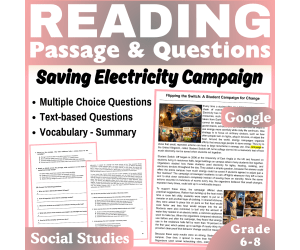
Saving Electricity Campaign: Social Studies Reading Passage (Docs)
ELA, Reading, Reading Comprehension, Strategies, Resources for Teachers, Social Studies, Sociology, Grade 6, 7, 8, 9, Writing Prompts, Worksheets & Printables, Centers, Activities, Teacher Tools, Assessments, Quizzes and Tests, Quizzes, Tests
Saving Electricity Campaign: Social Studies Reading Comprehension Passage (Docs) This resource introduces a unique Social Studies reading comprehension passage with questions about Saving Electricity Campaign. The passage is carefully designed to bridge the gap between social studies and literacy through strengthening reading comprehension and sparking knowledge curiosity in middle school students. Each passage blends English Language Arts skills with accurate social studies content . Ideal for interdisciplinary learning in ELA and Social Studies. Suitable for Grade 9 review, too! Student Tasks throughout the passage: 5 multiple-choice questions targeting the following skills: main idea, key details, inference, vocabulary in context, and use of evidence 5 vocabulary matching items with clear, student-friendly definitions 5 text-based questions that require citing specific lines or facts 1 summary prompt that asks students to condense central ideas accurately Full answer key for every section Available Formats for this Resource: PDF Fillable PDF Word Docs FULL CATALOG OF DOWNLOADING LINKS HERE Social Studies Reading Comprehension Collection Links: 1. Ancient Civilizations PDF Fillable PDF Word Docs Google Docs 2. Early Empires and Trade Networks PDF Fillable PDF Word Docs Google Docs 3. The Founding of the United States PDF Fillable PDF Word Docs Google Docs 4. Language, Culture, and Meaning PDF Fillable PDF Word Docs Google Docs 5. Psychology and Society PDF Fillable PDF Word Docs Google Docs 6. Global Festivals and Traditions PDF Fillable PDF Word Docs Google Docs 7. Extreme Environments and People PDF Fillable PDF Word Docs Google Docs 8. Food, Culture, and Preservation PDF Fillable PDF Word Docs Google Docs 9. Global Food Customs PDF Fillable PDF Word Docs Google Docs 10. Media, Communication, and Popular Culture PDF Fillable PDF Word Docs Google Docs 11. Human Impact on the Environment PDF Fillable PDF Word Docs Google Docs 12. Civic Action and Social Change PDF Fillable PDF Word Docs Google Docs 13. Fashion, Society, and Power PDF Fillable PDF Word Docs Google Docs 14. People, Places, and Unusual Histories PDF Fillable PDF Word Docs Google Docs Product Details: Length: 5 pages Grades: 6–8, also suitable for Grade 9 review Use cases: close reading, stations, homework, intervention, test prep, and sub plans Why Teachers Choose This Passage: Authentic social studies content paired with rigorous literacy practice Consistent task structure for easier planning and smoother student routines Clear, age-appropriate writing that builds confidence without oversimplifying Use this passage to reinforce ELA skills in social studies, to add literacy to your lessons, and to support independent work. The passage strengthens main idea, evidence use, vocabulary in context, inference, cause and effect, and summary writing. With ready-to-use assessments and complete answer keys, you can provide focused practice that is simple to run and fast to review.
Author Middle & High School - CORED Education
Rating
Tags Middle School, Reading Comprehension, Reading Strategies, ELA, Centers, Reading Passage, Assessments, Vocabulary, Social Studies, Sociology

How Languages Change: Social Studies Reading Passage (Docs)
ELA, Reading, Reading Comprehension, Strategies, Resources for Teachers, Social Studies, History, History: World, Grade 6, 7, 8, 9, Writing Prompts, Worksheets & Printables, Centers, Activities, Teacher Tools, Assessments, Quizzes and Tests, Quizzes, Tests
How Languages Change and Disappear: Social Studies Reading Comprehension Passage (Docs) This resource introduces a unique Social Studies reading comprehension passage with questions about How Languages Change and Disappear. The passage is carefully designed to bridge the gap between social studies and literacy through strengthening reading comprehension and sparking knowledge curiosity in middle school students. Each passage blends English Language Arts skills with accurate social studies content . Ideal for interdisciplinary learning in ELA and Social Studies. Suitable for Grade 9 review, too! Student Tasks throughout the passage: 5 multiple-choice questions targeting the following skills: main idea, key details, inference, vocabulary in context, and use of evidence 5 vocabulary matching items with clear, student-friendly definitions 5 text-based questions that require citing specific lines or facts 1 summary prompt that asks students to condense central ideas accurately Full answer key for every section Available Formats for this Resource: PDF Fillable PDF Word Docs FULL CATALOG OF DOWNLOADING LINKS HERE Social Studies Reading Comprehension Collection Links: 1. Ancient Civilizations PDF Fillable PDF Word Docs Google Docs 2. Early Empires and Trade Networks PDF Fillable PDF Word Docs Google Docs 3. The Founding of the United States PDF Fillable PDF Word Docs Google Docs 4. Language, Culture, and Meaning PDF Fillable PDF Word Docs Google Docs 5. Psychology and Society PDF Fillable PDF Word Docs Google Docs 6. Global Festivals and Traditions PDF Fillable PDF Word Docs Google Docs 7. Extreme Environments and People PDF Fillable PDF Word Docs Google Docs 8. Food, Culture, and Preservation PDF Fillable PDF Word Docs Google Docs 9. Global Food Customs PDF Fillable PDF Word Docs Google Docs 10. Media, Communication, and Popular Culture PDF Fillable PDF Word Docs Google Docs 11. Human Impact on the Environment PDF Fillable PDF Word Docs Google Docs 12. Civic Action and Social Change PDF Fillable PDF Word Docs Google Docs 13. Fashion, Society, and Power PDF Fillable PDF Word Docs Google Docs 14. People, Places, and Unusual Histories PDF Fillable PDF Word Docs Google Docs Product Details: Length: 5 pages Grades: 6–8, also suitable for Grade 9 review Use cases: close reading, stations, homework, intervention, test prep, and sub plans Why Teachers Choose This Passage: Authentic social studies content paired with rigorous literacy practice Consistent task structure for easier planning and smoother student routines Clear, age-appropriate writing that builds confidence without oversimplifying Use this passage to reinforce ELA skills in social studies, to add literacy to your lessons, and to support independent work. The passage strengthens main idea, evidence use, vocabulary in context, inference, cause and effect, and summary writing. With ready-to-use assessments and complete answer keys, you can provide focused practice that is simple to run and fast to review.
Author Middle & High School - CORED Education
Rating
Tags Middle School, Reading Comprehension, Reading Strategies, ELA, Centers, Reading Passage, Assessments, Vocabulary, Social Studies, WORLD HISTORY
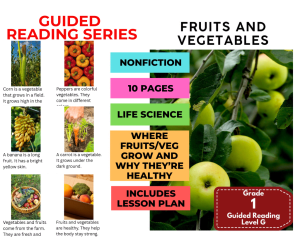
Fruits and Vegetables: Guided Reading Level G with Lesson Plan
ELA, Resources for Teachers, Reading Comprehension, Reading, Science, Language Development, Life Sciences, Health, P.E. & Health, Vocabulary, Kindergarten, Grade 1, 2, Worksheets & Printables, Worksheets, Teacher Tools, Centers, Activities, Literacy Readers, Quizzes, Quizzes and Tests, Assessments, Lesson Plans
This Fruits and Vegetables (level g) guided reading book with lesson plan includes: Guided Reading Color Label (front cover x1) This is a quick way to match the book’s demands to what students can generally handle.. The overall goal is to use the level/color to pick books for several smaller groups. To qualify for a certain level, a student is expected to read a book from that level with about 90–94% accuracy. If a student is consistently accurate and understands, move up a level. If the student is struggling at that level, drop down and add more support. Each student will improve at completely different rates, but it is generally one of the best ways to check progress across the class. DOWNLOAD THE CATALOG TO VIEW ALL GUIDED READING BOOKS AVAILABLE (SORTED LEVELS A-Z) Pre-Reading Question (x1) Teacher asks the prompt aloud, can be while showing the cover or first page. Students share what they already know, or make educated guesses from the cover. Prompt them to use the target vocabulary. Write some of their responses on the board to look back at during the reading. Vocabulary Words (x5) Introduce the five words, best doing it one at a time. Start by saying it, while students repeat and then see if anyone knows what it means before reading further. Read through the meaning and try to briefly connect each word to a picture or gesture so it’s meaningful. Ask students to flip through the book pages and point to where they see each of the vocabulary words. While reading the book pause upon coming across one of the vocab words or read the sentence twice to make sure students understand the word has appeared. Optional: Ask students to raise hands whenever they see/hear one of the new words. Guided Reading Pages (x10) Check the book snapshot (below) for: primary topic - do you need to prep extra reading or intro materials on this? what is taught best - decide on 1-2 bullets to focus on, use the prompt or words provided here for best results. learning goals - what you are checking for students to be able to do after the session, elicit answers using prompts or words provided. key vocabulary (see section above). questions overview - so you know what is coming up and if you need to prep extra materials to assist understanding. Run the lesson You may have already looked at a few of the pages together, but you can show them some of the pictures again first to set meaning. Depending on how much time you have and how familiar your students are with guided reading class, you may want to read the book aloud first with the group first. Students whisper or partner read, while you listen in. If time, do it as a group, one student reading a page each. Use the guided page’s prompts to coach: “Check the picture / does it make sense?” “Point under the words / try the first sound” “Reread the sentence smoothly”. Try to focus more on one student per session (rotating every time), so you can work out if they are ready to move up or need to move down a level. Comprehension Questions (back cover x3) This is your way to check that students didn’t just say the words, but actually understood the text. First, let students answer by pointing to the page/picture and saying a short sentence. After any answer, follow with: “Show me where you found that in the text.” In bigger groups, have partners answer first (10–20 seconds), then call on 2–3 students to share. Differentiation tips: Emerging speakers/struggling readers: oral + pointing On-level: oral in a full sentence Higher: one written sentence or draw + label Book Snapshot Title: Fruits and Vegetables Genre: Nonfiction Subject: Life Science (Plants and food) Primary Topic: Where fruits/vegetables grow and why they’re healthy Estimated Guided Reading Level (A–Z): G What This Book Teaches Best Many foods come from plants , and plants grow in the sun. Examples of fruits and where they grow (apple on a tall tree; banana with bright yellow skin). Examples of vegetables and where they grow (carrot under the ground; corn in a field; peppers in different colors; broccoli looks like a tiny tree). A simple fruit feature: most fruits have seeds inside (watermelon has many small seeds). Health connection: fruits and vegetables are healthy and help the body stay strong. Learning Goals Students will identify what the book says many foods come from. Students will describe where at least one fruit grows (example from the text). Students will describe where at least one vegetable grows (example from the text). Students will explain what the book says about seeds in fruits. Students will explain how fruits and vegetables help the body, using the book’s words. Key Vocabulary From the Text plants — living things that grow in the sun. fruit — food that can grow on a tree. vegetable — food that can grow in the ground. seeds — small parts inside fruits. healthy — good for your body. Discussion Prompts Pre-reading question: What fruits and vegetables do you already know, and where do you think they grow? Comprehension questions: What does the book say many foods come from? Comprehension questions: Where does the book say a carrot grows? Comprehension questions: How do fruits and vegetables help the body, according to the book? Printing Tips 1. Best Printing Method (Recommended) “Booklet” Printing (Best if Available) If your printer or PDF viewer supports Booklet Printing , use this. Settings to use: Print mode: Booklet Paper size: Letter or A4 (either works) Orientation: Landscape Print on both sides: Yes Flip on: Short edge Scaling: Fit to printable area Booklet subset: First test: Front sides only Then: Back sides only This will automatically: Pair pages correctly Put the cover on the outside Align everything for folding After printing, fold in half and staple along the spine . 2. If “Booklet” Printing Is NOT Available You can still print this correctly with manual duplex printing . Step-by-step: Open the PDF. Choose Print . Set: Orientation: Landscape Pages per sheet: 1 Print on both sides: Yes Flip on: Short edge Print all pages . Because each PDF page already contains two facing book pages, the result will still fold cleanly into a book. Thousands of Cored Education products are included with your TeachSimple membership. Download links and encyclopedia index available here.
Author Cored Education
Rating
Tags Reading Comprehension, Reading Passages, Reading, Guided Reading, Guided Reading Lesson Plan, Guided Reading Activity, Pre-reading, Science Lesson Plans, Life Science, Health

Basic Genetics - Digital Quiz
Science, Life Sciences, Biology, Grade 6, 7, 8, Quizzes, Quizzes and Tests, Teacher Tools
The Basic Genetics - Digital Quiz is a simple yet effective resource tool ideally suitable for middle school science educators conducting distance learning classes. Employing a Google Form interface, this comprehensive quiz aids in creating a digital, paperless classroom environment. In the role of an educator, comprehending the importance of providing students with quick feedback on their academic performance is paramount. This self-grading resource not only streamlines your teaching process but also offers instant results to students, promoting enhanced understanding of scientific concepts. This user-friendly teaching aid can be leveraged within varied pedagogical contexts including practice sessions, homework assignments or during science study groups. It has proven efficacious particularly during online education periods as well as in traditional face-to-face classrooms. The provided resource is fully adjustable and includes one quiz variant encompassing 10 questions that cover the basics of Genetics: Punnet squares Genotypes and phenotypes Alleles along with homozygous and heterozygous genotypes Dominant and recessive traits This fundamental level approach to these scientific concepts serves as excellent support for English learners or those with Individualized Education Programs (IEPs), ensuring all learners' accessibility. Note:This resource maintains its digital-native format meaning it cannot be converted into hard copy activities. The content herein targets grades six through eight Biology curricula but could also add value to related fields by enrichening understanding across various subject areas. Facing challenges unique to distance learning such as student access restrictions or learner diversity? Leverage tools like The Basic Genetics - Digital Quiz which boasts adaptable technologies to uphold inclusivity whilst ensuring quality educational experiences.
Author Sheltered Language Resources
Tags Genetics, Distance Learning, Middle School, Science Education, Digital Quiz
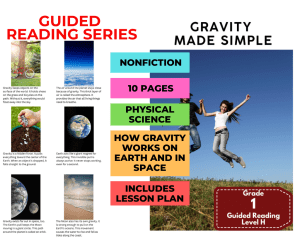
Guided Reading Level H - Gravity Made Simple
ELA, Resources for Teachers, Reading Comprehension, Reading, Science, Pre-Reading, Language Development, Vocabulary, Physics, Earth and Environmental Sciences, Kindergarten, Grade 1, 2, Worksheets & Printables, Worksheets, Teacher Tools, Centers, Activities, Literacy Readers, Quizzes, Quizzes and Tests, Assessments
This Guided Reading Book - Gravity Made Simple (Level H) includes: Guided Reading Color Label (front cover x1) This is a quick way to match the book’s demands to what students can generally handle.. The overall goal is to use the level/color to pick books for several smaller groups. To qualify for a certain level, a student is expected to read a book from that level with about 90–94% accuracy. If a student is consistently accurate and understands, move up a level. If the student is struggling at that level, drop down and add more support. Each student will improve at completely different rates, but it is generally one of the best ways to check progress across the class. DOWNLOAD THE CATALOG TO VIEW ALL GUIDED READING BOOKS AVAILABLE (SORTED LEVELS A-Z) Pre-Reading Question (x1) Teacher asks the prompt aloud, can be while showing the cover or first page. Students share what they already know, or make educated guesses from the cover. Prompt them to use the target vocabulary. Write some of their responses on the board to look back at during the reading. Vocabulary Words (x5) Introduce the five words, best doing it one at a time. Start by saying it, while students repeat and then see if anyone knows what it means before reading further. Read through the meaning and try to briefly connect each word to a picture or gesture so it’s meaningful. Ask students to flip through the book pages and point to where they see each of the vocabulary words. While reading the book pause upon coming across one of the vocab words or read the sentence twice to make sure students understand the word has appeared. Optional: Ask students to raise hands whenever they see/hear one of the new words. Guided Reading Pages (x10) Check the book snapshot (below) for: primary topic - do you need to prep extra reading or intro materials on this? what is taught best - decide on 1-2 bullets to focus on, use the prompt or words provided here for best results. learning goals - what you are checking for students to be able to do after the session, elicit answers using prompts or words provided. key vocabulary (see section above). questions overview - so you know what is coming up and if you need to prep extra materials to assist understanding. Run the lesson You may have already looked at a few of the pages together, but you can show them some of the pictures again first to set meaning. Depending on how much time you have and how familiar your students are with guided reading class, you may want to read the book aloud first with the group first. Students whisper or partner read, while you listen in. If time, do it as a group, one student reading a page each. Use the guided page’s prompts to coach: “Check the picture / does it make sense?” “Point under the words / try the first sound” “Reread the sentence smoothly”. Try to focus more on one student per session (rotating every time), so you can work out if they are ready to move up or need to move down a level. Comprehension Questions (back cover x3) This is your way to check that students didn’t just say the words, but actually understood the text. First, let students answer by pointing to the page/picture and saying a short sentence. After any answer, follow with: “Show me where you found that in the text.” In bigger groups, have partners answer first (10–20 seconds), then call on 2–3 students to share. Differentiation tips: Emerging speakers/struggling readers: oral + pointing On-level: oral in a full sentence Higher: one written sentence or draw + label Book Snapshot Title: Gravity Made Simple Genre: Nonfiction (informational) Subject: Science (Physical Science / Earth & Space Science) Primary Topic: How gravity works on Earth and in space Estimated Guided Reading Level (A–Z): H What This Book Teaches Best Gravity is a hidden, always-active force that pulls things toward Earth’s center. Gravity keeps objects on Earth’s surface—without it, things would float away. Gravity keeps the air close to Earth, forming the atmosphere that living things need to breathe. Gravity works in space too: Earth’s pull keeps the Moon in an orbit, and the Moon’s gravity affects ocean tides. Mass and gravity connect: more mass means a stronger gravitational pull, and weight measures gravity’s pull. Learning Goals Explain what gravity is and what it does to objects on Earth. Describe what happens when an object is dropped, according to the text. Tell how gravity helps keep objects (and air) close to Earth. Describe how Earth’s gravity affects the Moon’s orbit. Explain how the Moon’s gravity is connected to tides along the coast. Use the text to explain how mass relates to gravitational pull. Key Vocabulary From the Text gravity — a force that pulls things toward Earth. atmosphere — the thick layer of air around Earth. orbit — the path something takes around a planet. mass — how much matter is inside an object. tides — ocean water rising and falling along the coast. Discussion Prompts Pre-reading question: What do you think happens when you drop an object? Comprehension questions: What does the book say happens when an object is dropped? Comprehension questions: What does Earth’s pull do for the Moon’s path around Earth? Comprehension questions: What does the book say causes tides along the coast? Printing Tips 1. Best Printing Method (Recommended) “Booklet” Printing (Best if Available) If your printer or PDF viewer supports Booklet Printing , use this. Settings to use: Print mode: Booklet Paper size: Letter or A4 (either works) Orientation: Landscape Print on both sides: Yes Flip on: Short edge Scaling: Fit to printable area Booklet subset: First test: Front sides only Then: Back sides only This will automatically: Pair pages correctly Put the cover on the outside Align everything for folding After printing, fold in half and staple along the spine . 2. If “Booklet” Printing Is NOT Available You can still print this correctly with manual duplex printing . Step-by-step: Open the PDF. Choose Print . Set: Orientation: Landscape Pages per sheet: 1 Print on both sides: Yes Flip on: Short edge Print all pages . Because each PDF page already contains two facing book pages, the result will still fold cleanly into a book. Thousands of Cored Education products are included with your TeachSimple membership. Download links and encyclopedia index available here.
Author Cored Education
Rating
Tags Vocabulary, Reading Comprehension, Reading Passages, Leveled Reading, Nonfiction, Reading, Guided Reading, Gravity, Physics, Earth Science

Robert Boyle – Exploring the Foundations of Modern Chemistry
Life Sciences, Science, STEM, Social Studies, Biographies, Inventors, Basic Science, Physics, Chemistry, Human Body, Grade 6, 7, 8, 9, 10, 11, Worksheets, Worksheets & Printables, Quizzes, Quizzes and Tests, Teacher Tools, Projects, Activities
Robert Boyle – Exploring the Foundations of Modern Chemistry A short reading and activity set for grades 7–10 (PDF + H5P) ⚗️📘 A printable and digital resource This material introduces students to Robert Boyle, a 17th-century scientist often considered one of the founders of modern chemistry. His work on gases and scientific experimentation is still relevant today, especially when students first encounter Boyle’s Law or the basics of pressure and volume. The text and tasks are structured in a way that makes them easy to use in a regular lesson or even in a non-specialist substitute setting. Students work independently or in pairs to read, reflect, and test their understanding. Included in this resource: Informational text on Robert Boyle and his contributions Profile worksheet to guide understanding Quiz questions with solutions Two optional follow-up tasks: – Students write their own questions about the text – Partner activity: exchange and answer peer questions Formats: – Printable PDF – Editable DOCX (text only) – H5P version for interactive, digital use Classroom use: I’ve used materials like this to complement lessons on gas laws or to introduce a historical perspective on chemistry. It works well as part of a science unit, a literacy-focused lesson, or even during quiet working phases. Students read the short info text, fill out a profile sheet, and complete the quiz. The additional tasks are great for early finishers or small group work. The H5P version is useful for digital platforms and allows students to check their answers independently. No special preparation is needed – just print or upload and the activity is ready to go. Have fun exploring the world of science with your students! Warmly, Lernfitness Did You Know? I teach with a certified therapy dog, and together we focus on creating a positive and inspiring learning environment.
Author Lernfitness
Rating
Tags Science, Famous Scientists Lesson, H5P, Interactive Science Exercises, STEM, History, Scientists, Chemistry, Robert Boyle, Gases

Science Reading Passage: The Truth About Drinks (Fillable PDF)
Science, ELA, Reading, Reading Comprehension, Strategies, Resources for Teachers, Grade 6, 7, 8, 9, Writing Prompts, Worksheets & Printables, Centers, Activities, Teacher Tools, Assessments, Quizzes and Tests, Quizzes, Tests
Science Reading Comprehension Passage and Questions: The Truth About Drinks (Fillable PDF) This very engaging science reading passage about how common drinks affect health, focus, and sleep. It explains the differences between regular soda, diet soda, and energy drinks . The passage warns that regular soda often contains a lot of added sugar, diet soda uses artificial sweeteners that may affect taste habits, and energy drinks can contain high caffeine levels that may cause headaches, anxiety, racing heartbeat, and poor sleep in teenagers. It also teaches students how to read beverage labels by checking added sugar, caffeine, ingredients, and serving size . This passage is designed to bridge the gap between science and literacy through strengthening reading comprehension and sparking scientific curiosity in middle school students. The passage blends English Language Arts skills with accurate science content that supports NGSS classroom practice. Ideal for interdisciplinary learning in ELA and Science. Suitable for Grade 9 review, too! This passage is designed as a fillable PDF , which means students can type their answers directly into the document on any computer or tablet . Each page includes highlighted text fields that show them exactly where to type! Student Tasks for The Passage: 5 multiple-choice questions targeting main idea, key details, inference, vocabulary in context, and use of evidence 5 vocabulary matching items with clear, student-friendly definitions 5 text-based questions that require citing specific lines or facts 1 summary prompt that asks students to condense central ideas accurately Full answer key for every section Available Formats for this Resource PDF Word Docs Google Docs FULL CATALOG OF DOWNLOADING LINKS HERE Product Details Length: 5 pages total Grades: 6–8, also suitable for Grade 9 review Use cases: close reading, stations, homework, intervention, test prep, and sub plans Standards support: reinforces informational-text skills and supports NGSS-style sense making through observation, modeling, and clear use of claim, evidence, and reasoning Why Teachers Choose This Set Authentic science content paired with rigorous literacy practice Consistent task structure across all passages for easier planning and smoother student routines Clear, age-appropriate writing that builds confidence without oversimplifying Other Science Reading Collections you May find in the store: 1. Astronomy & Space Science 2. Volcanoes, Rocks, & Mountains 3. Rock Cycle, Soil, & Sinkholes 4. Mars, Glaciers, & Antarctica 5. Water Cycle, Acid Rain, & Wastewater 6. Insects, Animals, & Ecosystems 7. Bioluminescence & Insects 8. Animal Skin, Cats, & T. Rex 9. Human Body and Senses 10. Health & Applied Bioscience 11. Waves, Light, & Imaging 12. Electricity & Energy 13. Motion & Materials 14. Chemistry and Materials Science Use this set to reinforce ELA skills in science, to add literacy to your lessons, and to support independent work. The passages strengthen main idea, evidence use, vocabulary in context, inference, cause and effect, and summary writing. With ready-to-use assessments and complete answer keys, you can provide focused practice that is simple to run and fast to review.
Author Middle & High School - CORED Education
Rating
Tags Middle School, Reading Comprehension, Reading Strategies, ELA, Centers, Reading Passage, Assessments, Vocabulary, Bioscience

Goal Setting & Financial Independence Planners
Economics, Social Studies, Math, Statistics, Money, Order Of Operations, ELA, Reading, Strategies, Reading Comprehension, Life Skills, Grade 6, 7, 8, 9, 10, 11, 12, Teacher Tools, Assessments, Lesson Plans, Quizzes and Tests, Quizzes, Tests, Worksheets & Printables, Workbooks, Worksheets, Word Searches
With "Goal Setting & Financial Independence: The Architect's Blueprint", you will turn your students from passive consumers to future architects of their own financial success. Unlike most personal finance worksheets, this curriculum is designed specifically for high school and advanced middle school (Grades 8-11) students and provides them with the respect and knowledge necessary to thrive in today's economy. Say goodbye to condescending advice and oversimplified budgeting. The Curriculum explores the psychology of wealth, the mathematics of compound interest, and the strategic frameworks of top-level corporate strategists and investors. Budgeting as you know it is redefined as Strategic Resource Allocation, and students learn how to be the Chief Financial Officer (CFO) of their own life. Your students will get to create real-world cases, work through 10 detailed worksheets and find themselves on the road to implementing action plans that will help them achieve their goals. Subjects Discussed Are: The Psychology of Creating Goals and Identifying Habits Time-Money Relationship: The Impact of Compounding(72) Budgeting for Success through the Zero-Based Method Learning About Your Paycheck (Gross vs Net Income), FICA Tax/Withholdings/W-4? Difference between Good and Bad Debt, Credit, Amortization Teenage Investing: Roth Individual Retirement Accounts (IRAs), Index Funds & Dollar Cost Averaging (DCA) Evaluating Career and College Return on Investment Asymmetrical Risk - How to Build Human Capital through Entrepreneurship. TEENS AND THE FIRE MOVEMENT - Financially Independent Retire Early. This resource provides : educators with a comprehensive curriculum complete with four chapters covering the key principles of Personal Finance, Financial Literacy and Basic Money Management as well as a Student Workbook containing ten worksheets designed to allow students to create their own personal financial blueprint through multiple scenarios, calculations and reflection questions. The Teacher Resources (Visual Aids) are designed to provide educators with visual representations of the key topics covered in each of the four chapters so that the students can better understand these concepts through the use of anchor charts and an Answer Key for all objective type questions, along with a grading rubric for the subjective type questions. This resource can be used in various academic settings including: Personal Finance Classes/Electives, Economics Classes, Life Skills, Career Readiness Courses and Homeschool Co-Ops. This resource has been created to allow educators to design a complete instructional program that will give students the most valuable lesson they will ever learn and that is how to achieve Financial Independence. Keywords: Financial literacy; Personal Finance; High School; Middle School; Life Skills; Economics; Investing for Teens; Budgeting Worksheet; Goal Setting; Compound Interest; FIRE Movement; Career Readiness; College ROI; Digital resource; Printable; PDF; Curriculum; Homeschool; Case Study Method. Educational Benefits For Parents And Schools-Alike: More Than Just Basics: They will not only learn how to balance a check book, but will also learn about many other advanced financial strategies and 21st Century Financial Concepts relating to Investments, Career Return on Investment Analysis, and the Psychology of Wealth Building. Rigorous & Respectful; Curriculum uses behavioral economics and psychology to build a sophisticated vocabulary with a work related context, assumes that teenagers are intelligent individuals and builds and creates a database of excited students. Turn Key: Provides a detailed curriculum and 10 student assignment work sheets; Free Power Point Presentation; Student Manual; Teacher Manual; Complete Answer Key; complete Grading Rubric The "do-it-yourself" or upload method provides zero prep time for the instructor. Action-oriented & Practical: Students learn all of the aspects of financial literacy through case studies and hands-on experience with developing and developing their own personal goals, personal budgets, and long-term financial plans. Based on the analysis done : on the stated criteria, the cover lists the suggested audience to be Grades 8-11. This is an accurate portrayal of the grades as they apply to target audience. Grades 8 and 9: The concepts of goal-setting, identity-based habits, zero-based (simple) budgeting, and receiving a first paycheck all apply directly to this age group and may provide challenges (some, yet, not many); however, the material has enough scaffolding (additional content and/or support) to be very effective. Grades 10 and 11: This represents the best fit. These students are considering securing part-time employment, intending to save money for an automobile, or making major decisions concerning attending college or entering into the workforce. The worksheets provided on the topics "ROI (Return on Investment) Comparison of College vs. Career," "Dynamics of Debt," and Roth IRA will be extremely relevant and pertinent to these students. High School teachers of Personal Finance, Economics, and Life Skills. Instructors of Career and Technical Education (CTE). Parents who choose to home school and desire to use the material as a strong, legitimate financial curriculum. Middle School teachers of students that are classified as advanced or are placed into gifted programs. Terms of Use and Copyright: This book is copyrighted by Syed Hammad Rizvi. It is intended for use only by the individual or a single school classroom. No part of this resource may be altered, re-distributed or resold. In other words, you cannot post on the internet in a public place so that it can be found and downloaded. If you would like to share this resource with colleagues, please purchase additional licenses from Teachsimple to do so. Thank you for abiding by our terms of use. Syed Hammad Rizvi, thanks for bringing your amazing product.
Author Creative Book Store
Rating
Tags FinancialLiteracy, PersonalFinance, HighSchoolTeacher, LifeSkills, Investing, Budgeting, TeacherResources, FinancialEducation, Economics, CareerReadiness

Social Studies Reading Passage: Milk Carton Program (PDF)
ELA, Reading, Reading Comprehension, Strategies, Resources for Teachers, Social Studies, Sociology, Grade 6, 7, 8, 9, Writing Prompts, Worksheets & Printables, Centers, Activities, Teacher Tools, Assessments, Quizzes and Tests, Quizzes, Tests
Missing Children Milk Carton Program: Social Studies Reading Comprehension Passage (PDF) This resource introduces a unique Social Studies reading comprehension passage with questions about The Missing Children Milk Carton Program. The passage is carefully designed to bridge the gap between social studies and literacy through strengthening reading comprehension and sparking knowledge curiosity in middle school students. Each passage blends English Language Arts skills with accurate social studies content . Ideal for interdisciplinary learning in ELA and Social Studies. Suitable for Grade 9 review, too! Student Tasks throughout the passage: 5 multiple-choice questions targeting the following skills: main idea, key details, inference, vocabulary in context, and use of evidence 5 vocabulary matching items with clear, student-friendly definitions 5 text-based questions that require citing specific lines or facts 1 summary prompt that asks students to condense central ideas accurately Full answer key for every section Available Formats for this Resource: Fillable PDF Word Docs Google Docs FULL CATALOG OF DOWNLOADING LINKS HERE Social Studies Reading Comprehension Collection Links: 1. Ancient Civilizations PDF Fillable PDF Word Docs Google Docs 2. Early Empires and Trade Networks PDF Fillable PDF Word Docs Google Docs 3. The Founding of the United States PDF Fillable PDF Word Docs Google Docs 4. Language, Culture, and Meaning PDF Fillable PDF Word Docs Google Docs 5. Psychology and Society PDF Fillable PDF Word Docs Google Docs 6. Global Festivals and Traditions PDF Fillable PDF Word Docs Google Docs 7. Extreme Environments and People PDF Fillable PDF Word Docs Google Docs 8. Food, Culture, and Preservation PDF Fillable PDF Word Docs Google Docs 9. Global Food Customs PDF Fillable PDF Word Docs Google Docs 10. Media, Communication, and Popular Culture PDF Fillable PDF Word Docs Google Docs 11. Human Impact on the Environment PDF Fillable PDF Word Docs Google Docs 12. Civic Action and Social Change PDF Fillable PDF Word Docs Google Docs 13. Fashion, Society, and Power PDF Fillable PDF Word Docs Google Docs 14. People, Places, and Unusual Histories PDF Fillable PDF Word Docs Google Docs Product Details: Length: 5 pages Grades: 6–8, also suitable for Grade 9 review Use cases: close reading, stations, homework, intervention, test prep, and sub plans Why Teachers Choose This Passage: Authentic social studies content paired with rigorous literacy practice Consistent task structure for easier planning and smoother student routines Clear, age-appropriate writing that builds confidence without oversimplifying Use this passage to reinforce ELA skills in social studies, to add literacy to your lessons, and to support independent work. The passage strengthens main idea, evidence use, vocabulary in context, inference, cause and effect, and summary writing. With ready-to-use assessments and complete answer keys, you can provide focused practice that is simple to run and fast to review.
Author Middle & High School - CORED Education
Rating
Tags Middle School, Reading Comprehension, Reading Strategies, ELA, Centers, Reading Passage, Assessments, Vocabulary, Social Studies, Sociology

Coordinate Plane Reflections - Digital Quiz
Math, Geometry, Grade 8, Quizzes, Quizzes and Tests, Teacher Tools
Coordinate Plane Reflections - Digital Quiz Despite the ongoing challenges of distance learning, this thoughtfully designed digital math quiz assists middle school educators in teaching and assessing their students’ understanding effectively. The content focuses on geometric reflections in the coordinate plane, making it ideal for grade 8 students. The standout feature of 'Coordinate Plane Reflections - Digital Quiz' is its availability in a Google Forms format, enabling effortless integration with technology. This approach: Promotes environmentally friendly practices by reducing paper usage. Illuminates immediate feedback for learners promoting timely learning reinforcements. Bolstered with comprehensive modifiable content, this resource meets diverse student requirements and instructional styles effortlessly while maintaining its ease of use for ESL students or those with IEPs. Learners new to the geometric reflections can grasp algebraic rules like (-x,y) without any complex 2D figures involved, thanks to our carefully curated questions that reflect over x- and y-axis. This certified digital-only resource cannot be printed but makes an excellent complement for homework assignments or practice sessions or as mini-tests during math centers due to its adaptability to various scenarios such as: Broad classroom discussions In-depth group studies The quiz is available as a single variant within a downloadable PDF file promising hassle-free e-teaching experiences adding value and reliability to online education irrespective of geographical boundaries. Please note:To ensure suitability for your requirements, we recommend previewing before you decide upon adoption.
Author Sheltered Language Resources
Tags Distance Learning, Geometry, Coordinate Plane, Reflections, Digital Assessment
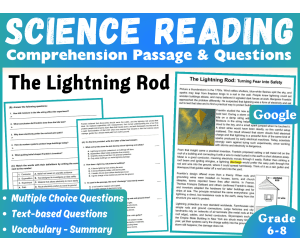
Science Reading Comprehension Passage: The Lightning Rod (Docs)
Science, ELA, Reading, Reading Comprehension, Strategies, Resources for Teachers, Physics, Grade 6, 7, 8, 9, Writing Prompts, Worksheets & Printables, Centers, Activities, Teacher Tools, Assessments, Quizzes and Tests, Quizzes, Tests
Physical Science Reading Comprehension Passage and Questions: The Lightning Rod (Docs) This very engaging science reading passage is about Benjamin Franklin’s lightning rod and how scientific understanding turned lightning from something people feared into a danger that could be managed. It explains that Franklin suspected lightning was a form of electricity, tested the idea with his kite experiment, and then developed the lightning rod as a practical way to protect buildings. The passage shows how a metal rod and grounding wire give lightning a low-resistance path into the ground , helping prevent fires in houses, barns, churches, ships, and modern buildings. This passage is designed to bridge the gap between science and literacy through strengthening reading comprehension and sparking scientific curiosity in middle school students. The passage blends English Language Arts skills with accurate science content that supports NGSS classroom practice. Ideal for interdisciplinary learning in ELA and Science. Suitable for Grade 9 review, too! Student Tasks for The Passage: 5 multiple-choice questions targeting main idea, key details, inference, vocabulary in context, and use of evidence 5 vocabulary matching items with clear, student-friendly definitions 5 text-based questions that require citing specific lines or facts 1 summary prompt that asks students to condense central ideas accurately Full answer key for every section Available Formats for this Resource PDF Fillable PDF Word Docs FULL CATALOG OF DOWNLOADING LINKS HERE Product Details Length: 4 pages total Grades: 6–8, also suitable for Grade 9 review Use cases: close reading, stations, homework, intervention, test prep, and sub plans Standards support: reinforces informational-text skills and supports NGSS-style sense making through observation, modeling, and clear use of claim, evidence, and reasoning Why Teachers Choose This Set Authentic science content paired with rigorous literacy practice Consistent task structure across all passages for easier planning and smoother student routines Clear, age-appropriate writing that builds confidence without oversimplifying Other Science Reading Collections you May find in the store: 1. Astronomy & Space Science 2. Volcanoes, Rocks, & Mountains 3. Rock Cycle, Soil, & Sinkholes 4. Mars, Glaciers, & Antarctica 5. Water Cycle, Acid Rain, & Wastewater 6. Insects, Animals, & Ecosystems 7. Bioluminescence & Insects 8. Animal Skin, Cats, & T. Rex 9. Human Body and Senses 10. Health & Applied Bioscience 11. Waves, Light, & Imaging 12. Electricity & Energy 13. Motion & Materials 14. Chemistry and Materials Science Use this set to reinforce ELA skills in science, to add literacy to your lessons, and to support independent work. The passages strengthen main idea, evidence use, vocabulary in context, inference, cause and effect, and summary writing. With ready-to-use assessments and complete answer keys, you can provide focused practice that is simple to run and fast to review.
Author Middle & High School - CORED Education
Rating
Tags Middle School, Reading Comprehension, Reading Strategies, ELA, Centers, Reading Passage, Assessments, Vocabulary, Physics, Physical Science And Electricity

Traditional Costumes: Social Studies Reading Passage (Fillable PDF)
ELA, Reading, Reading Comprehension, Strategies, Resources for Teachers, Social Studies, Sociology, Grade 6, 7, 8, 9, Writing Prompts, Worksheets & Printables, Centers, Activities, Teacher Tools, Assessments, Quizzes and Tests, Quizzes, Tests
Traditional Costumes: Social Studies Reading Comprehension Passage (Fillable PDF) This resource introduces a unique Social Studies reading comprehension passage with questions about Traditional Costumes: Clothing That Tells a Story. The passage is carefully designed to bridge the gap between social studies and literacy through strengthening reading comprehension and sparking knowledge curiosity in middle school students. Each passage blends English Language Arts skills with accurate social studies content . Ideal for interdisciplinary learning in ELA and Social Studies. Suitable for Grade 9 review, too! This resource is designed as a fillable PDF , which means students can type their answers directly into the document on any computer or tablet . Each page includes highlighted text fields that show them exactly where to type! Student Tasks throughout the passage: 5 multiple-choice questions targeting the following skills: main idea, key details, inference, vocabulary in context, and use of evidence 5 vocabulary matching items with clear, student-friendly definitions 5 text-based questions that require citing specific lines or facts 1 summary prompt that asks students to condense central ideas accurately Full answer key for every section Available Formats for this Resource: PDF Word Docs Google Docs FULL CATALOG OF DOWNLOADING LINKS HERE Social Studies Reading Comprehension Collection Links: 1. Ancient Civilizations PDF Fillable PDF Word Docs Google Docs 2. Early Empires and Trade Networks PDF Fillable PDF Word Docs Google Docs 3. The Founding of the United States PDF Fillable PDF Word Docs Google Docs 4. Language, Culture, and Meaning PDF Fillable PDF Word Docs Google Docs 5. Psychology and Society PDF Fillable PDF Word Docs Google Docs 6. Global Festivals and Traditions PDF Fillable PDF Word Docs Google Docs 7. Extreme Environments and People PDF Fillable PDF Word Docs Google Docs 8. Food, Culture, and Preservation PDF Fillable PDF Word Docs Google Docs 9. Global Food Customs PDF Fillable PDF Word Docs Google Docs 10. Media, Communication, and Popular Culture PDF Fillable PDF Word Docs Google Docs 11. Human Impact on the Environment PDF Fillable PDF Word Docs Google Docs 12. Civic Action and Social Change PDF Fillable PDF Word Docs Google Docs 13. Fashion, Society, and Power PDF Fillable PDF Word Docs Google Docs 14. People, Places, and Unusual Histories PDF Fillable PDF Word Docs Google Docs Product Details: Length: 4 pages Grades: 6–8, also suitable for Grade 9 review Use cases: close reading, stations, homework, intervention, test prep, and sub plans Why Teachers Choose This Passage: Authentic social studies content paired with rigorous literacy practice Consistent task structure for easier planning and smoother student routines Clear, age-appropriate writing that builds confidence without oversimplifying Use this passage to reinforce ELA skills in social studies, to add literacy to your lessons, and to support independent work. The passage strengthens main idea, evidence use, vocabulary in context, inference, cause and effect, and summary writing. With ready-to-use assessments and complete answer keys, you can provide focused practice that is simple to run and fast to review.
Author Middle & High School - CORED Education
Rating
Tags Middle School, Reading Comprehension, Reading Strategies, ELA, Centers, Reading Passage, Assessments, Vocabulary, Social Studies, Sociology
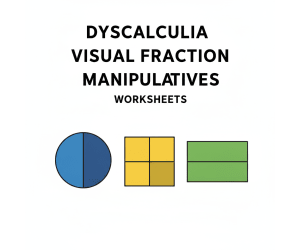
Dyscalculia Visual Fraction Manipulatives
Math, Fractions, Addition and Subtraction, Addition, Subtraction, Graphing, Money, Number Lines, Order Of Operations, Time, Homeschool Curriculum, Homeschool Templates, Grade 3, 4, 5, 6, 7, Worksheets & Printables, Workbooks, Worksheets, Word Searches, Teacher Tools, Assessments, Lesson Plans, Quizzes and Tests, Quizzes, Tests
Change the nature of instruction for fractions, and help all students by using this complete, evidence-based guide for teaching fractions to students who may have any or all of the following: Dyscalculia, Learning Disabilities in Mathematics, or Anxiety with regard to mathematics. Are you an educator or parent looking for an effective way to teach your students with prior difficulties with abstract mathematic concepts? If so, this is the resource for which you have been searching. This is NOT just another worksheet packet. This is a complete neuro-informed intervention system built to circumvent all cognitive barriers common to the students you teach, and create true and lasting understanding of fractions that will be retained for the remainder of the student's educational career. By following the Concrete-Pictorial-Abstract (CPA) framework along with the principles of cognitive science, this guide provides students with a means for teaching fractions in a way that they will finally be able to process and master from their neurodivergent brain perspective. Your students will no longer suffer from mathematics anxiety or the "Whole Number Bias", which results in students believing that 1/8 is greater than 1/3. We use Linear Fraction Bars as a visual aid and High Contrast Visual Mapping to make fractions tangible and explainable to students through the use of their neural systems, thus enabling students to understand fractions as Predictable and Intuitive. We deliberately avoid all of the Circular Fraction Models (i.e., Pizza) that confuse students with poor or absent spatial perception. THIS 37-PAGE COMPREHENSIVE GUIDELINE CONSISTS OF: The Educators Guide: This document consists of an in-depth look at the "why" behind the method in phase one. It will include definitions of the cognitive make-up behind dyscalculia, the incorrectness of standard methods, and the architectural guidelines for creating educational tools, including manipulatives that are compatible with how the brain works. This phase will also include case studies based on individual students that can be utilized in grade-level math classes. The Student Workbook: Phase Two will consist of a sequential ten part set of worksheets that will serve as step-by-step guides for students in grades three through five. In other words, the first page of the ten page guide will help students learn what a numerator and a denominator are before they then will be a part of the worksheet on determining whether two fractions are equal or comparable. The remainder of the pages will continue to follow the same sequence, with the last page covering mixed numbers. The Teacher Resources and Visual Aids Section: This section contains all the resources necessary for teacher's to correctly implement the above two guides. In addition to possessing high-resolution diagnostic diagrams that can be utilized in the classroom, this section also contains an answer key that has been developed with pedagogical notes included, and a clinical implementation guide that contains scripted interventions for how to address common errors made by students. PLEASE NOTE THE FOLLOWING Group: Individuals who provide direct instructional support to students with disabilities and other struggles in mathematics, such as: SE Teachers/Specialists Math Interventionists/ Specialists (Tier 2 & 3) Resource Room/Co-Teach Models Tutor and Educational Therapists Homeschool Parents General Ed Teachers who want to use effective differentiation strategies. Break the cycle of poor math performance. Get your students the tools they need to develop confidence and obtain true mastery of fractions through this master guide through the Math Anxiety. Key Terms: Dyscalculia, Math Intervention, Special Education Math, Fractions, Visual Math, Manipulatives, Math Anxiety, Learning Disabilities, Third, Fourth, Fifth, Grade, Homeschooling, RTI, Math Support, Number Sense, *CPA Framework (Concrete, Picture, Abstract) Teacher’s Guide. Reasons Why Parents/Schools Are Enthusiastic About This Resource: Evidence Based and Neuro-informed: This is truly not just a collection of activities but rather a structured program based on cognitive science; designed specifically to help students whom have dyscalculia. Eliminates Math Anxiety: The clear, visual, step-by-step approach removes uncertainty and abstract confusion which builds student confidence and creates a positive attitude ("I can do math") about math. Comprehensive All-In-One System: The complete package allows educators to save a tremendous amount of time in planning. It contains the theoretical document, the workbook (student-facing) as well as the full answer key that contains additional clinical cues. This resource is ready for immediate use as an intervention resource. Promotes True Understanding, Not Just Rote Memorization: By making fractions physical and visual, this program goes beyond mere memorization of rules and fosters true, deep conceptual understanding, which can be applied to future concepts. Highly Targeted for Intervention: This resource is an excellent Tier 2/3 resource for intervention, special education resource rooms, tutoring, and homeschooling. It provides very powerful and focused support, right where struggling learners require it most. An in-depth analysis of the content, research, and worksheets indicates the primary target audiences are: Special Education Teachers: This is a critical instructional support for teachers within this specialty since the resource was designed specifically for students diagnosed with learning disabilities. Math Interventionists: This resource meets the needs of small groups of students (Tier 2 and Tier 3) who are considerably below grade level in mathematics. Educational Therapists and Tutors: Qualified professionals who provide one-on-one support to students with dyscalculia. Homeschooling Parents: Especially for those children who have a diagnosis or possibly math deficits. Targeted Grade Levels: The component will specifically target grades three, four and five because all of the fractions address fundamental fractions through to adding fractions and mixed numbers, which are all taught at these grade levels. Rewriting Terms: All rights reserved. The author has copyright (Copyrighted by Syed Hammad Rizvi) on this work. A teacher may use this resource for his/her classroom and for private individual use. You may not modify this resource, distribute it, or sell it. You may not publish or make it available on the internet. If you would like to share this resource with your colleagues, please buy additional licenses from Teachsimple. Thank you for being honest and following my copyright terms. This product is made with love by Syed Hammad Rizvi.
Author Creative Book Store
Rating
Tags Dyscalculia, Dyscalculiaresources, Dyscalculiasupport, Mathintervention, Visualmath, Mathmanipulatives, Mathlearningdisability, Specialneedsmath, Neurodivergentlearning, Cpaframework

SAMPLE Social Studies Reading Passage: Milk Carton Program
ELA, Reading, Reading Comprehension, Strategies, Resources for Teachers, Social Studies, Sociology, Grade 6, 7, 8, 9, Writing Prompts, Worksheets & Printables, Centers, Activities, Teacher Tools, Assessments, Quizzes and Tests, Quizzes, Tests
This is a free passage sample from the complete resource. The full version includes everything needed for a complete reading comprehension activity: the passage, multiple-choice questions, short-answer questions, vocabulary matching, a summary-writing task, and a detailed answer key. Download the complete passage resource by clicking on the following links: PDF Fillable PDF Word Docs Google Docs Missing Children Milk Carton Program: Social Studies Reading Comprehension Passage (PDF) This resource introduces a unique Social Studies reading comprehension passage with questions about The Missing Children Milk Carton Program. The passage is carefully designed to bridge the gap between social studies and literacy through strengthening reading comprehension and sparking knowledge curiosity in middle school students. Each passage blends English Language Arts skills with accurate social studies content . Ideal for interdisciplinary learning in ELA and Social Studies. Suitable for Grade 9 review, too! Student Tasks throughout the passage: 5 multiple-choice questions targeting the following skills: main idea, key details, inference, vocabulary in context, and use of evidence 5 vocabulary matching items with clear, student-friendly definitions 5 text-based questions that require citing specific lines or facts 1 summary prompt that asks students to condense central ideas accurately Full answer key for every section FULL CATALOG OF DOWNLOADING LINKS HERE Other Social Studies Reading Comprehension Collections You May Find in the Store: 1. Ancient Civilizations 2. Early Empires and Trade Networks 3. The Founding of the United States 4. Language, Culture, and Meaning 5. Psychology and Society 6. Global Festivals and Traditions 7. Extreme Environments and People 8. Food, Culture, and Preservation 9. Global Food Customs 10. Media, Communication, and Popular Culture 11. Human Impact on the Environment 12. Civic Action and Social Change 13. Fashion, Society, and Power 14. People, Places, and Unusual Histories Product Details: Length: 5 pages Grades: 6–8, also suitable for Grade 9 review Use cases: close reading, stations, homework, intervention, test prep, and sub plans Why Teachers Choose This Passage: Authentic social studies content paired with rigorous literacy practice Consistent task structure for easier planning and smoother student routines Clear, age-appropriate writing that builds confidence without oversimplifying Use this passage to reinforce ELA skills in social studies, to add literacy to your lessons, and to support independent work. The passage strengthens main idea, evidence use, vocabulary in context, inference, cause and effect, and summary writing. With ready-to-use assessments and complete answer keys, you can provide focused practice that is simple to run and fast to review.
Author Middle & High School - CORED Education
Rating
Tags Middle School, Reading Comprehension, Reading Strategies, ELA, Centers, Reading Passage, Assessments, Vocabulary, Social Studies, Sociology

Calculating Speed - Digital Quiz
Science, Physics, Grade 6, 7, 8, Quizzes, Quizzes and Tests, Teacher Tools
Calculating Speed - Digital Quiz This Calculating Speed - Digital Quiz provides a valuable, digital-native resource for all science educators. Featuring a user-friendly interface, the quiz is designed for seamless integration into sustainable classrooms while providing real-time feedback to students. Ideal Teaching Tool The ideal tool for Grades 6-8 physical science teachers, this resource can be used in various scenarios such as practice work, homework assignments and evaluations. Moreover, it enhances both in-person and remote learning environments. Quiz Features: Ten questions focusing on speed calculation principles and concepts. Fully customizable format adaptable to specific classroom needs. Note: This is strictly a digital resource, hence not suitable for paper-pencil activities. Evaluation Functionality An embedded feature allows the quiz to serve as an assessment tool— enabling teachers to gauge topic comprehension before delving deeper into complex speed calculations content. Potential User Alert: Please review content orientation before purchase making sure alignment with your syllabus demands are met considering some of the more basic elements of this quiz despite its comprehensive coverage on fundamentals such as identification processes relating measures of time & distance involved in speed calculations. Paving Way For personalized Learning Experience This resource attempts bridging offline online learning barriers by simulating traditional class-room components; making the Calculating Speed - Digital Quiz an integral inclusion into any modern teaching toolkit. Lastly, Digital Feedback Option : Including instantaneous feedback options triggers swift understanding insights while streamlining grading processes; conforming seamlessly with both traditional and innovative pedagogical strategies alike.
Author Sheltered Language Resources
Tags Calculating Speed, Digital Quiz, Science Education, Distance Learning, Speed Concepts

Ancient Civilizations: Social Studies Reading Passages (Fillable PDF)
ELA, Reading, Reading Comprehension, Strategies, Resources for Teachers, Social Studies, History: Ancient, History, Grade 6, 7, 8, 9, Writing Prompts, Worksheets & Printables, Centers, Activities, Teacher Tools, Assessments, Quizzes and Tests, Quizzes, Tests
Ancient Civilizations: Social Studies Reading Passages (Fillable PDF) This very engaging collection of Social Studies reading passages about Ancient Civilizations is designed to bridge the gap between social studies and literacy through strengthening reading comprehension and sparking knowledge curiosity in middle school students. Each passage blends English Language Arts skills with accurate social studies content. Ideal for interdisciplinary learning in ELA and Social Studies. Suitable for Grade 9 review, too! These worksheets are designed as fillable PDFs , which means students can type their answers directly into the document on any computer or tablet . Each page includes highlighted text fields that show them exactly where to type! What Is Included? There are - (3) - informational passages: Sacred Whiskers: Cats in Ancient Egypt Mesopotamia: The First Urban World The Inca: Empire in the Clouds Student Tasks for Each Passage: 5 multiple-choice questions targeting main idea, key details, inference, vocabulary in context, and use of evidence 5 vocabulary matching items with clear, student-friendly definitions 5 text-based questions that require citing specific lines or facts 1 summary prompt that asks students to condense central ideas accurately Full answer key for every section Available Formats for this Resource PDF Word Docs Google Docs FULL CATALOG OF DOWNLOADING LINKS HERE Reading Passage Links: Ancient Civilizations PDF Fillable PDF Word Docs Google Docs Early Empires and Trade Networks PDF Fillable PDF Word Docs Google Docs The Founding of the United States PDF Fillable PDF Word Docs Google Docs Language, Culture, and Meaning PDF Fillable PDF Word Docs Google Docs Psychology and Society PDF Fillable PDF Word Docs Google Docs Global Festivals and Traditions PDF Fillable PDF Word Docs Google Docs Extreme Environments and People PDF Fillable PDF Word Docs Google Docs Food, Culture, and Preservation PDF Fillable PDF Word Docs Google Docs Global Food Customs PDF Fillable PDF Word Docs Google Docs Media, Communication, and Popular Culture PDF Fillable PDF Word Docs Google Docs Human Impact on the Environment PDF Fillable PDF Word Docs Google Docs Civic Action and Social Change PDF Fillable PDF Word Docs Google Docs Fashion, Society, and Power PDF Fillable PDF Word Docs Google Docs People, Places, and Unusual Histories PDF Fillable PDF Word Docs Google Docs How to Use These PDFs Click on the highlighted area to start typing your answer. Move to the next question by clicking in the next highlighted box. When you are finished, close the document and select SAVE so your answers stay recorded. If you want to keep a blank copy for later, choose Save As and give your completed version a new name. Product Details Length: 15 pages total Grades: 6–8, also suitable for Grade 9 review Use cases: close reading, stations, homework, intervention, test prep, and sub plans Why Teachers Choose This Set Authentic social studies content paired with rigorous literacy practice Consistent task structure across all passages for easier planning and smoother student routines Clear, age-appropriate writing that builds confidence without oversimplifying Use this set to reinforce ELA skills in social studies, to add literacy to your lessons, and to support independent work. The passages strengthen main idea, evidence use, vocabulary in context, inference, cause and effect, and summary writing. With ready-to-use assessments and complete answer keys, you can provide focused practice that is simple to run and fast to review.
Author Middle & High School - CORED Education
Rating
Tags Middle School, Reading Comprehension, Reading Strategies, ELA, Centers, Reading Passage, Assessments, Vocabulary, Social Studies, Ancient Civilization
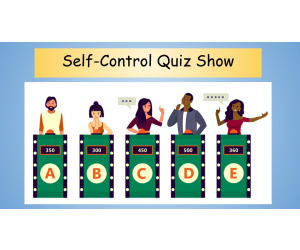
Self-Control Quiz Show-No Prep!
Life Studies, Special Resources, Life Skills, Grade 5, 6, 7, 8, 9, 10, Quizzes, Quizzes and Tests, Teacher Tools
The Self-Control Quiz Show-No Prep The Self-Control Quiz Show-No Prep is an educational resource designed for teachers of students in grades 5 to 10. The goal is to help develop their self-management and emotional intelligence skills. Apart from this, the approach of this tool merges education with enjoyment, offering lasting impact. Covering All Aspects of Life In creating a well-rounded understanding, the quiz show focuses on various aspects including: Social media interactions, Relationships with friends and family, Situations at school, Mixed topics related to real-life experiences. This comprehensive approach ensures that the student understands self-control as an integrated part of all aspects of life rather than an isolated trait. A Unique Interactive Resource This teaching resource is distinctively interactive. It empowers educators to instruct while also fostering active student participation throughout lessons. Questions are meticulously categorized according to relevance with today's young minds, each accompanied by immediate feedback through answer slides. No-Preparation Solution for Teachers Teachers need not worry about preparing or organizing anything themselves - it comes fully prepared and ready-to-use out-of-the-box, maximizing its impact on individual students’ personal growth while saving educator's time. Inclusivity Handling: An accompanying student handout provided within the PowerPoint itself ensuring smooth access and user-friendliness. Purposeful directions embedded within this PowerPoint-based quiz show making maneuverability during usage seamless. Adept Adaptability: This product caters to adaptability needs: it can be used either in whole group instruction times, for smaller deep-dive groups or even assigned as independent study material. This ensures versatility paired with impactful development across multiple platforms. Turning the Fun Factor into Fundamental Learning Mixing amusement with essential life skill learning such as self-control increases engagement. This results in optimal benefits through absorption and application alike, playing an instrumental part in shaping socially aware and emotionally intelligent citizens who excel at managing their behavior amid varying situations encountered throughout their day-to-day life.
Author Jennifer Moyer Taylor
Tags Self-control, Emotional Intelligence, Quiz Show, Interactive Learning, Social Skills, Self Control Test Questions

Guitars Reading Comprehension Passage - Cored Ed Encyclopedia
ELA, Language Development, Resources for Teachers, Reading Comprehension, Reading, Pre-Reading, Writing, Music, Creative Arts, Strategies, Grade 2, 3, 4, 5, Worksheets & Printables, Worksheets, Teacher Tools, Centers, Activities, Writing Prompts, Assessments, Tests, Quizzes and Tests, Quizzes
This guitars reading comprehension contains the following: Pre-Reading Trivia Students will write down one thing they already know about the subject and then read five more facts and discuss. These facts are fun, and the students will enjoy learning about the subject before reading more. Reading Passage The text is a high-interest reading passage with set paragraphs, roughly three to four paragraphs long. It contains a variety of themes about the topic, anywhere from history to technology. The passage is between 250 and 350 words in length. Mixed Questions The first question page contains four multiple-choice questions, each with a choice of four answers, and three written response questions that require a sentence or two from the student. Creative Writing In this question, the student will be required to write a five to eight sentence paragraph on a question related to the topic. Extension Activities This page is optional for fast finishers. If there are five to ten minutes left at the end of the lesson, the student can choose one of three activities, each one requiring a different skill. Answer Key There are answers for the multiple-choice questions and three written response questions have sample answers. FULL CATALOG OF DOWNLOAD LINKS AND ENCYCLOPEDIA INDEX HERE Cored Ed Encyclopedia Overview The Cored Ed Encyclopedia is a weekly series of lessons that you can pick up and use right away. These short readings fit into whatever time you have available. Each one includes a warm-up, a reading, and a set of questions, but it’s flexible — you can do just the reading, the full lesson, or skip the writing section if you need to. Each lesson focuses on a single topic so students don’t get lost. The writing is clear but never childish, making it perfect for grades two through five. Topics range from animals and science to history, inventions, and everyday things. No matter the level of the student, everyone should take away at least one new idea or fact from each lesson. The materials are easy to print, easy to explain, and require no setup. They work well for whole-class teaching, partner work, or independent study.
Author Cored Education
Rating
Tags Vocabulary, Spelling, Reading Comprehension, Reading Passages, Reading, Creative Writing, Reading Strategies, Writing Prompts, Guitars, Music
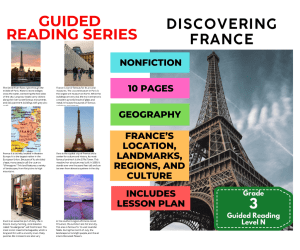
Discovering France: Guided Reading Level N with Lesson Plan
ELA, Resources for Teachers, Reading Comprehension, Reading, Science, Language Development, Vocabulary, Geography, Social Studies, Technology, Grade 2, 3, 4, Worksheets & Printables, Worksheets, Teacher Tools, Centers, Activities, Literacy Readers, Quizzes, Quizzes and Tests, Assessments, Lesson Plans
This Discovering France (level n) guided reading book with lesson plan includes: Guided Reading Color Label (front cover x1) This is a quick way to match the book’s demands to what students can generally handle.. The overall goal is to use the level/color to pick books for several smaller groups. To qualify for a certain level, a student is expected to read a book from that level with about 90–94% accuracy. If a student is consistently accurate and understands, move up a level. If the student is struggling at that level, drop down and add more support. Each student will improve at completely different rates, but it is generally one of the best ways to check progress across the class. DOWNLOAD THE CATALOG TO VIEW ALL GUIDED READING BOOKS AVAILABLE (SORTED LEVELS A-Z) Pre-Reading Question (x1) Teacher asks the prompt aloud, can be while showing the cover or first page. Students share what they already know, or make educated guesses from the cover. Prompt them to use the target vocabulary. Write some of their responses on the board to look back at during the reading. Vocabulary Words (x5) Introduce the five words, best doing it one at a time. Start by saying it, while students repeat and then see if anyone knows what it means before reading further. Read through the meaning and try to briefly connect each word to a picture or gesture so it’s meaningful. Ask students to flip through the book pages and point to where they see each of the vocabulary words. While reading the book pause upon coming across one of the vocab words or read the sentence twice to make sure students understand the word has appeared. Optional: Ask students to raise hands whenever they see/hear one of the new words. Guided Reading Pages (x10) Check the book snapshot (below) for: primary topic - do you need to prep extra reading or intro materials on this? what is taught best - decide on 1-2 bullets to focus on, use the prompt or words provided here for best results. learning goals - what you are checking for students to be able to do after the session, elicit answers using prompts or words provided. key vocabulary (see section above). questions overview - so you know what is coming up and if you need to prep extra materials to assist understanding. Run the lesson You may have already looked at a few of the pages together, but you can show them some of the pictures again first to set meaning. Depending on how much time you have and how familiar your students are with guided reading class, you may want to read the book aloud first with the group first. Students whisper or partner read, while you listen in. If time, do it as a group, one student reading a page each. Use the guided page’s prompts to coach: “Check the picture / does it make sense?” “Point under the words / try the first sound” “Reread the sentence smoothly”. Try to focus more on one student per session (rotating every time), so you can work out if they are ready to move up or need to move down a level. Comprehension Questions (back cover x3) This is your way to check that students didn’t just say the words, but actually understood the text. First, let students answer by pointing to the page/picture and saying a short sentence. After any answer, follow with: “Show me where you found that in the text.” In bigger groups, have partners answer first (10–20 seconds), then call on 2–3 students to share. Differentiation tips: Emerging speakers/struggling readers: oral + pointing On-level: oral in a full sentence Higher: one written sentence or draw + label Book Snapshot Title: Discovering France Genre: Nonfiction Subject: Social Studies (Geography/Culture) Primary Topic: France’s location, landmarks, regions, and culture Estimated Guided Reading Level (A–Z): N What This Book Teaches Best Geography basics about France , including where it is located and how its shape leads to a nickname. Key places and landmarks in Paris , such as the Eiffel Tower, the Seine River, and the Louvre Museum. Regional features of France by describing Provence, the French Alps, the French Riviera, and the Loire Valley. French culture and daily life , especially food traditions like boulangeries, baguettes, and croissants. Modern transportation in France , focusing on the TGV high-speed train and what it allows people to do. Learning Goals Students will identify where France is located and explain why it is called “L’Hexagone.” Students will describe at least two facts about Paris, including details about the Eiffel Tower. Students will explain how the Seine River is described and what people can see from boats on the river. Students will describe characteristics of at least two French regions (Provence, the Alps, the Riviera, or the Loire Valley) using details from the text. Students will describe examples of French culture from the text, including food and museums. Students will explain what the TGV is and how it changes travel across France. Key Vocabulary From the Text landmark — a famous place many people recognize. massive — very big. coastline — the land’s edge next to the sea. lavender — a purple plant/flower that can smell sweet. transportation — ways people travel from place to place. Discussion Prompts Pre-reading question: What do you already know about France, and what would you like to learn? Comprehension questions: Where does the text say France is located, and what nickname do some people give it because of its shape? Comprehension questions: What does the text tell you about the Eiffel Tower (such as when it was built or how tall it is)? Comprehension questions: Choose one region from the book (Provence, the French Alps, the French Riviera, or the Loire Valley) and describe two details the text gives about it. Printing Tips 1. Best Printing Method (Recommended) “Booklet” Printing (Best if Available) If your printer or PDF viewer supports Booklet Printing , use this. Settings to use: Print mode: Booklet Paper size: Letter or A4 (either works) Orientation: Landscape Print on both sides: Yes Flip on: Short edge Scaling: Fit to printable area Booklet subset: First test: Front sides only Then: Back sides only This will automatically: Pair pages correctly Put the cover on the outside Align everything for folding After printing, fold in half and staple along the spine . 2. If “Booklet” Printing Is NOT Available You can still print this correctly with manual duplex printing . Step-by-step: Open the PDF. Choose Print . Set: Orientation: Landscape Pages per sheet: 1 Print on both sides: Yes Flip on: Short edge Print all pages . Because each PDF page already contains two facing book pages, the result will still fold cleanly into a book. Thousands of Cored Education products are included with your TeachSimple membership. Download links and encyclopedia index available here.
Author Cored Education
Rating
Tags Reading Comprehension, Reading Passages, Reading, Guided Reading, Guided Reading Lesson Plan, Guided Reading Activity, Pre-reading, Social Studies, Geography, Technology
Digital Math for 5.NBT.4 - Understand the Place Value System (Slides + Self-Grading Quiz)
Math, Place Value, Grade 5, Quizzes, Quizzes and Tests, Teacher Tools
Digital Math for 5.NBT.4 - Understand the Place Value System A comprehensive and enjoyable approach to understanding core mathematical concepts, specific to the fifth-grade level. Interactive Learning Experience This tool addresses the principle of place value with interactive slides designed as visual tools that students can meaningfully engage with. It facilitates student learning through dragging, dropping, and sorting images that represent complex mathematical ideas in an accessible format. Easily Accessible Content Seamlessly rendered for use on both PowerPoint and Google Slides , this collection of twenty interactive slides meets your needs without demanding additional effort or preparation time. The Google Slides alternative allows one to quickly distribute this educative content via Google Classroom easily. Evaluation Integrated With Instruction Included within the resource is a follow-up quiz created using Google Forms which self-grades student performance, providing educators valuable data about their students' understanding of place values promptly. Versatile Usage: Can be utilized as a group activity in class or individual homework assignment to reinforce lessons taught during school hours. Especially useful in remote learning scenarios ensuring interrupted learning progression due to distance isn’t a worry anymore! Focused on Efficiency: As versatile as educational resources go without sacrificing quality and efficacy, Digital Math 5.NBT4 significantly transforms any dedicated teacher's repertoire into a more dynamic mode of instructing mathematics. Fostering Effective Learning:: Targets not just efficiency but also effective teaching towards helping fifth-graders fully grasp place value comprehension. </ul
Author Markers and Minions
Tags Digital Math, Place Value System, Interactive Slides, Visual Tools, Remote Learning
Life Science Reading Comprehension Passage: Protists and Fungi (PDF)
Science, ELA, Reading, Reading Comprehension, Strategies, Resources for Teachers, Life Sciences, Biology, Grade 6, 7, 8, 9, 10, Writing Prompts, Worksheets & Printables, Centers, Activities, Teacher Tools, Assessments, Quizzes and Tests, Quizzes, Tests
Life Science Reading Comprehension Passage and Questions: Protists and Fungi (PDF) This very engaging science reading passage is about protists and fungi , two groups of small but highly important organisms that affect ecosystems in major ways. It explains how protists can live in water, soil, or hosts; how some protists, such as algae, make food through photosynthesis and support aquatic food chains; and how others, such as Plasmodium , can cause disease. It also explains how fungi absorb nutrients, break down dead material, recycle nutrients, form helpful partnerships with plant roots, and contribute to foods and medicines such as bread and penicillin. This passage is designed to bridge the gap between science and literacy by strengthening reading comprehension while sparking scientific curiosity in middle school students. It blends English Language Arts skills with accurate science content, helping students build background knowledge, understand key concepts, use evidence from the text, and explain scientific ideas clearly. This resource supports science classroom practice while also reinforcing important literacy skills such as main idea, vocabulary, comprehension, and summarizing. Ideal for interdisciplinary learning in ELA and Science. Suitable for Grade 9 review, too! Student Tasks for The Passage: 10 multiple-choice questions targeting main idea, key details, science concepts, comparison, and real-world applications 10 True/False statements to check understanding and address common misconceptions 5 text-based short-answer questions that require students to explain important ideas from the passage 5 vocabulary matching items with clear, student-friendly definitions 1 summary prompt that asks students to condense the central ideas accurately Full answer key for every section Available Formats for this Resource Fillable PDF Word Docs Google Docs FULL CATALOG OF DOWNLOADING LINKS HERE Product Details Length: 7 pages total Grades: 6–8, also suitable for Grade 9 review Use cases: close reading, stations, homework, intervention, test prep, and sub plans Standards support: Reinforces informational-text skills and supports NGSS-style sense-making by helping students read scientific explanations, connect evidence to key concepts, interpret real-world examples, and explain cause-and-effect relationships in science. Why Teachers Choose This Set Authentic science content paired with rigorous literacy practice Consistent task structure across all passages for easier planning and smoother student routines Clear, age-appropriate writing that builds confidence without oversimplifying Other Science Reading Collections and Topics You May Find in the Store: 1. Astronomy & Space Science 2. Volcanoes, Rocks, & Mountains 3. Rock Cycle, Soil, & Sinkholes 4. Mars, Glaciers, & Antarctica 5. Water Cycle, Acid Rain, & Wastewater 6. Insects, Animals, & Ecosystems 7. Bioluminescence & Insects 8. Animal Skin, Cats, & T. Rex 9. Human Body and Senses 10. Health & Applied Bioscience 11. Waves, Light, & Imaging 12. Electricity & Energy 13. Motion & Materials 14. Chemistry and Materials Science 15. Electromagnetism 16. Acids and Bases 17. Gas Laws 18. Biotechnology 19. Periodic Trends 20. Protists and Fungi 21. Microevolution 22. Blood 23. Chemical Bonding 24. Magnets 25. Muscles 26. Nuclear Chemistry 27. Electromagnetic Devices 28. Epigenetics 29. The Law of Conservation of Mass 30. Atomic Models 31. Isotopes and Ions 32. Light 33. Human-Environment Interaction 34. Theory of Evolution 35. Photosynthesis 36. Origins of Life and Early Earth 37. Gene Expression and Regulation 38. Thermochemistry 39. Allergies 40. Coevolution 41. Birth to Adulthood 42. Cells 43. Entropy and Free Energy 44. The Human Brain 45. Mixtures and Solutions 46. Invertebrates 47. Zoo Animals 48. Biochemistry 49. Animal Behavior 50. Population Ecology ...and many more engaging science reading passages that cover intriguing and important topics designed to spark curiosity and support student learning. Use this passage to reinforce ELA skills in science, to add literacy to your lessons, and to support independent work. The passages strengthen main idea, evidence use, vocabulary in context, inference, cause and effect, and summary writing. With ready-to-use assessments and complete answer keys, you can provide focused practice that is simple to run and fast to review.
Author Middle & High School - CORED Education
Rating
Tags Middle School, Reading Comprehension, Reading Strategies, ELA, Centers, Reading Passage, Assessments, Vocabulary, Biology, Life Science

Electricity & Energy: SAMPLE Physical Science Reading Passage (Google)
Science, ELA, Reading, Reading Comprehension, Strategies, Resources for Teachers, Physics, Grade 6, 7, 8, 9, Writing Prompts, Worksheets & Printables, Centers, Activities, Teacher Tools, Assessments, Quizzes and Tests, Quizzes, Tests
This is a ONE PASSAGE SAMPLE. The following is the description of the FULL resource and the downloading links: Electricity and Energy: Physical Science Reading Comprehension Passages and Questions (Google) This very engaging collection of physical science reading passages about electricity and energy is designed to bridge the gap between science and literacy through strengthening reading comprehension and sparking scientific curiosity in middle school students. Each passage blends English Language Arts skills with accurate science content that supports NGSS classroom practice. Ideal for interdisciplinary learning in ELA and Science. Suitable for Grade 9 review, too! What Is Included? There are (3) informational passages: The Lightning Rod: Turning Fear into Safety Eel Power: A Holiday Surprise Electricity: From Source to Socket Student Tasks for Each Passage: 5 multiple-choice questions targeting main idea, key details, inference, vocabulary in context, and use of evidence 5 vocabulary matching items with clear, student-friendly definitions 5 text-based questions that require citing specific lines or facts 1 summary prompt that asks students to condense central ideas accurately Full answer key for every section Available Formats for this Resource PDF Word Docs FULL CATALOG OF DOWNLOADING LINKS HERE Other Science Reading Collections and Topics You May Find in the Store: 1. Astronomy & Space Science 2. Volcanoes, Rocks, & Mountains 3. Rock Cycle, Soil, & Sinkholes 4. Mars, Glaciers, & Antarctica 5. Water Cycle, Acid Rain, & Wastewater 6. Insects, Animals, & Ecosystems 7. Bioluminescence & Insects 8. Animal Skin, Cats, & T. Rex 9. Human Body and Senses 10. Health & Applied Bioscience 11. Waves, Light, & Imaging 12. Electricity & Energy 13. Motion & Materials 14. Chemistry and Materials Science 15. Electromagnetism 16. Acids and Bases 17. Gas Laws 18. Biotechnology 19. Periodic Trends 20. Protists and Fungi 21. Microevolution 22. Blood 23. Chemical Bonding 24. Magnets 25. Muscles 26. Nuclear Chemistry 27. Electromagnetic Devices 28. Epigenetics 29. The Law of Conservation of Mass 30. Atomic Models 31. Isotopes and Ions 32. Light 33. Human-Environment Interaction 34. Theory of Evolution 35. Photosynthesis 36. Origins of Life and Early Earth 37. Gene Expression and Regulation 38. Thermochemistry 39. Allergies 40. Coevolution 41. Birth to Adulthood 42. Cells 43. Entropy and Free Energy 44. The Human Brain 45. Mixtures and Solutions 46. Invertebrates 47. Zoo Animals 48. Biochemistry 49. Animal Behavior 50. Population Ecology ...and many more engaging science reading passages that cover intriguing and important topics designed to spark curiosity and support student learning. Product Details Length: 14 pages total Grades: 6–8, also suitable for Grade 9 review Use cases: close reading, stations, homework, intervention, test prep, and sub plans Standards support: reinforces informational-text skills and supports NGSS-style sense making through observation, modeling, and clear use of claim, evidence, and reasoning Why Teachers Choose This Set Authentic science content paired with rigorous literacy practice Consistent task structure across all passages for easier planning and smoother student routines Clear, age-appropriate writing that builds confidence without oversimplifying Use this set to reinforce ELA skills in science, to add literacy to your lessons, or to support independent work. The passages strengthen main idea, evidence use, vocabulary in context, inference, cause and effect, and summary writing. With ready-to-use assessments and complete answer keys, you can provide focused practice that is simple to run and fast to review.
Author Middle & High School - CORED Education
Rating
Tags Middle School, Reading Comprehension, Reading Strategies, ELA, Centers, Reading Passage, Assessments, Vocabulary, Physical Science, Physics
Digital Math for 1st Grade Geometry Standards - (BUNDLE of Slides + Self-Grading Quiz)
Math, Geometry, Grade 1, Quizzes, Quizzes and Tests, Teacher Tools
Digital Math for 1st Grade Geometry Standards Digital Math for 1st Grade Geometry Standards is a comprehensive set of digital learning resources including interactive slides and a self-grading quiz. This bundle focuses on enhancing the teaching and learning experience surrounding geometry standards outlined for the first grade. Interactive Learning: The interactive slides allow students to manipulate math concepts practically with a drag-and-drop functionality. The Google Forms quizzes are an invaluable tool in evaluating understanding as they automatically grade themselves, providing crucial feedback without the hassle of manual checking. Paperless Resource: No physical preparation is required, making this toolkit time-efficient and environmentally friendly. Compatibility with PowerPoint and Google Slides ensures hassle-free navigation backed by user-friendly instructions within the material. Customizable Learning: The digital format allows educators to assign whole files or specific slides depending on their lesson plans. The usage is not limited to individual assignments; it can effortlessly be integrated into small group activities or used as an educational resource center because of its engaging components that make complex geometry concepts simple with visual aids. Fitting Technology into Modern Education In today's tech-driven educational milieu where BLENDED LEARNING is key – this Digital Math Bundle for 1st Grade Geometry seamlessly merges technology with education - enhancing both traditional classroom settings or distance learning modules.
Author Markers and Minions
Tags Geometry, Digital Math, First Grade, Interactive Learning, Self-grading

Meteors Reading Comprehension Passage - Cored Ed Encyclopedia
ELA, Language Development, Resources for Teachers, Reading Comprehension, Reading, Pre-Reading, Science, Earth Sciences, Earth and Environmental Sciences, Space, Grade 2, 3, 4, 5, Worksheets & Printables, Worksheets, Teacher Tools, Centers, Activities, Writing Prompts, Assessments, Tests, Quizzes and Tests, Quizzes
This meteors reading comprehension contains the following: Visualize on the Cover (Teacher Read Aloud Script) Start your lesson by taking a few moments to visualize the topic and share thoughts or feelings about it. Pre-Reading Trivia Students will write down one thing they already know about the subject and then read five more facts and discuss. These facts are fun, and the students will enjoy learning about the subject before reading more. Reading Passage The text is a high-interest reading passage with set paragraphs, roughly three to four paragraphs long. It contains a variety of themes about the topic, anywhere from history to technology. The passage is between 250 and 350 words in length. Mixed Questions The first question page contains four multiple-choice questions, each with a choice of four answers, and three written response questions that require a sentence or two from the student. Vocabulary Questions Practice seven key words from the text in this section across two activities. First section is scrambled words where students will unscramble three words given a clue for each. The second section is a word to meaning matching activity. Creative Writing In this question, the student will be required to write a five to eight sentence paragraph on a question related to the topic. Extension Activities This page is optional for fast finishers or to take home. There are several activities, each one requiring a different skill. Do some, do none, do all, completely optional - but you will feel reassured knowing every possibility is planned for. Includes summary writting question. Answer Key There are answers for the multiple-choice questions, written response questions have sample answers, vocabulary answers and if there is a summary question then a sample summary will be provided as well. FULL CATALOG OF DOWNLOAD LINKS AND ENCYCLOPEDIA INDEX HERE Lesson Snapshot Title: Meteors Genre: Nonfiction Subject: Science (Earth & Space Science) Primary Topic: Meteoroids, meteors, meteorites, and meteor showers Estimated Guided Reading Level (A–Z): N What This Lesson Teaches Best Clarifies what a “shooting star” is by explaining how a space rock glows in Earth’s air. Teaches the three related terms— meteoroid , meteor , and meteorite —based on where the space rock is found. Explains why most meteors don’t reach the ground and describes what a meteorite can look like after a “fiery trip.” Describes meteor showers and explains why many streaks can seem to point back to one spot in the sky. Builds science curiosity by explaining that some meteorites are extremely old and can act like “time capsules.” Learning Goals Explain why a meteor is sometimes called a “shooting star,” using details from the text. Identify and describe the difference between a meteoroid, a meteor, and a meteorite. Describe what makes the bright streak of a meteor in Earth’s air. Explain what a meteor shower is and what causes it, based on the passage. Describe why meteorite finds are rare and why museums and scientists collect them. Key Vocabulary From the Text Meteoroid — a space rock while it is still in space. Meteor — a bright streak made as a space rock burns in air. Meteorite — a space rock that lands on the ground. Atmosphere — the air around Earth. Constellation — a named pattern of stars. Cored Ed Encyclopedia Overview The Cored Ed Encyclopedia is a weekly series of lessons that you can pick up and use right away. These short readings fit into whatever time you have available. Each one includes a warm-up, a reading, and a set of questions, but it’s flexible — you can do just the reading, the full lesson, or skip the writing section if you need to. Each lesson focuses on a single topic so students don’t get lost. The writing is clear but never childish, making it perfect for grades two through five. Topics range from animals and science to history, inventions, and everyday things. No matter the level of the student, everyone should take away at least one new idea or fact from each lesson. The materials are easy to print, easy to explain, and require no setup. They work well for whole-class teaching, partner work, or independent study.
Author Cored Education
Rating
Tags Vocabulary, Spelling, Reading Comprehension, Reading Passages, Reading, Creative Writing, Reading Strategies, Writing Prompts, Meteors, Space