



3,948 products added recently
Page 5 - Popular Worksheets
Discover a collection of popular worksheets that have been well-received by educators. Covering a variety of subjects and grade levels, these resources offer proven effectiveness in reinforcing concepts. Incorporate them into your lesson plans to save time and provide engaging activities for your students.

 Show filters


Science Reading Passages on Changes in the Earth and Sky Fillable PDF
Science, Earth and Environmental Sciences, Earth Sciences, Common Core, ESL, Language Development, ELA, Reading Comprehension, Reading, Space, Grade 2, 3, 4, Tests, Quizzes and Tests, Teacher Tools, Assessments, Worksheets, Worksheets & Printables, Diagrams, Centers, Activities
Science Reading Passages on Changes in the Earth and Sky Snapshot Genre: Nonfiction Subject: Science (Earth Science / Space Science) Primary Topic: Earth changes, weather, and motion in space Estimated Guided Reading Level (A–Z): R What This Teaches Best It helps students compare slow Earth changes such as weathering and erosion with fast changes such as volcanoes, landslides, and earthquakes. It explains cause and effect in Earth systems, including how magma forms volcanoes and how faults can lead to earthquakes. It teaches key weather concepts such as air pressure, wind, humidity, air masses, and fronts. It introduces scientific tools and measurements by showing how thermometers, barometers, hygrometers, and seismographs are used. It builds understanding of motion in space through rotation, orbit, period, distance, and the scale of the solar system. Learning Goals Students will compare slow changes and fast changes to Earth’s surface. Students will explain how volcanoes, earthquakes, and landslides can change Earth quickly. Students will describe how differences in air temperature and air pressure affect weather. Students will identify the tools used to measure temperature, air pressure, humidity, and movement in Earth’s crust. Students will explain the difference between Earth’s rotation and Earth’s orbit. Students will use text information to describe the size and motion of the solar system. Part 2 - Changes in the Earth and Sky Reading Passage 1: Slow Changes to the Earth's Surface Reading Passage 2: Fast Changes to the Earth's Surface Reading Passage 3: The Atmosphere and Weather Reading Passage 4: Measuring Temperature, Air Pressure, and Humidity Reading Passage 5: The Motion of Objects in the Universe FILLABLE PDF VERSION Worksheet-style pages, but with type-in answer boxes so students can complete and save their work digitally. Other versions are available in the links list below or in the full catalog. FULL CATALOG OF DOWNLOAD LINKS HERE Grade 3/4 Links: Physical Science Part 1 - Properties of Objects and Materials Google Docs/Slides/Forms PDF PPT Word Free Supplementary Pack Accompanying Videos Physical Science Part 2 - Position and Motion of Objects Google Docs/Slides/Forms PDF PPT Word Free Supplementary Pack Accompanying Videos Physical Science Part 3 - Light, Heat, Electricity, Magnetism Google Docs/Slides/Forms PDF PPT Word Free Supplementary Pack Accompanying Videos Life Science Part 1 - Characteristics of Organisms Google Docs/Slides/Forms PDF PPT Word Free Supplementary Pack Accompanying Videos Life Science Part 2 - Life Cycles of Organisms Google Docs/Slides/Forms PDF PPT Word Free Supplementary Pack Accompanying Videos Life Science Part 3 - Organisms and Environments Google Docs/Slides/Forms PDF PPT Word Free Supplementary Pack Accompanying Videos Earth Science Part 1 - Properties of Earth Materials Google Docs/Slides/Forms PDF PPT Word Free Supplementary Pack Accompanying Videos Earth Science Part 2 - Changes in the Earth and Sky Google Docs/Slides/Forms PDF PPT Word Free Supplementary Pack Accompanying Videos Earth Science Part 3 - Objects in the Sky Google Docs/Slides/Forms PDF PPT Word Free Supplementary Pack Accompanying Videos For similar products and other frees, do check out Cored Group on TeachSimple .
Author Cored Education
Rating
Tags Science, Elementary, Reading, Comprehension, Reading Centers, Science Assessments, Reading Comprehension Assessments, Vocabulary Assessments, Earth Science

Biodiversity & Ecosystem Protection Activity Sheets
Science, Earth and Environmental Sciences, Earth Sciences, Environmental Science, Geology, Space, Life Sciences, Nature & Plants, STEM, Basic Science, Homeschool Curriculum, Grade 3, 4, 5, 6, 7, 8, Teacher Tools, Lesson Plans, Presentations, Quizzes and Tests, Quizzes, Tests, Worksheets & Printables, Workbooks, Worksheets, Word Searches
This teaching resource is a 35-page Biodiversity & Ecosystem Protection bundle for upper elementary (3rd-5th grade) and for home school settings. It is professional and formatted for classroom distribution as well as for printing (and testing) in your classroom. Three Phases of Learning: PHASE 1 - The Educator's Guide (Chapters 1-4) contains in-depth information about the three levels of biodiversity, ecosystem architecture, the "wood wide web," keystone species, trophic cascades, habitat fragmentation, invasive species, wildlife corridors and the "Miyawaki Method," with many real-world examples. See the Tepuis in Guiana, the Brazil Nut tree, the Silent Forests of Guam, and Banff wildlife corridors. PHASE 2 - Student Workbook contains 10 worksheets of fill-in-the-blank questions, critical thinking prompts, scenario analyses, and design challenges for Ecosystem Vocabulary, Food Webs, World Biomes, Keystone Species, Habitat Fragmentation, Invasive Species, Marine Biodiversity, Pollinators, Conservation Legislation, and Citizen Science. PHASE 3 - Visual and Teacher Resources, including three classroom-ready diagrams (the Trophic Interdependence diagram, H.I.P.P.O. Threats Matrix, and Conservation Action Mind Map), an answer key for all worksheets, a guide for implementing all 14 NGSS Standards (3-LS4-3 & 5-LS2-1), differentiation strategies (ELL, SLD, gifted), and a formative assessment grading rubric. Best Suited For: Science educators, home-schoolers, nature and ecology groups, Earth Day project preparation, STEM course planning, substitute billing preparation and one-to-one tuition sessions. Type Of Item Available To Download: An easy-to-fit digital record making it possible for you to create your teaching resource as soon as you make your purchase, using copies of the files or printing directly from the completed files themselves as needed as teacher copying materials. Search Terms: biodiversity worksheets, ecosystems worksheets, NGSS aligned Science 3rd-5th grade, food web activities, keystone species lesson plan, environmental science prints, conservation worksheets, Earth Day Activities, life science curriculum, habitat Lesson plans. Overview of NGSS and Related Benefits: NGSS-aligned and Standards-based will directly meet Performance Expectations: 3 LS4-3 & 5 LS2-1, thus these resources will save teachers several hours of planning. All-in-One Resource: 3-in-1 Bundle will include: “Teacher Theory”, “Student Workbook” and “Answer Keys” including visuals. No need to purchase supplemental material. Fosters Critical Thinking Instead of Memorization: Real-life Case Studies, (Guam, Amazon, Banff) and “Constructivist Systems Thinking” approach to develop “analytical” minds. Includes Built-in Differentiation: A complete range of instructional strategies will be provided for ELL, Special Education (SLD & ADD), and Gifted & Talented students; one resource will serve all learners. Ready to Print and Use: Black and White "Ink on Paper" design saves ink; ready to print and teach in minutes with no preparation work. Solution-oriented approach: Combats "Eco-Anxiety" by providing students with clearly defined solutions to every cause/problem and offering students the ability to take: Action-Based Steps to Reduce Classroom Eco-Anxiety. The document clearly specifies that it has multiple intended uses, as follows: Primary Audience: Grades (ages) 8 to 11 (i.e., 3, 4, and 5). Secondary Audience: Grade 6 with introductory or review materials. Curriculum for students in these grades who are homeschooled. Curriculum for middle school English Language Learner (ELL) or English as a Second Language (ESL) students using simplified science concepts. Curriculum for students with special needs using the differentiation strategies provided in this document. Copyright and Terms of Use: Syed Hammad Rizvi owns the copyright to this book. It is provided for personal use and in a singular classroom. You cannot change it, sell any part of it, or redistribute any of it. In short, it cannot be provided over the Internet in such a way that others can access it and download it without your permission. If you wish to share this resource with your coworkers, you can purchase additional licenses for it through Teachsimple. Thank you for following the terms of agreement for this resource. This is a gift from Syed Hammad Rizvi.
Author Creative Book Store
Rating
Tags Biodiversity, EcosystemWorksheets, NGSSScience, ScienceWorksheets, ElementaryScience, ScienceTeachers, HomeschoolPrintables, BiodiversityWorksheets, BiodiversityActivities, EcosystemActivities
Jellyfish Reading Comprehension Passage - Cored Ed Encyclopedia
ELA, Language Development, Resources for Teachers, Reading Comprehension, Reading, Pre-Reading, Writing, Science, Animals, Life Sciences, Grade 2, 3, 4, 5, Worksheets & Printables, Worksheets, Teacher Tools, Centers, Activities, Writing Prompts, Assessments, Tests, Quizzes and Tests, Quizzes
This jellyfish reading comprehension contains the following: Visualize on the Cover Start your lesson by taking a few moments to visualize the topic and share thoughts or feelings about it. Pre-Reading Trivia Students will write down one thing they already know about the subject and then read five more facts and discuss. These facts are fun, and the students will enjoy learning about the subject before reading more. Reading Passage The text is a high-interest reading passage with set paragraphs, roughly three to four paragraphs long. It contains a variety of themes about the topic, anywhere from history to technology. The passage is between 250 and 350 words in length. Mixed Questions The first question page contains four multiple-choice questions, each with a choice of four answers, and three written response questions that require a sentence or two from the student. Vocabulary Questions Practice seven key words from the text in this section across two activities. First section is scrambled words where students will unscramble three words given a clue for each. The second section is a word to meaning matching activity. Creative Writing In this question, the student will be required to write a five to eight sentence paragraph on a question related to the topic. Extension Activities This page is optional for fast finishers or to take home. There are several activities, each one requiring a different skill. Do some, do none, do all, completely optional - but you will feel reassured knowing every possibility is planned for. Answer Key There are answers for the multiple-choice questions, written response questions have sample answers, vocabulary answers and if there is a summary question then a sample summary will be provided as well. FULL CATALOG OF DOWNLOAD LINKS AND ENCYCLOPEDIA INDEX HERE Lesson Snapshot Title: Jellyfish Genre: Nonfiction (Informational Text) Subject: Life Science / Reading (Informational Text) Primary Topic: Jellyfish bodies, movement, stings, and life changes Estimated Guided Reading Level (A–Z): N What This Lesson Teaches Best Identifies what jellyfish are (not fish) and describes their watery, bell-shaped bodies. Explains how jellyfish move by squeezing and relaxing their bell, and sometimes squirting water. Describes how tentacles help jellyfish catch prey using tiny stinging cells. Introduces how jellyfish change forms across their lives (drifting young, attached form, then floating swimmers). Uses headings to organize science information and includes follow-up questions/activities tied to the passage. Learning Goals Describe what a jellyfish can look like and what its main body part is called. Explain why a jellyfish is not a fish, using details from the text. Explain how a jellyfish moves through water. Describe what tentacles do and why people should be careful near jellyfish. Describe one way jellyfish change during their lives. Key Vocabulary From the Text invertebrates — animals without bones. tentacles — long parts that can sting and catch prey. plankton — very small sea life that animals can eat. bell — the main body part shaped like an umbrella. blooms — groups of jellyfish gathered together. Cored Ed Encyclopedia Overview The Cored Ed Encyclopedia is a weekly series of lessons that you can pick up and use right away. These short readings fit into whatever time you have available. Each one includes a warm-up, a reading, and a set of questions, but it’s flexible — you can do just the reading, the full lesson, or skip the writing section if you need to. Each lesson focuses on a single topic so students don’t get lost. The writing is clear but never childish, making it perfect for grades two through five. Topics range from animals and science to history, inventions, and everyday things. No matter the level of the student, everyone should take away at least one new idea or fact from each lesson. The materials are easy to print, easy to explain, and require no setup. They work well for whole-class teaching, partner work, or independent study.
Author Cored Education
Rating
Tags Vocabulary, Spelling, Reading Comprehension, Reading Passages, Reading, Creative Writing, Reading Strategies, Writing Prompts, Jellyfish, Life Science

Number Worksheets Packet | Preschool Number Resources
Math, Numbers, Kindergarten, Worksheets, Worksheets & Printables
Product Description: We introduce the Number Worksheets Packet, a commendable teaching resource under the category, Preschool Number Resources. This Packet is an enormous compilation of over 320 distinctive worksheets that offer educators valuable assistance in tutoring numbers from zero through twenty. The worksheets are meticulously designed to aid pupils in identifying, writing, and discerning numbers comprehensively. Each number is systematically tackled ensuring clarity and thorough understanding. The uniqueness of this resource lies in its flexibility; teachers can pick out a specific worksheet as per their lesson plan or pertaining to the topic being addressed in class. The unparalleled Number Worksheets Packet provides: 16 worksheets for each distinct number within 0-20 range. Lower-digit values like zero and one have accommodate adjustments acknowledging the limitations those numerals present conceptually. This teaching tool offers considerable variety which allows it to fit into diverse teaching techniques such as whole group instruction, small group discussion or independent study options– making it ideal for classrooms with heterogeneous learning styles. Furthermore, these easily printable resources could also be used as supplementary homework assignments for reinforcement at home! Teachers may find difficulties when introducing mathematical concepts due to its abstract nature at times but worry not! It’s easy now with our Number Worksheets Packet providing innovative solutions tailored perfectly suited to your needs along with supporting your preschoolers’ bright start journey in mathematics. "Teaching doesn't have any shortcuts but it sure does make way for tools that simplify the process - like ours do! We believe every pupil deserves quality education no matter where they start from so why wait? Start packing up positive learning experiences today with our reliable collection of classroom resources! Remember: It's never too early nor too late to lay down strong foundations in math skills development – better begin early than never!
Author Simply Schoolgirl
Tags Number Identification, Writing Numbers, Preschool Math, Teaching Resources, Worksheets
Sentence Structure Practice Questions - Grades 1-2 Grammar (Docs)
ELA, Language Development, ESL, Grammar, Common Core, Resources for Teachers, Grade 1, 2, Worksheets & Printables, Worksheets, Assessments, Teacher Tools, Tests, Quizzes and Tests, Centers, Activities
Sentence Structure Grammar Practice MCQS: 10 lessons, 150 MCQS, 43 pages ELA MCQS Overview: In this series of lessons, students will embark on an engaging exploration of the grammar skills that bring our language to life. These lessons are designed to help students identify, understand, and effectively use language arts skills in their writing and speech. Used with the free supplementary materials available for all topics, each lesson builds on the last, offering a mix of direct instruction, interactive group activities, and independent practice. Through fun and creative tasks, students will learn how to recognize grammar in sentences, understand their role in sentences and use them to enhance their own writing and speech. Sentence Structure Overview: Includes: Complete Sentences Sentence Fragments Subject of a Sentence Types of Sentence End Punctuation Docs Version This is the Docs editable and fillable version. This download is available in GOOGLE Docs, GOOGLE Forms, GOOGLE Slides. PDF, PPT, WORD, check the links below for more details. FULL CATALOG OF DOWNLOAD LINKS HERE Grade 1/2 Links: Capitalization and Punctuation Google Docs Google Forms Google Slides PDF PPT Word Free Supplementary Materials Pack Adjectives Google Docs Google Forms Google Slides PDF PPT Word Free Supplementary Materials Pack Nouns Google Docs Google Forms Google Slides PDF PPT Word Free Supplementary Materials Pack Pronouns Google Docs Google Forms Google Slides PDF PPT Word Free Supplementary Materials Pack Verbs Google Docs Google Forms Google Slides PDF PPT Word Free Supplementary Materials Pack Prefixes & Suffixes Google Docs Google Forms Google Slides PDF PPT Word Free Supplementary Materials Pack Sentence Structure Google Docs Google Forms Google Slides PDF PPT Word Free Supplementary Materials Pack Subject-Verb Agreement Google Docs Google Forms Google Slides PDF PPT Word Free Supplementary Materials Pack ELA Review Questions Overview Questions have three answer choices. There are a handful of pictures on each test for aesthetic purposes, as well as a review sheet covering most of the topics covered in the product. Introduction or Example Sheet Each topic will include an introduction or example sheet to go through first with your students. Full Answer Keys Full answer keys and sample responses are provided so no matter how busy you are, you know you're covered! In the Supplementary Pack Interactive Ice Breakers: Fun, hands-on activities that get students thinking about adjectives right from the start. Guided Practice: Teacher-led exercises that reinforce the day’s lesson, ensuring students can confidently identify and use adjectives. Group and Partner Tasks: Collaborative activities that allow students to work together to solve problems, categorize adjectives, and create descriptive sentences. Independent Worksheets: Structured worksheets that provide individual practice and help solidify understanding of key concepts. Exit Tasks: Quick, reflective activities at the end of each lesson that assess understanding and encourage students to apply what they’ve learned. For similar downloads and other frees, do check out Cored Group on TeachSimple.
Author Cored Education
Tags Elementary, Reading, Comprehension, Vocabulary, Answers, Ccss, Common Core, Spelling, Writing, Digital Centers

Phonic Worksheets for Early Years/Intervention - Growing Bundle
Special Resources, ELA, Special Education Needs (SEN), Language Development, Pre-Reading, Phonics, Reading, Spelling, Kindergarten, Preschool, Grade 1, 2, Teacher Tools, Lesson Plans, Worksheets & Printables, Worksheets, Activities, Games
This is a pack of Bumper Pack of 14 (to date) books of phonic worksheets for the digraphs: L blends, CK, SH, CH, TH, OO, EE, OR, AR, A-E, I-E, O-E, U-E, AI and EA especially designed for those with special needs, including those with dyslexia or who may be suspected of being dyslexic but will work equally well with young learners in Kindergarten/EYFS/Y1. These sheets are LETRS and UK GOV requirements aligned. These worksheets also align with the most popular phonic programmes, including RWI and Letters and Sounds. What is included? PDF's of worksheets each covering the sounds: L Blends. CK, SH, CH, TH, OO, EE, OR, AR, A-E, I-E, O-E, U-E, AI and EA, all following my special method devised as I privately tutor children of all ages with profound special needs. Over 180+ Worksheets: Your phonics lessons covered! Tracking, fluency triangles, spelling, reading, games, comprehension exercises....and more! Some sounds contain print-and-go games to make learning fun. AR and A-E each contain a board game. Who are these worksheets for? I have written them for pupils who struggle with processing information - especially sounds. This includes children who are DYSLEXIC or have ANY other kind of processing disorder. Such children may have failed with other methods of teaching phonics. Such pupils need activities that: ·are highly structured - one tiny step at a time building on the one before using only a limited number of words to start with and only using words that the child has already learnt to sound out, with no nasty surprises. ·Have only a little on each pageas these pupils tire easily. What makes these worksheets special? I have a powerful three-step process which I use with my special needs pupils, which is worked out over the course of the 12 worksheets: 1. See it!where we focus on becoming aware of the new sound in words. This involves first hearing the new sound in words and then seeing it in words (tracking). 2. Sound-it-out!Having learnt to see the new sound in words, we learn to sound out these words to read and write them. We begin by usingsound-it-out boxesfor reading and spelling which help the child to segment the word prior to blending the sounds together. Once the child can read and write individual words, we work on fluency by building familiarity with the common words in the new sound family. Once the child can sound the words out to read and spell confidently, we move on to recognising them/using them in longer reading and dictation passages, as soon as the child is able. I provide 2 reading passages with comprehension exercises and one dictation passage, with a page in the workbook dedicated to it, with room for a picture, which again cements understanding. 3. Write it! Incorporated into the above two steps, we constantly write the new sound. This adds a multi-sensory dimension to our work - we see with our eyes, we sound it with our mouth parts and voice, and then we move by writing. All three steps work together to help the child feel in control of his/her learning and to become a successful, confident learner. We finish each sound (except the Consonant L-Blends) with a dictation which culminates our work before we move on to the next sound. I try to give this a week after we finish the book, to act as revision. The dictation: Read this passage to your pupil, who should write it. Have the child read his/her work and check for errors. Make sure the writing is completely accurate before saying the child has finished, including full stops and capital letters correctly used. Flashcards are included in most books. Phonic Games are also included for AR and A-E to make learning more fun! What is included? 10 PDFs totalling 150 + worksheets each covering the sounds: CK, SH, CH, TH, OO, EE, OR, AR, A-E, I-E, O-E, U-E, AI and EA, 2 PDF games for AR and A-E in full colour and black and white
Author Lilibette's Resources
Tags Phonic Worksheets, Phonic Games, Speical Needs, Special Needs, Ee Phonics, Or Phonics, Ar Phonics, A-e Phonics, Split Digraph Phonics

Alphabet Stamping Worksheets
ELA, Language Development, Pre-Reading, Kindergarten, Preschool, Worksheets & Printables, Worksheets, Centers, Activities
These alphabet stamping worksheets are designed specifically for preschoolers and kindergartners. These alphabet worksheets combine the excitement of learning about the letters of the alphabet with hands on activity with stamps. This resource focuses on identifying and recognizing the letters of the alphabet in a fun and engaging way. What does it include? There is one worksheet for each letter of the alphabet. Each worksheet focuses on the capital and the lowercase letters of the alphabet. There are also alphabet stamping worksheets at the end with all of the letters on one page for students to identify and match. These worksheets include the letters in order and out of order. An alternative way to use the last 4 stamping worksheets is to have students stamp the capital letter under the lowercase letter or vice versa. When to Use: Literacy Center: The teacher can place these worksheets in a literacy center for students to complete. Morning Work: These worksheets make a great, easy to set up activity for students to complete as classmates arrive to class. Quiet Time Activity: Students who do not nap can complete these worksheets while their classmates rest. Homework: These worksheets are an easy to assign homework activity for students to complete with parents. Small Group Activity: Teachers can call aside small groups of students who need more help with letter recognition to complete these in a small group setting. Early Finishers: Students who finish their classroom assignments early can help fill the extra time by completing one of these worksheets. Emergency Sub Plans - These easy to assign worksheets allows subs to provide an engaging activity with little effort or planning. Developed Skills: Following Directions Matching Letters Hand eye coordination These alphabet worksheets are a no prep activity for teachers to assign to students. Simply print out each worksheet and hand to the students to complete.
Author The Connett Connection
Rating
Tags Color By Code, Alphabet Recognition, Preschool/kindergarten, Letter Recognition, Letter Identification, Alphabet Activity
The Equal Sign|Balancing Equations Worksheets and Exit Slips Equal Sig
Math, Addition and Subtraction, Addition, Calculus, Basic Operations, Early Math, Counting, Numbers, Kindergarten, Preschool, Grade 1, 2, 3, Worksheets & Printables, Teacher Tools, Classroom Decor, Activities, Centers, Worksheets, Workbooks
Students will find, recognize, recognize, recognize, recognize The Equal Sign for Special Education. These The Equal Sign are aligned with the science of reading The Equal Sign Activities for Special Education identity practices worksheet and in fact your prescript and kinderrain needs to master the The Equal Sign Activities for Special Education names, The Equal Sign seem that I have designed these The Equal Sign Activities for Special Education, which have designed these The Equal Sign Activities works, which is a The Equal Sign Activities for Special Education about a paper about the practice of the practice of guide practices, which is a The Equal Sign Activities for Special Education and plants about the practice To create a The Equal Sign Activities to create, which helps find different The Equal Sign , ensures a fun and structured approach to learning the The Equal Sign Activities . This worksheet provides a fun activities to identify the sounds of any pre -PR -Lafabet The Equal Sign Activities for Special Education, the formation of The Equal Sign Activities for Special Education, including a series of small activities on each page, including a series of students to involve a series of skills for The Equal Sign Activities for Special Education reviews.
Author LAMO
Rating
Tags Basic Operations, Math, Numbers, Activities, Printables, Worksheets

Everglades Reading Comprehension Passage - Cored Ed Encyclopedia
ELA, Language Development, Resources for Teachers, Reading Comprehension, Reading, Pre-Reading, Writing, Strategies, Geography, Social Studies, Grade 2, 3, 4, 5, Worksheets & Printables, Worksheets, Teacher Tools, Centers, Activities, Writing Prompts, Assessments, Tests, Quizzes and Tests, Quizzes
This Everglades reading comprehension contains the following: Pre-Reading Trivia Students will write down one thing they already know about the subject and then read five more facts and discuss. These facts are fun, and the students will enjoy learning about the subject before reading more. Reading Passage The text is a high-interest reading passage with set paragraphs, roughly three to four paragraphs long. It contains a variety of themes about the topic, anywhere from history to technology. The passage is between 250 and 350 words in length. Mixed Questions The first question page contains four multiple-choice questions, each with a choice of four answers, and three written response questions that require a sentence or two from the student. Creative Writing In this question, the student will be required to write a five to eight sentence paragraph on a question related to the topic. Extension Activities This page is optional for fast finishers. If there are five to ten minutes left at the end of the lesson, the student can choose one of three activities, each one requiring a different skill. Answer Key There are answers for the multiple-choice questions and three written response questions have sample answers. FULL CATALOG OF DOWNLOAD LINKS AND ENCYCLOPEDIA INDEX HERE Cored Ed Encyclopedia Overview The Cored Ed Encyclopedia is a weekly series of lessons that you can pick up and use right away. These short readings fit into whatever time you have available. Each one includes a warm-up, a reading, and a set of questions, but it’s flexible — you can do just the reading, the full lesson, or skip the writing section if you need to. Each lesson focuses on a single topic so students don’t get lost. The writing is clear but never childish, making it perfect for grades two through five. Topics range from animals and science to history, inventions, and everyday things. No matter the level of the student, everyone should take away at least one new idea or fact from each lesson. The materials are easy to print, easy to explain, and require no setup. They work well for whole-class teaching, partner work, or independent study.
Author Cored Education
Rating
Tags Vocabulary, Spelling, Reading Comprehension, Reading Passages, Cored Encyclopedia, Facts, Reading, Creative Writing, Geography, Everglades
Konrad Lorenz – Fact Sheet, Quiz & Interactive PDF incl. H5P
Life Sciences, Science, STEM, History, Social Studies, Biographies, Inventors, Basic Science, Physics, Biology, Grade 6, 7, 8, 9, 10, 11, 12, Worksheets, Worksheets & Printables, Quizzes, Quizzes and Tests, Teacher Tools, Projects, Activities
Scientist Konrad Lorenz - Fact Sheet, Quiz & Interactive Version (PDF & H5P) Konrad Lorenz – Animal Behavior and the Roots of Ethology Fact Sheet, Quiz & Interactive Exercises (PDF + H5P) 🦢🧠 This 45-minute resource introduces students in grades 7–10 to Konrad Lorenz – a key figure in the development of modern ethology, the study of animal behavior. Many students enjoy learning about animals, but the scientific side of behavior research ist oft weniger bekannt. Lorenz is especially known for his work on imprinting in geese – observing how young animals form strong attachments during a critical period after birth. His careful observations helped shape the way we think about instinct, learning, and behavior in both animals and humans. To make this topic approachable, I’ve put together a compact, ready-to-use lesson. It includes a short informational text, a fact sheet, quiz questions with answers, and a creative partner task. The materials are available in both color and black-and-white versions, plus there’s an H5P version for digital use. What’s included: A short, student-friendly text about Konrad Lorenz and his contributions to behavioral science A fact sheet to help students organize key ideas Quiz questions (with answer key) for review or self-check A partner task where students come up with their own questions and exchange them Formats: Printable/digital PDF and interactive H5P 💻 Answer key included ✅ I’ve used this material when introducing the basics of behavior in biology – especially to discuss how scientific observation works in practice. It also fits nicely into lessons on instinct vs. learning or historical perspectives on animal research. The flexible format works well for independent study, pair work, or short projects. 🚀 Download now and bring the legacy of Konrad Lorenz into your biology lessons today! 📍 Best wishes, Heike from Lernfitness Did You Know? I teach with a certified therapy dog, and together we create a positive and inspiring learning environment. 🐶✨
Author Lernfitness
Tags Science, Biology, Famous Scientists Lesson, H5P, Interactive Science Exercises, STEM, History, Scientists, Konrad Lorenz, Animal Behavior

Envision Math Grade 5 Topic 3: Multiplying (Notes, Quiz, Keys)
Math, Decimals, Multiplication and Division, Multiplication, Grade 5, Worksheets & Printables, Worksheets, Workbooks, Word Problems
Set your students up for success with multiplication mastery using this teacher-created resource for Envision Math Grade 5, Topic 3: Multiplying Whole Numbers . Whether or not you use the Envision Math textbook, this packet works perfectly as a stand-alone unit to teach, review, or reinforce multiplication concepts. This resource includes student notes, teacher notes, a teacher-designed quiz, and answer keys , making it an all-in-one tool for lesson planning, guided practice, and assessment. Lessons are written with clarity and structure so your 5th graders can build strong multiplication skills step by step. Topic 3 Lessons cover: Multiplication properties Using mental math to multiply Estimating products Exponents Distributive property Multiplying by 1-digit numbers Multiplying 2-digit by 2-digit numbers Multiplying greater numbers How you can use this packet in your classroom: Daily math notes during direct instruction Reference pages for student math journals Targeted small group practice and intervention Assignments for absent students to catch up easily Reteaching or enrichment activities Review before tests or standardized assessments Quick-prep substitute plans As of 2025, this resource has been fully updated with improved formatting, no page numbers (so it matches multiple editions of Envision Math), and better readability for ADA compliance and screen readers. Please note: This packet does not include problem-solving lessons, as those are taught using a separate curriculum. You can purchase each topic individually. This resource is aligned with but not affiliated with Envision Math Grade 5. It was designed for use in my own classroom and has been classroom-tested for effectiveness and flexibility. Tags/SEO: 5th grade math multiplication, Envision Math Grade 5 Topic 3, multiplying whole numbers worksheets, multiplication properties grade 5, 2-digit by 2-digit multiplication, distributive property grade 5, estimating products 5th grade, exponents grade 5 math, fifth grade math notes, multiplication quiz grade 5, stand-alone math unit
Author Kel's Klass
Rating
Tags Envision Math, Grade 5 Math, Mental Math, Multiplication Properties, Estimating Products, Exponents, Distributive Property, Multiplying 1-digit Numbers, Multiplying 2-digit Numbers, Multiplying Greater Numbers
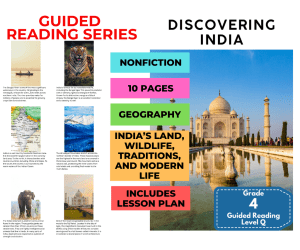
Discovering India: Guided Reading Level Q with Lesson Plan
ELA, Resources for Teachers, Reading Comprehension, Reading, Science, Geography, Social Studies, Technology, History, Life Sciences, Grade 3, 4, 5, Worksheets & Printables, Worksheets, Teacher Tools, Centers, Activities, Literacy Readers, Quizzes, Quizzes and Tests, Assessments, Lesson Plans
This Discovering India (level q) guided reading book with lesson plan includes: Guided Reading Color Label (front cover x1) This is a quick way to match the book’s demands to what students can generally handle.. The overall goal is to use the level/color to pick books for several smaller groups. To qualify for a certain level, a student is expected to read a book from that level with about 90–94% accuracy. If a student is consistently accurate and understands, move up a level. If the student is struggling at that level, drop down and add more support. Each student will improve at completely different rates, but it is generally one of the best ways to check progress across the class. DOWNLOAD THE CATALOG TO VIEW ALL GUIDED READING BOOKS AVAILABLE (SORTED LEVELS A-Z) Pre-Reading Question (x1) Teacher asks the prompt aloud, can be while showing the cover or first page. Students share what they already know, or make educated guesses from the cover. Prompt them to use the target vocabulary. Write some of their responses on the board to look back at during the reading. Vocabulary Words (x5) Introduce the five words, best doing it one at a time. Start by saying it, while students repeat and then see if anyone knows what it means before reading further. Read through the meaning and try to briefly connect each word to a picture or gesture so it’s meaningful. Ask students to flip through the book pages and point to where they see each of the vocabulary words. While reading the book pause upon coming across one of the vocab words or read the sentence twice to make sure students understand the word has appeared. Optional: Ask students to raise hands whenever they see/hear one of the new words. Guided Reading Pages (x10) Check the book snapshot (below) for: primary topic - do you need to prep extra reading or intro materials on this? what is taught best - decide on 1-2 bullets to focus on, use the prompt or words provided here for best results. learning goals - what you are checking for students to be able to do after the session, elicit answers using prompts or words provided. key vocabulary (see section above). questions overview - so you know what is coming up and if you need to prep extra materials to assist understanding. Run the lesson You may have already looked at a few of the pages together, but you can show them some of the pictures again first to set meaning. Depending on how much time you have and how familiar your students are with guided reading class, you may want to read the book aloud first with the group first. Students whisper or partner read, while you listen in. If time, do it as a group, one student reading a page each. Use the guided page’s prompts to coach: “Check the picture / does it make sense?” “Point under the words / try the first sound” “Reread the sentence smoothly”. Try to focus more on one student per session (rotating every time), so you can work out if they are ready to move up or need to move down a level. Comprehension Questions (back cover x3) This is your way to check that students didn’t just say the words, but actually understood the text. First, let students answer by pointing to the page/picture and saying a short sentence. After any answer, follow with: “Show me where you found that in the text.” In bigger groups, have partners answer first (10–20 seconds), then call on 2–3 students to share. Differentiation tips: Emerging speakers/struggling readers: oral + pointing On-level: oral in a full sentence Higher: one written sentence or draw + label Book Snapshot Title: Discovering India Genre: Nonfiction Subject: Social Studies (Geography/Culture) Primary Topic: India’s land, wildlife, traditions, and modern life Estimated Guided Reading Level (A–Z): Q What This Book Teaches Best Key geography facts about India’s location in Southern Asia, nearby borders, and surrounding waters. How landforms shape life in India, including the Himalayan Mountains and the Ganges River. Notable wildlife of India through examples like the Bengal tiger and the Indian elephant. Cultural traditions and everyday life, including spices used in meals and the celebration of Diwali. Modern India today, including transportation (auto-rickshaws) and major cities connected to technology and innovation. Learning Goals Students will describe where India is located and name details about its borders and southern waters. Students will explain how the Himalayan Mountains are described as protecting the inner plains. Students will explain why the Ganges River is important to people and farming in northern India. Students will describe key traits of the Bengal tiger and the Indian elephant using details from the text. Students will identify facts about the Taj Mahal, including where it is and features described in the book. Students will describe examples of Indian culture and modern life mentioned in the text (foods/spices, Diwali, transportation, cities). Key Vocabulary From the Text vast — very large in size. significant — very important. distinctive — easy to notice because it looks different. minarets — tall towers on a monument. diyas — small clay lamps used during Diwali. Discussion Prompts Pre-reading question: What are you hoping to learn about India as you read? Comprehension questions: What warm waters does the text say surround India to the south? Comprehension questions: According to the text, why is the Ganges River essential? Comprehension questions: What does the text say diyas symbolize during Diwali? Printing Tips 1. Best Printing Method (Recommended) “Booklet” Printing (Best if Available) If your printer or PDF viewer supports Booklet Printing , use this. Settings to use: Print mode: Booklet Paper size: Letter or A4 (either works) Orientation: Landscape Print on both sides: Yes Flip on: Short edge Scaling: Fit to printable area Booklet subset: First test: Front sides only Then: Back sides only This will automatically: Pair pages correctly Put the cover on the outside Align everything for folding After printing, fold in half and staple along the spine . 2. If “Booklet” Printing Is NOT Available You can still print this correctly with manual duplex printing . Step-by-step: Open the PDF. Choose Print . Set: Orientation: Landscape Pages per sheet: 1 Print on both sides: Yes Flip on: Short edge Print all pages . Because each PDF page already contains two facing book pages, the result will still fold cleanly into a book. Thousands of Cored Education products are included with your TeachSimple membership. Download links and encyclopedia index available here.
Author Cored Education
Rating
Tags Reading Comprehension, Reading Passages, Reading, Guided Reading, Guided Reading Lesson Plan, Guided Reading Activity, Pre-reading, Social Studies, Geography, History

Reading Comprehension: Cells, Reproduction and Genetics (Google Drive)
Science, Life Sciences, Human Body, Biology, Common Core, ELA, Reading Comprehension, Reading, Nature & Plants, Grade 5, 6, 7, Assessments, Teacher Tools, Presentations, Tests, Quizzes and Tests, Worksheets, Worksheets & Printables, Centers, Activities
Reading Comprehension: Cells, Reproduction and Genetics for Life Science (Biology) Cells, Reproduction and Genetics: Reading Passages Life Science - Enhance your assessment process with this ready-to-use science reading passage pack. Featuring enjoyable topics and themes, it's tailored to ensure students not only practice but also deepen their scientific understanding in preparation for tests. With questions meticulously aligned to the Common Core State Standards (CCSS), the pack dives into intriguing subjects such as circuits, electricity, and energy sources. It's a must-have resource for educators aiming to make learning both fun and fruitful. What's inside? Part 1 - Cells, Reproduction, Genetics Reading Passage 1: Cells Reading Passage 2: Cell Parts & Functions Reading Passage 3: Reproduction & Growth of Cells Reading Passage 4: Genetics Reading Passage 5: DNA Reading Passage 6: Uses of Genetics Product Info: 32 PAGES (Docs Version: US English with Answers) 6 FORMS (Self-Grading) 229 Slides Teaching Duration: 2 Weeks Science Reading Comprehension Outline: Introducing a comprehensive resource tailored for 5th and 6th graders, this product offers enriching reading passages supplemented with illustrative pictures and graphs to clarify key concepts. Aligned with the Common Core State Standards (CCSS), it offers a hassle-free approach to teaching, given that the bulk of the preparation is already done for you. The passages present a diverse set of questions – from multiple choice to data analysis and fill-in-the-blanks. This ensures a rich blend of high-interest content and fundamental curriculum-based science themes. With its versatility, you can seamlessly integrate these lessons into various classroom settings, whether it's whole class discussions, morning exercises, independent desk tasks, small group engagements, contingency plans for substitute teachers, regular homework assignments, or even themed activities for holidays. FULL CATALOG OF DOWNLOAD LINKS HERE Grade 5/6 Links: Physical Science Part 1 - Physical and Chemical Properties Google Docs/Slides/Forms PDF PPT Word Free Supplementary Pack Accompanying Videos Physical Science Part 2 - Motion and Energy Google Docs/Slides/Forms PDF PPT Word Free Supplementary Pack Accompanying Videos Physical Science Part 3 - Electricity and Magnets Google Docs/Slides/Forms PDF PPT Word Free Supplementary Pack Accompanying Videos Life Science Part 1 - Cells, Reproduction and Genetics Google Docs/Slides/Forms PDF PPT Word Free Supplementary Pack Accompanying Videos Life Science Part 2 - Human Body Systems Google Docs/Slides/Forms PDF PPT Word Free Supplementary Pack Accompanying Videos Life Science Part 3 - Plant Parts and Ecosystems Google Docs/Slides/Forms PDF PPT Word Free Supplementary Pack Accompanying Videos Earth Science Part 1 - Plate Tectonics and Rock Cycle Google Docs/Slides/Forms PDF PPT Word Free Supplementary Pack Accompanying Videos Earth Science Part 2 - Ocean Exploration and Natural Resources Google Docs/Slides/Forms PDF PPT Word Free Supplementary Pack Accompanying Videos Earth Science Part 3 - Weather and Solar System Google Docs/Slides/Forms PDF PPT Word Free Supplementary Pack Accompanying Videos For similar products and other frees, do check out Cored Group on TeachSimple .
Author Cored Education
Rating
Tags Science, Elementary, Reading, Comprehension, Vocabulary, Answers, Physics, Physical Science, Ccss, Digital Centers
Amazing Survival Stories Book: Reading and Writing Worksheets
ELA, Reading, Grade 3, 4, 5, 6, 7, 8, Worksheets, Worksheets & Printables
The Amazing Survival Stories Book: Reading and Writing Worksheets resource was created with reluctant readers in mind. The goal is that these survival stories grab the young reader's attention. Students can increase their reading and comprehension skills through these stories. The stories are written with vivid details and there are worksheets to follow. All of the activities vary from story to story to keep students engaged. This is a 68-page download.
Author Ready-Ed Publications
Tags Reading Worksheets, Writing Worksheets, Reluctant Readers, Survival Stories, Survival Kits

Square Root and Cube Root Mental Math Matching Game Estimating 8th 9th
Math, Algebra, Number Lines, Multiplication and Division, Grade 8, 9, Activities, Games, Worksheets & Printables, Worksheets
Here's a fun and hands-on way for your students to practice estimating square roots & cube roots using logical mental math strategies and known benchmarks. It's a simple matching game for students in 8th & 9th grade when they are learning about square roots & cube roots in math class. How to Use: Print a worksheet for each of your students along with a set of 24 matching cards for each group of two to four students. First, students need to complete their Square and Cube Roots Cheat Sheet. Give them time in class to do this in pairs or small groups. They should hold on to this sheet for the whole unit as it will be a useful resource. Let them practice estimating square and cube roots with the five practice questions. Go over mental math strategies as a class (use the answer key for ideas). When it’s time for the game, give groups of students one set of 24 cards. They need to shuffle the cards and match them up. They could do this several ways: Play as a memory matching game : spread cards facedown, flip 2 cards, see if they match, flip them back if they don’t. Play like Go Fish - ask the other players for certain cards. Or just spread all the cards out face-up, match up a pair, and explain why it’s a match . Grades to Use With: This game is designed to target 8th grade math learning outcomes about square roots, cube roots, mental math, and estimation. It could be used in 9th grade as a review activity. It could be used in high school special education classes where appropriate. What's Included: 6-Page PDF Ready to Print and Use! Teacher Instructions Square Root and Cube Root Cheat Sheet Answer Key for Square Root and Cube Root Cheat Sheet 3 pages (24 cards) for the Matching Game
Author Grace Under Pressure
Rating
Tags Square Root, Cube Root, Estimate Square Root, Estimate Cube Root, Square Root Game, Cube Root Game, Root Game, Perfect Square, Perfect Cube, Square Roots

Photosynthesis Lesson and Experiment for 3rd and 4th Grade Science
Science, Nature & Plants, Life Sciences, Earth and Environmental Sciences, Earth Sciences, Biology, Grade 3, 4, 5, Centers, Activities, Labs, Experiments, Worksheets, Worksheets & Printables
Photosynthesis Lesson, Worksheets, and Experiment How Plants Make Food - 3rd & 4th Grade Science Lesson I created this resource to give students a clear and enjoyable introduction to photosynthesis. The lesson blends reading, discussion, and a hands-on experiment so students can see how plants make their own food in a way that feels real and meaningful. I put this resource together because photosynthesis is one of those topics that becomes much easier to understand when students can read about it and observe it in action. This set offers a mix of activities that help students explore the idea from different angles. What’s inside? A short reading passage that explains photosynthesis Seven comprehension questions with an answer key A step by step experiment using black gram seeds Follow-up discussion questions to guide class conversation Safety notes and cautions for the experiment Two anchor charts that break the process into small pieces A quick True/False activity with answers A diagram activity where students label the photosynthesis process A story-writing page where students write from the point of view of a plant Complete answer keys to all the questions are included in this resource Resource features: I designed this set with 3rd and 4th graders in my mind. The reading level and activities are approachable for that age group. The experiment inside the resource is simple enough for students to complete in small groups, but still gives them something meaningful to observe. I have written all the instructions clearly. Each activity in this resource builds on the previous one so students can connect ideas as they go. This resource also blends science with literacy, drawing, and creative thinking, which makes it easy to fit into a variety of lesson plans or science centers. Ways to use it: Reading activity: Have students read the passage and answer the questions independently or with partners. Vocabulary work: Create a small word wall or glossary for science terms. Hands-on learning: Set up the seed experiment as a class or rotate it through small groups. Science journals: Encourage students to record their predictions and observations throughout the experiment. Art activity: Students can draw and label the parts of a plant involved in photosynthesis. Writing prompt: Let students write a short story from the perspective of a plant creating its own food. Group talk: Compare observations, discuss results, and talk through what might have caused them. Extensions: Students can look at different types of plants and explore how sunlight and environment affect their growth. Usefulness for teachers, homeschoolers, and parents This resource works well as a mini-unit as it requires very little preparation. The activities give students different ways to understand the process of photosynthesis. This resource is suitable for a wide range of learners. It supports reading comprehension, science vocabulary, and basic scientific inquiry skills, all while keeping instructions simple enough for independent use. The experiment uses easy to find materials, and the activities make it simple to incorporate science into home learning or family projects. photosynthesis, 3rd grade science, 4th grade science, anecdotal activity, photosynthesis story, hands-on learning, plant science, reading comprehension, science experiments, STEM, elementary education, homeschool science, nature study, scientific inquiry, vocabulary building, cross-curricular learning, environmental education, chlorophyll experiment, plant growth, science journaling, critical thinking, observation skills, teaching resource, environmental science, anchor charts, photosynthesis experiment
Author FlashKart
Rating
Tags Science, Photosynthesis, Plants, 3rd Grade Science, 4th Grade Science, Photosynthesis Experiment, Science Reading, Sunlight, Science Process, Earth Science

Past Tense Supplementary Materials Grades 3-4 (PDF)
ELA, Language Development, ESL, Grammar, Common Core, Resources for Teachers, Grade 3, 4, Worksheets & Printables, Worksheets, Quizzes and Tests, Teacher Tools, Tests, Assessments, Activities, Lesson Plans
Past Tense Supplementary Materials Note: This download DOES NOT include the tests themselves. You can still make use of these materials without them but they are recommended. Download in a format of your choice in the "Links" section below. Outline Ice Breaker (5-10 minutes) Engaging, interactive activity to introduce the lesson’s theme. Examples: Matching games, sentence races, charades, or storytelling challenges. Guided Practice (10-15 minutes) Teacher-led exercises to reinforce the concept. Examples: Sorting sentences by tense, sentence transformations, or fill-in-the-gap exercises. Group or Partner Task (15 minutes) Collaborative activity to practice the lesson’s focus in a fun and engaging way. Examples: Role-play, storytelling, sentence-building games, or small-group discussions. Independent Worksheet (15 minutes) Individual written activity to solidify understanding. Examples: Sentence corrections, verb conjugation drills, or tense identification exercises. Exit Task (5 minutes) Quick reflective activity to assess understanding before students leave. Examples: Writing a sentence using the target concept, identifying a tense, or explaining a rule. Links: Includes: Past Simple Past Continuous Past Perfect Mistake Finding Google Docs Google Forms Google Slides PDF PPT Word FULL CATALOG OF DOWNLOAD LINKS HERE Grade 3/4 Links: Adjectives Google Docs Google Forms Google Slides PDF PPT Word Free Supplementary Materials Pack Adverbs Google Docs Google Forms Google Slides PDF PPT Word Free Supplementary Materials Pack Conjunctions Google Docs Google Forms Google Slides PDF PPT Word Free Supplementary Materials Pack Nouns Google Docs Google Forms Google Slides PDF PPT Word Free Supplementary Materials Pack Pronouns Google Docs Google Forms Google Slides PDF PPT Word Free Supplementary Materials Pack Verbs Google Docs Google Forms Google Slides PDF PPT Word Free Supplementary Materials Pack Sentence Structure Google Docs Google Forms Google Slides PDF PPT Word Free Supplementary Materials Pack Present Tense Google Docs Google Forms Google Slides PDF PPT Word Free Supplementary Materials Pack Past Tense Google Docs Google Forms Google Slides PDF PPT Word Free Supplementary Materials Pack Future Tense Google Docs Google Forms Google Slides PDF PPT Word Free Supplementary Materials Pack Context Clues Google Docs Google Forms Google Slides PDF PPT Word Free Supplementary Materials Pack Defining Words Google Docs Google Forms Google Slides PDF PPT Word Free Supplementary Materials Pack Fill the Blanks Google Docs Google Forms Google Slides PDF PPT Word Free Supplementary Materials Pack Homophones Google Docs Google Forms Google Slides PDF PPT Word Free Supplementary Materials Pack Synonyms Google Docs Google Forms Google Slides PDF PPT Word Free Supplementary Materials Pack ELA Review Questions Overview Questions have three answer choices. There are a handful of pictures on each test for aesthetic purposes, as well as a review sheet covering most of the topics covered in the product. Introduction or Example Sheet Each topic will include an introduction or example sheet to go through first with your students. Full Answer Keys Full answer keys and sample responses are provided so no matter how busy you are, you know you're covered! In the Supplementary Pack Interactive Ice Breakers: Fun, hands-on activities that get students thinking about adjectives right from the start. Guided Practice: Teacher-led exercises that reinforce the day’s lesson, ensuring students can confidently identify and use adjectives. Group and Partner Tasks: Collaborative activities that allow students to work together to solve problems, categorize adjectives, and create descriptive sentences. Independent Worksheets: Structured worksheets that provide individual practice and help solidify understanding of key concepts. Exit Tasks: Quick, reflective activities at the end of each lesson that assess understanding and encourage students to apply what they’ve learned. For similar downloads and other frees, do check out Cored Group on TeachSimple.
Author Cored Education
Tags Elementary, Answers, Ccss, Common Core, Grammar, Tests, Test Prep, Grade 3, Grade 4, Lesson Plan

Kindness Crosswords (PDF)
ELA, Language Development, Resources for Teachers, Vocabulary, Spelling, ESL, Life Skills, Special Resources, Social Skills, Grade 2, 3, 4, 5, Worksheets & Printables, Worksheets, Teacher Tools, Crosswords Puzzles, Centers, Activities
Crossword Series This crossword series is designed for students in grades 2–5. Each set of crosswords is built around a clear vocabulary theme, allowing students to strengthen their word recognition, build subject-based knowledge, and reinforce early literacy and thinking skills. Each topic includes six crossword sets , and each set features the following consistent structure: 1. 8 vocabulary clues 2. Crossword puzzle 3. Answer key 4. 1 Did You Know fact related to the set These crosswords are designed to be student-friendly, classroom-ready, and easily integrated into thematic units, seasonal learning, morning work, or independent literacy stations. Kindness Crosswords Word List 1. Kind Words Please, Thank, Hello, Sorry, Nice, Smile, Help, Share 2. Helping Others Help, Share, Carry, Give, Fix, Ask, Listen, Care 3. Being a Good Friend Friend, Play, Talk, Laugh, Help, Hug, Share, Kind 4. Showing Respect Listen, Quiet, Wait, Polite, Honest, Fair, Safe, Friendly 5. Kindness at School Teacher, Share, Wait, Help, Quiet, Fair, Write, Learn 6. Kindness at Home Parent, Sibling, Grandparent, Care, Share, Talk, Meal, Love PDF Version Other versions will appear here when available. Follow the store for the lastest on new products. How to Use This Crossword These crosswords are ideal for whole-class work, small groups, literacy centers, or take-home activities. Use one set per day, or spread them across a week or month depending on your curriculum needs. Each clue has been crafted to align with the reading level of grades 2–5, with support for both decoding and meaning. The Did You Know? facts offer additional extension opportunities for writing, drawing, or display work. Whether you're reinforcing vocabulary, exploring a seasonal topic, or adding variety to your literacy block, these crosswords provide a fun, flexible, and focused way to boost early literacy in an engaging format. More Kindness Themed Products Nothing yet but follow the store for the lastest on new products. FULL CATALOG OF DOWNLOAD LINKS HERE AdditionAddition PDF Animals PDF Around the Home PDF Birthday PDF Candy PDF Christmas PDF Cinco de Mayo PDF Clothes PDF Colors PDF Days and Months PDF Division PDF Earth Day PDF Easter PDF Easy Crosswords PDF Fall PDF Father's Day PDF Food PDF Geography (Set 1) PDF Geography (Set 2) PDF Geography (Set 3) PDF Graduation PDF Health PDF History (Set 1) PDF History (Set 2) PDF History (Set 3) PDF Human Body PDF Kindness PDF Life Skills PDF Mother's Day PDF Multiplication PDF Science Crosswords (Set 1) PDF Science Crosswords (Set 2) PDF Science Crosswords (Set 3) PDF Shapes PDF Social Skills PDF Spring PDF Sports PDF St. Patrick's Day PDF Subtraction PDF Summer PDF Thanksgiving PDF Transport PDF Valentine's Day PDF Winter PDF Crosswords in Depth Structure Each crossword clue is written in simplified language to suit early readers, and follows a strict number-and-clue format (e.g., 1.A shape with four sides ). Students complete each puzzle using the themed vocabulary provided, helping to build both content knowledge and spelling confidence. Each completed set includes: A questions section with clearly formatted clues An answers section to support teacher checking or independent correction A Did You Know? fact tied to the topic (one per set) to add curiosity and cross-curricular value Themes Included The crosswords cover a wide variety of engaging, age-appropriate themes such as: Seasons & Holidays (e.g., Winter, Easter, Valentine’s Day) Math Concepts (e.g., Addition, Subtraction, Multiplication, Division) Everyday Topics (e.g., School, Colors, Animals, Weather) Special Units (e.g., Health, Earth Day, Sports, Graduation, Kindness) Each theme is carefully selected to reflect the experiences and interests of young learners, while reinforcing vocabulary and comprehension. For similar downloads and other frees, do check out Cored Group on TeachSimple.
Author Cored Education
Rating
Tags Vocabulary, Spelling, Crosswords, Kindness, Kindness Crosswords, Kind Words, Helping Others, Ela Crosswords, Crossword, Kindness Activities
Reading Comprehension Passages Nonfiction Set 1 (Docs) Digital Centers
ELA, Reading, Common Core, Reading Comprehension, Language Development, Spelling, Vocabulary, Resources for Teachers, Writing, Creative Writing, Grade 6, 7, Worksheets & Printables, Worksheets, Centers, Activities, Writing Prompts, Assessments, Teacher Tools, Tests, Quizzes and Tests
Reading Comprehension Passages Nonfiction Set 1 Overview Reading comprehension lessons, especially written for Grade 6-7, providing the chance to read interesting and engaging passages. Each lesson has a mix of questions to check understanding, a vocabulary or spelling activity to help remember key language introduced, and a writing exercise. Full answer keys are provided. Passages Include 1.American Bison: Find out more about North America's heaviest land animal. 2.Brown Bears: Featuring brown bears and Kodiak bears. 3.Elephant Seals: Fact: Elephant Seals spend 2 months a year on the beach! 4.Visayan Pigs: Punk rock pigs? Discover more about this endangered species. 5.Seahorses:Terrible swimmers but beautiful creatures all the same. 6.Pandas: Read about China's national symbol then write about America's. 7.Wolves: What does a wolf's howl mean? This article features that, and more! 8.Blue Jays: Can imitate other bird calls and feast on other birds' eggs! 9.Iceland: An amazing country, find out everything there is to know in this one. 10.Yogurt: Healthiest treat? Learn how yogurt is made & how it's good for us. 11.Karate: Who? How? When? Where? Did Karate all begin? 12.Clean Air: A longer article but the most important of subjects. Google Docs Version This is the Google Docs fillable and editable version. This download is available in GOOGLE Docs, GOOGLE Forms, GOOGLE Slides. PDF, PPT, WORD. FULL CATALOG OF DOWNLOAD LINKS HERE Grade 6/7 Links Fiction Set 1 Google Docs Google Forms Google Slides PDF PPT Word Guided Reading Materials Fiction Set 2 Google Docs Google Forms Google Slides PDF PPT Word Guided Reading Materials Nonfiction Set 1 Google Docs Google Forms Google Slides PDF PPT Word Guided Reading Materials Nonfiction Set 2 Google Docs Google Forms Google Slides PDF PPT Word Guided Reading Materials Reading Passages Overview Each passage is especially written for Grade 6/7 students, including key vocabulary required for this age group. Topics are varied and are accompanied by colorful graphics. Topics are meant to educate, yet entertain the modern student. The majority of these short stories contain an important message - a way of developing these young learners further. Mixed Questions The mixed questions section of each lesson includes a variation of five to six comprehension, vocabulary and Math questions. In addition, key reading strategies are frequently covered including cause & effect, summarizing, compare & contrast and making conclusions. Mixed questions require a written response (no MCQ's), full answers and example responses appear at the end of the lesson. Spelling & Vocab Each reading passage contains a variety of words and phrases designed for Grade 6/7 students. Spelling and vocab activities provide the opportunity to build fluency with these words. Activities provide clues to help assist students. Vocabulary activities include extra questions where students must write a synonym, an antonym or a sentence using a certain word. Writing Prompts Writing prompts are designed to continue the theme or lessons learned in the story. Students are persuaded to write in a variety of ways and each prompt includes several cues to help. The main focus in this product, is the student. Prompts will require the student to relate to past experiences and encourage them to discuss feelings and ways to improve. Full Answer Keys Full answer keys and sample responses are provided so no matter how busy you are, you know you're covered! Mixed question answers provide evidence from the text, Math questions contain the relevant workings. Answers are designed for use by the teacher, but also suitable as a handout to the student. For similar downloads and other frees, do check out Cored Group on TeachSimple.
Author Cored Education
Rating
Tags Elementary, Reading, Comprehension, Vocabulary, Answers, Common Core, Spelling, Writing, Digital Centers, Vocabulary Assessments
Addition Word Searches (PDF)
ELA, Language Development, Resources for Teachers, Vocabulary, Spelling, Addition and Subtraction, Math, Addition, Early Math, Numbers, Grade 2, 3, 4, 5, Worksheets & Printables, Worksheets, Teacher Tools, Centers, Activities, Word Searches
Wordsearch Series This wordsearch series is designed for students in grades 2–5. Each set of wordsearches is built around a clear vocabulary theme, helping students develop word recognition, improve spelling, and boost topic-related understanding through engaging visual puzzles. Every wordsearch also includes a fun hidden shape for students to guess—adding an interactive twist to traditional vocabulary practice. These wordsearches are student-friendly, classroom-ready, and perfect for integrating into literacy warmups, seasonal units, fast-finisher tasks, or home learning extensions. Each puzzle reinforces themed vocabulary in a playful, structured format that keeps learners motivated. Addition Word Search Word List 1. Basic Addition Seven, Eight, Nine, Ten, Thirteen, Fourteen, Sixteen, Fifteen 2. Slightly Harder Addition Five, Eleven, Twelve, Seventeen, Nineteen, Twenty, Twenty-Two, Twenty-Five 3. Intermediate Addition Eighteen, Twenty-One, Twenty-Six, Twenty-Seven, Thirty, Thirty-Three, Thirty-Four, Thirty-Five 4. Larger Numbers Forty, Forty-Two, Forty-Five, Forty-Seven, Fifty, Fifty-Four, Fifty-Eight, Sixty 5. Up to Seventy-Five Sixty-Five, Sixty-Nine, Seventy, Seventy-Two, Seventy-Five, Seventy-Nine, Eighty, Eighty-Five 6. Up to One Hundred Eighty-Nine, Ninety, Ninety-Five, Ninety-Seven, Ninety-Nine, One Hundred, One Hundred Five, One Hundred Ten PDF Version Other versions will appear here when available. Follow the store for the lastest on new products. How to Use These Wordsearches These wordsearches are ideal for: Morning work or early finisher bins Vocabulary centers or anchor activities Holiday or seasonal review lessons Independent literacy stations or take-home enrichment Each puzzle includes a themed word list and a shaped grid for students to complete. Word directions may vary (horizontal, vertical, diagonal), and answer keys are included for easy checking. Optional vocabulary challenges or writing tasks can be added to extend the learning experience. Whether you're reviewing key vocabulary, exploring a seasonal topic, or offering fun literacy practice, these wordsearches provide a flexible and engaging tool to support vocabulary growth in grades 2–5. More Addition Themed Products CROSSWORDS FULL CATALOG OF DOWNLOAD LINKS HERE Themed Word Search Links Addition PDF Animals PDF Around the Home PDF Birthday PDF Candy PDF Christmas PDF Cinco de Mayo PDF Clothes PDF Colors PDF Days and Months PDF Division PDF Earth Day PDF Easter PDF Easy Word Searches PDF Fall PDF Father's Day PDF Food PDF Geography (Set 1) PDF Geography (Set 2) PDF Geography (Set 3) PDF Graduation PDF Health PDF History (Set 1) PDF History (Set 2) PDF History (Set 3) PDF Human Body PDF Kindness PDF Life Skills PDF Mother's Day PDF Multiplication PDF Science Word Searches (Set 1) PDF Science Word Searches (Set 2) PDF Science Word Searches (Set 3) PDF Shapes PDF Social Skills PDF Spring PDF Sports PDF St. Patrick's Day PDF Subtraction PDF Summer PDF Thanksgiving PDF Transport PDF Valentine's Day PDF Winter PDF Wordsearches in Depth Structure Each wordsearch is crafted around a focused sub-theme and includes a visual puzzle shaped like a related object (e.g., balloon, gift, snowman). Students complete each puzzle using the provided themed word list, strengthening both content knowledge and spelling skills in a highly engaging format. Each completed set includes: A shaped wordsearch puzzle with 10 vocabulary words A student instruction guide with search directions (horizontal, vertical, diagonal) An answer key for teacher support or student self-checking A Did You Know? fact connected to the theme for enrichment or discussion Themes Included The wordsearches cover a wide range of fun, age-appropriate themes, including: Seasons & Holidays (e.g., Halloween, Easter, Valentine’s Day) Math Concepts (e.g., Addition, Number Words) Everyday Topics (e.g., Animals, Weather, School) Special Units (e.g., Health, Earth Day, Sports, Kindness) Each topic is selected to reflect students’ real-life experiences and interests while reinforcing literacy skills and content understanding in a playful, visual way. For similar downloads and other frees, do check out Cored Group on TeachSimple.
Author Cored Education
Rating
Tags Vocabulary, Spelling, Math, Basic Addition, Slightly Harder Addition, Intermediate Addition, Addition Activities, Word Searches, Addition Word Searches, Word Search
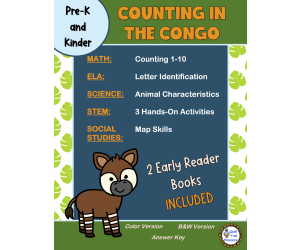
Congo Rainforest Worksheets & Activities | Cross-Curriculum
ELA, Reading, Reading Comprehension, STEM, Animals, Life Sciences, Science, Math, Counting, Early Math, Kindergarten, Activities, Worksheets & Printables, Worksheets, Read Alouds, Writing Prompts
Take your young learners on a journey through the Congo rainforest with these fun and engaging activities. Designed for learners in Pre-K and kindergarten, this product will give them the opportunity to strengthen skills across several learning domains. They’ll begin their journey travelling through the pages of “Counting in the Congo” all while practicing their reading and math skills. Next, they will complete a personalized version of the early reader book, helping to provide motivation for continued reading. Through the process of completing each of the 15 worksheets, your learners will focus on a variety of math, ELA, science, social studies, and STEM concepts . This product is a sure hit for all types of learners as it is filled with colorful, kid-friendly graphics, easy to understand instructions, and the opportunity to write, cut, glue, draw, build, and think outside the box. There are also several benefits for you in that both books and most worksheets are available in both color and black & white versions. Not only that, but the worksheets are print and go, allowing you to spend more time with your learners rather than prepping materials. Each worksheet and activity can be used independently or with various group sizes. They also make for a great last-minute fill-in for substitute teachers or changes in daily plans/routines. What’s more is that many of the worksheets can be laminated and used as a write-on/wipe-off activity in a small group setting. Whatever the situation, you can’t go wrong with this product. Take a look below at the details for each worksheet/activity. “COUNTING THE IN THE CONGO” Book 1 Learners will use the repetitive words to read through the 14 pages. They’ll practice number identification, counting 1-10, and 1-to-1 correspondence using a variety of animals found in the Congo rainforest. “COUNTING THE IN THE CONGO” Book 2 This interactive version will allow your learners to personalize the book. They’ll practice the aforementioned skills, while also writing numerals 1-10, reading color words, and following 1-step instructions. WORKSHEETS 1 & 2 : learners will identify numbers 0-10, write the numbers on the line, and count the corresponding markings on each rainforest snake. WORKSHEET 3 : learners will identify numbers and color names, then color the corresponding number of rainforest animals in each column. WORKSHEET 4: learners will count the groups of rainforest animals and write the corresponding number on the line. WORKSHEET 5: learners will identify numbers and cross out the group of rainforest fruits that do not match the numbers. INSTRUCTION PAGE: directions for 3 STEM activities focusing on estimating, measuring, problem solving, and fine motor skills (with a monkey theme). WORKSHEETS 6-8: learners will record data and reflect on the process of each STEM activity. WORKSHEET 9: learners will use cutting and gluing skills to sort rainforest animals in 3 categories (feathers, fur, scales) WORKSHEET 10: learners will practice reading comprehension skills by circling the animal that matches the sentence from the book. WORKSHEET 11: learners will practice identifying uppercase letters and their corresponding sounds, as well as writing uppercase and lowercase letters. WORKSHEET 12: learners will complete the writing prompt and draw a corresponding illustration. WORKSHEET 13: using the map of Africa, learners will practice color identification, writing uppercase and lowercase letters, measurement, and drawing. WORKSHEET 14: learners will strengthen visual discrimination skills by matching rainforest animals to their respective shadows. WORKSHEET 15: learners will draw a picture of their Congo rainforest family and write the number of members in said family. ANSWER KEY FOR ALL WORKSHEETS
Author Quail Trail Products
Rating
Tags Rainforest, Congo, Math, Ela, Science, STEM, Early Readers, Writing, Map Skills, Reading Comprehension

Subject-Verb Agreement Practice Questions - Grammar Grade 5-6 (Docs)
ELA, Language Development, ESL, Grammar, Common Core, Resources for Teachers, Grade 5, 6, 7, Worksheets & Printables, Worksheets, Quizzes and Tests, Teacher Tools, Tests, Assessments, Centers, Activities
Subject-Verb Agreement Grammar Practice MCQS ELA MCQS Overview: In this series of lessons, students will embark on an engaging journey to master the language arts skills that make communication effective and expressive. These lessons are designed to help students recognize, understand, and apply key grammar, vocabulary, and writing conventions in both their writing and speech. Each lesson builds upon the previous one, providing a structured blend of direct instruction, interactive group activities, and independent practice. With engaging tasks and thought-provoking questions, students will explore sentence structure, word choice, punctuation, and grammar rules to strengthen their understanding of English language conventions. Accompanied by free supplementary materials covering all topics, this series ensures a well-rounded and enjoyable learning experience. Through practice and exploration, students will develop the skills needed to analyze language, construct clear sentences, and express themselves with confidence. Subject-Verb Agreement Overview: Major Subject-Verb Practice Wish Sentences Request Sentences Contrary to Fact Sentences Docs Version This is the Docs editable and fillable version. This download is available in GOOGLE Docs, GOOGLE Forms, GOOGLE Slides. PDF, PPT, WORD, check the links below for more details. FULL CATALOG OF DOWNLOAD LINKS HERE Grade 5/6 Links: Capitalization & Punctuation Google Docs Google Forms Google Slides PDF PPT Word Free Supplementary Materials Pack Adjectives Google Docs Google Forms Google Slides PDF PPT Word Free Supplementary Materials Pack Nouns Google Docs Google Forms Google Slides PDF PPT Word Free Supplementary Materials Pack Pronouns Google Docs Google Forms Google Slides PDF PPT Word Free Supplementary Materials Pack Verbs Google Docs Google Forms Google Slides PDF PPT Word Free Supplementary Materials Pack Prefixes & Suffixes Google Docs Google Forms Google Slides PDF PPT Word Free Supplementary Materials Pack Sentence Structure Google Docs Google Forms Google Slides PDF PPT Word Free Supplementary Materials Pack Subject Verb Agreement Google Docs Google Forms Google Slides PDF PPT Word Free Supplementary Materials Pack Tenses Google Docs Google Forms Google Slides PDF PPT Word Free Supplementary Materials Pack Context Clues Google Docs Google Forms Google Slides PDF PPT Word Free Supplementary Materials Pack Defining Words Google Docs Google Forms Google Slides PDF PPT Word Free Supplementary Materials Pack Fill in the Blanks Google Docs Google Forms Google Slides PDF PPT Word Free Supplementary Materials Pack Homophones Google Docs Google Forms Google Slides PDF PPT Word Free Supplementary Materials Pack Synonyms Google Docs Google Forms Google Slides PDF PPT Word Free Supplementary Materials Pack ELA Review Questions Overview Questions have three answer choices. There are a handful of pictures on each test for aesthetic purposes, as well as a review sheet covering most of the topics covered in the product. Introduction or Example Sheet Each topic will include an introduction or example sheet to go through first with your students. Full Answer Keys Full answer keys and sample responses are provided so no matter how busy you are, you know you're covered! In the Supplementary Pack Interactive Ice Breakers: Engaging warm-up activities that introduce students to key ELA concepts, such as quick capitalization corrections and punctuation challenges. Guided Practice: Structured teacher-led exercises that reinforce grammar and punctuation rules, helping students identify and apply them correctly in sentences. Group and Partner Tasks: Collaborative activities where students work together to edit sentences, correct capitalization, and improve punctuation through peer discussion and teamwork. Independent Worksheets: Carefully designed worksheets that provide focused practice, allowing students to apply learned concepts and refine their skills independently. Exit Tasks: Quick assessments at the end of each lesson, prompting students to reflect on what they’ve learned and apply their knowledge in writing and editing tasks. For More Like This For similar downloads and other frees, do check out Cored Group on TeachSimple.
Author Cored Education
Tags Elementary, Answers, Ccss, Common Core, Grammar, Tests, Test Prep, Grade 5, Grade 6, Digital Centers
Prefixes and Suffixes Supplementary Materials - Grades 1-2 (PDF)
ELA, Language Development, ESL, Grammar, Common Core, Resources for Teachers, Grade 1, 2, Teacher Tools, Lesson Plans, Outlines, Quizzes, Quizzes and Tests, Tests, Assessments, Worksheets & Printables, Worksheets
Prefixes and Suffixes Supplementary Materials Note: This download DOES NOT include the tests themselves. You can still make use of these materials without them but they are recommended. Download in a format of your choice in the "Links" section below. In the Supplementary Pack Interactive Ice Breakers: Fun, hands-on activities that get students thinking about adjectives right from the start. Guided Practice: Teacher-led exercises that reinforce the day’s lesson, ensuring students can confidently identify and use adjectives. Group and Partner Tasks: Collaborative activities that allow students to work together to solve problems, categorize adjectives, and create descriptive sentences. Independent Worksheets: Structured worksheets that provide individual practice and help solidify understanding of key concepts. Exit Tasks: Quick, reflective activities at the end of each lesson that assess understanding and encourage students to apply what they’ve learned. Links: Includes: Intro to Prefixes Intro to Suffixes Forming Suffixes Determining Affix Word Meaning Google Docs Google Forms Google Slides PDF PPT Word FULL CATALOG OF DOWNLOAD LINKS HERE Grade 1/2 Links: Capitalization and Punctuation Google Docs Google Forms Google Slides PDF PPT Word Free Supplementary Materials Pack Adjectives Google Docs Google Forms Google Slides PDF PPT Word Free Supplementary Materials Pack Nouns Google Docs Google Forms Google Slides PDF PPT Word Free Supplementary Materials Pack Pronouns Google Docs Google Forms Google Slides PDF PPT Word Free Supplementary Materials Pack Verbs Google Docs Google Forms Google Slides PDF PPT Word Free Supplementary Materials Pack Prefixes & Suffixes Google Docs Google Forms Google Slides PDF PPT Word Free Supplementary Materials Pack Sentence Structure Google Docs Google Forms Google Slides PDF PPT Word Free Supplementary Materials Pack Subject-Verb Agreement Google Docs Google Forms Google Slides PDF PPT Word Free Supplementary Materials Pack ELA Review Questions Overview Questions have three answer choices. There are a handful of pictures on each test for aesthetic purposes, as well as a review sheet covering most of the topics covered in the product. Introduction or Example Sheet Each topic will include an introduction or example sheet to go through first with your students. Full Answer Keys Full answer keys and sample responses are provided so no matter how busy you are, you know you're covered! In the Supplementary Pack Interactive Ice Breakers: Fun, hands-on activities that get students thinking about adjectives right from the start. Guided Practice: Teacher-led exercises that reinforce the day’s lesson, ensuring students can confidently identify and use adjectives. Group and Partner Tasks: Collaborative activities that allow students to work together to solve problems, categorize adjectives, and create descriptive sentences. Independent Worksheets: Structured worksheets that provide individual practice and help solidify understanding of key concepts. Exit Tasks: Quick, reflective activities at the end of each lesson that assess understanding and encourage students to apply what they’ve learned. For similar downloads and other frees, do check out Cored Group on TeachSimple.
Author Cored Education
Tags Elementary, Reading, Comprehension, Vocabulary, Answers, Ccss, Common Core, Spelling, Writing, Passages

Batteries Reading Comprehension Passage - Cored Ed Encyclopedia
ELA, Language Development, Reading Comprehension, Reading, Social Studies, Writing, History, Pre-Reading, Physics, Science, Grade 2, 3, 4, 5, Worksheets & Printables, Worksheets, Teacher Tools, Centers, Activities, Writing Prompts, Assessments, Quizzes and Tests, Quizzes, Lesson Plans
This batteries reading comprehension with lesson plan includes: Visualization (on the front cover) Start your lesson by taking a minute to think and share something about the topic. Read the script aloud (slowly), perhaps prepare some music or sound effects. Student close their eyes and let their imaginations wander. Students open their eyes, read the question aloud and give them a few minutes to complete. Ask a few students to share or keep answers until the end to compare with what they learn in the passage. COMPANION VIDEO NOW AVAILABLE (EMBEDDED AFTER PREVIEW PICTURES IN PRODUCT DESCRIPTION) Quick pause—thousands of Cored Education products are included with your TeachSimple membership. Download links and encyclopedia index available here. Pre-Reading Trivia Students will write down one thing they already know about the subject and then read five more facts and discuss. These facts are fun, and the students will enjoy learning about the subject before reading more. Give 1 minute for students to write what they already know (no pressure—best guess is fine). Read the five facts together. After each fact, do ask a student for their opinion, was it surprising? Set a purpose by asking students to highlight/underline one fact they want to learn more about during the reading. Reading Passage The text is a high-interest reading passage with set paragraphs, roughly three to four paragraphs long. It contains a variety of themes about the topic, anywhere from history to technology. The passage is between 250 and 350 words in length. First, ask students to look at the headings and see what they’ll learn about today. What do they know about the topic/heading? First read options: Teacher read-aloud (best for support). Partner reading (paragraph by paragraph). While reading, students underline important details, and vocabulary words they think may come up in the questions section. Mixed Questions The first question page contains four multiple-choice questions, each with a choice of four answers, and three written response questions that require a sentence or two from the student. Students complete the mcqs first independently, then review quickly as a class. For the 3 written responses, try to get students giving the answer with some form of evidence: “I think ___ because the text says ___.” If students get stuck, send them back to check the passage. Vocabulary Questions Practice seven key words from the text in this section across two activities. First section is scrambled words where students will unscramble three words given a clue for each. The second section is a word to meaning matching activity. Before starting, have some students read out words they underlined in the passage. Ask students to say the word and read aloud the sentence(s) around each word. Ask students to do scrambled words and the matching exercise in pairs then go through answers as a class. For the scrambled spelling task, get four pairs to come up to the board and write the words for extra practice with the other student reading out the clue. For the matching task, prompt students to give full sentences: “I matched ___ with ___ because ___.” Creative Writing In this question, the student will be required to write a five to eight sentence paragraph on a question related to the topic. Before starting, ask students write down 3 key ideas they are going to include in their piece. Ask students for ideas to share around the class to help those struggling. Pro writing expectations: 5–8 sentences At least 2 facts or details from the passage At least 2 vocabulary words from the previous page Students read their paragraphs while classmates listen for facts and vocabulary words. Extension Activities This page is optional for fast finishers or to take home. There are several activities, each one requiring a different skill. Do some, do none, do all, completely optional - but you will feel reassured knowing every possibility is planned for. Includes summary writting question and additional facts. Answer Key There are answers for the multiple-choice questions, written response questions have sample answers, vocabulary answers and if there is a summary question then a sample summary will be provided as well. Lesson Plan Included Customized lesson plan for this lesson is included. Lesson Snapshot Title: Batteries Genre: Nonfiction (informational passage) Subject: Science (Physical Science / Electricity) Primary Topic: How batteries store energy and changed over time Estimated Guided Reading Level (A–Z): T What This Lesson Teaches Best Explains what a battery does and how it powers devices when connected in a circuit (electrons moving through a wire to light a bulb or spin a motor). Introduces key electricity ideas in context (plus/minus ends guiding the “flow” the right way; current moving for a while). Gives a clear mini-history of batteries, from 1800’s “voltaic pile” to later “wet cells,” “dry cells,” and rechargeable batteries. Connects science to real-world uses, from small watch batteries to lithium-ion packs and room-size battery banks for the power grid. Highlights responsible use: batteries don’t last forever, so careful charging and recycling can help protect people and the planet. Learning Goals Identify what the passage says is stored inside a battery and what makes electricity move in a circuit. Explain, using the text, how electrons help a flashlight make a bright beam. Describe what Alessandro Volta built in 1800 and what materials were stacked. Compare “wet cells” and “dry cells” using details from the passage about carrying and spilling. Explain what makes a rechargeable battery different, based on how the passage describes “pushing” chemical changes backward. Describe how batteries are used today, including small devices and large battery banks on the power grid. Key Vocabulary From the Text electrons — tiny particles that can move through a wire. circuit — a path electricity travels through to do work. current — electricity moving steadily in a path. rechargeable — able to be filled up again with electricity. recycling — using materials again instead of throwing them away. FULL CATALOG OF DOWNLOAD LINKS AND ENCYCLOPEDIA INDEX HERE
Author Cored Education
Rating
Tags Vocabulary, Reading Comprehension, Reading Passages, Lesson Plans, Ela Lesson Plans, Reading Comprehension Lesson Plans, Pre-reading, History, Science Lesson Plans, Physics