



3,947 products added recently
Page 8 - Fantasy Writing Prompts

 Show filters

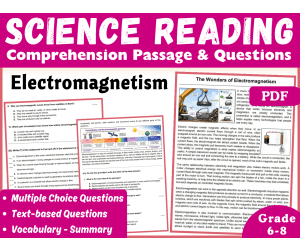
Physical Science Reading Comprehension Passage: Electromagnetism (PDF)
Science, ELA, Reading, Reading Comprehension, Strategies, Resources for Teachers, Physics, Grade 6, 7, 8, 9, Writing Prompts, Worksheets & Printables, Centers, Activities, Teacher Tools, Assessments, Quizzes and Tests, Quizzes, Tests
Physical Science Reading Comprehension Passage and Questions: Electromagnetism (PDF) This very engaging science reading passage is about electromagnetism and how electricity and magnetism work together in everyday technology . It explains that moving electric charges can create magnetic fields and shows how electromagnets can be turned on and off by controlling electric current. The passage describes how electromagnets are used in scrapyard cranes, classroom models, electric motors, and generators . It also introduces electromagnetic induction and explains how electromagnetic waves help carry signals for radios, cell phones, satellites, and other communication systems. This passage helps students understand how an invisible force powers machines, produces electricity, and sends information across long distances. This passage is designed to bridge the gap between science and literacy by strengthening reading comprehension while sparking scientific curiosity in middle school students. It blends English Language Arts skills with accurate science content, helping students build background knowledge, understand key concepts, use evidence from the text, and explain scientific ideas clearly. This resource supports science classroom practice while also reinforcing important literacy skills such as main idea, vocabulary, comprehension, and summarizing. Ideal for interdisciplinary learning in ELA and Science. Suitable for Grade 9 review, too! Student Tasks for The Passage: 10 multiple-choice questions targeting main idea, key details, science concepts, comparison, and real-world applications 8 True/False statements to check understanding and address common misconceptions 5 text-based short-answer questions that require students to explain important ideas from the passage 5 vocabulary matching items with clear, student-friendly definitions 1 summary prompt that asks students to condense the central ideas accurately Full answer key for every section Available Formats for this Resource Fillable PDF Word Docs Google Docs FULL CATALOG OF DOWNLOADING LINKS HERE Product Details Length: 6 pages total Grades: 6–8, also suitable for Grade 9 review Use cases: close reading, stations, homework, intervention, test prep, and sub plans Standards support: Reinforces informational-text skills and supports NGSS-style sense-making by helping students read scientific explanations, connect evidence to key concepts, interpret real-world examples, and explain cause-and-effect relationships in science. Why Teachers Choose This Set Authentic science content paired with rigorous literacy practice Consistent task structure across all passages for easier planning and smoother student routines Clear, age-appropriate writing that builds confidence without oversimplifying Other Science Reading Collections and Topics You May Find in the Store : 1. Astronomy & Space Science 2. Volcanoes, Rocks, & Mountains 3. Rock Cycle, Soil, & Sinkholes 4. Mars, Glaciers, & Antarctica 5. Water Cycle, Acid Rain, & Wastewater 6. Insects, Animals, & Ecosystems 7. Bioluminescence & Insects 8. Animal Skin, Cats, & T. Rex 9. Human Body and Senses 10. Health & Applied Bioscience 11. Waves, Light, & Imaging 12. Electricity & Energy 13. Motion & Materials 14. Chemistry and Materials Science 15. Electromagnetism 16. Acids and Bases 17. Gas Laws 18. Biotechnology 19. Periodic Trends 20. Protists and Fungi 21. Microevolution 22. Blood 23. Chemical Bonding 24. Magnets 25. Muscles 26. Nuclear Chemistry 27. Electromagnetic Devices 28. Epigenetics 29. The Law of Conservation of Mass 30. Atomic Models 31. Isotopes and Ions 32. Light 33. Human-Environment Interaction 34. Theory of Evolution 35. Photosynthesis 36. Origins of Life and Early Earth 37. Gene Expression and Regulation 38. Thermochemistry 39. Allergies 40. Coevolution 41. Birth to Adulthood 42. Cells 43. Entropy and Free Energy 44. The Human Brain 45. Mixtures and Solutions 46. Invertebrates 47. Zoo Animals 48. Biochemistry 49. Animal Behavior 50. Population Ecology ...and many more engaging science reading passages that cover intriguing and important topics designed to spark curiosity and support student learning. Use this passage to reinforce ELA skills in science, to add literacy to your lessons, and to support independent work. The passages strengthen main idea, evidence use, vocabulary in context, inference, cause and effect, and summary writing. With ready-to-use assessments and complete answer keys, you can provide focused practice that is simple to run and fast to review.
Author Middle & High School - CORED Education
Rating
Tags Middle School, Reading Comprehension, Reading Strategies, ELA, Centers, Reading Passage, Assessments, Vocabulary, Technology, Physics

Benjamin Franklin's Notebook of Virtues: Social Studies Passage (Word)
ELA, Reading, Reading Comprehension, Strategies, Resources for Teachers, Social Studies, History, History: USA, Grade 6, 7, 8, 9, Writing Prompts, Worksheets & Printables, Centers, Activities, Teacher Tools, Assessments, Quizzes and Tests, Quizzes, Tests
Benjamin Franklin's Notebook of Virtues: Social Studies Reading Comprehension Passage (Word) This resource introduces a unique Social Studies reading comprehension passage with questions about Benjamin Franklin's Notebook of Virtues. The passage is carefully designed to bridge the gap between social studies and literacy through strengthening reading comprehension and sparking knowledge curiosity in middle school students. Each passage blends English Language Arts skills with accurate social studies content . Ideal for interdisciplinary learning in ELA and Social Studies. Suitable for Grade 9 review, too! Student Tasks throughout the passage: 5 multiple-choice questions targeting the following skills: main idea, key details, inference, vocabulary in context, and use of evidence 5 vocabulary matching items with clear, student-friendly definitions 5 text-based questions that require citing specific lines or facts 1 summary prompt that asks students to condense central ideas accurately Full answer key for every section Available Formats for this Resource: PDF Fillable PDF Google Docs FULL CATALOG OF DOWNLOADING LINKS HERE Social Studies Reading Comprehension Collection Links: 1. Ancient Civilizations PDF Fillable PDF Word Docs Google Docs 2. Early Empires and Trade Networks PDF Fillable PDF Word Docs Google Docs 3. The Founding of the United States PDF Fillable PDF Word Docs Google Docs 4. Language, Culture, and Meaning PDF Fillable PDF Word Docs Google Docs 5. Psychology and Society PDF Fillable PDF Word Docs Google Docs 6. Global Festivals and Traditions PDF Fillable PDF Word Docs Google Docs 7. Extreme Environments and People PDF Fillable PDF Word Docs Google Docs 8. Food, Culture, and Preservation PDF Fillable PDF Word Docs Google Docs 9. Global Food Customs PDF Fillable PDF Word Docs Google Docs 10. Media, Communication, and Popular Culture PDF Fillable PDF Word Docs Google Docs 11. Human Impact on the Environment PDF Fillable PDF Word Docs Google Docs 12. Civic Action and Social Change PDF Fillable PDF Word Docs Google Docs 13. Fashion, Society, and Power PDF Fillable PDF Word Docs Google Docs 14. People, Places, and Unusual Histories PDF Fillable PDF Word Docs Google Docs Product Details: Length: 4 pages Grades: 6–8, also suitable for Grade 9 review Use cases: close reading, stations, homework, intervention, test prep, and sub plans Why Teachers Choose This Passage: Authentic social studies content paired with rigorous literacy practice Consistent task structure for easier planning and smoother student routines Clear, age-appropriate writing that builds confidence without oversimplifying Use this passage to reinforce ELA skills in social studies, to add literacy to your lessons, and to support independent work. The passage strengthens main idea, evidence use, vocabulary in context, inference, cause and effect, and summary writing. With ready-to-use assessments and complete answer keys, you can provide focused practice that is simple to run and fast to review.
Author Middle & High School - CORED Education
Rating
Tags Middle School, Reading Comprehension, Reading Strategies, ELA, Centers, Reading Passage, Assessments, Vocabulary, Social Studies, US HISTORY

Thanksgiving Counting and Writing Activities
ELA, Math, Early Learning, Elementary, Worksheets & Printables, Worksheets, Coloring Pages, Crosswords Puzzles, Writing Prompts, Drawing Templates & Outlines
This Thanksgiving Counting and Writing Activities Packet is designed for kids with Autism and Dyslexia in mind. It uses the OpenDyslexic typeface by Abigail Gonzalez. This resource combines Mathematics, English Language Arts, as well as fine motor skills. This material is perfect for any teacher, therapist, or parent that are looking for an engaging way to keep children motivated and enthusiastic during the holiday. This resource includes: Gratitude Counting Worksheets designed to practice one-to-one correspondence and practice number recognition; Thankfulness Prompts that are great support for language skills; Thanksgiving Crossword Puzzle that strengthens vocabulary about the holiday; Thanksgiving Coloring Pages that can be used as a reward for accomplishing the previous tasks or worksheets. This resource is available in PDF format. This material contains 20 pages. If you are looking for more resources similar to this, please visit my Teach Simple storefront! If you have any questions or suggestions please feel free to email us at thespecialtstore.customercare@gmail.com . Thank you!
Author The Special T. Store
Tags Thanksgiving, Primary, Elementary, Middle School, Special Ed., Preschool, Math, ELA, Crossword, Counting
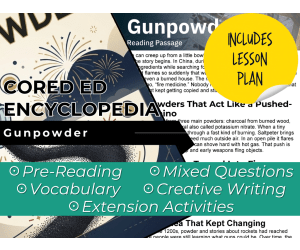
Gunpowder Reading Comprehension Passage - Cored Ed Encyclopedia
ELA, Reading Comprehension, Reading, Science, Technology, Pre-Reading, Language Development, History, Social Studies, Physics, Grade 2, 3, 4, 5, Worksheets & Printables, Worksheets, Teacher Tools, Centers, Activities, Writing Prompts, Assessments, Quizzes and Tests, Quizzes, Lesson Plans
This gunpowder reading comprehension with lesson plan includes: Visualization (on the front cover) Start your lesson by taking a minute to think and share something about the topic. Read the script aloud (slowly), perhaps prepare some music or sound effects. Student close their eyes and let their imaginations wander. Students open their eyes, read the question aloud and give them a few minutes to complete. Ask a few students to share or keep answers until the end to compare with what they learn in the passage. Quick pause—thousands of Cored Education products are included with your TeachSimple membership. Download links and encyclopedia index available here. Pre-Reading Trivia Students will write down one thing they already know about the subject and then read five more facts and discuss. These facts are fun, and the students will enjoy learning about the subject before reading more. Give 1 minute for students to write what they already know (no pressure—best guess is fine). Read the five facts together. After each fact, do ask a student for their opinion, was it surprising? Set a purpose by asking students to highlight/underline one fact they want to learn more about during the reading. Reading Passage The text is a high-interest reading passage with set paragraphs, roughly three to four paragraphs long. It contains a variety of themes about the topic, anywhere from history to technology. The passage is between 250 and 350 words in length. First, ask students to look at the headings and see what they’ll learn about today. What do they know about the topic/heading? First read options: Teacher read-aloud (best for support). Partner reading (paragraph by paragraph). While reading, students underline important details, and vocabulary words they think may come up in the questions section. Mixed Questions The first question page contains four multiple-choice questions, each with a choice of four answers, and three written response questions that require a sentence or two from the student. Students complete the mcqs first independently, then review quickly as a class. For the 3 written responses, try to get students giving the answer with some form of evidence: “I think ___ because the text says ___.” If students get stuck, send them back to check the passage. Vocabulary Questions Practice seven key words from the text in this section across two activities. First section is scrambled words where students will unscramble three words given a clue for each. The second section is a word to meaning matching activity. Before starting, have some students read out words they underlined in the passage. Ask students to say the word and read aloud the sentence(s) around each word. Ask students to do scrambled words and the matching exercise in pairs then go through answers as a class. For the scrambled spelling task, get four pairs to come up to the board and write the words for extra practice with the other student reading out the clue. For the matching task, prompt students to give full sentences: “I matched ___ with ___ because ___.” Creative Writing In this question, the student will be required to write a five to eight sentence paragraph on a question related to the topic. Before starting, ask students write down 3 key ideas they are going to include in their piece. Ask students for ideas to share around the class to help those struggling. Pro writing expectations: 5–8 sentences At least 2 facts or details from the passage At least 2 vocabulary words from the previous page Students read their paragraphs while classmates listen for facts and vocabulary words. Extension Activities This page is optional for fast finishers or to take home. There are several activities, each one requiring a different skill. Do some, do none, do all, completely optional - but you will feel reassured knowing every possibility is planned for. Includes summary writting question and additional facts. Answer Key There are answers for the multiple-choice questions, written response questions have sample answers, vocabulary answers and if there is a summary question then a sample summary will be provided as well. Lesson Plan Included Customized lesson plan for this lesson is included. Lesson Snapshot Title: Gunpowder Genre: Nonfiction (informational text) Subject: Science Primary Topic: How gunpowder was discovered and used over time Estimated Guided Reading Level (A–Z): Q What This Lesson Teaches Best Explains how gunpowder began in China during the Tang dynasty when alchemists mixed ingredients while searching for a life-lasting “elixir.” Identifies the three main powders in gunpowder—charcoal, sulfur, and saltpeter (also called potassium nitrate)—and describes what saltpeter adds to help burning. Describes how gunpowder behaves differently in an open pile versus a tight tube, leading to a strong push of hot gas. Traces how “fire medicine” was used first for celebrations and signals, then developed into fire arrows, bombs, fire lances, and hand cannons by the late 1200s. Shows how ideas travel as gunpowder and stories about rockets reached Europe, and how uses expanded to quarrying rock and digging tunnels, not only fighting. Learning Goals Students will describe how the text says gunpowder was discovered during the Tang dynasty in China. Students will identify the three main powders in gunpowder and explain what saltpeter adds to the burning process. Students will compare what happens when gunpowder burns in an open pile versus in a tight tube. Students will explain how “fire medicine” changed from signals and celebrations to fire arrows and later weapons over time. Students will describe two non-celebration uses of the powder mentioned in the text (quarrying rock and digging tunnels). Students will explain what the author means by “Ideas travel,” using the example of gunpowder reaching Europe. Key Vocabulary From the Text alchemists — people who mixed ingredients while searching for an “elixir.” elixir — a life-lasting drink they searched for. charcoal — powder from burned wood. sulfur — one of the three main powders. saltpeter — a mineral also called potassium nitrate. Discussion Prompts Pre-reading question: What do you think might happen if a powder burns very fast? Comprehension questions: How did the mixture get the name huoyao, or “fire medicine”? Comprehension questions: What role does saltpeter play when a tiny grain is lit? Comprehension questions: How did the uses of “fire medicine” change from celebrations to later tools or weapons? FULL CATALOG OF DOWNLOAD LINKS AND ENCYCLOPEDIA INDEX HERE
Author Cored Education
Rating
Tags Vocabulary, Reading Comprehension, Reading Passages, Lesson Plans, Ela Lesson Plans, Reading Comprehension Lesson Plans, Pre-reading, Science Lesson Plans, Social Studies Lesson Plans, History

Reading Comprehension Passages Fiction Set 3 - Friends (Word)
ELA, Reading, Reading Comprehension, Common Core, ESL, Language Development, Spelling, Vocabulary, Writing, Literature, Grade 4, 5, Worksheets & Printables, Worksheets, Assessments, Teacher Tools, Tests, Quizzes and Tests, Writing Prompts
Reading Comprehension Passages Fiction Set 3 Overview No prep reading comprehension lessons, with enjoyable stories and topics. Each lesson has a blend of post-reading activities. Mixed questions to check overall understanding. Vocabulary activities, plus a writing section. Lessons also contain a bonus extension exercise at the end. Some you may like, some you may not, either way they are there if you wish to use them. Full answer keys are provided. Passages Include 1.A Friend's Promise: Josh's brother makes sure he keeps his promise to a friend. 2.The Rumor: April feels sad that Selena is getting attention from everybodynow. 3.Finishing Together: Fernando helps a teacher by taking part in a fundraiser. 4.Seniors Acting: Brooke is doing shows at the senior center. Will her friend find out? 5.Funland: Not such a fun day at Funland for the author in this story. 6.Back to School: The author hates the first day back. She doesn't know what to wear! Word Version This is the Word editable version. This download is available in GOOGLE Docs, GOOGLE Forms, GOOGLE Slides. PDF, PPT, WORD. Browse the Complete Cored Catalog — 2,000+ Resources Included Reading Passages Each reading passage has been written specifically for students in Grades 4–5, using vocabulary and language that match their age and ability level. The collection covers a wide range of engaging topics, supported by colorful visuals that help bring the content to life. Every lesson is designed to build knowledge while keeping students interested and motivated to read. These resources are also designed with flexibility in mind. Unlike traditional textbooks that can quickly become outdated, lessons can be updated over time to reflect changes in technology, discoveries, and the world around us. Mixed Questions Every lesson includes a variety of questions that help students think more deeply about what they have read. The question section combines reading comprehension, vocabulary, and math skills, while also regularly reinforcing important reading strategies such as cause and effect, summarizing, compare and contrast, and drawing conclusions. Most lessons include a mix of multiple-choice and written-response questions, giving students opportunities to explain their thinking as well as select answers. Complete answer keys and sample responses are provided at the end of each lesson for quick and easy reference. Spelling & Vocabulary Each passage introduces students to useful words and phrases appropriate for Grades 4–5. To help build confidence and word knowledge, every lesson includes a spelling or vocabulary activity. Rather than repeating the same task throughout the collection, activities vary from lesson to lesson to keep practice fresh and engaging. Activities may include spelling challenges, sentence matching, decoding activities, mixed-up text exercises, and other vocabulary-building tasks connected directly to the reading. Writing Prompts Each lesson includes a writing activity that extends the ideas, themes, or topics explored in the passage. Students are encouraged to write in a variety of formats, with prompts providing helpful guidance and ideas to get them started. Writing tasks vary throughout the collection and may include creative writing, research activities, personal responses, poetry, opinion writing, and other engaging assignments. Full Answer Keys Complete answer keys and sample responses are included with every lesson, making planning and marking quicker and easier. Reading comprehension answers include evidence and support from the text, while math-based questions show the relevant working where appropriate. The answer keys are designed primarily for teachers but can also be shared with students when needed. Just for Fun Each lesson finishes with an optional extension activity called Just for Fun . These bonus activities provide an enjoyable way to extend learning beyond the main lesson and often encourage creativity, discussion, or independent thinking. They are completely optional, giving you the flexibility to use the activities that best suit your students and classroom needs. For similar downloads and other frees, do check out Cored Group on TeachSimple.
Author Cored Education
Rating
Tags Elementary, Reading, Comprehension, Vocabulary, Answers, Ccss, Common Core, Spelling, Writing, Passages
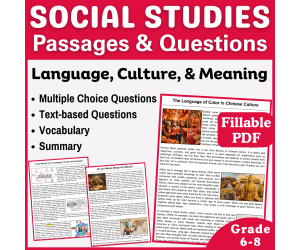
Social Studies Passages: Language, Culture, Meaning (Fillable PDF)
ELA, Reading, Reading Comprehension, Strategies, Resources for Teachers, Social Studies, Geography, Sociology, Grade 6, 7, 8, 9, Writing Prompts, Worksheets & Printables, Centers, Activities, Teacher Tools, Assessments, Quizzes and Tests, Quizzes, Tests
Social Studies Reading Comprehension Passages: Language, Culture, Meaning (Fillable PDF) This resource introduces a collection of Social Studies reading comprehension passages about Language, Culture, and Meaning. The passages are carefully designed to bridge the gap between social studies and literacy through strengthening reading comprehension and sparking knowledge curiosity in middle school students. Each passage blends English Language Arts skills with accurate social studies content. Ideal for interdisciplinary learning in ELA and Social Studies. Suitable for Grade 9 review, too! What Is Included in this Collection? There are three informational passages (with full answer keys): Living Words: How Languages Change and Disappear The Language of Color in Chinese Culture Do Our Words Shape Our Minds For Each Passage, students will have multiple tasks to complete as follow: 5 multiple-choice questions targeting main idea, key details, inference, vocabulary in context, and use of evidence 5 vocabulary matching items with clear, student-friendly definitions 5 text-based questions that require citing specific lines or facts 1 summary prompt that asks students to condense central ideas accurately Available Formats for this Resource Fillable PDF Word Docs Google Docs FULL CATALOG OF DOWNLOADING LINKS HERE For more Social Studies Reading Passages, check the following Links: Ancient Civilizations PDF Fillable PDF Word Docs Google Docs Early Empires and Trade Networks PDF Fillable PDF Word Docs Google Docs The Founding of the United States PDF Fillable PDF Word Docs Google Docs Language, Culture, and Meaning PDF Fillable PDF Word Docs Google Docs Psychology and Society PDF Fillable PDF Word Docs Google Docs Global Festivals and Traditions PDF Fillable PDF Word Docs Google Docs Extreme Environments and People PDF Fillable PDF Word Docs Google Docs Food, Culture, and Preservation PDF Fillable PDF Word Docs Google Docs Global Food Customs PDF Fillable PDF Word Docs Google Docs Media, Communication, and Popular Culture PDF Fillable PDF Word Docs Google Docs Human Impact on the Environment PDF Fillable PDF Word Docs Google Docs Civic Action and Social Change PDF Fillable PDF Word Docs Google Docs Fashion, Society, and Power PDF Fillable PDF Word Docs Google Docs People, Places, and Unusual Histories PDF Fillable PDF Word Docs Google Docs Product Details Length: 13 pages total Grades: 6–8, also suitable for Grade 9 review Use cases: close reading, stations, homework, intervention, test prep, and sub plans Why Teachers Choose This Set Authentic social studies content paired with rigorous literacy practice Consistent task structure across all passages for easier planning and smoother student routines Clear, age-appropriate writing that builds confidence without oversimplifying Use this set to reinforce ELA skills in social studies, to add literacy to your lessons, and to support independent work. The passages strengthen main idea, evidence use, vocabulary in context, inference, cause and effect, and summary writing. With ready-to-use assessments and complete answer keys, you can provide focused practice that is simple to run and fast to review.
Author Middle & High School - CORED Education
Rating
Tags Middle School, Reading Comprehension, Reading Strategies, ELA, Centers, Reading Passage, Assessments, Vocabulary, Social Studies

Radios Reading Comprehension Passage - Cored Ed Encyclopedia
ELA, Language Development, Reading Comprehension, Reading, Pre-Reading, History, Social Studies, Technology, Science, Physics, Grade 2, 3, 4, 5, Worksheets & Printables, Worksheets, Teacher Tools, Centers, Activities, Writing Prompts, Assessments, Quizzes and Tests, Quizzes, Lesson Plans
This radios reading comprehension includes: Visualization (on the front cover) Start your lesson by taking a minute to think and share something about the topic. Read the script aloud (slowly), perhaps prepare some music or sound effects. Student close their eyes and let their imaginations wander. Students open their eyes, read the question aloud and give them a few minutes to complete. Ask a few students to share or keep answers until the end to compare with what they learn in the passage. Quick pause—thousands of Cored Education products are included with your TeachSimple membership. Download links and encyclopedia index available here. Pre-Reading Trivia Students will write down one thing they already know about the subject and then read five more facts and discuss. These facts are fun, and the students will enjoy learning about the subject before reading more. Give 1 minute for students to write what they already know (no pressure—best guess is fine). Read the five facts together. After each fact, do ask a student for their opinion, was it surprising? Set a purpose by asking students to highlight/underline one fact they want to learn more about during the reading. Reading Passage The text is a high-interest reading passage with set paragraphs, roughly three to four paragraphs long. It contains a variety of themes about the topic, anywhere from history to technology. The passage is between 250 and 350 words in length. First, ask students to look at the headings and see what they’ll learn about today. What do they know about the topic/heading? First read options: Teacher read-aloud (best for support). Partner reading (paragraph by paragraph). While reading, students underline important details, and vocabulary words they think may come up in the questions section. Mixed Questions The first question page contains four multiple-choice questions, each with a choice of four answers, and three written response questions that require a sentence or two from the student. Students complete the mcqs first independently, then review quickly as a class. For the 3 written responses, try to get students giving the answer with some form of evidence: “I think ___ because the text says ___.” If students get stuck, send them back to check the passage. Vocabulary Questions Practice seven key words from the text in this section across two activities. First section is scrambled words where students will unscramble three words given a clue for each. The second section is a word to meaning matching activity. Before starting, have some students read out words they underlined in the passage. Ask students to say the word and read aloud the sentence(s) around each word. Ask students to do scrambled words and the matching exercise in pairs then go through answers as a class. For the scrambled spelling task, get four pairs to come up to the board and write the words for extra practice with the other student reading out the clue. For the matching task, prompt students to give full sentences: “I matched ___ with ___ because ___.” Creative Writing In this question, the student will be required to write a five to eight sentence paragraph on a question related to the topic. Before starting, ask students write down 3 key ideas they are going to include in their piece. Ask students for ideas to share around the class to help those struggling. Pro writing expectations: 5–8 sentences At least 2 facts or details from the passage At least 2 vocabulary words from the previous page Students read their paragraphs while classmates listen for facts and vocabulary words. Extension Activities This page is optional for fast finishers or to take home. There are several activities, each one requiring a different skill. Do some, do none, do all, completely optional - but you will feel reassured knowing every possibility is planned for. Includes summary writting question. Answer Key There are answers for the multiple-choice questions, written response questions have sample answers, vocabulary answers and if there is a summary question then a sample summary will be provided as well. Lesson Plan Included Customized lesson plan for this lesson is included. Lesson Snapshot Title: Radios Genre: Nonfiction (informational text) Subject: Science (Waves/Technology) / Social Studies (history of inventions) Primary Topic: How radio waves enabled communication over time Estimated Guided Reading Level (A–Z): R What This Lesson Teaches Best How scientists discovered and tested invisible waves (Maxwell’s prediction; Hertz’s spark machine and metal loop “reply”). What radio waves are described as (the longest waves in the electromagnetic family). How wireless communication developed from Morse-like code to sound and music (Marconi’s wireless telegraph; later broadcasting and family listening). How radios are used today for communication over long distances (emergency crews, airplanes and towers, spacecraft communication via NASA’s Deep Space Network). Understanding informational text structure with engaging section headings (“When Dots and Dashes Learned to Fly,” etc.). Learning Goals Students can explain how the text describes Maxwell’s and Hertz’s roles in understanding radio waves. Students can describe how Marconi’s wireless telegraph worked in the passage (wires, ground connection, detector clicking). Students can explain how radio changed from code to carrying voices and music, using details from the text. Students can identify at least two modern uses of radios named in the passage and why they matter. Students can use the section headings to state the main idea of each part of the passage. Key Vocabulary From the Text electromagnetic — related to electricity, magnetism, and waves. detector — a tool that clicks when a signal arrives. telegraph — a system for sending coded messages over distance. broadcasting — sending sounds to many listeners at once. antennas — parts that help send or receive radio signals. FULL CATALOG OF DOWNLOAD LINKS AND ENCYCLOPEDIA INDEX HERE
Author Cored Education
Rating
Tags Vocabulary, Reading Comprehension, Reading Passages, Reading, Creative Writing, Reading Strategies, Writing Prompts, Lesson Plans, Radios, Physics

Mars, Glaciers, & Antarctica: Reading Comprehension Passages (Word)
Science, Space, Earth and Environmental Sciences, ELA, Reading, Reading Comprehension, Strategies, Resources for Teachers, Environmental Science, Grade 6, 7, 8, 9, Writing Prompts, Worksheets & Printables, Centers, Activities, Teacher Tools, Assessments, Quizzes and Tests, Quizzes, Tests
Mars, Glaciers, and Antarctica: Reading Comprehension Passages (Word) This engaging collection of science reading passages about Mars, Glaciers, and Antarctica (Earth and Space Environments) is designed to bridge the gap between science and literacy through strengthening reading comprehension and sparking scientific curiosity in middle school students. Each passage blends English Language Arts skills with accurate science content that supports NGSS classroom practice. Ideal for interdisciplinary learning in ELA and Science. Suitable for Grade 9 review, too! What Is Included? There are (3) informational passages: Antarctica: Science at the End of the Earth Explore a protected polar laboratory where clear air, ancient ice, and unique wildlife let scientists study climate change, ocean circulation, and even space signals with high precision. From Earth to Mars: What Life Would Require Contrast Earth and Mars, then outline what settlers would need: breathable air, liquid water, radiation shielding, steady energy, food production, and closed-loop systems for waste and resources. Ice Age Leftovers: From Glaciers to Sea Ice Differentiate glaciers, ice shelves, sea ice, and icebergs, and see how they shape coasts, reflect sunlight, steer ocean temperatures, and preserve clues to past climates. Student Tasks for Each Passage: 5 multiple-choice questions targeting main idea, key details, inference, vocabulary in context, and use of evidence 5 vocabulary matching items with clear, student-friendly definitions 5 text-based questions that require citing specific lines or facts 1 summary prompt that asks students to condense central ideas accurately Full answer key for every section Available Formats for this Resource PDF Google Docs FULL CATALOG OF DOWNLOADING LINKS HERE Other Science Reading Collections you May find in the store: 1. Astronomy & Space Science 2. Volcanoes, Rocks, & Mountains 3. Rock Cycle, Soil, & Sinkholes 4. Mars, Glaciers, & Antarctica 5. Water Cycle, Acid Rain, & Wastewater 6. Insects, Animals, & Ecosystems 7. Bioluminescence & Insects 8. Animal Skin, Cats, & T. Rex 9. Human Body and Senses 10. Health & Applied Bioscience 11. Waves, Light, & Imaging 12. Electricity & Energy 13. Motion & Materials 14. Chemistry and Materials Science Product Details Length: 15 pages total Grades: 6–8, also suitable for Grade 9 review Use cases: close reading, stations, homework, intervention, test prep, and sub plans Standards support: reinforces informational-text skills and supports NGSS-style sense making through observation, modeling, and clear use of claim, evidence, and reasoning Why Teachers Choose This Set Authentic science content paired with rigorous literacy practice Consistent task structure across all passages for easier planning and smoother student routines Clear, age-appropriate writing that builds confidence without oversimplifying Use this set to reinforce ELA skills in science, to add literacy to your lessons, or to support independent work. The passages strengthen main idea, evidence use, vocabulary in context, inference, cause and effect, and summary writing. With ready-to-use assessments and complete answer keys, you can provide focused practice that is simple to run and fast to review.
Author Middle & High School - CORED Education
Rating
Tags Middle School, Reading Comprehension, Reading Strategies, Reading Passages, ELA, Centers, Reading Passage, Assessments, Vocabulary, Earth Science

Saving Electricity Campaign: Social Studies Reading Passage (Word)
ELA, Reading, Reading Comprehension, Strategies, Resources for Teachers, Social Studies, Sociology, Grade 6, 7, 8, 9, Writing Prompts, Worksheets & Printables, Centers, Activities, Teacher Tools, Assessments, Quizzes and Tests, Quizzes, Tests
Saving Electricity Campaign: Social Studies Reading Comprehension Passage (Word) This resource introduces a unique Social Studies reading comprehension passage with questions about Saving Electricity Campaign. The passage is carefully designed to bridge the gap between social studies and literacy through strengthening reading comprehension and sparking knowledge curiosity in middle school students. Each passage blends English Language Arts skills with accurate social studies content . Ideal for interdisciplinary learning in ELA and Social Studies. Suitable for Grade 9 review, too! Student Tasks throughout the passage: 5 multiple-choice questions targeting the following skills: main idea, key details, inference, vocabulary in context, and use of evidence 5 vocabulary matching items with clear, student-friendly definitions 5 text-based questions that require citing specific lines or facts 1 summary prompt that asks students to condense central ideas accurately Full answer key for every section Available Formats for this Resource: PDF Fillable PDF Google Docs FULL CATALOG OF DOWNLOADING LINKS HERE Social Studies Reading Comprehension Collection Links: 1. Ancient Civilizations PDF Fillable PDF Word Docs Google Docs 2. Early Empires and Trade Networks PDF Fillable PDF Word Docs Google Docs 3. The Founding of the United States PDF Fillable PDF Word Docs Google Docs 4. Language, Culture, and Meaning PDF Fillable PDF Word Docs Google Docs 5. Psychology and Society PDF Fillable PDF Word Docs Google Docs 6. Global Festivals and Traditions PDF Fillable PDF Word Docs Google Docs 7. Extreme Environments and People PDF Fillable PDF Word Docs Google Docs 8. Food, Culture, and Preservation PDF Fillable PDF Word Docs Google Docs 9. Global Food Customs PDF Fillable PDF Word Docs Google Docs 10. Media, Communication, and Popular Culture PDF Fillable PDF Word Docs Google Docs 11. Human Impact on the Environment PDF Fillable PDF Word Docs Google Docs 12. Civic Action and Social Change PDF Fillable PDF Word Docs Google Docs 13. Fashion, Society, and Power PDF Fillable PDF Word Docs Google Docs 14. People, Places, and Unusual Histories PDF Fillable PDF Word Docs Google Docs Product Details: Length: 5 pages Grades: 6–8, also suitable for Grade 9 review Use cases: close reading, stations, homework, intervention, test prep, and sub plans Why Teachers Choose This Passage: Authentic social studies content paired with rigorous literacy practice Consistent task structure for easier planning and smoother student routines Clear, age-appropriate writing that builds confidence without oversimplifying Use this passage to reinforce ELA skills in social studies, to add literacy to your lessons, and to support independent work. The passage strengthens main idea, evidence use, vocabulary in context, inference, cause and effect, and summary writing. With ready-to-use assessments and complete answer keys, you can provide focused practice that is simple to run and fast to review.
Author Middle & High School - CORED Education
Rating
Tags Middle School, Reading Comprehension, Reading Strategies, ELA, Centers, Reading Passage, Assessments, Vocabulary, Social Studies, Sociology

ESL Novel Study - Project Hail Mary - Andy Weir - Science Fiction
ELA, Language Development, ESL, Vocabulary, Writing, Creative Writing, Formal Writing, Grade 7, 8, 9, 10, 11, 12, Writing Prompts, Worksheets & Printables, Worksheets, Novel Studies
ESL Novel Study Worksheets - Project Hail Mary - Andy Weir - Science Fiction This ESL EFL TESOL (English Second or Foreign Language) teaching resource is a comprehensive novel study worksheet activity (2 printable PDF pages; Worksheets) focused on the novel "Project Hail Mary" (Novel by American author Andy Weir - Science Fiction). This Novel Study worksheets on "Project Hail Mary" (Novel by American author Andy Weir - Science Fiction) is tailored for middle and high school ESL students (7th–12th grade) and provide a variety of thought-provoking and language building activities. Whether you're teaching English as a Second Language (ESL), English as a Foreign Language (EFL), or in a TESOL context, this resource is classroom-ready and easy to use. Within this ESL Novel Study on "Project Hail Mary" (2 printable PDF worksheets pages), English Second or Foreign Language (ESL EFL TESOL) teachers can find the following activities: General information activity (author, genre, publishing date) Vocabulary building section – new words from the novel 1 Story timeline Personal reflection on a favorite chapter Student novel review and rating Creative writing task : pretending being a character you personally liked and writing 3 diary pages for 3 scenes as if you were this character This English Second or Foreign Language (ESL EFL) Novel Study Activity Worksheets on the "Project Hail Mary" (Novel by American author Andy Weir - Science Fiction) can be ideal for learners from 7th grade to 12th grade to study this Novel (middle school and High School Students) ESL with Alan is a high-quality ESL teaching resources that inspire both teachers and students. Our goal is to make learning English fun, interactive, and meaningful. Discover more English Second or Foreign Language activities by visiting our store – because learning English should always be fun! If you want to browse more of my English Language and Literature Novel Study Activity Teaching Resources, click here ESL with Alan!
Author Learning with Alan
Rating
Tags ESL, English Second Language, English, Science Fiction, Activity, Novel Study, Books, Reading, Writing Activity, Vocabulary
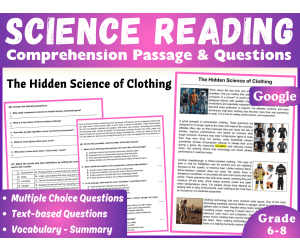
Science Reading Comprehension Passage: The Science of Clothing (Docs)
Science, ELA, Reading, Reading Comprehension, Strategies, Resources for Teachers, Technology, Engineering, Grade 6, 7, 8, 9, Writing Prompts, Worksheets & Printables, Centers, Activities, Teacher Tools, Assessments, Quizzes and Tests, Quizzes, Tests
Science Reading Comprehension Passage and Questions: The Hidden Science of Clothing (Docs) This very engaging science reading passage is about how modern clothing uses science and technology to improve safety, performance, comfort, and exploration . It explains different examples of high-tech clothing and materials, including compression clothing for athletes, flame-resistant clothing for firefighters and workers, aerogel for astronaut suits and space rovers, and smart fabrics that can play music, answer calls, or track a heartbeat. The visuals on page 1 support these examples by showing athletic clothing, protective work gear, and space-related clothing. This passage is designed to bridge the gap between science and literacy through strengthening reading comprehension and sparking scientific curiosity in middle school students. The passage blends English Language Arts skills with accurate science content that supports NGSS classroom practice. Ideal for interdisciplinary learning in ELA and Science. Suitable for Grade 9 review, too! Student Tasks for The Passage: 5 multiple-choice questions targeting main idea, key details, inference, vocabulary in context, and use of evidence 5 vocabulary matching items with clear, student-friendly definitions 5 text-based questions that require citing specific lines or facts 1 summary prompt that asks students to condense central ideas accurately Full answer key for every section Available Formats for this Resource PDF Fillable PDF Word Docs FULL CATALOG OF DOWNLOADING LINKS HERE Product Details Length: 4 pages total Grades: 6–8, also suitable for Grade 9 review Use cases: close reading, stations, homework, intervention, test prep, and sub plans Standards support: reinforces informational-text skills and supports NGSS-style sense making through observation, modeling, and clear use of claim, evidence, and reasoning Why Teachers Choose This Set Authentic science content paired with rigorous literacy practice Consistent task structure across all passages for easier planning and smoother student routines Clear, age-appropriate writing that builds confidence without oversimplifying Other Science Reading Collections you May find in the store: 1. Astronomy & Space Science 2. Volcanoes, Rocks, & Mountains 3. Rock Cycle, Soil, & Sinkholes 4. Mars, Glaciers, & Antarctica 5. Water Cycle, Acid Rain, & Wastewater 6. Insects, Animals, & Ecosystems 7. Bioluminescence & Insects 8. Animal Skin, Cats, & T. Rex 9. Human Body and Senses 10. Health & Applied Bioscience 11. Waves, Light, & Imaging 12. Electricity & Energy 13. Motion & Materials 14. Chemistry and Materials Science Use this set to reinforce ELA skills in science, to add literacy to your lessons, and to support independent work. The passages strengthen main idea, evidence use, vocabulary in context, inference, cause and effect, and summary writing. With ready-to-use assessments and complete answer keys, you can provide focused practice that is simple to run and fast to review.
Author Middle & High School - CORED Education
Rating
Tags Middle School, Reading Comprehension, Reading Strategies, ELA, Centers, Reading Passage, Assessments, Vocabulary, Technology
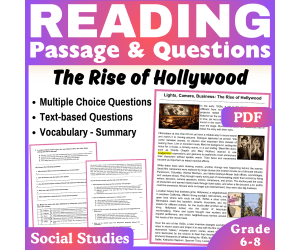
The Rise of Hollywood: Social Studies Reading Passage (PDF)
ELA, Reading, Reading Comprehension, Strategies, Resources for Teachers, Social Studies, Sociology, Grade 6, 7, 8, 9, Writing Prompts, Worksheets & Printables, Centers, Activities, Teacher Tools, Assessments, Quizzes and Tests, Quizzes, Tests
The Rise of Hollywood: Social Studies Reading Comprehension Passage (PDF) This resource introduces a unique Social Studies reading comprehension passage with questions about The Rise of Hollywood The passage is carefully designed to bridge the gap between social studies and literacy through strengthening reading comprehension and sparking knowledge curiosity in middle school students. Each passage blends English Language Arts skills with accurate social studies content . Ideal for interdisciplinary learning in ELA and Social Studies. Suitable for Grade 9 review, too! Student Tasks throughout the passage: 5 multiple-choice questions targeting the following skills: main idea, key details, inference, vocabulary in context, and use of evidence 5 vocabulary matching items with clear, student-friendly definitions 5 text-based questions that require citing specific lines or facts 1 summary prompt that asks students to condense central ideas accurately Full answer key for every section Available Formats for this Resource: Fillable PDF Word Docs Google Docs FULL CATALOG OF DOWNLOADING LINKS HERE Social Studies Reading Comprehension Collection Links: 1. Ancient Civilizations PDF Fillable PDF Word Docs Google Docs 2. Early Empires and Trade Networks PDF Fillable PDF Word Docs Google Docs 3. The Founding of the United States PDF Fillable PDF Word Docs Google Docs 4. Language, Culture, and Meaning PDF Fillable PDF Word Docs Google Docs 5. Psychology and Society PDF Fillable PDF Word Docs Google Docs 6. Global Festivals and Traditions PDF Fillable PDF Word Docs Google Docs 7. Extreme Environments and People PDF Fillable PDF Word Docs Google Docs 8. Food, Culture, and Preservation PDF Fillable PDF Word Docs Google Docs 9. Global Food Customs PDF Fillable PDF Word Docs Google Docs 10. Media, Communication, and Popular Culture PDF Fillable PDF Word Docs Google Docs 11. Human Impact on the Environment PDF Fillable PDF Word Docs Google Docs 12. Civic Action and Social Change PDF Fillable PDF Word Docs Google Docs 13. Fashion, Society, and Power PDF Fillable PDF Word Docs Google Docs 14. People, Places, and Unusual Histories PDF Fillable PDF Word Docs Google Docs Product Details: Length: 5 pages Grades: 6–8, also suitable for Grade 9 review Use cases: close reading, stations, homework, intervention, test prep, and sub plans Why Teachers Choose This Passage: Authentic social studies content paired with rigorous literacy practice Consistent task structure for easier planning and smoother student routines Clear, age-appropriate writing that builds confidence without oversimplifying Use this passage to reinforce ELA skills in social studies, to add literacy to your lessons, and to support independent work. The passage strengthens main idea, evidence use, vocabulary in context, inference, cause and effect, and summary writing. With ready-to-use assessments and complete answer keys, you can provide focused practice that is simple to run and fast to review.
Author Middle & High School - CORED Education
Rating
Tags Middle School, Reading Comprehension, Reading Strategies, ELA, Centers, Reading Passage, Assessments, Vocabulary, Social Studies, Sociology
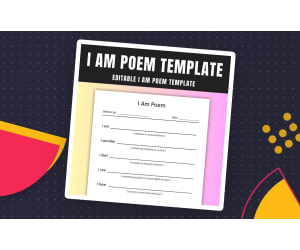
Editable I Am Poem Template for Younger Students with Instructions
Poetry, Literature, ELA, Creative Writing, Writing, Kindergarten, Grade 1, 2, 3, Templates, Writing Prompts, Worksheets & Printables
Editable I Am Poem Template This resources is designed specifically for younger students. This resource includes 8 engaging prompts. What's Included: minimalist, easy-to-use template: that allows students to focus on their writing without distraction. 8 thoughtfully crafted prompts: that inspire self-reflection and creativity. Helping students delve into their unique perspectives. Prompts Include: I am I wonder I feel I see I hear I want I am from I believe Features: Editable: Editable format for customization to suit your classroom needs. Instructions: Clear instructions to help students understand the activity. Versatile: Perfect for individual or group activities, encouraging discussion and sharing. Grades: Ideal for grades 2–5, promoting literacy and emotional development. This resource includes: 1 page (PowerPoint) US Letter (8.5" x 11") size This template can be used in writing centers, as a warm-up activity. Or as part of a larger unit on identity and self-expression. It’s perfect for building confidence in young writers or students. Helping them articulate their thoughts and feelings.
Author GY Creations
Tags I Am Poem Template, I Am Poem, Editable I Am Poem, Editable Template, Creative Writing, Poetry, Poem Writing, Printable

Antarctica Reading Comprehension Passage - Cored Ed Encyclopedia
ELA, Language Development, Reading Comprehension, Reading, Social Studies, Writing, Pre-Reading, Vocabulary, Geography, History, Grade 2, 3, 4, 5, Worksheets & Printables, Worksheets, Teacher Tools, Centers, Activities, Writing Prompts, Assessments, Quizzes and Tests, Quizzes, Lesson Plans
This Antarctica reading comprehension with lesson plan includes: Visualization (on the front cover) Start your lesson by taking a minute to think and share something about the topic. Read the script aloud (slowly), perhaps prepare some music or sound effects. Student close their eyes and let their imaginations wander. Students open their eyes, read the question aloud and give them a few minutes to complete. Ask a few students to share or keep answers until the end to compare with what they learn in the passage. COMPANION VIDEO NOW AVAILABLE (EMBEDDED AFTER PREVIEW PICTURES IN PRODUCT DESCRIPTION) Quick pause—thousands of Cored Education products are included with your TeachSimple membership. Download links and encyclopedia index available here. Pre-Reading Trivia Students will write down one thing they already know about the subject and then read five more facts and discuss. These facts are fun, and the students will enjoy learning about the subject before reading more. Give 1 minute for students to write what they already know (no pressure—best guess is fine). Read the five facts together. After each fact, do ask a student for their opinion, was it surprising? Set a purpose by asking students to highlight/underline one fact they want to learn more about during the reading. Reading Passage The text is a high-interest reading passage with set paragraphs, roughly three to four paragraphs long. It contains a variety of themes about the topic, anywhere from history to technology. The passage is between 250 and 350 words in length. First, ask students to look at the headings and see what they’ll learn about today. What do they know about the topic/heading? First read options: Teacher read-aloud (best for support). Partner reading (paragraph by paragraph). While reading, students underline important details, and vocabulary words they think may come up in the questions section. Mixed Questions The first question page contains four multiple-choice questions, each with a choice of four answers, and three written response questions that require a sentence or two from the student. Students complete the mcqs first independently, then review quickly as a class. For the 3 written responses, try to get students giving the answer with some form of evidence: “I think ___ because the text says ___.” If students get stuck, send them back to check the passage. Vocabulary Questions Practice seven key words from the text in this section across two activities. First section is scrambled words where students will unscramble three words given a clue for each. The second section is a word to meaning matching activity. Before starting, have some students read out words they underlined in the passage. Ask students to say the word and read aloud the sentence(s) around each word. Ask students to do scrambled words and the matching exercise in pairs then go through answers as a class. For the scrambled spelling task, get four pairs to come up to the board and write the words for extra practice with the other student reading out the clue. For the matching task, prompt students to give full sentences: “I matched ___ with ___ because ___.” Creative Writing In this question, the student will be required to write a five to eight sentence paragraph on a question related to the topic. Before starting, ask students write down 3 key ideas they are going to include in their piece. Ask students for ideas to share around the class to help those struggling. Pro writing expectations: 5–8 sentences At least 2 facts or details from the passage At least 2 vocabulary words from the previous page Students read their paragraphs while classmates listen for facts and vocabulary words. Extension Activities This page is optional for fast finishers or to take home. There are several activities, each one requiring a different skill. Do some, do none, do all, completely optional - but you will feel reassured knowing every possibility is planned for. Includes summary writting question and additional facts. Answer Key There are answers for the multiple-choice questions, written response questions have sample answers, vocabulary answers and if there is a summary question then a sample summary will be provided as well. Lesson Plan Included Customized lesson plan for this lesson is included. Lesson Snapshot Title: Antarctica Genre: Nonfiction (informational passage) Subject: Science / Geography (Polar environments; exploration & research) Primary Topic: Exploration, South Pole, treaty, and ice core science Estimated Guided Reading Level (A–Z): S Support pages noted in the PDF: visualization and pre-reading trivia (pp. 1–2), mixed questions (p. 4), vocabulary activities (p. 5), creative writing (p. 6), extension activities + summary box (p. 7), answer key (p. 8). Support-page QA notes: The vocabulary activity includes “Expedition,” which does not appear in the passage; one mixed question asks why compasses “spin strangely,” which the passage does not explain. What This Lesson Teaches Best How Antarctica went from a blank spot on maps to a confirmed icy continent described by explorers. Key physical features of the continent: cold, dry, windy conditions; little inland snow; land “high above sea level” like a “frozen plateau.” A short exploration timeline using dates and evidence (1820 reports of ice shelves; 1895 people stepped onto the continent). How journeys toward the South Pole were described (sleds, dogs, strange compasses) and what happened in December 1911 and afterward. Why international science cooperation matters there, including the International Geophysical Year, the Antarctic Treaty, and what ice cores can reveal through layers. Learning Goals Students will describe why early mapmakers could not point to land far south “with certainty.” Students will identify details that describe Antarctica’s inland climate and land shape (dry, windy, little snow; “frozen plateau”). Students will retell key events from the passage’s timeline using dates (1820, 1895, 1911, 1959). Students will explain what ships reported seeing in 1820 and how the author describes the coastal environment. Students will describe what happened when Roald Amundsen reached the South Pole and what Robert Falcon Scott found later. Students will explain what the passage says nations promised in 1959 and why ice cores are compared to a “frozen calendar.” Key Vocabulary From the Text certainty — being sure something is true. plateau — a high, flat area of land. shelves — wide, flat sheets of ice. treaty — an agreement between countries. supplies — needed materials stored for later use. FULL CATALOG OF DOWNLOAD LINKS AND ENCYCLOPEDIA INDEX HERE
Author Cored Education
Rating
Tags Vocabulary, Reading Comprehension, Reading Passages, Lesson Plans, Ela Lesson Plans, Reading Comprehension Lesson Plans, Pre-reading, Geography, Geography Lesson Plans
Reading Comprehension Passages Fiction Set 7 - Sports (PDF)
ELA, Reading, Reading Comprehension, Common Core, Children’s Literature, Literature, Language Development, ESL, Writing, Vocabulary, Grade 2, 3, Worksheets & Printables, Worksheets, Writing Prompts, Assessments, Teacher Tools, Tests, Quizzes and Tests, Centers, Activities
Reading Comprehension Passages Fiction Set 7 Overview Fascinating reading comprehension passages, each with an array of activities included. Stories are written for the modern classroom and topics are designed to promote enthusiasm from each student. Each lesson contains a mixed questions section to check understanding, a vocabulary or spelling activity to help remember key language introduced, and a writing exercise. Full answer keys are provided. For a more detailed overview, check the section under the links at the bottom of this description. Passages Include 1.Catch It, Dan: Dan is at the ball game and wants to catch a foul ball. 2.Feeling Left Out: Polly isn't invited bowling by her friends and wants to knowwhy. 3.Ian's Friday Nights: Ian wants to be anywhere but the bleachers on Friday nights. 4.Aimee's Dilemma: Soccer or cheerleading? That is the question. 5.A Great Team: Adam & Justin both want to play first base. How will they sortit? 6.Ana's Swimming Party: Jodie can't swim and doesn't want her friends to find out. 7.Touchdown Pythons: Serena loves her first football game. 8.Sam's Passion: Sam talks about his passion for Karate in this passage. 9.Where's My Board: Kerry spends all the story looking for her skateboard. 10.Lacey the Runner: Lacey has dreams to run in the Olympics. Read to find out more. Additional File: Ana's Swimming Party: Invitation Templates PDF Version This is the PDF uneditable version. This download is available in GOOGLE Docs, GOOGLE Forms, GOOGLE Slides. PDF, PPT, WORD. FULL CATALOG OF DOWNLOAD LINKS HERE Grade 2/3 Links Fiction Set 1 - Nature Google Docs Google Forms Google Slides PDF PPT Word Guided Reading Materials Fiction Set 2 - Animals Google Docs Google Forms Google Slides PDF PPT Word Guided Reading Materials Fiction Set 3 - Food Google Docs Google Forms Google Slides PDF PPT Word Guided Reading Materials Fiction Set 4 - School Google Docs Google Forms Google Slides PDF PPT Word Guided Reading Materials Fiction Set 5 - Friends Google Docs Google Forms Google Slides PDF PPT Word Guided Reading Materials Fiction Set 6 - Family Google Docs Google Forms Google Slides PDF PPT Word Guided Reading Materials Fiction Set 7 - Sports Google Docs Google Forms Google Slides PDF PPT Word Guided Reading Materials Nonfiction Set 1 - Technology Google Docs Google Forms Google Slides PDF PPT Word Guided Reading Materials Nonfiction Set 2 - Nutrition Google Docs Google Forms Google Slides PDF PPT Word Guided Reading Materials Nonfiction Set 3 - Animals Google Docs Google Forms Google Slides PDF PPT Word Guided Reading Materials Reading Passages Overview Each passage is especially written for Grade 2-3 students, including key vocabulary required for this age group. Topics are varied and are accompanied by colorful graphics. Topics are meant to educate, yet entertain the modern student. These passages are perfect for the modern classroom. Whereas textbooks can become outdated in no time, any changes to technology or the world will result in updates to this product. Mixed Questions The mixed questions section of each lesson includes a variation of fivecomprehension, vocabulary and math questions. In addition, key reading strategies are frequently covered including cause & effect, summarizing, compare & contrast and making conclusions. Three of the questions will be MCQs and two will require a written response of some kind. Full answers and example responses appear at the end of the lesson. Spelling & Vocab Each reading passage contains a variety of words and phrases designed for Grade 2-3 students. Spelling and vocab activities provide the opportunity to build fluency with these words. As it can become quite mundane doing the same activities over and over, each lesson in a set will contain a different spelling and vocab activity . Writing Prompts Writing prompts are designed to continue the theme or lessons learned in the story. Students are persuaded to write in a variety of ways and each prompt includes several cues to help. As with the spelling/vocab section, writing prompts will vary. This includes research pieces, reading responses, poetry and creative writing prompts. Full Answer Keys Full answer keys and sample responses are provided so no matter how busy you are, you know you're covered! Mixed question answers provide evidence from the text, math questions contain the relevant workings. Answers are designed for use by the teacher, but also suitable as a handout to the student. Additional File One lesson will have an additional file. This is something fun to extend the lesson with. For similar downloads and other frees, do check out Cored Group on TeachSimple.
Author Cored Education
Rating
Tags Elementary, Reading, Comprehension, Vocabulary, Answers, Spelling, Writing, Passages, Reading Centers, Reading Comprehension Assessment
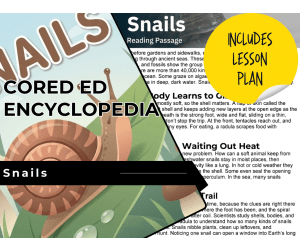
Snails Reading Comprehension Passage - Cored Ed Encyclopedia
ELA, Language Development, Reading Comprehension, Reading, Pre-Reading, Writing, Science, Animals, Life Sciences, Strategies, Grade 2, 3, 4, 5, Worksheets & Printables, Worksheets, Teacher Tools, Centers, Activities, Writing Prompts, Assessments, Quizzes and Tests, Quizzes, Lesson Plans
This snails reading comprehension includes: Visualization (on the front cover) Start your lesson by taking a minute to think and share something about the topic. Read the script aloud (slowly), perhaps prepare some music or sound effects. Student close their eyes and let their imaginations wander. Students open their eyes, read the question aloud and give them a few minutes to complete. Ask a few students to share or keep answers until the end to compare with what they learn in the passage. Quick pause—thousands of Cored Education products are included with your TeachSimple membership. Download links and encyclopedia index available here. Pre-Reading Trivia Students will write down one thing they already know about the subject and then read five more facts and discuss. These facts are fun, and the students will enjoy learning about the subject before reading more. Give 1 minute for students to write what they already know (no pressure—best guess is fine). Read the five facts together. After each fact, do ask a student for their opinion, was it surprising? Set a purpose by asking students to highlight/underline one fact they want to learn more about during the reading. Reading Passage The text is a high-interest reading passage with set paragraphs, roughly three to four paragraphs long. It contains a variety of themes about the topic, anywhere from history to technology. The passage is between 250 and 350 words in length. First, ask students to look at the headings and see what they’ll learn about today. What do they know about the topic/heading? First read options: Teacher read-aloud (best for support). Partner reading (paragraph by paragraph). While reading, students underline important details, and vocabulary words they think may come up in the questions section. Mixed Questions The first question page contains four multiple-choice questions, each with a choice of four answers, and three written response questions that require a sentence or two from the student. Students complete the mcqs first independently, then review quickly as a class. For the 3 written responses, try to get students giving the answer with some form of evidence: “I think ___ because the text says ___.” If students get stuck, send them back to check the passage. Vocabulary Questions Practice seven key words from the text in this section across two activities. First section is scrambled words where students will unscramble three words given a clue for each. The second section is a word to meaning matching activity. Before starting, have some students read out words they underlined in the passage. Ask students to say the word and read aloud the sentence(s) around each word. Ask students to do scrambled words and the matching exercise in pairs then go through answers as a class. For the scrambled spelling task, get four pairs to come up to the board and write the words for extra practice with the other student reading out the clue. For the matching task, prompt students to give full sentences: “I matched ___ with ___ because ___.” Creative Writing In this question, the student will be required to write a five to eight sentence paragraph on a question related to the topic. Before starting, ask students write down 3 key ideas they are going to include in their piece. Ask students for ideas to share around the class to help those struggling. Pro writing expectations: 5–8 sentences At least 2 facts or details from the passage At least 2 vocabulary words from the previous page Students read their paragraphs while classmates listen for facts and vocabulary words. Extension Activities This page is optional for fast finishers or to take home. There are several activities, each one requiring a different skill. Do some, do none, do all, completely optional - but you will feel reassured knowing every possibility is planned for. Includes summary writting question. Answer Key There are answers for the multiple-choice questions, written response questions have sample answers, vocabulary answers and if there is a summary question then a sample summary will be provided as well. Lesson Plan Included Customized lesson plan for this lesson is included. Lesson Snapshot Title: Snails Genre: Nonfiction (informational text with support pages) Subject: Science (Life Science) Primary Topic: Snail traits, habitats, and how they survive Estimated Guided Reading Level (A–Z): S What This Lesson Teaches Best What snails are (gastropods, “belly-footed” mollusks) and how they move using a strong foot on the bottom of their bodies. How snail body parts work, including the mantle making the shell, tentacles with tiny eyes, and a radula that scrapes food with many tiny teeth. How snails live in many habitats (mostly ocean; also land and freshwater), including near shore, on reefs, and in deep, dark water. How snails stay safe and survive tough conditions by pulling into their shell, becoming dormant, and sometimes sealing the opening with mucus or an operculum. How scientists use evidence (shell growth spirals and silvery trails) to study snails and understand how they live in so many places. Learning Goals Explain what “gastropods” means and how snails move using a strong foot. Describe how a snail’s mantle helps make and grow its shell. Identify what a radula is and how it helps a snail eat. Describe how land and freshwater snails avoid drying out and handle hot or cold weather. Use details from the passage to describe where snails live (near shore, reefs, deep water, and moist land places). Key Vocabulary From the Text gastropods — “belly-footed” animals that move using a strong foot. mantle — a flap of skin that makes the shell. radula — a scraper with many tiny teeth for eating. dormant — resting and not active for a while. operculum — a little door that can seal a shell opening. FULL CATALOG OF DOWNLOAD LINKS AND ENCYCLOPEDIA INDEX HERE
Author Cored Education
Rating
Tags Vocabulary, Reading Comprehension, Reading Passages, Reading, Creative Writing, Reading Strategies, Writing Prompts, Lesson Plans, Snails, Life Science
Holes Novel Study Unit
ELA, Literature, Vocabulary, Grade 5, 6, Novel Studies, Worksheets & Printables, Assessments, Quizzes and Tests, Writing Prompts
Engaging Holes Novel Study for Enriched Learning This comprehensive 300-page novel study guide for Holes helps educators lead rich discussions and activities to fully immerse 5th and 6th grade students in the popular novel. The unit includes vocabulary exercises, comprehension questions for each chapter, creative prompts, exit tickets to assess understanding, opportunities for group work and a final test. Answer keys provided. Teachers can use the ample materials to structure lessons for whole group learning or targeted small group instruction. Activities like the mystery match vocabulary build literacy skills; comprehension questions ensure students grasp critical plot points and themes; creative extensions allow students to make deeper text-to-self connections.
Author TrilogyTeacher
Rating
Tags Holes, Novel Study, Literature, Comprehension Questions, Louis Sachar, Holes Activities Pdf, Teaching Holes, Holes Lesson Plans

Rainbows Reading Comprehension Passage - Cored Ed Encyclopedia
ELA, Language Development, Reading Comprehension, Reading, Pre-Reading, Science, Earth Sciences, Earth and Environmental Sciences, Writing, Strategies, Grade 2, 3, 4, 5, Worksheets & Printables, Worksheets, Teacher Tools, Centers, Activities, Writing Prompts, Assessments, Quizzes and Tests, Quizzes, Lesson Plans
This rainbows reading comprehension includes: Visualization (on the front cover) Start your lesson by taking a minute to think and share something about the topic. Read the script aloud (slowly), perhaps prepare some music or sound effects. Student close their eyes and let their imaginations wander. Students open their eyes, read the question aloud and give them a few minutes to complete. Ask a few students to share or keep answers until the end to compare with what they learn in the passage. Quick pause—thousands of Cored Education products are included with your TeachSimple membership. Download links and encyclopedia index available here. Pre-Reading Trivia Students will write down one thing they already know about the subject and then read five more facts and discuss. These facts are fun, and the students will enjoy learning about the subject before reading more. Give 1 minute for students to write what they already know (no pressure—best guess is fine). Read the five facts together. After each fact, do ask a student for their opinion, was it surprising? Set a purpose by asking students to highlight/underline one fact they want to learn more about during the reading. Reading Passage The text is a high-interest reading passage with set paragraphs, roughly three to four paragraphs long. It contains a variety of themes about the topic, anywhere from history to technology. The passage is between 250 and 350 words in length. First, ask students to look at the headings and see what they’ll learn about today. What do they know about the topic/heading? First read options: Teacher read-aloud (best for support). Partner reading (paragraph by paragraph). While reading, students underline important details, and vocabulary words they think may come up in the questions section. Mixed Questions The first question page contains four multiple-choice questions, each with a choice of four answers, and three written response questions that require a sentence or two from the student. Students complete the mcqs first independently, then review quickly as a class. For the 3 written responses, try to get students giving the answer with some form of evidence: “I think ___ because the text says ___.” If students get stuck, send them back to check the passage. Vocabulary Questions Practice seven key words from the text in this section across two activities. First section is scrambled words where students will unscramble three words given a clue for each. The second section is a word to meaning matching activity. Before starting, have some students read out words they underlined in the passage. Ask students to say the word and read aloud the sentence(s) around each word. Ask students to do scrambled words and the matching exercise in pairs then go through answers as a class. For the scrambled spelling task, get four pairs to come up to the board and write the words for extra practice with the other student reading out the clue. For the matching task, prompt students to give full sentences: “I matched ___ with ___ because ___.” Creative Writing In this question, the student will be required to write a five to eight sentence paragraph on a question related to the topic. Before starting, ask students write down 3 key ideas they are going to include in their piece. Ask students for ideas to share around the class to help those struggling. Pro writing expectations: 5–8 sentences At least 2 facts or details from the passage At least 2 vocabulary words from the previous page Students read their paragraphs while classmates listen for facts and vocabulary words. Extension Activities This page is optional for fast finishers or to take home. There are several activities, each one requiring a different skill. Do some, do none, do all, completely optional - but you will feel reassured knowing every possibility is planned for. Includes summary writting question. Answer Key There are answers for the multiple-choice questions, written response questions have sample answers, vocabulary answers and if there is a summary question then a sample summary will be provided as well. Lesson Plan Included Customized lesson plan for this lesson is included. Lesson Snapshot Title: Rainbows Genre: Nonfiction (informational text with support pages) Subject: Science (Light & Weather) Primary Topic: How sunlight and raindrops make rainbows Estimated Guided Reading Level (A–Z): R What This Lesson Teaches Best Explains the conditions for seeing a rainbow (Sun behind you; rain or mist in front; rainbow appears opposite the Sun). Builds a clear scientific model of how rainbows form (sunlight enters a raindrop, bends, bounces inside, and bends again as it leaves). Teaches that a rainbow is part of a circle and why it can “disappear” when the Sun is higher (the circle drops below the horizon). Connects science ideas to history of discovery (scholars testing with water-filled glass spheres; Descartes and Newton using a prism to explain white light and colors). Extends learning with aligned practice pages (questions, writing, and activities); vocabulary is mostly aligned, but “Refraction” appears on a vocab page while the passage describes “bending” without using that word. Learning Goals Students will describe where the Sun and rain/mist need to be to see a rainbow. Students will explain the “twisty trip” sunlight takes inside a raindrop using key details from the passage. Students will describe why a rainbow is part of a circle and what happens when the Sun is higher. Students will explain how two bounces inside droplets create a fainter outer bow and flip the color order. Students will identify how people helped solve the rainbow mystery (examples from the Middle Ages, Descartes, and Newton). Key Vocabulary From the Text horizon — where the sky seems to meet the land. raindrop — a tiny drop of water from rain. prism — clear object that spreads white light into colors. scholars — people who study and test ideas carefully. droplets — very small drops of water in the air. FULL CATALOG OF DOWNLOAD LINKS AND ENCYCLOPEDIA INDEX HERE
Author Cored Education
Rating
Tags Vocabulary, Reading Comprehension, Reading Passages, Reading, Creative Writing, Reading Strategies, Writing Prompts, Lesson Plans, Earth Science, Rainbows

Quarters Reading Comprehension Passage - Cored Ed Encyclopedia
ELA, Language Development, Resources for Teachers, Reading Comprehension, Reading, Pre-Reading, Social Studies, History, Money, Math, Grade 2, 3, 4, 5, Worksheets & Printables, Worksheets, Teacher Tools, Centers, Activities, Writing Prompts, Assessments, Quizzes and Tests, Quizzes, Lesson Plans
This quarters reading comprehension includes: Visualization (on the front cover) Start your lesson by taking a minute to think and share something about the topic. Read the script aloud (slowly), perhaps prepare some music or sound effects. Student close their eyes and let their imaginations wander. Students open their eyes, read the question aloud and give them a few minutes to complete. Ask a few students to share or keep answers until the end to compare with what they learn in the passage. Quick pause—thousands of Cored Education products are included with your TeachSimple membership. Download links and encyclopedia index available here. Pre-Reading Trivia Students will write down one thing they already know about the subject and then read five more facts and discuss. These facts are fun, and the students will enjoy learning about the subject before reading more. Give 1 minute for students to write what they already know (no pressure—best guess is fine). Read the five facts together. After each fact, do ask a student for their opinion, was it surprising? Set a purpose by asking students to highlight/underline one fact they want to learn more about during the reading. Reading Passage The text is a high-interest reading passage with set paragraphs, roughly three to four paragraphs long. It contains a variety of themes about the topic, anywhere from history to technology. The passage is between 250 and 350 words in length. First, ask students to look at the headings and see what they’ll learn about today. What do they know about the topic/heading? First read options: Teacher read-aloud (best for support). Partner reading (paragraph by paragraph). While reading, students underline important details, and vocabulary words they think may come up in the questions section. Mixed Questions The first question page contains four multiple-choice questions, each with a choice of four answers, and three written response questions that require a sentence or two from the student. Students complete the mcqs first independently, then review quickly as a class. For the 3 written responses, try to get students giving the answer with some form of evidence: “I think ___ because the text says ___.” If students get stuck, send them back to check the passage. Vocabulary Questions Practice seven key words from the text in this section across two activities. First section is scrambled words where students will unscramble three words given a clue for each. The second section is a word to meaning matching activity. Before starting, have some students read out words they underlined in the passage. Ask students to say the word and read aloud the sentence(s) around each word. Ask students to do scrambled words and the matching exercise in pairs then go through answers as a class. For the scrambled spelling task, get four pairs to come up to the board and write the words for extra practice with the other student reading out the clue. For the matching task, prompt students to give full sentences: “I matched ___ with ___ because ___.” Creative Writing In this question, the student will be required to write a five to eight sentence paragraph on a question related to the topic. Before starting, ask students write down 3 key ideas they are going to include in their piece. Ask students for ideas to share around the class to help those struggling. Pro writing expectations: 5–8 sentences At least 2 facts or details from the passage At least 2 vocabulary words from the previous page Students read their paragraphs while classmates listen for facts and vocabulary words. Extension Activities This page is optional for fast finishers or to take home. There are several activities, each one requiring a different skill. Do some, do none, do all, completely optional - but you will feel reassured knowing every possibility is planned for. Includes summary writting question. Answer Key There are answers for the multiple-choice questions, written response questions have sample answers, vocabulary answers and if there is a summary question then a sample summary will be provided as well. Lesson Plan Included Customized lesson plan for this lesson is included. Lesson Snapshot Title: Quarters Genre: Nonfiction (informational reading passage) Subject: Social Studies (U.S. history) / Math (money) Primary Topic: How U.S. quarters changed over time Estimated Guided Reading Level (A–Z): S What This Lesson Teaches Best Understanding money value and fractions (a quarter is 25 cents; one fourth of a dollar; “two bits”). How coin materials and features affected trust and prevented cheating (silver, weight, and ridged edges called “reeding”). Timeline thinking using key dates and changes (1796, 1932, 1965, 1999, 2022–2025, 2026). How symbols/designs on coins reflect history and what a country honors (states, national parks, historical places, notable American women, 250th anniversary themes). Reading informational text with headings and main ideas (three titled sections explain different eras/changes). Learning Goals I can explain why a quarter is worth 25 cents and how it relates to a dollar. I can describe what “two bits” means and where the nickname came from. I can explain how “reeding” (the ridged edge) helped stop people from shaving off metal. I can describe one major change quarters went through over time (design or materials) using details from the passage. I can identify the main idea of the section about changing quarter designs. Key Vocabulary From the Text reeding — tiny ridges on a coin’s edge precious — very valuable recognize — know something by its look or feel coating — a covering layer on something honoring — showing respect by featuring someone or something FULL CATALOG OF DOWNLOAD LINKS AND ENCYCLOPEDIA INDEX HERE
Author Cored Education
Rating
Tags Vocabulary, Reading Comprehension, Reading Passages, Reading, Creative Writing, Reading Strategies, Writing Prompts, Lesson Plans, Quarters, Money
SAMPLE Social Studies Reading Passage: Salar de Uyuni in Bolivia
ELA, Reading, Reading Comprehension, Strategies, Resources for Teachers, Social Studies, Geography, Grade 6, 7, 8, 9, Writing Prompts, Worksheets & Printables, Centers, Activities, Teacher Tools, Assessments, Quizzes and Tests, Quizzes, Tests
This is a free passage sample from the complete resource. The full version includes everything needed for a complete reading comprehension activity: the passage, multiple-choice questions, short-answer questions, vocabulary matching, a summary-writing task, and a detailed answer key. Download the complete passage resource by clicking on the following links: PDF Fillable PDF Word Docs Google Docs Bolivia’s Salt Flat: Salar de Uyuni : Social Studies Reading Comprehension Passage (PDF) This resource introduces a unique Social Studies reading comprehension passage with questions about The World's Largest Salt Flat: Bolivia’s Salar de Uyuni. The passage is carefully designed to bridge the gap between social studies and literacy through strengthening reading comprehension and sparking knowledge curiosity in middle school students. Each passage blends English Language Arts skills with accurate social studies content . Ideal for interdisciplinary learning in ELA and Social Studies. Suitable for Grade 9 review, too! Student Tasks throughout the passage: 5 multiple-choice questions targeting the following skills: main idea, key details, inference, vocabulary in context, and use of evidence 5 vocabulary matching items with clear, student-friendly definitions 5 text-based questions that require citing specific lines or facts 1 summary prompt that asks students to condense central ideas accurately Full answer key for every section FULL CATALOG OF DOWNLOADING LINKS HERE 1. Ancient Civilizations 2. Early Empires and Trade Networks 3. The Founding of the United States 4. Language, Culture, and Meaning 5. Psychology and Society 6. Global Festivals and Traditions 7. Extreme Environments and People 8. Food, Culture, and Preservation 9. Global Food Customs 10. Media, Communication, and Popular Culture 11. Human Impact on the Environment 12. Civic Action and Social Change 13. Fashion, Society, and Power 14. People, Places, and Unusual Histories Product Details: Length: 5 pages Grades: 6–8, also suitable for Grade 9 review Use cases: close reading, stations, homework, intervention, test prep, and sub plans Why Teachers Choose This Passage: Authentic social studies content paired with rigorous literacy practice Consistent task structure for easier planning and smoother student routines Clear, age-appropriate writing that builds confidence without oversimplifying Use this passage to reinforce ELA skills in social studies, to add literacy to your lessons, and to support independent work. The passage strengthens main idea, evidence use, vocabulary in context, inference, cause and effect, and summary writing. With ready-to-use assessments and complete answer keys, you can provide focused practice that is simple to run and fast to review.
Author Middle & High School - CORED Education
Rating
Tags Middle School, Reading Comprehension, Reading Strategies, ELA, Centers, Reading Passage, Assessments, Vocabulary, Social Studies, Geography
Earth Science Reading Comprehension Passage: Soil Types (PDF)
Science, ELA, Reading, Reading Comprehension, Strategies, Resources for Teachers, Earth and Environmental Sciences, Earth Sciences, Geology, Grade 6, 7, 8, 9, Writing Prompts, Worksheets & Printables, Centers, Activities, Teacher Tools, Assessments, Quizzes and Tests, Quizzes, Tests
Science Reading Comprehension Passages and Questions: Soil Types (PDF) This very engaging earth science reading passage about Soil Types is designed to bridge the gap between science and literacy through strengthening reading comprehension and sparking scientific curiosity in middle school students. The passage blends English Language Arts skills with accurate science content that supports NGSS classroom practice. Ideal for interdisciplinary learning in ELA and Science. Suitable for Grade 9 review, too! Student Tasks for The Passage: 5 multiple-choice questions targeting main idea, key details, inference, vocabulary in context, and use of evidence 5 vocabulary matching items with clear, student-friendly definitions 5 text-based questions that require citing specific lines or facts 1 summary prompt that asks students to condense central ideas accurately Full answer key for every section Available Formats for this Resource Fillable PDF Word Docs Google Docs FULL CATALOG OF DOWNLOADING LINKS HERE Product Details Length: 5 pages total Grades: 6–8, also suitable for Grade 9 review Use cases: close reading, stations, homework, intervention, test prep, and sub plans Standards support: reinforces informational-text skills and supports NGSS-style sense making through observation, modeling, and clear use of claim, evidence, and reasoning Why Teachers Choose This Set Authentic science content paired with rigorous literacy practice Consistent task structure across all passages for easier planning and smoother student routines Clear, age-appropriate writing that builds confidence without oversimplifying Other Science Reading Collections you May find in the store: 1. Astronomy & Space Science 2. Volcanoes, Rocks, & Mountains 3. Rock Cycle, Soil, & Sinkholes 4. Mars, Glaciers, & Antarctica 5. Water Cycle, Acid Rain, & Wastewater 6. Insects, Animals, & Ecosystems 7. Bioluminescence & Insects 8. Animal Skin, Cats, & T. Rex 9. Human Body and Senses 10. Health & Applied Bioscience 11. Waves, Light, & Imaging 12. Electricity & Energy 13. Motion & Materials 14. Chemistry and Materials Science Use this set to reinforce ELA skills in science, to add literacy to your lessons, and to support independent work. The passages strengthen main idea, evidence use, vocabulary in context, inference, cause and effect, and summary writing. With ready-to-use assessments and complete answer keys, you can provide focused practice that is simple to run and fast to review.
Author Middle & High School - CORED Education
Rating
Tags Middle School, Reading Comprehension, Reading Strategies, ELA, Centers, Reading Passage, Assessments, Vocabulary, Environmental Science, Earth Science

Earth Science Reading Comprehension Passage: Soil Types (Fillable PDF)
Science, ELA, Reading, Reading Comprehension, Strategies, Resources for Teachers, Earth and Environmental Sciences, Earth Sciences, Geology, Grade 6, 7, 8, 9, Writing Prompts, Worksheets & Printables, Centers, Activities, Teacher Tools, Assessments, Quizzes and Tests, Quizzes, Tests
Science Reading Comprehension Passages and Questions: Soil Types (Fillable PDF) This very engaging earth science reading passage about Soil Types is designed to bridge the gap between science and literacy through strengthening reading comprehension and sparking scientific curiosity in middle school students. The passage blends English Language Arts skills with accurate science content that supports NGSS classroom practice. Ideal for interdisciplinary learning in ELA and Science. Suitable for Grade 9 review, too! These worksheets are designed as fillable PDFs , which means students can type their answers directly into the document on any computer or tablet . Each page includes highlighted text fields that show them exactly where to type! Student Tasks for The Passage: 5 multiple-choice questions targeting main idea, key details, inference, vocabulary in context, and use of evidence 5 vocabulary matching items with clear, student-friendly definitions 5 text-based questions that require citing specific lines or facts 1 summary prompt that asks students to condense central ideas accurately Full answer key for every section Available Formats for this Resource PDF Word Docs Google Docs FULL CATALOG OF DOWNLOADING LINKS HERE Product Details Length: 5 pages total Grades: 6–8, also suitable for Grade 9 review Use cases: close reading, stations, homework, intervention, test prep, and sub plans Standards support: reinforces informational-text skills and supports NGSS-style sense making through observation, modeling, and clear use of claim, evidence, and reasoning Why Teachers Choose This Set Authentic science content paired with rigorous literacy practice Consistent task structure across all passages for easier planning and smoother student routines Clear, age-appropriate writing that builds confidence without oversimplifying Other Science Reading Collections you May find in the store: 1. Astronomy & Space Science 2. Volcanoes, Rocks, & Mountains 3. Rock Cycle, Soil, & Sinkholes 4. Mars, Glaciers, & Antarctica 5. Water Cycle, Acid Rain, & Wastewater 6. Insects, Animals, & Ecosystems 7. Bioluminescence & Insects 8. Animal Skin, Cats, & T. Rex 9. Human Body and Senses 10. Health & Applied Bioscience 11. Waves, Light, & Imaging 12. Electricity & Energy 13. Motion & Materials 14. Chemistry and Materials Science Use this set to reinforce ELA skills in science, to add literacy to your lessons, and to support independent work. The passages strengthen main idea, evidence use, vocabulary in context, inference, cause and effect, and summary writing. With ready-to-use assessments and complete answer keys, you can provide focused practice that is simple to run and fast to review.
Author Middle & High School - CORED Education
Rating
Tags Middle School, Reading Comprehension, Reading Strategies, ELA, Centers, Reading Passage, Assessments, Vocabulary, Environmental Science, Earth Science
Reading Comprehension Fiction Set 1 Sample: Basketball (Google Docs)
ELA, Reading, Common Core, Reading Comprehension, ESL, Language Development, Vocabulary, Writing, Children’s Literature, Literature, Grade 6, 7, Worksheets & Printables, Worksheets, Centers, Activities, Writing Prompts, Assessments, Teacher Tools, Tests, Quizzes and Tests
Reading Comprehension Passages Fiction Set 1 Overview Reading comprehension lessons, especially written for Grade 6-7, providing the chance to read interesting and engaging passages. Each lesson has a mix of questions to check understanding, a vocabulary or spelling activity to help remember key language introduced, and a writing exercise. Full answer keys are provided. Passage Included 2.Basketball: Evie shows her newfound basketball skills. Google Docs Version This is the Google Docs editable and fillable version. This download is available in GOOGLE Docs, GOOGLE Forms, GOOGLE Slides. PDF, PPT, WORD. FULL CATALOG OF DOWNLOAD LINKS HERE Grade 6/7 Links Fiction Set 1 Google Docs Google Forms Google Slides PDF PPT Word Guided Reading Materials Fiction Set 2 Google Docs Google Forms Google Slides PDF PPT Word Guided Reading Materials Nonfiction Set 1 Google Docs Google Forms Google Slides PDF PPT Word Guided Reading Materials Nonfiction Set 2 Google Docs Google Forms Google Slides PDF PPT Word Guided Reading Materials Reading Passages Overview Each passage is especially written for Grade 6/7 students, including key vocabulary required for this age group. Topics are varied and are accompanied by colorful graphics. Topics are meant to educate, yet entertain the modern student. The majority of these short stories contain an important message - a way of developing these young learners further. Mixed Questions The mixed questions section of each lesson includes a variation of five to six comprehension, vocabulary and Math questions. In addition, key reading strategies are frequently covered including cause & effect, summarizing, compare & contrast and making conclusions. Mixed questions require a written response (no MCQ's), full answers and example responses appear at the end of the lesson. Spelling & Vocab Each reading passage contains a variety of words and phrases designed for Grade 6/7 students. Spelling and vocab activities provide the opportunity to build fluency with these words. Activities provide clues to help assist students. Vocabulary activities include extra questions where students must write a synonym, an antonym or a sentence using a certain word. Writing Prompts Writing prompts are designed to continue the theme or lessons learned in the story. Students are persuaded to write in a variety of ways and each prompt includes several cues to help. The main focus in this product, is the student. Prompts will require the student to relate to past experiences and encourage them to discuss feelings and ways to improve. Full Answer Keys Full answer keys and sample responses are provided so no matter how busy you are, you know you're covered! Mixed question answers provide evidence from the text, Math questions contain the relevant workings. Answers are designed for use by the teacher, but also suitable as a handout to the student. For similar downloads and other frees, do check out Cored Group on TeachSimple.
Author Cored Education
Tags Elementary, Reading, Comprehension, Vocabulary, Answers, Ccss, Common Core, Spelling, Writing, Digital Centers

Life Science Reading Passage: Muscular System (Fillable PDF)
Science, ELA, Reading, Reading Comprehension, Strategies, Resources for Teachers, Life Sciences, Biology, Human Body, Grade 6, 7, 8, 9, 10, Writing Prompts, Worksheets & Printables, Centers, Activities, Teacher Tools, Assessments, Quizzes and Tests, Quizzes, Tests
Life Science Reading Comprehension Passage and Questions: Muscular System (Fillable PDF) This very engaging science reading passage is about the muscular system and how different types of muscles help the body move and function . It explains how skeletal muscles move bones, how smooth muscles work automatically inside organs and blood vessels, and how cardiac muscle pumps blood through the body. Students also learn how muscles work in pairs, how the nervous system sends signals that control contraction, and why exercise, protein, and rest are important for muscle strength and recovery. This passage is designed to bridge the gap between science and literacy by strengthening reading comprehension while sparking scientific curiosity in middle school students. It blends English Language Arts skills with accurate science content, helping students build background knowledge, understand key concepts, use evidence from the text, and explain scientific ideas clearly. This resource supports science classroom practice while also reinforcing important literacy skills such as main idea, vocabulary, comprehension, and summarizing. Ideal for interdisciplinary learning in ELA and Science. Suitable for Grade 9 review, too! Student Tasks for The Passage: 10 multiple-choice questions targeting main idea, key details, science concepts, comparison, and real-world applications 10 True/False statements to check understanding and address common misconceptions 5 text-based short-answer questions that require students to explain important ideas from the passage 5 vocabulary matching items with clear, student-friendly definitions 1 summary prompt that asks students to condense the central ideas accurately Full answer key for every section This passage is designed as a fillable PDF , which means students can type their answers directly into the document on any computer or tablet . Each page includes highlighted text fields that show them exactly where to type! Available Formats for this Resource PDF Word Docs Google Docs FULL CATALOG OF DOWNLOADING LINKS HERE Product Details Length: 7 pages total Grades: 6–8, also suitable for Grade 9 review Use cases: close reading, stations, homework, intervention, test prep, and sub plans Standards support: Reinforces informational-text skills and supports NGSS-style sense-making by helping students read scientific explanations, connect evidence to key concepts, interpret real-world examples, and explain cause-and-effect relationships in science. Why Teachers Choose This Set Authentic science content paired with rigorous literacy practice Consistent task structure across all passages for easier planning and smoother student routines Clear, age-appropriate writing that builds confidence without oversimplifying Other Science Reading Collections and Topics You May Find in the Store: 1. Astronomy & Space Science 2. Volcanoes, Rocks, & Mountains 3. Rock Cycle, Soil, & Sinkholes 4. Mars, Glaciers, & Antarctica 5. Water Cycle, Acid Rain, & Wastewater 6. Insects, Animals, & Ecosystems 7. Bioluminescence & Insects 8. Animal Skin, Cats, & T. Rex 9. Human Body and Senses 10. Health & Applied Bioscience 11. Waves, Light, & Imaging 12. Electricity & Energy 13. Motion & Materials 14. Chemistry and Materials Science 15. Electromagnetism 16. Acids and Bases 17. Gas Laws 18. Biotechnology 19. Periodic Trends 20. Protists and Fungi 21. Microevolution 22. Blood 23. Chemical Bonding 24. Magnets 25. Muscles 26. Nuclear Chemistry 27. Electromagnetic Devices 28. Epigenetics 29. The Law of Conservation of Mass 30. Atomic Models 31. Isotopes and Ions 32. Light 33. Human-Environment Interaction 34. Theory of Evolution 35. Photosynthesis 36. Origins of Life and Early Earth 37. Gene Expression and Regulation 38. Thermochemistry 39. Allergies 40. Coevolution 41. Birth to Adulthood 42. Cells 43. Entropy and Free Energy 44. The Human Brain 45. Mixtures and Solutions 46. Invertebrates 47. Zoo Animals 48. Biochemistry 49. Animal Behavior 50. Population Ecology ...and many more engaging science reading passages that cover intriguing and important topics designed to spark curiosity and support student learning. Use this passage to reinforce ELA skills in science, to add literacy to your lessons, and to support independent work. The passages strengthen main idea, evidence use, vocabulary in context, inference, cause and effect, and summary writing. With ready-to-use assessments and complete answer keys, you can provide focused practice that is simple to run and fast to review.
Author Middle & High School - CORED Education
Rating
Tags Middle School, Reading Comprehension, Reading Strategies, ELA, Centers, Reading Passage, Assessments, Vocabulary, Muscular System, Life Science