


Multiply by 8 Worksheet: Doubling, Speed Drill, Code and Quick Check
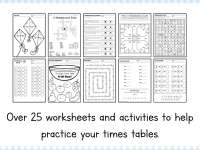
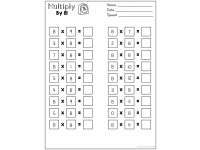
A seven-page ×8 set teaches the double-three-times strategy, then practices 8 × 0 to 8 × 12 through a speed drill, a multiples grid, a code riddle, word problems and a quick check, with two answer key pages.



- Grades
- Grades 3–4, Elementary
- Pages
- 7
- File type
- Answer key
- Included


- Subject
- Math, Multiplication and Division, Multiplication
- Topic
- 8 times table, multiplication facts
- Resource types
- Worksheets & Printables, Worksheets
- Answer key
- Included
About this resource
What's inside this resource
Doubling three times gives students a way to check any ×8 fact they forget, and the speed drill has time and score lines for repeat tries. The quick check and its self-rating work as an end-of-unit check on all facts to 8 × 12.
Related resources
More resources teachers may find useful
24 related resources were found using this product's title, contributor, categories and tags.


In the classroom
Teaching tips & learning objectives

Learning objectives
- Find a ×8 product by doubling a number three times.
- Skip count by eights, describe the ones-digit pattern and recognize multiples of 8.
- Recall the ×8 facts from 8 × 0 to 8 × 12 and find missing factors.

Teaching tips
- Fold a paper strip in half three times and open it to show 8 equal parts; it shows why three doublings make 8 groups.
- Watch for students who double only twice, which gives ×4, and for mix-ups between 8 × 7 and 8 × 6.

No reviews yet
Downloaded this resource? Tell other teachers how it went.
Curriculum
Standards, concepts & topics
Standards
 Standards
- 3.OA.A.1 — Interpret products of whole numbers, e.g., interpret 5 × 7 as the total number of objects in 5 groups of 7 objects each. For example, describe a context in which a total number of objects can be expressed as 5 × 7.
- 3.OA.A.3 — Use multiplication and division within 100 to solve word problems in situations involving equal groups, arrays, and measurement quantities, e.g., by using drawings and equations with a symbol for the unknown number to represent the problem.1
- 3.OA.A.4 — Determine the unknown whole number in a multiplication or division equation relating three whole numbers. For example, determine the unknown number that makes the equation true in each of the equations 8 × ? = 48, 5 = � ÷ 3, 6 × 6 = ?.
- 3.OA.B.5 — Apply properties of operations as strategies to multiply and divide.2 Examples: If 6 × 4 = 24 is known, then 4 × 6 = 24 is also known. (Commutative property of multiplication.) 3 × 5 × 2 can be found by 3 × 5 = 15, then 15 × 2 = 30, or by 5 × 2 = 10, then 3 × 10 = 30. (Associative property of multiplication.) Knowing that 8 × 5 = 40 and 8 × 2 = 16, one can find 8 × 7 as 8 × (5 + 2) = (8 × 5) + (8 × 2) = 40 + 16 = 56. (Distributive property.)
- 3.OA.C.7 — Fluently multiply and divide within 100, using strategies such as the relationship between multiplication and division (e.g., knowing that 8 × 5 = 40, one knows 40 ÷ 5 = 8) or properties of operations. By the end of Grade 3, know from memory all products of two one-digit numbers.
Core concepts
 Core concepts
- Doubling
- Skip counting
- Multiples of 8
- Missing factors
 Topics
Explore more
Categories this resource belongs to
Explore related searches
More to explore
You may also like
Worksheets & Printables, Task Cards, Teacher Tools, Assessments, Lesson Plans, Quizzes and Tests, Activities, Centers


Worksheets & Printables, Word Problems, Worksheets
Centers, Activities, Teacher Tools, Assessments, Lesson Plans, Quizzes and Tests, Worksheets & Printables, Task Cards
Worksheets & Printables, Task Cards, Teacher Tools, Assessments, Lesson Plans, Quizzes and Tests, Centers, Activities
Teacher Tools, Lesson Plans, Assessments, Quizzes and Tests, Worksheets & Printables, Task Cards, Centers, Activities

Teacher Tools, Assessments, Lesson Plans, Quizzes and Tests, Centers, Activities, Task Cards, Worksheets & Printables