



3,967 products added recently
Page 103 - 3rd Grade Activities
Enhance your third-grade curriculum with activities that stimulate interest and understanding. These resources offer hands-on experiments, creative projects, and problem-solving tasks. Incorporate them to support skill development and make learning a captivating experience.

 Show filters


Gross Motor Bingo Game
P.E. & Health, Physical Education, Grade 1, 2, 3, Activities, Games
This download is for students to play a gross motor bingo game. There are 5 bingo cards and 1 calling task list.
Author Miracles and Moree Therapy LLC
Tags Gross Motor Game, Gross Motor Activity, Bingo Game, Gross Motor Bingo, Bingo Motors
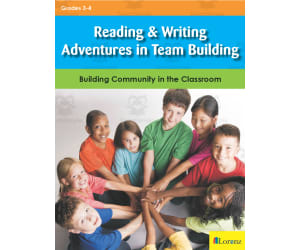
Reading & Writing Adventures in Team Building: Building Community in the Classroom
ELA, Reading, Grade 3, 4, Activities
Reading & Writing Adventures in Team Building: Building Community in the Classroom An engaging teaching resource designed to encourage classroom community through unique reading and writing exercises. This stimulating platform is intended for Grade 3 and Grade 4 students. Combining student interaction with problem-solving strategies, it fosters a rich learning environment. Activities: Captivating class-participation games that challenge students to delve into the Language Arts world. Numerous opportunities for learners to practice their alliteration sentences, handle poetry creation, embark on story revision tasks, and more! Allowing for flexible integration into daily lesson plans. These compact tasks can be completed within short periods but are versatile enough to be extended as required. Usage: Educators can use these games during whole class instruction or small group workstations. Alternatively, assigning them as homework is also an option. Presentation: This teaching resource comes as a PDF file with In summarization: Reading & Writing Adventures in Team Building: Building Community in the Classroom not only enhances reading and writing skill development but significantly contributes towards building unity within classroom settings – making educational journeys both productive and enjoyable adventures. Perfectly suited for homeschoolers looking dynamic ways of teaching reading while fostering camaraderie among learners or public school teachers searching innovative strategies promoting interaction during language arts sessions.
Author Classroom Complete Press
Tags Reading, Writing, Adventures, Team Building, Building Community
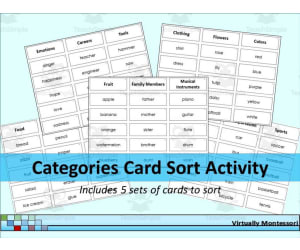
Categories Card Sort Activity
ELA, Language Development, Vocabulary, Grade 1, 2, 3, 4, 5, Activities
Categories Card Sort Activity Categories Card Sort Activity is an interactive teaching resource designed to enhance the learning experience about the classification of words into diverse categories. Presented as a must-have addition for grades one through five, this activity centers mainly on Language Arts-- underscored by its emphasis on Vocabulary Enrichment. The package includes five sets of categorization cards each deck composed of 15 cards representing three distinct categories. Learners have ample opportunities for intensive practice in word association in real-life settings either independently or with peers. Set 1: Clothing, Flowers, and Colors Set 2: Vegetables, Transportation, Sports Sets 3 - 5: Covers a widespread interval from food articles to school utilities; fruits down to family members and musical instruments all the way up to emotions then careers concluding with tools. To get this educational ride underway while concurrently providing visual learners a significant leg-up; begin by arranging heading cards from any chosen set such as 'Clothing' and 'Colors' for Set 1. Then students identify which category each card fits - sliding them under their respective headings until every card is sorted. In case there are any uncertainties about a word's meaning? This crucial moment provides teachers with an excellent opportunity encouraging dictionary use-- fostering independent research skills. Moreover, post-task completion every learner has access to answer keys rectify potential mistakes or cement correct decisions further strengthening their confidence command over vocabulary terms discussed. Bonus Extension Activity! A creative bonus extension activity challenges learners populate each header using personally contemplated words for even wider coverage of class insights and increased sparking creativity. So round off your teaching approach today with interactive, emotionally engaging 'Categories Card Sort Activity'! It's guaranteed to inject a fun stimulus into any Language Arts lesson plan. Note: This product is available as a PDF file format for easy, ready-to-print use. Lamination post-printing is recommended for durability and prolonged usage.
Author Virtually Montessori
Tags Categories, Vocabulary, Classification, Interactive Learning, Language Arts

Science Crossword - Set 3: 1 Page Sample (PDF)
ELA, Language Development, Vocabulary, Spelling, ESL, Resources for Teachers, Science, Physics, Earth and Environmental Sciences, Life Sciences, Grade 2, 3, 4, 5, Worksheets & Printables, Worksheets, Teacher Tools, Crosswords Puzzles, Centers, Activities
THIS IS A ONE PAGE SAMPLE OF A SIX CROSSWORD DOWNLOAD FULL SIX CROSSWORD DOWNLOAD INFORMATION: Crossword Series (Themed) This crossword series is designed for students in grades 2–5. Each set of crosswords is built around a clear vocabulary theme, allowing students to strengthen their word recognition, build subject-based knowledge, and reinforce early literacy and thinking skills. Each topic includes six crossword sets , and each set features the following consistent structure: 1. 8 vocabulary clues 2. Crossword puzzle 3. Answer key 4. 1 Did You Know fact related to the set These crosswords are designed to be student-friendly, classroom-ready, and easily integrated into thematic units, seasonal learning, morning work, or independent literacy stations. Science Crosswords Set 3 Word List 1. Human Body Systems Brain, Heart, Lungs, Muscles, Bones, Veins, Digest, Nerves 2. Ecosystems and Food Chains Ecosystem, Habitat, Producer, Consumer, Decomposer, Food Chain, Predator, Prey 3. States of Matter Matter, Solid, Liquid, Gas, Melt, Freeze, Evaporate, Condense 4. Space and the Universe Galaxy, Milky Way, Orbit, Gravity, Black Hole, Meteor, Astronomer, Telescope 5. Plants and Photosynthesis Roots, Stem, Leaf, Flower, Seed, Sunlight, Oxygen, Chlorophyll 6. Simple Machines and Engineering Lever, Pulley, Ramp, Wheel, Axle, Screw, Gears, Invent PDF Version Other versions will appear here when available. Follow the store for the lastest on new products. How to Use This Crossword These crosswords are ideal for whole-class work, small groups, literacy centers, or take-home activities. Use one set per day, or spread them across a week or month depending on your curriculum needs. Each clue has been crafted to align with the reading level of grades 2–5, with support for both decoding and meaning. The Did You Know? facts offer additional extension opportunities for writing, drawing, or display work. Whether you're reinforcing vocabulary, exploring a seasonal topic, or adding variety to your literacy block, these crosswords provide a fun, flexible, and focused way to boost early literacy in an engaging format. More Science Themed Products Science Crosswords (Set 1) PDF Science Crosswords (Set 2) PDF FULL CATALOG OF DOWNLOAD LINKS HERE Themed Crossword Links Addition PDF Animals PDF Around the Home PDF Birthday PDF Candy PDF Christmas PDF Cinco de Mayo PDF Clothes PDF Colors PDF Days and Months PDF Division PDF Earth Day PDF Easter PDF Easy Crosswords PDF Fall PDF Father's Day PDF Food PDF Geography (Set 1) PDF Geography (Set 2) PDF Geography (Set 3) PDF Graduation PDF Health PDF History (Set 1) PDF History (Set 2) PDF History (Set 3) PDF Human Body PDF Kindness PDF Life Skills PDF Mother's Day PDF Multiplication PDF Science Crosswords (Set 1) PDF Science Crosswords (Set 2) PDF Science Crosswords (Set 3) PDF Shapes PDF Social Skills PDF Spring PDF Sports PDF St. Patrick's Day PDF Subtraction PDF Summer PDF Thanksgiving PDF Transport PDF Valentine's Day PDF Winter PDF Crosswords in Depth Structure Each crossword clue is written in simplified language to suit early readers, and follows a strict number-and-clue format (e.g., 1.A shape with four sides ). Students complete each puzzle using the themed vocabulary provided, helping to build both content knowledge and spelling confidence. Each completed set includes: A questions section with clearly formatted clues An answers section to support teacher checking or independent correction A Did You Know? fact tied to the topic (one per set) to add curiosity and cross-curricular value Themes Included The crosswords cover a wide variety of engaging, age-appropriate themes such as: Seasons & Holidays (e.g., Winter, Easter, Valentine’s Day) Math Concepts (e.g., Addition, Subtraction, Multiplication, Division) Everyday Topics (e.g., School, Colors, Animals, Weather) Special Units (e.g., Health, Earth Day, Sports, Graduation, Kindness) Each theme is carefully selected to reflect the experiences and interests of young learners, while reinforcing vocabulary and comprehension. For similar downloads and other frees, do check out Cored Group on TeachSimple.
Author Cored Education
Rating
Tags Vocabulary, Spelling, Crosswords, Science, Science Crosswords, Human Body Systems, Ecosystems, Food Chains, States Of Matter, Plants And Photosynthesis
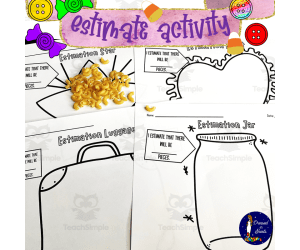
Estimate Activity
Math, Early Math, Grade 2, 3, 4, Activities
Students will have fun estimating with this fun activity that kids can do in teams of two or individually. They will estimate how many pieces of cotton balls, buttons, or macaroni can fill the shape shown. There are 12 shapes to fill! estimation jar estimation heart estimation star estimation pillow estimation bottle estimation book estimation luggage estimation canvas estimation envelope estimation gift estimation cup This activity will require glue and any item you choose for students to use to fill each object. Have fun! --------------------------------------------------------------------
Author Soumara Siddiqui
Tags Estimate, Estimation, Activities, Fun Estimating
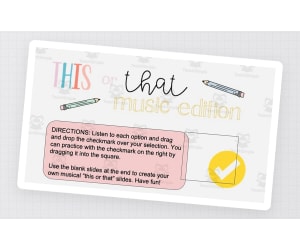
This or That Game: Music Edition
Creative Arts, Art, Music, Preschool, Grade 1, 2, 3, 4, 5, Activities, Games
This resource is a this or that game with a music theme. On each slide, students will be presented with 2 musical options. Students will decide which they prefer most.
Author Joyful Noise Teaching
Tags Music Game, Class Game, This Or That, Music, Instruments, This Or That Music Edition, Music This Or That
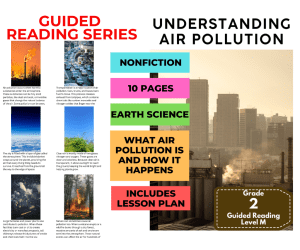
Guided Reading Level M - Air Pollution (with Lesson Plan)
ELA, Resources for Teachers, Reading Comprehension, Reading, Science, Technology, Physics, Life Sciences, Earth and Environmental Sciences, Environmental Science, Grade 2, 3, 4, Worksheets & Printables, Worksheets, Teacher Tools, Centers, Activities, Literacy Readers, Quizzes, Quizzes and Tests, Assessments, Lesson Plans
This Guided Reading Book - Understanding Air Pollution (Level M) with lesson plan includes: Guided Reading Color Label (front cover x1) This is a quick way to match the book’s demands to what students can generally handle.. The overall goal is to use the level/color to pick books for several smaller groups. To qualify for a certain level, a student is expected to read a book from that level with about 90–94% accuracy. If a student is consistently accurate and understands, move up a level. If the student is struggling at that level, drop down and add more support. Each student will improve at completely different rates, but it is generally one of the best ways to check progress across the class. DOWNLOAD THE CATALOG TO VIEW ALL GUIDED READING BOOKS AVAILABLE (SORTED LEVELS A-Z) Pre-Reading Question (x1) Teacher asks the prompt aloud, can be while showing the cover or first page. Students share what they already know, or make educated guesses from the cover. Prompt them to use the target vocabulary. Write some of their responses on the board to look back at during the reading. Vocabulary Words (x5) Introduce the five words, best doing it one at a time. Start by saying it, while students repeat and then see if anyone knows what it means before reading further. Read through the meaning and try to briefly connect each word to a picture or gesture so it’s meaningful. Ask students to flip through the book pages and point to where they see each of the vocabulary words. While reading the book pause upon coming across one of the vocab words or read the sentence twice to make sure students understand the word has appeared. Optional: Ask students to raise hands whenever they see/hear one of the new words. Guided Reading Pages (x10) Check the book snapshot (below) for: primary topic - do you need to prep extra reading or intro materials on this? what is taught best - decide on 1-2 bullets to focus on, use the prompt or words provided here for best results. learning goals - what you are checking for students to be able to do after the session, elicit answers using prompts or words provided. key vocabulary (see section above). questions overview - so you know what is coming up and if you need to prep extra materials to assist understanding. Run the lesson You may have already looked at a few of the pages together, but you can show them some of the pictures again first to set meaning. Depending on how much time you have and how familiar your students are with guided reading class, you may want to read the book aloud first with the group first. Students whisper or partner read, while you listen in. If time, do it as a group, one student reading a page each. Use the guided page’s prompts to coach: “Check the picture / does it make sense?” “Point under the words / try the first sound” “Reread the sentence smoothly”. Try to focus more on one student per session (rotating every time), so you can work out if they are ready to move up or need to move down a level. Comprehension Questions (back cover x3) This is your way to check that students didn’t just say the words, but actually understood the text. First, let students answer by pointing to the page/picture and saying a short sentence. After any answer, follow with: “Show me where you found that in the text.” In bigger groups, have partners answer first (10–20 seconds), then call on 2–3 students to share. Differentiation tips: Emerging speakers/struggling readers: oral + pointing On-level: oral in a full sentence Higher: one written sentence or draw + label Book Snapshot Title: Understanding Air Pollution Genre: Nonfiction (informational science text) Subject: Science (Earth & Environmental Science) Primary Topic: What air pollution is and how it happens Estimated Guided Reading Level (A–Z): M What This Book Teaches Best Introduces the atmosphere as an “invisible blanket” of air around Earth that living things need. Explains what clean air is mostly made of (nitrogen and oxygen) and why transparent air matters for sunlight and plant growth. Defines air pollution and shows that it can be visible (dust, soot) or hidden (invisible gases). Describes major sources of air pollution from transportation and from factories/power plants that burn fuels. Connects air pollution to real effects, including smog , health problems from particulate matter, and damage to plants through acid rain. Learning Goals Describe what the atmosphere is and why it is important for living things. Identify what clean air is mostly made of and describe characteristics of clean air from the text. Explain what air pollution is and name examples of pollutants described in the book. Describe how transportation and factories/power plants contribute to air pollution. Explain what smog is and how it forms, using details from the text. Describe one way technology can reduce air pollution based on the book’s examples. Key Vocabulary From the Text atmosphere — blanket of air around Earth. nitrogen — a gas that makes up much of clean air. oxygen — a gas living things need to survive. particulate — made of tiny pieces or specks. turbines — machines with blades that spin to make electricity. Discussion Prompts Pre-reading question: What are some things you think can make the air around us less clean? Comprehension questions: What two gases is clean air mostly made of? Comprehension questions: What is smog, according to the text? Comprehension questions: How do wind turbines and solar panels help reduce air pollution in the book? Printing Tips 1. Best Printing Method (Recommended) “Booklet” Printing (Best if Available) If your printer or PDF viewer supports Booklet Printing , use this. Settings to use: Print mode: Booklet Paper size: Letter or A4 (either works) Orientation: Landscape Print on both sides: Yes Flip on: Short edge Scaling: Fit to printable area Booklet subset: First test: Front sides only Then: Back sides only This will automatically: Pair pages correctly Put the cover on the outside Align everything for folding After printing, fold in half and staple along the spine . 2. If “Booklet” Printing Is NOT Available You can still print this correctly with manual duplex printing . Step-by-step: Open the PDF. Choose Print . Set: Orientation: Landscape Pages per sheet: 1 Print on both sides: Yes Flip on: Short edge Print all pages . Because each PDF page already contains two facing book pages, the result will still fold cleanly into a book. Thousands of Cored Education products are included with your TeachSimple membership. Download links and encyclopedia index available here.
Author Cored Education
Rating
Tags Reading Comprehension, Reading Passages, Reading, Guided Reading, Guided Reading Lesson Plan, Guided Reading Activity, Pre-reading, Science Lesson Plans, Earth Science, Physics
Numbers Reading Comprehension Passage - Cored Ed Encyclopedia
ELA, Language Development, Resources for Teachers, Reading Comprehension, Reading, Pre-Reading, Writing, History, Social Studies, Strategies, Grade 2, 3, 4, 5, Worksheets & Printables, Worksheets, Teacher Tools, Centers, Activities, Writing Prompts, Assessments, Tests, Quizzes and Tests, Quizzes
This numbers reading comprehension contains the following: Visualize on the Cover (Teacher Read Aloud Script) Start your lesson by taking a few moments to visualize the topic and share thoughts or feelings about it. Pre-Reading Trivia Students will write down one thing they already know about the subject and then read five more facts and discuss. These facts are fun, and the students will enjoy learning about the subject before reading more. Reading Passage The text is a high-interest reading passage with set paragraphs, roughly three to four paragraphs long. It contains a variety of themes about the topic, anywhere from history to technology. The passage is between 250 and 350 words in length. Mixed Questions The first question page contains four multiple-choice questions, each with a choice of four answers, and three written response questions that require a sentence or two from the student. Vocabulary Questions Practice seven key words from the text in this section across two activities. First section is scrambled words where students will unscramble three words given a clue for each. The second section is a word to meaning matching activity. Creative Writing In this question, the student will be required to write a five to eight sentence paragraph on a question related to the topic. Extension Activities This page is optional for fast finishers or to take home. There are several activities, each one requiring a different skill. Do some, do none, do all, completely optional - but you will feel reassured knowing every possibility is planned for. Includes summary writting question. Answer Key There are answers for the multiple-choice questions, written response questions have sample answers, vocabulary answers and if there is a summary question then a sample summary will be provided as well. FULL CATALOG OF DOWNLOAD LINKS AND ENCYCLOPEDIA INDEX HERE Lesson Snapshot Title: Numbers Genre: Nonfiction Subject: Math (Number Systems) Primary Topic: Counting systems, place value, and zero Estimated Guided Reading Level (A–Z): N What This Lesson Teaches Best Explains early counting methods (bodies, fingers, pebbles) and introduces the tally system as one mark per item. Shows why communities needed lasting number records as towns and trading grew, including wedge-shaped marks pressed into clay in Mesopotamia . Introduces different ways cultures wrote numbers (Egyptian hieroglyph symbols; Roman numerals using I, V, and X). Teaches how the base-ten system and place value use digits 0–9, and why zero matters for holding an empty place. Traces how Hindu-Arabic numerals spread through books, trade routes, and schools (including mention of Fibonacci) and appear today on receipts, maps, and screens. Learning Goals Describe two ways people counted before modern number symbols were common. Explain what a tally system is and why it can get “messy fast” for big amounts. Describe how people in Mesopotamia recorded numbers in soft clay and why those marks lasted. Explain how base-ten place value works (a digit’s spot helps decide its size). Explain why zero is important in the base-ten system, using the text’s explanation. Describe how the “method of the Indians” spread to new places over time. Key Vocabulary From the Text Tally — counting with one mark for each thing. Mesopotamia — an ancient place where early number writing appeared. Wedge-shaped — shaped like a wedge pressed into clay. Place value — a digit’s value depends on its position. Fibonacci — a thinker who helped spread the new number method. Cored Ed Encyclopedia Overview The Cored Ed Encyclopedia is a weekly series of lessons that you can pick up and use right away. These short readings fit into whatever time you have available. Each one includes a warm-up, a reading, and a set of questions, but it’s flexible — you can do just the reading, the full lesson, or skip the writing section if you need to. Each lesson focuses on a single topic so students don’t get lost. The writing is clear but never childish, making it perfect for grades two through five. Topics range from animals and science to history, inventions, and everyday things. No matter the level of the student, everyone should take away at least one new idea or fact from each lesson. The materials are easy to print, easy to explain, and require no setup. They work well for whole-class teaching, partner work, or independent study.
Author Cored Education
Rating
Tags Vocabulary, Spelling, Reading Comprehension, Reading Passages, Reading, Creative Writing, Reading Strategies, Writing Prompts, History, Numbers

Free Interactive Memory Game to Practice Days of the Week
Life Studies, ELA, Reading, Reading Comprehension, Language Development, Pre-Reading, Spelling, Vocabulary, Writing, Kindergarten, Preschool, Grade 1, 2, 3, Games, Activities
Practice Days of the Week with this Interactive Memory Game Students will love learning and reviewing the days of the week with this engaging digital memory game. The game strengthens visual memory, short-term memory, concentration, and more as students flip over cards to find matches. To play, students first learn the words on the slides. Then they click on card coordinates to reveal pictures and words. If the cards don't match, students flip them back over and try again. When all cards are matched, press the circular "Start Again" button for another round! Use this 7-slide PowerPoint in whole group, small group, centers, or as a computer activity . The game entertains while building language arts skills. Check out more Spanish games and activities from ShapeUp-N-Matematicas y Lenguaje in our TpT store.
Author ShapeUp-N-Matematicas y Lenguaje
Tags Days Of The Week, Weekdays, Games, Memory Game, Small Or Whole Group, Interactive Activity, Week, Date, Days, Day

Summer Olympic Elapsed Time Problems
Math, Time, Grade 3, 4, 5, Activities
Summer Olympic Elapsed Time Problems: The Ultimate Teaching Resource Optimizer for grades 3, 4, and 5 educators, the Summer Olympic Elapsed Time Problems is a compact teaching tool featuring interactive task cards with time-based problems. It's centered around various sports in the Summer Olympics and aligns perfectly with VA Math SOL standards--VA Math SOL 3.9 (elapsed time to the nearest hour), VA Math SOL 4.9 , and VA SOL 5.11 (elapsed time to the nearest minute). The magic of solving elapsed time problems makes math learning fun! The package includes: Ten large-sized elapsed-time problems in hour increments Ten small-sized task cards with similar problems but measured in minute increments Versatile Format for Varied Implementation Styles: The provided format is ideal for classroom scavenger hunts or small group sessions; learners can answer them on Google Slide collectively or it can be assigned digitally. Perfectly adaptable for remote learning environments too! An All-inclusive Digital Version: This product is also bundled as a zip file including two files – a full-sized printable version filled with exciting tasks and another versatile task card version. Note: Designed keeping educators' straightforward experience in mind. Redefining Lesson Planning: Incorporate these resources when planning lessons on elapsed times – adding an exciting connection to one of history's biggest sporting events!
Author SchoolingSara
Tags Elapsed Time, Word Problems, Summer Olympics, Task Cards, Sports

Geography Mazes - Set 3 (PDF)
ELA, Language Development, Vocabulary, Spelling, ESL, Resources for Teachers, Geography, Social Studies, Grade 2, 3, 4, 5, Worksheets & Printables, Worksheets, Teacher Tools, Centers, Activities, Mazes
Maze Series This maze series is designed for students in grades 2–5. Each set features a clear, kid-friendly theme with scene-based mazes that students first navigate, then complete by drawing a few target words from a simple word list. Pages come in varied styles and graduated difficulty, with an optional “color it in” step—and some themes invite quick calculations to match the task. These mazes are student-friendly, classroom-ready, and perfect for literacy warmups, seasonal units, fast-finisher bins, centers, sub plans, or home learning extensions. The playful, structured format builds problem-solving, attention to detail, and fine-motor control while reinforcing themed content in a motivating way. Note: Unlike many themed products, not all word-list words appear on the maze pages. To support full vocabulary coverage, we’ve released a companion word list you can find in the links section. Geography Set 3 Word List 1. More Countries of the World United States, United Kingdom, Australia, India, Peru, Egypt, South Korea, Turkey 2. More Famous Cities Chicago, Toronto, Dubai, Venice, Shanghai, Bangkok, Lisbon, Marrakech 3. More Famous Landmarks Mount Fuji, Sydney Opera House, Chichen Itza, Victoria Falls, Neuschwanstein Castle, Angkor Wat, Red Square, The Parthenon 4. Landforms and Earth's Features Canyon, Plateau, Delta, Glacier, Hill, Bay, Strait, Isthmus 5. U.S. States and Capitals California, Texas, Florida, Alaska, Hawaii, Washington D.C., New York, Illinois 6. People and Cultures Around the World Language, Tradition, Festival, Temple, Market, Music, Clothing, Customs PDF Version Other versions will appear here when available. Follow the store for the lastest on new products. How to Use These Mazes Perfect for: Morning work or early-finisher bins Literacy or STEM centers Holiday/seasonal review lessons Independent stations, sub plans, or take-home enrichment More Geography Themed Products Geography Crosswords (Set 1) PDF Geography Crosswords (Set 2) PDF Geography Crosswords (Set 3) PDF Geography Word Searches (Set 1) PDF Geography Word Searches (Set 2) PDF Geography Word Searches (Set 3) PDF Geography Mazes (Set 1) PDF Geography Mazes (Set 2) PDF FULL CATALOG OF DOWNLOAD LINKS HERE Themed Mazes Links Addition PDF Animals PDF Around the Home PDF Birthday PDF Candy PDF Christmas PDF Cinco de Mayo PDF Clothes PDF Colors PDF Days and Months PDF Division PDF Earth Day PDF Easter PDF Easy Mazes PDF Fall PDF Father's Day PDF Food PDF Geography (Set 1) PDF Geography (Set 2) PDF Geography (Set 3) PDF Graduation PDF Health PDF History (Set 1) PDF History (Set 2) PDF History (Set 3) PDF Human Body PDF Kindness PDF Life Skills PDF Mother's Day PDF Multiplication PDF Science (Set 1) PDF Science (Set 2) PDF Science (Set 3) PDF Shapes PDF Social Skills PDF Spring PDF Sports PDF St. Patrick's Day PDF Subtraction PDF Summer PDF Thanksgiving PDF Transport PDF Valentine's Day PDF Winter PDF Mazes in Depth Structure Each maze is crafted around a focused sub-theme. Students navigate the maze, encountering branches and cul-de-sacs that build attention and planning. Most pages include a tiny follow-up box—students draw or label 2–3 target words from a small word box, add a quick count, or color in the scene—so the activity reinforces both content and skills in a highly engaging format. Each completed set includes: A themed maze page. A simple student instruction strip. An answer key showing the solved path for teacher support or self-checking Themes Included These mazes cover a wide range of fun, age-appropriate themes, including: Seasons & Holidays (e.g., Halloween, Easter, Valentine’s Day) Math-Lite Connections (e.g., quick counts, number words) Everyday Topics (e.g., Animals, Weather, School) Special Units (e.g., Health, Earth Day, Sports, Kindness) Each topic reflects students’ real-life experiences and interests while strengthening problem-solving, visual scanning, and fine-motor control in a playful, highly visual way. Easy extensions (optional): Time it: solve once in pencil, then try to beat the time in pen Retell the route using sequence words (first, next, then, finally) Count intersections or turns and graph the results Write a 1–2 sentence mini-story about the scene using the target words Design a tiny maze in the corner for a partner to solve Differentiation tips: Offer a finger-trace pass before pencils for emerging learners Highlight the borders of the correct region on first attempts Use thicker-line versions or simpler pages to build confidence Pair roles: “navigator” gives directions; “driver” traces the path For similar downloads and other frees, do check out Cored Group on TeachSimple.
Author Cored Education
Rating
Tags Vocabulary, Spelling, Geography, Countries Of The World, Famous Cities, Famous Landmarks, Landforms And Earth's Features, U.S. States And Capitals, Mazes, Geography Mazes
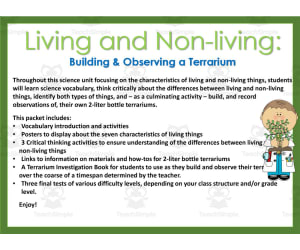
Living & Non-living Terrarium Packet
Science, Life Sciences, Biology, Grade 3, 4, 5, Activities
The Living & Non-living Terrarium Packet An immersive and detailed science unit designed for students in 3rd to 5th grade, this resource focuses on exploring living and non-living things through hands-on tasks such as building and observing a self-created terrarium. The journey begins with an introduction to relevant science vocabulary and a clear outline of the seven characteristics distinguishing living from non-living entities. Critical Thinking Activities Youths get to test their analytical skills via three targeted critical thinking activities. These exercises aim to consolidate student understanding and improve their object identification skills. Creating a Terrarium Following successful completion of these tasks, students move on to build their 2-liter bottle terrariums!. They're further encouraged with supporting materials, links providing instructions for terrarium construction. Additionally, they also receive a "Terrarium Investigation Book" which helps them through the process while providing space for recording observations over time . Evaluation Tests To effectively evaluate progress at various stages, there are three calibrate final tests based on observed classroom needs or grade levels. Upon successful completion of this unit’s learning cycle learners can take home their very own mini-ecosystem; promoting continued research outside school hours. Bonus: Flexibility in Learning This can be used across whole groups for collective discussion This can be used during small-group settings encouraging cooperative social-skills practice This can be administered as homework assignments, thereby extending learning beyond traditional space-time limits. A Final Word: This valuable 38-page teaching tool presents itself as a game-like interactive activity . It is not just an educational science unit but also provides enjoyable learning experiences.
Author At the Core
Tags Terrarium, Living Things, Non-living Things, Science Unit, Critical Thinking

Number Bonds 21-30 Bingo - Boards 11-15
Math, Fact Families, Addition and Subtraction, Addition, Grade 1, 2, 3, Activities, Games
Number Bonds 21-30 Bingo teaches number bonds for 21-30 in a fun, engaging way. This math game strengthens students' understanding of fact families and part-part-whole relationships. Teachers print, laminate, and cut the calling cards and bingo boards. Then students use manipulatives to cover called numbers. The first to cover 3 spaces in a row wins! Use this game for whole-class, small group, or individual practice. Differentiate by allowing some students to lead calling cards. Modify for multiple skills by calling combinations for targeted numbers or calling the total number bond fact. With endless variations, this game offers an interactive way to build number sense that students will love!
Author Colleen's Cosmic Collection
Tags Number Bonds, Number Bonds Games, Addition Game, Addition Activity, Math Facts, Addition Facts, Addition Math Facts, Math Fact Practice, Number Bonds To 30, Cccnbb2130

My beloved mother (Activity for Mother's Day)
ELA, Strategies, Writing, Grade 2, 3, 4, 5, 6, Activities
Celebrate Mother's Day in your classroom with this printable activity guiding students to reflect fondly on their mothers. Students complete the worksheet by recording descriptive details about mom's appearance, sketching her portrait, listing adjectives that capture her personality, sharing what makes her special, and deciding on a heartfelt gift. Use it for independent work, small groups, or as a springboard for crafting prose or poetry. Extend the lesson by having students present their completed work to the class. This resource promotes creativity, self-expression, and thoughtful writing - fitting for grades 2-6.
Author Teach To Heaven, Reoulita.com
Tags Mother's Day, Worksheet, Printout
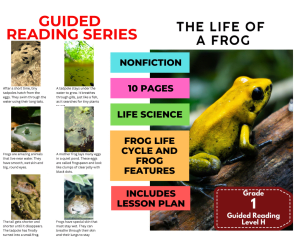
Guided Reading Level H - The Life of a Frog (with Lesson Plan)
ELA, Resources for Teachers, Reading Comprehension, Reading, Science, Animals, Life Sciences, Pre-Reading, Language Development, Vocabulary, Grade 1, 2, 3, Worksheets & Printables, Worksheets, Teacher Tools, Centers, Activities, Literacy Readers, Quizzes, Quizzes and Tests, Assessments, Lesson Plans
This Guided Reading Book - The Life of a Frog (Level H) with lesson plan includes: Guided Reading Color Label (front cover x1) This is a quick way to match the book’s demands to what students can generally handle.. The overall goal is to use the level/color to pick books for several smaller groups. To qualify for a certain level, a student is expected to read a book from that level with about 90–94% accuracy. If a student is consistently accurate and understands, move up a level. If the student is struggling at that level, drop down and add more support. Each student will improve at completely different rates, but it is generally one of the best ways to check progress across the class. DOWNLOAD THE CATALOG TO VIEW ALL GUIDED READING BOOKS AVAILABLE (SORTED LEVELS A-Z) Pre-Reading Question (x1) Teacher asks the prompt aloud, can be while showing the cover or first page. Students share what they already know, or make educated guesses from the cover. Prompt them to use the target vocabulary. Write some of their responses on the board to look back at during the reading. Vocabulary Words (x5) Introduce the five words, best doing it one at a time. Start by saying it, while students repeat and then see if anyone knows what it means before reading further. Read through the meaning and try to briefly connect each word to a picture or gesture so it’s meaningful. Ask students to flip through the book pages and point to where they see each of the vocabulary words. While reading the book pause upon coming across one of the vocab words or read the sentence twice to make sure students understand the word has appeared. Optional: Ask students to raise hands whenever they see/hear one of the new words. Guided Reading Pages (x10) Check the book snapshot (below) for: primary topic - do you need to prep extra reading or intro materials on this? what is taught best - decide on 1-2 bullets to focus on, use the prompt or words provided here for best results. learning goals - what you are checking for students to be able to do after the session, elicit answers using prompts or words provided. key vocabulary (see section above). questions overview - so you know what is coming up and if you need to prep extra materials to assist understanding. Run the lesson You may have already looked at a few of the pages together, but you can show them some of the pictures again first to set meaning. Depending on how much time you have and how familiar your students are with guided reading class, you may want to read the book aloud first with the group first. Students whisper or partner read, while you listen in. If time, do it as a group, one student reading a page each. Use the guided page’s prompts to coach: “Check the picture / does it make sense?” “Point under the words / try the first sound” “Reread the sentence smoothly”. Try to focus more on one student per session (rotating every time), so you can work out if they are ready to move up or need to move down a level. Comprehension Questions (back cover x3) This is your way to check that students didn’t just say the words, but actually understood the text. First, let students answer by pointing to the page/picture and saying a short sentence. After any answer, follow with: “Show me where you found that in the text.” In bigger groups, have partners answer first (10–20 seconds), then call on 2–3 students to share. Differentiation tips: Emerging speakers/struggling readers: oral + pointing On-level: oral in a full sentence Higher: one written sentence or draw + label Book Snapshot Title: The Life of a Frog Genre: Nonfiction (informational life cycle) Subject: Life Science + Reading (Informational Text) Primary Topic: Frog life cycle and frog features Estimated Guided Reading Level (A–Z): H What This Book Teaches Best Explains where frogs live and describes basic frog traits (smooth, wet skin; big, round eyes; living near water). Teaches the frog life cycle in clear steps: eggs (frogspawn) → tadpoles → legs grow → tail disappears → small frog. Shows how a tadpole lives and grows in water, including breathing through gills and eating tiny plants. Describes how frogs breathe (through skin and lungs) and how they get food (long, sticky tongue catching insects). Connects body parts to movement (strong back legs help frogs hop and jump high). Learning Goals Students will describe where frogs live and name physical traits the text mentions. Students will explain what frog eggs are called and describe what they look like. Students will retell the main stages of a frog’s life from eggs to a small frog. Students will describe how tadpoles move, breathe, and find food in the water. Students will explain how the frog’s body changes as legs grow and the tail disappears. Students will use text details to describe how a frog hunts and how it jumps. Key Vocabulary From the Text frogspawn — frog eggs that look like jelly. tadpoles — baby frogs that live in water and have tails. gills — body parts that help an animal breathe underwater. lungs — body parts used for breathing air. insects — small animals a frog can catch and eat. Discussion Prompts Pre-reading question: What changes do you think happen as a tadpole grows into a frog? Comprehension questions: Where does a mother frog lay many eggs, according to the text? Comprehension questions: What do tiny tadpoles use to swim through the water? Comprehension questions: What happens to the tadpole’s tail as it turns into a small frog? Printing Tips 1. Best Printing Method (Recommended) “Booklet” Printing (Best if Available) If your printer or PDF viewer supports Booklet Printing , use this. Settings to use: Print mode: Booklet Paper size: Letter or A4 (either works) Orientation: Landscape Print on both sides: Yes Flip on: Short edge Scaling: Fit to printable area Booklet subset: First test: Front sides only Then: Back sides only This will automatically: Pair pages correctly Put the cover on the outside Align everything for folding After printing, fold in half and staple along the spine . 2. If “Booklet” Printing Is NOT Available You can still print this correctly with manual duplex printing . Step-by-step: Open the PDF. Choose Print . Set: Orientation: Landscape Pages per sheet: 1 Print on both sides: Yes Flip on: Short edge Print all pages . Because each PDF page already contains two facing book pages, the result will still fold cleanly into a book. Thousands of Cored Education products are included with your TeachSimple membership. Download links and encyclopedia index available here.
Author Cored Education
Rating
Tags Reading Comprehension, Reading Passages, Reading, Guided Reading, Guided Reading Lesson Plan, Guided Reading Activity, Pre-reading, Science Lesson Plans, Animals, Frog Life Cycle

Emotional Response BINGO, Differentiated SEL Activities For K-5th
Special Resources, Life Skills, Grade 1, 2, 3, 4, 5, Activities
Emotional Response BINGO The Emotional Response BINGO is a resource packed with 56 pages of materials designed to support K-5th grade learners emotionally and socially. It includes comprehensive lesson plans, step-by-step instructions for an engaged learning experience, and other hands-on activities. What You Will Find Inside: Two Comprehensive Lesson Plans: Detailed outlines perfect for small group sessions or standalone classroom stations. 'Emotional Response BINGO' & 'Emotions Snowball Fight/Toss': Highly interactive activities to encourage participatory learning. Cards for 24 Emotional Scenarios: These are tailored separately for K-2nd graders and 3rd-5th graders keeping their understanding in perspective. Bonus Interactive Materials: Illustrated badges & customizable sets: Designed specifically to resonate with students’ individual comprehension levels. Fully equipped "Bingo" boards (3x3 and 5x5): Apart from its versatility, these offer activity flexibility suiting different teaching methodologies. " "Match or Mismatch":" This bonus behavioral activity facilitates experiential learning enhancing self-awareness among students. The resource additionally offers visuals that clarify confusing aspects of emotional responses which in turn makes this otherwise hard-to-grasp subject much more approachable. In essence, this versatile guide enables teachers an effective channel to develop their student’s potentials while creating a fun-filled yet educative environment.
Author Socially Skilled Kids
Tags Emotional Regulation, Social Cognition, Interactive Activities, Emotional Response BINGO, Self-awareness
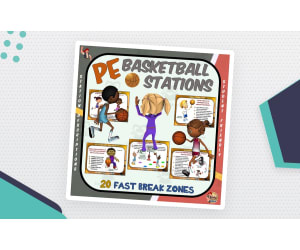
PE Basketball Stations – 20 Station Signs
P.E. & Health, Physical Education, Grade 2, 3, 4, 5, 6, 7, 8, Activities, Games
Here is a set of PE Basketball Stations. The PE basketball Stations are 20 fun filled, “fast break” basketball themed station signs/cards that you can use in your school gymnasium , outdoor blacktop or could be modified to be performed in a smaller space such as a classroom or empty cafeteria. Each basketball station card provides a basketball-related skill (i.e. dribbling, passing, shooting, etc.) and includes a brief instructional direction and a graphic that depicts the activity . The activities are standards-based and there are plenty of activities for you to choose from or for the students to take part in during multiple class periods or recess times if necessary. The stations work great as an activity for the weeks leading up to March Madness or the NBA Playoffs.
Author Cap'n Pete's Power PE
Rating
Tags Basketball, Physical Education, Stations, Sports, Exercise, Middle School Pe Basketball Lesson Plans, Basketball Passing Games For Elementary Pe

Vaccine or No Vaccine Activity
Science, Life Sciences, Biology, Human Body, Grade 3, 4, 5, 6, 7, 8, 9, Activities
Activity Introduction An amazing activity designed for the students to learn more about STEM subjects. Vaccine or No Vaccine Do you like STEM subjects? what is your favorite one? Have you ever tried to plant a seed? If yes, tell us more about it. Or have you ever tried to invent something? If yes, tell us more about it. And how do you think it will help us? Have you ever seen a microorganism under a microscope? What was it? And how it looked like? Mathematics is a marvelous subject. Let' sharpen our brains and solve some equations. Do you like timetable tricks? What is your favorite one? Do you know how to code? Have you ever created an app or a game before? If yes, how was it like? Vaccine or No Vaccine Activity The activity is perfect for encouraging the researching skills for the students, while learning more about this topic. Vaccine or No Vaccine This friendly designed worksheet is suitable for students at school, homeschooling, and as a group activity. Instructions Cut out everything on page 2 and glue them where they belong. Format Available in a PDF format.
Author Educational Voice
Tags Vaccine Or No Vaccine Activity, Vaccine, Vaccines, Vaccine Facts, Vaccine Facts For Kids, Human Body, Human Body Facts For Kids, Human Body Facts, STEM, STEM Facts

Practical Science: Earth and Beyond Activities for 8-10 year olds
Science, Earth and Environmental Sciences, Earth Sciences, Grade 3, 4, 5, Activities
The Practical Science: Earth and Beyond Hands-On Science Activities resource is a 28-page download. It is filled with very explicit lessons for 8-10 year olds. There are a total of 8 lessons. Each lesson begins with teacher notes for the teacher to gather necessary materials and consider lesson ideas and integration ideas.
Author Ready-Ed Publications
Tags Earth Sciences Activity, Eclipses Activity, Weather Data Activity, Science Materials, Practical Science Activities

Animals in Flight by Steve Jenkins Read-Aloud Activities
ELA, Reading, Reading Comprehension, Grade 2, 3, 4, Read Alouds, Activities
Enhance your students' reading experience with this comprehensive companion for Animals in Flight by Steve Jenkins. Featuring 26 ready-to-use activities, this resource is perfect for customizing learning to meet your students' needs and academic abilities. Designed to save you time and engage students effectively, these activities foster higher-level thinking skills and encourage textual evidence-based responses. Students will enjoy interactive and educational activities, while you appreciate having high-quality resources at your fingertips. INCLUDED IN THIS RESOURCE: Making Predictions KWL Graphic Organizer Animals in Flight - Student Notes Booklet Word Scramble (2 Versions) Who Am I? Fact or Fiction True or False (Bubble Answers ONLY) True or False (Bubble Answers & Correct the False Statement) Wingspan Math (2 Versions) 3-2-1 Making Connections Thinking About the Text Thinking Beyond the Text Flying Animals Playing Cards Animals in Flight ABCs Animals in Flight Poster 2 - Word Search Puzzles 2 - Crossword Puzzles Animal Yearbook Superlatives Fun Facts about Flying Animals & Insects New Vocabulary Book Review Roll & Research (2 Versions) This resource is for extension read-aloud activities only. The book is not included.
Author Creatively Gifted
Tags Reading Comprehension, Reading, Upper Elementary Reading, Picture Book , Read-aloud Activities, Interactive Read-aloud Activities, Book Companion, ELAR, Steve Jenkins, Animals

Ninja Syllables Puzzle and Game
ELA, Language Development, Spelling, Grade 1, 2, 3, Activities, Games
This resource is a Ninja Syllables Puzzle and Game. Puzzles are included for 2, 3, and 4 syllable words. Students can write the words as they create puzzles on the recording sheets. These are perfect for small group or literacy centers . Two sorts are included for students to complete. Your students will have fun playing as they read words with syllables on them.
Author Literacy Life
Tags Reading Puzzles, Spelling, Syllables, Ninja, Small Group
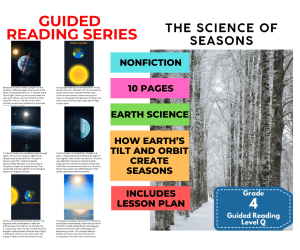
Guided Reading Level Q - Science of Seasons (with Lesson Plan)
ELA, Resources for Teachers, Reading Comprehension, Reading, Life Sciences, Science, Earth and Environmental Sciences, Geography, Social Studies, Space, Grade 3, 4, 5, Worksheets & Printables, Worksheets, Teacher Tools, Centers, Activities, Literacy Readers, Quizzes, Quizzes and Tests, Assessments
This Guided Reading Book - Science of Seasons (Level Q) with lesson plan includes: Guided Reading Color Label (front cover x1) This is a quick way to match the book’s demands to what students can generally handle.. The overall goal is to use the level/color to pick books for several smaller groups. To qualify for a certain level, a student is expected to read a book from that level with about 90–94% accuracy. If a student is consistently accurate and understands, move up a level. If the student is struggling at that level, drop down and add more support. Each student will improve at completely different rates, but it is generally one of the best ways to check progress across the class. DOWNLOAD THE CATALOG TO VIEW ALL GUIDED READING BOOKS AVAILABLE (SORTED LEVELS A-Z) Pre-Reading Question (x1) Teacher asks the prompt aloud, can be while showing the cover or first page. Students share what they already know, or make educated guesses from the cover. Prompt them to use the target vocabulary. Write some of their responses on the board to look back at during the reading. Vocabulary Words (x5) Introduce the five words, best doing it one at a time. Start by saying it, while students repeat and then see if anyone knows what it means before reading further. Read through the meaning and try to briefly connect each word to a picture or gesture so it’s meaningful. Ask students to flip through the book pages and point to where they see each of the vocabulary words. While reading the book pause upon coming across one of the vocab words or read the sentence twice to make sure students understand the word has appeared. Optional: Ask students to raise hands whenever they see/hear one of the new words. Guided Reading Pages (x10) Check the book snapshot (below) for: primary topic - do you need to prep extra reading or intro materials on this? what is taught best - decide on 1-2 bullets to focus on, use the prompt or words provided here for best results. learning goals - what you are checking for students to be able to do after the session, elicit answers using prompts or words provided. key vocabulary (see section above). questions overview - so you know what is coming up and if you need to prep extra materials to assist understanding. Run the lesson You may have already looked at a few of the pages together, but you can show them some of the pictures again first to set meaning. Depending on how much time you have and how familiar your students are with guided reading class, you may want to read the book aloud first with the group first. Students whisper or partner read, while you listen in. If time, do it as a group, one student reading a page each. Use the guided page’s prompts to coach: “Check the picture / does it make sense?” “Point under the words / try the first sound” “Reread the sentence smoothly”. Try to focus more on one student per session (rotating every time), so you can work out if they are ready to move up or need to move down a level. Comprehension Questions (back cover x3) This is your way to check that students didn’t just say the words, but actually understood the text. First, let students answer by pointing to the page/picture and saying a short sentence. After any answer, follow with: “Show me where you found that in the text.” In bigger groups, have partners answer first (10–20 seconds), then call on 2–3 students to share. Differentiation tips: Emerging speakers/struggling readers: oral + pointing On-level: oral in a full sentence Higher: one written sentence or draw + label Book Snapshot Title: The Science of Seasons Genre: Nonfiction (informational text) Subject: Earth & Space Science / Reading (Informational Text) Primary Topic: How Earth’s tilt and orbit create seasons Estimated Guided Reading Level (A–Z): Q What This Book Teaches Best Cause-and-effect in Earth science: The text explains how Earth’s orbit and its 23.5° axial tilt lead to changing seasons. Sunlight angle and temperature: Readers learn how direct, concentrated sunlight warms more than slanted rays that spread out and provide less heat. Key seasonal markers: The vernal equinox, summer solstice, autumnal equinox, and winter solstice are described with what happens to daylight and seasons. Hemispheres and opposite seasons: The book states seasons are opposite in the Northern and Southern Hemispheres because of Earth’s tilt. How living things respond to seasons: It describes animals migrating or hibernating when weather turns cold and food becomes scarce. Learning Goals Students will describe Earth’s orbit and explain that one trip takes approximately 365 days. Students will explain how Earth’s axial tilt affects the angles of sunlight hitting Earth. Students will compare direct rays and slanted rays using the text’s heat descriptions. Students will identify what happens during an equinox and during a solstice, based on the text. Students will explain why seasons are opposite in the Northern and Southern Hemispheres. Students will describe two ways animals survive seasonal change: migrating and hibernating. Key Vocabulary From the Text orbit — the path Earth travels around the Sun. axial — related to the line an object spins around. hemisphere — half of Earth. equinox — when day and night are nearly equal. migrate — move to a new place for better conditions. Discussion Prompts Pre-reading question: What do you think makes Earth have different seasons during the year? Comprehension questions: According to the text, how do Earth’s orbit and axial tilt help create the seasons? Comprehension questions: What happens to daylight and darkness during the vernal or autumnal equinox? Comprehension questions: What are two ways animals survive when the weather turns cold and food becomes scarce? Printing Tips 1. Best Printing Method (Recommended) “Booklet” Printing (Best if Available) If your printer or PDF viewer supports Booklet Printing , use this. Settings to use: Print mode: Booklet Paper size: Letter or A4 (either works) Orientation: Landscape Print on both sides: Yes Flip on: Short edge Scaling: Fit to printable area Booklet subset: First test: Front sides only Then: Back sides only This will automatically: Pair pages correctly Put the cover on the outside Align everything for folding After printing, fold in half and staple along the spine . 2. If “Booklet” Printing Is NOT Available You can still print this correctly with manual duplex printing . Step-by-step: Open the PDF. Choose Print . Set: Orientation: Landscape Pages per sheet: 1 Print on both sides: Yes Flip on: Short edge Print all pages . Because each PDF page already contains two facing book pages, the result will still fold cleanly into a book. Thousands of Cored Education products are included with your TeachSimple membership. Download links and encyclopedia index available here.
Author Cored Education
Rating
Tags Reading Comprehension, Reading Passages, Reading, Guided Reading, Guided Reading Lesson Plan, Guided Reading Activity, Pre-reading, Science Lesson Plans, Geography, Space

Math Cube Pocket Inserts: Comparing Fractions
Math, Fractions, Grade 3, 4, 5, Activities
Math Cube Pocket Inserts: Comparing Fractions is an engaging teaching resource that allows students to build and explore math cubes focused on comparing fractions. Students can assemble the cubes independently, in small groups, or as a class activity guided by the teacher. The set includes a variety of fraction comparison problems students can solve using the cubes they construct. A recording sheet is provided for students to show their work and solutions. An answer key is also included. This versatile resource allows teachers flexibility in implementation; the cubes can be used for independent practice, collaborative group work, assessment , or direct math instruction targeting the critical skill of comparing fractions. Students in grades 3-5 will find these hands-on math cubes enjoyable and helpful for mastering fraction comparison.
Author Teachers R Us Homeschool
Tags Comparing Fractions, Math Cubes, Math Inserts, Fractions Printable, Fractions Activity
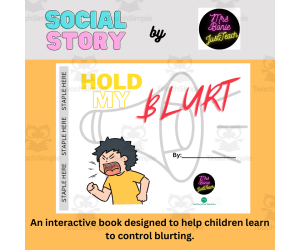
Blurting in Class- Interactive Book/Printable Behavior Support SEL
Special Resources, Social Emotional Learning (SEL), Social Skills, Grade 3, 4, 5, 6, Activities
Blurting in Class - Interactive Book/Printable Behavior Support SEL This resource is perfect for children aged 7-12 and is focused on addressing one of the most common classroom behavior issues - blurting out or shouting in class. It uses unique storytelling methods to engage with students. Adaptability: The resource can be used for whole class instruction as well as individual remediation for those learners who need more attention. Active learning is promoted by incorporating different activities such as answering questions, colouring images, drawing pictures and discussions. Inclusions: A full-sized printable book Half-page books that are space-efficient A Google Slides edition that can be projected on an ActiveBoard An inclusive discussion guide for facilitating classroom conversations Potential Applications: Whole-class Approach: The book can be projected onto the ActiveBoard while using the discussion guide to lead insightful conversations with students. In Small Groups via Counselling Circles or Tables: This approach can allow each student to participate actively in meaningful conversations about managing their behaviors effectively. In One-on-One Sessions: Vital information can be conveyed at a pace comfortable for individual students, providing much-needed personalized support. This promotes effective behavior intervention through tailored strategies. Beyond direct implementations, this vibrant storybook tool serves as an excellent take-home reinforcement aid; promoting revisits and better absorption of behavioral norms beyond school times. Other available topics include coping with emotions like sadness and anger, making friends at school, internet safety, etc., thus diversifying teachings towards a comprehensive Social Emotional Learning (SEL) program. This Interactive Book/Printable Behavior Support SEL is a must-have for any educator. Discuss thoroughly with your students, for real change stems from understanding encouraged through conversations.
Author Mrs Bonie Just Teach
Tags Behavior Management, Impulse Control, Social Emotional Learning, Classroom Support, Interactive Activities