



3,935 products added recently
Page 29 - Science Assessments
Provide comprehensive science assessments covering biology, chemistry, physics, and Earth science. This collection includes lab reports, concept checks, and experimental evaluations. Foster a deeper understanding of scientific principles by using targeted assessments.

 Show filters

Pennsylvania PSSA Pack of 3 Science Tests for Grade 8
Science, Grade 8, Assessments, Teacher Tools, Tests, Quizzes and Tests, Worksheets & Printables
Pennsylvania PSSA Pack of 3 Science Tests for Grade 8 Need rigorous 8th grade science test prep that actually reflects the PSSA? These PSSA Science Practice Tests give students real exam-style practice while building confidence and mastery across all tested standards. What’s Included ✅ 3 full-length PSSA-style science practice tests (45 questions each) ✅ 135 total multiple-choice questions ✅ Detailed answer key with step-by-step explanations ✅ Quick answer grids for efficient grading ✅ Comprehensive Teacher’s Guide with pacing and differentiation strategies ✅ Standards alignment (PA Science Anchors S8.A–S8.D) ✅ Diagnostic tools to track student progress and gaps How It Works in the Classroom This 8th grade science test prep resource is designed for flexible classroom use: Use as beginning-of-year benchmarks to assess readiness Implement as mid-year progress monitoring tools Assign for targeted PSSA test prep before exam season Break into stations, homework, or tutoring sessions Ideal for independent practice or sub plans Each test mirrors the format and rigor of the actual exam, helping students feel prepared and confident. Standards & Learning Goals Students review essential middle school science concepts: 🔬 Scientific inquiry, variables, and data analysis (S8.A) 🧬 Life science: cells, genetics, ecosystems (S8.B) ⚡ Physical science: matter, energy, forces, waves (S8.C) 🌎 Earth & space science: plate tectonics, weather, solar system (S8.D) Why Teachers Love It ⭐ Saves hours of planning with ready-to-use assessments ⭐ Prepares students with realistic, standards-aligned questions ⭐ Makes data-driven instruction simple and effective ⭐ Supports differentiation with built-in diagnostic tools ⭐ Works for whole class, small groups, or independent learning Make test prep easier and more effective with this 8th grade science test prep resource. Download today and help your students feel confident and ready for the PSSA!
Author Bright Classroom Ideas Marketplace
Rating
Tags Pennsylvania, Pssa, State Test, Science

Science Reading Passage: The Dinosaur Tyrannosaurus rex (Fillable PDF)
Science, ELA, Reading, Reading Comprehension, Strategies, Resources for Teachers, Life Sciences, Animals, Biology, Grade 6, 7, 8, 9, Writing Prompts, Worksheets & Printables, Centers, Activities, Teacher Tools, Assessments, Quizzes and Tests, Quizzes, Tests
Life Science Reading Comprehension Passage and Questions: The Dinosaur Tyrannosaurus rex (Fillable PDF) This very engaging science reading passage about Tyrannosaurus rex and how scientists use fossils to understand how it lived. It explains what fossils are, where and when T. rex lived, and what fossil evidence reveals about its size, teeth, skull, movement, speed, diet, hunting, and scavenging. It also shows how modern tools, such as CT scans, imaging, computer simulations, and coprolites , help paleontologists build a clearer picture of T. rex as a powerful predator from the late Cretaceous period. This passage is designed to bridge the gap between science and literacy through strengthening reading comprehension and sparking scientific curiosity in middle school students. The passage blends English Language Arts skills with accurate science content that supports NGSS classroom practice. Ideal for interdisciplinary learning in ELA and Science. Suitable for Grade 9 review, too! This passage is designed as a fillable PDF , which means students can type their answers directly into the document on any computer or tablet . Each page includes highlighted text fields that show them exactly where to type! Student Tasks for The Passage: 5 multiple-choice questions targeting main idea, key details, inference, vocabulary in context, and use of evidence 5 vocabulary matching items with clear, student-friendly definitions 5 text-based questions that require citing specific lines or facts 1 summary prompt that asks students to condense central ideas accurately Full answer key for every section Available Formats for this Resource PDF Word Docs Google Docs FULL CATALOG OF DOWNLOADING LINKS HERE Product Details Length: 5 pages total Grades: 6–8, also suitable for Grade 9 review Use cases: close reading, stations, homework, intervention, test prep, and sub plans Standards support: reinforces informational-text skills and supports NGSS-style sense making through observation, modeling, and clear use of claim, evidence, and reasoning Why Teachers Choose This Set Authentic science content paired with rigorous literacy practice Consistent task structure across all passages for easier planning and smoother student routines Clear, age-appropriate writing that builds confidence without oversimplifying Other Science Reading Collections you May find in the store: 1. Astronomy & Space Science 2. Volcanoes, Rocks, & Mountains 3. Rock Cycle, Soil, & Sinkholes 4. Mars, Glaciers, & Antarctica 5. Water Cycle, Acid Rain, & Wastewater 6. Insects, Animals, & Ecosystems 7. Bioluminescence & Insects 8. Animal Skin, Cats, & T. Rex 9. Human Body and Senses 10. Health & Applied Bioscience 11. Waves, Light, & Imaging 12. Electricity & Energy 13. Motion & Materials 14. Chemistry and Materials Science Use this set to reinforce ELA skills in science, to add literacy to your lessons, and to support independent work. The passages strengthen main idea, evidence use, vocabulary in context, inference, cause and effect, and summary writing. With ready-to-use assessments and complete answer keys, you can provide focused practice that is simple to run and fast to review.
Author Middle & High School - CORED Education
Rating
Tags Middle School, Reading Comprehension, Reading Strategies, ELA, Centers, Reading Passage, Assessments, Vocabulary, Life Science, The Dinosaur Tyrannosaurus Rex
Prompt Engineering for Content Creators & Freelancers Book
Science, Technology, Computer Science, Engineering, Resources for Teachers, Classroom Management, Research, Basic Science, Special Resources, Special Education Needs (SEN), Homeschool Curriculum, Homeschool Templates, Grade 9, 10, 11, 12, Projects, Activities, Experiments, Labs, Teacher Tools, Lesson Plans, Presentations, Assessments, Workbooks, Worksheets & Printables
Utilize AI to its largest extent while becoming a successful content creation business with the Ultimate Guide to Prompt Engineering. This book has been designed specifically for freelancers, digital entrepreneurs, and business service providers aged from twenty-two up through forty. By leveraging AI tools such as ChatGPT, Claude, and Gemini, you will learn how to increase your output by ten times; decrease content creation time by as much as sixty percent; and establish a sustainable, scalable income by creating engaging, informative content that drives traffic to your site. You will learn how to apply the Six-Component Framework for developing flawless prompts, as well as several advanced techniques (attributed to Steve Bidstrup) that allow a creator to express their brand's voice (Chain of Thought and Few-Shot) to produce business-specific content (Twitter/X, YouTube Channel, LinkedIn Page, Instagram Account, Email Newsletter) using case study examples illustrating how content creators such as Sarah and Marcus accomplished their respective businesses by utilizing the techniques contained within this book, while also reducing the total amount of hours worked per week by three. In addition, you will receive a complete thirty-day implementation guide; prompt templates that can be reused; and an ethics guide that will assist in the preservation of your current skill set. If your business model includes selling content services, a newsletter, and managing multiple social channels, then this guide will provide you with an unfair advantage in the modern AI-powered creation economy. You will no longer be required to wrestle with one-size-fits-all AI-generated materials; rather, you will engineer materials that drive commitment, conversion, and cash. Noteworthy Characteristics: The Reliable Six-Component Prompting System To Create Professional Grade AI Results. Site-Specific Prompting Formats and Guidelines for Most Major Platforms such as Twitter, Linked_in, Youtube, Instagram, And Email. Chain Of Thought And Few Shot Methods To Match Your “Real Voice” Exactly. A Full 30 Day Plan For Implementing Once You Have Laid Your Foundations -- To Finally Become Masterful At Using AI. Turnkey Productivity Systems that Will Give You Back 15-20 Hours A Week To Do Core Tasks. Monetization Strategies For Freelancers to Help Scale Their Service Offerings And Prevent From Getting Burned Out. An Ethics System Which Includes A Checklist For Quality Gatekeeping, So You Can Maintain Trust And Credibility As An AI User. Parents/Schools Appreciate It Because: Future-Proofed Career Skills. Students get hands-on experience communicating using AI, an in-demand skill regardless of career path, with a 30-day strategy to turn theoretical knowledge into applicable real-world knowledge through practical experience. Promoting the Ethical Use of AI. This book teaches the ethical and transparent use of AI via its dedicated chapter to ethics and quality gate systems, which enable students to avoid absences and misinformation, eliminate diluted voices, and understand how to leverage AI responsibly. Saving Time for Educators. This book contains pre-prompted library & system tools for educational institutions to utilize as time-savings in lesson plan creation while also modeling how to use AI to create an efficient workflow. Supporting Multidisciplinary & Cross-Curricular Learning. The content relates to English, business, technology, and media classes, representing an adaptable resource to support project-based learning and cross-curricular integration opportunities. Enhancing School Program Engagement and Revenue. It includes a strong emphasis on monetization and scaling of freelance businesses, resulting in veritable economic impact on career-tech programs, providing attractiveness for parents and school districts concerned with job placement readiness. Determine Which Students/Classrooms Are Targeted : This book is written with a professional audience in mind (22-40 yrs old), so your focus should be on post-secondary and professional development settings. Ideal audiences would be: Corporations and Universities Offering Courses in Digital Marketing, Media Creation, Journalism, Communications, Entrepreneurship and Business– Can be Contributed To As Either Textbook Or Suggested Reading For Any Course Of Study Related to Digital Strategy, Applications of AI in Business and/or Online Monetization Of Content. Vocational Training Certificates in Freelance Writing, Social Media Management, Digital Entrepreneurship and AI Literacy. Professional Development Workshops For Freelancers, Marketing Teams, Business Owners Who Want To Improve Their Skill Sets. High School Electives (Grades 11-12) Involved with Media Studies, Tech, Business or Career Readiness –Content Is Constructed Accessible With An Older Teenager Mindset(Preparing For The Digital Workforce). Use This Resource As An Add-On To Your Career Readiness Curriculums Provided By Business/Tech Teachers To High Schools Or As A PD Tool To Educators Who Want To Leverage AI In Their Content Creation. This book is written and published by Syed Hammad Rizvi, with exclusive copyright. This book can only be used individually (by one person) and in a class (by one class), and you cannot make any changes or distribute this book; that is, you cannot put the book on the internet or make it accessible. In order for you to share this book with your coworkers means you need to buy additional licenses to be able to share or give your coworkers. I want to express my sincere thanks to you for adhering to these guidelines of use as I truly appreciate you doing so. This product is made available to you through Syed Hammad Rizvi.
Author Creative Book Store
Rating
Tags PromptEngineering, AIContentCreation, ContentCreator, FreelancerLife, AItools, ChatGPT, ClaudeAI, DigitalProduct, CreatorEconomy, ContentMarketing
California CAASPP Pack of 3 College Readiness Tests for Grade 11
ELA, Math, Science, Grade 11, 12, Assessments, Teacher Tools, Tests, Quizzes and Tests, Worksheets & Printables
California CAASPP Pack of 3 College Readiness Tests for Grade 11 Prepare your students for success with these CAASPP Grade 11 College Readiness Practice Tests (ELA + Math) ! This comprehensive, standards-aligned bundle includes three full-length tests designed to build advanced literacy, mathematical reasoning, and true college readiness. What’s Included ✅ 3 full-length CAASPP Grade 11 practice tests (80 questions each, 240 total) ✅ Balanced assessment: 40 ELA + 40 Math questions per test ✅ Rigorous passages (informational + literary) and college-level math problems ✅ Complete Answer Key with detailed explanations for all 240 questions ✅ Comprehensive Teacher’s Guide with pacing, scoring, and instructional strategies ✅ Quick-score grids and student data tracking sheets How It Works in the Classroom These Grade 11 CAASPP practice tests are designed for flexible, high-impact use: Administer as full-length simulations (90–110 minutes per test) Split into two sessions: ELA (45–55 min) + Math (45–55 min) Use passages for close reading, annotation, and argument analysis Use math sections for problem-solving, modeling, and reasoning practice Track student growth with built-in scoring tools and domain breakdowns Standards & Learning Goals Aligned to California Common Core State Standards (CCSS) for Grade 11 / College Readiness . Students will build mastery in: ELA Domains: Reading Informational & Literary (analysis, inference, structure) Language & Vocabulary (grammar, conventions, word meaning) Writing & Editing (argumentation, revision, evidence use) Math Domains: Algebra & Functions (equations, exponential models, systems) Geometry & Trigonometry (circles, transformations, proofs) Statistics & Probability (data analysis, inference, regression) Number & Quantity (complex numbers, exponents, vectors) Why Teachers Love It ⭐ Mirrors real CAASPP Smarter Balanced format and rigor ⭐ Combines ELA + Math in one complete college-readiness resource ⭐ Includes detailed explanations for deep reteaching and review ⭐ Supports data-driven instruction with domain-level scoring ⭐ Helps students reach “Standard Met” and college-ready benchmarks Teachers love using this for benchmark assessments, intervention, and end-of-year test prep ! Download these CAASPP Grade 11 College Readiness Practice Tests (ELA + Math) today and give your students the rigorous, standards-based practice they need to succeed on the CAASPP—and beyond!
Author Bright Classroom Ideas Marketplace
Rating
Tags California, Caaspp, State Test, College Readiness

Science Revision for Grade 9
Science, Grade 9, Activities, Worksheets & Printables, Assessments, Teacher Tools
This Grade 9 Science worksheet ebook is perfect for busy teachers. It includes 30 ready-to-use activities that cover Biology, Chemistry, Physics, and Earth Science. All tasks can be completed on the page—no lab tools or extra materials needed. Students match, label, sort, calculate, and more. Each activity is designed to boost understanding and recall. The questions follow a clear, simple format. Answers are included at the end for quick checking. Teachers can use this ebook in class, for homework, or for revision. The mix of activities helps all types of learners stay engaged. It saves prep time and adds variety to your lessons. The worksheet fits any Grade 9 science curriculum. This is a great resource for review, test prep, or early finishers. Just print and go! Make your science lessons easier, more fun, and more effective. Download this worksheet today and give your students a smart, stress-free way to learn science. Your classroom will love it—and you will too!
Author Bright Classroom Ideas Marketplace
Rating
Tags Science, Revision, Grade 9

AI for Kids: Understanding Artificial Intelligence Book
Science, Technology, Computer Science, Engineering, Special Resources, Life Skills, Special Education Needs (SEN), STEM, Research, Resources for Teachers, Grade 6, 7, 8, 9, 10, 11, 12, Projects, Activities, Teacher Tools, Assessments, Lesson Plans, Presentations, Literacy Readers, Quizzes and Tests, Quizzes, Tests
Uncover the amazing world of Artificial Intelligence with AI for Kids by Syed Hammad Rizvi – the best easy to read and conceptual book about what AI is for kids! This 315 page long book has no coding requirement; instead, it presents many complicated ideas such as; machine learning, algorithms, deep learning, data patterns, ethical AI & bias, quantum computing, autonomous vehicles, robotics, and The Future of AI (including the singularity and AGI) in an interesting and fun way by using many familiar analogies that can be easily understood (i.e. Lego sorting, riding a bike, master cooks). AI for Kids is perfect for kids who want to learn how Siri, Netflix recommendations, facial recognition, and ChatGPT actually work without any programming or technical knowledge! There are 151 short chapters filled with real-life examples appropriate for children, and the information in these chapters empowers children. The book can be used as a tool to create interest in STEM subjects, or as an educational resource to be used at home, school, in after-school STEM clubs, or at night before bed to build AI literacy and inspire future generations of innovators, ethicists, and thinkers! Keywords: AI, kids, artificial intelligence, machine learning simply explained, neural networks beginners, ethical AI & the future of AI, no coding AI, STEM children 8-14. Here's what Parents & Schools find appealing about this Read: - No technical overwhelm – just follow AI concepts with relatable analogies to make it easy to understand & fun for kids. - Covers every aspect of AI within 151 bite-sized chapters (history, how AI learns, applications in health care, gaming & robotics, ethics, bias, jobs of the future) – this one book replaces the need for many resources. - Build early critical thinking skills and digital citizenship skills by getting children thinking critically about AI choices, identifying biased information, and preparing children for careers related to AI. - Very versatile for classroom/homeschooling use – short chapters, discussion prompts, & real-life examples are well-suited to be used as part of lessons/projects or for independent reading. - Future-proof & aspirational – encourages children to believe they can influence AI positively, while dreaming of careers such as “AI Ethicist" or "Human-AI Team Coordinator." Target Audience (Based on Complete Analysis of Book): The title and content are explicitly created for kids, with simple formats (analogies, short chapters), questions and real-life examples being used throughout all 151 chapters (from basics at Chapter 1 to complex concepts such as singularity, quantum AI, bias, ethics and future impact in the other chapters). The content continually uses easy-to-understand language to help engage kids, even through some of the most trying sections (example of AGI: like a true thinker who could write novels and create music; bias, using the analogy of a warped photograph; and food science using the analogy of a digital chef). While the book does not provide any required ages/grades, the depth of material (differentiating between narrow/general AI, explaining XAI, discussing the predictive policing debate, interdisciplinary teams, and impact on society) and no requirement of coding make it appropriate for children age 8-14 (grades 3-8 / upper elementary and middle school). Younger children (grades 3-5) will enjoy the fun stories and introduction of subject matter, while older children (grades 6-8) will understand the ethical aspects of these technologies and their potential future career opportunities as well as understand how these technologies apply to the real world and benefit society through further learning. This book would be a good resource for homeschoolers, teachers, gifted programs and any student who has an interest in technology. It will be too basic for high school students but will provide a solid foundation and valuable supplemental material. Copyright Terms: This book is protected by copyright as established by Syed Hammad Rizvi. This material is intended for individual use and for use in a single classroom. You cannot modify, distribute, or sell this material. In other words, you can’t post this material online where it has the potential of being found & downloaded by others. If you would like to share this material with teachers, please purchase an additional license from Teachsimple. Thank you for your cooperation with these copyright terms! This product is gratefully provided by Syed Hammad Rizvi.
Author Creative Book Store
Rating
Tags ArtificialIntelligence, STEM, STEMeducation, KidsSTEM, HomeschoolSTEM, TeacherResources, NeuralNetworksForKids, ChatGPTforKids, AIethicsForKids, FutureOfAI
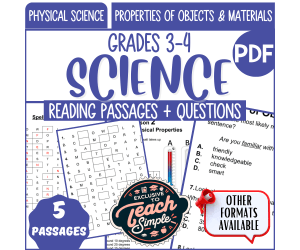
Reading Passages on Properties of Objects and Materials (PDF)
ELA, Reading, Reading Comprehension, Science, Physics, Common Core, ESL, Language Development, Vocabulary, Chemistry, Grade 2, 3, 4, Tests, Quizzes and Tests, Teacher Tools, Assessments, Worksheets, Worksheets & Printables, Centers, Activities
Reading Passages on Properties of Objects and Materials for Physical Science This comprehensive package Properties of Objects and Materials: Reading Passages Physical Science enables your students to practice reading strategies and learn essential science topics for the week. All of this is made easier by the fact that the bulk of the work is already completed for you. Physical properties and states of matter are the focus of the reading materials. What's inside? Part I Passage 1: Observable Physical Properties of Objects & Materials Passage 2: Measuring Physical Properties Passage 3: Classification of Matter Passage 4: States of Matter Passage 5: Change of Phase Product Info: 28 pages Teaching Duration: 2 Weeks Science Reading Comprehension Outline: Targeted for students in 3rd and 4th grades, these reading passages are enhanced with illustrations and graphs to elucidate critical points. Each lesson aligns with the Common Core State Standards, allowing you to integrate science reading practice effortlessly, knowing that minimal preparation is needed on your part. Each passage comes with a variety of questions in different formats, including multiple-choice formats, data analysis, and fill-in-the-blanks. The topics covered strike a balance between engaging content and core curriculum-based science subjects. Versatile in application, these lessons are suitable for a variety of settings such as whole-class instruction, morning activities, independent desk work, small group discussions, contingency plans for substitute teachers, homework assignments, or even special holiday-themed tasks. FULL CATALOG OF DOWNLOAD LINKS HERE Grade 3/4 Links: Physical Science Part 1 - Properties of Objects and Materials Google Docs/Slides/Forms PDF PPT Word Free Supplementary Pack Accompanying Videos Physical Science Part 2 - Position and Motion of Objects Google Docs/Slides/Forms PDF PPT Word Free Supplementary Pack Accompanying Videos Physical Science Part 3 - Light, Heat, Electricity, Magnetism Google Docs/Slides/Forms PDF PPT Word Free Supplementary Pack Accompanying Videos Life Science Part 1 - Characteristics of Organisms Google Docs/Slides/Forms PDF PPT Word Free Supplementary Pack Accompanying Videos Life Science Part 2 - Life Cycles of Organisms Google Docs/Slides/Forms PDF PPT Word Free Supplementary Pack Accompanying Videos Life Science Part 3 - Organisms and Environments Google Docs/Slides/Forms PDF PPT Word Free Supplementary Pack Accompanying Videos Earth Science Part 1 - Properties of Earth Materials Google Docs/Slides/Forms PDF PPT Word Free Supplementary Pack Accompanying Videos Earth Science Part 2 - Changes in the Earth and Sky Google Docs/Slides/Forms PDF PPT Word Free Supplementary Pack Accompanying Videos Earth Science Part 3 - Objects in the Sky Google Docs/Slides/Forms PDF PPT Word Free Supplementary Pack Accompanying Videos For similar products and other frees, do check out Cored Group on TeachSimple .
Author Cored Education
Rating
Tags Science, Elementary, Reading, Comprehension, Physics, Physical Science, Reading Centers, Reading Comprehension Assessments, Science Assessments, Vocabulary Assessments

Supplementary Materials for Electricity and Magnets (PDF)
Science, Physics, Common Core, Resources for Teachers, Pre-Reading, Language Development, ELA, ESL, Grade 5, 6, 7, Worksheets & Printables, Worksheets, Assessments, Teacher Tools, Tests, Quizzes and Tests
Supplementary Materials for Electricity and Magnets Each classroom is different and with that in mind, this free supplementary pack of questions gives teachers the opportunity to give early finishers some extra questions, or can be used for homework/holiday work. Each question is based on the topic of the reading lesson already covered, however, not all answers can be found in the text. What's inside? Extra Questions for Part 3 - Electricity and Magnets Reading Passage 1: Static Electricity Reading Passage 2: Circuits Reading Passage 3: Electromagnets Reading Passage 4: Electric Energy Reading Passage 5: Energy Sources & Conversion Product Info: 15 pages Teaching Duration: 2 Weeks Science Reading Comprehension Outline: Targeted for students in 3rd and 4th grades, these reading passages are enhanced with illustrations and graphs to elucidate critical points. Each lesson aligns with the Common Core State Standards, allowing you to integrate science reading practice effortlessly, knowing that minimal preparation is needed on your part. Each passage comes with a variety of questions in different formats, including multiple-choice formats, data analysis, and fill-in-the-blanks. The topics covered strike a balance between engaging content and core curriculum-based science subjects. Versatile in application, these lessons are suitable for a variety of settings such as whole-class instruction, morning activities, independent desk work, small group discussions, contingency plans for substitute teachers, homework assignments, or even special holiday-themed tasks. FULL CATALOG OF DOWNLOAD LINKS HERE Grade 3/4 Links: Physical Science Part 1 - Properties of Objects and Materials Google Docs/Slides/Forms PDF PPT Word Free Supplementary Pack Accompanying Videos Physical Science Part 2 - Position and Motion of Objects Google Docs/Slides/Forms PDF PPT Word Free Supplementary Pack Accompanying Videos Physical Science Part 3 - Light, Heat, Electricity, Magnetism Google Docs/Slides/Forms PDF PPT Word Free Supplementary Pack Accompanying Videos Life Science Part 1 - Characteristics of Organisms Google Docs/Slides/Forms PDF PPT Word Free Supplementary Pack Accompanying Videos Life Science Part 2 - Life Cycles of Organisms Google Docs/Slides/Forms PDF PPT Word Free Supplementary Pack Accompanying Videos Life Science Part 3 - Organisms and Environments Google Docs/Slides/Forms PDF PPT Word Free Supplementary Pack Accompanying Videos Earth Science Part 1 - Properties of Earth Materials Google Docs/Slides/Forms PDF PPT Word Free Supplementary Pack Accompanying Videos Earth Science Part 2 - Changes in the Earth and Sky Google Docs/Slides/Forms PDF PPT Word Free Supplementary Pack Accompanying Videos Earth Science Part 3 - Objects in the Sky Google Docs/Slides/Forms PDF PPT Word Free Supplementary Pack Accompanying Videos For similar products and other frees, do check out Cored Group on TeachSimple .
Author Cored Education
Tags Science, Elementary, Reading, Comprehension, Vocabulary, Answers, Physics, Physical Science, Ccss, Common Core
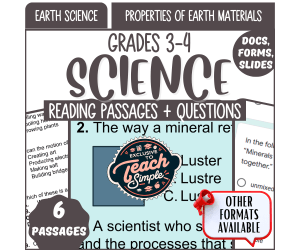
Reading Comprehension: Properties of Earth Materials (Google Drive)
Science, Earth and Environmental Sciences, Earth Sciences, Common Core, ESL, Language Development, ELA, Vocabulary, Reading Comprehension, Reading, Grade 2, 3, 4, Centers, Activities, Assessments, Teacher Tools, Presentations, Tests, Quizzes and Tests, Diagrams, Worksheets, Worksheets & Printables
Reading Comprehension: Properties of Earth Materials for Earth Science Properties of Earth Materials: Reading Passages Earth Science: Enhance your teaching arsenal with these captivating science reading lessons. Aligned with the Common Core State Standards (CCSS) and encompassing high-interest topics paired with diverse question types, these materials make introducing your students to science reading a breeze. With most of the groundwork laid out for you, delve into fascinating subjects such as minerals, the rock cycle, and fossils, ensuring an enriching and streamlined educational experience. What's inside? Part 1 - Properties of Earth Materials Reading Passage 1: Earth Science and Earth Materials Reading Passage 2: Earth Materials and Their Uses Reading Passage 3: Minerals Reading Passage 4: Rocks and the Rock Cycle Reading Passage 5: Soils Reading Passage 6: Fossils Product Info: 35 PAGES (Docs Version: US English with Answers) 6 FORMS (Self-Grading) 170 SLIDES Teaching Duration: 2 Weeks Science Reading Comprehension Outline: Targeted for students in 3rd and 4th grades, these reading passages are enhanced with illustrations and graphs to elucidate critical points. Each lesson aligns with the Common Core State Standards, allowing you to integrate science reading practice effortlessly, knowing that minimal preparation is needed on your part. Each passage comes with a variety of questions in different formats, including multiple-choice formats, data analysis, and fill-in-the-blanks. The topics covered strike a balance between engaging content and core curriculum-based science subjects. Versatile in application, these lessons are suitable for a variety of settings such as whole-class instruction, morning activities, independent desk work, small group discussions, contingency plans for substitute teachers, homework assignments, or even special holiday-themed tasks. FULL CATALOG OF DOWNLOAD LINKS HERE Grade 3/4 Links: Physical Science Part 1 - Properties of Objects and Materials Google Docs/Slides/Forms PDF PPT Word Free Supplementary Pack Accompanying Videos Physical Science Part 2 - Position and Motion of Objects Google Docs/Slides/Forms PDF PPT Word Free Supplementary Pack Accompanying Videos Physical Science Part 3 - Light, Heat, Electricity, Magnetism Google Docs/Slides/Forms PDF PPT Word Free Supplementary Pack Accompanying Videos Life Science Part 1 - Characteristics of Organisms Google Docs/Slides/Forms PDF PPT Word Free Supplementary Pack Accompanying Videos Life Science Part 2 - Life Cycles of Organisms Google Docs/Slides/Forms PDF PPT Word Free Supplementary Pack Accompanying Videos Life Science Part 3 - Organisms and Environments Google Docs/Slides/Forms PDF PPT Word Free Supplementary Pack Accompanying Videos Earth Science Part 1 - Properties of Earth Materials Google Docs/Slides/Forms PDF PPT Word Free Supplementary Pack Accompanying Videos Earth Science Part 2 - Changes in the Earth and Sky Google Docs/Slides/Forms PDF PPT Word Free Supplementary Pack Accompanying Videos Earth Science Part 3 - Objects in the Sky Google Docs/Slides/Forms PDF PPT Word Free Supplementary Pack Accompanying Videos For similar products and other frees, do check out Cored Group on TeachSimple .
Author Cored Education
Rating
Tags Science, Elementary, Reading, Comprehension, Vocabulary, Science Assessments, Reading Comprehension Assessments, Vocabulary Assessments, Earth Science, Self Assessment
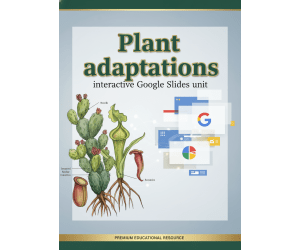
Plant Adaptations Interactive Google Slides Unit
Science, Earth and Environmental Sciences, Earth Sciences, Environmental Science, Geology, Space, Life Sciences, Animals, Nature & Plants, Biology, Grade 3, 4, 5, 9, 10, 11, 12, Experiments, Activities, Labs, Projects, Assessments, Teacher Tools, Diagrams, Lesson Plans, Outlines, Presentations
Find the best 4th Grade Plant Adaptations Interactive Google Slides Unit – a complete no-prep digital science resource that is perfectly correlated to NGSS 4-LS1-1! This teacher edition is a game-changer for teaching plant biology as an interactive adventure for students! With this resource, students will enjoy a hands-on approach to learning about plant adaptations as they explore interactive slides featuring desert succulents/cacti, rainforest drip tips/epiphytes, water plants floating leaves/stretching stems, structural vs. behavioral adaptations, roots, stem/leaf adaptations, defense structures, carnivorous plants Venus flytrap/pitcher plant, seed dispersal, mystery plant analysis, and a final knowledge check with answer keys! Students will actively engage in classifying adaptations, creating their own extremophiles, analyzing scenarios using Claim Evidence Reasoning, and connecting science to ELA, math, engineering, and technology using cross-curricular activities. It includes a teacher guide, standard alignment, steps to integrate into Google Classroom, instructional tips, interactive slide ideas, image credits, and ideas for self-grading. It can be used in a variety of learning environments, such as in-class learning, distance learning, homeschooling, etc. It saves automatically in Google Slides. Keywords: plant adaptation 4th grade, NGSS 4-LS1-1, Google Slides, interactive science unit, desert rainforest aquatic plants, carnivorous plants, seed dispersal activities, digital science resource, structure and function NGSS, no prep plant biology. Why Parents/Schools Love It : NGSS-Aligned & Standards-Ready: No planning required – lesson plans, objectives, and assessments are provided and align perfectly with 4th grade requirements. Truly Interactive & Engaging: Drag and drop sorting, CER plant mysteries, and biome builders ensure all students (including reluctant ones) are actively engaged and motivated to learn for hours. Cross-Curricular Powerhouse: Perfectly blends ELA (informative writing, vocabulary), math (data analysis, volume calculation), and engineering (biomimicry design challenges). Google Classroom Perfection: One-click “make a copy for each student,” auto-saving, and self-grading features save teachers 10+ hours per unit. Differentiation Built-In: Visual aids, scaffolding, and differentiation in activity levels and types meet the needs of diverse learners and challenge advanced students. Target Student Classes : This lesson is designed for 4th grade science (ages 9-10), specifically targeting the 4-LS1-1 standard for Structure and Function in plants/animals, as well as the cross cutting concepts of Systems and System Models + the Science and Engineering Practices of Engaging in Argument from Evidence. This lesson is suitable as the main resource for: Standard 4th grade life science curriculum for 4th grade students in public/private schools Homeschool 4th grade science curriculum (allows for fast or slow pacing for gifted or remedial students) Advanced 3rd grade science for 3rd grade students or 5th grade review for 5th grade students Special education or ESL students (visual learning tool of drag and drop CERs) Not recommended as the main resource for middle school students (6th+). Copyright/Terms of Use: This Book is copyrighted by Syed Hammad Rizvi. This is for your personal and single classroom use only. You may not change, reproduce, redistribute, or sell this in any way. This means you may not put it on the Internet in a way that it can be located and downloaded by others. If you wish to share this resource with others, please consider purchasing additional licenses from Teachsimple. Thank you for respecting these copyright laws! This product is happily brought to you by Syed Hammad Rizvi
Author Creative Book Store
Rating
Tags PlantAdaptations, 4thGradeScience, NGSS4LS11, GoogleSlidesScience, InteractiveScience, ScienceTeachers, ElementaryScience, NGSSScience, PlantAdaptationsUnit, DigitalScienceResource
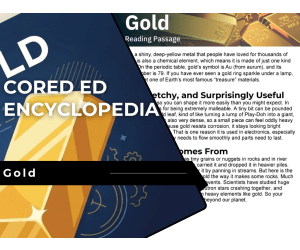
Gold Reading Comprehension Passage - Cored Ed Encyclopedia
ELA, Language Development, Resources for Teachers, Reading Comprehension, Reading, Pre-Reading, Writing, Science, Physics, Chemistry, Grade 2, 3, 4, 5, Worksheets & Printables, Worksheets, Teacher Tools, Centers, Activities, Writing Prompts, Assessments, Tests, Quizzes and Tests, Quizzes
This gold reading comprehension contains the following: Pre-Reading Trivia Students will write down one thing they already know about the subject and then read five more facts and discuss. These facts are fun, and the students will enjoy learning about the subject before reading more. Reading Passage The text is a high-interest reading passage with set paragraphs, roughly three to four paragraphs long. It contains a variety of themes about the topic, anywhere from history to technology. The passage is between 250 and 350 words in length. Mixed Questions The first question page contains four multiple-choice questions, each with a choice of four answers, and three written response questions that require a sentence or two from the student. Creative Writing In this question, the student will be required to write a five to eight sentence paragraph on a question related to the topic. Extension Activities This page is optional for fast finishers. If there are five to ten minutes left at the end of the lesson, the student can choose one of three activities, each one requiring a different skill. Answer Key There are answers for the multiple-choice questions and three written response questions have sample answers. FULL CATALOG OF DOWNLOAD LINKS AND ENCYCLOPEDIA INDEX HERE Cored Ed Encyclopedia Overview The Cored Ed Encyclopedia is a weekly series of lessons that you can pick up and use right away. These short readings fit into whatever time you have available. Each one includes a warm-up, a reading, and a set of questions, but it’s flexible — you can do just the reading, the full lesson, or skip the writing section if you need to. Each lesson focuses on a single topic so students don’t get lost. The writing is clear but never childish, making it perfect for grades two through five. Topics range from animals and science to history, inventions, and everyday things. No matter the level of the student, everyone should take away at least one new idea or fact from each lesson. The materials are easy to print, easy to explain, and require no setup. They work well for whole-class teaching, partner work, or independent study.
Author Cored Education
Rating
Tags Vocabulary, Spelling, Reading Comprehension, Reading Passages, Cored Encyclopedia, Facts, Reading, Creative Writing, Gold, Physics
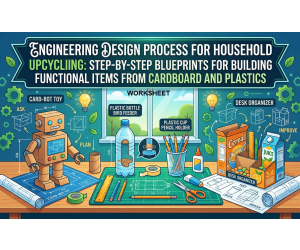
Engineering Design Process for Household Upcycling
Science, Basic Science, Inventors, Theories, Earth and Environmental Sciences, Earth Sciences, Environmental Science, Geology, Space, STEM, Homeschool Curriculum, Grade 3, 4, 5, 6, 7, 8, Worksheets & Printables, Workbooks, Worksheets, Word Searches, Teacher Tools, Assessments, Lesson Plans, Quizzes and Tests, Quizzes, Tests
Transform your students from consumers into creators with this complete, no-prep STEM curriculum! Are you looking for an engaging, hands-on project that teaches real-world engineering skills without breaking the budget? Dive into the "Engineering Design Process for Household Upcycling," a comprehensive, project-based learning (PBL) unit designed to turn everyday trash like cardboard boxes and plastic bottles into functional, load-bearing items. This isn't just another recycling craft. This rigorous curriculum guides 4th, 5th, and 6th-grade students through the authentic Engineering Design Process (EDP) . They will learn the material science of polymers and cardboard, draft orthographic blueprints, and apply principles of physics to build amazing items like a passive phone amplifier, a modular storage unit, a self-watering planter, and even a kinetic wind turbine! What's Included in This 35-Page All-in-One PDF? Part 1: In-Depth Instructional Text (Teacher's Guide): A detailed guide explaining the core concepts of material science, structural engineering, and each step of the EDP (Ask, Imagine, Plan, Create, Test, Improve) in the context of upcycling. Part 2: Printable Student Workbook (10 Worksheets): Ten carefully scaffolded worksheets that reinforce learning. Activities cover everything from blueprint basics and advanced joinery to data collection, troubleshooting, and a final capstone design challenge. Part 3: Teacher Resources & Visuals: Classroom Anchor Charts: Professional diagrams of the Engineering Design Process, a Material Science Matrix, and the Anatomy of a Blueprint. Comprehensive Answer Key: Complete answers for every knowledge check and worksheet question, saving you valuable prep time. Project Reflection Rubrics: Guidance for assessing student understanding and encouraging a growth mindset during the testing and iteration phases. This unit is perfect for STEM/STEAM labs, Earth Day activities, sustainability lessons, gifted and talented programs, or any teacher looking to integrate meaningful, hands-on engineering challenges into their classroom. Keywords: STEM, STEAM, Engineering Design Process, Project-Based Learning (PBL), Upcycling, Recycling Project, Earth Day, Sustainability, 4th Grade Science, 5th Grade Science, 6th Grade STEM, Middle School Engineering, Hands-On Learning, Critical Thinking, Cardboard Engineering, Plastic Bottle Projects, Printable Workbook, No-Prep, Homeschool Curriculum, After-School Club. Why Parents/Schools Love It: Turns Trash into Treasure (Zero-Cost Materials): This curriculum brilliantly uses common household waste like cardboard and plastic bottles, making it an incredibly affordable and accessible hands-on experience for any school or family. Teaches Authentic 21st-Century Skills: It goes far beyond simple crafts, teaching the real, iterative Engineering Design Process. Students learn critical thinking, problem-solving, spatial reasoning, and resilience in the face of failure. Comprehensive & "Print-and-Go": This is a complete, all-in-one unit. With an instructional guide, student worksheets, visual aids, and a full answer key, teachers can implement a high-quality engineering project with minimal prep time. Fosters Environmental Consciousness: The curriculum is built on a foundation of sustainability. It empowers students to see waste as a resource, teaching them practical ways to have a positive impact on their environment. Highly Engaging for All Learners: The hands-on building process and the creation of genuinely functional items (like a phone stand or a self-watering planter) capture students' imagination and provide a tangible sense of accomplishment. Target Audience : Based on the content's complexity, language, and stated goals, target: Grade Levels: 4th, 5th, and 6th Grade . The content is perfectly scaffolded for this upper-elementary to early-middle school range. Educator Types: Classroom Teachers (Grades 4-6) STEM/STEAM Lab Teachers Science Teachers Homeschooling Parents After-School Program Coordinators Gifted and Talented (GATE) Program Instructors Copyright/Terms of Use: This Book was copyrighted by Syed Hammad Rizvi. This resource is for personal and single classroom use only. You may not alter, redistribute, or sell any part of this resource. In other words, you may not put it on the Internet where it could be publicly found and downloaded. If you want to share this resource with colleagues, please purchase additional licenses from Teachsimple. Thank you for respecting these terms of use. This product is happily brought to you by Syed Hammad Rizvi
Author Creative Book Store
Rating
Tags STEM, STEAM, Engineering, EngineeringForKids, Upcycling, RecyclingProject, ProjectBasedLearning, HandsOnLearning, MaterialScience, EnvironmentalEducation
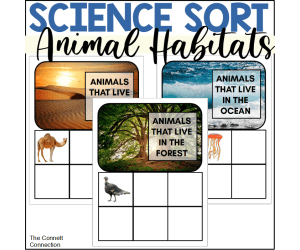
Animal Habitats Sort
Science, Life Sciences, Biology, Grade 1, 2, 3, Activities, Centers, Assessments, Teacher Tools
Allow students to sort animals by which habitat they live in. What is Included: There are sorting card headers for each habitat. There are sorting mats for each habitat. There are three to six picture cards for each of the sets of sorting activities. The animal habitats included in this set include: Antarctic, Arctic, Beach, Desert, Forest, Grassland, Ocean, Pond, Rain Forest, and Swamp Each sorting mat includes a real life example of an animal that belongs in that particular habitat. All of the picture cards also include real photographs of each habitat. What Questions are Asked: To use these, students will lay out either the header cards or the sorting mats. They will then sort the animal images beneath or on top of the correct sorting mat. When to Use: Science Center - The sorting mats can be placed in a science center for students to learn about living things and where they live. Morning Work - These animal sorts can allow teachers to create quick and easy morning activities for students while they wait on their classmates to arrive to class. Independent Practice - These animal sorts are great for students to independently work on living things. Emergency Sub Plans - The low prep nature and easy to set up activity , makes these worksheets a great activity to leave with subs to assign to students. Small Group Activity - These animal sorts can be used in small groups so teachers can target the students who need extra practice with living things. Writing Review Activity - These animal sorts work well as a review to reinforce student's learning of living things. These sorting activities are easy to create. The mats just need to be printed out. The picture cards need to be printed and cut apart. Once made, the sort can be used over and over.
Author The Connett Connection
Rating
Tags Science Sort, Hands On Assessment, Animal Habitats, Habitats
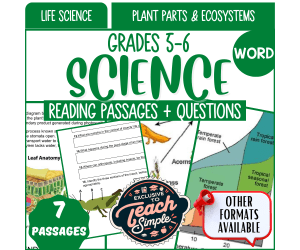
Science Reading Comprehension: Plant Parts and Ecosystems (Word)
ELA, Reading, Reading Comprehension, Common Core, Nature & Plants, Life Sciences, Science, Biology, Insects, Grade 5, 6, 7, Worksheets & Printables, Worksheets, Diagrams, Teacher Tools, Tests, Quizzes and Tests, Assessments
Science Reading Comprehension: Plant Parts & Ecosystems for Life Science Plant Parts and Ecosystems: Reading Passages Life Science - Enhance your assessment process with this ready-to-use science reading passage pack. Featuring enjoyable topics and themes, it's tailored to ensure students not only practice but also deepen their scientific understanding in preparation for tests. With questions meticulously aligned to the Common Core State Standards (CCSS), the pack dives into intriguing subjects such as circuits, electricity, and energy sources. It's a must-have resource for educators aiming to make learning both fun and fruitful. What's inside? Plant Parts & Ecosystems Reading Passage1: Classification of Organisms Reading Passage2: Function of Plant Parts Reading Passage3: Reproduction in Plants Reading Passage4: Invertebrates Reading Passage 5: Vertebrates Reading Passage6: Earth's Biomes Reading Passage7: Ecosystems Word Version: This is the Word version. 42 PAGES Science Reading Comprehension Outline: Introducing a comprehensive resource tailored for 5th and 6th graders, this product offers enriching reading passages supplemented with illustrative pictures and graphs to clarify key concepts. Aligned with the Common Core State Standards (CCSS), it offers a hassle-free approach to teaching, given that the bulk of the preparation is already done for you. The passages present a diverse set of questions – from multiple choice to data analysis and fill-in-the-blanks. This ensures a rich blend of high-interest content and fundamental curriculum-based science themes. With its versatility, you can seamlessly integrate these lessons into various classroom settings, whether it's whole class discussions, morning exercises, independent desk tasks, small group engagements, contingency plans for substitute teachers, regular homework assignments, or even themed activities for holidays. FULL CATALOG OF DOWNLOAD LINKS HERE Grade 5/6 Links: Physical Science Part 1 - Physical and Chemical Properties Google Docs/Slides/Forms PDF PPT Word Free Supplementary Pack Accompanying Videos Physical Science Part 2 - Motion and Energy Google Docs/Slides/Forms PDF PPT Word Free Supplementary Pack Accompanying Videos Physical Science Part 3 - Electricity and Magnets Google Docs/Slides/Forms PDF PPT Word Free Supplementary Pack Accompanying Videos Life Science Part 1 - Cells, Reproduction and Genetics Google Docs/Slides/Forms PDF PPT Word Free Supplementary Pack Accompanying Videos Life Science Part 2 - Human Body Systems Google Docs/Slides/Forms PDF PPT Word Free Supplementary Pack Accompanying Videos Life Science Part 3 - Plant Parts and Ecosystems Google Docs/Slides/Forms PDF PPT Word Free Supplementary Pack Accompanying Videos Earth Science Part 1 - Plate Tectonics and Rock Cycle Google Docs/Slides/Forms PDF PPT Word Free Supplementary Pack Accompanying Videos Earth Science Part 2 - Ocean Exploration and Natural Resources Google Docs/Slides/Forms PDF PPT Word Free Supplementary Pack Accompanying Videos Earth Science Part 3 - Weather and Solar System Google Docs/Slides/Forms PDF PPT Word Free Supplementary Pack Accompanying Videos For similar products and other frees, do check out Cored Group on TeachSimple .
Author Cored Education
Rating
Tags Science, Elementary, Reading, Comprehension, Vocabulary, Science Assessments, Reading Comprehension Assessments, Vocabulary Assessments, Life Science, Biology
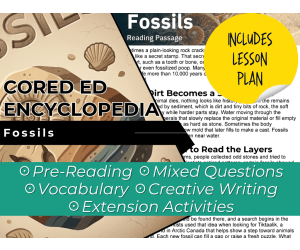
Fossils Reading Comprehension Passage - Cored Ed Encyclopedia
ELA, Reading Comprehension, Reading, Science, Technology, Earth and Environmental Sciences, Life Sciences, Pre-Reading, Language Development, Vocabulary, Grade 2, 3, 4, 5, Worksheets & Printables, Worksheets, Teacher Tools, Centers, Activities, Writing Prompts, Assessments, Quizzes and Tests, Quizzes, Lesson Plans
This fossils reading comprehension with lesson plan includes: Visualization (on the front cover) Start your lesson by taking a minute to think and share something about the topic. Read the script aloud (slowly), perhaps prepare some music or sound effects. Student close their eyes and let their imaginations wander. Students open their eyes, read the question aloud and give them a few minutes to complete. Ask a few students to share or keep answers until the end to compare with what they learn in the passage. Quick pause—thousands of Cored Education products are included with your TeachSimple membership. Download links and encyclopedia index available here. Pre-Reading Trivia Students will write down one thing they already know about the subject and then read five more facts and discuss. These facts are fun, and the students will enjoy learning about the subject before reading more. Give 1 minute for students to write what they already know (no pressure—best guess is fine). Read the five facts together. After each fact, do ask a student for their opinion, was it surprising? Set a purpose by asking students to highlight/underline one fact they want to learn more about during the reading. Reading Passage The text is a high-interest reading passage with set paragraphs, roughly three to four paragraphs long. It contains a variety of themes about the topic, anywhere from history to technology. The passage is between 250 and 350 words in length. First, ask students to look at the headings and see what they’ll learn about today. What do they know about the topic/heading? First read options: Teacher read-aloud (best for support). Partner reading (paragraph by paragraph). While reading, students underline important details, and vocabulary words they think may come up in the questions section. Mixed Questions The first question page contains four multiple-choice questions, each with a choice of four answers, and three written response questions that require a sentence or two from the student. Students complete the mcqs first independently, then review quickly as a class. For the 3 written responses, try to get students giving the answer with some form of evidence: “I think ___ because the text says ___.” If students get stuck, send them back to check the passage. Vocabulary Questions Practice seven key words from the text in this section across two activities. First section is scrambled words where students will unscramble three words given a clue for each. The second section is a word to meaning matching activity. Before starting, have some students read out words they underlined in the passage. Ask students to say the word and read aloud the sentence(s) around each word. Ask students to do scrambled words and the matching exercise in pairs then go through answers as a class. For the scrambled spelling task, get four pairs to come up to the board and write the words for extra practice with the other student reading out the clue. For the matching task, prompt students to give full sentences: “I matched ___ with ___ because ___.” Creative Writing In this question, the student will be required to write a five to eight sentence paragraph on a question related to the topic. Before starting, ask students write down 3 key ideas they are going to include in their piece. Ask students for ideas to share around the class to help those struggling. Pro writing expectations: 5–8 sentences At least 2 facts or details from the passage At least 2 vocabulary words from the previous page Students read their paragraphs while classmates listen for facts and vocabulary words. Extension Activities This page is optional for fast finishers or to take home. There are several activities, each one requiring a different skill. Do some, do none, do all, completely optional - but you will feel reassured knowing every possibility is planned for. Includes summary writting question and additional facts. Answer Key There are answers for the multiple-choice questions, written response questions have sample answers, vocabulary answers and if there is a summary question then a sample summary will be provided as well. Lesson Plan Included Customized lesson plan for this lesson is included. Lesson Snapshot Title: Fossils Genre: Nonfiction (Informational Text) Subject: Science (Earth Science/Life Science) / Reading (Informational Text) Primary Topic: Fossils, how they form, and what they reveal Estimated Guided Reading Level (A–Z): Q What This Lesson Teaches Best Defines a fossil and explains that fossils can be body parts (tooth, bone) or traces (footprint, burrow, fossilized poop) that become clues in the “fossil record.” Explains how fossils form when remains are quickly covered by sediment , and minerals in water replace material or fill empty spaces until remains harden like stone. Teaches mold and cast formation: a body can disappear, leaving a hollow mold that later fills to make a cast. Introduces paleontology and shows how scientists “read” patterns in sedimentary rock layers to learn how life has changed over time. Shows how fossils can guide new discoveries , including using rock layers to search for missing kinds of creatures (Tiktaalik example). Learning Goals Students will identify two kinds of fossils named in the text and give an example of each. Students will explain how sediment and minerals help remains become hard “as stone.” Students will describe how a mold and a cast can form, using the text’s explanation. Students will explain how scientists use patterns in sedimentary rock layers to learn which fossils are older. Students will describe why the fossil record is “not complete,” based on the passage. Students will describe how fossils can help scientists decide where to search for new discoveries. Key Vocabulary From the Text sediment — dirt and tiny bits of rock. minerals — materials in water that can harden remains. mold — a hollow shape left after a body is gone. cast — a filled-in copy of a hollow shape. paleontology — the study of ancient life using fossils. FULL CATALOG OF DOWNLOAD LINKS AND ENCYCLOPEDIA INDEX HERE
Author Cored Education
Rating
Tags Vocabulary, Reading Comprehension, Reading Passages, Lesson Plans, Ela Lesson Plans, Reading Comprehension Lesson Plans, Pre-reading, Science Lesson Plans, Earth Science, Life Science
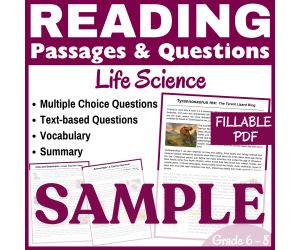
Animal Skin, Cats, and T. Rex: SAMPLE Reading passage (FILLABLE PDF)
Science, ELA, Reading, Reading Comprehension, Strategies, Resources for Teachers, Life Sciences, Animals, Insects, Nature & Plants, Grade 6, 7, 8, 9, Writing Prompts, Worksheets & Printables, Centers, Activities, Teacher Tools, Assessments, Quizzes and Tests, Quizzes, Tests
This is a ONE PASSAGE SAMPLE. The following is the description of the FULL resource and the downloading links: Animal Skin, Cats, & T. Rex: Reading Comprehension Passages (PDF) This very engaging and fillable collection of life science reading passages about Animal Skin, Cats, & T. Rex is designed to bridge the gap between science and literacy through strengthening reading comprehension and sparking scientific curiosity in middle school students. Each passage blends English Language Arts skills with accurate science content that supports NGSS classroom practice. Ideal for interdisciplinary learning in ELA and Science. Suitable for Grade 9 review, too! These worksheets are designed as fillable PDFs , which means students can type their answers directly into the document on any computer or tablet . Each page includes highlighted text fields that show them exactly where to type! What Is Included? There are (3) informational passages: Tyrannosaurus rex: The Tyrant Lizard King Cats and Sweetness: A Taste They Don’t Have Animal Skin: A Tool for Survival Student Tasks for Each Passage: 5 multiple-choice questions targeting main idea, key details, inference, vocabulary in context, and use of evidence 5 vocabulary matching items with clear, student-friendly definitions 5 text-based questions that require citing specific lines or facts 1 summary prompt that asks students to condense central ideas accurately Full answer key for every section Available Formats for this Resource Word Docs Google Docs FULL CATALOG OF DOWNLOADING LINKS HERE Other Science Reading Collections and Topics You May Find in the Store: 1. Astronomy & Space Science 2. Volcanoes, Rocks, & Mountains 3. Rock Cycle, Soil, & Sinkholes 4. Mars, Glaciers, & Antarctica 5. Water Cycle, Acid Rain, & Wastewater 6. Insects, Animals, & Ecosystems 7. Bioluminescence & Insects 8. Animal Skin, Cats, & T. Rex 9. Human Body and Senses 10. Health & Applied Bioscience 11. Waves, Light, & Imaging 12. Electricity & Energy 13. Motion & Materials 14. Chemistry and Materials Science 15. Electromagnetism 16. Acids and Bases 17. Gas Laws 18. Biotechnology 19. Periodic Trends 20. Protists and Fungi 21. Microevolution 22. Blood 23. Chemical Bonding 24. Magnets 25. Muscles 26. Nuclear Chemistry 27. Electromagnetic Devices 28. Epigenetics 29. The Law of Conservation of Mass 30. Atomic Models 31. Isotopes and Ions 32. Light 33. Human-Environment Interaction 34. Theory of Evolution 35. Photosynthesis 36. Origins of Life and Early Earth 37. Gene Expression and Regulation 38. Thermochemistry 39. Allergies 40. Coevolution 41. Birth to Adulthood 42. Cells 43. Entropy and Free Energy 44. The Human Brain 45. Mixtures and Solutions 46. Invertebrates 47. Zoo Animals 48. Biochemistry 49. Animal Behavior 50. Population Ecology ...and many more engaging science reading passages that cover intriguing and important topics designed to spark curiosity and support student learning. How to Use These PDFs Click on the highlighted area to start typing your answer. Move to the next question by clicking in the next highlighted box. When you are finished, close the document and select SAVE so your answers stay recorded. If you want to keep a blank copy for later, choose Save As and give your completed version a new name. Product Details Length: 1e pages total Grades: 6–8, also suitable for Grade 9 review Use cases: close reading, stations, homework, intervention, test prep, and sub plans Standards support: reinforces informational-text skills and supports NGSS-style sense making through observation, modeling, and clear use of claim, evidence, and reasoning Why Teachers Choose This Set Authentic science content paired with rigorous literacy practice Consistent task structure across all passages for easier planning and smoother student routines Clear, age-appropriate writing that builds confidence without oversimplifying Use this set to reinforce ELA skills in science, to add literacy to your lessons, or to support independent work. The passages strengthen main idea, evidence use, vocabulary in context, inference, cause and effect, and summary writing. With ready-to-use assessments and complete answer keys, you can provide focused practice that is simple to run and fast to review.
Author Middle & High School - CORED Education
Rating
Tags Middle School, Reading Comprehension, Reading Strategies, ELA, Centers, Reading Passage, Assessments, Vocabulary, Life Science, Dinosaurs
Science Reading Comprehension Passage 7: Force and Motion PPT
Science, Physics, Common Core, ESL, Language Development, ELA, Reading Comprehension, Reading, Resources for Teachers, Grade 5, 6, 7, Teacher Tools, Presentations, Activities, Tests, Quizzes and Tests, Assessments
Free Reading Passage on Force and Motion for Physical Science What's inside this free product? Science Reading Comprehension Passage: Force & Motion Independent PPT Version: This is the independent PPT version containingone lesson. Product Info: 32 SLIDES (US English with Answers) PPT Version Teaching Duration: 90 Minutes Science Reading Comprehension Outline: Introducing a comprehensive resource tailored for 5th and 6th graders, this product offers enriching reading passages supplemented with illustrative pictures and graphs to clarify key concepts. Aligned with the Common Core State Standards (CCSS), it offers a hassle-free approach to teaching, given that the bulk of the preparation is already done for you. The passages present a diverse set of questions – from multiple choice to data analysis and fill-in-the-blanks. This ensures a rich blend of high-interest content and fundamental curriculum-based science themes. With its versatility, you can seamlessly integrate these lessons into various classroom settings, whether it's whole class discussions, morning exercises, independent desk tasks, small group engagements, contingency plans for substitute teachers, regular homework assignments, or even themed activities for holidays. FULL CATALOG OF DOWNLOAD LINKS HERE Grade 5/6 Links: Physical Science Part 1 - Physical and Chemical Properties Google Docs/Slides/Forms PDF PPT Word Free Supplementary Pack Accompanying Videos Physical Science Part 2 - Motion and Energy Google Docs/Slides/Forms PDF PPT Word Free Supplementary Pack Accompanying Videos Physical Science Part 3 - Electricity and Magnets Google Docs/Slides/Forms PDF PPT Word Free Supplementary Pack Accompanying Videos Life Science Part 1 - Cells, Reproduction and Genetics Google Docs/Slides/Forms PDF PPT Word Free Supplementary Pack Accompanying Videos Life Science Part 2 - Human Body Systems Google Docs/Slides/Forms PDF PPT Word Free Supplementary Pack Accompanying Videos Life Science Part 3 - Plant Parts and Ecosystems Google Docs/Slides/Forms PDF PPT Word Free Supplementary Pack Accompanying Videos Earth Science Part 1 - Plate Tectonics and Rock Cycle Google Docs/Slides/Forms PDF PPT Word Free Supplementary Pack Accompanying Videos Earth Science Part 2 - Ocean Exploration and Natural Resources Google Docs/Slides/Forms PDF PPT Word Free Supplementary Pack Accompanying Videos Earth Science Part 3 - Weather and Solar System Google Docs/Slides/Forms PDF PPT Word Free Supplementary Pack Accompanying Videos For similar products and other frees, do check out Cored Group on TeachSimple .
Author Cored Education
Tags Science, Elementary, Reading, Comprehension, Vocabulary, Answers, Physics, Physical Science, Ccss, Common Core
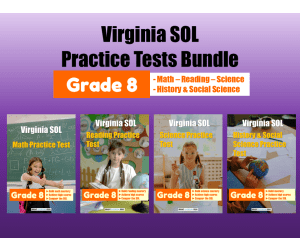
Virginia SOL Practice Tests Bundle for Grade 8
ELA, Math, Science, Social Studies, Grade 8, Assessments, Teacher Tools, Tests, Quizzes and Tests, Worksheets & Printables
Prepare your students for success with this Grade 8 Virginia SOL Math, Reading, Science, and History & Social Science Practice Tests Bundle . This comprehensive, standards-aligned resource helps students build confidence while strengthening essential skills across all tested subjects using a realistic SOL format. This bundle includes full-length practice tests for Math, Reading, Science, and History & Social Science, all aligned to Virginia SOL standards. Students practice linear equations, functions, and problem-solving in math, develop reading comprehension and evidence-based responses, strengthen scientific reasoning and data analysis, and build historical analysis and critical thinking skills through rigorous, test-style questions. Complete answer keys are included for quick and easy grading. The printable, classroom-ready format makes this resource simple to implement with no prep required. Teachers can use this bundle for test prep, benchmark assessments, small group intervention, or independent practice. It is also ideal for homework, review cycles, full test simulations, and sub plans. Students build familiarity with SOL test structure and expectations while improving accuracy, stamina, and confidence across all subjects. Just print and use. This Grade 8 SOL bundle makes test prep simple, thorough, and effective—helping your students feel confident and ready to succeed on test day.
Author Bright Classroom Ideas Marketplace
Rating
Tags Virginia, Sol, Reading, Math, Science, Social Science, State Test

Science Reading Comprehension Passage: The Science of Clothing (Word)
Science, ELA, Reading, Reading Comprehension, Strategies, Resources for Teachers, Technology, Engineering, Grade 6, 7, 8, 9, Writing Prompts, Worksheets & Printables, Centers, Activities, Teacher Tools, Assessments, Quizzes and Tests, Quizzes, Tests
Science Reading Comprehension Passage and Questions: The Hidden Science of Clothing (Word) This very engaging science reading passage is about how modern clothing uses science and technology to improve safety, performance, comfort, and exploration . It explains different examples of high-tech clothing and materials, including compression clothing for athletes, flame-resistant clothing for firefighters and workers, aerogel for astronaut suits and space rovers, and smart fabrics that can play music, answer calls, or track a heartbeat. The visuals on page 1 support these examples by showing athletic clothing, protective work gear, and space-related clothing. This passage is designed to bridge the gap between science and literacy through strengthening reading comprehension and sparking scientific curiosity in middle school students. The passage blends English Language Arts skills with accurate science content that supports NGSS classroom practice. Ideal for interdisciplinary learning in ELA and Science. Suitable for Grade 9 review, too! Student Tasks for The Passage: 5 multiple-choice questions targeting main idea, key details, inference, vocabulary in context, and use of evidence 5 vocabulary matching items with clear, student-friendly definitions 5 text-based questions that require citing specific lines or facts 1 summary prompt that asks students to condense central ideas accurately Full answer key for every section Available Formats for this Resource PDF Fillable PDF Google Docs FULL CATALOG OF DOWNLOADING LINKS HERE Product Details Length: 4 pages total Grades: 6–8, also suitable for Grade 9 review Use cases: close reading, stations, homework, intervention, test prep, and sub plans Standards support: reinforces informational-text skills and supports NGSS-style sense making through observation, modeling, and clear use of claim, evidence, and reasoning Why Teachers Choose This Set Authentic science content paired with rigorous literacy practice Consistent task structure across all passages for easier planning and smoother student routines Clear, age-appropriate writing that builds confidence without oversimplifying Other Science Reading Collections you May find in the store: 1. Astronomy & Space Science 2. Volcanoes, Rocks, & Mountains 3. Rock Cycle, Soil, & Sinkholes 4. Mars, Glaciers, & Antarctica 5. Water Cycle, Acid Rain, & Wastewater 6. Insects, Animals, & Ecosystems 7. Bioluminescence & Insects 8. Animal Skin, Cats, & T. Rex 9. Human Body and Senses 10. Health & Applied Bioscience 11. Waves, Light, & Imaging 12. Electricity & Energy 13. Motion & Materials 14. Chemistry and Materials Science Use this set to reinforce ELA skills in science, to add literacy to your lessons, and to support independent work. The passages strengthen main idea, evidence use, vocabulary in context, inference, cause and effect, and summary writing. With ready-to-use assessments and complete answer keys, you can provide focused practice that is simple to run and fast to review.
Author Middle & High School - CORED Education
Rating
Tags Middle School, Reading Comprehension, Reading Strategies, ELA, Centers, Reading Passage, Assessments, Vocabulary, Technology

Insects Reading Comprehension Passage - Cored Ed Encyclopedia
ELA, Reading Comprehension, Reading, Science, Pre-Reading, Language Development, Life Sciences, Insects, Earth and Environmental Sciences, Vocabulary, Grade 2, 3, 4, 5, Worksheets & Printables, Worksheets, Teacher Tools, Centers, Activities, Writing Prompts, Assessments, Quizzes and Tests, Quizzes, Lesson Plans
This Insects reading comprehension with lesson plan includes: Visualization (on the front cover) Start your lesson by taking a minute to think and share something about the topic. Read the script aloud (slowly), perhaps prepare some music or sound effects. Student close their eyes and let their imaginations wander. Students open their eyes, read the question aloud and give them a few minutes to complete. Ask a few students to share or keep answers until the end to compare with what they learn in the passage. Quick pause—thousands of Cored Education products are included with your TeachSimple membership. Download links and encyclopedia index available here. Pre-Reading Trivia Students will write down one thing they already know about the subject and then read five more facts and discuss. These facts are fun, and the students will enjoy learning about the subject before reading more. Give 1 minute for students to write what they already know (no pressure—best guess is fine). Read the five facts together. After each fact, do ask a student for their opinion, was it surprising? Set a purpose by asking students to highlight/underline one fact they want to learn more about during the reading. Reading Passage The text is a high-interest reading passage with set paragraphs, roughly three to four paragraphs long. It contains a variety of themes about the topic, anywhere from history to technology. The passage is between 250 and 350 words in length. First, ask students to look at the headings and see what they’ll learn about today. What do they know about the topic/heading? First read options: Teacher read-aloud (best for support). Partner reading (paragraph by paragraph). While reading, students underline important details, and vocabulary words they think may come up in the questions section. Mixed Questions The first question page contains four multiple-choice questions, each with a choice of four answers, and three written response questions that require a sentence or two from the student. Students complete the mcqs first independently, then review quickly as a class. For the 3 written responses, try to get students giving the answer with some form of evidence: “I think ___ because the text says ___.” If students get stuck, send them back to check the passage. Vocabulary Questions Practice seven key words from the text in this section across two activities. First section is scrambled words where students will unscramble three words given a clue for each. The second section is a word to meaning matching activity. Before starting, have some students read out words they underlined in the passage. Ask students to say the word and read aloud the sentence(s) around each word. Ask students to do scrambled words and the matching exercise in pairs then go through answers as a class. For the scrambled spelling task, get four pairs to come up to the board and write the words for extra practice with the other student reading out the clue. For the matching task, prompt students to give full sentences: “I matched ___ with ___ because ___.” Creative Writing In this question, the student will be required to write a five to eight sentence paragraph on a question related to the topic. Before starting, ask students write down 3 key ideas they are going to include in their piece. Ask students for ideas to share around the class to help those struggling. Pro writing expectations: 5–8 sentences At least 2 facts or details from the passage At least 2 vocabulary words from the previous page Students read their paragraphs while classmates listen for facts and vocabulary words. Extension Activities This page is optional for fast finishers or to take home. There are several activities, each one requiring a different skill. Do some, do none, do all, completely optional - but you will feel reassured knowing every possibility is planned for. Includes summary writting question and additional facts. Answer Key There are answers for the multiple-choice questions, written response questions have sample answers, vocabulary answers and if there is a summary question then a sample summary will be provided as well. Lesson Plan Included Customized lesson plan for this lesson is included. Lesson Snapshot Title: Insects Genre: Nonfiction (informational text) Subject: Reading (Informational Text) / Life Science Primary Topic: Insect body parts, growth, history, and study Estimated Guided Reading Level (A–Z): R What This Lesson Teaches Best Identifies core insect body parts and features (head, thorax, abdomen; six legs; antennae; compound eyes; many have wings). Explains how insects grow using an outside skeleton (exoskeleton) and why molting is needed as they get bigger. Describes butterfly life stages as an example of changing shape in stages (egg, caterpillar, chrysalis, winged adult). Connects insects to deep time and evidence from fossils (oldest known flying insects in the Carboniferous Period; many species today). Introduces how people study and classify insects over time (Aristotle, Carl Linnaeus, and modern entomology). Learning Goals Students will identify the three main insect body parts and describe what each part includes. Students will explain why insects must molt as they grow, using the idea of an exoskeleton. Students will describe the butterfly’s life stages in order, using details from the passage. Students will explain what fossils reveal about early flying insects and how insect groups changed over time. Students will define entomology and describe tools scientists use to study insects. Key Vocabulary From the Text thorax — middle body part where legs attach. abdomen — back body section behind the thorax. antennae — feelers that taste the air. exoskeleton — hard outer coat that works like a skeleton. entomology — the study of insects. FULL CATALOG OF DOWNLOAD LINKS AND ENCYCLOPEDIA INDEX HERE
Author Cored Education
Rating
Tags Vocabulary, Reading Comprehension, Reading Passages, Lesson Plans, Ela Lesson Plans, Reading Comprehension Lesson Plans, Pre-reading, Science Lesson Plans, Life Science, Insects

Free Reading Passage – Electricity, Circuits & Energy
ELA, Reading, Science, Physics, Common Core, Reading Comprehension, Spelling, Language Development, ESL, Resources for Teachers, Grade 2, 3, 4, Worksheets & Printables, Worksheets, Assessments, Teacher Tools, Tests, Quizzes and Tests
Free Reading Passage on Electricity, Electrical Circuits, and Energy for Physical Science What's inside this free product? Science Reading Comprehension Passage12 : Electricity, Electrical Circuits, and Energy Independent PDF Version: This is the independent PDF version containingone lesson with full answer keys. Product Info: 5 PAGES (US English with Answers) PDF Version Teaching Duration: 90 Minutes Science Reading Comprehension Outline: Targeted for students in 3rd and 4th grades, these reading passages are enhanced with illustrations and graphs to elucidate critical points. Each lesson aligns with the Common Core State Standards, allowing you to integrate science reading practice effortlessly, knowing that minimal preparation is needed on your part. Each passage comes with a variety of questions in different formats, including multiple-choice formats, data analysis, and fill-in-the-blanks. The topics covered strike a balance between engaging content and core curriculum-based science subjects. Versatile in application, these lessons are suitable for a variety of settings such as whole-class instruction, morning activities, independent desk work, small group discussions, contingency plans for substitute teachers, homework assignments, or even special holiday-themed tasks. FULL CATALOG OF DOWNLOAD LINKS HERE Grade 3/4 Links: Physical Science Part 1 - Properties of Objects and Materials Google Docs/Slides/Forms PDF PPT Word Free Supplementary Pack Accompanying Videos Physical Science Part 2 - Position and Motion of Objects Google Docs/Slides/Forms PDF PPT Word Free Supplementary Pack Accompanying Videos Physical Science Part 3 - Light, Heat, Electricity, Magnetism Google Docs/Slides/Forms PDF PPT Word Free Supplementary Pack Accompanying Videos Life Science Part 1 - Characteristics of Organisms Google Docs/Slides/Forms PDF PPT Word Free Supplementary Pack Accompanying Videos Life Science Part 2 - Life Cycles of Organisms Google Docs/Slides/Forms PDF PPT Word Free Supplementary Pack Accompanying Videos Life Science Part 3 - Organisms and Environments Google Docs/Slides/Forms PDF PPT Word Free Supplementary Pack Accompanying Videos Earth Science Part 1 - Properties of Earth Materials Google Docs/Slides/Forms PDF PPT Word Free Supplementary Pack Accompanying Videos Earth Science Part 2 - Changes in the Earth and Sky Google Docs/Slides/Forms PDF PPT Word Free Supplementary Pack Accompanying Videos Earth Science Part 3 - Objects in the Sky Google Docs/Slides/Forms PDF PPT Word Free Supplementary Pack Accompanying Videos For similar products and other frees, do check out Cored Group on TeachSimple.
Author Cored Education
Rating
Tags Science, Elementary, Reading, Comprehension, Vocabulary, Answers, Physics, Physical Science, Ccss, Common Core

Life Science Reading Passages: Human Body & Senses (FILLABLE PDF)
Science, ELA, Reading, Reading Comprehension, Strategies, Resources for Teachers, Life Sciences, Human Body, Grade 6, 7, 8, 9, Writing Prompts, Worksheets & Printables, Centers, Activities, Teacher Tools, Assessments, Quizzes and Tests, Quizzes, Tests
Human Body and Senses: Life Science Reading Comprehension Passages and Questions (FILLABLE PDF) This very engaging and fillable collection of life science reading passages about Contact Lenses, Goosebumps, and Skin is designed to bridge the gap between science and literacy through strengthening reading comprehension and sparking scientific curiosity in middle school students. Each passage blends English Language Arts skills with accurate science content that supports NGSS classroom practice. Ideal for interdisciplinary learning in ELA and Science. Suitable for Grade 9 review, too! These worksheets are designed as fillable PDFs , which means students can type their answers directly into the document on any computer or tablet . Each page includes highlighted text fields that show them exactly where to type! What Is Included? There are (3) informational passages: Clear Vision: The Story of Contact Lenses Goosebumps: A Chilly Reminder of Our Past Skin: Your Protective Shield Student Tasks for Each Passage: 5 multiple-choice questions targeting main idea, key details, inference, vocabulary in context, and use of evidence 5 vocabulary matching items with clear, student-friendly definitions 5 text-based questions that require citing specific lines or facts 1 summary prompt that asks students to condense central ideas accurately Full answer key for every section Available Formats for this Resource Word Docs Google Docs FULL CATALOG OF DOWNLOADING LINKS HERE Other Science Reading Collections and Topics You May Find in the Store: 1. Astronomy & Space Science 2. Volcanoes, Rocks, & Mountains 3. Rock Cycle, Soil, & Sinkholes 4. Mars, Glaciers, & Antarctica 5. Water Cycle, Acid Rain, & Wastewater 6. Insects, Animals, & Ecosystems 7. Bioluminescence & Insects 8. Animal Skin, Cats, & T. Rex 9. Human Body and Senses 10. Health & Applied Bioscience 11. Waves, Light, & Imaging 12. Electricity & Energy 13. Motion & Materials 14. Chemistry and Materials Science 15. Electromagnetism 16. Acids and Bases 17. Gas Laws 18. Biotechnology 19. Periodic Trends 20. Protists and Fungi 21. Microevolution 22. Blood 23. Chemical Bonding 24. Magnets 25. Muscles 26. Nuclear Chemistry 27. Electromagnetic Devices 28. Epigenetics 29. The Law of Conservation of Mass 30. Atomic Models 31. Isotopes and Ions 32. Light 33. Human-Environment Interaction 34. Theory of Evolution 35. Photosynthesis 36. Origins of Life and Early Earth 37. Gene Expression and Regulation 38. Thermochemistry 39. Allergies 40. Coevolution 41. Birth to Adulthood 42. Cells 43. Entropy and Free Energy 44. The Human Brain 45. Mixtures and Solutions 46. Invertebrates 47. Zoo Animals 48. Biochemistry 49. Animal Behavior 50. Population Ecology ...and many more engaging science reading passages that cover intriguing and important topics designed to spark curiosity and support student learning. How to Use These PDFs Click on the highlighted area to start typing your answer. Move to the next question by clicking in the next highlighted box. When you are finished, close the document and select SAVE so your answers stay recorded. If you want to keep a blank copy for later, choose Save As and give your completed version a new name. Product Details Length: 14 pages total Grades: 6–8, also suitable for Grade 9 review Use cases: close reading, stations, homework, intervention, test prep, and sub plans Standards support: reinforces informational-text skills and supports NGSS-style sense making through observation, modeling, and clear use of claim, evidence, and reasoning Why Teachers Choose This Set Authentic science content paired with rigorous literacy practice Consistent task structure across all passages for easier planning and smoother student routines Clear, age-appropriate writing that builds confidence without oversimplifying Use this set to reinforce ELA skills in science, to add literacy to your lessons, or to support independent work. The passages strengthen main idea, evidence use, vocabulary in context, inference, cause and effect, and summary writing. With ready-to-use assessments and complete answer keys, you can provide focused practice that is simple to run and fast to review.
Author Middle & High School - CORED Education
Rating
Tags Middle School, Reading Comprehension, Reading Strategies, ELA, Centers, Reading Passage, Assessments, Vocabulary, Life Science, Human Body
Crime and Innovation Forensics, Cold Cases, and Cyber Frontier Bundle
ELA, Reading, Writing, Life Studies, Research, Resources for Teachers, Science, STEM, Social Studies, High School, Homeschool Resources, Middle School, Teacher Tools, Assessments, Lesson Plans, Quizzes and Tests, Worksheets & Printables, Writing Prompts
As a homeschool mom, I know how challenging it can be to find engaging materials that capture your teen's attention while building critical thinking skills. The Intersection of Crime and Innovation Forensics, Cold Cases, and the Cyber Frontier Bundle combines three carefully crafted resources that dive into the captivating world where science meets justice. Your high school or college-age students/homeschoolers will explore how forensic science has transformed criminal investigations—from the early days of fingerprinting to today's high-tech cybercrime units and the DNA breakthroughs that solve decades-old cold cases. Each resource includes detailed reading passages that tell real stories, plus thoughtful questions designed to help your students/homeschoolers think deeply about the complex challenges facing our justice system today. INCLUDED IN THIS RESOURCE: 3 comprehensive reading passages covering forensic science evolution, cybercrime investigations, and cold case breakthroughs 60 analytical questions (20 per resource) designed to develop critical thinking and analytical skills 3 detailed answer key guides providing evaluation criteria and discussion points for educators 75 note-taking sheets (25 per resource) to support active reading and information organization TOPICS COVERED: Historical development of forensic science techniques and their impact on criminal investigations Modern cybercrime challenges including hacking, ransomware, digital espionage, and online fraud Revolutionary cold case investigations using DNA analysis, genetic genealogy, and digital forensics International cooperation in criminal justice and jurisdictional challenges in modern crime What I love most about this bundle is how it gives your students/homeschoolers a solid foundation in understanding how science, technology, and justice work together in real criminal investigations. These three resources complement each other beautifully, showing the incredible journey of forensic science from its humble beginnings to today's amazing cybercrime units and cold case breakthroughs. If you are working with high schoolers or homeschoolers, this bundle opens their eyes to exciting career possibilities while sharpening those critical thinking skills they will need for college and beyond. For your college-age students, the analytical depth will challenge them and prepare them well for advanced studies in criminology or forensic science. I have designed these materials to give students/homeschoolers both the big picture and the detailed knowledge they need to truly understand this fascinating field—perfect for any student/homeschooler who's ever been curious about how science solves crimes. If you and your students/homeschoolers enjoyed this bundle, please leave a review. Thank you for your support! Tina - Big Easy Homeschooling Mom Please subscribe: www.tidewindacademyhomeschool.com
Author Homeschool with Big Easy Homeschooling Mom
Rating
Tags Forensic Science Curriculum, Forensic Technology, Criminal Justice Education, Cybercrime Investigation Resources For Students, Cybercrime, Cold Cases, STEM Education, Investigative Techniques, Genetic Genealogy, Criminology
Dams Reading Comprehension Passage - Cored Ed Encyclopedia
ELA, Language Development, Reading Comprehension, Reading, Pre-Reading, Science, Technology, Physics, Earth and Environmental Sciences, Life Sciences, Grade 2, 3, 4, 5, Worksheets & Printables, Worksheets, Teacher Tools, Centers, Activities, Writing Prompts, Assessments, Quizzes and Tests, Quizzes, Lesson Plans
This dams reading comprehension with lesson plan includes: Visualization (on the front cover) Start your lesson by taking a minute to think and share something about the topic. Read the script aloud (slowly), perhaps prepare some music or sound effects. Student close their eyes and let their imaginations wander. Students open their eyes, read the question aloud and give them a few minutes to complete. Ask a few students to share or keep answers until the end to compare with what they learn in the passage. Quick pause—thousands of Cored Education products are included with your TeachSimple membership. Download links and encyclopedia index available here. Pre-Reading Trivia Students will write down one thing they already know about the subject and then read five more facts and discuss. These facts are fun, and the students will enjoy learning about the subject before reading more. Give 1 minute for students to write what they already know (no pressure—best guess is fine). Read the five facts together. After each fact, do ask a student for their opinion, was it surprising? Set a purpose by asking students to highlight/underline one fact they want to learn more about during the reading. Reading Passage The text is a high-interest reading passage with set paragraphs, roughly three to four paragraphs long. It contains a variety of themes about the topic, anywhere from history to technology. The passage is between 250 and 350 words in length. First, ask students to look at the headings and see what they’ll learn about today. What do they know about the topic/heading? First read options: Teacher read-aloud (best for support). Partner reading (paragraph by paragraph). While reading, students underline important details, and vocabulary words they think may come up in the questions section. Mixed Questions The first question page contains four multiple-choice questions, each with a choice of four answers, and three written response questions that require a sentence or two from the student. Students complete the mcqs first independently, then review quickly as a class. For the 3 written responses, try to get students giving the answer with some form of evidence: “I think ___ because the text says ___.” If students get stuck, send them back to check the passage. Vocabulary Questions Practice seven key words from the text in this section across two activities. First section is scrambled words where students will unscramble three words given a clue for each. The second section is a word to meaning matching activity. Before starting, have some students read out words they underlined in the passage. Ask students to say the word and read aloud the sentence(s) around each word. Ask students to do scrambled words and the matching exercise in pairs then go through answers as a class. For the scrambled spelling task, get four pairs to come up to the board and write the words for extra practice with the other student reading out the clue. For the matching task, prompt students to give full sentences: “I matched ___ with ___ because ___.” Creative Writing In this question, the student will be required to write a five to eight sentence paragraph on a question related to the topic. Before starting, ask students write down 3 key ideas they are going to include in their piece. Ask students for ideas to share around the class to help those struggling. Pro writing expectations: 5–8 sentences At least 2 facts or details from the passage At least 2 vocabulary words from the previous page Students read their paragraphs while classmates listen for facts and vocabulary words. Extension Activities This page is optional for fast finishers or to take home. There are several activities, each one requiring a different skill. Do some, do none, do all, completely optional - but you will feel reassured knowing every possibility is planned for. Includes summary writting question and additional facts. Answer Key There are answers for the multiple-choice questions, written response questions have sample answers, vocabulary answers and if there is a summary question then a sample summary will be provided as well. Lesson Plan Included Customized lesson plan for this lesson is included. Lesson Snapshot Title: Dams Genre: Nonfiction (informational text with headings) Subject: Science (Engineering) / Reading (Informational Text) Primary Topic: How dams store water, make electricity, and release water safely Estimated Guided Reading Level (A–Z): P What This Lesson Teaches Best Explains what a dam does by describing how a wall can hold back river water into a deep reservoir. Teaches types of dams and how they stay strong (embankment dams packed tight; gravity dams using weight; layers and drains for stability). Shows how stored water can generate electricity using penstocks, turbines, and generators. Highlights safety and trade-offs, including controlled release through a spillway, the danger of failure, and impacts on fish paths and river mud. Uses headings to organize information into clear sections (building, electricity, and safe water release). Learning Goals Students will explain how a dam changes a river’s flow and creates a reservoir. Students will describe how embankment dams are built and why tight packing matters. Students will identify the role of penstocks, turbines, and generators in making electricity. Students will explain why spillways are needed and how they help release extra water safely. Students will describe at least one cost or concern the passage connects to dams. Key Vocabulary From the Text reservoir — deep stored water behind a dam. embankment — packed earth-and-rock mound used to build a dam. penstocks — big pipes that send water down from a reservoir. turbines — spinning machines turned by rushing water. spillway — safe path for extra water to leave a reservoir. FULL CATALOG OF DOWNLOAD LINKS AND ENCYCLOPEDIA INDEX HERE
Author Cored Education
Rating
Tags Vocabulary, Reading Comprehension, Reading Passages, Lesson Plans, Ela Lesson Plans, Reading Comprehension Lesson Plans, Pre-reading, Science Lesson Plans, Physics, Technology