



3,924 products added recently
Page 69 - 3rd Grade Lesson Plans
Support your third graders' expanding abilities with lesson plans that encourage exploration and deeper understanding. Covering a range of subjects, these resources offer hands-on activities and discussions. Use them to create a vibrant learning atmosphere that fosters enthusiasm.

 Show filters

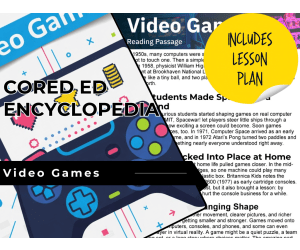
Video Games Reading Comprehension Passage - Cored Ed Encyclopedia
ELA, Language Development, Reading Comprehension, Reading, Pre-Reading, Science, Technology, Engineering, History, Social Studies, Grade 2, 3, 4, 5, Worksheets & Printables, Worksheets, Teacher Tools, Centers, Activities, Writing Prompts, Assessments, Quizzes and Tests, Quizzes, Lesson Plans
This video games reading comprehension with lesson plan includes: Visualization (on the front cover) Start your lesson by taking a minute to think and share something about the topic. Read the script aloud (slowly), perhaps prepare some music or sound effects. Student close their eyes and let their imaginations wander. Students open their eyes, read the question aloud and give them a few minutes to complete. Ask a few students to share or keep answers until the end to compare with what they learn in the passage. Quick pause—thousands of Cored Education products are included with your TeachSimple membership. Download links and encyclopedia index available here. Pre-Reading Trivia Students will write down one thing they already know about the subject and then read five more facts and discuss. These facts are fun, and the students will enjoy learning about the subject before reading more. Give 1 minute for students to write what they already know (no pressure—best guess is fine). Read the five facts together. After each fact, do ask a student for their opinion, was it surprising? Set a purpose by asking students to highlight/underline one fact they want to learn more about during the reading. Reading Passage The text is a high-interest reading passage with set paragraphs, roughly three to four paragraphs long. It contains a variety of themes about the topic, anywhere from history to technology. The passage is between 250 and 350 words in length. First, ask students to look at the headings and see what they’ll learn about today. What do they know about the topic/heading? First read options: Teacher read-aloud (best for support). Partner reading (paragraph by paragraph). While reading, students underline important details, and vocabulary words they think may come up in the questions section. Mixed Questions The first question page contains four multiple-choice questions, each with a choice of four answers, and three written response questions that require a sentence or two from the student. Students complete the mcqs first independently, then review quickly as a class. For the 3 written responses, try to get students giving the answer with some form of evidence: “I think ___ because the text says ___.” If students get stuck, send them back to check the passage. Vocabulary Questions Practice seven key words from the text in this section across two activities. First section is scrambled words where students will unscramble three words given a clue for each. The second section is a word to meaning matching activity. Before starting, have some students read out words they underlined in the passage. Ask students to say the word and read aloud the sentence(s) around each word. Ask students to do scrambled words and the matching exercise in pairs then go through answers as a class. For the scrambled spelling task, get four pairs to come up to the board and write the words for extra practice with the other student reading out the clue. For the matching task, prompt students to give full sentences: “I matched ___ with ___ because ___.” Creative Writing In this question, the student will be required to write a five to eight sentence paragraph on a question related to the topic. Before starting, ask students write down 3 key ideas they are going to include in their piece. Ask students for ideas to share around the class to help those struggling. Pro writing expectations: 5–8 sentences At least 2 facts or details from the passage At least 2 vocabulary words from the previous page Students read their paragraphs while classmates listen for facts and vocabulary words. Extension Activities This page is optional for fast finishers or to take home. There are several activities, each one requiring a different skill. Do some, do none, do all, completely optional - but you will feel reassured knowing every possibility is planned for. Includes summary writting question. Answer Key There are answers for the multiple-choice questions, written response questions have sample answers, vocabulary answers and if there is a summary question then a sample summary will be provided as well. Lesson Plan Included Customized lesson plan for this lesson is included. Lesson Snapshot Title: Video Games Genre: Nonfiction (Informational text) Subject: Science & Technology / Media Literacy Primary Topic: How video games changed from dots to VR Estimated Guided Reading Level (A–Z): P Story text location: Reading Passage on page 3. Support pages included: Visualization prompt (p.1), Pre-Reading Trivia (p.2), Mixed Questions (p.4), Vocabulary (p.5), Creative Writing (p.6), Extension Activities (p.7), Answers (p.8). Support-page QA check: The questions, vocabulary tasks, and answer key match the passage’s details (dates, examples, and key terms). What This Lesson Teaches Best Early video games grew from science tools and big computers: Describes room-sized computers and a “game screen” idea using an oscilloscope. Timeline of key early games and places: Connects Tennis for Two (1958), Spacewar! at MIT (1962), Computer Space (1971), and Atari’s Pong (1972). How cartridges changed home gaming: Explains that swapping cartridges let one system play many different games, and names early cartridge consoles (Fairchild system, Atari 2600). Technology improvements changed how games look, sound, and where they are played: Notes smoother movement, clearer pictures, richer sound, and games moving to handheld screens, computers, consoles, and phones. Games became many types of experiences: Lists examples like puzzles, team sports, building sets, long stories with choices, and virtual reality. Learning Goals Students will describe how Tennis for Two worked and what device showed the moving dot. Students will identify major milestones in early video game history by placing key examples in order. Students will explain how cartridges helped video games spread at home. Students will summarize how video games changed as computers became smaller and stronger. Students will give examples of different kinds of games mentioned in the passage. Key Vocabulary From the Text oscilloscope — a screen tool that can show moving signals. physicist — a scientist who studies matter and energy. arcades — public places where people play games. cartridges — plastic game boxes you swap into a system. virtual — computer-made, not physically real. FULL CATALOG OF DOWNLOAD LINKS AND ENCYCLOPEDIA INDEX HERE
Author Cored Education
Rating
Tags Vocabulary, Reading Comprehension, Reading Passages, Lesson Plans, Ela Lesson Plans, Reading Comprehension Lesson Plans, Pre-reading, Science Lesson Plans, Technology, History Lesson Plans

Number & Operations: Percentages with Fractions - Learn the Skill - MAC Software
Math, Percentages, Common Core, Grade 3, 4, 5, Teacher Tools, Lesson Plans
Number & Operations: Percentages with Fractions - Learn the Skill - MAC Software Overview: A comprehensive teaching resource designed for educators guiding students in grades 3 to 5. This software provides a hands-on experience in understanding calculations involving percentages and fractions, aligning perfectly with classroom lesson plans . Specially developed for math lessons focusing on percentages. Presents abstract mathematical ideas through real-world word problems. Fostering an engaging learning environment where students can connect their topics to everyday scenarios. Multilingual Support: In addition to English, our software also includes a Spanish text option and voice over accompaniment, catering to bilingual or Spanish-speaking classrooms. In-Classroom or Homeschool Application : Ideal for whole-group instruction or discussion sessions, this dynamic resource ensures an interactive learning experience. Can also be used effectively at home for homework assignments and reinforcement activities. Certifications : Closely Adheres: Common Core State Standards and STEM initiatives. Fully Compliant : NCTM standards. User-friendly Experience: The software is conveniently contained within one zip file specifically designed for MAC systems making it user-friendly. Post downloading onto your system it is instantly ready-to-use allowing immediate integration into your existing math lesson framework. To Sum Up :'Number & Operations: Percentages with Fractions'brings together best educational practices alongside technological convenience. Make mathematics more engaging than ever before! Consider integrating this tool today!
Author Classroom Complete Press
Tags Percentages, Fractions, Operations, Math Skills, Digital Math

Literary Devices - Digital Lesson Plan Gr. 5-8 | MAC Software
ELA, Reading, Grade 3, 4, 5, 6, 7, 8, Teacher Tools, Lesson Plans
The Literary Devices - Digital Lesson Plan Gr. 5-8 | MAC Software This comprehensive teaching resource is designed specifically for educators, both in public schools and in homeschooling settings. Perfectly suited to students between grades 5 and 8, this interactive learning tool focuses on enhancing the understanding of literature mechanics. An immersive learning experience covering a whopping 80 screen-pages, this module offers extensive tutorials on key storytelling components such as: Characterization Setting plot development Theme creation Point of view establishment Foreshadowing mechanisms Symbols integration Irony infusion strategies . Beyond just theory-based lessons, it includes practical examples accompanied by pre-and post-reading interactive activities to reinforce learning. A unique feature that encourages learners to apply their knowledge within actual scenarios. Educational Tools Included: Crosswords puzzles & word searches games for revision. A test prep section aids students' performance levels. A special text-to-speech function allows users to audibly consume content promoting auditory learning paths. Further backed up by video-audio support system providing varied content formats to suit different learner types. All resources bundle into one neat zip file exclusively formatted for MAC operating systems; serving as the perfect language arts curriculum support focusing specially on reading skills development for middle schoolers. Incorporating state educational standard alignments coupled with its structured design based on Blooms Taxonomy principles, The Literary Devices - Digital Lesson Plan Gr. 5-8 | MAC Software is an essential tool for educators irrespective of their teaching environment. Experience this unique learning pathway to enable students unravel the true meaning and purpose across different literature genres by understanding their fundament building blocks.
Author Classroom Complete Press
Tags Literary, Devices, Reading Skills, Digital Lesson Plan, Reading Lesson, Activities To Teach Literary Devices

Lesson Plan on The Weather - Grades 1-4
Earth and Environmental Sciences, Science, Earth Sciences, Environmental Science, Grade 1, 2, 3, 4, Activities, Lesson Plans, Teacher Tools, Worksheets & Printables
This fun 90-minute lesson is perfect for Grades 1–4. It helps students learn all about the weather in a simple and engaging way. The lesson starts with a quick observation activity where students look outside and describe what they see. Then, they watch a short, colorful video called Weather | Science for Kids . It explains what weather is, the different elements, and why it matters. After the video, students answer questions, sort weather cards, and work in pairs. The lesson includes a printable worksheet full of matching, drawing, and word games. Students also make their own weather wheels and act as mini meteorologists in class. Everything is hands-on and easy to follow. The lesson builds vocabulary, boosts speaking, and teaches science—all at once. It’s ideal for classroom or remote learning. Best of all, the activities are ready to print and use right away. If you want a weather lesson that’s fun, interactive, and packed with learning, this is it!
Author Bright Classroom Ideas Marketplace
Rating
Tags Weather, Lesson, Plan, Environment, Earth
I WONDER - What Is Special About A Gecko | Animated Video Lesson
STEM, Animals, Life Sciences, Science, Biology, Grade 1, 2, 3, 4, 5, 6, 7, 8, Lesson Plans, Teacher Tools
Video Introduction Animal kingdoms are full of fascinating wonders to learn. This video is designed for the students to learn more about animals in different countries. I WONDER - What Is Special About A Gecko | Animated Video Lesson Do you like animals? what is your favorite one? Do you own a pet? If yes, tell us more about it, like what its name? And what do you like most about it? What are the animal kingdoms? Can you write down the characteristics of each animal class like mammals, birds, reptiles, amphibian, fish and mollusks. Do you know that some animals can sing, can you name any of them? What is the largest and the smallest mammal in the world? What is the largest and the smallest bird in the world? What is the largest and the smallest fish in the world? I WONDER - What Is Special About A Gecko | Animated Video Lesson The video is perfect for encouraging the researching skills for the students, while learning more about these fantastic animals. I WONDER - What Is Special About A Gecko | Animated Video Lesson This friendly designed video is suitable for students at school, homeschooling, and as a group activity. Format Available in MP4 format.
Author Educational Voice
Tags What Is Special About A Gecko, What Is Special About A Gecko Video, Gecko, Gecko Facts, Gecko Facts For Kids, Gecko Video, Gecko Video For Kids, Animal, Animals, Animals Facts
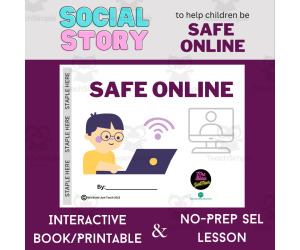
Social Story: SAFE ONLINE- Interactive Book/Printable SEL Lesson
Special Resources, Social Emotional Learning (SEL), Social Skills, Grade 3, 4, 5, 6, Lesson Plans, Teacher Tools
The Social Story: SAFE ONLINE- Interactive Book/Printable SEL Lesson is an essential tool for educators aiming to teach safe and responsible online behavior. This book, suitable for children aged 7 to 12, provides knowledge on internet safety and fosters awareness of potential dangers. As a key benefit of this resource, students become active learners by: Anwering questions Engaging in coloring activities Sketching images Discussing personal guidelines for online conduct The package contains detailed descriptions of social stories and offers two options based on individual preference: full-page print-out and half-page print-out formats. An inclusive tool that caters to all learning environments! Educator & Classroom Integration: To better assist teachers and facilitate lessons or discussions prompted from the content, a discussion guide is provided. Individual student involvement or classroom-wide reading sessions can take place dependent on specific approaches preferred by the educator. Digital Classrooms: In these modern times where Google Slides integration is highly useful - it proves invaluable here. Perfect for teacher-led instruction. Suggested Implementations: Individual Completion during Break Times-A powerful method to reinforce necessary behavioral changes in solitary settings. In Small Groups-This resource can be consistently utilized in counselor-led discussions focused around student's digital conduct. Creating copies together has a dual benefit – fostering camaraderie in group-based settings and maintaining consistency at home. Tackling Personalized Behavior Issues : The Social Story SAFE ONLINE works extraordinarily as a private intervention tool pertinent to personalized behavior management. Finally, through our collective efforts, we hope to engage all children in respectful digital discourse. This resource symbolizes our commitment towards a better-informed digital society. After all, teaching internet safety today should be as vital as learning how to cross the street!
Author Mrs Bonie Just Teach
Tags Internet Safety, Responsible Online Behavior, Social Story, Digital Citizenship, Online Boundaries

I WONDER - What Is A Melody | Animated Video Lesson
Music, Creative Arts, Grade 2, 3, 4, 5, 6, 7, 8, Lesson Plans, Teacher Tools
Video Introduction An amazing video designed for the students to learn more about music. I WONDER - What Is A Melody | Animated Video Lesson A melody is a series of musical notes played one after the other, creating a tune or main theme in a piece of music. It is often the most recognizable part of a song and can be played by a single instrument or sung by a voice. Melodies can be simple or complex and are usually created using a combination of steps (moving to the next note in the scale) and leaps (skipping one or more notes in the scale). A well-crafted melody will often have a balance of both steps and leaps, creating an interesting and memorable tune. I WONDER - What Is A Melody | Animated Video Lesson The video is perfect for encouraging the artistic skills for the students, while learning more about this fantastic topic. I WONDER - What Is A Melody | Animated Video Lesson This friendly designed video is suitable for students at school, homeschooling, and as a group activity. Format Available in MP4 format.
Author Educational Voice
Rating
Tags What Is A Melody, What Is A Melody Video, Melody, Melody Facts, Melody Video, Melody Facts For Kids, Melody Video For Kids, Music, Music Facts, Music Video

Communities of the World Unit
Social Studies, Geography, Grade 3, Lesson Plans, Teacher Tools
This resource is a Communities of the World Unit . Designed for your Grade 3 students, this resource is jam-packed with so many good printables to teach students about culture, diversity, geography and so much more. Within this unit , students will learn about: - Locating world communities - Living with the land - Resources - World communities - Daily life - Cultural diversity The focus communities here are: - Botswana - India
Author Rathgeber Resources
Tags World, Communities, India, Natural Resources, Culture

Hands-On STEM Challenges – Simple Machine Building Worksheets
STEM, Science, Basic Science, Inventors, Theories, Technology, Engineering, Special Resources, Social Emotional Learning (SEL), Special Education Needs (SEN), Homeschool Curriculum, Homeschool Templates, Grade 3, 4, 5, 6, 7, Worksheets & Printables, Workbooks, Worksheets, Word Searches, Teacher Tools, Lesson Plans, Quizzes and Tests, Quizzes, Tests, Assessments
Incorporate Real World Engineering & Discovery into Your Science Classroom with a Comprehensive Simple Machines STEM Unit. Tired of trying to teach students about abstract concepts like force, work, and mechanical advantage in physics without providing a tangible and exciting way to understand them? This complete 5-Week STEM Unit is the all-in-one solution that you've been searching for! It includes everything you need to take your 3rd, 4th & 5th grade students from the theory of physics to creating their very own projects! This product is NOT just a bunch of worksheets, it is an entire educational experience! The resource contains 3 parts: a theoretical guide for teachers, an interactive student workbook & a complete teacher resource pack. The unit provides students with hands-on experiences as they explore 6 classical simple machines (levers, pulleys, inclined planes, wedges, wheels and axles, screws) by examining real-world case studies such as the pyramids of Giza through modern skyscrapers, & then participating in a series of hands-on, challenging activities. Constructivist approaches promote "productive struggle" within the context of providing students with a true understanding of the concepts in this unit, using low-cost, readily available, recycled materials. No more expensive kits, use real-world, authentic inquiry-based learning that develops a true engineering mindset! What This 38-Page Resource Includes: In-depth explanation of Simple Machines: Each of the 6 Simple Machines is explained to teachers in easy-to-understand language. Helpful historical case studies and concept reinforcement questions are included to aid understanding. Worksheets: 10 challenging worksheets designed for students, allow students to demonstrate an understanding of Simple Machines in real-world contexts. These worksheets include activities such as identifying simple machines in everyday objects, analyzing compound machines, calculating mechanical advantage, and working on a design project similar to a Rube Goldberg. Visuals & Helpful Teacher Tools: Three High Contrast Anchor Charts: Vector illustrations of the 6 Simple Machines, a Class 1 Lever (Mechanical Advantage) and the Engineering Design Cycle (STEM). For use in display and projection. Detailed Answer Key: Complete answer key for all 10 worksheets. Complete Teacher Implementation Guide: The Ultimate Resource Guide - Contains teaching reasoning, recommended 5 week pacing guide, list of readily available recycled materials for use in the "Maker Station" and how to facilitate hands on activities and productive struggles in the classroom, as written by seasoned pros. Simple machines, STEM activities, processes used in the design of mechanical systems (engineering design), the learning of physics, the learning of physics from the perspective of children, third grade, fourth grade, fifth-grade science, hands-on learning, project-based learning (PBL), the use of levers and pulleys, worksheets, STEM units or courses together with lesson plans requiring little or no preparation and low-cost preparation; utilizing mechanical advantages using acceleration. The Reasons Parents/Schools Value: Comprehensive & Ready to Use: This isn't just one thing to do; it is a full 5-week unit plan which includes theory, worksheets, visuals, and a detailed teacher's guide. This prepares the teacher for doing the lesson in dozens of hours less than would normally be required. Cost Effective & Easily Accessible: This unit plan was designed to be completed with items that are readily available to you such as cardboard, bottle caps, or string. There is no need to purchase expensive robotic kits that are specialized. Provides Deeper Conceptual Understanding: When students work through building challenges (e.g., utilizing force) they have a hands-on experience they will remember long after the activity is completed. Encourages Developing an Engineering Mindset: In addition to using the Engineering Design Cycle and creating "productive struggle", there is an emphasis on teaching students how to think like an engineer and to use real-world skills to solve problems, be resilient, implement multiple iterations of their solution, and critically think. Target group analysis : The text has an explicit statement of the target audience ("For students in grades 3-5"), so it's clear that the cognitive level of this audience is in the appropriate range. Because of these two factors, we have identified: 1. Primary audience Members consisting of 3rd through 5th Grade Teachers (from public, private and charter schools). 2. Secondary audience members of Homeschooling Families looking for a complete, structured STEM Curriculum. 3. Tertiary audience members will be STEM/STEAM Coordinators, After School Program Directors and Science Club Leaders or Facilitators. Copyright and Terms of Use : Syed Hammad Rizvi is the copyright holder of this resource. This resource is intended for personal and single classroom use only. You cannot modify, distribute or sell this resource. In other words, you cannot post on the Internet for the public to access and download. If you wish to share this resource with other teachers, please consider purchasing a separate license through Teachsimple. Thank you for understanding and following these terms of use. This product has been developed in partnership with Syed Hammad Rizvi
Author Creative Book Store
Rating
Tags SimpleMachines, STEM, STEMeducation, HandsOnLearning, ProjectBasedLearning, ScienceTeacher, TeachersOfInstagram, ITeachScience, ITeachSTEM, EngineeringForKids

Egypt The Gift of the Nile: Guided Reading Level R with Lesson Plan
ELA, Resources for Teachers, Reading Comprehension, Reading, Science, Geography, Social Studies, History, Earth and Environmental Sciences, Technology, Grade 3, 4, 5, Worksheets & Printables, Worksheets, Teacher Tools, Centers, Activities, Literacy Readers, Quizzes, Quizzes and Tests, Assessments, Lesson Plans
This Egypt: The Gift of the Nile (level r) guided reading book with lesson plan includes: Guided Reading Color Label (front cover x1) This is a quick way to match the book’s demands to what students can generally handle.. The overall goal is to use the level/color to pick books for several smaller groups. To qualify for a certain level, a student is expected to read a book from that level with about 90–94% accuracy. If a student is consistently accurate and understands, move up a level. If the student is struggling at that level, drop down and add more support. Each student will improve at completely different rates, but it is generally one of the best ways to check progress across the class. DOWNLOAD THE CATALOG TO VIEW ALL GUIDED READING BOOKS AVAILABLE (SORTED LEVELS A-Z) Pre-Reading Question (x1) Teacher asks the prompt aloud, can be while showing the cover or first page. Students share what they already know, or make educated guesses from the cover. Prompt them to use the target vocabulary. Write some of their responses on the board to look back at during the reading. Vocabulary Words (x5) Introduce the five words, best doing it one at a time. Start by saying it, while students repeat and then see if anyone knows what it means before reading further. Read through the meaning and try to briefly connect each word to a picture or gesture so it’s meaningful. Ask students to flip through the book pages and point to where they see each of the vocabulary words. While reading the book pause upon coming across one of the vocab words or read the sentence twice to make sure students understand the word has appeared. Optional: Ask students to raise hands whenever they see/hear one of the new words. Guided Reading Pages (x10) Check the book snapshot (below) for: primary topic - do you need to prep extra reading or intro materials on this? what is taught best - decide on 1-2 bullets to focus on, use the prompt or words provided here for best results. learning goals - what you are checking for students to be able to do after the session, elicit answers using prompts or words provided. key vocabulary (see section above). questions overview - so you know what is coming up and if you need to prep extra materials to assist understanding. Run the lesson You may have already looked at a few of the pages together, but you can show them some of the pictures again first to set meaning. Depending on how much time you have and how familiar your students are with guided reading class, you may want to read the book aloud first with the group first. Students whisper or partner read, while you listen in. If time, do it as a group, one student reading a page each. Use the guided page’s prompts to coach: “Check the picture / does it make sense?” “Point under the words / try the first sound” “Reread the sentence smoothly”. Try to focus more on one student per session (rotating every time), so you can work out if they are ready to move up or need to move down a level. Comprehension Questions (back cover x3) This is your way to check that students didn’t just say the words, but actually understood the text. First, let students answer by pointing to the page/picture and saying a short sentence. After any answer, follow with: “Show me where you found that in the text.” In bigger groups, have partners answer first (10–20 seconds), then call on 2–3 students to share. Differentiation tips: Emerging speakers/struggling readers: oral + pointing On-level: oral in a full sentence Higher: one written sentence or draw + label Book Snapshot Title: Egypt: The Gift of the Nile Genre: Nonfiction Subject: Social Studies (Geography/History) Primary Topic: How the Nile shaped ancient and modern Egypt Estimated Guided Reading Level (A–Z): R What This Book Teaches Best How Egypt’s desert environment (Sahara Desert, little rain) made a single water source essential for a thriving civilization. Why the Nile River’s yearly floods mattered, including how receding water left fertile silt for growing food. Major symbols of ancient Egypt and what the text says they were for or represented (Great Pyramid of Giza; Great Sphinx). Key beliefs and systems of ancient Egypt, including pharaohs, the afterlife, hieroglyphics, and mummification. Connections between past and present by describing modern Cairo, the Suez Canal, tourism, and archaeologists’ discoveries. Learning Goals Students will describe Egypt’s location and explain how the Sahara Desert affects the land. Students will explain how Nile floods helped farmers grow food by using the text’s details about silt. Students will identify what the Great Pyramid of Giza was built for and describe one detail about its construction. Students will describe how ancient Egyptians recorded history and managed government using hieroglyphics and scribes. Students will explain why mummification was developed and describe what the text says happened during the process. Students will describe two details that show Egypt is a modern nation today (for example, Cairo and the Suez Canal). Key Vocabulary From the Text receded — moved back after being higher. silt — rich dark soil left by water. monumental — very large and important. hieroglyphics — picture symbols used as a writing system. mummification — preserving a body by drying and wrapping. Discussion Prompts Pre-reading question: How might a river help people live and farm in a desert place? Comprehension questions: What did the Nile River’s floods leave behind when the water receded, and why did that help farmers? Comprehension questions: What does the text say the Great Pyramid of Giza was built for? Comprehension questions: What two details from the text show Egypt is a modern nation today? Printing Tips 1. Best Printing Method (Recommended) “Booklet” Printing (Best if Available) If your printer or PDF viewer supports Booklet Printing , use this. Settings to use: Print mode: Booklet Paper size: Letter or A4 (either works) Orientation: Landscape Print on both sides: Yes Flip on: Short edge Scaling: Fit to printable area Booklet subset: First test: Front sides only Then: Back sides only This will automatically: Pair pages correctly Put the cover on the outside Align everything for folding After printing, fold in half and staple along the spine . 2. If “Booklet” Printing Is NOT Available You can still print this correctly with manual duplex printing . Step-by-step: Open the PDF. Choose Print . Set: Orientation: Landscape Pages per sheet: 1 Print on both sides: Yes Flip on: Short edge Print all pages . Because each PDF page already contains two facing book pages, the result will still fold cleanly into a book. Thousands of Cored Education products are included with your TeachSimple membership. Download links and encyclopedia index available here.
Author Cored Education
Rating
Tags Reading Comprehension, Reading Passages, Reading, Guided Reading, Guided Reading Lesson Plan, Guided Reading Activity, Pre-reading, Social Studies, Geography, History

I WONDER - How Did Soldiers Practice In The Rain | Animated Video
Earth Sciences, Earth and Environmental Sciences, Science, History, Social Studies, History: British, History: Europe, Grade 3, 4, 5, 6, 7, 8, 9, Lesson Plans, Teacher Tools
Video Introduction An amazing video designed for the students to learn more about famous phenomena in different countries. I WONDER - How Did Soldiers Practice In The Rain | Animated Video Lesson Weather phenomena can affect our lives, crops and even animals! Can you name any of the weather phenomena that happened in your country? Do you know when hailstorms happen? And what is the most country who has lots of hailstorms happening per year? Do you think the all countries have four seasons? If no, can you name any? Why do some animals sleep at winter? Can you name any of these animals? I WONDER - How Did Soldiers Practice In The Rain | Animated Video Lesson The video is perfect for encouraging the researching skills for the students, while learning more about this fantastic phenomenon. I WONDER - How Did Soldiers Practice In The Rain | Animated Video Lesson The video is perfect for encouraging the researching skills for the students, while learning more about this fantastic phenomenon. Format Available in a PDF format.
Author Educational Voice
Rating
Tags How Did Soldiers Practice In The Rain, Rain, Rain Facts, Rain Video, Rain Video For Kids, Rain Facts For Kids, Soldiers Practice, Soldiers Practice In Rainy Days, Weather, Rain In History

Application of Multiplication and Division Unit Vocabulary Words Interactive Foldables for 3rd Grade - EBOOK
Math, Multiplication and Division, Division, Grade 2, 3, 4, Lesson Plans, Teacher Tools
This set includes 3 vocabulary interactive foldables based on combined state standards for 3rd Grade Application of Multiplication and Division Units. Each foldable is offered in three formats, words only, definitions only, and words with definitions. These 3 foldables cover: •Area •Counting (natural) numbers •Dividend •Divisor •Equation •Even number •Expression •Fact families •Factor •Odd number •Product •Quotient •Whole numbers This ebook is a downloadable PDF file. Just follow the instructions, cut, fold, glue, and create! Keywords: math, vocabulary, Area, Counting (natural) numbers, Dividend, Divisor, Equation, Even number, Expression, Fact families, Factor, Odd number, Product, Quotient, Whole numbers second grade, third grade, fourth grade, Candie Donner
Author Knowledge Box Central
Tags Math, Multiplication, Division, Vocabulary Words, Equation

Plants of Australia | Australia Unit Study | Geography Bundle
Social Studies, Geography, Grade 3, 4, 5, 6, 7, Lesson Plans, Teacher Tools
Plants of Australia | Continent of Australia Unit Study | Geography Bundle This teaching resource introduces students to the botanical beauty and variety that graces the Australian continent. The packet contains detailed information cards on twelve different plants native to Australia: bottlebrush kangaroo paw golden wattle gum tree (eucalyptus) melaleuca boab tree screw palm mistletoe, wedding bushes, wollemi pine, and macademia tree. Note: A delightful feature is that two separate sets of these cards are provided - one using metric system measurements and another using imperial units. About The Cards in This Set: The double-sided cards feature basic information about each plant alongside a realistic photo on one side. A mini-article exploring more interesting features is printed on the other. Included Tools: Besides these informative cards, educators will find worksheets, activities, and small pictures at their disposal for varied learning engagements! Educational Application: This resource can be integrated into whole class discussions about Australian geography or used in smaller groups for collaborative learning sessions. Individual learners can also utilize it independently for homework assignments or supplementary study materials outside regular lessons. Suitable For: Grades 3 through 7 classrooms with a Social Studies focus or any other context where knowledge about Earth's geography is required. Tech Specifications: The file comes in an accessible 1 zip file which includes ready-to-print pages via PDF format and Image files. Finally, this bundle embodies the learning philosophy of Simply Schoolgirl - making education uncomplicated! Venture into an exciting exploration of Australian plants straight from your classrooms using this engaging learning resource.
Author Simply Schoolgirl
Tags Australia, Plants, Continent, Geography Bundle, Unit Study

Ancient Rome Social Studies Notes (Aligned to 3rd Grade VA SOLs)
Social Studies, History, History: Europe, Grade 3, 4, 5, Teacher Tools, Lesson Plans
The Ancient Rome Social Studies Notes: A Scalable Teaching Aid Based on VA SOLs This state-of-the-art teaching resource effectively straddles modern pedagogical demands and historical accuracy, encompassing the essentials of Ancient Rome that glues learners' attention. Attuned to the varying classroom requirements of today, this product is made available in printable and digital formats. It satisfies different engagement intensities through distinct information densities - featuring complete notes to fill-in-the-blank pages. This resource can function conveniently as a personal homework assignment or group activity tool, and it can also be highlighted during full class instruction for an interactive discussion. In-depth Learning Points Vocabulary section: Assists learners in understanding challenging terminology. Geography domain: Explores Rome's geographical changes over time — crucially underscoring Roman Empire's significant impact on Western civilization. Government studies segment: Revisits ancient Rome's Republic and Empire stages. Roman contributions subsection: Discusses significant Roman structures such as arches, aqueducts, roads along with architectural wonders like Coliseum and Pantheon. Societal Landscape Viewpoint No study about ancient civilizations would come full circle without delving into their societal landscape: how did Romans leverage their environment; what were their adaptation strategies? A dedicated section illumines this aspect by pondering upon Human Resources, Natural Resources, Capital Resources - augmented with a note on Roman Numerals! Educational Scope & Accessibility Feature: Whether you're impacting young minds inside conventional classrooms or in a homeschooling scenario — introducing them to the marvels of Ancient Rome has never been this engaging and enlightening! This product can be easily incorporated into lesson plans targeting grade 5 to grade 3 students learning social studies under 'History: Europe' sub-category qualification standards. Making it even more user-friendly, it’s available in multiple file types.
Author SchoolingSara
Tags Ancient Rome, Social Studies, Roman Empire, Roman Civilization, Geography

Darts Reading Comprehension Passage - Cored Ed Encyclopedia
ELA, Language Development, Reading Comprehension, Reading, Pre-Reading, History, Social Studies, Math, Sports, P.E. & Health, Grade 2, 3, 4, 5, Worksheets & Printables, Worksheets, Teacher Tools, Centers, Activities, Writing Prompts, Assessments, Quizzes and Tests, Quizzes, Lesson Plans
This darts reading comprehension with lesson plan includes: Visualization (on the front cover) Start your lesson by taking a minute to think and share something about the topic. Read the script aloud (slowly), perhaps prepare some music or sound effects. Student close their eyes and let their imaginations wander. Students open their eyes, read the question aloud and give them a few minutes to complete. Ask a few students to share or keep answers until the end to compare with what they learn in the passage. Quick pause—thousands of Cored Education products are included with your TeachSimple membership. Download links and encyclopedia index available here. Pre-Reading Trivia Students will write down one thing they already know about the subject and then read five more facts and discuss. These facts are fun, and the students will enjoy learning about the subject before reading more. Give 1 minute for students to write what they already know (no pressure—best guess is fine). Read the five facts together. After each fact, do ask a student for their opinion, was it surprising? Set a purpose by asking students to highlight/underline one fact they want to learn more about during the reading. Reading Passage The text is a high-interest reading passage with set paragraphs, roughly three to four paragraphs long. It contains a variety of themes about the topic, anywhere from history to technology. The passage is between 250 and 350 words in length. First, ask students to look at the headings and see what they’ll learn about today. What do they know about the topic/heading? First read options: Teacher read-aloud (best for support). Partner reading (paragraph by paragraph). While reading, students underline important details, and vocabulary words they think may come up in the questions section. Mixed Questions The first question page contains four multiple-choice questions, each with a choice of four answers, and three written response questions that require a sentence or two from the student. Students complete the mcqs first independently, then review quickly as a class. For the 3 written responses, try to get students giving the answer with some form of evidence: “I think ___ because the text says ___.” If students get stuck, send them back to check the passage. Vocabulary Questions Practice seven key words from the text in this section across two activities. First section is scrambled words where students will unscramble three words given a clue for each. The second section is a word to meaning matching activity. Before starting, have some students read out words they underlined in the passage. Ask students to say the word and read aloud the sentence(s) around each word. Ask students to do scrambled words and the matching exercise in pairs then go through answers as a class. For the scrambled spelling task, get four pairs to come up to the board and write the words for extra practice with the other student reading out the clue. For the matching task, prompt students to give full sentences: “I matched ___ with ___ because ___.” Creative Writing In this question, the student will be required to write a five to eight sentence paragraph on a question related to the topic. Before starting, ask students write down 3 key ideas they are going to include in their piece. Ask students for ideas to share around the class to help those struggling. Pro writing expectations: 5–8 sentences At least 2 facts or details from the passage At least 2 vocabulary words from the previous page Students read their paragraphs while classmates listen for facts and vocabulary words. Extension Activities This page is optional for fast finishers or to take home. There are several activities, each one requiring a different skill. Do some, do none, do all, completely optional - but you will feel reassured knowing every possibility is planned for. Includes summary writting question and additional facts. Answer Key There are answers for the multiple-choice questions, written response questions have sample answers, vocabulary answers and if there is a summary question then a sample summary will be provided as well. Lesson Plan Included Customized lesson plan for this lesson is included. Lesson Snapshot Title: Darts Genre: Nonfiction (informational text with headings) Subject: Reading (Informational Text) / Math (numbers & scoring context) Primary Topic: History, dartboard design, and how scoring works Estimated Guided Reading Level (A–Z): Q What This Lesson Teaches Best Explains how darts began as indoor throwing at targets in England and became a friendly challenge in taverns and homes. Teaches key dartboard features (20 pie-shaped sections, thin wires, double/triple rings, and a bull’s-eye that can be 50 points). Builds real-world math context by describing common game formats (301 or 501) where points are subtracted each turn. Uses a cause-and-claim structure to discuss uncertainties and evidence (a debated story about why numbers are scrambled; a court case about skill vs luck). Connects materials/technology to sports equipment (sisal fibers that close up; tungsten barrels for a slimmer grip) and modern leagues/championships. Learning Goals Students will summarize how the text describes darts’ early history and where people played. Students will identify key parts of a dartboard in the text and explain what they do for scoring. Students will explain how a 301 or 501 game works in the passage, including what happens each turn. Students will describe why the dartboard numbers might be scrambled and explain what the text says is uncertain about that story. Students will explain what happened in 1908 and how it relates to whether darts is luck or skill. Students will cite details about modern boards and darts (sisal fibers, tungsten barrels, leagues/championships). Key Vocabulary From the Text taverns — places where people gather for food and drink. oche — the throwing line you stand behind. subtracted — taken away from a total number. sisal — strong fibers used to make dartboards. tungsten — a dense metal used for slimmer dart barrels. Discussion Prompts FULL CATALOG OF DOWNLOAD LINKS AND ENCYCLOPEDIA INDEX HERE
Author Cored Education
Rating
Tags Vocabulary, Reading Comprehension, Reading Passages, Lesson Plans, Ela Lesson Plans, Reading Comprehension Lesson Plans, Pre-reading, Sports, History, Social Studies Lesson Plans

I WONDER - Why Is Ireland Famous For Red Hair | Animated Video Lesson
Geography, Social Studies, Grade 3, 4, 5, 6, 7, 8, 9, Lesson Plans, Teacher Tools
Video Introduction An amazing video designed for the students to learn more about famous places in different countries. I WONDER - Why Is Ireland Famous For Red Hair | Animated Video Lesson What do you know about this place? Do you know in which part of the world it is? Have you ever visited this place? If yes, can you tell us more about your adventure, and what do you like the most about this place? Do you like reading about Geography? What is your favorite country in the whole world? If you are going on a trip where it will be? Which country? What you are going to see there? Does this country has a famous place to visit? I WONDER - Why Is Ireland Famous For Red Hair | Animated Video Lesson The activity is perfect for encouraging the researching skills for the students, while learning more about this fantastic place. I WONDER - Why Is Ireland Famous For Red Hair | Animated Video Lesson This friendly designed video is suitable for students at school, homeschooling, and as a group activity. Format Available in MP4 format.
Author Educational Voice
Tags Why Is Ireland Famous For Red Hair, Why Is Ireland Famous For Red Hair Video, Ireland Famous For Red Hair, Ireland, Ireland Facts, Ireland Facts For Kids, Ireland Video, Ireland Video For Kids
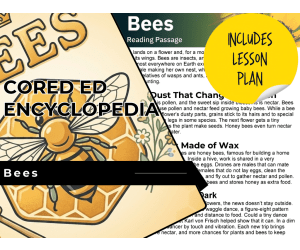
Bees Reading Comprehension Passage - Cored Ed Encyclopedia
ELA, Language Development, Reading Comprehension, Reading, Writing, Pre-Reading, Science, Insects, Life Sciences, Vocabulary, Grade 2, 3, 4, 5, Worksheets & Printables, Worksheets, Teacher Tools, Centers, Activities, Writing Prompts, Assessments, Quizzes and Tests, Quizzes, Lesson Plans
This bees reading comprehension with lesson plan includes: Visualization (on the front cover) Start your lesson by taking a minute to think and share something about the topic. Read the script aloud (slowly), perhaps prepare some music or sound effects. Student close their eyes and let their imaginations wander. Students open their eyes, read the question aloud and give them a few minutes to complete. Ask a few students to share or keep answers until the end to compare with what they learn in the passage. Quick pause—thousands of Cored Education products are included with your TeachSimple membership. Download links and encyclopedia index available here. Pre-Reading Trivia Students will write down one thing they already know about the subject and then read five more facts and discuss. These facts are fun, and the students will enjoy learning about the subject before reading more. Give 1 minute for students to write what they already know (no pressure—best guess is fine). Read the five facts together. After each fact, do ask a student for their opinion, was it surprising? Set a purpose by asking students to highlight/underline one fact they want to learn more about during the reading. Reading Passage The text is a high-interest reading passage with set paragraphs, roughly three to four paragraphs long. It contains a variety of themes about the topic, anywhere from history to technology. The passage is between 250 and 350 words in length. First, ask students to look at the headings and see what they’ll learn about today. What do they know about the topic/heading? First read options: Teacher read-aloud (best for support). Partner reading (paragraph by paragraph). While reading, students underline important details, and vocabulary words they think may come up in the questions section. Mixed Questions The first question page contains four multiple-choice questions, each with a choice of four answers, and three written response questions that require a sentence or two from the student. Students complete the mcqs first independently, then review quickly as a class. For the 3 written responses, try to get students giving the answer with some form of evidence: “I think ___ because the text says ___.” If students get stuck, send them back to check the passage. Vocabulary Questions Practice seven key words from the text in this section across two activities. First section is scrambled words where students will unscramble three words given a clue for each. The second section is a word to meaning matching activity. Before starting, have some students read out words they underlined in the passage. Ask students to say the word and read aloud the sentence(s) around each word. Ask students to do scrambled words and the matching exercise in pairs then go through answers as a class. For the scrambled spelling task, get four pairs to come up to the board and write the words for extra practice with the other student reading out the clue. For the matching task, prompt students to give full sentences: “I matched ___ with ___ because ___.” Creative Writing In this question, the student will be required to write a five to eight sentence paragraph on a question related to the topic. Before starting, ask students write down 3 key ideas they are going to include in their piece. Ask students for ideas to share around the class to help those struggling. Pro writing expectations: 5–8 sentences At least 2 facts or details from the passage At least 2 vocabulary words from the previous page Students read their paragraphs while classmates listen for facts and vocabulary words. Extension Activities This page is optional for fast finishers or to take home. There are several activities, each one requiring a different skill. Do some, do none, do all, completely optional - but you will feel reassured knowing every possibility is planned for. Includes summary writting question and additional facts. Answer Key There are answers for the multiple-choice questions, written response questions have sample answers, vocabulary answers and if there is a summary question then a sample summary will be provided as well. Lesson Plan Included Customized lesson plan for this lesson is included. Lesson Snapshot Title: Bees Genre: Nonfiction (informational passage) Subject: Life Science Primary Topic: Pollination, hive roles, and waggle-dance communication Estimated Guided Reading Level (A–Z): S What This Lesson Teaches Best Bees as insects with many kinds (more than 20,000) living almost everywhere on Earth except **Antarctica. How bees help plants make seeds by moving pollen from flower to flower while gathering nectar and pollen for baby bees. How honey bees live in organized hives with shared jobs (queen, drones, and worker bees doing specific tasks). How honey bees turn nectar into honey and store it for later as extra food. How the waggle dance can share direction and distance to food, supported by the work of Karl von Frisch. Learning Goals Describe where bees live and how many kinds the passage says there are. Explain how pollen gets from one flower to another in the passage. Identify what pollen and nectar do for growing baby bees. Describe how jobs are shared in a honey bee hive, including the queen, drones, and workers. Explain what the waggle dance communicates and how other bees follow it in a dim hive. Describe how honey is made and stored, using details from the passage. Key Vocabulary From the Text pollen — yellow dust that helps plants make seeds. nectar — sweet liquid inside blossoms. colony — a group of bees living together. larvae — baby insects before they become adults. vibration — shaking that can be felt as movement. FULL CATALOG OF DOWNLOAD LINKS AND ENCYCLOPEDIA INDEX HERE
Author Cored Education
Rating
Tags Vocabulary, Reading Comprehension, Reading Passages, Lesson Plans, Ela Lesson Plans, Reading Comprehension Lesson Plans, Pre-reading, Science Lesson Plans, Life Science, Insects

Winter Hibernation Mini Unit
Science, Basic Science, Earth and Environmental Sciences, Earth Sciences, Environmental Science, Grade 1, 2, 3, Lesson Plans, Teacher Tools
Winter Hibernation Mini Unit This educational material familiarizes students with concepts such as animal behaviors, survival strategies, and the interconnectedness of living organisms with their environment. It aims to enhance students' understanding of how animals adapt to changes in their surroundings, especially during challenging seasons like winter. Includes: Reading on hibernation with comprehension questions Information on animals that hibernate Questions about animals that hibernate Activity page on creating shelters during hibernation Answer key for reference Students will be able to tell why animals hibernate, when they hibernate, how they wake up from hibernation, and what happens to an animals body during the hibernation process. By learning about this attribute in animals students will also be able to deduce which animals go into hibernation and what locations they may use to hibernate. Additionally, students will learn about bears, groundhogs, chipmunks, hedgehogs, and how they survive the winter months. Engage students in reading, writing, and drawing to express their knowledge gained from the resource. A valuable addition to any winter science unit. Enjoy the learning experience! Winter Hibernation Mini Unit | Winter Hibernation Mini Unit | Winter Hibernation Mini Unit | Winter Hibernation Mini Unit | Winter Hibernation Mini Unit | Winter Hibernation Mini Unit |
Author Soumara Siddiqui
Tags Hibernation, Winter Hibernation, Winter, Animals And Winter, Winter Animals
I WONDER - How Did The Celts Get Their Name | Animated Video Lesson
History: Ancient, History, Social Studies, History: British, History: Europe, Grade 3, 4, 5, 6, 7, 8, 9, Lesson Plans, Teacher Tools
Video Introduction An amazing video designed for the students to learn more about history. I WONDER - How Did The Celts Get Their Name | Animated Video Lesson Let's use our time machine and trave though time till we get to the ancient world where life began! Have you ever thought about how did ancient Greeks, Romans, Egyptians and even the Viking and Celts use to shower? And how did these amazing civilizations build iconic buildings and invented things that we still use till today like toothpaste? Do you know who was the first king and queen in the world? Which countries they ruled? Who is the most fascinating person lived on Earth? Tell us more about him/her. I WONDER - How Did The Celts Get Their Name | Animated Video Lesson The video is perfect for encouraging the researching skills for the students, while learning more about history. I WONDER - How Did The Celts Get Their Name | Animated Video Lesson This friendly designed video is suitable for students at school, homeschooling, and as a group activity. Format Available in MP4 format.
Author Educational Voice
Rating
Tags How Did The Celts Get Their Name, Celts, Celts Facts, Celts Video, Celts Video For Kids, Celts Facts For Kids, Celtic Names, Celtic Names Facts, Celtic Names Video, Celtic Names Video For Kids

Revolutionary War on Wednesday (Magic Tree House #22 Lesson Plan, Activities)
Social Studies, ELA, History, History: USA, Reading, Reading Comprehension, Grammar, Literature, Language Development, Vocabulary, Spelling, Writing, Grade 1, 2, 3, Lesson Plans, Teacher Tools
A 5-day NO PREP novel study of Revolutionary War on Wednesday (Magic Tree House #22). This comprehensive book companion includes a lesson plan, chapter comprehension questions, vocabulary practice, and many other activities. You can easily customize lessons based on student age, reading and comprehension level, interests, and learning style! Additionally, all worksheets can be completed in an interactive notebook or simply discussed aloud if you desire to reduce the number of pages you print. THIS RESOURCE COVERS: Art (drawing, coloring, arts & crafts) Comprehension English language arts Geography Grammar History Reading Research Social studies Spelling Writing Includes: A 5-day lesson plan List of required materials and optional supplements Curated videos Chapter comprehension quizzes Chapter vocabulary (2 options) Pre-reading, during reading, and post-reading worksheets and activities Interactive notebook pieces (6 options) Book review reports (6 options) Writing craftivity
Author Heather Huhman
Tags Revolutionary War On Wednesday, Magic Tree House, George Washington, Revolutionary War, Book Companion, Novel Study, Revolutionary War Activities
I WONDER - In Baseball What Is A Strike | Animated Video Lesson
Sports, P.E. & Health, Grade 2, 3, 4, 5, 6, 7, 8, Lesson Plans, Teacher Tools
Video Introduction An amazing video designed for the students to learn more about sports in different countries. I WONDER - In Baseball What Is A Strike | Animated Video Lesson What is your favorite sport? Tell us more about it. Who is your favorite athlete? Or what is your favorite team? Do you know who invented basketball? When basketball has been invented? Can you tell us where is the first time it has been played? Have you ever played soccer or football? If yes, tell us what was your position: A goal keeper, midfield player, or a defender? Do you like watching golf? If yes who is your favorite player? Can you name the differences between tennis and ping pong? Have you ever played volleyball on the beach? When it has been officially recognized by the Olympics? Do you like watching Formula 1 races? If yes, who is your favorite team or driver? Have you ever tried to play handball? If yes tell us more. Do you like watching people skiing or surfing? I WONDER - In Baseball What Is A Strike | Animated Video Lesson The video is perfect for encouraging the researching skills for the students, while learning more about this sport. I WONDER - In Baseball What Is A Strike | Animated Video Lesson This friendly designed video is suitable for students at school, homeschooling, and as a group activity. Format Available in MP4 format.
Author Educational Voice
Rating
Tags Strike, Strike Facts, Strike Video, Strike Video For Kids, Strike Facts For Kids, In Baseball What Is A Strike, In Baseball What Is A Strike Video, Baseball, Baseball Facts, Baseball Video
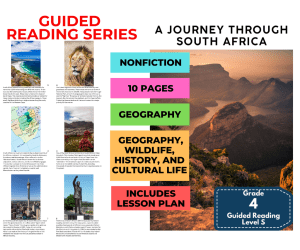
Journey Through South Africa: Guided Reading Level S with Lesson Plan
ELA, Resources for Teachers, Reading Comprehension, Reading, Science, Geography, Social Studies, History, Life Sciences, Government, Grade 3, 4, 5, Worksheets & Printables, Worksheets, Teacher Tools, Centers, Activities, Literacy Readers, Quizzes, Quizzes and Tests, Assessments, Lesson Plans
This A Journey Through South Africa (level s) guided reading book with lesson plan includes: Guided Reading Color Label (front cover x1) This is a quick way to match the book’s demands to what students can generally handle.. The overall goal is to use the level/color to pick books for several smaller groups. To qualify for a certain level, a student is expected to read a book from that level with about 90–94% accuracy. If a student is consistently accurate and understands, move up a level. If the student is struggling at that level, drop down and add more support. Each student will improve at completely different rates, but it is generally one of the best ways to check progress across the class. DOWNLOAD THE CATALOG TO VIEW ALL GUIDED READING BOOKS AVAILABLE (SORTED LEVELS A-Z) Pre-Reading Question (x1) Teacher asks the prompt aloud, can be while showing the cover or first page. Students share what they already know, or make educated guesses from the cover. Prompt them to use the target vocabulary. Write some of their responses on the board to look back at during the reading. Vocabulary Words (x5) Introduce the five words, best doing it one at a time. Start by saying it, while students repeat and then see if anyone knows what it means before reading further. Read through the meaning and try to briefly connect each word to a picture or gesture so it’s meaningful. Ask students to flip through the book pages and point to where they see each of the vocabulary words. While reading the book pause upon coming across one of the vocab words or read the sentence twice to make sure students understand the word has appeared. Optional: Ask students to raise hands whenever they see/hear one of the new words. Guided Reading Pages (x10) Check the book snapshot (below) for: primary topic - do you need to prep extra reading or intro materials on this? what is taught best - decide on 1-2 bullets to focus on, use the prompt or words provided here for best results. learning goals - what you are checking for students to be able to do after the session, elicit answers using prompts or words provided. key vocabulary (see section above). questions overview - so you know what is coming up and if you need to prep extra materials to assist understanding. Run the lesson You may have already looked at a few of the pages together, but you can show them some of the pictures again first to set meaning. Depending on how much time you have and how familiar your students are with guided reading class, you may want to read the book aloud first with the group first. Students whisper or partner read, while you listen in. If time, do it as a group, one student reading a page each. Use the guided page’s prompts to coach: “Check the picture / does it make sense?” “Point under the words / try the first sound” “Reread the sentence smoothly”. Try to focus more on one student per session (rotating every time), so you can work out if they are ready to move up or need to move down a level. Comprehension Questions (back cover x3) This is your way to check that students didn’t just say the words, but actually understood the text. First, let students answer by pointing to the page/picture and saying a short sentence. After any answer, follow with: “Show me where you found that in the text.” In bigger groups, have partners answer first (10–20 seconds), then call on 2–3 students to share. Differentiation tips: Emerging speakers/struggling readers: oral + pointing On-level: oral in a full sentence Higher: one written sentence or draw + label Book Snapshot Title: A Journey Through South Africa Genre: Nonfiction Subject: Social Studies (Geography/Culture/History) Primary Topic: South Africa’s geography, wildlife, history, and cultural life Estimated Guided Reading Level (A–Z): S What This Book Teaches Best Country overview and civics detail: South Africa’s location at Africa’s southernmost tip and its unusual system of three capital cities (Pretoria, Cape Town, Bloemfontein). Landforms and unique plant life: Table Mountain as a major landmark and part of a national park with many plant species found nowhere else. Habitats, wildlife, and conservation: Coastal habitats (including African penguins) and inland grasslands/savannas connected to the “Big Five” and protection of animals and environments. Modern cities and historical change: Johannesburg’s growth after gold discovery and South Africa’s journey from apartheid toward equality and democracy through Nelson Mandela’s leadership. Culture and identity through arts and community life: Traditions, music, and dance (Zulu and Xhosa) plus artistic expression like Ndebele painting and beadwork with special meanings. Learning Goals Students will identify South Africa’s three capital cities and explain each city’s role as described in the text. Students will describe two natural features or habitats in South Africa (for example, Table Mountain or the coastline) using details from the text. Students will explain how the text describes South Africa’s coastline and name the oceans it includes. Students will describe the inland grasslands and savannas and identify animals included in the text’s “Big Five.” Students will explain what apartheid was and describe how the text says South Africa moved toward equality and democracy. Students will describe at least two examples of South African culture or identity from the text (music/dance, art/beadwork, sports, or national symbols). Key Vocabulary From the Text southernmost — farthest to the south. administrative — related to running a government or system. savannas — wide grassy areas with some trees. apartheid — unfair system that separated people by race. resilience — strength to recover and keep going. Discussion Prompts Pre-reading question: What do you think you will learn about South Africa’s people, places, and animals? Comprehension questions: What are the three capital cities of South Africa named in the text? Comprehension questions: Which two oceans does the text say border South Africa’s coastline? Comprehension questions: What is the name of the system that separated people by race in South Africa? Printing Tips 1. Best Printing Method (Recommended) “Booklet” Printing (Best if Available) If your printer or PDF viewer supports Booklet Printing , use this. Settings to use: Print mode: Booklet Paper size: Letter or A4 (either works) Orientation: Landscape Print on both sides: Yes Flip on: Short edge Scaling: Fit to printable area Booklet subset: First test: Front sides only Then: Back sides only This will automatically: Pair pages correctly Put the cover on the outside Align everything for folding After printing, fold in half and staple along the spine . 2. If “Booklet” Printing Is NOT Available You can still print this correctly with manual duplex printing . Step-by-step: Open the PDF. Choose Print . Set: Orientation: Landscape Pages per sheet: 1 Print on both sides: Yes Flip on: Short edge Print all pages . Because each PDF page already contains two facing book pages, the result will still fold cleanly into a book. Thousands of Cored Education products are included with your TeachSimple membership. Download links and encyclopedia index available here.
Author Cored Education
Rating
Tags Reading Comprehension, Reading Passages, Reading, Guided Reading, Guided Reading Lesson Plan, Guided Reading Activity, Pre-reading, Social Studies, Geography, History

The Worry Dragon Coloring Book
Special Resources, Life Skills, Social Emotional Learning (SEL), Social Skills, Special Education Needs (SEN), Speech Therapy, STEM, Creative Arts, Fine Arts, Art, Kindergarten, Preschool, Grade 1, 2, 3, 4, 5, Drawing Templates & Outlines, Worksheets & Printables, Workbooks, Worksheets, Coloring Pages, Crosswords Puzzles, Dot To Dots, Mazes, Teacher Tools, Lesson Plans
Help Your Child Overcome Their Fears and Anxiety with Wiggles the Worry Dragon! Is your child/student afraid or anxious about something big in their life? Wiggles the Worry Dragon can be your child's new best friend! A colorful 30-page printable coloring book, Wiggles is the perfect resource for teaching children how to recognize, manage, and conquer their fears through creative positive social-emotional learning strategies. By using beautiful illustrations and easy-to-understand concepts, Wiggles will guide your child in building their own self-confidence and resilience through the power of imagination and creativity. This is not just a coloring book; it includes several evidence-based therapeutic approaches to help children learn about anxiety (such as cognitive-behavioral therapy and mindfulness techniques). ► What’s Included in the Magical PDF File of Wiggles the Worry Dragon? 30 Different & Unique Coloring Pages: This book contains 30 different pages of coloring sheets, each introducing your child to a different way to cope with anxiety. Concrete Coping Skills that Kids Will Use: The coping strategies contained in the book include how to use deep breathing techniques, create a 'Worry Jar', create a 'Safe Zone', and write a 'Worry Journal.' Positive Affirmations to Change the Way Kids Think: Many of the pages contain different affirmations (such as "I have brave thoughts", "I love myself", "I am confident") that will help build a positive self-image in your child. Fun Activities for Learning to Cope: One of the coloring pages includes a "Worry Battle" game board, making learning about coping skills fun and memorable! Printable and Can Be Used Over and Over: You may print each of the pages in the book or all together depending on how you would like to use them in your home, school, or therapist office. Parents, educators, school counselors, and therapists will benefit greatly from this resource. This is an important resource for any calm down corner, morning work routine or one-on-one session with children. This book provides an opportunity for children to change their worry into wisdom and their fearful feelings into courageousness. Download your own copy today to begin to help create a life-long foundation of emotional well-being for children. Keywords: Social-Emotional Learning, SEL, Anxiety resources, Coping skills for kids, Mindfulness coloring pages, Worry Dragon, Calm Down Corner, School Counselor resources, Printable activities, Emotional Regulation, CBT for kids, Anxiety workbook, Positive affirmations, Kids mental health, Digital Download. What parents/schools enjoy most about it: Makes feelings that are hard for kids to understand into something they can relate too. For example; anxiety, as it translates into worries, and provides children with tools (Worry Zapper & Courage Cape) to cope with the emotion of anxiety. Provides children with practical strategies to cope with anxiety. For example; taking deep breaths and using positive self-talk is a great way for kids to cope instantly with anxiety rather than just talking about their feelings. Kids learn about emotional regulation through coloring; this is how they learn to cope with the impending emotion of anxiety and is never a lesson or responsibility for the child. Children gain confidence and build their resilience by learning that they have control over their thoughts, feelings, and emotions therefore giving them a sense of independence and self-efficacy. As this is a downloadable product, you can use the product in any setting including at home, in a therapy office or in a school calm-down/quiet area. Target Audience for Materials: The following materials are designed for children aged 4 to 9 years, who will benefit from the following information based on the illustrations, simplicity of ideas and activities-NOTE: The target audience is children who attend the Pre-K, Kindergarten, 1st, 2nd and 3rd grades. The target user is any parent, teacher (elementary), school counselor, child therapist/special education teacher working with children in this age range. Copyright Terms & Conditions: This book has been copyrighted by Syed Hammad Rizvi for your personal and single classroom use only. You may not make alterations to this product or use it for resale to another individual (or sell through the Internet), nor put this resource on the Internet for others to find and download for free. If you would like to share with others, please purchase additional licenses from Teachsimple. Thank you for your compliance with these terms and conditions. With love from Syed Hammad Rizvi!
Author Creative Book Store
Rating
Tags Kidsactivities, Printables, Digitaldownload, Coloringpages, Mindfulness, Anxiety, Mentalhealth, Parenting, Teaching, Homeschool

I WONDER - How Long Does It Take To Digest Food | Animated Video
Human Body, Life Sciences, Science, Biology, STEM, Grade 2, 3, 4, 5, 6, 7, 8, Lesson Plans, Teacher Tools
Video Overview The human body is full of fascinating wonders to learn. This video is created to help the students recognize the anatomy and the job of the human body. I WONDER - How Long Does It Take To Digest Food | Animated Video Lesson Every part and organ in our human body is vital so let's see how important they are. Have you ever imagined how we look like if we didn't have a skeleton? Did you know that because we have our amazing muscles we can stand! Do you know how many teeth do we have? Have you ever wondered about the food journey inside our body? Can you name all the glands in our body? Why do we have skin? Our nervous system is really good at sending signals. Can you tell us more about it? Are you really good at Mathematics, painting, or any other thing? You should really thank your brain about it! The famous five senses are really doing a great work? Can you explain how every sense works? I WONDER - How Long Does It Take To Digest Food | Animated Video Lesson The video is perfect for encouraging the researching skills for the students, while learning more about our fantastic human body. I WONDER - How Long Does It Take To Digest Food | Animated Video Lesson This friendly designed video is suitable for students at school, homeschooling, and as a group activity. Format Available in MP4 format.
Author Educational Voice
Tags How Long Does It Take To Digest Food, How Long Does It Take To Digest Food Video, Digesting Food, Digesting Food Facts, Digesting Food Facts For Kids, Digesting Food Video, Digesting Food Video For Kids