



3,885 products added recently
Page 27 - Popular Quizzes
Our Popular Quizzes collection features the most widely used and highly rated assessments among teachers. These quizzes have been praised for their quality, alignment with educational standards, and ability to accurately gauge student comprehension. Covering various subjects and grade levels, they can be easily integrated into your teaching routine. By choosing from our Popular Quizzes, you can trust that you're utilizing proven tools to evaluate and enhance your students' learning experiences.

 Show filters

Diggers Reading Comprehension Passage - Cored Ed Encyclopedia
ELA, Language Development, Reading Comprehension, Reading, Science, Technology, Social Studies, Engineering, History, Physics, Grade 2, 3, 4, 5, Worksheets & Printables, Worksheets, Teacher Tools, Centers, Activities, Writing Prompts, Assessments, Quizzes and Tests, Quizzes, Lesson Plans
This diggers reading comprehension with lesson plan includes: Visualization (on the front cover) Start your lesson by taking a minute to think and share something about the topic. Read the script aloud (slowly), perhaps prepare some music or sound effects. Student close their eyes and let their imaginations wander. Students open their eyes, read the question aloud and give them a few minutes to complete. Ask a few students to share or keep answers until the end to compare with what they learn in the passage. Quick pause—thousands of Cored Education products are included with your TeachSimple membership. Download links and encyclopedia index available here. Pre-Reading Trivia Students will write down one thing they already know about the subject and then read five more facts and discuss. These facts are fun, and the students will enjoy learning about the subject before reading more. Give 1 minute for students to write what they already know (no pressure—best guess is fine). Read the five facts together. After each fact, do ask a student for their opinion, was it surprising? Set a purpose by asking students to highlight/underline one fact they want to learn more about during the reading. Reading Passage The text is a high-interest reading passage with set paragraphs, roughly three to four paragraphs long. It contains a variety of themes about the topic, anywhere from history to technology. The passage is between 250 and 350 words in length. First, ask students to look at the headings and see what they’ll learn about today. What do they know about the topic/heading? First read options: Teacher read-aloud (best for support). Partner reading (paragraph by paragraph). While reading, students underline important details, and vocabulary words they think may come up in the questions section. Mixed Questions The first question page contains four multiple-choice questions, each with a choice of four answers, and three written response questions that require a sentence or two from the student. Students complete the mcqs first independently, then review quickly as a class. For the 3 written responses, try to get students giving the answer with some form of evidence: “I think ___ because the text says ___.” If students get stuck, send them back to check the passage. Vocabulary Questions Practice seven key words from the text in this section across two activities. First section is scrambled words where students will unscramble three words given a clue for each. The second section is a word to meaning matching activity. Before starting, have some students read out words they underlined in the passage. Ask students to say the word and read aloud the sentence(s) around each word. Ask students to do scrambled words and the matching exercise in pairs then go through answers as a class. For the scrambled spelling task, get four pairs to come up to the board and write the words for extra practice with the other student reading out the clue. For the matching task, prompt students to give full sentences: “I matched ___ with ___ because ___.” Creative Writing In this question, the student will be required to write a five to eight sentence paragraph on a question related to the topic. Before starting, ask students write down 3 key ideas they are going to include in their piece. Ask students for ideas to share around the class to help those struggling. Pro writing expectations: 5–8 sentences At least 2 facts or details from the passage At least 2 vocabulary words from the previous page Students read their paragraphs while classmates listen for facts and vocabulary words. Extension Activities This page is optional for fast finishers or to take home. There are several activities, each one requiring a different skill. Do some, do none, do all, completely optional - but you will feel reassured knowing every possibility is planned for. Includes summary writting question and additional facts. Answer Key There are answers for the multiple-choice questions, written response questions have sample answers, vocabulary answers and if there is a summary question then a sample summary will be provided as well. Lesson Plan Included Customized lesson plan for this lesson is included. Lesson Snapshot Title: Diggers Genre: Nonfiction (informational text with headings) Subject: Science (Engineering & Technology) / Reading (Informational Text) Primary Topic: How diggers work and what they build Estimated Guided Reading Level (A–Z): P What This Lesson Teaches Best Explains key parts of a digger and what they do (cab on a turning platform; tracks or wheels; long arm and bucket). Describes how diggers changed over time—from hand digging to steam shovels to modern excavators using hydraulics. Teaches how hydraulics works in simple cause-and-effect terms (a small push becomes a bigger push through pressure in a system). Connects machines to real construction jobs (foundations, roads, clearing broken concrete, paths for water and sewer lines). Uses headings to organize information into sections (history, hydraulics, and what gets built). Learning Goals Students will describe how a digger moves and turns using details from the text. Students will explain at least two things a digger’s bucket can do on a building site. Students will explain how digging tools changed from long ago to modern excavators, using evidence from the passage. Students will explain how hydraulics helps a small joystick move a giant bucket, based on the text. Students will identify why oil is used as the hydraulic liquid in many machines, using details from the passage. Students will describe why some digging must be slow and careful, according to the passage. Key Vocabulary From the Text trench — a long, dug-out cut in the ground. excavators — digging machines that grew from power shovels. hydraulics — science of pushing liquids so pressure travels. cylinders — parts helped by oil to do powerful work. pressurized — under pressure (like oil that helps systems work). FULL CATALOG OF DOWNLOAD LINKS AND ENCYCLOPEDIA INDEX HERE
Author Cored Education
Rating
Tags Vocabulary, Reading Comprehension, Reading Passages, Lesson Plans, Ela Lesson Plans, Reading Comprehension Lesson Plans, Pre-reading, Science Lesson Plans, Engineering, Physics
Reading Comprehension Passage: Fast Fashion (Fillable PDF Sample)
ELA, Reading, Reading Comprehension, Strategies, Resources for Teachers, Social Studies, Sociology, Grade 6, 7, 8, 9, Writing Prompts, Worksheets & Printables, Centers, Activities, Teacher Tools, Assessments, Quizzes and Tests, Quizzes, Tests
This is a ONE PASSAGE SAMPLE. The following is the description of the FULL resource and the downloading links: Social Studies Reading Comprehension Passages and Questions: Fashion, Society, and Power (Fillable PDF) This resource introduces a collection of Social Studies reading comprehension passages with questions about Fashion, Society, and Power. The passages are carefully designed to bridge the gap between social studies and literacy through strengthening reading comprehension and sparking knowledge curiosity in middle school students. Each passage blends English Language Arts skills with accurate social studies content . Ideal for interdisciplinary learning in ELA and Social Studies. Suitable for Grade 9 review, too! These worksheets are designed as fillable PDFs , which means students can type their answers directly into the document on any computer or tablet . Each page includes highlighted text fields that show them exactly where to type! What Is Included in this Collection? There are three informational passages (with full answer keys): Beyond the Price Tag: How Fast Fashion Affects the World The Fur Debate: Ethics, Fashion, and Survival Designing Change: Chanel, Dior, and Women’s Lives For Each Passage, students will have multiple tasks to complete as follow: 5 multiple-choice questions targeting main idea, key details, inference, vocabulary in context, and use of evidence 5 vocabulary matching items with clear, student-friendly definitions 5 text-based questions that require citing specific lines or facts 1 summary prompt that asks students to condense central ideas accurately Available Formats for this Resource PDF Word Docs Google Docs FULL CATALOG OF DOWNLOADING LINKS HERE For more Social Studies Reading Passages, check the following Links: Ancient Civilizations PDF Fillable PDF Word Docs Google Docs Early Empires and Trade Networks PDF Fillable PDF Word Docs Google Docs The Founding of the United States PDF Fillable PDF Word Docs Google Docs Language, Culture, and Meaning PDF Fillable PDF Word Docs Google Docs Psychology and Society PDF Fillable PDF Word Docs Google Docs Global Festivals and Traditions PDF Fillable PDF Word Docs Google Docs Extreme Environments and People PDF Fillable PDF Word Docs Google Docs Food, Culture, and Preservation PDF Fillable PDF Word Docs Google Docs Global Food Customs PDF Fillable PDF Word Docs Google Docs Media, Communication, and Popular Culture PDF Fillable PDF Word Docs Google Docs Human Impact on the Environment PDF Fillable PDF Word Docs Google Docs Civic Action and Social Change PDF Fillable PDF Word Docs Google Docs Fashion, Society, and Power PDF Fillable PDF Word Docs Google Docs People, Places, and Unusual Histories PDF Fillable PDF Word Docs Google Docs How to Use These PDFs Click on the highlighted area to start typing your answer. Move to the next question by clicking in the next highlighted box. When you are finished, close the document and select SAVE so your answers stay recorded. If you want to keep a blank copy for later, choose Save As and give your completed version a new name. Product Details Length: 15 pages total Grades: 6–8, also suitable for Grade 9 review Use cases: close reading, stations, homework, intervention, test prep, and sub plans Why Teachers Choose This Set Authentic social studies content paired with rigorous literacy practice Consistent task structure across all passages for easier planning and smoother student routines Clear, age-appropriate writing that builds confidence without oversimplifying Use this set to reinforce ELA skills in social studies, to add literacy to your lessons, and to support independent work. The passages strengthen main idea, evidence use, vocabulary in context, inference, cause and effect, and summary writing. With ready-to-use assessments and complete answer keys, you can provide focused practice that is simple to run and fast to review.
Author Middle & High School - CORED Education
Rating
Tags Middle School, Reading Comprehension, Reading Strategies, ELA, Centers, Reading Passage, Assessments, Vocabulary, Social Studies, Fashion

How Words Shape Our Minds: Social Studies Reading Passage Fillable PDF
ELA, Reading, Reading Comprehension, Strategies, Resources for Teachers, Social Studies, Psychology, Grade 6, 7, 8, 9, Writing Prompts, Worksheets & Printables, Centers, Activities, Teacher Tools, Assessments, Quizzes and Tests, Quizzes, Tests
How Words Shape Our Minds: Social Studies Reading Comprehension Passage (Fillable PDF) This resource introduces a unique Social Studies reading comprehension passage with questions about How Words Shape Our Minds. The passage is carefully designed to bridge the gap between social studies and literacy through strengthening reading comprehension and sparking knowledge curiosity in middle school students. Each passage blends English Language Arts skills with accurate social studies content . Ideal for interdisciplinary learning in ELA and Social Studies. Suitable for Grade 9 review, too! This resource is designed as a fillable PDF , which means students can type their answers directly into the document on any computer or tablet . Each page includes highlighted text fields that show them exactly where to type! Student Tasks throughout the passage: 5 multiple-choice questions targeting the following skills: main idea, key details, inference, vocabulary in context, and use of evidence 5 vocabulary matching items with clear, student-friendly definitions 5 text-based questions that require citing specific lines or facts 1 summary prompt that asks students to condense central ideas accurately Full answer key for every section Available Formats for this Resource: PDF Word Docs Google Docs FULL CATALOG OF DOWNLOADING LINKS HERE Social Studies Reading Comprehension Collection Links: 1. Ancient Civilizations PDF Fillable PDF Word Docs Google Docs 2. Early Empires and Trade Networks PDF Fillable PDF Word Docs Google Docs 3. The Founding of the United States PDF Fillable PDF Word Docs Google Docs 4. Language, Culture, and Meaning PDF Fillable PDF Word Docs Google Docs 5. Psychology and Society PDF Fillable PDF Word Docs Google Docs 6. Global Festivals and Traditions PDF Fillable PDF Word Docs Google Docs 7. Extreme Environments and People PDF Fillable PDF Word Docs Google Docs 8. Food, Culture, and Preservation PDF Fillable PDF Word Docs Google Docs 9. Global Food Customs PDF Fillable PDF Word Docs Google Docs 10. Media, Communication, and Popular Culture PDF Fillable PDF Word Docs Google Docs 11. Human Impact on the Environment PDF Fillable PDF Word Docs Google Docs 12. Civic Action and Social Change PDF Fillable PDF Word Docs Google Docs 13. Fashion, Society, and Power PDF Fillable PDF Word Docs Google Docs 14. People, Places, and Unusual Histories PDF Fillable PDF Word Docs Google Docs Product Details: Length: 5 pages Grades: 6–8, also suitable for Grade 9 review Use cases: close reading, stations, homework, intervention, test prep, and sub plans Why Teachers Choose This Passage: Authentic social studies content paired with rigorous literacy practice Consistent task structure for easier planning and smoother student routines Clear, age-appropriate writing that builds confidence without oversimplifying Use this passage to reinforce ELA skills in social studies, to add literacy to your lessons, and to support independent work. The passage strengthens main idea, evidence use, vocabulary in context, inference, cause and effect, and summary writing. With ready-to-use assessments and complete answer keys, you can provide focused practice that is simple to run and fast to review.
Author Middle & High School - CORED Education
Rating
Tags Middle School, Reading Comprehension, Reading Strategies, ELA, Centers, Reading Passage, Assessments, Vocabulary, Social Studies, Pschology

Digital Math for 4.OA.4 - Factors and Multiples (Slides + Self-Grading Quiz)
Math, Algebra, Grade 4, Quizzes, Quizzes and Tests, Teacher Tools
Digital Math for 4.OA.4 - Factors and Multiples (Slides + Self-Grading Quiz) is a dynamic teaching resource that proves indispensable when it comes to reinforcing, practicing, and enhancing students' understanding of mathematical concepts. This engaging means of instruction not only liberates you from the painstaking chores of paper trails but also allows for a no-prep approach towards teaching. Strategically Targeting the 4.OA.4 Standard Our highly interactive package expertly introduces learners to factors and multiples using visual representation which offers an easier grasp of these concepts through features like drag and drop for images. The package is in both PowerPoint and Google Slides formats facilitating smooth assignment on platforms such as Google Classroom. Includes 20 student slides rich in content tackling several aspects related to factors and multiples suitable for any fourth-grade curriculum needs in both algebra studies and general mathematics lessons. Provides educators with room to select specific slides suitable for particular lessons without necessarily having to use the entire file at once—a flexibility enabled by inclusive instructions within the setup. Gauging Comprehension: The tool comes equipped with a self-grading Google Forms quiz perfect as an assessment tool aiding in data collection related to student progress on the given standard. Versatility: This versatile resource proves useful across multiple scenarios—it might be applied during distance learning sessions or serve as a homework assignment tool owing its digital nature. Its suitability is not limited digitally; it can be optimally deployed during physical interaction periods like small group discussions or instruction sessions at centers making it versatile enough across different teaching styles. So why wait? Leverage this Digital Math asset today! Empower your fourth graders' understanding of factors and multiples in an engaging, flexible, and highly effective instructional digital platform.
Author Markers and Minions
Tags Factors, Multiples, Interactive Slides, Self-grading Quiz, Digital Learning
Sensory Play - Dot Marker Activity Books for Fine Motor Development
Math, Early Math, Counting, Numbers, Patterns, Shapes, Place Value, Montessori, Number Lines, Graphing, Infant, Toddler, Kindergarten, Preschool, Grade 1, 2, Activities, Crafts, Centers, Escape Room, Games, Projects, Lesson Plans, Teacher Tools, Quizzes and Tests, Quizzes
Unleash the potential of your preschooler with this all-inclusive Dot Marker Activity Workbook for Fine Motor Development – the best-kept secret in sensory play for kids aged 3-5! This 41-page professional version, developed by Syed Hammad Rizvi, features exciting printable dot marker activities and professional exercises to develop critical pre-writing skills, hand-eye coordination, grip strength, and visual-motor skills. Perfect for homeschooling parents, preschool teachers, and early childhood educators, this SEO-optimized digital download features in-depth instruction on linear paths, curvy trails, geometric shapes, color identification, uppercase alphabet introduction, numeric counting (1-10), pattern sequencing, nature object fill-ins, maze exploration, symmetry reflection, and a customizable certificate of completion. Give your child the gift of academic readiness through fun and stress-free play that develops natural hand muscles, enhances proprioception, and gets them ready for kindergarten success. Perfect for Montessori-style learning, occupational therapy, and fine motor skills, download now and start dotting today! Why Parents/Schools Love It: Proven Developmental Benefits: Develops necessary fine motor skills such as tripod touch and hand-eye coordination through fun and scientifically valid activities that help children prepare for writing, reading, and other tasks without becoming frustrated or tired. Easy-to-Use and Low-Prep: Comes in printable PDF format with easy-to-follow instructions, lists of materials needed, and instructions for the facilitator – ideal for parents and teachers who are busy and want quick, mess-free sensory activities for kids at home or in the classroom. Builds Confidence and Resilience: The immediate colorful output of dot markers inspires children to finish tasks and boosts their confidence, making learning a fun activity while developing pathways in the brain for future academic success. Versatile for All Learners: Activities range from basic stamping to complex maze exercises suitable for different skill levels, including children with motor skill disorders, and incorporate cross-curricular themes such as colors, shapes, letters, and numbers. Professional Quality with Rewards: Comes with a customizable certificate of completion to mark progress, making it a rewarding resource for homeschooling, preschool, or therapy activities with long-term educational benefits. Target Audience Based on Analysis : After conducting an extensive analysis of the entire 41-page PDF file, from basic warm-up exercises to advanced literacy and numeracy activities, the content is specifically designed for children aged 3-5 years old. This is typically for preschool and pre-kindergarten students in early childhood education programs. Specifically: Preschool Classes (Ages 3-4): Emphasis is on basic exercises like random stamping, linear/curvy paths, geometric shapes, color identification, and object fill-ins to enhance basic grip, pressure, hand-eye coordination, and sensory integration without the need for advanced cognitive abilities. Pre-Kindergarten Classes (Ages 4-5): Emphasis is on more complex exercises like alphabet introduction, numeric counting, pattern arrangement, mazes, and symmetry to enhance pre-writing, executive functioning, visual-spatial skills, and academic readiness for kindergarten transition. The workbook does not require any prerequisite skills except basic palmar grasp and is designed for low-stakes, high-reward play, making it ideal for neurotypically developing children, children with fine motor delays, homeschooling, Montessori education, or occupational therapy. Copyright/Terms of Use: This Book is copyrighted by Syed Hammad Rizvi. This resource is for personal and single classroom use only. You may not alter, redistribute, or sell any part of this resource. In other words, you may not put it on the Internet where it could be publicly found and downloaded. If you want to share this resource with colleagues, please purchase additional licenses from Teachsimple. Thank you for respecting these terms of use. This product is happily brought to you by Syed Hammad Rizvi
Author Creative Book Store
Rating
Tags DotMarkerActivities, FineMotorSkills, SensoryPlayForKids, PreschoolActivities, EarlyChildhoodEducation, HomeschoolResources, PreWritingSkills, HandEyeCoordination, GripStrengthDevelopment, ToddlerActivitiesAges3To5

Sunglasses Reading Comprehension Passage - Cored Ed Encyclopedia
ELA, Language Development, Reading Comprehension, Reading, Pre-Reading, Writing, Science, Physics, History, Social Studies, Grade 2, 3, 4, 5, Worksheets & Printables, Worksheets, Teacher Tools, Centers, Activities, Writing Prompts, Assessments, Quizzes and Tests, Quizzes, Lesson Plans
This sunglasses reading comprehension includes: Visualization (on the front cover) Start your lesson by taking a minute to think and share something about the topic. Read the script aloud (slowly), perhaps prepare some music or sound effects. Student close their eyes and let their imaginations wander. Students open their eyes, read the question aloud and give them a few minutes to complete. Ask a few students to share or keep answers until the end to compare with what they learn in the passage. Quick pause—thousands of Cored Education products are included with your TeachSimple membership. Download links and encyclopedia index available here. Pre-Reading Trivia Students will write down one thing they already know about the subject and then read five more facts and discuss. These facts are fun, and the students will enjoy learning about the subject before reading more. Give 1 minute for students to write what they already know (no pressure—best guess is fine). Read the five facts together. After each fact, do ask a student for their opinion, was it surprising? Set a purpose by asking students to highlight/underline one fact they want to learn more about during the reading. Reading Passage The text is a high-interest reading passage with set paragraphs, roughly three to four paragraphs long. It contains a variety of themes about the topic, anywhere from history to technology. The passage is between 250 and 350 words in length. First, ask students to look at the headings and see what they’ll learn about today. What do they know about the topic/heading? First read options: Teacher read-aloud (best for support). Partner reading (paragraph by paragraph). While reading, students underline important details, and vocabulary words they think may come up in the questions section. Mixed Questions The first question page contains four multiple-choice questions, each with a choice of four answers, and three written response questions that require a sentence or two from the student. Students complete the mcqs first independently, then review quickly as a class. For the 3 written responses, try to get students giving the answer with some form of evidence: “I think ___ because the text says ___.” If students get stuck, send them back to check the passage. Vocabulary Questions Practice seven key words from the text in this section across two activities. First section is scrambled words where students will unscramble three words given a clue for each. The second section is a word to meaning matching activity. Before starting, have some students read out words they underlined in the passage. Ask students to say the word and read aloud the sentence(s) around each word. Ask students to do scrambled words and the matching exercise in pairs then go through answers as a class. For the scrambled spelling task, get four pairs to come up to the board and write the words for extra practice with the other student reading out the clue. For the matching task, prompt students to give full sentences: “I matched ___ with ___ because ___.” Creative Writing In this question, the student will be required to write a five to eight sentence paragraph on a question related to the topic. Before starting, ask students write down 3 key ideas they are going to include in their piece. Ask students for ideas to share around the class to help those struggling. Pro writing expectations: 5–8 sentences At least 2 facts or details from the passage At least 2 vocabulary words from the previous page Students read their paragraphs while classmates listen for facts and vocabulary words. Extension Activities This page is optional for fast finishers or to take home. There are several activities, each one requiring a different skill. Do some, do none, do all, completely optional - but you will feel reassured knowing every possibility is planned for. Includes summary writting question. Answer Key There are answers for the multiple-choice questions, written response questions have sample answers, vocabulary answers and if there is a summary question then a sample summary will be provided as well. Lesson Plan Included Customized lesson plan for this lesson is included. Lesson Snapshot Title: Sunglasses Genre: Nonfiction (informational text + support pages) Subject: Science (Light) / Health & Safety Primary Topic: Why sunglasses help and how they evolved Estimated Guided Reading Level (A–Z): Q What This Lesson Teaches Best What glare is and how tinted lenses can “calm down” sharp, shiny light bouncing off surfaces like water, sand, snow, or a car hood. A simple history of eye protection: smoky quartz lenses in 12th-century China and Inuit snow goggles with narrow slits to cut glare. How sunglasses became part of everyday life (experiments with tints; boardwalk sales in 1929; polarized lenses arriving in 1936). What UV light is (invisible but harmful over time) and what UV400 labeling means in the passage (filtering nearly all UVA/UVB up to 400 nanometers). How polarized lenses reduce reflected sparkle off flat surfaces like roads and water, making shapes easier to see. Learning Goals Define glare using details from the passage. Explain how tinted lenses help eyes feel more comfortable in bright sunlight. Describe two early ways people protected their eyes from harsh light. Explain how sunglasses became popular for everyday use using the dates and examples given. Describe what UV light is and what UV400 means in the passage. Explain how polarized lenses help with reflections off water and roads. Key Vocabulary From the Text glare — sharp, shiny light that bounces off surfaces. tinted — made darker, like a shaded window for eyes. quartz — a mineral used like simple dark lenses long ago. ultraviolet — invisible light that can harm eyes and skin over time. polarized — lens type that reduces reflections and sparkle. FULL CATALOG OF DOWNLOAD LINKS AND ENCYCLOPEDIA INDEX HERE
Author Cored Education
Rating
Tags Vocabulary, Reading Comprehension, Reading Passages, Lesson Plans, Ela Lesson Plans, Reading Comprehension Lesson Plans, Reading, Pre-reading, Physics, Sunglasses
Digital Math for 3rd Grade OA Standards - (BUNDLE of Slides + Self-Grading Quiz)
Math, Algebra, Grade 3, Quizzes, Quizzes and Tests, Teacher Tools
Digital Math for 3rd Grade OA Standards: Product Overview This is a comprehensive bundle, offering a seamless blend of traditional and digital learning resources, curated to support mathematical mastery amongst third-grade students. Compatible with both PowerPoint and Google Slides formats, this resource can be easily integrated within your classroom operations. Key Components: Math Slides:Packed with review exercises, practice sessions, and enrichment activities in an immersive digital environment. The slides promote active student engagement via elements such as drag-and-drop images. Suitable For Various Settings:The resource can be utilized effectively during distance learning assignments or small group settings. User-Friendly Instructions:Included for easy assignment either in entirety or by selecting individual slides based on curriculum needs. Self-Grading Quizzes:A unique feature leveraging Google Forms to assess student understanding post their interaction with the respective slide deck, providing valuable performance level insights. The standards covered range from 3.OA.1 up to 3.OA.9 - focusing on Operations and Algebraic Thinking (OA). Multidimensional Resource for Multiple Deployment Needs This calculus-teaching asset accommodates diverse deployment needs whilst exercising versatility across various implementation arenas - making it a valuable addition into any multidimensional third-grade algebra curriculum design strategy.
Author Markers and Minions
Tags Digital Math, Operations And Algebraic Thinking, Interactive Slides, Self-Grading Quizzes, Virtual Classroom
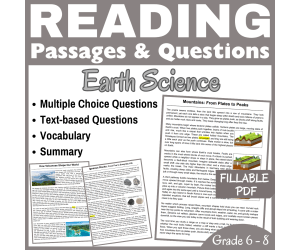
Science Reading Passages: Volcanoes, Rocks, & Mountains (FILLABLE PDF)
Science, Earth and Environmental Sciences, ELA, Reading, Reading Comprehension, Strategies, Resources for Teachers, Earth Sciences, Geology, Grade 6, 7, 8, 9, Writing Prompts, Worksheets & Printables, Centers, Activities, Teacher Tools, Assessments, Quizzes and Tests, Quizzes, Tests
Volcanoes, Rocks, & Mountains: Reading Comprehension Passages (FILLABLE PDF) This very engaging and fillable collection of earth science reading passages about Mountains, Volcanoes, and Igneous Rocks is designed to bridge the gap between science and literacy through strengthening reading comprehension and sparking scientific curiosity in middle school students. Each passage blends English Language Arts skills with accurate science content that supports NGSS classroom practice. Ideal for interdisciplinary learning in ELA and Science. Suitable for Grade 9 review, too! These worksheets are designed as fillable PDFs , which means students can type their answers directly into the document on any computer or tablet . Each page includes highlighted text fields that show them exactly where to type! What Is Included? There are (3) informational passages: Mountains: From Plates to Peaks How Volcanoes Shape Our World Igneous Rocks: From Fire to Everyday Life Student Tasks for Each Passage: 5 multiple-choice questions targeting main idea, key details, inference, vocabulary in context, and use of evidence 5 vocabulary matching items with clear, student-friendly definitions 5 text-based questions that require citing specific lines or facts 1 summary prompt that asks students to condense central ideas accurately Full answer key for every section Available Formats for this Resource Word Docs Google Docs FULL CATALOG OF DOWNLOADING LINKS HERE Other Science Reading Collections and Topics You May Find in the Store: 1. Astronomy & Space Science 2. Volcanoes, Rocks, & Mountains 3. Rock Cycle, Soil, & Sinkholes 4. Mars, Glaciers, & Antarctica 5. Water Cycle, Acid Rain, & Wastewater 6. Insects, Animals, & Ecosystems 7. Bioluminescence & Insects 8. Animal Skin, Cats, & T. Rex 9. Human Body and Senses 10. Health & Applied Bioscience 11. Waves, Light, & Imaging 12. Electricity & Energy 13. Motion & Materials 14. Chemistry and Materials Science 15. Electromagnetism 16. Acids and Bases 17. Gas Laws 18. Biotechnology 19. Periodic Trends 20. Protists and Fungi 21. Microevolution 22. Blood 23. Chemical Bonding 24. Magnets 25. Muscles 26. Nuclear Chemistry 27. Electromagnetic Devices 28. Epigenetics 29. The Law of Conservation of Mass 30. Atomic Models 31. Isotopes and Ions 32. Light 33. Human-Environment Interaction 34. Theory of Evolution 35. Photosynthesis 36. Origins of Life and Early Earth 37. Gene Expression and Regulation 38. Thermochemistry 39. Allergies 40. Coevolution 41. Birth to Adulthood 42. Cells 43. Entropy and Free Energy 44. The Human Brain 45. Mixtures and Solutions 46. Invertebrates 47. Zoo Animals 48. Biochemistry 49. Animal Behavior 50. Population Ecology ...and many more engaging science reading passages that cover intriguing and important topics designed to spark curiosity and support student learning. How to Use These PDFs Click on the highlighted area to start typing your answer. Move to the next question by clicking in the next highlighted box. When you are finished, close the document and select SAVE so your answers stay recorded. If you want to keep a blank copy for later, choose Save As and give your completed version a new name. Product Details Length: 13 pages total Grades: 6–8, also suitable for Grade 9 review Use cases: close reading, stations, homework, intervention, test prep, and sub plans Standards support: reinforces informational-text skills and supports NGSS-style sense making through observation, modeling, and clear use of claim, evidence, and reasoning Why Teachers Choose This Set Authentic science content paired with rigorous literacy practice Consistent task structure across all passages for easier planning and smoother student routines Clear, age-appropriate writing that builds confidence without oversimplifying Use this set to reinforce ELA skills in science, to add literacy to your lessons, or to support independent work. The passages strengthen main idea, evidence use, vocabulary in context, inference, cause and effect, and summary writing. With ready-to-use assessments and complete answer keys, you can provide focused practice that is simple to run and fast to review.
Author Middle & High School - CORED Education
Rating
Tags Middle School, Reading Comprehension, Reading Strategies, Reading Passages, ELA, Centers, Reading Passage, Assessments, Vocabulary, Earth Science
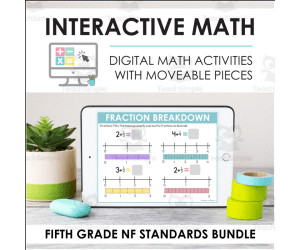
Digital Math for 5th Grade NF Standards - (BUNDLE of Slides + Self-Grading Quiz)
Math, Fractions, Grade 5, Quizzes, Quizzes and Tests, Teacher Tools
Digital Math for 5th Grade NF Standards - (BUNDLE of Slides + Self-Grading Quiz) Product Features: An interactive, all-digital solution, this product serves as an invaluable tool for both public school teachers and homeschoolers. It adopts a no-prep approach to make mathematics fun and engaging. Offers hands-on practice for 5th grade math students focusing on the NF (Number and Operations in Fractions) Standards Introduces mathematical concepts using visual representations where pupils drag, drop, sort images... Presentation Formats & Auto-Grading Quizzes: The slide decks are offered in PowerPoint (.pptx) and Google Slides formats. Further enhancing learning efficiency is a self-grading quiz based in Google Forms accompanying each standard introduced... Note:The auto-grading feature provides timely feedback helping educators track student performance + speed up their grading process! Versatility Across Learning Environments: This unique product fits perfectly into various learning environments... A boon to distance learning: Can be assigned as tasks during remote teaching. Oriented to classroom sessions: The slides could also be used directly during live classes. Suitable even for home-schooling setups or tutors who coach small groups. Tailor-made Instruction Plans & Comprehensive Coverage The Digital Math material offers flexibility at its best! From tailoring instructions according to your academic plan – greet the liberty of assigning either the entire file or selectively dispatching slides basis curriculum requirements. To accommodating varied types students ranging from those who perform best with individual tasks to those who favour group interactions or hands-on exercises Compatibility & Seamless Integration All this, packed in a bundle that religiously adheres to Grade 5 Fraction standards and ensures effortless transition between traditional classroom instruction and digital learning... even across different tech platforms - .pptx & Google!
Author Markers and Minions
Tags Interactive, Digital Solution, Math Practice, Self-grading Quiz, Visual Representations
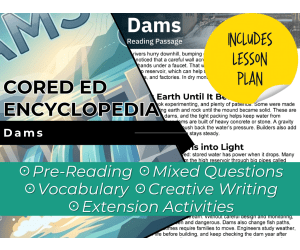
Dams Reading Comprehension Passage - Cored Ed Encyclopedia
ELA, Language Development, Reading Comprehension, Reading, Pre-Reading, Science, Technology, Physics, Earth and Environmental Sciences, Life Sciences, Grade 2, 3, 4, 5, Worksheets & Printables, Worksheets, Teacher Tools, Centers, Activities, Writing Prompts, Assessments, Quizzes and Tests, Quizzes, Lesson Plans
This dams reading comprehension with lesson plan includes: Visualization (on the front cover) Start your lesson by taking a minute to think and share something about the topic. Read the script aloud (slowly), perhaps prepare some music or sound effects. Student close their eyes and let their imaginations wander. Students open their eyes, read the question aloud and give them a few minutes to complete. Ask a few students to share or keep answers until the end to compare with what they learn in the passage. Quick pause—thousands of Cored Education products are included with your TeachSimple membership. Download links and encyclopedia index available here. Pre-Reading Trivia Students will write down one thing they already know about the subject and then read five more facts and discuss. These facts are fun, and the students will enjoy learning about the subject before reading more. Give 1 minute for students to write what they already know (no pressure—best guess is fine). Read the five facts together. After each fact, do ask a student for their opinion, was it surprising? Set a purpose by asking students to highlight/underline one fact they want to learn more about during the reading. Reading Passage The text is a high-interest reading passage with set paragraphs, roughly three to four paragraphs long. It contains a variety of themes about the topic, anywhere from history to technology. The passage is between 250 and 350 words in length. First, ask students to look at the headings and see what they’ll learn about today. What do they know about the topic/heading? First read options: Teacher read-aloud (best for support). Partner reading (paragraph by paragraph). While reading, students underline important details, and vocabulary words they think may come up in the questions section. Mixed Questions The first question page contains four multiple-choice questions, each with a choice of four answers, and three written response questions that require a sentence or two from the student. Students complete the mcqs first independently, then review quickly as a class. For the 3 written responses, try to get students giving the answer with some form of evidence: “I think ___ because the text says ___.” If students get stuck, send them back to check the passage. Vocabulary Questions Practice seven key words from the text in this section across two activities. First section is scrambled words where students will unscramble three words given a clue for each. The second section is a word to meaning matching activity. Before starting, have some students read out words they underlined in the passage. Ask students to say the word and read aloud the sentence(s) around each word. Ask students to do scrambled words and the matching exercise in pairs then go through answers as a class. For the scrambled spelling task, get four pairs to come up to the board and write the words for extra practice with the other student reading out the clue. For the matching task, prompt students to give full sentences: “I matched ___ with ___ because ___.” Creative Writing In this question, the student will be required to write a five to eight sentence paragraph on a question related to the topic. Before starting, ask students write down 3 key ideas they are going to include in their piece. Ask students for ideas to share around the class to help those struggling. Pro writing expectations: 5–8 sentences At least 2 facts or details from the passage At least 2 vocabulary words from the previous page Students read their paragraphs while classmates listen for facts and vocabulary words. Extension Activities This page is optional for fast finishers or to take home. There are several activities, each one requiring a different skill. Do some, do none, do all, completely optional - but you will feel reassured knowing every possibility is planned for. Includes summary writting question and additional facts. Answer Key There are answers for the multiple-choice questions, written response questions have sample answers, vocabulary answers and if there is a summary question then a sample summary will be provided as well. Lesson Plan Included Customized lesson plan for this lesson is included. Lesson Snapshot Title: Dams Genre: Nonfiction (informational text with headings) Subject: Science (Engineering) / Reading (Informational Text) Primary Topic: How dams store water, make electricity, and release water safely Estimated Guided Reading Level (A–Z): P What This Lesson Teaches Best Explains what a dam does by describing how a wall can hold back river water into a deep reservoir. Teaches types of dams and how they stay strong (embankment dams packed tight; gravity dams using weight; layers and drains for stability). Shows how stored water can generate electricity using penstocks, turbines, and generators. Highlights safety and trade-offs, including controlled release through a spillway, the danger of failure, and impacts on fish paths and river mud. Uses headings to organize information into clear sections (building, electricity, and safe water release). Learning Goals Students will explain how a dam changes a river’s flow and creates a reservoir. Students will describe how embankment dams are built and why tight packing matters. Students will identify the role of penstocks, turbines, and generators in making electricity. Students will explain why spillways are needed and how they help release extra water safely. Students will describe at least one cost or concern the passage connects to dams. Key Vocabulary From the Text reservoir — deep stored water behind a dam. embankment — packed earth-and-rock mound used to build a dam. penstocks — big pipes that send water down from a reservoir. turbines — spinning machines turned by rushing water. spillway — safe path for extra water to leave a reservoir. FULL CATALOG OF DOWNLOAD LINKS AND ENCYCLOPEDIA INDEX HERE
Author Cored Education
Rating
Tags Vocabulary, Reading Comprehension, Reading Passages, Lesson Plans, Ela Lesson Plans, Reading Comprehension Lesson Plans, Pre-reading, Science Lesson Plans, Physics, Technology

Podcast Interview Question Outlines
Technology, Science, Computer Science, Engineering, Special Resources, Life Skills, Social Emotional Learning (SEL), Special Education Needs (SEN), Reading, ELA, Grade 6, 7, 8, 9, 10, 11, 12, Worksheets & Printables, Workbooks, Worksheets, Word Searches, Teacher Tools, Assessments, Lesson Plans, Quizzes and Tests, Quizzes, Tests
Transform your students from passive listeners into masterful storytellers with this complete, no-prep Podcasting Interview Skills Unit! Are you looking for an engaging, real-world project that goes beyond the traditional essay or book report? This comprehensive resource is designed to teach middle school students the sophisticated art of conducting powerful podcast interviews. Students will move beyond simple Q&A and learn to become architects of inquiry, crafting open-ended questions, listening actively, and unearthing compelling narratives. This is more than just a set of worksheets; it's a full-fledged pedagogical journey into the heart of communication, critical thinking, and media literacy. Perfect for your ELA, Journalism, Public Speaking, or Media Studies class, this unit equips students with the 21st-century skills they need to succeed. What's Included in this 48-Page Resource? This unit is meticulously structured into three phases to ensure student success and make implementation a breeze for you: Part 1: The Methodology & Theory (10 Pages) Deep dive into the "Architecture of Inquiry." Clear explanations of open-ended vs. closed questions, active listening, and structuring a narrative arc. Engaging case studies and examples that illustrate core concepts like "Narrative Anchors" and "Thematic Buckets." Strategies for troubleshooting common interview problems like reluctant guests or tangents. Part 2: The Student Workbook (19 Pages) 10 scaffolded, high-interest worksheets that move students from theory to practice. Exercises on identifying and transforming weak questions, drafting powerful follow-ups, spotting "the drop," using the "5 Whys" technique, structuring a narrative, navigating emotion, and more. A final "Master Blueprint" worksheet that guides students in creating a full interview outline from start to finish. Part 3: Visuals & Teacher Resources (19 Pages) Classroom-Ready Visual Aids: Three clear, printable anchor charts/visual frameworks explaining the core concepts (Anatomy of a Question, Active Listening Funnel, Interview Flow). Comprehensive Answer Key: Detailed, exemplar answers and pedagogical notes for all 10 student worksheets to make grading easy and effective. A Complete Teacher Implementation Guide: A 5-day+ lesson plan that walks you through direct instruction, modeling, guided practice, role-playing activities, and a final audio documentary project. Assessment Rubric: A clear, 4-point rubric for grading the final student interview project, focusing on question quality, narrative structure, follow-up agility, and audio professionalism. This isn't just a project; it's an experience. Watch your students' confidence soar as they learn to listen with empathy, think on their feet, and curate truth through the power of the human voice. Why Parents/Schools Love It: Develops Core Critical Thinking Skills: This curriculum explicitly teaches students how to move beyond surface-level facts and analyze information, synthesize ideas, and construct logical inquiries—skills essential for academic and life success. Builds 21st-Century Communication Skills: In an age of digital distraction, this program cultivates the "soft skills" that are most in demand: active listening, empathetic conversation, public speaking, and clear articulation of thought. Promotes Media & Digital Literacy: Instead of just consuming media, students become thoughtful creators. They learn the process behind the podcasts they listen to, gaining a deeper understanding of narrative construction and journalistic ethics. Provides Authentic, Real-World Application: Students are highly motivated by this project because it feels relevant and real. They are not just learning for a test; they are creating a tangible product (an audio documentary) that they can be proud of. Comprehensive and Teacher-Friendly: This is a complete, "plug-and-play" unit. The detailed teacher's guide, answer keys, and rubric save educators dozens of hours of prep time, making it easy for schools to implement a high-quality, engaging curriculum. Target Student Classes : Based on the explicit text in the PDF ("sixth-grade scholar," "Target Audience: Grade 6 Educators"), the primary target is 6th Grade . However, the material is sophisticated and rigorous enough to be highly effective for a broader range. I would recommend it for: Middle School ELA (Grades 6-8): As an alternative to traditional research papers or oral presentations. It hits standards for speaking, listening, writing, and critical analysis. Middle School Journalism or Media Studies Electives (Grades 7-9): This is a perfect foundational unit for any introductory journalism course. High School (Grades 9-10): Excellent for remedial or introductory communications, public speaking, or journalism classes. Gifted and Talented Programs (Grades 5-6): Ideal for younger, advanced learners who are ready for a challenging, project-based learning experience. Copyright/Terms of Use: This Book was copyrighted by Syed Hammad Rizvi. This resource is for personal and single classroom use only. You may not alter, redistribute, or sell any part of this resource. In other words, you may not put it on the Internet where it could be publicly found and downloaded. If you want to share this resource with colleagues, please purchase additional licenses from Teachsimple. Thank you for respecting these terms of use. This product is happily brought to you by Syed Hammad Rizvi
Author Creative Book Store
Rating
Tags Podcasting, CriticalThinking, ActiveListening, ProjectBasedLearning, PBL, DigitalStorytelling, MediaLiteracy, PublicSpeaking, CommunicationSkills, 21stCenturySkills

Digital Math for 3.MD.3 - Picture and Bar Graphs (Slides + Self-Grading Quiz)
Math, Graphing, Grade 3, Quizzes, Quizzes and Tests, Teacher Tools
Digital Math for 3.MD.3 - Picture and Bar Graphs (Slides + Self-Grading Quiz) This is a digitally enhanced teaching resource designed to support the development of third-grade students' understanding of picture and bar graphs. A Unique Learning Tool The standout feature of this resource is its unique merge of visual mathematics with interactive digital content, enabling students to grasp graphing concepts in a hands-on way. Wide Device Compatibility This teaching tool comes in both PowerPoint and Google Slides formats, ensuring easy adaptation across various digital platforms. Bonus Features: Instruction aids for easy assignment distribution. Integration capability with Google Classroom. Supports small group instruction within both traditional class settings and distance learning situations. Real-time Student Performance Data The package includes a self-grading Google Forms quiz that provides teachers instantaneous data on student performances—essential feedback that can inform future instruction while saving crucial grading time. In summary, Digital Math for 3.MD.3 - Picture and Bar Graphs (Slides + Self-Grading Quiz) serves as an extremely versatile tool that meets educators where they're at—whether it's a public school teacher looking to modernize their math classroom or homeschoolers seeking more interactivity.
Author Markers and Minions
Tags Interactive Learning, Graphing, Digital Resources, Self-assessment, Data Analysis

Fridges Reading Comprehension Passage - Cored Ed Encyclopedia
ELA, Language Development, Resources for Teachers, Reading Comprehension, Reading, Pre-Reading, Writing, Science, Technology, Physics, Grade 2, 3, 4, 5, Worksheets & Printables, Worksheets, Teacher Tools, Centers, Activities, Writing Prompts, Assessments, Tests, Quizzes and Tests, Quizzes
This fridges reading comprehension contains the following: Pre-Reading Trivia Students will write down one thing they already know about the subject and then read five more facts and discuss. These facts are fun, and the students will enjoy learning about the subject before reading more. Reading Passage The text is a high-interest reading passage with set paragraphs, roughly three to four paragraphs long. It contains a variety of themes about the topic, anywhere from history to technology. The passage is between 250 and 350 words in length. Mixed Questions The first question page contains four multiple-choice questions, each with a choice of four answers, and three written response questions that require a sentence or two from the student. Creative Writing In this question, the student will be required to write a five to eight sentence paragraph on a question related to the topic. Extension Activities This page is optional for fast finishers. If there are five to ten minutes left at the end of the lesson, the student can choose one of three activities, each one requiring a different skill. Answer Key There are answers for the multiple-choice questions and three written response questions have sample answers. FULL CATALOG OF DOWNLOAD LINKS AND ENCYCLOPEDIA INDEX HERE Cored Ed Encyclopedia Overview The Cored Ed Encyclopedia is a weekly series of lessons that you can pick up and use right away. These short readings fit into whatever time you have available. Each one includes a warm-up, a reading, and a set of questions, but it’s flexible — you can do just the reading, the full lesson, or skip the writing section if you need to. Each lesson focuses on a single topic so students don’t get lost. The writing is clear but never childish, making it perfect for grades two through five. Topics range from animals and science to history, inventions, and everyday things. No matter the level of the student, everyone should take away at least one new idea or fact from each lesson. The materials are easy to print, easy to explain, and require no setup. They work well for whole-class teaching, partner work, or independent study.
Author Cored Education
Rating
Tags Vocabulary, Spelling, Reading Comprehension, Reading Passages, Reading, Creative Writing, Reading Strategies, Writing Prompts, Technology, Physics

Guided Reading Level F - Planets in Our Solar System
ELA, Resources for Teachers, Reading Comprehension, Reading, Language Development, Pre-Reading, Vocabulary, Science, Earth and Environmental Sciences, Space, Kindergarten, Grade 1, 2, Worksheets & Printables, Worksheets, Teacher Tools, Centers, Activities, Literacy Readers, Quizzes, Quizzes and Tests, Assessments
This Guided Reading Book - Planets in Our Solar System (Level F) includes: Guided Reading Color Label (front cover x1) This is a quick way to match the book’s demands to what students can generally handle.. The overall goal is to use the level/color to pick books for several smaller groups. To qualify for a certain level, a student is expected to read a book from that level with about 90–94% accuracy. If a student is consistently accurate and understands, move up a level. If the student is struggling at that level, drop down and add more support. Each student will improve at completely different rates, but it is generally one of the best ways to check progress across the class. DOWNLOAD THE CATALOG TO VIEW ALL GUIDED READING BOOKS AVAILABLE (SORTED LEVELS A-Z) COMPANION VIDEO NOW AVAILABLE (EMBEDDED AFTER PREVIEW PICTURES IN PRODUCT DESCRIPTION) Pre-Reading Question (x1) The teacher says the question aloud, either while showing the cover or the first page. Students share what they already know or make sensible guesses based on the cover. Encourage them to use the target vocabulary where possible. Write a few of their ideas on the board so you can return to them during or after the reading. Vocabulary Words (x5) Introduce the five words one at a time. Say each word aloud, have students repeat it, and then ask if anyone already knows what it means. Read the meaning together and briefly connect each word to a picture, action, or gesture so it feels more memorable. Ask students to flip through the book and point to any pages where they spot the vocabulary words. While reading, pause when one of the words appears, or reread the sentence so students clearly notice and understand it in context. Optional: Ask students to raise their hands whenever they see or hear one of the new words. Guided Reading Pages (x10) Check the book snapshot below for: Primary topic — decide whether students need a quick introduction or extra background first. What this lesson teaches best — choose 1–2 key points to focus on during the session. Learning goals — keep in mind what students should be able to understand or say by the end. Key vocabulary — review and reinforce these throughout the lesson. Questions overview — look ahead so you know what students will be asked and whether any extra support is needed. Run the lesson You may already have looked at a few pages together, but it can help to revisit some of the pictures first to build meaning. Depending on your time and how confident the group is with guided reading, you may want to read the whole book aloud to them first. Students can then whisper-read or partner-read while you listen in. If time allows, you can also read as a group, with each student taking a page. Use the guided reading prompts to support them, such as: “Check the picture—does it make sense?” “Point under the words.” “Try the first sound.” “Reread the sentence smoothly.” It can be helpful to focus more closely on one student each session, rotating over time, so you can better judge whether they are ready to move up or may need more support at their current level. Comprehension Questions (back cover x3) This is where you check that students understood the text, not just the words on the page. Start by letting students answer by pointing to a page or picture and saying a short sentence. After they respond, follow up with: “Show me where you found that in the text.” In larger groups, let partners discuss their answer first for 10–20 seconds, then invite 2–3 students to share. Differentiation tips Emerging speakers / struggling readers: oral response + pointing On-level: oral response in a full sentence Higher: one written sentence or a drawing with labels Book Snapshot Title: Planets in Our Solar System Genre: Nonfiction (informational) Subject: Science Primary Topic: Basic facts about the Sun, the planets, and the Moon Estimated Guided Reading Level (A–Z): F What This Book Teaches Best Introduces the Sun as a star at the center of the solar system that gives light and heat to the planets. Teaches the order of the planets, from Mercury to Neptune, with one main fact about each one. Builds science vocabulary naturally through the text, including words like craters , surface , giant , unique , and reflects . Helps students compare planets using simple details such as color, temperature, rings, winds, and clouds. Learning Goals Students will identify the Sun’s job in the solar system using details from the text. Students will name the planets in order from Mercury to Neptune as shown in the book. Students will describe at least three planets using facts from the text. Students will explain what makes one planet “unique” in the book. Students will tell what the Moon does at night, according to the text. Key Vocabulary From the Text craters — deep holes in the ground surface — the outside layer of something giant — very, very big unique — special and different from others reflects — bounces light back Discussion Prompts Pre-reading question: What do you already know about the Sun, the Moon, and the planets? Comprehension question: Which planet does the book say is the smallest? Comprehension question: What is Saturn famous for? Comprehension question: What does the Moon reflect at night? 1. Best Printing Method (Recommended) Booklet printing is the best option if your printer or PDF viewer supports it. This method usually places the pages in the correct order automatically and makes folding much easier. Settings to use: Print mode: Booklet Paper size: Letter or A4 Orientation: Landscape Print on both sides: Yes Flip on: Short edge Scaling: Fit to printable area Booklet subset: First, print front sides only Then, print back sides only This will automatically: Pair the pages correctly Place the cover on the outside Help everything line up properly for folding After printing, fold the pages in half and staple along the spine. 2. If “Booklet” Printing Is Not Available You can still print the book correctly by using manual duplex printing . Step-by-step: Open the PDF. Click Print . Use these settings: Orientation: Landscape Pages per sheet: 1 Print on both sides: Yes Flip on: Short edge Print all pages. Since each PDF page already contains two facing book pages, the pages should still fold neatly into a book. Thousands of Cored Education products are included with your TeachSimple membership. Download links and encyclopedia index available here.
Author Cored Education
Rating
Tags Vocabulary, Reading Comprehension, Reading Passages, Leveled Reading, Nonfiction, Reading, Guided Reading, Earth Science, Space, Planets

Wool Reading Comprehension Passage - Cored Ed Encyclopedia
ELA, Language Development, Reading Comprehension, Reading, Pre-Reading, Science, Technology, Physics, History, Social Studies, Grade 2, 3, 4, 5, Worksheets & Printables, Worksheets, Teacher Tools, Centers, Activities, Writing Prompts, Assessments, Quizzes and Tests, Quizzes, Lesson Plans
This wool reading comprehension with lesson plan includes: Visualization (on the front cover) Start your lesson by taking a minute to think and share something about the topic. Read the script aloud (slowly), perhaps prepare some music or sound effects. Student close their eyes and let their imaginations wander. Students open their eyes, read the question aloud and give them a few minutes to complete. Ask a few students to share or keep answers until the end to compare with what they learn in the passage. Quick pause—thousands of Cored Education products are included with your TeachSimple membership. Download links and encyclopedia index available here. Pre-Reading Trivia Students will write down one thing they already know about the subject and then read five more facts and discuss. These facts are fun, and the students will enjoy learning about the subject before reading more. Give 1 minute for students to write what they already know (no pressure—best guess is fine). Read the five facts together. After each fact, do ask a student for their opinion, was it surprising? Set a purpose by asking students to highlight/underline one fact they want to learn more about during the reading. Reading Passage The text is a high-interest reading passage with set paragraphs, roughly three to four paragraphs long. It contains a variety of themes about the topic, anywhere from history to technology. The passage is between 250 and 350 words in length. First, ask students to look at the headings and see what they’ll learn about today. What do they know about the topic/heading? First read options: Teacher read-aloud (best for support). Partner reading (paragraph by paragraph). While reading, students underline important details, and vocabulary words they think may come up in the questions section. Mixed Questions The first question page contains four multiple-choice questions, each with a choice of four answers, and three written response questions that require a sentence or two from the student. Students complete the mcqs first independently, then review quickly as a class. For the 3 written responses, try to get students giving the answer with some form of evidence: “I think ___ because the text says ___.” If students get stuck, send them back to check the passage. Vocabulary Questions Practice seven key words from the text in this section across two activities. First section is scrambled words where students will unscramble three words given a clue for each. The second section is a word to meaning matching activity. Before starting, have some students read out words they underlined in the passage. Ask students to say the word and read aloud the sentence(s) around each word. Ask students to do scrambled words and the matching exercise in pairs then go through answers as a class. For the scrambled spelling task, get four pairs to come up to the board and write the words for extra practice with the other student reading out the clue. For the matching task, prompt students to give full sentences: “I matched ___ with ___ because ___.” Creative Writing In this question, the student will be required to write a five to eight sentence paragraph on a question related to the topic. Before starting, ask students write down 3 key ideas they are going to include in their piece. Ask students for ideas to share around the class to help those struggling. Pro writing expectations: 5–8 sentences At least 2 facts or details from the passage At least 2 vocabulary words from the previous page Students read their paragraphs while classmates listen for facts and vocabulary words. Extension Activities This page is optional for fast finishers or to take home. There are several activities, each one requiring a different skill. Do some, do none, do all, completely optional - but you will feel reassured knowing every possibility is planned for. Includes summary writting question. Answer Key There are answers for the multiple-choice questions, written response questions have sample answers, vocabulary answers and if there is a summary question then a sample summary will be provided as well. Lesson Plan Included Customized lesson plan for this lesson is included. Lesson Snapshot Title: Wool Genre: Nonfiction (informational text) Subject: Life Science / Informational Reading Primary Topic: How wool works, history, and uses Estimated Guided Reading Level (A–Z): R Support pages present: Pre-reading trivia, mixed questions, vocabulary activities, creative writing, extension activities, and an answer key (all match the passage’s ideas and terms). What This Lesson Teaches Best Explains what wool is made of (tiny protein fibers) and how a natural wave called crimp helps fibers cling when spun into yarn. Teaches a clear cause-and-effect science idea : wool cloth traps air pockets, and trapped air helps keep warmth close. Builds understanding of how humans and sheep changed over time , including breeding for thicker coats, learning to shear, and wool becoming valuable through trade. Describes the process from fleece to finished materials , including shearing, lanolin in fresh wool, washing/sorting, spinning into yarn, and rubbing fibers into felt. Highlights real-world uses and properties of wool , including moisture handling and resistance to melting/dripping in fire because it chars instead. Learning Goals Students will explain how crimp helps wool fibers cling together when making yarn. Students will describe how wool cloth keeps warmth close using details about trapped air. Students will identify two ways people have used wool, based on examples in the text. Students will sequence key steps from fleece to yarn or felt that are stated in the passage. Students will describe why freshly shorn wool is called “greasy,” using evidence from the passage. Key Vocabulary From the Text fleece — a sheep’s coat that can be sheared off. protein — a natural building block that wool fibers are made of. crimp — a natural wave in each wool fiber. lanolin — a waxy substance from a sheep’s skin. felt — thick material made when fibers lock together. FULL CATALOG OF DOWNLOAD LINKS AND ENCYCLOPEDIA INDEX HERE
Author Cored Education
Rating
Tags Vocabulary, Reading Comprehension, Reading Passages, Lesson Plans, Ela Lesson Plans, Reading Comprehension Lesson Plans, Pre-reading, Science Lesson Plans, History Lesson Plans, Wool

TikTok Algorithm & Content Calendar Mapping
Technology, Science, Computer Science, Engineering, Business, Life Studies, Career, Leadership, Research, Finance, Homeschool Curriculum, Grade 7, 8, 9, 10, 11, 12, Worksheets & Printables, Workbooks, Worksheets, Word Searches, Teacher Tools, Assessments, Lesson Plans, Quizzes and Tests, Quizzes, Tests
Are your students spending hours scrolling TikTok? It's time to transform their passive consumption into a powerful, career-building skill! This comprehensive, 43-page project-based learning unit demystifies the TikTok algorithm and empowers students to think like professional digital strategists. Move beyond random posting and teach the data-driven science behind viral content. This isn't just a worksheet packet; it's a complete, academically rigorous curriculum designed for high school students. It treats TikTok as a serious case study in modern marketing, audience psychology, and behavioral economics. Students will transition from being casual creators to strategic digital architects, capable of planning, executing, and analyzing a 30-day content campaign. What's Included in This 43-Page All-in-One Unit: Part 1: Core Theory & Case Studies (10 Pages): In-depth chapters covering the architecture of the TikTok algorithm, the 4 phases of audio lifecycles (Inception, Acceleration, Apex, Decay), strategic content pillars, the 70/20/10 risk model, and real-world case studies. Part 2: The Student Workbook (21 Pages): Ten detailed worksheets guide students through practical application. They will analyze trending audio, calculate velocity, identify algorithmic triggers, define their niche, establish content pillars, build a 30-day posting calendar, and learn to iterate based on performance data. Part 3: Teacher Resources & Visuals (12 Pages): High-Contrast Diagrams: Perfect for classroom projection, breaking down the audio lifecycle, content matrix, and distribution feedback loop. Comprehensive Answer Key: Detailed, expected answers for every worksheet to make grading clear and objective. Teacher Implementation Guide: A step-by-step guide with pre-teaching strategies, classroom activities, discussion prompts, and advice for overcoming common student roadblocks. This resource is perfect for project-based learning and ready to print or use digitally. Equip your students with the 21st-century media literacy and marketing skills they need to succeed in the digital economy. Perfect for: High School Marketing & Business Classes Media Literacy & Digital Citizenship Units Career and Technical Education (CTE) Courses Journalism & Communications Entrepreneurship Programs Keywords: TikTok Marketing, Social Media Strategy, Digital Literacy, Algorithm, Content Calendar, Project-Based Learning (PBL), High School Business, CTE, Media Studies, 21st Century Skills, Content Creation, Viral Trends, Marketing Curriculum. Why Parents/Schools Love It: Turns Screen Time into Skill Time: It transforms a platform students already use for entertainment into a rigorous academic exercise, teaching critical thinking and analytical skills. Teaches In-Demand 21st-Century Skills: Students learn the fundamentals of digital marketing, data analysis, strategic planning, and content creation—skills that are highly valuable in college and future careers. 100% Turnkey & No-Prep: This is a complete, ready-to-go unit. With a teacher's guide, answer keys, and student worksheets, educators can implement it immediately without hours of prep work. Highly Engaging & Relevant: By using TikTok, a platform students are passionate about, this curriculum guarantees high student engagement and makes abstract concepts (like data analysis) tangible and exciting. Promotes Digital Citizenship: The unit encourages students to think ethically and critically about the content they create and consume, fostering responsible behavior in the digital world. Target Student Audience : Based on the academic language ("sociological study," "algorithmic architecture") and the direct mention on page 1, target: Grades: 9th to 12th Grade . While designed with 9th graders in mind, the complexity of the strategic concepts makes it perfectly suitable and challenging for students up to grade 12, especially in advanced marketing or business courses. Classes: Marketing, Business, Media Studies, Digital Literacy, Communications, Entrepreneurship, and Career & Technical Education (CTE) electives. Copyright/Terms of Use: This Book was copyrighted by Syed Hammad Rizvi. This resource is for personal and single classroom use only. You may not alter, redistribute, or sell any part of this resource. In other words, you may not put it on the Internet where it could be publicly found and downloaded. If you want to share this resource with colleagues, please purchase additional licenses from TpT. Thank you for respecting these terms of use. This product is happily brought to you by Syed Hammad Rizvi Are your students spending hours scrolling TikTok? It's time to transform their passive consumption into a powerful, career-building skill! This comprehensive, 43-page project-based learning unit demystifies the TikTok algorithm and empowers students to think like professional digital strategists. Move beyond random posting and teach the data-driven science behind viral content. This isn't just a worksheet packet; it's a complete, academically rigorous curriculum designed for high school students. It treats TikTok as a serious case study in modern marketing, audience psychology, and behavioral economics. Students will transition from being casual creators to strategic digital architects, capable of planning, executing, and analyzing a 30-day content campaign. What's Included in This 43-Page All-in-One Unit: Part 1: Core Theory & Case Studies (10 Pages): In-depth chapters covering the architecture of the TikTok algorithm, the 4 phases of audio lifecycles (Inception, Acceleration, Apex, Decay), strategic content pillars, the 70/20/10 risk model, and real-world case studies. Part 2: The Student Workbook (21 Pages): Ten detailed worksheets guide students through practical application. They will analyze trending audio, calculate velocity, identify algorithmic triggers, define their niche, establish content pillars, build a 30-day posting calendar, and learn to iterate based on performance data. Part 3: Teacher Resources & Visuals (12 Pages): High-Contrast Diagrams: Perfect for classroom projection, breaking down the audio lifecycle, content matrix, and distribution feedback loop. Comprehensive Answer Key: Detailed, expected answers for every worksheet to make grading clear and objective. Teacher Implementation Guide: A step-by-step guide with pre-teaching strategies, classroom activities, discussion prompts, and advice for overcoming common student roadblocks. This resource is perfect for project-based learning and ready to print or use digitally. Equip your students with the 21st-century media literacy and marketing skills they need to succeed in the digital economy. Perfect for: High School Marketing & Business Classes Media Literacy & Digital Citizenship Units Career and Technical Education (CTE) Courses Journalism & Communications Entrepreneurship Programs Keywords: TikTok Marketing, Social Media Strategy, Digital Literacy, Algorithm, Content Calendar, Project-Based Learning (PBL), High School Business, CTE, Media Studies, 21st Century Skills, Content Creation, Viral Trends, Marketing Curriculum. Why Parents/Schools Love It: Turns Screen Time into Skill Time: It transforms a platform students already use for entertainment into a rigorous academic exercise, teaching critical thinking and analytical skills. Teaches In-Demand 21st-Century Skills: Students learn the fundamentals of digital marketing, data analysis, strategic planning, and content creation—skills that are highly valuable in college and future careers. 100% Turnkey & No-Prep: This is a complete, ready-to-go unit. With a teacher's guide, answer keys, and student worksheets, educators can implement it immediately without hours of prep work. Highly Engaging & Relevant: By using TikTok, a platform students are passionate about, this curriculum guarantees high student engagement and makes abstract concepts (like data analysis) tangible and exciting. Promotes Digital Citizenship: The unit encourages students to think ethically and critically about the content they create and consume, fostering responsible behavior in the digital world. Target Student Audience : Based on the academic language ("sociological study," "algorithmic architecture") and the direct mention on page 1, target: Grades: 9th to 12th Grade . While designed with 9th graders in mind, the complexity of the strategic concepts makes it perfectly suitable and challenging for students up to grade 12, especially in advanced marketing or business courses. Classes: Marketing, Business, Media Studies, Digital Literacy, Communications, Entrepreneurship, and Career & Technical Education (CTE) electives. Copyright/Terms of Use: This Book was copyrighted by Syed Hammad Rizvi. This resource is for personal and single classroom use only. You may not alter, redistribute, or sell any part of this resource. In other words, you may not put it on the Internet where it could be publicly found and downloaded. If you want to share this resource with colleagues, please purchase additional licenses from Teachsimple. Thank you for respecting these terms of use. This product is happily brought to you by Syed Hammad Rizvi
Author Creative Book Store
Rating
Tags TikTokAlgorithm, TikTokMarketing, ContentStrategy, SocialMediaMarketing, DigitalMarketing, ContentCalendar, ViralMarketing, TrendingAudio, SocialMediaStrategy, BusinessTeacher

UK/Aus English Pronouns Practice Questions - Year 6-7 (PPT)
ELA, Language Development, ESL, Grammar, Common Core, Resources for Teachers, Grade 5, 6, 7, Quizzes and Tests, Teacher Tools, Tests, Assessments, Activities, Quizzes, Presentations
THIS IS THE UK/AUS ENGLISH SPELLING VERSION. CHECK THE CATALOG FOR THE ORIGINAL AMERICAN ENGLISH VERSION. Pronouns Grammar Practice MCQS ELA MCQS Overview: In this series of lessons, students will embark on an engaging journey to explore the grammar skills that make our language vibrant and expressive. These lessons are crafted to help students identify, comprehend, and effectively apply language arts skills in both writing and speech. This UK/Aus English version is especially useful for schools, teachers, and families working with British-based spelling and language conventions. It is a helpful option for classrooms using UK curriculum expectations, international programmes influenced by British English, or any setting where learners need to practise the correct capitalisation and punctuation forms for that version of English. Pronouns Overview: Includes: Indefinite Pronouns Intensive Pronouns Interrogative Pronouns Reflexive Pronouns Relative Pronouns PPT Version This is the PPT editable and interactive version. There is a fillable answer sheet at the end. This download is available in GOOGLE Docs, GOOGLE Forms, GOOGLE Slides. PDF, PPT, WORD, check the links below for more details. FULL CATALOG OF DOWNLOAD LINKS HERE ELA Review Questions Overview Each review test includes three answer choices for every question, which helps keep things simple and manageable for students. The layout is clear and easy to follow, so students can focus on the questions instead of figuring out what to do. A few pictures are included on each test to make the pages feel a little more inviting and less overwhelming. A review sheet is also included, giving students a chance to go back over many of the main skills covered in the resource. Introduction or Example Sheet Each topic comes with an introduction or example sheet to look at before students begin. This gives students a clear starting point and helps them feel more prepared. It also lets them see what to expect before moving into the main work. For many students, it is a helpful way to quickly refresh the key ideas before they start practicing on their own. Full Answer Keys Full answer keys are included to make marking and checking work faster and easier. Sample responses are also provided where needed, especially for open-ended tasks. This can be a real time-saver on busy days and makes the resource more practical to use. Everything is there to help make planning, teaching, and checking student work feel a little more straightforward. For More Like This For similar downloads and other frees, do check out Cored Group on TeachSimple.
Author Cored Education
Rating
Tags Elementary, Answers, Ccss, Common Core, Grammar, Tests, Test Prep, Assessment, Grade 5, Grade 6

Earth Science Reading Comprehension Passage: Ice Age Leftovers. SAMPLE
Science, ELA, Reading, Reading Comprehension, Strategies, Resources for Teachers, Earth and Environmental Sciences, Earth Sciences, Grade 6, 7, 8, 9, Writing Prompts, Worksheets & Printables, Centers, Activities, Teacher Tools, Assessments, Quizzes and Tests, Quizzes, Tests
This is a free passage sample from the complete resource. The full version includes everything needed for a complete reading comprehension activity: the passage, multiple-choice questions, short-answer questions, vocabulary matching, a summary-writing task, and a detailed answer key. Download the complete passage resource by clicking on the following links: PDF Fillable PDF Word Docs Google Docs Science Reading Comprehension Passages and Questions: Ice Age Leftovers (PDF) This very engaging earth science reading passage about how ice left from the Ice Age still affects Earth today . It explains the differences between glaciers, ice sheets, ice shelves, icebergs, and sea ice , and shows how each one shapes land, oceans, weather, and climate. This passage is designed to bridge the gap between science and literacy through strengthening reading comprehension and sparking scientific curiosity in middle school students. The passage blends English Language Arts skills with accurate science content that supports NGSS classroom practice. Ideal for interdisciplinary learning in ELA and Science. Suitable for Grade 9 review, too! Student Tasks for The Passage: 5 multiple-choice questions targeting main idea, key details, inference, vocabulary in context, and use of evidence 5 vocabulary matching items with clear, student-friendly definitions 5 text-based questions that require citing specific lines or facts 1 summary prompt that asks students to condense central ideas accurately Full answer key for every section FULL CATALOG OF DOWNLOADING LINKS HERE Product Details Length: 5 pages total Grades: 6–8, also suitable for Grade 9 review Use cases: close reading, stations, homework, intervention, test prep, and sub plans Standards support: reinforces informational-text skills and supports NGSS-style sense making through observation, modeling, and clear use of claim, evidence, and reasoning Why Teachers Choose This Set Authentic science content paired with rigorous literacy practice Consistent task structure across all passages for easier planning and smoother student routines Clear, age-appropriate writing that builds confidence without oversimplifying Other Science Reading Collections you May find in the store: 1. Astronomy & Space Science 2. Volcanoes, Rocks, & Mountains 3. Rock Cycle, Soil, & Sinkholes 4. Mars, Glaciers, & Antarctica 5. Water Cycle, Acid Rain, & Wastewater 6. Insects, Animals, & Ecosystems 7. Bioluminescence & Insects 8. Animal Skin, Cats, & T. Rex 9. Human Body and Senses 10. Health & Applied Bioscience 11. Waves, Light, & Imaging 12. Electricity & Energy 13. Motion & Materials 14. Chemistry and Materials Science Use this set to reinforce ELA skills in science, to add literacy to your lessons, and to support independent work. The passages strengthen main idea, evidence use, vocabulary in context, inference, cause and effect, and summary writing. With ready-to-use assessments and complete answer keys, you can provide focused practice that is simple to run and fast to review.
Author Middle & High School - CORED Education
Rating
Tags Middle School, Reading Comprehension, Reading Strategies, ELA, Centers, Reading Passage, Assessments, Vocabulary, Environmental Science, Space

Digital Math for 2nd Grade MATH Standards - (BUNDLE of Slides + Self-Grading Quiz)
, Grade 2, Quizzes, Quizzes and Tests, Teacher Tools
Sure, please see the below formatted text: Digital Math for 2nd Grade MATH Standards A comprehensive bundle of interactive slides and a self-grading quiz, is a unique teaching resource designed for both virtual and physical classrooms. This engaging educational tool provides practice, review, and enrichment activities that maintain an exciting learning environment while reinforcing important mathematical concepts. Complete Coverage of Second Grade Math Standards This digital teaching resource covers all: Geometry standards Operations & Algebraic thinking standards Number in Base Ten standards Measurement & Data standards The bundle includes two dynamic PowerPoint formats and Google Slides that broaden the potential applications of this product. Paperless Teaching Resource with Self-Grading Quizzes. The practicality fluctuates from whole-class guided instruction on smartboards to independent work on student devices. With visual representation of math concepts with drag-and-drop functions in the slides deck: students interactively strengthen their understanding while enjoying the learning process. Each standard includes an instructive Google Form Self-Grading Quiz - perfect as homework assignments allowing you to gauge student progress remotely. User-Friendly Format This paperless feature provides time efficiency by eliminating prep work associated with print materials. It's not just a comprehensive MATH standard bundle but also simple implementation potential enhances it farther; be it enriching distance-learning assignment or lively group discussions! Learn more about this Digital Math Bundle here!
Author Markers and Minions
Tags Interactive Slides, Self-grading Quiz, Digital Math, Geometry, Operations & Algebraic Thinking
Basic Climate Change Causes & Everyday Action Worksheets
Science, Earth and Environmental Sciences, Earth Sciences, Environmental Science, Geology, Space, Life Sciences, Human Body, Nature & Plants, Biology, Homeschool Curriculum, Homeschool Templates, Grade 2, 3, 4, 5, Worksheets & Printables, Workbooks, Worksheets, Word Searches, Teacher Tools, Assessments, Lesson Plans, Quizzes and Tests, Quizzes, Tests
Introducing Climate Change Worksheets for Grades 2-4! This incredible resource is a completely packaged bundle that can just be printed out and used. It includes the following areas of focus to help you teach students about climate change: Greenhouse Effect Carbon Footprint Fossil Fuels Deforestation Ocean Acidification Albedo Feedback Loops How to take action and make a difference. In addition, there is lots of great information that is presented in age-appropriate science language and style, using easily relatable analogies and examples, plus hands-on activities. The Climate Change Worksheets for Grades 2-4 bundle contains 38 pages and can be used for: Elementary science lessons Homeschooling Social-Emotional Learning (SEL) integration Substitute teacher plans The Climate Change Worksheets for Grades 2-4 bundle is composed of three phases: Phase 1: Core theory chapters will be presented using Constructivist Climate Pedagogy (e.g., no fear-based stories, only empowerment and agency). Phase 2: Ten interactive student worksheets (filling in the blank, analyzing scenarios, brainstorming, using math to solve real-life problems, becoming carbon detectives/energy vampires, making compost, becoming 3Rs experts, transforming our transportation systems, culminating with Climate Action Pledge). Phase 3: A high-contrast visual aid (examples: the Greenhouse Effect Diagram, the Chain of Climate Change Flowchart, the Everyday Action Plan Matrix) and the Teacher Answer Key to assist you in easy grading and differentiation. The resources are designed to meet the NGSS and will help your students build a STEM vocabulary (examples: anthropogenic, albedo, positive feedback, etc.), while also developing their resilience as environmental stewards. The Climate Change Worksheets for Grades 2-4 bundle is low-prep/high-impact and is suitable for Elementary Science, Environmental Education, or Cross-Curricular teaching resources for Grades 2-4. When you purchase these resources, you will receive an instant digital download of the PDF for easy use and printing. What makes it a hit for Parents and Schools: Kid-friendly yet Scientifically Accurate: Uses correct terms and real mechanics, no ‘bad pollution’ oversimplifications, while also using a solution-focused & empowering language to prevent eco-anxiety among young learners Zero Prep, Ready to Implement: Complete Teaching Answer Key + Printable Worksheets + Gorgeous Images = Instant Lesson Plans save Teachers dozens of hours to prepare lessons Action Oriented and Positive: Each of the day to day Habits measure up to the knowledge gained, turning it into Action Confidence and Real-world Skills kids can use at Home Cross Curriculum for Success: Merges Science, Mathematics, Writing, Critical Thinking and Social Emotional Learning (SEL), perfect for meeting multiple standards within one engaging unit Proven Winner in Classrooms and at Home: High contrast illustrations will produce high quality prints, Worksheets will work for whole group, small group or independent usage and the pledge and activity pages foster meaningful conversation among families or school-wide. Intended Users/Grades: This resource was designed in a way that is very clear to understand and has been age-appropriate scaffolding for Grades 2 - 4 (ages 7 - 10) or early elementary students. It is appropriate for: General Education Classrooms (science OR integrated social studies/SEL block) Homeschool families who want a rigorous but accessible resource for climate literacy Special Education or Neuro-inclusion settings (clear visuals, concrete examples, not too many overwhelming elements or data) After School Programs, Environmental Clubs, or Scout Troops Substitute Teacher Plans or Emergency Substitute Teacher Folders The pedagogy introduced throughout the curriculum does not teach about abstract world doom, but rather supports the grounding of concepts through “backyard” observation and personal agency of children. Therefore, it is considered to be developmentally appropriate for concrete operational thinkers at this age group. Copyright & Terms of Use This book is copyrighted to Syed Hammad Rizvi. The contents of this book are only permitted for private, single classroom use. The contents of this book may not be modified, re-distributed or sold. Essentially, the contents of this book cannot be posted on a website where others could find them and download them. If you want to share these resources with your colleagues, you must purchase additional licenses from Teachsimple. Thank you for honoring our terms of use. This resource was created by Syed Hammad Rizvi.
Author Creative Book Store
Rating
Tags ClimateChangeWorksheets, GreenhouseEffect, CarbonFootprint, ElementaryScience, Grades2To4, ClimateActionForKids, EverydayClimateAction, ClimateChangeForKids, NoEcoAnxiety, ActionOrientedScience
Reading Comprehension Passage: Jackie Robinson (PDF Sample)
ELA, Reading, Reading Comprehension, Strategies, Resources for Teachers, Social Studies, Geography, History: USA, History, Grade 6, 7, 8, 9, Writing Prompts, Worksheets & Printables, Centers, Activities, Teacher Tools, Assessments, Quizzes and Tests, Quizzes, Tests
This is a ONE PASSAGE SAMPLE. The following is the description of the FULL resource and the downloading links: Social Studies Reading Comprehension Passages and Questions: People, Places, and History (PDF) This resource introduces a collection of Social Studies reading comprehension passages with questions about People, Places, and History. The passages are carefully designed to bridge the gap between social studies and literacy through strengthening reading comprehension and sparking knowledge curiosity in middle school students. Each passage blends English Language Arts skills with accurate social studies content . Ideal for interdisciplinary learning in ELA and Social Studies. Suitable for Grade 9 review, too! What Is Included in this Collection? There are three informational passages (with full answer keys): Jackie Robinson: More Than a Rookie Haewoojae: Korea’s Toilet Culture Museum The Giant’s Causeway: Nature’s Puzzle of Stone For Each Passage, students will have multiple tasks to complete as follow: 5 multiple-choice questions targeting main idea, key details, inference, vocabulary in context, and use of evidence 5 vocabulary matching items with clear, student-friendly definitions 5 text-based questions that require citing specific lines or facts 1 summary prompt that asks students to condense central ideas accurately Available Formats for this Resource Fillable PDF Word Docs Google Docs FULL CATALOG OF DOWNLOADING LINKS HERE For more Social Studies Reading Passages, check the following Links: Ancient Civilizations PDF Fillable PDF Word Docs Google Docs Early Empires and Trade Networks PDF Fillable PDF Word Docs Google Docs The Founding of the United States PDF Fillable PDF Word Docs Google Docs Language, Culture, and Meaning PDF Fillable PDF Word Docs Google Docs Psychology and Society PDF Fillable PDF Word Docs Google Docs Global Festivals and Traditions PDF Fillable PDF Word Docs Google Docs Extreme Environments and People PDF Fillable PDF Word Docs Google Docs Food, Culture, and Preservation PDF Fillable PDF Word Docs Google Docs Global Food Customs PDF Fillable PDF Word Docs Google Docs Media, Communication, and Popular Culture PDF Fillable PDF Word Docs Google Docs Human Impact on the Environment PDF Fillable PDF Word Docs Google Docs Civic Action and Social Change PDF Fillable PDF Word Docs Google Docs Fashion, Society, and Power PDF Fillable PDF Word Docs Google Docs People, Places, and Unusual Histories PDF Fillable PDF Word Docs Google Docs Product Details Length: 14 pages total Grades: 6–8, also suitable for Grade 9 review Use cases: close reading, stations, homework, intervention, test prep, and sub plans Why Teachers Choose This Set Authentic social studies content paired with rigorous literacy practice Consistent task structure across all passages for easier planning and smoother student routines Clear, age-appropriate writing that builds confidence without oversimplifying Use this set to reinforce ELA skills in social studies, to add literacy to your lessons, and to support independent work. The passages strengthen main idea, evidence use, vocabulary in context, inference, cause and effect, and summary writing. With ready-to-use assessments and complete answer keys, you can provide focused practice that is simple to run and fast to review.
Author Middle & High School - CORED Education
Rating
Tags Middle School, Reading Comprehension, Reading Strategies, ELA, Centers, Reading Passage, Assessments, Vocabulary, Social Studies, People Place And History
Guided Reading Level L - Boats on the Move (with Lesson Plan)
ELA, Resources for Teachers, Reading Comprehension, Reading, Science, Engineering, Technology, Physics, Sports, P.E. & Health, Grade 2, 3, 4, Worksheets & Printables, Worksheets, Teacher Tools, Centers, Activities, Literacy Readers, Quizzes, Quizzes and Tests, Assessments, Lesson Plans
This Guided Reading Book - Boats on the Move (Level L) with lesson plan includes: Guided Reading Color Label (front cover x1) This is a quick way to match the book’s demands to what students can generally handle.. The overall goal is to use the level/color to pick books for several smaller groups. To qualify for a certain level, a student is expected to read a book from that level with about 90–94% accuracy. If a student is consistently accurate and understands, move up a level. If the student is struggling at that level, drop down and add more support. Each student will improve at completely different rates, but it is generally one of the best ways to check progress across the class. DOWNLOAD THE CATALOG TO VIEW ALL GUIDED READING BOOKS AVAILABLE (SORTED LEVELS A-Z) Pre-Reading Question (x1) Teacher asks the prompt aloud, can be while showing the cover or first page. Students share what they already know, or make educated guesses from the cover. Prompt them to use the target vocabulary. Write some of their responses on the board to look back at during the reading. Vocabulary Words (x5) Introduce the five words, best doing it one at a time. Start by saying it, while students repeat and then see if anyone knows what it means before reading further. Read through the meaning and try to briefly connect each word to a picture or gesture so it’s meaningful. Ask students to flip through the book pages and point to where they see each of the vocabulary words. While reading the book pause upon coming across one of the vocab words or read the sentence twice to make sure students understand the word has appeared. Optional: Ask students to raise hands whenever they see/hear one of the new words. Guided Reading Pages (x10) Check the book snapshot (below) for: primary topic - do you need to prep extra reading or intro materials on this? what is taught best - decide on 1-2 bullets to focus on, use the prompt or words provided here for best results. learning goals - what you are checking for students to be able to do after the session, elicit answers using prompts or words provided. key vocabulary (see section above). questions overview - so you know what is coming up and if you need to prep extra materials to assist understanding. Run the lesson You may have already looked at a few of the pages together, but you can show them some of the pictures again first to set meaning. Depending on how much time you have and how familiar your students are with guided reading class, you may want to read the book aloud first with the group first. Students whisper or partner read, while you listen in. If time, do it as a group, one student reading a page each. Use the guided page’s prompts to coach: “Check the picture / does it make sense?” “Point under the words / try the first sound” “Reread the sentence smoothly”. Try to focus more on one student per session (rotating every time), so you can work out if they are ready to move up or need to move down a level. Comprehension Questions (back cover x3) This is your way to check that students didn’t just say the words, but actually understood the text. First, let students answer by pointing to the page/picture and saying a short sentence. After any answer, follow with: “Show me where you found that in the text.” In bigger groups, have partners answer first (10–20 seconds), then call on 2–3 students to share. Differentiation tips: Emerging speakers/struggling readers: oral + pointing On-level: oral in a full sentence Higher: one written sentence or draw + label Book Snapshot Title: Boats on the Move Genre: Nonfiction (informational) Subject: Science (Forces & Motion) / Reading (Informational Text) Primary Topic: Different ways boats move across water Estimated Guided Reading Level (A–Z): L What This Book Teaches Best Different ways boats move on water (wind, oars, paddles, engines). How specific boat parts help movement (sails, mast, ropes, propeller). How coordinated actions affect motion (oars dipping “at the same time” to go straight). How markers guide movement during a race (boats turn around bright orange buoys to stay on track). Comparing speed and movement styles (quiet glide vs fast roar; forward motion by alternating paddle sides). Learning Goals Students will identify several ways boats move across the water using details from the text. Students will explain how sails and wind help pull a boat forward. Students will describe how rowers use oars together to move a boat straight ahead. Students will describe how a double-ended paddle helps a kayak move forward quickly. Students will explain how an engine and propeller help push a motorboat through the water. Students will describe why boats turn around buoys during a race, based on the text. Key Vocabulary From the Text mast — a tall pole that holds sails up. rhythm — a steady pattern of movement. double-ended — having an end on both sides. propeller — a spinning part that helps push a boat. buoys — floating markers that show where to go. Discussion Prompts Pre-reading question: What are some different ways a boat could move across the water? Comprehension questions: How do large white sails help a boat move forward? What do rowers do “at the same time,” and what does that help the boat do? Why must boats turn around bright orange buoys during a race? Printing Tips 1. Best Printing Method (Recommended) “Booklet” Printing (Best if Available) If your printer or PDF viewer supports Booklet Printing , use this. Settings to use: Print mode: Booklet Paper size: Letter or A4 (either works) Orientation: Landscape Print on both sides: Yes Flip on: Short edge Scaling: Fit to printable area Booklet subset: First test: Front sides only Then: Back sides only This will automatically: Pair pages correctly Put the cover on the outside Align everything for folding After printing, fold in half and staple along the spine . 2. If “Booklet” Printing Is NOT Available You can still print this correctly with manual duplex printing . Step-by-step: Open the PDF. Choose Print . Set: Orientation: Landscape Pages per sheet: 1 Print on both sides: Yes Flip on: Short edge Print all pages . Because each PDF page already contains two facing book pages, the result will still fold cleanly into a book. Thousands of Cored Education products are included with your TeachSimple membership. Download links and encyclopedia index available here.
Author Cored Education
Rating
Tags Reading Comprehension, Reading Passages, Reading, Guided Reading, Guided Reading Lesson Plan, Guided Reading Activity, Pre-reading, Science Lesson Plans, Physics, Technology
Quiz Shows Reading Comprehension Passage - Cored Ed Encyclopedia
ELA, Language Development, Reading Comprehension, Reading, Pre-Reading, Writing, Strategies, Vocabulary, History, Social Studies, Grade 2, 3, 4, 5, Worksheets & Printables, Worksheets, Teacher Tools, Centers, Activities, Writing Prompts, Assessments, Quizzes and Tests, Quizzes, Lesson Plans
This quiz shows reading comprehension includes: Visualization (on the front cover) Start your lesson by taking a minute to think and share something about the topic. Read the script aloud (slowly), perhaps prepare some music or sound effects. Student close their eyes and let their imaginations wander. Students open their eyes, read the question aloud and give them a few minutes to complete. Ask a few students to share or keep answers until the end to compare with what they learn in the passage. Quick pause—thousands of Cored Education products are included with your TeachSimple membership. Download links and encyclopedia index available here. Pre-Reading Trivia Students will write down one thing they already know about the subject and then read five more facts and discuss. These facts are fun, and the students will enjoy learning about the subject before reading more. Give 1 minute for students to write what they already know (no pressure—best guess is fine). Read the five facts together. After each fact, do ask a student for their opinion, was it surprising? Set a purpose by asking students to highlight/underline one fact they want to learn more about during the reading. Reading Passage The text is a high-interest reading passage with set paragraphs, roughly three to four paragraphs long. It contains a variety of themes about the topic, anywhere from history to technology. The passage is between 250 and 350 words in length. First, ask students to look at the headings and see what they’ll learn about today. What do they know about the topic/heading? First read options: Teacher read-aloud (best for support). Partner reading (paragraph by paragraph). While reading, students underline important details, and vocabulary words they think may come up in the questions section. Mixed Questions The first question page contains four multiple-choice questions, each with a choice of four answers, and three written response questions that require a sentence or two from the student. Students complete the mcqs first independently, then review quickly as a class. For the 3 written responses, try to get students giving the answer with some form of evidence: “I think ___ because the text says ___.” If students get stuck, send them back to check the passage. Vocabulary Questions Practice seven key words from the text in this section across two activities. First section is scrambled words where students will unscramble three words given a clue for each. The second section is a word to meaning matching activity. Before starting, have some students read out words they underlined in the passage. Ask students to say the word and read aloud the sentence(s) around each word. Ask students to do scrambled words and the matching exercise in pairs then go through answers as a class. For the scrambled spelling task, get four pairs to come up to the board and write the words for extra practice with the other student reading out the clue. For the matching task, prompt students to give full sentences: “I matched ___ with ___ because ___.” Creative Writing In this question, the student will be required to write a five to eight sentence paragraph on a question related to the topic. Before starting, ask students write down 3 key ideas they are going to include in their piece. Ask students for ideas to share around the class to help those struggling. Pro writing expectations: 5–8 sentences At least 2 facts or details from the passage At least 2 vocabulary words from the previous page Students read their paragraphs while classmates listen for facts and vocabulary words. Extension Activities This page is optional for fast finishers or to take home. There are several activities, each one requiring a different skill. Do some, do none, do all, completely optional - but you will feel reassured knowing every possibility is planned for. Includes summary writting question. Answer Key There are answers for the multiple-choice questions, written response questions have sample answers, vocabulary answers and if there is a summary question then a sample summary will be provided as well. Lesson Plan Included Customized lesson plan for this lesson is included. Lesson Snapshot Title: Quiz Shows Genre: Nonfiction (informational reading passage) Subject: Reading (Informational Text) / Social Studies (media history) Primary Topic: Quiz shows from radio to TV to podcasts Estimated Guided Reading Level (A–Z): R What This Lesson Teaches Best How quiz shows changed over time, from radio “question games” to television and modern podcasts. Key historical milestones and examples (late 1930s radio programs; 1938 BBC spelling quiz on TV; 1950s U.S. daytime quiz/game shows). Understanding fairness and trust in media (some shows were “rigged,” followed by investigations, hearings, and stronger rules). Text structure practice using section headings to track ideas (early radio → TV era → fairness tested → today). Strong built-in supports that match the passage (questions, vocabulary work, writing prompt, and extensions align to passage details). Learning Goals Students will describe how people participated in quiz shows before TVs were common, using details from the passage. Students will explain how television changed quiz shows, including what it was like for contestants under cameras and lights. Students will explain what “rigged” means in the passage and why quiz shows had to “rebuild trust.” Students will identify ways quiz shows appear today (board, screen at home, or podcast), based on the passage. Students will use the section headings to state the main idea of each section and support it with one detail. Key Vocabulary From the Text contestants — people who compete in a game rigged — secretly fixed so it is not fair producers — people who run and plan a show investigations — careful searches to find out what happened genre — a type or category of show FULL CATALOG OF DOWNLOAD LINKS AND ENCYCLOPEDIA INDEX HERE
Author Cored Education
Rating
Tags Vocabulary, Reading Comprehension, Reading Passages, Reading, Creative Writing, Reading Strategies, Writing Prompts, Lesson Plans, Quiz Shows, History
Social Studies Reading Passage: Salar de Uyuni in Bolivia (Docs)
ELA, Reading, Reading Comprehension, Strategies, Resources for Teachers, Social Studies, Geography, Grade 6, 7, 8, 9, Writing Prompts, Worksheets & Printables, Centers, Activities, Teacher Tools, Assessments, Quizzes and Tests, Quizzes, Tests
Bolivia’s Salt Flat: Salar de Uyuni : Social Studies Reading Comprehension Passage (Docs) This resource introduces a unique Social Studies reading comprehension passage with questions about The World's Largest Salt Flat: Bolivia’s Salar de Uyuni. The passage is carefully designed to bridge the gap between social studies and literacy through strengthening reading comprehension and sparking knowledge curiosity in middle school students. Each passage blends English Language Arts skills with accurate social studies content . Ideal for interdisciplinary learning in ELA and Social Studies. Suitable for Grade 9 review, too! Student Tasks throughout the passage: 5 multiple-choice questions targeting the following skills: main idea, key details, inference, vocabulary in context, and use of evidence 5 vocabulary matching items with clear, student-friendly definitions 5 text-based questions that require citing specific lines or facts 1 summary prompt that asks students to condense central ideas accurately Full answer key for every section Available Formats for this Resource: PDF Fillable PDF Word Docs FULL CATALOG OF DOWNLOADING LINKS HERE Social Studies Reading Comprehension Collection Links: 1. Ancient Civilizations PDF Fillable PDF Word Docs Google Docs 2. Early Empires and Trade Networks PDF Fillable PDF Word Docs Google Docs 3. The Founding of the United States PDF Fillable PDF Word Docs Google Docs 4. Language, Culture, and Meaning PDF Fillable PDF Word Docs Google Docs 5. Psychology and Society PDF Fillable PDF Word Docs Google Docs 6. Global Festivals and Traditions PDF Fillable PDF Word Docs Google Docs 7. Extreme Environments and People PDF Fillable PDF Word Docs Google Docs 8. Food, Culture, and Preservation PDF Fillable PDF Word Docs Google Docs 9. Global Food Customs PDF Fillable PDF Word Docs Google Docs 10. Media, Communication, and Popular Culture PDF Fillable PDF Word Docs Google Docs 11. Human Impact on the Environment PDF Fillable PDF Word Docs Google Docs 12. Civic Action and Social Change PDF Fillable PDF Word Docs Google Docs 13. Fashion, Society, and Power PDF Fillable PDF Word Docs Google Docs 14. People, Places, and Unusual Histories PDF Fillable PDF Word Docs Google Docs Product Details: Length: 5 pages Grades: 6–8, also suitable for Grade 9 review Use cases: close reading, stations, homework, intervention, test prep, and sub plans Why Teachers Choose This Passage: Authentic social studies content paired with rigorous literacy practice Consistent task structure for easier planning and smoother student routines Clear, age-appropriate writing that builds confidence without oversimplifying Use this passage to reinforce ELA skills in social studies, to add literacy to your lessons, and to support independent work. The passage strengthens main idea, evidence use, vocabulary in context, inference, cause and effect, and summary writing. With ready-to-use assessments and complete answer keys, you can provide focused practice that is simple to run and fast to review.
Author Middle & High School - CORED Education
Rating
Tags Middle School, Reading Comprehension, Reading Strategies, ELA, Centers, Reading Passage, Assessments, Vocabulary, Social Studies, Geography