






3,932 products added recently
Page 29 - Science Quizzes
Basic Science Quizzes focus on fundamental scientific ideas, such as the scientific method, basic laboratory safety, and introductory concepts in biology, chemistry, and physics. These quizzes help establish a strong foundation for students beginning their exploration of science. They emphasize critical thinking and observation skills, which are essential for success in all scientific endeavors.

 Show filters

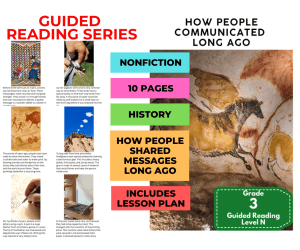
Guided Reading Level N - How People Communicated (with Lesson Plan)
ELA, Resources for Teachers, Reading Comprehension, Reading, Science, Pre-Reading, Language Development, Technology, History, Social Studies, Grade 2, 3, 4, Worksheets & Printables, Worksheets, Teacher Tools, Centers, Activities, Literacy Readers, Quizzes, Quizzes and Tests, Assessments
This Guided Reading Book - How People Communicated (Level N) with lesson plan includes: Guided Reading Color Label (front cover x1) This is a quick way to match the book’s demands to what students can generally handle.. The overall goal is to use the level/color to pick books for several smaller groups. To qualify for a certain level, a student is expected to read a book from that level with about 90–94% accuracy. If a student is consistently accurate and understands, move up a level. If the student is struggling at that level, drop down and add more support. Each student will improve at completely different rates, but it is generally one of the best ways to check progress across the class. DOWNLOAD THE CATALOG TO VIEW ALL GUIDED READING BOOKS AVAILABLE (SORTED LEVELS A-Z) Pre-Reading Question (x1) Teacher asks the prompt aloud, can be while showing the cover or first page. Students share what they already know, or make educated guesses from the cover. Prompt them to use the target vocabulary. Write some of their responses on the board to look back at during the reading. Vocabulary Words (x5) Introduce the five words, best doing it one at a time. Start by saying it, while students repeat and then see if anyone knows what it means before reading further. Read through the meaning and try to briefly connect each word to a picture or gesture so it’s meaningful. Ask students to flip through the book pages and point to where they see each of the vocabulary words. While reading the book pause upon coming across one of the vocab words or read the sentence twice to make sure students understand the word has appeared. Optional: Ask students to raise hands whenever they see/hear one of the new words. Guided Reading Pages (x10) Check the book snapshot (below) for: primary topic - do you need to prep extra reading or intro materials on this? what is taught best - decide on 1-2 bullets to focus on, use the prompt or words provided here for best results. learning goals - what you are checking for students to be able to do after the session, elicit answers using prompts or words provided. key vocabulary (see section above). questions overview - so you know what is coming up and if you need to prep extra materials to assist understanding. Run the lesson You may have already looked at a few of the pages together, but you can show them some of the pictures again first to set meaning. Depending on how much time you have and how familiar your students are with guided reading class, you may want to read the book aloud first with the group first. Students whisper or partner read, while you listen in. If time, do it as a group, one student reading a page each. Use the guided page’s prompts to coach: “Check the picture / does it make sense?” “Point under the words / try the first sound” “Reread the sentence smoothly”. Try to focus more on one student per session (rotating every time), so you can work out if they are ready to move up or need to move down a level. Comprehension Questions (back cover x3) This is your way to check that students didn’t just say the words, but actually understood the text. First, let students answer by pointing to the page/picture and saying a short sentence. After any answer, follow with: “Show me where you found that in the text.” In bigger groups, have partners answer first (10–20 seconds), then call on 2–3 students to share. Differentiation tips: Emerging speakers/struggling readers: oral + pointing On-level: oral in a full sentence Higher: one written sentence or draw + label Book Snapshot Title: How People Communicated Long Ago Genre: Nonfiction (Informational) Subject: Social Studies (Past and Present) / Reading Primary Topic: How people shared messages long ago Estimated Guided Reading Level (A–Z): N What This Book Teaches Best How people shared information long ago using cave wall paintings made from crushed rocks and water. How messengers (runners) delivered spoken messages or wooden tablets across forests and mountains. Different tools for sending messages, including carrier pigeons , letters , and the printing press for making many copies quickly. How inventions changed communication over time—from telegraph (Morse code) to telephone to near-instant messages today. Quality check note: One page includes text about firefighters’ turnout gear that does not match the book’s communication topic, and the vocabulary list includes firefighter terms (“protective,” “turnout”). Learning Goals Students will describe at least three ways people communicated long ago using details from the text. Students will explain how carrier pigeons carried letters according to the text. Students will describe how the printing press changed how books were made. Students will explain how the telegraph sent messages and name “Morse code” as described. Students will compare older communication methods to today’s communication described in the book. Key Vocabulary From the Text messengers — people who carry messages or news. invention — something new created for the first time. telegraph — machine that sent messages using electricity. envelope — paper cover that holds a letter. instantly — right away, with almost no waiting. Discussion Prompts Pre-reading question: What are some ways people might share information when they are far apart? Comprehension questions: How did people use cave walls to share information thousands of years ago? What did carrier pigeons carry, and where was it attached? According to the text, how can a message travel around the world today in just a few seconds? Printing Tips 1. Best Printing Method (Recommended) “Booklet” Printing (Best if Available) If your printer or PDF viewer supports Booklet Printing , use this. Settings to use: Print mode: Booklet Paper size: Letter or A4 (either works) Orientation: Landscape Print on both sides: Yes Flip on: Short edge Scaling: Fit to printable area Booklet subset: First test: Front sides only Then: Back sides only This will automatically: Pair pages correctly Put the cover on the outside Align everything for folding After printing, fold in half and staple along the spine . 2. If “Booklet” Printing Is NOT Available You can still print this correctly with manual duplex printing . Step-by-step: Open the PDF. Choose Print . Set: Orientation: Landscape Pages per sheet: 1 Print on both sides: Yes Flip on: Short edge Print all pages . Because each PDF page already contains two facing book pages, the result will still fold cleanly into a book. Thousands of Cored Education products are included with your TeachSimple membership. Download links and encyclopedia index available here.
Author Cored Education
Rating
Tags Reading Comprehension, Reading Passages, Reading, Guided Reading, Guided Reading Lesson Plan, Guided Reading Activity, Pre-reading, Vocabulary, History Lesson Plans, Technology
Mutations - Digital Quiz
Science, Life Sciences, Biology, Grade 6, 7, 8, Quizzes, Quizzes and Tests, Teacher Tools
Mutations - Digital Quiz: A Teaching Resource for Modern Classrooms An innovative, convenient and versatile tool to complement your middle school science teaching methods, the Mutations - Digital Quiz is a self-graded digital resource that delivers immediate feedback to students. Leveraging the highly-accessible Google Forms platform, it can be effectively integrated into various teaching scenarios depending on your individual needs. Use Cases & Flexibility Whole Group Instruction Smaller Group Exercises Homework Assignments for Remote Learning Periods This adaptable resource was designed primarily with sixth to eighth-grade science syllabi in mind but has demonstrated efficacy in various learning environments such as classrooms or remote learning sessions. Each quiz is fully editable making it adaptable according to specific subject requirements or unique student needs. Educational Content & Scope The field of biology comes with its fair share of inherently complex concepts, one of them being Mutations.This quiz revolves around this topic: Base pairings within DNA sequences The scientific definition for mutation The ways genetic changes are passed onto subsequent generations Inclusivity & Special Provisions Accommodation This digital quiz isn't just suited for mainstream classroom setups but also performs well when catering to learners under special provision categories such as Individuals Education Programs (IEPs) and English Language Learners (ELLs). Please note that this product only exists in a digital format—making them printable isn't an option currently available. Upon purchase you will receive 1 PDF file containing all necessary links and information. Efficiency & Resource Saving Contrary to traditional paper-pencil tests which require hefty logistics such as printing and hand-grading, digital quizzes significantly reduce the time taken while also reducing manpower. This shift towards digital-native pedagogical resources enhances efficiency for both teachers and learners by streamlining education processes.
Author Sheltered Language Resources
Tags Mutations, Digital Quiz, Biology Education, Middle School Science, Distance Learning

Electrical and Chemical Energy Mini-Unit: PPT, Printables, Lesson Plans and Quiz
Science, Basic Science, Grade 4, 5, 6, Quizzes, Quizzes and Tests, Teacher Tools
Electrical and Chemical Energy Mini-Unit: PPT, Printables, Lesson Plans and Quiz offers a comprehensive teaching tool designed for Grade 4 to 6 students. This two-lesson mini-unit delves deep into the concepts of electrical and chemical energy, focusing on how these forms of energy bring about change. This package includes: An interactive notebook for note-taking A 32 slide PowerPoint presentation with animations Visual aids in the form of well-crafted clipart and real-world examples Intriguing STEAM activity involving a bottle and balloon experiment that observes stored chemical energy at play. Seven printable worksheets including reading comprehension exercises. The lessons are structured as follows: Lesson One: This lesson uses direct instruction!. It's conducted in tandem with an animated PowerPoint presentation while students fill out their 'learning maps' in their interactive notebooks. Lesson Two: In this lesson, students will get hands-on experience as they investigate chemical energy through an exciting STEAM activity. The Worksheets: Facts centered around electrical energy (the power of electrons). A clear understanding of stored chemical energy. i Different forms of energies such as light, heat alongside electrical & chemical sources. The Assessment Methodology: assessment is compiled into a thirteen-question quiz amalgamating various testing techniques; Fill in blanks, multiple-choice questions, short answers All these resources are designed to make the teaching and learning process of Electrical and Chemical Energy Mini-Unit a much easier, engaging, fun-filled experience.
Author ScienceRocket
Tags Electricity, Chemical Reactions, Energy Transformations, Interactive Learning, Assessment

Space Science Quiz
Science, Earth and Environmental Sciences, Space, Grade 6, Quizzes, Quizzes and Tests, Teacher Tools
Space Science Quiz Support your students’ learning with this Space Science Quiz. This resource was specifically designed to assess student understanding. This quiz was crafted for your Grade 6 Science students. How to Use This Space Science Quiz: Once you have completed instruction for your Space unit, you can print the quiz pages and allow students to complete them. The quiz is a 2-page printable with a variety of questions (true and false, matching, writing prompts, and more). Students will identify and explain topics for outer space and the solar system. An answer key is included. This Space Science Quiz will leave you feeling more prepared and will leave your students feeling more knowledgeable about this topic. There is a point system for each section to make scoring easier for you. This quiz is worth 38 points. Using it as a pre-test and post-test is a great way to activate background knowledge at the start of a unit and then assess learned knowledge at the end of the unit. I hope you enjoy!! Here Are More of My Resources for You to Enjoy: A Pioneer Child’s Life Diary Entry Art History Research Project Classifying and Identifying Rocks Worksheet Landform Patterns Review and Test DIY Music Podcast Ratio Monster Puzzle For similar resources and other engaging resources, visit my store: Resource Garden
Author Resource Garden
Tags Space Quiz, Science Quiz, Astronomy Unit, Space Unit, Science Assessment, Writing Prompt, True Or False, Solar System, Matching

Electrical Safety Quiz / Assessment and Answer Sheet (for the lesson on Electrical Safety)
Science, Basic Science, Grade 6, Quizzes, Quizzes and Tests, Teacher Tools
Electrical Safety Quiz and Answer Sheet The quiz and answer sheet are for the powerpoint lesson on Electrical Safety. Enjoy Teaching! SAVE PREP TIME BUILD YOUR RESOURCES OFFER LEARNERS MORE! Store Motto: For the cost of a cup of coffee, save hours of classroom planning! Copyright © 2014 EasyasABC ALL RIGHTS RESERVED.
Author Easy As ABC
Tags Electrical Safety Quiz, Electrical Safety Assessment, Grade Six Science, Science Assessment, Science Quiz