



3,950 products added recently
Page 26 - Popular Worksheets
Discover a collection of popular worksheets that have been well-received by educators. Covering a variety of subjects and grade levels, these resources offer proven effectiveness in reinforcing concepts. Incorporate them into your lesson plans to save time and provide engaging activities for your students.

 Show filters

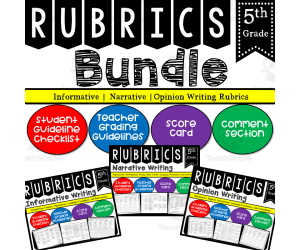
Writing Rubric BUNDLE for 5th Grade with Checklist
ELA, Writing, Resources for Teachers, Grade 5, Rubrics, Teacher Tools, Worksheets, Worksheets & Printables
Writing Rubrics and Checklists for 5th Grade. This 27-page bundle provides 5th grade teachers with the tools they need to support student growth in writing. Specifically, it includes informative, narrative, and opinion writing rubrics that use a 1-5 scale to assess introduction, support, organization, language/vocabulary, development/setting, plot/conflict, and conventions. Detailed checklists outlining the criteria students should meet for proficient writing are also provided. By providing students with clear expectations and examples of what quality writing looks like, teachers can confidently evaluate student work. The rubrics and checklists facilitate meaningful feedback and allow teachers to track growth over time. They are versatile resources that can be used for whole-class writing instruction, small group lessons, or individual writing conferences. Appropriate for a range of ability levels, these materials help develop 5th grade students into skilled, thoughtful writers. For many writing units for 3rd - 5th grade students and K-2nd grade that are specifically from the K-5 Treasures author of these products that are perfect to use with this rubric, click on the links below: Fall | Back to School Writing Prompt BUNDLE! 3rd-5th Grade Thanksgiving Writing Prompts for 3rd-5th Grade Winter Writing Prompts for 3rd-5th Grade Christmas Writing Prompts for 3rd-5th Grade Martin Luther King Jr. Writing Prompts for 3rd-5th Grade Valentine's Day Writing Activities for 3rd - 5th Grade: Narrative, Opinion, and Informative President's Day Writing Activities for 3rd - 5th Grade: Narrative, Opinion, and Informative Spring Narrative Writing, Spring Opinion Writing, and Spring Informative Writing Prompts for 3rd - 5th Grade Easter Narrative Writing, Easter Opinion Writing, and Easter Informative Writing Prompts for 3rd - 5th Grade K-2nd Grade Writing Units SUMMER ESL Writing Prompts and Drawing for K-2nd Grade Spring Narrative Writing, Spring Opinion Writing, and Spring Informative Writing Prompts with Vocabulary Words for K-2nd Grade For other rubrics for more grades, click on the links below: Writing Rubric BUNDLE for 3rd Grade with Checklist Writing Rubric BUNDLE for 4th Grade with Checklist Writing Rubric BUNDLE for 5th Grade with Checklist
Author K-5 Treasures
Tags Writing Rubrics, Opinion Writing Rubric, Informative Writing Rubric, Writing Rubric For 5th Grade, 5th Grade Writing Rubric, Narrative Writing Rubric, 5th Grade Writing Assessment, Writing Assessment
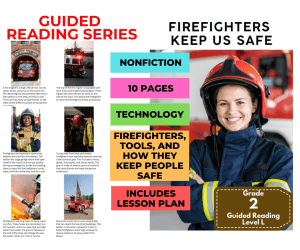
Guided Reading Level L - Firefighters Keep Us Safe (with Lesson Plan)
ELA, Resources for Teachers, Reading Comprehension, Reading, Pre-Reading, Language Development, Science, Engineering, Technology, Vocabulary, Grade 1, 2, 3, Worksheets & Printables, Worksheets, Teacher Tools, Centers, Activities, Literacy Readers, Quizzes, Quizzes and Tests, Assessments
This Guided Reading Book - Firefighters Keep Us Safe (Level L) with lesson plan includes: Guided Reading Color Label (front cover x1) This is a quick way to match the book’s demands to what students can generally handle.. The overall goal is to use the level/color to pick books for several smaller groups. To qualify for a certain level, a student is expected to read a book from that level with about 90–94% accuracy. If a student is consistently accurate and understands, move up a level. If the student is struggling at that level, drop down and add more support. Each student will improve at completely different rates, but it is generally one of the best ways to check progress across the class. DOWNLOAD THE CATALOG TO VIEW ALL GUIDED READING BOOKS AVAILABLE (SORTED LEVELS A-Z) Pre-Reading Question (x1) Teacher asks the prompt aloud, can be while showing the cover or first page. Students share what they already know, or make educated guesses from the cover. Prompt them to use the target vocabulary. Write some of their responses on the board to look back at during the reading. Vocabulary Words (x5) Introduce the five words, best doing it one at a time. Start by saying it, while students repeat and then see if anyone knows what it means before reading further. Read through the meaning and try to briefly connect each word to a picture or gesture so it’s meaningful. Ask students to flip through the book pages and point to where they see each of the vocabulary words. While reading the book pause upon coming across one of the vocab words or read the sentence twice to make sure students understand the word has appeared. Optional: Ask students to raise hands whenever they see/hear one of the new words. Guided Reading Pages (x10) Check the book snapshot (below) for: primary topic - do you need to prep extra reading or intro materials on this? what is taught best - decide on 1-2 bullets to focus on, use the prompt or words provided here for best results. learning goals - what you are checking for students to be able to do after the session, elicit answers using prompts or words provided. key vocabulary (see section above). questions overview - so you know what is coming up and if you need to prep extra materials to assist understanding. Run the lesson You may have already looked at a few of the pages together, but you can show them some of the pictures again first to set meaning. Depending on how much time you have and how familiar your students are with guided reading class, you may want to read the book aloud first with the group first. Students whisper or partner read, while you listen in. If time, do it as a group, one student reading a page each. Use the guided page’s prompts to coach: “Check the picture / does it make sense?” “Point under the words / try the first sound” “Reread the sentence smoothly”. Try to focus more on one student per session (rotating every time), so you can work out if they are ready to move up or need to move down a level. Comprehension Questions (back cover x3) This is your way to check that students didn’t just say the words, but actually understood the text. First, let students answer by pointing to the page/picture and saying a short sentence. After any answer, follow with: “Show me where you found that in the text.” In bigger groups, have partners answer first (10–20 seconds), then call on 2–3 students to share. Differentiation tips: Emerging speakers/struggling readers: oral + pointing On-level: oral in a full sentence Higher: one written sentence or draw + label Book Snapshot Title: Firefighters Keep Us Safe Genre: Nonfiction (informational) Subject: Social Studies (Community Helpers) / Health & Safety / Reading Primary Topic: Firefighters, tools, and how they keep people safe Estimated Guided Reading Level (A–Z): L What This Book Teaches Best How firefighters are community helpers who work at a fire station and respond to an emergency call. Why firefighters wear turnout gear and how it protects them from heat and smoke (layers resist flames and keep them cool). What a fire engine carries and how sirens and flashing lights help firefighters reach emergencies quickly (drivers move to the side). How key equipment works: hoses connect to a hydrant , nozzles change the water spray, and long ladders help with rescue and spraying from above. Firefighters’ jobs go beyond fires: they help in car accidents and medical emergencies , and training and dedication help keep the community safe. Learning Goals Students will explain how firefighters help keep a community safe using details from the text. Students will describe what turnout gear is and why firefighters wear it. Students will identify what a fire engine carries and how sirens and flashing lights help on the road. Students will describe how hoses, hydrants, and nozzles help firefighters spray water on a fire. Students will explain why firefighters use masks and air tanks in smoky buildings. Students will describe why firefighters train daily and how dedication connects to safety. Key Vocabulary From the Text community — people who live and work in the same place. emergency — a sudden problem that needs help right away. protective — made to help keep someone safe from harm. hydrant — a street pipe where firefighters can get water. dedication — working hard and not giving up. Discussion Prompts Pre-reading question: What do you think firefighters need to do their jobs safely? Comprehension questions: What is turnout gear, and how does it help firefighters around heat and smoke? What do the sirens and flashing lights on a fire engine tell other drivers to do? Why do firefighters wear a special mask and an air tank in a smoky building? Printing Tips 1. Best Printing Method (Recommended) “Booklet” Printing (Best if Available) If your printer or PDF viewer supports Booklet Printing , use this. Settings to use: Print mode: Booklet Paper size: Letter or A4 (either works) Orientation: Landscape Print on both sides: Yes Flip on: Short edge Scaling: Fit to printable area Booklet subset: First test: Front sides only Then: Back sides only This will automatically: Pair pages correctly Put the cover on the outside Align everything for folding After printing, fold in half and staple along the spine . 2. If “Booklet” Printing Is NOT Available You can still print this correctly with manual duplex printing . Step-by-step: Open the PDF. Choose Print . Set: Orientation: Landscape Pages per sheet: 1 Print on both sides: Yes Flip on: Short edge Print all pages . Because each PDF page already contains two facing book pages, the result will still fold cleanly into a book. Thousands of Cored Education products are included with your TeachSimple membership. Download links and encyclopedia index available here.
Author Cored Education
Rating
Tags Reading Comprehension, Reading Passages, Reading, Guided Reading, Guided Reading Lesson Plan, Guided Reading Activity, Pre-reading, Vocabulary, Technology, Engineering
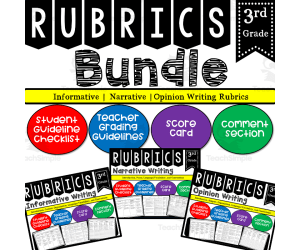
Writing Rubric BUNDLE for 3rd Grade with Checklist
ELA, Writing, Resources for Teachers, Grade 3, Rubrics, Teacher Tools, Worksheets & Printables, Worksheets
Teaching Writing Rubrics and Checklists for 3rd Grade. This 24-page writing rubric bundle equips 3rd grade teachers with the tools they need to set clear expectations and assess student writing. In this unit, it includes informative, narrative, and opinion writing rubrics that outline specific criteria like introduction, content, focus, organization, vocabulary, and conventions. Teachers can use the detailed 1-5 rating scale to precisely grade writing samples. Students can reference the accompanying checklists to understand what's required for high quality writing. Classrooms will benefit from having clearly communicated standards. Students will write with more confidence knowing the expectations. Teachers will save time grading and feel empowered to provide specific, helpful feedback. With rubrics for multiple genres, this resource can be utilized for various writing assignments throughout the year. It's a comprehensive assessment solution for any 3rd grade ELA curriculum. For many writing units for 3rd - 5th grade students and K-2nd grade that are specifically from the K-5 Treasures author of these products that are perfect to use with this rubric, click on the links below: Fall | Back to School Writing Prompt BUNDLE! 3rd-5th Grade Thanksgiving Writing Prompts for 3rd-5th Grade Winter Writing Prompts for 3rd-5th Grade Christmas Writing Prompts for 3rd-5th Grade Martin Luther King Jr. Writing Prompts for 3rd-5th Grade Valentine's Day Writing Activities for 3rd - 5th Grade: Narrative, Opinion, and Informative President's Day Writing Activities for 3rd - 5th Grade: Narrative, Opinion, and Informative Spring Narrative Writing, Spring Opinion Writing, and Spring Informative Writing Prompts for 3rd - 5th Grade Easter Narrative Writing, Easter Opinion Writing, and Easter Informative Writing Prompts for 3rd - 5th Grade K-2nd Grade Writing Units SUMMER ESL Writing Prompts and Drawing for K-2nd Grade Spring Narrative Writing, Spring Opinion Writing, and Spring Informative Writing Prompts with Vocabulary Words for K-2nd Grade For other rubrics for more grades, click on the links below: Writing Rubric BUNDLE for 3rd Grade with Checklist Writing Rubric BUNDLE for 4th Grade with Checklist Writing Rubric BUNDLE for 5th Grade with Checklist
Author K-5 Treasures
Tags Writing Rubrics, Opinion Writing Rubric, Informative Writing Rubric, Narrative Writing Rubric, Writing Assessment, 3rd Grade Writing Rubric, Writing Rubric For 3rd Grade, Third Grade Writing Rubrics, 3rd Grade Writing
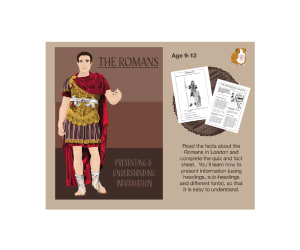
Presenting And Understanding Information: The Romans (9-14 years)
ELA, Writing, Grade 4, 5, 6, 7, Worksheets & Printables, Worksheets
Presenting And Understanding Information: The Romans (9-14 years) An invaluable teaching resource designed for teachers and homeschoolers alike, catering to students in Grades 4 through 7. It focuses primarily within the field of Language Arts, honing writing skills. This comprehensive pack comprises numerous worksheets aimed at fostering creativity and enhancing literacy prowess. The material acclimatizes students to various aspects of information writing, such as advising, informing, explaining, reviewing and commenting; offering them quality instructional content. A key emphasis is placed on differentiating between facts and opinions - a crucial feature at this educational stage. It aids learners in understanding diverse written communication styles by dissecting their structure explicitly. Different formats such as newspaper articles, formal letters, e-mails among others are covered thereby serving as multifunctional instructional tools . Teachers can implement this resource for whole group discussions or use it in smaller groups allowing concentrated learning. Moreover it could be utilised for homework assignments which aid individual practice. It covers broad possibilities like biographies autobiographies interviews book reviews etc.,this tool provides constructive starting points to elicit creative thoughts especially amongst children who may be initially reluctant writers Student Writing: The student's writings are rendered engaging due to sentence variability usage punctuations good grammar concocted into structured paragraphs hence fostering proficient writers out of budding learners In addition to eliciting idea generation numerous model answers along with well-crafted sample texts by students serve as references enriching their knowledge furthermore Practice questions will undoubtedly test the newly acquired understanding This pedagogic supplement discerns common errors subtly rectifying them thereby refining writing over time Teachers will find these packs highly flexible and time savers while constructing lesson plans or assigning homework tasks. The pack contains exemplar plans which could be used as blueprints for preparing creative lessons. In Conclusion: 'Presenting And Understanding Information: The Romans' is an essential, comprehensive toolbox of ideas for writing. Focusing on organizing thoughts and refining written skills makes this pack an absolute must-have in the language arts syllabus for children aged 9-14 years old.
Author Guinea Pig Education
Tags Writing Skills, Information Writing, Comprehension, Teaching Resource, Language Arts

Equivalent Fractions – Visual Rectangle Approach
Math, Fractions, Grade 3, Worksheets & Printables, Worksheets
If two fractions are equivalent it means they are the same in terms of shape and size, but are expressed using different numbers Equivalent fractions are best introduced using shape models before proceeding on to using the number line or any numerical method. If two fractions are equivalent it means they are the same in terms of shape and size, but are expressed using different numbers In these resources fractions are compared using rectangles, where each rectangle represents the same area of a whole. The 4 Sets of Worksheets form a progression as follows: Worksheet Set 1: Each pair of rectangles on the page has a fraction of it's space colored in. Students write down the (equivalent) fractions of each in numerical terms. Worksheet Set 2: For each pair of rectangles, equivalent fractions are shown . Students color in the areas on two rectangles that represent two given equivalent fractions. Worksheet Set 3: Pairs of coloured-in rectangles and the denominators of the equivalent fractions are shown. Students must determine the numerators (of each fraction) and the multiplier that connects the two fractions. Worksheet Set 4: Shown pairs of partially coloured-in rectangles pupils are asked to write down the fractions coloured-in and the multiplier connecting the two fractions. How many worksheets are in each set ? A lot. At the click of a button all numbers are randomised, so the questions change every time. This means you can create new worksheets for plenty of extra practice throughout the year or even give groups of pupils in your class different sets of questions. Answers can be found on the second page of every worksheet, which are automatically generated when you create a new worksheet. Note These resources are PDF documents and work with the official Adobe Acrobat Reader on Windows or Mac computers with the randomising buttons also working via a touchscreen (on a PC or Mac) or on an Interactive Whiteboard. Common Core Standards CCSS3.NF.A.1 Understand a fraction 1/𝘣 as the quantity formed by 1 part when a whole is partitioned into 𝘣 equal parts; understand a fraction 𝘢/𝑏 as the quantity formed by 𝘢 printables/parts-of-and-anatomy-of">parts of size 1/𝘣. CCSS3.NF.A.3 Explain equivalence of fractions in special cases, and compare fractions by reasoning about their size. CCSS3.NF.A.3a Understand two fractions as equivalent (equal) if they are the same size, or the same point on a number line. CCSS3.NF.A.3b Recognize and generate simple equivalent fractions, (e.g., 1/2 = 2/4, 4/6 = 2/3). Explain why the fractions are equivalent, e.g., by using a visual fraction model. You may also like: Equivalent Fractions on the Number Line Worksheets 3rd Grade Equivalent Fractions - Numerical method with multipliers and divisors
Author Jeff's Notebooks
Rating
Tags Equivalent Fractions, Fractions, Visual Model Equivalent Fraction, Grade 3, Jeff's Notebooks, Worksheets, Math, Numeracy, Interactive Whiteboard

Prefixes and Suffixes Practice Questions - Grades 1-2 Grammar (PDF)
ELA, Language Development, ESL, Grammar, Common Core, Resources for Teachers, Grade 1, 2, Worksheets & Printables, Worksheets, Assessments, Teacher Tools, Tests, Quizzes and Tests
Prefixes and Suffixes Grammar Practice MCQS: 8 lessons, 120 MCQS, 35 pages ELA MCQs Overview: This grammar resource gives students plenty of focused practice with two essential writing skills: capitalisation and punctuation. Across 10 lessons and 150 multiple-choice questions, students work through clear, manageable practice that helps them spot mistakes, improve accuracy, and build real confidence over time. The lessons are designed to feel structured without becoming dry or repetitive. Each one builds naturally on the previous lesson, giving students the chance to review, strengthen, and apply what they have learned. With a mix of direct teaching, group work, and independent practice, the resource works well for whole-class lessons, revision, homework, or extra support. Prefixes and Suffixes Overview: Includes: Intro to Prefixes Intro to Suffixes Forming Suffixes Determining Affix Word Meaning PDF Version This is the PDF uneditable version. This download is available in GOOGLE Docs, GOOGLE Forms, GOOGLE Slides. PDF, PPT, WORD, check the links below for more details. FULL CATALOG OF DOWNLOAD LINKS HERE ELA Review Questions Overview Each review test includes three answer choices for every question. The format is clear and easy for students to follow. A small number of pictures are included on each test to make the pages feel more welcoming and less plain. A review sheet is also included to help students go back over many of the main skills covered in the product. Introduction or Example Sheet Each topic includes an introduction or example sheet to use before students begin. This gives students a clear starting point. It also helps refresh key ideas before they move into the practice. Full Answer Keys Full answer keys are included for easy checking. Sample responses are also provided where needed. This helps save time and makes the resource easier to use, even on busy days. In the Supplementary Pack Interactive Ice Breakers: Simple hands-on activities to help students start thinking about the topic. Guided Practice: Teacher-led work that helps students build understanding before working alone. Group and Partner Tasks: Activities that encourage discussion, shared ideas, and teamwork. Independent Worksheets: Extra practice pages for students to complete by themselves. Exit Tasks: Short end-of-lesson activities to check understanding and review learning. For similar downloads and other frees, do check out Cored Group on TeachSimple.
Author Cored Education
Rating
Tags Elementary, Vocabulary, Answers, Ccss, Common Core, Spelling, Writing, Grammar, Prefixes And Suffixes, Ela

Climate Change - Science Reading Article - Grades 5-7
Science, Earth and Environmental Sciences, Environmental Science, Grade 5, 6, 7, Worksheets & Printables, Worksheets
Climate Change Science Reading Article teaches students in grades 5-7 about the causes and effects of climate change. It explains key concepts like the greenhouse effect and global warming in clear, grade-appropriate language. The reading covers how human activities like burning fossil fuels are increasing atmospheric carbon dioxide, as well as the potential impacts of climate change. It encourages critical thinking by having students reflect on sustainable solutions. This resource includes a reading passage, vocabulary support, discussion questions, and an answer key. It can be used for whole class instruction, small group work, or independent practice. The engaging content integrates well with science curricula while building literacy skills.
Author Teach With Fergy
Tags Climate Change, Weather, Storms, Reading, Comprehension

Adding Tenths + Hundredths – 4th Grade Fractions
Math, Fractions, Grade 4, Worksheets & Printables, Worksheets
For educators and homeschoolers searching for a complete way for students to become proficient with adding 1/10th and 1/100ths, this resource will be a valuable asset! Designed with ease of use in mind, it offers no-prep scaffolded worksheets with and without visual support divided into 11 sets from ensuring a good foundation to challenges. The first six sets provide practice for preparation for the core work. Using the visual model of squares divided into 10 and 100 parts, students are asked to: find the fractions colored in (Set 1) color in the fraction indicated (Set 2) In Set 3 students practice looking for the visual connection between equivalent fractions given in 1/10ths and 1/100ths. Seeing 1/10 is the same as 10/100. is a pivotal point in the whole process. There is a simple Teaching Page included in the pack which you can use at this points to show the connection between 10ths and 100ths both visually and numerically (multiplying numerator and denominator by 10) which will prepare your students for Set 4 which has purely numerical questions. Sets 5 and 6 provide practice adding 1/100ths with and without visual support Sets 7, 8 & 9 are the core of the topic - adding a mix of 1/10ths & 100ths. Set 7 - adding these fractions with visual support Set 8 - numerical questions with an intermediate step where students must show their conversion of the tenth fraction to a hundreth before adding Set 9 - numerical questions Challenges For the students who mastered the above there are two extra sets of worksheets Set 10 - adding 3 fractions with a mix of tenths and hundredths Set 11 - equations with 3 fractions BUT students have to find the value of one of the addends. How many worksheets in each set ? As many as you need. A standout feature is the worksheet randomization. With a single click, educators can generate an entirely new set of questions, making it a renewable resource for the entire school year. Be it for classwork, revision, or homework, adaptability ensures students achieve proficiency in the topic. Each worksheet concludes with an automatically generated answer key on its second page, offering a quick reference point for educators. And if there's ever a need for a last-minute lesson or work for a substitute teacher, these sheets are a reliable fallback. Lastly, it's essential to note that these resources can be downloaded as PDF documents. They operate seamlessly with the official Adobe Acrobat Reader on both Windows and Mac. Plus, the randomizing features are effortlessly accessible via touchscreen devices or interactive whiteboards.
Author Jeff's Notebooks
Rating
Tags Math, Fractions, Adding Fractions, 4th Grade, Jeff's Notebooks, Equivalent Fractions

Powered Neuro-Inclusive Micro-Learning Strategy Cards for Diverse
Science, Technology, Computer Science, Engineering, Special Resources, Social Emotional Learning (SEL), Special Education Needs (SEN), STEM, Life Skills, ELA, Grade 2, 3, 4, 5, 9, 10, 11, 12, Worksheets & Printables, Flashcards, Parts of and Anatomy of, Word Problems, Workbooks, Worksheets, Writing Prompts, Teacher Tools, Assessments, Lesson Plans
Unlocks the future of inclusive education with this 49-page ultimate resource: "AI-Powered Neuro-Inclusive Micro-Learning Strategy Cards for Diverse Classrooms (Ready!)" – an innovative and educator-recommended resource that disrupts and transforms K-12 educational strategies for the better. This downloadable pdf resource pushes the boundaries of neuro-inclusive education practices, micro-learning best practices, and responsible AI applications, covering all theoretical aspects of neuro-inclusive educational practices, micro-learning best practices, AI applications, and a lot more with its profound evidence-based resources on UDL, Cognitive Load Factors, and Constructivist concepts, with actual demonstration cases from elementary and high school levels, strategy card templates for creative development on worksheets and ethics of AI applications for educational environments, all crafted together for optimal cognitive engagement and minimizing educational barriers for effective personalized cognitive educational development. Perfect for special education resources, differentiated resources for personalized educational practices, and educational management tools, this SEO-optimized resource for educators helps and enables all educators for preparation of balanced cognitive educational morsels for enhanced cognitive engagements, motivation, and academic achievement for students across diverse K-12 educational environments. Keywords: Neuro-inclusive educational practices for classrooms, AI-based educational resources for classrooms, Micro-learning for neuro-diverse students, K-12 Neuro-inclusive educational practices, UDL resources for classrooms. Why Parents/Schools Love It: Personalized and Inclusive Strategy: Enables teachers to provide personalized education support for neurodiverse students, making them less frustrated and more confident using bite-sized and adjustable strategies such as tools for students with ADHD or autistic students. Time-Saving AI Integration: “Ethical AI capabilities offer real-time analytics, personalized content, and feedback loops that ease the instructor’s workload and help enhance outcomes in a K-12 classroom.” Results That Speak for Themselves: Proven on the evidence-based frameworks of UDL and Cognitive Load Theory, as well as illustrated cases of 20% or greater retention and engagement rates, there is no doubt that it helps students significantly. Versatile & Ready to Use: Comes with strategy cards, worksheets, & writing prompts that teachers can print out for instant use in their classrooms, thus being very useful in encouraging motivation, managing cognitive overload, & ensuring equitable education. Future-Proof Designs: equipped with ethical AI tools and frameworks that protect consumer and individual rights to privacy and mitigate biases, to ready and prepare learners for a technology-driven and worldwide environment while focusing on teaching and learning. Targeted Classes/Students : After thoroughly evaluating the entire 49-page PDF file, which contains information on foundational theory (Chapters 1-3), the design and execution of strategy cards (Chapter 4), worksheets for practice, ethical issues, case studies, and advanced topics, it is clear that the guide is designed for use in K-12 education environments. It applies to all grade levels, Kindergarten through 12th grade, with a focus on neurodiverse students. Specific suggestions are included for: Elementary School Students (Grades K-5): Underlying concepts may target fractions, reading comprehension, or social-emotional control, with examples such as Northwood Elementary focusing on ADHD, Dyslexia, and Autistic students during grades 3-5. Designed specifically for students who profit from visual supports and time-dosing assistance with their learning and attention. Middle School Students (6-8): Focuses on executive functioning assistance, multi-step task planning (ecosystems lesson for instance), AI-powered modifications for ESL, anxious, gifted students. Case examples, like Summit Ridge Middle School, discuss differentiating for students with learning disabilities. High School Students(9-12): Focuses on difficult topics in geometry proofs, formulas for volume, and abstract ideas, using micro-learning for dyscalculia, slow processing, and high-functioning autism. Examples include Emerald High School’s geometry in the 9th grade, which emphasize challenging concepts. Copyright/Terms of Use : This Book was copyrighted by Syed Hammad Rizvi. This document or textbook is exclusively for non-commercial personal and classroom use only. You are not allowed to copy, distribute, or sell any portion of this document or textbook through the Internet for public download. If you would like to share this resource with others in your workplace, please purchase additional licenses from Teachsimple. We appreciate your respect for these guidelines for use. This product is proudly brought to you by Syed Hammad Rizvi
Author Creative Book Store
Rating
Tags NeuroInclusiveEducation, AIPoweredLearning, MicroLearningStrategies, K12InclusivePedagogy, NeurodiversityInClassrooms, UDLPrinciples, CognitiveLoadTheory, EthicalAIInEducation, ADHDTeachingTools, DyslexiaSupportResources

Hydroelectric Energy Production - Digital Science Reading Article - Grades 5-7
Science, Physics, Grade 5, 6, 7, Worksheets & Printables, Worksheets
Hydroelectric Energy Production is an engaging science reading activity for grades 5-7 that tackles literacy and science. This resource looks at renewable hydroelectric energy, how hydroelectric plants work, present-day facilities, and the pros and cons of this energy source. The reading features key vocabulary terms and a variety of question types including knowledge-based, critical thinking, connecting ideas, and open-ended. An answer key is included. This 40-60 minute activity is perfect for in-class assignments, distance learning with easy integration into Google Classroom, or as an engaging substitute plan. It helps students improve science literacy, reading comprehension, analysis skills, and provides an interesting extension for advanced students. It’s a great way to meet literacy standards in science.
Author Teach With Fergy
Tags Renewable Energy Passage, Energy Production Article, Energy Production Reading, Hydroelectric Reading Passage

Literary Devices Creative Writing Worksheets
ELA, Writing, Creative Writing, Grade 6, 7, 8, 9, 10, 11, 12, Worksheets & Printables, Worksheets
Crafting literature is hard, and these short literary devices worksheets allow students to explore the individual components of good creative writing before they begin drafting their own original work. Included in this packet are 3 unique worksheets, each based around a key literary device (Details, Diction, and Tone). In these individual assignments, students will learn about each literary device, see examples of them, and get a straightforward task that will build on their learning and prepare them for their own original writing. Simple, engaging, and a great building block to the development of sound creative writing skills, these activities naturally build towards our Song Lesson activities and Literary Devices: Creative Writing Workshop products - links below. Administering and guiding your students through these three dynamic and fun worksheets could not be easier! Simply figure out when you desire to teach each of the three literary devices and hand out the corresponding worksheet. The directions, expert scaffolding, and your students creativity will take care of the rest! This packet of worksheets includes: - An activity that addresses the literary device of DETAILS and then asks students to complete several prompted multiple choice and short answer activities - Another activity that addresses the literary device of DICTION and then asks students to complete several prompted multiple choice and short answer activities - A third activity that addresses the literary device of TONE and then asks students to complete several prompted multiple choice and short answer activities Although this resource can be fitted for any secondary Language Arts classroom, it has been carefully designed to work best in grades 6 through 12. The included activities are subtly but specifically tied to Common Core ELA Standards for Language (3 and 5). This resource is provided in print-ready, bookmarked, and adjustable PDF files and PowerPoint Show files. This resource contains 7 pages.
Author The Language of Educational Art, LLC
Tags Literary Devices, Worksheets, Creative Writing, Pre-writing
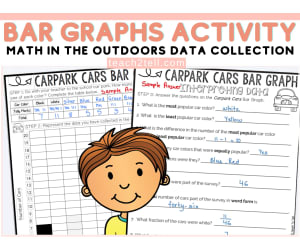
Bar Graphs Worksheets Data and Graphing Column Graphs Tally Marks
Math, Graphing, Measurements, Grade 2, 3, 4, 5, Worksheets & Printables, Worksheets, Activities
Looking for a data and graphing activity that gets your students moving and learning at the same time? These Bar Graphs Worksheets are the perfect mix of hands-on fun and curriculum-aligned skills practice! With a hands-on, real-world approach, your students will head outside to collect data using tally marks—yes, real data from your staff car park ! From Observation to Representation Your students will observe car colors and record their findings using tally marks . Then, they’ll transfer that data into a clear and colorful column (bar) graph . It’s a simple yet powerful way to connect real-life observation with structured math skills. Deepen Thinking with Data Interpretation Once the graphs are complete, students answer a series of questions to analyze and interpret the data. This step encourages them to think critically, make comparisons, and draw conclusions based on evidence—hello, higher-order thinking! What’s Included ✔️ Tally mark data collection sheet ✔️ Column/Bar graph template ✔️ Comprehension questions for data interpretation ✔️ US and British English versions for flexible classroom use Perfect For: Math centers or rotations Early finishers Outdoor learning experiences Grades 2–4 (or adaptable for other levels) Real-life, cross-curricular connections Why Teachers Love It This resource is more than just a worksheet—it's an experience. Students are actively engaged , moving , thinking , and connecting math to the world around them . Real data. Real math. Real fun. Bring graphing to life and turn your next math lesson into a mini adventure!
Author Teach2Tell
Rating
Tags Bar Graphs Worksheets, Data And Graphing Activities, Bar Graph Math Center, Graphing Data For 2nd Grade, Graphing Data For 3rd Grade, Math Worksheets Bar Graphs, Real-world Math Project, Picture And Bar Graph Worksheets, Common Core Graphing Lesson, Math Graphing Printables
Number & Operations: Fractions - Addition & Subtraction - Pre-Assessment & Teach the Skill - PC Software
Math, Fractions, Common Core, Grade 3, 4, 5, Assessments, Teacher Tools, Worksheets
Number & Operations: Fractions - Addition & Subtraction - Pre- Assessment & Teach the Skill PC Software This advanced educational resource is aimed at developing a foundation in Math by focusing on adding and subtracting fractions, vital skills for Grade 3, Grade 4, and Grade 5 students. Key Features: A dedicated PC software serving as a potent teaching tool. Incorporates pre-assessment activities in addition to a well-rounded lesson plan easing teachers' task of instructing fractions. Inclusion of math tools to supplement teacher resources and promote interactive learning methodologies. The software can be used flexibly within various teaching formats, from whole group lessons to small tutoring groups and even for homework assignments. The resource is versatile enough to enable effective learning beyond the normal classroom hours while eliminating the usual stress associated with understanding fraction operations! Covers all major faction topics like addition and subtraction while also aligns perfectly with Common Core State Standards (CCSS), thus ensuring uniformity in learning across different regions! Fulfils National Council of Teachers of Mathematics' (NCTM) principles further assuring top-notch quality throughout its components! A unique highlight includes bilingual voice overs—with English and Spanish versions—along with respective text variants which cater explicitly to ELL learners whether they are schooled conventionally or pursuing home education. This provision broadens its accessibility making it all-inclusive! All of these assets come neatly packaged into one zip file—an offering that epitomises user convenience given today's educational scenario! No matter if you’re a public school teacher looking to facilitate concept clearance among varied skill levels or homeschoolers seeking structured curriculum content—this advanced PC-based educational resource transforms conventional Math challenges into impactful Fractional breakthroughs! Foster a generation of confident mathematicians equipped with sound knowledge in fraction fundamentals— credits to the Number & Operations: Fractions - Addition & Subtraction - Pre-Assessment & Teach the Skill PC software!
Author Classroom Complete Press
Rating
Tags Fractions Lesson Plan, Operations, Pre-assessment, Digital Math, Fractions Printable
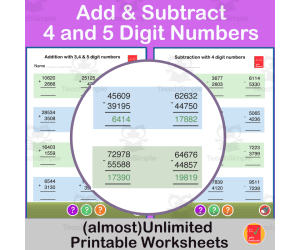
Add & subtract 4 & 5-digit whole numbers with or without regrouping
Math, Addition and Subtraction, Addition, Common Core, Grade 4, 5, Worksheets & Printables, Worksheets
There are a number of alternative methods used to solve these problems (and especially with 2 & 3 digit numbers), but the standard algorithm at this level is probably the best preparation your pupils can have for working with decimal numbers which will follow in Grade 5.These sets of worksheets focus on addition and subtraction working primarily with 4 and 5 digit numbers. On each Worksheet there are three buttons, each of which will randomise the numbers in the questions at 3 levels, namely addition and subtraction with: -4 digit numbers only -5 digit numbers only -A mix of 3,4 or 5 digit numbers The questions are presented in the standard column format so students can start working on them straight away. How many worksheets are in each set ? Lots and lots. At the click of a button all numbers are randomised, so the questions change every time. This will allow you to create as many new worksheets you will need for practice throughout the year or even give groups of pupils in your class different sets of questions. There will certainly be enough to ensure fluency in this topic. Answers can be found on the second page of every worksheet, automatically generated when you create a new worksheet. You can also remove all numbers from the sheet, so you have a blank template to work with or for your pupils to create their own set of questions. Note These resources are PDF documents and work with the official Adobe Acrobat Reader on Windows or Mac computers with the randomising buttons also working via a touchscreen or on an Interactive Whiteboard. Common Core State Standards 4.NBT.B.4 Fluently add and subtract multi-digit whole numbers using the standard algorithm. UK National Curriculum - Year 4 Programme of Study - Addition and Subtraction Add and subtract numbers with up to 4 digits using the formal written methods of columnar addition and subtraction where appropriate Need to review this topic with 2-digit or 3-digit numbers ? Add and Subtract 2-digit numbers with and without regrouping 2nd Grade Add and subtract 3 Digit numbers with and without regrouping
Author Jeff's Notebooks
Tags Addition, Subtraction, 5th Grade, 4th Grade, Jeff's Notebooks, Standard Algorithm, Column Addition, 4 Digit Numners, 5 Digit Numbers, Interactive Whiteboard
Algebra - Drill Sheets Vol. 3 Gr. PK-2
Math, Algebra, Common Core, Grade 1, 2, Worksheets & Printables, Worksheets
Algebra - Drill Sheets Vol. 3 Gr. PK-2 Mathematics teachers and homeschool educators will find utilitarian value in the third volume of our algebra drill sheets, designed specifically for pre-kindergarten through 2nd grade students. These drill sheets have been meticulously constructed to align with algebraic concepts addressed by the National Council of Teachers of Mathematics (NCTM) standards, presenting these complex ideas to young learners in accessible ways. The worksheet contents are diverse, ranging from patterning exercises and evaluations of algebraic expressions to investigations involving number lines and graphs. This array ensures educators can keep learning exciting while mirroring comprehensive curriculum goals. Inclusion of mathematical sentence exercises and activities focused on exploring algebraic properties. Tech-integrated components encouraging learners to use digital tools whilst working on their drills offering them a moderne experience that appropriately blends tradition with innovation. The worksheets also include reflective sections after each exercise encouraging critical thinking – bridging practice and understanding further solidifying learned concepts within young minds. Finally, this resource provides assessment rubrics aligned with Common Core State Standards making grading straightforward for teachers while ensuring alignment with best teaching practices across multiple educational fronts. The provided standards rubrics simplify tracking progress or identifying areas that may need additional focus thus streamlining the instruction process. Bonus Features: Review sheets, Vibrant activity posters adding visual stimulus aiding retention plus, Bonus worksheets increase value encountered as an educator using this resource as it integrates multiple aspects required in teaching young learners about complex math concepts like Algebra gracefully.
Author Classroom Complete Press
Tags PDF
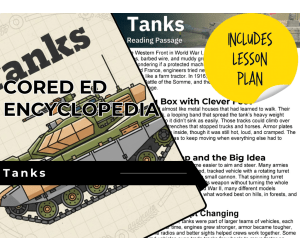
Tanks Reading Comprehension Passage - Cored Ed Encyclopedia
ELA, Language Development, Reading Comprehension, Reading, Pre-Reading, Science, Technology, Engineering, History, Social Studies, Grade 2, 3, 4, 5, Worksheets & Printables, Worksheets, Teacher Tools, Centers, Activities, Writing Prompts, Assessments, Quizzes and Tests, Quizzes, Lesson Plans
This tanks reading comprehension includes: Visualization (on the front cover) Start your lesson by taking a minute to think and share something about the topic. Read the script aloud (slowly), perhaps prepare some music or sound effects. Student close their eyes and let their imaginations wander. Students open their eyes, read the question aloud and give them a few minutes to complete. Ask a few students to share or keep answers until the end to compare with what they learn in the passage. Quick pause—thousands of Cored Education products are included with your TeachSimple membership. Download links and encyclopedia index available here. Pre-Reading Trivia Students will write down one thing they already know about the subject and then read five more facts and discuss. These facts are fun, and the students will enjoy learning about the subject before reading more. Give 1 minute for students to write what they already know (no pressure—best guess is fine). Read the five facts together. After each fact, do ask a student for their opinion, was it surprising? Set a purpose by asking students to highlight/underline one fact they want to learn more about during the reading. Reading Passage The text is a high-interest reading passage with set paragraphs, roughly three to four paragraphs long. It contains a variety of themes about the topic, anywhere from history to technology. The passage is between 250 and 350 words in length. First, ask students to look at the headings and see what they’ll learn about today. What do they know about the topic/heading? First read options: Teacher read-aloud (best for support). Partner reading (paragraph by paragraph). While reading, students underline important details, and vocabulary words they think may come up in the questions section. Mixed Questions The first question page contains four multiple-choice questions, each with a choice of four answers, and three written response questions that require a sentence or two from the student. Students complete the mcqs first independently, then review quickly as a class. For the 3 written responses, try to get students giving the answer with some form of evidence: “I think ___ because the text says ___.” If students get stuck, send them back to check the passage. Vocabulary Questions Practice seven key words from the text in this section across two activities. First section is scrambled words where students will unscramble three words given a clue for each. The second section is a word to meaning matching activity. Before starting, have some students read out words they underlined in the passage. Ask students to say the word and read aloud the sentence(s) around each word. Ask students to do scrambled words and the matching exercise in pairs then go through answers as a class. For the scrambled spelling task, get four pairs to come up to the board and write the words for extra practice with the other student reading out the clue. For the matching task, prompt students to give full sentences: “I matched ___ with ___ because ___.” Creative Writing In this question, the student will be required to write a five to eight sentence paragraph on a question related to the topic. Before starting, ask students write down 3 key ideas they are going to include in their piece. Ask students for ideas to share around the class to help those struggling. Pro writing expectations: 5–8 sentences At least 2 facts or details from the passage At least 2 vocabulary words from the previous page Students read their paragraphs while classmates listen for facts and vocabulary words. Extension Activities This page is optional for fast finishers or to take home. There are several activities, each one requiring a different skill. Do some, do none, do all, completely optional - but you will feel reassured knowing every possibility is planned for. Includes summary writting question. Answer Key There are answers for the multiple-choice questions, written response questions have sample answers, vocabulary answers and if there is a summary question then a sample summary will be provided as well. Lesson Plan Included Customized lesson plan for this lesson is included. Lesson Snapshot Title: Tanks Genre: Nonfiction (informational text) Subject: Social Studies (History & Technology) Primary Topic: Why tanks were created and how they changed Estimated Guided Reading Level (A–Z): R What This Lesson Teaches Best Explains a real-world problem from World War I (trenches, barbed wire, muddy ground) and why a new machine was needed. Describes how tracks work by spreading a tank’s heavy weight so it doesn’t sink as easily and can cross rough land and trenches. Introduces key tank parts and purposes, including armor plates for protection and a rotating turret that helps the tank aim. Shows how designs changed over time (stronger engines, tougher armor, radios, better sights) and how tanks became part of teams with special jobs. Reinforces the idea that inventions are problem-solving —how to protect people inside a moving machine and travel over hard-to-cross land. Learning Goals Students will identify the main problems soldiers faced on the Western Front that led to tanks being developed. Students will explain how tracks helped early tanks move over muddy ground and cross trenches. Students will describe what a rotating turret does and why it was an important design change. Students will summarize how tanks changed from World War I to the end of World War II using key details from the text. Students will use text evidence to explain how new tools (like radios) helped crews work together. Key Vocabulary From the Text trenches — long ditches where soldiers sheltered during war. barbed — having sharp points that make crossing dangerous. tracks — looped bands that help vehicles grip the ground. turret — a rotating top part that carries the main weapon. armored — protected with strong metal on the outside. FULL CATALOG OF DOWNLOAD LINKS AND ENCYCLOPEDIA INDEX HERE
Author Cored Education
Rating
Tags Vocabulary, Reading Comprehension, Reading Passages, Lesson Plans, Ela Lesson Plans, Reading Comprehension Lesson Plans, Pre-reading, History, Social Studies, Social Studies Lesson Plans

Just Think! Grade 4
, Grade 4, Worksheets & Printables, Worksheets
Just Think! Grade 4: A Remarkable Teaching Resource Just Think! Grade 4 is an innovative educational tool, crafted to assist teachers in imparting critical thinking skills seamlessly to students. The framework for its design has been based on the universally adopted Bloom's Taxonomy, a system that categorizes cognitive learning objectives into six divisions namely - Knowledge, Comprehension, Application, Analysis, Synthesis, and Evaluation. Cross- Curriculum Activities and More! The book spans across numerous key subjects involving : The core Math and Language Arts, To crucial ones like Science/Social Studies along with elements from history/geography . In addition ,a distinctive feature of this resource lies in promoting creativity & creative appreciation via fine arts as it is inclusive of tasks oriented towards Art & Music . Fully equipped for the Fourth-Grade Curriculum ! With a total of 48 pages, each page offering unique exercises aligned with various learning objectives according to Bloom's Taxonomy , Just think grade! makes its way as a preferred choice within fourth grade curriculums . The material also includes comprehensive answer keys enabling teachers flexibility during evaluation exercises . Be it public school educators or homeschooling parents – this resource caters to varied teaching requirements effectively. Just Think! Grade 4 is provided in PDF format ensuring wide compatibility whether you decide print out copies or maintain digital ones. Ready-to-print as is without a need for any modifications comes as an added advantage while incorporating it into your lesson plans. All in all , Just Think! Grade 4 offers vital assistance to educators, amplifying their teaching effectiveness, while fostering the essential thinking abilities for learners irrespective of their curriculum . In essence - this resource truly nurtures young minds not just with knowledge but also encourages them to "Just Think!".
Author Classroom Complete Press
Tags Color In Motion, Writing Definitions, Charts And Graphs, Making Inferences, Writing Analogies

Injury and Violence Prevention Health: 4th and 5th Grade Unit 5
P.E. & Health, Life Studies, Physical Education, Health, Special Resources, Life Skills, Social Emotional Learning (SEL), Social Skills, Grade 4, 5, Teacher Tools, Lesson Plans, Worksheets & Printables, Worksheets
Injury and Violence Prevention Health: 4th and 5th Grade Unit 5 For 4th and 5th Grade Health, there are seven standards that students will practice and learn. Through using this Injury and Violence Prevention Health: 4th and 5th Grade Unit 5 students will explore and learn to identify daily healthy habits. This is a wonderful unit to help students to stay safe and healthy. With this 4th and 5th Grade Health Unit 5: Injury / Violence Prevention, kids will learn to identify daily healthy habits along with how to treat minor cuts with basic first aid. Students will also learn how and when to call 911 and identify when there is an emergency to call. Furthermore, students will learn how to use the Heimlich maneuver. Other worksheets in this unit will teach students how to prevent common injuries at home, school, and in the community. In addition, there is an important paper on stranger danger and the tricks that strangers use on kids. Lastly, students will learn about bullying and how they can handle bullying situations along with how to deal with conflicts. This unit meets Common Core Standards. There are 16 pages included. Included in this Injury and Violence Prevention Health: 4th and 5th Grade Unit 5 Basic first aid will be taught for minor cuts. When and how to call 911 and know when it's an emergency. How to use the Heimlich maneuver. Understand the common injuries that happen at home, school, and in their community. Students will gain an understanding about stranger danger. Strategies to stop bullying and how to handle conflicts. There is also an activity about how words can break someone or build them up. There is an assessment included. An answer key is included. There are seven units that cover all the health requirements for 4th and 5th grade. Here are the links to other health units: Health | 4th and 5th Grade Unit 1: Personal Health Health | 4th and 5th Grade Unit 2: Growth and Development Health | 4th and 5th Grade Unit 3: Nutrition and Physical Activity Health | 4th and 5th Grade Unit 4: Substance Use and Abuse Health |4th and 5th Grade Unit 5: Injury and Violence Prevention Health | 4th and 5th Grade Unit 6: Prevention and Control of Disease Health |4th and 5th Grade Unit 7: Environmental Consumer Health
Author K-5 Treasures
Tags Health Unit, Personal Health, Healthy Goals, Health Activities, Physical Goals, Health Goals, Health And Wellness, 4th Grade Health, 5th Grade Heath, Heath Units

High Frequency Sight Words: Crossword - FLASH-MAC
ELA, Language Development, Vocabulary, Grade 1, 2, Crosswords Puzzles, Worksheets, Worksheets & Printables
High Frequency Sight Words: Crossword - FLASH-MAC This engaging teaching resource is designed to bolster vocabulary learning among Grade 1 and Grade 2 students. Known to be a robust tool for enhancing the comprehension of Dolch sight words, this product features a mini crossword puzzle with clues provided both across and down. In this vibrant activity, the crossword incorporates 21 Dolch sight words. These are high frequency words that are crucial for advancing early reading skills. The included verbs cover: Simple verbs such as 'Eat', 'Find'', 'Sit'', 'Wash', and 'Advanced vocabulary including ' ", "iUnder' ", etc from the High Frequency Sight Words lesson plan. The resource focuses on building a strong foundation of common words for younger learners, making it suitable not only in large classroom settings but also in smaller groups or for individual homework assignments. Focusing on Language Arts & Vocabulary Learning This product is specifically tailored with an emphasis on subjects like Vocabulary which falls under Language Arts. It follows an approach that encourages interactive learning, ensuring an enriching classroom or home-schooling environment. The FLASH-MAC file format assures compatibility with Mac systems resulting in seamless operation. This tool can be integrated into teachers' lesson plans to create an immersive platform where students learn new vocabularies while they play. Note: High Frequency Sight Words: Crossword - FLASH-MAC goes beyond being merely another "activity". It's developed software that keeps in mind the capabilities and needs of grade 1-2 students, suiting diverse educational settings - be it public school classrooms or homeschooling environments.
Author Classroom Complete Press
Tags Software (Mac)
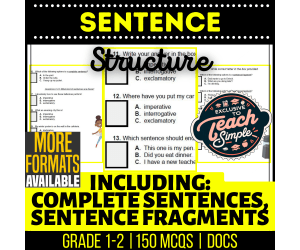
Sentence Structure Practice Questions - Grades 1-2 Grammar (Docs)
ELA, Language Development, ESL, Grammar, Common Core, Resources for Teachers, Grade 1, 2, Worksheets & Printables, Worksheets, Assessments, Teacher Tools, Tests, Quizzes and Tests, Centers, Activities
Sentence Structure Grammar Practice MCQS: 10 lessons, 150 MCQS, 43 pages ELA MCQS Overview: In this series of lessons, students will embark on an engaging exploration of the grammar skills that bring our language to life. These lessons are designed to help students identify, understand, and effectively use language arts skills in their writing and speech. Used with the free supplementary materials available for all topics, each lesson builds on the last, offering a mix of direct instruction, interactive group activities, and independent practice. Through fun and creative tasks, students will learn how to recognize grammar in sentences, understand their role in sentences and use them to enhance their own writing and speech. Sentence Structure Overview: Includes: Complete Sentences Sentence Fragments Subject of a Sentence Types of Sentence End Punctuation Docs Version This is the Docs editable and fillable version. This download is available in GOOGLE Docs, GOOGLE Forms, GOOGLE Slides. PDF, PPT, WORD, check the links below for more details. FULL CATALOG OF DOWNLOAD LINKS HERE Grade 1/2 Links: Capitalization and Punctuation Google Docs Google Forms Google Slides PDF PPT Word Free Supplementary Materials Pack Adjectives Google Docs Google Forms Google Slides PDF PPT Word Free Supplementary Materials Pack Nouns Google Docs Google Forms Google Slides PDF PPT Word Free Supplementary Materials Pack Pronouns Google Docs Google Forms Google Slides PDF PPT Word Free Supplementary Materials Pack Verbs Google Docs Google Forms Google Slides PDF PPT Word Free Supplementary Materials Pack Prefixes & Suffixes Google Docs Google Forms Google Slides PDF PPT Word Free Supplementary Materials Pack Sentence Structure Google Docs Google Forms Google Slides PDF PPT Word Free Supplementary Materials Pack Subject-Verb Agreement Google Docs Google Forms Google Slides PDF PPT Word Free Supplementary Materials Pack ELA Review Questions Overview Questions have three answer choices. There are a handful of pictures on each test for aesthetic purposes, as well as a review sheet covering most of the topics covered in the product. Introduction or Example Sheet Each topic will include an introduction or example sheet to go through first with your students. Full Answer Keys Full answer keys and sample responses are provided so no matter how busy you are, you know you're covered! In the Supplementary Pack Interactive Ice Breakers: Fun, hands-on activities that get students thinking about adjectives right from the start. Guided Practice: Teacher-led exercises that reinforce the day’s lesson, ensuring students can confidently identify and use adjectives. Group and Partner Tasks: Collaborative activities that allow students to work together to solve problems, categorize adjectives, and create descriptive sentences. Independent Worksheets: Structured worksheets that provide individual practice and help solidify understanding of key concepts. Exit Tasks: Quick, reflective activities at the end of each lesson that assess understanding and encourage students to apply what they’ve learned. For similar downloads and other frees, do check out Cored Group on TeachSimple.
Author Cored Education
Tags Elementary, Reading, Comprehension, Vocabulary, Answers, Ccss, Common Core, Spelling, Writing, Digital Centers
Algebra - Drill Sheets Gr. PK-2
Math, Algebra, Grade 1, 2, Worksheets & Printables, Worksheets
Algebra - Drill Sheets Gr. PK-2 An effective teaching resource for developing fundamental algebraic skills in early learners. Incorporating both warm-up exercises and timed drills ensure the promotion of procedural proficiency for students from prekindergarten to grade 2. Activities Designed for Basic Algebra Mastery Pattern-completion tasks Missing-number puzzles on a hundreds chart Solving addition and subtraction sentences with unknown numbers Comparing quantities using terms like 'more than', 'less than' or 'equal to' The worksheets also feature an exercise where children are guided to place numbers in descending order - giving them insights into real-life applications of numerical values. Adding complexity, they are introduced to the concept of ‘Fact Families’, where they learn how to find missing facts from a given set. An Opportunity Showcasing Team Work and Understanding Division Visually! A portion of these drill sheets hosts a group activity wherein books need to be divided into equal groups before students formally learn division as a concept. Niche Teachings with Wide Applications! This resource allows learning at varied paces accommodating flexible instruction approaches. Teachers can facilitate whole group lessons, break into smaller groups focusing on specific areas or assign portions as homework assignments enriching the overall learning experience! Incorporating state standards and meeting NCTM guidelines validate this materials educational quality. Evaluation Tools Aplenty! Inclusive within this easy-to-use PDF format file are reproducible drill sheets along with answer keys & review sections helping teachers gauge student comprehension throughout their academic journey.
Author Classroom Complete Press
Tags PDF
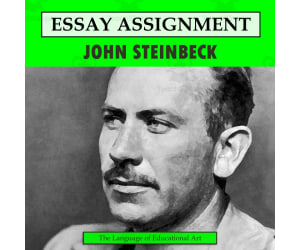
Research Organizer & Essay Assignment: John Steinbeck
ELA, Literature, Writing, Grade 8, 9, 10, 11, 12, Activities, Projects, Worksheets & Printables, Worksheets
Research Organizer & Essay Assignment: John Steinbeck Guide students to research the renowned author John Steinbeck with this complete 6-page essay assignment. Students first gather facts and sources about Steinbeck's life using the provided 2-page handout. Next, they organize their research by outlining a 5-paragraph essay. Finally, students write a draft, utilize the peer review checklist, and submit a final research essay that can be assessed with the included rubric. This resource scaffolds the research process and develops writing skills. Use the full lesson or just parts as a research activity or sub plan for grades 8-11. Includes color and B&W printable PDFs plus an editable Google Sheet rubric that integrates with Google Classroom to easily assign and assess.
Author The Language of Educational Art, LLC
Tags Essay, Rubric, Research, Notetaking, Outlining

Sentence Structure Practice Grammar Grade 5-6 (Presentable PDF)
ELA, Language Development, ESL, Grammar, Common Core, Resources for Teachers, Grade 5, 6, 7, Worksheets & Printables, Worksheets, Quizzes and Tests, Teacher Tools, Tests, Assessments
Sentence Structure Grammar Practice MCQS Snapshot Title: Sentence Structure Genre: Nonfiction Subject: Writing Primary Topic: Identifying and building complete sentence patterns The review sheet defines sentence fragments, sentence types, clauses, predicates, prepositional phrases, compound sentences, compound predicates, and complex sentences, and the worksheets ask students to identify these features in example sentences. What This Teaches Best Distinguishing complete sentences from fragments. Classifying declarative, imperative, interrogative, and exclamatory sentences. Identifying independent and dependent clauses. Recognizing predicates, prepositional phrases, and object complements. Telling apart simple, compound, and complex sentence structures. Learning Goals Students will identify whether a group of words is a complete sentence or a fragment. Students will classify sentences by type using punctuation and purpose. Students will distinguish between independent and dependent clauses. Students will find the subject, predicate, or prepositional phrase in a sentence. Students will identify whether a sentence is simple, compound, or complex. Key Vocabulary fragment — an incomplete sentence. declarative — a sentence that states a fact. interrogative — a sentence that asks a question. predicate — the part that tells what the subject does. Common Core Alignment CCSS.ELA-LITERACY.L.4.1.F — Produce complete sentences, recognizing and correcting inappropriate fragments and run-ons. CCSS.ELA-LITERACY.L.5.1.A — Explain the function of conjunctions, prepositions, and interjections in general and their function in particular sentences. CCSS.ELA-LITERACY.L.6.3.A — Vary sentence patterns for meaning, reader interest, and style. Sentence Structure Overview: Sentences Clauses Phrases Predicates Additional Practice PRESENTABLE PDF VERSION Run it like a slide show straight from a PDF, with no PowerPoint or extra software needed, just open, project, and teach. Other versions are available in the links list below or in the full catalog. FULL CATALOG OF DOWNLOAD LINKS HERE ELA Review Questions Overview Each set of review questions includes three answer choices, making them simple for students to work through with confidence. Every test also includes a few pictures to keep the pages visually appealing, along with a review sheet that covers most of the skills and concepts featured in the resource. Introduction or Example Sheet Each topic begins with an introduction or example sheet that you can review with your students before they start practicing. This helps set the stage, refresh key skills, and build understanding from the start. Full Answer Keys Complete answer keys and sample responses are included, so you can check work quickly and feel prepared even on your busiest days. In the Supplementary Pack Interactive Ice Breakers Fun warm-up activities help introduce important ELA skills, including quick capitalization fixes and punctuation challenges. Guided Practice Teacher-led practice activities give students support as they review grammar and punctuation rules and learn how to apply them correctly in sentences. Group and Partner Tasks Collaborative activities encourage students to work together to edit sentences, fix capitalization mistakes, and strengthen punctuation through discussion and teamwork. Independent Worksheets Targeted worksheets give students the chance to practice on their own, apply what they have learned, and build confidence with key skills. Exit Tasks Quick end-of-lesson activities help students reflect on their learning and show what they know through short writing and editing tasks. For More Like This For similar resources and other freebies, be sure to check out Cored Group on TeachSimple.
Author Cored Education
Rating
Tags Elementary, Answers, Ccss, Common Core, Grammar, Tests, Test Prep, Assessment, Grade 5, Grade 6
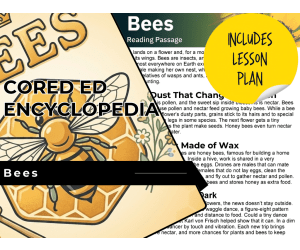
Bees Reading Comprehension Passage - Cored Ed Encyclopedia
ELA, Language Development, Reading Comprehension, Reading, Writing, Pre-Reading, Science, Insects, Life Sciences, Vocabulary, Grade 2, 3, 4, 5, Worksheets & Printables, Worksheets, Teacher Tools, Centers, Activities, Writing Prompts, Assessments, Quizzes and Tests, Quizzes, Lesson Plans
This bees reading comprehension with lesson plan includes: Visualization (on the front cover) Start your lesson by taking a minute to think and share something about the topic. Read the script aloud (slowly), perhaps prepare some music or sound effects. Student close their eyes and let their imaginations wander. Students open their eyes, read the question aloud and give them a few minutes to complete. Ask a few students to share or keep answers until the end to compare with what they learn in the passage. Quick pause—thousands of Cored Education products are included with your TeachSimple membership. Download links and encyclopedia index available here. Pre-Reading Trivia Students will write down one thing they already know about the subject and then read five more facts and discuss. These facts are fun, and the students will enjoy learning about the subject before reading more. Give 1 minute for students to write what they already know (no pressure—best guess is fine). Read the five facts together. After each fact, do ask a student for their opinion, was it surprising? Set a purpose by asking students to highlight/underline one fact they want to learn more about during the reading. Reading Passage The text is a high-interest reading passage with set paragraphs, roughly three to four paragraphs long. It contains a variety of themes about the topic, anywhere from history to technology. The passage is between 250 and 350 words in length. First, ask students to look at the headings and see what they’ll learn about today. What do they know about the topic/heading? First read options: Teacher read-aloud (best for support). Partner reading (paragraph by paragraph). While reading, students underline important details, and vocabulary words they think may come up in the questions section. Mixed Questions The first question page contains four multiple-choice questions, each with a choice of four answers, and three written response questions that require a sentence or two from the student. Students complete the mcqs first independently, then review quickly as a class. For the 3 written responses, try to get students giving the answer with some form of evidence: “I think ___ because the text says ___.” If students get stuck, send them back to check the passage. Vocabulary Questions Practice seven key words from the text in this section across two activities. First section is scrambled words where students will unscramble three words given a clue for each. The second section is a word to meaning matching activity. Before starting, have some students read out words they underlined in the passage. Ask students to say the word and read aloud the sentence(s) around each word. Ask students to do scrambled words and the matching exercise in pairs then go through answers as a class. For the scrambled spelling task, get four pairs to come up to the board and write the words for extra practice with the other student reading out the clue. For the matching task, prompt students to give full sentences: “I matched ___ with ___ because ___.” Creative Writing In this question, the student will be required to write a five to eight sentence paragraph on a question related to the topic. Before starting, ask students write down 3 key ideas they are going to include in their piece. Ask students for ideas to share around the class to help those struggling. Pro writing expectations: 5–8 sentences At least 2 facts or details from the passage At least 2 vocabulary words from the previous page Students read their paragraphs while classmates listen for facts and vocabulary words. Extension Activities This page is optional for fast finishers or to take home. There are several activities, each one requiring a different skill. Do some, do none, do all, completely optional - but you will feel reassured knowing every possibility is planned for. Includes summary writting question and additional facts. Answer Key There are answers for the multiple-choice questions, written response questions have sample answers, vocabulary answers and if there is a summary question then a sample summary will be provided as well. Lesson Plan Included Customized lesson plan for this lesson is included. Lesson Snapshot Title: Bees Genre: Nonfiction (informational passage) Subject: Life Science Primary Topic: Pollination, hive roles, and waggle-dance communication Estimated Guided Reading Level (A–Z): S What This Lesson Teaches Best Bees as insects with many kinds (more than 20,000) living almost everywhere on Earth except **Antarctica. How bees help plants make seeds by moving pollen from flower to flower while gathering nectar and pollen for baby bees. How honey bees live in organized hives with shared jobs (queen, drones, and worker bees doing specific tasks). How honey bees turn nectar into honey and store it for later as extra food. How the waggle dance can share direction and distance to food, supported by the work of Karl von Frisch. Learning Goals Describe where bees live and how many kinds the passage says there are. Explain how pollen gets from one flower to another in the passage. Identify what pollen and nectar do for growing baby bees. Describe how jobs are shared in a honey bee hive, including the queen, drones, and workers. Explain what the waggle dance communicates and how other bees follow it in a dim hive. Describe how honey is made and stored, using details from the passage. Key Vocabulary From the Text pollen — yellow dust that helps plants make seeds. nectar — sweet liquid inside blossoms. colony — a group of bees living together. larvae — baby insects before they become adults. vibration — shaking that can be felt as movement. FULL CATALOG OF DOWNLOAD LINKS AND ENCYCLOPEDIA INDEX HERE
Author Cored Education
Rating
Tags Vocabulary, Reading Comprehension, Reading Passages, Lesson Plans, Ela Lesson Plans, Reading Comprehension Lesson Plans, Pre-reading, Science Lesson Plans, Life Science, Insects