Adding Tenths + Hundredths – 4th Grade Fractions
- Grades
- Grade 4, Elementary
- Pages
- 11
- File type
- Preparation
- Print ready


- Subject
- Math, Fractions
- Topic
- math, fractions
- Resource types
- Worksheets & Printables, Worksheets
- Preparation
- Print ready
- Standards
- 4.NF.C.5
About this resource
What's inside this resource
For educators and homeschoolers searching for a complete way for students to become proficient with adding 1/10th and 1/100ths, this resource will be a valuable asset!
Designed with ease of use in mind, it offers no-prep scaffolded worksheets with and without visual support divided into 11 sets from ensuring a good foundation to challenges.
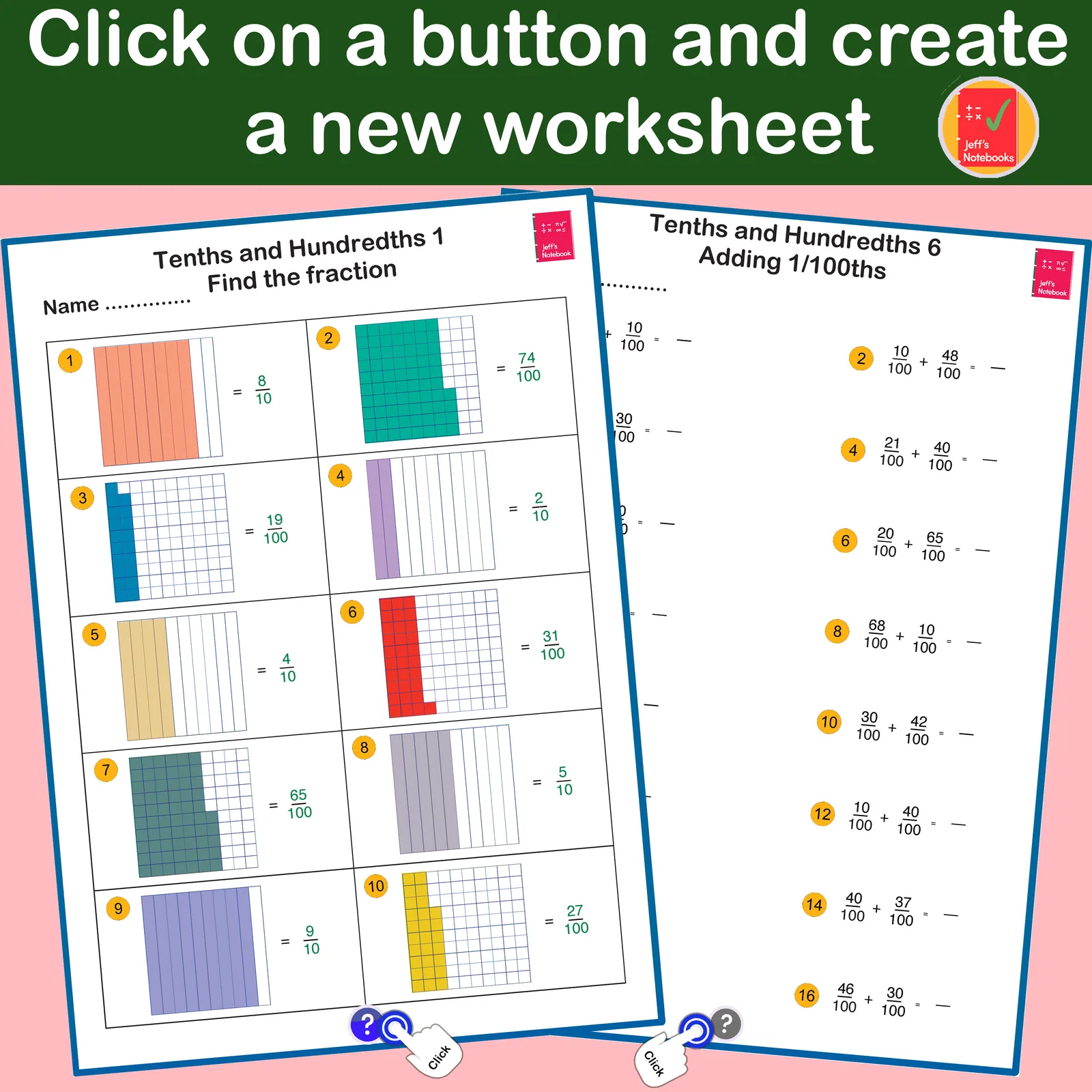
The first six sets provide practice for preparation for the core work. Using the visual model of squares divided into 10 and 100 parts, students are asked to:
find the fractions colored in (Set 1)
color in the fraction indicated (Set 2)
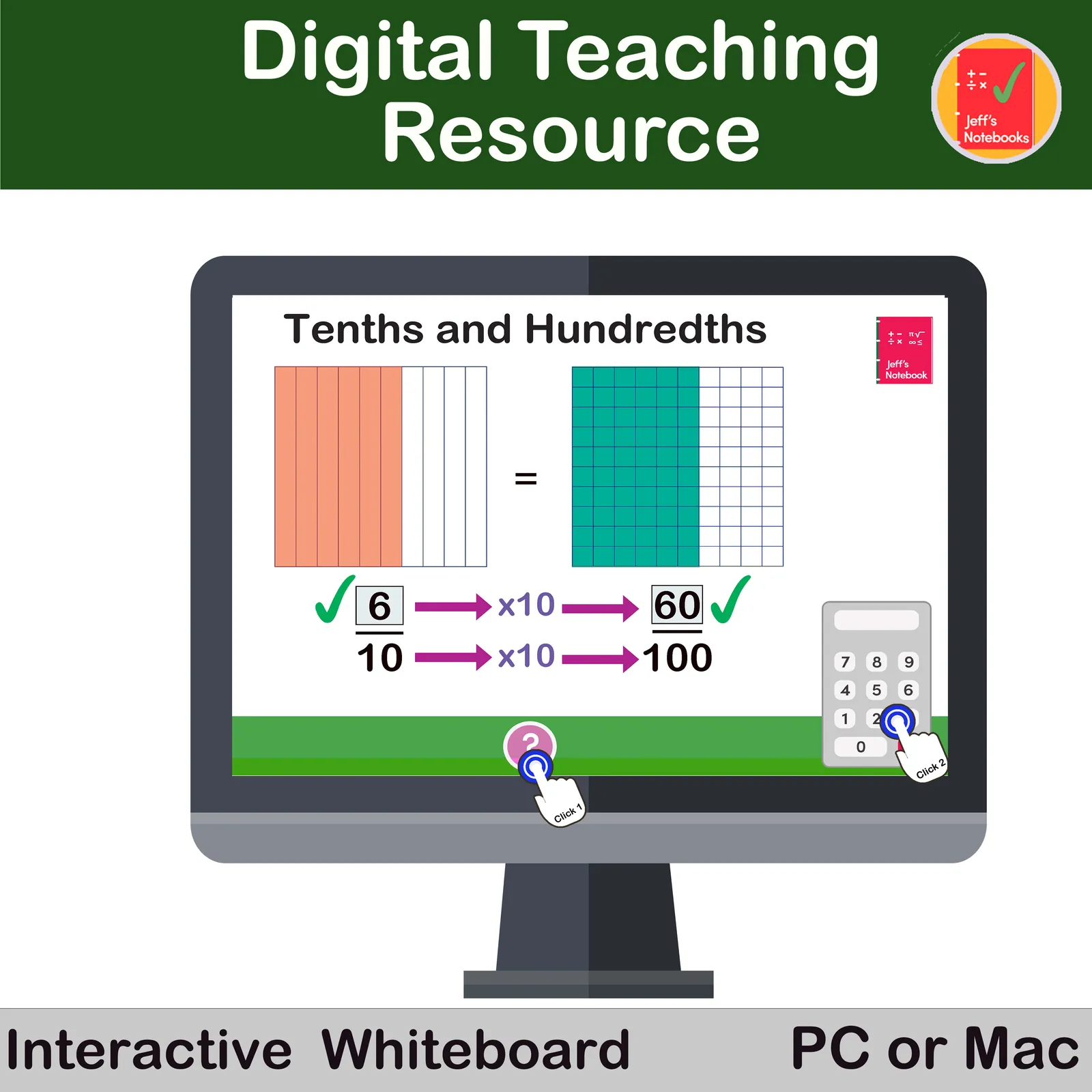
In Set 3 students practice looking for the visual connection between equivalent fractions given in 1/10ths and 1/100ths. Seeing 1/10 is the same as 10/100. is a pivotal point in the whole process.
There is a simple Teaching Page included in the pack which you can use at this points to show the connection between 10ths and 100ths both visually and numerically (multiplying numerator and denominator by 10) which will prepare your students for Set 4 which has purely numerical questions.
Sets 5 and 6 provide practice adding 1/100ths with and without visual support
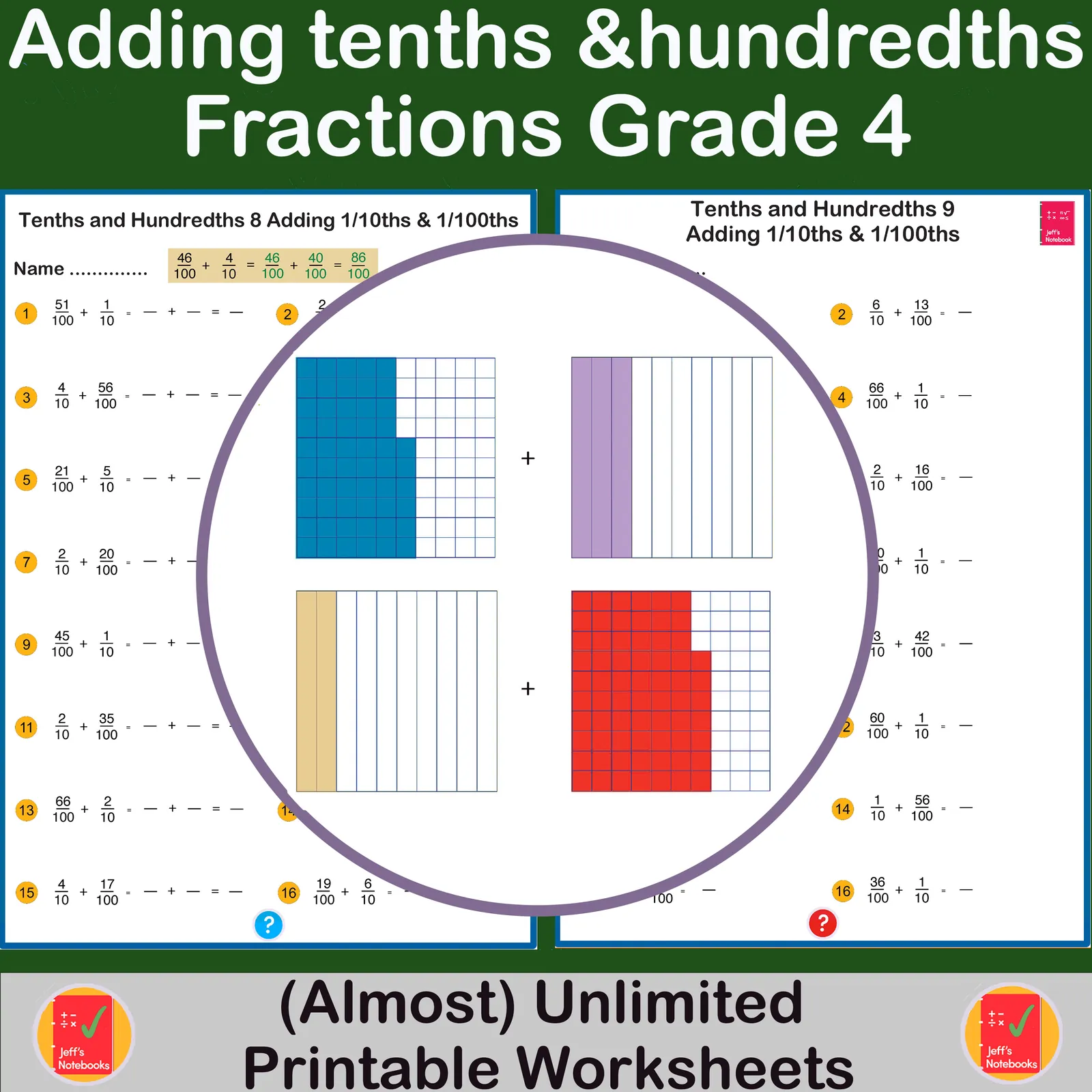
Sets 7, 8 & 9 are the core of the topic - adding a mix of 1/10ths & 100ths.
Set 7 - adding these fractions with visual support
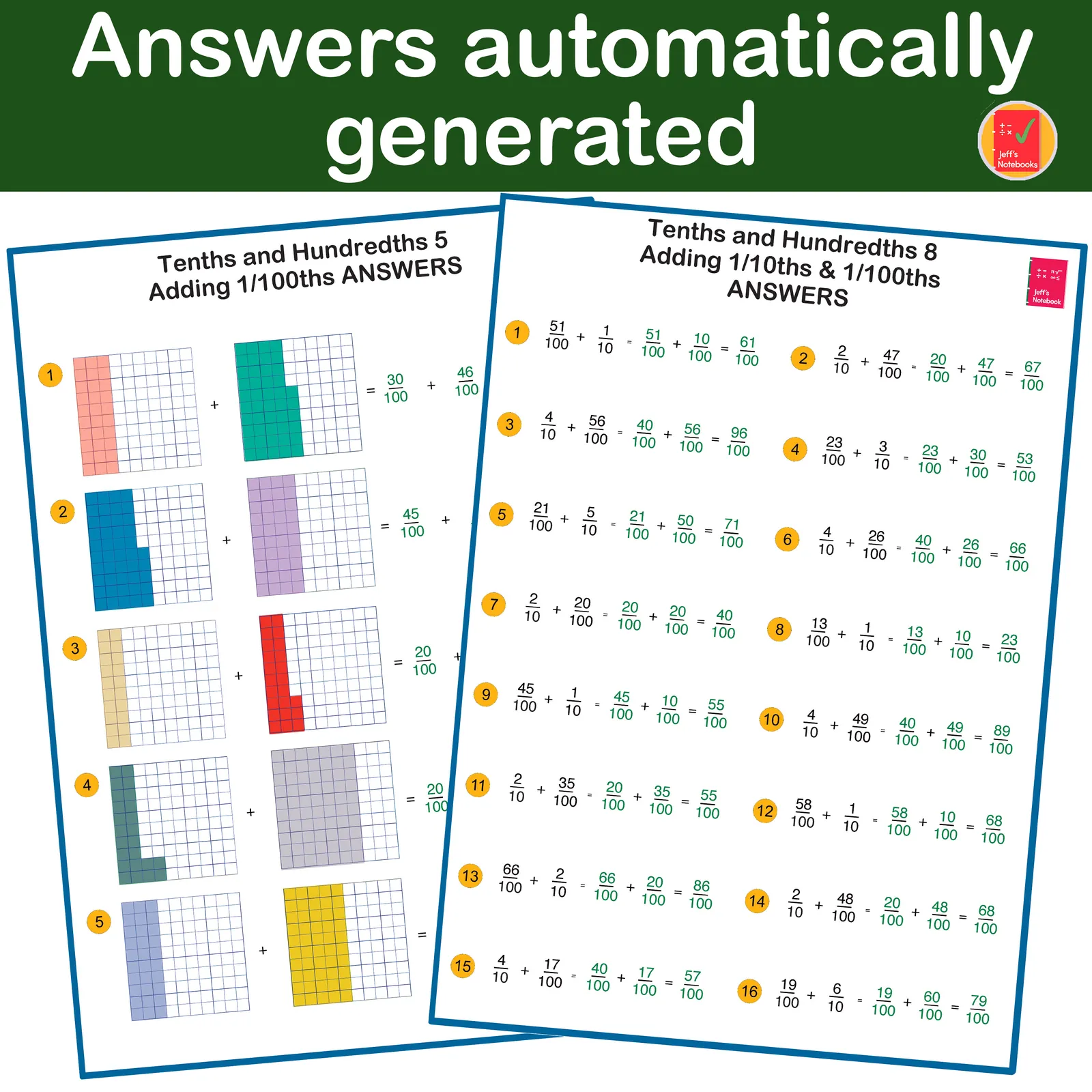
Set 8 - numerical questions with an intermediate step where students must show their conversion of the tenth fraction to a hundreth before adding
Set 9 - numerical questions
Challenges
For the students who mastered the above there are two extra sets of worksheets
Set 10 - adding 3 fractions with a mix of tenths and hundredths
Set 11 - equations with 3 fractions BUT students have to find the value of one of the addends.
How many worksheets in each set ?
As many as you need.
A standout feature is the worksheet randomization. With a single click, educators can generate an entirely new set of questions, making it a renewable resource for the entire school year. Be it for classwork, revision, or homework, adaptability ensures students achieve proficiency in the topic.
Each worksheet concludes with an automatically generated answer key on its second page, offering a quick reference point for educators. And if there's ever a need for a last-minute lesson or work for a substitute teacher, these sheets are a reliable fallback.
Lastly, it's essential to note that these resources can be downloaded as PDF documents. They operate seamlessly with the official Adobe Acrobat Reader on both Windows and Mac. Plus, the randomizing features are effortlessly accessible via touchscreen devices or interactive whiteboards.
Related resources
More resources teachers may find useful
24 related resources were found using this product's title, contributor, categories and tags.


In the classroom
Teaching tips & learning objectives

Learning objectives
Identify and represent a fraction of a grid divided into 10 or 100 equal parts, with and without visual support.
Convert a fraction with denominator 10 to an equivalent fraction with denominator 100 by multiplying the numerator and denominator by 10.
Add a mix of tenths and hundredths fractions after converting to a common denominator.

Teaching tips
Use the Teaching Page between Sets 3 and 4 to formalize, as a class, the pattern students notice when comparing shaded areas of tenths and hundredths grids before moving to numerical-only work.
Because every worksheet has a randomizing button, the same set can be reassigned throughout the year for extra practice or review without students seeing repeated numbers.
Move through the sets in guide order (1-2 recognition, 3-4 equivalence, 5-6 hundredths addition, 7-9 mixed addition, 10-11 challenges), since each set is described as preparation for the next.

Skills covered
Fraction identification and modeling — students find or shade fractions of tenths and hundredths grids in Sets 1 and 2.
Fraction equivalence — students connect 1/10 to 10/100 visually in Set 3 and numerically in Set 4 by multiplying numerator and denominator by 10.
Addition of fractions with denominators of 10 and 100 — students add hundredths-only fractions in Sets 5-6, then mixed tenths-and-hundredths fractions in Sets 7-9.
Good to know
Questions teachers ask about this resource
Do the worksheets repeat the same numbers every time they're printed?
No — every worksheet set has a randomizing button that generates a new set of questions with a click, so the same set can be reused throughout the year without repeating numbers.
What does the Teaching Page cover?
It shows, both visually and numerically, why converting a tenths fraction to hundredths means multiplying the numerator and denominator by 10 — the step students need before Set 4.
How are the two Challenge sets different from each other?
Set 10 asks students to add three tenths-and-hundredths fractions, while Set 11 gives the total and asks students to find one missing addend.

No reviews yet
Downloaded this resource? Tell other teachers how it went.
Curriculum
Standards, concepts & topics
Standards
 Standards
- 4.NF.C.5 — Express a fraction with denominator 10 as an equivalent fraction with denominator 100, and use this technique to add two fractions with respective denominators 10 and 100.4 For example, express 3/10 as 30/100, and add 3/10 + 4/100 = 34/100.
Core concepts
 Core concepts
tenths and hundredths
fraction equivalence
adding fractions
common denominators
 Topics
Explore more
Categories this resource belongs to
Explore related searches
More to explore
You may also like