



3,991 products added recently
Page 110 - 5th Grade Activities
Support your fifth graders as they prepare for middle school with activities that promote independence and higher-order thinking. These resources offer interactive lessons and projects that make learning relevant and exciting. Incorporate them to enhance understanding and enthusiasm in your classroom.

 Show filters

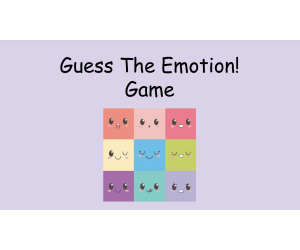
Guess The Emotion! SEL Game
Special Resources, Life Skills, Grade 3, 4, 5, Activities, Games
In this product, you will get instructions and 32 different feeling cards that are a part of a "guess the emotion" game. Each group will receive a stack of cards with an emotion written on it. On the cards students will be given the directions to either act out, draw, fill in the blank (like Hangman), or sculpt to express a feeling. The Google Slides will explain directions as well as contain the 32 cards on 8 slides. Materials needed: Small bit of clay such as play doh or clay. Dry erase board or paper, dry erase marker or pencil. Have fun! Once you download the pdf, click on the image and it will prompt you to make a copy, click "yes" and you will have access to my slide presentation. This game is beneficial for students to increase their social emotional learning. It is great for them to regulate and express their emotions in a friendly manner. The emotions included in this game are: Angry Peaceful Surprised Happy Shy Worried Chill Shocked Energetic Proud Scared Disappointed Bored Tired Excluded Annoyed Silly Grateful Relaxed Furious Embarrassed Grumpy Guilty Left Out Confident Hopeful Stressed Nervous Disgusted Awkward Brave Loved
Author Jennifer Moyer Taylor
Tags Feelings, Social-emotional Learning, SEL, School Counseling, Emotions, Special Education, Game, Guess The Feelings, Guess The Feeling
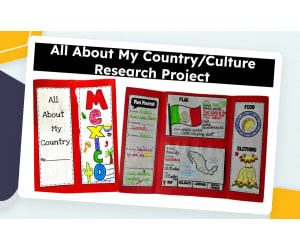
All About My Country Project
Social Studies, Geography, Grade 3, 4, 5, Activities, Projects
Introduction- This is a My Culture/Country Project that your students will love making. This activity will allow students to creatively research and display information about their country and or culture. These make great displays on your bulletin boards or can also be used as a presentation project. In addition, students can work on this activity during class or it can be assigned as a take home project. This is a fun way for students to show what they know, as they write about traditions, famous people and more! Order, Outline and Steps- very simple, just print and go! Helpful to model how to put the parts together for students before they get started so they have an idea of how to do it themselves. Grades or Ages- can be used from 2nd grade to upper 4/5th grades. Implementation Format- can be implemented during special culture days celebrated or research projects in social studies class. You may also assign countries to students or this can be completed any time you are studying a new country. How to use and Variations- this can be used at any time of the school year, especially during "international/culture week or day" at school. This activity takes a few lessons/days to complete. File Types- this file comes as a PDF that can be printed on a standard sheet of 8.5"x11' paper. Total Number of Pages- 12 pages are included Project Focus Areas: Country Flag- section to draw and write about the country flag, colors, symbols, and meaning of the flag. Country Food- a plate to draw some food Country Clothing- section to draw some traditional country clothing Country Map- includes area to daw the country, population, and size Holidays Famous Landmarks Famous People/Person Fun Facts Language Currency Climate Important products produced
Author CraftEdPrints
Tags Social Studies Project, Geography, All About My Country, Traditions, Holidays

Ornithology: The American Robin - Research Project
Science, Life Sciences, Animals, Research, Grade 4, 5, 6, 7, Activities
Ornithology: The American Robin - Research Project Students dive deep into ornithology research with this science project on the American Robin. Working independently or in small groups, fourth through seventh graders use textbooks, encyclopedias, or reputable websites to discover facts about the robin's physical characteristics, habitat, reproduction, behavior, migration patterns, and more. They record their findings in an organized chart included in this 3-page PDF. Teachers can allow creative presentation options like posters or slideshows while still collecting the completed research chart. This project facilitates rich discussion and learning about the robin’s unique traits and survival adaptations. It's an engaging way to meet science standards on conducting research, collecting and analyzing zoological data, and communicating evidence-based explanations.
Author THE LANTERN OF KNOWLEDGE
Tags Research Project, American Robin, Ornithology, Birds, Classification

Lava Activity
Science, Earth and Environmental Sciences, Earth Sciences, Environmental Science, Grade 3, 4, 5, 6, 7, 8, 9, 10, Activities
Activity Introduction An amazing activity designed for the students to learn more about natural disasters in different countries. Lava What do you know about this natural disaster? Do you know in which part of the world this could happen? Have you ever read about the safety misusers that we could have to protect ourselves from this natural disaster? If yes, can you tell us more about them? Can you name other natural disasters? If yes, tell us more about where they are likely to happen? And how frequently? Do you like reading about Geography? What is your favorite country in the whole world? If you are going on a trip where it will be? Which country? What you are going to see there? Does this country has a famous place to visit? Do you like reading about Geology? If yes, what is your favourite topic? Lava Activity The activity is perfect for encouraging the researching skills for the students, while learning more about this fantastic place. Lava This friendly designed worksheet is suitable for students at school, homeschooling, and as a group activity. Instructions Where does lava come from? Colour the parts where it comes from the Earth's layers, then write down how lava is formed. Format Available in a PDF format.
Author Educational Voice
Tags Lava Activity, Lava, Lava Facts, Lava Facts For Kids, Natural Disaster, Natural Disasters, Natural Disaster Facts, Natural Disasters Facts For Kids, Volcano , Volcano Facts

Japanese Fans & Tanka Poems – Art + Poetry Activity
Creative Arts, Art, Social Studies, History, History: Asian, History: World, Grade 5, 6, 7, 8, 9, 10, Activities, Projects
Teach your students about both the beauty of Japanese fans but also the Tanka poem form. Students work to create their own simple poems and then create and decorate their own fans to be displayed in class. Always a favorite activity in my own classroom and I hope yours as well.
Author Mr Gray History
Rating
Tags Japan, Japanese, Japanese Fans, Types Of Japanese Fans, Japanese Fans History
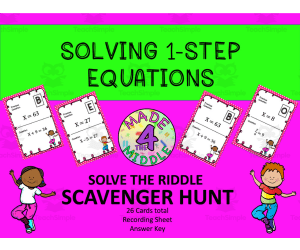
Math Scavenger Hunt: Solving 1-Step Equations
Math, Algebra, Grade 4, 5, 6, Activities
This is a Math Scavenger Hunt: Solving 1-Step Equations that will challenge your math students in a fun way. There are 26 cards printed 2 per page. The letters on each card will spell out the answer to a riddle. A recording sheet is included for students to write their answers An answer key is included.
Author Made 4 The Middle
Tags 1-step Equations, Algebra, Riddles, Scavenger Hunt, Task Cards
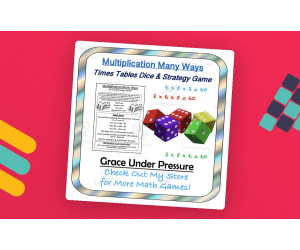
Times Tables Game: Multiplication Strategies & Commutative Property
Math, Fact Families, Multiplication and Division, Division, Grade 4, 5, 6, 7, Activities, Games
Here's a quick and easy activity to practice multiplication facts, multiplication strategies, and the commutative property. Full instructions are provided. All students need are 6- or 10-sided dice and scrap paper or a whiteboard! Instructions: Here’s a fun way to practice multiplication facts with a friend. Roll several dice. Your job is to multiply the numbers in as many creative ways as you can. You and your partner take turns thinking of a new way to multiply the numbers. A player gets a point when their partner can not think of another way. Sample Game: Sue and Max are playing the medium level. They roll a 6, a 5, and a 2. Sue: 5x2 = 10x6 = 60 Max: 6x5 = 30x2 = 60 Sue: 6x2 = 12x5 = 60 Max might give up and Sue gets the point. Or, he could get creative and say 6x5 is the same as 5x5+5 = 30x2= 60 Then Sue might give up and Max gets the point. Grades to Use With: This game is a great way to practice multiplication facts in the intermediate and middle school grades (4-9). It could also be used in high school special education or in a grade 2/3 enrichment program. Standards: CCSS5.NBT.B.5 Fluently multiply multi-digit whole numbers using the standard algorithm. If you enjoy this product, check out some of my other math activities: Perimeter of Complex Shapes Strategy Game Area of Triangles, Parallelograms, and Trapezoids: Jigsaw Journal Activity 20 Middle School Math Journals for the Whole Year! Financial Literacy: My Party Budget Math Matching Games: 8 Sets of Math Fact Cards Theoretical and Experimental Probability: Hands-On Math Task with Fractions and Percentages Math Project: Circle Graphs and Pie Charts And more! What is Included: 2 Page PDF: Teacher Page and Student Instructions with Sample Game
Author Grace Under Pressure
Tags Times Tables, Math Facts, Multiplication, Multiplication Game, Math Game, Dice Game, Commutative Property, Math Strategy, Multiple Methods
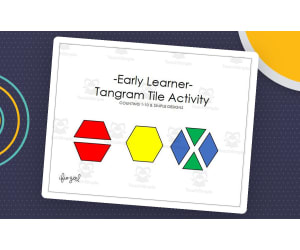
Tangram Tile Activity
Special Resources, Special Education Needs (SEN), Math, Patterns, Early Math, Geometry, Science, Basic Science, Kindergarten, Preschool, Grade 2, 3, 4, 5, 6, Activities
The Tangram Tile Activity : An Effective Teaching Resource The Tangram Tile Activity is a robust educational tool aimed at learners from Preschool to Grade 6. Designed for both public school and homeschooling environments, this activity uses tangram puzzles to engage learners in interactive learning. Main Objectives Spatial reasoning: By working with various shapes, students gain an understanding of the interplay between spaces and shapes. Problem-solving: Assembling the tiles into specified designs challenges learner's logical thinking and creativity. Creativity: Tiles arrange into unique patterns enhancing students' imaginative thinking and self-expression skills. Critical Thinking Skills: Understanding each shape's relationship with other pieces requires analytical skills and promotes critical thought process. Add-on Benefits Tangram activities help improve hand-eye coordination as they require precise motor skills for arranging them correctly. They are valuable aids when teaching geometry, basic science, and promoting creativity within learning groups. Specially Designed for Early Learners This particular set escalates from simple compositions to more complex ones introducing beginner-level participants smoothly into these creations’ engaging world. Tiles are well-spaced making it easier for students facing challenges related to motor functions or visual interpretation issues. Besides having a counting exercise which allows enumeration practice from one through ten, there also 19 patterned-design cards ranging levels catering perfectly across different abilities ensuring progress at every step. These printable activities in PDF format can be used flexibly as individual homework assignments, small group workshops or as a comprehensive classroom resource.
Author IFIO girl - I'll Figure It Out
Tags Tangram Puzzles, Spatial Reasoning, Problem-solving, Creativity, Critical Thinking

Magnets and Electromagnets 42 Question Board Game
Science, Physics, Grade 5, 6, 7, 8, 9, Activities, Games
With 42 question cards on permanent magnets and electromagnets this is an enjoyable and challenging board game for up to six players per set. It is suitable for all abilities. It can be played at the end of a module on electricity and electromagnets but is also a very useful test prep tool. This game is so much fun, pupils will forget they are learning! What You Get Game board (color and black and white) 42 question cards with questions of varying degrees of difficulty Answer sheet Instruction sheet. Rules for Play The player who throws the highest score starts and play proceeds in a clockwise direction. Students take turns and work their way around the board following the instructions in the squares. Some squares tell the student totake a question card from the face down pile. If correct they move on 2 spaces. If a player thinks an answer given by an opponent is incorrect they can challenge. If the challenge is correct the challenger moves forward 2 spaces. If the challenge is wrong the challenger moves back two spaces. In the event of a challenge, pupils are encouraged to consult their books but the teacher has a quick-check answer sheet. Prior Knowledge Required Composition of Magnets: Magnets are constructed using magnetic materials. Common materials include Iron, Cobalt, Nickel, and their corresponding alloys. Pole Interactions: Magnets have two types of poles - North and South. When two like poles (e.g., North and North) come close to each other, they repel. Conversely, when opposite poles (e.g., North and South) are brought together, they attract each other. Magnetic Fields: Surrounding every magnet is an invisible force field known as the magnetic field. This field can be visualized through field lines. Field Line Density: The density of these field lines determines the strength of the magnetic field. A region with closely spaced field lines indicates a stronger magnetic field than a region where they're spread out. Visualization of Field Lines: It's essential to understand and recognize the pattern of field lines around two bar magnets, especially when they have the same or opposite poles facing each other. Field Strength at Poles: The magnetic field is strongest at the poles of a magnet due to a higher concentration of field lines. Distance and Field Strength: The strength of the magnetic field diminishes as one moves farther from the magnet. Direction of Field Lines: Field lines emanate outward from the magnet's south pole and point inward toward the north pole. Magnetization Process: When a non-magnetized magnetic material becomes a magnet, the tiny regions within it called domains, which were initially oriented in random directions, align themselves to point uniformly in the same direction. Earth's Magnetic Properties: The Earth behaves like a large magnet. Interestingly, there appears to be a south-type magnetic pole near the Earth's geographic North Pole and a north-type magnetic pole near the Earth's geographic South Pole. Application in Devices: It would be beneficial to have a basic understanding of how magnets and magnetic fields operate within certain devices. Familiarize yourself with the structure and functioning of electric bells, relays, and circuit breakers, as they use these principles. See more Elf Off the Shelf resources on this topic and many others. Revisit attraction and repulsion with this magnetic poles investigation .
Author Elf off the Shelf Resources
Tags Magnets, Electromagnets, Magnetic Materials, Magnetic Fields, Earths Magnetism , Electric Bell, Electric Relay, North And South Poles, Magnetic Fileld Lines, Magnetism Game

Make Your Own Pendulum Activity
Science, Physics, Grade 3, 4, 5, 6, Activities
This is a Make Your Own Pendulum Activity. This printable will give students information about pendulums and then provide instructions for how they can make their own.
Author Elementary Resources 4 U
Tags Physical Science, Pendulum, Science Project, Science Activity, Physics, Gravity, Force, Motion, Vocabulary, Time, Can You Make Your Own Pendulum, Making Pendulums, How To Make Your Own Pendulum, Make Your Own Pendulum

Roll & Respond-Kelso's Choices SEL Bingo Game (Grades 3-5)
Life Studies, Grade 3, 4, 5, Activities, Games
In this Roll & Respond game , students in grades 3rd-5th will have fun discussing Kelso's Choices and trying to earn a BINGO with a partner. The students need 2 dice to play. One student will roll for the "down" side and the other student will roll for the "across" side. Each time they land on a question, they read it out loud and discuss it together. This is a great reinforcement activity after reviewing Kelso's Choices with older elementary students.
Author Jennifer Moyer Taylor
Tags Kelso's Choices, Social-emotional Learning, Sel, School Counseling, Special Education, Bingo, Conflict Resolution, Relationship Skills, Social Skills, Kelsos Choices
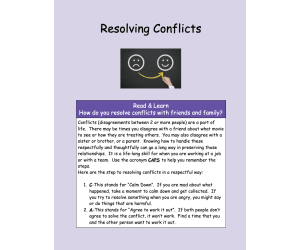
Resolving Conflicts -An SEL Hyperdoc
Special Resources, Life Studies, Life Skills, Grade 4, 5, 6, 7, 8, 9, Activities
Resolving Conflicts – An SEL Hyperdoc: A Dynamic Digital Learning Tool This is a brilliant multi-faceted teaching tool created to guide students ranging from Grade 4 to 9 through the fundamentals of conflict resolution. It's tailored for special resources and life studies subjects with a focus on building life skills. Key Features Read & Learn: This section kickstarts the learning journey by providing informational resources such as Videolink and Brainpop videos and an engaging article. Explore: Interactive learning is propelled in this segment, making it ideal for remote classes or individual assignments. Think & Respond: Offering a space for learners to illustrate their understanding directly within the document, aiding educators in progress evaluation. Apply: Here, students are prompted to apply what they've learned by proposing solutions to realistic scenarios. The hyperdoc adapts well to both large-scale class instruction and smaller study groups. It also bears scope for customization by educators which helps align the content with their school ethos or regulations. Thus making education more personalized and relatable.` Note: The document comes as a PDF file hosting an integrated Google doc link so it can be conveniently shared across various platforms. Please remember , prior distributing tasks from this hyperdoc publically, go through all linked google docs inside the original hyperdoc ensuring smooth dissemination among pupils. To Conclude... In essence, Resolving Conflicts – An SEL Hyperdoc fosters simplified instruction while honing student's conflict resolution prowess - Definitely worth an addition into your educational resource toolbox!
Author Jennifer Moyer Taylor
Tags Conflict Resolution, Social-emotional Learning, Digital Tool, Interactive Learning, Critical Thinking
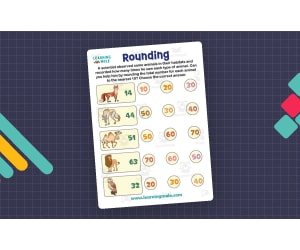
Rounding Down Activity
Numbers, Early Math, Math, Patterns, Basic Operations, Grade 1, 2, 3, 4, 5, 6, 7, Activities
Activity Introduction An amazing activity designed for the students to learn more about STEM. Rounding Down Do you like STEM subjects? what is your favorite one? Have you ever tried to plant a seed? If yes, tell us more about it. Or have you ever tried to invent something? If yes, tell us more about it. And how do you think it will help us? Have you ever seen a microorganism under a microscope? What was it? And how it looked like? Mathematics is a marvelous subject. Let' sharpen our brains and solve some equations. Do you like timetable tricks? What is your favorite one? Do you know how to code? Have you ever created an app or a game before? If yes, how was it like? Rounding Down Activity The activity is perfect for encouraging the researching skills for the students, while learning more about this fantastic topic. Rounding Down This friendly designed worksheet is suitable for students at school, homeschooling, and as a group activity. Instructions A scientist observed some animals in their habitats and recorded how many times he saw each type of animal. Can you help him by rounding the total number for each animal to the nearest 10? Choose the correct answer. Format Available in a PDF format.
Author Educational Voice
Tags Rounding Down Activity, Rounding, Rounding Activity, Rounding Facts, Rounding Facts For Kids, Maths, Math, Math Facts, Math Facts For Kids, Math Activity
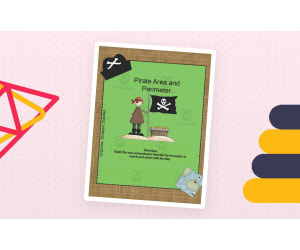
Area and Perimeter Pirate Activity
Math, Measurements, Grade 3, 4, 5, Activities
If you want to give math students extra practice with area and perimeter, I have just the resource for you! What You Get: This is an Area and Perimeter Pirate Activity that was designed for upper elementary students who have learning or are reviewing this skill. This resource is a 9-page printable . How To Implement This Resource: You will print off the word problem cards and the answer “ships” and laminate them. You will also print off enough recording sheets for all students. There are 6 pirates that students will need to match to the correct ship. There are 2 cards per page. When students have been introduced to area and perimeter, they’ll be ready to complete this activity. Students will have fun solving the problems and matching the ships. This is great for an independent activity or in small groups. Answer key included. I hope you enjoy! Here are more of my resources for you to enjoy: Total Solar Eclipse Worksheet Recognizing Fractions Worksheet Long U Matching Puzzle 1.OA.5 Common Core Math Lesson Point of View Activity Rounding to the Nearest Hundred Thousandth Worksheet You can find more resources at my storefront here: Have Fun Teaching
Author Have Fun Teaching
Tags Math Activity, Pirate Activity, Finding The Area, Finding The Perimeter, Measurement, Measuring Activity, Math Task Cards
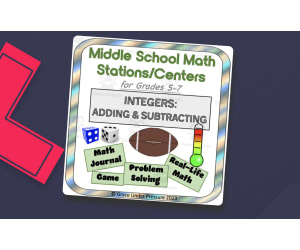
Middle School Math Stations or Centers: Adding and Subtracting Integers
Math, Number Lines, Addition and Subtraction, Subtraction, Measurements, Grade 4, 5, 6, 7, Centers, Activities
Math stations are a great way to get students engaged as they move about the room and work collaboratively with their peers. But they are a lot of work to prepare! This ready-to-go set of 5 stations will supplement a unit about adding and subtracting integers. Ways to Use: You can break your class into 5 groups and have them rotate one at a time through the centres, giving them 10-20 minutes at each one. Or, start students at certain centres and then allow them to move around at their own pace as long as no one centre gets too full. I find these are a great resource as you are finishing your unit and preparing for the unit test. Station 1: Students solve four realistic word problems using integers. (optional: set out white boards for students to use) Station 2: Students play a dice game to practice adding and subtracting integers. (supplies needed: 2 dice per pair- they must be different in some way so one can be + and one can be -) Station 3: Students compare temperatures in two cities (in degrees Celsius) and create a number line. Online game extension. (supplies needed: laptop or tablet) Station 4: Students use integers to decide if a football team would score a touchdown based on 8 plays. Station 5: Students do an integer drill and explain their thinking about integers in words. Grades to Use With: These stations will work well in grades 4-7 or high school special education classrooms. Standards: CCSS6.NS.C.5 Understand that positive and negative numbers are used together to describe quantities having opposite directions or values (e.g., temperature above/below zero, elevation above/below sea level, credits/debits, positive/negative electric charge); use positive and negative numbers to represent quantities in real-world contexts, explaining the meaning of 0 in each situation. If you enjoy these math stations, check out my other packs of 5 stations each for intermediate and middle school math classrooms: 5 Math Stations for Factors, Multiples, Prime and Composite 5 Math Stations for Decimals and Percent 5 Math Stations for Early Algebra
Author Grace Under Pressure
Tags Math Stations, Integers, Adding And Subtracting Integers, Number Lines, Math Games, Math Centers, Math Centres, Negative Numbers, Word Problems, Temperature
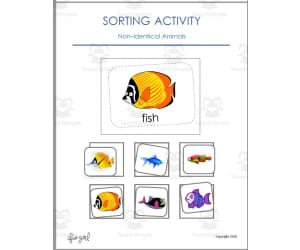
Sorting Activity: Animals - Non-identicals
Special Resources, Special Education Needs (SEN), Math, Early Math, Science, Basic Science, Preschool, Grade 1, 2, 3, 4, 5, 6, Activities
This downloadable PDF is an educational activity that involves sorting non-identical animals. Why we teach sorting and grouping - Sorting and grouping are important skills for young children to learn because they lay the foundation for many other important academic and life skills. Sorting and grouping involve categorizing objects based on common attributes such as color, shape, size, and function. These skills help children to understand and make sense of the world around them. This activity begins by presenting the learner with two large cards, one depicting a dog and the other a cat, to introduce the two animal categories. Then, the learner is given 12 smaller cards, 6 with different pictures of a dog and 6 with different pictures of a cat. The task is to sort the smaller cards into two piles, one for dogs and the other for cats, based on the animal depicted in the picture. The learner is encouraged to observe and compare the pictures to identify the distinguishing features of each animal and group them accordingly. As the learner progresses, the activity can be made more challenging by introducing pictures of animals that are similar such as a horse and a cow, to test their ability to differentiate between similar but unrelated objects. This activity can be used to promote several learning outcomes- visual discrimination classification critical thinking skills It is also a fun and engaging way for learners to explore and learn about different types of animals while practicing essential cognitive skills. This activity was created to be an activity book. However, feel free to print and create to fit your needs. This is a ten-page book with twenty different animals to sort. The different animals can be switched out and rearranged on the different pages to fit the individual learner. Enjoy IFIO girl I'll Figure It Out Extend animal matching to other familiar groups with this picture categories worksheet . Begin with identical animal picture matching before moving to pictures that look different.
Author IFIO girl - I'll Figure It Out
Tags Animals, Non-identicals, Sorting, Visual Discrimination, Problem Solving, Ablls-r, Tasked Based Teaching, Classification, Critical Thinking Skills, Catagorization

Cloud Cut Outs
Science, Earth and Environmental Sciences, Earth Sciences, Creative Arts, Art, Preschool, Kindergarten, Grade 1, 2, 3, 4, 5, 6, Activities
These Cloud Cut Outs are perfect for classroom decoration or student activities . They are quick and easy to use, and will help your students learn and have fun at the same time.
Author Have Fun Teaching
Tags Water, Weather
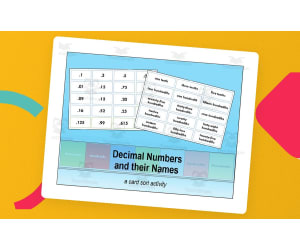
Decimal Numbers and their Names Card Sort Activity
Math, Decimals, Grade 3, 4, 5, 6, Activities
Decimal Numbers and their Names – to Thousandths Learning to say a number’s proper name is an important step in understanding place value. When a student sees .1, it can be read it as “point 1” but does the student know what that means - that is represents “one tenth?” This material can be used as a card sort or memory game where the decimal number is matched to the corresponding place value name (e.g. “five tenths” and “.5” are a match). The purpose is to practice saying the decimal number’s name and be able to associate the words with the number. Encourage the student to read the number as if it were a whole number and then say the decimal place value of the last (right-most) number. For example, .25 would be read as “twenty five hundredths.” When adding whole numbers, remind students that the decimal point is read as “and.” For example, 2.13 would be read as “two and thirteen hundredths.” Material includes: • Decimal place value strips with numeric values and place value names (to be used as a reference for the card sort or memory game) • Three sets of differentiated number/name cards – each set is increasingly more challenging by adding another place value or whole numbers o Set 1: 15 numbers and corresponding name cards in tenths and hundredths places o Set 2: 15 numbers and corresponding name cards in hundredths and thousandths places o Set 3: 15 numbers and corresponding name cards with whole numbers and tenths, hundredths, and thousandths places o Two versions of each of the three sets is provided black and white colored – each set has a different color border • Recording sheet • Blank cards (a few extra cards for students to create their own numbers and write the names, or challenge a friend to do so) • Answer key Instructions The cards can be used for one of the activities below, or however you or your students imagine! It is recommended that the cards be printed** on cardstock and then laminated before use. **Note: These cards are intended to be printed in landscape mode. Please make sure to set your printer settings accordingly. Card Sort (for review or assessment ) 1. Set out each column header card (Decimal Name, Decimal Number). 2. Sort the remaining cards under the appropriate column label, with the number next to the matching name. 3. Check the work using the included answer key (last page of the document). 4. Record the information in a math journal, or the included recording sheet, if desired.
Author Virtually Montessori
Tags Math Activity, Math Cards, Decimal Numbers, Decimal Names, Decimal Activity, Card Sort, Sorting Activity, Value Sort Activity, Decimal Names
Math Order of Operations Halloween Escape Room
Math, Order Of Operations, Grade 5, 6, 7, Escape Room, Activities
Looking for an exciting and hassle-free way to review order of operations with your fifth graders this Halloween? Look no further! This Halloween-themed digital math escape room is here to make learning a spooktacular adventure. With 20 thoughtfully crafted problems featuring parentheses and no exponents, this escape room is designed to engage your students' mathematical minds while they help a little zombie find their way back to the cemetery. It's an educational journey that's both fun and challenging, perfect for keeping your students motivated and focused. One of the standout features of this escape room is its flexibility. Students can tackle it at their own pace and even spread it over different days. All they need to do is save the address at the top of the page, and they'll seamlessly pick up where they left off. This adaptability ensures that your students can fit the escape room into their schedules without any stress. But that's not all; I've also included a printable version of the questions for those who prefer a hands-on approach. Whether you're in a digital or traditional classroom, I've got you covered. To make your life as an educator easier, solutions are included for your convenience. No more time spent double-checking answers; it's all there for you. The best part? This escape room is 100% online with interactive pages, meaning there's absolutely no prep required on your end. No more configuring locks or hiding clues—everything your students need is right at their fingertips. You can simply provide the link, and they're off on their math adventure. And here's the icing on the cake: NO Google Classroom or Microsoft Teams logins are necessary. We've made it as straightforward as possible for you and your students to dive right in and get the most out of this activity. You can use this escape room in various ways: ★ As additional materials for remediation to reinforce key concepts. ★ As a rewarding "Fun Friday" activity to keep your students engaged. ★ Before the busy holiday break to maintain their math skills. ★ As a handy emergency sub-lesson plan that ensures learning never stops, even in your absence. So, if you're seeking an engaging, Halloween-themed math activity that's easy to implement and highly effective, this digital escape room is the perfect choice. Your fifth graders will love the challenge, and you'll love the convenience it brings to your teaching toolkit. Don't miss out on this opportunity to make learning math a thrilling adventure this Halloween!
Author Matemaths
Tags Matemaths, Order Of Operations, Digital, Escape Room, Halloween
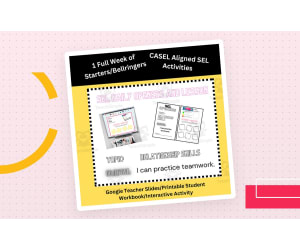
Teamwork | SEL Daily Openers/Bellringers and Weekly Activity
Special Resources, Social Emotional Learning (SEL), Social Skills, Life Skills, Grade 3, 4, 5, 6, Activities
Teamwork | SEL Daily Openers/Bellringers and Weekly Activity This vital teaching resource focuses on a critical skill - teamwork. Targeted at grades 3 to 6, it boosts social-emotional learning (SEL), social skills, and life skills through captivating daily activities and a coherent weekly lesson. Students kick off the day with a structured ten-minute session using their no-prep workbook. Teachers showcase the corresponding slides, instigating thought-inducing discussions about teamwork and allowing mental health check-ins. The connection between teachers and students gets nurtured right from the start of the day, intertwining essential SEL skills into regular routines. The unique feature of this product lies in its dual delivery style: bellringers' daily exercise along with an elaborate weekly activity . These are tied together under one umbrella theme - Teamwork. The weekly lesson enables an immersive exploration into relationship building for students under the aim 'I Can Practice Teamwork'. You can implement this handy aid across various setups; during whole group instruction or smaller group interaction - even as self-directed homework assignments! Included Materials: Detailed teacher slides (PDF & Google Slide Deck versions) arranged for each weekday, A printable student workbook including five daily tasks plus title slide options (color & b&w). A fun printable book/ activity designed to enhance teamwork amongst children -available in full-page & half-page formats. This resource does not promise miracles nor extraordinary outcomes; however, it offers a vibrant pathway for educators aiming to integrate SEL smoothly into everyday classrooms. It empowers students to tackle life's hurdles by building meaningful relationships and effective teamwork skills.
Author Mrs Bonie Just Teach
Tags Teamwork, Social-emotional Learning, SEL Skills, Daily Openers/bellringers, Weekly Activity

World Cerebral Palsy Day Word Search 2rd 3th 4th 5th Grade worksheet
Language Development, ELA, Vocabulary, Spelling, Social Studies, Grade 2, 3, 4, 5, Games, Activities, Word Searches, Worksheets, Worksheets & Printables
Celebrate World Cerebral Palsy Day with this informative Word Search! 💙 Students will learn about vocabulary that relates to cerebral palsy, accessibility, inclusion, and the supports surrounding it + they will practice spelling, scanning, and word recognition skills. This engaging, no-prep printable will have students thinking about inclusivity and empathy in a fun way! Goals: This activity will help students to: - Learn and practice vocabulary that intersects disability awareness and inclusion ♿ - Build spelling, literacy, and focus skills ✏️ - Develop empathy, respect, and understanding of diversity 🌟 - Initiate discussions about supports, accessibility, and inclusion 💙 Procedure / Steps: 1️⃣ Give students the World Cerebral Palsy Day Word Search worksheet. 2️⃣ Read through the word list + introduce the key words. 3️⃣ Students search the word find and circle those words or highlight those words. 4️⃣ Follow-up with a class discussion about inclusion and supports for people with disabilities. 5️⃣ Use the answer key provided for a quick class review ✅ Grades or Age: Designed for 2nd–5th grade. 🌟 Way of Implementation: Can be done as independent work, as part of a Social Emotional Learning (SEL) lesson, for early finishers, for partner work, or as a substitute version. 🤝 It works well with social studies units or units about disability awareness.Answer Keys: ✅ Provided for the easy use of teachers and for students to self-check How to Use and Variations: Timed challenge ⏳ - see who finds all of the words first Partner puzzle 🤝 - work together Vocabulary extension ✏️ - write sentences or paragraphs about inclusion, empathy, and support Create-your-own 🧩 - students create their own disability-awareness word search Standards: Supports CCSS/ELA vocabulary development and encourages/awareness of SEL skills centered on empathy, diversity, and inclusion. 🌍📘 File Types & Pages: Utilizing PDF format 🖨️ Color + B&W versions Printable ink-friendly option Answer key : included Teacher Encouragement: To promote World Cerebral Palsy Day while simultaneously building literacy and empathy with this fun, no-prep, word search; encouraging learning, reflection, and engagement with a purpose! 💙🧩✨
Author Classsim
Rating
Tags World, Cerebral , Day, Word Search , 2rd 3th 4th 5th Grade , Worksheet , Activity, World Cerebral Palsy Day , World Cerebral Palsy Day Word Search 2rd 3th 4th 5th Grade , World Cerebral Palsy Day Word Search 2rd 3th 4th 5th Grade Worksheet Activity

Scratch: Game Mechanics Bundle
Science, Technology, Computer Science, Grade 3, 4, 5, 6, 7, 8, 9, 10, Games, Activities
Introducing the Scratch: Game Mechanics Bundle This comprehensive teaching tool is well-suited for grades 3 through 10. Designed to guide students in creating their own games using Scratch, this platform is ideal for exploring Computer Science subjects. Understanding Game Mechanics Built around understanding game mechanics, students start with basic elements like Sprites scrolling, running, walking and jumping. As they further hone their skills, they master more advanced techniques fundamental to designing video games. This includes the logic that powers complex features in 3D games and platformers. Flexible for Both Students and Educators Independent Study: Suitable for students with some understanding of Scratch already under their belts; Educator-driven Instruction:Able to be used as an engaging component in whole-group instruction or computer-science driven small-group exercises; Setting Assignments:Makes homework much more exciting by encouraging students to create pieces they are proud of while deepening understanding of game development. Diverse File Types & Platforms Supported The bundle provides multiple file types making it adaptable across various platforms ensuring its reach no matter what your digital classroom setup may look like. It's specifically developed towards enriching science curriculum standards which simplifies teaching coding principles and modern IT literacy goals through hands-on engagement cleverly disguised as fun game creation sessions! In Summation... This resource encourages progress at individual pace offering plenty chances for trial and error before mastering a skill set eventually. Note though that the joyfulness weaved into learning process via creative gaming undertakings doesn't discard the value instilled during traditional teachings, but supplements them resulting in well-rounded education fostering the next generation's digital minds!
Author Roombop
Tags Scratch, Game Mechanics, Computer Science, Video Games, Educational Resource
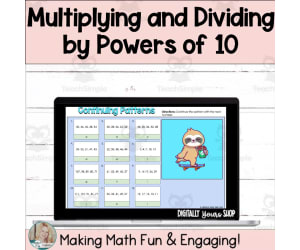
Multiplying and Dividing by Powers of 10 Digital Activity
Math, Patterns, Decimals, Multiplication and Division, Division, Grade 5, Activities
Multiplying and Dividing by Powers of 10 Digital Activity : An All-in-One Teaching Resource This exciting teaching tool is perfectly suited for educators - including public school teachers and homeschoolers. The tool serves as a performance-enhancing resource, offering students a unique way to reinforce their understanding of Powers of 10 through multiplication and division. Product Features: A twelve-question math activity : Designed in a 'Scramble Picture Reveal' game format on Google Sheets where correct answers reveal parts of a scrambled picture. A student recording sheet: This feature allows pupils to systematically record their process and solutions, complementing the digital activities wonderfully. Treasure for Teachers:An included answer key benefits educators by saving time and effort during assessment or grading tasks.. Versatile Applications: The Multiplying & Dividing by Powers of 10 Digital Activity can be seamlessly incorporated into various elements of your curriculum. It works excellently as morning work, homework, bell ringer exercises or exit tickets after lessons. Other suitable uses include warm-up exercises before diving deep into math topics or as quick checks for understanding during lessons. Reteach/Review Sessions: Encourage Mastery Over Rote Learning! This tool also shines when used in reteach/review sessions. It provides students with another opportunity to master previously-taught material while focusing on comprehension rather than rote learning. The Convenience Factor: Zero Preparations & High Engagement! Leverage the benefits offered by this tool without any preparations! The product integrates smoothly with Google Drive - simply add it there, assign to your students using Google Classroom, and let the tool do the rest. This hands-free facilitator ensures more time for face-to-face engagement with students, driving them towards self-directed learning. The Multiplying and Dividing by Powers of 10 Digital Activity is an invaluable resource for educators seeking easily implementable tools in classrooms or for at-home practices.
Author Digitally Yours Shop
Tags Powers Of 10, Multiplication, Division, Digital Activity, Math Game

Light - Reflection and Refraction Find the Pair Game for Middle School
Science, Physics, Grade 5, 6, 7, 8, 9, Games, Activities
This is an engaging and enjoyable memory game on reflection in plane mirrors and refraction. Pupils work in teams of three or four. Each team lays out their 42 cards face down in a square and take it in turn to turn over two cards. If the cards are a question and its correct answer, the pupil keeps the pair. If they are not a match they are turned face down and the next pupil gets a turn. This process continues until all cards are matched and the winner is the pupil with the most pairs. If a team member thinks that the selectors pair is not a correct match, they can challenge. Pupils are encouraged to check their books for the correct answer but the teacher also has a quick-check answer sheet. If the challenge is correct, the challenger keeps the pair. Included in this Pack. > 42 question and answer cards > Teacher’s answer sheet. > Instruction sheet Preparation > Use double-sided printing to copy 1 set per group of 4 pupils. > Sheets could be laminated to enable year-on-year use. > Cut sheets into cards. Prior Knowledge Required > The more dense the medium the slower the speed of light. > When light travels from a less dense medium to a more dense medium it is bent towards the normal. > When light travels from a more dense medium to a less dense medium it is bent away from the normal. > Light hitting a boundary at 900 is not refracted. > Light is not refracted at a curved boundary. > Complete ray diagrams showing refraction. > Design an experiment and results table to investigate refraction through a semi - circular glass block > Why lightning is seen before thunder is heard when a cloud discharges. > Real and apparent depth. > Transparent, translucent and opaque materials > Luminous and non-luminous objects > Labelling the incident and reflected rays, the angles of incidence and reflection, the normal and the point of incidence > Virtual experiment to prove i = r > Ray diagram showing how the eye sees an image in a plane mirror > The image formed in a plane mirror is upright, virtual (appears to be formed behind the mirror) laterally inverted, the same size as the object and as far behind the mirror as the object is in front. > Ray diagram showing how the eye sees an image in a periscope > Specular and diffuse images See more Elf Off the Shelf resources on this topic and many others
Author Elf off the Shelf Resources
Tags Refraction, Reflection, Angle Of Incidence, Angle Of Reflection