



3,931 products added recently
Page 6 - Other Experiments
Introduce your students to a range of unique experiments that cover unconventional topics and methods. This collection includes interdisciplinary projects, environmental studies, and innovative demonstrations. By integrating these experiments into your lessons, you can broaden students' horizons and spark curiosity.

 Show filters

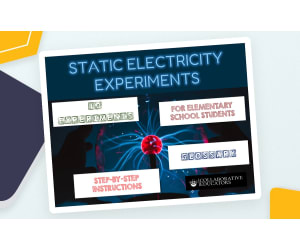
Static Electricity Experiments for Elementary School
Physics, Science, Grade 2, 3, 4, 5, Labs, Experiments, Activities
What is electrostatics, or static electricity? The buildup of electric charge on an object's surface is called static electricity, or electrostatics. This charge, which can be either positive or negative, is produced when a material's atoms acquire or lose electrons. When two objects rub against one another, electrons are transferred from one to the other, creating this static energy. As a result, one of the materials has a negative charge due to an excess of electrons, while the other material has a positive charge due to a lack of electrons. The feeling of a tiny electric shock after stepping on a rug and then contacting a metal surface is a typical example. Ten extremely basic and doable experiments that use or create static electricity are included in this useful e-book. Every experiment is safe and may be carried out using normal, commonplace items. Every experiment has comprehensive, step-by-step instructions. Lastly, each experiment is given a brief explanation so that elementary school pupils can understand it. Have fun exploring the marvels of static electricity through experimentation!
Author Bright Classroom Ideas Marketplace
Rating
Tags Static, Electricity, Experiment, Elementary, Science, Physics

Periodic Table – Lab Station Activity
Science, Chemistry, Grade 9, 10, 11, 12, Labs, Experiments, Activities
This fully editable Lab Station Activity on the Periodic Table is meant to get your students out of their seats and engaged in the content. Each station not only offers a unique opportunity to test your students' knowledge (offer an opinion, answer questions based on a video or reading, draw, etc.), but also provides a fantastic learning opportunity where your kids are learning through assessment. Each station comes with a description card while some also contain more detailed instructions, a reading, questions to answer, etc. Students are equipped with a recording sheet (passport) to write their answers. There is almost no prep for you. Simply print the cards, lay them out around the room and you're all set. An answer key is also provided where applicable. This lab activity covers: - The Periodic Table - The History behind its creation ---------------------------------------------- Bonus Activities: To ensure your students don’t have any downtime between stations, your lab also includes a 10-word word scramble and word search, both with an answer key. You can use them as part of their mark, as a bonus so it’s not mandatory, etc. However you choose to use it, it will ensure that your students are always busy and never idle. Note: For stronger classes, I give the word scramble and for weaker ones, the word search. ----------------------------------------------- ---------------------------------------------- How do the Lab Stations work? Each station is specially designed to be a unique complement to the material while at the same time, provide a valuable learning experience. Below is an overview of how each station works. In your activity , each will be tailored to the specific content. Station 1: Get Hands-On – using their creative skills, students are required to draw or build. Station 2: Research – using a classroom computer or their own device, students must research a specific question/issue surrounding the topic. Station 3: Explain yourself – students write down an opinion to a question in paragraph form. Station 4: Rest Station - students can use this time to catch up on work they didn't have time to complete at a previous station or prepare themselves for an upcoming one. Station 5 - Applicability reading – students read a short passage from an article, website, etc. which directly connects the classroom content to a real life application. Station 6: Test your knowledge – students answer 5 multiple choice questions then provide a written explanation for how/why they came to their conclusions. Station 7: Learn from the expert – using a classroom computer or their own device, students must watch a short video clip and answer the associated questions. They may stop, rewind and restart as often as they like during the time frame. Station 8 - Rest Station. Station 9: Become the question master – Students must create 2 multiple-choice questions, 2 true/false questions and 1 short answer question. Students must also supply the answers. ------------------------------- You might also be interested in my other lab station activities Biology: • Cell and the Cell Theory • The Human Digestive System • The Circulatory System • The Human Respiratory System • Mitosis and the Cell Cycle • Cellular Respiration and Photosynthesis • Photosynthesis • Cancer: Cell Division Gone Wrong - Volume I • Cancer: Cell Division Gone Wrong - Volume II • Cell Membrane and Transport • Hearing and the Human Ear • The Human Eye • Genetic Material: DNA and RNA • The Nervous System • Energy Flow In Ecosystems Ecology and the Environment: • Ecosystems • The Classification of Living Things • Biodiversity and Invasive Species • The Carbon and Water Cycle • Climate Change • Photosynthesis • Cellular Respiration and Photosynthesis • Ecological Succession • Plant Sexual and Asexual Reproduction • Earth's Seasons • Interactions Within Ecosystems Physics: • Newton's Three Laws of Motion • Kinetic and Gravitational Potential Energy • Current Electricity and Circuit Diagrams • Static Electricity • Light Optics and the Production of Light • Sound, Sound Energy and Speed • One and Two-Dimensional Motion • Uniform Acceleration • How Planes Fly • Refraction • Friction • Energy and Its Forms • Density and Buoyancy Space Science: • The Life and Death of Stars • The Moon and its Phases • Life In Space • Our Solar System • Solar and Lunar Eclipse • Earth's Seasons • Asteroids, Comets and Meteors Chemistry: • Atomic Model, Notation and Atoms • Chemical Reactions and Balancing Equations • Molecular and Ionic Compounds • Physical and Chemical Properties & Changes • Acids, Bases, and Neutralization Reactions • The Periodic Table • Single and Double Displacement Reactions • Balancing Chemical Equations • Synthesis, Decomposition and Combustion Reactions • Atomic Theory, Atomic Structure and Isotopes • Types of Bonds and Intermolecular Forces • The Mole/Avogadro's Number • Density and Buoyancy These station cards are meant to be used as a lab activity but can also be utilized in a review task before a test or a quiz. Used either way, your students will love it! I know mine do and I'm telling you from first-hand experience as I've used this activity in my own class. Thank you for your interest in my products. If you have any questions, please send me an email - devon@teachwithfergy.com
Author Teach With Fergy
Tags Chemistry, Periodic Table, Elements, Metals, Lab Station, The Periodic Table Lab, The Periodic Table Lab Answers, Periodic Table Activities, Periodic Table Lab Answer Key
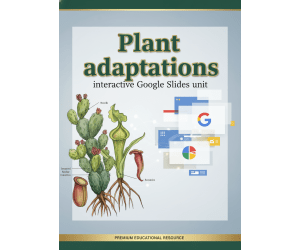
Plant Adaptations Interactive Google Slides Unit
Science, Earth and Environmental Sciences, Earth Sciences, Environmental Science, Geology, Space, Life Sciences, Animals, Nature & Plants, Biology, Grade 3, 4, 5, 9, 10, 11, 12, Experiments, Activities, Labs, Projects, Assessments, Teacher Tools, Diagrams, Lesson Plans, Outlines, Presentations
Find the best 4th Grade Plant Adaptations Interactive Google Slides Unit – a complete no-prep digital science resource that is perfectly correlated to NGSS 4-LS1-1! This teacher edition is a game-changer for teaching plant biology as an interactive adventure for students! With this resource, students will enjoy a hands-on approach to learning about plant adaptations as they explore interactive slides featuring desert succulents/cacti, rainforest drip tips/epiphytes, water plants floating leaves/stretching stems, structural vs. behavioral adaptations, roots, stem/leaf adaptations, defense structures, carnivorous plants Venus flytrap/pitcher plant, seed dispersal, mystery plant analysis, and a final knowledge check with answer keys! Students will actively engage in classifying adaptations, creating their own extremophiles, analyzing scenarios using Claim Evidence Reasoning, and connecting science to ELA, math, engineering, and technology using cross-curricular activities. It includes a teacher guide, standard alignment, steps to integrate into Google Classroom, instructional tips, interactive slide ideas, image credits, and ideas for self-grading. It can be used in a variety of learning environments, such as in-class learning, distance learning, homeschooling, etc. It saves automatically in Google Slides. Keywords: plant adaptation 4th grade, NGSS 4-LS1-1, Google Slides, interactive science unit, desert rainforest aquatic plants, carnivorous plants, seed dispersal activities, digital science resource, structure and function NGSS, no prep plant biology. Why Parents/Schools Love It : NGSS-Aligned & Standards-Ready: No planning required – lesson plans, objectives, and assessments are provided and align perfectly with 4th grade requirements. Truly Interactive & Engaging: Drag and drop sorting, CER plant mysteries, and biome builders ensure all students (including reluctant ones) are actively engaged and motivated to learn for hours. Cross-Curricular Powerhouse: Perfectly blends ELA (informative writing, vocabulary), math (data analysis, volume calculation), and engineering (biomimicry design challenges). Google Classroom Perfection: One-click “make a copy for each student,” auto-saving, and self-grading features save teachers 10+ hours per unit. Differentiation Built-In: Visual aids, scaffolding, and differentiation in activity levels and types meet the needs of diverse learners and challenge advanced students. Target Student Classes : This lesson is designed for 4th grade science (ages 9-10), specifically targeting the 4-LS1-1 standard for Structure and Function in plants/animals, as well as the cross cutting concepts of Systems and System Models + the Science and Engineering Practices of Engaging in Argument from Evidence. This lesson is suitable as the main resource for: Standard 4th grade life science curriculum for 4th grade students in public/private schools Homeschool 4th grade science curriculum (allows for fast or slow pacing for gifted or remedial students) Advanced 3rd grade science for 3rd grade students or 5th grade review for 5th grade students Special education or ESL students (visual learning tool of drag and drop CERs) Not recommended as the main resource for middle school students (6th+). Copyright/Terms of Use: This Book is copyrighted by Syed Hammad Rizvi. This is for your personal and single classroom use only. You may not change, reproduce, redistribute, or sell this in any way. This means you may not put it on the Internet in a way that it can be located and downloaded by others. If you wish to share this resource with others, please consider purchasing additional licenses from Teachsimple. Thank you for respecting these copyright laws! This product is happily brought to you by Syed Hammad Rizvi
Author Creative Book Store
Rating
Tags PlantAdaptations, 4thGradeScience, NGSS4LS11, GoogleSlidesScience, InteractiveScience, ScienceTeachers, ElementaryScience, NGSSScience, PlantAdaptationsUnit, DigitalScienceResource

Science Popcorn Activity | Heat Transfer Lab
Science, Physics, Grade 5, 6, 7, 8, Labs, Experiments, Activities
This resource is a Science Popcorn Activity Heat Transfer Lab . This activity is focused on Convection, Conduction, & Radiation. Students will follow procedures, document their observations, collect data and so much more.
Author Maude in the Middle
Tags Science Lab, Heat Transfer, Popcorn Activity, Physical Science, Student Observation, Popcorn Lab, Heat Transfer Labs, Heat Transfer Lab Middle School

Science Action Labs Insects: Hands-On Science Activities Ready for Student Use
Science, Life Sciences, Insects, Grade 1, 2, 3, Labs, Experiments, Activities
Science Action Labs Insects: Hands-On Science Activities Ready for Student Use This interactive science activity kit offers a riveting method of teaching elementary students, specifically those in grades 1 through 3, about the fascinating world of insects. This comprehensive resource unravels various aspects about different insects and their life cycles under a simple yet informative light. Dynamic Learning Experience The unique experience integrates demonstrations and experiments into lessons. Activites include: Writing poetry about bugs Holding grasshopper jumping contests Constructing honeycombs from scratch Guide characters C.D., Allie, and Orbit are presented throughout for systematic knowledge acquisition that renders comprehension easier for young learners. A Teacher-Friendly Resource with Different Implementations This rich-resource comes packed with 64 printable pages tailored to beginner scientists' needs. It's an excellent tool for educators introducing insects at primary grade level either through individual study or group studies within classrooms. The buzzing environment at our feet opens up wonders beyond any storybook ever could relay about mother nature's intricate designs. Truly, the learning journey into the insect kingdom ties closely with fun for enhanced learner engagement together with Science Action Labs Insects teachings on these vital players in nature's ecological dance.</p
Author Classroom Complete Press
Tags Science Action Lab, Insects, Hands-on, Science Activities

Science Action Labs Air Science: Active Science with Air
, Grade 4, 5, 6, 7, 8, Labs, Experiments, Activities
Science Action Labs Air Science: Active Science with Air This resource for grade 4 to grade 8 classrooms takes students into the captivating world of air science through hands-on experiments and observations. Exposing learners to the essential yet unseen aspect of air its characteristics, it transforms textbook learning into a more practical and engaging experience. Engaging and Practical Approach "Science Action Labs Air Science: Active Science with Air" is designed with an active learning methodology that extends beyond conventional teaching methods. The hands-on laboratories make learners define what air is, explore wind concepts or delve deeper into Bernoulli’s principle. Accomplishing this allows students to build a deeper understanding and have remarkable learning experiences. Detailed Guidance for Teachers: To facilitate the implementation process, teachers are provided continuous support through detailed explanations, advice notes and regular encouragement reminders found throughout the book. Ready-to-use Material: This PDF contains 64 ready-to-download-and-print pages. Teachers can instantly integrate these fun-filled educational sessions into their lesson plans. Versatile Teaching Resource: The resource can be adapted easily for small group activities or individual tasks in a science classroom setting or as part of home-learning activities. In summary, " "Science Action Labs Air Science: Active Science with Air" " suits public school teachers seeking potent ways to teach complex topics through guided hands-on experience as well as homeschooling parents looking for effective resources that make subjects like 'air' clear enough for young minds to grasp.
Author Classroom Complete Press
Tags Bottled Eggs, Measuring Air Pressure, Smog Lab, Action Labs, Air Science
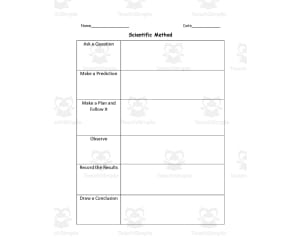
Scientific Method Templates - Perfect for Basic Science Experiments
Research, Science, Basic Science, Elementary, Homeschool Resources, Not Grade Specific, Pre-K, Experiments, Activities, Labs
This super basic Scientific Method Template is perfect for getting kids started with the scientific method and for teaching them about scientific research. There are two versions of the template, one with cute pictures and one without pictures. This template can and has been used for all ages up to high school and even adults for basic in-home and at school experiments. Not only could you use this template in the kitchen for food science and baking experiments, for example, comparing the different weights between baking flours, but you can use it for basic chemistry, physics, life science, and more. Kids can use it to jot their ideas down if they aren't sure what they want to do for their experiment or science research project. It is super easy to use and self-explanatory and would be a perfect brainstorming tool. pdf downloadable file, 2 usable pages with cover sheet. Minimal ink needed. Not age specific but may be especially useful for younger elementary and special education students. Also, for visual learners and kids who aren't reading yet (the template with the pictures tells the story without needing to read).
Author Homeschooling Dietitian Mom
Tags 1st Grade Science Experiments, 2nd Grade Science Experiments, 3rd Grade Science Experiments, Scientific Research Projects, Science Templates, Science Worksheets, Science Writing Prompts

Independent, Dependent & Controlled Variables Lesson
Science, Basic Science, Grade 4, 5, 6, 7, 8, Activities, Experiments
This fun science lesson is a great introduction for a science fair unit or a beginning of the year scientific method unit when you need to teach your students how to carry out a true experiment . It teaches students about independent, dependent and controlled variables using humour and real-life situations. The first page has fill-in-the blank notes about a pretend experiment I completed that had some mistakes in the design. Students should stay engaged and focused throughout the lesson component as they have to fill in the blanks. They should start to think about why controlling variables matters, and they learn the relevant vocabulary. The second page gives students a chance to start brainstorming some basic experimental design ideas on their own or in pairs. They are given three situations and need to think of independent variables they could alter, what dependent variable that would affect, and all of the other variables they would need to carefully control. At the end, there is a quick review to reinforce the relevant vocabulary. Grades to Use With: This lesson can easily work in a variety of grades in the middle years, from grades 4-8 and possibly beyond! Standards: NGSS3-5-ETS1-3 Plan and carry out fair tests in which variables are controlled and failure points are considered to identify aspects of a model or prototype that can be improved. If you enjoy this science activity, check out some other options in my store: Personal Carbon Emissions /Footprint: Integrated Math and Earth Sciences Lesson: Ways to Slow Climate Change Periodic Table: Element Baseball Cards STEM Project: Extreme Environment Technology Design and "Shark Tank" Presentation STEM Project: Climate Change Solutions 8 Low-Prep STEM Tasks for Elementary and Middle School Students: Simple Handouts for Each Experiment
Author Grace Under Pressure
Rating
Tags Science Experiments, Independent Variable, Dependent Variable, Science Fair, Scientific Method, Control Variable, Experiment, STEM, Science, Elementary Science, Variables In Science Experiments, Independent And Controlled Variables, Controlled Scientific Experiment, Examples Of Independent Dependent And Controlled Variables, Controlled Variables In Science, Independent Dependent And Control Variables, What Are Independent Dependent And Controlled Variables, Science Experiment Control, Variables For Science Projects, Worksheet, Lesson, Science Worksheet, Science Lesson
Climate Change – Lab Station Activity
Science, Earth and Environmental Sciences, Environmental Science, Grade 8, 9, 10, 11, Labs, Experiments, Activities
Climate Change Lab Station Activity Dive deep into climate change with this engaging lab station activity . Students will rotate through 9 stations, each offering a unique hands-on opportunity to learn about topics like greenhouse gases, global warming, and the greenhouse effect. Activities range from drawing models to conducting research, watching videos, and even creating their own questions. The self-guided format promotes inquiry-based learning, while the recording sheets let students document their progress. This versatile resource works for whole groups, small groups, or independent work. Modify it to fit your class's needs. An answer key is included for applicable stations. This activity covers core climate change concepts, connects them to real-world impacts, and gets students out of their seats. Use it to inspire curiosity about this urgent topic.
Author Teach With Fergy
Tags Climate, Change, Global Warming, Scientist, Lab Station
10 Amazing Cell Projects for Grades 4-5
Biology, Life Sciences, Science, Grade 4, 5, Experiments, Activities
🔬 10 Amazing Cell Projects for Grades 4–5 Bring cell biology to life with these hands-on, creative cell projects that help upper elementary students truly understand how cells work! From edible models to digital presentations, this pack includes 10 differentiated project ideas that engage every learner through art, science, and imagination. 🧠 What’s Included 10 detailed project directions (edible cell, diorama, board game, and more) Step-by-step teacher notes and timeline suggestions Differentiation strategies for advanced, ELL, and struggling learners Assessment rubric (accuracy, creativity, completeness, presentation) Student project worksheet with clear instructions Materials master list and parent communication letter Extension and display ideas for showcasing projects 🧬 How It Works in the Classroom Use this project pack to conclude your cells unit or as a culminating STEM project. Perfect for: Whole-class or choice-based projects Science fairs or learning exhibitions Cross-curricular connections with art, writing, and technology Center activities or group projects Each activity encourages creativity while reinforcing key science concepts through real-world analogies and visual learning. 📏 Standards & Learning Goals Aligned with: NGSS 5-LS1-1: Support an argument that plants get materials for growth from air and water. Common Core W.4.2 & W.5.2: Write informative/explanatory texts. State standards on cell structure and function. Students will: Identify major cell organelles and their functions Compare plant and animal cells Demonstrate understanding through creative, multimodal projects 💛 Why Teachers Love It ✅ Highly engaging and creative—students stay motivated for weeks ✅ Differentiated options for all learning styles ✅ Easy to prep with ready-to-use templates and rubrics ✅ Encourages student voice and choice ✅ Great for assessment, enrichment, or science fair projects Empower your young scientists to explore the amazing world of cells through creativity, critical thinking, and fun! Download today and watch your classroom come alive with learning.
Author Bright Classroom Ideas Marketplace
Rating
Tags Biology, Cell, Project, Experiment, Science, Life, Human, Grade 4, Grade 5

"Water Bottle Rockets" eBook Excerpt
, Grade 6, 7, 8, Activities, Experiments
This is an excerpt that comes from the eBook titled “Middle Schoolin: 50 Stories about the Challenges, Humor, and Rewards of Teaching” written by Paul Rallion. This is from Chapter 33 titled Water Bottle Rockets. In science class, it is important to incorporate hands-on activities because students learn better by doing, according to John Dewey, considered by many the father of modern education. I remember when I was in second grade and my teacher talked about erosion. We went on a field trip to see an arid field with poor or no irrigation, and I was able to see what erosion was and what a field looked like when it occurred. I am sure it would have taken longer for me to learn what erosion was without that field trip. Now I found myself teaching Newton’s laws of motion. These three laws deal with how objects behave at rest and in motion. They are difficult concepts for some students to absorb at the middle school level. Doing this experiment helped my students grab the concept of Newton’s laws of motion better than if I had just talked about them. Students enjoy a hands-on experiment more than a lecture or reading a book. The bottom line is, if you teach science, do hands-on activities and experiments whenever possible. I hope you enjoy! Take A Look at My Best Sellers: ”Classes Re-Zoomed” eBook “10 Tips to Become a National Board Certified Teacher” eBook 15 Computer Tips eBook Visiting London eBook Spanish: Middle School Parents eBook “Growing Modern Obesity” eBook You can find more resources at my storefront here: https://teachsimple.com/contributor/paul-rallion
Author Paul Rallion
Tags Middle School Tips, Middle School Parents, Newton's Law Of Motions, Science Experiment, Science EBook, Science Lecture, Science Lab

Science Action Labs Air Science
, Grade 1, 2, 3, Labs, Experiments, Activities
"Science Action Labs Air Science" An engaging approach to teaching air science for students in grades 1-3. Through hands-on simple experiments , students gain a solid foundation on the key concepts including that: Air is transparent Carries weight Exerts pressure and resistance Is composed of different gases. This learning resource contains various activities within its easy-to-use PDF file: Straightforward experimentation, scientific discourse and relatable poems. The opportunity for whole group discovery sessions, small group collaboration exercises or independent work. Including fun games throughout the program that adds a layer of friendly competition reinforcing kinesthetic learners' comprehension skills. Embedded periodic quizzes to measure student progress and reinforce acquired knowledge about air science. With "Science Action Labs Air Science", teaching about elements like air becomes an optimal practical perspective for primary grade levels. Note: Valuable tools need not be expensive components like extensive laboratory sets; sometimes it could be as simple as print-ready pages filled with creative ways to learn life's fundamental theories!</p+
Author Classroom Complete Press
Tags Science Labs, Air Science, Air Pressure, All About Oxygen, Science Experiments

Cancer Volume II – Lab Station Activity
Science, Life Sciences, Biology, Grade 7, 8, 9, 10, 11, Labs, Experiments, Activities
The Carbon and Water Cycle – Lab Station Activity This is an engaging teaching resource exclusively designed for educators and homeschoolers. It offers a highly interactive, customizable lab station activity exploring the carbon and water cycles. Main Features: Hands-on learning material with proven effectiveness in student engagement Caters to various learning styles. No extensive preparation required. Simply download, print out the cards and place them around your classroom or create virtual stations for online learners. Each station comes with a detailed description card providing instructions or guiding questions for active discussion among students. Station Activities Include: Offering opinions Answering questions based on videos or readings . Drawing exercises Bonus activities such as word scrambles or word searches are included to ensure productive use of time between transitions from one station to another. These can be integrated into grading system or used as optional enrichment tasks. 'Rest Stations' allow students to catch up on any unfinished assignments without feeling rushed when transiting from one station to another. 'Real-world Topic Stations' provide short readings linking classroom material directly with practical applications in today's world. Exercise modes vary across stations: From tapping into creative skills at one station, researching surrounding topics using own devices at other stations, reading related passages, writing down opinions etc., each provides a unique student experience. A Comprehensive Learning Solution: The Lab Station Activity is focused on key Science/Biology study topics for Grades 7 through 11 specifically carbon cycle and water cycle. Furthermore, it can be adjusted smoothly across different classroom settings – whole class activities, small collaborative groups or individual homework assignments. In Summary: The Carbon and Water Cycle Lab Station Activity provides a highly dynamic and student-preferred learning environment, bridging seamlessly across various teaching styles.
Author Teach With Fergy
Tags Carbon Cycle, Water Cycle, Lab Activity, Hands-on Learning, Interactive

Electricity Generation – Lab Station Activity
Science, Technology, Engineering, Grade 7, 8, 9, 10, Labs, Experiments, Activities
Educators seeking an engaging, hands-on resource to teach the principles of electricity generation will find the Electricity Generation - Lab Station Activity to be an invaluable teaching tool. This product is a fully editable lab station activity designed to actively engage students in learning about electricity production. This robust product offers seven distinct lab stations with unique and engaging activities. Students have opportunities at each station to test their understanding of different methods of electricity production—such as renewable and non-renewable sources, fossil fuels, nuclear power, wind energy, hydroelectric power and future technologies in interactive ways. The resource includes practically no-prep for educators - just print the cards and lay them out around the classroom! Bonus activities: An added advantage is bonus activities such as word scrambles and word searches related to the topic. These orchestrated interjections ensure there is no idle time between transitioning from one action-packed station activity to another! The toolkit can be used during laboratory sessions or serves well for review tasks prior tests or quizzes. This resource also promotes independent thinking skills by requiring students to research specific aspects relating to electricity generation on their own devices or a classroom computer at 'research' stations. It encourages expression as students write down opinions on questions surrounding how electricity gets produced. Designed for multi-modal learners from 7th-10th grade studying science with subtopics in engineering; this package can also be sent home as extensions/homework tasks after lessons end. Overall teachers will appreciate how effortlessly it blends learning assessment while ensuring student engagement! Note: An answer key is provided where applicable so educators can quickly and accurately grade student work and offer feedback on their learning progress. In summary, this unique collection of station activities facilitates a complete immersion into understanding electricity generation while ensuring students remain stimulated and engaged throughout their exploration. As they navigate through each station activity – either in small groups or individually – students strengthen their grasp over the subject matter.
Author Teach With Fergy
Tags Electricity Generation, Lab Station, Hands-on Learning, Renewable Energy, STEM Education
Cell Lab Activity
Science, Life Sciences, Human Body, Grade 9, 10, 11, 12, Labs, Experiments, Activities
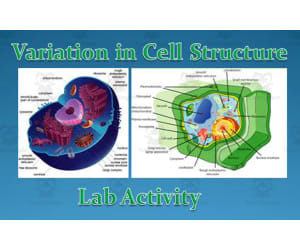
Cell Lab Activity: An Engaging Teaching Resource for Science Educators Enhance your science curriculum with the interactive Cell Lab Activity focused on differentiating between animal and plant cells. This adaptable lab suits a wide demographic of students, emphasizing a hands-on learning approach. The Activity Process In this hands-on experiment, students: Observe cells from sources such as tomato pulp and skin, potato, and human cheek cells. Analyze biological material under scientific scrutiny. Gain insightful knowledge about the functions of various cell parts. Depending upon your classroom's pace, this activity spans approximately 1½ to 2 days—optimizing time towards understanding complex concepts. What Else is Included? The kit includes: A Variation in Cell Structure Lab worksheet with an answer key for students to verify their findings- reinforcing self-evaluation techniques. A helpful materials list and general guidelines that assist educators in organizing resources smoothly. Inclusive sample pictures which support descriptions of cellular concepts accessible to all learners—including visual-learners—for better comprehension! The inclusion of practical thinking into teaching methodologies widens horizons: Leveraging education beyond textbooks boundaries preparing our future scientific pioneers—to drive societal goals—from just simple thinkers to thought leaders! Note: It’s important teachers know that every lab activity must always be performed under supervision!
Author The Teacher Team
Tags Cell Structure, Lab Activity, Plant Cells, Animal Cells, Hands-on Learning

Muscular and Skeletal System – Lab Station Activity
Science, Life Sciences, Human Body, Grade 7, 8, 9, 10, 11, 12, Labs, Experiments, Activities
Muscular and Skeletal System Lab Station Activity Dive deep into the muscular and skeletal system with this engaging lab station activity . Specifically designed for middle and high school students, it gets learners up and active while assessing knowledge. The 9 unique stations offer a variety of learning modalities, including building models, conducting research, answering discussion questions, and more. Questions and activities focus on key concepts like muscle growth, bone structure and function, homeostasis, and real-world connections. With minimal prep required and an included answer key, this resource is teacher-approved and student-tested. Use it to complement your unit on body systems or as a review before exams. Modify it to fit any schedule and customize it to various ability levels. This interactive approach keeps students engaged as they learn about this essential bodily system.
Author Teach With Fergy
Tags Muscular, Skeletal, System, Joints, Lab Station, Activities For Skeletal System, Skeletal System Activities For High School Students, Skeletal System Lesson Plans High School, Skeletal System Lab, Skeletal System Activity, Skeletal System Activities

Pressure, Volume, and Temperature – Lab Station Activity
Science, Chemistry, Grade 8, 9, 10, 11, Labs, Experiments, Activities
Pressure, Volume, and Temperature – Lab Station Activity This dynamic teaching resource designed for middle and high school physical science students brings the classroom to life with interactive activities revolving around pressure-volume-temperature laws. Key Highlights: Station tasks exploring Archimedes' Principle, Avogadro’s Law, Boyle’s Law, Charles's Law and Ideal Gas Law Inclusive lab recording sheets (passports) for documenting observations or answers Activity cards that can be placed around your classroom to turn it into a miniature laboratory Included answer keys for efficient progress tracking and immediate feedback The distinct features of this resource promote an active learning environment. Students are propelled towards collaborative discussions thereby solidifying their understanding of the involved principles. A highlight of added fun: To increase interaction in a less formal setting while ensuring that no learner is left out; two full-time activities—a word scramble and word search are provided. Ready-made answer keys make grading a breeze! Tailored Flexibility: This product fits perfectly into various teaching strategies without straining resources—whether you plan whole-group communal activities or divide students into smaller groups for methodical task completion under your guidance. Towards Promoting Lifelong Learning: The hands-on experience gained from scientific explorations encourages inquiry-based learning. The successful integration in numerous teaching styles aims at fostering engagement which sparks their curiosity paving way for lifelong learners! An essential tool catering not just to public school teachers but homeschooling parents seeking effective teaching aids as well. Digital & Printable Formats: Available in different file types for easy access across digital platforms. It proves proficient for Grade 8-11 science students boosting their comprehension of pressure, volume and temperature thereby enhancing scientific literacy. Experience the joy of teaching with this interactive lab station activity that challenges student understanding and intrigues young minds!
Author Teach With Fergy
Tags Pressure, Volume, Temperature, Lab Station Activity, Active Learning
Force and Motion Science Experiment
Physics, Grade 3, 4, 5, Experiments, Activities
We all know that science is learned best with our hands! When we have the opportunity to really explore scientific concepts with an interactive approach, the learning just sticks! More than that, students love the chance to do experiments . This is a Force and Motion Science Experiment for your students to take part in. It may be used best with 3rd – 5th grade students. Students will work with a set of balls to apply what they know about force and motion. Students will complete the 2 page printable along the way. They will begin by making a hypothesis, as scientists do, before engaging in the experiment. Students will hypothesize which ball they believe will need the most wind-force for motion and which ball will need the least wind-force. You may choose to have your students decide on this hypothesis individually or in small groups. When students have wrapped up their hypothesis, they will move forward into the experiment portion. Students will follow the directions on page 1 to test out the force and motion of each ball. There is space for them to test out 6 balls. Your class may love completing this in small groups or with a partner. On page 2, they will reflect on the experiment by writing their particular outcome and formulating a conclusion about the wind-force needed to put balls in motion. I hope you enjoy! Here are links to similar resources in my store: https://teachsimple.com/product/area-and-perimeter-mini-tasks https://teachsimple.com/product/animal-report-packet Here is a link to my store to enjoy other resources from me: https://teachsimple.com/contributor/at-the-core I can be contacted for questions and concerns at sallyplant12@hotmail.com .
Author At the Core
Tags Science Experiment, Force, Motion, Wind-force, Hypothesis, Hands-on Science, Experiments, Activities, Force And Motion

Life In Space – Lab Station Activity
Science, Earth and Environmental Sciences, Space, Grade 7, 8, 9, 10, Labs, Experiments, Activities
Life In Space Lab Station Activity Presenting an exclusive and innovative teaching tool, the Life In Space Lab Station Activity . Exploring the areas of space science and Astronomy,, it is tailored for active learning within Grades 7-10. A Multidimensional Learning Platform Unlike others This resource boasts of seven independent yet interconnected learning stations allowing students to engage in comprehensive space-themed activities. The activity styles include but are not limited to: Drawing or constructing Forming opinions on topics Multiple choice questions Video-based learning The flexibility is extended to include enriching research tasks that solidify their learning experience. Navigating Through the Stations The journey begins with understanding historic human space travel, delving deeper into International Space Station (ISS), appreciating the effects of microgravity on health and investigating sustainable long-term solutions for life in space. Note About The Exercise Cards at Each station: "Cards carry instructions about various exercises which range from simple Q&Ato advanced assignments digging deeper into each topic.” The Guided Self-Assessment Passport Sheet Students record their progress through lab stations on a sheet where they answer questions, enabling constant self-evaluation, goal-setting,mapping progressrate both for students themselves and teachers. Bonus Material – Fun With Vocabulary! Bonus content includes word scrambles & searches that extend vocabulary related lessons; ensuring student engagement soars high during every class. This highly interactive program accomodates different strength levels across a mixed ability group. Cooperation during group tasks coexists with independence for solo homework/assignments. WhyChoose "Life In Space - Lab Station Activity ?" "This program stands out for transforming passive lectures into hands-on exploration of the fascinating topic of life beyond Earth's atmosphere." Experience an education resource like no other; placed light years ahead in terms of learning effectiveness.
Author Teach With Fergy
Tags Space Science, Active Learning, Astronomy, Lab Activity, Engagement
Food Science and Elevation eBook
, Grade 7, 8, 9, 10, Activities, Experiments
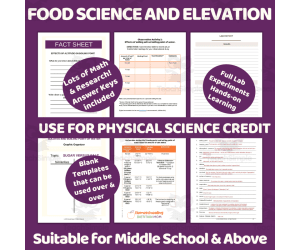
Food Science and Elevation eBook This thoughtfully created teaching resource is targeted for educators seeking materials that encourage hands-on learning particularly suitable for grade 7-10 students interested in science and math. Main Features: An exciting avenue to explore food science experiments involving salt, sugar, and boiling water among others. Improve students' research abilities, math skills, and writing competence through practical tasks. The extensive 40-page PDF file introduces learners to various scientific concepts such as atmospheric pressure with real-life examples of how solutes affect the boiling point. Additionally, it covers complex topics including the effects of sugar and salt on freezing points. Navigational Guide: Tailored background information on each scientific phenomenon. A structured guide for experimental work provided by blank lab templates. Data gathering encouraged through the measuring observations via thermometers. A Practical Approach to Learning: Through integral practical exercises within this comprehensive resource, students are enabled to: Determine how elevation changes affect common attributes like pressure or temperatures; This teaching material goes beyond theory by allowing pupils to record methods such converting units used commonly in science like psi into inches Hg or Celsius into Fahrenheit etc., This promotes an active learning environment surrounding mathematical calculations from simple addition/subtraction processes up towards more complex ones such as decimals rounding techniques. This aids overall academic progression effectively across multiple disciplines combined throughout its entirety preparing them for future endeavors irrespective of settings whether it be homeschool public school-based sessions gaining experiences crucial fostering academia holistically.
Author Homeschooling Dietitian Mom
Tags Food Science, Elevation, Atmospheric Pressure, Boiling Point, Freezing Point
Atomic Theory, Structure and Isotopes – Lab Station Activity
Science, Chemistry, Grade 7, 8, 9, 10, Labs, Experiments, Activities
Atomic Theory, Structure and Isotopes Lab Stations Engage students in learning atomic theory, atomic structure, and isotopes with this interactive lab station activity. Students move through nine stations, including drawing atoms, watching expert videos, completing knowledge checks, reading real-life applications, and formulating their own questions.recording answers on a passport worksheet. This resource requires almost no teacher prep - just print the self-explanatory station cards with detailed student directions. The activity works well for whole group or independent work, covers core topics, and aligns to grades 7-10 science standards. Assessment at multiple stations allows students to exhibit understanding in various ways while staying focused and challenged. Extend student learning by pairing the lab stations with the included word scramble and word search.
Author Teach With Fergy
Tags Atoms, Atomic, Theory, Structure, Isotopes

Physical and Behavioral Adaptations – Lab Station Activity
Science, Physics, Grade 8, 9, 10, Labs, Experiments, Activities
Physical and Behavioral Adaptations – Lab Station Activity The Physical and Behavioral Adaptations - Lab Station Activity is a student-oriented learning resource meant for Grade 8, Grade 9, and Grade 10 Science classrooms. It enhances the understanding of physical and behavioral adaptations in plants and animals using dynamic learning techniques. This product diverges from traditional resources by offering multiplex testing methods. In one station, students might need to voice opinions or answer queries stemming from a video or passage. Another station may involve creating diagrams or models related to physical/behavioral adaptations. The package comprises fully customizable station cards that can be printed out and arranged around the classroom. These facilitate an engaging learning environment. Each card comes with comprehensive instructions which aid smooth movement across activities for learners individually, in small groups or full class setups - without wasting any time. A log sheet (passport) is included for students' input along with an answer key where required easing monitoring of progress. A distinguishing component that elevates this product's value are exciting additionals: word scrambles & searches aimed at cementing concepts during transitions between stations thus minimizing idle time amongst learners. Beyond serving as a practical lab task, this could be used as review material before evaluations too. Requiring minimal preparation on part of educators (only card printing), this proves highly efficient without negotiating on quality education. In summary, The Physical and Behavioral Adaptations - Lab Station Activity provides interactive educational experiences centered around pivotal science themes catering to diverse learner types promoting advanced levels understanding.
Author Teach With Fergy
Tags Physical Adaptations, Behavioral Adaptations, Plants, Animals, Lab Activity

Biomes – Lab Station Activity
Science, Earth and Environmental Sciences, Environmental Science, Grade 6, 7, 8, 9, Labs, Experiments, Activities
Biomes Lab Station Activity Bring the diverse biomes of planet Earth into your middle or high school science classroom with this engaging lab station activity . Students will rotate through 9 stations to get hands-on experience with concepts like major biome types, adaptation, and more. Activities range from creative drawing prompts to knowledge checks and inquiry-based reading. An included recording sheet allows students to document their learning journey. This ready-to-implement resource covers terrestrial biomes like grasslands, forests, deserts and tundra as well as aquatic environments. Word scramble, word search and answer keys provide built-in differentiation. Modify the content or instructions as needed with the fully editable teacher version. Turn key lab stations make biome exploration interactive, memorable and fun.
Author Teach With Fergy
Tags Biomes, Freshwater, Marines, Environment, Science
Particle Theory and Matter Classification – Lab Station Activity
Science, Chemistry, Grade 8, 9, 10, 11, Labs, Experiments, Activities
This fully editable Lab Station on The Particle Theory and the Classification of Matter is meant to get your students out of their seats and engaged in the content. Each station not only offers a unique opportunity to test your students' knowledge (offer an opinion, answer questions based on a video or reading, draw, etc.), but also provides a fantastic learning opportunity where your kids are learning through assessment. Each station comes with a description card while some also contain more detailed instructions, a reading, questions to answer, etc. Students are equipped with a recording sheet (passport) to write their answers. There is almost no prep for you. Simply print the cards, lay them out around the room and you're all set. An answer key is also provided where applicable. This lab activity covers: - The particle theory - Matter classification - Mixtures --> Homogeneous (solutions) --> Heterogeneous (mechanical mixtures) - Pure substances --> Elements --> Compounds How do the Lab Stations work? Each station is specially designed to be a unique complement to the material while at the same time, provide a valuable learning experience. Below is an overview of how each station works. In your activity , each will be tailored to the specific content. Station 1: Get Hands-On – using their creative skills, students are required to draw or build. Station 2: Research – using a classroom computer or their own device, students must research a specific question/issue surrounding the topic. Station 3: Explain yourself – students write down an opinion to a question in paragraph form. Station 4: Rest Station - students can use this time to catch up on work they didn't have time to complete at a previous station or prepare themselves for an upcoming one. Station 5 - Applicability reading – students read a short passage from an article, website, etc. which directly connects the classroom content to a real life application. Station 6: Test your knowledge – students answer 5 multiple choice questions then provide a written explanation for how/why they came to their conclusions. Station 7: Learn from the expert – using a classroom computer or their own device, students must watch a short video clip and answer the associated questions. They may stop, rewind and restart as often as they like during the time frame. Station 8 - Rest Station. Station 9: Become the question master – Students must create 2 multiple-choice questions, 2 true/false questions and 1 short answer question. Students must also supply the answers. ------------------------------- You might also be interested in my other lab station activities Physics: • Newton's Three Laws of Motion • Kinetic and Gravitational Potential Energy • Current Electricity and Circuit Diagrams • Static Electricity • Light Optics and the Production of Light • Sound, Sound Energy and Speed • One and Two-Dimensional Motion • Uniform Acceleration • How Planes Fly • Refraction • Friction • Energy and Its Forms • Density and Buoyancy • Electricity Production Coming Soon: - Calculating average speed, velocity, and displacement - Work = F x d - Renewable energy sources - Nonrenewable energy sources Space Science: • The Life and Death of Stars • The Moon and its Phases • Life In Space • Our Solar System • Solar and Lunar Eclipse • Earth's Seasons • Asteroids, Comets and Meteors Ecology and the Environment: • Ecosystems • The Classification of Living Things • Biodiversity and Invasive Species • The Carbon and Water Cycle • Climate Change • Photosynthesis • Cellular Respiration and Photosynthesis • Ecological Succession • Plant Sexual and Asexual Reproduction • Earth's Seasons • Interactions Within Ecosystems Biology: • Cell and the Cell Theory • The Human Digestive System • The Circulatory System • The Human Respiratory System • Mitosis and the Cell Cycle • Cellular Respiration and Photosynthesis • Photosynthesis • Cancer: Cell Division Gone Wrong - Volume I • Cancer: Cell Division Gone Wrong - Volume II • Cell Membrane and Transport • Hearing and the Human Ear • The Human Eye • Genetic Material: DNA and RNA • The Nervous System • Energy Flow In Ecosystems Coming Soon: - Excretory system - Endocrine system Chemistry: • Atomic Model, Notation and Atoms • Chemical Reactions and Balancing Equations • Molecular and Ionic Compounds • Physical and Chemical Properties & Changes • Acids, Bases, and Neutralization Reactions • The Periodic Table • Single and Double Displacement Reactions • Balancing Chemical Equations • Synthesis, Decomposition and Combustion Reactions • Atomic Theory, Atomic Structure and Isotopes • Types of Bonds and Intermolecular Forces • The Mole/Avogadro's Number • Density and Buoyancy • The Particle Theory and the Classification of Matter Coming Soon: - Counting atoms - Periodic table group properties These station cards are meant to be used as a lab activity but can also be utilized in a review task before a test or a quiz. Used either way, your students will love it! I know mine do and I'm telling you from first-hand experience as I've used this activity in my own class. Thank you for your interest in my products. If you have any questions, please send me an email - devon@teachwithfergy.com
Author Teach With Fergy
Tags Particles, Classification, Matter, Lab Station, Chemistry