



3,950 products added recently
Page 32 - High School Assessments
Challenge your high school students with assessments that measure their mastery of complex subjects. This collection includes standardized test preparations, analytical writing assignments, and advanced problem-solving tasks. Equip your students for future success by integrating these comprehensive assessments.

 Show filters


Life Science Reading Comprehension Passage: Insects (Word)
Science, ELA, Reading, Reading Comprehension, Strategies, Resources for Teachers, Life Sciences, Insects, Grade 6, 7, 8, 9, Writing Prompts, Worksheets & Printables, Centers, Activities, Teacher Tools, Assessments, Quizzes and Tests, Quizzes, Tests
Life Science Reading Comprehension Passage and Questions: Insects (Word) This very engaging life science reading passage about insects . It explains that insects may be small, but they have a huge impact. They help pollinate plants , spread seeds , recycle waste , and provide food for many animals . It also explains what makes an insect an insect, including its exoskeleton, three body parts, six legs, and antennae . This passage is designed to bridge the gap between science and literacy through strengthening reading comprehension and sparking scientific curiosity in middle school students. The passage blends English Language Arts skills with accurate science content that supports NGSS classroom practice. Ideal for interdisciplinary learning in ELA and Science. Suitable for Grade 9 review, too! Student Tasks for The Passage: 5 multiple-choice questions targeting main idea, key details, inference, vocabulary in context, and use of evidence 5 vocabulary matching items with clear, student-friendly definitions 5 text-based questions that require citing specific lines or facts 1 summary prompt that asks students to condense central ideas accurately Full answer key for every section Available Formats for this Resource PDF Fillable PDF Google Docs FULL CATALOG OF DOWNLOADING LINKS HERE Product Details Length: 4 pages total Grades: 6–8, also suitable for Grade 9 review Use cases: close reading, stations, homework, intervention, test prep, and sub plans Standards support: reinforces informational-text skills and supports NGSS-style sense making through observation, modeling, and clear use of claim, evidence, and reasoning Why Teachers Choose This Set Authentic science content paired with rigorous literacy practice Consistent task structure across all passages for easier planning and smoother student routines Clear, age-appropriate writing that builds confidence without oversimplifying Other Science Reading Collections you May find in the store: 1. Astronomy & Space Science 2. Volcanoes, Rocks, & Mountains 3. Rock Cycle, Soil, & Sinkholes 4. Mars, Glaciers, & Antarctica 5. Water Cycle, Acid Rain, & Wastewater 6. Insects, Animals, & Ecosystems 7. Bioluminescence & Insects 8. Animal Skin, Cats, & T. Rex 9. Human Body and Senses 10. Health & Applied Bioscience 11. Waves, Light, & Imaging 12. Electricity & Energy 13. Motion & Materials 14. Chemistry and Materials Science Use this set to reinforce ELA skills in science, to add literacy to your lessons, and to support independent work. The passages strengthen main idea, evidence use, vocabulary in context, inference, cause and effect, and summary writing. With ready-to-use assessments and complete answer keys, you can provide focused practice that is simple to run and fast to review.
Author Middle & High School - CORED Education
Rating
Tags Middle School, Reading Comprehension, Reading Strategies, ELA, Centers, Reading Passage, Assessments, Vocabulary, Life Science, Insects
Fostering Stability in Golden Age: Regents Global 9 CRQ + Video Lesso
Social Studies, History, History: World, Grade 9, 10, Teacher Tools, Assessments
Regents Global 9 CRQ: Governing Ancient Times + Video Lessons This product is a constructed-response question (“CRQ”) in the format of the new New York State Regents examination in Global History and Geography. The CRQ calls upon the student to examine historical sources (I use exclusively primary sources) by providing historical or geographic context, identifying the point of view, intended audience, or purpose of a document and then using the two documents in either compare-contrast, cause-effect analysis, or turning point identification. I advocate a strategy of assigning one CRQ in each unit of study in grades nine and ten without access to notes. I used this as one of the tests at the end of a unit of study. I would tell students about what kinds of documents would appear and what historical context they should be able to recall in advance. It is a challenging task for them. The first challenge for novices is to understand what it means to provide context. Faced with the question “What is the historical context of this document?”, beginners will retell what the document says. The reason for this mistake is that, since they were little kids, teachers have asked them to relate what a text means to prove they understood it. [ Read more at the Innovation blog ] Product includes: 1. Student version 2. Teacher version with suggested answers 3. Passcode to video lessons students can use to prepare the task. Documents: Pliny the Younger: Life of a Refined Roman Gentleman Xenophon: Everyday life in ancient Greece Map, Asoka's Rock Edicts Debate on Salt and Iron, Han Dynasty Passcode Lessons: Ancient Rome part 3 Ancient Rome part 4 Overview of Ancient Greece, part 1 Overview of Ancient Greece, part 2 The Mauryan Empire Han Dynasty About Innovation Passcodes Passcodes let your students access selected lessons in my own virtual classroom at InnovationAssessments.com . No registration is required. Use the codes at InnovationAssessments.com/TestDrive .
Author Innovation Assessments LLC
Tags New York State Regents, Global History And Geography, Constructed-response, CRQ, Golden Age

Literary Terms Lessons for Poetry
ELA, Language Development, Vocabulary, Grade 9, 10, 11, 12, Teacher Tools, Assessments
Explore the rich world of poetry with this comprehensive collection of THREE short literary terms lessons. Uncover every significant concept connected to the art of writing and appreciating poetry, providing invaluable introductions or supplements to units focused on the analysis and creation of poetic works. To fully grasp the beauty and depth of poetry, students must familiarize themselves with the most common terms and techniques used in this art form. L-EA's literary terms lessons empower students to learn and practice these techniques, cultivating a deep understanding of poetry while providing teachers with essential resources to assess student comprehension. Engage students in a captivating exploration of poetic language, forms, and devices, nurturing their ability to analyze, appreciate, and create poetry with skill and insight. Whether used as standalone lessons or as valuable additions to poetry-focused units, this resource elevates students' understanding of literary art and their proficiency as poets and critics. Teaching this resource is simple! Start it by presenting the included slideshow of literary terms and definitions while students use the accompanying worksheet to take notes. The, handout the accompanying homework assignment. Later in the week or following week, administer the quiz, which is provided as a printable or Google Form quiz (ideal for Google Classroom distribution!) “Literary Terms Lessons: Poetry” includes: - THREE presentations of 33 literary terms and definitions connected to poetry - THREE presentation note-taking activity worksheets (w/ answer keys) - THREE writing assignments that ask students to use presented terms in a piece of original poetry - THREE quiz assessments that include definition matching (or drop-down selection) and one essay question, provided in 5 file types (Google Forms, Easel assessments, PDFs, ExamView test files, and ExamView test bank files) TERMS INCLUDED IN THIS LESSON: Alliteration, Assonance, Ballad, Blank verse, Consonance, Couplet, Didactic poetry, Elegy, Epic, Euphony, Fixed form, Foot, Free verse, Haiku, Iambic pentameter, Limerick, Lyric, Meter, Narrative poem, Octave, Ode, Onomatopoeia, Organic form, Personification, Prose poem, Quatrain, Rhyme, Rhythm, Simile, Sonnet, Stanza, Terza rima, Triplet, and Verse Although this resource can be fitted for any secondary Language Arts classroom, it has been carefully designed to work best in grades 9, 10, 11, and 12. The included activities and quizzes are subtly but specifically tied to Common Core ELA Standard for Language (6). This resource is provided in a print-ready, bookmarked, and adjustable PDFs, Google Form, and PowerPoint Show files. This resource contains: 15 Pages; 36 Slides; 3 Google Forms; 6 Test Files
Author The Language of Educational Art, LLC
Tags Literature, Presentation, Quiz, Assignment, Vocabulary
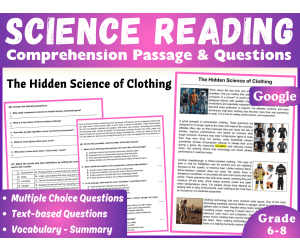
Science Reading Comprehension Passage: The Science of Clothing (Docs)
Science, ELA, Reading, Reading Comprehension, Strategies, Resources for Teachers, Technology, Engineering, Grade 6, 7, 8, 9, Writing Prompts, Worksheets & Printables, Centers, Activities, Teacher Tools, Assessments, Quizzes and Tests, Quizzes, Tests
Science Reading Comprehension Passage and Questions: The Hidden Science of Clothing (Docs) This very engaging science reading passage is about how modern clothing uses science and technology to improve safety, performance, comfort, and exploration . It explains different examples of high-tech clothing and materials, including compression clothing for athletes, flame-resistant clothing for firefighters and workers, aerogel for astronaut suits and space rovers, and smart fabrics that can play music, answer calls, or track a heartbeat. The visuals on page 1 support these examples by showing athletic clothing, protective work gear, and space-related clothing. This passage is designed to bridge the gap between science and literacy through strengthening reading comprehension and sparking scientific curiosity in middle school students. The passage blends English Language Arts skills with accurate science content that supports NGSS classroom practice. Ideal for interdisciplinary learning in ELA and Science. Suitable for Grade 9 review, too! Student Tasks for The Passage: 5 multiple-choice questions targeting main idea, key details, inference, vocabulary in context, and use of evidence 5 vocabulary matching items with clear, student-friendly definitions 5 text-based questions that require citing specific lines or facts 1 summary prompt that asks students to condense central ideas accurately Full answer key for every section Available Formats for this Resource PDF Fillable PDF Word Docs FULL CATALOG OF DOWNLOADING LINKS HERE Product Details Length: 4 pages total Grades: 6–8, also suitable for Grade 9 review Use cases: close reading, stations, homework, intervention, test prep, and sub plans Standards support: reinforces informational-text skills and supports NGSS-style sense making through observation, modeling, and clear use of claim, evidence, and reasoning Why Teachers Choose This Set Authentic science content paired with rigorous literacy practice Consistent task structure across all passages for easier planning and smoother student routines Clear, age-appropriate writing that builds confidence without oversimplifying Other Science Reading Collections you May find in the store: 1. Astronomy & Space Science 2. Volcanoes, Rocks, & Mountains 3. Rock Cycle, Soil, & Sinkholes 4. Mars, Glaciers, & Antarctica 5. Water Cycle, Acid Rain, & Wastewater 6. Insects, Animals, & Ecosystems 7. Bioluminescence & Insects 8. Animal Skin, Cats, & T. Rex 9. Human Body and Senses 10. Health & Applied Bioscience 11. Waves, Light, & Imaging 12. Electricity & Energy 13. Motion & Materials 14. Chemistry and Materials Science Use this set to reinforce ELA skills in science, to add literacy to your lessons, and to support independent work. The passages strengthen main idea, evidence use, vocabulary in context, inference, cause and effect, and summary writing. With ready-to-use assessments and complete answer keys, you can provide focused practice that is simple to run and fast to review.
Author Middle & High School - CORED Education
Rating
Tags Middle School, Reading Comprehension, Reading Strategies, ELA, Centers, Reading Passage, Assessments, Vocabulary, Technology

My Name from The House on Mango Street Diction Deep Dive Group Analysis!
ELA, Literature, Grade 7, 8, 9, 10, 11, 12, Teacher Tools, Assessments
Analyze the figurative language and diction in "My Name" from The House on Mango Street with this engaging group activity. The resource provides six quotes from Sandra Cisneros' vignette for students to dive into. Small groups will identify and examine the type of figurative language utilized in each quote, highlight specific word choices, and analyze how these literary devices establish tone and mood. Groups record their analysis directly onto slides in an editable Google slideshow. When complete, the whole class can view all groups' slides to enrich their comprehension. This collaborative deep dive into Cisneros' craft moves learning beyond basic plot into deeper literary analysis in an interactive formatstudents enjoy. Approach this complex vignette in a more dynamic way!
Author The Red-Haired Reader
Tags Figurative Language, Diction, Group Work, Analysis, Comprehension

Water Cycle, Acid Rain, & Wastewater: SAMPLE Reading Passage (PDF)
Science, Earth and Environmental Sciences, ELA, Reading, Reading Comprehension, Strategies, Resources for Teachers, Environmental Science, Grade 6, 7, 8, 9, Writing Prompts, Worksheets & Printables, Centers, Activities, Teacher Tools, Assessments, Quizzes and Tests, Quizzes, Tests
This is a ONE PASSAGE SAMPLE. The following is the description of the FULL resource and the downloading links: Water Cycle, Acid Rain, & Wastewater: Reading Comprehension Passages (PDF) This very engaging collection of environmental science reading passages about Water Cycle, Acid Rain, & Wastewater is designed to bridge the gap between science and literacy through strengthening reading comprehension and sparking scientific curiosity in middle school students. Each passage blends English Language Arts skills with accurate science content that supports NGSS classroom practice. Ideal for interdisciplinary learning in ELA and Science. Suitable for Grade 9 review, too! What Is Included? There are (3) informational passages: Wastewater: From Drain to Clean Follow water from your sink to the treatment plant as screens pull out debris, grit settles, microbes break down leftovers, and disinfection makes the water safe to release or reuse. The Water Cycle: The Engine of Our Planet Watch water move through evaporation, condensation, precipitation, and runoff, with plants and soils helping store and move it. See how this cycle powers weather and refills rivers and aquifers. Acid Rain: Causes, Impacts, and Solutions Learn how certain air pollutants turn rain more acidic, what that means for lakes, forests, and buildings, and how cleaner energy and emission controls help damaged ecosystems recover. Student Tasks for Each Passage: 5 multiple-choice questions targeting main idea, key details, inference, vocabulary in context, and use of evidence 5 vocabulary matching items with clear, student-friendly definitions 5 text-based questions that require citing specific lines or facts 1 summary prompt that asks students to condense central ideas accurately Full answer key for every section Available Formats for this Resource Word Docs Google Docs FULL CATALOG OF DOWNLOADING LINKS HERE Other Science Reading Collections and Topics You May Find in the Store: 1. Astronomy & Space Science 2. Volcanoes, Rocks, & Mountains 3. Rock Cycle, Soil, & Sinkholes 4. Mars, Glaciers, & Antarctica 5. Water Cycle, Acid Rain, & Wastewater 6. Insects, Animals, & Ecosystems 7. Bioluminescence & Insects 8. Animal Skin, Cats, & T. Rex 9. Human Body and Senses 10. Health & Applied Bioscience 11. Waves, Light, & Imaging 12. Electricity & Energy 13. Motion & Materials 14. Chemistry and Materials Science 15. Electromagnetism 16. Acids and Bases 17. Gas Laws 18. Biotechnology 19. Periodic Trends 20. Protists and Fungi 21. Microevolution 22. Blood 23. Chemical Bonding 24. Magnets 25. Muscles 26. Nuclear Chemistry 27. Electromagnetic Devices 28. Epigenetics 29. The Law of Conservation of Mass 30. Atomic Models 31. Isotopes and Ions 32. Light 33. Human-Environment Interaction 34. Theory of Evolution 35. Photosynthesis 36. Origins of Life and Early Earth 37. Gene Expression and Regulation 38. Thermochemistry 39. Allergies 40. Coevolution 41. Birth to Adulthood 42. Cells 43. Entropy and Free Energy 44. The Human Brain 45. Mixtures and Solutions 46. Invertebrates 47. Zoo Animals 48. Biochemistry 49. Animal Behavior 50. Population Ecology ...and many more engaging science reading passages that cover intriguing and important topics designed to spark curiosity and support student learning. Product Details Length: 15 pages total Grades: 6–8, also suitable for Grade 9 review Use cases: close reading, stations, homework, intervention, test prep, and sub plans Standards support: reinforces informational-text skills and supports NGSS-style sense making through observation, modeling, and clear use of claim, evidence, and reasoning Why Teachers Choose This Set Authentic science content paired with rigorous literacy practice Consistent task structure across all passages for easier planning and smoother student routines Clear, age-appropriate writing that builds confidence without oversimplifying Use this set to reinforce ELA skills in science, to add literacy to your lessons, or to support independent work. The passages strengthen main idea, evidence use, vocabulary in context, inference, cause and effect, and summary writing. With ready-to-use assessments and complete answer keys, you can provide focused practice that is simple to run and fast to review.
Author Middle & High School - CORED Education
Rating
Tags Middle School, Reading Comprehension, Reading Strategies, Reading Passages, ELA, Centers, Reading Passage, Assessments, Vocabulary, Environmental Science

"Civil Rights No. 4" Regents US History Short Essays
Social Studies, ELA, History, History: USA, Writing, Grade 10, 11, 12, Teacher Tools, Assessments
Civil Rights No. 4 Regents US History Short Essays Develop students' historical analysis skills with this set of short essay questions formatted like the New York State Regents exam. Students will read primary source documents and place them in historical context, identify relationships between events and ideas, and evaluate reliability and potential bias. This teaching resource contains two pairs of primary source documents on civil rights history with accompanying essay prompts. One set focuses on cause/effect, similarities/differences, and turning points. The other analyzes audience, purpose, bias, and point of view. Questions are designed for grades 10-12. Use these essay sets for test prep or assign them periodically to build analysis skills. Includes a cover sheet, two short essay questions with documents, and a grading rubric. Engage students in historical thinking with authentic primary sources!
Author Innovation Assessments LLC
Tags Us History, Regents, Frameworks, Dbq, Short Essay, History Grade 12 Essays Pdf Download, Past Us History Regents, Us History Regents Grading Rubric

Experiential Learning – Community Problem-Solving Projects
Social Studies, Government, Sociology, History: USA, History, Resources for Teachers, Classroom Management, Community Building, Special Resources, Social Emotional Learning (SEL), Grade 5, 7, 8, 9, 10, 11, 12, Worksheets & Printables, Workbooks, Worksheets, Word Searches, Teacher Tools, Assessments, Lesson Plans, Quizzes and Tests, Quizzes, Tests
Utilizing the no-prep experiential learning unit on solving community issues will empower your students to be active learners and members of their community by providing them with a hands-on, project-based learning (PBL) experience that goes far beyond the traditional textbook. The complete curriculum guide and student workbook for this PBL unit will give you all the necessary information to create an engaging and effective PBL unit with your middle school students. The curriculum is built on the proven E.P.I.C framework (empathize, probe, innovate, commit), which will lead them through the entire civic action process, from identifying an authentic community issue, to conducting research about that issue, to designing a sustainable solution, to implementing their proposed solution. ● Learning Objectives For Participants: 1. Developing Systems Thinking through the use of tools like Iceberg Model and Five Whys, to identify underlying causes of issues rather than just surface level symptoms. 2. Supporting Empathetic Research by conducting interviews with Stakeholders and Mapping Community Assets through uses of Asset-Based Community Development. 3. Developing Data Analysis through differentiating and collecting data from both Qualitative and Quantitative sources in order to effectively communicate the case for change. 4. Supporting Design Thinking and Innovation by brainstorming and using a Feasibility/Impact Matrix to develop the best ideas. 5. Developing project management through Budgeting, Resources Allocation, Timelines with Milestones and Risk Mitigation. 6. Developing Persuasive Communication by learning how to "Pitch" using Ethos, Pathos and Logos to obtain Stakeholder Buy-In. 7. Developing Resilience and Reflection by gaining experience with real-world friction, by learning from successes and failures. Basic Content Summary. The following outlines the contents of the 39-page PDF document: - Part 1 is the Teacher's Theoretical Guide (approximately 11 pages in total) and provides a comprehensive overview of experiential learning's pedagogical background. The guide will give you the ability to facilitate, and confidence to use, experiential learning with your students. - Part 2 is the Student Workbook (about 16 pages total) and has worksheets that are scaffolded for each step of the project from community mapping through to summative reflection; includes 10 different worksheets. - Part 3 is comprised of Visuals & Teacher Resources (about 12 pages total). - Classroom Visuals: Contains anchor charts for The Experiential Learning Cycle, Root Cause Analysis (Fishbone Diagram), and the Strategic Intervention Matrix. - Comprehensive Answer Key & Rubrics: Contains exhibiting example rubrics at every stage (from Substandard to Advanced responses) so that grading is on the process of completion—this means your students know what to expect when working on this project! - Teacher Implementation Guide: Provides suggestions on becoming a guide on the side to your students, how to manage issues that may arise throughout the project, as well as how to create psychological safety for your students. Social Studies, Civics, Government, Leadership, Service-Learning, and Project-Based Learning (PBL) classrooms can benefit from using this resource to empower their students to positively impact the world around them. Download this resource today to begin developing the next generations of architects who will create social change! Projects Based Learning, (PBL), Experiential Learning, Civic, Social Studies, Middle School, Community Service, Servic eLearning, Problem Solving/ Critical Thinking/ Designthinking, Student Workbook (and Teacherguide). This resource also contains Rubrics, No Prep needed, Printable, Leadership and Civic engagement. What Makes It Good for Parents & Schools: Teaches 21st Century Skills Through Real-Life Scenarios: This learning experience is much more than hand memorizing; it teaches students real life skills that they will use throughout highschool, college, and their professional lives, such as budgeting, project management, public speaking, and analyzing data. Promotes Empathy and Civic Responsibility: Through class activities and community projects that are performed as a group and individulally, students will inherently develop a sense of empathy toward others and their community, realizing that they can and should take responsibility for helping bring about positive changes. Develops Resiliency & Growth Mindset: The curriculum helps students change the way they think about challenges (obstacles) and how they see their own failure (a way to collect information for growth). Students will learn to be resilient, open and flexible to the change of environment/challenges, as well as to be perseverant in overcoming obstacles into adulthood. Provides a Complete Package of A High-Quality, Cross-Curricular, and Academically Rigorou: The project consists of four major areas all integrated into one project: social studies, ie. civic mindedness; math, ie. development of budget(s); ELA, ie. persuasive writing skills; science, ie. collection of data. As a result, the project allows for multiplication of all of the classes learned as opposed to singularly focused learning. Provides Everything Needed in a Complete Turnkey Package: When teachers receive the project; it includes a teacher guide, student workbooks, and visual aids, as well as description of the method to assess the student's work is extremely organized, easy-to-understand as well as easy to implement and to grade both substantively and fairly. Intended Audience by Age Group: Age Breakdown Based on Content, Language and Express; Grades 6-8, (Middle School). Page 2 has an explicit mention of the "critical development window of grades 5-8". The task complexity (Budgeting, Stakeholder Analysis and System Thinking) fits perfectly within this age bracket particularly in 7-8 grade level. Secondary Audience: Advanced 5th grade or as part of Introductory 9th/10th grade course work. Material is substantial enough to be used as a High School Freshman/Sophomore Civics, Government or Leadership Elective Course- and, an awesome resource for Gifted and Talented (of which there are many!) in Middle School. Copyright & Terms Of Use: Syed Hammad Rizvi owns copyright on this book. The materials on this site may be used only by yourself or in your classroom (individually). You may not modify, share, or sell any part of it; therefore you are prohibited from placing it on the Internet so that someone else could download it. If you would like to share the resource with your Co-Workers, please purchase Multiple licenses through Teachsimple. Thank you for abiding by the Terms of Use. We thank you for your continued support of Syed Hammad Rizvi.
Author Creative Book Store
Rating
Tags ProjectBasedLearning, PBL, ExperientialLearning, ServiceLearning, CommunityProblemSolving, CivicEngagement, CivicAction, DesignThinking, SystemsThinking, InquiryBasedLearning

Insects, Animals, & Ecosystems: Reading Comprehension passages (Word)
Science, ELA, Reading, Reading Comprehension, Strategies, Resources for Teachers, Life Sciences, Animals, Insects, Nature & Plants, Grade 6, 7, 8, 9, Writing Prompts, Worksheets & Printables, Centers, Activities, Teacher Tools, Assessments, Quizzes and Tests, Quizzes, Tests
Insects, Animals, & Ecosystems: Reading Comprehension Passages (Word) This engaging collection of life science reading passages about Insects, Animals, & Ecosystems is designed to bridge the gap between science and literacy through strengthening reading comprehension and sparking scientific curiosity in middle school students. Each passage blends English Language Arts skills with accurate science content that supports NGSS classroom practice. Ideal for interdisciplinary learning in ELA and Science. Suitable for Grade 9 review, too! What Is Included? There are (3) informational passages: Ecosystems: Webs of Life and Change See how living things and their surroundings fit together. Follow energy from producers to consumers to decomposers, and notice how fires, floods, or people can disturb a system and how it can recover. Insects: Small Creatures, Giant Impact Meet the helpers that pollinate, recycle waste, and feed countless animals. Learn how simple body parts and smart behaviors let insects thrive almost everywhere. Unique Animals of the Rainforest Visit a forest bursting with life, from Hyacinth Macaws and pink river dolphins to golden lion tamarins and poison dart frogs. Understand why protecting habitats keeps these remarkable species alive. Student Tasks for Each Passage: 5 multiple-choice questions targeting main idea, key details, inference, vocabulary in context, and use of evidence 5 vocabulary matching items with clear, student-friendly definitions 5 text-based questions that require citing specific lines or facts 1 summary prompt that asks students to condense central ideas accurately Full answer key for every section Available Formats for this Resource PDF Google Docs FULL CATALOG OF DOWNLOADING LINKS HERE Other Science Reading Collections you May find in the store: 1. Astronomy & Space Science 2. Volcanoes, Rocks, & Mountains 3. Rock Cycle, Soil, & Sinkholes 4. Mars, Glaciers, & Antarctica 5. Water Cycle, Acid Rain, & Wastewater 6. Insects, Animals, & Ecosystems 7. Bioluminescence & Insects 8. Animal Skin, Cats, & T. Rex 9. Human Body and Senses 10. Health & Applied Bioscience 11. Waves, Light, & Imaging 12. Electricity & Energy 13. Motion & Materials 14. Chemistry and Materials Science Product Details Length: 14 pages total Grades: 6–8, also suitable for Grade 9 review Use cases: close reading, stations, homework, intervention, test prep, and sub plans Standards support: reinforces informational-text skills and supports NGSS-style sense making through observation, modeling, and clear use of claim, evidence, and reasoning Why Teachers Choose This Set Authentic science content paired with rigorous literacy practice Consistent task structure across all passages for easier planning and smoother student routines Clear, age-appropriate writing that builds confidence without oversimplifying Use this set to reinforce ELA skills in science, to add literacy to your lessons, or to support independent work. The passages strengthen main idea, evidence use, vocabulary in context, inference, cause and effect, and summary writing. With ready-to-use assessments and complete answer keys, you can provide focused practice that is simple to run and fast to review.
Author Middle & High School - CORED Education
Rating
Tags Middle School, Reading Comprehension, Reading Strategies, ELA, Centers, Reading Passage, Assessments, Vocabulary, Life Science, Insects
Illuminating Life: The Chemistry of Photosynthesis Reading Passage
ELA, Reading, Writing, Research, Resources for Teachers, Science, Nature & Plants, Life Sciences, High School, Homeschool Resources, Teacher Tools, Assessments, Quizzes and Tests, Lesson Plans, Worksheets & Printables, Writing Prompts
:Photosynthesis is one of those magical processes that truly brings science to life, and as a homeschool mom of a 9th grader, I know how important it is to have resources that make complex topics accessible and engaging. That is exactly why I created Illuminating Life: The Chemistry of Photosynthesis Reading Passage and Q & A . This Illuminating Life: The Chemistry of Photosynthesis Reading Passage and Q & A resource is designed to help students/homeschoolers grasp the essential role photosynthesis plays in sustaining life on Earth, while also building their reading comprehension and note-taking skills. Whether you are teaching in a classroom or around your kitchen table, this set will make tackling biology’s “big ideas” a whole lot easier. INCLUDED IN THIS RESOURCE: Engaging, student-friendly reading passage on photosynthesis 20 thought-provoking Q & A comprehension and critical thinking questions Complete answer key for all questions 5 versatile note-taking sheets to suit different learning styles TOPICS COVERED: The process and importance of photosynthesis Light-dependent reactions and the Calvin Cycle The role of chlorophyll and energy transformation Photosynthesis’ impact on ecosystems and the carbon cycle Illuminating Life: The Chemistry of Photosynthesis Reading Passage and Q & A is more than just a worksheet—it is a complete mini-unit designed to foster curiosity, critical thinking, and a deeper appreciation for the wonders of biology. As a homeschool mom, I know how precious your time is and how important it is to have resources you can trust. With this set, you will be able to guide your students/homeschoolers through one of science’s most essential topics with confidence and ease. Happy learning! If you and your students/homeschoolers enjoyed this resource, please leave a review. Thank you for your support! Tina - Big Easy Homeschooling Mom
Author Homeschool with Big Easy Homeschooling Mom
Rating
Tags Photosynthesis Reading Passage For High School, Biology Q&A Worksheet, Homeschool Photosynthesis Resource, Energy Transformation In Biology, Understanding The Calvin Cycle, Chlorophyll And Photosynthesis Explained, Cycle Activities For Students, Light-dependent Reactions, Homeschool Science, Energy Transformation

"Globalization No. 1", Regents US History Short Essays
Social Studies, ELA, History, History: USA, Writing, Grade 10, 11, 12, Teacher Tools, Assessments
Globalization No. 1, Regents US History Short Essays Enhance your students' historical document analysis abilities with Globalization No. 1, a comprehensive collection of Regents US History Short Essays focusing on the theme THE US IN A GLOBALIZING WORLD. Suited for grades 10 to12, this high-quality tool encapsulates areas such as Social Studies and Language Arts, with a definitive focus on United States History and Writing. This robust resource revolves around Stimulus-Based Short-Essay Questions based off recent New York State Regents examinations in United States History and Government (Framework). These meticulously evaluate both the understandings of students regarding historical context from two documents as well as their skillset of distinguishing relationships between events or ideas within there. It provokes young thinkers to analyze various factors like audience bias, purpose or point-of-view influencing each document's reliability as evidentiary sources. Comprised of two sets offering two pairs of documents each along with corresponding prompts. One short essay question is served per set. A five-point rubric outlines scoring basis for every question posed in Sets 1 & 2 derived from authentic NYSED models circulated June 2019. Exclusively Designed by David Jones This teaching resource interestingly includes passcodes for video lessons complete with embedded auto-correcting questions available at InnovationAssessments.com/TestDrive. Covers topics ranging from '20th-century Iraq', 'the Persian Gulf War', '9/11', 'the Second Persian Gulf War', 'Globalization' & beyond. The videos provide an interactive complement to traditional classroom instruction. In different learning environments whether its whole group discussions or small group collaborations; even used independent homework assignments, these materials promote active engagement fostering deeper comprehension of key concepts through practical contexts. The benefits: The resource facilitates an instant and noticeable impact within your classrooms while extending learning beyond it. It creates opportunities for direct application into everyday life experiences, aiding in the development of well-informed, rounded citizens. Format: The product arrives in a PDF format offered as a student version of the assessment for seamless classroom integration. Please note that purchase permits single classroom use by the purchaser only—redistribution, editing, sale or unauthorized internet posting violates these terms.
Author Innovation Assessments LLC
Tags Globalization, Regents US History, Document Analysis, Short Essays, Stimulus-based Questions
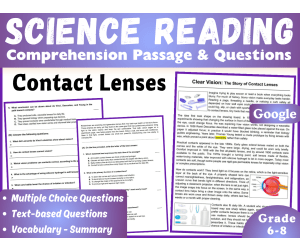
Life Science Reading Comprehension Passage: Clear Vision (Docs)
Science, ELA, Reading, Reading Comprehension, Strategies, Resources for Teachers, Life Sciences, Grade 6, 7, 8, 9, Writing Prompts, Worksheets & Printables, Centers, Activities, Teacher Tools, Assessments, Quizzes and Tests, Quizzes, Tests
Life Science Reading Comprehension Passage and Questions: Clear Vision (Docs) This very engaging life science reading passage about the history, science, and everyday use of contact lenses. It explains how contact lenses developed from early ideas by Leonardo da Vinci, René Descartes, and Thomas Young into practical lenses used today. It also explains how contacts work by bending light so it focuses correctly on the retina , helping correct nearsightedness, farsightedness, and astigmatism . The passage also discusses soft lenses, silicone hydrogel, daily use, safety habits, and future lens technology. This passage is designed to bridge the gap between science and literacy through strengthening reading comprehension and sparking scientific curiosity in middle school students. The passage blends English Language Arts skills with accurate science content that supports NGSS classroom practice. Ideal for interdisciplinary learning in ELA and Science. Suitable for Grade 9 review, too! Student Tasks for The Passage: 5 multiple-choice questions targeting main idea, key details, inference, vocabulary in context, and use of evidence 5 vocabulary matching items with clear, student-friendly definitions 5 text-based questions that require citing specific lines or facts 1 summary prompt that asks students to condense central ideas accurately Full answer key for every section Available Formats for this Resource PDF Fillable PDF Word Docs FULL CATALOG OF DOWNLOADING LINKS HERE Product Details Length: 5 pages total Grades: 6–8, also suitable for Grade 9 review Use cases: close reading, stations, homework, intervention, test prep, and sub plans Standards support: reinforces informational-text skills and supports NGSS-style sense making through observation, modeling, and clear use of claim, evidence, and reasoning Why Teachers Choose This Set Authentic science content paired with rigorous literacy practice Consistent task structure across all passages for easier planning and smoother student routines Clear, age-appropriate writing that builds confidence without oversimplifying Other Science Reading Collections you May find in the store: 1. Astronomy & Space Science 2. Volcanoes, Rocks, & Mountains 3. Rock Cycle, Soil, & Sinkholes 4. Mars, Glaciers, & Antarctica 5. Water Cycle, Acid Rain, & Wastewater 6. Insects, Animals, & Ecosystems 7. Bioluminescence & Insects 8. Animal Skin, Cats, & T. Rex 9. Human Body and Senses 10. Health & Applied Bioscience 11. Waves, Light, & Imaging 12. Electricity & Energy 13. Motion & Materials 14. Chemistry and Materials Science Use this set to reinforce ELA skills in science, to add literacy to your lessons, and to support independent work. The passages strengthen main idea, evidence use, vocabulary in context, inference, cause and effect, and summary writing. With ready-to-use assessments and complete answer keys, you can provide focused practice that is simple to run and fast to review.
Author Middle & High School - CORED Education
Rating
Tags Middle School, Reading Comprehension, Reading Strategies, ELA, Centers, Reading Passage, Assessments, Vocabulary, Life Science

Science Reading Comprehension Passage: Seeing Color (Docs)
Science, ELA, Reading, Reading Comprehension, Strategies, Resources for Teachers, Physics, Grade 6, 7, 8, 9, Writing Prompts, Worksheets & Printables, Centers, Activities, Teacher Tools, Assessments, Quizzes and Tests, Quizzes, Tests
Science Reading Comprehension Passage and Questions: Seeing Color (Docs) This very engaging science reading passage is about how people see color . It explains that color depends on the interaction among light, objects, and the human visual system . It covers how white light contains many wavelengths, how objects reflect some wavelengths and absorb others, how a prism uses refraction to separate white light into the visible spectrum, and how cone cells in the eye and the brain help create the experience of color. The visuals on page 1 also support this by showing a classroom changing with light, an apple reflecting/absorbing light, and a prism separating white light into colors. This passage is designed to bridge the gap between science and literacy through strengthening reading comprehension and sparking scientific curiosity in middle school students. The passage blends English Language Arts skills with accurate science content that supports NGSS classroom practice. Ideal for interdisciplinary learning in ELA and Science. Suitable for Grade 9 review, too! Student Tasks for The Passage: 5 multiple-choice questions targeting main idea, key details, inference, vocabulary in context, and use of evidence 5 vocabulary matching items with clear, student-friendly definitions 5 text-based questions that require citing specific lines or facts 1 summary prompt that asks students to condense central ideas accurately Full answer key for every section Available Formats for this Resource PDF Fillable PDF Word Docs FULL CATALOG OF DOWNLOADING LINKS HERE Product Details Length: 4 pages total Grades: 6–8, also suitable for Grade 9 review Use cases: close reading, stations, homework, intervention, test prep, and sub plans Standards support: reinforces informational-text skills and supports NGSS-style sense making through observation, modeling, and clear use of claim, evidence, and reasoning Why Teachers Choose This Set Authentic science content paired with rigorous literacy practice Consistent task structure across all passages for easier planning and smoother student routines Clear, age-appropriate writing that builds confidence without oversimplifying Other Science Reading Collections you May find in the store: 1. Astronomy & Space Science 2. Volcanoes, Rocks, & Mountains 3. Rock Cycle, Soil, & Sinkholes 4. Mars, Glaciers, & Antarctica 5. Water Cycle, Acid Rain, & Wastewater 6. Insects, Animals, & Ecosystems 7. Bioluminescence & Insects 8. Animal Skin, Cats, & T. Rex 9. Human Body and Senses 10. Health & Applied Bioscience 11. Waves, Light, & Imaging 12. Electricity & Energy 13. Motion & Materials 14. Chemistry and Materials Science Use this set to reinforce ELA skills in science, to add literacy to your lessons, and to support independent work. The passages strengthen main idea, evidence use, vocabulary in context, inference, cause and effect, and summary writing. With ready-to-use assessments and complete answer keys, you can provide focused practice that is simple to run and fast to review.
Author Middle & High School - CORED Education
Rating
Tags Middle School, Reading Comprehension, Reading Strategies, ELA, Centers, Reading Passage, Assessments, Vocabulary, Physics, Light Waves And Optics
Emotional Regulation & Self-Care Planners for Teens
Special Resources, Social Emotional Learning (SEL), Life Skills, Social Skills, Special Education Needs (SEN), Speech Therapy, Life Studies, Coaching, Career, Leadership, Grade 9, 10, 11, 12, Teacher Tools, Assessments, Lesson Plans, Quizzes and Tests, Quizzes, Tests, Worksheets & Printables, Worksheets, Word Searches, Workbooks
The Emotional Regulation & Self-Care Planner for Teens (39 pages), which is available digitally as a curriculum and a planner, is laid out in three phases. The first phase (core content & theory) consists of four chapters dealing with the neurobiology of adolescent emotions, the cognitive restructuring process as well as working with the inner critic; somatic regulation (resilience of the nervous system); strategic self-care (boundary architecture). Also included are real-life case studies of teenagers (amygdala hijack, perfectionism spiral, freeze response/burnout cycle); The second phase consists of a student workbook that includes ten interactive worksheets (re: affective granularity/metacognition cognitive distortion; interoceptive/somatic map; navigating the Window of Tolerance boundary architecture; digital ecosystem audit; executive function/anticipatory anxiety; and interpersonal rupture & repair); The third phase consists of visuals & teacher resources (classroom visuals, answer keys, assessment rubrics, teacher implementation guide). The three visuals contain high-fidelity representations of the Window of Tolerance diagram; cognitive-behavioral triad; multidimensional self-care matrix). The teacher resources contain answer keys for each module and rubrics for use in assessing student work. The resource addresses self-care from three frameworks, cognitive-behavioral therapy (CBT), dialectical behavior therapy (DBT), and polyvagal theory and defines self-care as "radical stewardship of oneself". It provides teenagers with practical tools for emotional regulation, managing stress, setting digital boundaries, and developing resilience. The resource was designed to be print-ready and tested in classrooms, and includes fillable blank forms and reflection items. What Parents/Schools Appreciate: Based on research and ready to use in class – Integrating CBT, DBT and Polyvagal Theory, the program includes worksheets for students as well as the teacher's key that connects with social emotional learning (SEL) standards, thereby saving weeks of lesson planning. Directly targeted to teens and highly engaging – The material is presented via case studies from students, real-world issues they face with the digital age and through visual diagrams that connect to these emotional learning experiences for grades 9-12. Trauma-informed and provides safety – The material provides the students with options, breaks the stigma on emotional learning and clearly explains the reporting protocols for educators, making it a resource they can use for success in diverse classrooms. Comprehensive and multi-functional – It can be used for whole class lesson plans, small group counseling, advisory periods or as a self-help resource for individual students, one product meets several needs. Immediate learning and long term benefit – Students develop ongoing skills in emotional granularity, boundary setting, and regulating their nervous system while parents and schools experience decreased levels of anxiety and increased levels of focus. Intended Students: Students in Grades 9-12 only. All the examples, case studies, language, and content are created specifically for high school students (ages 14-18) who are dealing with academic pressures, social media, peer group dynamics, forming their identity, and normal neurodevelopmental changes in the developing teenage brain. This material is inappropriate for middle school students (too mature) or college students (too teen-focused). Copyright Notice and Terms of Use: This Book is the exclusive property of Syed Hammad Rizvi and may not be used for anything other than personal or one-on-one classroom usage. You cannot make any changes, distribute, or sell all or any portion of this Book in any form without written permission from Syed Hammad Rizvi. This means that you cannot publish this Book on the Internet for public access. If you would like to give this Book to your colleagues, please contact Teachsimple for more licenses. Thank you for understanding our terms of use. We hope you enjoy this product from Syed Hammad Rizvi.
Author Creative Book Store
Rating
Tags EmotionalRegulationForTeens, SelfCarePlannerForTeens, TeenEmotionalRegulation, SELcurriculum, TeenMentalHealth, HighSchoolSEL, CBTForTeens, DBTForTeens, TeenSelfCare, EmotionalRegulationWorkbook
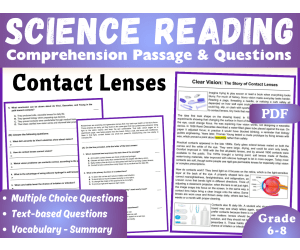
Life Science Reading Comprehension Passage: Clear Vision (PDF)
Science, ELA, Reading, Reading Comprehension, Strategies, Resources for Teachers, Life Sciences, Grade 6, 7, 8, 9, Writing Prompts, Worksheets & Printables, Centers, Activities, Teacher Tools, Assessments, Quizzes and Tests, Quizzes, Tests
Life Science Reading Comprehension Passage and Questions: Clear Vision (PDF) This very engaging life science reading passage about the history, science, and everyday use of contact lenses. It explains how contact lenses developed from early ideas by Leonardo da Vinci, René Descartes, and Thomas Young into practical lenses used today. It also explains how contacts work by bending light so it focuses correctly on the retina , helping correct nearsightedness, farsightedness, and astigmatism . The passage also discusses soft lenses, silicone hydrogel, daily use, safety habits, and future lens technology. This passage is designed to bridge the gap between science and literacy through strengthening reading comprehension and sparking scientific curiosity in middle school students. The passage blends English Language Arts skills with accurate science content that supports NGSS classroom practice. Ideal for interdisciplinary learning in ELA and Science. Suitable for Grade 9 review, too! Student Tasks for The Passage: 5 multiple-choice questions targeting main idea, key details, inference, vocabulary in context, and use of evidence 5 vocabulary matching items with clear, student-friendly definitions 5 text-based questions that require citing specific lines or facts 1 summary prompt that asks students to condense central ideas accurately Full answer key for every section Available Formats for this Resource Fillable PDF Word Docs Google Docs FULL CATALOG OF DOWNLOADING LINKS HERE Product Details Length: 5 pages total Grades: 6–8, also suitable for Grade 9 review Use cases: close reading, stations, homework, intervention, test prep, and sub plans Standards support: reinforces informational-text skills and supports NGSS-style sense making through observation, modeling, and clear use of claim, evidence, and reasoning Why Teachers Choose This Set Authentic science content paired with rigorous literacy practice Consistent task structure across all passages for easier planning and smoother student routines Clear, age-appropriate writing that builds confidence without oversimplifying Other Science Reading Collections you May find in the store: 1. Astronomy & Space Science 2. Volcanoes, Rocks, & Mountains 3. Rock Cycle, Soil, & Sinkholes 4. Mars, Glaciers, & Antarctica 5. Water Cycle, Acid Rain, & Wastewater 6. Insects, Animals, & Ecosystems 7. Bioluminescence & Insects 8. Animal Skin, Cats, & T. Rex 9. Human Body and Senses 10. Health & Applied Bioscience 11. Waves, Light, & Imaging 12. Electricity & Energy 13. Motion & Materials 14. Chemistry and Materials Science Use this set to reinforce ELA skills in science, to add literacy to your lessons, and to support independent work. The passages strengthen main idea, evidence use, vocabulary in context, inference, cause and effect, and summary writing. With ready-to-use assessments and complete answer keys, you can provide focused practice that is simple to run and fast to review.
Author Middle & High School - CORED Education
Rating
Tags Middle School, Reading Comprehension, Reading Strategies, ELA, Centers, Reading Passage, Assessments, Vocabulary, Life Science
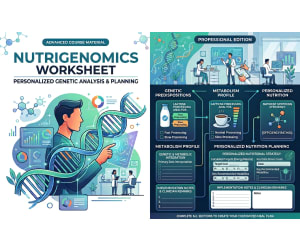
Nutrigenomics & DNA-Based Diet Planning
Science, Chemistry, Life Sciences, Biology, Human Body, Research, Resources for Teachers, Classroom Management, Community Building, STEM, Grade 6, 7, 8, 9, 10, 11, 12, Worksheets & Printables, Worksheets, Workbooks, Word Searches, Teacher Tools, Assessments, Lesson Plans, Quizzes and Tests, Quizzes, Tests
Unlock the future of personalized nutrition with this comprehensive, 42-page curriculum on Nutrigenomics and DNA-Based Diet Planning . Are your students or clients tired of one-size-fits-all health advice? This digital resource is the perfect tool to bridge the gap between complex genetic data and real-world, actionable meal planning. Designed for advanced learners, this unit moves beyond basic nutrition and dives into the cutting-edge science of how our unique genetic makeup dictates our response to foods. Students will learn to translate raw genetic data (SNPs) from common variants like MTHFR, APOE, TCF7L2, CYP1A2 (caffeine metabolism), and MCM6 (lactose intolerance) into highly personalized dietary protocols. This is not just a lecture—it's a complete, turnkey educational package perfect for AP Biology, IB Biology, university-level nutrition or genetics courses, and professional development for health coaches and dietitians. What's Included in This 42-Page All-in-One Resource: Part 1: Core Content & Theory (11 pages): A robust introduction to the molecular paradigm of nutrition, covering the genetics of macronutrient metabolism, enzymatic pathways (caffeine & lactose), and a hierarchical approach to building a DNA-based meal plan. Includes two detailed case studies (Elena & Marcus) that demonstrate how to synthesize multiple genetic factors into a cohesive plan. Part 2: Student Workbook (20 pages): Ten in-depth, high-level worksheets that guide students through an analytical process. They will map their own (or a case study's) genetic predispositions related to: Caffeine Metabolism (CYP1A2) Lactose Persistence (MCM6/LCT) Folate Metabolism (MTHFR) Lipid Transport & Saturated Fat (APOE/APOA2) Starch Digestion (AMY1) Vitamin D Receptor (VDR) Sodium Sensitivity (ACE/AGT) Histamine Degradation (DAO) And a final, integrated "Master Meal Plan" worksheet. Part 3: Visuals & Teacher Resources (11 pages): Includes high-resolution diagrams perfect for presentations and handouts, plus a complete Teacher Answer Key for the case study worksheets, providing detailed, expert-level answers and rationale. Learning Outcomes: Upon completion, students will be able to: Analyze and interpret key single nucleotide polymorphisms (SNPs) related to diet. Understand the biochemical impact of genetic variants on metabolism. Develop a prioritized, evidence-based dietary plan from genetic data. Critically evaluate how diet can be used to mitigate genetic risk and optimize health. Move from abstract theory to practical, real-world application. Keywords: Nutrigenomics, Personalized Nutrition, DNA Diet, Genetics, Biology Curriculum, AP Biology, IB Biology, University Nutrition, Dietetics, Health Coach Resource, SNP, MTHFR, APOE, CYP1A2, Caffeine Metabolism, Lactose Intolerance, Printable, Digital Workbook, Science, Project-Based Learning. Why Parents/Schools Love It: Bridges Theory and Real-World Application: This isn't just memorizing facts. It teaches students critical thinking by applying complex genetic science to a practical, everyday subject: food. Prepares Students for Future-Focused Careers: It provides a strong foundation in the rapidly growing fields of personalized medicine and wellness, giving students a significant advantage in college applications and future careers. Turnkey, Comprehensive Curriculum: It's an all-in-one resource with theory, worksheets, visuals, and a complete answer key, saving teachers valuable preparation time while providing a rigorous, high-quality lesson. Makes Science Personal and Engaging: By focusing on how DNA affects an individual's own body (or compelling case studies), it transforms an abstract topic into a deeply personal and engaging investigation. Target Audience (Student Classes) : Based on the advanced vocabulary ("phenotypic risk stratification," "cytochrome P450," "thermolabile enzyme") and the complexity of the tasks, target the following groups: University/College Students: This is the primary audience. It's perfectly suited for undergraduate and graduate courses in: Nutrition and Dietetics Human Biology and Kinesiology Genetics and Molecular Biology Naturopathic or Functional Medicine Programs Advanced High School Students: This is an excellent resource for accelerated programs, providing a significant competitive edge. AP Biology (especially for units on genetics and gene expression) IB Biology (Higher Level) Advanced Health Science Electives Professional Development: This workbook is a valuable upskilling tool for practicing or training: Health Coaches Nutritionists Personal Trainers with an interest in advanced nutrition. Copyright/Terms of Use: This Book was copyrighted by Syed Hammad Rizvi. This resource is for personal and single classroom use only. You may not alter, redistribute, or sell any part of this resource. In other words, you may not put it on the Internet where it could be publicly found and downloaded. If you want to share this resource with colleagues, please purchase additional licenses from Teachsimple. Thank you for respecting these terms of use. This product is happily brought to you by Syed Hammad Rizvi
Author Creative Book Store
Rating
Tags Nutrigenomics, PersonalizedNutrition, DNADiet, NutritionalGenomics, PrecisionNutrition, FunctionalNutrition, GeneticTesting, Biohacking, HealthScience, MolecularBiology
Social Studies Comprehension Passages: Media and Communication (Docs)
ELA, Reading, Reading Comprehension, Strategies, Resources for Teachers, Social Studies, Sociology, Grade 6, 7, 8, 9, Writing Prompts, Worksheets & Printables, Centers, Activities, Teacher Tools, Assessments, Quizzes and Tests, Quizzes, Tests
Social Studies Reading Comprehension Passages and Questions: Media, Communication, and Popular Culture (Docs) This resource introduces a collection of Social Studies reading comprehension passages with questions about Media, Communication, and Popular Culture. The passages are carefully designed to bridge the gap between social studies and literacy through strengthening reading comprehension and sparking knowledge curiosity in middle school students. Each passage blends English Language Arts skills with accurate social studies content . Ideal for interdisciplinary learning in ELA and Social Studies. Suitable for Grade 9 review, too! What Is Included in this Collection? There are three informational passages (with full answer keys): Lights, Camera, Business: The Rise of Hollywood The LEGO Story: From Workshop to World Stage When Milk Cartons Became Message Boards For Each Passage, students will have multiple tasks to complete as follow: 5 multiple-choice questions targeting main idea, key details, inference, vocabulary in context, and use of evidence 5 vocabulary matching items with clear, student-friendly definitions 5 text-based questions that require citing specific lines or facts 1 summary prompt that asks students to condense central ideas accurately Available Formats for this Resource PDF Fillable PDF Word Docs FULL CATALOG OF DOWNLOADING LINKS HERE For more Social Studies Reading Passages, check the following Links: Ancient Civilizations PDF Fillable PDF Word Docs Google Docs Early Empires and Trade Networks PDF Fillable PDF Word Docs Google Docs The Founding of the United States PDF Fillable PDF Word Docs Google Docs Language, Culture, and Meaning PDF Fillable PDF Word Docs Google Docs Psychology and Society PDF Fillable PDF Word Docs Google Docs Global Festivals and Traditions PDF Fillable PDF Word Docs Google Docs Extreme Environments and People PDF Fillable PDF Word Docs Google Docs Food, Culture, and Preservation PDF Fillable PDF Word Docs Google Docs Global Food Customs PDF Fillable PDF Word Docs Google Docs Media, Communication, and Popular Culture PDF Fillable PDF Word Docs Google Docs Human Impact on the Environment PDF Fillable PDF Word Docs Google Docs Civic Action and Social Change PDF Fillable PDF Word Docs Google Docs Fashion, Society, and Power PDF Fillable PDF Word Docs Google Docs People, Places, and Unusual Histories PDF Fillable PDF Word Docs Google Docs Product Details Length: 15 pages total Grades: 6–8, also suitable for Grade 9 review Use cases: close reading, stations, homework, intervention, test prep, and sub plans Why Teachers Choose This Set Authentic social studies content paired with rigorous literacy practice Consistent task structure across all passages for easier planning and smoother student routines Clear, age-appropriate writing that builds confidence without oversimplifying Use this set to reinforce ELA skills in social studies, to add literacy to your lessons, and to support independent work. The passages strengthen main idea, evidence use, vocabulary in context, inference, cause and effect, and summary writing. With ready-to-use assessments and complete answer keys, you can provide focused practice that is simple to run and fast to review.
Author Middle & High School - CORED Education
Rating
Tags Middle School, Reading Comprehension, Reading Strategies, ELA, Centers, Reading Passage, Assessments, Vocabulary, Social Studies, Media Communication And Culture

Earth Science Reading Passage: The Rock Cycle (Fillable PDF)
Science, ELA, Reading, Reading Comprehension, Strategies, Resources for Teachers, Earth and Environmental Sciences, Earth Sciences, Grade 6, 7, 8, 9, Writing Prompts, Worksheets & Printables, Centers, Activities, Teacher Tools, Assessments, Quizzes and Tests, Quizzes, Tests
Science Reading Comprehension Passages and Questions: The Rock Cycle (PDF) This very engaging earth science reading passage about The Rock Cycle is designed to bridge the gap between science and literacy through strengthening reading comprehension and sparking scientific curiosity in middle school students. The passage blends English Language Arts skills with accurate science content that supports NGSS classroom practice. Ideal for interdisciplinary learning in ELA and Science. Suitable for Grade 9 review, too! These worksheets are designed as fillable PDFs , which means students can type their answers directly into the document on any computer or tablet . Each page includes highlighted text fields that show them exactly where to type! Student Tasks for The Passage: 5 multiple-choice questions targeting main idea, key details, inference, vocabulary in context, and use of evidence 5 vocabulary matching items with clear, student-friendly definitions 5 text-based questions that require citing specific lines or facts 1 summary prompt that asks students to condense central ideas accurately Full answer key for every section Available Formats for this Resource PDF Word Docs Google Docs FULL CATALOG OF DOWNLOADING LINKS HERE Product Details Length: 5 pages total Grades: 6–8, also suitable for Grade 9 review Use cases: close reading, stations, homework, intervention, test prep, and sub plans Standards support: reinforces informational-text skills and supports NGSS-style sense making through observation, modeling, and clear use of claim, evidence, and reasoning Why Teachers Choose This Set Authentic science content paired with rigorous literacy practice Consistent task structure across all passages for easier planning and smoother student routines Clear, age-appropriate writing that builds confidence without oversimplifying Other Science Reading Collections you May find in the store: 1. Astronomy & Space Science 2. Volcanoes, Rocks, & Mountains 3. Rock Cycle, Soil, & Sinkholes 4. Mars, Glaciers, & Antarctica 5. Water Cycle, Acid Rain, & Wastewater 6. Insects, Animals, & Ecosystems 7. Bioluminescence & Insects 8. Animal Skin, Cats, & T. Rex 9. Human Body and Senses 10. Health & Applied Bioscience 11. Waves, Light, & Imaging 12. Electricity & Energy 13. Motion & Materials 14. Chemistry and Materials Science Use this set to reinforce ELA skills in science, to add literacy to your lessons, and to support independent work. The passages strengthen main idea, evidence use, vocabulary in context, inference, cause and effect, and summary writing. With ready-to-use assessments and complete answer keys, you can provide focused practice that is simple to run and fast to review.
Author Middle & High School - CORED Education
Rating
Tags Middle School, Reading Comprehension, Reading Strategies, ELA, Centers, Reading Passage, Assessments, Vocabulary, Environmental Science, Earth Science

Physical Science Reading Comprehension Passage: Acids and Bases (PDF)
Science, ELA, Reading, Reading Comprehension, Strategies, Resources for Teachers, Chemistry, Grade 6, 7, 8, 9, Writing Prompts, Worksheets & Printables, Centers, Activities, Teacher Tools, Assessments, Quizzes and Tests, Quizzes, Tests
Physical Science Reading Comprehension Passage and Questions: Acids and Bases (PDF) This very engaging science reading passage is about acids and bases and how they appear in everyday materials. It explains that acids release hydrogen ions in water and are found in substances such as lemon juice, vinegar, citrus fruits, and stomach acid. It also describes bases, including soap, baking soda, ammonia, and cleaners, and explains how scientists use the pH scale to compare how acidic or basic a substance is. The passage introduces neutralization reactions , showing how acids and bases can react to form water and a salt, and connects the topic to real-life uses in farming, medicine, cooking, and cleaning. This passage is designed to bridge the gap between science and literacy by strengthening reading comprehension while sparking scientific curiosity in middle school students. It blends English Language Arts skills with accurate science content, helping students build background knowledge, understand key concepts, use evidence from the text, and explain scientific ideas clearly. This resource supports science classroom practice while also reinforcing important literacy skills such as main idea, vocabulary, comprehension, and summarizing. Ideal for interdisciplinary learning in ELA and Science. Suitable for Grade 9 review, too! Student Tasks for The Passage: 10 multiple-choice questions targeting main idea, key details, science concepts, comparison, and real-world applications 10 True/False statements to check understanding and address common misconceptions 5 text-based short-answer questions that require students to explain important ideas from the passage 5 vocabulary matching items with clear, student-friendly definitions 1 summary prompt that asks students to condense the central ideas accurately Full answer key for every section Available Formats for this Resource Fillable PDF Word Docs Google Docs FULL CATALOG OF DOWNLOADING LINKS HERE Product Details Length: 6 pages total Grades: 6–8, also suitable for Grade 9 review Use cases: close reading, stations, homework, intervention, test prep, and sub plans Standards support: Reinforces informational-text skills and supports NGSS-style sense-making by helping students read scientific explanations, connect evidence to key concepts, interpret real-world examples, and explain cause-and-effect relationships in science. Why Teachers Choose This Set Authentic science content paired with rigorous literacy practice Consistent task structure across all passages for easier planning and smoother student routines Clear, age-appropriate writing that builds confidence without oversimplifying Other Science Reading Collections and Topics You May Find in the Store: 1. Astronomy & Space Science 2. Volcanoes, Rocks, & Mountains 3. Rock Cycle, Soil, & Sinkholes 4. Mars, Glaciers, & Antarctica 5. Water Cycle, Acid Rain, & Wastewater 6. Insects, Animals, & Ecosystems 7. Bioluminescence & Insects 8. Animal Skin, Cats, & T. Rex 9. Human Body and Senses 10. Health & Applied Bioscience 11. Waves, Light, & Imaging 12. Electricity & Energy 13. Motion & Materials 14. Chemistry and Materials Science 15. Electromagnetism 16. Acids and Bases 17. Gas Laws 18. Biotechnology 19. Periodic Trends 20. Protists and Fungi 21. Microevolution 22. Blood 23. Chemical Bonding 24. Magnets 25. Muscles 26. Nuclear Chemistry 27. Electromagnetic Devices 28. Epigenetics 29. The Law of Conservation of Mass 30. Atomic Models 31. Isotopes and Ions 32. Light 33. Human-Environment Interaction 34. Theory of Evolution 35. Photosynthesis 36. Origins of Life and Early Earth 37. Gene Expression and Regulation 38. Thermochemistry 39. Allergies 40. Coevolution 41. Birth to Adulthood 42. Cells 43. Entropy and Free Energy 44. The Human Brain 45. Mixtures and Solutions 46. Invertebrates 47. Zoo Animals 48. Biochemistry 49. Animal Behavior 50. Population Ecology ...and many more engaging science reading passages that cover intriguing and important topics designed to spark curiosity and support student learning. Use this passage to reinforce ELA skills in science, to add literacy to your lessons, and to support independent work. The passages strengthen main idea, evidence use, vocabulary in context, inference, cause and effect, and summary writing. With ready-to-use assessments and complete answer keys, you can provide focused practice that is simple to run and fast to review.
Author Middle & High School - CORED Education
Rating
Tags Middle School, Reading Comprehension, Reading Strategies, ELA, Centers, Reading Passage, Assessments, Vocabulary, Chemistry, Physical Science

Earth Science Reading Passage: Cleaning Wasterwater (Word)
Science, ELA, Reading, Reading Comprehension, Strategies, Resources for Teachers, Earth and Environmental Sciences, Earth Sciences, Environmental Science, Grade 6, 7, 8, 9, Writing Prompts, Worksheets & Printables, Centers, Activities, Teacher Tools, Assessments, Quizzes and Tests, Quizzes, Tests
Science Reading Comprehension Passages and Questions: Cleaning Wastewater (Word) This very engaging earth science reading passage about Cleaning Wastewater . It is designed to bridge the gap between science and literacy through strengthening reading comprehension and sparking scientific curiosity in middle school students. The passage blends English Language Arts skills with accurate science content that supports NGSS classroom practice. Ideal for interdisciplinary learning in ELA and Science. Suitable for Grade 9 review, too! Student Tasks for The Passage: 5 multiple-choice questions targeting main idea, key details, inference, vocabulary in context, and use of evidence 5 vocabulary matching items with clear, student-friendly definitions 5 text-based questions that require citing specific lines or facts 1 summary prompt that asks students to condense central ideas accurately Full answer key for every section Available Formats for this Resource PDF Fillable PDF Google Docs FULL CATALOG OF DOWNLOADING LINKS HERE Product Details Length: 4 pages total Grades: 6–8, also suitable for Grade 9 review Use cases: close reading, stations, homework, intervention, test prep, and sub plans Standards support: reinforces informational-text skills and supports NGSS-style sense making through observation, modeling, and clear use of claim, evidence, and reasoning Why Teachers Choose This Set Authentic science content paired with rigorous literacy practice Consistent task structure across all passages for easier planning and smoother student routines Clear, age-appropriate writing that builds confidence without oversimplifying Other Science Reading Collections you May find in the store: 1. Astronomy & Space Science 2. Volcanoes, Rocks, & Mountains 3. Rock Cycle, Soil, & Sinkholes 4. Mars, Glaciers, & Antarctica 5. Water Cycle, Acid Rain, & Wastewater 6. Insects, Animals, & Ecosystems 7. Bioluminescence & Insects 8. Animal Skin, Cats, & T. Rex 9. Human Body and Senses 10. Health & Applied Bioscience 11. Waves, Light, & Imaging 12. Electricity & Energy 13. Motion & Materials 14. Chemistry and Materials Science Use this set to reinforce ELA skills in science, to add literacy to your lessons, and to support independent work. The passages strengthen main idea, evidence use, vocabulary in context, inference, cause and effect, and summary writing. With ready-to-use assessments and complete answer keys, you can provide focused practice that is simple to run and fast to review.
Author Middle & High School - CORED Education
Rating
Tags Middle School, Reading Comprehension, Reading Strategies, ELA, Centers, Reading Passage, Assessments, Vocabulary, Environmental Science
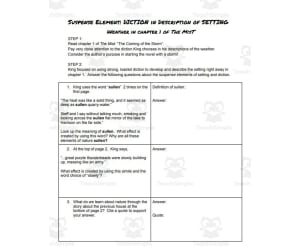
Suspense in Chapter 1 of Stephen King's The Mist: Diction and Setting + answers
ELA, Literature, Grade 7, 8, 9, 10, 11, 12, Teacher Tools, Assessments
Examining Suspense in Stephen King's The Mist\n\nThis educational resource helps secondary students analyze Stephen King's use of suspense in the first chapter of his novella The Mist, originally published in the short story collection Skeleton Crew. The 8 text-based questions guide learners to examine how King establishes an ominous tone and foreshadowing through descriptive diction and details about the setting. As students respond to the thought-provoking questions, they will gain a deeper understanding of how an acclaimed horror writer immediately draws in readers and develops an atmosphere thick with tension. This practical literacy activity comes with a suggested answer key so educators can easily implement it during suspense, horror, or Stephen King units. The Google Doc format allows teachers flexibility for whole-class analysis, small literature circles, or independent skill-building.
Author The Red-Haired Reader
Tags Suspense, Foreshadowing, Diction, Setting, Tone
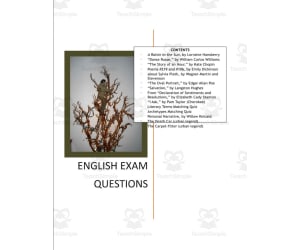
English Assessment
ELA, Reading, Reading Comprehension, Writing, Grade 9, 10, 11, 12, Teacher Tools, Assessments
English Assessment A comprehensive teaching resource designed to meet the demands of standardized testing mandates and provide educators with an essential tool for boosting students' English comprehension skills. It carries the intrinsic value of training in test item creation making it an excellent asset for educators. Resource Features Over 100 multiple-choice and matching exam questions that resemble those in standardized literature tests. A variety of reading selections, offering a well-rounded learning experience. Authors include Lorraine Hansberry, Kate Chopin, Emily Dickinson and Edgar Allan Poe among others. An array of American and Cherokee poetry plus selections of criticism supplementing texts by known authors. Beyond literary comprehension itself, this teaching aid also serves to fortify knowledge on key English concepts: Literary terms enquiry Understanding archetypal themes -Designing personal narratives, Verb tense cognition, Addition: Coordinating conjunctions utilization. Crafted for versatile usage, this resource can be implemented across various scenarios such as whole-group sessions or small-group projects- suitable not only for classroom settings but also distance learning environments. The product spreads across a document file allowing accessibility either via print-outs or digital sharing during online lessons. Suitable primarily for Grade 9 through Grade 12 students studying Language Arts with a concentration on Writing & Comprehension skills improvement. Conclusion: Whether you’re an educator tasked with school instruction or catering to home-schooled learners’ needs - this resource paves way for shaping confident readers, apt at navigating complex textual landscapes.
Author The Education Lab
Tags Standardized Testing, Exam Preparation, English Comprehension, Literature Analysis, Teaching Resource

Assessments: Short Stories with Literary Elements
ELA, Reading, Reading Comprehension, Literature, Grade 8, 9, 10, 11, 12, Teacher Tools, Assessments
Assessments : Short Stories with Literary Elements A perfect resource for educators keen on bolstering their Language Arts curriculum and fostering a comprehensive understanding of literature among students. Ideal for grades 8 through 12, this tool transcends standard textbook learning, engaging pupils in nuanced literary analysis. Detailed Specifications The educational asset is thoughtfully crafted and features: A riveting, two-page short story teeming with satirical wit and irony. Integral literary aspects like character development, climax structure, satire representation, dramatic irony setups and striking themes embedded within the annotated tales. An Interactive Learning Experience The inclusion of ten reflective questions accompanying each short story prompts students into exploring narrative elements deeply in addition to thinking critically about the story construction. Comprehending such underlying subtleties forms the crux of studying literature. Versatile Usage This resource can be effectively deployed across various classroom settings: As an initiate-participate activity at group discussions or broken down into smaller group debates. In solitary as homework assignments or one-to-one instructional scenarios depending on your teaching approach and student ease of access. Maturity Disclaimer! Since satire is a key theme - alike "A Modest Proposal" by Jonathan Swift - some stories may contain material necessitating mature comprehension making it unsuitable for younger readers. Hence, educator discretion on usage context pertains. Friendly Format! The material comes as a user-friendly Microsoft Word document enabling convenient customization suiting specific requirements adding to its practicality in varied education environments- traditional classrooms or homeschool setups alike! Lastly, gear up your instructional approach with Assessments : Short Stories with Literary Elements for facilitating intensive reading comprehension skill development in budding learners.
Author The Education Lab
Tags Interactive Learning, Literary Analysis, Short Stories, Critical Thinking, Satire

Life Science Reading Comprehension Passage: Insects' Disguises. SAMPLE
Science, ELA, Reading, Reading Comprehension, Strategies, Resources for Teachers, Life Sciences, Animals, Grade 6, 7, 8, 9, Writing Prompts, Worksheets & Printables, Centers, Activities, Teacher Tools, Assessments, Quizzes and Tests, Quizzes, Tests
This is a free passage sample from the complete resource. The full version includes everything needed for a complete reading comprehension activity: the passage, multiple-choice questions, short-answer questions, vocabulary matching, a summary-writing task, and a detailed answer key. Download the complete passage resource by clicking on the following links: PDF Fillable PDF Word Docs Google Docs Life Science Reading Comprehension Passage and Questions: Insects' Disguises (PDF) This very engaging life science reading passage about Insects' Disguises: how insects use camouflage and mimicry to survive . It explains the difference between the two strategies: Camouflage helps insects blend into their surroundings so predators do not notice them. Examples include stick insects, leaf insects, and katydids. Mimicry helps insects look like something else, either something dangerous or something tempting. Examples include hoverflies that look like bees or wasps, and mantises that imitate flowers or dead leaves. The passage also explains how these disguises work because predators make quick decisions based on color, shape, motion, and patterns. This passage is designed to bridge the gap between science and literacy through strengthening reading comprehension and sparking scientific curiosity in middle school students. The passage blends English Language Arts skills with accurate science content that supports NGSS classroom practice. Ideal for interdisciplinary learning in ELA and Science. Suitable for Grade 9 review, too! Student Tasks for The Passage: 5 multiple-choice questions targeting main idea, key details, inference, vocabulary in context, and use of evidence 5 vocabulary matching items with clear, student-friendly definitions 5 text-based questions that require citing specific lines or facts 1 summary prompt that asks students to condense central ideas accurately Full answer key for every section FULL CATALOG OF DOWNLOADING LINKS HERE Product Details Length: 5 pages total Grades: 6–8, also suitable for Grade 9 review Use cases: close reading, stations, homework, intervention, test prep, and sub plans Standards support: reinforces informational-text skills and supports NGSS-style sense making through observation, modeling, and clear use of claim, evidence, and reasoning Why Teachers Choose This Set Authentic science content paired with rigorous literacy practice Consistent task structure across all passages for easier planning and smoother student routines Clear, age-appropriate writing that builds confidence without oversimplifying Other Science Reading Collections you May find in the store: 1. Astronomy & Space Science 2. Volcanoes, Rocks, & Mountains 3. Rock Cycle, Soil, & Sinkholes 4. Mars, Glaciers, & Antarctica 5. Water Cycle, Acid Rain, & Wastewater 6. Insects, Animals, & Ecosystems 7. Bioluminescence & Insects 8. Animal Skin, Cats, & T. Rex 9. Human Body and Senses 10. Health & Applied Bioscience 11. Waves, Light, & Imaging 12. Electricity & Energy 13. Motion & Materials 14. Chemistry and Materials Science Use this set to reinforce ELA skills in science, to add literacy to your lessons, and to support independent work. The passages strengthen main idea, evidence use, vocabulary in context, inference, cause and effect, and summary writing. With ready-to-use assessments and complete answer keys, you can provide focused practice that is simple to run and fast to review.
Author Middle & High School - CORED Education
Rating
Tags Middle School, Reading Comprehension, Reading Strategies, ELA, Centers, Reading Passage, Assessments, Vocabulary, Life Science, Insects