



3,949 products added recently
Page 7 - Life Skills Lesson Plans
Prepare your students for life beyond the classroom with lesson plans that cover essential life skills such as financial literacy, communication, and problem-solving. These activities provide practical knowledge and experiences. Use them to empower students with the tools they need for success.

 Show filters


I WONDER - What Is Online Safety | Animated Video Lesson
Life Skills, Special Resources, Social Emotional Learning (SEL), Social Skills, Computer Science, Technology, Science, Grade 3, 4, 5, 6, 7, 8, 9, Lesson Plans, Teacher Tools
Video Introduction An amazing video designed for the students to learn more about social and soft skills in our daily life. I WONDER - What Is Online Safety | Animated Video Lesson Have you ever read about soft skills or social skills? If yes, can you tell us more about them? Body language is so important for us to learn about, as it teaches us how to deliver the correct message to the people we are talking to, and get the right message from the people who talk to us, by simply reading their body language. What do you know about etiquette? Do you know that every country has got its unique etiquette? What do you know about online etiquette? What is your strongest soft/social skill? Can you name other social or soft skills? Do you think we should be always nice to our friends and family? Do you think we should be kind with animals? Have you ever read about online etiquette? If yes, tell us more about it. What are the essential skills that we should have while dealing with people online? I WONDER - What Is Online Safety | Animated Video Lesson The video is perfect for encouraging the researching skills for the students, while learning more about these fantastic social and soft skills in our daily life. I WONDER - What Is Online Safety | Animated Video Lesson This friendly designed video is suitable for students at school, homeschooling, and as a group activity. Format Available in MP4 format.
Author Educational Voice
Rating
Tags What Is Online Safety, What Is Online Safety Video, Online Safety, Online Safety Video, Online Safety Facts, Online Safety Video For Kids, Online Safety Facts For Kids, Life Skills, Life Skills For Kids
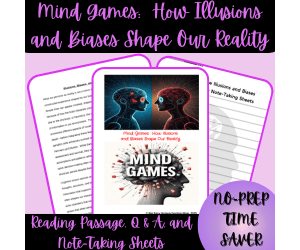
Mind Games: How Illusions and Biases Shape Our Reality Reading Passage
ELA, Reading, Writing, Research, Resources for Teachers, Science, STEM, Life Skills, Special Resources, High School, Homeschool Resources, Teacher Tools, Assessments, Lesson Plans, Quizzes and Tests, Worksheets & Printables, Writing Prompts
As a homeschool mom who is passionate about bringing real science into our learning, I created this resource after watching my own kids become fascinated by optical illusions and questioning "how do we really know what we see?" This comprehensive package takes that natural curiosity and channels it into serious academic exploration of how our minds work. I have spent countless hours researching current neuroscience studies to ensure this material meets the rigor your advanced students deserve while remaining engaging and accessible. Whether you are preparing high schoolers/homeschoolers for college psychology courses or diving deep into critical thinking with curious learners, this resource delivers the kind of substantial content that sparks meaningful discussions around your kitchen table or classroom. INCLUDED IN THIS RESOURCE: Comprehensive reading passage that makes complex neuroscience understandable 20 carefully crafted questions that really make students think (not just recall facts) Complete answer key with detailed explanations Five note-taking sheets TOPICS COVERED: How optical illusions reveal the shortcuts our brains take every day Why we believe what we want to believe (confirmation bias explained) The sneaky ways first impressions influence all our decisions How growing up in different cultures literally changes what we see This resource bridges the gap between high school and college-level work beautifully. I designed it specifically for families and educators who want to offer their students/homeschoolers the kind of rigorous, research-based content they will encounter in university psychology and neuroscience courses. The depth and sophistication of the material challenges advanced learners while the clear organization and teaching supports make it manageable for dedicated students/homeschoolers. Whether you are homeschooling through high school or teaching AP-level courses, this resource provides the academic foundation and critical thinking development that sets students/homeschoolers up for success in higher education and beyond. If you and your students/homeschoolers enjoyed this resource, please leave a review. Thank you for your support! Tina - Big Easy Homeschooling Mom
Author Homeschool with Big Easy Homeschooling Mom
Rating
Tags How Optical Illusions Work Educational Resource, Cognitive Biases Lesson Plan High School, Cognitive Psychology, Neuroscience, Visual Perception, Psychology Curriculum, Homeschool Psychology Resources, Perception And Reality Educational Content, Psychology Reading Comprehension Activities, , Neuroscience Curriculum Homeschool

CBT & Anxiety Management Toolkit
Life Skills, Special Resources, Social Emotional Learning (SEL), Social Skills, Special Education Needs (SEN), Speech Therapy, STEM, Resources for Teachers, Classroom Management, Community Building, Homeschool Curriculum, Homeschool Templates, Grade 9, 10, 11, 12, Projects, Activities, Teacher Tools, Assessments, Graphic Organizers, Lesson Plans, Outlines, Rubrics, Presentations, Worksheets & Printables
Find the top CBT Anxiety Management Toolkit Professional Edition PDF – a 47-page digital guide filled with helpful information and tools to beat anxiety. This guide is meant for therapists, life coaches, and individuals looking for effective mental health tools. This SEO-friendly CBT workbook provides detailed information on cognitive models, anxiety triggers, cognitive distortions, ABC models, automatic thought records, evidence boards, worry trees, de-catastrophizing scripts, fear ladders, grounding techniques, behavioral activation plans, core beliefs, and daily mood trackers. Be empowered with step-by-step strategies for cognitive restructuring, exposure therapy, behavioral activation, and sensory grounding techniques to overcome anxiety and live an anxiety-free life. This guide is meant for psychology professionals and mental health enthusiasts. Get this printable CBT anxiety workbook PDF today and get the mental health assistance and resilience training you need. Why Parents/Schools Love It: Evidence-Based Tools for Real-World Application: CBT worksheets for students to develop skills that can be applied in the real world, helping them develop emotional resilience that can improve their academic performance. Promotes Self-Awareness and Mental Health Literacy: Encourages students to engage in reflective exercises that can help them develop skills that can last a lifetime, allowing them to cope with stress in an appropriate manner. Flexible for Classroom or Home Application: PDFs with diagrams that can be printed out for use in the classroom or at home for students who need extra support during high-stress periods of the academic calendar. Professional Quality Content at an Affordable Price: Helps provide students with the tools that can normally only be accessed with the guidance of a therapist, all at an affordable price for the school. Tracks Progress for Measurable Growth: Helps parents/educators track the progress of students' emotional state so that improvements can be measured. Target Classes/Students : Given that the PDF is a comprehensive analysis and review of CBT tools and strategies for anxiety management, targeted towards professionals and adult learners, the target audience would be students in higher education and advanced programs, especially in the field of psychology and counseling. The target classes/students would be: Undergraduate Psychology or Counseling Students (Sophomore to Senior Level): The PDF would be ideal for classes such as “Introduction to CBT,” “Abnormal Psychology,” or “Mental Health Interventions,” where students can use the worksheets for case study and self-reflection assignments. Graduate Students in Clinical Psychology, Social Work, or Therapy: The PDF would be suitable for classes such as “Cognitive Behavioral Therapy Practicum,” “Anxiety Disorders Treatment,” or “Professional Counseling Skills,” where students can use the content for case studies and assignments. Adult Education or Continuing Education: The target audience would be adult learners in online or community college classes, especially in the field of psychology and counseling, or in a life coaching program. High School Advanced Placement (AP) Psychology: The target audience would be seniors in advanced psychology classes, provided that the curriculum covers CBT concepts, as the content is too advanced and technical for a general audience. Copyright/Terms of Use: This Book was copyrighted by Syed Hammad Rizvi. This resource is for personal and single classroom use only. You may not alter, redistribute, or sell any part of this resource. In other words, you may not put it on the Internet where it could be publicly found and downloaded. If you want to share this resource with your colleagues, you may buy additional licenses from Teachsimple. Thank you for respecting these terms of use. This product is happily brought to you by Syed Hammad Rizvi
Author Creative Book Store
Rating
Tags CBT, CognitiveBehavioralTherapy, AnxietyManagement, AnxietyRelief, MentalHealth, MentalHealthMatters, MentalHealthAwareness, StressRelief, OvercomeAnxiety, AnxietyTools
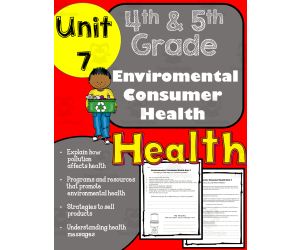
Environmental Consumer Health: 4th and 5th Grade Unit 7
P.E. & Health, Life Studies, Physical Education, Health, Life Skills, Special Resources, Social Emotional Learning (SEL), Social Skills, Grade 4, 5, Teacher Tools, Lesson Plans, Worksheets & Printables, Worksheets
Environmental Consumer Health: 4th and 5th Grade Unit 7 For 4th and 5th Grade Health, there are seven standards that students will practice and learn. Through using this Environmental Consumer Health: 4th and 5th Grade Health Unit 7 students will explore and learn to identify daily healthy habits. This Environmental Consumer Health Unit 7, is full of engaging worksheets to help students learn about their environment in an educational way as it pertains to their own health and the health of others. In this unit, students will be educated on the pollution that effects the land, water, and air in their neighborhood and community. They will also identify solutions to stop the pollution. Along with that, they will discover ways to help the environment by reducing, recycling, and reusing products. Advertisers use tricky ways to convince consumers that unhealthy food is beneficial to them. Kids will learn about these tricky strategies and the messages that advertisers use that convince the public to use these unhealthy products. In addition, students will have the opportunity to draw their own advertisement to help stop the spread of a disease outbreak in a community. Lastly, there is an assessment to check for understanding. This Environmental Consumer Health unit is the perfect way for teachers and parents to help their students understand the importance of health in a community and teaches students a way to develop healthy habits for life! Included in this Environmental Consumer Health: 4th and 5th Grade Unit 7 are the following: How the land, water, and air pollution affect persona health and our community health. A worksheet is provided on solutions to stop the pollution. Learn ways to help a community with reducing, recycling, and reusing products. Students will learn about tricky strategies advertisers use on consumers to coerce them to purchase unhealthy products and the messages these advertisers are sending to kids. Understand what environmental health messages mean to a community. Draw your own health advertisement to help stop a disease outbreak in a community. Lastly, there is an assessment to check for understanding. There is an answer key included. There are 16 pages included! This unit meets Common Core Standards. There are seven units that cover all the health requirements for 4th and 5th grade. Here are the links to other health units: Health | 4th and 5th Grade Unit 1: Personal Health Health | 4th and 5th Grade Unit 2: Growth and Development Health | 4th and 5th Grade Unit 3: Nutrition and Physical Activity Health | 4th and 5th Grade Unit 4: Substance Use and Abuse Health |4th and 5th Grade Unit 5: Injury and Violence Prevention Health | 4th and 5th Grade Unit 6: Prevention and Control of Disease Health |4th and 5th Grade Unit 7: Environmental Consumer Health
Author K-5 Treasures
Tags Health Unit, Personal Health, Healthy Goals, Health Activities, Physical Goals, Health Goals, Health And Wellness, 4th Grade Health, 5th Grade Heath, Heath Units
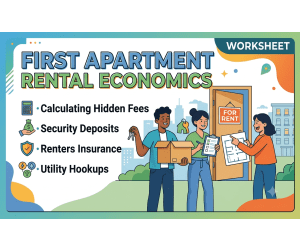
First Apartment Rental Economics
Resources for Teachers, Classroom Management, Community Building, Math, Money, Statistics, STEM, Special Resources, Social Emotional Learning (SEL), Life Skills, Homeschool Curriculum, Homeschool Templates, Grade 9, 10, 11, 12, Worksheets & Printables, Workbooks, Worksheets, Word Searches, Teacher Tools, Lesson Plans, Quizzes and Tests, Quizzes, Tests, Assessments
If you're looking for an effective and exciting program to teach financial concepts, then look no further. With this lesson on the Economics of First Apartment Rentals, your high school students can be prepared for one of the biggest financial choices of their lives. Gone are the days of basic budgeting. This program provides a thorough academic understanding of everything that goes into renting an apartment. Students will be able to analyze lease agreements and determine hidden costs, as well as calculate the actual finances they will need in order to live on their own. The first part consists of a total of 10 pages with 4 chapters explaining some key terms related to finances. The chapter titles include: Chapter 1 - Move-In Expenses and Security Fees: The principle of funds that are unrecoverable compared to budget that is recoverable. Chapter 2 - The Iceberg Phenomenon of Rental Charges: The breakdown of administrative charges, garbage fees, and pet fees. Chapter 3 - Utility Costs in the Rental Business: The understanding of monopoly service providers and the concept of refundable deposits. Chapter 4 - Renters Insurance Economics: The formulas used for risk distribution, deductible amounts, and liabilities. This part contains interesting practical examples of how theories work. The second part is called Student Workbook and consists of 21 pages. It has 10 very extensive worksheets containing more than 80 questions aimed at checking the knowledge of some math. Some of the topics here are: Move-In Expenses and Availability of Capital The Two-Fold Nature of Security Deposits Hidden Administrative Costs Exposed Utility Connections and Credit Provisions Renters Insurance Payments and Deductibles The Science of Prorated Rent The "Pet Penalty" Price Expenses and Chances Cost Lease Contract Analysis and Punishments A Master Sheet with a final exam consisting of all the practical and useful data. PART 3: Visuals and Teacher Materials (22 Pages) Three Instructional Graphics: Three effective images suitable for classroom instruction or presentations ("The Move-In Iceberg," "The Lifecycle of the Security Deposit," "The Utility Activation Matrix"). A Detailed, Comprehensive Teacher Answer Key: Not only the answers but detailed calculations and interpretations for each question—delivering significant time savings on preparation. Teach your students to become knowledgeable and confident individuals who transition from passive consumers to informed decision-makers. Reasons why Parents/Schools appreciate it: Boosts Self-Assurance in the Real-World: With its practical approach, it is able to go beyond theoretical teaching and equips students with all the necessary skills to be able to conquer a challenging process and avoid beginner mistakes. Interdisciplinary & Challenging: The unit integrates mathematics (calculations, percentages), economics (market concepts), and language studies (dissecting a legal text) thus making learning very valuable. Fosters Financial Literacy: The program encourages students to go beyond the advertised price of a product and to examine the terms of the contract, thus becoming better consumers. Fully Comprehensive & Simplifies Teaching: This instructional resource provides teachers with all the necessary materials including detailed lesson plans, 10 worksheets for students, and a complete answer key. Classes for Students: According to the terminology used (asymmetric information, microeconomics, liquidity, sunk cost), degree of difficulty, and the topics covered, the material is most suitable for: High School Juniors and Seniors (11th and 12th Grade): These students are most receptive to achieving independence and will find the material directly relevant and useful in their near future. They may include: Personal Finance classes Economics classes (as an applied microeconomics project) Consumer Mathematics or other applied math classes Life Skills or Home Economics classes College Freshmen: The material is particularly well suited for a "First Year Experience" or "College Success" seminar. Young Adults in Community Education Programs: The material may be adjusted and presented in form of a workshop addressing the needs of young adults aged 18-25. Copyright and Usage Policy: This book is copyrighted to Syed Hammad Rizvi and is intended for personal use and classroom use only. No part of this resource can be changed, given away, or sold. Thus, it cannot be uploaded online for public access. If you want to share this resource with your friends, please buy more licenses from Teachsimple. This product is proudly given to you by Syed Hammad Rizvi.
Author Creative Book Store
Rating
Tags FinancialLiteracy, PersonalFinance, LifeSkills, Budgeting, Economics, MoneyManagement, FinancialEducation, InvestingForBeginners, RealWorldMath, ConsumerMath
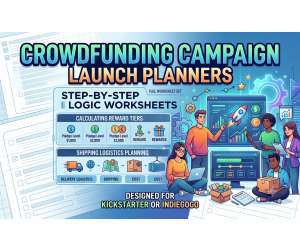
Crowdfunding Campaign Launch Planners
Special Resources, Life Skills, Social Emotional Learning (SEL), Social Skills, Special Education Needs (SEN), Resources for Teachers, Classroom Management, Community Building, STEM, Research, Grade 6, 7, 8, 9, 10, 11, 12, Workbooks, Worksheets & Printables, Worksheets, Word Searches, Teacher Tools, Assessments, Lesson Plans, Quizzes and Tests, Quizzes, Tests
Transform your students from passive learners into active entrepreneurs! Are you looking for a project-based learning (PBL) unit that brings real-world business, economics, and mathematics to life? This comprehensive curriculum guides students through the high-stakes, logical puzzle of launching a product on crowdfunding platforms like Kickstarter or Indiegogo. This isn't just another business plan template. This 44-page, in-depth unit moves beyond marketing fluff and dives deep into the gritty, unforgiving mathematics of product fulfillment and supply chain logistics. Students will act as logistical architects, learning that a successful business isn't just about a great idea—it's about flawless execution. ▶ WHAT'S INSIDE THIS COMPLETE UNIT? Part 1: In-Depth Theory Guide (Chapters 1-4): A professional-grade guide covering the core concepts: The Economics of Crowdfunding: Uncover the hidden fees and calculate the "True Cost" of a funding goal. Behavioral Economics & Pricing: Learn the psychology of reward tiers using concepts like anchoring and the decoy effect. Global Shipping Logistics: Master the devastating impact of Dimensional Weight (DIM), Harmonized System (HS) codes, and international fulfillment hubs. Risk Mitigation & Margin Preservation: Build a contingency matrix and use algebraic modeling to create financial buffers that ensure profitability. Part 2: Student Workbook (10 Worksheets): Rigorous, scaffolded worksheets that put theory into practice. Students will calculate COGS, platform fees, shipping costs, break-even points, and contingency buffers through real-world scenarios. Critical thinking prompts ensure deep understanding. Part 3: Teacher & Visual Resources: Everything you need to teach with confidence! Pedagogical Visuals: Three ready-to-print or projectable anchor charts visually explaining Reward Tier Pricing, Dimensional Weight, and Global Logistics. Comprehensive Answer Key: A full, step-by-step answer key for all 10 student worksheets. Teacher Implementation Guide: Includes a 5-day pacing guide, discussion prompts, classroom demonstration ideas, and enrichment opportunities for advanced students. ▶ PERFECT FOR: High School Business or Entrepreneurship Classes Career and Technical Education (CTE) Programs AP Macroeconomics or Microeconomics (as a real-world application project) Financial Literacy and Math Electives Homeschool curriculum for high schoolers interested in business. Equip your students with the practical math, critical thinking, and financial literacy skills they need to survive in the modern economy. Download now and bring the ultimate business challenge into your classroom! Keywords: Crowdfunding, Kickstarter, Business Plan, Entrepreneurship Project, Project-Based Learning, PBL, High School Business, Economics, Supply Chain, Logistics, Cost of Goods Sold, COGS, Profit Margin, Financial Literacy, CTE, Student Workbook, Answer Key Why Parents/Schools Love It: Real-World Application: It moves economics and math from abstract theory into a tangible, modern context (Kickstarter!) that students find engaging, teaching skills directly applicable to today's economy. Develops Critical 21st-Century Skills: This unit forces students to synthesize data, perform multi-step calculations, think critically about risk, and solve complex logistical problems—skills that are essential for any future career. Comprehensive & Turnkey Solution: This isn't just a worksheet; it's a complete, ready-to-use instructional unit. The included theory, visuals, answer key, and teacher guide save educators dozens of hours of prep time. Rigorous & High-Level: The curriculum respects students' intelligence by presenting them with authentic, high-stakes challenges. It avoids "fluff" and focuses on the rigorous logic and math required to actually run a business, preparing them for post-secondary education and beyond. Target Audience : Based on the content, language ("Grade 11 business and economics students"), and structure, target: Primary Target: High School Teachers of grades 10-12 for subjects like Business, Entrepreneurship, Economics (including AP), and Marketing. The CTE (Career and Technical Education) market is perfect for this. Secondary Target: Homeschool Parents of high school students who are looking for advanced, project-based curriculum that teaches practical life skills. Tertiary Target: College Instructors for introductory business or entrepreneurship courses, who could use this as a practical, foundational module. Copyright/Terms of Use: This Book was copyrighted by Syed Hammad Rizvi. This resource is for personal and single classroom use only. You may not alter, redistribute, or sell any part of this resource. In other words, you may not put it on the Internet where it could be publicly found and downloaded. If you want to share this resource with colleagues, please purchase additional licenses from Teachsimple. Thank you for respecting these terms of use. This product is happily brought to you by Syed Hammad Rizvi
Author Creative Book Store
Rating
Tags Crowdfunding, Entrepreneurship, Kickstarter, SupplyChain, BusinessLogistics, ProfitMargin, CostOfGoodsSold , COGS, ProductLaunch, StartupLife

Grade 1 Digital Citizenship Yearlong Curriculum | 36 Weekly Lessons
Technology, Science, Life Skills, Special Resources, August, Months, Holiday & Seasonal, September, Fall, Seasons, Grade 1, Lesson Plans, Teacher Tools, Worksheets, Worksheets & Printables
Grade 1 Digital Citizenship Curriculum | Yearlong Digital Citizenship Lessons, Activities, Slides, Worksheets & Assessments Help your students become confident, responsible technology users with this Grade 1 Digital Citizenship Curriculum ! This comprehensive, yearlong resource includes everything you need to teach digital citizenship through engaging, age-appropriate lessons that build safe technology habits from the very first week. With 36 complete lessons, presentation slides, student workbook pages, worksheets, quizzes, projects, and assessments, you'll have a true grab-and-go curriculum for the entire school year. What's Included ⭐ 36 complete weekly digital citizenship lessons ⭐ Full teacher lesson plans with scripted instruction ⭐ Student workbook with 180 printable pages ⭐ Nearly 200 presentation slides for whole-group instruction ⭐ 100+ no-prep printable worksheets ⭐ 36 weekly exit tickets for quick formative assessment ⭐ 10 unit and cumulative quizzes ⭐ 8 collaborative, hands-on classroom projects with rubrics ⭐ Complete answer keys ⭐ Teacher toolkit with assessment, planning, data tracking, and small-group support ⭐ Graphs, class charts, and progress trackers ⭐ Family connection activities built into every lesson How It Works in the Classroom This Digital Citizenship Curriculum follows a predictable weekly routine that keeps lesson preparation simple while helping students build confidence. Each lesson includes: Bell ringer Mini lesson Interactive presentation slides Reading passage Guided notes Hands-on practice activity Partner discussion Real-world digital citizenship scenario Independent practice Journal writing Exit ticket Optional family connection Answer key The resource works beautifully for: Whole-group instruction Technology class Classroom teachers Media center lessons Computer lab 1:1 classrooms Limited-device classrooms Print or projected instruction Homeschool and co-op settings Standards & Learning Goals Students develop age-appropriate digital citizenship skills throughout the school year, including: Choosing the right digital device for different tasks Understanding buttons, icons, and menus Logging in, saving work, and logging out safely Keyboard and basic technology skills Internet basics Websites, links, and online searching Online safety Advertising awareness Evaluating information Digital footprints Password creation and private information Respectful online communication Cyberbullying prevention and being an upstander Healthy screen balance Responsible technology use Technology careers and helpers Lessons emphasize decision-making through authentic scenarios rather than simple rule memorization, helping students apply digital citizenship concepts in meaningful ways. Why Teachers Love It ❤️ Zero-prep weekly lessons ❤️ Complete yearlong curriculum in one purchase ❤️ Consistent lesson format saves planning time ❤️ Engaging, developmentally appropriate activities ❤️ Built-in formative and summative assessments ❤️ Easy differentiation with projects, worksheets, discussions, and independent work ❤️ Works whether students have devices or not ❤️ Includes answer keys for every activity ❤️ Perfect for classroom teachers, technology teachers, and media specialists ❤️ Strong balance of direct instruction, collaboration, writing, discussion, and hands-on learning Give your students the digital citizenship foundation they need! If you're looking for a complete Grade 1 Digital Citizenship Curriculum with engaging lessons, printable activities, assessments, slides, projects, and teacher support, this resource provides everything needed to confidently teach digital citizenship all year long.
Author Bright Classroom Ideas Marketplace
Rating
Tags Digital, Citizenship, Back To School, Yearlong, Curriculum, Full Year, Technology

Negativity Bias-A Positive Psychology Concept SEL Hyperdoc
Special Resources, Life Studies, Life Skills, Grade 5, 6, 7, 8, 9, 10, 11, 12, Teacher Tools, Lesson Plans
Negativity Bias-A Positive Psychology Concept SEL Hyperdoc Negativity Bias-A Positive Psychology Concept SEL Hyperdoc is an interactive teaching resource purposefully engineered to foster comprehension of the mind's propensity for negative thinking, a concept in positive psychology known as "negativity bias". The Four Stages: Read & Learn Explore Think & Respond Apply Your Knowledge. The students can dive into readings and videos explaining the science behind our neural tendency towards negativity. There are also numerous opportunities to use the interactive fields within this document for notating their newly grasped knowledge. This insightful hyperdoc is 100% compatible with Google Classroom, assisting seamless integration into your current teaching materials. Crafted originally for remote instruction, it still showcases flexibility by also serving superbly as a resource in conventional face-to-face instruction or even as a relevant homework assignment. Digital Learning Tool Features: A ready-to-use PDF file containing an embedded Google Doc link conveniently placed under the title image. A comprehensive design compatible across grade levels from Grade 5 up until Grade 12 making it not only apt for typical classroom settings but also perfect for homeschooling requirements. Covering key subjects such as Special Resources and Life Studies with particular emphasis on life skills progression, it exceptionally aids social emotional learning (SEL) sessions. Be sure not miss out on incorporating this multidimensional lesson plan into your set of effective educational resources. </p
Author Jennifer Moyer Taylor
Tags Negativity Bias, Positive Psychology, SEL, Hyperdoc, Interactive Learning
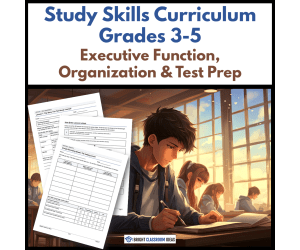
Study Skills Curriculum Grades 3-5, Executive Function & Test Prep
Life Skills, Special Resources, Grade 3, 4, 5, Lesson Plans, Teacher Tools, Assessments, Worksheets & Printables
Study Skills Curriculum Grades 3-5, Executive Function, Organization & Test Prep Study skills for grades 3–5 can be taught as simple, repeatable routines—not overwhelming techniques. This 10-unit curriculum helps students build practical habits for organization, planning, focus, reading, note-taking, studying, test preparation, and asking for help. What’s Included This comprehensive study skills resource includes: ⭐ Facilitator Guide with teaching routines and implementation guidance 📋 Scope & Sequence with three pacing options 📝 Student Self-Inventory for pre/post reflection and goal setting 🧠 10 complete study skills units 📚 How Your Brain Learns 🗂️ Get Organized 📖 Directions & Getting Started 📅 Time & Planning 🎯 Focus & Study Space 📘 Reading to Learn ✏️ Note-Taking Basics 🧠 Remembering What You Learn 📝 Getting Ready for a Test 🙋 Asking for Help ✂️ Printable Student Tools, checklists, templates, and trackers 📓 30-prompt Reflection Journal 🏠 Family Guide for supporting skills at home 📊 Assessment and Progress Tracking materials How It Works in the Classroom Each unit is designed for a 25-minute lesson with a consistent five-part structure: Hook Teacher Model Guided Practice Transfer Task Reflection Close The most important part is the transfer task. Students apply each strategy to their real, current schoolwork , helping study skills become classroom routines instead of isolated worksheet activities. Choose the pacing that fits your setting: Weekly across the school year for long-term retention Six-week intensive for intervention, electives, or summer programs As-needed tutoring or homeschool use based on current student needs The resource works well for whole-class instruction, small groups, intervention, tutoring, homeschool, resource rooms, and advisory or morning-meeting blocks. Standards & Learning Goals Students build practical executive-function and self-management skills, including: Organization and materials management Task initiation Following multi-step directions Planning and time management Sustained attention Comprehension monitoring Note-taking Retrieval practice and spaced studying Test preparation and error analysis Self-advocacy and asking specific questions Reflection and metacognition The resource also supports CCSS ELA , CASEL self-management and responsible decision-making . Why Teachers Love It ⭐ Low-prep implementation — Lessons follow the same predictable structure. ⭐ Real-world practice — Students use strategies with actual assignments and current content. ⭐ Built-in differentiation — Grade-band adjustments support grades 3, 4, and 5. ⭐ Student independence — Checklists, planners, trackers, and question-building tools make routines visible. ⭐ Family connection — Send-home guides help reinforce the same habits beyond school. ⭐ Progress monitoring — A four-point developmental rubric and observable look-fors help teachers track growth without treating study skills like academic content. ⭐ Metacognition matters — Weekly reflection prompts help students notice their habits and make intentional changes. This study skills curriculum for grades 3–5 is especially useful for helping students become more organized, independent, and prepared for the increasing demands of upper elementary school and the transition toward middle school. ✨ Give your students practical routines they can use every day—not just strategies they forget after one lesson. Download the Study Skills Resource Pack for Grades 3–5 and give students tools they can carry into real classroom work, homework, studying, and future grades.
Author Bright Classroom Ideas Marketplace
Rating
Tags Study Skills, Curriculum, Executive Function, Organization, Test Prep
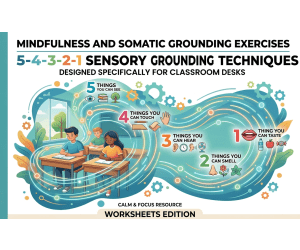
Mindfulness and Somatic Grounding Exercises
Life Skills, Special Resources, Social Emotional Learning (SEL), Social Skills, Special Education Needs (SEN), Speech Therapy, STEM, Resources for Teachers, Classroom Management, Community Building, Grade 5, 6, 7, 8, 10, 11, Worksheets & Printables, Workbooks, Worksheets, Word Searches, Teacher Tools, Assessments, Lesson Plans, Quizzes and Tests, Quizzes, Tests
The 5-4-3-2-1 Classroom Desk Edition is the ultimate resource for teachers to help their students relieve anxiety, manage the stress of testing, and develop better focus in class. Do you need an evidence-based, effective method to help students, manage anxiety, combat test stress, and improve focus on work? Use the Mindfulness and Somatic Grounding Classroom Desk Edition. This no-fuss curriculum helps teachers help their students through the unique challenges of middle school. In a traditional middle school, there are limited opportunities for students to use mindfulness in a private manner that does not draw attention to themselves. The Mindfulness and Somatic Grounding Classroom Desk Edition is a trauma-sensitive, neurobiologically accurate best practice that provides students with a method to use at their desks that will not call attention to them or make them feel conspicuous. The framework is based on the well-known 5-4-3-2-1 sensory method. By providing instructions for using the 5-4-3-2-1 sensory method at their desks, you will create a space for your students that can serve as an anchor of calmness and safety. The toolkit is a perfect fit for school counselors, homeroom teachers, and any teacher interested in Social-Emotional Learning (SEL). Everything you need to know to successfully teach this practice to your students is included in the toolkit! Here is a breakdown of the 43-page document: Part 1: Educator's Guide and Methodology: We go deep into an adolescent’s brain and how anxiety and their brain function. This will identify the reasons that this method works so that you have the professional knowledge to effectively teach it to students. The report contains case studies and the correct method of implementation. Part 2: 10-Worksheet Student Workbook: The student workbook is practical, interesting and beautifully produced to help guide all students through mastering the technique of Sensory Mapping. The worksheets are progressive in approach to build upon each of the skills necessary to master the technique (for example, from basic sensory mapping to “stealth” self-regulation in social situations and adapting the method of self-regulation for different environments—e.g., the library, science laboratory or assemblies). Part 3: Visuals and Educator Resources: a. Professional visuals—printable diagrams and mind maps that will allow you to visually represent Sensory Mapping to your students (ideal for use as classroom posters or in interactive notebooks); b. Scripts for Educators to teach the new technique to students in the classroom, both to the entire class and to individuals; c. Troubleshooting Guide (advice on what to do when students resist or have challenges with this approach); d. Section-by-section answer keys and educator notes to make it easy for you to assess and assist your students with each of the student worksheets. Assist your students in transitioning from the “fight or flight” response to the “rest and learn” mode by providing them with a self-regulation tool that they can use throughout their lives . Keywords: Social Emotional Learning (SEL), Mindfulness for Kids, Somatic Grounding, 5-4-3-2-1 Technique, Anxiety Management, Classroom Management, Middle School, 6th Grade, 7th Grade, 8th Grade, Test Anxiety, Focus, Self-Regulation, Trauma-Informed, Calm Down Corner, School Counselors, Printable Workbook, Digital Resource. Why School Systems and Parents Appreciate It: Low-Key and Without Stigma: This program lets students secretly control their anxiety with no attention drawn to themselves at their desks. Thus there is no social stigma attached to using an obvious 'calm down' tool or leaving the class to manage anxiety, which many adolescents are concerned about. Empowers Students: By learning how to ‘hack’ their own nervous system instead of relying on an adult to help them stop escalating to an explosive state, students are developing a coping strategy that gives them a tangible skill as well as a sense of control over their emotional state. Based on Evidence and Academics: The approach is based on established research from neurobiology and somatic psychology (the study of the amygdala hijack); therefore, both educators and students view the program in an academically serious manner because of the sophistication of the content but the simplicity of delivery. Comprehensive and Easy to Implement: This program is a comprehensive, use-ready package that includes a thorough description of the concepts, required materials, instructions for the teacher, illustrations, and complete answer keys. A busy educator could implement this program successfully with no problems at all. Addresses a Significant Need: With the increasing number of students suffering from anxiety in school, this program will help educators to address a significant need by providing a practical, efficient, and non-intrusive method to help students be present and able to learn. Target Audience: Content for Primary Target: The content of this resource is specifically targeting the primary target audience with specific and thorough data supporting it. Primary Target: Students in 6th-8th Grade (Middle School). The PDF provides information about this group consistently within the context of their neurological and social challenges they face (e.g. Synaptic Pruning, Social Camouflage, Peer Evaluation). The attached case studies/examples of two students, Julian and Maya, who are in the 8th and 6th grades, respectively and consistent with this audience. The worksheet difficulties are completely appropriate for this age group. Secondary Target: Students in 9th-10th Grade: Older readers with test anxiety or social anxiety will find this resource extremely useful. School Counselors, Psychologists and Therapists: This resource is an excellent Tier 1 (whole-class) and Tier 2 (individual/small group) intervention for school employed mental health providers. Special Education Teachers: This resource will provide an excellent tool to assist students who need a structured, concrete, sensory approach to learning self-regulation. Copyright Notice/Terms of Use By Syed Hammad Rizvi The author of this resource has given permission for it to be used as an individual and personal resource in an identified one room class. No part of this resource may be altered, given to anyone else in any form, and sold. In other words, this cannot appear on the Internet in any way for all to find and download. If you want to share this resource with any other colleagues, you must purchase other licenses (Teachsimple). Thank you for honouring this Terms of Use. This resource was provided to you in a spirit of enthusiasm by Syed Hammad Rizvi.
Author Creative Book Store
Rating
Tags SocialEmotionalLearning, SEL, MindfulnessForKids, MindfulnessInTheClassroom, StudentWellness, MentalHealthInSchools, TraumaInformedTeaching, ClassroomManagement, StudentMentalHealth, EmotionalRegulation

Growth and Development Health: 4th and 5th Grade Unit 2
P.E. & Health, Life Studies, Physical Education, Health, Special Resources, Life Skills, Social Emotional Learning (SEL), Social Skills, Grade 4, 5, Teacher Tools, Lesson Plans, Worksheets & Printables, Worksheets
Growth and Development Health: 4th and 5th Grade Unit 2 For 4th and 5th Grade Health, there are seven standards that students will practice and learn. This unit is all about Growth and Development. Through using this Growth and Development Health: 4th and 5th Grade Unit 2 students will explore and learn to identify daily healthy habits. This unit is the perfect way to help 4th and 5th grade students learn and develop healthy habits. In this unit, students will understand and explain the six major body systems including the cardiovascular system, the digestive system, muscular system, the respiratory system, the nervous and skeletal systems, along and more. Also included in this unit, students will compare their emotional, physical, and academic differences with other classmates as they do activities with each other to build friendships and classroom unity with each other. Furthermore, students will have the opportunity to practice scenarios using different healthy methods. At the end of this unit, there is an assessment to check for understanding with answer keys included. This 24-page unit meets Common Core Standards and is filled with engaging activities that will help any student build a healthy foundation! Included in this 4th and 5th Grade Health Unit are the following: There are six major body systems that students will learn and be able to explain how they work and function together. The 6 major systems listed in this unit and include the following systems: Cardiovascular, Respiratory, Digestive, Skeletal, Nervous, and Muscular. Students will also compare their emotional, physical, and academic differences. There is an opportunity for students to healthy methods using different scenarios. Lastly, included there is an assessment to check for understanding with answers. There are 24 pages included! This 4th and 5th Grade Unit 2: Growth and Development meets the Common Core Standards. There are seven units that cover all the health requirements for 4th and 5th grade. Here are the links to other health units: Health | 4th and 5th Grade Unit 1: Personal Health Health | 4th and 5th Grade Unit 2: Growth and Development Health | 4th and 5th Grade Unit 3: Nutrition and Physical Activity Health | 4th and 5th Grade Unit 4: Substance Use and Abuse Health |4th and 5th Grade Unit 5: Injury and Violence Prevention Health | 4th and 5th Grade Unit 6: Prevention and Control of Disease Health |4th and 5th Grade Unit 7: Environmental Consumer Health
Author K-5 Treasures
Tags Health Unit, Personal Health, Healthy Goals, Health Activities, Physical Goals, Health Goals, Health And Wellness, 4th Grade Health, 5th Grade Heath, Heath Units

AI for Kids: Understanding Artificial Intelligence Book
Science, Technology, Computer Science, Engineering, Special Resources, Life Skills, Special Education Needs (SEN), STEM, Research, Resources for Teachers, Grade 6, 7, 8, 9, 10, 11, 12, Projects, Activities, Teacher Tools, Assessments, Lesson Plans, Presentations, Literacy Readers, Quizzes and Tests, Quizzes, Tests
Uncover the amazing world of Artificial Intelligence with AI for Kids by Syed Hammad Rizvi – the best easy to read and conceptual book about what AI is for kids! This 315 page long book has no coding requirement; instead, it presents many complicated ideas such as; machine learning, algorithms, deep learning, data patterns, ethical AI & bias, quantum computing, autonomous vehicles, robotics, and The Future of AI (including the singularity and AGI) in an interesting and fun way by using many familiar analogies that can be easily understood (i.e. Lego sorting, riding a bike, master cooks). AI for Kids is perfect for kids who want to learn how Siri, Netflix recommendations, facial recognition, and ChatGPT actually work without any programming or technical knowledge! There are 151 short chapters filled with real-life examples appropriate for children, and the information in these chapters empowers children. The book can be used as a tool to create interest in STEM subjects, or as an educational resource to be used at home, school, in after-school STEM clubs, or at night before bed to build AI literacy and inspire future generations of innovators, ethicists, and thinkers! Keywords: AI, kids, artificial intelligence, machine learning simply explained, neural networks beginners, ethical AI & the future of AI, no coding AI, STEM children 8-14. Here's what Parents & Schools find appealing about this Read: - No technical overwhelm – just follow AI concepts with relatable analogies to make it easy to understand & fun for kids. - Covers every aspect of AI within 151 bite-sized chapters (history, how AI learns, applications in health care, gaming & robotics, ethics, bias, jobs of the future) – this one book replaces the need for many resources. - Build early critical thinking skills and digital citizenship skills by getting children thinking critically about AI choices, identifying biased information, and preparing children for careers related to AI. - Very versatile for classroom/homeschooling use – short chapters, discussion prompts, & real-life examples are well-suited to be used as part of lessons/projects or for independent reading. - Future-proof & aspirational – encourages children to believe they can influence AI positively, while dreaming of careers such as “AI Ethicist" or "Human-AI Team Coordinator." Target Audience (Based on Complete Analysis of Book): The title and content are explicitly created for kids, with simple formats (analogies, short chapters), questions and real-life examples being used throughout all 151 chapters (from basics at Chapter 1 to complex concepts such as singularity, quantum AI, bias, ethics and future impact in the other chapters). The content continually uses easy-to-understand language to help engage kids, even through some of the most trying sections (example of AGI: like a true thinker who could write novels and create music; bias, using the analogy of a warped photograph; and food science using the analogy of a digital chef). While the book does not provide any required ages/grades, the depth of material (differentiating between narrow/general AI, explaining XAI, discussing the predictive policing debate, interdisciplinary teams, and impact on society) and no requirement of coding make it appropriate for children age 8-14 (grades 3-8 / upper elementary and middle school). Younger children (grades 3-5) will enjoy the fun stories and introduction of subject matter, while older children (grades 6-8) will understand the ethical aspects of these technologies and their potential future career opportunities as well as understand how these technologies apply to the real world and benefit society through further learning. This book would be a good resource for homeschoolers, teachers, gifted programs and any student who has an interest in technology. It will be too basic for high school students but will provide a solid foundation and valuable supplemental material. Copyright Terms: This book is protected by copyright as established by Syed Hammad Rizvi. This material is intended for individual use and for use in a single classroom. You cannot modify, distribute, or sell this material. In other words, you can’t post this material online where it has the potential of being found & downloaded by others. If you would like to share this material with teachers, please purchase an additional license from Teachsimple. Thank you for your cooperation with these copyright terms! This product is gratefully provided by Syed Hammad Rizvi.
Author Creative Book Store
Rating
Tags ArtificialIntelligence, STEM, STEMeducation, KidsSTEM, HomeschoolSTEM, TeacherResources, NeuralNetworksForKids, ChatGPTforKids, AIethicsForKids, FutureOfAI

Real World Life Skills - Social Skills Gr. 6-12+ - Canadian Content
Special Resources, Life Skills, Grade 6, 7, 8, 9, 10, 11, 12, Teacher Tools, Lesson Plans
Real World Life Skills - Social Skills Gr. 6-12+ An invaluable educational resource with a focus on Canadian content, designed mainly for students in grades six through twelve who are working through the complexities of life skills and social dynamics. Key Features: Nurtures identification of favorable versus unfavorable traits Promotes personal independence and accountability Teaches basic principles of etiquette and collaboration skills Incorporates a variety of instructional methods for maximum comprehension (reading passages, graphic organizers etc.) Educational Settings & Use: This versatile tool can be seamlessly integrated into general classroom settings or used individually at home. Due to its adherence to Provincial Standards and framing within Bloom's Taxonomy learning objectives, it is particularly applicable in both public schools as well as homeschooling setups. Added Benefits: The focused structure ensures reinforced grasp on subject matter via quizzes The flexible, reproducible content results in cost-effectiveness over time by adaptability in various instructional scenarios. "Real World Life Skills - Social Skills Gr. This tool not only guaranties academic success but also guides students towards lifelong achievements+" .
Author Classroom Complete Press
Tags PDF

I WONDER - How Can You Practice Gratitude | Animated Video Lesson
Social Emotional Learning (SEL), Special Resources, Life Skills, Grade 6, 7, 8, 9, 10, 11, 12, Lesson Plans, Teacher Tools
Video Introduction An amazing video designed for the students to have fun learning about our daily activities or even to have fun learning more about our mental health. I WONDER - How Can You Practice Gratitude | Animated Video Lesson Our mental health is a crucial aspect nowadays for everyone. Do you know how to keep our mind and soul healthy? Have you ever practice gratitude? If yes, tell us what are you thankful for? Have you ever practiced meditation? If yes, can you share with us the steps you have done? Do you like group activities or crafts that you can enjoy with your friends and family? Which one makes you feel better? Yoga is really good for our mental health, have you tried it before? I WONDER - How Can You Practice Gratitude | Animated Video Lesson The activity is perfect for encouraging us to have a better way of life and thinking for the students, while having fun with our cool activities and crafts that let students learn more about our mental health. I WONDER - How Can You Practice Gratitude | Animated Video Lesson This friendly designed video is suitable for students at school, homeschooling, and as a group activity. Format Available in MP4 format.
Author Educational Voice
Rating
Tags How Can You Practice Gratitude, How Can You Practice Gratitude Video, Practicing Gratitude, Practicing Gratitude Video, Practicing Gratitude Video For Kids, Practicing Gratitude Facts For Kids, Practicing Gratitude Facts

Health 1st Grade Unit 3: Nutrition and Physical Activity
P.E. & Health, Health, Physical Education, Special Resources, Life Skills, Social Emotional Learning (SEL), Social Skills, Grade 1, Lesson Plans, Teacher Tools, Worksheets & Printables, Worksheets
For 1st Grade Health there are seven standards that need to be taught. Unit 1 Personal Health Unit 2 Growth and Development Unit 3 Nutrition and Physical Activity Unit 4 Substance Use and Abuse Unit 5 Injury/ Violence Prevention Control and Safety Unit 6 Prevention/Control of Disease Unit 7 Environmental Consumer Health These units can be taught out of order. They are only numbered for your convenience. At the end of each unit, there is an assessment to test students’ understanding. Through using this Health 1st Grade Unit 3: Nutrition and Physical Activity students will explore and learn to identify: * Students will be able to categorize healthy foods. * Students will be able to identify healthy foods and physical activities to help them stay healthy. * Students will be able to identify active verses inactive and understand the consequences of being active vs inactive At the end of the unit, there is an assessment to check for understanding. A total of 11 pages for Health 1st Grade Unit 3: Nutrition and Physical Activity. There are seven units that cover all the health requirements for first grade. Here are the links to other health units: Health 1st Grade Unit 1: Personal Health Health 1st Grade Unit 2: Growth and Development Health 1st Grade Unit 3: Nutrition and Physical Activity Health 1st Grade Unit 4: Substance Use and Abuse Health 1st Grade Unit 5: Injury / Violence Prevention and Safety Health 1st Grade Unit 6: Prevention / Control of Disease Health 1st Grade Unit 7: Environmental / Consumer Health You can also teach your students about keeping yourself safe by studying about the Coronavirus, where and when it started and facts that plagued our world with this virus. 1st grade Coronavirus / Covid-19 Facts by Teach Simple This unit meets Common Core Standards.
Author K-5 Treasures
Tags Health Unit, Nutrition, Physical Activity, Healthy Foods, Active Vs. Inactive, 1st Grade Health, First Grade Health, Personal Health, Physical Activities, 1st Grade Resources

Independent Living: Personal Safety Gr. 9-12+
Special Resources, Life Skills, Grade 9, 10, 11, 12, Teacher Tools, Lesson Plans
Independent Living: Personal Safety Gr. 9-12+ Independent Living: Personal Safety Gr. 9-12+ is an indispensable teaching tool, especially tailored for Grades 9 to 12+. The material equips students with life skills essential for personal safety and self-reliant living. Renting Vs Owning a Home This resource clearly delineates the key difference between renting and owning a home, enabling learners to thoroughly understand both choices. Living Expenses An integral component of this material outlines the expenses connected to independent living—giving learners insights into real-life responsibilities associated with independence. Transportation and Emergencies The guide offers pragmatic instruction about public transportation systems; enhancing students' ability to plan their journeys effectively under different scenarios. Increase students’ readiness during crises through guidance on creating fire escape plans—an overlooked yet crucial life skill. Sustainability Practices and Energy Conservation This curriculum doesn't neglect the importance of sustainability—it includes sessions on energy conservation that encourage eco-friendly habits while highlighting potential savings from adopting energy-efficient practices at home. Contact List Building- A pivotal inclusion in any guide teaching independent living —providing vital contacts required during emergencies or injuries—an important aspect adulting individuals should know about. The content is richly delivered via multimedia elements: Vivid reading passages, Educational visual representations through graphic organizers, Tasks grounded in real-world contexts complemented by vocabulary-expanding crossword puzzles make studying entertaining yet meaningful. The implementation of interactive comprehension quizzes allows regular learner assessment assisting tutors manage student progress efficiently. This useful content is packaged into a single, user-friendly PDF file that could easily be integrated into diverse teaching methods - from class instruction to smaller group discussions; as well as homework or additional enrichment exercises. Learning Approach The instruction is written concisely and leverages Bloom's Taxonomy principles. It aligns with State Standards, confirming its competency in terms of quality and compliance. Make a great influence on your students' journey towards independent living—start by adopting Independent Living: Personal Safety Gr. 9-12+ in your syllabus now.
Author Classroom Complete Press
Tags PDF

Two Sides to Every Story 2: An Examination of Ethics, Dilemmas, and Points of View through Discussion, Writing, and Improvisation
Special Resources, Life Skills, Grade 6, 7, 8, Teacher Tools, Lesson Plans
Two Sides to Every Story 2: An Examination of Ethics, Dilemmas, and Points of View through Discussion, Writing, and Improvisation This standout educational resource is tailored specifically for Grade 6 to Grade 8 educators. Equiped with this learning tool, you will have the means to spark critical thinking in your students—irrespective of the learning environment being public schooling or homeschooling. About the Text This isn't just another sequel—the text's prominent feature lies in tackling intricate concepts such as ethics, dilemmas and points of view. The underlying belief is that every story has at least two sides from which it can be viewed; this premise informs the structuring of its content which includes 15 original stories. These narratives are skillfully crafted to elicit thought-provoking decisions from young minds who are encouraged to consider various perspectives on each topic. The Topics & Add-Ons The subject matters contained in this resource span across real-world topics. They are presented in a manner appealing across diverse studying speeds. Discussion Questions: Each narrative comes with attached thought-engaging questions meant for expanding your classroom discussion horizon. Variations for Role-Playing: Readers get a chance at personal experience scenarios from these stories—a fun-filled mode for active student participation via plays spun off these narratives. Writing Suggestions & Student Commentaries: Included writing advice enhances their creative reach while comment sections contribute towards an enriched comprehension all round. The language use remains concise but packs enough insight on today's societal ethical dilemmas—an excellent path towards life skills enlightenment for students. Note: As a compact PDF of just about 94 pages, Two Sides To Every Story 2 can function both as a selection for whole-group reading sessions or used selectively during small group tutelage—it is equally suited for homework assignments. The versatility knows no bounds thus making it an indispensable tool within and outside classrooms. In Conclusion If you are seeking an entry point to thoughtful moral discussions alongside broadening your student's conceptual horizons, the best choice would be Two Sides to Every Story 2!
Author Classroom Complete Press
Tags Character Education, Ethics, Decision Making, Points Of View, Dilemmas

Worry Wizards: Small/Whole Group Curriculum | Anxiety Lesson Plans
Special Resources, Life Skills, Preschool, Grade 1, 2, Lesson Plans, Teacher Tools
Worry Wizards: Small/Whole Group Curriculum | Anxiety Lesson Plans is a 100-page resource that will prepare you with all the tools you need to support your students with their anxiety. This curriculum can be conducted with small groups or whole groups. You will receive: - 10 lesson plans - Parent letters - Activity resources - Self-assessments - Digital resources This curriculum is designed for a small group called “Worry Wizards” that aims to empower students to understand anxiety and learn strategies to support anxious thoughts. It could be used with a whole group but would be better in small groups. This group is ideal for students who may be struggling with anxiety. A suggested timeline would be meeting once a week for 30 minutes for approximately 10 weeks (although could range from 8-14 depending on your students and time allotted). Ideally groups will be limited to 4-6 students. While each lesson has a suggested Coping Strategy and 2 Minute Game, facilitators can easily exchange these with other activities provided to best fit the needs of their group.
Author Kindergarten Cafe
Tags Whole Group Curriculum, Small Group Curriculum, Anxiety Lesson Plan, Anxiety Work Curriculum, Class Structure

Executive Functioning & Neuro-Inclusive Seasonal Curriculum: The Comp
Social Emotional Learning (SEL), Special Resources, Social Skills, Special Education Needs (SEN), Speech Therapy, Life Skills, Life Studies, Career, Leadership, Grade 3, 4, 5, 6, 7, 8, Assessments, Teacher Tools, Charts, Lesson Plans, Quizzes and Tests, Quizzes, Tests, Worksheets, Worksheets & Printables, Workbooks
Unlock the potential of neurodiverse students with this complete Executive Functioning Curriculum for Grades 3-8, a neuro-inclusive seasonal resource that helps develop vital skills such as task initiation, emotional control, cognitive flexibility, and metacognition. This 43-page digital resource, optimized for educators, parents, and homeschoolers, combines neurobiology theory with worksheets, visual aids, and teacher guidance to address the learning needs of neurodiverse students with conditions such as ADHD, Autism, Dyslexia, and more. By utilizing the natural rhythms of the academic calendar, the curriculum moves from a reactive teaching style to a proactive teaching style, reducing cognitive load for the student and promoting self-regulation. This seasonal resource includes 10 fun worksheets with fillable prompts for the students, 3 vital visuals for the teacher, an answer key, and a teacher guide with differentiation ideas for different neurotypes. This SEO-optimized resource for developing executive functioning skills, designed for special education, RTI, and regular classrooms, promotes inclusive education, reduces behavioral problems, and increases the learning stamina of your students. Keywords: Executive Functioning Activities, Neurodiverse Curriculum, ADHD Resources for Teachers, Autism Classroom Tools, Dyslexia Support Materials. Why Parents/Schools Love It: Aligns with the Seasons, Avoiding Burnout: "Executive functioning skills are aligned with the natural ebbs and flows of the school calendar, making strategies more effective and avoiding common pitfalls such as winter dysregulation and spring fatigue." Neuro-Inclusive, Differentiated, and Accessible: "Designed with neurodiverse students (ADHD, Autism, Dyslexia) in mind, with the use of visuals and worksheets that can be adapted for different neuroprofiles." Practical, Ready-to-Use, and Action-Oriented: "Includes 10 student worksheets, teacher guides, answer keys, and visuals for immediate application, promoting real-world skills such as self-regulation, metacognition, and independence." Evidence-Based, with Measurable Progress: "Based on neurobiology and cognitive load theory, with an emphasis on process, not product, to promote a growth mindset and functional independence." Engaging, Empowering, and Transformational: "From compliance to comprehension, this program empowers students to 'engineer their own cognitive environments' with hands-on, engaging activities that increase self-confidence and decrease behavioral problems." Target Classes/Students : The curriculum has been designed to target students from Grade 3 to Grade 8 based on an exhaustive analysis of the entire PDF content, which includes theoretical aspects, worksheets for students, visuals, and teacher guides. It specifically targets the period of brain development where the prefrontal cortex is developing and the "literacy watershed" from learning to read to reading to learn. It specifically mentions case studies for Grade 4-6, scaffolding for Grade 3-5 and Grade 6-8, and strategies for neurodiverse students such as ADHD, Autism, and Dyslexia for middle elementary to early middle school ages. It would be appropriate for elementary and middle school classrooms, special education programs, homeschooling programs, and intervention programs for ages 8-14. Copyright/Terms of Use: This Book was copyrighted by Syed Hammad Rizvi. This is for personal use and use in one classroom. It is not for you to change, redistribute, or sell any part of this product. This means you cannot put it on the Internet for any person to find and download. If you wish to use the product with other teachers, you can purchase additional licenses through Teachsimple. Thank you for understanding these terms of use. This product is happily brought to you by Syed Hammad Rizvi
Author Creative Book Store
Rating
Tags ExecutiveFunctioningCurriculum, NeuroInclusiveEducation, SeasonalCurriculum, ADHDResources, AutismSupportTools, DyslexiaInterventions, ExecutiveFunctioningActivities, NeurodiverseLearners, Grades3to8, SpecialEducationResources

The Benefits of Fasting A Mini Health Unit
Special Resources, Life Skills, Grade 7, 8, 9, 10, 11, 12, Lesson Plans, Teacher Tools
The Benefits of Fasting: A Mini Health Unit This is an educational resource designed particularly for educators in public schools and homeschooling contexts. The unit aims to provide students with a comprehensive understanding of fasting, its influence on physical health, and its significance in various world religions. Relevance and Scope Focused towards middle-to-high school levels – Grade 7 through to Grade 12 – this material allows students to delve into essential questions revolving around fasting both individually or collaboratively in groups. Content Overview 'The Dangers of Overeating' 'Rewards of Fasting' 'Beyond Food' The above topics collectively offer a balanced view on the possible challenges and benefits linked with controlled eating habits such as fasting. Thus, it paves the way for larger class discussions about health-conscious lifestyle choices. Inclusive of Answer Key This unit includes an answer key—making it handy for educators when planning out homework assignments or assessments . It aids them easily check student responses promoting independent learning among students enabled by self-check activities. Note: This resource is strictly meant only for educational purposes. It does not replace professional medical advice from qualified healthcare providers. In Conclusion: The Benefits Of Fasting: A Mini Health Unit can be integrated seamlessly within lesson plans aimed at raising student awareness about life skills such as informed decision-making—particularly those related to nutrition and overall well-being. This document is provided as a PDF file, allowing easy digital distribution or printout options. Brim your students with profound knowledge about the human body and our dietary effect on it!
Author Soumara Siddiqui
Tags Fasting, Health Benefits, Nutrition, Lifestyle Choices, Body Systems

Strategy Mastermind: Thinking Like a Gamer to Solve Real-World Problem
Life Skills, Special Resources, Social Emotional Learning (SEL), Social Skills, Special Education Needs (SEN), Speech Therapy, STEM, Research, Mental Health, P.E. & Health, Grade 6, 7, 8, 9, 10, 11, 12, Games, Activities, Lesson Plans, Teacher Tools, Assessments, Word Problems, Worksheets & Printables, Workbooks
Unlock Your Child’s Potential with the Ultimate Guide to Strategic Thinking—Inspired by Gaming! “Strategy Mastermind: Thinking Like a Gamer to Solve Real-World Problems” is more than just another study guide. This powerful book is the key to unlocking the excitement of gaming while incorporating the skills required in everyday life. This book was written specifically for the middle school and high school audience to see the potential in using the skills learned by being a gamer to excel in school, interpersonal relationships, or any desired professions. By means of 80 fascinating chapters, learners will be able to: Break down complex challenges like defeating a boss into smaller steps that are manageable. Master resource management—time, attention, and energy, same as in-game inventory. Cultivate critical thinking skills through the observation of patterns, weaknesses, and "game mechanisms" in the real world. Develop a resilient and adaptable personality by learning and learning and learning, and by learning through failure. The application of Game Theory to Teamwork, Negotiation, and Strategic Planning. "Strategy Mastermind" is filled to the brim with analogies that are easy to understand, exercises that help improve learning skills, and real-world cases that turn learning problems into thrilling missions. It will be of immense help to students irrespective of the fact that their parents are gamers or that they themselves are one. Why Parents/Schools Love It Transforms a Possible Distraction into a Learning Device: Capitalizing on the innate passion for gaming that most students have, it offers learning opportunities related to discipline, planning, and critical thinking. Fosters Real-World Readiness Skills: These skills include time management, regulating one’s emotions, teamwork skills, and making ethical decisions. These skills can be very useful in the classroom as well as when Cultivates Growth Mindset: Teaches students to be resilient, adaptable, and learn from failures, which are all important for lifelong achievements Easy to Implement: Every chapter contains strategies, stories, and reflective questions designed for easy implementation in the classroom, a study session, or the homeschool. Relevance to the Modern Educational Scene: This textbook aligns with the modern education scenario because: It supports STEM education. It supports SEL education. It lends itself to the development of Target Audience by Class/Grade PRIMARY TARGET: Grades 7-12 (Ages Perfectly suited to a middle school and high school audience to help gaming-minded students leverage their gaming skills to succeed in academics and life. Secondary Audience: Highly able Grade 5-6 pupils (if interested in academics) College freshmen and young adults in search of basic strategic and life skills. Educators & Parents interested in new methods to integrate students' involvement in SEL (Social-Emotional Learning) and executive functions. Copyright/Terms of Use This Book is copyrighted by Syed Hammad Rizvi. This educational resource is for personal and classroom use only and cannot be changed or distributed or sold or given away by you or your institution by any means, including but not limited to being posted or shared on the Internet and available for download by everyone. For the purpose of sharing the resource among colleagues, you need to consider acquiring licenses from Teachsimple. This product has been happily made available to me by Syed Hammad Rizvi
Author Creative Book Store
Rating
Tags StrategyMastermind, GamerMindset, TeenSuccess, StudentMotivation, LearningThroughGaming, ParentingTips, EdTech, 21stCenturySkills, GrowthMindset, BookLaunch

Health | 3rd Grade Unit 7: Enviromental Consumer Health
P.E. & Health, Life Studies, Physical Education, Health, Life Skills, Special Resources, Social Emotional Learning (SEL), Social Skills, Grade 3, Teacher Tools, Lesson Plans, Worksheets & Printables, Worksheets
This 3rd Grade Health Unit focuses on Enviromental Consumer Health and is essential to help students with their health and wellness. There are seven units in all taught in 3rd grade that focus on health. These units include: Unit 1 that focuses on Personal Health and Wellness Unit 2 that focuses on Growth and Development Unit 3 teaches students about Nutrition and Physical Activity and how to eat right and stay active Unit 4 that helps students with Substance Use and Abuse and how to avoid bad substances Unit 5 that will teach students about Injury/ Violence Prevention Control and Safety Unit 6 that covers what happened during Covid and how to protect themselves while learning about Prevention/Control of Disease Unit 7 discusses our environment and how to help save our planet with Environmental Consumer Health These units can be taught out of order. They are only numbered for your convenience. At the end of each unit, there is an assessment to test students’ understanding. Through using this 3rd Grade Health Unit 7: Environmental Consumer Health, students will explore and learn to identify daily healthy habits. Included in this 3rd Grade Health Unit are the following: Students will learn about different types of pollution in the air, land, and sea and how the pollution affects community health. In this unit, students will read about how to keep the community in which they live in clean and the importance of being apart of a clean community. We've all heard of the terms: reuse, reduce, and recycle. Students will be able to understand the importance of these terms and how to recycle objects. There is a question about if kids today are healthier or less healthy and students will need to explain their reasoning. Many communities have a farmer's market with fresh fruits and vegetables. Students will discuss their thoughts on if this is beneficial for a community and how it can affect the environment and our health. Lastly, there is an assessment to check for understanding. This unit meets Common Core Standards. It is 11 pages of fun engaging activities! There are seven units that cover all the health requirements for 3rd grade. Go to K-5 Treasures to check out the other 3rd Grade Health Units to help students complete the entire Health Standards for the year!
Author K-5 Treasures
Rating
Tags Health Unit, Personal Health, Healthy Goals, Unhealthy Choices, Health Activities, Physical Goals, Health Goals, Health And Wellness, 3rd Grade Health, Third Grade Health

Trauma-Informed Coping Strategies & Burnout Prevention
Life Skills, Special Resources, Social Emotional Learning (SEL), Social Skills, Special Education Needs (SEN), Speech Therapy, STEM, Resources for Teachers, Classroom Management, Community Building, Grade 9, 10, 11, 12, Worksheets & Printables, Workbooks, Worksheets, Word Searches, Teacher Tools, Lesson Plans, Quizzes and Tests, Quizzes, Tests, Assessments
Do you have academically smart students who feel apathetic? Do you see signs of burnout: perfectionism, worry, sleepless nights, and lack of will to study any further? The current academic environment seems to be a very stressful place to be in. For students in advanced placement programs such as AP, IB, and other similar programs, the intense search for success often leads to chronic levels of stress, anxiety, and burnout. Traditional advice on time management and wellness simply does not work in this situation – since what they need is not effort but rather the functioning of their nervous systems in survival mode. The name of the program is Trauma-Informed Coping Strategies and Burnout Prevention: Self-Awareness Strategies for High School Students. This is not just another workbook. It is a well-developed curriculum based on neurobiological principles that helps the students deal with stress and avoid burnout. This guide helps the students stop looking at stress as a psychological phenomenon. What is Included in the 34-Page Material? Section One: The Structural Nature of Academic Resilience: This part of the paper presents concise information regarding the reason behind burnout. The section also teaches students about the neurobiology of stress such as the HPA Axis, Allostatic Load and Window of Tolerance which are important concepts in the educational field. It also features such significant ideas as Strategic Underachievement and Harm Reduction. Section Two: The Student Workbook (11 Self-Tests): This part be viewed as the basis of the whole curriculum and through the help of 11 intense self-tests the educators will be able to explain the nature of stress. Among the themes discussed are; the Burnout Proximity Scale, Nervous system and perfectionism tests, Assessment of Energy Expenditure and Time- Blindness, The External Forces and the Relational Boundaries, The Imposter and Academic Worth, Acute crisis and Grounding. Section Three: Visuals and Teacher/Counselor Resources: This section is important for the teachers and educators due to the fact it contains the following diagrams; the Academic Burnout Cascade, Trauma-Informed Coping Matrix and The Self-Auditing Cycle. Moreover, as far as the teacher can reach the information concerning students’ needs and problems. In that way, the person will be able to remain at the correct track. This tool is ideal for all kinds of professionals such as counselors, psychologists, teachers in health and wellness classes, and people working with the youth. With it, you will be able to help these students successfully survive high school along with creating essential skills they need during college years and in their lives. Keywords: social emotional learning, mental health, preventing burnout, stress management, skills of study, executive function skills, high school, AP, IB, college preparation, academic resilience, coping skills, trauma informed, workbook, anxiety, perfectionism, school counselor Reasons Why Parents/Schools Appreciate It: Evidence-Based Approach: The program doesn’t consist only of generic self-care tips, rather it provides students with an understanding of neurobiology behind stress. Promotes Self-Awareness in Students: The self-audit format allows students to put themselves in control of their situations and helps them to learn how to analyze their own states of well-being and develop useful skills. Presents a Well-defined, Actionable Approach: The program brings a unique mix of theory and practice, offering students all necessary tools to create their own management plan. Includes All Necessary Resources for Teachers: The comprehensive Teacher Guide, diagnostic rubrics and facilitation scripts turn this program into a plug-and-play solution for counselors and teachers. Develops Resilience: The skills developed will allow individuals to set personal boundaries, manage emotions, think differently, and separate self-esteem from success. Intended Target Audience: The targeted audiences would vary in the context of the subject matter discussed (AP, IB, highly competitive college admission procedures, neurobiology). Main Audience: Gifted students and high school students in grades 10–12. Among this group of students, there are many advanced courses (AP, IB, Dual Enrollment) students who experience problems relating to the college admission process. Minor Audience: School counselors this program can be used successfully in individual and group counseling. Health, wellness, and psychology teachers this program can be used as a multi-week unit in their classes. Advisory / homeroom teachers this program will serve as a useful resource for the school SEL curriculum. Proactive students and parents of gifted kids who need a practical instrument to cope with school stress. Copyright and Other Legal Issues Copyright on this Book rests with Syed Hammad Rizvi. This material is created for your own personal and one day classroom uses. You may not modify, market or sell any part of this resource. In other words, you must not place it on web for public access. If you wish to share this material with your colleagues, please purchase additional copies from Teachsimple.
Author Creative Book Store
Rating
Tags AcademicBurnout, StudentBurnout, StressManagement, AcademicStress, StudentAnxiety, TestAnxiety, Perfectionism, Procrastination, Overwhelm, StudentMentalHealth

Keeping Clean: A Cross-Curricular Unit
Life Studies, Special Resources, Life Skills, Preschool, Kindergarten, Teacher Tools, Lesson Plans
Keeping Clean: A Cross-Curricular Unit This comprehensive unit is an engaging teaching resource designed for kindergarten and preschool students to help understand the importance of cleanliness in daily life. Young learners are introduced to concepts about germs, why we need cleanliness, and methods needed for effective hygiene practices. About the Unit The unit is straightforward and easily understandable. It contains a nonfiction article explaining the significance of cleaning oneself after getting dirty which offers insightful knowledge about how staying clean aids against germ-related issues. Inclusive Learning Activities The resource package includes six ready-to-print pages that offer enjoyable activities like: Hands-on exercises educating children about items assisting in cleanliness Identifying objects that can potentially make them susceptible to germs. The exercises not only educate but also foster active participation among little learners for enriching their learning experience. Digital Convenience All resources are handily provided in a PDF file type. It's easy for any teacher or homeschooling parent to use without worry or hassle — share with students individually at home or integrate into small group settings within classrooms as per your preference or need. Incorporating into Lesson Plans: The Importance Of Life Skills Curriculum "Keeping Clean: A Cross-Curricular Unit" When incorporated into lesson plans as part of Life Skills curriculum , this unit offers practical knowledge by combining reading comprehension with interactive activities tailored specifically for younger minds. Integrating such invaluable addition boosts teaching strategies by making your pupils understand necessity of hygiene while fostering better habits they would carry forward beyond school years. Now, whether you're seeking an effective way to introduce essential hygienic practices or hunting for interactive materials that reinforce current lessons on cleanliness; this cross-curricular unit is an ideal tool amongst your educational resources. It enhances your overall learning environment catering towards the holistic development of young children.
Author Classroom Complete Press
Tags Keeping Clean, Cross-curricular Unit, Lesson Plan, Nonfiction Article, Worksheets