



3,906 products added recently
Page 85 - Science Lesson Plan Template
Enhance your science instruction with a flexible lesson plan template designed for educators. This tool helps you structure objectives, materials, procedures, and assessments efficiently. Use it to create organized and impactful science lessons that cater to your students' needs.

 Show filters

I WONDER - How Big Are Asteroids | Animated Video Lesson
Space, Earth and Environmental Sciences, Science, Grade 2, 3, 4, 5, 6, 7, 8, Lesson Plans, Teacher Tools
Video Introduction An amazing video designed for the students to learn more about space facts. I WONDER - How Big Are Asteroids | Animated Video Lesson Have you ever thought about travelling to space?! Join us with this amazing video about asteroids. Do you think an asteroid could be a planet some day? How amazing is space! Let's discover some amazing facts about planets and asteroids! Do you know that we have two kinds of planets in our solar system? Can you name the planets based upon their core type? I WONDER - How Big Are Asteroids | Animated Video Lesson The video is perfect for encouraging the researching skills for the students, while learning more about the fantastic space. I WONDER - How Big Are Asteroids | Animated Video Lesson This friendly designed video is suitable for students at school, homeschooling, and as a group activity. Format Available in MP4 format.
Author Educational Voice
Rating
Tags How Big Are Asteroids, Asteroids, Asteroids Facts, Asteroids Video, Asteroids Video For Kids, Space, Space Facts, Space Video, Space Facts For Kids, Space Video For Kids
I WONDER - How Do Animal Adaptations Help | Animated Video Lesson
STEM, Animals, Life Sciences, Science, Biology, Grade 1, 2, 3, 4, 5, 6, 7, 8, Lesson Plans, Teacher Tools
Video Introduction Animal kingdoms are full of fascinating wonders to learn. This video is designed for the students to learn more about animals in different countries. I WONDER - How Do Animal Adaptations Help | Animated Video Lesson Do you like animals? what is your favorite one? Do you own a pet? If yes, tell us more about it, like what its name? And what do you like most about it? What are the animal kingdoms? Can you write down the characteristics of each animal class like mammals, birds, reptiles, amphibian, fish and mollusks. Do you know that some animals can sing, can you name any of them? What is the largest and the smallest mammal in the world? What is the largest and the smallest bird in the world? What is the largest and the smallest fish in the world? I WONDER - How Do Animal Adaptations Help | Animated Video Lesson The video is perfect for encouraging the researching skills for the students, while learning more about these fantastic animals. I WONDER - How Do Animal Adaptations Help | Animated Video Lesson This friendly designed video is suitable for students at school, homeschooling, and as a group activity. Format Available in MP4 format.
Author Educational Voice
Tags How Do Animal Adaptations Help, How Do Animal Adaptations Help Video, Animal Adaptations, Animal Adaptations Facts, Animal Adaptations Facts For Kids, Animal Adaptations Video, Animal Adaptations Video For Kids

Reporting on Rainforests: A Cross-Curricular Unit
Science, Earth and Environmental Sciences, Environmental Science, Grade 5, 6, Teacher Tools, Lesson Plans
Reporting on Rainforests: A Cross-Curricular Unit This is a comprehensive teaching resource designed to capture the attention of Grades 5 and 6 students. The primary focus is Environmental Science, specifically centering on the topic of rainforests. Narrative Engagement: The resource hinges around a captivating narrative in which four characters: Kristen, Jordan, Kate, and Ben present about rainforests to their class. As this story unfolds, it engages learners effectively while piquing their interest and promoting a sense of curiosity. Ease of Use: A notable feature of ‘Reporting on Rainforests: A Cross-Curricular Unit’ is its convenience. It comes as an accessible PDF file with seven ready-to-print pages allowing quick preparation for instructional times. Cross-curricular Worksheets & Activities: The unit includes integrated worksheets for deeper understanding and broader coverage of related topics. A variety of creative activity suggestions are also provided to enhance interactivity while ensuring comprehensive concept coverage. This educational package offers flexibility suiting varying teaching styles or learner needs — standing out as effective for whole group instructions, small group activities or even independent study-intensive homework tasks. In essence, Reporting on Rainforests: A Cross-Curricular Unit provides an engaging exploration into Environmental Science whilst fulfilling curriculums requirements thoroughly.
Author Classroom Complete Press
Tags Rainforests, Science Report, Environmental Science, Graphic Organizers, Compound Words
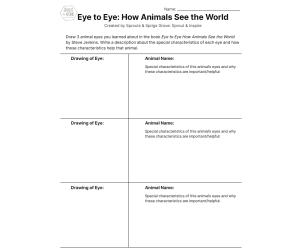
Eye to Eye How Animals See the World
Science, Life Sciences, Animals, Basic Science, Grade 3, 4, 5, 6, Teacher Tools, Lesson Plans
Description: During this lesson, children will examine, read about, and watch animal eyes in action as they learn more about the designs and functions of different eyes. They will create a model of an animal’s eye and present what they know about it to their friends, family, or class. Learning objectives I can… Describe different designs of animals’ eyes. Describe different functions of animals’ eyes. Create a realistic model of an animal’s eye. Teach someone else about a unique animal eye. Outline Build Interest: 1 photo discussion activity Read: 1 book and additional book & online options Draw: 1 realistic eye drawing activity and response Watch: selection of 5 video options (3:00-9:00 min/each) Model: 1 realistic eye model project Present: 1 preparation and presentation activity Debrief/Assess: 1 set of questions Glossary: 1 set of terms Suggested Extension Activities: 2+ activities Time needed: 2 - 4 hours Grade levels: 3rd - 6th Subject: Science Next Generation Science Standards: SCI 3-LS4-2. Use evidence to construct an explanation for how the variations in characteristics among individuals of the same species may provide advantages in surviving, finding mates, and reproducing. 4-LS1-1. Construct an argument that plants and animals have internal and external structures that function to support survival, growth, behavior, and reproduction.
Author Sprout & Inspire
Tags Animals, Eyes, Animal Features, Animal Science

Environmental Lesson Plan: DOES MEAT CONSUMPTION THREATEN OUR WAY OF LIFE? (Digital and Print)
Science, Earth and Environmental Sciences, Earth Sciences, Grade 8, 9, 10, Lesson Plans, Teacher Tools
Environmental Lesson Plan: Does Meat Consumption Threaten Our Way of Life? (Digital and Print) In this lesson plan, an in-depth look at the role of meat production in environmental sustainability is presented. This resource is suitable for grades 8 through 10 and complements Earth Science curriculum. Key Topics: Meat production and pollution The impact of modern factory farming on climate change Animal agriculture's water footprint Possible solutions via environmentally friendly farming methods This lesson plan encourages active student engagement with a research-based approach. Hyperlinked blogs and related video content form the major teaching tools here. Versatility: Digital and Print Formats Covered! The inclusive design encompasses both digitally fillable PDF for online classrooms or tech-savvy students as well as a printable version for traditional classrooms settings. Notably, there's also a Google Slides Hyperdoc with fillable fields tailored for easy student use. Ideal Class Time: You can expect each session—coupled with discussion—to soak up around 30 minutes—making it flexible enough to fit into tight classroom schedules or be assigned as homework. This Downloadable Bundle Contains Three Separate PDFs: A digitally fillable PDF A printable version PDF A Google Slides Hyperdoc file In conclusion, this environmental lesson stands out as an excellent tool promoting proactive environmental stewardship among young learners
Author Dynamic Earth Learning
Tags Meat Production, Environmental Sustainability, Climate Change, Factory Farming, Water Footprint
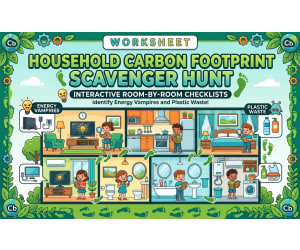
Household Carbon Footprint Scavenger Hunt
Science, Earth and Environmental Sciences, Environmental Science, Earth Sciences, Geology, Theories, Basic Science, Technology, Engineering, Space, Grade 3, 4, 5, 6, 7, 8, 9, Worksheets & Printables, Workbooks, Worksheets, Word Searches, Teacher Tools, Assessments, Lesson Plans, Quizzes and Tests, Quizzes, Tests
Transform your students into real-life Eco-Detectives! Are you looking for a hands-on, engaging, and impactful environmental science activity that goes beyond a standard worksheet? This Household Carbon Footprint Scavenger Hunt turns learning about climate change into a fun, actionable mission that empowers students to make a real difference, right in their own homes. This comprehensive, no-prep resource tackles two of the biggest "invisible" contributors to a household's carbon footprint: Energy Vampires (devices draining standby power) and Single-Use Plastics . By turning abstract concepts into a tangible hunt, students will develop critical thinking, data collection, and problem-solving skills aligned with Next Generation Science Standards (NGSS) . Perfect for Earth Day , a unit on environmental science, project-based learning (PBL), or a meaningful distance learning assignment, this scavenger hunt gets kids moving, observing, and collaborating with their families to create a more sustainable home. What's Included in this 38-Page PDF Resource: Part 1: Educator's Scientific Guide: A detailed 10-page introduction for the teacher or parent, explaining the science behind phantom power and the lifecycle of plastics in clear, easy-to-understand terms. Part 2: The Student Workbook (19 pages): Vocabulary Mission Briefing: Ensures students understand key terms before they begin. 8 Unique Room-by-Room Checklists: Students audit the Kitchen, Living Room, Bedroom, Bathroom, Laundry Room, and Home Office, hunting for culprits. 2 Action Plan Worksheets: Guides students to synthesize their data and create realistic, actionable plans for reducing energy and plastic waste. Part 3: Teacher Resources & Visuals (9 pages): 3 High-Quality Visual Aids: Concept maps and charts, perfect for classroom projection or as print-outs. Step-by-Step Teacher Implementation Guide: Includes pre-hunt prep, safety protocols, and tips for facilitating a powerful post-hunt reflection. Comprehensive Answer Key: A complete key with evaluation rubrics to make grading simple and objective. Give your students the gift of eco-agency, not eco-anxiety. Download today and empower the next generation of environmental stewards! Keywords: Earth Day, Carbon Footprint, Environmental Science, Scavenger Hunt, Project-Based Learning, At-Home Activity, Distance Learning, 3rd Grade, 4th Grade, 5th Grade, NGSS, Climate Change, Energy Conservation, Plastic Waste, Recycling, STEM, Go Green. Why Parents/Schools Love It: Turns Abstract Concepts into a Fun Game: It transforms the overwhelming idea of "climate change" into a tangible "scavenger hunt" for "energy vampires," making learning active, memorable, and incredibly engaging for kids. Empowers Students with Actionable Solutions: Instead of causing eco-anxiety, this resource gives children a sense of agency. By unplugging a charger or choosing a reusable bottle, they see an immediate, positive impact they can make. Comprehensive & No-Prep: This is a complete, ready-to-go resource. With a detailed teacher guide, student workbooks, visual aids, and an answer key, it saves educators and parents valuable preparation time. Strengthens the Home-School Connection: It's the perfect project to send home. The activity encourages students to collaborate with their families, bringing environmental education from the classroom to the living room. Builds Real-World Science Skills: Students aren't just memorizing facts; they are acting like real scientists—observing, collecting data (on their checklists), analyzing findings, and proposing solutions (in their action plans), directly aligning with NGSS practices. Target Student Audience : Based on a complete analysis of the language, concepts, and tasks in the workbook: Primary Target: 3rd Grade (8-9 years old). The PDF explicitly mentions this grade level, and the content is perfectly aligned with their cognitive abilities (the concrete operational stage). The tasks involve reading, counting, identification, and simple written responses. Secondary Target: 4th Grade and 5th Grade. This activity is still highly relevant and engaging for these students. They can complete it with more independence and provide more detailed, analytical responses in the action plan sections. Possible Niche Target: Advanced 2nd Graders (with significant parent/teacher guidance) or Middle School Special Education students who benefit from hands-on, concrete learning activities. Copyright/Terms of Use: This Book was copyrighted by Syed Hammad Rizvi. This resource is for personal and single classroom use only. You may not alter, redistribute, or sell any part of this resource. In other words, you may not put it on the Internet where it could be publicly found and downloaded. If you want to share this resource with colleagues, please purchase additional licenses from Teachsimple. Thank you for respecting these terms of use. This product is happily brought to you by Syed Hammad Rizvi
Author Creative Book Store
Rating
Tags EarthDay, TeacherResources, EnvironmentalScience, STEM, Homeschool, ScavengerHunt, DigitalDownload, Printable, CarbonFootprint, EarthDayActivities
Habitats & Communities Gr. 4-6
Science, Life Sciences, Animals, Grade 4, 5, Teacher Tools, Lesson Plans
Habitats & Communities Gr. 4-6 Lesson Plan Review The Habitats & Communities Gr. 4-6 lesson plan is an engaging teaching resource geared towards enhancing student comprehension of the world's fragile ecosystems. This resource awakens learners to pressing global issues such as, Acid Rain Global Warming Rising endangerment and extinction of species. A Comprehensive Study Unit on Ecosystems This study unit thoroughly explores various habitats, outlining their distinct features and interactions within these environments - which fosters a robust understanding of biological interplay among young learners. An essential focus is on the adaptation mechanisms employed by plants and animals in response to changing environmental conditions - an essential survival component. The intrusive advances of human activities into natural spaces are meaningfully presented, showcasing how our expansion can impact susceptible habitats. The Motherlode for Active Learning Experiences Besides its theoretical exploration into relevant scientific concepts under the grade-level science curriculum framework, this guide stresses equally on practical implementation.It promotes active learning through tasks like: Solving crossword puzzles or word searches, with topics directly related to lessons learned about ecosystems. Applications Of Habitats & Communities Lesson Plan Complete with an answer key that readily supports comprehensive assessments regarding student comprehension levels or assignment progress status – there are limitless ways this versatile tool can be utilised; Facilitating group discussions during science lessons, where educators could initiate dialogues based on provided reading passages, Applying it during personal tutor sessions, or Setting home assignments that encourages self-learning beyond the classroom. The broad opportunity this plan affords for students to not only gain knowledge but also develop appreciation towards environmental conservation is invaluable. It shapes a mindset geared towards responsible, sustainable interactions with our shared earthly domain among young scholars.
Author Classroom Complete Press
Tags PDF

Drone Data Detectives:Mastering UAVs for Environmental Mapping
Research, Community Building, Resources for Teachers, Science, Earth and Environmental Sciences, Earth Sciences, Environmental Science, Geology, Space, Life Sciences, Grade 2, 3, 4, 5, 9, 10, 11, 12, Activities, Centers, Experiments, Labs, Assessments, Teacher Tools, Graphic Organizers, Lesson Plans, Outlines, Literacy Readers
Get ready for the ultimate in drones and environmental science with "Drone Data Detectives: Mastering UAVs for Environmental Mapping & Climate Monitoring." The comprehensive high school STEM book on drones deepens the knowledge of teens into the world of Unmanned Aerial Vehicles, making them drone pilots, data analysts, and environmental stewards. This key resource covers everything needed to take raw drone data and develop actional insights in support of climate change monitoring, conservation, agriculture, and disaster response-from the basics in drone piloting and safety regulations to planning flights, and from the advanced sensors that capture aerial data, such as thermal imaging and multispectral cameras, to LiDAR. Packed full of real-world missions, ethical considerations, GIS analysis techniques, machine learning applications, and project-based learning, it is a no-brainer for aspiring scientists interested in remote sensing, photogrammetry, vegetation health metrics, and sustainable technology. This is an ideal textbook for grades 9-12 classrooms, great for homeschooling, or self-study, this book aims to fire up the theoretical teaching with practical skills in order to inspire the next generation of eco-innovators. Keywords: drone education for teens, UAV environmental mapping, climate monitoring drones, STEM books high school, data analysis environmental science, drone piloting guide, remote sensing technology, Why Parents/Schools Love It: Hands-On STEM Activities: Blends theoretical concepts with hands-on drone operations, developing critical thinking and real-world problem-solving capabilities, especially in environmental sectors such as climate change and biodiversity. Future Ready Career Preparation: It delves into areas such as conservation using drones, data science, which matches global career requirements in the field of Green Technology, sustainable development, among others. Encourages Environmental Awareness: Emphasizes responsible use of drones and awareness of global issues that encourage teens to play a role in protecting the planet with technology. Thorough and Readily Available: This text consists of 100 chapters perfectly suited for a classroom setting as it covers topics ranging from fundamental to advanced levels. Safe & Responsible Focus: It is more bent on rules, safety, and risk management, offering reassurance for educational UAV operations. Target Audience : After analyzing the content of the book in entirety—right from the introduction about basic components of drones to aerodynamics, followed by intermediate levels of topics such as sensors and data acquisition, advanced topics of machine learning and analysis of space, to practical implementations in conservation and climate observation—the book has been written for students in grades 9-12 (14-18 years of age), aiming at students expressing interest in the science of tech but gradually increasing in content across: For grade 9 and 10 students, one may focus on the fundamental chapters related to the history of drones, its parts, and the basics of piloting a drone. Grade 11/12 students: Engage with advanced topics such as multi-spectral indices, GIS integration, and photogrammetry. Designed for students who are deeply interested in environment/earth science, technology, and data sciences, and for students of STEM streams such as those in robotics and science clubs. Not designed for middle-school students due to technical complexity such as operations in the electromagnetic spectrum and calculations for NDVI, and nor for college students who would be doing research and hence would require research detail. Copyright/Terms of Use : This book is copied and adapted from Syed Hammad Rizvi. This Work/Way is intended Solely for Private Use. Neither the text nor any part of this Work/Way shall be copied, distributed, or sold. This means that no part of this Work/Way shall be placed on the Internet where it could be publicly accessed. If you want to Share it with your fellow teachers, you can buy additional licenses from Teachsimple. Thank you for Using Responsibly. “This product is happily brought to you by Syed Hammad Rizvi”
Author Creative Book Store
Rating
Tags DroneDataDetectives, MasteringUAVs, EnvironmentalMapping, ClimateMonitoring, UAVTechnology, DroneEducation, STEMBooks, HighSchoolSTEM, EnvironmentalScience, DronePiloting
I WONDER - What Are Nimbostratus Clouds | Animated Video Lesson
Earth Sciences, Earth and Environmental Sciences, Science, Grade 4, 5, 6, 7, 8, 9, 10, Lesson Plans, Teacher Tools
Video Introduction An amazing video designed for the students to learn more about famous phenomena in different countries. I WONDER - What Are Nimbostratus Clouds | Animated Video Lesson What do you know about this phenomenon? Where it happens? When it happens? What are the safety measures that we should take to be safe during this phenomenon? Are there any other places in the world that experienced this phenomenon? If yes, tell us more about them. Why do you think it happens? Do you like reading about Geography? What is your favorite country in the whole world? I WONDER - What Are Nimbostratus Clouds | Animated Video Lesson The video is perfect for encouraging the researching skills for the students, while learning more about this fantastic phenomenon. I WONDER - What Are Nimbostratus Clouds | Animated Video Lesson The video is perfect for encouraging the researching skills for the students, while learning more about this fantastic phenomenon. Format Available in a PDF format.
Author Educational Voice
Rating
Tags What Are Nimbostratus Clouds, What Are Nimbostratus Clouds Video, Nimbostratus Clouds, Nimbostratus Clouds Video, Nimbostratus Clouds Facts, Nimbostratus Clouds Video For Kids, Nimbostratus Clouds Facts For Kids
Project Lesson Plans for 3D Printing - Utensil Redesign
Science, Technology, Computer Science, Grade 2, 3, 4, 5, 6, 7, 8, 9, 10, 11, 12, Lesson Plans, Teacher Tools
Project Lesson Plans for 3D Printing - Utensil Redesign The Project Lesson Plans for 3D Printing - Utensil Redesign, is a comprehensive resource that equips educators to introduce their pupils aged 8 and up to the engaging world of 3D printing. This package provides students across grades 2-12 with an exciting opportunity to design and create a utensil customised specifically for eating certain food better. Features An all-inclusive teaching resource presented in clear step-by-step details over eight lesson days. A detailed analysis of prior knowledge requirements, learning objectives and standards. Stipulated assessments designed to track the progress of learners throughout this innovative project. All necessary materials along with instructions on how technology should be integrated every step of the way are provided. Inclusion strategies have been included which ensure that no students are left behind due to differences in learning needs or capabilities. The package also includes external web links directing educators further towards more related study topics. Concluding from Day Eight onwards are helpful closure strategies coupled alongside extension activities which enhance retention while generating interest around future projects. An easily adaptable format: The product is offered in PDF segments catering flexibly with various teaching situations such as whole group instructions or smaller screen-sharing groups ensuring adaptability into individual environments including home-study settings if necessary. Ideal For: Every science existent educator especially those specialising in computer science across Grades 2-12 looking forward bringing practicality into theory by jumping aboard real-world applications using tomorrow’s groundbreaking tech.
Author WhyMaker
Tags 3D Printing, Utensil Redesign, Lesson Plans, Technology Integration, Inclusion Strategies

I WONDER - What Is Frost | Animated Video Lesson
Earth Sciences, Earth and Environmental Sciences, Science, Geography, Social Studies, STEM, Chemistry, Grade 4, 5, 6, 7, 8, 9, 10, Lesson Plans, Teacher Tools
Video Introduction An amazing video designed for the students to learn more about famous phenomena in different countries. I WONDER - What Is Frost | Animated Video Lesson What do you know about this phenomenon? Where it happens? When it happens? What are the safety measures that we should take to be safe during this phenomenon? Are there any other places in the world that experienced this phenomenon? If yes, tell us more about them. Why do you think it happens? Do you like reading about Geography? What is your favorite country in the whole world? I WONDER - What Is Frost | Animated Video Lesson The video is perfect for encouraging the researching skills for the students, while learning more about this fantastic phenomenon. I WONDER - What Is Frost | Animated Video Lesson The video is perfect for encouraging the researching skills for the students, while learning more about this fantastic phenomenon. Format Available in a PDF format.
Author Educational Voice
Rating
Tags What Is Frost, What Is Frost Video, Frost, Frost Facts, Frost Video, Frost Video For Kids, Frost Facts For Kids, Frosting, Frosting Facts, Frosting Video

Introduction to Gases - Senior Chemistry lesson
Science, Chemistry, Grade 10, 11, 12, Teacher Tools, Lesson Plans
This chemistry lesson walks Grade 12 students through the properties, mechanics, and measurement of gases. Students will learn about characteristics of gases, kinetic molecular theory, pressure units such as Pascals and atmospheres, temperature scales, and more. The lesson incorporates two videos and an exit ticket. Educators receive a teacher presentation , student presentation with fill-in-the-blanks for engagement, and student handouts. Whether teaching virtually or in-person, this resource seamlessly fits into lesson plans. Learning is interactive yet teacher-guided. Reduce grading time with the auto-graded exit ticket. This lesson comes in Office and Google Drive formats.
Author Teach With Fergy
Tags Chemistry Lesson, Gases, Particles, Kinetic Energy Theory, Molecular Theory, Pressure, Pascals, Bars, Atmospheres, Barometer
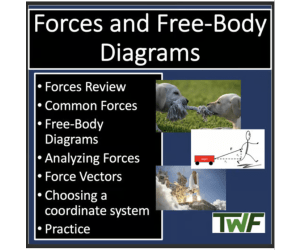
Forces and Free-Body Diagrams - Senior Physics Lesson
Science, Physics, Grade 10, 11, 12, Teacher Tools, Lesson Plans
Frames of Reference and Relativity - Senior Physics Lesson Your lesson covers chemical reactions and balancing. In order, the lesson teaches about; Forces, Common Forces, Free-Body Diagrams, Analyzing Forces, Force Vectors, and Choosing a coordinate system. Your lesson includes the teacher and student version of the presentation, an auto-graded exit ticket, TWO EMBEDDED videos and a student lesson handout so the students can record the notes on a more condensed medium. This lesson is designed to be your go-to resource, whether you're in a traditional classroom or a virtual one. With both a teacher version and a student version, it seamlessly fits into your lesson plans, making learning engaging and adaptable. Assessment made easy We've included an auto-graded Exit Ticket and a quiz with an answer key because I know you don't have an excess of time. I know you don't, because I don't and I know I'll do whatever I can to reduce my grading time. Whether you use PowerPoint or Google Slides, prefer Word or Google Docs, this lesson has you covered. This lesson comes in both Office and Google formats for your convenience. The student version of the presentation has strategically placed blanks for them to fill in as you're teaching. It keeps them active and engaged, encourages discussion, and leaves more time for those "aha" moments.
Author Teach With Fergy
Tags Chemistry Lesson, Relativity, Common Forces, Free-body Diagrams, Force Vectors, Vectors

I WONDER - How Does Refraction Cause Rainbows | Animated Video Lesson
Physics, Science, STEM, Grade 6, 7, 8, 9, 10, 11, 12, Lesson Plans, Teacher Tools
Video Introduction An amazing video designed for the students to learn more about STEM. I WONDER - How Does Refraction Cause Rainbows | Animated Video Lesson Do you like STEM subjects? what is your favorite one? Have you ever tried to plant a seed? If yes, tell us more about it. Or have you ever tried to invent something? If yes, tell us more about it. And how do you think it will help us? Have you ever seen a microorganism under a microscope? What was it? And how it looked like? Mathematics is a marvelous subject. Let' sharpen our brains and solve some equations. Do you like timetable tricks? What is your favorite one? Do you know how to code? Have you ever created an app or a game before? If yes, how was it like? I WONDER - How Does Refraction Cause Rainbows | Animated Video Lesson The video is perfect for encouraging the researching skills for the students, while learning more about this fantastic topic. I WONDER - How Does Refraction Cause Rainbows | Animated Video Lesson This friendly designed video is suitable for students at school, homeschooling, and as a group activity. Format Available in MP4 format.
Author Educational Voice
Tags How Does Refraction Cause Rainbows, How Does Refraction Cause Rainbows Video, Refraction, Refraction Facts, Refraction Facts For Kids, Refraction Video, Rainbows, Rainbows Video, Rainbows Facts
I WONDER - Why Do We Need Acids And Bases | Animated Video Lesson
Chemistry, Science, STEM, Grade 6, 7, 8, 9, 10, 11, 12, Lesson Plans, Teacher Tools
Video Introduction An amazing video designed for the students to learn more about STEM. I WONDER - Why Do We Need Acids And Bases | Animated Video Lesson Do you like STEM subjects? what is your favorite one? Have you ever tried to plant a seed? If yes, tell us more about it. Or have you ever tried to invent something? If yes, tell us more about it. And how do you think it will help us? Have you ever seen a microorganism under a microscope? What was it? And how it looked like? Mathematics is a marvelous subject. Let' sharpen our brains and solve some equations. Do you like timetable tricks? What is your favorite one? Do you know how to code? Have you ever created an app or a game before? If yes, how was it like? I WONDER - Why Do We Need Acids And Bases | Animated Video Lesson The video is perfect for encouraging the researching skills for the students, while learning more about this fantastic topic. I WONDER - Why Do We Need Acids And Bases | Animated Video Lesson This friendly designed video is suitable for students at school, homeschooling, and as a group activity. Format Available in MP4 format.
Author Educational Voice
Tags Why Do We Need Acids And Bases, Why Do We Need Acids And Bases Video, Acids And Bases, Acids And Bases Facts, Acids And Bases Facts For Kids, Acids And Bases Video, Acids And Bases Video For Kids
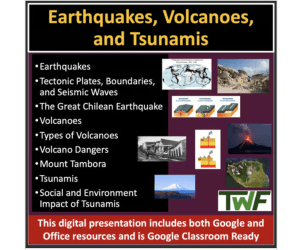
Earthquakes, Volcanoes, and Tsunamis - Senior Earth and Space lesson
Science, Earth and Environmental Sciences, Space, Earth Sciences, Grade 10, 11, 12, Teacher Tools, Lesson Plans
Earthquakes, Volcanoes, and Tsunamis - Senior High School Earth and Space Lesson Your lesson covers the causes and impacts of Earthquakes, Volcanoes, and Tsunamis on Earth. In order, the lesson teaches about; Earthquakes, Tectonic Plates, Boundaries, and Seismic Waves, the Great Chilean Earthquake, Volcanoes, Types of Volcanoes, Volcano Dangers, Mount Tambora, Tsunamis, and the Social and Environmental Impact of Tsunamis. Your lesson includes the teacher and student version of the presentation, NINE embedded videos, an auto-graded exit ticket, and a student lesson handout so the students can record the notes on a more condensed medium. This lesson is designed to be your go-to resource, whether you're in a traditional classroom or a virtual one. With both a teacher version and a student version, it seamlessly fits into your lesson plans, making learning engaging and adaptable. Assessment made easy We've included an auto-graded Exit Ticket and a quiz with an answer key because I know you don't have an excess of time. I know you don't, because I don't and I know I'll do whatever I can to reduce my grading time. Whether you use PowerPoint or Google Slides, prefer Word or Google Docs, this lesson has you covered. This lesson comes in both Office and Google formats for your convenience. The student version of the presentation has strategically placed blanks for them to fill in as you're teaching. It keeps them active and engaged, encourages discussion, and leaves more time for those "aha" moments.
Author Teach With Fergy
Tags Space Science, Tectonic Plates, Earthquakes, VOLCANOES, TSUNAMIS, Mount Tambora
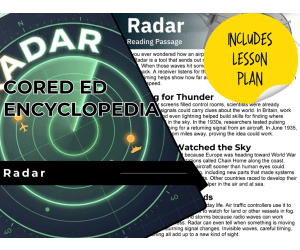
Radar Reading Comprehension Passage - Cored Ed Encyclopedia
ELA, Language Development, Reading Comprehension, Reading, Pre-Reading, Writing, History, Social Studies, Technology, Science, Grade 2, 3, 4, 5, Worksheets & Printables, Worksheets, Teacher Tools, Centers, Activities, Writing Prompts, Assessments, Quizzes and Tests, Quizzes, Lesson Plans
This radar reading comprehension includes: Visualization (on the front cover) Start your lesson by taking a minute to think and share something about the topic. Read the script aloud (slowly), perhaps prepare some music or sound effects. Student close their eyes and let their imaginations wander. Students open their eyes, read the question aloud and give them a few minutes to complete. Ask a few students to share or keep answers until the end to compare with what they learn in the passage. Quick pause—thousands of Cored Education products are included with your TeachSimple membership. Download links and encyclopedia index available here. Pre-Reading Trivia Students will write down one thing they already know about the subject and then read five more facts and discuss. These facts are fun, and the students will enjoy learning about the subject before reading more. Give 1 minute for students to write what they already know (no pressure—best guess is fine). Read the five facts together. After each fact, do ask a student for their opinion, was it surprising? Set a purpose by asking students to highlight/underline one fact they want to learn more about during the reading. Reading Passage The text is a high-interest reading passage with set paragraphs, roughly three to four paragraphs long. It contains a variety of themes about the topic, anywhere from history to technology. The passage is between 250 and 350 words in length. First, ask students to look at the headings and see what they’ll learn about today. What do they know about the topic/heading? First read options: Teacher read-aloud (best for support). Partner reading (paragraph by paragraph). While reading, students underline important details, and vocabulary words they think may come up in the questions section. Mixed Questions The first question page contains four multiple-choice questions, each with a choice of four answers, and three written response questions that require a sentence or two from the student. Students complete the mcqs first independently, then review quickly as a class. For the 3 written responses, try to get students giving the answer with some form of evidence: “I think ___ because the text says ___.” If students get stuck, send them back to check the passage. Vocabulary Questions Practice seven key words from the text in this section across two activities. First section is scrambled words where students will unscramble three words given a clue for each. The second section is a word to meaning matching activity. Before starting, have some students read out words they underlined in the passage. Ask students to say the word and read aloud the sentence(s) around each word. Ask students to do scrambled words and the matching exercise in pairs then go through answers as a class. For the scrambled spelling task, get four pairs to come up to the board and write the words for extra practice with the other student reading out the clue. For the matching task, prompt students to give full sentences: “I matched ___ with ___ because ___.” Creative Writing In this question, the student will be required to write a five to eight sentence paragraph on a question related to the topic. Before starting, ask students write down 3 key ideas they are going to include in their piece. Ask students for ideas to share around the class to help those struggling. Pro writing expectations: 5–8 sentences At least 2 facts or details from the passage At least 2 vocabulary words from the previous page Students read their paragraphs while classmates listen for facts and vocabulary words. Extension Activities This page is optional for fast finishers or to take home. There are several activities, each one requiring a different skill. Do some, do none, do all, completely optional - but you will feel reassured knowing every possibility is planned for. Includes summary writting question. Answer Key There are answers for the multiple-choice questions, written response questions have sample answers, vocabulary answers and if there is a summary question then a sample summary will be provided as well. Lesson Plan Included Customized lesson plan for this lesson is included. Lesson Snapshot Title: Radar Genre: Nonfiction (informational text with support pages) Subject: Science (Physical Science/Technology) Primary Topic: Using radio waves to find objects Estimated Guided Reading Level (A–Z): R What This Lesson Teaches Best Explains how radar works using radio waves, an “echo,” and a receiver that measures return time. Connects timing to distance (how long the trip takes helps show how far away something is). Builds background knowledge about radar’s development before World War II (tests in the 1930s; June 1935 detection; Chain Home stations). Shows real-world uses after the war (air traffic control, ships in fog, weather radar tracking rain and storms). Includes support pages that match the passage content (questions, vocabulary, writing, and extension activities focus on radio waves, echoes, Chain Home, and the 1935 test). Learning Goals Students can describe radar as a tool that sends out radio waves and listens for the waves that bounce back. Students can explain how a receiver uses the echo’s return time to show distance. Students can describe one early step in radar’s development mentioned in the passage (1930s tests or the June 1935 detection). Students can explain why early-warning stations mattered as World War II was getting closer. Students can identify at least two ways radar is used in everyday life after the war (planes, ships, or weather). Key Vocabulary From the Text receiver — device that listens for the returning signal echo — a returning signal that bounces back pulsing — sending waves in repeated bursts detected — found or noticed something was there vessels — boats or ships FULL CATALOG OF DOWNLOAD LINKS AND ENCYCLOPEDIA INDEX HERE
Author Cored Education
Rating
Tags Vocabulary, Reading Comprehension, Reading Passages, Reading, Creative Writing, Reading Strategies, Writing Prompts, Lesson Plans, History, Radar
I WONDER - Was Stephen Hawkins Adventurous | Animated Video Lesson
Inventors, Basic Science, Science, Biographies, Social Studies, Grade 4, 5, 6, 7, 8, 9, 10, Lesson Plans, Teacher Tools
Video Introduction An amazing video designed for the students to learn more about famous people in different countries. I WONDER - Was Stephen Hawkins Adventurous | Animated Video Lesson What do you know about Stephen Hawking? Can you tell us five five facts about him? Was Stephen Hawking always good at school? Was Stephen Hawkins adventurous? Was Stephen Hawkins a good teacher? What did Stephen Hawking discover? When was Stephen Hawking diagnosed with ALS? What do you know about black holes? And what did Stephen Hawkins discovered about them? I WONDER - Was Stephen Hawkins Adventurous | Animated Video Lesson The video is perfect for encouraging the researching skills for the students, while learning more about this fantastic place. I WONDER - Was Stephen Hawkins Adventurous | Animated Video Lesson This friendly designed video is suitable for students at school, homeschooling, and as a group activity. Format Available in MP4 format.
Author Educational Voice
Rating
Tags Was Stephen Hawkins Adventurous, Stephen Hawkins, Stephen Hawkins Facts, Stephen Hawkins Video, Stephen Hawkins Facts For Kids, Stephen Hawkins Video For Kids, Famous People, Famous People Facts
I WONDER - What Types Of Rock Are Part Of The Igneous Rock Family
Geography, Social Studies, Earth Sciences, Earth and Environmental Sciences, Science, Grade 4, 5, 6, 7, 8, 9, 10, Lesson Plans, Teacher Tools
Video Introduction An amazing video designed for the students to learn more about famous places in different countries. I WONDER - What Types Of Rock Are Part Of The Igneous Rock Family | Animated Video Lesson What do you know about this place? Do you know in which part of the world it is? Have you ever visited this place? If yes, can you tell us more about your adventure, and what do you like the most about this place? Do you like reading about Geography? What is your favorite country in the whole world? If you are going on a trip where it will be? Which country? What you are going to see there? Does this country has a famous place to visit? I WONDER - What Types Of Rock Are Part Of The Igneous Rock Family | Animated Video Lesson The activity is perfect for encouraging the researching skills for the students, while learning more about this fantastic place. I WONDER - What Types Of Rock Are Part Of The Igneous Rock Family | Animated Video Lesson This friendly designed video is suitable for students at school, homeschooling, and as a group activity. Format Available in MP4 format.
Author Educational Voice
Tags What Types Of Rock Are Part Of The Igneous Rock Family, What Types Of Rock Are Part Of The Igneous Rock Family Video, Igneous Rock, Igneous Rock Facts, Igneous Rock Facts For Kids, Igneous Rock Video
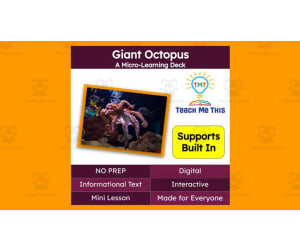
Octopus | Interactive Science Lesson | Micro-Learning Deck
Science, Life Sciences, Animals, Grade 4, 5, 6, 7, Teacher Tools, Lesson Plans
Octopus | Interactive Science Lesson This science lesson teaching resource engages 4th-7th grade students with an informative slideshow about octopuses. Educators can implement it in whole group, small group, or individual settings. The interactive digital deck immerses students with a video, reading passage with audio, close reading activity, and quick write prompt about the physical characteristics and behaviors of these captivating cephalopods. The combination of informal assessments and informational text keeps learners engaged throughout the self-paced lesson. This concise resource supplements a zoology or ocean life unit by presenting key facts and images of octopuses in their habitats in a straightforward yet compelling multimedia format.
Author Teach Me This
Tags Octopus, Digital Science, Science Lesson, Interactive Lesson, Quick Write

Circulatory,Digestive & Reproductive Systems: The Excretory System - Skin,Liver and Lungs - FLASH-PC
Science, Life Sciences, Human Body, Common Core, Grade 5, 6, 7, 8, Teacher Tools, Lesson Plans
The Circulatory, Digestive & Reproductive Systems: The Excretory System - Skin, Liver and Lungs - FLASH-PC An educational resource engineered to help students understand the workings of the circulatory, digestive and reproductive systems focusing particularly on the excretory system including skin, liver and lungs components. This resource is created mainly for learners from grade 5 to grade 8 with a focus on science topics related to the human body. Digital Content: Sporting reading passages presenting detailed curriculum -based content in one software boasting a simple user interface. Notable features include pre-reading elements (Before you Read) for setting a foundation and post-reading elements (After you Read) for knowledge enhancement. Customized Learning Styles: Videos & Audio content Interactive activities suitable for both classroom or home settings Inclusion of printable content as per requirement Vocabulary flash cards paired with related visuals aiding topic understanding Tailored Teaching Approach: Apt not only for group instructions in classrooms but also beneficial for homeschooling where structured material equals formal academic training. Could be tailored easily to suit small groups enabling concentrated learning sessions. National Alignment & Accessibility: Meticulously aligned towards meeting Common Core State Standards ideal even according Wise’s Taxonomy catering well towards promoting critical thinking abilities among young learners. Compact zip file package contains everything ensuring an easy download process leading towards seamless computer software access.
Author Classroom Complete Press
Tags Reproductive Systems, Science Assessment, Human Body, Excretory System, Science Quiz
I WONDER - Is Rewilding Just About Plants | Animated Video Lesson
Environmental Science, Earth and Environmental Sciences, Science, Earth Sciences, Nature & Plants, Life Sciences, Insects, Animals, Biology, Grade 6, 7, 8, 9, 10, 11, 12, Lesson Plans, Teacher Tools
Video Introduction An amazing video designed for the students to learn more about STEM. I WONDER - Is Rewilding Just About Plants | Animated Video Lesson Do you like STEM subjects? what is your favorite one? Have you ever tried to plant a seed? If yes, tell us more about it. Or have you ever tried to invent something? If yes, tell us more about it. And how do you think it will help us? Have you ever seen a microorganism under a microscope? What was it? And how it looked like? Mathematics is a marvelous subject. Let' sharpen our brains and solve some equations. Do you like timetable tricks? What is your favorite one? Do you know how to code? Have you ever created an app or a game before? If yes, how was it like? I WONDER - Is Rewilding Just About Plants | Animated Video Lesson The video is perfect for encouraging the researching skills for the students, while learning more about this fantastic topic. I WONDER - Is Rewilding Just About Plants | Animated Video Lesson This friendly designed video is suitable for students at school, homeschooling, and as a group activity. Format Available in MP4 format.
Author Educational Voice
Tags Is Rewilding Just About Plants, Is Rewilding Just About Plants Video, Rewilding, Rewilding Facts, Rewilding Facts For Kids, Rewilding Video, Rewilding Video For Kids, Environmental Science, Environment

Bones Are Not Just For The Dog!: A Cross-Curricular Unit on the Human Body
Science, Life Sciences, Human Body, Grade 3, 4, Teacher Tools, Lesson Plans
Bones Are Not Just For The Dog! A Cross-Curricular Unit on the Human Body This compact and informative teaching tool is specifically designed for educators who seek innovative ways to explain anatomy's foundational elements. Designed for third and fourth-grade students, this resource aims to elevate their understanding of human body science concepts. Teaching Methodology This packet infusion acknowledges that learning shouldn't be confined within traditional norms. Therefore, it uses non-fiction articles about bones–detailing their core structure, function and growth requirements. This investigative approach encourages critical thinking skills while fostering an interest in scientific inquiry. Product Breakdown A six-page PDF file with print-ready lesson plans reducing teacher preparation time without compromising quality education. Cross-curricular worksheets integrating learning across different subjects, promoting a wider scope of learning perspective among students. Adaptability & Usage The unit can be used in whole-class lectures or small group activities during class hours for robust contextualization through peer interaction. The user-friendly interface and readability standards are tailored at seventh- and eighth-graders level hence suitable during private study sessions or home-schooling days. Purpose & Impact Bones Are Not Just For The Dog! genuinely nurtures curiosity-filled understanding around our bodies beyond classroom boundaries —an essential resource every educator needs in empowering tomorrow's scientifically-literate society leaders.
Author Classroom Complete Press
Tags Dog Bones, Human Body, Anatomy, Science Worksheet, Cross-curricular Unit

I WONDER - How Long Do Electric Car Batteries Last | Animated Video
Physics, Science, STEM, Grade 6, 7, 8, 9, 10, 11, 12, Lesson Plans, Teacher Tools
Video Introduction An amazing video designed for the students to learn more about STEM. I WONDER - How Long Do Electric Car Batteries Last | Animated Video Lesson Do you like STEM subjects? what is your favorite one? Have you ever tried to plant a seed? If yes, tell us more about it. Or have you ever tried to invent something? If yes, tell us more about it. And how do you think it will help us? Have you ever seen a microorganism under a microscope? What was it? And how it looked like? Mathematics is a marvelous subject. Let' sharpen our brains and solve some equations. Do you like timetable tricks? What is your favorite one? Do you know how to code? Have you ever created an app or a game before? If yes, how was it like? I WONDER - How Long Do Electric Car Batteries Last | Animated Video Lesson The video is perfect for encouraging the researching skills for the students, while learning more about this fantastic topic. I WONDER - How Long Do Electric Car Batteries Last | Animated Video Lesson This friendly designed video is suitable for students at school, homeschooling, and as a group activity. Format Available in MP4 format.
Author Educational Voice
Tags How Long Do Electric Car Batteries Last, How Long Do Electric Car Batteries Last Video, Electric Car Batteries, Electric Car Battery, Electric Car Batteries Facts, Electric Car Batteries Facts For Kids, Electric Car Batteries Video