



3,993 products added recently
Page 237 - Popular Lesson Plans
Explore a curated selection of popular lesson plans that have proven successful in classrooms. Covering various subjects and topics, these resources provide innovative ideas and activities. Use them to refresh your curriculum and engage your students with tried-and-true methods.

 Show filters

I WONDER - How Fast Can The International Space Station Travel
Space, Earth and Environmental Sciences, Science, Grade 6, 7, 8, 9, 10, 11, 12, Lesson Plans, Teacher Tools
Video Introduction An amazing video designed for the students to learn more about space facts. I WONDER - How Fast Can The International Space Station Travel | Animated Video Lesson Do you like reading about space? If yes, what is your favorite topic? What do you know about our solar system? What is the smallest planet in our solar system? What is the biggest planet in our solar system? What is the hottest planet in our solar system? And what is the coldest one? Do you think there are aliens? If yes, what do you think they look like? What do they eat and how they speak to each other? Where do they live? What is a galaxy? And what is a milky way? Have you recently saw a shooting star? If yes, tell us more about it, like when did it happen and where? What is a blackhole? Can a blackhole gets bigger by time? Do you like counting the stars? What do you think a star is made of? I WONDER - How Fast Can The International Space Station Travel | Animated Video Lesson The video is perfect for encouraging the researching skills for the students, while learning more about the fantastic space. I WONDER - How Fast Can The International Space Station Travel | Animated Video Lesson This friendly designed video is suitable for students at school, homeschooling, and as a group activity. Format Available in MP4 format.
Author Educational Voice
Tags How Fast Can The International Space Station Travel, How Fast Can The International Space Station Travel Video, International Space Station, International Space Station Facts, International Space Station Video, International Space Station Facts For Kids
I WONDER - Where Was Saint Patrick From | Animated Video Lesson
History, Social Studies, History: Ancient, History: Europe, History: British, Grade 2, 3, 4, 5, 6, 7, 8, Lesson Plans, Teacher Tools
Video Introduction An amazing video designed for the students to learn more about history. I WONDER - Where Was Saint Patrick From | Animated Video Lesson Do you like history? Which topic do you really enjoy about history? Have you ever read an interesting fact about the Vikings? If yes, can you mention them? What do you like most about the Victorian era? Can you name all the Tudors? Have you ever wondered how people used to live in ancient Japan and ancient China? Do you know any interesting facts about ancient Egyptians and the Pharaohs? Have you ever visited South America? What do you know about Incas and Aztecs? Celtic culture was really one of a kind, can you name any of the places that Celts used to live in? Imagine yourself living during the ancient Roman empire, how your life will look like? Ancient Greece was an amazing place to live in. What do you know about ancient Greek life? I WONDER - Where Was Saint Patrick From | Animated Video Lesson The video is perfect for encouraging the researching skills for the students, while learning more about history. I WONDER - Where Was Saint Patrick From | Animated Video Lesson This friendly designed video is suitable for students at school, homeschooling, and as a group activity. Format Available in MP4 format.
Author Educational Voice
Tags Where Was Saint Patrick From, Where Was Saint Patrick From Video, Saint Patrick, Saint Patrick Video, Saint Patrick Facts, Saint Patrick Video For Kids, Saint Patrick Facts For Kids, Ireland

1st Grade Morning Work | 180 Days of Daily Spiral Review | Math & ELA
ELA, Math, Grade 1, Assessments, Teacher Tools, Lesson Plans, Worksheets & Printables
First Grade Morning Work | 180 Days of Daily Spiral Review | Math & ELA Bell Ringers | Print & Go Start every school day with meaningful, no-prep practice that builds confident, independent learners! This First Grade Morning Work resource includes 180 days of daily spiral review designed to reinforce essential first grade math and ELA skills all year long. With engaging literacy, math, calendar, SEL, and critical thinking activities, students review previously taught concepts while steadily building new skills through consistent practice. The resource is designed as a two-page daily routine with literacy on Page A and math, calendar, and thinking activities on Page B, making it easy to establish predictable classroom routines. What's Included 180 days of printable morning work Two-page daily format (360 student pages) Daily literacy practice: Phonics Sight words Handwriting Grammar Sentence writing Vocabulary Reading challenge Writing prompt Daily math practice: Place value Addition Subtraction Telling time 2D & 3D shapes Math challenges Daily classroom routines: Calendar Weather SEL check-in Fun facts Jokes & riddles Growth mindset quotes Brain teasers Would You Rather questions Teacher Guide 36-week Pacing Guide Skills Checklist for progress monitoring Editable Morning Work Schedule (Word & PDF) Complete Answer Key for all 180 days How It Works in the Classroom This First Grade Morning Work resource is flexible enough to fit almost any classroom schedule. Use it for: Morning work Bell ringers Daily spiral review Independent practice Early finisher activities Homework Small group warm-ups Intervention review Test prep Emergency sub plans The predictable routine helps students build independence while allowing teachers to greet students, conference with individuals, monitor progress, or pull small groups during the first 10–15 minutes of the day. Standards & Learning Goals This resource reviews and reinforces a wide range of first grade Common Core skills, including: ELA Phonics Phonological awareness High-frequency words Grammar and conventions Sentence writing Reading comprehension Vocabulary development Daily writing practice Math Number sense Place value Addition and subtraction within 20 Telling time 2D and 3D shapes Calendar skills Problem solving Mathematical thinking Students also develop: Social-emotional learning Growth mindset Critical thinking Reading stamina Independent work habits Daily review routines Why Teachers Love It ❤️ No-prep, print-and-go lessons ❤️ Covers an entire 180-day school year ❤️ Builds consistent morning routines ❤️ Spirals previously taught skills for better retention ❤️ Keeps students engaged with fresh activities every day ❤️ Includes both literacy and math in one resource ❤️ Makes progress monitoring simple with the Skills Checklist ❤️ Includes editable planning documents and a complete answer key ❤️ Perfect for classrooms, intervention groups, homeschooling, and substitute teachers Perfect For First Grade Classrooms Homeschool RTI MTSS Morning Bins Bell Work Daily Review Centers Independent Work Fast Finishers Homework Test Review If you're looking for a First Grade Morning Work resource that saves planning time while giving students meaningful daily spiral review in both math and ELA, this comprehensive 180-day resource is ready to use from the first day of school through the last. Download today and make your morning routine organized, engaging, and stress-free!
Author Bright Classroom Ideas Marketplace
Rating
Tags Ela, Math, Spiral, Review, Morning Work, Daily, Yearlong, Full Year
I WONDER - Why Do Red Pandas Have Stripes On Their Faces
STEM, Animals, Life Sciences, Science, Biology, Grade 1, 2, 3, 4, 5, 6, 7, 8, Lesson Plans, Teacher Tools
Video Introduction Animal kingdoms are full of fascinating wonders to learn. This video is designed for the students to learn more about animals in different countries. I WONDER - Why Do Red Pandas Have Stripes On Their Faces | Animated Video Lesson Do you like animals? what is your favorite one? Do you own a pet? If yes, tell us more about it, like what its name? And what do you like most about it? What are the animal kingdoms? Can you write down the characteristics of each animal class like mammals, birds, reptiles, amphibian, fish and mollusks. Do you know that some animals can sing, can you name any of them? What is the largest and the smallest mammal in the world? What is the largest and the smallest bird in the world? What is the largest and the smallest fish in the world? I WONDER - Why Do Red Pandas Have Stripes On Their Faces | Animated Video Lesson The video is perfect for encouraging the researching skills for the students, while learning more about these fantastic animals. I WONDER - Why Do Red Pandas Have Stripes On Their Faces | Animated Video Lesson This friendly designed video is suitable for students at school, homeschooling, and as a group activity. Format Available in MP4 format.
Author Educational Voice
Tags Why Do Red Pandas Have Stripes On Their Faces, Why Do Red Pandas Have Stripes On Their Faces Video, Red Pandas, Red Pandas Face Stripes, Red Pandas Face Stripes Facts, Red Pandas Face Stripes Video

Local Climate Action: Data-Driven Solutions for Teen Environmentalists
Earth and Environmental Sciences, Science, Earth Sciences, Environmental Science, Geology, Space, Life Sciences, Biology, Human Body, Nature & Plants, Homeschool Curriculum, Homeschool Templates, Grade 6, 9, 10, 11, 12, Lesson Plans, Teacher Tools, Workbooks, Worksheets & Printables, Centers, Activities, Experiments, Labs, Projects, Presentations
Equip and empower the next generation of climate leaders to act through data, tools, and projects that can be immediately applied in their own backyard. "Local Climate Action: Data-Driven Solutions for Teen Environmentalists" is a game-changing book that will empower high school students from climate observers to data-informed climate activists. This textbook written by Syed Hammad Rizvi connects climate knowledge around the world to practical solutions on a local level. By means of 45 chapters, teens are taught how to: Obtain and interpret local environment data with the help of easily accessible tools and sensors Integrate climate change impacts like urban heat islands, flood zones, or pollution hotspots Learn how to effectively disseminate your findings through the use of graphics, such as charts and Create and deliver youth-led projects on climate change that have tangible implications in the real world. Packed with practical examples, protocols, and ethics for a responsible climate response, this book turns classrooms and communities into living laboratories for climate resilience. It is a textbook and a toolkit that reaches beyond education by providing a means for empowerment and increasing awareness and knowledge for a climate-conscious population. Why Parents & Schools Love It: Practical and application-based: Goes beyond theory and projects that students can implement and have the potential for making a difference in the neighborhood community. This inculcates critical skills in data literacy, scientific inquiry, mapping, presentation, and project management skills which will benefit them in both school as well as in their future lives. Aligns with Curriculum: This can be easily incorporated into the curriculum of environmental science, geography, STEM education, and social studies. Youth Agency Enthusiast: This helps youth exercise leadership, representation, and partnership with the community for their benefit, enhancing their self-confidence. Engaging Youth Publication Lowdown Ethical & Inclusive: Emphasizes responsible data use, community science, & justice for our planet & our communities. Target Audience & Grade Level: Primary Audience: Grades: 9-12 Subjects: Environmental Science, Geography, STEM Education, Civics Education, Data Liter Target group: High school students, Eco-clubs, Project based learning initiatives, Homeschoolers, Climate advocacy groups for youths. Secondary Audience: Educators, Science Teachers, People involved in developing Curriculums. Those interested in Activity-based, ‘ Youth groups, libraries, and community centers running climate action projects. Copyright/Terms of Use This Book is copyrighted by Syed Hammad Rizvi. This material is intended only for personal and single-classroom use. This means you do not have the right to copy, distribute, and sell any part of this material. That is, you cannot place the material on the Internet where it could be downloaded by the public. If you want to share this resource among colleagues in your institution, you would need to purchase additional copies of this product through Teachsimple. Thank you for respecting this usage policy. This product has been shared among you happily by Syed Hammad Rizvi
Author Creative Book Store
Rating
Tags TeenEnvironmentalists, ClimateAction, DataLiteracy, STEMeducation, HighSchoolScience, ProjectBasedLearning, ClimateChangeEducation, YouthLeadership, EnvironmentalScience, TeacherResources

Nikola Tesla - Close Reading Comprehension Worksheet & Lesson Plan
Science, Physics, Grade 8, 9, 10, 11, 12, Lesson Plans, Teacher Tools
This resource is wonderful for students to increase vocabulary, improve reading comprehension, and also English fluency! The reading itself is of Nikola Telsa and the lesson plan & worksheet includes the following items: - pre-reading warm-up & discussion - 350-word article - True/false reading comprehension questions - Open-ended reading comprehension questions - Discussion questions & debate starters - Timeline writing exercise - Additional activities for homework/differentiation Example of English level: "Who was Nikola Tesla? If there was more justice in the world, as many people today would be familiar with the name of Nikola Tesla as they are with the name of his bitter rival, Thomas Edison. In the 1880s Tesla and Edison carried out the famous “War of the Currents”, as they each tried to establish their own versions of electric currents as the preeminent standard for widespread use. Edison may now be better known, but this doesn’t diminish Tesla’s incredible accomplishments in advancing modern technology."
Author The Laughing Linguist
Tags Einstein, Albert Einstein, Scientist, Reading Comprehension, Close Reading

How to Write a Paragraph: Proofreading Your Paragraph
ELA, Writing, Common Core, Grade 5, 6, 7, 8, Teacher Tools, Lesson Plans
How to Write a Paragraph: Proofreading Your Paragraph A premium educational resource for teachers and home-school parents catering to grades 5 through 8. This tool primarily focuses on Language Arts, particularly writing. Purpose: The goal of this lesson plan is not just honing sentence construction capacity, but also helping students transform thoughts into cohesive, structured paragraphs. It simplifies the writing process making it both intelligible and direct for enhanced learning. Benefits: Offers tangible exposure to students about the pre-writing process with helpful graphic organizers. Hones practical proficiency in paragraph composition by introducing four pivotal paragraph forms. Implementation: This resource adheres to Bloom’s Taxonomy’s crucial teaching principles, making it substantially beneficial as an addition to existing reading programs or used independently for student projects. Inclusions: A comprehensive implementation guide assisting user-friendly application of the resource. An assessment measure including rubrics and comprehension quizzes to track student improvement over time. Fosters enrichment of language arts skills with engaging interactive content like word puzzles included in the mix. Complementary learning aids: Six colorful graphic organizers provide step-by-step guidance assisting learners in successful writing techniques. This tutorial tool aligns well with modern education models worldwide due to being : - Driven meticulously by Common Core State Standards (CCSS) - Closely attuned with Bloom's Taxonomy guiding principles. Accessible conveniently in PDF format; this teaching resource serves as a valuable aid across different educational platforms.
Author Classroom Complete Press
Tags PDF

Famous Musicians Reading Comprehension: Bowie, Beethoven & Lady Gaga - Engaging ESL & English Worksheets & Lesson Plans
ELA, Creative Arts, Art, Language Development, ESL, Music, Not Grade Specific, Lesson Plans, Teacher Tools
Famous Musicians Reading Comprehension: Bowie, Beethoven & Lady Gaga - Engaging ESL & English Worksheets & Lesson Plans A teaching resource that offers the perfect fusion of music and language learning. It examines the lives and influences of three iconic individuals from diverse musical genres – David Bowie, Beethoven, and Lady Gaga. An excellent method to enhance your students' critical thinking abilities while developing their language skills. The Bundle: Lesson Plans and More! The bundle is equipped with comprehensive lesson plans for these three artists. Guarantee a vibrant exploration into the worlds of classical music, rock 'n' roll, and contemporary pop culture. Covers musicians’ backgrounds vividly Highlights unique styles Delineates undeniable impact on world music Focused Lessons: Group or Paired Work Settings: Stimulating discussions about each artist. Vocabulary-building exercises: Relevant to each artist's era or style. Reading comprehension activities: To ensure understanding of each musician’s life. Multimedia Learning enhancement: Inclusion of video content Social Issues: Promoting Meaningful Conversations This resource incorporates important social issues such as Lady Gaga's advocacy— making way for meaningful dialogues within classrooms that encourages student presentations promoting people not just to learn but think critically as well. Honing Writing Skills Through Practice : Writing practice serves as another crucial part in this curriculum — learners absorb the knowledge while practicing written discourse, thus improving writing fluency. An All-Around Teaching Resource This bundle is flexible enough for use in both homework and whole class instruction, suitable not just for public school classes but homeschool settings alike. Ideal for Language Arts classes covering subjects like ESL (English as a Second Language) lessons or even Music discussion hours. Teach Beyond Reading: Holistic Learning Approach Improve your students' linguistic abilities while familiarizing them with legendary musicians across different epochs. Enjoy the fusion of music and language with Famous Musicians Reading Comprehension: Bowie, Beethoven & Lady Gaga teaching resource!
Author The Laughing Linguist
Tags Music History, Famous Musicians, Reading Comprehension, Critical Thinking, Vocabulary-building

Ambush: Full Lesson Plan w/ PowerPoints & Graphic Organizers
ELA, Reading, Grade 6, 7, 8, 9, Lesson Plans, Teacher Tools
Ambush: Full Lesson Plan w/ PowerPoints & Graphic Organizers This dynamic pack is an all-encompassing collection of digital resources designed for Grades 6-9 educators, with a specific focus on enhancing Language Arts instruction in the field of Reading. Centered around the text 'Ambush' by Tim O'Brien, this comprehensive teaching resource offers direction, guidance and structure to your lesson plans. All materials are conveniently bundled within a zip file containing both PDF and Word document formats. Included In The Pack: A wide selection of diverse graphic organizer worksheets suited to various instructional requirements such as: Characterisation charts for deeper literary comprehension. Figurative language sheets for enhanced understanding. Venn Diagrams to introduce comparison studies. Eight unique PowerPoint presentations focusing on essential themes found within 'Ambush': Plot Structure Analysis Symbols and Allegory Interpretation Study , . Ideal tools to facilitate students' brainstorming efforts or prompt engaging whole-group discussions. Fully mapped out lesson plans offering easy inclusion into: In-class group activities or projects. . Rewards-driven homework tasks that extend learning beyond the classroom environment. .\/l. Bouple] The resource pack's key goal is centered around simplifying instructive work while magnifying students' reading comprehension skills - aiming not just at equipping them with knowledge about 'Ambush', but preparing them for further academic progress. With a flexible format, it caters to diverse teaching styles and learning paces, equally suitable for both public school educators and homeschoolers.. Plus: Discover bonus materials included within the pack designed to solidify your arsenal of instructive resources aimed at potentializing your learners' literacy prowess .
Author Quality Teaching Products
Tags Lesson Plan, Reading Comprehension, Graphic Organizers, PowerPoint Presentations, Text Analysis, Imagery Graphic Organizer

Gut Feeling | Figurative Language Activity | Micro-Learning Deck
ELA, Reading, Reading Comprehension, Grade 4, 5, 6, 7, Teacher Tools, Lesson Plans
Gut Feeling | Figurative Language Learning Activity teaches students about figurative language through an engaging micro-learning deck. Students start by watching a short video that explains the figurative language term "gut feeling." Next, they read a passage with audio recording that uses gut feeling to paint a descriptive picture. After reading, students answer reading comprehension questions to check their understanding. They finish by completing a quick write activity to apply what they learned about gut feeling in their own writing. This versatile resource can be used for whole group instruction to introduce figurative language. It also works for small groups or individual assignments to reinforce this language concept.
Author Teach Me This
Tags Reading Lesson, Comprehension Activity, Learning Deck, Figurative, Language

'Zootopia' Lesson Plan & Worksheets | Grades 7 - 11
ELA, Social Emotional Learning (SEL), Special Resources, Grade 7, 8, 9, 10, 11, Lesson Plans, Teacher Tools, Worksheets & Printables
Zootopia Movie Study | Disney Movie Guide | Media Literacy, Critical Thinking, Bias, SEL & ELA Activities | Grades 7–11 Challenge students to think critically about stereotypes, prejudice, media influence, and social responsibility with this engaging Zootopia Movie Study ! Based on Disney’s award-winning animated film, this resource goes far beyond simple comprehension activities by helping students analyze allegory, propaganda, bias, character development, and data interpretation. Through 30 rigorous activities, students strengthen reading comprehension, media literacy, critical thinking, writing, and social-emotional learning while exploring important real-world issues through the lens of an engaging story. What's Included 30 student activities Printable student workbook Comprehensive teacher guide Complete answer key Reading comprehension questions Plot timeline and sequencing activities Character analysis tasks S.T.E.A.L. characterization activities Theme and allegory analysis Stereotype and bias exploration Propaganda and persuasion lessons Media literacy activities Context clues and vocabulary development Connotation and tone analysis Point-of-view activities Conflict and foil character analysis Critical-thinking discussion prompts Evidence-based argument writing Reflection and SEL activities Stacked bar graph interpretation Scatter plot analysis Correlation vs. causation lessons Data reasoning and graphing activities Students will explore: Stereotypes and prejudice Bias and assumptions Media influence Propaganda and persuasion Empathy and understanding others Identity and belonging Critical thinking Correlation vs. causation Fairness and justice Personal responsibility and growth How It Works in the Classroom This Zootopia movie guide is designed for flexible classroom use and works well for: English Language Arts lessons Media literacy instruction Social studies and civics discussions Social-Emotional Learning (SEL) Critical-thinking units Independent work Homeschool learning Substitute plans Small-group discussions Cross-curricular learning Students complete activities before, during, and after viewing the film. Lessons include stereotype tracking, mystery clue logs, comprehension checks, vocabulary development, character analysis, allegory exploration, propaganda analysis, graph interpretation, evidence-based writing, and reflective discussion. The included teacher guide provides a complete 90-minute lesson plan, differentiation strategies, discussion questions, and assessment tools. Standards & Learning Goals Students will: Analyze how allegory communicates real-world issues Examine stereotypes, prejudice, and bias Evaluate propaganda and persuasive techniques Analyze character foils and indirect characterization Strengthen reading comprehension and inference skills Develop media literacy and critical-thinking abilities Interpret scatter plots and stacked bar graphs Distinguish correlation from causation Construct evidence-based arguments Reflect on empathy, identity, and personal responsibility Supports instruction in: English Language Arts Media Literacy Social Studies & Civics Critical Thinking Writing Skills Mathematics & Statistics Social-Emotional Learning (SEL) Speaking and Listening Why Teachers Love It ✅ No-prep printable resource ✅ Includes teacher guide and complete answer key ✅ Strong focus on media literacy and critical thinking ✅ Encourages meaningful discussions about bias and fairness ✅ Integrates literacy, social studies, SEL, and data analysis ✅ Teaches students how to evaluate information critically ✅ Supports evidence-based reasoning and argument writing ✅ Promotes empathy and perspective-taking ✅ Flexible for classroom, homeschool, and enrichment settings ✅ Connects powerful movie themes to real-world issues Teachers love how this resource transforms a popular Disney movie into a rigorous learning experience. Students engage with important conversations about stereotypes, prejudice, propaganda, and media influence while building the analytical skills needed to think critically about the world around them. Add this Zootopia Movie Study to your classroom today and help students explore bias, empathy, media literacy, and critical thinking through engaging activities that transform movie day into a meaningful and thought-provoking learning experience.
Author Bright Classroom Ideas Marketplace
Rating
Tags Zootopia, Film, Movie, Guide, Lesson, Plan, Worksheet
Learn to Read: Lesson 7: OO
Special Resources, ELA, Special Education Needs (SEN), Language Development, Phonics, Reading, Spelling, Vocabulary, Writing, Grade 1, 2, 3, Lesson Plans, Teacher Tools
About This Product This is a pack of 49 Phonic OO worksheets to teach the OO, specially designed for those with special needs, including those with dyslexia or who may be suspected of being dyslexic, but will work equally well with young learners in Kindergarten/EYFS/Y1. These sheets are LETRS/Science of Reading and UK GOV requirements aligned. These worksheets also align with the most popular phonic programmes, including RWI and Letters and Sounds. Who are these worksheets for? I have written them for pupils who struggle with processing information - especially sounds. This includes children who are DYSLEXIC or have ANY other kind of processing disorder. Such children may have failed with other methods of teaching phonics. Such pupils need activities that: ·are highly structured - one tiny step at a time building on the one before using only a limited number of words to start with and only using words that the child has already learnt to sound out, with no nasty surprises. ·Have only a little on each pageas these pupils tire easily. What makes these worksheets special? I have a powerful three-step process which I use with my special needs pupils, which is worked out throughout the worksheets: 1. See it!where we focus on becoming aware of the new sound in words. This involves first hearing the new sound in words and then seeing it in words (tracking). 2. Sound-it-out!Having learnt to see the new sound in words, we learn to sound out these words to read and write them. We begin by usingsound-it-out boxesfor reading and spelling which help the child to segment the word before blending the sounds. Once the child can read and write individual words, we work on fluency by building familiarity with the common words in the new sound family. Once the child can sound the words out to read and spell confidently, we move on to recognising them/using them in longer reading and dictation passages, as soon as the child is able. I provide 2 reading passages with comprehension exercises and one dictation passage, with a page in the workbook dedicated to it, with room for a picture, which again cements understanding. 3. Write it! Incorporated into the above two steps, we constantly write the new sound. This adds a multi-sensory dimension to our work - we see with our eyes, we sound it with our mouth parts and voice, and then we move by writing. All three steps work together to help the child feel in control of his/her learning and to become a successful, confident learner. We finish each sound with a dictation which culminates our work before we move on to the next sound. I try to give this a week after we finish the book, to act as revision. The dictation: Read this passage to your pupil, who should write it. Have the child read his/her work and check for errors. Make sure the writing is completely accurate before saying the child has finished, including full stops and capital letters correctly used. Flashcards are included. What is included in the pack: 46 Activities 2 Games Flashcards Please note: This pack is in a series: Find the bundle here: https://teachsimple.com/product/phonic-worksheets-for-special-needs-bundle-highly-structured I do hope others find these Special Needs Phonic worksheets helpful for their pupils with ordering and processing difficulties!
Author Lilibette's Resources
Tags Special Needs Phonics, Dyslexia Phonic Worksheets, Phonic Worksheets For Dyslexics, Home Education, Reading Intervention, OO WORKSHEETS, OO Phonic Worksheets, Home-school

Basic Math Skills | Counting Estimation Comparison 1
Special Resources, Special Education Needs (SEN), Math, Early Math, Numbers, Place Value, Preschool, Grade 1, Teacher Tools, Lesson Plans, Worksheets & Printables, Flashcards, Activities
Basic Math Skills | Counting Estimation Comparison . This is a comprehensive and resourceful teaching aid series designed to instill foundational math skills in kindergarten and grade 1 students . It is an essential tool for educators in varied environments, including public schools and homeschooling . Resource Contents : Each PDF file features 24 pages of vibrant, picture - based materials . Covered concepts include quantity counting, estimations, and comparisons . The resources emphasize visual representation of quantities for easier understanding . Inclusive are pages where equal or unequal amounts are arranged either linearly or randomly . Certain sheets feature objects appearing up to 20 times for learners to cut out, point, count and paste - reinforcing manual learning techniques . All materials come both as colored illustrations as well as blackline versions catered to different printing preferences or learner needs . The resource can be used either as larger A4 size work mats / screen view slides or smaller task cards / flash cards - proving effective during group instruction sessions or individualized tutoring . The range of visuals from apples & worms to elephants & coconuts provides fun reinforcement while maintaining student’s interest in counting skills . Furthermore these sustainable resources can be laminated post - printing thus ensuring their longevity while enhancing tactile engagement among young learners . In addition to basic numeracy, the Basic Math Skills | Counting Estimation Comparison, lays the groundwork for number comprehension & place value ! It provides teachers with reliable support while forming the strong numeric foundations crucial at this important educational stage . The material is presented either in A4 size, as work mats / screen view slides or as 4-on-a-page flash cards to use as task cards as well . It is a great resource for your math stations and math centers and once you print and laminate, you can store forever . 1 pdf file . 24 pages with mats / screens / task cards / flash cards to work on counting, estimation and comparison basic math skills . For more pdf materials on numeracy, basic math and pictorial / manipulative approach to learning, you can click WORDS ASIDE .
Author WORDS ASIDE
Tags Math, Numbers, Task Cards, Mats, Manipulatives, Math Station, Math Center, Pictorial , Slides, Words Aside

Jeeps Reading Comprehension Passage - Cored Ed Encyclopedia
ELA, Reading Comprehension, Reading, Language Development, Vocabulary, History, Social Studies, Technology, Science, Pre-Reading, Grade 2, 3, 4, 5, Worksheets & Printables, Worksheets, Teacher Tools, Centers, Activities, Writing Prompts, Assessments, Quizzes and Tests, Quizzes, Lesson Plans
This Jeeps reading comprehension with lesson plan includes: Visualization (on the front cover) Start your lesson by taking a minute to think and share something about the topic. Read the script aloud (slowly), perhaps prepare some music or sound effects. Student close their eyes and let their imaginations wander. Students open their eyes, read the question aloud and give them a few minutes to complete. Ask a few students to share or keep answers until the end to compare with what they learn in the passage. Quick pause—thousands of Cored Education products are included with your TeachSimple membership. Download links and encyclopedia index available here. Pre-Reading Trivia Students will write down one thing they already know about the subject and then read five more facts and discuss. These facts are fun, and the students will enjoy learning about the subject before reading more. Give 1 minute for students to write what they already know (no pressure—best guess is fine). Read the five facts together. After each fact, do ask a student for their opinion, was it surprising? Set a purpose by asking students to highlight/underline one fact they want to learn more about during the reading. Reading Passage The text is a high-interest reading passage with set paragraphs, roughly three to four paragraphs long. It contains a variety of themes about the topic, anywhere from history to technology. The passage is between 250 and 350 words in length. First, ask students to look at the headings and see what they’ll learn about today. What do they know about the topic/heading? First read options: Teacher read-aloud (best for support). Partner reading (paragraph by paragraph). While reading, students underline important details, and vocabulary words they think may come up in the questions section. Mixed Questions The first question page contains four multiple-choice questions, each with a choice of four answers, and three written response questions that require a sentence or two from the student. Students complete the mcqs first independently, then review quickly as a class. For the 3 written responses, try to get students giving the answer with some form of evidence: “I think ___ because the text says ___.” If students get stuck, send them back to check the passage. Vocabulary Questions Practice seven key words from the text in this section across two activities. First section is scrambled words where students will unscramble three words given a clue for each. The second section is a word to meaning matching activity. Before starting, have some students read out words they underlined in the passage. Ask students to say the word and read aloud the sentence(s) around each word. Ask students to do scrambled words and the matching exercise in pairs then go through answers as a class. For the scrambled spelling task, get four pairs to come up to the board and write the words for extra practice with the other student reading out the clue. For the matching task, prompt students to give full sentences: “I matched ___ with ___ because ___.” Creative Writing In this question, the student will be required to write a five to eight sentence paragraph on a question related to the topic. Before starting, ask students write down 3 key ideas they are going to include in their piece. Ask students for ideas to share around the class to help those struggling. Pro writing expectations: 5–8 sentences At least 2 facts or details from the passage At least 2 vocabulary words from the previous page Students read their paragraphs while classmates listen for facts and vocabulary words. Extension Activities This page is optional for fast finishers or to take home. There are several activities, each one requiring a different skill. Do some, do none, do all, completely optional - but you will feel reassured knowing every possibility is planned for. Includes summary writting question and additional facts. Answer Key There are answers for the multiple-choice questions, written response questions have sample answers, vocabulary answers and if there is a summary question then a sample summary will be provided as well. Lesson Plan Included Customized lesson plan for this lesson is included. Lesson Snapshot Title: Jeeps Genre: Nonfiction (informational text) Subject: Social Studies (History) / Reading (Informational Text) Primary Topic: WWII jeep origins and how the Jeep line evolved Estimated Guided Reading Level (A–Z): S What This Lesson Teaches Best Explains why the U.S. Army wanted a small, tough 4-wheel-drive truck in 1940 and how designs led to the World War II jeep (Willys MB and Ford GPW). Uses concrete facts and numbers (more than 600,000 built; held 3 to 6 people; carried scouts, messengers, and heavy gear). Explores multiple possible origins of a word/nickname (“g.p.”, soldier slang, and Eugene the Jeep) and shows that history can have more than one source. Traces change over time: military jeep → civilian CJs (starting 1945) → a family of vehicles including SUVs and the Wrangler as a descendant of the CJ line. Supports comprehension with clear section headings that organize the timeline and ideas. Learning Goals Identify the problem armies faced in 1940 and what kind of truck the U.S. Army wanted. Describe two details about World War II jeeps (names, number built, what they carried, or how many people fit). Explain why the passage says the nickname “jeep” is “not that simple,” using text evidence. Describe how jeeps changed after the war when Willys began selling CJs. Summarize how the Jeep line continued and changed “over the years,” including the Wrangler and one feature it kept. Key Vocabulary From the Text 4-wheel-drive — power can go to all four wheels. nickname — a fun or short name. civilian — not in the military. surplus — extra items left over after use. descendant — a newer vehicle from the same family line. FULL CATALOG OF DOWNLOAD LINKS AND ENCYCLOPEDIA INDEX HERE
Author Cored Education
Rating
Tags Vocabulary, Reading Comprehension, Reading Passages, Lesson Plans, Ela Lesson Plans, Reading Comprehension Lesson Plans, Pre-reading, Social Studies Lesson Plans, History, Technology

I WONDER - What Is A Pangolin | Animated Video Lesson
STEM, Biology, Life Sciences, Science, Animals, Grade 1, 2, 3, 4, 5, 6, 7, 8, Lesson Plans, Teacher Tools
Video Introduction Animal kingdoms are full of fascinating wonders to learn. This video is designed for the students to learn more about animals in different countries. I WONDER - What Is A Pangolin | Animated Video Lesson Do you like animals? what is your favorite one? Do you own a pet? If yes, tell us more about it, like what its name? And what do you like most about it? What are the animal kingdoms? Can you write down the characteristics of each animal class like mammals, birds, reptiles, amphibian, fish and mollusks. Do you know that some animals can sing, can you name any of them? What is the largest and the smallest mammal in the world? What is the largest and the smallest bird in the world? What is the largest and the smallest fish in the world? I WONDER - What Is A Pangolin | Animated Video Lesson The video is perfect for encouraging the researching skills for the students, while learning more about these fantastic animals. I WONDER - What Is A Pangolin | Animated Video Lesson This friendly designed video is suitable for students at school, homeschooling, and as a group activity. Format Available in MP4 format.
Author Educational Voice
Tags What Is A Pangolin, What Is A Pangolin Video, Pangolin, Pangolins, Pangolin Facts, Pangolin Facts For Kids, Pangolin Video, Pangolin Video For Kids, Pangolins Facts, Pangolins Video

Reducing Your School's Carbon Footprint: How Your School Uses Energy Gr. 5-8
Science, Earth and Environmental Sciences, Environmental Science, Grade 5, 6, 7, 8, Teacher Tools, Lesson Plans
Reducing Your School's Carbon Footprint: How Your School Uses Energy Gr. 5-8 Reducing Your School's Carbon Footprint: How Your School Uses Energy Gr. 5-8 is a teaching resource for instructors focusing on contemporary environmental issues. Aimed at students from grade 5 through to grade 8, it presents an engaging way for teachers to guide their students into recognizing, analyzing and lessening the carbon footprint of their school. The Content: This educational tool simplifies the wide-ranging subject of climate change into attainable lessons and activities. Students are invited to identify various fossil fuels used at their school, helping them develop an understanding of how these resources contribute towards convenience in day-to-day life. This curriculum has a practical dimension that urges educators and learners to think critically about potential methods for decreasing energy consumption within their school environment—providing suggestions such as minimizing idle time or planting trees around the campus grounds. The Historical Context: The material also outlines historical events linked with greenhouse gas emissions. An elaboration upon measures like carbon offsets taken worldwide to reduce schools’ carbon footprints is included as well. Bloom's Taxonomy & STEAM Compliant: This package adheres to Bloom’s Taxonomy guidelines and supplements STEAM initiatives - it encourages participatory activities supporting multidimensional learning objectives. Included Materials: A graphic organizer , A calculator for measuring carbon footprints , Crossword puzzles, , Word searches, Quizzes (& answer keys). All consolidated into one easy-to-navigate PDF file containing thirty print-ready pages. Flexible Use: The resource is primarily created for group instruction or classroom scenarios, but could also be used during smaller breakout sessions & independent study periods, or even as preparatory homework tasks. In Summary: Reducing Your School's Carbon Footprint: How Your School Uses Energy Gr. 5-8, strikes a balance between imparting crucial learning about global environmental issues and nudging learners to start making an eco difference in their immediate environment. It empowers both teachers and students to actively contribute towards protecting the environment, while mastering necessary scientific knowledge regarding energy usage.
Author Classroom Complete Press
Tags School Environment, Science Quiz, Reading Passage, Comprehension Questions, Science Review
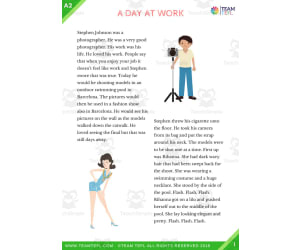
A Day at Work Short Story | Pre-Intermediate Lesson Plan
ELA, Reading, Grade 8, 9, 10, 11, 12, Teacher Tools, Lesson Plans
A Day At Work Lesson Plan is an ideal teaching resource for educators seeking to engage their students in the joy of reading and comprehension. This easy-to-use lesson plan is a great fit for public school teachers, homeschoolers, and other types of educators looking for efficient resources. This pre intermediate lesson plan focuses on A Day At Work, bringing to life the reality and hopes of a day at work. To ensure that learners wholly understand the text material, follow-up exercises are also included in this package. These thoughtfully designed tests assess student reading comprehension while simultaneously sharpening grammar and vocabulary skills - two educational elements often intertwined yet crucial to master at an early age. Includes an answer key Makes it easier than ever for educators to evaluate student responses accurately Eases manual workload on teachers when assessing responses delivered using traditional or conventional methods. The package consists of three PDFs with four ready-to-print pages along with one digital access file. With the A Day At Work ESL ELA ELL Beginner Lesson Plan, educators have at their disposal a profound tool that makes the educational journey into reading comprehension exciting and purposeful whilst their students develop important new skills.
Author TEAM TEFL
Tags Short Story, Reading Passage, ESL Lesson, Vocabulary, Turn And Talk

Long U Words – Grade 1–2 Phonics Unit
ELA, Grammar, Language Development, Phonics, Reading, Pre-Reading, Grade 1, 2, Worksheets & Printables, Worksheets, Teacher Tools, Lesson Plans
This Unit focuses on the Long U Sounds! Learning how to read can be the most challenging activity for students and for a teacher. Understanding that the combination of letters can make the same vowel sound requires lots of repetitive practice of reading and writing these words with these sounds. There are other phonics units that I sell that focuses on the Long A sound with a combination of different letters, the Long E sound with a combination of different letters, the Long I sound with a combination of different letters, and the Long O sound with a combination of different letters. Reading can be made easier with these phonic helps that repeatedly encourage students to practice these Long U sounds. Activities include reading comprehension and identifying the Long U in their reading, writing their answers to questions regarding the paragraph, identifying additional Long U words in sentences using a word bank, matching words with pictures, spinning a paperclip activity where students will write the word with the Long U sound, and lastly a fun wordsearch with variations of Long U words. These activities are for each long vowel words that are focused on the Long U sounds so there are plenty of opportunities for students to practice their comprehension reading skills and phonic sounds. Students will practice the following Long U Word sounds: U_E, EW, OO, UE, UI and OU. Teachers can use this resource in whole group, individually with students, students can practice with each other in centers, or these worksheets can be assigned as homework. Worksheets are also differentiated for each Long U sounds for all young learners which makes it perfect for all 1st - 2nd graders. A total of 38 pages full of reading and phonic activities. Along with reading and writing there are matching, cutting, and pasting activities. Word searches and spin and make a word activity are also a part of this packet which make learning to read these phonic sounds entertaining for young learners. For a list of other phonics and grammar activities, click on the following links: CVC Word Families for Beginning Readers: Stamp it, Make it, Trace it, and Write it CVC Words | Short Vowel Phonics | Word Families for K- 2nd Grade Phonics for 1st and 2nd Grade: Help Students Learn Long A Words: AY, AI, A_E, EIGH, EY, and EA Phonics for 1st and 2nd Grade: Help Students Learn Long E Words: EE, EA, E_E, and Y Phonics for 1st and 2nd Grade: Help Students Learn Long I Words: I_E, IE, IGH, and Y Phonics for 1st and 2nd Grade: Help Students Learn Long O Words: O_E, OA, OW, OE, and OUGH Phonics for 1st and 2nd Grade: Help Students Learn Long U Words: U_E, EW, OO, UE, UI and OU Phonics / Digraphs for 1st and 2nd Grade: Beginning, Middle, and Ending Sounds Phonics / Digraphs for 1st -2nd: Ending Sounds: CK, NG, SH, TH, and NK Phonics / Digraphs for 1st and 2nd Grade: Beginning Sounds: SH, TH, WH and PH Phonics: R-Controlled Words for 1st and 2nd Grade and Early Readers
Author K-5 Treasures
Rating
Tags Phonics, Grammar, Long Vowels, Long U Sounds, Long U Words, Reading, Long Vowel Sounds, Long U Phonics, 1st Grade Resources, First Grade Reading

Reading Comprehension: Sequencing - FLASH-PC
ELA, Reading, Reading Comprehension, Grade 5, 6, 7, 8, Teacher Tools, Lesson Plans
Reading Comprehension: Sequencing - FLASH-PC The Reading Comprehension: Sequencing - FLASH-PC is an educational tool delicately constructed to boost the comprehension skills of students in Grades 5 through 8 focusing on language arts. Rooted in its core functionality, it enhances the ability of learners to arrange facts accurately within reading contexts. While maintaining its compactness, this resource robustly centers on delivering curriculum-related content through inclusive elements such as: Reading passages Strategically positioned comprehension queries conducted both 'before' and 'after' reading sessions that inspire prediction strategies and checks reflection understanding respectively. These techniques uniquely engage student involvement. Diversified Learning Experience & Classroom Interaction To further diversify the learning experience, printable materials intended for direct inclusion into lesson plans or as additional homework assignments are available. This setup offers teachers a simple way to guide without needing to create worksheets. In addition, vocabulary flashcards incorporated aim at solidifying key terminology studied in context. Also present are graphic organizers that visually arrange data for students who absorb better through such methods ensuring learners of all styles can benefit from this resource. A layer of digital interactivity has been woven into this educational tool via PC software integrated activities encouraging dynamic responses boosting learner's interest in allocated tasks be it within classrooms or remote learning scenarios. Fulfills Varied Teaching Techniques & Caters Individual Needs This resource exhibits significant flexibility catering to different teaching techniques be it for comprehensive classes or smaller group breakout sessions while simultaneously delivering tailored material suiting individual scholar needs. A Beneficial Educational Tool at Your Disposal In conclusion, Reading Comprehension: Sequencing - FLASH-PC stands as a vital asset effectively driving results when teaching fact sequencing under comprehension lessons while aiding in the progressive academic journey of every learner.
Author Classroom Complete Press
Tags Software (PC)

How to Write a Paragraph: Drafting Your Paragraph
ELA, Writing, Common Core, Grade 5, 6, 7, 8, Teacher Tools, Lesson Plans
How to Write a Paragraph: Drafting Your Paragraph This indispensable teaching resource offers educators a comprehensive tool for assisting students in learning the process of writing paragraphs. The product targets learners at grade level 5 through 8, with the goal of improving their writing skills. The product is designed to make understanding the logical flow of the writing process easier while providing opportunities for student engagement. Bloom’s Taxonomy and Learning Objectives The lessons are deeply rooted in Bloom’s Taxonomy and align closely with accepted learning objectives. The subject focus is Language Arts, emphasizing Writing. It does not adhere strictly to structured sections but includes authentic content built around multiple forms of paragraph formation. Ready-to-use lesson plans included. An extensive guide for effective implementation within any teaching environment - public school or homeschooling. Accommodates various classroom dynamics: whole group settings, small groups or even homework assignments. Included Features: Graphic Organizers: These six-color diagrams illustrate the prewriting process vividly and efficiently, guiding students through their individual writing processes. Comprehension Quiz & Word Puzzles: Presented in PDF format, these resources enhance comprehension and aid memory retention respectively.. Rubrics:A student assessment rubric provides immediate feedback concerning areas requiring improvement, directing subsequent instruction as necessary Beyond Today's Lesson Tips & Goals: How to Write a Paragraph: Drafting Your Paragraph fosters self-directed learning by building upon students' existing knowledge base - leading them towards greater academic success by improving their ability to express college-level thoughts in well-crafted sentences and paragraphs as they prepare for future academic pursuits. Note: This tool abides by Common Core State Standards regulations assuring that your learners receive a quality, standards-compliant, educational experience.
Author Classroom Complete Press
Tags PDF
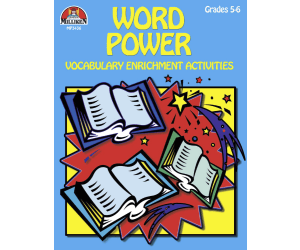
Word Power Gr 5-6
ELA, Language Development, Vocabulary, Grade 5, 6, Teacher Tools, Lesson Plans
Word Power Gr 5-6: An Interactive Language Arts Learning Tool The Word Power Gr 5-6 is a learning resource designed specifically for strengthening the language arts skills of Grade 5 and Grade 6 students. Remarkably, this tool is not a standard vocabulary builder, but one that utilizes words taken directly from popular literature relevant for these grade levels - leading to more natural and practical word-learning scenarios. Vibrant Variety of Activities This versatile educational device offers a sum total of 22 interactive activities, each introducing over 60 new challenge words in context. These differentiated exercises span various learner needs - from pairing words with their meanings to organizing words alphabetically, interacting with antonyms, and solving puzzles. Anchors vocabulary enhancement Promotes critical thinking skills through interactive engagement with fresh vocabularies Ample reinforcement on each page via engaging tasks designed by experienced educators for maximum recall. Innovative Review Systems & Comprehensive Guides In addition, three two-page reviews are sprinkled judiciously throughout the Word Power Gr 5-6 to ensure a firm understanding of word usage before moving onto newer concepts. This fosters gradual scaffolded growth. A companion teacher's guide includes an extensive list of source books at every level – making it an ideal fit into any structured Language Arts curriculum or enriching support for homeschoolers looking forward to enhancing vocabulary development at home. Easily Adoptable Format All resources come in a user-friendly PDF file format that can be effortlessly integrated into any Learning Management System (LMS) or printed out directly – catering inexhaustibly to all teaching environments. Builds Robust Linguistic Foundations Focusing on real-world word usage and comprehension-focused exercises, Word Power Gr 5-6 is a vital asset for enabling efficient vocabulary instruction.
Author Classroom Complete Press
Tags PDF
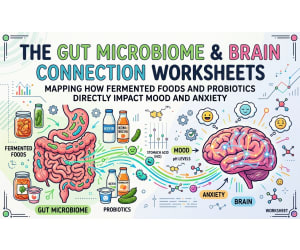
The Gut Microbiome & Brain Connection Worksheets
P.E. & Health, Health, Mental Health, Mindfulness, Physical Education, Sports, Yoga, Science, Physics, Chemistry, Grade 6, 7, 8, 9, 10, 11, 12, Worksheets & Printables, Workbooks, Worksheets, Word Searches, Teacher Tools, Lesson Plans, Quizzes and Tests, Quizzes, Tests, Assessments
Unlock the Science of Mood! A Comprehensive Gut-Brain Connection Unit for Health & Biology Are your students struggling with anxiety, stress, or low moods? Are you looking for a way to connect biology and nutrition to real-world mental health and Social-Emotional Learning (SEL)? This comprehensive, no-prep digital unit, "The Gut-Brain Connection: How Fermented Foods Impact Mood and Anxiety," is the resource you need. It provides a fascinating, scientifically-backed exploration of the gut microbiome and its direct link to our brains. Empower your students with the knowledge to understand and "bio-hack" their own mental well-being through nutrition! This 46-page resource is perfect for health, biology, or life science classes and is designed to be engaging, rigorous, and easy to implement. Students will move from understanding the theory to applying it to their own lives. ► What's Included in This 46-Page Unit? Phase 1: Core Content & Theory (Student Textbook): In-depth yet easy-to-understand chapters covering: The Gut-Brain Axis & The "Second Brain" The Vagus Nerve & Neurotransmitters (Serotonin, GABA) The Science of Probiotics, Fermentation, and Short-Chain Fatty Acids (SCFAs) Specific Mood-Boosting Foods: Kefir, Kimchi, Sauerkraut, and Miso Real-world case studies on managing anxiety and mood. Phase 2: Student Workbook (10 Worksheets): A complete workbook to test comprehension and critical thinking. Activities include: Vocabulary mapping and fill-in-the-blanks True/False/Nuance analysis Scenario analysis and case study questions Personal reflection and data collection A capstone project: "Synthesizing the Science: Your Gut-Brain Action Plan." Phase 3: Visuals & Teacher Resources (The Ultimate Time-Saver!): 3 High-Quality Visual Diagrams: Perfect for projectors or as printable posters (The Vagus Nerve Highway, Data Literacy Chart, Fermented Foods Mind Map). Comprehensive Answer Key: Detailed answers for every single question in the student workbook. Teacher Implementation Guide: A day-by-day pacing guide for a 3-day micro-unit, including objectives, instructional strategies, and discussion prompts. This isn't just a lesson; it's a powerful tool that gives students agency over their health. It demystifies anxiety and provides actionable, science-based steps for a healthier mind. Download today to bring this game-changing topic to your classroom! Keywords: Gut-Brain Axis, Gut Health, Mental Health, Anxiety, Nutrition, Health Curriculum, Biology, Middle School Health, High School Health, Probiotics, Fermented Foods, Social-Emotional Learning (SEL), Worksheets, Lesson Plan, No-Prep, Printable, Digital, Science, Serotonin, GABA, Vagus Nerve, Microbiome. Why Parents/Schools Love It: Empowers Students with Actionable Knowledge: It moves beyond theory, teaching students practical, dietary strategies they can use to manage their own mood and anxiety. Bridges Science with Social-Emotional Learning (SEL): This unit perfectly integrates rigorous biology with the critical topic of mental wellness, showing students the direct connection between what they eat and how they feel. Scientifically Accurate & Rigorous: The content is based on modern nutritional psychiatry, providing credible and trustworthy information that demystifies complex biological processes. Comprehensive & No-Prep Resource: With a student reader, 10 worksheets, visual aids, and a full answer key, this unit saves teachers valuable prep time and is ready to print or use digitally immediately. Addresses a Timely and Critical Topic: In a world where student anxiety is on the rise, this resource tackles the issue head-on from a fresh, biological perspective, removing stigma and promoting proactive health. Target Audience : Based on the content's language, complexity, and explicit mention on page 2 ("Grade 6 Health scholars"), primary target is: Grade 6 Health and Science Teachers. However, the material can easily be adapted for a broader range. should also target: Grades 7-9 Health, Life Science, and Biology Teachers. High School Psychology or Home Economics/Nutrition Teachers. Homeschooling Parents teaching middle or early high school science and health. Copyright/Terms of Use: This Book was copyrighted by Syed Hammad Rizvi. This resource is for personal and single classroom use only. You may not alter, redistribute, or sell any part of this resource. In other words, you may not put it on the Internet where it could be publicly found and downloaded. If you want to share this resource with colleagues, please purchase additional licenses from Teachsimple. Thank you for respecting these terms of use. This product is happily brought to you by Syed Hammad Rizvi
Author Creative Book Store
Rating
Tags GutBrainAxis, GutBrainConnection, GutMicrobiome, Microbiome, Probiotics, MentalHealth, MentalWellness, AnxietySupport, AnxietyRelief, StudentMentalHealth

Reducing Your Own Carbon Footprint: A Footprint On Your Dinner Plate Gr. 5-8
Science, Earth and Environmental Sciences, Environmental Science, Grade 5, 6, 7, 8, Teacher Tools, Lesson Plans
Reducing Your Own Carbon Footprint: A Footprint On Your Dinner Plate Gr. 5-8 Reducing Your Own Carbon Footprint: A Footprint On Your Dinner Plate Gr. 5-8 is an impactful teaching resource designed for grades 5 to 8. It guides students through the global issue of climate change, illustrating the human influences and their correlated environmental impacts. Main Features: Designed in consideration of Bloom's Taxonomy and STEAM initiatives An integrative blend of scientific theory and practical application A deep dive into the carbon footprints associated with our food consumption patterns The resource primes students with extensive information about the greenhouse effect - a critical background to comprehend how typical human actions can augment global warming. It then explores domestic energy use, specifically in kitchen scenarios. Kitchen to Farm Journey: New insights are explored about each step involved in transporting food from farm fields up to your dinner plates - pointing out every step that broadens carbon footprints along this journey. Sustainable Practices Discussion: Emphasizing contrasting methods used in sustainable agricultural practices versus conventional ones. Travel & Waste Management Components: A travel footprint calculator is included for students to compute their own travel-related carbon emission situations. An elaboration on waste management dynamics post-consumption stage also forms a key part of this resource, instilling an essential sense of responsibility in students beyond just safe disposal ethics. Creative Exercise for Community Eco-friendly Practices: Exploring feasible ways of embedding eco-friendly norms into community life encourages social contract development. This offers engaging group collaboration opportunities or homework assignments. Downloadable Resource: This teaching resource comes in a convenient downloadable PDF format. Loaded with 30 pages of printable material including graphic organizers , crossword puzzles, comprehension quizzes (with answer keys), and word searches, it makes the learning process interactive yet straightforward.
Author Classroom Complete Press
Tags Carbon Footprint, Agriculture, Environment, Graphic Organizers, Electricity
I WONDER - Were The Vikings Dirty | Animated Video Lesson
History: British, History, Social Studies, History: Ancient, History: Europe, Grade 3, 4, 5, 6, 7, 8, 9, Lesson Plans, Teacher Tools
Video Introduction An amazing video designed for the students to learn more about history. I WONDER - Were The Vikings Dirty | Animated Video Lesson Let's use our time machine and trave though time till we get to the ancient world where life began! Have you ever thought about how did ancient Greeks, Romans, Egyptians and even the Viking and Celts use to shower? And how did these amazing civilizations build iconic buildings and invented things that we still use till today like toothpaste? Do you know who was the first king and queen in the world? Which countries they ruled? Who is the most fascinating person lived on Earth? Tell us more about him/her. I WONDER - Were The Vikings Dirty | Animated Video Lesson The video is perfect for encouraging the researching skills for the students, while learning more about history. I WONDER - Were The Vikings Dirty | Animated Video Lesson This friendly designed video is suitable for students at school, homeschooling, and as a group activity. Format Available in MP4 format.
Author Educational Voice
Rating
Tags Were The Vikings Dirty, Vikings, Vikings Facts, Vikings Video, Vikings Facts For Kids, Vikings Video For Kids, Viking Combs, Viking Combs Facts, Viking Combs Video, The Vikings Grooming Tools