



3,927 products added recently
Page 3 - Popular Lesson Plans
Explore a curated selection of popular lesson plans that have proven successful in classrooms. Covering various subjects and topics, these resources provide innovative ideas and activities. Use them to refresh your curriculum and engage your students with tried-and-true methods.

 Show filters

Flashlights Reading Comprehension Passage - Cored Ed Encyclopedia
ELA, Reading Comprehension, Reading, Science, Technology, Language Development, Social Studies, History, Pre-Reading, Physics, Grade 2, 3, 4, 5, Worksheets & Printables, Worksheets, Teacher Tools, Centers, Activities, Writing Prompts, Assessments, Quizzes and Tests, Quizzes, Lesson Plans
This Flashlights reading comprehension with lesson plan includes: Visualization (on the front cover) Start your lesson by taking a minute to think and share something about the topic. Read the script aloud (slowly), perhaps prepare some music or sound effects. Student close their eyes and let their imaginations wander. Students open their eyes, read the question aloud and give them a few minutes to complete. Ask a few students to share or keep answers until the end to compare with what they learn in the passage. Quick pause—thousands of Cored Education products are included with your TeachSimple membership. Download links and encyclopedia index available here. Pre-Reading Trivia Students will write down one thing they already know about the subject and then read five more facts and discuss. These facts are fun, and the students will enjoy learning about the subject before reading more. Give 1 minute for students to write what they already know (no pressure—best guess is fine). Read the five facts together. After each fact, do ask a student for their opinion, was it surprising? Set a purpose by asking students to highlight/underline one fact they want to learn more about during the reading. Reading Passage The text is a high-interest reading passage with set paragraphs, roughly three to four paragraphs long. It contains a variety of themes about the topic, anywhere from history to technology. The passage is between 250 and 350 words in length. First, ask students to look at the headings and see what they’ll learn about today. What do they know about the topic/heading? First read options: Teacher read-aloud (best for support). Partner reading (paragraph by paragraph). While reading, students underline important details, and vocabulary words they think may come up in the questions section. Mixed Questions The first question page contains four multiple-choice questions, each with a choice of four answers, and three written response questions that require a sentence or two from the student. Students complete the mcqs first independently, then review quickly as a class. For the 3 written responses, try to get students giving the answer with some form of evidence: “I think ___ because the text says ___.” If students get stuck, send them back to check the passage. Vocabulary Questions Practice seven key words from the text in this section across two activities. First section is scrambled words where students will unscramble three words given a clue for each. The second section is a word to meaning matching activity. Before starting, have some students read out words they underlined in the passage. Ask students to say the word and read aloud the sentence(s) around each word. Ask students to do scrambled words and the matching exercise in pairs then go through answers as a class. For the scrambled spelling task, get four pairs to come up to the board and write the words for extra practice with the other student reading out the clue. For the matching task, prompt students to give full sentences: “I matched ___ with ___ because ___.” Creative Writing In this question, the student will be required to write a five to eight sentence paragraph on a question related to the topic. Before starting, ask students write down 3 key ideas they are going to include in their piece. Ask students for ideas to share around the class to help those struggling. Pro writing expectations: 5–8 sentences At least 2 facts or details from the passage At least 2 vocabulary words from the previous page Students read their paragraphs while classmates listen for facts and vocabulary words. Extension Activities This page is optional for fast finishers or to take home. There are several activities, each one requiring a different skill. Do some, do none, do all, completely optional - but you will feel reassured knowing every possibility is planned for. Includes summary writting question and additional facts. Answer Key There are answers for the multiple-choice questions, written response questions have sample answers, vocabulary answers and if there is a summary question then a sample summary will be provided as well. Lesson Plan Included Customized lesson plan for this lesson is included. Lesson Snapshot Title: Flashlights Genre: Nonfiction (Informational Text) Subject: Science (Technology/Physical Science) / Reading (Informational Text) Primary Topic: Flashlight parts, history, and how it works Estimated Guided Reading Level (A–Z): P What This Lesson Teaches Best Explains the main parts inside a flashlight (a power source, a switch, and a reflector) and what they do. Teaches a short history of flashlights , including the “dry cell” battery and an 1899 U.S. patent for a hand-held electric light. Shows cause and effect : early zinc-carbon batteries tired quickly, so the light came in short flashes—leading to the name “flashlight.” Compares how flashlight beams improved over time, from sputtering light to steadier beams, including incandescent bulbs and later LEDs. Connects electricity to a real object by describing how a click of the switch completes a circuit so electricity can flow. Learning Goals Students will describe what a flashlight carries “in one hand” and what it helps people do in the dark. Students will identify three parts inside a flashlight case and explain each part’s job using the passage. Students will explain why the flashlight got its name, using evidence about early batteries and short flashes. Students will describe how flashlight lighting changed over time (dry cell batteries, incandescent bulbs, LEDs). Students will explain what happens when a flashlight switch is clicked, based on how the circuit is completed. Key Vocabulary From the Text reflector — shiny part that gathers glow and pushes it forward. patent — legal protection for an invention. incandescent — a kind of bulb that makes light using heat. LEDs — bright lights that can shine longer on same power. circuit — complete path that lets electricity flow. FULL CATALOG OF DOWNLOAD LINKS AND ENCYCLOPEDIA INDEX HERE
Author Cored Education
Rating
Tags Vocabulary, Reading Comprehension, Reading Passages, Lesson Plans, Ela Lesson Plans, Reading Comprehension Lesson Plans, Pre-reading, Science Lesson Plans, History, Technology

AI Ethics for Young Learners - Artificial Intelligence Book
Strategies, Reading, ELA, Reading Comprehension, Research, Technology, Science, Computer Science, Engineering, STEM, Grade 3, 4, 5, 9, 10, 11, 12, Activities, Projects, Teacher Tools, Assessments, Lesson Plans, Literacy Readers, Outlines, Rubrics, Writing Prompts, Worksheets & Printables
Unravel the fascinating realm of artificial intelligence through "AI Ethics for Young Learners - Artificial Intelligence," an all-inclusive textbook crafted to inculcate AI concepts and ethical values in young minds in an interesting and young-friendly manner. Offering in-depth information starting from AI in daily life examples such as assistants and video games to more complex topics such as biased computer algorithms, issues of data privacy, fundamental concepts of cybersecurity, and AI use, this SEO-friendly kids’ book is most suited to class 4 to class 12 settings, providing young minds with empowerment to learn AI basics, identify ethical issues, and become responsible digital participants. With 90 chapters spread throughout AI learning patterns in young minds, ethical issues in decision-making algorithms, robot AI while maintaining system security, program accountability in AI, and AI in the coming age of medicine, creativity, and environmental protection, this AI book by subject experts is ideal to disrupt young minds with AI-related critical thinking skills through practical AI examples and ethical tales of AI adventures in society. Tags: AI ethics education in kids, AI textbook in classroom education, AI education in teen brains, ethical AI learning book, classroom learning books in grade 4 to grade12 levels. Why Parents/Schools Love It: Engaging and Age-Appropriate Content: Reduces complex AI and ethics topics to simple and relatable stories and examples that hold the attention of young learners without causing an overload. Encourages Critical Thinking and Responsibility: Students learn to second-guess AI decisions, to perceive bias, and to claim responsibility for their actions as advocates for the appropriate use of technology in daily life. Comprehensive Curriculum Support: With 90 chapters, it leads the students from the basics of AI through advanced ethical dilemmas; perfect for STEM lessons, homeschooling, or classroom discussions. Values and Safety: Stressing the importance of privacy, fairness, and human judgment in AI-all important to giving parents peace of mind that aligns with family values. Inspires Innovation: This lets the kids come up with their own ethical AI ideas and concepts, which can trigger their innovative thinking to make them future-ready in the tech arena. Targeted Classes for Students : It can be seen from the thorough evaluation of the contents and suitability of the material in the book that it is ideally suited for students from grades 4 through 12 as mentioned in the title page. The contents begin with explanatory pieces that are simple and accessible in terms of the examples they use such as “What is Artificial Intelligence?" and examples such as smart assistants in basic forms for earlier grades (4-6), then move into advanced examples such as bias in algorithms, the issue of privacy laws and cybersecurity threats and ethical problem-solving for advanced students from grades 7-12. The text is written in simple sentences and analogies (as in the explanation given in “How A.I. Learns Like Playing a Game"), and sophisticated technical terms are avoided in this manner and can be suited for the entire spectrum mentioned. Copyright/Terms of Use : This Book was copyrighted by Syed Hammad Rizvi. Please do not give out or sell copies of this resource or any part of it. Furthermore, do not post this resource on the Internet in such a way that people can download this resource. By the way, you can modify this resource, but only for your personal or school-class usage. Please note that if you would like to share this resource with your peers, licensing options for additional copies are available via Teachsimple. Thank you for your compliance with this usage agreement. This product is delightedly presented to you by Syed Hammad Rizvi
Author Creative Book Store
Rating
Tags AIEthicsForKids, ArtificialIntelligenceBook, AIEducationForTeens, EthicalAIForYoungLearners, STEMBooksForStudents, AIBasicsForGrades4to12, DataPrivacyForKids, BiasInAIExplained, ResponsibleTechForYouth, AIAndEthicsCurriculum

At the Funfair | Citizenship Video Lesson
, Not Grade Specific, Lesson Plans, Teacher Tools
This citizenship video lesson is all about at the funfair. Students will love this engaging and interactive video. This video serves as a great introduction or review video for your learners. This is a 6-minute video lesson.
Author Educational Voice
Tags Video Lesson, Videos, At The Fair, At The Park
All About Problem Solving | Animated Math Video Lesson
, Grade 1, 2, 3, Lesson Plans, Teacher Tools
All About Problem Solving | Animated Math Video Lesson All About Problem Solving | Animated Math Video Lesson is an exceptional teaching resource designed to stimulate students' learning progression and simplify the instructional journey for educators. This effective tool perfectly suits Grade 1 to Grade 3 curriculum. Overview This concise, 9-minute video lesson in MP4 format presents dynamic animations and precise explanations concerning problem-solving concepts. Packed with captivating animations, it makes complex mathematical problems comprehendible via straightforward visual lessons. The problem-solving method steps are broken-down logically ensuring effortless understanding. Versatility and Flexibility Educators enjoy the flexible nature of this resource as it integrates effortlessly into different teaching approaches – ranging from whole group presentations, small-group discussions or even individual tutoring sessions. Whether used for introducing new material or a refresher course on previously studied concepts, its effectiveness remains unhindered. Suitable during homeschooling periods where digital resources are indispensable No complications in software compatibility because of its .MP4 format ensures downloading convenience across diverse platforms Beyond Just Mathematics Learning At Grades 1-3 Levels In addition to strengthening budding mathematicians' problem-solving skills; this tool enhances cognitive abilities such as analytical thinking, evaluation skills and logical reasoning abilities among them. Its clear presentation style engenders attentive listening while fostering independent thought processes. An Experience Like No Other! All About Problem Solving | Animated Math Video Lesson fosters an immersive learning environment where math transforms from intimidating to creatively navigable! Interesting characters intertwined with clear narratives based around core mathematical ideas make learning fun-filled and information absorption seamless. In conclusion, this resource, an effective journey to mathematical proficiency breeds a fascination towards numeracy among young learners. It equips them with confidence against future academic challenges involving numeracy, ensuring they excel in them.
Author Educational Voice
Tags Problem Solving, Math Video, Animated Lesson, Cognitive Skills, Numeracy, Animated Math, Math Animated

All About The Skeleton | Human Body Video Lesson
Science, Life Sciences, Human Body, Not Grade Specific, Lesson Plans, Teacher Tools
All About The Skeleton | Human Body Video Lesson All About The Skeleton | Human Body Video Lesson is a comprehensive video-based learning resource. This 10-minute-long guide makes an approachable introduction to the vital function and role of the human skeleton. Usability and Scope: This engaging resource is perfect for classroom environments, including public schools and homeschooling setups. The lesson has broad adaptability across various education grades, fitting diverse teaching requirements. An ideal addition for science curriculums covering subtopics on human body studies. In-depth Learning: The resource introduces students to the anatomy of skeletal structures, their relevance in life functions, along with key vocabulary and vital concepts in skeletal system studies. Versatile Applications: It can stimulate inquiry-based group discussions during live classes. This resource can also enhance focused understanding during small group discussions or individual study settings. Beyond classroom teachings, it can serve as homework materials inviting further research on included topics. The video comes as an MP4 file which ensures seamless digital navigation by educators across various platforms. It provides flexibility for teachers to incorporate it within class lessons or revisit it when reinforcing previously covered concepts. In conclusion, All About The Skeleton | Human Body Video Lesson, combining technology with scholarly pedagogy, offers fruitful experiences for both educators and pupils. This interesting take on explaining complex anatomy fosters curiosity while making education integrally exciting!
Author Educational Voice
Tags Skeletal System, Human Body, Anatomy, Video Lesson, Interactive

Prevention and Control of Disease Health: 4th and 5th Grade Unit 6
P.E. & Health, Life Studies, Physical Education, Health, Life Skills, Special Resources, Social Emotional Learning (SEL), Social Skills, Grade 4, 5, Teacher Tools, Lesson Plans, Worksheets & Printables, Worksheets
Prevention and Control of Disease Health: 4th and 5th Grade Unit 6 For 4th and 5th Grade Health, there are seven standards that students will practice and learn. Through using this Prevention and Control of Disease Health: 4th and 5th Grade Unit 6 students will explore and learn to identify daily healthy habits. In this unit, students will learn how to prevent illness and diseases. There is a sorting activity where students will learn basics of communicable and non-communicable diseases and decipher which category they fall under. Students will learn how to promote good health, and they will understand how to identify reliable health sources. Included in this unit, students will study the Coronavirus, its origin, how it spreads, and how to keep communities and people safe. This unit is a perfect way for students to learn about diseases and how students can be healthy and stay informed! There are 44 pages included. This unit meets Common Core Standards. Included in this Prevention and Control of Disease Health: 4th and 5th Grade Unit 6 Worksheet on what is communicable and non-communicable diseases and sorting these diseases. An understanding of pathogens and how they spread in communities. Worksheets on four ways to promote good health and prevent illnesses. Learn to write healthy goals and learn how to accomplish these goals. There are harmful choices that could affect kids' health. Learning how to get enough sleep is good for their health. Students will also learn where to get reliable health information when needed such as a school nurse or counselor. Information about the Coronavirus is also included. Questions that will be answered include: What is Covid-19? How did Covid-19 start? How does it spread? Who is WHO and the CDC? What happens if you get Covid-19? What can you do to be safe? There is an assessment to check for understanding. An answer key is included. There are seven units that cover all the health requirements for 4th and 5th grade. Here are the links to other health units: Health | 4th and 5th Grade Unit 1: Personal Health Health | 4th and 5th Grade Unit 2: Growth and Development Health | 4th and 5th Grade Unit 3: Nutrition and Physical Activity Health | 4th and 5th Grade Unit 4: Substance Use and Abuse Health |4th and 5th Grade Unit 5: Injury and Violence Prevention Health | 4th and 5th Grade Unit 6: Prevention and Control of Disease Health |4th and 5th Grade Unit 7: Environmental Consumer Health
Author K-5 Treasures
Tags Health Unit, Personal Health, Healthy Goals, Health Activities, Physical Goals, Health Goals, Health And Wellness, 4th Grade Health, 5th Grade Heath, Heath Units

Equator Reading Comprehension Passage - Cored Ed Encyclopedia
ELA, Reading Comprehension, Reading, Science, Technology, Language Development, History, Social Studies, Earth and Environmental Sciences, Geography, Grade 2, 3, 4, 5, Worksheets & Printables, Worksheets, Teacher Tools, Centers, Activities, Writing Prompts, Assessments, Quizzes and Tests, Quizzes, Lesson Plans
This Equator reading comprehension with lesson plan includes: Visualization (on the front cover) Start your lesson by taking a minute to think and share something about the topic. Read the script aloud (slowly), perhaps prepare some music or sound effects. Student close their eyes and let their imaginations wander. Students open their eyes, read the question aloud and give them a few minutes to complete. Ask a few students to share or keep answers until the end to compare with what they learn in the passage. Quick pause—thousands of Cored Education products are included with your TeachSimple membership. Download links and encyclopedia index available here. Pre-Reading Trivia Students will write down one thing they already know about the subject and then read five more facts and discuss. These facts are fun, and the students will enjoy learning about the subject before reading more. Give 1 minute for students to write what they already know (no pressure—best guess is fine). Read the five facts together. After each fact, do ask a student for their opinion, was it surprising? Set a purpose by asking students to highlight/underline one fact they want to learn more about during the reading. Reading Passage The text is a high-interest reading passage with set paragraphs, roughly three to four paragraphs long. It contains a variety of themes about the topic, anywhere from history to technology. The passage is between 250 and 350 words in length. First, ask students to look at the headings and see what they’ll learn about today. What do they know about the topic/heading? First read options: Teacher read-aloud (best for support). Partner reading (paragraph by paragraph). While reading, students underline important details, and vocabulary words they think may come up in the questions section. Mixed Questions The first question page contains four multiple-choice questions, each with a choice of four answers, and three written response questions that require a sentence or two from the student. Students complete the mcqs first independently, then review quickly as a class. For the 3 written responses, try to get students giving the answer with some form of evidence: “I think ___ because the text says ___.” If students get stuck, send them back to check the passage. Vocabulary Questions Practice seven key words from the text in this section across two activities. First section is scrambled words where students will unscramble three words given a clue for each. The second section is a word to meaning matching activity. Before starting, have some students read out words they underlined in the passage. Ask students to say the word and read aloud the sentence(s) around each word. Ask students to do scrambled words and the matching exercise in pairs then go through answers as a class. For the scrambled spelling task, get four pairs to come up to the board and write the words for extra practice with the other student reading out the clue. For the matching task, prompt students to give full sentences: “I matched ___ with ___ because ___.” Creative Writing In this question, the student will be required to write a five to eight sentence paragraph on a question related to the topic. Before starting, ask students write down 3 key ideas they are going to include in their piece. Ask students for ideas to share around the class to help those struggling. Pro writing expectations: 5–8 sentences At least 2 facts or details from the passage At least 2 vocabulary words from the previous page Students read their paragraphs while classmates listen for facts and vocabulary words. Extension Activities This page is optional for fast finishers or to take home. There are several activities, each one requiring a different skill. Do some, do none, do all, completely optional - but you will feel reassured knowing every possibility is planned for. Includes summary writting question and additional facts. Answer Key There are answers for the multiple-choice questions, written response questions have sample answers, vocabulary answers and if there is a summary question then a sample summary will be provided as well. Lesson Plan Included Customized lesson plan for this lesson is included. Lesson Snapshot Title: Equator Genre: Nonfiction (Informational Text) Subject: Social Studies (Geography) / Science (Earth Science) / Reading (Informational Text) Primary Topic: Equator, latitude, hemispheres, sunlight, and navigation Estimated Guided Reading Level (A–Z): N What This Lesson Teaches Best Explains the equator as an imaginary line at 0 degrees latitude that circles Earth’s widest part. Shows how the equator splits Earth into the Northern and Southern Hemispheres and acts as a starting line for measuring north and south . Connects observation to science by telling how Eratosthenes compared shadow angles to help estimate Earth’s size long ago. Describes how sunlight near the equator is more direct , helping many equator regions stay warm and keeping day and night close in length. Links geography to modern tools by noting GPS and satellites still begin with the 0-degree equator circle. Learning Goals Students will identify the equator as an imaginary line at 0 degrees latitude . Students will explain how the equator divides Earth into the Northern Hemisphere and Southern Hemisphere . Students will describe how latitude is measured north or south of the equator. Students will explain how shadow angles helped Eratosthenes estimate Earth’s size. Students will describe why sunlight near the equator can feel more direct and how that affects warmth and day/night length. Students will describe how the equator is used as a reference point in GPS and satellites . Key Vocabulary From the Text latitude — degrees north or south of the equator. hemispheres — the two halves of Earth. shadows — dark shapes made when light is blocked. solstice — a day when the Sun’s position is special. satellites — objects in space used to help find locations. FULL CATALOG OF DOWNLOAD LINKS AND ENCYCLOPEDIA INDEX HERE
Author Cored Education
Rating
Tags Vocabulary, Reading Comprehension, Reading Passages, Lesson Plans, Ela Lesson Plans, Reading Comprehension Lesson Plans, Pre-reading, Geography, Earth Science, Science Lesson Plans

Ancient Civilizations: Mesopotamia Unit Study
Social Studies, History, History: Ancient, Grade 3, 4, 5, 6, Lesson Plans, Teacher Tools
Immerse students in Mesopotamian history and culture with this expansive cross-curricular teaching kit. Through vivid visuals, interactive activities and multi-sensory projects, core knowledge comes alive on topics like cuneiform, Code of Hammurabi, city-states, innovations and daily living. Begin by introducing key figures, places and artifacts using illustrated posters and word banks. Then, extend comprehension through mapping tasks, timelines and coloring pages. Discover critical innovations in writing, agriculture and infrastructure by reading leveled articles. Watch recommended documentary clips and recreate cultural elements like ziggurats, carved reliefs and steered carts. Assess retention with a Jeopardy-style review game covering everything from barley cultivation to the legendary Epic of Gilgamesh. This comprehensive package contains teacher guides aligning materials to social studies standards, plus adaptations for learners of all abilities. Weave modules into existing ancient civilization units or facilitate an entire stand-alone Mesopotamia study. Writing prompts allow students to connect learnings to their own lives across narrative, informative and persuasive genres. Through varied activities tapping visual, auditory and kinesthetic pathways, your classroom unearths the remarkable history buried between the Tigris and Euphrates. Rediscover the "cradle of civilization" where so much of human enterprise began! Check out other resources from my store: Simply Schoolgirl! I can be contacted for questions and concerns at simplyschoolgirl1@gmail.com
Author Simply Schoolgirl
Tags Ancient Civilizations, Social Studies Project, Mesopotamia, History Poster, Artifacts, Asia, Middle East, Cuneiform, Ziggurat, Mesopotamian, Mesopotamia Poster Project, Ancient Civilizations In Mesopotamia, Education Of Mesopotamia, Ancient Civilizations Of Mesopotamia, Ancient Civilizations Mesopotamia, Teaching Ancient Civilizations, The Code Of Hammurabi Is A Product Of This Civilization.

6th Grade Science Diagnostic Assessment & Review System
Science, Grade 6, Assessments, Teacher Tools, Lesson Plans, Worksheets & Printables
Start the year with a clear picture of student readiness using this 6th grade beginning of year science assessment and targeted skills system. With a 48-question diagnostic worth 119 points , scoring and analysis tools, instructional grouping support, 11 targeted follow-up practice pages , and complete explained answer keys, this resource helps teachers move from assessment results to focused instruction without piecing together separate materials. Designed as a complete Assess → Analyze → Group → Review → Reteach system, this Grade 6 science resource emphasizes model interpretation, data analysis, graph reading, and scientific reasoning across Life Science, Earth & Space Science, Physical Science, and Scientific Practices . Students work with cells, body systems, classification, ecosystems, plate tectonics, atoms and molecules, energy transformations, forces and motion, experimental variables, and Claim-Evidence-Reasoning tasks. What’s Included This 6th grade science assessment and review system includes: ✅ 48-question beginning-of-year science diagnostic ✅ 119 total assessment points ✅ 4 major science strands ✅ Life Science questions ✅ Earth & Space Science questions ✅ Physical Science questions ✅ Scientific Practices questions ✅ Multiple-choice questions ✅ Short-answer questions ✅ Labeling activities ✅ Matching questions ✅ Diagram interpretation ✅ Data tables ✅ Multi-line graph reading ✅ Scientific scenarios ✅ Vocabulary-in-context questions ✅ Claim-Evidence-Reasoning (CER) tasks ✅ 13 labeling and diagram-interpretation items ✅ Detailed cell model ✅ Digestive system model ✅ Classification hierarchy ✅ Earth’s layers diagram ✅ Plate boundary models ✅ Moon phase interpretation ✅ Atomic structure model ✅ Molecule models ✅ Energy transformation system ✅ Distance-time graph ✅ Free-body force diagrams ✅ Experimental variables setup ✅ Answer recording sheet ✅ Quick-reference answer key ✅ Skill-by-skill scoring chart ✅ Strand analysis tool ✅ Secure, Developing, and Needs Support performance bands ✅ Individual Student Performance Profile ✅ Whole-class data tracker ✅ Suggested instructional groups ✅ 11 targeted follow-up science practice pages ✅ “Key Concept” refresher on every follow-up page ✅ “Extension” task for students who are Secure ✅ All-new follow-up practice with no repeated assessment questions ✅ Complete answer keys ✅ Suggested short-answer responses ✅ Completed visual and diagram answers ✅ Sample CER responses ✅ Short “why” explanation for every assessment item ✅ Partial-credit guidance Part 1 contains 48 mixed-format questions worth 119 total points . The Teacher Guide recommends two 45-minute sessions and specifically explains that the diagnostic emphasizes interpretation and reasoning through models, data, and graphs rather than isolated recall. The At-a-Glance chart on page 2 also identifies 13 labeling or diagram-interpretation items focused on cells, body systems, classification, Earth’s layers, plate boundaries, atomic structure, molecules, and energy systems. Part 2 turns student responses into actionable data with an answer recording sheet, quick-reference answer key, skill-by-skill scoring chart, strand analysis, performance bands, student profiles, a whole-class data tracker, and ready-made suggested instructional groups. Part 3 includes 11 ready-to-assign targeted follow-up pages with all-new practice. Each page includes a concise Key Concept refresher and an Extension task for students who are secure. Part 4 provides correct answers for all 48 questions, short explanations of why answers are correct, suggested responses for open-ended items, completed diagrams, sample CER responses, and partial-credit guidance. How It Works in the Classroom Use this 6th grade beginning of year science assessment during the first weeks of school to identify what students retained from earlier science learning and where middle school science instruction should begin. The resource follows a practical five-step system: 🔎 Assess — Students complete the 48-item mixed-format science diagnostic 📊 Analyze — Score by skill and strand to identify patterns and gaps 👥 Group — Form targeted instructional groups based on shared needs 📝 Review — Assign focused follow-up practice by strand and skill 🎯 Reteach — Use full answer keys, explanations, worked visuals, and model CER responses to support next steps The Assess → Reteach System chart on page 2 of Part 1 directly connects each step to the matching component of the four-part resource, creating a clear workflow from diagnostic assessment to targeted instruction. Use this resource for: ⭐ Beginning-of-year science assessment ⭐ 6th grade science diagnostic ⭐ Middle school science pre-assessment ⭐ Back-to-school science review ⭐ Science readiness check ⭐ Formative assessment ⭐ Small-group planning ⭐ Science intervention ⭐ Targeted reteaching ⭐ Data-driven instruction ⭐ Skill-based grouping ⭐ Independent follow-up practice ⭐ Science centers or stations ⭐ CER practice ⭐ Graph and data interpretation review ⭐ Middle school science reasoning practice The Scoring at a Glance chart on page 2 of Part 2 breaks the assessment into four strand totals: Life Science /36, Earth & Space Science /31, Physical Science /31, and Scientific Practices /21 , for 119 total points . It also defines three performance bands: Secure (80%–100%) , Developing (50%–79%) , and Needs Support (below 50%) . The Student Performance Profile on page 15 of Part 2 provides a one-page strand snapshot with space for strengths, focus areas, assigned Part 3 practice pages, and group placement. The Class Data Tracker on page 16 gives teachers a whole-class view of strand percentages so they can scan columns for class-wide gaps and rows for individual grouping needs. Standards & Learning Goals This sixth grade science diagnostic assessment reviews foundational concepts and scientific reasoning across four major strands: 🌱 Life Science — cell theory, cell structures, organelle functions, levels of organization, body systems, digestive system, interactions between body systems, classification, classification levels, kingdoms and groups, ecosystem energy flow, predator-prey data, photosynthesis, cellular respiration, and ecosystem CER reasoning 🌎 Earth & Space Science — Earth’s layers, plate boundaries, plate tectonics, evidence for tectonic movement, minerals, Mohs hardness, Earth system interactions, weather versus climate, climate graphs, Moon phases, inner and outer planets, and climate-trend CER reasoning ⚛️ Physical Science — kinetic theory, atomic structure, protons, neutrons, electrons, elements, compounds, chemical symbols, molecule models, physical and chemical changes, conservation of energy, energy transformations, motion graphs, net force, free-body diagrams, inertia, Newton’s first law, friction, and chemical-change CER reasoning 🔬 Scientific Practices — controlled experiments, independent and dependent variables, controlled variables, hypotheses, data tables, multi-line graphs, bar graphs, evaluating experimental design, drawing conclusions, and Claim-Evidence-Reasoning from data Students demonstrate understanding through varied science tasks rather than one question type. The diagnostic includes a six-part cell labeling task , organelle function analysis, body-system matching, a digestive path diagram, a classification ladder, predator-prey data, Earth’s four layers, three plate-boundary models, Mohs hardness data, Earth systems interactions, a temperature-over-time graph, Moon phases, an atom model, molecule models, an energy transformation chain, a cyclist distance-time graph, force diagrams, a dissolving-rate experiment, a two-line plant-growth graph, and a town energy-source bar graph. The Skill-by-Skill Scoring Chart on pages 11–13 of Part 2 helps teachers pinpoint specific gaps instead of relying only on one overall score. Skills include cell theory, organelle function, body systems, classification, ecosystem energy, Earth’s layers, plate boundaries, tectonic evidence, mineral identification, climate graphs, Moon phases, kinetic theory, atomic structure, elements and compounds, molecule models, energy transformations, motion graphs, net force, inertia, experimental design, variables, data interpretation, graph analysis, and CER conclusions. Why Teachers Love It ✨ Move beyond a single test score. Results can be analyzed by strand and individual skill, helping teachers see exactly where students are secure and where review is needed. ✨ Emphasize reasoning instead of isolated recall. The Teacher Guide explicitly centers model interpretation, data analysis, graph reading, and scientific reasoning—skills that matter as students transition into middle school science. ✨ Turn assessment data into an instructional plan. The scoring tools connect results to performance bands, student profiles, instructional groups, and targeted follow-up practice instead of leaving teachers with a stack of completed tests. ✨ Use visual and model-based questions to see student thinking. Students interpret cell structures, body systems, classification levels, Earth layers, plate boundaries, Moon phases, atoms, molecules, energy transformations, forces, and experimental setups. ✨ Assess deeper diagram interpretation. The diagnostic includes 13 labeling or diagram-interpretation items , giving students multiple opportunities to analyze scientific models and visual information. ✨ Support data-driven small groups. Part 2 includes ready-made suggested instructional groups that help teachers sort students by shared gaps and connect them to matching Part 3 practice. ✨ Differentiate with clear performance bands. Use Secure, Developing, and Needs Support ranges to guide enrichment, targeted practice, or foundational small-group reteaching. ✨ Assign only the review students need. The 11 targeted follow-up pages include: Cells & Body Systems Review Classification Review Ecosystems Review Earth’s Layers & Plate Tectonics Review Rocks & Minerals Review Weather & Space Review Atoms & Matter Review Energy Review Forces & Motion Review Experimental Design & Variables Review Graph Analysis Review The Practice Page Menu on page 2 of Part 3 directly matches common student difficulties to specific follow-up pages, making targeted assignment faster. ✨ Refresh key concepts before practice. Every targeted page includes a concise Key Concept section. For example, the Atoms & Matter page reviews subatomic particles, elements, compounds, mixtures, and kinetic theory before students begin the new practice tasks. ✨ Extend learning for students who are already secure. Every follow-up page includes an Extension task that pushes students beyond basic recall into explanation, prediction, or application. ✨ Use fresh follow-up practice instead of repeating the diagnostic. Part 3 explicitly provides all-new practice, allowing students to demonstrate understanding with new examples and situations. ✨ Build Claim-Evidence-Reasoning skills. The diagnostic includes CER tasks connected to ecosystem change, climate trends, chemical change, and data-based conclusions. Part 4 includes sample CER responses teachers can use when checking student reasoning. ✨ Make grading more manageable. Part 4 provides the correct answer, a short explanation of why, suggested responses for writing tasks, and guidance for awarding partial credit on multi-part items. ✨ Use completed diagrams for faster checking. The Completed Diagrams Quick View on page 2 of Part 4 identifies fully worked versions of the detailed cell, digestive system, classification ladder, Earth’s four layers, plate boundaries, atom model, molecule models, and energy system. ✨ Track individual student needs. The one-page Student Performance Profile gives teachers a place to record strand performance, strengths, focus areas, assigned practice, and group placement. ✨ See class-wide patterns quickly. The Class Data Tracker supports a whole-class view of Life, Earth, Physical, and Scientific Practices performance so teachers can identify common gaps and form groups more efficiently. ✨ Keep the instructional loop connected. Assessment, analysis, grouping, targeted review, reteaching, and answer support are designed as one coordinated system rather than disconnected activities. Start the year knowing what students understand and what they need next with this 6th grade beginning of year science assessment . Download this complete middle school science diagnostic and targeted review system to assess readiness, analyze results by strand and skill, create focused instructional groups, assign specific follow-up practice, and support reteaching with complete explained answer keys. Perfect for teachers searching for a 6th grade science diagnostic assessment , beginning-of-year science review, middle school science pre-assessment, back-to-school science assessment, sixth grade science review, Life Science review, Earth and Space Science review, Physical Science review, Scientific Practices assessment, cells and body systems, classification, ecosystems, plate tectonics, rocks and minerals, weather and climate, Moon phases, atoms and molecules, energy transformations, forces and motion, Newton’s laws, experimental design, variables, graph analysis, CER practice, science intervention, small-group science planning, data-driven instruction, or targeted science reteaching.
Author Bright Classroom Ideas Marketplace
Rating
Tags Science, Assessment, Diagnostic, Review, Back To School, Worksheet
Grade 2 Yearlong Reading Comprehension Curriculum | 72 Worksheets
ELA, Grade 2, Lesson Plans, Teacher Tools, Worksheets & Printables
Grade 2 Yearlong Reading Comprehension Curriculum | 72 No-Prep Worksheets Build strong readers all year long with this comprehensive Grade 2 Reading Comprehension Curriculum ! Designed specifically for second-grade learners, this year-long resource includes 72 original fiction and nonfiction passages , vocabulary development, comprehension practice, and meaningful writing activities that help students grow into confident, independent readers. With engaging topics, spiraled skills, and a predictable instructional routine, you'll have everything you need for reading comprehension instruction from the first week of school through the last. What's Included ✅ 36 weeks of reading comprehension instruction ✅ 72 original fiction and nonfiction passages ✅ 2 passages per week ✅ Vocabulary matching activity for every passage ✅ Four comprehension questions per passage ✅ Writing prompt with every lesson ✅ Complete Student Worksheet Book ✅ Teacher's Guide with pacing and differentiation support ✅ Answer Key for quick grading ✅ Reading skills spiraled throughout the year How It Works in the Classroom This Grade 2 reading curriculum is designed for flexible implementation and works well for: Whole-group reading instruction Small-group lessons Literacy centers Independent practice Reading intervention Homework Morning work Substitute plans Each lesson follows a simple routine: Read and discuss the passage Complete vocabulary practice Answer comprehension questions using text evidence Respond to the writing prompt The consistent format builds student confidence and independence while strengthening comprehension skills all year long. Standards & Learning Goals Students will practice: Key details Story characters and setting Main idea and main topic Cause and effect Compare and contrast Sequence of events Making predictions Drawing conclusions Author's purpose Fact and opinion Problem and solution Story elements Reading comprehension strategies Vocabulary development Written responses using text evidence Skills are revisited and expanded throughout the year to support mastery and long-term retention. Why Teachers Love It ⭐ No weekly planning required ⭐ Consistent structure students quickly learn ⭐ Balanced fiction and nonfiction reading practice ⭐ Vocabulary, comprehension, and writing in one resource ⭐ Supports differentiated instruction ⭐ Encourages text-based responses ⭐ Builds reading stamina and confidence ⭐ Perfect for classroom, homeschool, and intervention settings Students explore engaging themes including families, animals, seasons, community helpers, plants, healthy habits, transportation, Earth science, and imaginative stories while strengthening comprehension skills across the entire school year. Perfect For ✔ Grade 2 classrooms ✔ Reading intervention ✔ Literacy centers ✔ Homeschool instruction ✔ Independent reading practice ✔ Small-group instruction ✔ Supplemental reading curriculum ✔ Year-long reading programs Download Today If you're looking for a complete Grade 2 Reading Comprehension Curriculum that combines engaging reading passages, vocabulary practice, comprehension questions, writing prompts, teacher support materials, and answer keys into one easy-to-use resource, this comprehensive year-long program is ready to support your students every step of the way.
Author Bright Classroom Ideas Marketplace
Rating
Tags Back-to-school, Yearlong, Curriculum, Full Year, Ela, Reading, Comprehension, Writing

Breeding and Development | Animated Birds Video Lesson
Science, Life Sciences, Animals, Not Grade Specific, Lesson Plans, Teacher Tools
Breeding and Development | Animated Birds Video Lesson: A Teaching Resource The Breeding and Development | Animated Birds Video Lesson is a valuable teaching resource designed to broaden students' understanding of nature - focusing specifically on bird breeding and development. This resourceful 14-minute MP4 video captures the interest of learners across various age groups, emphasizing its versatility. Integrating Dynamic Learning Tools into Curriculum: Pulling this animated science video lesson into your curriculum can supplement traditional classroom sessions, fostering a more dynamic learning environment. The visual medium used in this video facilitates better comprehension among students. Tuning Science Education with Animation: The lessons are centered around Zoology, combining vital information with animation to create an 'edutaining' experience for the students. Teachers can utilise this tool in different ways including whole-group studies, small-group discussions, or even homework assignments betokening an innovative approach to home-study practices. Fostering Interests via Multimedia Learning: The combined appeal of extensive utility and appealing animation makes for a comprehensive learning environment. Vibrant visuals are cleverly interspersed with nuggets about avian cultures which foster comprehensive learning experiences above textbook confines. Reinventing Conventional Teaching Methods: This tool provides educators not just an opportunity to clarify complex biological processes but also boost student interest in biology-related academics. With accurately researched facts presented alongside eye-catching animations, it makes the perfect fit for different types of learners across varying age/grade-levels. Elevate Your Teaching Techniques Today! Revolutionize your teaching techniques with this engaging animated video lesson covering every aspect related to bird breeding and development - a surefire way of instilling not just knowledge but also enthusiasm in young, curious minds ready to navigate the expansive world of Science.
Author Educational Voice
Tags Bird Breeding, Development, Animated Video, Zoology, Science

Fill in the Blanks Supplementary Materials Grades 3-4 (PDF)
ELA, Language Development, ESL, Common Core, Resources for Teachers, Vocabulary, Grade 3, 4, Worksheets & Printables, Worksheets, Quizzes and Tests, Teacher Tools, Tests, Assessments, Activities, Lesson Plans
Fill in the Blanks Supplementary Materials Note: This download DOES NOT include the tests themselves. You can still make use of these materials without them but they are recommended. Download in a format of your choice in the "Links" section below. Outline Ice Breaker (5-10 minutes) Engaging, interactive activity to introduce the lesson’s theme. Examples: Matching games, sentence races, charades, or storytelling challenges. Guided Practice (10-15 minutes) Teacher-led exercises to reinforce the concept. Examples: Sorting sentences by tense, sentence transformations, or fill-in-the-gap exercises. Group or Partner Task (15 minutes) Collaborative activity to practice the lesson’s focus in a fun and engaging way. Examples: Role-play, storytelling, sentence-building games, or small-group discussions. Independent Worksheet (15 minutes) Individual written activity to solidify understanding. Examples: Sentence corrections, verb conjugation drills, or tense identification exercises. Exit Task (5 minutes) Quick reflective activity to assess understanding before students leave. Examples: Writing a sentence using the target concept, identifying a tense, or explaining a rule. Links: Includes: Adjectives in Sentences Nouns in Sentences Verbs in Sentences Frequently Mistaken Words Google Docs Google Forms Google Slides PDF PPT Word FULL CATALOG OF DOWNLOAD LINKS HERE Grade 3/4 Links: Adjectives Google Docs Google Forms Google Slides PDF PPT Word Free Supplementary Materials Pack Adverbs Google Docs Google Forms Google Slides PDF PPT Word Free Supplementary Materials Pack Conjunctions Google Docs Google Forms Google Slides PDF PPT Word Free Supplementary Materials Pack Nouns Google Docs Google Forms Google Slides PDF PPT Word Free Supplementary Materials Pack Pronouns Google Docs Google Forms Google Slides PDF PPT Word Free Supplementary Materials Pack Verbs Google Docs Google Forms Google Slides PDF PPT Word Free Supplementary Materials Pack Sentence Structure Google Docs Google Forms Google Slides PDF PPT Word Free Supplementary Materials Pack Present Tense Google Docs Google Forms Google Slides PDF PPT Word Free Supplementary Materials Pack Past Tense Google Docs Google Forms Google Slides PDF PPT Word Free Supplementary Materials Pack Future Tense Google Docs Google Forms Google Slides PDF PPT Word Free Supplementary Materials Pack Context Clues Google Docs Google Forms Google Slides PDF PPT Word Free Supplementary Materials Pack Defining Words Google Docs Google Forms Google Slides PDF PPT Word Free Supplementary Materials Pack Fill the Blanks Google Docs Google Forms Google Slides PDF PPT Word Free Supplementary Materials Pack Homophones Google Docs Google Forms Google Slides PDF PPT Word Free Supplementary Materials Pack Synonyms Google Docs Google Forms Google Slides PDF PPT Word Free Supplementary Materials Pack ELA Review Questions Overview Questions have three answer choices. There are a handful of pictures on each test for aesthetic purposes, as well as a review sheet covering most of the topics covered in the product. Introduction or Example Sheet Each topic will include an introduction or example sheet to go through first with your students. Full Answer Keys Full answer keys and sample responses are provided so no matter how busy you are, you know you're covered! In the Supplementary Pack Interactive Ice Breakers: Fun, hands-on activities that get students thinking about adjectives right from the start. Guided Practice: Teacher-led exercises that reinforce the day’s lesson, ensuring students can confidently identify and use adjectives. Group and Partner Tasks: Collaborative activities that allow students to work together to solve problems, categorize adjectives, and create descriptive sentences. Independent Worksheets: Structured worksheets that provide individual practice and help solidify understanding of key concepts. Exit Tasks: Quick, reflective activities at the end of each lesson that assess understanding and encourage students to apply what they’ve learned. For similar downloads and other frees, do check out Cored Group on TeachSimple.
Author Cored Education
Tags Elementary, Answers, Ccss, Common Core, Tests, Test Prep, Grade 3, Grade 4, Vocabulary, Lesson Plan
Biomimetic Engineering &Regenerative Design:A K-12 Vertical Curriculum
Science, Basic Science, Life Sciences, Animals, Biology, Human Body, Nature & Plants, Physics, Technology, Engineering, Grade 2, 3, 4, 5, 9, 10, 11, 12, Worksheets & Printables, Worksheets, Workbooks, Word Searches, Dot To Dots, Teacher Tools, Assessments, Lesson Plans, Presentations, Quizzes and Tests
With this K-12 Biomimetic Engineering & Regenerative Design Curriculum Framework, show the student the future of STEM education through a complete, ready-to-use, vertically scaffolded transition from traditional ‘take/make/dispose’ mindsets to innovation inspired by nature! This digital PDF is composed of 35 pages full of professionally-designed and thoroughly researched and organized resources to develop your students’ biomimetic engineering and regenerative design skills: Phase 1: Core Theory includes a comprehensive introduction to the subject with four chapters of in-depth theory, and real-world case studies (The Shinkansen bullet train, Namib Desert beetle, Eastgate Centre’s termite mounds, Lloyd Crossing); Phase 2: Student Workbook contains 10 well-developed, engaging, standards-aligned worksheets for student to use to complete Morphological Mapping, Fluid Dynamics, Structural Integrity, Thermoregulation, Water Harvesting, Structural Color, Kinetic Plant Mechanism, Ecosystem Emulation, and Capstone Regenerative Design Project; Phase 3: Visuals & Teacher Resources provides all of the tools needed for the teacher to use the above materials (printable posters, K-12 Vertical Articulation Map, Biomimetic Design Spiral visual, and Paradigm Shift graph) This curriculum framework is a perfect fit for use in biomimicry, regenerative design, environmental engineering and next-generation STEM/STEAM classrooms. Vertical scaffolding is included (i.e., K-5: Observation & Empathy → 6-8: Mechanism & Translation → 9-12: Chemistry, Thermodynamics & Systems), thus allowing all students to develop their understanding of ecological literacy at an intuitive level from kindergarten through graduation! This framework provides fill-in-the-blank theory prompts, hands-on sketching and calculating, design challenge, and “Function First” taxonomy training on all projects using databases. The materials in this framework require no preparation on the part of the teacher as all links may be instantly downloaded from your computer, printed and used in Google Classroom! What Parents/Schools Appreciate: Preparation for Success in the Looking Future: The curriculum helps develop important skills for the 21st Century such as systems thinking, creating circular designed systems and creating regenerative innovations through hands-on projects and real-world examples that teach STEM concepts and Next Generation Science Standards (NGSS). It also develops the skills students will need to pursue green careers. Zero Preparation Time with Immediate Engagement : Teachers can drum up hours of quality instructional time, as the curriculum has ready-to-print theory chapters, 10 scaffolded worksheets, beautiful visual examples, case studies and lots of real-world examples of biomimicry hands-on projects. This makes for very engaged students in the classroom. Eco-Positive Effect: The curriculum helps provide a paradigm shift from the phrase "sustainable" to helping to regenerate the Earth's environment and teach both parents and administrators about ecological literacy and a higher sustainable carbon footprint. Aligned Across Multiple Grade Levels and All Have Inclusive Loosely Related Activities from Pre K to 12 All Have Common Curriculum- The curriculum support teachers in changing their instruction to a more differentiated style across multiple grade levels, providing differentiated instruction and methods to support students demonstrating gifted abilities! Quality and Professionally-Low Cost: Because of the high quality of the product (design, scientific accuracy, posters, and capstone project), it should cost much more than its price tag indicates. Target Students/Classes : The intended audience for this curriculum is K-12, and if you are looking for a curriculum for K-12, you will find that this is an appropriate curriculum to teach students/ classes; It includes and has built-in differentiation, making it easy to teach every student/ class at any level ( K-12). Elementary (K-5) – emphasis on observing and being empathetic towards others. Teachers can use this curriculum with elementary school Science, Nature Studies, and early STEM Clubs. Middle School (grades 6-8) – Using Mechanisms to Translate- Teachers can use this curriculum to teach their students about how mechanisms work and how they relate to life science, physical science, engineering electives, and project-based learning. High School- (grades 9-12): Chemistry, Thermodynamics & Systems- Teachers can use this curriculum with their high school biology, physics, environmental science, engineering, architecture, and AP/IB STEM classes. The curriculum will be great for educators who work in the public/ private K-12 systems, homeschoolers ( families), STEM coaches, after-school programs, and makerspace facilitators. It can be used throughout a district or school. Copyright and Terms of Use This book was written by Syed Hammad Rizvi and all rights are reserved to him. This book is for the purpose of personal use, or single class use only. You may NOT modify, reproduce, or distribute this book in any way. In other words, do not place this on the internet where it is available for anyone to download. If you wish to share this product with colleagues, please purchase additional licenses at Teachsimple. We appreciate your support in following this agreement. This product was happily created for you by Syed Hammad Rizvi.
Author Creative Book Store
Rating
Tags K12Curriculum, STEMEducation, STEAMEducation, ScienceTeachers, ElementarySTEM, MiddleSchoolSTEM, HighSchoolSTEM, HomeschoolCurriculum, ProjectBasedLearning, NGSS
Recycling Material Texture Match & Sorting
Science, Life Sciences, Earth and Environmental Sciences, Earth Sciences, Environmental Science, Geology, Space, Nature & Plants, Human Body, Basic Science, Preschool, Grade 1, 2, 3, 4, 5, 6, Worksheets & Printables, Workbooks, Worksheets, Word Searches, Teacher Tools, Lesson Plans, Quizzes and Tests, Quizzes, Tests, Assessments
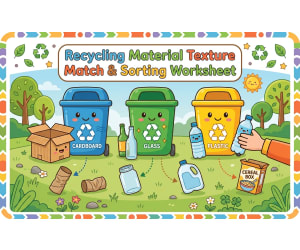
Transform your recycling lesson from a flat, boring worksheet into an unforgettable, hands-on sensory adventure! This comprehensive, research-based curriculum is designed to teach toddlers and preschoolers about recycling through the way they learn best: by touching, feeling, and doing. Grounded in the principles of Embodied Cognition, Montessori, and Vygotskian scaffolding , this resource moves beyond simple picture matching. It guides children to understand the fundamental properties of materials like cardboard, plastic, and glass (using safe proxies) through their distinct textures, temperatures, weights, and sounds. It’s the perfect, developmentally appropriate resource for your Earth Day unit, sensory tables, fine motor centers, or at-home learning. This isn't just a set of printables; it's a complete pedagogical system designed for early childhood educators, occupational therapists, and dedicated parents. ► What's Included in this 33-Page PDF? Phase 1: Core Content & Theory: A professional, in-depth guide for the educator. It explains the neuroscience behind tactile learning in early childhood, the design of the sensory materials, and the cognitive mapping process that helps toddlers connect a physical object to a symbolic icon. Phase 2: Facilitator's Workbook: 10 detailed, scaffolded worksheets that serve as lesson plans and observation guides. Each worksheet focuses on a different sensory attribute (e.g., Thermal Conductivity, Auditory Feedback, Material Elasticity) and provides step-by-step instructions and prompts for recording the child's progress. Phase 3: Visuals & Teacher Resources: Everything you need for seamless implementation! Professional Diagrams: Visual models of the learning process and ideal classroom setup. Developmental Milestones Matrix: Track a child's progress from exploration to mastery. Teacher Implementation Guide: Detailed instructions on material preparation, safety protocols, and a step-by-step guide to executing the lessons. Comprehensive Answer Key & Observation Rubric: Understand the "why" behind a child's actions and identify emerging, developing, and mastering skills. ► Skills Developed: Sensory Processing: Tactile, thermal, auditory, and kinesthetic discrimination. Fine Motor Skills: Pincer grasp, grip-force modulation, object manipulation. Cognitive Skills: Sorting and categorizing, problem-solving, working memory, cognitive flexibility. Early Science/Environmental Concepts: Understanding material properties, introduction to recycling and ecological stewardship. Language Development: Builds vocabulary for textures and properties ("bumpy," "smooth," "cold," "crinkly"). ► Perfect For: Preschool, Pre-K, and Toddler Teachers Occupational Therapists (A fantastic tool for sensory integration and fine motor goals!) Homeschooling Parents Special Education Professionals Montessori & Reggio Emilia inspired classrooms Stop the "laminate and lecture" cycle. Download this curriculum today and empower your little learners to become true "somatic ecologists" who understand their world through meaningful interaction! Keywords: Recycling, Earth Day, Sensory Bin, Toddler Activities, Preschool Curriculum, Montessori, Occupational Therapy, Fine Motor Skills, Sorting Activities, Tactile Learning, Hands-On Learning, Special Education, SPED, Sensory Integration, Early Childhood, Teacher Resource, Case Study Why Parents/Schools Love It: Goes Beyond Worksheets: It’s a multi-sensory, hands-on experience that turns abstract concepts like recycling into concrete, memorable play. It aligns perfectly with how young children naturally learn. Builds Real-World Skills: This curriculum masterfully combines critical developmental goals (fine motor, sensory discrimination) with an essential real-world lesson on environmental responsibility. Research-Backed & Professional: Unlike many resources, this curriculum is grounded in solid educational theory (Montessori, Vygotsky) and neuroscience, giving educators and therapists confidence in its effectiveness. Incredibly Versatile & Adaptable: It can be used for one-on-one therapy, a home learning activity, or a classroom sensory station. The detailed rubrics help track individual progress in any setting. Target Student Classes : Based on the content, case studies (ages 28-48 months), and developmental focus, target facilitators (the adults) working with: Toddlers (18 months - 3 years) Preschool / Pre-K (3 - 4 years) This resource is also exceptionally well-suited for Early Intervention and Special Education classrooms focusing on sensory processing and fine motor development, as well as for Occupational Therapy (OT) sessions. Copyright/Terms of Use: This Book was copyrighted by Syed Hammad Rizvi. This resource is for personal and single classroom use only. You may not alter, redistribute, or sell any part of this resource. In other words, you may not put it on the Internet where it could be publicly found and downloaded. If you want to share this resource with colleagues, please purchase additional licenses from Teachsimple. Thank you for respecting these terms of use. This product is happily brought to you by Syed Hammad Rizvi
Author Creative Book Store
Rating
Tags Recycling, Sorting, Earthday, Environment, Sustainability, Recyclingactivities, Sortingactivities, Earthdayactivities, Learningtorecycle, Environmentalscience
Toothbrushes Reading Comprehension Passage - Cored Ed Encyclopedia
ELA, Language Development, Reading Comprehension, Reading, Science, Technology, Engineering, History, Social Studies, Life Sciences, Grade 2, 3, 4, 5, Worksheets & Printables, Worksheets, Teacher Tools, Centers, Activities, Writing Prompts, Assessments, Quizzes and Tests, Quizzes, Lesson Plans
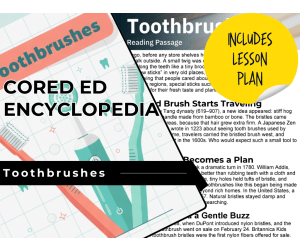
This toothbrushes reading comprehension includes: Visualization (on the front cover) Start your lesson by taking a minute to think and share something about the topic. Read the script aloud (slowly), perhaps prepare some music or sound effects. Student close their eyes and let their imaginations wander. Students open their eyes, read the question aloud and give them a few minutes to complete. Ask a few students to share or keep answers until the end to compare with what they learn in the passage. Quick pause—thousands of Cored Education products are included with your TeachSimple membership. Download links and encyclopedia index available here. Pre-Reading Trivia Students will write down one thing they already know about the subject and then read five more facts and discuss. These facts are fun, and the students will enjoy learning about the subject before reading more. Give 1 minute for students to write what they already know (no pressure—best guess is fine). Read the five facts together. After each fact, do ask a student for their opinion, was it surprising? Set a purpose by asking students to highlight/underline one fact they want to learn more about during the reading. Reading Passage The text is a high-interest reading passage with set paragraphs, roughly three to four paragraphs long. It contains a variety of themes about the topic, anywhere from history to technology. The passage is between 250 and 350 words in length. First, ask students to look at the headings and see what they’ll learn about today. What do they know about the topic/heading? First read options: Teacher read-aloud (best for support). Partner reading (paragraph by paragraph). While reading, students underline important details, and vocabulary words they think may come up in the questions section. Mixed Questions The first question page contains four multiple-choice questions, each with a choice of four answers, and three written response questions that require a sentence or two from the student. Students complete the mcqs first independently, then review quickly as a class. For the 3 written responses, try to get students giving the answer with some form of evidence: “I think ___ because the text says ___.” If students get stuck, send them back to check the passage. Vocabulary Questions Practice seven key words from the text in this section across two activities. First section is scrambled words where students will unscramble three words given a clue for each. The second section is a word to meaning matching activity. Before starting, have some students read out words they underlined in the passage. Ask students to say the word and read aloud the sentence(s) around each word. Ask students to do scrambled words and the matching exercise in pairs then go through answers as a class. For the scrambled spelling task, get four pairs to come up to the board and write the words for extra practice with the other student reading out the clue. For the matching task, prompt students to give full sentences: “I matched ___ with ___ because ___.” Creative Writing In this question, the student will be required to write a five to eight sentence paragraph on a question related to the topic. Before starting, ask students write down 3 key ideas they are going to include in their piece. Ask students for ideas to share around the class to help those struggling. Pro writing expectations: 5–8 sentences At least 2 facts or details from the passage At least 2 vocabulary words from the previous page Students read their paragraphs while classmates listen for facts and vocabulary words. Extension Activities This page is optional for fast finishers or to take home. There are several activities, each one requiring a different skill. Do some, do none, do all, completely optional - but you will feel reassured knowing every possibility is planned for. Includes summary writting question. Answer Key There are answers for the multiple-choice questions, written response questions have sample answers, vocabulary answers and if there is a summary question then a sample summary will be provided as well. Lesson Plan Included Customized lesson plan for this lesson is included. Lesson Snapshot Title: Toothbrushes Genre: Nonfiction (informational text) Subject: Science (Health & Technology) Primary Topic: How toothbrushes changed over time Estimated Guided Reading Level (A–Z): R What This Lesson Teaches Best Explains how people cleaned teeth before store-bought toothbrushes by chewing a twig until it turned “fuzzy” and rubbing it on teeth. Shows how evidence from the past (archaeologists finding signs in places like Mesopotamia and Egypt) can tell us about tooth care long ago. Traces the history of the bristled brush from China’s Tang dynasty to Europe in the 1600s, highlighting how inventions travel. Describes how toothbrush designs changed to solve problems (for example, natural bristles staying damp and trapping bacteria). Summarizes key innovations—nylon bristles (1938) and the electric toothbrush (1954)—and connects them to the ongoing goal of protecting teeth. Learning Goals Students will describe how a “chew stick” was used to clean teeth long ago. Students will identify evidence in the text that people cared about clean mouths thousands of years ago. Students will explain how the bristled brush began in China and later spread to Europe. Students will summarize how toothbrush-making changed after 1780 using details about materials and design. Students will explain why inventors searched for new bristle materials and what nylon changed. Students will describe how an electric toothbrush helped brushing by adding steady motion. Key Vocabulary From the Text archaeologists — scientists who study the past using old remains. Mesopotamia — an ancient region where people lived long ago. miswak — a special stick used for cleaning teeth. patent — legal rights that protect an invention. bacteria — tiny germs that can cause problems. FULL CATALOG OF DOWNLOAD LINKS AND ENCYCLOPEDIA INDEX HERE
Author Cored Education
Rating
Tags Vocabulary, Reading Comprehension, Reading Passages, Lesson Plans, Ela Lesson Plans, Reading Comprehension Lesson Plans, Pre-reading, History, History Lesson Plans, Toothbrushes

Health | 3rd Grade Unit 6: Prevention Control of Disease
P.E. & Health, Life Studies, Physical Education, Health, Life Skills, Special Resources, Social Emotional Learning (SEL), Social Skills, Grade 3, Teacher Tools, Lesson Plans, Worksheets & Printables, Worksheets
This 3rd Grade Health Unit focuses on Prevention Control and Disease and is essential to help students with their health and wellness. There are seven units in all taught in 3rd grade that focus on health. These units include: Unit 1 that focuses on Personal Health and Wellness Unit 2 that focuses on Growth and Development Unit 3 teaches students about Nutrition and Physical Activity and how to eat right and stay active Unit 4 that helps students with Substance Use and Abuse and how to avoid bad substances Unit 5 that will teach students about Injury/ Violence Prevention Control and Safety Unit 6 that covers what happened during Covid and how to protect themselves while learning about Prevention/Control of Disease Unit 7 discusses our environment and how to help save our planet with Environmental Consumer Health Included in this 3rd Grade Health Unit are the following: These units can be taught out of order. They are only numbered for your convenience. At the end of each unit, there is an assessment to test students’ understanding. Through using this 3rd Grade Health Unit 6: Prevention Control of Disease, students will explore and learn to identify daily healthy habits. Included in this 3rd Grade Health Unit are the following: In this unit, students will learn new vocabulary and cut and paste illnesses as they sort and discover what illness are communicable and non-communicable diseases. Students will learn to take care of themselves as they learn about personal hygiene and the importance of how to stay clean with their bodies. They will learn about the importance of making and keeping goals and write three healthy goals and a way to accomplish these goals. Handwashing is another part of how to control disease. Students will review the importance of keeping their hands clean and how that will help them to stay healthy. For fun, there is a word search on dental hygiene included as they review these vocabulary words. Viruses can spread quickly in communities. In this unit, students will learn about the Coronavirus and measures on how to keep themselves and their family safe from spreadable diseases and viruses. Included is information on the Coronavirus for students to learn and then they will answer several questions as to its origin, how it started, how it spread, and what they can do to be safe for future viruses. Lastly, there is an assessment to check for understanding. This unit meets Common Core Standards. It is 30 pages of fun engaging activities! At the end of the unit, there is an assessment to check for understanding. There are seven units that cover all the health requirements for 3rd grade. Go to K-5 Treasures to check out the other 3rd Grade Health Units to help students complete the entire Health Standards for the year!
Author K-5 Treasures
Rating
Tags Health Unit, Personal Health, Healthy Goals, Unhealthy Choices, Health Activities, Physical Goals, Health Goals, Health And Wellness, 3rd Grade Health, Third Grade Health
Cellular Respiration: Energy Extraction in Cells Reading Passage
ELA, Reading, Writing, Research, Resources for Teachers, Science, Biology, Life Sciences, High School, Homeschool Resources, Teacher Tools, Assessments, Quizzes and Tests, Lesson Plans, Worksheets & Printables, Writing Prompts
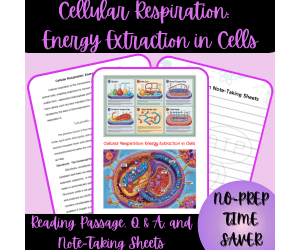
Teaching cellular respiration can feel overwhelming, especially when you want your students/homeschoolers to truly understand how cells create energy, not just memorize steps. As a homeschool mom guiding my own ninth grader, I know how important it is to have resources that break down complex topics into manageable, engaging pieces. That is why I created this Cellular Respiration: Energy Extraction in Cells Reading Passage, Q & A, and Note-Taking Sheets resource, complete with a detailed and complex reading passage, thought-provoking questions, and five versatile note-taking sheets. Designed for high school/homeschool biology, this resource helps students/homeschoolers grasp the big picture of cellular respiration while also encouraging critical thinking and independent learning. Whether you are teaching at home or in a classroom, you will find this resource to be a practical and effective addition to your curriculum. INCLUDED IN THIS RESOURCE: Multi-page, detailed Cellular Respiration Reading Passage 20 critical thinking passage questions A comprehensive answer key 5 flexible note-taking sheets for guided or independent study TOPICS COVERED: The three main stages: glycolysis, Krebs cycle, and electron transport chain Differences between aerobic respiration and fermentation The role of ATP, NADH, FADH₂, and key enzymes Real-world applications and connections to health and biotechnology This Cellular Respiration: Energy Extraction in Cells Reading Passage, Q & A, and Note-Taking Sheets resource is a practical, engaging, and flexible tool for teaching one of biology’s most essential processes. Whether you are a homeschool parent like me or a classroom teacher, you will appreciate how this resource brings clarity and confidence to your lessons. It is designed to help students/homeschoolers not just learn, but truly understand how cells power life. If you and your students/homeschoolers enjoyed this resource, please leave a review. Thank you for your support! Tina - Big Easy Homeschooling Mo
Author Homeschool with Big Easy Homeschooling Mom
Rating
Tags Cellular Respiration Reading Passage For High School, Homeschool Biology Cellular Respiration Resource, Glycolysis Krebs Cycle Electron Transport Chain Explained, Critical Thinking Questions For Cellular Respiration, Electron Transport Chain, Advanced Biology Cellular Respiration Activities, Krebs Cycle, Glycolysis, AP Biology Resource, Homeschool Biology Resource

Phonics / Digraphs for 1st and 2nd Grade: Beginning, Middle, and Ending Sounds
ELA, Reading, Reading Comprehension, Grammar, Language Development, Phonics, Pre-Reading, Grade 1, 2, Worksheets & Printables, Worksheets, Teacher Tools, Lesson Plans
This unit focuses on the Beginning, Middle and Ending Digraph sounds. Learning how to read can be the most challenging activity for many students and for a teacher. A digraph in the English language are two letters put together that represents a single sound or phoneme. Understanding that the combination of letters can make one sound can be difficult to master and requires repetitive practice of reading and writing these words with these sounds. There are other phonics units that I sell that focuses on the Beginning Digraph sounds, and one that focuses on just the Ending Digraph sounds. Reading can be made easier with these phonic helps that repeatedly encourage students to practice these Beginning, Middle and Ending Digraph sounds. Activities include reading comprehension and identifying the digraphs in their reading, writing their answers to questions regarding the paragraph, identifying additional digraph words in sentences using a word bank, matching words with pictures, spinning a paperclip activity where students will write the word with the digraph sound, and lastly a fun wordsearch with the digraph words. These activities are for each digraph so there is plenty of opportunities for students to practice their comprehension reading skills and phonic sounds. Students will practice the following Beginning, Middle and Ending Digraph sounds: ch, sh, th, wh, and ph. Teachers can use this resource in whole group, individually with students, students can practice with each other in centers, or they can be assigned as homework. Worksheets are also differentiated for each Beginning, Middle and Ending Digraph sound for all young learners which makes it perfect for all 1st - 2nd graders. A total of 33 pages full of reading and phonic activities. Along with reading and writing, there are matching, cutting, and pasting activities. Word searches and spin and make a word activity are also a part of this packet which make learning to read these phonic sounds entertaining for young learners. For a list of other phonics and grammar activities, click on the following links: CVC Word Families for Beginning Readers: Stamp it, Make it, Trace it, and Write it CVC Words | Short Vowel Phonics | Word Families for K- 2nd Grade Phonics for 1st and 2nd Grade: Help Students Learn Long A Words: AY, AI, A_E, EIGH, EY, and EA Phonics for 1st and 2nd Grade: Help Students Learn Long E Words: EE, EA, E_E, and Y Phonics for 1st and 2nd Grade: Help Students Learn Long I Words: I_E, IE, IGH, and Y Phonics for 1st and 2nd Grade: Help Students Learn Long O Words: O_E, OA, OW, OE, and OUGH Phonics for 1st and 2nd Grade: Help Students Learn Long U Words: U_E, EW, OO, UE, UI and OU Phonics / Digraphs for 1st and 2nd Grade: Beginning, Middle, and Ending Sounds Phonics / Digraphs for 1st -2nd: Ending Sounds: CK, NG, SH, TH, and NK Phonics / Digraphs for 1st and 2nd Grade: Beginning Sounds: SH, TH, WH and PH Phonics: R-Controlled Words for 1st and 2nd Grade and Early Readers
Author K-5 Treasures
Tags Digraphs, Beginning Sounds, Ending Sounds, Phonics, Digraph Words, Ph Words, Th Words , Sh Words, Ch Words, Phonics Digraphs

Alliteration Poem Template Poetry Writing Activity with Examples
ELA, Poetry, Literature, Homeschool Templates, Grade 2, 3, 4, 5, Centers, Activities, Graphic Organizers, Teacher Tools, Lesson Plans, Rubrics, Worksheets & Printables
Looking for a way to help your students actually understand alliteration without it turning into a bunch of random or overly silly sentences? I’ve found that alliteration can be one of those concepts students either overdo or don’t quite grasp, especially when they’re trying to apply it in their own writing. Having a bit of structure really makes a difference. This activity gives students a starting point, so they’re not guessing what to do. Instead of just identifying alliteration, they’re using it in their own poems, which helps it stick. The examples make it easier for them to see what’s expected, and the templates guide them through the process without taking away their creativity. In my experience, this works well whether you’re introducing alliteration for the first time or revisiting it during a poetry unit. You can model a few examples together, then let students have a go using the templates. Some will need a bit more support, and others will run with it—but the structure is there for both. Once they’ve drafted their poem, they can create a final version to display. It’s one of those activities where students actually enjoy reading each other’s work, which is always a win. There’s also a simple lesson outline included if you want something easy to follow, along with a rubric to make marking more straightforward. It fits nicely into literacy rotations, whole-class lessons, or even as something to leave for early finishers when you need a meaningful task that doesn’t require a lot of extra explanation. Items Included Alliteration poem interactive notebook templates Student-friendly example (color and blackline posters) Step-by-step lesson plan Publishing page for a final copy Assessment rubric
Author Teach2Tell
Rating
Tags Poetry Lesson Plan, Poetry Writing Activity, Alliteration Poem Template, Alliteration Activity, Alliteration Examples, Phonics Alliteration, Literacy Centers Writing, Creative Writing Activity, Figurative Language Activity, Poetry Lesson Elementary

Ancient Civilizations: Aztec, Inca, and Maya Unit Study
Social Studies, History, History: Ancient, Grade 3, 4, 5, 6, Lesson Plans, Teacher Tools
Discover the ancient Aztec, Maya and Inca societies with this expansive teaching kit. Through vivid posters, interactive maps and hands-on projects, core knowledge comes alive on topics like agriculture, architecture, culture and ultimately Spanish conquest. The bundle includes an assortment of fiction and non-fiction book recommendations, ensuring a well-rounded approach to learning about Aztec, Maya, and Inca civilizations. Beyond conventional learning materials, project and craft ideas breathe life into history, fostering hands-on engagement. Supplementing classroom instruction, curated links to YouTube videos and documentaries add a visual dimension to the educational experience. Timeline cards and illustrated narratives adapted to two reading levels chronicle the trajectory of each civilization. Enhance learning via coloring pages, glyph tracing activities and artifact analysis extensions. 3D crafts let students design codex books, geometric tunics and more. Assess comprehension with a competitive Jeopardy-style game addressing everything from staple foods like maize to the basics of the ritual ball game. This resource contains plentiful teacher support guiding connections to social studies standards for grades 3-6. Easily incorporate as a stand-alone Mesoamerican unit or alongside lessons on the conquistadors. Writing prompts facilitate connections across narrative, informative and persuasive genres. Writing prompts are provided at multiple writing levels to be accessible to all learners. Check out other resources from my store: Simply Schoolgirl! I can be contacted for questions and concerns at simplyschoolgirl1@gmail.com
Author Simply Schoolgirl
Rating 1
Tags Maya, Inca, Aztec, Ancient Civilizations, History Project, Central America, South America, Codex, Glyphs, Machu Picchu, Incas Aztecs Mayans Map, Inca Vs Aztec Vs Maya Map, Inca Aztec Maya, Inca Maya Aztec Map, Inca And Maya, Maya Inca Aztec Timeline, Aztec Inca, Mayan Aztec Inca, Inca Maya Aztec Timeline, Maya Inca Aztec Map, Maya Inca Aztec, Aztecs Incas Mayans, Inca And Mayan Civilization, Aztec Mayan Inca Timeline, Mayan Vs Aztec Vs Inca Timeline, Maya Aztec Inca Map, Aztec Vs Inca Vs Maya, Aztec Inca Maya Map, Aztec Mayan Inca Map, Mayan Aztec Inca Map, Aztec Maya And Inca Map, Inca Vs Aztec, Map Of Maya Aztec And Inca, Mayan And Inca, Aztec Inca And Maya Map, Map Of Aztecs Mayans And Incas, Inca And Mayan, Aztec Landform, Inca Maya, Aztecs Incas And Mayans, Inca Maya Aztecs, Inca And Aztec, Aztec Inca Mayan Timeline, Inca Vs Maya, Maya Aztec Inca Timeline, The Aztec Inca And Mayan Civilization, Mayan Aztec Inca Timeline, Aztec Incas Mayas, Incas Aztecs And Mayans, Aztec Maya Inca Timeline, Inca Aztec, Aztecs Inca Maya
All About Numbers 1-20 | Animated Math Video Lesson
Math, Numbers, Kindergarten, Preschool, Grade 1, Lesson Plans, Teacher Tools
All About Numbers 1-20 Animated Math Video Lesson: Product Description The All About Numbers 1-20 Animated Math Video Lesson is an educational tool designed to enrich the learning experience of young students. Tailored specifically for preschoolers, kindergarteners, and first graders, this tool centers around helping children familiarize themselves with numbers from 1-20. Animation as a Teaching Medium Elevating the traditional math class experience, this video lesson employs animation – a compelling teaching medium for young minds. The crux of its design revolves around fostering interaction and engagement in students while introducing them or reinforcing their knowledge of numbers. Balancing Brevity and Content Being a 10-minute MP4 video lesson, it strikes a perfect balance between brevity and content richness that matches with the attention span of young learners. This duration allows sufficient time to navigate through all numbers from 1-20 without rushing or overstretching, maintaining student interests without diminishing their concentration levels. Focused Teaching Resource This teaching resource remains focused on number introduction and reinforcement at all times thus giving your lessons a sharply defined edge. The potential benefits can be realized through several implementable approaches like: Integrating it in whole group instruction, Using it for small group activities, Assigning it as an individual homework exercise. Versatility in Application: Classroom & Homechooling Approach This animated math video lesson aligns well with conventional education principles as well as homeschooling approach – offering universal advantages irrespective of individual teaching methodologies. It is designed from the ground up keeping ease-of-use at its core yet uncompromising on imparting knowledge effectively. Achieve a fun-filled and insightful learning experience simultaneously, no matter where the classroom may be!
Author Educational Voice
Tags Numbers, Math, Animated, Video Lesson, Interactive
Guided Reading Level N - Nanjing (with Lesson Plan)
ELA, Resources for Teachers, Reading Comprehension, Reading, Social Studies, Geography, Earth and Environmental Sciences, Science, History, Economics, Grade 2, 3, 4, Worksheets & Printables, Worksheets, Teacher Tools, Centers, Activities, Literacy Readers, Quizzes, Quizzes and Tests, Assessments, Lesson Plans
This Guided Reading Book - Nanjing (Level N) with lesson plan includes: Guided Reading Color Label (front cover x1) This is a quick way to match the book’s demands to what students can generally handle.. The overall goal is to use the level/color to pick books for several smaller groups. To qualify for a certain level, a student is expected to read a book from that level with about 90–94% accuracy. If a student is consistently accurate and understands, move up a level. If the student is struggling at that level, drop down and add more support. Each student will improve at completely different rates, but it is generally one of the best ways to check progress across the class. DOWNLOAD THE CATALOG TO VIEW ALL GUIDED READING BOOKS AVAILABLE (SORTED LEVELS A-Z) Pre-Reading Question (x1) Teacher asks the prompt aloud, can be while showing the cover or first page. Students share what they already know, or make educated guesses from the cover. Prompt them to use the target vocabulary. Write some of their responses on the board to look back at during the reading. Vocabulary Words (x5) Introduce the five words, best doing it one at a time. Start by saying it, while students repeat and then see if anyone knows what it means before reading further. Read through the meaning and try to briefly connect each word to a picture or gesture so it’s meaningful. Ask students to flip through the book pages and point to where they see each of the vocabulary words. While reading the book pause upon coming across one of the vocab words or read the sentence twice to make sure students understand the word has appeared. Optional: Ask students to raise hands whenever they see/hear one of the new words. Guided Reading Pages (x10) Check the book snapshot (below) for: primary topic - do you need to prep extra reading or intro materials on this? what is taught best - decide on 1-2 bullets to focus on, use the prompt or words provided here for best results. learning goals - what you are checking for students to be able to do after the session, elicit answers using prompts or words provided. key vocabulary (see section above). questions overview - so you know what is coming up and if you need to prep extra materials to assist understanding. Run the lesson You may have already looked at a few of the pages together, but you can show them some of the pictures again first to set meaning. Depending on how much time you have and how familiar your students are with guided reading class, you may want to read the book aloud first with the group first. Students whisper or partner read, while you listen in. If time, do it as a group, one student reading a page each. Use the guided page’s prompts to coach: “Check the picture / does it make sense?” “Point under the words / try the first sound” “Reread the sentence smoothly”. Try to focus more on one student per session (rotating every time), so you can work out if they are ready to move up or need to move down a level. Comprehension Questions (back cover x3) This is your way to check that students didn’t just say the words, but actually understood the text. First, let students answer by pointing to the page/picture and saying a short sentence. After any answer, follow with: “Show me where you found that in the text.” In bigger groups, have partners answer first (10–20 seconds), then call on 2–3 students to share. Differentiation tips: Emerging speakers/struggling readers: oral + pointing On-level: oral in a full sentence Higher: one written sentence or draw + label Book Snapshot Title: World Cities: Nanjing Genre: Nonfiction (informational text) Subject: Social Studies (Geography) Primary Topic: Nanjing’s rivers, landmarks, and seasonal changes Estimated Guided Reading Level (A–Z): N What This Book Teaches Best How Nanjing’s location along the Yangtze River helped it become a travel and trade hub. How a major river can divide a city and lead to bridges being built to connect districts. How landforms and green spaces (like Purple Mountain’s forests) can help keep a city’s air clean and support plant life. How human-built features (the ancient city wall) can follow natural geography like hills and lakes. How climate and seasons change a city’s landscape through spring blossoms, autumn leaf color, and summer shade from “green tunnels.” Learning Goals Students will describe where Nanjing is located and what major river it sits along. Students will explain why bridges were built across the Yangtze River in Nanjing. Students will identify Purple Mountain and explain how its forests help the city. Students will describe how Nanjing’s ancient city wall follows the natural geography of the land. Students will describe one role Xuanwu Lake plays (islands/bridges or collecting rainwater). Students will describe how Nanjing’s humid subtropical climate connects to changes across seasons. Key Vocabulary From the Text districts — parts of a city. subtropical — warm climate, often with lots of humidity. transformation — a big change. fertile — good for plants to grow. geography — land features of a place. Discussion Prompts Pre-reading question: How might rivers and hills help a city grow and change? Comprehension questions: Where does the text say Nanjing is located, and what river runs through it? Comprehension questions: Why were massive bridges built across the Yangtze River in Nanjing? Comprehension questions: What change does the text describe happening in Nanjing during autumn? Printing Tips 1. Best Printing Method (Recommended) “Booklet” Printing (Best if Available) If your printer or PDF viewer supports Booklet Printing , use this. Settings to use: Print mode: Booklet Paper size: Letter or A4 (either works) Orientation: Landscape Print on both sides: Yes Flip on: Short edge Scaling: Fit to printable area Booklet subset: First test: Front sides only Then: Back sides only This will automatically: Pair pages correctly Put the cover on the outside Align everything for folding After printing, fold in half and staple along the spine . 2. If “Booklet” Printing Is NOT Available You can still print this correctly with manual duplex printing . Step-by-step: Open the PDF. Choose Print . Set: Orientation: Landscape Pages per sheet: 1 Print on both sides: Yes Flip on: Short edge Print all pages . Because each PDF page already contains two facing book pages, the result will still fold cleanly into a book. Thousands of Cored Education products are included with your TeachSimple membership. Download links and encyclopedia index available here.
Author Cored Education
Rating
Tags Reading Comprehension, Reading Passages, Reading, Guided Reading, Guided Reading Lesson Plan, Guided Reading Activity, Pre-reading, Geography, Social Studies Lesson Plans, History

Future Tense Supplementary Materials Grades 3-4 (PDF)
ELA, Language Development, ESL, Grammar, Common Core, Resources for Teachers, Grade 3, 4, Worksheets & Printables, Worksheets, Quizzes and Tests, Teacher Tools, Tests, Assessments, Lesson Plans, Activities
Future Tense Supplementary Materials Note: This download DOES NOT include the tests themselves. You can still make use of these materials without them but they are recommended. Download in a format of your choice in the "Links" section below. Outline Ice Breaker (5-10 minutes) Engaging, interactive activity to introduce the lesson’s theme. Examples: Matching games, sentence races, charades, or storytelling challenges. Guided Practice (10-15 minutes) Teacher-led exercises to reinforce the concept. Examples: Sorting sentences by tense, sentence transformations, or fill-in-the-gap exercises. Group or Partner Task (15 minutes) Collaborative activity to practice the lesson’s focus in a fun and engaging way. Examples: Role-play, storytelling, sentence-building games, or small-group discussions. Independent Worksheet (15 minutes) Individual written activity to solidify understanding. Examples: Sentence corrections, verb conjugation drills, or tense identification exercises. Exit Task (5 minutes) Quick reflective activity to assess understanding before students leave. Examples: Writing a sentence using the target concept, identifying a tense, or explaining a rule. Links: Includes: Future Simple Future Continuous Future Perfect Mistake Finding Google Docs Google Forms Google Slides PDF PPT Word FULL CATALOG OF DOWNLOAD LINKS HERE Grade 3/4 Links: Adjectives Google Docs Google Forms Google Slides PDF PPT Word Free Supplementary Materials Pack Adverbs Google Docs Google Forms Google Slides PDF PPT Word Free Supplementary Materials Pack Conjunctions Google Docs Google Forms Google Slides PDF PPT Word Free Supplementary Materials Pack Nouns Google Docs Google Forms Google Slides PDF PPT Word Free Supplementary Materials Pack Pronouns Google Docs Google Forms Google Slides PDF PPT Word Free Supplementary Materials Pack Verbs Google Docs Google Forms Google Slides PDF PPT Word Free Supplementary Materials Pack Sentence Structure Google Docs Google Forms Google Slides PDF PPT Word Free Supplementary Materials Pack Present Tense Google Docs Google Forms Google Slides PDF PPT Word Free Supplementary Materials Pack Past Tense Google Docs Google Forms Google Slides PDF PPT Word Free Supplementary Materials Pack Future Tense Google Docs Google Forms Google Slides PDF PPT Word Free Supplementary Materials Pack Context Clues Google Docs Google Forms Google Slides PDF PPT Word Free Supplementary Materials Pack Defining Words Google Docs Google Forms Google Slides PDF PPT Word Free Supplementary Materials Pack Fill the Blanks Google Docs Google Forms Google Slides PDF PPT Word Free Supplementary Materials Pack Homophones Google Docs Google Forms Google Slides PDF PPT Word Free Supplementary Materials Pack Synonyms Google Docs Google Forms Google Slides PDF PPT Word Free Supplementary Materials Pack ELA Review Questions Overview Questions have three answer choices. There are a handful of pictures on each test for aesthetic purposes, as well as a review sheet covering most of the topics covered in the product. Introduction or Example Sheet Each topic will include an introduction or example sheet to go through first with your students. Full Answer Keys Full answer keys and sample responses are provided so no matter how busy you are, you know you're covered! In the Supplementary Pack Interactive Ice Breakers: Fun, hands-on activities that get students thinking about adjectives right from the start. Guided Practice: Teacher-led exercises that reinforce the day’s lesson, ensuring students can confidently identify and use adjectives. Group and Partner Tasks: Collaborative activities that allow students to work together to solve problems, categorize adjectives, and create descriptive sentences. Independent Worksheets: Structured worksheets that provide individual practice and help solidify understanding of key concepts. Exit Tasks: Quick, reflective activities at the end of each lesson that assess understanding and encourage students to apply what they’ve learned. For similar downloads and other frees, do check out Cored Group on TeachSimple.
Author Cored Education
Tags Elementary, Answers, Ccss, Common Core, Grammar, Tests, Test Prep, Grade 3, Grade 4, Lesson Plan

Lesson Plan on the American Civil War
History: USA, History, Social Studies, Grade 5, 6, 7, 8, Lesson Plans, Teacher Tools, Worksheets & Printables, Activities
This engaging 90 minute lesson introduces Grades 5-8 to the key events, causes and impact of the American Civil War. Based on the animated YouTube video The American Civil War Explained , the lesson includes discussion, note-taking and a student worksheet. Students will explore topics such as slavery, states’ rights, secession, major battles, the Emancipation Proclamation and the war’s legacy. Through a combination of multimedia, critical thinking questions and short writing tasks learners will gain a deeper understanding of the war’s significance. The worksheet includes a timeline activity, vocabulary matching, true/false questions, short answers and character identification all with an answer key for easy assessment. The lesson encourages active participation, critical thinking and historical empathy. It’s perfect for a U.S. history unit and can be used in person or distance learning. This lesson helps students connect past to present day issues of equality, unity and civil rights in American history.
Author Bright Classroom Ideas Marketplace
Rating
Tags American, Civil, War, History, Lesson, Plan, Grade 5, Grade 6, Grade 7, Grade 8