



3,927 products added recently
Page 5 - Popular Lesson Plans
Explore a curated selection of popular lesson plans that have proven successful in classrooms. Covering various subjects and topics, these resources provide innovative ideas and activities. Use them to refresh your curriculum and engage your students with tried-and-true methods.

 Show filters

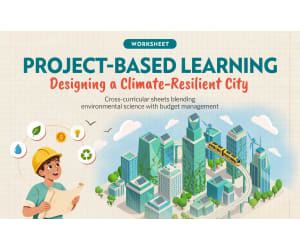
Project-Based Learning Designing a Climate-Resilient City
Science, Earth and Environmental Sciences, Life Sciences, Earth Sciences, Environmental Science, Geology, Space, Nature & Plants, STEM, Special Resources, Grade 6, 7, 8, 9, 10, 11, 12, Teacher Tools, Lesson Plans, Quizzes and Tests, Quizzes, Tests, Worksheets & Printables, Workbooks, Worksheets, Word Searches, Assessments
Transform your classroom into a hub of real-world problem-solving with this comprehensive Project-Based Learning (PBL) module: Designing a Climate-Resilient City! Are you looking for a rigorous, engaging, and cross-curricular project that prepares students for the challenges of the 21st century? This turnkey resource is the perfect solution. It masterfully blends Environmental Science, Earth Science, Mathematics, Economics, and Civics into one high-impact simulation. Students step into the dual role of a city's Chief Sustainability Officer and Chief Financial Officer. Tasked with a $500,000,000 budget , they must make critical decisions to protect their fictional municipality, "Nova Civitas," from the escalating impacts of climate change. From urban heat islands and flood defense to renewable energy transitions and waste management, every choice has both ecological and financial consequences. This isn't just a worksheet packet; it's a complete, three-phase educational experience: Phase 1: Core Content & Theory (Student Field Manual): A detailed guide that teaches the foundational scientific and economic principles, including concepts like CapEx vs. OpEx, Return on Investment (ROI), green vs. grey infrastructure, and the circular economy. Phase 2: The Student Workbook: Ten detailed, scaffolded worksheets guide students through the entire city-planning process. They will perform calculations, analyze data, and justify their budgetary decisions, tackling everything from energy grids and public transit to disaster insurance and sustainable housing. Phase 3: Visuals & Teacher Resources: This package is ready to go with printable/projectable visual aids (flowcharts, graphs, mind maps) and a comprehensive, step-by-step answer key with exemplar responses and crucial teacher notes. Perfect for in-class, hybrid, or homeschool environments, this project fosters critical thinking, financial literacy, data analysis, and collaborative problem-solving. Empower your students to grapple with relevant, real-world issues and discover that the most sustainable solutions are often the most economically sound. Download today and empower your students to build a better, more resilient future! Keywords: Project-Based Learning (PBL), STEM, STEAM, Climate Change, Environmental Science, AP Environmental Science (APES), Earth Science, Economics, Civics, Sustainability, Urban Planning, City Design, Budgeting, Financial Literacy, Math, Critical Thinking, Real-World Application, Cross-Curricular, Middle School, High School, Digital Resource, Printable Worksheets. Why Parents/Schools Love It: Teaches Real-World Skills: This project moves beyond theory. It teaches critical 21st-century skills like financial literacy, data-driven decision-making, and long-term strategic planning that students will use their entire lives. Deeply Engaging & Relevant: The role-playing simulation is highly engaging. Students are not just learning about climate change; they are actively working to solve its challenges, making the topic personal and urgent. Truly Cross-Curricular: In an era of siloed subjects, this resource beautifully demonstrates how science, math, and social studies are interconnected in the real world, promoting holistic understanding. Complete Turnkey Solution: It is a massive time-saver for educators. The package includes all student-facing materials, teacher visuals, and a comprehensive answer key with detailed calculations, saving hours of prep work. Target Audience: Student Classes : Based on the complexity of the concepts (e.g., municipal finance, payback periods, ROI) and the level of mathematics, target the following: High School (Grades 9-12): This is the primary target. It is perfect for: Environmental Science / AP Environmental Science (APES): This is a perfect fit, covering numerous topics from the APES curriculum. Earth Science: Excellent for units on human impact and climate systems. Economics / Government / Civics: Provides a practical, tangible application of public finance, policy-making, and resource allocation. General Math / Financial Algebra: A fantastic real-world application for math concepts. STEM or PBL Elective Courses: An ideal capstone or unit-long project. Advanced Middle School (Grades 7-8): This resource would be highly effective for gifted and talented programs, advanced science or math classes, or a school with a strong PBL focus. The concepts are challenging but achievable with the right guidance. Copyright/Terms of Use: This Book was copyrighted by Syed Hammad Rizvi. This resource is for personal and single classroom use only. You may not alter, redistribute, or sell any part of this resource. In other words, you may not put it on the Internet where it could be publicly found and downloaded. If you want to share this resource with colleagues, please purchase additional licenses from Teachsimple. Thank you for respecting these terms of use. This product is happily brought to you by Syed Hammad Rizvi
Author Creative Book Store
Rating
Tags EnvironmentalScience, EarthScience, STEM, STEAM, Economics, ClimateChange, Sustainability, Civics, UrbanPlanning, Ecology

Business Career Exploration Unit (Full Intro to Business Unit)
Life Studies, Social Studies, Finance, Business, Career, Economics, Grade 7, 8, 9, 10, 11, 12, Teacher Tools, Lesson Plans
Embark on a meaningful unit of career exploration with this comprehensive roadmap to guide your students toward fulfilling and meaningful professional paths! Ultimately, there is no greater lesson to be learned in business than what one's ideal place in it is! This unit allows students to question and explore where they feel most comfortable in the world of business. It's a great addition to your business curriculum , and the 8th entry into the Business Series! This unit includes 4 main topics: Exploring Career Paths: Explore and assess your student's compatibility for various career paths within business through some typology "quizzes" and tools. Professional Skills Development: What does it take to thrive in various lanes of business? Students have the chance to explore that question, and other ways to develop professionally. Often, students are unaware of a number of tools at their disposal to develop their skills in business and beyond. Networking and Informational Interviews: "It's not what you know, it's who you know" is one of those annoyingly true pieces of advice your students have no doubt heard before. This section of the unit allows them to think critically about building out their network and some concrete steps they can take to begin. Career Planning and Goal Setting: Students can transform their dreams into actionable plans with a focus on career planning and goal setting. This chapter introduces the idea of SMART goals and other strategies for setting and reaching their goals in the short, medium, and long term. This unit comes complete with a goal-setting video worksheet, student follow-along notes for a simple note-taking method, two online career exploration "quizzes", and a unit slideshow to tie it all together. In short, this collection of resources is designed to make your job easy in developing an impactful unit on career exploration.
Author Ed Dynamic
Rating 5
Tags Career Exploration, Business, Careers In Business, Jobs In Business, Career Paths, Career Quizzes, College, Professional Development, Career Pathways

Ocean and Climate | Animated Ocean Video Lesson
Science, Earth and Environmental Sciences, Earth Sciences, Not Grade Specific, Lesson Plans, Teacher Tools
Product Description: The Ocean and Climate | Animated Ocean Video Lesson is a premier instructional tool that educators will find beneficial in making the subjects of oceanography and climate science come to life for their students. This animated video lesson spans approximately 14 minutes and explores the indispensable role oceans assume in our planet's climate systems. This animated science video champions both educators' teaching objectives and students' learning experiences by translating complex environmental concepts through engaging, visually-stunning animations. Consequently, this helps students understand these principles in action far better than conventional reading or oral lecture methods, resulting in an enhanced grasp of earth sciences. The product's non grade-specific design means it can be employed across various educational levels successfully. Apt for visual learners who assimilate information more efficiently through visual presentation rather than textual interpretation. The product’s flexibility allows teachers to utilise it as: An introductory concept explainer at the beginning of a new unit using whole class instruction strategy. A reinforcement tool post-lesson delivery during small group discussions. A supplement resource for individual study or homework assignments due to its easy-to-share mp4 format. This learning aid not only creates exciting classroom discussions around crucial Earth Sciences concepts but also aids robust recall of key scientific postulates linked with our oceans and climatic systems. In addition, by infusing interest into subject matter via animation features ultimately caters to finite lateral thinking skills among learners. In sum,, The Ocean and Climate | Animated Ocean Video Lesson, offering weaves simplicity with efficacy promising an enhanced learning experience about our environment engaging them effectively while imparting knowledge.
Author Educational Voice
Tags Oceanography, Climate Science, Animated Video, Environmental Concepts, Earth Sciences

Health 2nd Grade Unit 3: Nutrition and Physical Activity
P.E. & Health, Health, Physical Education, Special Resources, Life Skills, Social Emotional Learning (SEL), Social Skills, Grade 2, Lesson Plans, Teacher Tools, Worksheets & Printables, Worksheets
For 2nd Grade Health there are seven standards that need to be taught. Unit 1 Personal Health Unit 2 Growth and Development Unit 3 Nutrition and Physical Activity Unit 4 Substance Use and Abuse Unit 5 Injury/ Violence Prevention Control and Safety Unit 6 Prevention/Control of Disease Unit 7 Environmental Consumer Health These units can be taught out of order. They are only numbered for your convenience. At the end of each unit, there is an assessment to test students’ understanding. Through using this Health 2nd Grade Unit 3: Nutrition and Physical Activity students will explore and learn to identify: * Healthy foods they should and foods that they should not eat that are unhealthy for their bodies. * Physical activities beneficial to their health and suggestions of which types of activities they can do. * Consequences of being active vs inactive * Students will also learn the importance of eating a healthy balanced diet and the benefits of being physically active at school, at home, and with their friends. This unit meets Common Core Standards for 2nd grade health. A total of 10 pages for this 2nd Grade Health Unit 3 on Nutrition and Physical Activity. At the end of the unit, there is an assessment to check for understanding. There are seven units that cover all the health requirements for second grade. Here are the links to other health units: Health 2nd Grade Unit 1: Personal Health Health 2nd Grade Unit 2: Growth and Development Health 1st Grade Unit 3: Nutrition and Physical Activity Health 2nd Grade Unit 4: Substance Use and Abuse Health 2nd Grade Unit 5: Injury / Violence Prevention and Safety Health 2nd Grade Unit 6: Prevention / Control of Disease Health 2nd Grade Unit 7: Environmental / Consumer Health 2nd grade Coronavirus / Covid-19 Facts
Author K-5 Treasures
Tags Health Unit, Nutrition, Physical Activity, Healthy Food, 2nd Grade Health, Second Grade Health, Physical Health, Eating Healthy, Health Resources, 2nd Grade Health Resources

Simple Eco-Hero Stories & Green Habit Coloring Worksheets
Science, Earth and Environmental Sciences, Life Sciences, Earth Sciences, Environmental Science, Geology, Space, Nature & Plants, Human Body, STEM, Homeschool Curriculum, Homeschool Templates, Grade 1, 2, 3, 4, 5, Worksheets & Printables, Drawing Templates & Outlines, Workbooks, Worksheets, Coloring Pages, Word Searches, Teacher Tools, Assessments, Lesson Plans, Quizzes and Tests
You can use this all-inclusive, research-supported curriculum on environmental education to change your students from being eco-anxious to being empowered and confident eco-heros! This isn't just an assortment of worksheets. It's an entire framework designed to help students develop all of the daily habits associated with protecting the environment based on an understanding of environmental concepts transformed into narrative-kinesthetic activities. This can be used for Earth Day; as part of a year-long science curriculum; as a supplement for character education; etc. The combination of engaging stories about Eco-Heroes and hands-on literacy and visual arts activities will help students realize they too can protect the planet! What's Included in This 47-Page Resource? 1. Comprehensive Teacher's Guide: (10 Pages) An explanation of the educational philosophy by providing research-based rationale and examples from real-world scenarios to assure you of how to teach environmental principles effectively from a positive perspective. 2. Student Workbook: (21 Pages) Contains activities for students. Includes: 9 colorable images representing an eco-friendly habit (e.g., "The Water Champion," "The Carbon Tracker Team"), plus 10 age-appropriate worksheets (e.g., water conservation; energy; recycling; composting; plastic pollution) that require the use of fill-in-the-blank responses. 3. Certificate: Certifies the completion of a student’s commitment to becoming an eco-hero. Printable/collaborative format. 4. Complete Teacher Material: (16 Pages). In support of implementing the resources effectively and efficiently. Components are: - Pedagogical diagrams that help the Educator understand the principles. - Answer keys to all 10 worksheets. - A comprehensive guide showing the Educator how to use the materials with examples of differentiated instructional strategies for Grade Levels 1, 2, and 3. Important Topics In Environmental Education: Water & Energy Conserving Recycling, Upcycling & Waste Sorting Composting & Biodegrading Plastic Pollution & Reusables Alternatives Carbon Footprints & Alternative Transport Reforestation, Habitats & Photosynthesis Sustainable Agriculture & Locally Grown Food This resource requires no preparation; it can be printed out immediately and includes worksheets suitable for children of all ages. This resource will help teachers, parents, and club leaders to encourage children to become thoughtful, responsible global beings. Key Words: Earth Day, Environmental Science, Conservation, Recycling, Climate Change, Coloring Pages, Worksheets, 1st 2nd 3rd Grades, 1st, 2nd, 3rd Grade, Printable & Activites for Homeschooling. Things Parents/Teachers Like : Empowerment versus Fear: Helps to empower the child rather than leave them feeling overwhelmed by all the environmental issues around us (eco-anxiety), resulting in a child-to-hero relationship while focusing on positive actions that the child can do. Educational Not Just Boredom: Utilizes a “Narrative Kinesthetic” approach validated by educational psychology to teach habits through storytelling and action (coloring), resulting in a lasting behavioral change. Cross Curricula/All-in-one Unit: This resource is a unit containing integrated science, literacy (reading/writing), art and character education to provide teachers with time-saving resources. No-preparation Teacher Friendly: There is an implementation guide, visual supports and answer keys to help teachers immediately and confidently use the resource after posting on their site. Establishes Real-World Habits: Offers tools and ideas to replicate and create long-term positive programs that exist outside the classroom (e.g., conducting a "Home Waste Audit" as a follow up to an assignment). Audience Overview : - The text in this document identifies the target audience directly from key terms used, such as Grades 1-3 and primary aged learners. The level of difficulty of the student activities also provides direction for who this resource is written for. Primary Target - teachers for first, second, and third grade. The differentiated instructions at the end of this guide make it a very valuable resource for teachers that teach multiple grades or at least have multiple grade levels within their classroom(s). Secondary Target - Parents who are homeschooling their children, age 6-9 years old. Elementary Science Coordinators. After-school program coordinators (e.g., environmental club, boy/girl scout leaders). Parents looking for meaningful learning experiences that are centered around Earth Day. Copyright Notice/Terms of Use: The copyright for this book is owned by Syed Hammad Rizvi. This material is intended for personal and one classroom use only; it cannot be copied or altered in any way. In addition, it cannot be posted online where someone could possibly find it and download it. If you wish to use this product with other staff/professionals in different situations, please purchase an additional license(s) from Teachsimple. Thank you for your support of these terms of use. This product has been provided by Syed Hammad Rizvi.
Author Creative Book Store
Rating
Tags EnvironmentalScience, EnvironmentalEducation, SustainabilityForKids, Conservation, RecyclingActivities, CompostingForKids, WaterConservation, ClimateEducation, GreenHabits, EcoFriendlyKids
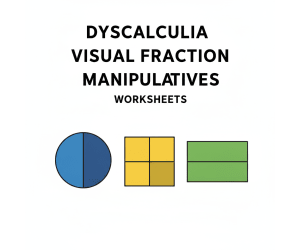
Dyscalculia Visual Fraction Manipulatives
Math, Fractions, Addition and Subtraction, Addition, Subtraction, Graphing, Money, Number Lines, Order Of Operations, Time, Homeschool Curriculum, Homeschool Templates, Grade 3, 4, 5, 6, 7, Worksheets & Printables, Workbooks, Worksheets, Word Searches, Teacher Tools, Assessments, Lesson Plans, Quizzes and Tests, Quizzes, Tests
Change the nature of instruction for fractions, and help all students by using this complete, evidence-based guide for teaching fractions to students who may have any or all of the following: Dyscalculia, Learning Disabilities in Mathematics, or Anxiety with regard to mathematics. Are you an educator or parent looking for an effective way to teach your students with prior difficulties with abstract mathematic concepts? If so, this is the resource for which you have been searching. This is NOT just another worksheet packet. This is a complete neuro-informed intervention system built to circumvent all cognitive barriers common to the students you teach, and create true and lasting understanding of fractions that will be retained for the remainder of the student's educational career. By following the Concrete-Pictorial-Abstract (CPA) framework along with the principles of cognitive science, this guide provides students with a means for teaching fractions in a way that they will finally be able to process and master from their neurodivergent brain perspective. Your students will no longer suffer from mathematics anxiety or the "Whole Number Bias", which results in students believing that 1/8 is greater than 1/3. We use Linear Fraction Bars as a visual aid and High Contrast Visual Mapping to make fractions tangible and explainable to students through the use of their neural systems, thus enabling students to understand fractions as Predictable and Intuitive. We deliberately avoid all of the Circular Fraction Models (i.e., Pizza) that confuse students with poor or absent spatial perception. THIS 37-PAGE COMPREHENSIVE GUIDELINE CONSISTS OF: The Educators Guide: This document consists of an in-depth look at the "why" behind the method in phase one. It will include definitions of the cognitive make-up behind dyscalculia, the incorrectness of standard methods, and the architectural guidelines for creating educational tools, including manipulatives that are compatible with how the brain works. This phase will also include case studies based on individual students that can be utilized in grade-level math classes. The Student Workbook: Phase Two will consist of a sequential ten part set of worksheets that will serve as step-by-step guides for students in grades three through five. In other words, the first page of the ten page guide will help students learn what a numerator and a denominator are before they then will be a part of the worksheet on determining whether two fractions are equal or comparable. The remainder of the pages will continue to follow the same sequence, with the last page covering mixed numbers. The Teacher Resources and Visual Aids Section: This section contains all the resources necessary for teacher's to correctly implement the above two guides. In addition to possessing high-resolution diagnostic diagrams that can be utilized in the classroom, this section also contains an answer key that has been developed with pedagogical notes included, and a clinical implementation guide that contains scripted interventions for how to address common errors made by students. PLEASE NOTE THE FOLLOWING Group: Individuals who provide direct instructional support to students with disabilities and other struggles in mathematics, such as: SE Teachers/Specialists Math Interventionists/ Specialists (Tier 2 & 3) Resource Room/Co-Teach Models Tutor and Educational Therapists Homeschool Parents General Ed Teachers who want to use effective differentiation strategies. Break the cycle of poor math performance. Get your students the tools they need to develop confidence and obtain true mastery of fractions through this master guide through the Math Anxiety. Key Terms: Dyscalculia, Math Intervention, Special Education Math, Fractions, Visual Math, Manipulatives, Math Anxiety, Learning Disabilities, Third, Fourth, Fifth, Grade, Homeschooling, RTI, Math Support, Number Sense, *CPA Framework (Concrete, Picture, Abstract) Teacher’s Guide. Reasons Why Parents/Schools Are Enthusiastic About This Resource: Evidence Based and Neuro-informed: This is truly not just a collection of activities but rather a structured program based on cognitive science; designed specifically to help students whom have dyscalculia. Eliminates Math Anxiety: The clear, visual, step-by-step approach removes uncertainty and abstract confusion which builds student confidence and creates a positive attitude ("I can do math") about math. Comprehensive All-In-One System: The complete package allows educators to save a tremendous amount of time in planning. It contains the theoretical document, the workbook (student-facing) as well as the full answer key that contains additional clinical cues. This resource is ready for immediate use as an intervention resource. Promotes True Understanding, Not Just Rote Memorization: By making fractions physical and visual, this program goes beyond mere memorization of rules and fosters true, deep conceptual understanding, which can be applied to future concepts. Highly Targeted for Intervention: This resource is an excellent Tier 2/3 resource for intervention, special education resource rooms, tutoring, and homeschooling. It provides very powerful and focused support, right where struggling learners require it most. An in-depth analysis of the content, research, and worksheets indicates the primary target audiences are: Special Education Teachers: This is a critical instructional support for teachers within this specialty since the resource was designed specifically for students diagnosed with learning disabilities. Math Interventionists: This resource meets the needs of small groups of students (Tier 2 and Tier 3) who are considerably below grade level in mathematics. Educational Therapists and Tutors: Qualified professionals who provide one-on-one support to students with dyscalculia. Homeschooling Parents: Especially for those children who have a diagnosis or possibly math deficits. Targeted Grade Levels: The component will specifically target grades three, four and five because all of the fractions address fundamental fractions through to adding fractions and mixed numbers, which are all taught at these grade levels. Rewriting Terms: All rights reserved. The author has copyright (Copyrighted by Syed Hammad Rizvi) on this work. A teacher may use this resource for his/her classroom and for private individual use. You may not modify this resource, distribute it, or sell it. You may not publish or make it available on the internet. If you would like to share this resource with your colleagues, please buy additional licenses from Teachsimple. Thank you for being honest and following my copyright terms. This product is made with love by Syed Hammad Rizvi.
Author Creative Book Store
Rating
Tags Dyscalculia, Dyscalculiaresources, Dyscalculiasupport, Mathintervention, Visualmath, Mathmanipulatives, Mathlearningdisability, Specialneedsmath, Neurodivergentlearning, Cpaframework

All About Elevators | Staying Safe Video Lesson
, Not Grade Specific, Lesson Plans, Teacher Tools
This staying safe video lesson is all about elevators. Students will love this engaging and interactive video. This video serves as a great introduction or review video for your learners. This is a 10-minute video lesson.
Author Educational Voice
Tags Transportation, Hotels, Elevators, Safety, Videos

Defining Words Supplementary Materials Grades 3-4 (PDF)
ELA, Language Development, ESL, Common Core, Resources for Teachers, Vocabulary, Grade 3, 4, Worksheets & Printables, Worksheets, Quizzes and Tests, Teacher Tools, Tests, Assessments, Lesson Plans, Activities
Defining Words Supplementary Materials Note: This download DOES NOT include the tests themselves. You can still make use of these materials without them but they are recommended. Download in a format of your choice in the "Links" section below. Outline Ice Breaker (5-10 minutes) Engaging, interactive activity to introduce the lesson’s theme. Examples: Matching games, sentence races, charades, or storytelling challenges. Guided Practice (10-15 minutes) Teacher-led exercises to reinforce the concept. Examples: Sorting sentences by tense, sentence transformations, or fill-in-the-gap exercises. Group or Partner Task (15 minutes) Collaborative activity to practice the lesson’s focus in a fun and engaging way. Examples: Role-play, storytelling, sentence-building games, or small-group discussions. Independent Worksheet (15 minutes) Individual written activity to solidify understanding. Examples: Sentence corrections, verb conjugation drills, or tense identification exercises. Exit Task (5 minutes) Quick reflective activity to assess understanding before students leave. Examples: Writing a sentence using the target concept, identifying a tense, or explaining a rule. Links: Includes: Includes: Match Words to Definition Match Definition to Words Accurately Define Meanings Defining Word Practice Google Docs Google Forms Google Slides PDF PPT Word FULL CATALOG OF DOWNLOAD LINKS HERE Grade 3/4 Links: Adjectives Google Docs Google Forms Google Slides PDF PPT Word Free Supplementary Materials Pack Adverbs Google Docs Google Forms Google Slides PDF PPT Word Free Supplementary Materials Pack Conjunctions Google Docs Google Forms Google Slides PDF PPT Word Free Supplementary Materials Pack Nouns Google Docs Google Forms Google Slides PDF PPT Word Free Supplementary Materials Pack Pronouns Google Docs Google Forms Google Slides PDF PPT Word Free Supplementary Materials Pack Verbs Google Docs Google Forms Google Slides PDF PPT Word Free Supplementary Materials Pack Sentence Structure Google Docs Google Forms Google Slides PDF PPT Word Free Supplementary Materials Pack Present Tense Google Docs Google Forms Google Slides PDF PPT Word Free Supplementary Materials Pack Past Tense Google Docs Google Forms Google Slides PDF PPT Word Free Supplementary Materials Pack Future Tense Google Docs Google Forms Google Slides PDF PPT Word Free Supplementary Materials Pack Context Clues Google Docs Google Forms Google Slides PDF PPT Word Free Supplementary Materials Pack Defining Words Google Docs Google Forms Google Slides PDF PPT Word Free Supplementary Materials Pack Fill the Blanks Google Docs Google Forms Google Slides PDF PPT Word Free Supplementary Materials Pack Homophones Google Docs Google Forms Google Slides PDF PPT Word Free Supplementary Materials Pack Synonyms Google Docs Google Forms Google Slides PDF PPT Word Free Supplementary Materials Pack ELA Review Questions Overview Questions have three answer choices. There are a handful of pictures on each test for aesthetic purposes, as well as a review sheet covering most of the topics covered in the product. Introduction or Example Sheet Each topic will include an introduction or example sheet to go through first with your students. Full Answer Keys Full answer keys and sample responses are provided so no matter how busy you are, you know you're covered! In the Supplementary Pack Interactive Ice Breakers: Fun, hands-on activities that get students thinking about adjectives right from the start. Guided Practice: Teacher-led exercises that reinforce the day’s lesson, ensuring students can confidently identify and use adjectives. Group and Partner Tasks: Collaborative activities that allow students to work together to solve problems, categorize adjectives, and create descriptive sentences. Independent Worksheets: Structured worksheets that provide individual practice and help solidify understanding of key concepts. Exit Tasks: Quick, reflective activities at the end of each lesson that assess understanding and encourage students to apply what they’ve learned. For similar downloads and other frees, do check out Cored Group on TeachSimple.
Author Cored Education
Tags Elementary, Answers, Ccss, Common Core, Tests, Test Prep, Grade 3, Grade 4, Vocabulary, Lesson Plan
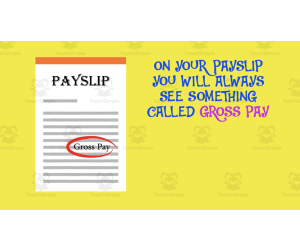
All About Payslips | Financial Literacy Video Lesson
Life Studies, Math, Money, Not Grade Specific, Lesson Plans, Teacher Tools
This financial literacy video lesson is all about Payslips. Students will love this engaging and interactive video as they learn more about money and being responsible with finances. The video begins with introducing students to learning about the definition of a payslip, and then explaining all the sections included on a payslip. These include gross pay, net pay, deductions, income taxes, national insurance, retirement, and other deductions. This All About Payslips | Financial Literacy Video Lesson resource is a very colorful video! It was designed to be used by students with any grade as it is attractive to any of them. This video serves as a great introduction or review video for your learners. This is a 3-minute video lesson. The use of this video All About Payslips | Financial Literacy Video Lesson, may be to complement a Payslips lesson. It may be an introduction to the topic, or a review of the topic at the end of a lesson. The most important is that students are informed about the Payslips and learn about where the money stated as gross pay is distributed. This is done throughout the video in a simple, but direct manner so that students increase their knowledge on the topic.
Author Educational Voice
Tags Money Skills, Financial, Literacy, Earning Money
Pricing and Profit (Full Intro to Business Unit)
Life Studies, Social Studies, Finance, Business, Career, Economics, Grade 8, 9, 10, 11, 12, Teacher Tools, Lesson Plans
Attention, business educators! Unlock the secrets of pricing with this simple and easy to implement "Pricing and Profit" unit – a great tool for your business curriculum ! This unit includes 4 main topics: Overview of Pricing: Get into the fundamentals that set the stage for profitable business. Explore what it means to set price points and try to achieve profitability. How do corporations come to pricing decisions? And more. Pricing Strategies: Explore the most common pricing strategies used in this era of business: Cost-Plus Pricing, Value-Based Pricing, Penetration Pricing, and Skimming Pricing. This chapter takes a look at each of those concepts in-depth. Break-Even Analysis: "What do we need to price things at in order to achieve profitability? This is maybe the most fundamental question about pricing that a business can ask. This portion of the lesson gives them experience actually doing those calculations. Profit Margin Calculations: From gross to net profit margins, this chapter helps students analyze just how big of a margin a business is able to accomplish with its pricing strategy, and how different strategies pursue different levels of profit margins. This teaching package includes many resources – from a helpful and well-made class slideshow to impactful embedded videos, and student-friendly follow-along notes. It's a practical toolkit designed to make your classroom experience both engaging and impactful. In short, this product helps you get back to doing what you do well... focusing on the actual teaching! This product is part of a wider business curriculum . Be on the lookout for similar products from this store! Enjoy, and don't be afraid to reach out with questions, comments, or suggestions.
Author Ed Dynamic
Rating 5
Tags Price, Profit, Pricing, Business, Economics, Finance, Profit Margin, Break Even Analysis, Entrepreneurship

G 3–5 Health Curriculum | Nutrition & Physical Education Activities
P.E. & Health, Grade 3, 4, 5, Lesson Plans, Teacher Tools, Worksheets & Printables
Nutrition & Physical Literacy Curriculum | Complete Health Curriculum for Grades 3–5 | Health, PE & Wellness Activities Looking for a comprehensive Nutrition & Physical Literacy curriculum that makes teaching health engaging, meaningful, and easy to implement? This complete Grades 3–5 Health Curriculum includes everything you need to teach nutrition, fitness, healthy habits, sportsmanship, personal wellness, and informed decision-making through high-interest reading passages, hands-on activities, data analysis, writing, vocabulary, and real-world application. Designed for upper elementary classrooms, this low-prep resource helps students build healthy habits that last a lifetime while strengthening literacy and critical thinking skills across the curriculum. With over 600 printable pages , six comprehensive instructional units, and an extensive collection of teacher resources, assessments, and classroom materials, this complete curriculum makes health instruction simple, engaging, and standards-aligned. ⭐ What's Included This complete curriculum includes: Core Curriculum ✅ Complete Teacher Guide with lesson plans, differentiation, facilitation notes, pacing guide, and answer guidance ✅ 392 student activity pages ✅ Six complete instructional units ✅ 23 engaging health and physical literacy topics ✅ Reading passages ✅ Vocabulary development ✅ Graphic organizers ✅ Data analysis and graphing activities ✅ Hands-on learning tasks ✅ Weekly challenges ✅ Discussion prompts ✅ Writing activities ✅ Reflection pages ✅ Real-world application activities Bonus Teacher Resources ✅ Answer Key ✅ Assessment Rubrics (including editable rubric) ✅ Unit Tests ✅ Exit Tickets ✅ Vocabulary Cards (126 terms) ✅ Concept Flashcards ✅ Classroom Posters ✅ Award Certificates ✅ Parent Letters ✅ Progress Checklists ✅ Editable Planning Documents Over 600 printable pages are included across all files, making this a complete, year-long health and wellness resource. ❤️ Topics Covered Unit 1: Nutrition Basics Unit 1: Nutrition Basics Students learn about: Food Groups Nutrients Healthy Snacks Reading Nutrition Labels Unit 2: Physical Activity Students explore: Fitness Components Daily Physical Activity Warm-Ups Cool-Downs Unit 3: Healthy Lifestyle Lessons include: Sleep Hydration Screen Time Hygiene Unit 4: Sports Skills Students develop: Teamwork Fair Play Coordination Goal Setting in Sports Unit 5: Healthy Decisions Students investigate: Food Advertising Sugar Processed Foods Portion Sizes Unit 6: Personal Wellness Students focus on: Healthy Habits Personal Goal Setting Reflection & Personal Growth Every topic includes engaging reading, vocabulary, graphic organizers, data analysis, discussion, hands-on activities, and reflection to help students apply what they learn in meaningful ways. 🏫 How It Works in the Classroom This curriculum is designed to be flexible and easy to teach. Use it for: Health Class Physical Education Classroom Health Lessons Science Connections Literacy Integration Morning Meeting Small Groups Intervention Homeschool Summer Learning Each lesson follows a consistent instructional sequence: Read & Learn Vocabulary Practice Comprehension Questions Graphic Organizer Data Analysis Hands-On Application Discussion Reflection Assessment Lessons are designed for approximately 45–60 minutes and can easily be divided into shorter class periods. 🎯 Standards & Learning Goals Students will learn to: Build healthy eating habits Understand food groups and nutrients Read Nutrition Facts labels confidently Develop lifelong physical activity habits Improve fitness knowledge Practice healthy sleep and hydration habits Balance screen time responsibly Understand hygiene and disease prevention Demonstrate teamwork and sportsmanship Make healthy food choices Analyze advertising critically Set personal health goals Reflect on personal wellness and growth ❤️ Why Teachers Love It ⭐ Complete Nutrition & Physical Literacy curriculum for Grades 3–5 ⭐ Over 600 printable pages with everything needed for instruction ⭐ Low-prep, print-and-teach lessons ⭐ Integrates reading, writing, science, health, and physical education ⭐ Consistent lesson structure saves planning time ⭐ Hands-on activities keep students engaged ⭐ Includes assessments, rubrics, tests, exit tickets, and answer keys ⭐ Editable planning tools simplify lesson organization ⭐ Parent communication resources strengthen home-school connections ⭐ Classroom posters, vocabulary cards, flashcards, and certificates extend learning beyond individual lessons ⭐ Perfect for classroom teachers, PE teachers, health educators, homeschool families, intervention teachers, and enrichment programs 📚 Help Students Build Lifelong Healthy Habits Give your students the knowledge and confidence to make healthy choices with this engaging Nutrition & Physical Literacy Curriculum for Grades 3–5 . Combining literacy, science, health, physical education, and real-world application, this comprehensive program helps students develop healthy habits, critical thinking skills, and lifelong wellness while making health instruction easy, organized, and engaging for teachers.
Author Bright Classroom Ideas Marketplace
Rating
Tags Nutrition, Health, Physical, Activities, Yearlong, Curriculum, Full Year, Back To School
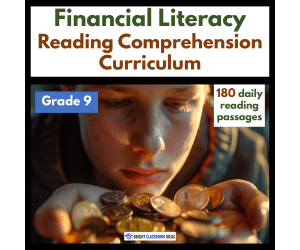
Grade 9 Financial Literacy Reading Comprehension | 180 Daily Passages
ELA, Finance, Life Studies, Grade 9, Lesson Plans, Teacher Tools, Worksheets & Printables
Grade 9 Financial Literacy Reading Comprehension Curriculum | 180 Daily Personal Finance Activities Prepare high school students for real-world financial success with this comprehensive Grade 9 Financial Literacy Reading Comprehension Curriculum . This year-long resource combines rigorous nonfiction reading passages with advanced personal finance concepts, helping students strengthen reading comprehension, critical thinking, vocabulary, and analytical writing while developing the financial literacy skills they need for adulthood. What's Included ✔ 180 daily financial literacy reading passages ✔ 12 comprehensive financial literacy units ✔ Daily academic vocabulary development ✔ Text-dependent reading comprehension questions ✔ Critical-thinking writing prompts ✔ Charts, graphs, and financial data analysis activities ✔ Student Workbook ✔ Teacher's Guide with pacing, instructional strategies, and differentiation ✔ Complete Answer Key with model responses ✔ Diagnostic pre-assessment ✔ 12 unit quizzes ✔ Cumulative final exam ✔ Writing rubrics and assessment tools ✔ Print-and-go or digital learning flexibility How It Works in the Classroom This flexible curriculum is ideal for: • Personal Finance classes • Economics courses • Financial Literacy electives • Bell ringers • Daily reading comprehension practice • Career readiness instruction • Advisory or homeroom • Independent practice • Homework • Sub plans • Small-group intervention Each daily lesson features an engaging nonfiction passage focused on authentic financial concepts, followed by vocabulary development, text-based comprehension questions, and an evidence-based writing activity. Many lessons include charts or financial data, encouraging students to analyze information, apply economic reasoning, and make real-world financial decisions. Standards & Learning Goals Students develop essential knowledge in: Money, Markets & The Economy • Functions of money • Markets and pricing • Supply and demand • Inflation and purchasing power • Central banking • Global trade and globalization • Cryptocurrency and digital payments Income & Career Planning • Earned vs. unearned income • Wages, salaries, and total compensation • Paychecks and deductions • Career planning • Labor markets • Freelancing and entrepreneurship Budgeting & Financial Planning • Budget creation • Financial goals • Emergency funds • Money management strategies Banking, Credit & Borrowing • Banking services • Credit scores • Responsible borrowing • Debt management Interest & Investing • Simple and compound interest • Time value of money • Stocks, bonds, diversification, and investing Taxes, Consumer Skills & Risk Management • Taxes and public finance • Smart consumer decision-making • Insurance • Risk management • Entrepreneurship and economic thinking Why Teachers Love It ⭐ Complete 180-day financial literacy curriculum ⭐ Combines rigorous reading comprehension with real-world personal finance ⭐ Minimal daily prep required ⭐ Develops financial literacy, reading, writing, vocabulary, and critical-thinking skills simultaneously ⭐ Includes built-in assessments throughout the year ⭐ Supports differentiated instruction for diverse learners ⭐ Includes complete answer keys for fast grading ⭐ Flexible for whole-class instruction, intervention, homework, or independent work ⭐ Uses authentic financial scenarios that prepare students for adulthood ⭐ Builds confidence in personal finance, economics, and responsible decision-making Perfect For ✔ Grade 9 Financial Literacy ✔ High School Personal Finance ✔ Economics Classes ✔ Reading Comprehension Warm-Ups ✔ Career Readiness ✔ Financial Literacy Electives ✔ Homeschool Curriculum ✔ Advisory Classes ✔ Independent Practice ✔ Year-Long Personal Finance Curriculum If you're looking for Grade 9 financial literacy worksheets , high school personal finance activities , financial literacy reading comprehension passages , economics reading comprehension , or a complete year-long financial literacy curriculum , this resource provides everything you need to help students become informed consumers, thoughtful decision-makers, and financially responsible adults. Download today and give students engaging, standards-aligned financial literacy lessons that connect classroom learning to real-life financial success!
Author Bright Classroom Ideas Marketplace
Rating
Tags Reading, Comprehension, Writing, Financial, Literacy, Ela, Worksheet, Yearlong, Curriculum, Full Year

All About Reptiles | Animated Animals Video Lesson
Science, Life Sciences, Animals, Grade 3, 4, 5, 6, 7, Lesson Plans, Teacher Tools
All About Reptiles | Animated Animals Video Lesson This 6-minute animated science video engages students while teaching them about the animal group - reptiles. Through vivid images and clear narration, learners explore what defines a reptile and examine their unique traits like scales, cold blood, and laying eggs. Educators can utilize this lively footage to introduce the reptile classification in a memorable way or review key characteristics. Whether presented to an entire class or smaller groups, the focused content suits various learning styles. Assign as prep work before a herpetology unit or reptile craft. Let the vivid scenes spark discussion about local species or have students journal interesting facts afterward. This lively resource suits grades 3-7.
Author Educational Voice
Tags Reptiles, Science Lesson, Science Video, Reptiles Activity, Frogs

Adverbs Supplementary Materials Grades 3-4 (PDF)
ELA, Language Development, ESL, Grammar, Common Core, Resources for Teachers, Grade 3, 4, Worksheets & Printables, Worksheets, Quizzes and Tests, Teacher Tools, Tests, Assessments, Lesson Plans, Activities
Adverbs Supplementary Materials Note: This download DOES NOT include the tests themselves. You can still make use of these materials without them but they are recommended. Download in a format of your choice in the "Links" section below. Outline Ice Breaker (5-10 minutes) Engaging, interactive activity to introduce the lesson’s theme. Examples: Matching games, sentence races, charades, or storytelling challenges. Guided Practice (10-15 minutes) Teacher-led exercises to reinforce the concept. Examples: Sorting sentences by tense, sentence transformations, or fill-in-the-gap exercises. Group or Partner Task (15 minutes) Collaborative activity to practice the lesson’s focus in a fun and engaging way. Examples: Role-play, storytelling, sentence-building games, or small-group discussions. Independent Worksheet (15 minutes) Individual written activity to solidify understanding. Examples: Sentence corrections, verb conjugation drills, or tense identification exercises. Exit Task (5 minutes) Quick reflective activity to assess understanding before students leave. Examples: Writing a sentence using the target concept, identifying a tense, or explaining a rule. Links: Includes: When Adverbs Where Adverbs How Adverbs Mistake Finding Google Docs Google Forms Google Slides PDF PPT Word FULL CATALOG OF DOWNLOAD LINKS HERE Grade 3/4 Links: Adjectives Google Docs Google Forms Google Slides PDF PPT Word Free Supplementary Materials Pack Adverbs Google Docs Google Forms Google Slides PDF PPT Word Free Supplementary Materials Pack Conjunctions Google Docs Google Forms Google Slides PDF PPT Word Free Supplementary Materials Pack Nouns Google Docs Google Forms Google Slides PDF PPT Word Free Supplementary Materials Pack Pronouns Google Docs Google Forms Google Slides PDF PPT Word Free Supplementary Materials Pack Verbs Google Docs Google Forms Google Slides PDF PPT Word Free Supplementary Materials Pack Sentence Structure Google Docs Google Forms Google Slides PDF PPT Word Free Supplementary Materials Pack Present Tense Google Docs Google Forms Google Slides PDF PPT Word Free Supplementary Materials Pack Past Tense Google Docs Google Forms Google Slides PDF PPT Word Free Supplementary Materials Pack Future Tense Google Docs Google Forms Google Slides PDF PPT Word Free Supplementary Materials Pack Context Clues Google Docs Google Forms Google Slides PDF PPT Word Free Supplementary Materials Pack Defining Words Google Docs Google Forms Google Slides PDF PPT Word Free Supplementary Materials Pack Fill the Blanks Google Docs Google Forms Google Slides PDF PPT Word Free Supplementary Materials Pack Homophones Google Docs Google Forms Google Slides PDF PPT Word Free Supplementary Materials Pack Synonyms Google Docs Google Forms Google Slides PDF PPT Word Free Supplementary Materials Pack ELA Review Questions Overview Questions have three answer choices. There are a handful of pictures on each test for aesthetic purposes, as well as a review sheet covering most of the topics covered in the product. Introduction or Example Sheet Each topic will include an introduction or example sheet to go through first with your students. Full Answer Keys Full answer keys and sample responses are provided so no matter how busy you are, you know you're covered! In the Supplementary Pack Interactive Ice Breakers: Fun, hands-on activities that get students thinking about adjectives right from the start. Guided Practice: Teacher-led exercises that reinforce the day’s lesson, ensuring students can confidently identify and use adjectives. Group and Partner Tasks: Collaborative activities that allow students to work together to solve problems, categorize adjectives, and create descriptive sentences. Independent Worksheets: Structured worksheets that provide individual practice and help solidify understanding of key concepts. Exit Tasks: Quick, reflective activities at the end of each lesson that assess understanding and encourage students to apply what they’ve learned. For similar downloads and other frees, do check out Cored Group on TeachSimple.
Author Cored Education
Tags Elementary, Answers, Ccss, Common Core, Grammar, Tests, Test Prep, Grade 3, Grade 4, Lesson Plan
Prompt Engineering & Ethical AI for Digital Creators:Launch Your Creat
Science, Technology, Computer Science, Engineering, STEM, Research, Resources for Teachers, Community Building, Classroom Management, Homeschool Curriculum, Grade 8, 9, 10, 11, 12, Activities, Games, Projects, Teacher Tools, Assessments, Lesson Plans, Literacy Readers, Workbooks, Worksheets & Printables, Writing Prompts
This book, "Prompt Engineering & Ethical AI for Digital Creators: Launch Your Creative Career," written by Syed Hammad Rizvi, is a guide for high school aged teens (14-18) interested in pursuing a creative career using Artificial Intelligence (AI). This is the only resource you need to learn about creating AI Art, using Writing Tools to create content, and understanding the fundamentals of Computer Science. You will learn about prompt engineering to create either stunning visuals from text-to-image or write compelling stories using large language model systems. You will also explore the applications of audio and video technology where you can use emerging Artificial Intelligence to make your career as a digital creator. Additionally, you will become familiar with ethical practices about how to avoid bias, copyright infringement, and promote responsible innovation. You will have the opportunity to build a portfolio of your digital artwork on sites like Artstation and Behance, and learn different ways to monetize your work like selling artwork on Etsy, offering prompt engineering services, and licensing your creations on stock platforms. This guide provides valuable information for aspiring digital creators (artists, writers, designers, and technology lovers) who are looking for beginner level AI tutorials, ethical AI education, and also provides practical steps for starting a successful creative career in the growing field of AI. The information in this guide is ideal for homeschooled students, classroom curriculum, or independent self-study, and will enable you to equip your teen with valuable generative AI, digital design, and content marketing skills that will provide them a successful future. Benefits for Parents and Schools: The curriculum gives students many future-proof skills relevant to working with AI. It focuses on teaching students how to equip themselves with practical AI tools, as well as prompt engineering techniques, so they can succeed in new creative industries such as digital art and content creation. Another great part of this program is that it places a strong emphasis on teaching ethical and responsible ways of using AI. Students will learn how to avoid bias, protect their privacy, and make moral decisions when using ethical AI in a technology-driven world. Hands-on learning: Students will gain an understanding of the theories of AI through real-world examples and opportunities to be creative using AI in conjunction with their own ideas. The program takes a career launch approach, showing students how to build a portfolio, network, and monetize their skills so they will be well-prepared to enter professional careers in technology, design, and media. The curriculum is suitable for high school-aged children, with a logical progression of chapters, making it easy to integrate into the classroom, home, or independent study. Target Student Groups [Classes]: Based on a complete review of the content of this book, the organization of information within it, and the stated focus of the intended audience (which is explicitly for high school students interested in AI creativity and has chapters on basic concepts through advanced applications of AI in art, writing, ethical issues, etc.), the book is primarily designed for students in grades 9-12 (ages 14-18). These levels coincide with introductory to intermediate levels in: Computer Science (focusing on understanding basic AI concepts, generative models, and the ethical use of computers). Art & Design (focusing on using AI to create visual images, illustrations, clothing and architecture). Creative Writing / English (focusing on using AI to create plots / stories ), / dialogue, and other forms of text). Career & Technical Education (CTE) or Digital Media (including developing portfolios and monetizing your creative work). Other elective or club (e.g. STEM, art, and innovation) or extracurricular programs for students interested in investigating issues related to ethical and creative uses of AI. Copyright/Terms of Use: Copyright for this Book: All Rights Reserved by Syed Hammad Rizvi. This resource is for personal use only, as well as single classroom use. You cannot alter, redistribute or sell any part of this resource. You also cannot post this resource on the Internet in any way that would allow others access to it or to download it from the Internet. If you would like to share this resource with your colleagues, please purchase another license from Teachsimple. Thank you for cooperating with these terms of use. This product is proudly supplied to you by Syed Hammad Rizvi
Author Creative Book Store
Rating
Tags AIPromptEngineering, EthicalAI, DigitalCreators, LaunchCreativeCareer, AIForTeens, PromptEngineeringGuide, AIArtGeneration, AIWritingTools, GenerativeAI, TextToImageAI

All About Rain, Wind & Snow | Animated Weather Video Lesson
Science, Earth and Environmental Sciences, Environmental Science, Not Grade Specific, Lesson Plans, Teacher Tools
All About Rain, Wind & Snow | Animated Weather Video Lesson This educational resource is a comprehensive tool for educators, from public school teachers to homeschooling parents providing a detailed understanding of essential Environmental Science concepts related to weather. The pedagogical content effectively serves a broad range of grade levels. By transcending the scope of traditional textbooks, it aids in making education lively and alluring. At its core is an interactive 8-minute animated video that elucidates different aspects of weather - rain, wind and snow. This MP4 file eases sharing across various platforms making it versatile for diverse mediums – be it projectors or computers or tablets. Versatility of Use: This educational tool can be utilized efficiently over multiple teaching strategies such as introducing new topics as well as reinforcing already taught materials with real world visuals. This could be also part of Guided Reading curriculum used in small groups, helping students engage more visually while building their science vocabulary simultaneously. Possible Applications: This video lesson might be used during homework assignments ensuring conceptual absorption at individual level. It can also transform regular classroom activities into collaborative knowledge-sharing sessions. Incorporating this unique All About Rain Wind & Snow | Animated Weather Video Lesson into academic resources not only sparks excitement among learners but also transforms challenging weather concepts into readily comprehensible knowledge while igniting their natural curiosity about environment sciences. </p
Author Educational Voice
Tags Weather, Rain, Wind, Snow, Science
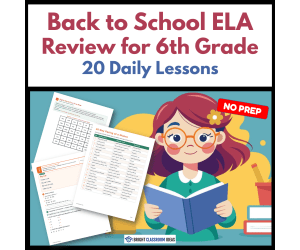
Back to School ELA Review for 6th Grade | 20 Daily Lessons
ELA, Grade 6, Assessments, Teacher Tools, Lesson Plans, Worksheets & Printables
Start the school year with a rigorous yet manageable 6th grade back to school ELA review designed to revisit essential Grade 5 reading, grammar, vocabulary, word study, and writing skills. With 20 daily lessons plus 16 print-and-play literacy games , this resource helps sixth graders refresh key skills, build confidence, and transition into middle school ELA routines. Each lesson follows a predictable four-part rhythm— Read & Think, Language & Grammar, Word Work, and Write About It —with a full lesson designed for approximately 15–25 minutes . Skills spiral across the 20 days, moving from focused review into more complex analysis, evidence, argument, editing, vocabulary, and reflection. What’s Included This 6th grade ELA review includes: ✅ 20 daily ELA review lessons ✅ 40 pages of daily student lessons ✅ Short fiction and nonfiction passages ✅ Reading comprehension questions ✅ Central idea and summary practice ✅ Theme and character development ✅ Inference and text evidence practice ✅ Claim and evidence activities ✅ Evaluating evidence practice ✅ Grammar and language review ✅ Vocabulary and word study ✅ Greek and Latin roots ✅ Advanced prefixes and suffixes ✅ Academic vocabulary ✅ Daily writing prompts ✅ 16 print-and-play literacy games and activities ✅ Partner and small-group activities ✅ Literacy center options ✅ Complete answer key for all 20 days ✅ Teacher Guide ✅ 20-day pacing overview ✅ Four-week planning guide ✅ Differentiation suggestions ✅ Game preparation directions ✅ Game-to-skill quick-reference map ✅ Class progress record sheet ✅ Family letter ✅ Student reflection ✅ Reading Star Award The 68-page Student Workbook contains 20 daily lessons plus 16 print-and-play games for centers, partners, small groups, and independent practice. The separate Answer Key provides complete responses for all 20 daily lessons, organized by section for faster checking, with reasonable student wording accepted for open writing and reflection tasks. How It Works in the Classroom Use this 6th grade back to school ELA review for morning work, bell ringers, whole-group warm-ups, independent practice, literacy centers, small groups, intervention, homework, early finishers, or beginning-of-year formative assessment. Each daily lesson follows the same student-friendly structure: 📖 Read & Think — Students read a short fiction, nonfiction, or persuasive passage and answer four comprehension questions, including inference and text-evidence items ✏️ Language & Grammar — Students revisit a focused Grade 5 language skill 🔤 Word Work — Students practice Greek and Latin roots, advanced affixes, context clues, connotation and denotation, figurative language, analogies, shades of meaning, and academic vocabulary 📝 Write About It — Students complete a short writing task connected to the day’s passage and thinking The Teacher Guide recommends previewing the genre, asking students to identify evidence behind their answers, modeling the first grammar item, and then releasing students to work independently or with a partner. The 20-Day Pacing at a Glance chart on page 6 of the Teacher Guide visually maps the full progression across reading, language, and word work. Students move from central idea and summary, theme development, character development, tone and mood, and plot and conflict into inference and evidence, cause and effect, compare and contrast, author’s purpose and perspective, point of view, text structure, claim and evidence, evaluating evidence, citing evidence, drawing conclusions, comparing across texts, mixed review, and final reflection. For a four-week routine, teachers can assign workbook lessons Monday through Thursday and use Friday for a game, literacy center rotation, or catch-up. The suggested planning guide pairs each week with targeted games based on the skills being reviewed. Standards & Learning Goals This Grade 5 skills review for 6th grade revisits key learning across five major ELA strands: 📚 Reading Comprehension — central idea and summary, theme development, character development, tone and mood, plot and conflict, inference and evidence, cause and effect, compare and contrast, author’s purpose and perspective, point of view, text structure, claim and evidence, evaluating evidence, citing evidence, drawing conclusions, making inferences, comparing across texts, and mixed reading review ✏️ Grammar & Language — independent and dependent clauses, simple/compound/complex sentences, pronoun case, active and passive voice, subject-verb agreement, phrases and clauses, commas and semicolons, colons and lists, punctuating titles and dialogue, apostrophes and possessives, parallel structure, misplaced modifiers, capitalization, consistent tense and voice, transitions, comprehensive editing, commonly confused words, concise language, and mixed grammar review 🔤 Word Study — Greek and Latin roots, roots and affixes, advanced prefixes, suffixes, affix meanings, and root review 💬 Vocabulary — context clues, connotation and denotation, homographs, homophones, figurative language, idioms, analogies, shades of meaning, academic vocabulary, word relationships, and mixed vocabulary review 📝 Writing — summary writing, argument writing, claim and evidence, character analysis, mood and setting description, cause-and-effect explanation, compare-and-contrast writing, persuasive writing, problem-solution writing, text-based responses, concise language, inference-based writing, narrative continuation, and reflection The daily workbook intentionally pairs skills across strands. For example, Day 1 combines central idea and summary with independent and dependent clauses plus roots and affixes ; Day 8 combines compare and contrast with colons and lists plus homophones ; Day 12 combines claim and evidence with misplaced modifiers and connotation ; and Day 18 combines comparing across texts with concise language and root review . Why Teachers Love It ✨ Build a consistent first-month routine. The same four-part structure repeats across all 20 days, helping students know what to expect while building independence. ✨ Review multiple ELA strands in one resource. Reading comprehension, grammar, vocabulary, word study, and writing are integrated into manageable daily practice. ✨ Get 20 days of ready-to-use review. The pacing is already mapped, and the visual chart on page 6 of the Teacher Guide shows exactly how reading, language, and word-work skills spiral across the month. ✨ Strengthen middle school reading readiness. Students practice central idea, theme development, tone and mood, inference, evidence, author’s perspective, point of view, text structure, argument, evaluating evidence, citing evidence, drawing conclusions, and comparing across texts. ✨ Revisit rigorous Grade 5 grammar skills. Practice includes clauses, sentence structure, pronoun case, active and passive voice, subject-verb agreement, semicolons, colons, parallel structure, modifiers, dialogue punctuation, apostrophes, transitions, concise language, and comprehensive editing. ✨ Build stronger vocabulary and morphology skills. Students work with Greek and Latin roots, advanced prefixes and suffixes, context clues, connotation and denotation, homographs, homophones, idioms, figurative language, analogies, shades of meaning, and academic vocabulary. ✨ Include meaningful writing every day. Students summarize, argue, compare, explain, cite details, describe mood, evaluate claims, continue narratives, write inference-based scenes, and reflect on growth. ✨ Add hands-on practice with 16 literacy games and activities , including: Clause Sort Root Word Match Synonym Match Roll-a-Root Word Academic Vocabulary BINGO Multisyllable Roll & Read Prefix Sort Antonym Match Reading Road Race Central Idea Baskets Claim or Evidence Sort Sentence Building Tiles Fix-It Cards Sequence Cards Homophone Match Figurative Language Sort The Game → Skill Quick Map on page 9 of the Teacher Guide pairs each activity with its target skill, including independent and dependent clauses, Greek and Latin roots, academic vocabulary, reading fluency, advanced prefixes, central idea and details, claim versus evidence, compound-complex sentences, editing, text structure, commonly confused words, and figurative language. ✨ Prep once and reuse throughout the year. The Teacher Guide recommends printing game pages on cardstock, laminating boards and cards, cutting pieces apart, and storing each game in a labeled bag for repeated use. ✨ Differentiate without creating entirely separate lessons. The Teacher Guide includes support ideas for below-level students, on-level learners, above-level students, and multilingual learners. ✨ Use daily work as low-stakes formative assessment. The Class Record Sheet on page 10 of the Teacher Guide provides Week 1 through Week 4 tracking columns plus a notes section, making it easier to identify skills that may need reteaching. ✨ Save time checking student work. The included Answer Key covers all 20 days and organizes responses by day and section for quick reference. ✨ Support home-school communication. A ready-to-send family letter explains the daily ELA review routine and offers simple ideas for supporting reading and language practice at home. Give students a confident, structured start to sixth grade with this 6th grade back to school ELA review . Download it for 20 days of Grade 5 skills review, daily reading and writing practice, focused grammar and vocabulary work, plus 16 print-and-play literacy games that extend learning into centers, partner work, small groups, bell ringers, and early-finisher routines. Perfect for teachers searching for 6th grade morning work , sixth grade bell ringers, Grade 5 skills review, beginning-of-year ELA activities, middle school ELA review, sixth grade literacy centers, reading comprehension practice, grammar review, academic vocabulary, Greek and Latin roots, claim and evidence practice, first month of school activities, formative assessment, or a complete back-to-school literacy review.
Author Bright Classroom Ideas Marketplace
Rating
Tags Back To School, Assessment, Daily, Ela, Lesson, Reading, Writing, Grammar

Cells Reading Comprehension Passage - Cored Ed Encyclopedia
ELA, Language Development, Reading Comprehension, Reading, Pre-Reading, Life Sciences, Science, Technology, History, Social Studies, Grade 2, 3, 4, 5, Worksheets & Printables, Worksheets, Teacher Tools, Centers, Activities, Writing Prompts, Assessments, Quizzes and Tests, Quizzes, Lesson Plans
This cells reading comprehension with lesson plan includes: Visualization (on the front cover) Start your lesson by taking a minute to think and share something about the topic. Read the script aloud (slowly), perhaps prepare some music or sound effects. Student close their eyes and let their imaginations wander. Students open their eyes, read the question aloud and give them a few minutes to complete. Ask a few students to share or keep answers until the end to compare with what they learn in the passage. Quick pause—thousands of Cored Education products are included with your TeachSimple membership. Download links and encyclopedia index available here. Pre-Reading Trivia Students will write down one thing they already know about the subject and then read five more facts and discuss. These facts are fun, and the students will enjoy learning about the subject before reading more. Give 1 minute for students to write what they already know (no pressure—best guess is fine). Read the five facts together. After each fact, do ask a student for their opinion, was it surprising? Set a purpose by asking students to highlight/underline one fact they want to learn more about during the reading. Reading Passage The text is a high-interest reading passage with set paragraphs, roughly three to four paragraphs long. It contains a variety of themes about the topic, anywhere from history to technology. The passage is between 250 and 350 words in length. First, ask students to look at the headings and see what they’ll learn about today. What do they know about the topic/heading? First read options: Teacher read-aloud (best for support). Partner reading (paragraph by paragraph). While reading, students underline important details, and vocabulary words they think may come up in the questions section. Mixed Questions The first question page contains four multiple-choice questions, each with a choice of four answers, and three written response questions that require a sentence or two from the student. Students complete the mcqs first independently, then review quickly as a class. For the 3 written responses, try to get students giving the answer with some form of evidence: “I think ___ because the text says ___.” If students get stuck, send them back to check the passage. Vocabulary Questions Practice seven key words from the text in this section across two activities. First section is scrambled words where students will unscramble three words given a clue for each. The second section is a word to meaning matching activity. Before starting, have some students read out words they underlined in the passage. Ask students to say the word and read aloud the sentence(s) around each word. Ask students to do scrambled words and the matching exercise in pairs then go through answers as a class. For the scrambled spelling task, get four pairs to come up to the board and write the words for extra practice with the other student reading out the clue. For the matching task, prompt students to give full sentences: “I matched ___ with ___ because ___.” Creative Writing In this question, the student will be required to write a five to eight sentence paragraph on a question related to the topic. Before starting, ask students write down 3 key ideas they are going to include in their piece. Ask students for ideas to share around the class to help those struggling. Pro writing expectations: 5–8 sentences At least 2 facts or details from the passage At least 2 vocabulary words from the previous page Students read their paragraphs while classmates listen for facts and vocabulary words. Extension Activities This page is optional for fast finishers or to take home. There are several activities, each one requiring a different skill. Do some, do none, do all, completely optional - but you will feel reassured knowing every possibility is planned for. Includes summary writting question and additional facts. Answer Key There are answers for the multiple-choice questions, written response questions have sample answers, vocabulary answers and if there is a summary question then a sample summary will be provided as well. Lesson Plan Included Customized lesson plan for this lesson is included. Lesson Snapshot Title: Cells Genre: Nonfiction (informational science text with headings) Subject: Life Science / Reading (Informational Text) Primary Topic: Cell discovery, parts, and how cells work Estimated Guided Reading Level (A–Z): Q What This Lesson Teaches Best Explains how scientists first described “cells” by observing cork under a microscope (Robert Hooke, 1665). Shows how improved lenses led to new discoveries, including seeing living tiny organisms and developing the idea that living things are built from cells. Teaches core cell-part functions using a clear analogy (a cell as a “busy little city”), including membrane, nucleus/DNA, and organelles. Highlights differences and similarities across living things (one-celled organisms vs. animals with trillions of cells working in teams). Introduces the idea of cell division and specialization as a way living things grow and heal. Learning Goals Students will explain why Robert Hooke used the word “cells” for what he saw in cork. Students will describe how better microscopes changed what scientists could observe. Students will identify key cell parts named in the text and describe what each does. Students will compare one-celled organisms with animals made of many cells, using details from the passage. Students will describe what the passage says about how new cells form. Key Vocabulary From the Text membrane — thin “skin” that separates inside from outside. nucleus — cell center part that holds DNA. organelles — tiny cell parts with special jobs. mitochondria — parts that help release energy from food. chloroplasts — green parts that capture sunlight. FULL CATALOG OF DOWNLOAD LINKS AND ENCYCLOPEDIA INDEX HERE
Author Cored Education
Rating
Tags Vocabulary, Reading Comprehension, Reading Passages, Lesson Plans, Ela Lesson Plans, Reading Comprehension Lesson Plans, Pre-reading, Science Lesson Plans, Life Science, History
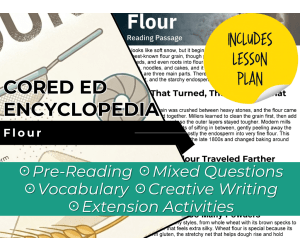
Flour Reading Comprehension Passage - Cored Ed Encyclopedia
ELA, Reading Comprehension, Reading, Science, Technology, Language Development, Social Studies, History, Pre-Reading, Life Sciences, Grade 2, 3, 4, 5, Worksheets & Printables, Worksheets, Teacher Tools, Centers, Activities, Writing Prompts, Assessments, Quizzes and Tests, Quizzes, Lesson Plans
This flour reading comprehension with lesson plan includes: Visualization (on the front cover) Start your lesson by taking a minute to think and share something about the topic. Read the script aloud (slowly), perhaps prepare some music or sound effects. Student close their eyes and let their imaginations wander. Students open their eyes, read the question aloud and give them a few minutes to complete. Ask a few students to share or keep answers until the end to compare with what they learn in the passage. Quick pause—thousands of Cored Education products are included with your TeachSimple membership. Download links and encyclopedia index available here. Pre-Reading Trivia Students will write down one thing they already know about the subject and then read five more facts and discuss. These facts are fun, and the students will enjoy learning about the subject before reading more. Give 1 minute for students to write what they already know (no pressure—best guess is fine). Read the five facts together. After each fact, do ask a student for their opinion, was it surprising? Set a purpose by asking students to highlight/underline one fact they want to learn more about during the reading. Reading Passage The text is a high-interest reading passage with set paragraphs, roughly three to four paragraphs long. It contains a variety of themes about the topic, anywhere from history to technology. The passage is between 250 and 350 words in length. First, ask students to look at the headings and see what they’ll learn about today. What do they know about the topic/heading? First read options: Teacher read-aloud (best for support). Partner reading (paragraph by paragraph). While reading, students underline important details, and vocabulary words they think may come up in the questions section. Mixed Questions The first question page contains four multiple-choice questions, each with a choice of four answers, and three written response questions that require a sentence or two from the student. Students complete the mcqs first independently, then review quickly as a class. For the 3 written responses, try to get students giving the answer with some form of evidence: “I think ___ because the text says ___.” If students get stuck, send them back to check the passage. Vocabulary Questions Practice seven key words from the text in this section across two activities. First section is scrambled words where students will unscramble three words given a clue for each. The second section is a word to meaning matching activity. Before starting, have some students read out words they underlined in the passage. Ask students to say the word and read aloud the sentence(s) around each word. Ask students to do scrambled words and the matching exercise in pairs then go through answers as a class. For the scrambled spelling task, get four pairs to come up to the board and write the words for extra practice with the other student reading out the clue. For the matching task, prompt students to give full sentences: “I matched ___ with ___ because ___.” Creative Writing In this question, the student will be required to write a five to eight sentence paragraph on a question related to the topic. Before starting, ask students write down 3 key ideas they are going to include in their piece. Ask students for ideas to share around the class to help those struggling. Pro writing expectations: 5–8 sentences At least 2 facts or details from the passage At least 2 vocabulary words from the previous page Students read their paragraphs while classmates listen for facts and vocabulary words. Extension Activities This page is optional for fast finishers or to take home. There are several activities, each one requiring a different skill. Do some, do none, do all, completely optional - but you will feel reassured knowing every possibility is planned for. Includes summary writting question and additional facts. Answer Key There are answers for the multiple-choice questions, written response questions have sample answers, vocabulary answers and if there is a summary question then a sample summary will be provided as well. Lesson Plan Included Customized lesson plan for this lesson is included. Lesson Snapshot Title: Flour Genre: Nonfiction (Informational Text) Subject: Science (Food Science) / Reading (Informational Text) Primary Topic: How flour is made from seeds and grains Estimated Guided Reading Level (A–Z): P What This Lesson Teaches Best Explains what flour is made from: flour begins as a seed , and people grind grains (and other plants) into powder used for many foods. Teaches the three main parts inside a grain seed — bran , germ , and endosperm —and what each part is like. Describes how milling changed over time, from heavy stones to steel rollers and lots of sifting to make very fine flour. Builds understanding of why white flour became popular (it kept longer) and what “enriched” flour means in this text. Connects ingredient science to baking by explaining how wheat proteins can form gluten , helping dough rise and hold bubbles of air. Learning Goals Students will explain how flour begins as a seed and becomes powder through grinding. Students will identify the three main parts of a grain seed: bran, germ, and endosperm. Students will describe how modern mills use rollers and sifting to make fine flour. Students will explain why white flour kept longer, based on what the text says about oils. Students will describe what “enriched” flour means in the passage and why it mattered. Students will explain how gluten helps dough rise and hold bubbles of air. Key Vocabulary From the Text bran — the outer part of a grain seed. germ — the tiny part that could sprout. endosperm — the starchy part that feeds the seed. enriched — flour with certain vitamins and iron added back. gluten — stretchy net that helps dough rise and hold air. FULL CATALOG OF DOWNLOAD LINKS AND ENCYCLOPEDIA INDEX HERE
Author Cored Education
Rating
Tags Vocabulary, Reading Comprehension, Reading Passages, Lesson Plans, Ela Lesson Plans, Reading Comprehension Lesson Plans, Pre-reading, Science Lesson Plans, History, Technology

Intro to US Unit of Measurements
Math, Measurements, Grade 5, Lesson Plans, Teacher Tools
This is a 49 page PowerPoint which is a complete teaching lesson. This is a 5th grade lesson which covers the Common Core Standard: Measurement and Data 5.MD Convert like measurement units within a given meaurement system. 1. Convert among differnt-sized standard measurement units within a given measurement sysytem and using these conversions in solving multi-step and real world problems. Students will be taken through the US units of measure for capacity (cup, pint, quart, gallon), length (feet, miles, yards), and weight or mass (ounces, pounds, tons.) Students are given the conversions as well as real world examples for each unit of meausure. Students are also given a number line representation for comparison. A flow-chart type of model is used to show students how to convert from one unit of meaure to another. Plenty of examples are given as well as having many problems for students to try on their own. There are plenty of examples and "try these" problems for converting with capactity before moving on to length and then plenty of practice with length before moving on to weight. You are free to omit some slides and practice depending on your student's skill level and understanding. The final slide contains an exit ticket to assess understanding.
Author Math Resources With Rigor
Tags Capacity, Lenght, Weight, Mass, Measurements, Conversions

Narrative Tenses ESL Advanced Lesson Plan
ELA, Language Development, ESL, Grammar, Not Grade Specific, Middle School, High School, Adult Education, Teacher Tools, Lesson Plans, Worksheets & Printables
Narrative Tenses | Advanced Lesson Plan provides educators with a comprehensive resource to teach upper-level students about utilizing proper verb tenses in narrative writing. This packet begins by clearly explaining the nuances between simple past, past continuous, past perfect, and past perfect continuous tenses. Students then apply their knowledge by completing targeted exercises assessing their comprehension and ability to correctly implement these grammar skills. Whether used for whole-class instruction, small group work, or independent practice, this versatile resource aligns well with any language arts curriculum. Answer keys are included, allowing educators to easily provide students with feedback. This advanced lesson can also be utilized digitally through Google Apps, providing flexible access to engage 21st century learners. The ESL lesson plan includes flashcards , a warmer, grammar rules, exercises, role-play, conversation, writing drill, activity, answers and an extra study that would be good to set as homework. There are 34+ pages and there are teachers notes to guide the teacher. Answers are included in the zip file.
Author TEAM TEFL
Tags Narrative, Tenses, ESL, Lesson Plan, Language Arts

Kindergarten Health: Unit 6
P.E. & Health, Life Studies, Health, Physical Education, Special Resources, Life Skills, Social Emotional Learning (SEL), Social Skills, Kindergarten, Lesson Plans, Teacher Tools, Worksheets & Printables, Worksheets
For Kindergarten Health there are seven standards that need to be taught to achieve healthy habits! Unit 1 Personal Health Unit 2 Growth and Development Unit 3 Nutrition and Physical Activity Unit 4 Substance Use and Abuse Unit 5 Injury/ Violence Prevention Control and Safety Unit 6 Prevention/Control of Disease Unit 7 Environmental Consumer Health These units can be taught out of order. They are only numbered for your convenience. Through using this Kindergarten Health: Unit 6, students will learn about disease prevention and how to control disease. Included in this unit : * Students will learn what germs are and how to prevent the spread of germs. * Students will learn how to wash their hands to prevent the spread of germs. They will do an activity of cut and paste for hand washing. * Students will understand the role of doctors and identify the role of some of the instruments that they use to care for your health needs. * Also included is information on the coronavirus and how to prevent the spread of this disease and how to stay healthy. Students will learn about disease prevention and how to stay healthy by controlling diseases. There are a total of 20 pages included in this unit for Kindergarten Health. There are seven units that cover all the health requirements for Kindergarten. Here are the links to other health units: Kindergarten Health: Unit 1 Personal Health Kindergarten Health: Unit 2 Growth and Development Kindergarten Health: Unit 3 Nutrition and Physical Activity Kindergarten Health: Unit 4 Substance Use and Abuse Kindergarten Health: Unit 5 Injury / Violence Prevention Control and Safety Kindergarten Health: Unit 6 Prevention / Control of Disease Kindergarten Health: Unit 7 Enviromental Consumer Health You can also teach your students about keeping yourself safe by studying about the Coronavirus, where and when it started and facts that plagued our world with this virus. Kindergarten Health: Covid 19 / Coronavirus Facts This unit meets Common Core Standards.
Author K-5 Treasures
Tags Kindergarten Health, Health Units, Healthy Habits, Healthy Food, Health Worksheets, Worksheets On Health, Kids Health, Personal Health, Health, Health For Kindergarten

All About The Mouth | Human Body Video Lesson
Science, Life Sciences, Human Body, Not Grade Specific, Lesson Plans, Teacher Tools
All About The Mouth | Human Body Video Lesson This video lesson resource is scientifically designed to offer an engaging explanation of the human mouth's intricate structure and function. This 12-minute video breaks down complex biology into easily digestible information, making learning fun and memorable. Teaching Versatility No matter your grade level - every teacher can benefit from this resource. Its lack of a grade-specific curriculum makes it suitable to numerous age groups. It is ideal for public schools educators as well as homeschooling parents. About the Lesson The lesson incorporates clear animations detailing diverse parts of our mouth anatomy - from teeth to tongue! You can use it for group learning in an interactive classroom or individuals studying at home as per your preference. Promotes independent learning Extensive knowledge presented concisely A ready-to-download single MP4 file format 'All About The Mouth | Human Body Video Lesson': Don't just teach - invoke curiosity and passion towards gaining knowledge! Experience real excitement among learners by letting them journey through their own mouths' mysteries. So why wait? Enhance your science lessons with this resource now!
Author Educational Voice
Tags Human Mouth, Anatomy, Teeth, Tongue, Video Lesson
What is an Insect? | Animated Insect Video Lesson
Science, Life Sciences, Insects, Grade 3, 4, 5, 6, Lesson Plans, Teacher Tools
Teaching Resource: What is an Insect? | Animated Insect Video Lesson Description: An animated video lesson that provides comprehensive information on insects. Ideal for 3rd to 6th graders studying Science, especially the sub-topic of insects. Format: Single MP4 file Detailed Information This 11-minute science video lesson takes a simple yet educational approach to teaching students about different types of insects, their characteristics, and their roles in the ecosystem. The use of easy language and engaging visuals makes this resource extremely accessible to early adolescent learners. Purpose & Use Educational Tool: This video can be used as an introduction or review aid during whole-group instruction in any learning environment. It fits seamlessly into both public school settings and individual homeschooled curriculums where a focus on Science concepts is essential. Homeschooling Aid: Teachers have found success assigning this resource as homework reinforcement, lending students the opportunity to learn at their own pace from home. Catalyst for Group Discussions: Its versatility shines during small group discussions where each student can discuss what they learned from the video - promoting peer interactions and enhancing overall comprehension. In conclusion, "What is an Insect? | Animated Inject Video Lesson" greatly enriches a teacher's resources by combining simplicity with depth. The utilization of visual learning strategies through animation not only keeps it interesting but also ensures effectual understanding among students regardless of their academic level. This resource effortlessly manages to make learning both fun and informative!
Author Educational Voice
Tags Insect Characteristics, Ecosystem Roles, Science Curriculum, Animated Video Lesson, Interactive Learning