






3,931 products added recently
Page 24 - Science Quizzes
Basic Science Quizzes focus on fundamental scientific ideas, such as the scientific method, basic laboratory safety, and introductory concepts in biology, chemistry, and physics. These quizzes help establish a strong foundation for students beginning their exploration of science. They emphasize critical thinking and observation skills, which are essential for success in all scientific endeavors.

 Show filters


Walkie-Talkies Reading Comprehension Passage - Cored Ed Encyclopedia
ELA, Language Development, Reading Comprehension, Reading, Pre-Reading, Science, Social Studies, History, Technology, Physics, Grade 2, 3, 4, 5, Worksheets & Printables, Worksheets, Teacher Tools, Centers, Activities, Writing Prompts, Assessments, Quizzes and Tests, Quizzes, Lesson Plans
This walkie-talkies reading comprehension with lesson plan includes: Visualization (on the front cover) Start your lesson by taking a minute to think and share something about the topic. Read the script aloud (slowly), perhaps prepare some music or sound effects. Student close their eyes and let their imaginations wander. Students open their eyes, read the question aloud and give them a few minutes to complete. Ask a few students to share or keep answers until the end to compare with what they learn in the passage. Quick pause—thousands of Cored Education products are included with your TeachSimple membership. Download links and encyclopedia index available here. Pre-Reading Trivia Students will write down one thing they already know about the subject and then read five more facts and discuss. These facts are fun, and the students will enjoy learning about the subject before reading more. Give 1 minute for students to write what they already know (no pressure—best guess is fine). Read the five facts together. After each fact, do ask a student for their opinion, was it surprising? Set a purpose by asking students to highlight/underline one fact they want to learn more about during the reading. Reading Passage The text is a high-interest reading passage with set paragraphs, roughly three to four paragraphs long. It contains a variety of themes about the topic, anywhere from history to technology. The passage is between 250 and 350 words in length. First, ask students to look at the headings and see what they’ll learn about today. What do they know about the topic/heading? First read options: Teacher read-aloud (best for support). Partner reading (paragraph by paragraph). While reading, students underline important details, and vocabulary words they think may come up in the questions section. Mixed Questions The first question page contains four multiple-choice questions, each with a choice of four answers, and three written response questions that require a sentence or two from the student. Students complete the mcqs first independently, then review quickly as a class. For the 3 written responses, try to get students giving the answer with some form of evidence: “I think ___ because the text says ___.” If students get stuck, send them back to check the passage. Vocabulary Questions Practice seven key words from the text in this section across two activities. First section is scrambled words where students will unscramble three words given a clue for each. The second section is a word to meaning matching activity. Before starting, have some students read out words they underlined in the passage. Ask students to say the word and read aloud the sentence(s) around each word. Ask students to do scrambled words and the matching exercise in pairs then go through answers as a class. For the scrambled spelling task, get four pairs to come up to the board and write the words for extra practice with the other student reading out the clue. For the matching task, prompt students to give full sentences: “I matched ___ with ___ because ___.” Creative Writing In this question, the student will be required to write a five to eight sentence paragraph on a question related to the topic. Before starting, ask students write down 3 key ideas they are going to include in their piece. Ask students for ideas to share around the class to help those struggling. Pro writing expectations: 5–8 sentences At least 2 facts or details from the passage At least 2 vocabulary words from the previous page Students read their paragraphs while classmates listen for facts and vocabulary words. Extension Activities This page is optional for fast finishers or to take home. There are several activities, each one requiring a different skill. Do some, do none, do all, completely optional - but you will feel reassured knowing every possibility is planned for. Includes summary writting question. Answer Key There are answers for the multiple-choice questions, written response questions have sample answers, vocabulary answers and if there is a summary question then a sample summary will be provided as well. Lesson Plan Included Customized lesson plan for this lesson is included. Lesson Snapshot Title: Walkie-Talkies Genre: Nonfiction (informational text) Subject: Science & Technology (Informational Reading) Primary Topic: How walkie-talkies work, history, and clear communication Estimated Guided Reading Level (A–Z): P What This Lesson Teaches Best Explains how a walkie-talkie works as a handheld two-way radio that switches from listening to sending when the talk button is pressed. Builds understanding of shared communication rules , including that only one radio can transmit at a time and messages stay “short and clear.” Introduces a simple history of portable radios , from early military use (including a “packset” and the Motorola SCR-300) to later helpers on job sites. Highlights how word choice matters when people share the air, connecting clear/kind words to teamwork and getting things done. Uses comparisons and descriptive language (e.g., “scratchy,” “like a distant whisper,” “lighter than a deck of cards”) to help readers picture sound and size. Learning Goals Students will describe what a walkie-talkie is and what it can do (send and receive messages). Students will explain what happens when the talk button is pressed and why the radio listens most of the time. Students will identify at least two ways early walkie-talkies differed from many walkie-talkies today. Students will describe why teams keep messages short and clear when using walkie-talkies. Students will use evidence from the text to explain what “over” means in walkie-talkie talk. Key Vocabulary From the Text antenna — the part that sticks up to help signals travel. channel — a shared path where people hear the same messages. portable — easy to carry from place to place. transmit — send a message through the air. rugged — strong and built to last. FULL CATALOG OF DOWNLOAD LINKS AND ENCYCLOPEDIA INDEX HERE
Author Cored Education
Rating
Tags Vocabulary, Reading Comprehension, Reading Passages, Lesson Plans, Ela Lesson Plans, Reading Comprehension Lesson Plans, Pre-reading, Science Lesson Plans, History Lesson Plans, Technology

Spot It! – Laboratory Equipment 3 Fun & Engaging Game for Science Lab
STEM, Science, Chemistry, Physics, Life Sciences, Special Education Needs (SEN), Special Resources, Research, Biology, Homeschool Templates, Grade 6, 7, 8, 9, 10, Activities, Games, Worksheets & Printables, Task Cards, Quizzes and Tests, Teacher Tools, Quizzes, Word Problems, Word Searches, Worksheets
Spot It! Laboratory Equipment 3 A Fun & Engaging Game for Science Classrooms 🔬 Make Learning Lab Equipment Fun and Interactive! Teaching students about laboratory equipment doesn’t have to be dull or overwhelming. With Spot It! – Laboratory Equipment, you can turn learning into a fun and engaging experience! This fast-paced matching game is perfect for chemistry, physics, and biology teachers who want to reinforce lab tool recognition in a way that students will love. 🎲 Why This Game Works for Science Teachers ✅ Boosts Visual Memory – Matching images of lab equipment helps students quickly recognize and remember key tools used in science labs. ✅ Encourages Active Participation – Gets students involved instead of passively memorizing lists. ✅ Improves Classroom Engagement – The fast-paced nature of the game keeps students motivated and focused. ✅ Perfect for Any Science Class – Whether you're teaching chemistry, physics, or biology, this game makes learning lab equipment easy and fun. ✅ Promotes Social Interaction – Encourages teamwork, communication, and collaborative learning. 🧪 What’s Included? 🃏 93 Total Cards – You’ll receive three different versions of the game, each with 31 cards: ✔ Round cards – Traditional Spot It! design. ✔ Square cards – Easy to cut and prepare. ✔ Hexagonal cards – Unique design for an extra challenge. 📖 Game Instructions: 1️⃣ Print the cards. 2️⃣ Laminate them for durability (optional). 3️⃣ Cut out the cards in your preferred shape: round, square, or hexagonal. 🎯 How to Play 🃏 Each player receives one card. 🔬 Turn over a card from the stack in the middle. 👀 Find a matching image between your card and the revealed card as quickly as possible. 🏆 If you find a match first, you win the revealed card. 🎉 The player with the most cards at the end wins! This game turns science learning into a competitive, fast-paced, and enjoyable classroom activity that will keep students engaged while reinforcing important lab vocabulary. 📌 Why Teachers Love It ✔ Saves Prep Time – Ready-to-print, simple setup, and no extra materials required. ✔ Great for Small Groups & Whole Class – Use it in science centers, team challenges, or as a warm-up activity. ✔ Adaptable for Different Learning Levels – Suitable for middle school, high school, and even introductory university-level science classes. 🔬 Make Science Learning More Engaging! If you’re looking for a fun, effective, and interactive way to help students learn and remember laboratory equipment, this Spot It! game is the perfect addition to your science classroom. 🚀 Download now and bring hands-on science learning into your classroom today! 📍 Best wishes, Heike from Lernfitness Did You Know? I teach with a certified therapy dog, and together we focus on creating a positive and inspiring learning environment. 🐶✨
Author Lernfitness
Tags Game, Spot It, Educational Card Games, Picture Match, Chemistry, Lab, Biology, Laboratory Equipment, Lab Tools, Physics
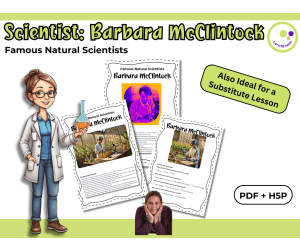
Barbara McClintock – Fact Sheet, Quiz & Interactive PDF incl. H5P
Life Sciences, Science, STEM, History, Social Studies, Biographies, Inventors, Basic Science, Physics, Biology, Grade 6, 7, 8, 9, 10, 11, 12, Worksheets, Worksheets & Printables, Quizzes, Quizzes and Tests, Teacher Tools, Projects, Activities
Scientist Barbara McClintock - Fact Sheet, Quiz & Interactive Version (PDF & H5P) Barbara McClintock – Genetics and the Discovery of Jumping Genes Fact Sheet, Quiz & Interactive Exercises (PDF + H5P) 🌽🧬 This 45-minute resource introduces students in grades 7–10 to Barbara McClintock – a pioneering geneticist whose research changed the way we understand genes and heredity. Many students know the basics of DNA and inheritance, but fewer have heard of McClintock or her discovery of “jumping genes” (transposons). Working with maize plants 🌽 in the mid-20th century, she found that genes can move within the genome – a finding that was far ahead of its time and only fully recognized years later. To help students access this complex but fascinating topic, I’ve created a compact and ready-to-use lesson. It includes an informational text, a fact sheet, quiz questions with answers, and a creative partner task. All materials come in both color and black-and-white versions, plus there’s an H5P version for digital use. What’s included: A short, student-friendly text about Barbara McClintock and her scientific contributions A fact sheet to help students organize key information Quiz questions (with answer key) for self-checking or review A creative task where students come up with their own questions and exchange them in pairs Formats: Printable/digital PDF and interactive H5P version 💻 Answer key included ✅ I’ve used this material as part of our genetics unit, especially when discussing how scientific ideas are received and validated over time. It also works well in lessons on women in science or the history of biology. Easy to implement and suitable for partner work, independent study, or short projects. 🚀 Download now and bring the legacy of Barbara McClintock into your biology lessons today! 📍 Best wishes, Heike from Lernfitness Did You Know? I teach with a certified therapy dog, and together we create a positive and inspiring learning environment. 🐶✨
Author Lernfitness
Tags Science, Biology, Famous Scientists Lesson, H5P, Interactive Science Exercises, STEM, History, Scientists, DNA, Barbara McClintock

Science Reading Comprehension Passage. The Solar System (Word)
Science, ELA, Reading, Reading Comprehension, Strategies, Resources for Teachers, Space, Earth and Environmental Sciences, Grade 6, 7, 8, 9, Writing Prompts, Worksheets & Printables, Centers, Activities, Teacher Tools, Assessments, Quizzes and Tests, Quizzes, Tests
Science Reading Comprehension Passages and Questions: The Solar System (Word) This very engaging science reading passage about The Solar System is designed to bridge the gap between science and literacy through strengthening reading comprehension and sparking scientific curiosity in middle school students. The passage blends English Language Arts skills with accurate science content that supports NGSS classroom practice. Ideal for interdisciplinary learning in ELA and Science. Suitable for Grade 9 review, too! Student Tasks for The Passage: 5 multiple-choice questions targeting main idea, key details, inference, vocabulary in context, and use of evidence 5 vocabulary matching items with clear, student-friendly definitions 5 text-based questions that require citing specific lines or facts 1 summary prompt that asks students to condense central ideas accurately Full answer key for every section Available Formats for this Resource PDF Fillable PDF Google Docs FULL CATALOG OF DOWNLOADING LINKS HERE Product Details Length: 5 pages total Grades: 6–8, also suitable for Grade 9 review Use cases: close reading, stations, homework, intervention, test prep, and sub plans Standards support: reinforces informational-text skills and supports NGSS-style sense making through observation, modeling, and clear use of claim, evidence, and reasoning Why Teachers Choose This Set Authentic science content paired with rigorous literacy practice Consistent task structure across all passages for easier planning and smoother student routines Clear, age-appropriate writing that builds confidence without oversimplifying Other Science Reading Collections you May find in the store: 1. Astronomy & Space Science 2. Volcanoes, Rocks, & Mountains 3. Rock Cycle, Soil, & Sinkholes 4. Mars, Glaciers, & Antarctica 5. Water Cycle, Acid Rain, & Wastewater 6. Insects, Animals, & Ecosystems 7. Bioluminescence & Insects 8. Animal Skin, Cats, & T. Rex 9. Human Body and Senses 10. Health & Applied Bioscience 11. Waves, Light, & Imaging 12. Electricity & Energy 13. Motion & Materials 14. Chemistry and Materials Science Use this set to reinforce ELA skills in science, to add literacy to your lessons, and to support independent work. The passages strengthen main idea, evidence use, vocabulary in context, inference, cause and effect, and summary writing. With ready-to-use assessments and complete answer keys, you can provide focused practice that is simple to run and fast to review.
Author Middle & High School - CORED Education
Rating
Tags Middle School, Reading Comprehension, Reading Strategies, ELA, Centers, Reading Passage, Assessments, Vocabulary, Environmental Science, The Solar System

Animal Skin, Cats, and T. Rex: Reading passages (FILLABLE PDF)
Science, ELA, Reading, Reading Comprehension, Strategies, Resources for Teachers, Life Sciences, Animals, Insects, Nature & Plants, Grade 6, 7, 8, 9, Writing Prompts, Worksheets & Printables, Centers, Activities, Teacher Tools, Assessments, Quizzes and Tests, Quizzes, Tests
Animal Skin, Cats, & T. Rex: Reading Comprehension Passages (PDF) This very engaging and fillable collection of life science reading passages about Animal Skin, Cats, & T. Rex is designed to bridge the gap between science and literacy through strengthening reading comprehension and sparking scientific curiosity in middle school students. Each passage blends English Language Arts skills with accurate science content that supports NGSS classroom practice. Ideal for interdisciplinary learning in ELA and Science. Suitable for Grade 9 review, too! These worksheets are designed as fillable PDFs , which means students can type their answers directly into the document on any computer or tablet . Each page includes highlighted text fields that show them exactly where to type! What Is Included? There are (3) informational passages: Tyrannosaurus rex: The Tyrant Lizard King Cats and Sweetness: A Taste They Don’t Have Animal Skin: A Tool for Survival Student Tasks for Each Passage: 5 multiple-choice questions targeting main idea, key details, inference, vocabulary in context, and use of evidence 5 vocabulary matching items with clear, student-friendly definitions 5 text-based questions that require citing specific lines or facts 1 summary prompt that asks students to condense central ideas accurately Full answer key for every section Available Formats for this Resource Word Docs Google Docs FULL CATALOG OF DOWNLOADING LINKS HERE Other Science Reading Collections and Topics You May Find in the Store: 1. Astronomy & Space Science 2. Volcanoes, Rocks, & Mountains 3. Rock Cycle, Soil, & Sinkholes 4. Mars, Glaciers, & Antarctica 5. Water Cycle, Acid Rain, & Wastewater 6. Insects, Animals, & Ecosystems 7. Bioluminescence & Insects 8. Animal Skin, Cats, & T. Rex 9. Human Body and Senses 10. Health & Applied Bioscience 11. Waves, Light, & Imaging 12. Electricity & Energy 13. Motion & Materials 14. Chemistry and Materials Science 15. Electromagnetism 16. Acids and Bases 17. Gas Laws 18. Biotechnology 19. Periodic Trends 20. Protists and Fungi 21. Microevolution 22. Blood 23. Chemical Bonding 24. Magnets 25. Muscles 26. Nuclear Chemistry 27. Electromagnetic Devices 28. Epigenetics 29. The Law of Conservation of Mass 30. Atomic Models 31. Isotopes and Ions 32. Light 33. Human-Environment Interaction 34. Theory of Evolution 35. Photosynthesis 36. Origins of Life and Early Earth 37. Gene Expression and Regulation 38. Thermochemistry 39. Allergies 40. Coevolution 41. Birth to Adulthood 42. Cells 43. Entropy and Free Energy 44. The Human Brain 45. Mixtures and Solutions 46. Invertebrates 47. Zoo Animals 48. Biochemistry 49. Animal Behavior 50. Population Ecology ...and many more engaging science reading passages that cover intriguing and important topics designed to spark curiosity and support student learning. How to Use These PDFs Click on the highlighted area to start typing your answer. Move to the next question by clicking in the next highlighted box. When you are finished, close the document and select SAVE so your answers stay recorded. If you want to keep a blank copy for later, choose Save As and give your completed version a new name. Product Details Length: 1e pages total Grades: 6–8, also suitable for Grade 9 review Use cases: close reading, stations, homework, intervention, test prep, and sub plans Standards support: reinforces informational-text skills and supports NGSS-style sense making through observation, modeling, and clear use of claim, evidence, and reasoning Why Teachers Choose This Set Authentic science content paired with rigorous literacy practice Consistent task structure across all passages for easier planning and smoother student routines Clear, age-appropriate writing that builds confidence without oversimplifying Use this set to reinforce ELA skills in science, to add literacy to your lessons, or to support independent work. The passages strengthen main idea, evidence use, vocabulary in context, inference, cause and effect, and summary writing. With ready-to-use assessments and complete answer keys, you can provide focused practice that is simple to run and fast to review.
Author Middle & High School - CORED Education
Rating
Tags Middle School, Reading Comprehension, Reading Strategies, ELA, Centers, Reading Passage, Assessments, Vocabulary, Life Science, Dinosaurs

Life Science Reading Passage: The Dinosaur Tyrannosaurus rex (Docs)
Science, ELA, Reading, Reading Comprehension, Strategies, Resources for Teachers, Life Sciences, Animals, Biology, Grade 6, 7, 8, 9, Writing Prompts, Worksheets & Printables, Centers, Activities, Teacher Tools, Assessments, Quizzes and Tests, Quizzes, Tests
Life Science Reading Comprehension Passage and Questions: The Dinosaur Tyrannosaurus rex (Docs) This very engaging science reading passage about Tyrannosaurus rex and how scientists use fossils to understand how it lived. It explains what fossils are, where and when T. rex lived, and what fossil evidence reveals about its size, teeth, skull, movement, speed, diet, hunting, and scavenging. It also shows how modern tools, such as CT scans, imaging, computer simulations, and coprolites , help paleontologists build a clearer picture of T. rex as a powerful predator from the late Cretaceous period. This passage is designed to bridge the gap between science and literacy through strengthening reading comprehension and sparking scientific curiosity in middle school students. The passage blends English Language Arts skills with accurate science content that supports NGSS classroom practice. Ideal for interdisciplinary learning in ELA and Science. Suitable for Grade 9 review, too! Student Tasks for The Passage: 5 multiple-choice questions targeting main idea, key details, inference, vocabulary in context, and use of evidence 5 vocabulary matching items with clear, student-friendly definitions 5 text-based questions that require citing specific lines or facts 1 summary prompt that asks students to condense central ideas accurately Full answer key for every section Available Formats for this Resource PDF Fillable PDF Word Docs FULL CATALOG OF DOWNLOADING LINKS HERE Product Details Length: 5 pages total Grades: 6–8, also suitable for Grade 9 review Use cases: close reading, stations, homework, intervention, test prep, and sub plans Standards support: reinforces informational-text skills and supports NGSS-style sense making through observation, modeling, and clear use of claim, evidence, and reasoning Why Teachers Choose This Set Authentic science content paired with rigorous literacy practice Consistent task structure across all passages for easier planning and smoother student routines Clear, age-appropriate writing that builds confidence without oversimplifying Other Science Reading Collections you May find in the store: 1. Astronomy & Space Science 2. Volcanoes, Rocks, & Mountains 3. Rock Cycle, Soil, & Sinkholes 4. Mars, Glaciers, & Antarctica 5. Water Cycle, Acid Rain, & Wastewater 6. Insects, Animals, & Ecosystems 7. Bioluminescence & Insects 8. Animal Skin, Cats, & T. Rex 9. Human Body and Senses 10. Health & Applied Bioscience 11. Waves, Light, & Imaging 12. Electricity & Energy 13. Motion & Materials 14. Chemistry and Materials Science Use this set to reinforce ELA skills in science, to add literacy to your lessons, and to support independent work. The passages strengthen main idea, evidence use, vocabulary in context, inference, cause and effect, and summary writing. With ready-to-use assessments and complete answer keys, you can provide focused practice that is simple to run and fast to review.
Author Middle & High School - CORED Education
Rating
Tags Middle School, Reading Comprehension, Reading Strategies, ELA, Centers, Reading Passage, Assessments, Vocabulary, Life Science, The Dinosaur Tyrannosaurus Rex

Life Science Reading Comprehension Passage: Bioluminescence. SAMPLE
Science, ELA, Reading, Reading Comprehension, Strategies, Resources for Teachers, Life Sciences, Animals, Grade 6, 7, 8, 9, Writing Prompts, Worksheets & Printables, Centers, Activities, Teacher Tools, Assessments, Quizzes and Tests, Quizzes, Tests
This is a free passage sample from the complete resource. The full version includes everything needed for a complete reading comprehension activity: the passage, multiple-choice questions, short-answer questions, vocabulary matching, a summary-writing task, and a detailed answer key. Download the complete passage resource by clicking on the following links: PDF Fillable PDF Word Docs Google Docs Life Science Reading Comprehension Passage and Questions: Bioluminescence (PDF) This very engaging life science reading passage about Bioluminescence: how living things produce light through chemical reactions . It explains how glowing organisms use light for survival , including communication, defense, camouflage, attracting prey, and escaping predators. Examples include glowing plankton, anglerfish, squid, jellyfish, fireflies, glow-worms, fungi, microbes, and marine bacteria . It also explains the science behind firefly light, especially luciferin, oxygen, and luciferase , and shows how scientists use bioluminescence in labs and possible technology. This passage is designed to bridge the gap between science and literacy through strengthening reading comprehension and sparking scientific curiosity in middle school students. The passage blends English Language Arts skills with accurate science content that supports NGSS classroom practice. Ideal for interdisciplinary learning in ELA and Science. Suitable for Grade 9 review, too! Student Tasks for The Passage: 5 multiple-choice questions targeting main idea, key details, inference, vocabulary in context, and use of evidence 5 vocabulary matching items with clear, student-friendly definitions 5 text-based questions that require citing specific lines or facts 1 summary prompt that asks students to condense central ideas accurately Full answer key for every section FULL CATALOG OF DOWNLOADING LINKS HERE Product Details Length: 5 pages total Grades: 6–8, also suitable for Grade 9 review Use cases: close reading, stations, homework, intervention, test prep, and sub plans Standards support: reinforces informational-text skills and supports NGSS-style sense making through observation, modeling, and clear use of claim, evidence, and reasoning Why Teachers Choose This Set Authentic science content paired with rigorous literacy practice Consistent task structure across all passages for easier planning and smoother student routines Clear, age-appropriate writing that builds confidence without oversimplifying Other Science Reading Collections you May find in the store: 1. Astronomy & Space Science 2. Volcanoes, Rocks, & Mountains 3. Rock Cycle, Soil, & Sinkholes 4. Mars, Glaciers, & Antarctica 5. Water Cycle, Acid Rain, & Wastewater 6. Insects, Animals, & Ecosystems 7. Bioluminescence & Insects 8. Animal Skin, Cats, & T. Rex 9. Human Body and Senses 10. Health & Applied Bioscience 11. Waves, Light, & Imaging 12. Electricity & Energy 13. Motion & Materials 14. Chemistry and Materials Science Use this set to reinforce ELA skills in science, to add literacy to your lessons, and to support independent work. The passages strengthen main idea, evidence use, vocabulary in context, inference, cause and effect, and summary writing. With ready-to-use assessments and complete answer keys, you can provide focused practice that is simple to run and fast to review.
Author Middle & High School - CORED Education
Rating
Tags Middle School, Reading Comprehension, Reading Strategies, ELA, Centers, Reading Passage, Assessments, Vocabulary, Life Science, Bioluminescence
Onions Reading Comprehension Passage - Cored Ed Encyclopedia
ELA, Language Development, Resources for Teachers, Reading Comprehension, Reading, Pre-Reading, Writing, Life Sciences, Science, Nature & Plants, Grade 2, 3, 4, 5, Worksheets & Printables, Worksheets, Teacher Tools, Centers, Activities, Writing Prompts, Assessments, Tests, Quizzes and Tests, Quizzes
This onions reading comprehension contains the following: Visualize on the Cover (Teacher Read Aloud Script) Start your lesson by taking a few moments to visualize the topic and share thoughts or feelings about it. Pre-Reading Trivia Students will write down one thing they already know about the subject and then read five more facts and discuss. These facts are fun, and the students will enjoy learning about the subject before reading more. Reading Passage The text is a high-interest reading passage with set paragraphs, roughly three to four paragraphs long. It contains a variety of themes about the topic, anywhere from history to technology. The passage is between 250 and 350 words in length. Mixed Questions The first question page contains four multiple-choice questions, each with a choice of four answers, and three written response questions that require a sentence or two from the student. Vocabulary Questions Practice seven key words from the text in this section across two activities. First section is scrambled words where students will unscramble three words given a clue for each. The second section is a word to meaning matching activity. Creative Writing In this question, the student will be required to write a five to eight sentence paragraph on a question related to the topic. Extension Activities This page is optional for fast finishers or to take home. There are several activities, each one requiring a different skill. Do some, do none, do all, completely optional - but you will feel reassured knowing every possibility is planned for. Includes summary writting question. Answer Key There are answers for the multiple-choice questions, written response questions have sample answers, vocabulary answers and if there is a summary question then a sample summary will be provided as well. FULL CATALOG OF DOWNLOAD LINKS AND ENCYCLOPEDIA INDEX HERE Lesson Snapshot Title: Onions Genre: Nonfiction (informational text) Subject: Life Science (plants) / Reading Informational Text Primary Topic: Onion bulbs, history, tears, and growing Estimated Guided Reading Level (A–Z): Q What This Lesson Teaches Best How an onion bulb is made of layers and helps the plant grow. Key plant facts: onions send up hollow leaves , and the bulb swells at the bottom of the stalks. A clear cause-and-effect explanation for why cutting onions can make eyes water (chemicals mix → gas → tears). A brief history of onions, including early recipes on clay tablets in ancient Mesopotamia and later planting in North America. How onions are grown/harvested, including that onions are biennial plants and can be started from sets . Learning Goals Students will identify details that describe what an onion bulb is like and what it does for the plant. Students will explain why cutting an onion can make eyes water using information from the text. Students will describe one way people long ago saved and replanted onions. Students will describe how onions can be grown (from seeds or sets) and when they are often harvested. Students will use section headings to locate key information in the passage. Key Vocabulary From the Text biennial — a plant built for a two-year life cycle. chemicals — substances that can mix and cause changes. Mesopotamia — an ancient place where people wrote on clay tablets. colonists — people who settled in a new place long ago. sets — small starter onion bulbs used for planting. Cored Ed Encyclopedia Overview The Cored Ed Encyclopedia is a weekly series of lessons that you can pick up and use right away. These short readings fit into whatever time you have available. Each one includes a warm-up, a reading, and a set of questions, but it’s flexible — you can do just the reading, the full lesson, or skip the writing section if you need to. Each lesson focuses on a single topic so students don’t get lost. The writing is clear but never childish, making it perfect for grades two through five. Topics range from animals and science to history, inventions, and everyday things. No matter the level of the student, everyone should take away at least one new idea or fact from each lesson. The materials are easy to print, easy to explain, and require no setup. They work well for whole-class teaching, partner work, or independent study.
Author Cored Education
Rating
Tags Vocabulary, Spelling, Reading Comprehension, Reading Passages, Reading, Creative Writing, Reading Strategies, Writing Prompts, Onions, Life Science
Marshmallows Reading Comprehension Passage - Cored Ed Encyclopedia
ELA, Language Development, Resources for Teachers, Reading Comprehension, Reading, Pre-Reading, Writing, Strategies, Physics, Science, Grade 2, 3, 4, 5, Worksheets & Printables, Worksheets, Teacher Tools, Centers, Activities, Writing Prompts, Assessments, Tests, Quizzes and Tests, Quizzes
This marshmallows reading comprehension contains the following: Visualize on the Cover (Teacher Read Aloud Script) Start your lesson by taking a few moments to visualize the topic and share thoughts or feelings about it. Pre-Reading Trivia Students will write down one thing they already know about the subject and then read five more facts and discuss. These facts are fun, and the students will enjoy learning about the subject before reading more. Reading Passage The text is a high-interest reading passage with set paragraphs, roughly three to four paragraphs long. It contains a variety of themes about the topic, anywhere from history to technology. The passage is between 250 and 350 words in length. Mixed Questions The first question page contains four multiple-choice questions, each with a choice of four answers, and three written response questions that require a sentence or two from the student. Vocabulary Questions Practice seven key words from the text in this section across two activities. First section is scrambled words where students will unscramble three words given a clue for each. The second section is a word to meaning matching activity. Creative Writing In this question, the student will be required to write a five to eight sentence paragraph on a question related to the topic. Extension Activities This page is optional for fast finishers or to take home. There are several activities, each one requiring a different skill. Do some, do none, do all, completely optional - but you will feel reassured knowing every possibility is planned for. Includes summary writting question. Answer Key There are answers for the multiple-choice questions, written response questions have sample answers, vocabulary answers and if there is a summary question then a sample summary will be provided as well. FULL CATALOG OF DOWNLOAD LINKS AND ENCYCLOPEDIA INDEX HERE Lesson Snapshot Title: Marshmallows Genre: Nonfiction Subject: Science (informational reading) Primary Topic: How marshmallows become foam; heat and pressure Estimated Guided Reading Level (A–Z): N What This Lesson Teaches Best Explains what a marshmallow is (a sweet foam) and how tiny air bubbles get trapped inside. Describes the process of making marshmallow mixture turn “fluffy” as it is beaten and thickens. Builds word knowledge through the origin of the name “marshmallow” from the marsh mallow plant and its “root sap.” Connects cause-and-effect in simple “food science”: heat toasts the outside and melts the inside; air pressure can make marshmallows puff up or shrink. Provides aligned support pages (trivia, questions, vocabulary tasks, writing, and extensions) that reuse the passage’s key ideas and terms. Learning Goals Explain why a marshmallow is called a “foam” using details from the text. Describe how air gets trapped in marshmallow ingredients while they are whipped or beaten. Tell why marshmallows are dusted with cornstarch. Explain where the word “marshmallow” comes from, based on the passage. Describe what heat does to a marshmallow over a fire or in hot chocolate. Describe how changes in air pressure can make marshmallows change size. Key Vocabulary From the Text Gelatin — ingredient that helps mixture set and hold bubbles. Cornstarch — powder dusted on marshmallows so they don’t stick. Cylinders — tube shapes, like short, round rolls. Sap — sticky liquid from a plant’s root. Pressure — force of air that can make bubbles shrink or grow. Cored Ed Encyclopedia Overview The Cored Ed Encyclopedia is a weekly series of lessons that you can pick up and use right away. These short readings fit into whatever time you have available. Each one includes a warm-up, a reading, and a set of questions, but it’s flexible — you can do just the reading, the full lesson, or skip the writing section if you need to. Each lesson focuses on a single topic so students don’t get lost. The writing is clear but never childish, making it perfect for grades two through five. Topics range from animals and science to history, inventions, and everyday things. No matter the level of the student, everyone should take away at least one new idea or fact from each lesson. The materials are easy to print, easy to explain, and require no setup. They work well for whole-class teaching, partner work, or independent study.
Author Cored Education
Rating
Tags Vocabulary, Spelling, Reading Comprehension, Reading Passages, Reading, Creative Writing, Reading Strategies, Writing Prompts, Physics, Marshmallows

Waves, Light, Imaging: Physical Science Reading Comprehension (Google)
Science, ELA, Reading, Reading Comprehension, Strategies, Resources for Teachers, Physics, Grade 6, 7, 8, 9, Writing Prompts, Worksheets & Printables, Centers, Activities, Teacher Tools, Assessments, Quizzes and Tests, Quizzes, Tests
Waves, Light, Imaging: Physical Science Reading Comprehension Passages and Questions (Google) This very engaging collection of physical science reading passages about Waves, Light, and Imaging is designed to bridge the gap between science and literacy through strengthening reading comprehension and sparking scientific curiosity in middle school students. Each passage blends English Language Arts skills with accurate science content that supports NGSS classroom practice. Ideal for interdisciplinary learning in ELA and Science. Suitable for Grade 9 review, too! What Is Included? There are (3) informational passages: How Sound Travels: Sound starts with a vibration that squeezes and stretches nearby matter, sending a wave through air, water, or solid material. The ear and brain team up to turn those moving pressures into the pitch and loudness we hear, which is why sound needs a medium. Seeing Color: Reflection, Absorption, Refraction: Color shows up only when light hits an object and some wavelengths bounce back to the eye. Materials reflect, absorb, or bend light differently, so a prism, a black backpack, or even dim lighting can change what we see. Cameras: From Dark Rooms to Smartphones: A simple darkened box with a tiny opening once projected faint, upside-down scenes onto a wall. Adding lenses, mirrors, film, and later digital sensors turned that idea into cameras for art, news, and everyday life, ending with phones that can snap and share in seconds. Student Tasks for Each Passage: 5 multiple-choice questions targeting main idea, key details, inference, vocabulary in context, and use of evidence 5 vocabulary matching items with clear, student-friendly definitions 5 text-based questions that require citing specific lines or facts 1 summary prompt that asks students to condense central ideas accurately Full answer key for every section Available Formats for this Resource PDF Google Docs FULL CATALOG OF DOWNLOADING LINKS HERE Other Science Reading Collections you May find in the store: 1. Astronomy & Space Science 2. Volcanoes, Rocks, & Mountains 3. Rock Cycle, Soil, & Sinkholes 4. Mars, Glaciers, & Antarctica 5. Water Cycle, Acid Rain, & Wastewater 6. Insects, Animals, & Ecosystems 7. Bioluminescence & Insects 8. Animal Skin, Cats, & T. Rex 9. Human Body and Senses 10. Health & Applied Bioscience 11. Waves, Light, & Imaging 12. Electricity & Energy 13. Motion & Materials 14. Chemistry and Materials Science Product Details Length: 14 pages total Grades: 6–8, also suitable for Grade 9 review Use cases: close reading, stations, homework, intervention, test prep, and sub plans Standards support: reinforces informational-text skills and supports NGSS-style sense making through observation, modeling, and clear use of claim, evidence, and reasoning Why Teachers Choose This Set Authentic science content paired with rigorous literacy practice Consistent task structure across all passages for easier planning and smoother student routines Clear, age-appropriate writing that builds confidence without oversimplifying Use this set to reinforce ELA skills in science, to add literacy to your lessons, or to support independent work. The passages strengthen main idea, evidence use, vocabulary in context, inference, cause and effect, and summary writing. With ready-to-use assessments and complete answer keys, you can provide focused practice that is simple to run and fast to review.
Author Middle & High School - CORED Education
Rating
Tags Middle School, Reading Comprehension, Reading Strategies, ELA, Centers, Reading Passage, Assessments, Vocabulary, Physical Science, Physics
Life Science Reading Passage SAMPLE: SKIN & Human Body (FILLABLE PDF)
Science, ELA, Reading, Reading Comprehension, Strategies, Resources for Teachers, Life Sciences, Human Body, Grade 6, 7, 8, 9, Writing Prompts, Worksheets & Printables, Centers, Activities, Teacher Tools, Assessments, Quizzes and Tests, Quizzes, Tests
This is a ONE PASSAGE SAMPLE. The following is the description of the FULL resource and the downloading links: Human Body and Senses: Life Science Reading Comprehension Passages and Questions (FILLABLE PDF) This very engaging and fillable collection of life science reading passages about Contact Lenses, Goosebumps, and Skin is designed to bridge the gap between science and literacy through strengthening reading comprehension and sparking scientific curiosity in middle school students. Each passage blends English Language Arts skills with accurate science content that supports NGSS classroom practice. Ideal for interdisciplinary learning in ELA and Science. Suitable for Grade 9 review, too! These worksheets are designed as fillable PDFs , which means students can type their answers directly into the document on any computer or tablet . Each page includes highlighted text fields that show them exactly where to type! What Is Included? There are (3) informational passages: Clear Vision: The Story of Contact Lenses Goosebumps: A Chilly Reminder of Our Past Skin: Your Protective Shield Student Tasks for Each Passage: 5 multiple-choice questions targeting main idea, key details, inference, vocabulary in context, and use of evidence 5 vocabulary matching items with clear, student-friendly definitions 5 text-based questions that require citing specific lines or facts 1 summary prompt that asks students to condense central ideas accurately Full answer key for every section Available Formats for this Resource Word Docs Google Docs FULL CATALOG OF DOWNLOADING LINKS HERE Other Science Reading Collections and Topics You May Find in the Store: 1. Astronomy & Space Science 2. Volcanoes, Rocks, & Mountains 3. Rock Cycle, Soil, & Sinkholes 4. Mars, Glaciers, & Antarctica 5. Water Cycle, Acid Rain, & Wastewater 6. Insects, Animals, & Ecosystems 7. Bioluminescence & Insects 8. Animal Skin, Cats, & T. Rex 9. Human Body and Senses 10. Health & Applied Bioscience 11. Waves, Light, & Imaging 12. Electricity & Energy 13. Motion & Materials 14. Chemistry and Materials Science 15. Electromagnetism 16. Acids and Bases 17. Gas Laws 18. Biotechnology 19. Periodic Trends 20. Protists and Fungi 21. Microevolution 22. Blood 23. Chemical Bonding 24. Magnets 25. Muscles 26. Nuclear Chemistry 27. Electromagnetic Devices 28. Epigenetics 29. The Law of Conservation of Mass 30. Atomic Models 31. Isotopes and Ions 32. Light 33. Human-Environment Interaction 34. Theory of Evolution 35. Photosynthesis 36. Origins of Life and Early Earth 37. Gene Expression and Regulation 38. Thermochemistry 39. Allergies 40. Coevolution 41. Birth to Adulthood 42. Cells 43. Entropy and Free Energy 44. The Human Brain 45. Mixtures and Solutions 46. Invertebrates 47. Zoo Animals 48. Biochemistry 49. Animal Behavior 50. Population Ecology ...and many more engaging science reading passages that cover intriguing and important topics designed to spark curiosity and support student learning. How to Use These PDFs Click on the highlighted area to start typing your answer. Move to the next question by clicking in the next highlighted box. When you are finished, close the document and select SAVE so your answers stay recorded. If you want to keep a blank copy for later, choose Save As and give your completed version a new name. Product Details Length: 14 pages total Grades: 6–8, also suitable for Grade 9 review Use cases: close reading, stations, homework, intervention, test prep, and sub plans Standards support: reinforces informational-text skills and supports NGSS-style sense making through observation, modeling, and clear use of claim, evidence, and reasoning Why Teachers Choose This Set Authentic science content paired with rigorous literacy practice Consistent task structure across all passages for easier planning and smoother student routines Clear, age-appropriate writing that builds confidence without oversimplifying Use this set to reinforce ELA skills in science, to add literacy to your lessons, or to support independent work. The passages strengthen main idea, evidence use, vocabulary in context, inference, cause and effect, and summary writing. With ready-to-use assessments and complete answer keys, you can provide focused practice that is simple to run and fast to review.
Author Middle & High School - CORED Education
Rating
Tags Middle School, Reading Comprehension, Reading Strategies, ELA, Centers, Reading Passage, Assessments, Vocabulary, Life Science, Human Body

Earth Science Reading Comprehension Passage: Ice Age Leftovers (Docs)
Science, ELA, Reading, Reading Comprehension, Strategies, Resources for Teachers, Earth and Environmental Sciences, Earth Sciences, Grade 6, 7, 8, 9, Writing Prompts, Worksheets & Printables, Centers, Activities, Teacher Tools, Assessments, Quizzes and Tests, Quizzes, Tests
Science Reading Comprehension Passages and Questions: Ice Age Leftovers (Docs) This very engaging earth science reading passage about how ice left from the Ice Age still affects Earth today . It explains the differences between glaciers, ice sheets, ice shelves, icebergs, and sea ice , and shows how each one shapes land, oceans, weather, and climate. This passage is designed to bridge the gap between science and literacy through strengthening reading comprehension and sparking scientific curiosity in middle school students. The passage blends English Language Arts skills with accurate science content that supports NGSS classroom practice. Ideal for interdisciplinary learning in ELA and Science. Suitable for Grade 9 review, too! Student Tasks for The Passage: 5 multiple-choice questions targeting main idea, key details, inference, vocabulary in context, and use of evidence 5 vocabulary matching items with clear, student-friendly definitions 5 text-based questions that require citing specific lines or facts 1 summary prompt that asks students to condense central ideas accurately Full answer key for every section Available Formats for this Resource PDF Fillable PDF Word Docs FULL CATALOG OF DOWNLOADING LINKS HERE Product Details Length: 5 pages total Grades: 6–8, also suitable for Grade 9 review Use cases: close reading, stations, homework, intervention, test prep, and sub plans Standards support: reinforces informational-text skills and supports NGSS-style sense making through observation, modeling, and clear use of claim, evidence, and reasoning Why Teachers Choose This Set Authentic science content paired with rigorous literacy practice Consistent task structure across all passages for easier planning and smoother student routines Clear, age-appropriate writing that builds confidence without oversimplifying Other Science Reading Collections you May find in the store: 1. Astronomy & Space Science 2. Volcanoes, Rocks, & Mountains 3. Rock Cycle, Soil, & Sinkholes 4. Mars, Glaciers, & Antarctica 5. Water Cycle, Acid Rain, & Wastewater 6. Insects, Animals, & Ecosystems 7. Bioluminescence & Insects 8. Animal Skin, Cats, & T. Rex 9. Human Body and Senses 10. Health & Applied Bioscience 11. Waves, Light, & Imaging 12. Electricity & Energy 13. Motion & Materials 14. Chemistry and Materials Science Use this set to reinforce ELA skills in science, to add literacy to your lessons, and to support independent work. The passages strengthen main idea, evidence use, vocabulary in context, inference, cause and effect, and summary writing. With ready-to-use assessments and complete answer keys, you can provide focused practice that is simple to run and fast to review.
Author Middle & High School - CORED Education
Rating
Tags Middle School, Reading Comprehension, Reading Strategies, ELA, Centers, Reading Passage, Assessments, Vocabulary, Environmental Science, Space
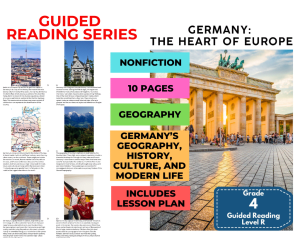
Germany: The Heart of Europe: Guided Reading Level R with Lesson Plan
ELA, Resources for Teachers, Reading Comprehension, Reading, Science, Geography, Social Studies, History, Earth and Environmental Sciences, Technology, Grade 3, 4, 5, Worksheets & Printables, Worksheets, Teacher Tools, Centers, Activities, Literacy Readers, Quizzes, Quizzes and Tests, Assessments, Lesson Plans
This Germany: The Heart of Europe (level r) guided reading book with lesson plan includes: Guided Reading Color Label (front cover x1) This is a quick way to match the book’s demands to what students can generally handle.. The overall goal is to use the level/color to pick books for several smaller groups. To qualify for a certain level, a student is expected to read a book from that level with about 90–94% accuracy. If a student is consistently accurate and understands, move up a level. If the student is struggling at that level, drop down and add more support. Each student will improve at completely different rates, but it is generally one of the best ways to check progress across the class. DOWNLOAD THE CATALOG TO VIEW ALL GUIDED READING BOOKS AVAILABLE (SORTED LEVELS A-Z) Pre-Reading Question (x1) Teacher asks the prompt aloud, can be while showing the cover or first page. Students share what they already know, or make educated guesses from the cover. Prompt them to use the target vocabulary. Write some of their responses on the board to look back at during the reading. Vocabulary Words (x5) Introduce the five words, best doing it one at a time. Start by saying it, while students repeat and then see if anyone knows what it means before reading further. Read through the meaning and try to briefly connect each word to a picture or gesture so it’s meaningful. Ask students to flip through the book pages and point to where they see each of the vocabulary words. While reading the book pause upon coming across one of the vocab words or read the sentence twice to make sure students understand the word has appeared. Optional: Ask students to raise hands whenever they see/hear one of the new words. Guided Reading Pages (x10) Check the book snapshot (below) for: primary topic - do you need to prep extra reading or intro materials on this? what is taught best - decide on 1-2 bullets to focus on, use the prompt or words provided here for best results. learning goals - what you are checking for students to be able to do after the session, elicit answers using prompts or words provided. key vocabulary (see section above). questions overview - so you know what is coming up and if you need to prep extra materials to assist understanding. Run the lesson You may have already looked at a few of the pages together, but you can show them some of the pictures again first to set meaning. Depending on how much time you have and how familiar your students are with guided reading class, you may want to read the book aloud first with the group first. Students whisper or partner read, while you listen in. If time, do it as a group, one student reading a page each. Use the guided page’s prompts to coach: “Check the picture / does it make sense?” “Point under the words / try the first sound” “Reread the sentence smoothly”. Try to focus more on one student per session (rotating every time), so you can work out if they are ready to move up or need to move down a level. Comprehension Questions (back cover x3) This is your way to check that students didn’t just say the words, but actually understood the text. First, let students answer by pointing to the page/picture and saying a short sentence. After any answer, follow with: “Show me where you found that in the text.” In bigger groups, have partners answer first (10–20 seconds), then call on 2–3 students to share. Differentiation tips: Emerging speakers/struggling readers: oral + pointing On-level: oral in a full sentence Higher: one written sentence or draw + label Book Snapshot Title: Germany: The Heart of Europe Genre: Nonfiction Subject: Social Studies (Geography/Culture/History) Primary Topic: Germany’s geography, history, culture, and modern life Estimated Guided Reading Level (A–Z): R What This Book Teaches Best Germany’s central location in Europe and how that makes it a crossroads for trade, travel, and cultural exchange. Physical geography and waterways , including the Bavarian Alps and the Rhine River’s role in transportation. History meeting modern life through Berlin’s past division (Berlin Wall) and the Brandenburg Gate as a symbol of reunification. Cultural traditions , including long-held festivals, music (Bach and Beethoven), and traditional clothing like lederhosen and dirndls. Modern strengths and priorities , such as engineering/technology, renewable energy, public transportation, and environmental conservation. Learning Goals Students will describe where Germany is located in Europe and explain why its location matters in the text. Students will identify major physical features of Germany (plains, mountains, or the Bavarian Alps) using details from the text. Students will explain why the text says rivers like the Rhine are important for moving goods between cities. Students will describe Berlin as the capital and explain one way the text shows history and modern life together there. Students will describe what the text says about castles from the Middle Ages and what they are used for today. Students will identify examples of Germany today (technology/engineering, renewable energy, conservation, education, or democracy) using text evidence. Key Vocabulary From the Text crossroads — central meeting place where routes and people connect. metropolis — a very large, busy city. reunification — joining back together after being separated. renewable — energy source replaced naturally, like wind or sun. conservation — protecting nature so it stays healthy for the future. Discussion Prompts Pre-reading question: What kinds of facts do you think a book about Germany might teach you? Comprehension questions: Why does the text say Germany is a major crossroads within the European Union? Comprehension questions: What does the text say the Brandenburg Gate represents today? Comprehension questions: What is one way the text says Germany works to protect the climate? Printing Tips 1. Best Printing Method (Recommended) “Booklet” Printing (Best if Available) If your printer or PDF viewer supports Booklet Printing , use this. Settings to use: Print mode: Booklet Paper size: Letter or A4 (either works) Orientation: Landscape Print on both sides: Yes Flip on: Short edge Scaling: Fit to printable area Booklet subset: First test: Front sides only Then: Back sides only This will automatically: Pair pages correctly Put the cover on the outside Align everything for folding After printing, fold in half and staple along the spine . 2. If “Booklet” Printing Is NOT Available You can still print this correctly with manual duplex printing . Step-by-step: Open the PDF. Choose Print . Set: Orientation: Landscape Pages per sheet: 1 Print on both sides: Yes Flip on: Short edge Print all pages . Because each PDF page already contains two facing book pages, the result will still fold cleanly into a book. Thousands of Cored Education products are included with your TeachSimple membership. Download links and encyclopedia index available here.
Author Cored Education
Rating
Tags Reading Comprehension, Reading Passages, Reading, Guided Reading, Guided Reading Lesson Plan, Guided Reading Activity, Pre-reading, Social Studies, Geography, History
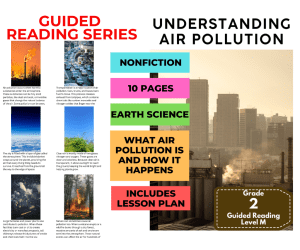
Guided Reading Level M - Air Pollution (with Lesson Plan)
ELA, Resources for Teachers, Reading Comprehension, Reading, Science, Technology, Physics, Life Sciences, Earth and Environmental Sciences, Environmental Science, Grade 2, 3, 4, Worksheets & Printables, Worksheets, Teacher Tools, Centers, Activities, Literacy Readers, Quizzes, Quizzes and Tests, Assessments, Lesson Plans
This Guided Reading Book - Understanding Air Pollution (Level M) with lesson plan includes: Guided Reading Color Label (front cover x1) This is a quick way to match the book’s demands to what students can generally handle.. The overall goal is to use the level/color to pick books for several smaller groups. To qualify for a certain level, a student is expected to read a book from that level with about 90–94% accuracy. If a student is consistently accurate and understands, move up a level. If the student is struggling at that level, drop down and add more support. Each student will improve at completely different rates, but it is generally one of the best ways to check progress across the class. DOWNLOAD THE CATALOG TO VIEW ALL GUIDED READING BOOKS AVAILABLE (SORTED LEVELS A-Z) Pre-Reading Question (x1) Teacher asks the prompt aloud, can be while showing the cover or first page. Students share what they already know, or make educated guesses from the cover. Prompt them to use the target vocabulary. Write some of their responses on the board to look back at during the reading. Vocabulary Words (x5) Introduce the five words, best doing it one at a time. Start by saying it, while students repeat and then see if anyone knows what it means before reading further. Read through the meaning and try to briefly connect each word to a picture or gesture so it’s meaningful. Ask students to flip through the book pages and point to where they see each of the vocabulary words. While reading the book pause upon coming across one of the vocab words or read the sentence twice to make sure students understand the word has appeared. Optional: Ask students to raise hands whenever they see/hear one of the new words. Guided Reading Pages (x10) Check the book snapshot (below) for: primary topic - do you need to prep extra reading or intro materials on this? what is taught best - decide on 1-2 bullets to focus on, use the prompt or words provided here for best results. learning goals - what you are checking for students to be able to do after the session, elicit answers using prompts or words provided. key vocabulary (see section above). questions overview - so you know what is coming up and if you need to prep extra materials to assist understanding. Run the lesson You may have already looked at a few of the pages together, but you can show them some of the pictures again first to set meaning. Depending on how much time you have and how familiar your students are with guided reading class, you may want to read the book aloud first with the group first. Students whisper or partner read, while you listen in. If time, do it as a group, one student reading a page each. Use the guided page’s prompts to coach: “Check the picture / does it make sense?” “Point under the words / try the first sound” “Reread the sentence smoothly”. Try to focus more on one student per session (rotating every time), so you can work out if they are ready to move up or need to move down a level. Comprehension Questions (back cover x3) This is your way to check that students didn’t just say the words, but actually understood the text. First, let students answer by pointing to the page/picture and saying a short sentence. After any answer, follow with: “Show me where you found that in the text.” In bigger groups, have partners answer first (10–20 seconds), then call on 2–3 students to share. Differentiation tips: Emerging speakers/struggling readers: oral + pointing On-level: oral in a full sentence Higher: one written sentence or draw + label Book Snapshot Title: Understanding Air Pollution Genre: Nonfiction (informational science text) Subject: Science (Earth & Environmental Science) Primary Topic: What air pollution is and how it happens Estimated Guided Reading Level (A–Z): M What This Book Teaches Best Introduces the atmosphere as an “invisible blanket” of air around Earth that living things need. Explains what clean air is mostly made of (nitrogen and oxygen) and why transparent air matters for sunlight and plant growth. Defines air pollution and shows that it can be visible (dust, soot) or hidden (invisible gases). Describes major sources of air pollution from transportation and from factories/power plants that burn fuels. Connects air pollution to real effects, including smog , health problems from particulate matter, and damage to plants through acid rain. Learning Goals Describe what the atmosphere is and why it is important for living things. Identify what clean air is mostly made of and describe characteristics of clean air from the text. Explain what air pollution is and name examples of pollutants described in the book. Describe how transportation and factories/power plants contribute to air pollution. Explain what smog is and how it forms, using details from the text. Describe one way technology can reduce air pollution based on the book’s examples. Key Vocabulary From the Text atmosphere — blanket of air around Earth. nitrogen — a gas that makes up much of clean air. oxygen — a gas living things need to survive. particulate — made of tiny pieces or specks. turbines — machines with blades that spin to make electricity. Discussion Prompts Pre-reading question: What are some things you think can make the air around us less clean? Comprehension questions: What two gases is clean air mostly made of? Comprehension questions: What is smog, according to the text? Comprehension questions: How do wind turbines and solar panels help reduce air pollution in the book? Printing Tips 1. Best Printing Method (Recommended) “Booklet” Printing (Best if Available) If your printer or PDF viewer supports Booklet Printing , use this. Settings to use: Print mode: Booklet Paper size: Letter or A4 (either works) Orientation: Landscape Print on both sides: Yes Flip on: Short edge Scaling: Fit to printable area Booklet subset: First test: Front sides only Then: Back sides only This will automatically: Pair pages correctly Put the cover on the outside Align everything for folding After printing, fold in half and staple along the spine . 2. If “Booklet” Printing Is NOT Available You can still print this correctly with manual duplex printing . Step-by-step: Open the PDF. Choose Print . Set: Orientation: Landscape Pages per sheet: 1 Print on both sides: Yes Flip on: Short edge Print all pages . Because each PDF page already contains two facing book pages, the result will still fold cleanly into a book. Thousands of Cored Education products are included with your TeachSimple membership. Download links and encyclopedia index available here.
Author Cored Education
Rating
Tags Reading Comprehension, Reading Passages, Reading, Guided Reading, Guided Reading Lesson Plan, Guided Reading Activity, Pre-reading, Science Lesson Plans, Earth Science, Physics

Earth Science Reading Comprehension Passage: The Water Cycle. SAMPLE
Science, ELA, Reading, Reading Comprehension, Strategies, Resources for Teachers, Earth and Environmental Sciences, Earth Sciences, Environmental Science, Grade 6, 7, 8, 9, Writing Prompts, Worksheets & Printables, Centers, Activities, Teacher Tools, Assessments, Quizzes and Tests, Quizzes, Tests
This is a free passage sample from the complete resource. The full version includes everything needed for a complete reading comprehension activity: the passage, multiple-choice questions, short-answer questions, vocabulary matching, a summary-writing task, and a detailed answer key. Download the complete passage resource by clicking on the following links: PDF Fillable PDF Word Docs Google Docs Science Reading Comprehension Passages and Questions: The Water Cycle (PDF) This very engaging earth science reading passage about the Water Cycle . It is designed to bridge the gap between science and literacy through strengthening reading comprehension and sparking scientific curiosity in middle school students. The passage blends English Language Arts skills with accurate science content that supports NGSS classroom practice. Ideal for interdisciplinary learning in ELA and Science. Suitable for Grade 9 review, too! Student Tasks for The Passage: 5 multiple-choice questions targeting main idea, key details, inference, vocabulary in context, and use of evidence 5 vocabulary matching items with clear, student-friendly definitions 5 text-based questions that require citing specific lines or facts 1 summary prompt that asks students to condense central ideas accurately Full answer key for every section FULL CATALOG OF DOWNLOADING LINKS HERE Product Details Length: 5 pages total Grades: 6–8, also suitable for Grade 9 review Use cases: close reading, stations, homework, intervention, test prep, and sub plans Standards support: reinforces informational-text skills and supports NGSS-style sense making through observation, modeling, and clear use of claim, evidence, and reasoning Why Teachers Choose This Set Authentic science content paired with rigorous literacy practice Consistent task structure across all passages for easier planning and smoother student routines Clear, age-appropriate writing that builds confidence without oversimplifying Other Science Reading Collections you May find in the store: 1. Astronomy & Space Science 2. Volcanoes, Rocks, & Mountains 3. Rock Cycle, Soil, & Sinkholes 4. Mars, Glaciers, & Antarctica 5. Water Cycle, Acid Rain, & Wastewater 6. Insects, Animals, & Ecosystems 7. Bioluminescence & Insects 8. Animal Skin, Cats, & T. Rex 9. Human Body and Senses 10. Health & Applied Bioscience 11. Waves, Light, & Imaging 12. Electricity & Energy 13. Motion & Materials 14. Chemistry and Materials Science Use this set to reinforce ELA skills in science, to add literacy to your lessons, and to support independent work. The passages strengthen main idea, evidence use, vocabulary in context, inference, cause and effect, and summary writing. With ready-to-use assessments and complete answer keys, you can provide focused practice that is simple to run and fast to review.
Author Middle & High School - CORED Education
Rating
Tags Middle School, Reading Comprehension, Reading Strategies, ELA, Centers, Reading Passage, Assessments, Vocabulary, Environmental Science, Water Cycle

Science Reading Comprehension Passage: Eel Power (Word)
Science, ELA, Reading, Reading Comprehension, Strategies, Resources for Teachers, Physics, Grade 6, 7, 8, 9, Writing Prompts, Worksheets & Printables, Centers, Activities, Teacher Tools, Assessments, Quizzes and Tests, Quizzes, Tests
Science Reading Comprehension Passage and Questions: Eal Power (Word) This very engaging science reading passage is about electric eels and how their natural electrical pulses can make holiday lights flicker . More specifically, it explains how electric eels use special cells called electrocytes to produce electricity for sensing, communication, hunting, and defense. It then describes how aquariums in Japan and Utah use safe equipment, such as aluminum panels and wires, to collect the eel’s brief pulses and make Christmas tree lights flicker. The passage also introduces the broader idea of bioelectricity , or electricity made by living things. This passage is designed to bridge the gap between science and literacy through strengthening reading comprehension and sparking scientific curiosity in middle school students. The passage blends English Language Arts skills with accurate science content that supports NGSS classroom practice. Ideal for interdisciplinary learning in ELA and Science. Suitable for Grade 9 review, too! Student Tasks for The Passage: 5 multiple-choice questions targeting main idea, key details, inference, vocabulary in context, and use of evidence 5 vocabulary matching items with clear, student-friendly definitions 5 text-based questions that require citing specific lines or facts 1 summary prompt that asks students to condense central ideas accurately Full answer key for every section Available Formats for this Resource PDF Fillable PDF Google Docs FULL CATALOG OF DOWNLOADING LINKS HERE Product Details Length: 5 pages total Grades: 6–8, also suitable for Grade 9 review Use cases: close reading, stations, homework, intervention, test prep, and sub plans Standards support: reinforces informational-text skills and supports NGSS-style sense making through observation, modeling, and clear use of claim, evidence, and reasoning Why Teachers Choose This Set Authentic science content paired with rigorous literacy practice Consistent task structure across all passages for easier planning and smoother student routines Clear, age-appropriate writing that builds confidence without oversimplifying Other Science Reading Collections you May find in the store: 1. Astronomy & Space Science 2. Volcanoes, Rocks, & Mountains 3. Rock Cycle, Soil, & Sinkholes 4. Mars, Glaciers, & Antarctica 5. Water Cycle, Acid Rain, & Wastewater 6. Insects, Animals, & Ecosystems 7. Bioluminescence & Insects 8. Animal Skin, Cats, & T. Rex 9. Human Body and Senses 10. Health & Applied Bioscience 11. Waves, Light, & Imaging 12. Electricity & Energy 13. Motion & Materials 14. Chemistry and Materials Science Use this set to reinforce ELA skills in science, to add literacy to your lessons, and to support independent work. The passages strengthen main idea, evidence use, vocabulary in context, inference, cause and effect, and summary writing. With ready-to-use assessments and complete answer keys, you can provide focused practice that is simple to run and fast to review.
Author Middle & High School - CORED Education
Rating
Tags Middle School, Reading Comprehension, Reading Strategies, ELA, Centers, Reading Passage, Assessments, Vocabulary, Physics, Electricity

Reading Comprehension for Science Articles – Critical Analysis
Science, Basic Science, Inventors, Theories, Chemistry, Earth and Environmental Sciences, Earth Sciences, Environmental Science, Life Sciences, Nature & Plants, Grade 6, 7, 8, 9, 10, 11, 12, Worksheets & Printables, Workbooks, Worksheets, Word Searches, Teacher Tools, Assessments, Lesson Plans, Quizzes and Tests, Quizzes, Tests
This comprehensive literature unit on scientific article analysis will turn your students from being passive readers into critical thinkers! True scientific literacy—being able to evaluate evidence critically—has become the most important skill of our time due to the overwhelming amount of information and misinformation in today’s society. This unit is a complete, no-prep 5-day lesson plan that will help students in middle and high school understand how to break down scientific articles. With this unit’s help, students will learn how to look at methodological procedures; how to find biases; how to tell the difference between correlation and causation; and how to develop evidence-based arguments—all of which are necessary for success in AP classes, as well as in college! This unit is appropriate for the following classes: Biology, Chemistry, Environmental Science, Physics and as a cross-curricular project with ELA. This resource also correlates with the NGSS Science and Engineering Practices (Engaging in Argument Based on Evidence) and other Common Core Literacy standards. Included in this unit: 1. Educator & Student Master Guide (47 pgs) : Part 1 consists of an in-depth detailed core instructional guide for teachers on Scientific Reading Theory. Core principles and concepts included: IMRAD (scientific structure) ; Hierarchy of Evidence ; Identifying Fallacies Part 2 consists of constructing 10 scaffolded, grade level appropriate worksheets using High-Interest/Relevant scientific reading materials. Examples include: Anatomy of an Abstract Isolation of Variable and Control Critique Methodology Interpret Data & Statistical Literacy Correlation vs. Causation Identify Bias/Conflict of Interest Synthesize Competing Hypotheses Peer Review Simulation Part 3 consists of teacher support systems: 3 Visual Professional Anchor Charts/Posters (anatomy of a scientific argument, source credibility matrix, interrogating empirical graphics) Comprehensive Answer Key (all 10 worksheets) 5-Day Implementation/Teaching Plan: step-by-step plan to facilitate complete unit implementation successfully Will enable your students to read as scientists, question as reporters, and think as researchers; providing the necessary tools to assist in developing their confidence/skepticism towards the scientific world. How Parents and Schools Appreciate It: Teaches Skills for the 21st Century: Instead of teaching through rote memorization, this unit prepares students to learn to think critically. Students learn to use the problem-solving skills needed for success in college and their future career paths. Teaches Digital and Media Literacy: In this age of "fake news" and false claims, the unit provides students with tools to evaluate the credibility of scientific information they see online, including news headlines and social media posts. Prepares Students for Academic Challenge: The analytical skills that students develop (being able to analyze dense texts, understand research design, and base their opinion on credible evidence) give students a solid head-start into AP science classes and university studies. Comprehensive Teaching Tools for Teachers: The unit is a complete unit, and includes everything that teachers need to implement student learning. Each teacher will find all of the information and teaching materials necessary, along with a comprehensive teacher guide, ready-to-publish worksheets, visual aids, and answer key; which will save every teacher dozens of hours on the preparation and planning of each lesson. Audience: The Target Audience includes: Primary: Grades 8-12 Science (On Level); High School AP or Honors Biology; Chemistry; Environmental Science; Physics Secondary: Gifted or Advanced (Grades 6-7-Science), as the concepts may be difficult for Sixth-grade students who are not Advanced or Gifted; nevertheless, students classified as Advanced will do well. Cross-Curricular: High School ELA/ELA or Media Literacy planer interested in adding analysis of non-fictional/informational text to their plan. Copyright/Terms of Use: This Book is the property of Syed Hammad Rizvi, and it is provided as a resource for you to use in a personal and single classroom only. You cannot alter, redistribute or sell any part of this resource. Thereby, any part of this resource cannot be placed on the Internet where all can access (e.g., downloaded). If you would like to share this resource with colleagues, please purchase additional licenses from Teachsimple. Thank you for abiding by these terms. Syed Hammad Rizvi, thank you for bringing you (with a smile) this product.
Author Creative Book Store
Rating
Tags STEM, ScienceEducation, Education, Teaching, EdTech, STEMeducation, TeacherLife, Homeschool, BackToSchool, ScientificLiteracy
Scientist Alfred Russel Wallace Fact Sheet, Quiz + Exercises PDF + H5P
Life Sciences, Science, Biology, STEM, History: World, History, Social Studies, Biographies, Inventors, Basic Science, Grade 6, 7, 8, 9, Worksheets, Worksheets & Printables, Quizzes, Quizzes and Tests, Teacher Tools, Projects, Activities
Discover Alfred Russel Wallace – The Scientist Who Revolutionized Evolutionary Biology 🔬 Introduce Your Students to the Unsung Hero of Evolution! Most students have heard of Charles Darwin, but did you know that Alfred Russel Wallace independently developed the theory of natural selection at the same time? Despite his groundbreaking contributions to evolution, biogeography, and ecology, Wallace remains one of the most overlooked figures in science history. With this engaging Fact Sheet, Quiz, and Interactive Exercises, your students will explore Wallace’s discoveriesand understand his impact on modern biology – all in just one lesson (45 minutes)! 🧪 Why This Resource is a Must-Have for Biology Teachers ✅ Ready-to-Use & Time-Saving – A structured lesson plan that requires zero prep! ✅ Engaging & Interactive – Includes fact sheets, quizzes, and creative tasks to spark curiosity. ✅ Perfect for Middle & High School – Designed for grades 7–10 with differentiation options. ✅ Flexible Format – Available in printable PDF and digital H5P interactive exercises. ✅ Encourages Independent Learning – Students can work at their own pace with built-in self-assessment tools. 📚 What’s Included? 📝 Concise & Engaging Informational Text – A student-friendly introduction to Wallace’s life, discoveries, and impact. 📄 Fact Sheet Activity – Helps students organize knowledge in a structured, creative way. ❓ Quiz Questions with Solutions – A fun way to reinforce learning with built-in self-assessment. 🎭 Interactive & Creative Tasks – Encourages critical thinking with student-generated questions and peer activities. 🎨 Color & Black-and-White Templates – Choose what works best for your class. 🖥 H5P Digital Exercises – Interactive activities for blended or digital learning environments. 📌 How to Use This Resource in Your Classroom 1️⃣ Students read the informative text about Alfred Russel Wallace. 2️⃣ They create a fact sheet to organize their learning. 3️⃣ Quiz questions help consolidate their understanding. 4️⃣ Students develop their own questions, exchanging them with classmates for peer discussions. 💡 Great for Regular Lessons, Substitutes, and Digital Learning! 🌟 Why Biology Teachers Love It ✔ Makes Evolution Engaging – Helps students understand natural selection & biogeography in an exciting way. ✔ Brings an Overlooked Scientist to Life – A great way to expand beyond Darwin and explore other key figures in science. ✔ Flexible for Different Teaching Styles – Use it for direct instruction, independent work, or interactive digital lessons. ✔ Encourages Deeper Thinking – Sparks curiosity and discussion about the history of science. 🔬 Inspire Future Scientists with the Story of Alfred Russel Wallace! Give your students a new perspective on evolution and scientific discovery with this ready-to-use fact sheet, quiz, and interactive activities. 🚀 Download now and bring the fascinating legacy of Alfred Russel Wallace into your classroom today! 📍 Best wishes, Heike from Lernfitness Did You Know? I teach with a certified therapy dog, and together we create a positive and inspiring learning environment. 🐶✨
Author Lernfitness
Tags Science, Biology, Famous Scientists Lesson, H5P, Interactive Science Exercises, STEM, History, Scientists, Evolution, Alfred Russel Wallace
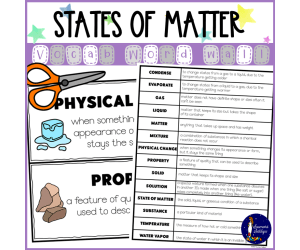
States of Matter Vocabulary Word Wall with Vocabulary Quiz
Science, Basic Science, Earth and Environmental Sciences, Earth Sciences, Physics, Grade 3, 4, Quizzes, Quizzes and Tests, Teacher Tools
States of Matter Vocabulary Word Wall with Vocabulary Quiz Included in this collection: 14 large flashcards for your word wall A student handout containing all vocabulary words A quiz on states of matter vocabulary An answer key Vocabulary Words: Condense Evaporate Gas Liquid Matter Mixture Physical change Property Solid Solution State of matter Substance Temperature Water vapor Grasping the concepts of states of matter and understanding the associated vocabulary is a crucial foundation for more advanced scientific learning in subsequent grades. These essential ideas aid students in constructing a robust base for their scientific knowledge. Each vocabulary card features a corresponding image, facilitating clearer explanations and addressing student queries. Enhance your students' confidence with the included quiz! This assessment encourages students to contemplate the behavior of various substances, their classification, and their potential transformations between different states. Thank you! States of Matter Vocabulary Word Wall with Vocabulary Quiz | States of Matter Vocabulary Word Wall with Vocabulary Quiz | States of Matter Vocabulary Word Wall with Vocabulary Quiz | States of Matter Vocabulary Word Wall with Vocabulary Quiz | States of Matter Vocabulary Word Wall with Vocabulary Quiz | States of Matter Vocabulary Word Wall with Vocabulary Quiz | States of Matter Vocabulary Word Wall with Vocabulary Quiz |
Author Soumara Siddiqui
Tags States Of Matter, States Of Matter Vocabulary, Mixture, Physical Properties, Solution, Substance
Jeans Reading Comprehension Passage - Cored Ed Encyclopedia
ELA, Reading Comprehension, Reading, Language Development, Vocabulary, History, Social Studies, Technology, Science, Pre-Reading, Grade 2, 3, 4, 5, Worksheets & Printables, Worksheets, Teacher Tools, Centers, Activities, Writing Prompts, Assessments, Quizzes and Tests, Quizzes, Lesson Plans
This Jeans reading comprehension with lesson plan includes: Visualization (on the front cover) Start your lesson by taking a minute to think and share something about the topic. Read the script aloud (slowly), perhaps prepare some music or sound effects. Student close their eyes and let their imaginations wander. Students open their eyes, read the question aloud and give them a few minutes to complete. Ask a few students to share or keep answers until the end to compare with what they learn in the passage. Quick pause—thousands of Cored Education products are included with your TeachSimple membership. Download links and encyclopedia index available here. Pre-Reading Trivia Students will write down one thing they already know about the subject and then read five more facts and discuss. These facts are fun, and the students will enjoy learning about the subject before reading more. Give 1 minute for students to write what they already know (no pressure—best guess is fine). Read the five facts together. After each fact, do ask a student for their opinion, was it surprising? Set a purpose by asking students to highlight/underline one fact they want to learn more about during the reading. Reading Passage The text is a high-interest reading passage with set paragraphs, roughly three to four paragraphs long. It contains a variety of themes about the topic, anywhere from history to technology. The passage is between 250 and 350 words in length. First, ask students to look at the headings and see what they’ll learn about today. What do they know about the topic/heading? First read options: Teacher read-aloud (best for support). Partner reading (paragraph by paragraph). While reading, students underline important details, and vocabulary words they think may come up in the questions section. Mixed Questions The first question page contains four multiple-choice questions, each with a choice of four answers, and three written response questions that require a sentence or two from the student. Students complete the mcqs first independently, then review quickly as a class. For the 3 written responses, try to get students giving the answer with some form of evidence: “I think ___ because the text says ___.” If students get stuck, send them back to check the passage. Vocabulary Questions Practice seven key words from the text in this section across two activities. First section is scrambled words where students will unscramble three words given a clue for each. The second section is a word to meaning matching activity. Before starting, have some students read out words they underlined in the passage. Ask students to say the word and read aloud the sentence(s) around each word. Ask students to do scrambled words and the matching exercise in pairs then go through answers as a class. For the scrambled spelling task, get four pairs to come up to the board and write the words for extra practice with the other student reading out the clue. For the matching task, prompt students to give full sentences: “I matched ___ with ___ because ___.” Creative Writing In this question, the student will be required to write a five to eight sentence paragraph on a question related to the topic. Before starting, ask students write down 3 key ideas they are going to include in their piece. Ask students for ideas to share around the class to help those struggling. Pro writing expectations: 5–8 sentences At least 2 facts or details from the passage At least 2 vocabulary words from the previous page Students read their paragraphs while classmates listen for facts and vocabulary words. Extension Activities This page is optional for fast finishers or to take home. There are several activities, each one requiring a different skill. Do some, do none, do all, completely optional - but you will feel reassured knowing every possibility is planned for. Includes summary writting question and additional facts. Answer Key There are answers for the multiple-choice questions, written response questions have sample answers, vocabulary answers and if there is a summary question then a sample summary will be provided as well. Lesson Plan Included Customized lesson plan for this lesson is included. Lesson Snapshot Title: Jeans Genre: Nonfiction (informational text) Subject: Reading (Informational Text) / Social Studies Primary Topic: Denim, rivets, and how jeans changed over time Estimated Guided Reading Level (A–Z): R What This Lesson Teaches Best Explains what makes denim strong (slanted, diagonal woven lines) and connects denim’s blue color to indigo dye. Builds word/history knowledge by linking “denim” to Nîmes and “jeans” to the port city of Genoa. Shows an invention problem-and-solution story: pockets ripped, so copper rivets were added, leading to a patented idea. Traces how jeans spread from work clothes to popular culture (mines/farms → World War II → 1950s movie stars). Introduces environmental impact through a concrete detail: making and caring for jeans can use thousands of liters of water, so mending/sharing/reusing matters. Learning Goals Identify the main idea and key details about how jeans were made to be tough. Explain why denim is strong and how indigo connects to the story of jeans. Describe the problem Jacob W. Davis noticed and how rivets solved it. Describe at least two ways jeans changed over time, using details and dates from the passage. Explain why mending, sharing, and reusing jeans can matter, based on the passage. Key Vocabulary From the Text denim — strong cloth with slanted, diagonal woven lines. indigo — a deep blue dye used to color denim. rivets — tiny metal pieces that strengthen places that rip. patent — legal protection for a new invention idea. synthetic — made by people, not from nature. FULL CATALOG OF DOWNLOAD LINKS AND ENCYCLOPEDIA INDEX HERE
Author Cored Education
Rating
Tags Vocabulary, Reading Comprehension, Reading Passages, Lesson Plans, Ela Lesson Plans, Reading Comprehension Lesson Plans, Pre-reading, Social Studies Lesson Plans, History, Technology

Electricity Quiz
Science, Physics, Grade 3, 4, 5, 6, 7, 8, 9, 10, 11, 12, Quizzes, Quizzes and Tests, Teacher Tools
A simple 10 question electricity quiz to check student's understand of electricity concepts.
Author WhyMaker
Tags Career And Technical Education, Physical Science, Engineering, Electricity Quiz

Science Reading Comprehension Passage: Baseball Science (Docs)
Science, ELA, Reading, Reading Comprehension, Strategies, Resources for Teachers, Physics, Grade 6, 7, 8, 9, Writing Prompts, Worksheets & Printables, Centers, Activities, Teacher Tools, Assessments, Quizzes and Tests, Quizzes, Tests
Science Reading Comprehension Passage and Questions: Baseball Science (Docs) This very engaging science reading passage is about the physics of baseball , especially how forces and energy affect the way a baseball moves after it is hit or pitched. It explains how kinetic energy transfers from the bat to the ball, how launch angle affects distance, how air resistance/drag slows the ball, and how spin creates the Magnus effect, which can make pitches curve or make batted balls carry farther. It also explains how weather and location, such as high altitude, warm air, and humidity, can affect how far a ball travels. This passage is designed to bridge the gap between science and literacy through strengthening reading comprehension and sparking scientific curiosity in middle school students. The passage blends English Language Arts skills with accurate science content that supports NGSS classroom practice. Ideal for interdisciplinary learning in ELA and Science. Suitable for Grade 9 review, too! Student Tasks for The Passage: 5 multiple-choice questions targeting main idea, key details, inference, vocabulary in context, and use of evidence 5 vocabulary matching items with clear, student-friendly definitions 5 text-based questions that require citing specific lines or facts 1 summary prompt that asks students to condense central ideas accurately Full answer key for every section Available Formats for this Resource PDF Fillable PDF Word Docs FULL CATALOG OF DOWNLOADING LINKS HERE Product Details Length: 4 pages total Grades: 6–8, also suitable for Grade 9 review Use cases: close reading, stations, homework, intervention, test prep, and sub plans Standards support: reinforces informational-text skills and supports NGSS-style sense making through observation, modeling, and clear use of claim, evidence, and reasoning Why Teachers Choose This Set Authentic science content paired with rigorous literacy practice Consistent task structure across all passages for easier planning and smoother student routines Clear, age-appropriate writing that builds confidence without oversimplifying Other Science Reading Collections you May find in the store: 1. Astronomy & Space Science 2. Volcanoes, Rocks, & Mountains 3. Rock Cycle, Soil, & Sinkholes 4. Mars, Glaciers, & Antarctica 5. Water Cycle, Acid Rain, & Wastewater 6. Insects, Animals, & Ecosystems 7. Bioluminescence & Insects 8. Animal Skin, Cats, & T. Rex 9. Human Body and Senses 10. Health & Applied Bioscience 11. Waves, Light, & Imaging 12. Electricity & Energy 13. Motion & Materials 14. Chemistry and Materials Science Use this set to reinforce ELA skills in science, to add literacy to your lessons, and to support independent work. The passages strengthen main idea, evidence use, vocabulary in context, inference, cause and effect, and summary writing. With ready-to-use assessments and complete answer keys, you can provide focused practice that is simple to run and fast to review.
Author Middle & High School - CORED Education
Rating
Tags Middle School, Reading Comprehension, Reading Strategies, ELA, Centers, Reading Passage, Assessments, Vocabulary, Making Candy, Physics

Life Science Reading Comprehension Passage: Animal Skin (Fillable PDF)
Science, ELA, Reading, Reading Comprehension, Strategies, Resources for Teachers, Life Sciences, Animals, Biology, Grade 6, 7, 8, 9, Writing Prompts, Worksheets & Printables, Centers, Activities, Teacher Tools, Assessments, Quizzes and Tests, Quizzes, Tests
Life Science Reading Comprehension Passage and Questions: Animal Skin (Fillable PDF) This very engaging life science reading passage about how animal skin helps animals survive. It explains that skin is not just a body covering. It can protect animals from sunlight, germs, insects, and predators. The passage gives three main examples : Hippos: Their red-colored secretion works like sunscreen, discourages insects, and helps kill bacteria. Zebras: Their stripes act as camouflage and can confuse predators when the herd moves together. King snakes: Their colors imitate venomous coral snakes, which makes predators hesitate or back off. This passage is designed to bridge the gap between science and literacy through strengthening reading comprehension and sparking scientific curiosity in middle school students. The passage blends English Language Arts skills with accurate science content that supports NGSS classroom practice. Ideal for interdisciplinary learning in ELA and Science. Suitable for Grade 9 review, too! This passage is designed as a fillable PDF , which means students can type their answers directly into the document on any computer or tablet . Each page includes highlighted text fields that show them exactly where to type! Student Tasks for The Passage: 5 multiple-choice questions targeting main idea, key details, inference, vocabulary in context, and use of evidence 5 vocabulary matching items with clear, student-friendly definitions 5 text-based questions that require citing specific lines or facts 1 summary prompt that asks students to condense central ideas accurately Full answer key for every section Available Formats for this Resource PDF Word Docs Google Docs FULL CATALOG OF DOWNLOADING LINKS HERE Product Details Length: 4 pages total Grades: 6–8, also suitable for Grade 9 review Use cases: close reading, stations, homework, intervention, test prep, and sub plans Standards support: reinforces informational-text skills and supports NGSS-style sense making through observation, modeling, and clear use of claim, evidence, and reasoning Why Teachers Choose This Set Authentic science content paired with rigorous literacy practice Consistent task structure across all passages for easier planning and smoother student routines Clear, age-appropriate writing that builds confidence without oversimplifying Other Science Reading Collections you May find in the store: 1. Astronomy & Space Science 2. Volcanoes, Rocks, & Mountains 3. Rock Cycle, Soil, & Sinkholes 4. Mars, Glaciers, & Antarctica 5. Water Cycle, Acid Rain, & Wastewater 6. Insects, Animals, & Ecosystems 7. Bioluminescence & Insects 8. Animal Skin, Cats, & T. Rex 9. Human Body and Senses 10. Health & Applied Bioscience 11. Waves, Light, & Imaging 12. Electricity & Energy 13. Motion & Materials 14. Chemistry and Materials Science Use this set to reinforce ELA skills in science, to add literacy to your lessons, and to support independent work. The passages strengthen main idea, evidence use, vocabulary in context, inference, cause and effect, and summary writing. With ready-to-use assessments and complete answer keys, you can provide focused practice that is simple to run and fast to review.
Author Middle & High School - CORED Education
Rating
Tags Middle School, Reading Comprehension, Reading Strategies, ELA, Centers, Reading Passage, Assessments, Vocabulary, Life Science
Chalk Reading Comprehension Passage - Cored Ed Encyclopedia
ELA, Language Development, Reading Comprehension, Reading, Pre-Reading, Life Sciences, Science, Social Studies, Earth and Environmental Sciences, Geography, Grade 2, 3, 4, 5, Worksheets & Printables, Worksheets, Teacher Tools, Centers, Activities, Writing Prompts, Assessments, Quizzes and Tests, Quizzes, Lesson Plans
This chalk reading comprehension with lesson plan includes: Visualization (on the front cover) Start your lesson by taking a minute to think and share something about the topic. Read the script aloud (slowly), perhaps prepare some music or sound effects. Student close their eyes and let their imaginations wander. Students open their eyes, read the question aloud and give them a few minutes to complete. Ask a few students to share or keep answers until the end to compare with what they learn in the passage. Quick pause—thousands of Cored Education products are included with your TeachSimple membership. Download links and encyclopedia index available here. Pre-Reading Trivia Students will write down one thing they already know about the subject and then read five more facts and discuss. These facts are fun, and the students will enjoy learning about the subject before reading more. Give 1 minute for students to write what they already know (no pressure—best guess is fine). Read the five facts together. After each fact, do ask a student for their opinion, was it surprising? Set a purpose by asking students to highlight/underline one fact they want to learn more about during the reading. Reading Passage The text is a high-interest reading passage with set paragraphs, roughly three to four paragraphs long. It contains a variety of themes about the topic, anywhere from history to technology. The passage is between 250 and 350 words in length. First, ask students to look at the headings and see what they’ll learn about today. What do they know about the topic/heading? First read options: Teacher read-aloud (best for support). Partner reading (paragraph by paragraph). While reading, students underline important details, and vocabulary words they think may come up in the questions section. Mixed Questions The first question page contains four multiple-choice questions, each with a choice of four answers, and three written response questions that require a sentence or two from the student. Students complete the mcqs first independently, then review quickly as a class. For the 3 written responses, try to get students giving the answer with some form of evidence: “I think ___ because the text says ___.” If students get stuck, send them back to check the passage. Vocabulary Questions Practice seven key words from the text in this section across two activities. First section is scrambled words where students will unscramble three words given a clue for each. The second section is a word to meaning matching activity. Before starting, have some students read out words they underlined in the passage. Ask students to say the word and read aloud the sentence(s) around each word. Ask students to do scrambled words and the matching exercise in pairs then go through answers as a class. For the scrambled spelling task, get four pairs to come up to the board and write the words for extra practice with the other student reading out the clue. For the matching task, prompt students to give full sentences: “I matched ___ with ___ because ___.” Creative Writing In this question, the student will be required to write a five to eight sentence paragraph on a question related to the topic. Before starting, ask students write down 3 key ideas they are going to include in their piece. Ask students for ideas to share around the class to help those struggling. Pro writing expectations: 5–8 sentences At least 2 facts or details from the passage At least 2 vocabulary words from the previous page Students read their paragraphs while classmates listen for facts and vocabulary words. Extension Activities This page is optional for fast finishers or to take home. There are several activities, each one requiring a different skill. Do some, do none, do all, completely optional - but you will feel reassured knowing every possibility is planned for. Includes summary writting question and additional facts. Answer Key There are answers for the multiple-choice questions, written response questions have sample answers, vocabulary answers and if there is a summary question then a sample summary will be provided as well. Lesson Plan Included Customized lesson plan for this lesson is included. Lesson Snapshot Title: Chalk Genre: Nonfiction (informational text with headings) Subject: Life Science / Earth Science / Reading (Informational Text) Primary Topic: How chalk forms and how people use it Estimated Guided Reading Level (A–Z): O What This Lesson Teaches Best Explains chalk’s origin: microscopic ocean life made calcium carbonate shells that piled up, hardened, and became chalk. Uses cause-and-effect to show how pressure, time, and weather change materials (shells → rock; waves/wind reveal cliffs). Connects a natural material to human uses (building materials, improving sour soil, writing and drawing). Builds understanding of properties of materials (chalk is soft, rubs into powder, leaves visible marks on dark boards). Highlights how tools and surfaces change over time (dark boards, colored chalk experiments, sidewalk chalk, whiteboards). Learning Goals Students will explain how chalk forms over a long time using details from the text. Students will identify what chalk is made from in the beginning of its story (shells of microscopic living things). Students will describe at least two practical uses of chalk named in the text. Students will explain why chalk worked well on dark boards, using evidence from the passage. Students will compare chalk rock and gypsum “chalk” as described in the passage. Key Vocabulary From the Text microscopic — too tiny to see without help. carbonate — part of a mineral in many shells. crumbly — easy to break into small pieces. gypsum — a mineral used to make some board “chalk.” pavement — the hard surface of a sidewalk or road. FULL CATALOG OF DOWNLOAD LINKS AND ENCYCLOPEDIA INDEX HERE
Author Cored Education
Rating
Tags Vocabulary, Reading Comprehension, Reading Passages, Lesson Plans, Ela Lesson Plans, Reading Comprehension Lesson Plans, Pre-reading, Science Lesson Plans, Earth Science, Geography