



3,950 products added recently
Page 23 - Popular Worksheets
Discover a collection of popular worksheets that have been well-received by educators. Covering a variety of subjects and grade levels, these resources offer proven effectiveness in reinforcing concepts. Incorporate them into your lesson plans to save time and provide engaging activities for your students.

 Show filters


Iguanas Reading Comprehension Passage - Cored Ed Encyclopedia
ELA, Reading Comprehension, Reading, History, Social Studies, Science, Physics, Earth and Environmental Sciences, Life Sciences, Geography, Grade 2, 3, 4, 5, Worksheets & Printables, Worksheets, Teacher Tools, Centers, Activities, Writing Prompts, Assessments, Quizzes and Tests, Quizzes, Lesson Plans
This Iguanas reading comprehension with lesson plan includes: Visualization (on the front cover) Start your lesson by taking a minute to think and share something about the topic. Read the script aloud (slowly), perhaps prepare some music or sound effects. Student close their eyes and let their imaginations wander. Students open their eyes, read the question aloud and give them a few minutes to complete. Ask a few students to share or keep answers until the end to compare with what they learn in the passage. Quick pause—thousands of Cored Education products are included with your TeachSimple membership. Download links and encyclopedia index available here. Pre-Reading Trivia Students will write down one thing they already know about the subject and then read five more facts and discuss. These facts are fun, and the students will enjoy learning about the subject before reading more. Give 1 minute for students to write what they already know (no pressure—best guess is fine). Read the five facts together. After each fact, do ask a student for their opinion, was it surprising? Set a purpose by asking students to highlight/underline one fact they want to learn more about during the reading. Reading Passage The text is a high-interest reading passage with set paragraphs, roughly three to four paragraphs long. It contains a variety of themes about the topic, anywhere from history to technology. The passage is between 250 and 350 words in length. First, ask students to look at the headings and see what they’ll learn about today. What do they know about the topic/heading? First read options: Teacher read-aloud (best for support). Partner reading (paragraph by paragraph). While reading, students underline important details, and vocabulary words they think may come up in the questions section. Mixed Questions The first question page contains four multiple-choice questions, each with a choice of four answers, and three written response questions that require a sentence or two from the student. Students complete the mcqs first independently, then review quickly as a class. For the 3 written responses, try to get students giving the answer with some form of evidence: “I think ___ because the text says ___.” If students get stuck, send them back to check the passage. Vocabulary Questions Practice seven key words from the text in this section across two activities. First section is scrambled words where students will unscramble three words given a clue for each. The second section is a word to meaning matching activity. Before starting, have some students read out words they underlined in the passage. Ask students to say the word and read aloud the sentence(s) around each word. Ask students to do scrambled words and the matching exercise in pairs then go through answers as a class. For the scrambled spelling task, get four pairs to come up to the board and write the words for extra practice with the other student reading out the clue. For the matching task, prompt students to give full sentences: “I matched ___ with ___ because ___.” Creative Writing In this question, the student will be required to write a five to eight sentence paragraph on a question related to the topic. Before starting, ask students write down 3 key ideas they are going to include in their piece. Ask students for ideas to share around the class to help those struggling. Pro writing expectations: 5–8 sentences At least 2 facts or details from the passage At least 2 vocabulary words from the previous page Students read their paragraphs while classmates listen for facts and vocabulary words. Extension Activities This page is optional for fast finishers or to take home. There are several activities, each one requiring a different skill. Do some, do none, do all, completely optional - but you will feel reassured knowing every possibility is planned for. Includes summary writting question and additional facts. Answer Key There are answers for the multiple-choice questions, written response questions have sample answers, vocabulary answers and if there is a summary question then a sample summary will be provided as well. Lesson Plan Included Customized lesson plan for this lesson is included. Lesson Snapshot Title: Iguanas Genre: Nonfiction (informational text) Subject: Reading (Informational Text) / Life Science Primary Topic: Green vs. marine iguanas: tails, habitat, survival Estimated Guided Reading Level (A–Z): R What This Lesson Teaches Best Describes key iguana features and what they look like (dewlap, a line of spines). Explains where iguanas live and notes that most live in the Americas, with some relatives on islands. Shows how a green iguana’s long tail helps with survival (whip-like defense and strong tail strokes for swimming away). Compares two related iguanas by habitat and behavior (tree-climbing green iguana vs. sea-foraging marine iguana that eats algae and basks on dark rocks). Builds awareness of changing habitats and reasons protection matters (building on land, hunting/capturing, predators, El Niño, oil spills). Learning Goals Identify details that describe what an iguana looks like and where it lives. Explain how a green iguana uses its tail when danger comes near water. Describe how the marine iguana finds food and what it does after a cold swim. Compare the green iguana and marine iguana using evidence from the passage. Describe at least two reasons iguanas might need protection based on changes in their habitats. Key Vocabulary From the Text dewlap — loose throat skin that can hang in a fold. spines — pointed bumps that may rise along its back. forages — searches for food. predators — animals that hunt other animals. habitats — places animals need to live. FULL CATALOG OF DOWNLOAD LINKS AND ENCYCLOPEDIA INDEX HERE
Author Cored Education
Rating
Tags Vocabulary, Reading Comprehension, Reading Passages, Lesson Plans, Ela Lesson Plans, Reading Comprehension Lesson Plans, Pre-reading, History, Science Lesson Plans, Life Science
Research Organizer & Essay Assignment: Ray Bradbury
ELA, Literature, Writing, Grade 6, 7, 8, 9, 10, Activities, Projects, Worksheets & Printables, Worksheets
This resource provides your students with the opportunity to independently research and write about the life of Ray Bradbury, the renowned science fiction and fantasy author, with this engaging research planner and essay assignment. This carefully scaffolded and easy-to-assign-AND-assess resource has been designed to guide student learning from Bradbury fact-collection to the careful development of a five-paragraph research essay. Teaching this resource could not be easier! Start by handing out the background research and note-taking worksheet (you could also ONLY hand this out if you want a shorter lesson!). Once students have found their facts and sources, provide them with the essay outline activity, which guides them step-by-step through the requirements of a short research essay. From there, drafting their essay, using the provided peer review checklist, and submitting their final draft will be no problem at all. And then you can assess their work with the provided Common Core rubric! Use this entire resource as a complete research lesson or just part of it as a short research activity or sub plan! This TeachSimple download includes: A Ray Bradbury essay writing assignment with directions, requirements, research essay writing tips, a peer review checklist, and Common Core-tied grading rubric An editable rubric, provided as a link, that lets you make adjustments to the grade values and guidelines. This link is provided as as Google Sheet specifically built for integration into Google Classroom, although you can also modify it for use in other Learning Management Systems (LMSs) A Ray Bradbury biography and note-taking worksheet that will guide your students through information gathering. This straightforward two-page handout includes instructions for background research, a fun drawing section, and an area to cite quality sources and organize conducted research A research essay outlining worksheet, so students build on their Ray Bradbury notes in a clear and simple manner as they build their work towards a draft and final paper All 6-pages of this lesson are provided in full-color and B&W versions Although this resource can be fitted for any secondary Language Arts classroom, it has been carefully designed to work best in grades 8 through 11. The included rubric is subtly but specifically tied to Common Core ELA Standards for Language (3) and Writing (2 and 7). This resource is provided as a print-ready, bookmarked, and adjustable PDF file. The rubric is also included as an editable Google Sheet. This resource contains 6 pages and 1 Google Sheet.
Author The Language of Educational Art, LLC
Tags Research, Notetaking, Essay, Outlining, Rubric

High School Science The Keystone Paradigm Unit
ELA, Reading, Writing, Reading Comprehension, Research, Resources for Teachers, Science, Earth and Environmental Sciences, Homeschool Resources, High School, Teacher Tools, Assessments, Lesson Plans, Quizzes and Tests, Rubrics, Worksheets & Printables, Writing Prompts, Worksheets
Let’s be real: finding science curriculum for a ninth grader that is not fluff feels like a full-time job. Once we hit the high school years, the "nature study" phase is over, and suddenly we are staring down the barrel of complex theories and massive textbooks. I built this unit because I was tired of "busy work" packets. I wanted my own daughter to see that science isn't just a list of facts to memorize—it is a messy, fascinating debate that is still happening right now. INCLUDED IN THIS RESOURCE: Keystone Paradigm Text 30-Year Population Data MacNulty Science Challenge Complete Grading Suite TOPICS COVERED: Trophic Cascade Mechanics Ecosystem Engineering Abiotic vs. Biotic Factors Scientific Model Critiques I will never forget the morning she finally sat at the table, nose deep in the MacNulty critique, and the "aha!" moment hit. Watching her connect the dots on how a wolf can actually shift the course of a river... that is the spark we’re all chasing, right? I designed this to give your student/homeschooler that same intellectual respect while giving you a breather. It is rigorous, it’s deep, and most importantly, it is ready to go. I hope it brings some incredible "lightbulb moments" and lively debates to your house, too. If you and your students/homeschoolers enjoyed this resource, please leave a review. Thank you for your support! Tina - Big Easy Homeschooling Mom
Author Homeschool with Big Easy Homeschooling Mom
Rating
Tags High School Science, Homeschool Science, Ecology Unit, Trophic Cascades, Yellowstone Wolves, Biology Module, Environmental Science, High School Ecology Curriculum, MacNulty Challenge Science, High School Biology Curriculum

Word Puzzles Crossword Wordsearch Anagram THEATER
Special Resources, ELA, Creative Arts, Art, Special Education Needs (SEN), Speech Therapy, Language Development, ESL, Writing, Handwriting, Vocabulary, Drama, Not Grade Specific, Crosswords Puzzles, Worksheets, Worksheets & Printables
Word Games with Puzzles | Crossword Wordsearch Anagram | THEATER . Designed for usage across multiple grade levels, this teaching resource known as 'Word Games with Puzzles' seamlessly integrates essential vocabulary study with an engaging THEATER theme . This resource is incredibly versatile and adaptable to fit a variety of learning environments . It invites educators in public schools, or even those that teach in a homeschooling setting, to invigorate their Language Arts curriculum while catering to educational trends including Special Education Needs ( SEN ), Speech Therapy, ESL instruction, and Life Skills lessons . The primary contents of the package comprise : two matching activities ( words to pictures & vice versa ) . a word search board with real photos or illustrations on top of the page . two quiz versions . anagrams worksheet ( with photos or color illustration images ) . a wheel of images to spin, cut and paste or laminate as flash cards . a wheel of words to spin, cut and paste or laminate as flash cards . two writing boards (blank and lined) . The word search board challenges pupils further by letting them identify key keywords hidden amongst many irrelevant ones - offering both challenge and fun . Supplemental Materials include : Real photos along with whimsical illustrations serve dual purposes; they function not only as flashcards but also allow teachers to create visual folders thus adding versatility and creativity into everyday teaching circumstances . All elements included in this resource can double down both as part of your center 's resources library or can be handed out on individual bases hence serving multiple needs, from group- works to homework assignments . This brings you the valued flexibility everyone appreciates when it comes down classroom management - making this product extremely well- rounded . 12 page pdf .
Author WORDS ASIDE
Tags Vocabulary Study, Handwriting Practice, Word Search, Visual Aids, Word Wall, Crossword, Independent Work, Centers, Theater, Words Aside

Finding Nemo Movie Guide (Fish Philosophy - Social/Emotional)
Special Resources, Social Emotional Learning (SEL), Social Skills, Grade 3, 4, 5, Teacher Tools, Worksheets
The Finding Nemo movie guide combines writing and social emotional learning (social studies) as students must find examples of the Fish Philosophy in the movie and provide evidence of how these concepts are used. Using movies and movie guides in the classroom can make learning more engaging and relatable for students. Movies bring lessons to life by showing scientific concepts and social issues in an entertaining way, while movie guides help students focus on important details and think critically about what they watch. Movie Synopsis: Marlin, a clown fish, is overly cautious with his son, Nemo, who has a small fin (Some consider it a disability). When Nemo swims too close to the surface to prove himself, he is caught by a diver, and now Marlin must set out to find him, even though he is afraid of the ocean. A blue reef fish named Dory, who has a really short memory, meets up with Marlin and complicates (and sometimes helps with) the chance meetings of sharks, jellyfish, and a host of ocean dangers. At the same time, Nemo plots his escape from a dentist's fish tank, with the help of another fish with a shortened fin and a seagull. Speaking and listening standards can also be covered depending on how many of the above topics you cover in your classroom. The movie guide provides an opportunity for teachers to "get back" some of that class time at the end of a unit, whether needed for grading projects, working one on one with students, or finishing up assessments. Other students are engaged and still actively searching for the topics covered in the unit discussed. The activities provided allow for: Class discussion Small group discussion Informal assessment Movie Rating: G Grades: 3rd - 5th Tags: Finding Nemo, Disney Pixar, movie guide, Fish Philosophy, social emotional learning, behavior management, Choose your Attitude, Play, Make Their Day, Be There File type: PDF Pages: 2 - including answer key
Author Kel's Klass
Tags Disney Pixar, Movie Guide, Finding Nemo, Fish Philosophy, Social Emotional Learning, Behavior Management, Choose Your Attitude, Play, Make Their Day, Be There
Hurricanes - Digital Scientific Reading Comprehension Article – Grades 5-7
Science, Earth and Environmental Sciences, Environmental Science, Grade 5, 6, 7, Worksheets & Printables, Worksheets
Hurricanes - Fully editable, Science Reading Comprehension Activity - Disciplinary Literacy for Grades 5-7 (ages 10-12) as well as older students with lower developed learning levels. Tackle literacy and science by having your students read and answer questions from a scientific article. Questions include knowledge (direct from the paper), thinking, connecting, and open-ended varieties. The reading looks at: - What is a hurricane? - Hurricane wind - How do hurricanes form? - What to do in case of a hurricane? ----------------------------------------------- Google Classroom and Distance Learning Ready This resource is perfect for in-class or distance learning and integrates seamlessly with Google Classroom. Automatically creates a copy of the reading and puts it directly into your Google Drive with a single click. Purchase --> Open --> Click --> Assign to your students The reading also includes a Microsoft Word and PDF version. Having all three options allow you to assign the reading to your students without worrying about formatting issues as all the work has already been done for you. It also allows you, as well as your students, to access everything no matter where you are or what kind of equipment is being used. This reading is perfect for an extension activity , substitute plans, or literacy practice and hits on the following Common Core Standards: - CCSS.ELA-LITERACY.RST.6-8.1 - CCSS.ELA-LITERACY.RST.6-8.2 - CCSS.ELA-LITERACY.RST.6-8.10 The Problems You Face - Not having the time to properly teach scientific literacy (disciplinary literacy) or improve your students reading comprehension and analysis skills. - Some students work faster than others and you would like an interesting extension activity for your faster-moving students to keep them learning and engaged. The Solution This fully editable, NO PREP reading comprehension article is composed of relevant, applicable, and engaging reading activities which can be used to: • introduce your topic • improve your students literacy skills • improve your students reading comprehension and scientific literacy skills • improve your students' analysis skills • provide an extension activity to students who move at a faster pace • provide extra credit to students in need • measure your students literacy skills Furthermore, this resource works very well as an emergency substitute plan as it will keep your students on task and focused while you are away. This resource will take your students between 30-60 minutes to complete and includes a variety of questions. An answer key is also included for your reference. The following grade 5-7 readings are also available in My Store. Health and Wellbeing • Concussions • The Common Cold • Allergies • Cancer • Viruses • The Cardiovascular System • Vaccines • Blood Types • The Nervous System • Asthma and Asthma Attacks • Acne • Immune System – Your Body’s Police Force • Fracking and Its Dangers • The Measles • Stem Cells • The Flu • How Protective Equipment Keeps You Safe • Caffeine: The Elixir of Energy • Exercise and its Importance for Health • Smallpox • HIV and AIDS • Polio • Effects of stress on the brain • Pesticides • Whooping Cough • Genetics and Gene Therapy • Down Syndrome • Cystic Fibrosis • Heart Disease • Heart Attack and Stroke • Multiple Sclerosis • Laser Eye Surgery • Muscle Growth • Diabetes Ecology • Invasive Species • Urban Sprawl • Food Webs • Why Leaves Change Color In The Fall • The Effects of Pollution • Endangered Species • Animal Adaptations • Biodiversity • The Water Cycle • The Seasons and What Causes Them • Nocturnal Animals • Climate Change • Oil Spills and Their Consequences • Farming – Is Organic Really Better? • Fracking and Its Dangers • Why Bees Are Important • Bioaccumulation and Biomagnification • Ecosystems • Mosquitoes And The Diseases They Spread • Predator-Prey Relationship • Physical Adaptations • Watersheds Chemistry • The Chemistry of Cooking • Water Softeners • Chemistry of Dyeing Hair • Smog • Ocean Acidification • Pollution Control Devices • The Greenhouse Effect • Cleaning up Acid Spills • Rust-Proofing • Chemistry of Cosmetics Physics • Energy Use and Conservation • Wind Energy Production • Hydroelectric Energy Production • Solar Electricity Production • Fossil Fuel Energy Production • Nuclear Energy - Fission and Fusion • The Science of Roller Coasters • Optical Phenomena • The Northern and Southern Lights • Car Safety • Hydraulics • Simple Machines Natural Disasters and Weather • Earthquakes • Hurricanes • Tornadoes • How Weather Works • Lightning • Thunderstorms • Why The Wind Blows • Climate Change • Volcanoes • Tsunamis • Natural Disasters: Weather and Climate • Natural Disasters: Earth, Water, and Space General Sciences • Making Food Using Fermentation • Why is the Sky Blue? • The Limitations of Space Travel • Artificial Preservatives • Plate Tectonics • How Do Ships Float? • Effects of Everyday Forces • The Planets Of Our Solar System • Fossils Biology • Genetically Modified Organisms • Twins - Identical and Fraternal • The Importance of Bats • Predator-Prey Relationship Each summary is rich with age-appropriate content (grades 5-7) and is 1-3 pages long (13-font). Following each summary are 5-8 questions along with the answer key, which will help guide your students understanding. The questions include information-based questions straight from the article as well as more open-ended thinking questions that provide an extension for the learning. How this product will help your students: Improve their scientific and disciplinary literacy skills Improve their reading comprehension and scientific knowledge Give them insights into important scientific concepts Provide an extension activity for your faster moving/more gifted students How this product will help you: Allow you to meet the NGSS, TEKS, and Common Core Standards Provide you with a concise introduction to your topic Provide you with an engaging and easy to leave substitute plan which will keep your students engaged and on task Provide you a means of measuring your students' literacy skills We don't spend enough time teaching scientific literacy to our students. This is either because we don't have the resources to do so effectively or we don't have the time. However, teaching our students to become scientifically literate is vital if we want them to succeed in life. We need them to know about the world they live in and about the issues they face. ***************************** I also have a range of assignments and lessons/units from other grade levels at my store. Please CLICK HERE to have a look around and don’t forget to follow if you like what you see. Also, please visit my blog Teach Science With Fergy for my thoughts on teaching, learning, and everything in between.
Author Teach With Fergy
Tags Hurricanes Printable, Hurricanes Reading Passage, Hurricane Wind Printable, Digital Article, Digital Science Reading
Introduces Triple Consonant Blends. Read Fun Rhymes
ELA, Language Development, Phonics, Preschool, Kindergarten, Grade 1, 2, Worksheets & Printables, Worksheets
Introduces Triple Consonant Blends from Read Fun Rhymes This comprehensive teaching resource is designed for educators of Kindergarten to grade 2 students and is perfectly suited to homeschoolers and classroom environments alike. Establish a strong phonics foundation and master triple consonant blends in an engaging way Ideal for children as young as three, it enables the mastering of reading skills within six months to a year Utilize fun rhymes and games to introduce complex blends like 'squ', 'scr', 'str' and 'tch'– vital tools for learning nearly 80% of English words. The Learning Journey: Leverage initial sounds like 'b', 'd’ along with vowel sounds such as ‘a' Create an interactive learning environment where students generate words that transform into sentences under guided instruction. Through continuous practice provided by structured exercises, students progressively gain comfort in blending phonic sounds to create three or four-letter words. Beyond Word Building: In addition to word building exercises, this pack also includes entertaining word games similar to snap or bingo that make learning enjoyable. The opportunity for students to creatively personalize supplemental drawings instills a sense of ownership over their work. Remember: repetition is key! Ensure kids repeat exercises until they confidently understand them. This priceless resource not only inspires retention but also fosters love for language among young learners. Your learners deserve the best: prepare them today with Introduces Triple Consonant Blends!
Author Guinea Pig Education
Tags Phonics, Reading, Triple Blends, Interactive Learning, Word Games, Triple Consonant Blends

Addition Mazes (PDF)
ELA, Language Development, Resources for Teachers, Vocabulary, Spelling, Addition and Subtraction, Math, Addition, Early Math, Numbers, Grade 2, 3, 4, 5, Worksheets & Printables, Worksheets, Teacher Tools, Centers, Activities, Mazes
Maze Series This maze series is designed for students in grades 2–5. Each set features a clear, kid-friendly theme with scene-based mazes that students first navigate, then complete by drawing a few target words from a simple word list. Pages come in varied styles and graduated difficulty, with an optional “color it in” step—and some themes invite quick calculations to match the task. These mazes are student-friendly, classroom-ready, and perfect for literacy warmups, seasonal units, fast-finisher bins, centers, sub plans, or home learning extensions. The playful, structured format builds problem-solving, attention to detail, and fine-motor control while reinforcing themed content in a motivating way. Note: Unlike many themed products, not all word-list words appear on the maze pages. To support full vocabulary coverage, we’ve released a companion word list you can find in the links section. Addition Word List 1. Basic Addition Seven, Eight, Nine, Ten, Thirteen, Fourteen, Sixteen, Fifteen 2. Slightly Harder Addition Five, Eleven, Twelve, Seventeen, Nineteen, Twenty, Twenty-Two, Twenty-Five 3. Intermediate Addition Eighteen, Twenty-One, Twenty-Six, Twenty-Seven, Thirty, Thirty-Three, Thirty-Four, Thirty-Five 4. Larger Numbers Forty, Forty-Two, Forty-Five, Forty-Seven, Fifty, Fifty-Four, Fifty-Eight, Sixty 5. Up to Seventy-Five Sixty-Five, Sixty-Nine, Seventy, Seventy-Two, Seventy-Five, Seventy-Nine, Eighty, Eighty-Five 6. Up to One Hundred Eighty-Nine, Ninety, Ninety-Five, Ninety-Seven, Ninety-Nine, One Hundred, One Hundred Five, One Hundred Ten PDF Version Other versions will appear here when available. Follow the store for the lastest on new products. How to Use These Mazes Perfect for: Morning work or early-finisher bins Literacy or STEM centers Holiday/seasonal review lessons Independent stations, sub plans, or take-home enrichment More Addition Themed Products CROSSWORDS WORD SEARCHES FULL CATALOG OF DOWNLOAD LINKS HERE Themed Mazes Links Addition PDF Animals PDF Around the Home PDF Birthday PDF Candy PDF Christmas PDF Cinco de Mayo PDF Clothes PDF Colors PDF Days and Months PDF Division PDF Earth Day PDF Easter PDF Easy Mazes PDF Fall PDF Father's Day PDF Food PDF Geography (Set 1) PDF Geography (Set 2) PDF Geography (Set 3) PDF Graduation PDF Health PDF History (Set 1) PDF History (Set 2) PDF History (Set 3) PDF Human Body PDF Kindness PDF Life Skills PDF Mother's Day PDF Multiplication PDF Science (Set 1) PDF Science (Set 2) PDF Science (Set 3) PDF Shapes PDF Social Skills PDF Spring PDF Sports PDF St. Patrick's Day PDF Subtraction PDF Summer PDF Thanksgiving PDF Transport PDF Valentine's Day PDF Winter PDF Mazes in Depth Structure Each maze is crafted around a focused sub-theme. Students navigate the maze, encountering branches and cul-de-sacs that build attention and planning. Most pages include a tiny follow-up box—students draw or label 2–3 target words from a small word box, add a quick count, or color in the scene—so the activity reinforces both content and skills in a highly engaging format. Each completed set includes: A themed maze page. A simple student instruction strip. An answer key showing the solved path for teacher support or self-checking Themes Included These mazes cover a wide range of fun, age-appropriate themes, including: Seasons & Holidays (e.g., Halloween, Easter, Valentine’s Day) Math-Lite Connections (e.g., quick counts, number words) Everyday Topics (e.g., Animals, Weather, School) Special Units (e.g., Health, Earth Day, Sports, Kindness) Each topic reflects students’ real-life experiences and interests while strengthening problem-solving, visual scanning, and fine-motor control in a playful, highly visual way. Easy extensions (optional): Time it: solve once in pencil, then try to beat the time in pen Retell the route using sequence words (first, next, then, finally) Count intersections or turns and graph the results Write a 1–2 sentence mini-story about the scene using the target words Design a tiny maze in the corner for a partner to solve Differentiation tips: Offer a finger-trace pass before pencils for emerging learners Highlight the borders of the correct region on first attempts Use thicker-line versions or simpler pages to build confidence Pair roles: “navigator” gives directions; “driver” traces the path For similar downloads and other frees, do check out Cored Group on TeachSimple.
Author Cored Education
Rating
Tags Vocabulary, Spelling, Math, Basic Addition, Slightly Harder Addition, Intermediate Addition, Addition Activities, Math Mazes, Addition Mazes, Mazes

Reading Comprehension and Questions Fiction Set 5 - Sports (Word)
ELA, Reading, Common Core, Children’s Literature, Literature, ESL, Language Development, Spelling, Vocabulary, Writing, Grade 4, 5, Worksheets & Printables, Worksheets, Assessments, Teacher Tools, Tests, Quizzes and Tests, Writing Prompts
Reading Comprehension Passages Fiction Set 5 Overview No prep reading comprehension lessons, with enjoyable stories and topics. Each lesson has a blend of post-reading activities. Mixed questions to check overall understanding. Vocabulary activities, plus a writing section. Lessons also contain a bonus extension exercise at the end. Some you may like, some you may not, either way they are there if you wish to use them. Full answer keys are provided. Passages Include 1.Olympics: Lauren and her class get excited when talking about the Olympics. 2.Tryouts: Max is getting himself ready for the basketball tryouts. 3.Big Brienne: Kitty has the game of her life against Big Brienne. 4.A Skate on the Lake: Aimee has a nice evening at the lake with her dad and friends. 5.Baseball Boy: Mitch goes to watch the Chicago Hitters. Read about his day. 6.Running: An informative, yet light piece about running. Word Version This is the Word editable version. This download is available in GOOGLE Docs, GOOGLE Forms, GOOGLE Slides. PDF, PPT, WORD. Browse the Complete Cored Catalog — 2,000+ Resources Included Reading Passages Each reading passage has been written specifically for students in Grades 4–5, using vocabulary and language that match their age and ability level. The collection covers a wide range of engaging topics, supported by colorful visuals that help bring the content to life. Every lesson is designed to build knowledge while keeping students interested and motivated to read. These resources are also designed with flexibility in mind. Unlike traditional textbooks that can quickly become outdated, lessons can be updated over time to reflect changes in technology, discoveries, and the world around us. Mixed Questions Every lesson includes a variety of questions that help students think more deeply about what they have read. The question section combines reading comprehension, vocabulary, and math skills, while also regularly reinforcing important reading strategies such as cause and effect, summarizing, compare and contrast, and drawing conclusions. Most lessons include a mix of multiple-choice and written-response questions, giving students opportunities to explain their thinking as well as select answers. Complete answer keys and sample responses are provided at the end of each lesson for quick and easy reference. Spelling & Vocabulary Each passage introduces students to useful words and phrases appropriate for Grades 4–5. To help build confidence and word knowledge, every lesson includes a spelling or vocabulary activity. Rather than repeating the same task throughout the collection, activities vary from lesson to lesson to keep practice fresh and engaging. Activities may include spelling challenges, sentence matching, decoding activities, mixed-up text exercises, and other vocabulary-building tasks connected directly to the reading. Writing Prompts Each lesson includes a writing activity that extends the ideas, themes, or topics explored in the passage. Students are encouraged to write in a variety of formats, with prompts providing helpful guidance and ideas to get them started. Writing tasks vary throughout the collection and may include creative writing, research activities, personal responses, poetry, opinion writing, and other engaging assignments. Full Answer Keys Complete answer keys and sample responses are included with every lesson, making planning and marking quicker and easier. Reading comprehension answers include evidence and support from the text, while math-based questions show the relevant working where appropriate. The answer keys are designed primarily for teachers but can also be shared with students when needed. Just for Fun Each lesson finishes with an optional extension activity called Just for Fun . These bonus activities provide an enjoyable way to extend learning beyond the main lesson and often encourage creativity, discussion, or independent thinking. They are completely optional, giving you the flexibility to use the activities that best suit your students and classroom needs. For similar downloads and other frees, do check out Cored Group on TeachSimple.
Author Cored Education
Rating
Tags Elementary, Reading, Comprehension, Vocabulary, Answers, Ccss, Common Core, Spelling, Writing, Passages

Fractions for Grade 3
Fractions, Math, Grade 3, Lesson Plans, Teacher Tools, Presentations, Worksheets, Worksheets & Printables
The components of a whole or group of items are represented by fractions. There are two components to a fraction. The numerator is the number at the top of the line. It indicates the number of equal portions picked from the entire collection. The denominator is the number that is below the line. It displays the total number of identical items in a collection or the total number of equal portions into which the whole is divided. The number of pieces we take is a fraction when the total is divided into equal parts. A cake is considered to have 1/8 of the cake on each dish if it is cut into eight equal pieces and one piece is put on each plate. It is read as ‘one-eighth’ or ‘1 by 8’. This ebook is an gradual and easy introduction to fractions. It is designed especially for Grade 3. There re many colourful activities included, and their answers are provided at the end.
Author Bright Classroom Ideas Marketplace
Rating
Tags Fraction, Math, Grade 3

The Effects of Caffeine Reading Comprehension Article
Science, Life Sciences, Human Body, Grade 8, 9, 10, 11, Worksheets & Printables, Worksheets
The Effects of Caffeine Reading Comprehension Article: An Essential Resource for Educators This is a comprehensive resource based on a scientific reading article exploring the effects of caffeine on the human body. A crucial tool for parents, homeschoolers and public school teachers, it is excellent for engaging and educating young minds. Article Overview: A deep dive into why we feel tired An exploration of how caffeine influences our bodies An examination of the potential side effects of caffeine consumption This hands-on tool comes with thought-provoking questions that encourage knowledge retention and critical thinking. Educational Compatibility & Distance Learning Readiness: One key advantage is its compatibility with Google Classroom making it an efficient tool in assigning readings to students. This teaching material also eliminates concerns about formatting or accessibility issues, offering both Microsoft Word and PDF versions. The Challenges Today's Educators Face: The common problem among teachers today – lack of time needed for teaching disciplinary literacy or developing effective reading comprehension skills – has been addressed through this solution. It introduces relevant topics while also enhancing students' reading comprehension and analytical skills simultaneously. Possible Uses include : Introducing new subjects. Gauging literacy levels. Catering to fast-paced learners who need extension activities. It offers simplicity paired with effectiveness - taking between 50-75 minutes to complete, including open-ended questions that boost cognitive engagement while also supplying an answer key for convenient grading process. Suitable For Grades 8-11: This packet provides in-depth insight into the basic biological processes that govern our everyday experiences – like feelings of fatigue that vary throughout the day due to caffeine. The complexities of science have never been more straightforward and effortless to understand. Experience an immediate benefit from this resource by incorporating it into lesson plans , group activities, homework assignments, or even remedial educational settings. This tool fosters a well-rounded understanding of scientific phenomena among future scientists and critical thinkers. Discover a hassle-free way to explore complex scientific concepts with The Effects of Caffeine Reading Comprehension Article today!
Author Teach With Fergy
Tags Caffeine Effects, Reading Comprehension, Scientific Inquiry, Critical Thinking, Knowledge Retention
Counting On & Back Addition Subtraction Number Line Worksheets
Math, Addition and Subtraction, Addition, Subtraction, Counting, Early Math, Basic Operations, Kindergarten, Preschool, Grade 1, 2, 3, Worksheets & Printables, Worksheets, Workbooks, Activities, Centers, Experiments
This interactive and attractive setCounting On & Back Addition Subtraction Number Line Worksheets Pages learners develop their original Counting On & Back Addition Subtraction Number Line Worksheets this set contains 79 pages in this set, each in each a different Digraphs Counting On & Back Addition Subtraction Number Line Worksheets of dedicated Counting On & Back Addition Subtraction Number Line Worksheets Pagesto ensure a fun and structured approach to using a fun and type of work that useful; Each card is fun this edited set ofCounting On & Back Addition Subtraction Number Line Worksheets is built in an elegant style that attracts attention this interactive and attractive set of Counting On & Back Addition Subtraction Number Line Worksheetsdesigned to help young learners develop their originalCounting On & Back Addition Subtraction Number Line Worksheets skills through Counting On & Back Addition Subtraction Number Line Worksheets sexercises This set contains 79 pages. these printable Worksheets offer useful courses, this provides a useful course-rich practice, it is designed to help using resource grade 2 easily to learn about activities Counting On & Back Addition Subtraction Number Line Worksheets a fun and interactive manner. A collaborative learning activity added students. PDF format
Author LAMO
Rating
Tags Activities, Centers, Worksheets, Math, Basic Operations, Homework
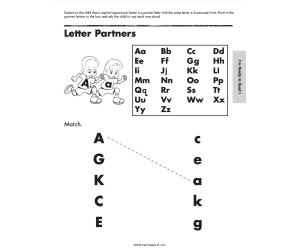
Kindergarten Skill Builder: Get Ready To Read A-L
ELA, Reading, Preschool, Grade 1, Worksheets & Printables, Worksheets
Reviewed, evaluated, edited, and creatively written by teaching professionals, this Kindergarten-focused digital resource implements current teaching strategies and aligns with grade-level standards to teach beginning-reading skills. With the ability to print the pages over and over, your child can complete the activities again and again until the skills have been mastered. Includes activities that focus on: • Letter partners • Matching, coloring and drawing • Tracing and writing letters Aa-Ll
Author Twin Sisters Digital Media
Tags Letters, Matching, Color, Draw, Fread
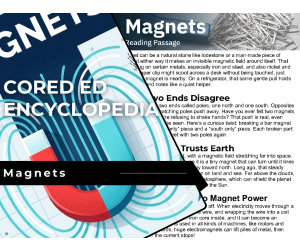
Magnets Reading Comprehension Passage - Cored Ed Encyclopedia
ELA, Language Development, Resources for Teachers, Reading Comprehension, Reading, Pre-Reading, Writing, Science, Physics, Strategies, Grade 2, 3, 4, 5, Worksheets & Printables, Worksheets, Teacher Tools, Centers, Activities, Writing Prompts, Assessments, Tests, Quizzes and Tests, Quizzes
This magnets reading comprehension contains the following: COMPANION VIDEO NOW AVAILABLE (EMBEDDED AFTER PREVIEW PICTURES IN PRODUCT DESCRIPTION) Visualize on the Cover (Teacher Read Aloud Script) Start your lesson by taking a few moments to visualize the topic and share thoughts or feelings about it. Pre-Reading Trivia Students will write down one thing they already know about the subject and then read five more facts and discuss. These facts are fun, and the students will enjoy learning about the subject before reading more. Reading Passage The text is a high-interest reading passage with set paragraphs, roughly three to four paragraphs long. It contains a variety of themes about the topic, anywhere from history to technology. The passage is between 250 and 350 words in length. Mixed Questions The first question page contains four multiple-choice questions, each with a choice of four answers, and three written response questions that require a sentence or two from the student. Vocabulary Questions Practice seven key words from the text in this section across two activities. First section is scrambled words where students will unscramble three words given a clue for each. The second section is a word to meaning matching activity. Creative Writing In this question, the student will be required to write a five to eight sentence paragraph on a question related to the topic. Extension Activities This page is optional for fast finishers or to take home. There are several activities, each one requiring a different skill. Do some, do none, do all, completely optional - but you will feel reassured knowing every possibility is planned for. Includes summary writting question. Answer Key There are answers for the multiple-choice questions, written response questions have sample answers, vocabulary answers and if there is a summary question then a sample summary will be provided as well. FULL CATALOG OF DOWNLOAD LINKS AND ENCYCLOPEDIA INDEX HERE Lesson Snapshot Title: Magnets Genre: Nonfiction Subject: Physical Science Primary Topic: Magnetic fields, poles, and electromagnets Estimated Guided Reading Level (A–Z): N What This Lesson Teaches Best Explains that magnets create an invisible magnetic field that can pull certain metals without touching them. Teaches how poles work: opposite poles attract and matching poles repel (push away). Builds science vocabulary and concepts using clear examples (paper clips, refrigerator notes, compass needle). Connects magnetism to Earth: Earth’s magnetic field helps compasses point roughly north and helps form the magnetosphere . Introduces how electricity can create an electromagnet that can be switched on and off. Learning Goals Describe how a magnet’s magnetic field can pull metal without touching it. Identify that every magnet has two poles called north and south. Explain what happens when opposite poles meet and when matching poles meet. Explain why breaking a bar magnet makes smaller magnets with two poles. Describe how a compass needle uses Earth’s magnetic field to point roughly north. Explain how an electromagnet is made using electricity and a coiled wire. Key Vocabulary From the Text Lodestone — a natural rock that acts like a magnet. Magnetic field — invisible area around a magnet that can pull metals. Poles — the two ends of a magnet: north and south. Magnetosphere — a shield around Earth made by its magnetic field. Electromagnet — a magnet made with electricity that can switch on/off. Cored Ed Encyclopedia Overview The Cored Ed Encyclopedia is a weekly series of lessons that you can pick up and use right away. These short readings fit into whatever time you have available. Each one includes a warm-up, a reading, and a set of questions, but it’s flexible — you can do just the reading, the full lesson, or skip the writing section if you need to. Each lesson focuses on a single topic so students don’t get lost. The writing is clear but never childish, making it perfect for grades two through five. Topics range from animals and science to history, inventions, and everyday things. No matter the level of the student, everyone should take away at least one new idea or fact from each lesson. The materials are easy to print, easy to explain, and require no setup. They work well for whole-class teaching, partner work, or independent study.
Author Cored Education
Rating
Tags Vocabulary, Spelling, Reading Comprehension, Reading Passages, Reading, Creative Writing, Reading Strategies, Writing Prompts, Physics
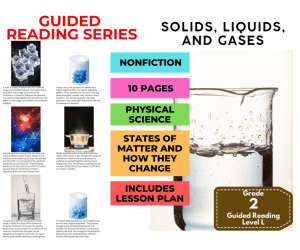
Guided Reading Level L - Solids, Liquids, and Gases
ELA, Resources for Teachers, Reading Comprehension, Reading, Science, Pre-Reading, Language Development, Physics, Grade 1, 2, 3, Worksheets & Printables, Worksheets, Teacher Tools, Centers, Activities, Literacy Readers, Quizzes, Quizzes and Tests, Assessments
This Guided Reading Book - Solids, Liquids, and Gases (Level L) includes: Guided Reading Color Label (front cover x1) This is a quick way to match the book’s demands to what students can generally handle.. The overall goal is to use the level/color to pick books for several smaller groups. To qualify for a certain level, a student is expected to read a book from that level with about 90–94% accuracy. If a student is consistently accurate and understands, move up a level. If the student is struggling at that level, drop down and add more support. Each student will improve at completely different rates, but it is generally one of the best ways to check progress across the class. DOWNLOAD THE CATALOG TO VIEW ALL GUIDED READING BOOKS AVAILABLE (SORTED LEVELS A-Z) Pre-Reading Question (x1) Teacher asks the prompt aloud, can be while showing the cover or first page. Students share what they already know, or make educated guesses from the cover. Prompt them to use the target vocabulary. Write some of their responses on the board to look back at during the reading. Vocabulary Words (x5) Introduce the five words, best doing it one at a time. Start by saying it, while students repeat and then see if anyone knows what it means before reading further. Read through the meaning and try to briefly connect each word to a picture or gesture so it’s meaningful. Ask students to flip through the book pages and point to where they see each of the vocabulary words. While reading the book pause upon coming across one of the vocab words or read the sentence twice to make sure students understand the word has appeared. Optional: Ask students to raise hands whenever they see/hear one of the new words. Guided Reading Pages (x10) Check the book snapshot (below) for: primary topic - do you need to prep extra reading or intro materials on this? what is taught best - decide on 1-2 bullets to focus on, use the prompt or words provided here for best results. learning goals - what you are checking for students to be able to do after the session, elicit answers using prompts or words provided. key vocabulary (see section above). questions overview - so you know what is coming up and if you need to prep extra materials to assist understanding. Run the lesson You may have already looked at a few of the pages together, but you can show them some of the pictures again first to set meaning. Depending on how much time you have and how familiar your students are with guided reading class, you may want to read the book aloud first with the group first. Students whisper or partner read, while you listen in. If time, do it as a group, one student reading a page each. Use the guided page’s prompts to coach: “Check the picture / does it make sense?” “Point under the words / try the first sound” “Reread the sentence smoothly”. Try to focus more on one student per session (rotating every time), so you can work out if they are ready to move up or need to move down a level. Comprehension Questions (back cover x3) This is your way to check that students didn’t just say the words, but actually understood the text. First, let students answer by pointing to the page/picture and saying a short sentence. After any answer, follow with: “Show me where you found that in the text.” In bigger groups, have partners answer first (10–20 seconds), then call on 2–3 students to share. Differentiation tips: Emerging speakers/struggling readers: oral + pointing On-level: oral in a full sentence Higher: one written sentence or draw + label Book Snapshot Title: Solids, Liquids, and Gases Genre: Nonfiction (informational) Subject: Science (Physical Science) Primary Topic: States of matter and how they change Estimated Guided Reading Level (A–Z): L What This Book Teaches Best Defines matter as anything that takes up space and has mass, made of tiny particles including atoms and molecules. Explains the three primary states of matter— solid, liquid, gas —and links each state to how closely particles are packed and how much energy they have. Describes key properties of each state (solids have definite shape/volume; liquids have definite volume but no fixed shape; gases have neither and expand to fill containers). Shows how heat/energy changes states (melting, freezing, evaporation at boiling point, and condensation into droplets). Connects science ideas to observable examples (liquids flow downward, gases can be compressed with pressure, dew as an example of condensation). Learning Goals Define matter using the book’s description (takes up space and has mass). Describe how particle spacing and energy relate to whether matter is a solid, liquid, or gas. Compare solids, liquids, and gases by shape and volume using details from the text. Explain what happens to particles when a solid is heated enough to melt into a liquid. Explain evaporation as described in the book when a liquid reaches its boiling point. Explain condensation as described in the book when a gas cools into droplets of liquid. Key Vocabulary From the Text matter — anything that takes up space and has mass. particles — tiny pieces everything is made of. molecules — very tiny groups of atoms that make up matter. evaporation — when a liquid changes into a gas. condensation — when a gas cools and turns into tiny drops of liquid. Discussion Prompts Pre-reading question: What are some things you think could be solids, liquids, or gases? Comprehension questions: What does the book say matter is? Comprehension questions: How does the book describe the particles inside a solid? Comprehension questions: According to the book, what is condensation? Printing Tips 1. Best Printing Method (Recommended) “Booklet” Printing (Best if Available) If your printer or PDF viewer supports Booklet Printing , use this. Settings to use: Print mode: Booklet Paper size: Letter or A4 (either works) Orientation: Landscape Print on both sides: Yes Flip on: Short edge Scaling: Fit to printable area Booklet subset: First test: Front sides only Then: Back sides only This will automatically: Pair pages correctly Put the cover on the outside Align everything for folding After printing, fold in half and staple along the spine . 2. If “Booklet” Printing Is NOT Available You can still print this correctly with manual duplex printing . Step-by-step: Open the PDF. Choose Print . Set: Orientation: Landscape Pages per sheet: 1 Print on both sides: Yes Flip on: Short edge Print all pages . Because each PDF page already contains two facing book pages, the result will still fold cleanly into a book. Thousands of Cored Education products are included with your TeachSimple membership. Download links and encyclopedia index available here.
Author Cored Education
Rating
Tags Vocabulary, Reading Comprehension, Reading Passages, Leveled Reading, Nonfiction, Reading, Guided Reading, Physics, States Of Matter, Water

Concussions - Scientific Reading Comprehension Article – Grades 5-7
Science, Life Sciences, Human Body, Grade 5, 6, 7, Worksheets & Printables, Worksheets
Concussions: Scientific Reading Comprehension for Grades 5-7 This science reading comprehension article helps students in grades 5-7 learn about concussions. It defines what a concussion is and highlights symptoms, treatments, and prevention. The 3-page reading includes a word bank explaining key terms. It is followed by knowledge, thinking, connecting, and open-ended questions. An answer key is also provided. This literacy resource works for whole group instruction, small groups, substitute plans, or independent practice. It aligns with TEKS, NGSS, and ELA standards on analyzing informational texts. The editable Word doc and PDF can be easily assigned digitally or printed. Overall, this concussion reading comprehension encourages scientific literacy, boosts reading skills, and extends learning for gifted students.
Author Teach With Fergy
Tags Concussions, Injury, Brain Damage, Reading, Comprehension

Animal Adaptations - Science Reading Article – Grades 5-7
Science, Life Sciences, Biology, Grade 5, 6, 7, Worksheets & Printables, Worksheets
```html Introduction The Animal Adaptations - Science Reading Article for Grades 5-7 is a versatile teaching resource that delves into the fascinating world of animal adaptations. Ideal for public school educators and homeschooling parents, it provides a comprehensive learning experience for students aged 10-12. Aims and Focus This fully editable activity focuses on strengthening scientific literacy skills. It provides detailed explanations about how animals adapt structurally, physiologically, and behaviourally. Emphasizing on important terminologies, it methodically covers different types of animal adaptations with numerous illustrative examples. Versatility and Flexibility The material easily adapts to various teaching scenarios including whole-group classroom discussions, small-group activities, individual assignments at home or distance learning setups through Google Classroom settings. Moreover, it promotes critical thinking as it does not merely contain direct questions from the text but also open-ended ones encouraging idea connection. Progress Tracking: A Microsoft Word document companion facilitates easy recording of responses sans formatting issues. Evaluation Made Easy: An answer key aids educators or parents in simple assessment of students' understanding. Balanced Timing: Typically completed between 40-60 minutes making it useful even during unexpected substitute teacher periods. In Conclusion To summarise: Whether your aim is to enrich lessons with informative readings about animal adaptation complexities that aligns well with grades 5–7 curriculum requirements; or provide engaging resources that keep fast-paced learners challenged—the "Animal Adaptations - Science Reading Article" effortlessly caters to those needs. ```
Author Teach With Fergy
Tags Animal Adaptations, Science Reading, Biology, Structural Adaptations, Physiological Adaptations
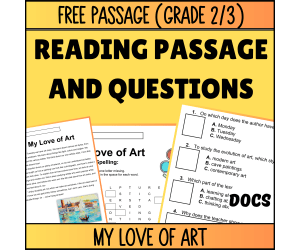
Reading Comprehension Fiction Set 4 Sample: My Love of Art (Docs)
ELA, Reading, Common Core, Reading Comprehension, Children’s Literature, Literature, ESL, Language Development, Spelling, Writing, Grade 2, 3, Worksheets & Printables, Worksheets, Writing Prompts, Assessments, Teacher Tools, Tests, Quizzes and Tests, Centers, Activities
Reading Comprehension Passages Fiction Set 4 Sample Overview Fascinating reading comprehension passages, each with an array of activities included. Stories are written for the modern classroom and topics are designed to promote enthusiasm from each student. Each lesson contains a mixed questions section to check understanding, a vocabulary or spelling activity to help remember key language introduced, and a writing exercise. Full answer keys are provided. For a more detailed overview, check the section under the links at the bottom of this description. Passage Included 6.My Love of Art: Read about the author's love of art class in this lesson. Docs Version This is the Docs editable and fillable version. This download is available in GOOGLE Docs, GOOGLE Forms, GOOGLE Slides. PDF, PPT, WORD. FULL CATALOG OF DOWNLOAD LINKS HERE Grade 2/3 Links Fiction Set 1 - Nature Google Docs Google Forms Google Slides PDF PPT Word Guided Reading Materials Fiction Set 2 - Animals Google Docs Google Forms Google Slides PDF PPT Word Guided Reading Materials Fiction Set 3 - Food Google Docs Google Forms Google Slides PDF PPT Word Guided Reading Materials Fiction Set 4 - School Google Docs Google Forms Google Slides PDF PPT Word Guided Reading Materials Fiction Set 5 - Friends Google Docs Google Forms Google Slides PDF PPT Word Guided Reading Materials Fiction Set 6 - Family Google Docs Google Forms Google Slides PDF PPT Word Guided Reading Materials Fiction Set 7 - Sports Google Docs Google Forms Google Slides PDF PPT Word Guided Reading Materials Nonfiction Set 1 - Technology Google Docs Google Forms Google Slides PDF PPT Word Guided Reading Materials Nonfiction Set 2 - Nutrition Google Docs Google Forms Google Slides PDF PPT Word Guided Reading Materials Nonfiction Set 3 - Animals Google Docs Google Forms Google Slides PDF PPT Word Guided Reading Materials Reading Passages Overview Each passage is especially written for Grade 2-3 students, including key vocabulary required for this age group. Topics are varied and are accompanied by colorful graphics. Topics are meant to educate, yet entertain the modern student. These passages are perfect for the modern classroom. Whereas textbooks can become outdated in no time, any changes to technology or the world will result in updates to this product. Mixed Questions The mixed questions section of each lesson includes a variation of fivecomprehension, vocabulary and math questions. In addition, key reading strategies are frequently covered including cause & effect, summarizing, compare & contrast and making conclusions. Three of the questions will be MCQs and two will require a written response of some kind. Full answers and example responses appear at the end of the lesson. Spelling & Vocab Each reading passage contains a variety of words and phrases designed for Grade 2-3 students. Spelling and vocab activities provide the opportunity to build fluency with these words. As it can become quite mundane doing the same activities over and over, each lesson in a set will contain a different spelling and vocab activity . Writing Prompts Writing prompts are designed to continue the theme or lessons learned in the story. Students are persuaded to write in a variety of ways and each prompt includes several cues to help. As with the spelling/vocab section, writing prompts will vary. This includes research pieces, reading responses, poetry and creative writing prompts. Full Answer Keys Full answer keys and sample responses are provided so no matter how busy you are, you know you're covered! Mixed question answers provide evidence from the text, math questions contain the relevant workings. Answers are designed for use by the teacher, but also suitable as a handout to the student. Additional File One lesson will have an additional file. This is something fun to extend the lesson with. For similar downloads and other frees, do check out Cored Group on TeachSimple.
Author Cored Education
Tags Elementary, Reading, Comprehension, Vocabulary, Answers, Ccss, Common Core, Spelling, Writing, Digital Centers

Reading Passages on Human Body Systems (PDF)
ELA, Reading, Reading Comprehension, Science, Life Sciences, Human Body, Biology, Common Core, ESL, Language Development, Grade 5, 6, 7, Worksheets & Printables, Worksheets, Assessments, Teacher Tools, Tests, Quizzes and Tests, Centers, Activities
Reading Passages on Human Body Systems for Life Science (Biology) Human Body Systems: Reading Passages Life Science - Stimulate renewed enthusiasm and curiosity in the realm of science with these vibrant science reading comprehension lessons. Bursting with vivid colors and engaging topics, these resources are designed to captivate and motivate your students, urging them to delve deeper into their scientific explorations. And the best part? As an educator, you can be at ease and confident in the effectiveness of these lessons, knowing that a significant portion of the groundwork and preparation has been meticulously taken care of for you, making the teaching process smoother and more enjoyable. What's inside? Part 2 - Human Body Systems Reading Passage 1: Skeletal & Muscular Systems Reading Passage 2: Circulatory & Respiratory Systems Reading Passage 3: Nervous System Reading Passage 4: Digestive System Reading Passage 5: Reproductive System Product Info: 41 PAGES (PDF Version: US English with Answers) Teaching Duration: 2 Weeks Science Reading Comprehension Outline: Introducing a comprehensive resource tailored for 5th and 6th graders, this product offers enriching reading passages supplemented with illustrative pictures and graphs to clarify key concepts. Aligned with the Common Core State Standards (CCSS), it offers a hassle-free approach to teaching, given that the bulk of the preparation is already done for you. The passages present a diverse set of questions – from multiple choice to data analysis and fill-in-the-blanks. This ensures a rich blend of high-interest content and fundamental curriculum-based science themes. With its versatility, you can seamlessly integrate these lessons into various classroom settings, whether it's whole class discussions, morning exercises, independent desk tasks, small group engagements, contingency plans for substitute teachers, regular homework assignments, or even themed activities for holidays. FULL CATALOG OF DOWNLOAD LINKS HERE Grade 5/6 Links: Physical Science Part 1 - Physical and Chemical Properties Google Docs/Slides/Forms PDF PPT Word Free Supplementary Pack Accompanying Videos Physical Science Part 2 - Motion and Energy Google Docs/Slides/Forms PDF PPT Word Free Supplementary Pack Accompanying Videos Physical Science Part 3 - Electricity and Magnets Google Docs/Slides/Forms PDF PPT Word Free Supplementary Pack Accompanying Videos Life Science Part 1 - Cells, Reproduction and Genetics Google Docs/Slides/Forms PDF PPT Word Free Supplementary Pack Accompanying Videos Life Science Part 2 - Human Body Systems Google Docs/Slides/Forms PDF PPT Word Free Supplementary Pack Accompanying Videos Life Science Part 3 - Plant Parts and Ecosystems Google Docs/Slides/Forms PDF PPT Word Free Supplementary Pack Accompanying Videos Earth Science Part 1 - Plate Tectonics and Rock Cycle Google Docs/Slides/Forms PDF PPT Word Free Supplementary Pack Accompanying Videos Earth Science Part 2 - Ocean Exploration and Natural Resources Google Docs/Slides/Forms PDF PPT Word Free Supplementary Pack Accompanying Videos Earth Science Part 3 - Weather and Solar System Google Docs/Slides/Forms PDF PPT Word Free Supplementary Pack Accompanying Videos For similar products and other frees, do check out Cored Group on TeachSimple .
Author Cored Education
Rating
Tags Science, Elementary, Reading, Comprehension, Vocabulary, Worksheets, Printables, Reading Centers, Reading Comprehension Assessments, Science Assessments

Health | 3rd Grade Unit 3: Nutrition and Physical Activity
P.E. & Health, Life Studies, Physical Education, Health, Special Resources, Life Skills, Social Emotional Learning (SEL), Social Skills, Grade 3, Teacher Tools, Lesson Plans, Worksheets & Printables, Worksheets
This 3rd Grade Health Unit focuses on Nutrition and Physical Activity and is essential to help students with their health and wellness. There are seven units in all taught in 3rd grade that focus on health. These units include: Unit 1 that focuses on Personal Health and Wellness Unit 2 that focuses on Growth and Development Unit 3 teaches students about Nutrition and Physical Activity and how to eat right and stay active Unit 4 that helps students with Substance Use and Abuse and how to avoid bad substances Unit 5 that will teach students about Injury/ Violence Prevention Control and Safety Unit 6 that covers what happened during Covid and how to protect themselves while learning about Prevention/Control of Disease Unit 7 discusses our environment and how to help save our planet with Environmental Consumer Health In this unit, students will learn about the six basic nutrients that the body needs to be healthy. These nutrients include: water, protein, carbohydrates, fat, vitamins, and minerals. Students will learn the function of each of these nutrients and how they help our bodies as well. There is a matching activity to test their knowledge on each of these six basic nutrients. Students will also learn about how much of these nutrients we need to eat daily. Examples of what to eat and how much is provided in this unit that is similar to the food pyramid. Based on what they should eat, students will draw a healthy meal. There is also a lesson on physical activity and different physical activities they can do to stay healthy. This unit meets Common Core Standards. It is 11 pages of fun engaging activities! At the end of the unit, there is an assessment to check for understanding. There are seven units that cover all the health requirements for 3rd grade. Go to K-5 Treasures to check out the other 3rd Grade Health Units to help students complete the entire Health Standards for the year!
Author K-5 Treasures
Rating
Tags Health Unit, Personal Health, Healthy Goals, Unhealthy Choices, Health Activities, Physical Goals, Health Goals, Health And Wellness, 3rd Grade Health, Third Grade Health

CVC Words
Vocabulary, Language Development, ELA, Spelling, Early Learning, Elementary, Lesson Plans, Teacher Tools, Worksheets, Worksheets & Printables
One of the most significant turning points in a child's education is learning to read. Using CVC words is one of the oldest and most successful methods of teaching reading. Consonant-Vowel-Consonant is referred to as CVC. For young students and beginning readers, these straightforward three-letter words with a regular structure are perfect. Children can better grasp how individual sounds, or phonemes, combine to make words by using CVC words. They offer a strong basis for decoding, blending, and phonics abilities. Children can learn to read the entire word "cat," for instance, by blending the sounds /k/, /a/, and /t/. Early learners, ESL students, and everyone else just starting out in reading and spelling are the target audience for this ebook. It contains 50 of the most widely used CVC words, along with a definition and sample sentence for each. The word list is followed by a student worksheet that includes thirty entertaining and instructive activities to help reinforce the content. There are answers at the end for teachers or self-evaluation. Now let's start learning!
Author Bright Classroom Ideas Marketplace
Rating
Tags Cvc, Word, English, Language, Vocabulary, Elt, Esl, Efl
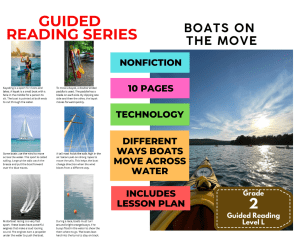
Guided Reading Level L - Boats on the Move (with Lesson Plan)
ELA, Resources for Teachers, Reading Comprehension, Reading, Science, Engineering, Technology, Physics, Sports, P.E. & Health, Grade 2, 3, 4, Worksheets & Printables, Worksheets, Teacher Tools, Centers, Activities, Literacy Readers, Quizzes, Quizzes and Tests, Assessments, Lesson Plans
This Guided Reading Book - Boats on the Move (Level L) with lesson plan includes: Guided Reading Color Label (front cover x1) This is a quick way to match the book’s demands to what students can generally handle.. The overall goal is to use the level/color to pick books for several smaller groups. To qualify for a certain level, a student is expected to read a book from that level with about 90–94% accuracy. If a student is consistently accurate and understands, move up a level. If the student is struggling at that level, drop down and add more support. Each student will improve at completely different rates, but it is generally one of the best ways to check progress across the class. DOWNLOAD THE CATALOG TO VIEW ALL GUIDED READING BOOKS AVAILABLE (SORTED LEVELS A-Z) Pre-Reading Question (x1) Teacher asks the prompt aloud, can be while showing the cover or first page. Students share what they already know, or make educated guesses from the cover. Prompt them to use the target vocabulary. Write some of their responses on the board to look back at during the reading. Vocabulary Words (x5) Introduce the five words, best doing it one at a time. Start by saying it, while students repeat and then see if anyone knows what it means before reading further. Read through the meaning and try to briefly connect each word to a picture or gesture so it’s meaningful. Ask students to flip through the book pages and point to where they see each of the vocabulary words. While reading the book pause upon coming across one of the vocab words or read the sentence twice to make sure students understand the word has appeared. Optional: Ask students to raise hands whenever they see/hear one of the new words. Guided Reading Pages (x10) Check the book snapshot (below) for: primary topic - do you need to prep extra reading or intro materials on this? what is taught best - decide on 1-2 bullets to focus on, use the prompt or words provided here for best results. learning goals - what you are checking for students to be able to do after the session, elicit answers using prompts or words provided. key vocabulary (see section above). questions overview - so you know what is coming up and if you need to prep extra materials to assist understanding. Run the lesson You may have already looked at a few of the pages together, but you can show them some of the pictures again first to set meaning. Depending on how much time you have and how familiar your students are with guided reading class, you may want to read the book aloud first with the group first. Students whisper or partner read, while you listen in. If time, do it as a group, one student reading a page each. Use the guided page’s prompts to coach: “Check the picture / does it make sense?” “Point under the words / try the first sound” “Reread the sentence smoothly”. Try to focus more on one student per session (rotating every time), so you can work out if they are ready to move up or need to move down a level. Comprehension Questions (back cover x3) This is your way to check that students didn’t just say the words, but actually understood the text. First, let students answer by pointing to the page/picture and saying a short sentence. After any answer, follow with: “Show me where you found that in the text.” In bigger groups, have partners answer first (10–20 seconds), then call on 2–3 students to share. Differentiation tips: Emerging speakers/struggling readers: oral + pointing On-level: oral in a full sentence Higher: one written sentence or draw + label Book Snapshot Title: Boats on the Move Genre: Nonfiction (informational) Subject: Science (Forces & Motion) / Reading (Informational Text) Primary Topic: Different ways boats move across water Estimated Guided Reading Level (A–Z): L What This Book Teaches Best Different ways boats move on water (wind, oars, paddles, engines). How specific boat parts help movement (sails, mast, ropes, propeller). How coordinated actions affect motion (oars dipping “at the same time” to go straight). How markers guide movement during a race (boats turn around bright orange buoys to stay on track). Comparing speed and movement styles (quiet glide vs fast roar; forward motion by alternating paddle sides). Learning Goals Students will identify several ways boats move across the water using details from the text. Students will explain how sails and wind help pull a boat forward. Students will describe how rowers use oars together to move a boat straight ahead. Students will describe how a double-ended paddle helps a kayak move forward quickly. Students will explain how an engine and propeller help push a motorboat through the water. Students will describe why boats turn around buoys during a race, based on the text. Key Vocabulary From the Text mast — a tall pole that holds sails up. rhythm — a steady pattern of movement. double-ended — having an end on both sides. propeller — a spinning part that helps push a boat. buoys — floating markers that show where to go. Discussion Prompts Pre-reading question: What are some different ways a boat could move across the water? Comprehension questions: How do large white sails help a boat move forward? What do rowers do “at the same time,” and what does that help the boat do? Why must boats turn around bright orange buoys during a race? Printing Tips 1. Best Printing Method (Recommended) “Booklet” Printing (Best if Available) If your printer or PDF viewer supports Booklet Printing , use this. Settings to use: Print mode: Booklet Paper size: Letter or A4 (either works) Orientation: Landscape Print on both sides: Yes Flip on: Short edge Scaling: Fit to printable area Booklet subset: First test: Front sides only Then: Back sides only This will automatically: Pair pages correctly Put the cover on the outside Align everything for folding After printing, fold in half and staple along the spine . 2. If “Booklet” Printing Is NOT Available You can still print this correctly with manual duplex printing . Step-by-step: Open the PDF. Choose Print . Set: Orientation: Landscape Pages per sheet: 1 Print on both sides: Yes Flip on: Short edge Print all pages . Because each PDF page already contains two facing book pages, the result will still fold cleanly into a book. Thousands of Cored Education products are included with your TeachSimple membership. Download links and encyclopedia index available here.
Author Cored Education
Rating
Tags Reading Comprehension, Reading Passages, Reading, Guided Reading, Guided Reading Lesson Plan, Guided Reading Activity, Pre-reading, Science Lesson Plans, Physics, Technology

Research Organizer & Essay Assignment: Charles Dickens
ELA, Literature, Writing, Grade 8, 9, 10, 11, 12, Activities, Projects, Worksheets & Printables, Worksheets
Charles Dickens is perhaps the most significant novelist of the Victorian Era. This resource provides your students with the opportunity to independently research and write about the life of the renowned author of Great Expectations, A Tale of Two Cities, Oliver Twist, and many other classic novels, with this engaging research planner and essay assignment. This carefully scaffolded and easy-to-assign-AND-assess resource has been designed to guide student learning from Charles Dickens fact-collection to the careful development of a five-paragraph research essay. Teaching this resource could not be easier! Start by handing out the background research and note-taking worksheet (you could also ONLY hand this out if you want a shorter lesson!). Once students have found their facts and sources, provide them with the essay outline activity, which guides them step-by-step through the requirements of a short research essay. From there, drafting their essay, using the provided peer review checklist, and submitting their final draft will be no problem at all. And then you can assess their work with the provided Common Core rubric! Use this entire resource as a complete research lesson or just part of it as a short research activity or sub plan! This TeachSimple download includes: A Charles Dickens essay writing assignment with directions, requirements, research essay writing tips, a peer review checklist, and Common Core-tied grading rubric An editable rubric, provided as a link, that lets you make adjustments to the grade values and guidelines. This link is provided as as Google Sheet specifically built for integration into Google Classroom, although you can also modify it for use in other Learning Management Systems (LMSs) A Charles Dickens biography and note-taking worksheet that will guide your students through information gathering. This straightforward two-page handout includes instructions for background research, a fun drawing section, and an area to cite quality sources and organize conducted research A research essay outlining worksheet, so students build on their Charles Dickens notes in a clear and simple manner as they build their work towards a draft and final paper All 6-pages of this lesson are provided in full-color and B&W versions Although this resource can be fitted for any secondary Language Arts classroom, it has been carefully designed to work best in grades 8 through 11. The included rubric is subtly but specifically tied to Common Core ELA Standards for Language (3) and Writing (2 and 7). This resource is provided as a print-ready, bookmarked, and adjustable PDF file. The rubric is also included as an editable Google Sheet. This resource contains 6 pages and 1 Google Sheet.
Author The Language of Educational Art, LLC
Tags Essay, Research, Rubric, Outlining, Notetaking

Data Analysis & Probability - Drill Sheets Vol. 1 Gr. PK-2
Math, Statistics, Common Core, Grade 1, 2, Worksheets & Printables, Worksheets
"Data Analysis & Probability - Drill Sheets Vol. 1 Gr. PK-2" Dive into the realm of quantitative education with this specialized and comprehensive teaching resource, "Data Analysis & Probability - Drill Sheets Vol. 1 Gr. PK-2". Expertly tailored to meet the precise requirements of Grades PK through Grade 2 curriculum, it fulfills both NCTM standards and Common Core State Standards, providing an exemplary means to empower educators in their quest for qualitative learning experiences. This volume contains: Engaging warm-up activities. Timed drills for practice. Vast opportunities to practice data analysis & probability concepts. The skill-based approach encourages pupils to explore ways of collecting, organizing, analyzing, interpreting and predicting data probabilities effectively.This resources manages dynamic variation in complexity levels within content such as differentiated learning sheets or review exercises encouraging students' comprehension capacity incrementally depending upon their aptitude pace thus mirroring a humanized touch understanding varying abilities among students. Incorporation of technology: In today's digital age, our product recognizes the importance of incorporating technological elements into instruction as naturally as utilizing traditional chalk ‘n’ talk methods as part of its delivery strategy offering room for educational reflections via digital tools adapting even more seamlessly towards modern pedagogical methodologies smartly supplementing them instead outdating them outrightly Beyond Standard Educative Instructions: Assessment rubrics: Ensuring gap identification & rectification measures Standards rubrics: Providing definitive guidelines on child’s progress measurement Picturesque activity posters : Upping engagement quotient Extra activities: Bonus worksheets granting extended practicum escorting children through various probability landscapes. This resource is designed for budding mathematicians grades PK-2, and provides a new way to keep Math educators engaged by incorporating elements of Statistics into the core curriculum. It comes in an easily-accessible PDF file format allowing hassle-free printouts or digital usage with equal ease making learning Math engaging, challenging yet rewarding at the same time. Potential Usage: This teaching tool can be utilized as a full-class instructional material where teaching faculty command pacing based on student's information absorption ability; alternatively it can also be used as a small-group interactive session supplement where students get to collaboratively solve problems and learn through peer interaction. Moreover, its potential as an independent homework assignment propels the continuum of learning journey for students beyond classrooms rendering this resource an indispensable support in every teacher’s scholarly arsenal.
Author Classroom Complete Press
Tags PDF