Phonic Reading Scheme for Older Pupils: SH Book 8

Special Resources, ELA, Special Education Needs (SEN), Language Development, Phonics, Reading
Kindergarten, Preschool, Grade 1


About This Product
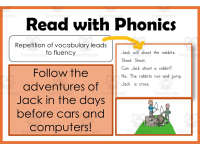
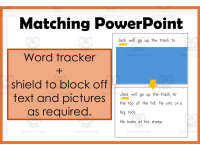
This SH decodable reading book is the 8th book in a series that can help children develop reading fluency. Each book comes with a matching PowerPoint making it suitable for use in a range of settings.
The Jack Stories, of which this book is one, introduces one phonic sound at a time, and subsequent books build on the vocabulary of the books before, constantly revising and reviewing learned sounds. Irregular sight words are only slowly and gradually introduced.
Science of reading aligned. Based on the most up-to-date phonic research.
This book is the next in our new series for budding historians who may be older pupils and may have special needs and need a more mature storyline than cats and dogs!
It follows on from our previous sets of 'Learn to Read' packs covering the 5 vowels and the previous books in the series so the pupil is expected to be able to blend 3 and 4 sounds securely and be ready to read words with /oo/.
These books are best read in sequence.
This book contains words with the following sounds: CK: OO, EE and SH.
The whole series to date can also be purchased as a growing bundle here, with a scope and sequence.
This series has been written with the aid of one of my pupils, aged 8. He writes his ideas and draws pictures and then I formulate them into a fool-proof reading book using only decodable words.
Reading Made Simple for Special Needs
A 100% systematic phonic reading programme for all ages and abilities.
Give your child a Head start in reading!
Due to its 100% systematic nature, this reading programme is highly suitable for any child with a special need, including dyslexia (or suspected), or any other need that is causing a child to have difficulties learning to read.
What makes this reading programme different?
· It has its own, easy-to-download and print phonic reading books, making it accessible to many children worldwide.
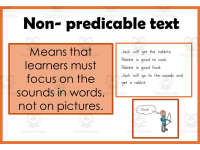
· Each book carefully builds on the vocabulary of those that have gone before, providing much repetition, without relying on predictable text.
· Pictures aid the storyline without encouraging reading from the pictures – i.e. guessing.
· The vocabulary is based on phonic families, which are introduced in a carefully planned way.
· True sight words – those that cannot be sounded out - are kept to the very minimum. Most words are introduced in their phonic family wherever possible.
· It is truly multisensory, using the power of the hand. We not only look at the words, but we write them too. This is powerful and has the bonus of turning the child not only into a reader but into a writer as well.
Typical signs that this programme can help:
· Difficulty recalling words when seen on flashcards or when reading texts, which results in no or little reading fluency
· b/d letter reversal of a chronic nature – i.e. the child has not grown out of it
· Difficulty ordering letters in words: E.g. top becomes pot.
· Difficulty differentiating between like words: spoon/soon; back/black; sheep/sleep etc…
· Difficulty tracking words across a page
To help all children succeed, each phonic family is taught in two lessons, each a week in duration. This speed has been tried and tested to be the optimum speed to allow children to absorb new information without mental overload. You may find that some children need longer - but never less. Each phonic family is split into half and only 5/6 words in a family are studied each week.
Activities are provided to give the child plenty of exposure to the new sound and the set of words that contain it. These activities are not hard, but simply bring the child face to face with the words, first individually, then in sentences, and finally in longer passages.
We also seek to strengthen knowledge of blends and develop phonemic awareness through the activities, much needed by these learners.
In all, the way that Reading Made Simple has been designed reduces the burden on the working memory, making it easier for children to learn to read.
Children relax as they meet familiar words again and again. They begin to say – sometimes for the first time, ‘I can read’.
With this programme, you can help a non-reader today!
How long are the books?
The reading books are 16 pages long.
Why are these books FREE when other people's books cost so much? Are they of lesser quality?
They are free as I regard the ability to read as being a fundamental right of every living person. Why should some miss out on top-quality resources because they cannot pay for them?
In terms of content, they are top quality, carefully planned and sequenced to help as many children as possible get started on the phonic road to reading.
What is included?
1 PDF 16 pp X A5
Print as a booklet
Flip on the short edge
One 16-slide PowerPoint
Resource Tags
0 Reviews
Check out these other great products