



3,950 products added recently
Page 17 - Sensory Activities
Provide your students with sensory activities that enhance learning through touch, sight, sound, and movement. This collection includes sensory bins, tactile explorations, and auditory games. By incorporating these sensory activities into your teaching, you can support engagement and accommodate different learning needs.

 Show filters

November Reward Buddy - Turkey
Special Resources, Resources for Teachers, Classroom Management, Special Education Needs (SEN), Grade 3, 4, 5, 6, Activities
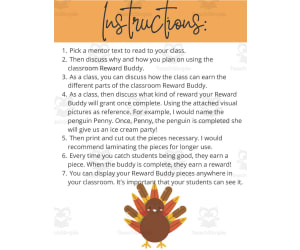
November Reward Buddy - Turkey: Classroom Management Tool The "November Reward Buddy - Turkey" is a unique behavioral management tool tailored for educators looking for cutting-edge ways to inspire their students towards meeting behavioral management goals. Planned for monthly use, this resource can symbolically become the class's favorite pet, fostering collective work and achievement of rewards! Grade Range This November Reward Buddy - Turkey: Classroom Management Tool is perfect for students in grades 3 through 6. It not only sparks young minds' curiosity but actively involves them in a constructive exercise that enhances their motivation and results in positive behavior choices. Inclusive Approach Whether within Special Education Needs classrooms or as a general teaching resource, the November Reward Buddy - Turkey: Classroom Management Tool is beneficial in creating realistic expectations and understanding student behavior patterns. This November Reward Buddy - Turkey: Classroom Management Tool Includes: Built-in visuals: Great assistance with selecting particular behavior goals and allocating corresponding incentives. Mentor Text options & Reward prompts: Encourages greater engagement among students maintaining consistent interaction. 'We are Working For' visuals: Broadcasts important cues that outline daily objectives pushing constant success rates aiding long-term accomplishments beyond classroom confines. This November Reward Buddy - Turkey: Classroom Management Tool is ready to use!
Author Penguin Teacher Store
Tags Classroom Management, Behavior Goals, Reward System, Special Education, Student Motivation
High School Life Skills Worksheet - How to Choose a Gym Membership
P.E. & Health, Special Resources, Creative Arts, Art, Life Studies, Health, Special Education Needs (SEN), Social Skills, Speech Therapy, Life Skills, Grade 10, 11, 12, Activities, Worksheets & Printables, Worksheets
Educators can use How to Choose a Gym Membership to help students with disabilities lead healthier by engaging in physical fitness. Identifying budget-friendly options, managing finances, choosing the right gym, and completing sign-up forms are all covered in this adaptive life skills resource. Your students will benefit from this resource as they learn to make independent choices and engage in fitness pursuits. This lesson enables informed decision-making, whether it's proximity to their home or work, inclusive facilities, or personalized fitness options. Your students will develop essential living skills outside of the classroom when you incorporate this adaptive lesson into their curriculum. There are a total of 45 reading comprehension questions in this Functional Life Skills resource! This activity will assist high school students in developing the necessary life skills to become more independent at school, at home, and in their communities. A great place to use this handout is in special education classes or one-to-one settings, such as ABA therapy, speech therapy, job coaches, occupational therapy, and Registered Behavior Technician (RBT) sessions. High school students working on independent living would benefit significantly from this activity for defining, setting, and measuring IEP goals. In addition to interactive instruction, this resource is ideal for hands-on and community-based learning. Engage your special education class with this highly interactive High School Functional Life Skills Activity! This activity contains step-by-step instructions, questions, and answers that reinforce learning, age-appropriate graphics, real-world examples, and ideas for implementation. This is the perfect special education activity for grade 10, grade 11, grade 12, and autism life skill centers . This special education life skills handout was designed to assist teens and adults with difficulties developing independent living skills. It's a printable, easy-to-use activity ready to hand out! Related Products for Developing Independent Living Skills How to Read a Basic Pay Stub How to Fill Out a Job Application How to Create a Shopping List How Credit Cards Work How to Create a Monthly Budget How to Schedule an Appointment How to Prepare for a Job Interview Home Repair Service Agreement How to Complete a Boarding Pass Auto Repair Service Agreement A PDF with 21 unique pages. Color and black-and-white versions of each page are available for this pdf resource.
Author Adulting Life Skills Resources
Tags Independent Living Skills, IEP Goal-Oriented Skills, Autism Resource For Parent , Life Skills For Autistic Teens And Adults, Adulting On The Spectrum, Social And Emotional Learning, Financial Literacy

Language Vocabulary Flashcards ESL 32
ELA, Language Development, Vocabulary, ESL, Speech Therapy, Special Resources, Special Education Needs (SEN), Not Grade Specific, Worksheets & Printables, Flashcards, Centers, Activities, Classroom Decor, Word Walls
Boost your English Vocabulary Language skills with these fun and interactive flashcards resource series ! They' re perfect for kids and adults, whether you' re a native English speaker or learning English as a Foreign / Second Language . These cards are designed to help you build everyday vocabulary and communication skills, with pictures and words that match real- life contexts . You can use them in a class setting, one-on-one with a tutor, or even at home, whether for fun or educational purposes . The cards cover all sorts of modern topics, like animals, clothes, hobbies, food, and many many more . They' re super versatile and can be used in many subjects, from science to language arts . With this resource, you can create your personal " go-to " folder, for all ages and subjects . Here' s what you instantly get with this download : A4- sized cards with pictures and words and one set with just pictures . Smaller cards with pictures and words and one set with just pictures ( 6 on a page ) . Smaller cards with just words ( 6 on a page, no pictures ) . These cards are perfect for : English language learners . Students with learning difficulties . Occupational therapists . Speech and Language therapists / pathologists . Classroom teachers ( in mainstream or special education ) . So, get ready to have fun and improve your language vocabulary skills ! 3 7 PDF pages with vocabulary flash cards, in two size versions, with and without words . Print and laminate for better application . Use on your screens to save on ink and paper ! For more P D F materials and educational and therapy resources on language, special education, numeracy, basic math and pictorial / manipulative approach to learning, you can click WORDS ASIDE
Author WORDS ASIDE
Tags Oral Communication, Social Skills, Pragmatics, Speech, Occupational Therapy, SEN, Centers, Mini Books, Esl, Words Aside

a-e Phonic Game: 'E' or no 'E'? Print 'n Play!
Special Resources, ELA, Special Education Needs (SEN), Language Development, Pre-Reading, Phonics, Reading, Spelling, Kindergarten, Preschool, Grade 1, Activities, Games
Here is a simple, fun, print n' play phonic game to help children learn the split digraph a-e. Your pupils will learn in no time with this easy-to-play game! This is a game for 2 players. The pack included both colour and black and white versions. Laminate the colour version for durability and sen the black and white version home for extra practice. Who can use the a-e phonic Game? Teachers, Parents home-educators Private Tutors Anyone who needs it! Aim of the game: ·To demonstrate how the short vowel sound /a/ changes when ‘e’ is added to make /ae/. ·To give the child plenty of practice recognising the difference between /a/ words and /ae/ words. How to play: Place the picture/word cards in a pile and put the ‘e’ cards neatly on the table. Players take turns to take a spot card from the feely bag. A green spot means that the player should take the topmost picture/word card from the pile and place it in front of him/her. S/he must then decide (by reading the word, sounding out if necessary) whether or not this word requires an ‘e’ or not to change the /a/ to /ae/. If needed the ‘e’ should be added and the card set aside by the player. If not, the word should be placed likewise. Should a red spot be picked, the player must miss a turn. The winner is the player with the most completed cards when al the cards have been used up. Should a player add an ‘e’ when it is not needed, or fail to add one when it is needed should/would/could lose the card, should the teacher deem it helpful to the child. In some cases, the teacher may allow the child help and let the child keep the card once corrected. This is at the teacher's discretion bearing in mind the needs of each child. Teaching tips: This game provides the opportunity for the pupil and teacher to see just where there are problems - listen out for the ‘messages’ in a pupil’s hesitation, his/her misreading of a word so that it does not describe the picture, or thoughtlessness in studying the word and picture carefully to decide about the need, or not, of the ‘e’. These are all indicators of understanding. discipline is required too as the pupil realises that letters in words and spelling are important. For many pupils, this is a new discovery. ‘Look what you have done to ‘hat’! You have changed it into ‘hate’ by putting ‘e’ on the end! This states the problem and for many pupils is the key to sorting out whether an ‘e’ is needed or not. Included: 1 PDF file with 1 game in both colour and black and white.
Author Lilibette's Resources
Tags A-e Game, Split Digraph A-e, Split Dihraph, Silent E, Magic E, Lazy E, Split Digraph, Phonics, Sepcial Needs, Special Neeeds

Basic Math Skills | Counting Estimation Comparison 1
Special Resources, Special Education Needs (SEN), Math, Early Math, Numbers, Place Value, Preschool, Grade 1, Teacher Tools, Lesson Plans, Worksheets & Printables, Flashcards, Activities
Basic Math Skills | Counting Estimation Comparison . This is a comprehensive and resourceful teaching aid series designed to instill foundational math skills in kindergarten and grade 1 students . It is an essential tool for educators in varied environments, including public schools and homeschooling . Resource Contents : Each PDF file features 24 pages of vibrant, picture - based materials . Covered concepts include quantity counting, estimations, and comparisons . The resources emphasize visual representation of quantities for easier understanding . Inclusive are pages where equal or unequal amounts are arranged either linearly or randomly . Certain sheets feature objects appearing up to 20 times for learners to cut out, point, count and paste - reinforcing manual learning techniques . All materials come both as colored illustrations as well as blackline versions catered to different printing preferences or learner needs . The resource can be used either as larger A4 size work mats / screen view slides or smaller task cards / flash cards - proving effective during group instruction sessions or individualized tutoring . The range of visuals from apples & worms to elephants & coconuts provides fun reinforcement while maintaining student’s interest in counting skills . Furthermore these sustainable resources can be laminated post - printing thus ensuring their longevity while enhancing tactile engagement among young learners . In addition to basic numeracy, the Basic Math Skills | Counting Estimation Comparison, lays the groundwork for number comprehension & place value ! It provides teachers with reliable support while forming the strong numeric foundations crucial at this important educational stage . The material is presented either in A4 size, as work mats / screen view slides or as 4-on-a-page flash cards to use as task cards as well . It is a great resource for your math stations and math centers and once you print and laminate, you can store forever . 1 pdf file . 24 pages with mats / screens / task cards / flash cards to work on counting, estimation and comparison basic math skills . For more pdf materials on numeracy, basic math and pictorial / manipulative approach to learning, you can click WORDS ASIDE .
Author WORDS ASIDE
Tags Math, Numbers, Task Cards, Mats, Manipulatives, Math Station, Math Center, Pictorial , Slides, Words Aside

Finance Life Skills: Omar Learns How Credit Cards Work
Special Resources, Life Studies, Special Education Needs (SEN), Social Skills, Speech Therapy, Life Skills, Grade 10, 11, 12, Activities, Worksheets & Printables, Worksheets
In Omar Learns How Credit Cards Work, Olivia shows Omar how to read a credit card statement and discusses the purpose of a credit card. The use of this Finance Life Skills resource will allow students to engage in the following: • This story uses simple language and relatable examples to explain what credit cards are and how they work. • It includes the consequences of not making minimum payments and how it affects your credit score. • Explain cash advances and why they are not a good idea. • Discuss why checking your credit card statement for mistakes is important and how to address them. • Discuss responsible credit card use and avoiding extra fees. • The interactive dialog and questions engage learners and reinforce their understanding of the story and the concepts. • The real-world examples, and age-appropriate visual aids, such as illustrations and diagrams , make this conversational story an excellent resource for teaching social narratives. • This social narrative's simple and direct language sets clear expectations, making it ideal for high school students and adults with intellectual disabilities. The story includes seven (7) reading comprehension questions and answers to reinforce and measure the student's understanding of the Finance Life Skills contained in the story! This life skills story will assist high school students and young adults in developing the necessary independent living skills to become more independent at school, at home, and in their communities. This story is designed to be used by special education teachers, occupational therapists, speech therapists, ABA therapists, registered behavior technicians (RBT), parents, supported living coaches, and life skills teachers to teach their students valuable life skills. In addition to interactive instruction, this resource is ideal for hands-on and community-based learning, defining, setting, and measuring IEP goals. Related Products for Developing Money Management Skills The Value of a Bank Account How to Create a Monthly Budget How to Create a Shopping List How Credit Cards Work Level 1 Grocery Shopping Money Math Level 1 Clothes Shopping Money Math Level 1 Reading Menus Money Math Engage your special education class with this highly interactive High School Finance Life Skills Story! It's printable , easy to use, and ready to hand out! A PDF file with five (5) pages.
Author Adulting Life Skills Resources
Tags Adulting On The Spectrum, Independent Living Skills, IEP Goal-Oriented Skills, Autism Resource For Parent , Life Skills For Autistic Teens And Adults, Summer Life Skills Activities, Financial Literacy
AAC Math Visual Support Addition Word Problem 3
Math, Addition, Addition and Subtraction, Basic Operations, Early Math, Special Resources, Special Education Needs (SEN), Grade 1, 2, Centers, Activities, Task Cards, Worksheets & Printables, Word Problems
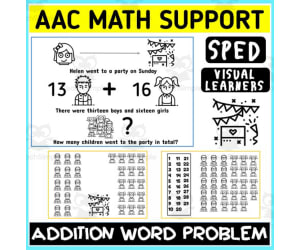
A A C Math Visual Support Addition Word Problem . This is a comprehensive math resource designed to support students in understanding addition word problems through visual and pictorial aids . This resource is particularly beneficial for educators working with students who with special education need as well as those who are visual learners since it serves as an augmentative and alternative communication ( A A C ) tool for structured math problem instruction . Perfect for various teaching settings, this resource can be used during morning work, whole group instruction, or in math centers . It includes a diverse array of task cards and worksheets that can work for different learning styles . Each task card or worksheet features a combination of pictures and clear text, as well as options that present text alone or visuals only . Additionally, students will find opportunities to trace the text, cut- out the images for role play, and so much more ! This versatile educational resource ensures that students not only comprehend the word problems they are working on but also develop problem- solving skills in a supportive and interactive manner . Incorporate these materials into your daily teaching and create an enriching learning environment that fosters understanding and confidence in practical mathematics . The black and white format is printer cost friendly and offers coloring and customised opportunities for each student . For more A A C pdf educational resources, you can check the following work by WORDS ASIDE : AAC Reading and Writing Development Task Cards 1 READING and WRITING | 2 | : Sentence to Paragraph A A C Reading and Writing Development Task Cards 2 Greek A A C Sentence to Paragraph READING and WRITING | 1 | This P D F file includes 1 8 pages of word problem pictorial presentations
Author WORDS ASIDE
Tags Basic Math, Problem Solving, Word Problems, Visual Support, AAC, Visual Learners, Pictorial Math, Math Manipulatives, Addition, Words Aside
Finance Life Skills: Brian Learns All About His Credit
Special Resources, Life Studies, Special Education Needs (SEN), Speech Therapy, Life Skills, Finance, Grade 9, 10, 11, 12, Activities, Worksheets & Printables, Worksheets
Product Title: Finance Life Skills: Brian Learns All About His Credit The product, a teaching resource titled Finance Life Skills: Brian Learns All About His Credit is a relevant and practical tool designed to impart financial wisdom in students. This unique educational resource revolves around an engaging narrative wherein 'Brian' understands the reasoning and implications of credit usage. The enriched content delves deep into responsible credit use, clarifying the importance of timely payments, avoiding excessive debt and maintaining a positive credit history. The storyline punches in critical learning details such as explaining the range of credit scores from 300 to 850, showing how higher scores can impact loan terms and interest rates favorably. This resource deviates from standard teaching methods by capturing student attention through story-driven real-life examples. Interactive dialogue combines with probing questions which encourage learners to internalize the material comprehensively. Through this accessible tool, teachers not only instruct but also empower their pupils by elucidating how lenders, landlords, and employers utilize credit reports for decision making purposes. Furthermore, it provides insights into how comprehensive records of an individual's borrowing and payment history are maintained at credit bureaus. A unique feature lies in its execution - utilizing illustrations or diagrams where necessary for clear representation. The simple language used throughout makes it suitable for high school students and even adults with intellectual disabilities who intend on upskilling themselves financially. Its robust structure entails - seven reading comprehension questions with corresponding answers that gauge learners understanding effectively while empowering them with sound financial know-how essential for living independently at school or home environments comfortably. Versatile application:- appropriate for whole group discussion but also small group study or even an individual homework assignment if required. It could be of value to special education teachers across grades nine through twelve as well as other educators like speech therapists among others who seek practical life skill education avenues for their pupils. With its focus on interactive learning interspersed within a wider community-based learning approach, it supports a multitude of instructional strategies while aligning seamlessly with IEP goals. Finance Life Skills: Brian Learns All About His Credit comes readily printable in an accessible PDF format and consists of six pages. A highly valuable addition to any teacher's trove of informative tools, it promises imbuing students with essential financial literacy skills for a confident start in independent living.
Author Adulting Life Skills Resources
Tags Finance, Credit Literacy, Financial Skills, Responsible Borrowing, Interactive Learning

Letter A Spot and Dot
Special Resources, ELA, Special Education Needs (SEN), Language Development, Pre-Reading, Reading, Writing, Handwriting, Spelling, Kindergarten, Preschool, Activities
Product Overview: Letter A Spot and Dot This innovative product offers a unique and engaging learning experience tailored to the needs of young learners in the early stages of their education. Ideal for educators in both public schools and homeschool settings, this essential resource presents a series of activities all centered around exploring the letter 'A'. Product Features: A comprehensive 22-page activity set complete with both color and black-and-white versions of worksheets, designed to entertain as well as educate younger students. A focus on key aspects such as identifying the capital 'A', lowercase 'a', as well as objects associated with this letter—including interpretative images such as airplanes, apples, acorns etc.—providing a broad learning perspective for children. Special Feature: An emphasis on helping children develop fine motor skills. For example, managing dot markers aids in mastering pressure application – making it fun while fostering development! The packet also aids in bilateral hand coordination improvement, motor planning skills enhancement amongst developing other essential life skills from an early age. No particular group is left out - be it toddlers showing enthusiasm towards letters or preschoolers aiming for pre-reading proficiency or even children on autism spectrum who seek interactive ways to learn. Excelling beyond mere visual perceptual skill building—this product actively promotes recognition of letters sounds and encourages object association starting from 'A'. Versatility & Application: Educators can utilise these resources in multiple educational contexts—be it whole group sessions or small study groups; even using them for constructive homework assignments that strengthens learning outside classrooms is possible! The easy adaptability allows activities like sitting at a desk or prone actions on floor while linking movements with learning. Usability & Format: The resource is available in a versatile PDF format—ensuring compatibility across multiple digital platforms. This makes it a must-consider teaching tool for early learners coming to grips with the basics of the English language and cognitive development. In conclusion, Letter A Spot and Dot encompasses several facets that enhance language arts supplements focusing on handwriting, spelling, reading practice from early learners up to pre-kindergarten levels. Simplified usage, affordable cost, and extensive applicability make it an indispensable asset in every educator's toolkit.
Author mnorganizingmom
Tags Fine Motor Skills, Letter Recognition, Object Association, Developmental Attributes, Versatile Learning
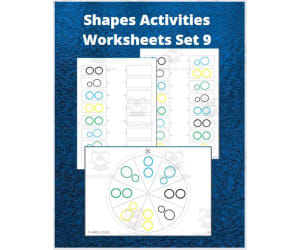
Shapes Activities Worksheets Set 9
Special Resources, Special Education Needs (SEN), Speech Therapy, Math, Patterns, Early Math, Geometry, Preschool, Grade 1, 2, Worksheets & Printables, Flashcards, Activities, Games, Worksheets
Shapes Activities Worksheets Set 9 is a 3-page PDF resource designed to enhance visual perception and cognitive skills in students from Kindergarten to Grade 2. Through a progressive sequence of activities with basic shapes like circles, squares, triangles and rhombus, students will differentiate quantities, sizes, outline thicknesses, and filled/outlined colors. Interactive tasks involve replicating shapes, rotating wheels to match shapes, and connecting similar shapes. This versatile resource can be used for whole group instruction, independent work, homework, or in special education settings for occupational and speech therapy. The straightforward layout and minimalistic design make it easy to use as printable worksheets or convert into task cards, games, and mini-books for math centers . With a focus on early geometry concepts like identifying and discriminating between common shapes, this practical 3-page PDF will engage students while targeting foundational visual perception and fine motor skills.
Author WORDS ASIDE
Tags Geometry, Math Worksheets, Math Centers, Attributes, Matching, Homework, Independent Work, Shapes, Visual Perception, Words Aside
Going on an Airplane Social Story
Special Resources, Social Emotional Learning (SEL), Social Skills, Special Education Needs (SEN), Not Grade Specific, Activities
Airplane travel can be an exciting adventure, but also filled with uncertainty for many children. For kids on the autism spectrum especially, the unfamiliar surroundings and procedures can heighten confusion and anxiety without proper preparation. This social story resource aims to walk children through air travel from start to finish in a detailed yet reassuring way. The story covers every phase, using simple language and visual supports. It explains what to expect when getting tickets, packing bags, and arriving at the airport. Going through security, waiting at the gate, boarding, and taking off are all described in concrete terms. While seated on the plane, appropriate behaviors are outlined along with various occupying activities for the flight like reading books, listening to music, or watching movies. finally, the story describes the sensations of descending and landing as well as exiting the plane and airport. Common emotions a child may experience throughout are validated and labeled, like feeling eager, nervous, bored, or impatient at different points. Suggestions for coping strategies are woven in, like asking for hugs, taking deep breaths, requesting snacks, or stretching. The consistency of the narrative and matter-of-fact tone provide stability children can hold onto. By naming specific sites, sounds, procedures and feelings to expect, uncertainty is diminished. Walking through the entire airport/airplane experience start to finish, this social story is an ideal method for preparing autistic children for airplane travel. It allows them to fully understand and participate in this immersive real-world activity that requires certain social-emotional skills - exactly what social stories are designed for. These books should be used over and over to reinforce the point so I would suggest either putting the pages into a display book or laminating and binding them. Clipart images courtesy of Kari Bolt ClipArt
Author SEN Resource Source
Tags Holiday, Vacation, Airplane, Fear Of Flying, Social Story

Pictorial Math Multiplication Flashcards | SPACE x3
Special Resources, Special Education Needs (SEN), Math, Addition and Subtraction, Addition, Multiplication and Division, Division, Place Value, Grade 2, 3, 4, Teacher Tools, Lesson Plans, Worksheets & Printables, Flashcards, Activities
Pictorial Math Multiplication Flashcards | SPACE x3 Description The Pictorial Math Multiplication Flashcards with a space x3 theme are designed to provide engaging and intuitive ways for students in grades 2-4 to learn multiplication facts. With a unique focus on pictorial representation, these visually pleasing flashcards make memorizing multiplication facts easier. Key Features: Packaged into a 13-page PDF, three different styles of fact display are used per page, offering variety and catering to diverse learning styles. They showcase the fact number integrated with the factor (such as 2 times tables); the fact number alongside the subsequent part of its equation; and additionally depict individual factors at the bottom row of their respective matrix. A clever feature is how each range (factors from 1 -10) is depicted in unique colors which help aside sorting and cueing. Also enriching student’ experience is the inclusion of quirky space-themed images for every set of flashcards, making learning lively while keeping it educational. Versatile in use, these flashcards can be transformed into an instructive flipbook for centers or could perform efficiently as reference material for problem-solving sessions centered around operations like addition and division alongside multiplication. The content has been crafted keeping potential applications such as task cards and custom-made books in mind – truly an educator's delight! Their attractive designs also qualify them to double up as fun décor pieces on bulletin boards across seasons further assist visual learners. A resource that covers all elementary grade levels', this makes it simple to tailor its usage – from decoration posters to visual cues resource or work mats. This tool sets itself apart by approaching teaching multiplication differently: instead appealing directly both via design alone visually enforces each math concept associated with multiplying numbers up till ten. Let your students dive headfirst into a rich galaxy teeming with equations waiting to be solved – take their learning journey exactly where it needs to go with this Pictorial Math Multiplication Flashcards | SPACE x3 tool. 13 - page PDF resource with three types of pictorial explanation for multiplication FACTS and FACTORS , for your bulletin boards , your classroom walls , your screens and your custom made task cards and books .
Author WORDS ASIDE
Tags Multiplication Flashcards, Pictorial Representation, Space, Math Manipulatives, Visual Aids, Math Center, Bulletin Board, Decoration, Wall Poster, Words Aside
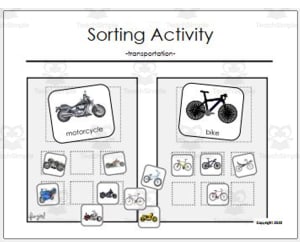
Sorting Activity: Transportation - Non-identical items
Special Resources, Special Education Needs (SEN), Speech Therapy, Math, Early Math, Kindergarten, Preschool, Grade 1, 2, 3, 4, 5, 6, Activities
This is a 28 page downloadable transportation sorting activity. In this fun and engaging activity, children will be asked to sort pictures of different modes of transportation. The activity is designed to help children develop their sorting and categorization skills while learning about various modes of transportation. The activity includes different modes of transportation, such as bikes, cars, boats, and motorcycles. Each mode of transportation is represented by six non-identical pictures. The learner will be presented with a set of cards that includes pictures of different modes of transportation. Their task is to sort the pictures by placing all the cards of the same mode of transportation together. For example, if the learner is given a picture of a car and a boat, they will be presented with 12 individual cards - 6 non-identical pictures of a car and 6 non-identical pictures of a boat. They will be asked to sort these pictures by placing all the cars together and all the boats together. The activity can be made easy by sorting clearly different modes of transportation such as cars and boats, or it can be made more challenging by sorting a bike and a motorcycle that may look similar. This activity is not only fun but also beneficial for children's cognitive development. Sorting and categorization skills are important for children's cognitive growth, and this activity is a great way to enhance those skills while also teaching children about different modes of transportation. This activity can be assembled as a • Binder activity • File folder activity • Coil bound activity book • Or used as task cards This sorting activity was made so the teacher could create and rearrange the activity easily for the various different learners. IFIO girl I'll Figure It Out
Author IFIO girl - I'll Figure It Out
Tags Sorting Activity, Sorting Transportation, Visual Discrimination, Non-identical Items, Category, Grouping Transportation Pictures, Autism, Occupational Therapy, ABLLS-R, Discrete Trial Training
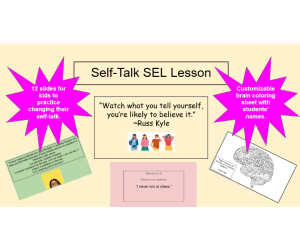
Changing Negative Self-Talk Into Positive Self-Talk SEL Presentation
Special Resources, Social Emotional Learning (SEL), Social Skills, Special Education Needs (SEN), Elementary, Middle School, Activities, Worksheets & Printables, Coloring Pages, Worksheets
In this Google Slide SEL presentation, students will learn how to change their negative thoughts into positive ones. There is a quote at the beginning of the slide show that says "Watch what you tell yourself, you're likely to believe it." by Russ Kyle. The students can share what they think this quote means to them. Then there is an educational slide on the value of changing their negative thoughts into positive ones. Then the students will have 12 slides to practice changing negative thoughts into realistic and positive ones. They can do this as a turn and talk with a partner, whole group instruction, or in their table groups. You can decide the best approach for your students. After they practice 12 different thoughts, the students will participate in an elimination game using a playing deck of cards. You will randomly pull a red or black card and students need to declare which one they think you will pull before you pull it. There are directions on the slide notes. The goal is for them to say out loud to the person next to them about which one they guess is going to get pulled for their own accountability. Ask students to pay attention to their own self-talk during this game. This game is based on luck only. You can play the game as many times as you want as time allows. Lastly, the students will get to color a mindfulness coloring sheet of a brain with their own name on it. You can make as many handouts as you have students in your class. Simply double click on the name and change it to the names of students in your class and press enter. Print off as many copies as you need. For other lessons on thoughts and changing one's thinking, check out this lesson about inner coach versus inner critic: https://teachsimple.com/product/inner-coach-or-inner-critic-boom-cards-plus-extension-handout https://teachsimple.com/product/cut-sort-and-glue-inner-coach-or-critic
Author Jennifer Moyer Taylor
Tags Sel, Social Emotional Learning, School Counseling, Social Skills, Self-regulation, Cognitive, Special Education, Psychology, SEL Presentations, SEL Coloring Pages
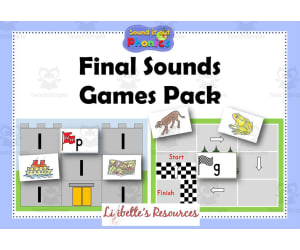
Final or Ending Sounds Phonic Game Phonemic Awareness Activity
Special Resources, ELA, Special Education Needs (SEN), Speech Therapy, Language Development, Phonics, Spelling, Kindergarten, Grade 1, 2, Activities, Games
Final or Ending Sounds Phonic Game Phonemic Awareness Activity A fun pack of two games to help children develop the important phonic skill of hearing the final (or ending) sound of a word. It covers the final sounds: t, d, k, g, p, b, m, s, n. Choose from: Build A Castle or Win the Race. The games are the same whichever you choose and use the same picture cards, but the choice of the game board means that children will not get bored playing the game again and again, plus the fact that you can increase the fun level to keep the children playing! (see below). Objectives This game pack has been designed to give children practice hearing the final sound of a word, something many children struggle with, especially those with a speech delay. It is hoped that, as the child has fun playing the game that the child's phonemic awareness can be developed. The game can also be used within speech therapy to help children distinguish between sounds which are produced in a like manner: k/g; p/b; t/d. Many children have difficulty with sounds that are produced using the same part of the mouth/voice/tongue. If this is true of your pupil, then I suggest that you start by playing the game with two sounds which are not at all similar. Once the child can confidently hear the final sound of a word, then the game can be played with sounds which are similar to help the child’s speech development and the ability to carefully discriminate between like sounds. Grade/ages These games are suitable for children of any age who need to learn to hear the final sound of a word. Games make learning easy, and children learn without knowing they are! Pre-K to teens with special needs will all love these games . The fact that the games allow for an increased challenge level is an added factor, making them games that children and young people will want to play again and again—all good practice for securing the skill of hearing that final sound! How many players? It is suggested that at first, each child plays alone with an adult until they hear the final sound. Then, up to 4 children can be invited to play together. Simply print out the number of game boards you need. Increase the fun level! Begin by playing the game simply. Once the child gains confidence and you wish to play again with sounds that are produced in a similar way or to give further practice, then add in some fun. Flag or wheel cards can be scattered amongst the pictures, and the teacher can choose what these mean - either extra turns or 'miss a go'. I made this game for a ten-year-old reluctant pupil. It worked, and now he can hear the final sound! Win Win!! What is included? 1 PDF File 2 versions of a game 63 picture cards Full instructions Picture Key
Author Lilibette's Resources
Rating
Tags Final Sounds, Fianl Sounds Game, Phonic Final Sound, Hearing The Final Sound Of Words, Phonics Final Sound Activities, Final Sound D, Final Sound T, Ending Sounds, Phonemic Awareness Activity

Puzzle: Shapes with non-interlocking pieces - ABLLS-R section B
Special Resources, Creative Arts, Art, Special Education Needs (SEN), Speech Therapy, Graphic Arts, Math, Patterns, Early Math, Geometry, Science, Basic Science, Kindergarten, Preschool, Grade 1, 2, Activities
Teaching young learners non-interlocking puzzles is important for a variety of reasons. Promotes problem-solving skills: Non-interlocking puzzles challenge young learners to use critical thinking and problem-solving skills. By figuring out how the pieces fit together, children develop their spatial awareness, logical reasoning, and attention to detail. Improves fine motor skills: As children manipulate the pieces of the puzzle, they develop their hand-eye coordination and fine motor skills. These skills are important for a range of activities, from writing and drawing to sports and other physical activities. Encourages persistence and resilience: Completing a puzzle requires persistence and resilience. Children learn that it takes time and effort to reach a goal, and that mistakes and setbacks are a natural part of the process. These skills can help them in other areas of their lives, such as academic work and extracurricular activities. Fosters a sense of accomplishment: Finishing a puzzle can give young learners a sense of accomplishment and pride. This can boost their self-esteem and confidence, and motivate them to take on other challenges. Provides a fun and engaging learning experience: Non-interlocking puzzles can be a fun and engaging way for young learners to learn new concepts and skills. They offer a hands-on, interactive experience that can capture children's attention and make learning more enjoyable. This resource can be used as teaching or assessment tool for the ABLLS-R Section B Visual Performance. Non-interlocking puzzle 3, 4, and 5 pieces. The puzzle image is fun silly shapes. Not complicated picture but enough design to work on visual discrimination and visual awareness. Print and laminate all pages. If a learner struggles with fine motor and clear velcro dot can be placed on the picture to hold the puzzle piece in place to reduce frustration for the learner. Store all pieces in a large clear plastic envelope for many years of teaching. Enjoy IFIO girl I'll Figure It Out
Author IFIO girl - I'll Figure It Out
Tags Fine Motor Skills, Visual Discrimination, ABLLS-R Section B Visual Performance, Shapes Puzzle, ABLLS-R Section B, Autism, Early Puzzle, 4 Piece Puzzle, Non Interlocking Puzzle, Occupational Therapy, Interlocking Pieces
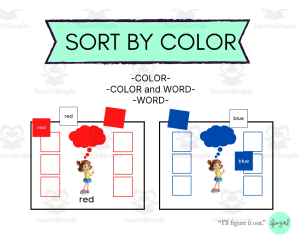
Sort-Grouping Activity by Color, color and words - girl version
Special Resources, Special Education Needs (SEN), Math, Early Math, Kindergarten, Preschool, Grade 1, 2, 3, 4, 5, 6, 7, 8, 9, 10, 11, 12, Activities
-GIRL VERSION- Why we teach sorting and grouping - Sorting and grouping are important skills for young children to learn because they lay the foundation for many other important academic and life skills. Sorting and grouping involve categorizing objects based on common attributes such as color, shape, size, and function. These skills help children to understand and make sense of the world around them. This is a color sorting activity for early learners. This activity is simple, engaging and can help children develop their cognitive, motor and social skills. To conduct this activity , you will need two large cards - one red and one blue, and twelve smaller cards - six cards that are blue and six cards that are red. (There are multiple types of color cards to choose from 1) square color cards 2) square color card with the word of the color on the card 3) color word cards. These different smaller cards adds variety and interest to the activity and helps individualize to different learners. Here are the steps for conducting this activity : 1. Start by introducing the two large color cards to the children and ask them to identify the colors. 2. Then, show them the smaller cards and ask them to identify the colors of these cards as well. 3. Explain to the children that they need to sort the smaller cards onto the larger color cards based on their colors. 4. Model the activity by sorting a few cards yourself and asking the children to observe. Once you have modeled the activity , give each child a set of smaller cards and ask them to sort them onto the corresponding color card. As the children are sorting, observe and offer support and guidance as needed. This color sorting activity is a great way to help young children develop their visual discrimination skills, color recognition skills, and cognitive skills. It also promotes socialization and communication skills as children share their thoughts and ideas with each other. This activity is EASY to assemble and easy to individualize print laminate cut - once velcro You can coil bind this activity or simply place it in a three ring binder. ENJOY! IFIO girl I'll Figure it Out
Author IFIO girl - I'll Figure It Out
Tags Early Learner, Visual Discrimination, ABLLS-R V8, Visual Performance, ABLLS-R B11, ESL, Early Reading, Critical Thinking, Tasked Based Language, Tasked Based Teaching

Lunch Rules, Behaviors and Manners Clip Cards
Special Resources, Social Emotional Learning (SEL), Special Education Needs (SEN), Social Skills, Life Skills, Resources for Teachers, Classroom Management, Kindergarten, Preschool, Grade 1, Worksheets & Printables, Flashcards, Activities
Lunch Rules, Behaviors and Manners Clip Cards These Lunch Rules Clips Cards are an unparalleled teaching supplement aimed at fostering commendable behaviors and manners in students during lunch time. Designed meticulously to cater to all possible student eating environment, this tool is valuable for both classroom lunches as well as proper canteen decorum. Through these clip cards, students are informed about the acceptable and unacceptable behavior patterns at school. The adaptability of the cards ensures that educators can customize their utilization according to different scenarios like whole group learning sessions, small group harmonizing activities or even as engaging homework assignments. The product is an asset for elementary school children who might be new to a learning environment or who could benefit from clear behavioral direction during mealtimes. Doubles up as a discreet assessment mechanism helping teachers in pinpointing those students grappling with maintaining appropriate manners during unstructured intervals like lunch. This unique resource also encompasses children who may be non-verbal by offering them a method through which they can physically indicate appropriate or inappropriate mealtime actions. The package brings along 31 recess behavior indicators emphasizing both positive and negative actions. Mindful of printing resources while focussing on enhancing user experience, options for black-and-white printing along with vibrant full-color versions are included in the clip card offerings. The assortment primarily benefits preschoolers through Grade 1 learners engaged towards honing their social emotional learning aspects along with specific consideration for children having special education needs (SEN). This distinctive selection prompts natural development of pivotal life skills such as social abilities alongside providing structured classroom management processes too. Variety of Application modes- solo lessons primarily focused on SEL components complimented by guidance directions regarding standard classroom rules to supplement your teaching curriculum without overwhelming budding learners. Practical Engagement- minimalistic prep requirement ensuring smooth integration of the tools into routine teaching, making it convenient for educators. All required files are delivered in a universally compatible PDF format adding simplicity and convenience while accessing Lunch Rules, Behaviors and Manners Clip Cards.
Author The Feelings and Friends Teacher
Tags Lunch Rules, Behavior Management, Manners, Clip Cards, Social Skills, Lunch Room Rules
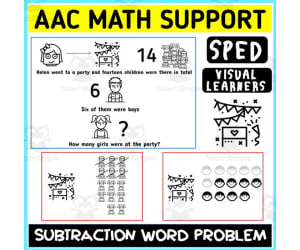
AAC Math Visual Support Subtraction Word Problem 3
Math, Addition and Subtraction, Basic Operations, Early Math, Special Resources, Special Education Needs (SEN), Subtraction, Grade 1, 2, Centers, Activities, Task Cards, Worksheets & Printables, Word Problems
A A C Math Visual Support Subtraction Word Problem . This is a comprehensive math resource designed to support students in understanding Subtraction word problems through visual and pictorial aids . This resource is particularly beneficial for educators working with students who with special education need as well as those who are visual learners since it serves as an augmentative and alternative communication ( A A C ) tool for structured math problem instruction . Perfect for various teaching settings, this resource can be used during morning work, whole group instruction, or in math centers . It includes a diverse array of task cards and worksheets that can work for different learning styles . Each task card or worksheet features a combination of pictures and clear text, as well as options that present text alone or visuals only . Additionally, students will find opportunities to trace the text, cut- out the images for role play, and so much more ! This versatile educational resource ensures that students not only comprehend the word problems they are working on but also develop problem- solving skills in a supportive and interactive manner . Incorporate these materials into your daily teaching and create an enriching learning environment that fosters understanding and confidence in practical mathematics . The black and white format is printer cost friendly and offers coloring and customised opportunities for each student . For more A A C pdf educational resources, you can check the following work by WORDS ASIDE : AAC Reading and Writing Development Task Cards 1 READING and WRITING | 2 | : Sentence to Paragraph A A C Reading and Writing Development Task Cards 2 Greek A A C Sentence to Paragraph READING and WRITING | 1 | This P D F file includes 2 1 pages of word problem pictorial presentations
Author WORDS ASIDE
Tags Basic Math, Problem Solving, Word Problems, Visual Support, AAC, Visual Learners, Pictorial Math, Math Manipulatives, Words Aside, Subtraction

Core Semantics Mats + Cards: Furniture Pack
Special Resources, ELA, Special Education Needs (SEN), Language Development, ESL, Vocabulary, Kindergarten, Preschool, Grade 1, Teacher Tools, Lesson Plans, Worksheets & Printables, Flashcards, Activities, Games
Core Semantics Mats + Cards: Furniture Pack This 13-page pack focuses on building vocabulary and communication skills related to common household furniture. With full-color and black-and-white images, students will expand their understanding of basic furniture terms through open-ended writing prompts , conversation starters, matching activities, and more. Use the materials for individual, small group, or whole-class instruction. The cards can be printed or displayed digitally to target language comprehension, expression, memory, following instructions, and other critical skills. Combine this pack with others in the series to create additional reasoning, categorization, and exclusion tasks. The engaging visual components make these materials versatile for early learning, elementary, ESL/EFL, and special education classrooms.
Author WORDS ASIDE
Tags Cards, Semantics, Language, Vocabulary, Occupational Therapy, Speech Therapry, Match To Sample, Boards, Minibook, Sped

Color Sorting Boards
Special Resources, Math, Early Math, Special Education Needs (SEN), Preschool, Grade 1, Activities
Boost color recognition skills with these hands-on Color Sorting boards! This engaging activity includes 6 durable sorting boards labeled with the color words red, blue, yellow, green, orange and purple. Each color has 6 cards to match with pictures of cubes, foods, clothes, household objects and beads. Students reinforce color names and matching by simply sticking the correct colorful picture cards onto the corresponding sorting board. The self-correcting activity allows young learners to check their own work and build confidence in color recognition abilities. The tactile experience of handling the picture cards and sorting them onto the boards provides helpful multisensory learning. Students gain repeated practice identifying, matching and naming colors in a fun, interactive way. The versatile set is perfect for centers , small groups or independent work. Developing color awareness and vocabulary lays the foundation for early reading, science and math. With their hands-on, self-correcting format, these Color Sorting boards make mastering basic colors engaging and foolproof! Early childhood educators will love having this simple activity in their classroom toolbox. It provides the focused repetition little learners need to cement color recognition skills through play-based learning. For repeated use I would suggest laminating the boards and cards and then use velcro to stick them on. Clipart courtesy of Kari Bolt Clipart.
Author SEN Resource Source
Tags Colors, Sorting, Matching, Grouping, Early Math

NUMBER SENSE POSTERS ACTIVITY MATS: number '2' trace dot paint count
Special Resources, Special Education Needs (SEN), Math, Early Math, Numbers, Kindergarten, Preschool, Grade 1, Worksheets & Printables, Flashcards, Activities
Number Sense Posters and Activity Mats: Number '2' Trace, Dot, Paint, Count is a 42-page PDF resource that helps preschool to grade 1 students grasp number quantity and early math concepts surrounding the number 2. Students trace, dot, and paint various creative representations of the numeral 2 while counting objects, patterns, and dice combinations. The hands-on mats and vibrant posters strengthen fine motor control, shape recognition, counting skills, and pattern awareness. Educators can facilitate small group lessons with the mats and posters or provide them as independent practice. The engaging activities like tracing, dot-to-dot, finger counting, and painting build number sense with simplicity and joy. As students explore the different stories and forms of 2 through diverse activities, this resource narrates an engaging early math journey that forges memorable connections.
Author WORDS ASIDE
Tags Number Sense, Numeral Representation, Interactive Activities, Fine Motor Skills, Quantity Recognition, Numeracy, Centers, Task Cards, Pictorial Math, Words Aside

Spot Four Differences Series |7|
Special Resources, Special Education Needs (SEN), Speech Therapy, Math, Early Math, Not Grade Specific, Worksheets & Printables, Flashcards, Activities, Games, Worksheets
Spot Four Differences Series |7| is an engaging 16-page educational resource intended for elementary educators and homeschool parents. This PDF provides 58 diversified themes spread across 3 challenge levels that prompt students to spot 4 differences between an original image and its altered pair. Comparing mirrored and slightly modified versions of the same illustration hones visual perception, concentration, and critical thinking in a fun format. Answer keys empower independent learning. Usages span whole-group introduction, small-group practice, independent work, homework, formative assessment , and beyond. Speech therapy, special education, foreign language, online/distance contexts also stand to benefit. Suitable for math and other subjects at early grades, this series’ universal themes and black-and-white aesthetic grant flexibility. The puzzles double as coloring sheets that inspire creativity. Spot Four Differences develops vital cognitive skills through an entertaining activity adaptable to diverse learners and settings.
Author WORDS ASIDE
Tags Premath, Cognitive Skills, Visual Perceptual, Math Stations, Attention, Concentration, Language, Fun, Coloring, Words Aside

Finance Life Skills: Jasmine Learns to Manage Her Money
Special Resources, Life Studies, Special Education Needs (SEN), Speech Therapy, Life Skills, Finance, Grade 9, 10, 11, 12, Activities, Worksheets & Printables, Worksheets
In Jasmine Learns to Manage Her Money, Jackson helps Jasmine understand the importance of spending less money than she earns. The use of this Finance Life Skills resource will allow students to engage in the following: • The significance of tracking personal expenses by recording spending habits and analyzing where money is being allocated helps identify areas for potential savings. • The importance of an emergency fund to cover unexpected expenses and how much to save. • The importance of avoiding excessive borrowing and the associated interest payments emphasizes the benefits of saving money and earning interest instead. • The interactive dialog and questions engage learners and reinforce their understanding of the story and the concepts. • The real-world examples, and age-appropriate visual aids, such as illustrations and diagrams , make this conversational story an excellent resource for teaching social narratives. • This social narrative's simple and direct language sets clear expectations, making it ideal for high school students and adults with intellectual disabilities. The story includes seven (7) reading comprehension questions and answers to reinforce and measure the student's understanding of the Finance Life Skills contained in the story! This life skills story will assist high school students and young adults in developing the necessary independent living skills to become more independent at school, at home, and in communities. This story is designed to be used by special education teachers, occupational therapists, speech therapists, ABA therapists, registered behavior technicians (RBT), parents, supported living coaches, and life skills teachers to teach their students valuable life skills. In addition to interactive instruction, this resource is ideal for hands-on and community-based learning, defining, setting, and measuring IEP goals. Related Products for Developing Independent Living Skills The Value of a Bank Account How to Create a Monthly Budget How to Create a Shopping List How Credit Cards Work Level 1 Grocery Shopping Money Math Level 1 Clothes Shopping Money Math Level 1 Reading Menus Money Math Engage your special education class with this highly interactive High School Finance Life Skills Story! It's printable , easy to use, and ready to hand out! A PDF file with six(6) pages.
Author Adulting Life Skills Resources
Tags Adulting On The Spectrum, Summer Life Skills Autism Reading Comprehension, Personal Finance Life Skills, Life Skills For Speech Therapists, Life Skills For Occupational Therapists, Life Skills Resource For ABA Therapists, Life Skills For Special Education Teachers, Social And Emotional Learning, Autism Life Skills For Visual Learners, Reading Comprehension Life Skills Passages