



5,388 products added recently
Page 144 - Newest Teaching Resources

 Show filters

Summer Coloring Pages for Kids | End of the Year Activities
Creative Arts, Art, Graphic Arts, Kindergarten, Preschool, Activities, Worksheets & Printables, Worksheets, Coloring Pages
Are you looking for fun and hassle-free summer activities to keep your students or children entertained? Summer Coloring Pages is a good choice for the classroom setting, summer camps, or even at home. With the end of the school year, summer teaching, or just looking for something artistic and peaceful, these well-designed pictures can serve the purpose. Table of Contents Summary: 24 unique summer-related images that include detailed and printable pictures showcasing beach life, summer snacks, plant life of the tropics, and encouraging quotes. Easily printable format with a PDF file to make it easily distributable. Various uses include morning activities, quick finish tasks, brain-break activities, summer activities, or celebration at the end of the year. Thematic Areas: Beach activities and surfing Refreshing summer snacks (e.g., watermelon, popsicle, lemonade) Ecological activities of summer (sunflower, palm tree, aquatic animals) Fun summer graphics and quotes (e.g., Stay Sunny, Summer Solstice) Benefit of Using This Product: Doesn't Need Any Preparations: Download it, print it, and make use of it. Interesting Activities: Keeps kids interested due to its fun, elaborate, and appropriate design. Helps Build Creativity: Encourages development of fine motor skills and creativity. Best Uses: Instruction at elementary schools (End-of-Year activities) Camp activities At-home education Quick art activities For more products, subscribe to this seller for weekly sales.
Author Source Class
Rating
Tags Summer Coloring Pages | End Of The Year Activities | June Morning Work Sheets, Summer Coloring Pages, End Of The Year Activities, June Morning Work Sheets, End Of The Year Activitie, Summer Camp Activities, Printable Summer Coloring Sheets, Last Day Of SchLast Day Of Schoolool
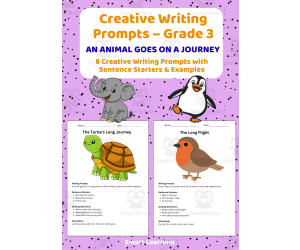
Creative Writing Prompts Grade 3 | An Animal Goes on a Journey
Creative Writing, Writing, ELA, Grade 2, 3, 4, Writing Prompts, Worksheets & Printables
Creative Writing Prompts Grade 3 | An Animal Goes on a Journey Get a creative writing prompt resource for 3rd grade on the topic of animals. What does this resource include? This resource contains 8 creative writing prompts on jungle animals-related topics, each with sentence starters for each task, guiding questions to support ideas, word banks with helpful vocabulary, separate writing pages with plenty of space, “How to Write a Story” guide (beginning, middle, end), 3 example stories. Each reading passage is unique. The jungle animal topics were carefully selected and each passage is accompanied by appropriate graphics. What is it suitable for? The material is suitable for English language arts classes. It is ideally suited for 3rd grade. This material is also suitable for weaker 4th-grade classes or particularly strong 2nd-grade classes. It is suitable for teachers looking for teaching materials that can be used immediately. No tedious adapting or formatting required. Simply print it out and use it directly in class. It is suitable for various teaching formats: - writing workshop - literacy centers - independent work - early finishers - homework What topics does the reading comprehension cover? 1 The Turtle’s Long Journey 2 The Long Flight 3 A Journey Through Nature 4 A Journey Through the Sea 5 Across the Open Fields 6 A Journey in the Ice 7 A Fun Trip 8 From Tree to Tree In addition, there are two advanced-level problems (easy and hard). The material is provided as a PDF file to make it easy to print and use in class. It is part of a larger series. If you like this material, you can explore creative writing prompt resources on a variety of other topics in my shop that will enrich your lessons. In addition to creative writing prompts, I also offer reading comprehension, math word problems, informational texts, and reading tests.
Author Smart Learning Classroom
Rating
Tags Creative Writing, Writing, Pet, Animal, Writing Prompts, Grade 3, Writing Workshop, Story Writing, Animals, Journey

Reading Comprehension Turtle | Grade 3 Informational Texts
Reading Comprehension, Reading, ELA, Grade 3, 4, Teacher Tools, Worksheets & Printables, Tests, Quizzes and Tests
Reading Comprehension Turtle | Grade 3 Informational Texts Get a reading comprehension resource for 3rd grade on the topic of turtles. What does this resource include? This resource contains 5 informational texts on turtle-related topics, each with 5 exercises. These include multiple-choice, true or false, vocabulary, and creative tasks. Each reading passage is unique. The turtle topics were carefully selected and each passage is accompanied by appropriate graphics. Additionally, answers are provided at the end of the resource to facilitate its use in elementary school. This material helps students develop their reading comprehension skills while also allowing them to gain a deeper understanding of a specific topic through short informational texts. What is it suitable for? The material is suitable for English language arts classes. It is ideally suited for 3rd grade. This material is also suitable for weaker 4th-grade classes or particularly strong 2nd-grade classes. It is suitable for teachers looking for teaching materials that can be used immediately. No tedious adapting or formatting required. Simply print it out and use it directly in class. It is suitable for various teaching formats: - Independent work - test preparation - Literacy centers - Small group instruction - Homework - Reading workshops - Classroom literacy rotations What topics does the reading comprehension cover? 🧭 1 A Turtle in the Garden 🚢 2 Slow but Safe 🗺 3 What Turtles Eat 🌎 4 Living in Warm Places 🚢 5 Well Protected The material is provided as a PDF file to make it easy to print and use in class. It is part of a larger series. If you like this material, you can explore informational texts on a variety of other topics in my shop that will enrich your lessons. In addition to reading comprehension, I also offer creative writing, math word problems, reading comprehension and reading tests.
Author Smart Learning Classroom
Rating
Tags Reading Comprehension, Grade 3 Reading, Informational Texts, Reading Activities, Reading Passages, Grade 4 Reading, Vocabulary Activities, Pet, Turtle, Turtles

Reading Comprehension Arctic Animals | Grade 3 Reading Activities
Reading Comprehension, Reading, ELA, Grade 3, 4, Teacher Tools, Worksheets & Printables, Tests, Quizzes and Tests
Reading Comprehension Worksheets – Arctic Animals Theme | Grade 3 Get a reading comprehension resource for 3rd grade on the topic of Arctic Animals. What does this resource include? This resource contains 10 reading passages on arctic animal-related topics, each with 5 exercises. These include multiple-choice, true or false, vocabulary, and creative tasks. Each reading passage is unique. The arctic Animal topics were carefully selected and each passage is accompanied by appropriate graphics. Additionally, answers are provided at the end of the resource to facilitate its use in elementary school. What is it suitable for? The material is suitable for English language arts classes. It is ideally suited for 3rd grade. This material is also suitable for weaker 4th-grade classes or particularly strong 2nd-grade classes. It is suitable for teachers looking for teaching materials that can be used immediately. No tedious adapting or formatting required. Simply print it out and use it directly in class. It is suitable for various teaching formats: - Independent work - Literacy centers - Small group instruction - Homework - Reading workshops - Classroom literacy rotations What topics does the reading comprehension cover? 🐻❄️ 1 The Big Polar Bear 🦭 2 The Quick Seal 🐋 3 The Strong Whale 🦊 4 The Quick Arctic Fox 🦭 5 The Big Walrus 🐇 6 The Fast Arctic Hare 🦄 7 The Big Narwhal 🦉 8 The Big Snowy Owl 🦌 9 The Migrating Reindeer 🐭 10 The Little Lemming The material is provided as a PDF file to make it easy to print and use in class. It is part of a larger series. If you like this material, you can explore reading comprehension resources on a variety of other topics in my shop that will enrich your lessons. In addition to reading comprehension, I also offer creative writing, math word problems, informational texts, and reading tests.
Author Smart Learning Classroom
Rating
Tags Reading Comprehension, Grade 3 Reading, Informational Texts, Reading Activities, Reading Passages, Grade 4 Reading, Vocabulary Activities, Animals, Arctic Animals, Arctic
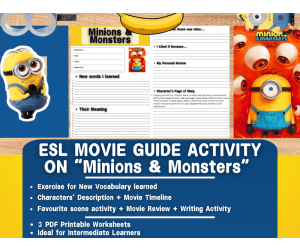
ESL Movie Guide Worksheets on "Minions & Monsters"
ELA, Language Development, ESL, Vocabulary, Writing, Creative Writing, Grade 6, 7, 8, 9, Worksheets & Printables, Writing Prompts, Worksheets
ESL Movie Guide Worksheets on "Minions & Monsters" This English Second or Foreign Language (ESL - EFL - TESOL) teaching resource is a 3 page printable PDF movie guide for " Minions & Monsters " (2026 animated film with Minions; Despicable Me) is designed to help English as a Second Language (ESL - EFL - TESOL) learners. This teaching resource can be ideal for post movie activities and is ideal for Middle School and High School students , from 7th to 12th grade . This ESL - EFL - TESOL (English Second or Foreign Language) Movie Guide Activity can be great for newcomers and any English language learners, making it an amazing teaching toolbox to use in ESL - EFL classrooms, language centers, or by tutors around the World. Within this ESL EFL Movie Guide on " Minions & Monsters " (2026 animated film with Minions; Despicable Me) ESL EFL TESOL teachers can find the following English Second or Foreign Language (ESL - EFL - TESOL - TEFL) film activities: General Information – Students fill in key details about the film, including the director, genre, release year etc. Vocabulary Builder – An activity dedicated to new words and phrases , to improve ESL EFL students’ English vocabulary Character Analysis – Students describe the main characters, helping them practice descriptive language and comprehension . Movie Timeline Activity – Students arrange scenes in chronological order to enhance their understanding of the storyline . Favorite Scene Reflection – A writing activity where students describe and explain their favorite moments from the film . Movie Review Writing – Learners express their opinions in a structured review, improving their evaluative writing skills . Creative Writing Activity – Students imagine themselves as one of the characters and write three diary entries from that character’s perspective, deepening their connection with the storyline. This " Minions & Monsters " (2026 animated film with Minions; Despicable Me) movie guide is designed to create an enjoyable and stimulating learning experience for intermediate advanced ESL students. ESL with Alan is an amazing Teaching Resources Store which aims to support English as a Second or foreign Language (ESL - EFL - TESOL -TEFOL) Teachers, Educators and Tutors around the globe (be it online or offline) to achieve their students' learning objectives while creating an enjoyable and stimulating learning environment. Never Forget! Learning is fun, So should English! Always
Author Learning with Alan
Rating
Tags ESL, English Second Language, English, Movie Guide, Films, Monsters, Character Analysis, Creative Writing, Vocabulary Building

ESL Vocabulary Flashcards - Books & Literature - Pictures
ELA, Language Development, ESL, Vocabulary, Not Grade Specific, Middle School, High School, Adult Education, Worksheets & Printables, Flashcards, Worksheets
ESL Vocabulary Flashcards - Books & Literature - Pictures This high quality English language teaching resource is designed for students learning English as a second or foreign language . It includes 4 printable PDF pages featuring vocabulary flashcards and worksheets centered around the theme of "Books & Literature" This ESL Vocabulary Flashcards on "Books & Literature" Worksheets Activity can be ideal for Beginner level ESL - EFL - TESOL learners, including newcomers and English language learners of all ages. 🌟 What's Included? In this ESL Vocabulary Flashcards Activity on " Books & Literature ", there are provided: ✅ 40 Printable Flashcards (4 Printable PDF worksheets) ✅ Essential vocabulary and phrases in English ✅ Engaging icons and emojis on select flashcards to support comprehension and vocabulary retention (not all flashcards) 🏫 Who Can Benefit from This Resource? 📌 Beginner ESL - EFL students looking to improve their English vocabulary 📌 Newcomers & English Language Learners (ESL - EFL - TESOL -TEFL) in schools, tutoring sessions, or self-study 📌 Teachers and tutors looking for fun and engaging vocabulary building activities 📌 Language centers, homeschool educators, and ESL programs 🎯 How Does this ESL Teaching Resource Help you and your Students? ✨ Strengthens essential English communication skills ✨ Provides English vocabulary (ESL - EFL - TESOL - TEFL) for better understanding ✨ Encourages engaging learning with printable flashcards that can be used in various ESL - EFL (English Second or Foreign Language) class activities Whether you're an ESL teacher or an English tutor these ESL Vocabulary Flashcards on " Books & Literature " are a valuable and fun resource to improve basic conversation skills in English. Start learning today and make English introductions simple, engaging, and effective ! ESL with Alan is a Teaching Resources Store whose aim is to help English as a Second or foreign Language (ESL EFL TESOL) Teachers, Educators and Tutors around the world (be it online or offline) to achieve their teaching objectives while creating an enjoyable and stimulating learning environment. Learning is fun, So should English! Always If you want to browse more of my ESL, EFL, TESOL Teaching Resources, click here right ESL with Alan!
Author Learning with Alan
Rating
Tags ESL, English Second Languages, English, Flashcards, Vocabulary, Books, Literature, Worksheets, Printable, Activity
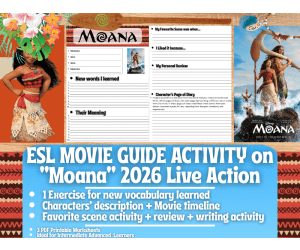
ESL Movie Guide Worksheets on "Moana" - 2026 Live Action
ELA, Language Development, ESL, Vocabulary, Writing, Creative Writing, Grade 7, 8, Worksheets & Printables, Worksheets, Writing Prompts
ESL Movie Guide Worksheets on "Moana" - 2026 Live Action This English Second or Foreign Language (ESL - EFL - TESOL) teaching resource is a 3 page printable PDF movie guide for " Moana " (2026 Walt Disney live action film set in Ancient Polynesia) is designed to help English as a Second Language (ESL - EFL - TESOL) learners. This teaching resource can be ideal for post movie activities and is ideal for Middle School and High School students , from 7th to 12th grade . This ESL - EFL - TESOL (English Second or Foreign Language) Movie Guide Activity can be great for newcomers and any English language learners, making it an amazing teaching toolbox to use in ESL - EFL classrooms, language centers, or by tutors around the World. Within this ESL EFL Movie Guide on " Moana " (2026 Walt Disney live action film set in Ancient Polynesia) ESL EFL TESOL teachers can find the following English Second or Foreign Language (ESL - EFL - TESOL - TEFL) film activities: General Information – Students fill in key details about the film, including the director, genre, release year etc. Vocabulary Builder – An activity dedicated to new words and phrases , to improve ESL EFL students’ English vocabulary Character Analysis – Students describe the main characters, helping them practice descriptive language and comprehension . Movie Timeline Activity – Students arrange scenes in chronological order to enhance their understanding of the storyline . Favorite Scene Reflection – A writing activity where students describe and explain their favorite moments from the film . Movie Review Writing – Learners express their opinions in a structured review, improving their evaluative writing skills . Creative Writing Activity – Students imagine themselves as one of the characters and write three diary entries from that character’s perspective, deepening their connection with the storyline. This " Moana " (2026 Walt Disney live action film set in Ancient Polynesia) movie guide is designed to create an enjoyable and stimulating learning experience for intermediate advanced ESL students. ESL with Alan is an amazing Teaching Resources Store which aims to support English as a Second or foreign Language (ESL - EFL - TESOL -TEFOL) Teachers, Educators and Tutors around the globe (be it online or offline) to achieve their students' learning objectives while creating an enjoyable and stimulating learning environment. Never Forget! Learning is fun, So should English! Always
Author Learning with Alan
Rating
Tags ESL, English Second Language, English, Movie Guide, Disney, Oceania, Worksheets, Printable
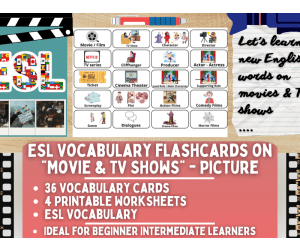
ESL Vocabulary Flashcards - Movies & TV Shows - Pictures
Language Development, ELA, ESL, Vocabulary, Not Grade Specific, Middle School, High School, Adult Education, Worksheets & Printables, Flashcards, Worksheets
ESL Vocabulary Flashcards - Movies & TV Shows - Pictures This high quality English language teaching resource is designed for students learning English as a second or foreign language . It includes 4 printable PDF pages featuring vocabulary flashcards and worksheets centered around the theme of "Movies & TV Shows" This ESL Vocabulary Flashcards on "Movies & TV Shows" Worksheets Activity can be ideal for Beginner level ESL - EFL - TESOL learners, including newcomers and English language learners of all ages. 🌟 What's Included? In this ESL Vocabulary Flashcards Activity on " Movies & TV Shows ", there are provided: ✅ 36 Printable Flashcards (4 Printable PDF worksheets) ✅ Essential vocabulary and phrases in English ✅ Engaging icons and emojis on select flashcards to support comprehension and vocabulary retention (not all flashcards) 🏫 Who Can Benefit from This Resource? 📌 Beginner ESL - EFL students looking to improve their English vocabulary 📌 Newcomers & English Language Learners (ESL - EFL - TESOL -TEFL) in schools, tutoring sessions, or self-study 📌 Teachers and tutors looking for fun and engaging vocabulary building activities 📌 Language centers, homeschool educators, and ESL programs 🎯 How Does this ESL Teaching Resource Help you and your Students? ✨ Strengthens essential English communication skills ✨ Provides English vocabulary (ESL - EFL - TESOL - TEFL) for better understanding ✨ Encourages engaging learning with printable flashcards that can be used in various ESL - EFL (English Second or Foreign Language) class activities Whether you're an ESL teacher or an English tutor these ESL Vocabulary Flashcards on Music " are a valuable and fun resource to improve basic conversation skills in English. Start learning today and make English introductions simple, engaging, and effective ! ESL with Alan is a Teaching Resources Store whose aim is to help English as a Second or foreign Language (ESL EFL TESOL) Teachers, Educators and Tutors around the world (be it online or offline) to achieve their teaching objectives while creating an enjoyable and stimulating learning environment. Learning is fun, So should English! Always If you want to browse more of my ESL, EFL, TESOL Teaching Resources, click here right ESL with Alan!
Author Learning with Alan
Rating
Tags ESL, English Second Language, English, Flashcards, Vocabulary, TV Shows, Movies, Films, Cinema, Activity

Summer Learning Packet Kindergarten to Grade 1 | Math & Reading Review
ELA, Math, Kindergarten, Lesson Plans, Teacher Tools, Worksheets & Printables
Help young learners stay engaged and confident over the summer with this fun and easy-to-use Summer Learning Packet for Kindergarten to 1st Grade. Designed for students finishing Kindergarten and preparing for first grade, this resource provides meaningful practice in both reading and math while helping prevent summer learning loss. The packet includes 50 print-and-go pages filled with engaging, summer-themed activities that reinforce essential early literacy and numeracy skills. Students practice letter recognition, beginning and ending sounds, CVC words, rhyming, sight words, reading comprehension, counting, number sense, addition, subtraction, shapes, measurement, and graphing. Fun enrichment activities such as mazes, I Spy pages, color-by-number tasks, connect-the-dots, and a summer bucket list help keep learning enjoyable and motivating. Perfect for summer packets, summer school, homeschool learning, tutoring, intervention, or back-to-school review, the activities are designed to be completed independently with minimal support. Students can work through one or two pages each day, making learning manageable for families. With an included answer key, teacher and parent guide, and completion certificate, this packet provides a simple and effective way to keep learning going all summer long.
Author Bright Classroom Ideas Marketplace
Rating
Tags Summer, Reading, Ela, Math, Worksheet

ESL Novel Study Worksheets - Enola Holmes and the Mark of the Mongoose
ELA, Language Development, ESL, Vocabulary, Creative Writing, Writing, Formal Writing, Grade 7, 8, 9, 10, 11, 12, Worksheets & Printables, Novel Studies, Worksheets, Writing Prompts
ESL Novel Study Worksheets on Enola Holmes and the Mark of the Mongoose This ESL - EFL - TESOL (English Second or Foreign Language) teaching resource is a comprehensive novel study worksheet activity (2 printable PDF pages; Worksheets) focused on the novel "Enola Holmes and the Mark of the Mongoose" (Nancy Springer's novels portraying Sherlock Holmes' sister's adventures in Victorian England). This Novel Study worksheets on "Enola Holmes and the Mark of the Mongoose" (Nancy Springer's novels portraying Sherlock Holmes' sister's adventures in Victorian England) is tailored for middle and high school ESL students (7th – 12th grade) and provide a variety of thought provoking and language building activities. Whether you're teaching English as a Second Language (ESL), English as a Foreign Language (EFL), or in a TESOL context, this resource is classroom-ready and easy to use. Within this ESL Novel Study on "Enola Holmes and the Mark of the Mongoose" (Nancy Springer's novels portraying Sherlock Holmes' sister's adventures in Victorian England) (2 printable PDF worksheets pages), English Second or Foreign Language (ESL - EFL - TESOL - TEFL) teachers can find the following activities: General information activity (author, genre, publishing date) Vocabulary building section – new words from the novel 1 Story timeline Personal reflection on a favorite chapter Student novel review and rating Creative writing task : pretending being a character you personally liked and writing 3 diary pages for 3 scenes as if you were this character This English Second or Foreign Language (ESL - EFL - TESOL - TEFL) Novel Study Activity Worksheets on the "Enola Holmes and the Mark of the Mongoose" (Nancy Springer's novels portraying Sherlock Holmes' sister's adventures in Victorian England) can be ideal for learners from 7th grade to 12th grade to study this Novel (middle school + High School Students + Adult learners + University Students) ESL with Alan is a high-quality ESL teaching resources that inspire both teachers and students. Our goal is to make learning English fun, interactive, and meaningful. Discover more English Second or Foreign Language activities by visiting our store – because learning English should always be fun! If you want to browse more of my English Language and Literature Novel Study Activity Teaching Resources, click here ESL with Alan!
Author Learning with Alan
Rating
Tags ESL, English Second Language, English, Novel Study, Books, Enola Holmes, Sherlock Holmes, Activity, Writing Activity, Worksheets
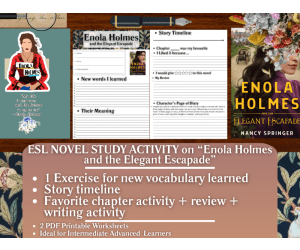
ESL Novel Study Worksheets - Enola Holmes and the Elegant Escapade
ELA, Language Development, ESL, Vocabulary, Writing, Creative Writing, Formal Writing, Grade 7, 8, 9, 10, 11, 12, Worksheets & Printables, Novel Studies, Worksheets, Writing Prompts
ESL Novel Study Worksheets - Enola Holmes and the Elegant Escapade - Nancy Springer This ESL - EFL - TESOL (English Second or Foreign Language) teaching resource is a comprehensive novel study worksheet activity (2 printable PDF pages; Worksheets) focused on the novel "Enola Holmes and the Elegant Escapade" (Nancy Springer's novels portraying Sherlock Holmes' sister's adventures in Victorian England). This Novel Study worksheets on "Enola Holmes and the Elegant Escapade" (Nancy Springer's novels portraying Sherlock Holmes' sister's adventures in Victorian England) is tailored for middle and high school ESL students (7th – 12th grade) and provide a variety of thought provoking and language building activities. Whether you're teaching English as a Second Language (ESL), English as a Foreign Language (EFL), or in a TESOL context, this resource is classroom-ready and easy to use. Within this ESL Novel Study on "Enola Holmes and the Elegant Escapade" (Nancy Springer's novels portraying Sherlock Holmes' sister's adventures in Victorian England) (2 printable PDF worksheets pages), English Second or Foreign Language (ESL - EFL - TESOL - TEFL) teachers can find the following activities: General information activity (author, genre, publishing date) Vocabulary building section – new words from the novel 1 Story timeline Personal reflection on a favorite chapter Student novel review and rating Creative writing task : pretending being a character you personally liked and writing 3 diary pages for 3 scenes as if you were this character This English Second or Foreign Language (ESL - EFL - TESOL - TEFL) Novel Study Activity Worksheets on the "Enola Holmes and the Elegant Escapade" (Nancy Springer's novels portraying Sherlock Holmes' sister's adventures in Victorian England) can be ideal for learners from 7th grade to 12th grade to study this Novel (middle school + High School Students + Adult learners + University Students) ESL with Alan is a high-quality ESL teaching resources that inspire both teachers and students. Our goal is to make learning English fun, interactive, and meaningful. Discover more English Second or Foreign Language activities by visiting our store – because learning English should always be fun! If you want to browse more of my English Language and Literature Novel Study Activity Teaching Resources, click here ESL with Alan!
Author Learning with Alan
Rating
Tags ESL, English Second Language, English, Novel Study, Enola Holmes, Sherlock Holmes, Detective, Writing Activity, Activity, Worksheets
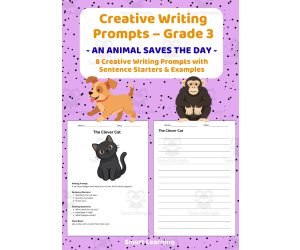
Creative Writing Prompts Grade 3 | An Animal Saves the Day
Creative Writing, Writing, ELA, Grade 2, 3, 4, Writing Prompts, Worksheets & Printables
Creative Writing Prompts Grade 3 | An Animal Saves the Day Get a creative writing prompt resource for 3rd grade on the topic of animals. What does this resource include? This resource contains 8 creative writing prompts on animal-related topics, each with sentence starters for each task, guiding questions to support ideas, word banks with helpful vocabulary, separate writing pages with plenty of space, “How to Write a Story” guide (beginning, middle, end), 3 example stories. Each reading passage is unique. The animal topics were carefully selected and each passage is accompanied by appropriate graphics. What is it suitable for? The material is suitable for English language arts classes. It is ideally suited for 3rd grade. This material is also suitable for weaker 4th-grade classes or particularly strong 2nd-grade classes. It is suitable for teachers looking for teaching materials that can be used immediately. No tedious adapting or formatting required. Simply print it out and use it directly in class. It is suitable for various teaching formats: - writing workshop - literacy centers - independent work - early finishers - homework What topics does the reading comprehension cover? 1 The Clever Cat 2 The Brave Dog 3 The Warning Bird 4 Help in the Field 5 The Strong Helper 6 Help in the Ocean 7 The Smart Monkey 8 Help on the Ice In addition, there are two advanced-level problems (easy and hard). The material is provided as a PDF file to make it easy to print and use in class. It is part of a larger series. If you like this material, you can explore creative writing prompt resources on a variety of other topics in my shop that will enrich your lessons. In addition to creative writing prompts, I also offer reading comprehension, math word problems, informational texts, and reading tests.
Author Smart Learning Classroom
Rating
Tags Creative Writing, Writing, Pet, Animal, Writing Prompts, Grade 3, Writing Workshop, Story Writing, Animals, Cat
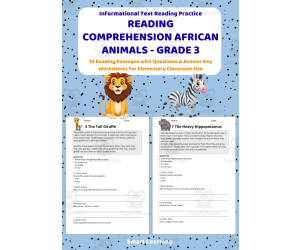
Reading Comprehension African Animals | Grade 3 Reading Activities
Reading Comprehension, Reading, ELA, Grade 3, 4, Teacher Tools, Worksheets & Printables, Tests, Quizzes and Tests
Reading Comprehension Worksheets – African Animals Theme | Grade 3 Get a reading comprehension resource for 3rd grade on the topic of African Animals. What does this resource include? This resource contains 10 reading passages on african animal-related topics, each with 5 exercises. These include multiple-choice, true or false, vocabulary, and creative tasks. Each reading passage is unique. The African Animal topics were carefully selected and each passage is accompanied by appropriate graphics. Additionally, answers are provided at the end of the resource to facilitate its use in elementary school. What is it suitable for? The material is suitable for English language arts classes. It is ideally suited for 3rd grade. This material is also suitable for weaker 4th-grade classes or particularly strong 2nd-grade classes. It is suitable for teachers looking for teaching materials that can be used immediately. No tedious adapting or formatting required. Simply print it out and use it directly in class. It is suitable for various teaching formats: - Independent work - Literacy centers - Small group instruction - Homework - Reading workshops - Classroom literacy rotations What topics does the reading comprehension cover? 🐘 1 The Strong Elephant 🐆 2 The Fast Cheetah 🦒 3 The Tall Giraffe 🦁 4 The Roaring Lion 🦏 5 The Heavy Rhinoceros 🦓 6 The Fast Zebra 🦛 7 The Heavy Hippopotamus 🐒 8 The Quick Monkey 🦍 9 The Strong Gorilla 🦤 10 The Fast Ostrich The material is provided as a PDF file to make it easy to print and use in class. It is part of a larger series. If you like this material, you can explore reading comprehension resources on a variety of other topics in my shop that will enrich your lessons. In addition to reading comprehension, I also offer creative writing, math word problems, informational texts, and reading tests.
Author Smart Learning Classroom
Rating
Tags Reading Comprehension, Grade 3 Reading, Informational Texts, Reading Activities, Reading Passages, Grade 4 Reading, Vocabulary Activities, Animals, African Animals, African

Reading Comprehension Horse | Grade 3 Informational Texts
Reading Comprehension, Reading, ELA, Grade 3, 4, Teacher Tools, Worksheets & Printables, Tests, Quizzes and Tests
Reading Comprehension Horse | Grade 3 Informational Texts Get a reading comprehension resource for 3rd grade on the topic of horses. What does this resource include? This resource contains 5 informational texts on horse-related topics, each with 5 exercises. These include multiple-choice, true or false, vocabulary, and creative tasks. Each reading passage is unique. The horse topics were carefully selected and each passage is accompanied by appropriate graphics. Additionally, answers are provided at the end of the resource to facilitate its use in elementary school. This material helps students develop their reading comprehension skills while also allowing them to gain a deeper understanding of a specific topic through short informational texts. What is it suitable for? The material is suitable for English language arts classes. It is ideally suited for 3rd grade. This material is also suitable for weaker 4th-grade classes or particularly strong 2nd-grade classes. It is suitable for teachers looking for teaching materials that can be used immediately. No tedious adapting or formatting required. Simply print it out and use it directly in class. It is suitable for various teaching formats: - Independent work - test preparation - Literacy centers - Small group instruction - Homework - Reading workshops - Classroom literacy rotations What topics does the reading comprehension cover? 🧭 1 A Day at the Stable 🚢 2 Movement and Running 🗺 3 Food for the Horse 🌎 4 Horses in a Herd 🚢 5 Horses Show Signs The material is provided as a PDF file to make it easy to print and use in class. It is part of a larger series. If you like this material, you can explore informational texts on a variety of other topics in my shop that will enrich your lessons. In addition to reading comprehension, I also offer creative writing, math word problems, reading comprehension and reading tests.
Author Smart Learning Classroom
Rating
Tags Reading Comprehension, Grade 3 Reading, Informational Texts, Reading Activities, Reading Passages, Grade 4 Reading, Vocabulary Activities, Pet, Horse, Horses
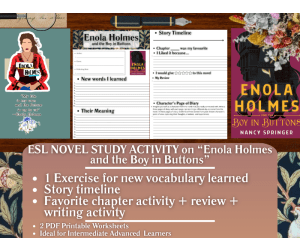
ESL Novel Study Worksheet - Enola Holmes and the Boy in Buttons
ELA, Language Development, ESL, Vocabulary, Writing, Creative Writing, Grade 7, 8, 9, 10, 11, 12, Worksheets & Printables, Novel Studies, Worksheets, Writing Prompts
ESL Novel Study Worksheet - Enola Holmes and the Boy in Buttons - Nancy Springer This ESL - EFL - TESOL (English Second or Foreign Language) teaching resource is a comprehensive novel study worksheet activity (2 printable PDF pages; Worksheets) focused on the novel "Enola Holmes and the Boy in Buttons" (Nancy Springer's novels portraying Sherlock Holmes' sister's adventures in Victorian England). This Novel Study worksheets on "Enola Holmes and the Boy in Buttons" (Nancy Springer's novels portraying Sherlock Holmes' sister's adventures in Victorian England) is tailored for middle and high school ESL students (7th – 12th grade) and provide a variety of thought provoking and language building activities. Whether you're teaching English as a Second Language (ESL), English as a Foreign Language (EFL), or in a TESOL context, this resource is classroom-ready and easy to use. Within this ESL Novel Study on "Enola Holmes and the Boy in Buttons" (Nancy Springer's novels portraying Sherlock Holmes' sister's adventures in Victorian England) (2 printable PDF worksheets pages), English Second or Foreign Language (ESL - EFL - TESOL - TEFL) teachers can find the following activities: General information activity (author, genre, publishing date) Vocabulary building section – new words from the novel 1 Story timeline Personal reflection on a favorite chapter Student novel review and rating Creative writing task : pretending being a character you personally liked and writing 3 diary pages for 3 scenes as if you were this character This English Second or Foreign Language (ESL - EFL - TESOL - TEFL) Novel Study Activity Worksheets on the "Enola Holmes and the Boy in Buttons" (Nancy Springer's novels portraying Sherlock Holmes' sister's adventures in Victorian England) can be ideal for learners from 7th grade to 12th grade to study this Novel (middle school + High School Students + Adult learners + University Students) ESL with Alan is a high-quality ESL teaching resources that inspire both teachers and students. Our goal is to make learning English fun, interactive, and meaningful. Discover more English Second or Foreign Language activities by visiting our store – because learning English should always be fun! If you want to browse more of my English Language and Literature Novel Study Activity Teaching Resources, click here ESL with Alan!
Author Learning with Alan
Rating
Tags ESL, English Second Language, English, Novel Study, Sherlock Holmes, Enola Holmes, Activity, Printable, Books, Writing Activity

ESL Novel Study - Enola Holmes and the Case of the Black Barouche
ELA, Language Development, ESL, Vocabulary, Writing, Creative Writing, Formal Writing, Grade 7, 8, 9, 10, 11, 12, Novel Studies, Worksheets & Printables, Worksheets, Writing Prompts
ESL Novel Study Worksheets - Enola Holmes and the Case of the Black Barouche This ESL - EFL - TESOL (English Second or Foreign Language) teaching resource is a comprehensive novel study worksheet activity (2 printable PDF pages; Worksheets) focused on the novel "Enola Holmes and the Case of the Black Barouche" (Nancy Springer's novels portraying Sherlock Holmes' sister's adventures in Victorian England). This Novel Study worksheets on "Enola Holmes and the Case of the Black Barouche" (Nancy Springer's novels portraying Sherlock Holmes' sister's adventures in Victorian England) is tailored for middle and high school ESL students (7th – 12th grade) and provide a variety of thought provoking and language building activities. Whether you're teaching English as a Second Language (ESL), English as a Foreign Language (EFL), or in a TESOL context, this resource is classroom-ready and easy to use. Within this ESL Novel Study on "Enola Holmes and the Case of the Black Barouche" (Nancy Springer's novels portraying Sherlock Holmes' sister's adventures in Victorian England) (2 printable PDF worksheets pages), English Second or Foreign Language (ESL - EFL - TESOL - TEFL) teachers can find the following activities: General information activity (author, genre, publishing date) Vocabulary building section – new words from the novel 1 Story timeline Personal reflection on a favorite chapter Student novel review and rating Creative writing task : pretending being a character you personally liked and writing 3 diary pages for 3 scenes as if you were this character This English Second or Foreign Language (ESL - EFL - TESOL - TEFL) Novel Study Activity Worksheets on the "Enola Holmes and the Case of the Black Barouche" (Nancy Springer's novels portraying Sherlock Holmes' sister's adventures in Victorian England) can be ideal for learners from 7th grade to 12th grade to study this Novel (middle school + High School Students + Adult learners + University Students) ESL with Alan is a high-quality ESL teaching resources that inspire both teachers and students. Our goal is to make learning English fun, interactive, and meaningful. Discover more English Second or Foreign Language activities by visiting our store – because learning English should always be fun! If you want to browse more of my English Language and Literature Novel Study Activity Teaching Resources, click here ESL with Alan!
Author Learning with Alan
Rating
Tags ESL, English Second Language, English, Enola Holmes, Sherlock Holmes, Detective, Activity, Printable, Books, Novel Study

BC Grade 8 Math: Full-Year 8th Grade Real World Math Worksheets
Math, Number Lines, Percentages, Algebra, Decimals, Fractions, Geometry, Measurements, Statistics, Multiplication and Division, Grade 7, 8, 9, Worksheets, Worksheets & Printables, Word Problems
Grade 8 Math: Full Year of Worksheets, Games, and Projects: Do you need some new & engaging real-world math worksheets, games and projects for your 8th grade math class? If you want to add a fun and relevance to your grade 8 math program in British Columbia , Canada or beyond, this is the full-year math resource for you! This full-year 100-page PDF is full of real-life applications , math stations , fun games , quick assessments , and math projects that match up with every single Learning Outcome in the BC Math 8 curriculum. How to Use: This is a supplemental curriculum and is designed to be used alongside your regular textbook lessons. First teach your students the basics, and then you can use these applied math projects, worksheets, and games to show how the math learned in class can be applied to useful everyday situations! There is at least one math task for each learning standard. My students love seeing how they can use statistics to explore hourly wages, or apply what they know about the Pythagorean Theorem to solve everyday problems. Many of the tasks include financial literacy learning , because that is a great way to make math meaningful and useful in the real world! Here are the topics covered: Square & Cube Roots Perfect Squares & Cubes Percents Less Than One or Greater Than One Hundred Proportional Relationships (rates, ratios, percent) Fraction Operations Discrete Linear Relationships Write & Evaluate Expressions Two-Step Equations Surface Area & Volume of 3-D Shapes Pythagorean Theorem Nets of 3-D Objects Central Tendency (mean, median & mode) Theoretical Probability Financial Literacy Grades to Use With: This product is specially designed for Grade 8 math classes in the province of British Columbia, Canada . However, the PDF is full of math tasks that meet 7th & 8th grade common core standards, so it could easily be used in many classrooms! What's Included: 100-Page PDF with over 20 Different Activities Where applicable, Answer Keys are included If you enjoy this product, check out my other full-year supplemental math curriculums: BC Grade 4 Math Full-Year Supplemental Math Activities BC Grade 5 Math Full-Year Supplemental Math Activities BC Grade 6 Math Full-Year Supplemental Math Activities BC Grade 7 Math Full-Year Supplemental Math Activities
Author Grace Under Pressure
Rating
Tags Math Games, Math Stations, Math Projects, Financial Literacy, Geometry, 8th Grade Math, Grade 8 Math, Full Year Math, 8th Grade Math Worksheets, Grade 8 Math Worksheets
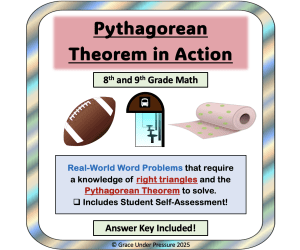
Real-World Pythagorean Theorem Word Problems Pythagoras 8th 9th Grade
Math, Measurements, Geometry, Grade 8, 9, Worksheets & Printables, Worksheets, Word Problems
Here are real-world and no-prep Pythagorean Theorem word problem worksheets for students in 8th or 9th grade. We use and calculate with information about right triangles & the Pythagorean Theorem in our daily lives- these word problems show students realistic situations where they can apply the Pythagorean Theorem! Traditionally, teaching the Pythagorean Theorem can be dry and mostly about memorizing the formula. This lesson will show your students why understanding right triangles and the Pythagorean Theorem matters for their everyday lives. It answers the question, "When will we use this in our lives?" For each realistic everyday scenario, students will draw a triangle diagram and calculate the answer using the Pythagorean Theorem. At the end of the lesson, students get to write their own word problem and self-assess their skills. How to Use: Use these Pythagorean Theorem worksheets after you have taught your students the basics of the Pythagorean Theorem. Print three pages of worksheets for each student and exit tickets for the whole class. Let students work in pairs or small groups on the word problems. For each word problem, they should draw a diagram and calculate an exact answer using the Pythagorean Theorem. Students will create their own word problem and trade with a friend. Students reflect on when understanding right triangles can be helpful in their lives. At the end, hand out exit ticket self-assessment slips to see where your students need more support. Grades to Use With : These worksheets are designed for students in 8th & 9th grade who are learning about right triangles & the Pythagorean Theorem. They are a good way to incorporate real-world math into your program. The worksheets could be used in high school special education classes where appropriate. What's Included: 6-Page PDF: Ready to Print and Use! Teacher Instructions 2-Page Student Word Problem Worksheet 1-Page Student Reflection Worksheet Student Exit Tickets Complete Answer Key
Author Grace Under Pressure
Rating
Tags Pythagoras, Pythagorean Theorem, Right Triangles, 8th Grade Geometry, 9th Grade Geometry, Square Root, Real World Math, Geometry Word Problems, Pythagoras Word Problems
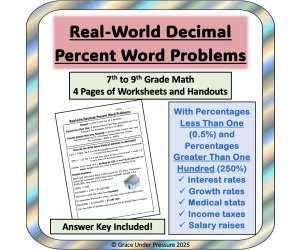
Percent Less Than One & More Than a Hundred: Decimal Percent Worksheet
Math, Addition and Subtraction, Multiplication and Division, Percentages, Decimals, Grade 7, 8, 9, Worksheets & Printables, Worksheets, Word Problems
Here are no-prep Real-World Decimal Percent word problem worksheets that show your students in 7th, 8th or 9th grade realistic scenarios that need the use of percentages less than one (for example, 0.5%) and percentages more than one hundred (for example, 250%) to solve. From measuring and comparing population growth to deciphering medical statistics to bookkeeping for small businesses- people use information about decimal percentages in our daily lives without even noticing it! Your Students Will: Learn from a sample scenario involving house price appreciation. Solve real-world decimal percent word problems involving interest rates, growth rates, medical statistics, salary raises, and more! Self-assess their skills with a simple self-assessment scale. How to Use: Print 4 pages of worksheets for each student Go through the sample problem together, ensuring students know how to convert percentages into decimals for easy calculations. Let students work in pairs or small groups on the word problems. Students self-assess their skills using a simple scale. Have students come up and share their solution methods when you review the questions as a class. A complete answer key is included. Math Skills Required: Converting percents less than one and more than one hundred into decimals. Completing calculations using the four operations, large numbers, and decimal percents. Using mental math and estimation skills to check the reasonableness of answers. Grades to Use With : These worksheets are perfect for students in 7th, 8th and 9th grade who are learning about (or reviewing) proportional relationships- specifically more complicated percents. They are a great way for students to practice solving real-world math word problems. The worksheets could also be used in high school special education classes where appropriate. What's Included: 6-Page PDF: Ready to Print and Use! Teacher Instructions Student Handout with Vocabulary and Sample Scenario 3 Pages of Student Worksheets with Word Problems and Self-Assessment Complete Answer Key
Author Grace Under Pressure
Rating
Tags Decimal Percent, Percent Less Than One, Percent More Than One Hundred, Percent Word Problems, 7th Grade Percent, 8th Grade Percent, Percentages, Real World Math, 9th Grade Percent
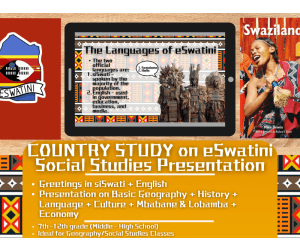
Country Study Presentation - eSwatini - Geography- Africa
Social Studies, Economics, Geography, History, History: African, Grade 7, 8, 9, 10, 11, 12, Teacher Tools, Presentations
Country Study Presentation - eSwatini - Geography + Social Studies - Southern Africa Try this Teaching Resource on eSwatini (Introductory Presentation Lesson - PDF Printable), designed for Geography + African History (Southern Africa) + Social Studies lessons. Suitable for Grades 7–12 (Middle school and High School students), this Introductory PDF Presentation offers a ready to use lesson that requires little to no preparation. Geography and Social Studies students will learn about eSwatini ’s geography, history, culture, language and economy — making it perfect for classroom instruction, homeschooling, or online learning. 📘 Teachers can find the following topics in this Social Studies and Geograhy Teaching resource ✅ Greetings in siSwati + English ✅ Geography of eSwatini (Southern Africa) – Key facts, borders, and an interactive Google Maps link to its location. ✅ Quick Facts – Population, capital city, currency and other essential details. ✅ Languages of eSwatini : English + siSwati - introduction in the languages spoken + basic vocabuary ✅ History Overview – A concise summary of the most important events in the history of eSwatini (Southern Africa) ✅ Geography & Environment – Details about the country’s land area, regions, and climate zones. ✅ eSwatini's Economy – paragraph on eSwatini ’s industries, exports, currency and economic strengths (Southern Africa) ✅ Mbabane & Labamba – Explore the capital city of eSwatini , its famous landmarks, and cultural highlights. ✅ Other Major Cities – A map showcasing additional important cities in eSwatini (Southern Africa) ✅ eSwatini's Culture & Traditions – A look at the customs and values that define eSwatini (Southern Africa) ✅ Farewell in siSwati + English 🎯 This Geography and Social Studies Teaching Resource can be perfect for: Geography classes Social Studies lessons World cultures units Country study projects Substitute teacher toolbox Digital learning In-class or online teaching 📂 Resource Details Format: PDF Digital Presentation Grade Levels: 7th–12th Grade (Middle School and High School students) Learning with Alan is an educational resource store created to help teachers, educators, and tutors reach their teaching goals while building a fun, engaging, and stimulating learning environment . Because learning should always be meaningful—and fun! 🎓✨ If you want to browse more of my Teaching Resources, click here Learning with Alan!!
Author Learning with Alan
Rating
Tags Social Studies, Geography, Country Study, Africa, ESwatini, Southern Africa, Lesson, Introduction, Presentation, History

Drawing Nets for 3-D Objects: Applied & Real-World Math 6th 7th 8th
Math, Geometry, Measurements, Grade 6, 7, 8, Worksheets & Printables, Word Problems, Worksheets, Activities
Here is an 8th grade math lesson that incorporates Indigenous cultural learning along with math skills for calculating surface area and volume, drawing different views of 3-D objects, and constructing nets for 3-D objects. Students will learn about indigenous bentwood boxes and practice drawing nets of these items to help calculate surface area and volume in real-world scenarios. How to Use: Print four pages of worksheets for each student. Go through the first page together to learn about bentwood boxes. Either show the video and webpages to the whole class or let students complete research in pairs or small groups. They must sketch at least one bentwood box and take some notes. Next, students complete calculations with the sample red box. NOTE: Assume the lid sits ON the sides (and does not cover the sides) like a true bentwood box. I have only used right angles here, which is not completely realistic for a bentwood box, but is appropriate for this level of math. The sides of the lid would have to be thick for this to work in real life. Students calculate the volume and surface area of the box and consider how capacity is different than volume in this case. On pages three and four, students draw nets for the three pieces of the bentwood box and use a simple scale (1 grid square = 8cm). Remind them that the box’s sides are made from one continuous piece of wood that is scored and bent. Finally, students can create a design on their net. See if they can determine what way the pieces fit together to ensure their design is oriented correctly. This is a great way to apply geometry learning to a real-life task, and it incorporates indigenous culture into your math classroom. Grades to Use With: This lesson was specifically designed for British Columbia Mathematics 8 curriculum, but it can work in any classroom that is learning about surface area, volume, and nets of 3-D shapes in grades 6, 7, or 8. What's Included: 6-Page PDF: Ready to Print and Use! - Teacher Instructions - Learn about Bentwood Boxes Handout - Calculating Volume & Surface Area Worksheet - Drawing Nets Worksheets - Complete Answer Key
Author Grace Under Pressure
Rating
Tags Nets, Geometry Nets, 3-d Objects, Bentwood Boxes, First Peoples Principles, Applied Math, Real World Math, Middle School Math, Middle School Geometry, Surface Area

Experiential Learning – Community Problem-Solving Projects
Social Studies, Government, Sociology, History: USA, History, Resources for Teachers, Classroom Management, Community Building, Special Resources, Social Emotional Learning (SEL), Grade 5, 7, 8, 9, 10, 11, 12, Worksheets & Printables, Workbooks, Worksheets, Word Searches, Teacher Tools, Assessments, Lesson Plans, Quizzes and Tests, Quizzes, Tests
Utilizing the no-prep experiential learning unit on solving community issues will empower your students to be active learners and members of their community by providing them with a hands-on, project-based learning (PBL) experience that goes far beyond the traditional textbook. The complete curriculum guide and student workbook for this PBL unit will give you all the necessary information to create an engaging and effective PBL unit with your middle school students. The curriculum is built on the proven E.P.I.C framework (empathize, probe, innovate, commit), which will lead them through the entire civic action process, from identifying an authentic community issue, to conducting research about that issue, to designing a sustainable solution, to implementing their proposed solution. ● Learning Objectives For Participants: 1. Developing Systems Thinking through the use of tools like Iceberg Model and Five Whys, to identify underlying causes of issues rather than just surface level symptoms. 2. Supporting Empathetic Research by conducting interviews with Stakeholders and Mapping Community Assets through uses of Asset-Based Community Development. 3. Developing Data Analysis through differentiating and collecting data from both Qualitative and Quantitative sources in order to effectively communicate the case for change. 4. Supporting Design Thinking and Innovation by brainstorming and using a Feasibility/Impact Matrix to develop the best ideas. 5. Developing project management through Budgeting, Resources Allocation, Timelines with Milestones and Risk Mitigation. 6. Developing Persuasive Communication by learning how to "Pitch" using Ethos, Pathos and Logos to obtain Stakeholder Buy-In. 7. Developing Resilience and Reflection by gaining experience with real-world friction, by learning from successes and failures. Basic Content Summary. The following outlines the contents of the 39-page PDF document: - Part 1 is the Teacher's Theoretical Guide (approximately 11 pages in total) and provides a comprehensive overview of experiential learning's pedagogical background. The guide will give you the ability to facilitate, and confidence to use, experiential learning with your students. - Part 2 is the Student Workbook (about 16 pages total) and has worksheets that are scaffolded for each step of the project from community mapping through to summative reflection; includes 10 different worksheets. - Part 3 is comprised of Visuals & Teacher Resources (about 12 pages total). - Classroom Visuals: Contains anchor charts for The Experiential Learning Cycle, Root Cause Analysis (Fishbone Diagram), and the Strategic Intervention Matrix. - Comprehensive Answer Key & Rubrics: Contains exhibiting example rubrics at every stage (from Substandard to Advanced responses) so that grading is on the process of completion—this means your students know what to expect when working on this project! - Teacher Implementation Guide: Provides suggestions on becoming a guide on the side to your students, how to manage issues that may arise throughout the project, as well as how to create psychological safety for your students. Social Studies, Civics, Government, Leadership, Service-Learning, and Project-Based Learning (PBL) classrooms can benefit from using this resource to empower their students to positively impact the world around them. Download this resource today to begin developing the next generations of architects who will create social change! Projects Based Learning, (PBL), Experiential Learning, Civic, Social Studies, Middle School, Community Service, Servic eLearning, Problem Solving/ Critical Thinking/ Designthinking, Student Workbook (and Teacherguide). This resource also contains Rubrics, No Prep needed, Printable, Leadership and Civic engagement. What Makes It Good for Parents & Schools: Teaches 21st Century Skills Through Real-Life Scenarios: This learning experience is much more than hand memorizing; it teaches students real life skills that they will use throughout highschool, college, and their professional lives, such as budgeting, project management, public speaking, and analyzing data. Promotes Empathy and Civic Responsibility: Through class activities and community projects that are performed as a group and individulally, students will inherently develop a sense of empathy toward others and their community, realizing that they can and should take responsibility for helping bring about positive changes. Develops Resiliency & Growth Mindset: The curriculum helps students change the way they think about challenges (obstacles) and how they see their own failure (a way to collect information for growth). Students will learn to be resilient, open and flexible to the change of environment/challenges, as well as to be perseverant in overcoming obstacles into adulthood. Provides a Complete Package of A High-Quality, Cross-Curricular, and Academically Rigorou: The project consists of four major areas all integrated into one project: social studies, ie. civic mindedness; math, ie. development of budget(s); ELA, ie. persuasive writing skills; science, ie. collection of data. As a result, the project allows for multiplication of all of the classes learned as opposed to singularly focused learning. Provides Everything Needed in a Complete Turnkey Package: When teachers receive the project; it includes a teacher guide, student workbooks, and visual aids, as well as description of the method to assess the student's work is extremely organized, easy-to-understand as well as easy to implement and to grade both substantively and fairly. Intended Audience by Age Group: Age Breakdown Based on Content, Language and Express; Grades 6-8, (Middle School). Page 2 has an explicit mention of the "critical development window of grades 5-8". The task complexity (Budgeting, Stakeholder Analysis and System Thinking) fits perfectly within this age bracket particularly in 7-8 grade level. Secondary Audience: Advanced 5th grade or as part of Introductory 9th/10th grade course work. Material is substantial enough to be used as a High School Freshman/Sophomore Civics, Government or Leadership Elective Course- and, an awesome resource for Gifted and Talented (of which there are many!) in Middle School. Copyright & Terms Of Use: Syed Hammad Rizvi owns copyright on this book. The materials on this site may be used only by yourself or in your classroom (individually). You may not modify, share, or sell any part of it; therefore you are prohibited from placing it on the Internet so that someone else could download it. If you would like to share the resource with your Co-Workers, please purchase Multiple licenses through Teachsimple. Thank you for abiding by the Terms of Use. We thank you for your continued support of Syed Hammad Rizvi.
Author Creative Book Store
Rating
Tags ProjectBasedLearning, PBL, ExperientialLearning, ServiceLearning, CommunityProblemSolving, CivicEngagement, CivicAction, DesignThinking, SystemsThinking, InquiryBasedLearning
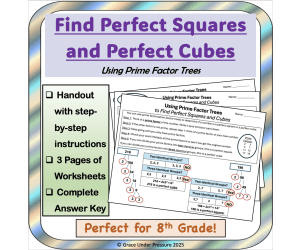
Prime Factor Trees to Find Perfect Squares and Perfect Cubes 8th 9th
Math, Algebra, Multiplication and Division, Grade 7, 8, 9, Worksheets & Printables, Worksheets
Here is a ready-to-use math lesson to teach your students in 8th or 9th grade how to find perfect squares and how to find perfect cubes using prime factorization and prime factor trees. It includes a clear handout with helpful visuals, step-by-step instructions, three pages of student worksheets, and a complete answer key so no prep is needed! Your students will gain a comprehensive understanding of perfect squares & perfect cubes by applying their knowledge of prime numbers and prime factorization to identify them! How to Use: Print a 4-page worksheet packet for each student. Go through the first page handout together as a class. Teach students how to create prime factor trees using the included step-by-step instructions. Go through two samples to show students how to use the prime factor tree to identify perfect squares and perfect cubes (look for two identical groups of prime factors or three identical groups of prime factors). Give students time to create 12 more prime factor trees for the included numbers. They will identify four perfect cubes, four perfect squares, three numbers that are neither, and one number (64) that is both! Review the work as a class and answer any questions. Grades to Use With: This lesson is designed for students in 8th grade who are learning about perfect squares and perfect cubes. It could be used in 7th grade as enrichment or 9th grade as review. It could be used in high school special education settings where appropriate as it breaks the process down step-by-step with clear instructions. What's Included: 5-Page PDF: Ready to Print and Use! Teacher Instructions and Answer Key Handout to Model the Steps 3 Pages of Worksheets If you are looking for other 8th and 9th grade math activities, check out my store: Solving Systems of Equations Using Substitution Worksheets Two Step Equations Worksheet: Real-World Two Step Equations Exponent Board Game: A Great Way to Practice Using Exponents
Author Grace Under Pressure
Rating
Tags Prime Factorization, Prime Factor, Prime Factors, Prime Factor Trees, Perfect Squares, Perfect Cubes, Perfect Square, Perfect Cube, 8th Grade Math, 9th Grade Math
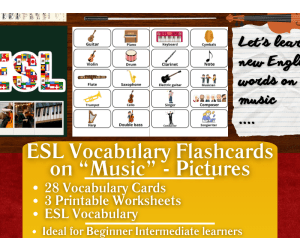
ESL Vocabulary Flashcards - Music - Pictures
ELA, Language Development, ESL, Vocabulary, Not Grade Specific, Middle School, High School, Adult Education, Worksheets & Printables, Flashcards, Worksheets, Writing Prompts
ESL Vocabulary Flashcards - Music - Pictures This high quality English language teaching resource is designed for students learning English as a second or foreign language . It includes 3 printable PDF pages featuring vocabulary flashcards and worksheets centered around the theme of "Music" This ESL Vocabulary Flashcards on "Music" Worksheets Activity can be ideal for Beginner level ESL - EFL - TESOL learners, including newcomers and English language learners of all ages. 🌟 What's Included? In this ESL Vocabulary Flashcards Activity on " Music ", there are provided: ✅ 28 Printable Flashcards (3 Printable PDF worksheets) ✅ Essential vocabulary and phrases in English ✅ Engaging icons and emojis on select flashcards to support comprehension and vocabulary retention (not all flashcards) 🏫 Who Can Benefit from This Resource? 📌 Beginner ESL - EFL students looking to improve their English vocabulary 📌 Newcomers & English Language Learners (ESL - EFL - TESOL -TEFL) in schools, tutoring sessions, or self-study 📌 Teachers and tutors looking for fun and engaging vocabulary building activities 📌 Language centers, homeschool educators, and ESL programs 🎯 How Does this ESL Teaching Resource Help you and your Students? ✨ Strengthens essential English communication skills ✨ Provides English vocabulary (ESL - EFL - TESOL - TEFL) for better understanding ✨ Encourages engaging learning with printable flashcards that can be used in various ESL - EFL (English Second or Foreign Language) class activities Whether you're an ESL teacher or an English tutor these ESL Vocabulary Flashcards on Music " are a valuable and fun resource to improve basic conversation skills in English. Start learning today and make English introductions simple, engaging, and effective ! ESL with Alan is a Teaching Resources Store whose aim is to help English as a Second or foreign Language (ESL EFL TESOL) Teachers, Educators and Tutors around the world (be it online or offline) to achieve their teaching objectives while creating an enjoyable and stimulating learning environment. Learning is fun, So should English! Always If you want to browse more of my ESL, EFL, TESOL Teaching Resources, click here right ESL with Alan!
Author Learning with Alan
Rating
Tags ESL, English Second Language, English, Vocabulary, Flashcards, Music, Worksheets, Printable, Activity, Picture