



3,938 products added recently
Page 8 - Holiday and Seasonal Quizzes
Holiday and Seasonal Quizzes add a festive element to assessments, making them more enjoyable for students. These quizzes feature questions related to holidays like Christmas, Halloween, and Spring festivals, blending curriculum content with seasonal themes. They can cover topics such as historical origins, cultural practices, or subject-specific questions presented in a holiday context. Using these quizzes keeps students motivated and interested in learning, especially during times when attention spans might wane due to holiday excitement.

 Show filters


Social Studies Reading Passages: Extreme Environment and People (PDF)
ELA, Reading, Reading Comprehension, Strategies, Resources for Teachers, Social Studies, Geography, Grade 6, 7, 8, 9, Writing Prompts, Worksheets & Printables, Centers, Activities, Teacher Tools, Assessments, Quizzes and Tests, Quizzes, Tests
Social Studies Reading Comprehension Passages and Questions: Extreme Environment and People (PDF) This resource introduces a collection of Social Studies reading comprehension passages with questions about Extreme Environment and People. The passages are carefully designed to bridge the gap between social studies and literacy through strengthening reading comprehension and sparking knowledge curiosity in middle school students. Each passage blends English Language Arts skills with accurate social studies content . Ideal for interdisciplinary learning in ELA and Social Studies. Suitable for Grade 9 review, too! What Is Included in this Collection? There are three informational passages (with full answer keys): Salar de Uyuni: Bolivia’s Shining Salt Flat Above the Alps: The Story of the Eiger’s North Face Sherpas: Guardians of the High Mountains For Each Passage, students will have multiple tasks to complete as follow: 5 multiple-choice questions targeting main idea, key details, inference, vocabulary in context, and use of evidence 5 vocabulary matching items with clear, student-friendly definitions 5 text-based questions that require citing specific lines or facts 1 summary prompt that asks students to condense central ideas accurately Available Formats for this Resource Fillable PDF Word Docs Google Docs FULL CATALOG OF DOWNLOADING LINKS HERE For more Social Studies Reading Passages, check the following Links: Ancient Civilizations PDF Fillable PDF Word Docs Google Docs Early Empires and Trade Networks PDF Fillable PDF Word Docs Google Docs The Founding of the United States PDF Fillable PDF Word Docs Google Docs Language, Culture, and Meaning PDF Fillable PDF Word Docs Google Docs Psychology and Society PDF Fillable PDF Word Docs Google Docs Global Festivals and Traditions PDF Fillable PDF Word Docs Google Docs Extreme Environments and People PDF Fillable PDF Word Docs Google Docs Food, Culture, and Preservation PDF Fillable PDF Word Docs Google Docs Global Food Customs PDF Fillable PDF Word Docs Google Docs Media, Communication, and Popular Culture PDF Fillable PDF Word Docs Google Docs Human Impact on the Environment PDF Fillable PDF Word Docs Google Docs Civic Action and Social Change PDF Fillable PDF Word Docs Google Docs Fashion, Society, and Power PDF Fillable PDF Word Docs Google Docs People, Places, and Unusual Histories PDF Fillable PDF Word Docs Google Docs Product Details Length: 14 pages total Grades: 6–8, also suitable for Grade 9 review Use cases: close reading, stations, homework, intervention, test prep, and sub plans Why Teachers Choose This Set Authentic social studies content paired with rigorous literacy practice Consistent task structure across all passages for easier planning and smoother student routines Clear, age-appropriate writing that builds confidence without oversimplifying Use this set to reinforce ELA skills in social studies, to add literacy to your lessons, and to support independent work. The passages strengthen main idea, evidence use, vocabulary in context, inference, cause and effect, and summary writing. With ready-to-use assessments and complete answer keys, you can provide focused practice that is simple to run and fast to review.
Author Middle & High School - CORED Education
Rating
Tags Middle School, Reading Comprehension, Reading Strategies, ELA, Centers, Reading Passage, Assessments, Vocabulary, Social Studies, Geography
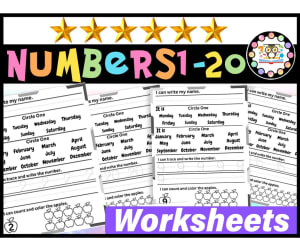
Morning Work Worksheets Math Kindergarten Spiral Review
Math, Pre-K, Elementary, Early Learning, Worksheets & Printables, Activities, Teacher Tools, Worksheets, Workbooks, Word Problems, Centers, Quizzes and Tests, Quizzes, Tests
This interactive and attractive set of number worksheet is designed to help young learners develop their original letters and numbers skills, this set contains 20 pages in this set, each in each, each in a different number of dedicated numbers to ensure a fun and structured approach to using a fun and structured approach can work to use a type of work that can work in a type of work that can work in a type Can do a type of work. A copy house with a student requiring additional practices hopes that you find it useful each card is fun, it is made of edited set of number worksheet in an elegant style that attracts attention this set includes different types of numbers related to worksheet and designs. these printable Worksheets offer useful courses, this provides a useful course-rich practice, it is designed to help using resource grade 2 easily to learn about activities numbers Worksheets in a fun and interactive manner. A collaborative learning activity added students. PDF format-wasted and digital-friendly!
Author LAMO
Rating
Tags Homeschool, Homework, Worksheets, Printables, Math, Numbers
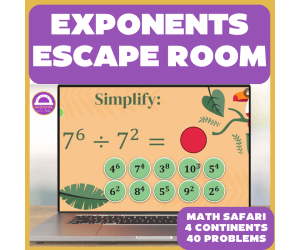
Exponents Safari Escape Room – Interactive Math Adventure
Math, Order Of Operations, Algebra, Grade 6, 7, 8, Escape Room, Activities, Games, Quizzes, Quizzes and Tests, Teacher Tools, Worksheets & Printables, Worksheets
Take your students on a global math safari with this exciting digital escape room activity for exponents! As they travel across Africa, Asia, South America, and Australia, students complete challenging exponent problems in order to pursue wildlife and unlock each destination. With 40 self-scoring problems and an inspiring travel theme, this activity gets practicing exponent rules fun and relevant! How It Works Students begin their journey by responding to exponent questions at every destination. After they finish the set successfully, they unlock the next exotic animal destination. By the end of the journey, they will have utilized all of the important exponent skills as they journey around the globe. They will travel and track: Elephant (Africa) Tiger (Asia) Macaw (South America) Kangaroo (Australia) What's Included: 40 Exponent Questions (4 sets of 10) of: Evaluating powers Simplifying using the Product Rule Simplifying with the Quotient & Power Rules Mixed exponent expressions Self-Checking Drag-and-Drop Format – engaging and interactive Printable Worksheet – great for additional practice or differentiation Answer Key – saves time grading or reviewing Special Feature – Autosave & Resume Students can pause and return later! If they open the activity on the same device and browser, a "Continue" button lets them begin where they stopped—no work lost. Skills Covered: Comparing powers with whole-number exponents Using the Product Rule Using the Quotient Rule Using the Power Rule Simplifying expressions with mixed exponents Perfect For: 6th & 7th Grade Math Math centers or stations Digital learning days Spiral review or test prep Sub plans or enrichment activities Why Teachers & Students Love It: Interactive Global Theme – makes review an adventure Interactive & Self-Checking – instant feedback keeps students engaged Flexible & No Prep – use digitally or with printables in minutes Differentiation Ready – includes both interactive and printable versions Transform exponent practice into a worldwide safari adventure! Students will love tracking animals while building fluency, and you’ll love how easy and effective this activity is to implement. Add to your cart today and make exponents exciting in your classroom!
Author Matemaths
Rating
Tags Matemaths, Exponents, Escape Room, Safari, Math, Middle School

Life Science Reading Comprehension Passage Clear Vision (Fillable PDF)
Science, ELA, Reading, Reading Comprehension, Strategies, Resources for Teachers, Life Sciences, Grade 6, 7, 8, 9, Writing Prompts, Worksheets & Printables, Centers, Activities, Teacher Tools, Assessments, Quizzes and Tests, Quizzes, Tests
Life Science Reading Comprehension Passage and Questions: Clear Vision (Fillable PDF) This very engaging life science reading passage about the history, science, and everyday use of contact lenses. It explains how contact lenses developed from early ideas by Leonardo da Vinci, René Descartes, and Thomas Young into practical lenses used today. It also explains how contacts work by bending light so it focuses correctly on the retina , helping correct nearsightedness, farsightedness, and astigmatism . The passage also discusses soft lenses, silicone hydrogel, daily use, safety habits, and future lens technology. This passage is designed to bridge the gap between science and literacy through strengthening reading comprehension and sparking scientific curiosity in middle school students. The passage blends English Language Arts skills with accurate science content that supports NGSS classroom practice. Ideal for interdisciplinary learning in ELA and Science. Suitable for Grade 9 review, too! This passage is designed as a fillable PDF , which means students can type their answers directly into the document on any computer or tablet . Each page includes highlighted text fields that show them exactly where to type! Student Tasks for The Passage: 5 multiple-choice questions targeting main idea, key details, inference, vocabulary in context, and use of evidence 5 vocabulary matching items with clear, student-friendly definitions 5 text-based questions that require citing specific lines or facts 1 summary prompt that asks students to condense central ideas accurately Full answer key for every section Available Formats for this Resource PDF Word Docs Google Docs FULL CATALOG OF DOWNLOADING LINKS HERE Product Details Length: 5 pages total Grades: 6–8, also suitable for Grade 9 review Use cases: close reading, stations, homework, intervention, test prep, and sub plans Standards support: reinforces informational-text skills and supports NGSS-style sense making through observation, modeling, and clear use of claim, evidence, and reasoning Why Teachers Choose This Set Authentic science content paired with rigorous literacy practice Consistent task structure across all passages for easier planning and smoother student routines Clear, age-appropriate writing that builds confidence without oversimplifying Other Science Reading Collections you May find in the store: 1. Astronomy & Space Science 2. Volcanoes, Rocks, & Mountains 3. Rock Cycle, Soil, & Sinkholes 4. Mars, Glaciers, & Antarctica 5. Water Cycle, Acid Rain, & Wastewater 6. Insects, Animals, & Ecosystems 7. Bioluminescence & Insects 8. Animal Skin, Cats, & T. Rex 9. Human Body and Senses 10. Health & Applied Bioscience 11. Waves, Light, & Imaging 12. Electricity & Energy 13. Motion & Materials 14. Chemistry and Materials Science Use this set to reinforce ELA skills in science, to add literacy to your lessons, and to support independent work. The passages strengthen main idea, evidence use, vocabulary in context, inference, cause and effect, and summary writing. With ready-to-use assessments and complete answer keys, you can provide focused practice that is simple to run and fast to review.
Author Middle & High School - CORED Education
Rating
Tags Middle School, Reading Comprehension, Reading Strategies, ELA, Centers, Reading Passage, Assessments, Vocabulary, Life Science

Earth Science Reading Comprehension Passage: Types of Mountains (Docs)
Science, ELA, Reading, Reading Comprehension, Strategies, Resources for Teachers, Earth and Environmental Sciences, Earth Sciences, Grade 6, 7, 8, 9, Writing Prompts, Worksheets & Printables, Centers, Activities, Teacher Tools, Assessments, Quizzes and Tests, Quizzes, Tests
Science Reading Comprehension Passages and Questions: Types of Mountains (Docs) This very engaging earth science reading passage about Types of Mountains is designed to bridge the gap between science and literacy through strengthening reading comprehension and sparking scientific curiosity in middle school students. The passage blends English Language Arts skills with accurate science content that supports NGSS classroom practice. Ideal for interdisciplinary learning in ELA and Science. Suitable for Grade 9 review, too! Student Tasks for The Passage: 5 multiple-choice questions targeting main idea, key details, inference, vocabulary in context, and use of evidence 5 vocabulary matching items with clear, student-friendly definitions 5 text-based questions that require citing specific lines or facts 1 summary prompt that asks students to condense central ideas accurately Full answer key for every section Available Formats for this Resource PDF Fillable PDF Word Docs FULL CATALOG OF DOWNLOADING LINKS HERE Product Details Length: 4 pages total Grades: 6–8, also suitable for Grade 9 review Use cases: close reading, stations, homework, intervention, test prep, and sub plans Standards support: reinforces informational-text skills and supports NGSS-style sense making through observation, modeling, and clear use of claim, evidence, and reasoning Why Teachers Choose This Set Authentic science content paired with rigorous literacy practice Consistent task structure across all passages for easier planning and smoother student routines Clear, age-appropriate writing that builds confidence without oversimplifying Other Science Reading Collections you May find in the store: 1. Astronomy & Space Science 2. Volcanoes, Rocks, & Mountains 3. Rock Cycle, Soil, & Sinkholes 4. Mars, Glaciers, & Antarctica 5. Water Cycle, Acid Rain, & Wastewater 6. Insects, Animals, & Ecosystems 7. Bioluminescence & Insects 8. Animal Skin, Cats, & T. Rex 9. Human Body and Senses 10. Health & Applied Bioscience 11. Waves, Light, & Imaging 12. Electricity & Energy 13. Motion & Materials 14. Chemistry and Materials Science Use this set to reinforce ELA skills in science, to add literacy to your lessons, and to support independent work. The passages strengthen main idea, evidence use, vocabulary in context, inference, cause and effect, and summary writing. With ready-to-use assessments and complete answer keys, you can provide focused practice that is simple to run and fast to review.
Author Middle & High School - CORED Education
Rating
Tags Middle School, Reading Comprehension, Reading Strategies, ELA, Centers, Reading Passage, Assessments, Vocabulary, Environmental Science, Earth Science

Physical Science Reading Comprehension Passage: Magnets (Docs)
Science, ELA, Reading, Reading Comprehension, Strategies, Resources for Teachers, Physics, Grade 6, 7, 8, 9, 10, Writing Prompts, Worksheets & Printables, Centers, Activities, Teacher Tools, Assessments, Quizzes and Tests, Quizzes, Tests
Physical Science Reading Comprehension Passage and Questions: Magnets (Google Docs) This very engaging science reading passage is about magnetism and the invisible forces magnets exert on certain materials . It explains magnetic fields, north and south poles, attraction and repulsion, and why materials such as iron, nickel, and cobalt respond strongly to magnets. Students also compare permanent magnets with electromagnets and explore how magnets are used in compasses, speakers, scrapyard cranes, MRI machines, and other everyday technologies. This passage is designed to bridge the gap between science and literacy by strengthening reading comprehension while sparking scientific curiosity in middle school students. It blends English Language Arts skills with accurate science content, helping students build background knowledge, understand key concepts, use evidence from the text, and explain scientific ideas clearly. This resource supports science classroom practice while also reinforcing important literacy skills such as main idea, vocabulary, comprehension, and summarizing. Ideal for interdisciplinary learning in ELA and Science. Suitable for Grade 9 review, too! Student Tasks for The Passage: 10 multiple-choice questions targeting main idea, key details, science concepts, comparison, and real-world applications 10 True/False statements to check understanding and address common misconceptions 5 text-based short-answer questions that require students to explain important ideas from the passage 5 vocabulary matching items with clear, student-friendly definitions 1 summary prompt that asks students to condense the central ideas accurately Full answer key for every section Available Formats for this Resource PDF Fillable PDF Word Docs FULL CATALOG OF DOWNLOADING LINKS HERE Product Details Length: 7 pages total Grades: 6–8, also suitable for Grade 9 review Use cases: close reading, stations, homework, intervention, test prep, and sub plans Standards support: Reinforces informational-text skills and supports NGSS-style sense-making by helping students read scientific explanations, connect evidence to key concepts, interpret real-world examples, and explain cause-and-effect relationships in science. Why Teachers Choose This Set Authentic science content paired with rigorous literacy practice Consistent task structure across all passages for easier planning and smoother student routines Clear, age-appropriate writing that builds confidence without oversimplifying Other Science Reading Collections and Topics You May Find in the Store: 1. Astronomy & Space Science 2. Volcanoes, Rocks, & Mountains 3. Rock Cycle, Soil, & Sinkholes 4. Mars, Glaciers, & Antarctica 5. Water Cycle, Acid Rain, & Wastewater 6. Insects, Animals, & Ecosystems 7. Bioluminescence & Insects 8. Animal Skin, Cats, & T. Rex 9. Human Body and Senses 10. Health & Applied Bioscience 11. Waves, Light, & Imaging 12. Electricity & Energy 13. Motion & Materials 14. Chemistry and Materials Science 15. Electromagnetism 16. Acids and Bases 17. Gas Laws 18. Biotechnology 19. Periodic Trends 20. Protists and Fungi 21. Microevolution 22. Blood 23. Chemical Bonding 24. Magnets 25. Muscles 26. Nuclear Chemistry 27. Electromagnetic Devices 28. Epigenetics 29. The Law of Conservation of Mass 30. Atomic Models 31. Isotopes and Ions 32. Light 33. Human-Environment Interaction 34. Theory of Evolution 35. Photosynthesis 36. Origins of Life and Early Earth 37. Gene Expression and Regulation 38. Thermochemistry 39. Allergies 40. Coevolution 41. Birth to Adulthood 42. Cells 43. Entropy and Free Energy 44. The Human Brain 45. Mixtures and Solutions 46. Invertebrates 47. Zoo Animals 48. Biochemistry 49. Animal Behavior 50. Population Ecology ...and many more engaging science reading passages that cover intriguing and important topics designed to spark curiosity and support student learning. Use this passage to reinforce ELA skills in science, to add literacy to your lessons, and to support independent work. The passages strengthen main idea, evidence use, vocabulary in context, inference, cause and effect, and summary writing. With ready-to-use assessments and complete answer keys, you can provide focused practice that is simple to run and fast to review.
Author Middle & High School - CORED Education
Rating
Tags Middle School, Reading Comprehension, Reading Strategies, ELA, Centers, Reading Passage, Assessments, Vocabulary, Physical Science, Magnets

Mesopotamia: Social Studies Reading Comprehension Passage (Word)
ELA, Reading, Reading Comprehension, Strategies, Resources for Teachers, Social Studies, History: Ancient, History, Geography, Grade 6, 7, 8, 9, Writing Prompts, Worksheets & Printables, Centers, Activities, Teacher Tools, Assessments, Quizzes and Tests, Quizzes, Tests
Mesopotamia: Social Studies Reading Comprehension Passage (Word) This resource introduces a unique Social Studies reading comprehension passage with questions about Mesopotamia: The First Urban World. The passage is carefully designed to bridge the gap between social studies and literacy through strengthening reading comprehension and sparking knowledge curiosity in middle school students. Each passage blends English Language Arts skills with accurate social studies content . Ideal for interdisciplinary learning in ELA and Social Studies. Suitable for Grade 9 review, too! Student Tasks throughout the passage: 5 multiple-choice questions targeting the following skills: main idea, key details, inference, vocabulary in context, and use of evidence 5 vocabulary matching items with clear, student-friendly definitions 5 text-based questions that require citing specific lines or facts 1 summary prompt that asks students to condense central ideas accurately Full answer key for every section Available Formats for this Resource: PDF Fillable PDF Google Docs FULL CATALOG OF DOWNLOADING LINKS HERE Social Studies Reading Comprehension Collection Links: 1. Ancient Civilizations PDF Fillable PDF Word Docs Google Docs 2. Early Empires and Trade Networks PDF Fillable PDF Word Docs Google Docs 3. The Founding of the United States PDF Fillable PDF Word Docs Google Docs 4. Language, Culture, and Meaning PDF Fillable PDF Word Docs Google Docs 5. Psychology and Society PDF Fillable PDF Word Docs Google Docs 6. Global Festivals and Traditions PDF Fillable PDF Word Docs Google Docs 7. Extreme Environments and People PDF Fillable PDF Word Docs Google Docs 8. Food, Culture, and Preservation PDF Fillable PDF Word Docs Google Docs 9. Global Food Customs PDF Fillable PDF Word Docs Google Docs 10. Media, Communication, and Popular Culture PDF Fillable PDF Word Docs Google Docs 11. Human Impact on the Environment PDF Fillable PDF Word Docs Google Docs 12. Civic Action and Social Change PDF Fillable PDF Word Docs Google Docs 13. Fashion, Society, and Power PDF Fillable PDF Word Docs Google Docs 14. People, Places, and Unusual Histories PDF Fillable PDF Word Docs Google Docs Product Details: Length: 5 pages Grades: 6–8, also suitable for Grade 9 review Use cases: close reading, stations, homework, intervention, test prep, and sub plans Why Teachers Choose This Passage: Authentic social studies content paired with rigorous literacy practice Consistent task structure for easier planning and smoother student routines Clear, age-appropriate writing that builds confidence without oversimplifying Use this passage to reinforce ELA skills in social studies, to add literacy to your lessons, and to support independent work. The passage strengthens main idea, evidence use, vocabulary in context, inference, cause and effect, and summary writing. With ready-to-use assessments and complete answer keys, you can provide focused practice that is simple to run and fast to review.
Author Middle & High School - CORED Education
Rating
Tags Middle School, Reading Comprehension, Reading Strategies, ELA, Centers, Reading Passage, Assessments, Vocabulary, Social Studies, Ancient Civilization
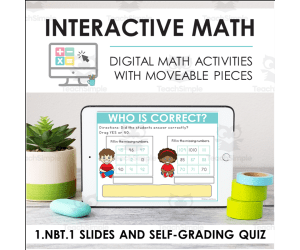
Digital Math for 1.NBT.1 - Counting Sequence (Slides + Self-Grading Quiz)
Math, Numbers, Grade 1, Quizzes, Quizzes and Tests, Teacher Tools
Digital Math for 1.NBT.1 - Counting Sequence (Slides + Self-Grading Quiz) This interactive package combines dynamic learning with digital convenience for teaching the mathematical concept of counting sequences. Interactive Learning: Students can manipulate images through drag-and-drop activities, bridging the gap between abstract mathematical concepts and perceptible reality. Allows versatility in teaching settings: whole group or small groups, and individual homework assignments. Digital Convenience: Resource files are available in PowerPoint and Google Slides format, with instructions included on how to assign either file-types according to whole files or selected slides only depending on their needs per session. Added Feature: Self-Grading Quiz The package includes a self-grading Google Forms quiz for gauging students’ understanding and progress after interacting with the slides. It collects real-time data effortlessly—making assessment easier and more efficient for teachers. No-Prep and Paperless The resource is ready-to-use (no-preparation), helping decrease paper clutter—a perfect fit in our growing trend towards digital education—the less paperwork equals more efficiency principle applied. Covers NBT Part 1 Standard: The product's focus on Number And Operations In Base Ten (NBT) part 1 standard makes it an essential tool within first-grade mathematics curriculum. Overview: Key Features include: A formative assessment via a self-grading quiz Cross-platform accessible: PowerPoint & Google Slides formats provided a Versatile use catering different learning environments(from group classes down onto individual assignments) a An engaging focus on 1st grade essential math topic: number sequences (NBT.1) Easy-to-follow instructions for seamless implementation a The resource is designed to make mathematical learning experiential and fun while integrating technology into education seamlessly.
Author Markers and Minions
Tags Counting Sequences, Digital Math, Interactive Slides, Self-grading Quiz, NBT1

How to Write an Essay: What is a Narrative Essay?
ELA, Writing, Common Core, Vocabulary, Grade 5, 6, 7, 8, Teacher Tools, Lesson Plans, Graphic Organizers, Quizzes, Crosswords Puzzles, Word Searches
How to Write an Essay: What is a Narrative Essay? Rooted in the earnest desire to simplify the essay writing process for students, this resource decomposes every step of essay composition. Devised as an autonomous chapter from the expansive lesson plan 'How to Write an Essay,' this instructional handbook propounds a novel approach for elucidating and streamlining what often arises as a daunting assignment. The key is in simplicity, and this teaching resource impeccably delivers it. This 24-page PDF guide offers lucid yet captivating content tailored specifically for grade 5-8 students. Adhering to Bloom's Taxonomy principles, it ensures seamless flow from one topic to another, thereby serving perfectly fit for group learning or guiding small group activities. Imagine leading student cognition of narrative essays beyond basic definition. The module not only provides simple definitions but delves into various stages of essay writing - selecting topics, building arguments, crafting climactic conclusions - leaving no stones unturned. The real treasure lies in its explicit segments on four widespread types of essays along with recap sessions around essential elements such as verbs, adjectives, and pronouns that are useful across all subjects requiring proficient written communication skills. Educational value shouldn't be confined only within classrooms . Recognising the importance of independent learning too,this guide can be seamlessly used as homework material encouraging learning away from school. You'll marvel at the ease with which evaluation can be executed using this bundle owing not just to individual word puzzle exercises & comprehension quizzes but also through detailed scoring rubrics enabling smooth tracking of learner progress. Additionally,it incorporates six full-colored graphic organizers offering visual aids aimed towards easy grasp of key concepts while steering your class towards completion their own engaging narratives successfully. An added benefit is its compliance with Common Core State Standards, reassuring reliability and effectiveness. Choose 'How To Write An Essay: What is a Narrative Essay?' for its intricate design and effective structure that make teaching essay writing an achievable and less intimidating task.
Author Classroom Complete Press
Tags Language Arts, Writing, Essay Writing, Narrative Essay, Comprehension Quiz

Digital Math for 3.MD.8 - Perimeters of Polygons (Slides + Self-Grading Quiz)
Math, Measurements, Grade 3, Quizzes, Quizzes and Tests, Teacher Tools
Digital Math for 3.MD.8 - Perimeters of Polygons (Slides + Self-Grading Quiz) A comprehensive and refined resource designed for third-grade students, specializing in the subject area of Mathematics. Specifically, focusing on measurements and perimeters of polygons. Digital Adaptability This product distinguishes itself with its adaptability to both PowerPoint and Google Slides formats. It allows a flexible access irrespective of the location - be it a computer lab or on student tablets. Interactive Student Slides An offering of 20 interactive slides embedded with drag-and-drop features and visual representations. Promotes self-guided exploration by serving as engaging homework assignments or during whole group discussions in classroom settings. Self-Grading Google Forms Quiz The package also includes a self-grading quiz that effortlessly assesses students' understanding based on their responses. It can also serve as critical data contributing towards an educator's effective strategy planning. Paperless Efficiency: This resource is entirely paperless! You can enjoy going green without compromising efficiency nor effectiveness. Note:"Employing this tool will undoubtedly make mathematics instruction far less complex yet remarkably effective". You can utilize it individually or within small groups during center activities. In summary, this significant teaching resource augments an enriching academic experience for your students.
Author Markers and Minions
Tags Digital Math, Perimeters, Polygons, Interactive Learning, Self-Grading
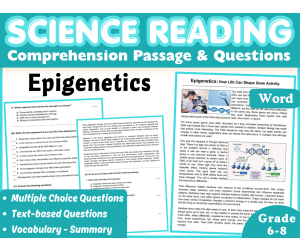
Epigenetics: Middle School Life Science Reading Comprehension (Word)
Science, ELA, Reading, Reading Comprehension, Strategies, Resources for Teachers, Common Core, Language Development, Life Sciences, Biology, Grade 6, 7, 8, 9, 10, Writing Prompts, Worksheets & Printables, Centers, Activities, Teacher Tools, Assessments, Quizzes and Tests, Quizzes, Tests, Literacy Readers
Life Science Reading Comprehension Passage and Questions for Middle School: Epigenetics (Word Document) The engaging passage is about how gene activity can change without changing the DNA sequence itself . It explains how chemical tags, including methyl groups, can affect whether genes are more or less active, and how factors such as diet, stress, exercise, sleep, pollution, and life experiences may influence epigenetic patterns. It also covers identical twins and differences in gene activity over time, possible epigenetic effects across generations, links between epigenetics and disease, and possible uses in personalized medicine. This passage is designed to bridge the gap between science and literacy by strengthening reading comprehension while sparking scientific curiosity in middle school students. It blends English Language Arts skills with accurate science content, helping students build background knowledge, understand key concepts, use evidence from the text, and explain scientific ideas clearly. This resource supports science classroom practice while also reinforcing important literacy skills such as main idea, vocabulary, comprehension, and summarizing. Ideal for interdisciplinary learning in ELA and Science. Suitable for Grade 9 review, too! Student Tasks for The Passage: 10 multiple-choice questions targeting main idea, key details, science concepts, comparison, and real-world applications 10 True/False statements to check understanding and address common misconceptions 5 text-based short-answer questions that require students to explain important ideas from the passage 5 vocabulary matching items with clear, student-friendly definitions 1 summary prompt that asks students to condense the central ideas accurately Full answer key for every section Available Formats for this Resource PDF Fillable PDF Google Docs Product Details Length: 7 pages total Grades: 6–8, also suitable for Grade 9 review Use cases: close reading, stations, homework, intervention, test prep, and sub plans Standards support: Reinforces informational-text skills and supports NGSS-style sense-making by helping students read scientific explanations, connect evidence to key concepts, interpret real-world examples, and explain cause-and-effect relationships in science. FULL CATALOG OF DOWNLOADING LINKS HERE Other Science Reading Collections and Topics You May Find in the Store: 1. Astronomy & Space Science 2. Volcanoes, Rocks, & Mountains 3. Rock Cycle, Soil, & Sinkholes 4. Mars, Glaciers, & Antarctica 5. Water Cycle, Acid Rain, & Wastewater 6. Insects, Animals, & Ecosystems 7. Bioluminescence & Insects 8. Animal Skin, Cats, & T. Rex 9. Human Body and Senses 10. Health & Applied Bioscience 11. Waves, Light, & Imaging 12. Electricity & Energy 13. Motion & Materials 14. Chemistry and Materials Science 15. Electromagnetism 16. Acids and Bases 17. Gas Laws 18. Biotechnology 19. Periodic Trends 20. Protists and Fungi 21. Microevolution 22. Blood 23. Chemical Bonding 24. Magnets 25. Muscles 26. Nuclear Chemistry 27. Electromagnetic Devices 28. Epigenetics 29. The Law of Conservation of Mass 30. Atomic Models 31. Isotopes and Ions 32. Light 33. Human-Environment Interaction 34. Theory of Evolution 35. Photosynthesis 36. Origins of Life and Early Earth 37. Gene Expression and Regulation 38. Thermochemistry 39. Allergies 40. Coevolution 41. Birth to Adulthood 42. Cells 43. Entropy and Free Energy 44. The Human Brain 45. Mixtures and Solutions 46. Invertebrates 47. Zoo Animals 48. Biochemistry 49. Animal Behavior 50. Population Ecology ...and many more engaging science reading passages that cover intriguing and important topics designed to spark curiosity and support student learning. Use this passage to reinforce ELA skills in science, to add literacy to your lessons, and to support independent work. The passages strengthen main idea, evidence use, vocabulary in context, inference, cause and effect, and summary writing. With ready-to-use assessments and complete answer keys, you can provide focused practice that is simple to run and fast to review.
Author Middle & High School - CORED Education
Rating
Tags Middle School, Reading Comprehension, Reading Strategies, ELA, Centers, Reading Passage, Assessments, Vocabulary, Life Science, Biology
Digital Math for 1.OA.3 - Apply Properties of Operation (Slides + Self-Grading Quiz)
Math, Algebra, Grade 1, Quizzes, Quizzes and Tests, Teacher Tools
Digital Math for 1.OA.3 - Apply Properties of Operation This is a novel, interactive tool that adds depth to mathematical instruction in Grade 1 classrooms with a focus on the algebraic properties of operations. Compatibility and Usage: This resource features both PowerPoint and Google Slides compatibility making it easily accessible. Whether being used within classroom context, homeschooling, or distance learning programs; individual slides can be assigned all together or selectively based on the teaching plan. Automatic Self-Grading Quiz: An additional feature is an automatic self-grading quiz powered by Google Forms that once completed gives educators swift feedback about their students' understanding. List of Features: 24 Interactive Student Slides: The package contains slides with various mathematical problems that showcase multiple aspects of applying operational properties giving ample content for several teaching sessions. Nurturing Understanding: Packed with tasks involving dragging, dropping and sorting images help transform complex theoretical concepts into simpler understandable parts making math fun rather than intimidating for young learners. Versatility: This resource's adaptability shines not only in virtual classrooms but extends to function effectively during small group instructions at in-person math centers using hands-on manipulative strategized moments further reinforcing understanding. In conclusion, Digital Math for 1.OA.3 serves as a highly beneficial teaching aid lending automated convenience along with effective teaching techniques accommodating today's diverse educational landscapes.
Author Markers and Minions
Tags Digital Math, Properties Of Operation, Interactive Slides, Self-grading Quiz, Visual Stimulus
Atomic Models: Physical Science Reading Comprehension Passage (Word)
Science, ELA, Reading, Reading Comprehension, Strategies, Resources for Teachers, Common Core, Language Development, Physics, Grade 6, 7, 8, 9, 10, Writing Prompts, Worksheets & Printables, Centers, Activities, Teacher Tools, Assessments, Quizzes and Tests, Quizzes, Tests, Literacy Readers
Physical Science Reading Comprehension Passage and Questions for Middle School: Atomic Models (Word Document) This resource explores how scientists’ understanding of the atom changed over time as new evidence became available . Students follow the development of atomic models from Democritus’s early idea of indivisible particles to Dalton’s solid-sphere model, Thomson’s discovery of the electron, Rutherford’s nuclear model, Bohr’s energy levels, and the modern electron-cloud model . It emphasizes how scientific models are revised when new experiments and discoveries provide better evidence . It also introduces important ideas such as electrons, the nucleus, empty space within atoms, energy levels, electron clouds, and probability . This passage is designed to bridge the gap between science and literacy by strengthening reading comprehension while sparking scientific curiosity in middle school students. It blends English Language Arts skills with accurate science content, helping students build background knowledge, understand key concepts, use evidence from the text, and explain scientific ideas clearly. This resource supports science classroom practice while also reinforcing important literacy skills such as main idea, vocabulary, comprehension, and summarizing. Ideal for interdisciplinary learning in ELA and Science. Suitable for Grade 9 review, too! Student Tasks for The Passage: 10 multiple-choice questions targeting main idea, key details, science concepts, comparison, and real-world applications 10 True/False statements to check understanding and address common misconceptions 5 text-based short-answer questions that require students to explain important ideas from the passage 5 vocabulary matching items with clear, student-friendly definitions 1 summary prompt that asks students to condense the central ideas accurately Full answer key for every section Available Formats for this Resource PDF Fillable PDF Google Docs Product Details Length: 7 pages total Grades: 6–8, also suitable for Grade 9 review Use cases: close reading, stations, homework, intervention, test prep, and sub plans Standards support: Reinforces informational-text skills and supports NGSS-style sense-making by helping students read scientific explanations, connect evidence to key concepts, interpret real-world examples, and explain cause-and-effect relationships in science. FULL CATALOG OF DOWNLOADING LINKS HERE Other Science Reading Collections and Topics You May Find in the Store: 1. Astronomy & Space Science 2. Volcanoes, Rocks, & Mountains 3. Rock Cycle, Soil, & Sinkholes 4. Mars, Glaciers, & Antarctica 5. Water Cycle, Acid Rain, & Wastewater 6. Insects, Animals, & Ecosystems 7. Bioluminescence & Insects 8. Animal Skin, Cats, & T. Rex 9. Human Body and Senses 10. Health & Applied Bioscience 11. Waves, Light, & Imaging 12. Electricity & Energy 13. Motion & Materials 14. Chemistry and Materials Science 15. Electromagnetism 16. Acids and Bases 17. Gas Laws 18. Biotechnology 19. Periodic Trends 20. Protists and Fungi 21. Microevolution 22. Blood 23. Chemical Bonding 24. Magnets 25. Muscles 26. Nuclear Chemistry 27. Electromagnetic Devices 28. Epigenetics 29. The Law of Conservation of Mass 30. Atomic Models 31. Isotopes and Ions 32. Light 33. Human-Environment Interaction 34. Theory of Evolution 35. Photosynthesis 36. Origins of Life and Early Earth 37. Gene Expression and Regulation 38. Thermochemistry 39. Allergies 40. Coevolution 41. Birth to Adulthood 42. Cells 43. Entropy and Free Energy 44. The Human Brain 45. Mixtures and Solutions 46. Invertebrates 47. Zoo Animals 48. Biochemistry 49. Animal Behavior 50. Population Ecology ...and many more engaging science reading passages that cover intriguing and important topics designed to spark curiosity and support student learning. Use this passage to reinforce ELA skills in science, to add literacy to your lessons, and to support independent work. The passages strengthen main idea, evidence use, vocabulary in context, inference, cause and effect, and summary writing. With ready-to-use assessments and complete answer keys, you can provide focused practice that is simple to run and fast to review.
Author Middle & High School - CORED Education
Rating
Tags Middle School, Reading Comprehension, Reading Strategies, ELA, Centers, Reading Passage, Assessments, Vocabulary, Physical Science, Physics

Joseph John Thomson – The Discovery of the Electron
Life Sciences, Science, STEM, Social Studies, Biographies, Inventors, Basic Science, Physics, Chemistry, Technology, Grade 6, 7, 8, 9, 10, 11, Worksheets, Worksheets & Printables, Quizzes, Quizzes and Tests, Teacher Tools, Projects, Activities
Joseph John Thomson – The Discovery of the Electron Comprehension Activities A ready-to-use science resource for grades 7–10 (PDF + H5P) ⚛️📘 A printable and digital resource for grades 7–10 science and cross-curricular teaching 🧪🧠 This classroom resource introduces students to Joseph John Thomson, the physicist who discovered the electron and helped shape our modern understanding of atomic structure. His work not only earned him a Nobel Prize, but also laid the groundwork for the atomic models students learn about in middle and high school. The material is designed to be easy to use – even if you’re short on prep time. The reading text is short and accessible, followed by a structured worksheet and quiz questions. It’s suitable for science lessons focused on atomic theory or the history of chemistry, but it also works well in substitute teaching settings since students can work through it independently. Included in this resource: A short informational text on J.J. Thomson A profile worksheet to help students summarize key points Quiz questions (with solution key) Two extension activities: – Students write their own questions based on the reading – Exchange and answer a partner’s questions File formats: – PDF (for printing or digital use) – DOCX (editable, text only) – H5P version (interactive, for learning platforms) How I use it in class: I like using materials like this at the start of a unit on atomic structure or when we discuss the development of scientific models. It gives students a chance to see how our current understanding has evolved – and reminds them that science is built on the ideas of real people. The H5P version allows for digital delivery and self-checking, making it great for homework or blended learning. It also gives students the chance to reflect, work at their own pace, or collaborate in pairs. Quick to prepare, easy to adapt – and a great way to connect abstract content to the scientists who helped shape it. Have fun exploring the world of science with your students! Warmly, Lernfitness Did You Know? I teach with a certified therapy dog, and together we focus on creating a positive and inspiring learning environment.
Author Lernfitness
Rating
Tags Science, Famous Scientists Lesson, H5P, Interactive Science Exercises, STEM, Scientists, Chemistry, Joseph John Thomson, Electron, Atomic Structure

Cognitive Restructuring for Test Anxiety
Life Skills, Special Resources, Social Emotional Learning (SEL), Social Skills, Special Education Needs (SEN), Speech Therapy, STEM, Resources for Teachers, Classroom Management, Community Building, Grade 6, 7, 8, 9, 10, 11, 12, Worksheets & Printables, Workbooks, Worksheets, Word Searches, Teacher Tools, Assessments, Lesson Plans, Quizzes and Tests, Quizzes, Tests
Do your pupils suffer from anxiety before exams, worry about their academic ability and feel they are going to fail? Have you seen brilliant students, who should do well on national exams such as the SATs, Advanced Placement finals or chapter tests, perform poorly due to the pressure of the exam? The source of the issues described above isn’t because the student is not knowledgeable; rather, it is due to a lack of mental control. The extensive Cognitive Restructuring Guide & Workbook (28 pages) is the premier resource for educators, school counsellors, psychotherapists and tutors. This evidence-based resource incorporates the principles of Cognitive Behavioural Therapy (CBT), but goes much deeper than merely telling students to ‘relax’ before an exam by providing them with the skills they need to eliminate test anxiety by looking at the root causes. Your students will learn to become scientists of their own minds and to change their catastrophic thoughts into calm and rational confidence. WHAT IS INCLUDED IN THIS 28-PAGE RESOURCE: PART 1: The Educator’s Foundational Guide (10 Pages) A comprehensive understanding of test anxiety through the psychology behind test anxiety and also the "The Anatomy of Academic Panic" model. Foundational understandings and explanations of the following CBT concepts: Tripartite Model of Anxiety; Catastrophizing; Cognitive Distortions (All-or-Nothing, Fortune Telling, etc.); and Cognitive Defusion. In-depth and relatable case studies that provide real-life context to the theory so that you can explain to your students in a relatable manner. PART 2: The Student Workbook (10 Actionable Worksheets) A step-by-step process through which a student can begin to actively restructure their anxious thoughts. Each worksheet is intended to build on the previous worksheet to create long-lasting & profound changes. Worksheet 1: The Anatomy of an Anxious Thought Worksheet 2: Spotting the Catastrophe Worksheet 3: The Empirical Evidence Board Worksheet 4: The ''And Then What?'' Protocol (Decatastrophizing) Worksheet 5: The Double Standard Technique Worksheet 6: Moving from What If to Even If Worksheet 7: Somatic Awareness and Cognitive Links Worksheet 8: Looking at Your Past Successes Worksheet 9: The Productive vs Unproductive Worry: Action vs Anxiety Worksheet 10: The "Cognitive Blueprint for Pre-Exam Thoughts" PART 3: Teaching Resources/Visuals and Answer Key (8 Pages) Pedagogy based visuals: There are three high-quality Anchor Charts/Visual Aids (The Cognitive Triangle; The Five-Step Restructuring Sequence; Taxonomy of Distortions) which can be used as classroom displays or given out as individually provided handouts. Answer key: This answer key provides a description of how an answer should be provided to each question and includes the "Exemplar Look-Fors" that you will need to evaluate a student's understanding of the material. THESE ARE IDEAL FOR: Counselors who work with small groups or use one-on-one session Teachers in High School and Middle School (specifically those who teach AP/IB/class with high testing requirements) Those involved in delivering Social-Emotional Learning (SEL) curriculum Individuals who provide Executive Function (EF) coaching/tutoring services Therapists who work with adolescents Parents who want to provide structure to help their anxious teen Finally, every student should have every resource available to them to not only pass their tests and exams, but also overcome anxiety and other challenges that hold them back from success. Download this incredible resource today! Test Anxiety, Cognitive Behavioral Therapy (CBT), Worksheets, High School, Middle School, SEL, Social Emotional Learning, School Counselor, Study Skills, AP Exams, SAT Preparation, Final Exams, Growth Mindset, Executive Functioning, Printable/Digital Resource, Anxiety, Catastrophizing. Why Parents / Schools Appreciate It : Evidence-Based & Effective - Backed by the proven Cognitive Behavioral Therapy, this is not just fluffy advice. This systematic and scientific approach to anxiety relief provides result-driven actions for those who take part in the program. Provides Actionable, Skills for a Lifetime – Students become contributors to their own mental health and have the tools to be active participants in their recovery. Not only do they learn how to regain control, but they develop useable critical thinking and emotional regulation tools that they will continue to benefit from throughout their lives. Comprehensive & Turnkey – The all-inclusive packet saves educators and counselors valuable time in preparation. It includes the theoretical background behind the theory, student worksheets, visual aids, and a detailed answer key that explains the 'why' behind each activity. Creates True Resilience & Confidence – By teaching students to identify, challenge and change the way they think, this program helps them create true self-worth and building resiliency as they come to understand that failure is not an option, but an opportunity to develop a growth mindset. Perfect for Organizations and Individuals – The versatility in the program can be used for individual or group counseling, as a whole class SEL lesson, or independently by the students themselves. Targeting the Target Audience: After analyzing the content, structure, language, and examples used in the PDF (AP History & SAT & Algebra.) List the following target audiences: Primary Student Audience: 8th to 12th Grade Students. This explicit reference provides information for students between grades eight through twelve. This information can be utilized to assist those students, especially high-achieving students (eighth to twelfth grader), who are experiencing stress/pressure/stress associated with taking standardized tests/AP exams/college applications. In addition, there are also many eighth graders that are beginning to experience anxiety regarding final exams and/or high school placement tests that could benefit from this resource. Primary Professional Audience: School Counselors and Psychologists: This is the primary audience. School-based counselors/psychologists will primarily be utilizing this resource for individual and/or small-group counseling sessions focused on academic anxiety. High School Teachers: Will especially benefit from utilizing this resource when they are providing instruction to students enrolled in high school AP/IB/honors-level courses where student performance will be evaluated based on standardized tests. Tutors & Executive Functioning Coaches: These professionals will work with students who are experiencing difficulties related to academic performance. They will also utilize this resource as a foundational element of their toolkits. Therapists: Private practitioners providing services to adolescents will primarily be focused on utilizing this resource to support adolescents struggling with anxiety/depression/distress charged by the pressures of academic performance. Copyright Information and Terms of Service: This Book has been copyrighted by the Author Syed Hammad Rizvi. This resource is for private and personal use and not intended for use by multiple persons in group settings. There is no permission to make changes to, copy, print, distribute or sell any portion of this resource. That is, you cannot upload it to the internet in a public format (e.g., through a website or file-sharing service). If you would like to share this resource with your colleagues, please buy additional licenses through Teachsimple. Thank you for your understanding and compliance with the terms of service. Syed Hammad Rizvi is proud to offer this resource to you through Teachsimple.
Author Creative Book Store
Rating
Tags SchoolCounselor, HighSchoolCounselor, MiddleSchoolCounselor, SchoolCounseling, CounselorResources, TeachersOfInstagram, HighSchoolTeacher, MiddleSchoolTeacher, TeacherResources, Educator
Reading Comprehension Passage: Sugar Addiction (Docs SAMPLE)
ELA, Reading, Reading Comprehension, Strategies, Resources for Teachers, Social Studies, Sociology, Grade 6, 7, 8, 9, Writing Prompts, Worksheets & Printables, Centers, Activities, Teacher Tools, Assessments, Quizzes and Tests, Quizzes, Tests
This is a ONE PASSAGE SAMPLE. The following is the description of the FULL resource and the downloading links: Social Studies Reading Comprehension Passages and Questions: Global Food Customs (Docs) This resource introduces a collection of Social Studies reading comprehension passages with questions about Global Food Customs. The passages are carefully designed to bridge the gap between social studies and literacy through strengthening reading comprehension and sparking knowledge curiosity in middle school students. Each passage blends English Language Arts skills with accurate social studies content . Ideal for interdisciplinary learning in ELA and Social Studies. Suitable for Grade 9 review, too! What Is Included in this Collection? There are three informational passages (with full answer keys): On the Menu: Why Some Cultures Eat Insects More Than a Drink: Tea Customs Sweet Cravings: Understanding Sugar “Addiction” For Each Passage, students will have multiple tasks to complete as follow: 5 multiple-choice questions targeting main idea, key details, inference, vocabulary in context, and use of evidence 5 vocabulary matching items with clear, student-friendly definitions 5 text-based questions that require citing specific lines or facts 1 summary prompt that asks students to condense central ideas accurately Available Formats for this Resource PDF Fillable PDF Word Docs FULL CATALOG OF DOWNLOADING LINKS HERE For more Social Studies Reading Passages, check the following Links: Ancient Civilizations PDF Fillable PDF Word Docs Google Docs Early Empires and Trade Networks PDF Fillable PDF Word Docs Google Docs The Founding of the United States PDF Fillable PDF Word Docs Google Docs Language, Culture, and Meaning PDF Fillable PDF Word Docs Google Docs Psychology and Society PDF Fillable PDF Word Docs Google Docs Global Festivals and Traditions PDF Fillable PDF Word Docs Google Docs Extreme Environments and People PDF Fillable PDF Word Docs Google Docs Food, Culture, and Preservation PDF Fillable PDF Word Docs Google Docs Global Food Customs PDF Fillable PDF Word Docs Google Docs Media, Communication, and Popular Culture PDF Fillable PDF Word Docs Google Docs Human Impact on the Environment PDF Fillable PDF Word Docs Google Docs Civic Action and Social Change PDF Fillable PDF Word Docs Google Docs Fashion, Society, and Power PDF Fillable PDF Word Docs Google Docs People, Places, and Unusual Histories PDF Fillable PDF Word Docs Google Docs Product Details Length: 14 pages total Grades: 6–8, also suitable for Grade 9 review Use cases: close reading, stations, homework, intervention, test prep, and sub plans Why Teachers Choose This Set Authentic social studies content paired with rigorous literacy practice Consistent task structure across all passages for easier planning and smoother student routines Clear, age-appropriate writing that builds confidence without oversimplifying Use this set to reinforce ELA skills in social studies, to add literacy to your lessons, and to support independent work. The passages strengthen main idea, evidence use, vocabulary in context, inference, cause and effect, and summary writing. With ready-to-use assessments and complete answer keys, you can provide focused practice that is simple to run and fast to review.
Author Middle & High School - CORED Education
Rating
Tags Middle School, Reading Comprehension, Reading Strategies, ELA, Centers, Reading Passage, Assessments, Vocabulary, Social Studies, Food And Culture

Guided Reading Level M - The Sport of Fencing (with Lesson Plan)
ELA, Resources for Teachers, Reading Comprehension, Reading, Science, Engineering, Technology, Sports, P.E. & Health, Physical Education, Grade 2, 3, 4, Worksheets & Printables, Worksheets, Teacher Tools, Centers, Activities, Literacy Readers, Quizzes, Quizzes and Tests, Assessments, Lesson Plans
This Guided Reading Book - The Sport of Fencing (Level M) with lesson plan includes: Guided Reading Color Label (front cover x1) This is a quick way to match the book’s demands to what students can generally handle.. The overall goal is to use the level/color to pick books for several smaller groups. To qualify for a certain level, a student is expected to read a book from that level with about 90–94% accuracy. If a student is consistently accurate and understands, move up a level. If the student is struggling at that level, drop down and add more support. Each student will improve at completely different rates, but it is generally one of the best ways to check progress across the class. DOWNLOAD THE CATALOG TO VIEW ALL GUIDED READING BOOKS AVAILABLE (SORTED LEVELS A-Z) Pre-Reading Question (x1) Teacher asks the prompt aloud, can be while showing the cover or first page. Students share what they already know, or make educated guesses from the cover. Prompt them to use the target vocabulary. Write some of their responses on the board to look back at during the reading. Vocabulary Words (x5) Introduce the five words, best doing it one at a time. Start by saying it, while students repeat and then see if anyone knows what it means before reading further. Read through the meaning and try to briefly connect each word to a picture or gesture so it’s meaningful. Ask students to flip through the book pages and point to where they see each of the vocabulary words. While reading the book pause upon coming across one of the vocab words or read the sentence twice to make sure students understand the word has appeared. Optional: Ask students to raise hands whenever they see/hear one of the new words. Guided Reading Pages (x10) Check the book snapshot (below) for: primary topic - do you need to prep extra reading or intro materials on this? what is taught best - decide on 1-2 bullets to focus on, use the prompt or words provided here for best results. learning goals - what you are checking for students to be able to do after the session, elicit answers using prompts or words provided. key vocabulary (see section above). questions overview - so you know what is coming up and if you need to prep extra materials to assist understanding. Run the lesson You may have already looked at a few of the pages together, but you can show them some of the pictures again first to set meaning. Depending on how much time you have and how familiar your students are with guided reading class, you may want to read the book aloud first with the group first. Students whisper or partner read, while you listen in. If time, do it as a group, one student reading a page each. Use the guided page’s prompts to coach: “Check the picture / does it make sense?” “Point under the words / try the first sound” “Reread the sentence smoothly”. Try to focus more on one student per session (rotating every time), so you can work out if they are ready to move up or need to move down a level. Comprehension Questions (back cover x3) This is your way to check that students didn’t just say the words, but actually understood the text. First, let students answer by pointing to the page/picture and saying a short sentence. After any answer, follow with: “Show me where you found that in the text.” In bigger groups, have partners answer first (10–20 seconds), then call on 2–3 students to share. Differentiation tips: Emerging speakers/struggling readers: oral + pointing On-level: oral in a full sentence Higher: one written sentence or draw + label Book Snapshot Title: The Sport of Fencing Genre: Nonfiction (informational) Subject: Physical Education / Reading (Informational Text) Primary Topic: Fencing gear, swords, and how matches work Estimated Guided Reading Level (A–Z): M What This Book Teaches Best Basic overview of fencing as a sport, including where it takes place (a long, narrow mat called a “strip”). Safety equipment and how it protects fencers (mask, jacket, glove, cuff). Differences among the three fencing swords and how points are scored with each (foil, épée, sabre). Key fencing moves and positions used in a match (“En Garde” stance, lunge). How modern fencing tracks points and how respect is shown before and after matches. Learning Goals Students will describe what fencing looks like and where it takes place using details from the text. Students will explain how fencing safety gear protects a fencer during a match. Students will compare foil, épée, and sabre by describing how targets and scoring work. Students will identify and describe the “En Garde” stance and why it helps movement. Students will explain how a lunge helps a fencer reach an opponent to score a point. Students will describe how fencing shows respect before and after a match. Key Vocabulary From the Text strip — the long, narrow mat where fencers move. foil — a light, flexible sword used in fencing. épée — the heaviest fencing sword with the whole body as target. sabre — a fast sword that can score with tip or edge. lunge — a move stepping forward to reach an opponent. Discussion Prompts Pre-reading question: What safety gear do you think someone would need to fence safely? Comprehension questions: Why do fencers wear a fencing mask? In a foil match, what part of the opponent is the target for scoring points? What do fencers do before and after a match to show respect? Printing Tips 1. Best Printing Method (Recommended) “Booklet” Printing (Best if Available) If your printer or PDF viewer supports Booklet Printing , use this. Settings to use: Print mode: Booklet Paper size: Letter or A4 (either works) Orientation: Landscape Print on both sides: Yes Flip on: Short edge Scaling: Fit to printable area Booklet subset: First test: Front sides only Then: Back sides only This will automatically: Pair pages correctly Put the cover on the outside Align everything for folding After printing, fold in half and staple along the spine . 2. If “Booklet” Printing Is NOT Available You can still print this correctly with manual duplex printing . Step-by-step: Open the PDF. Choose Print . Set: Orientation: Landscape Pages per sheet: 1 Print on both sides: Yes Flip on: Short edge Print all pages . Because each PDF page already contains two facing book pages, the result will still fold cleanly into a book. Thousands of Cored Education products are included with your TeachSimple membership. Download links and encyclopedia index available here.
Author Cored Education
Rating
Tags Reading Comprehension, Reading Passages, Reading, Guided Reading, Guided Reading Lesson Plan, Guided Reading Activity, Pre-reading, Health Lesson Plans, P.e., Sports

Social Studies Reading Passages: Early Empires and Trades (PDF)
ELA, Reading, Reading Comprehension, Strategies, Resources for Teachers, Social Studies, History: Ancient, History, Economics, Geography, Grade 6, 7, 8, 9, Writing Prompts, Worksheets & Printables, Centers, Activities, Teacher Tools, Assessments, Quizzes and Tests, Quizzes, Tests
Social Studies Reading Comprehension Passages: Early Empires and Trade Networks (PDF) This very engaging collection of Social Studies reading passages about Early Empires and Trade Networks is designed to bridge the gap between social studies and literacy through strengthening reading comprehension and sparking knowledge curiosity in middle school students. Each passage blends English Language Arts skills with accurate social studies content. Ideal for interdisciplinary learning in ELA and Social Studies. Suitable for Grade 9 review, too! What Is Included? There are - (3) - informational passages: Digging Into Time: How Archaeology Explains Prehistory When Spices Ruled the World: Trade, Power, and Taste The Rise and Fall of the Aztec Empire Student Tasks for Each Passage: 5 multiple-choice questions targeting main idea, key details, inference, vocabulary in context, and use of evidence 5 vocabulary matching items with clear, student-friendly definitions 5 text-based questions that require citing specific lines or facts 1 summary prompt that asks students to condense central ideas accurately Full answer key for every section Available Formats for this Resource Fillable PDF Word Docs Google Docs FULL CATALOG OF DOWNLOADING LINKS HERE Reading Passage Links: Ancient Civilizations PDF Fillable PDF Word Docs Google Docs Early Empires and Trade Networks PDF Fillable PDF Word Docs Google Docs The Founding of the United States PDF Fillable PDF Word Docs Google Docs Language, Culture, and Meaning PDF Fillable PDF Word Docs Google Docs Psychology and Society PDF Fillable PDF Word Docs Google Docs Global Festivals and Traditions PDF Fillable PDF Word Docs Google Docs Extreme Environments and People PDF Fillable PDF Word Docs Google Docs Food, Culture, and Preservation PDF Fillable PDF Word Docs Google Docs Global Food Customs PDF Fillable PDF Word Docs Google Docs Media, Communication, and Popular Culture PDF Fillable PDF Word Docs Google Docs Human Impact on the Environment PDF Fillable PDF Word Docs Google Docs Civic Action and Social Change PDF Fillable PDF Word Docs Google Docs Fashion, Society, and Power PDF Fillable PDF Word Docs Google Docs People, Places, and Unusual Histories PDF Fillable PDF Word Docs Google Docs Product Details Length: 15 pages total Grades: 6–8, also suitable for Grade 9 review Use cases: close reading, stations, homework, intervention, test prep, and sub plans Why Teachers Choose This Set Authentic social studies content paired with rigorous literacy practice Consistent task structure across all passages for easier planning and smoother student routines Clear, age-appropriate writing that builds confidence without oversimplifying Use this set to reinforce ELA skills in social studies, to add literacy to your lessons, and to support independent work. The passages strengthen main idea, evidence use, vocabulary in context, inference, cause and effect, and summary writing. With ready-to-use assessments and complete answer keys, you can provide focused practice that is simple to run and fast to review.
Author Middle & High School - CORED Education
Rating
Tags Middle School, Reading Comprehension, Reading Strategies, ELA, Centers, Reading Passage, Assessments, Vocabulary, Social Studies, Ancient Civilization
Video Games Reading Comprehension Passage - Cored Ed Encyclopedia
ELA, Language Development, Reading Comprehension, Reading, Pre-Reading, Science, Technology, Engineering, History, Social Studies, Grade 2, 3, 4, 5, Worksheets & Printables, Worksheets, Teacher Tools, Centers, Activities, Writing Prompts, Assessments, Quizzes and Tests, Quizzes, Lesson Plans
This video games reading comprehension with lesson plan includes: Visualization (on the front cover) Start your lesson by taking a minute to think and share something about the topic. Read the script aloud (slowly), perhaps prepare some music or sound effects. Student close their eyes and let their imaginations wander. Students open their eyes, read the question aloud and give them a few minutes to complete. Ask a few students to share or keep answers until the end to compare with what they learn in the passage. Quick pause—thousands of Cored Education products are included with your TeachSimple membership. Download links and encyclopedia index available here. Pre-Reading Trivia Students will write down one thing they already know about the subject and then read five more facts and discuss. These facts are fun, and the students will enjoy learning about the subject before reading more. Give 1 minute for students to write what they already know (no pressure—best guess is fine). Read the five facts together. After each fact, do ask a student for their opinion, was it surprising? Set a purpose by asking students to highlight/underline one fact they want to learn more about during the reading. Reading Passage The text is a high-interest reading passage with set paragraphs, roughly three to four paragraphs long. It contains a variety of themes about the topic, anywhere from history to technology. The passage is between 250 and 350 words in length. First, ask students to look at the headings and see what they’ll learn about today. What do they know about the topic/heading? First read options: Teacher read-aloud (best for support). Partner reading (paragraph by paragraph). While reading, students underline important details, and vocabulary words they think may come up in the questions section. Mixed Questions The first question page contains four multiple-choice questions, each with a choice of four answers, and three written response questions that require a sentence or two from the student. Students complete the mcqs first independently, then review quickly as a class. For the 3 written responses, try to get students giving the answer with some form of evidence: “I think ___ because the text says ___.” If students get stuck, send them back to check the passage. Vocabulary Questions Practice seven key words from the text in this section across two activities. First section is scrambled words where students will unscramble three words given a clue for each. The second section is a word to meaning matching activity. Before starting, have some students read out words they underlined in the passage. Ask students to say the word and read aloud the sentence(s) around each word. Ask students to do scrambled words and the matching exercise in pairs then go through answers as a class. For the scrambled spelling task, get four pairs to come up to the board and write the words for extra practice with the other student reading out the clue. For the matching task, prompt students to give full sentences: “I matched ___ with ___ because ___.” Creative Writing In this question, the student will be required to write a five to eight sentence paragraph on a question related to the topic. Before starting, ask students write down 3 key ideas they are going to include in their piece. Ask students for ideas to share around the class to help those struggling. Pro writing expectations: 5–8 sentences At least 2 facts or details from the passage At least 2 vocabulary words from the previous page Students read their paragraphs while classmates listen for facts and vocabulary words. Extension Activities This page is optional for fast finishers or to take home. There are several activities, each one requiring a different skill. Do some, do none, do all, completely optional - but you will feel reassured knowing every possibility is planned for. Includes summary writting question. Answer Key There are answers for the multiple-choice questions, written response questions have sample answers, vocabulary answers and if there is a summary question then a sample summary will be provided as well. Lesson Plan Included Customized lesson plan for this lesson is included. Lesson Snapshot Title: Video Games Genre: Nonfiction (Informational text) Subject: Science & Technology / Media Literacy Primary Topic: How video games changed from dots to VR Estimated Guided Reading Level (A–Z): P Story text location: Reading Passage on page 3. Support pages included: Visualization prompt (p.1), Pre-Reading Trivia (p.2), Mixed Questions (p.4), Vocabulary (p.5), Creative Writing (p.6), Extension Activities (p.7), Answers (p.8). Support-page QA check: The questions, vocabulary tasks, and answer key match the passage’s details (dates, examples, and key terms). What This Lesson Teaches Best Early video games grew from science tools and big computers: Describes room-sized computers and a “game screen” idea using an oscilloscope. Timeline of key early games and places: Connects Tennis for Two (1958), Spacewar! at MIT (1962), Computer Space (1971), and Atari’s Pong (1972). How cartridges changed home gaming: Explains that swapping cartridges let one system play many different games, and names early cartridge consoles (Fairchild system, Atari 2600). Technology improvements changed how games look, sound, and where they are played: Notes smoother movement, clearer pictures, richer sound, and games moving to handheld screens, computers, consoles, and phones. Games became many types of experiences: Lists examples like puzzles, team sports, building sets, long stories with choices, and virtual reality. Learning Goals Students will describe how Tennis for Two worked and what device showed the moving dot. Students will identify major milestones in early video game history by placing key examples in order. Students will explain how cartridges helped video games spread at home. Students will summarize how video games changed as computers became smaller and stronger. Students will give examples of different kinds of games mentioned in the passage. Key Vocabulary From the Text oscilloscope — a screen tool that can show moving signals. physicist — a scientist who studies matter and energy. arcades — public places where people play games. cartridges — plastic game boxes you swap into a system. virtual — computer-made, not physically real. FULL CATALOG OF DOWNLOAD LINKS AND ENCYCLOPEDIA INDEX HERE
Author Cored Education
Rating
Tags Vocabulary, Reading Comprehension, Reading Passages, Lesson Plans, Ela Lesson Plans, Reading Comprehension Lesson Plans, Pre-reading, Science Lesson Plans, Technology, History Lesson Plans
Bioluminescence and Insects : SAMPLE Reading passage (FILLABLE PDF)
Science, ELA, Reading, Reading Comprehension, Strategies, Resources for Teachers, Life Sciences, Animals, Insects, Nature & Plants, Grade 6, 7, 8, 9, Writing Prompts, Worksheets & Printables, Centers, Activities, Teacher Tools, Assessments, Quizzes and Tests, Quizzes, Tests
This is a ONE PASSAGE SAMPLE. The following is the description of the FULL resource and the downloading links: Bioluminescence and Insects: Reading Comprehension Passages and Questions (FILLABLE PDF) This very engaging and fillable collection of life science reading passages about Bioluminescence and Insects is designed to bridge the gap between science and literacy through strengthening reading comprehension and sparking scientific curiosity in middle school students. Each passage blends English Language Arts skills with accurate science content that supports NGSS classroom practice. Ideal for interdisciplinary learning in ELA and Science. Suitable for Grade 9 review, too! These worksheets are designed as fillable PDFs , which means students can type their answers directly into the document on any computer or tablet . Each page includes highlighted text fields that show them exactly where to type! What Is Included? There are (3) informational passages: Living Lights: The Science of Bioluminescence Cicadas: The Long Wait Underground Masters of Disguise: How Insects Hide and Imitate Student Tasks for Each Passage: 5 multiple-choice questions targeting main idea, key details, inference, vocabulary in context, and use of evidence 5 vocabulary matching items with clear, student-friendly definitions 5 text-based questions that require citing specific lines or facts 1 summary prompt that asks students to condense central ideas accurately Full answer key for every section Available Formats for this Resource Word Docs Google Docs FULL CATALOG OF DOWNLOADING LINKS HERE Other Science Reading Collections and Topics You May Find in the Store: 1. Astronomy & Space Science 2. Volcanoes, Rocks, & Mountains 3. Rock Cycle, Soil, & Sinkholes 4. Mars, Glaciers, & Antarctica 5. Water Cycle, Acid Rain, & Wastewater 6. Insects, Animals, & Ecosystems 7. Bioluminescence & Insects 8. Animal Skin, Cats, & T. Rex 9. Human Body and Senses 10. Health & Applied Bioscience 11. Waves, Light, & Imaging 12. Electricity & Energy 13. Motion & Materials 14. Chemistry and Materials Science 15. Electromagnetism 16. Acids and Bases 17. Gas Laws 18. Biotechnology 19. Periodic Trends 20. Protists and Fungi 21. Microevolution 22. Blood 23. Chemical Bonding 24. Magnets 25. Muscles 26. Nuclear Chemistry 27. Electromagnetic Devices 28. Epigenetics 29. The Law of Conservation of Mass 30. Atomic Models 31. Isotopes and Ions 32. Light 33. Human-Environment Interaction 34. Theory of Evolution 35. Photosynthesis 36. Origins of Life and Early Earth 37. Gene Expression and Regulation 38. Thermochemistry 39. Allergies 40. Coevolution 41. Birth to Adulthood 42. Cells 43. Entropy and Free Energy 44. The Human Brain 45. Mixtures and Solutions 46. Invertebrates 47. Zoo Animals 48. Biochemistry 49. Animal Behavior 50. Population Ecology ...and many more engaging science reading passages that cover intriguing and important topics designed to spark curiosity and support student learning. How to Use These PDFs Click on the highlighted area to start typing your answer. Move to the next question by clicking in the next highlighted box. When you are finished, close the document and select SAVE so your answers stay recorded. If you want to keep a blank copy for later, choose Save As and give your completed version a new name. Product Details Length: 14 pages total Grades: 6–8, also suitable for Grade 9 review Use cases: close reading, stations, homework, intervention, test prep, and sub plans Standards support: reinforces informational-text skills and supports NGSS-style sense making through observation, modeling, and clear use of claim, evidence, and reasoning Why Teachers Choose This Set Authentic science content paired with rigorous literacy practice Consistent task structure across all passages for easier planning and smoother student routines Clear, age-appropriate writing that builds confidence without oversimplifying Use this set to reinforce ELA skills in science, to add literacy to your lessons, or to support independent work. The passages strengthen main idea, evidence use, vocabulary in context, inference, cause and effect, and summary writing. With ready-to-use assessments and complete answer keys, you can provide focused practice that is simple to run and fast to review.
Author Middle & High School - CORED Education
Rating
Tags Middle School, Reading Comprehension, Reading Strategies, ELA, Centers, Reading Passage, Assessments, Vocabulary, Life Science, Insects

Science Reading Comprehension Passage: How Sound Travels (Word)
Science, ELA, Reading, Reading Comprehension, Strategies, Resources for Teachers, Physics, Grade 6, 7, 8, 9, Writing Prompts, Worksheets & Printables, Centers, Activities, Teacher Tools, Assessments, Quizzes and Tests, Quizzes, Tests
Physical Science Reading Comprehension Passage and Questions: How Sound Travels (Word) This very engaging Physical science reading passage is about how sound travels . More specifically, it explains that sound begins with vibrations , moves as a longitudinal wave through a medium such as air, liquid, or solid, and then reaches the ear. It also explains how the eardrum, ossicles, cochlea, auditory nerve, and brain work together so we can recognize pitch and loudness. The passage also corrects the misconception that sound travels fastest in air by explaining that sound often travels faster in solids because their particles are packed closer together. This passage is designed to bridge the gap between science and literacy through strengthening reading comprehension and sparking scientific curiosity in middle school students. The passage blends English Language Arts skills with accurate science content that supports NGSS classroom practice. Ideal for interdisciplinary learning in ELA and Science. Suitable for Grade 9 review, too! These worksheets are designed as fillable PDFs , which means students can type their answers directly into the document on any computer or tablet . Each page includes highlighted text fields that show them exactly where to type! Student Tasks for The Passage: 5 multiple-choice questions targeting main idea, key details, inference, vocabulary in context, and use of evidence 5 vocabulary matching items with clear, student-friendly definitions 5 text-based questions that require citing specific lines or facts 1 summary prompt that asks students to condense central ideas accurately Full answer key for every section Available Formats for this Resource PDF Fillable PDF Google Docs FULL CATALOG OF DOWNLOADING LINKS HERE Product Details Length: 5 pages total Grades: 6–8, also suitable for Grade 9 review Use cases: close reading, stations, homework, intervention, test prep, and sub plans Standards support: reinforces informational-text skills and supports NGSS-style sense making through observation, modeling, and clear use of claim, evidence, and reasoning Why Teachers Choose This Set Authentic science content paired with rigorous literacy practice Consistent task structure across all passages for easier planning and smoother student routines Clear, age-appropriate writing that builds confidence without oversimplifying Other Science Reading Collections you May find in the store: 1. Astronomy & Space Science 2. Volcanoes, Rocks, & Mountains 3. Rock Cycle, Soil, & Sinkholes 4. Mars, Glaciers, & Antarctica 5. Water Cycle, Acid Rain, & Wastewater 6. Insects, Animals, & Ecosystems 7. Bioluminescence & Insects 8. Animal Skin, Cats, & T. Rex 9. Human Body and Senses 10. Health & Applied Bioscience 11. Waves, Light, & Imaging 12. Electricity & Energy 13. Motion & Materials 14. Chemistry and Materials Science Use this set to reinforce ELA skills in science, to add literacy to your lessons, and to support independent work. The passages strengthen main idea, evidence use, vocabulary in context, inference, cause and effect, and summary writing. With ready-to-use assessments and complete answer keys, you can provide focused practice that is simple to run and fast to review.
Author Middle & High School - CORED Education
Rating
Tags Middle School, Reading Comprehension, Reading Strategies, ELA, Centers, Reading Passage, Assessments, Vocabulary, Physical Science, Physics
Korea’s Toilet Culture Museum: Social Studies Reading Passage (Docs)
ELA, Reading, Reading Comprehension, Strategies, Resources for Teachers, Social Studies, Sociology, Grade 6, 7, 8, 9, Writing Prompts, Worksheets & Printables, Centers, Activities, Teacher Tools, Assessments, Quizzes and Tests, Quizzes, Tests
Korea’s Toilet Culture Museum: Social Studies Reading Comprehension Passage (Docs) This resource introduces a unique Social Studies reading comprehension passage with questions about Korea’s Toilet Culture Museum. The passage is carefully designed to bridge the gap between social studies and literacy through strengthening reading comprehension and sparking knowledge curiosity in middle school students. Each passage blends English Language Arts skills with accurate social studies content . Ideal for interdisciplinary learning in ELA and Social Studies. Suitable for Grade 9 review, too! Student Tasks throughout the passage: 5 multiple-choice questions targeting the following skills: main idea, key details, inference, vocabulary in context, and use of evidence 5 vocabulary matching items with clear, student-friendly definitions 5 text-based questions that require citing specific lines or facts 1 summary prompt that asks students to condense central ideas accurately Full answer key for every section Available Formats for this Resource: PDF Fillable PDF Word Docs FULL CATALOG OF DOWNLOADING LINKS HERE Social Studies Reading Comprehension Collection Links: 1. Ancient Civilizations PDF Fillable PDF Word Docs Google Docs 2. Early Empires and Trade Networks PDF Fillable PDF Word Docs Google Docs 3. The Founding of the United States PDF Fillable PDF Word Docs Google Docs 4. Language, Culture, and Meaning PDF Fillable PDF Word Docs Google Docs 5. Psychology and Society PDF Fillable PDF Word Docs Google Docs 6. Global Festivals and Traditions PDF Fillable PDF Word Docs Google Docs 7. Extreme Environments and People PDF Fillable PDF Word Docs Google Docs 8. Food, Culture, and Preservation PDF Fillable PDF Word Docs Google Docs 9. Global Food Customs PDF Fillable PDF Word Docs Google Docs 10. Media, Communication, and Popular Culture PDF Fillable PDF Word Docs Google Docs 11. Human Impact on the Environment PDF Fillable PDF Word Docs Google Docs 12. Civic Action and Social Change PDF Fillable PDF Word Docs Google Docs 13. Fashion, Society, and Power PDF Fillable PDF Word Docs Google Docs 14. People, Places, and Unusual Histories PDF Fillable PDF Word Docs Google Docs Product Details: Length: 5 pages Grades: 6–8, also suitable for Grade 9 review Use cases: close reading, stations, homework, intervention, test prep, and sub plans Why Teachers Choose This Passage: Authentic social studies content paired with rigorous literacy practice Consistent task structure for easier planning and smoother student routines Clear, age-appropriate writing that builds confidence without oversimplifying Use this passage to reinforce ELA skills in social studies, to add literacy to your lessons, and to support independent work. The passage strengthens main idea, evidence use, vocabulary in context, inference, cause and effect, and summary writing. With ready-to-use assessments and complete answer keys, you can provide focused practice that is simple to run and fast to review.
Author Middle & High School - CORED Education
Rating
Tags Middle School, Reading Comprehension, Reading Strategies, ELA, Centers, Reading Passage, Assessments, Vocabulary, Social Studies, Sociology

Native Plant Vs. Invasive Species Sorting Maps
Science, Life Sciences, Nature & Plants, Earth and Environmental Sciences, Earth Sciences, Environmental Science, Geology, Basic Science, Inventors, Theories, Homeschool Curriculum, Grade 3, 4, 5, 6, 7, 8, Worksheets & Printables, Workbooks, Worksheets, Word Searches, Teacher Tools, Lesson Plans, Quizzes and Tests, Quizzes, Tests
Transform your students from passive observers into active ecological detectives! This comprehensive, no-prep ecology unit on Native Plants vs. Invasive Species is designed to make complex environmental science concepts accessible, engaging, and unforgettable for elementary and middle school students. Say goodbye to "green-wall" blindness! This resource moves beyond simple plant identification and dives deep into the why —why native plants are ecosystem heroes and how invasive species disrupt the delicate balance of nature. Through a compelling blend of theory, real-world case studies (like Monarchs & Milkweed, Kudzu, and Garlic Mustard), and hands-on visual sorting activities, students will build a foundational understanding of their local ecosystems. This isn't just a set of worksheets; it's a complete pedagogical toolkit designed to foster critical thinking, scientific observation, and a sense of environmental stewardship. Perfect for your Earth Day unit, life science curriculum, or any time you want to connect students with the natural world in their own backyards. WHAT'S INCLUDED (34 Pages): Part 1: In-Depth Educator's Guide (Chapters 1-4) Foundations of Ecology: Clear explanations of Co-evolution, Native, Non-Native, and Invasive Species. Compelling Case Studies: Flora that Helps (Oak, Milkweed) and Flora that Harms (Garlic Mustard, Kudzu). Classroom Implementation Guide: Step-by-step instructions for a seamless teaching experience, from abstract concepts to concrete outdoor activities. Key Vocabulary & Glossary: A perfect student reference sheet or spelling list. Part 2: Engaging Student Workbook (10 Worksheets) 10 scaffolded, fill-in-the-blank worksheets covering key topics like: The Foundation of Local Ecology Pollinator Pathways & Food Webs The Root of the Matter – Soil Security Woodland, Wetland, and Backyard Ecosystems Mechanisms of Invasion & Restoration Strategies A final "Design a Native Oasis" capstone project! Part 3: Visuals & Teacher Resources Printable Classroom Posters/Anchor Charts: Flora Classification Mind Map, Ecosystem Impact Comparison Chart (Helps vs. Harms), and a Field Identification Flowchart. Comprehensive Answer Key: Detailed answers for worksheet. Teacher Implementation Guide: Includes a pedagogical framework, suggested lesson sequencing (4-Day plan), and differentiation strategies for both emerging and advanced learners. Keywords: Native Plants, Invasive Species, Ecology, Ecosystem, Biodiversity, Food Web, Lesson Plan, Worksheet, Activity, 4th Grade Science, 5th Grade Science, 3rd Grade, 6th Grade, NGSS, STEM, Environmental Science, Earth Day, Printable, Digital, Homeschool, Life Science, Plant Unit. Why Parents/Schools Love It: Turns Abstract Science into Concrete Action: It masterfully bridges the gap between textbook theory and the real world, equipping students to identify plants and ecological issues in their own schoolyards and parks. Fosters Critical Thinking, Not Rote Memorization: Instead of just learning plant names, students analyze relationships, cause-and-effect, and ecosystem functions, developing true scientific literacy. Comprehensive & Teacher-Friendly: This is a complete, "plug-and-play" unit with a teacher's guide, lesson plans, differentiation strategies, student worksheets, visuals, and a full answer key, saving educators dozens of hours of prep time. Engaging for Multiple Learning Styles: The curriculum appeals to visual learners (charts, maps), kinesthetic learners (sorting activities), and narrative learners (compelling case studies), ensuring the entire class stays engaged. Promotes Real Environmental Stewardship: The ultimate goal of this unit is to empower a new generation of informed environmentalists who understand and value their local biodiversity, making it a lesson with a lasting impact. Target Student Audience : Based on the content's language, concepts, and structure, primary target audience is: Sweet Spot: 4th and 5th Grade Students. The document explicitly mentions "fourth-grade student" and the cognitive development of nine-to-ten-year-olds. The concepts (e.g., allelopathy, keystone species) are challenging but presented in a scaffolded way that is perfect for this age group. Expanded Range: 3rd to 6th Grade. The material can be easily adapted. For 3rd graders, you can focus more on the visual sorting and the core "helper vs. harmer" concepts. For 6th graders, you can use the "For Advanced Learners" suggestions and expand on the research and restoration project ideas. Other Markets: This is also an excellent resource for homeschooling co-ops , environmental clubs , nature centers , and after-school STEM programs . Copyright/Terms of Use: This Book was copyrighted by Syed Hammad Rizvi. This resource is for personal and single classroom use only. You may not alter, redistribute, or sell any part of this resource. In other words, you may not put it on the Internet where it could be publicly found and downloaded. If you want to share this resource with colleagues, please purchase additional licenses from Teachsimple. Thank you for respecting these terms of use. This product is happily brought to you by Syed Hammad Rizvi
Author Creative Book Store
Rating
Tags LifeScience, ScienceLesson, STEM, STEAMEducation, ScienceForKids, FoodWeb, EnvironmentalEducation, ScienceActivities, EnvironmentalScience, Ecosystem

Social Studies Reading Passages: Extreme Environment and People (Word)
ELA, Reading, Reading Comprehension, Strategies, Resources for Teachers, Social Studies, Geography, Grade 6, 7, 8, 9, Writing Prompts, Worksheets & Printables, Centers, Activities, Teacher Tools, Assessments, Quizzes and Tests, Quizzes, Tests
Social Studies Reading Comprehension Passages and Questions: Extreme Environment and People (Word) This resource introduces a collection of Social Studies reading comprehension passages with questions about Extreme Environment and People. The passages are carefully designed to bridge the gap between social studies and literacy through strengthening reading comprehension and sparking knowledge curiosity in middle school students. Each passage blends English Language Arts skills with accurate social studies content . Ideal for interdisciplinary learning in ELA and Social Studies. Suitable for Grade 9 review, too! What Is Included in this Collection? There are three informational passages (with full answer keys): Salar de Uyuni: Bolivia’s Shining Salt Flat Above the Alps: The Story of the Eiger’s North Face Sherpas: Guardians of the High Mountains For Each Passage, students will have multiple tasks to complete as follow: 5 multiple-choice questions targeting main idea, key details, inference, vocabulary in context, and use of evidence 5 vocabulary matching items with clear, student-friendly definitions 5 text-based questions that require citing specific lines or facts 1 summary prompt that asks students to condense central ideas accurately Available Formats for this Resource PDF Fillable PDF Google Docs FULL CATALOG OF DOWNLOADING LINKS HERE For more Social Studies Reading Passages, check the following Links: Ancient Civilizations PDF Fillable PDF Word Docs Google Docs Early Empires and Trade Networks PDF Fillable PDF Word Docs Google Docs The Founding of the United States PDF Fillable PDF Word Docs Google Docs Language, Culture, and Meaning PDF Fillable PDF Word Docs Google Docs Psychology and Society PDF Fillable PDF Word Docs Google Docs Global Festivals and Traditions PDF Fillable PDF Word Docs Google Docs Extreme Environments and People PDF Fillable PDF Word Docs Google Docs Food, Culture, and Preservation PDF Fillable PDF Word Docs Google Docs Global Food Customs PDF Fillable PDF Word Docs Google Docs Media, Communication, and Popular Culture PDF Fillable PDF Word Docs Google Docs Human Impact on the Environment PDF Fillable PDF Word Docs Google Docs Civic Action and Social Change PDF Fillable PDF Word Docs Google Docs Fashion, Society, and Power PDF Fillable PDF Word Docs Google Docs People, Places, and Unusual Histories PDF Fillable PDF Word Docs Google Docs Product Details Length: 14 pages total Grades: 6–8, also suitable for Grade 9 review Use cases: close reading, stations, homework, intervention, test prep, and sub plans Why Teachers Choose This Set Authentic social studies content paired with rigorous literacy practice Consistent task structure across all passages for easier planning and smoother student routines Clear, age-appropriate writing that builds confidence without oversimplifying Use this set to reinforce ELA skills in social studies, to add literacy to your lessons, and to support independent work. The passages strengthen main idea, evidence use, vocabulary in context, inference, cause and effect, and summary writing. With ready-to-use assessments and complete answer keys, you can provide focused practice that is simple to run and fast to review.
Author Middle & High School - CORED Education
Rating
Tags Middle School, Reading Comprehension, Reading Strategies, ELA, Centers, Reading Passage, Assessments, Vocabulary, Social Studies, Geography