Quadrilaterals Reference Chart – 2D Shapes Poster


- Grades
- Grades 3–6, Elementary, Middle School
- Pages
- 2
- File type
- Preparation
- Print ready


- Subject
- Geometry, Math
- Topic
- Quadrilaterals, 2D Shapes
- Resource types
- Posters, Classroom Decor, Anchor Charts, Charts
- Preparation
- Print ready
About this resource
What's inside this resource
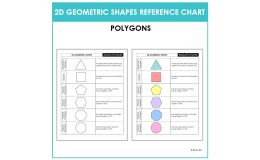
Quadrilaterals Reference Chart
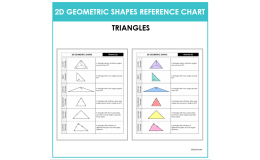
Understanding polygons has never been easier. This reference chart provides a clear, organized view of the main types of polygons, helping students identify and compare them based on their sides, angles, and special properties. The chart comes in a full-color version, which works beautifully on classroom walls, whiteboards, or even for digital displays. There is also a black-and-white version, perfect for student binders, interactive notebooks, or individual study sheets, so students can have a handy reference at their desks.
This resource is great for lessons on 2D shapes and polygons classification. It is especially helpful for visual learners who benefit from seeing concepts illustrated clearly, and it can enhance math centers, classroom displays, or study materials. Using the chart regularly helps students build confidence in recognizing and naming different polygons types while reinforcing essential geometry vocabulary. Teachers will also appreciate the convenience, since the chart is ready to print and use immediately. It is best suited for students in grades 3 through 6, but it can also serve as a useful review for older students. Whether displayed in color on the math wall or printed in black-and-white for student reference, this chart is a flexible and practical addition to any geometry unit or STEM resource collection.
Related resources
More resources teachers may find useful
24 related resources were found using this product's title, contributor, categories and tags.
In the classroom
Teaching tips & learning objectives

Learning objectives
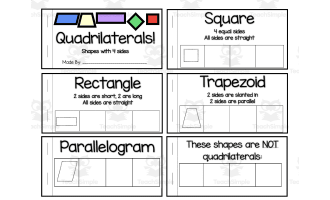
Students will identify a quadrilateral (square, rectangle, parallelogram, rhombus, trapezoid, or kite) from its listed side and angle properties.
Students will compare two quadrilaterals by the properties they share and the properties that differentiate them (e.g., square vs. rectangle, square vs. rhombus).

Teaching tips
Post the chart at eye level near the classroom's geometry wall so students can check the six quadrilateral definitions while working other tasks.
Use the shared and differing properties — squares and rectangles both list four 90° interior angles, while squares and rhombuses both list four equal sides — to prompt a compare-and-contrast discussion rather than isolated memorization.
Introduce the chart at the start of a quadrilateral-classification unit, since it functions as a lookup reference rather than a graded task.

Skills covered
Quadrilateral property recognition — matching a shape to its defining side-length, parallelism, and angle properties as printed on the chart.
Shape classification reasoning — distinguishing quadrilaterals that share some properties (e.g., squares and rectangles both have four 90° angles) but not others.
Geometry vocabulary — using terms such as parallel, opposite sides, interior angle, and adjacent sides as they appear on the chart.
Good to know
Questions teachers ask about this resource
How does the chart distinguish a square from a rhombus?
Both are listed with four equal sides and parallel opposite sides, but the square's entry also states all interior angles are 90°, a property the rhombus entry does not include.

No reviews yet
Downloaded this resource? Tell other teachers how it went.
Curriculum
Standards, concepts & topics
Standards
 Standards
- 5.G.B.3 — Understand that attributes belonging to a category of two-dimensional figures also belong to all subcategories of that category. For example, all rectangles have four right angles and squares are rectangles, so all squares have four right angles.
- 5.G.B.4 — Classify two-dimensional figures in a hierarchy based on properties.
- 3.G.A.1 — Understand that shapes in different categories (e.g., rhombuses, rectangles, and others) may share attributes (e.g., having four sides), and that the shared attributes can define a larger category (e.g., quadrilaterals). Recognize rhombuses, rectangles, and squares as examples of quadrilaterals, and draw examples of quadrilaterals that do not belong to any of these subcategories.
Core concepts
 Core concepts
quadrilaterals
geometric properties
parallel sides
interior angles
 Topics
Explore more
Categories this resource belongs to
Explore related searches
More to explore
You may also like