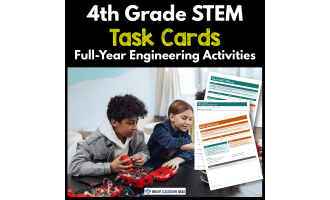
3rd Grade STEM Challenge Cards | Full-Year Engineering Activities


About This Product
🔬 Grade 3 STEM Challenge Cards | 98 Print-and-Go Engineering Cards
Make Grade 3 STEM easier to launch, manage, and differentiate with 98 print-and-go STEM Challenge Cards designed to put the engineering problem, criteria, constraints, and testing expectations directly in students’ hands.
📦 What’s Included
This complete Grade 3 STEM Challenge Cards set includes:
🔧 36 Weekly Challenge Cards with driving questions, criteria, constraints, predictions, variables, and trial counts
🚀 36 Level Up Cards — one meaningful extension for every weekly challenge
💬 14 Engineer Talk Cards featuring process steps, evidence-based sentence stems, and team roles
⚡ 12 Quick Build Cards for short, ten-minute STEM challenges
🖨️ 4 cards per page for easy printing
📎 Designed to print on cardstock, laminate, and reuse
🎨 Color-coded borders that correspond with the curriculum units
🗂️ Storage labels for organizing the four card sets
🌈 36 Weekly Engineering Challenges
The cards provide a full progression through six Grade 3 STEM units:
Unit 1: Engineering Design
The Investigator's Toolkit
Design a Bridge
The Decision Matrix
Design a Packaging Solution
Prototype and Iterate
Capstone: The Engineering Challenge
Unit 2: Forces & Motion
Build a Wind-Powered Vehicle
Balanced and Unbalanced Forces
Friction Investigation
Magnetic and Electric Forces
Create a Simple Machine
Capstone: The Vehicle Grand Prix
Unit 3: Matter & Materials
Create a Solar Oven
The Insulation Investigation
Design a Water Filtration System
Material Strength Testing
Changes of State Investigation
Capstone: The Solar Cooker Challenge
Unit 4: Life Science
Build a Model Ecosystem
Build a Sustainable Garden
Life Cycles Investigation
Traits and Variation
When Habitats Change
Capstone: The Ecosystem Investigation
Unit 5: Earth & Space
Design a Weather Station
Climate Across Regions
Design for Weather Hazards
Create an Earthquake-Resistant Structure
The Sun's Patterns
Capstone: The Hazard Summit
Unit 6: Engineering for Communities
Define the Problem
Design for Accessibility
Engineering for Water Access
The Community Problem
Energy and Waste Investigation
Capstone: STEM Investigators Showcase
🏫 How It Works in the Classroom
Post a Weekly Challenge Card in your Build Zone from the beginning through the end of the challenge.
Each card gives students the essential information they need to work more independently:
Driving question
Criteria — what the solution must accomplish
Constraints — the limits students must follow
Prediction
Independent variable
Required trials
Measurement information
For example, students investigating a bridge aren't simply asked to build one. They must compare three structure types using the same material allowance, record load and mass, calculate efficiency, and rank their designs.
🚀 Differentiate With Level Up Cards
The 36 Level Up Cards are designed for students who meet the criteria early, need a greater challenge, or have competing design claims that can be settled through additional testing.
Instead of simply saying “build another one,” each Level Up introduces a competing goal or deeper investigation. Students might add another condition, change a variable, compare trade-offs, investigate a new barrier, or test whether a prediction holds up.
This makes differentiation feel like more STEM thinking, not extra busywork.
💬 Build Data-Focused STEM Language
The Engineer Talk Cards stay posted near the Build Zone and provide students with visual reminders for the engineering process and evidence-based communication.
Students practice:
ASK — identify the problem, criteria, and constraints
IMAGINE — sketch three possible solutions
PLAN — label the design, list materials, and make a prediction
CREATE — build from the plan and document changes
Testing and recording every result
Using evidence to explain conclusions
Working within team roles
The cards specifically emphasize that a failed trial is data, helping students develop the mindset that unexpected results are useful information rather than something to hide.
⚡ Need a Quick STEM Activity?
The Quick Build Cards provide short, no-prep challenges that can be used for indoor recess, morning work, spare time, or with a supply teacher, with materials already available (cups, straws, tape, paper, string, etc.). Examples include Shape Strength, Three Trials, Sort and Graph, and Code the Route.
🎯 Standards & Learning Goals
These Grade 3 STEM Challenge Cards support the engineering design, science, math, data, communication, and computational-thinking skills embedded throughout the Grade 3 curriculum.
Students practice:
Defining problems using evidence
Identifying criteria and constraints
Generating multiple solutions
Planning fair tests
Identifying independent, dependent, and controlled variables
Conducting repeated trials
Recording all results
Calculating ranges and typical values
Comparing data sets
Creating and interpreting graphs
Making evidence-based recommendations
Recognizing limitations in conclusions
Revising designs based on analyzed data
Communicating engineering decisions
Using algorithms, loops, and conditional logic
The Grade 3 coding strand is intentionally unplugged and connects directly to engineering investigations, including algorithms, loops, and conditional logic.
⭐ Why Teachers Love It
🖨️ Print-and-Go Convenience
Print four cards per page, cut, laminate, and organize them on rings for a reusable STEM system.
👀 Students Know Exactly What They're Supposed to Do
Criteria and constraints are printed directly on the cards, so students can check their own work against the specification instead of repeatedly asking the teacher.
🔬 Real Engineering Thinking
Students aren't just building projects. They're investigating questions, controlling variables, testing solutions, analyzing results, and making recommendations.
📊 Data Drives the Decisions
Many challenges require students to calculate ranges, typical values, efficiency, ratios, percentages, or other meaningful comparisons before deciding which design performs best.
🚀 Built-In Differentiation
Level Up Cards provide a ready-to-use challenge for students who are ready to go deeper.
💬 Strengthen STEM Discussions
Engineer Talk Cards give students language for discussing evidence, explaining improvements, and communicating their thinking.
⚡ Perfect for Flexible STEM Time
Quick Build Cards give you a stash of short activities when you need meaningful STEM with almost no preparation.
🧠 Build Independence
One of the biggest goals of the card system is helping students make the shift from “Is this allowed?” to “Let me check the specification.”
💛 Put the Engineering Challenge in Students' Hands!
Give your third graders a clear, consistent system for tackling Grade 3 STEM challenges all year long.
With 98 cards, you'll have weekly engineering investigations, meaningful extensions, STEM conversation supports, team roles, and quick-build activities ready to use.
Help your students become the kind of engineers who don't just say “My design worked.”
They can explain how they know.
Resource Tags
0 Reviews
Check out these other great products