


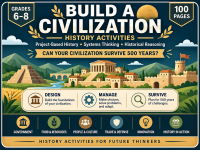
Build a Civilization | History Workbook | Grades 6–8 | 100 Pages



About This Product
Build a Civilization | Project-Based History Workbook | Grades 6–8 | 100 Pages
100-Page Middle School History Resource | Civilization Design, Systems Thinking & Historical Reasoning
Can your civilization survive 500 years?
Bring history, critical thinking, and project-based learning together with Build a Civilization, a 100-page middle school history resource designed for students in Grades 6–8.
In this civilization-building challenge, students explore how societies develop, organize their governments, manage resources, establish trade networks, solve problems, and respond to historical challenges.
Through 12 connected learning units, students investigate the relationships between geography, economy, technology, social structures, government, culture, and long-term civilization survival.
The resource emphasizes decision-making, systems thinking, historical reasoning, and evidence-based explanations.
What's Included?
100 total pages
12 themed learning units
84 student activity pages (Pages 5–88)
Five questions per activity page, as indicated in the table of contents
10 answer key pages (Pages 89–98)
Historical Comparison & Extension Guide (Page 99)
Curriculum & Skills Guide (Page 100)
Civilization design and planning activities
Government and economic decision-making tasks
Resource management and settlement challenges
Trade, technology, culture, and defense scenarios
Crisis management and civilization survival investigations
Final civilization project
12 Learning Units
Unit 1: Geography & Settlement (Pages 5–11)
Students examine geographic evidence, settlement locations, maps, and the factors that influence where civilizations develop.
Unit 2: Food Surplus & Specialization (Pages 12–18)
Explore how food production, storage, surplus, and specialized labor contribute to the development of organized societies.
Unit 3: Government Choices (Pages 19–25)
Investigate different government systems, leadership decisions, accountability, and responses to political challenges.
Unit 4: Laws & Social Order (Pages 26–32)
Students examine lawmaking, fairness, dispute resolution, social responsibilities, and the consequences of different rules.
Unit 5: Trade & Economy (Pages 33–39)
Explore trade routes, economic decisions, goods and ideas, and challenges that influence economic development.
Unit 6: Social Structure & Labor (Pages 40–46)
Analyze social roles, labor systems, status, mobility, and the relationship between social organization and opportunity.
Unit 7: Technology & Infrastructure (Pages 47–53)
Investigate innovation, infrastructure priorities, technology choices, and the effects of technological development.
Unit 8: Defense & Security (Pages 54–60)
Students examine security needs, defense strategies, resource allocation, alliances, and responses to threats.
Unit 9: Culture, Belief & Identity (Pages 61–67)
Explore cultural evidence, traditions, communication, belief systems, and the development of shared identity.
Unit 10: Crisis & Adaptation (Pages 68–74)
Students respond to simulated crises involving drought, trade disruption, leadership disputes, and illness while developing adaptation plans.
Unit 11: Civilization Systems Lab (Pages 75–81)
Investigate how civilization systems interact through decision consequences, cause-and-effect reasoning, historical comparisons, and system readiness checks.
Unit 12: Final Civilization Project (Pages 82–88)
Students bring together their learning through a final civilization-building project involving strengths and vulnerabilities, a 500-year crisis test, evidence analysis, and a final written argument.
Key Learning Skills
Historical reasoning
Systems thinking
Critical thinking
Project-based learning
Geography and settlement analysis
Government and civic decision-making
Economic reasoning
Resource management
Cause-and-effect analysis
Problem-solving
Evidence-based argumentation
Comparing historical systems
Long-term planning
Evaluating consequences
Understanding civilization development
Suggested Classroom Uses
This resource can support:
Middle school social studies lessons
Grades 6–8 world history
Civilization-building projects
Ancient civilizations units
Project-based learning activities
Small-group investigations
Independent classroom work
History enrichment
Critical thinking lessons
Cross-curricular history and geography projects
Historical reasoning practice
End-of-unit projects
Teachers can use individual activity pages to reinforce specific historical concepts or organize the 12 units into a longer civilization-building learning experience.
Answer Key & Teacher Resources
Pages 89–98 are designated for the page-by-page answer key.
Page 99 contains the Historical Comparison & Extension Guide.
Page 100 contains the Curriculum & Skills Guide.
Activities involving design decisions, historical arguments, and civilization planning may allow multiple reasonable answers when supported by appropriate evidence.
Resource Information
Grade Levels: Grades 6–8
Primary Subject: Social Studies / History
Format: Printable PDF
Total Pages: 100
Student Activity Pages: 84
Learning Units: 12
Questions Per Activity: 5, as stated in the contents
Answer Key: 10 pages
Teacher Resources: Historical Comparison & Extension Guide and Curriculum & Skills Guide
Help students explore how civilizations develop, how their systems interact, and how historical decisions can produce long-term consequences.
Design. Manage. Adapt. Can Your Civilization Survive 500 Years?
Resource Tags
0 Reviews
Check out these other great products


