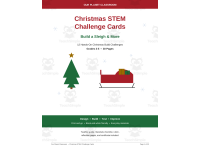
Christmas STEM Challenge Cards: Build a Sleigh & More, Grades 2-5



About This Product
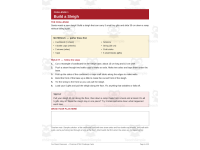
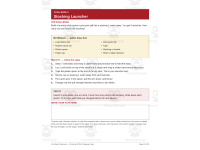
Santa needs engineers, and this 30-page Christmas STEM pack for Grades 2-5 turns students into builders. Twelve hands-on challenges ask students to solve a Christmas problem with everyday classroom materials, then test what they built, record the results, and improve it. A sleigh must carry five gifts and slide 30 centimetres without falling apart. A parachute must carry a gift down a paper-towel-tube chimney and land it softly. A paper-cup tower must stand for ten seconds with a star on top. A bridge must span a 20-centimetre gap and hold a toy reindeer. A launcher must toss a pom-pom gift into a stocking one metre away. A catapult must throw a cotton-ball snowball over a 15-centimetre fence. A folded sheet of wrapping paper must bridge 25 centimetres and hold pennies. A jingle bell must roll through a box-lid maze in at least ten seconds. A graham-cracker house must stand on its own for one minute. A ramp must send a toy sled past a finish line 50 centimetres away. A crane must lift a paper star to the top of a 30-centimetre tree tube. And a parachute must carry a paper ornament down as slowly as possible, landing right-side up.
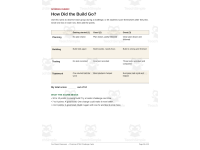
Every challenge follows the same clear layout: the goal, a materials list, step-by-step build steps, a test-it prompt, a plan-drawing box, and a short teacher note with a sample solution. Each challenge also has its own recording sheet with space for what was built, a test-results table using the challenge's own measurement (three trials for most challenges, five for the Stocking Launcher and Snowball Catapult), what happened, what to change, a drawing box, and a star self-check. A teacher guide on page 2 explains how to run a challenge day in five steps, with groups of three or four, four jobs, and a timing table of about 50 to 60 minutes per challenge. A materials checklist on page 3 lists 18 everyday items. A scoring rubric on page 28 covers planning, building, testing, and teamwork, each scored 1 to 3 for a total out of 12. Six think-like-an-engineer reflection prompts on page 29 and a certificate on page 30 finish the pack. Students learn real engineering practice: plan first, build, test, change one thing at a time, and test again.
Resource Tags
0 Reviews
Check out these other great products