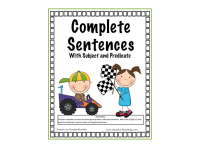
Complete Sentences with Subject and Predicate Activity

- Grades
- Grades 1–2, Elementary
- Pages
- 4
- File type
- Preparation
- Print ready


- Subject
- ELA, Language Development, Grammar
- Topic
- Complete Sentences, Subjects and Predicates
- Resource types
- Activities
- Preparation
- Print ready
- Standards
- CCSS.L.1.1
Product description
From the author
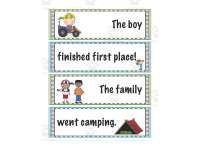
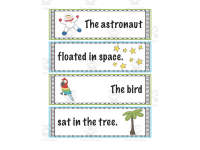
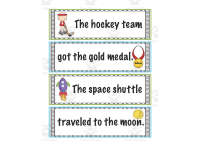
This activity is perfect for students who need help understanding how to create complete sentences with a subject and predicate. This activity can be used in a small group or as a whole class. This is a great way for students to practice creating complete sentences.
Related resources
More resources teachers may find useful
24 related resources were found using this product's title, contributor, categories and tags.


In the classroom
Teaching tips & learning objectives

Learning objectives
Combine a subject and a predicate to form a grammatically complete sentence
Recognize which subject and predicate pairing produces a logical, complete sentence

Teaching tips
Cut the cards apart and shuffle the predicate cards before handing them out so students actively match rather than simply read pre-paired sentences.
Use as a small-group or center activity where students race to correctly pair all six subject and predicate cards.
Follow up by having students write one or two of their own original subject-predicate sentence pairs using the same sentence pattern.

Skills covered
Subject-predicate matching — students combine a subject card with the correct predicate card to form a complete sentence.

No reviews yet
Downloaded this resource? Tell other teachers how it went.
Curriculum
Standards, concepts & topics
Standards
 Standards
- CCSS.L.1.1 — Demonstrate command of the conventions of standard English grammar and usage when writing or speaking. a. Print all upper- and lowercase letters. b. Use common, proper, and possessive nouns. c. Use singular and plural nouns with matching verbs in basic sentences (e.g., He hops; We hop). d. Use personal, possessive, and indefinite pronouns (e.g., I, me, my; they, them, their; anyone, everything). e. Use verbs to convey a sense of past, present, and future (e.g., Yesterday I walked home; Today I walk home; Tomorrow I will walk home). f. Use frequently occurring adjectives. g. Use frequently occurring conjunctions (e.g., and, but, or, so, because). h. Use determiners (e.g., articles, demonstratives). i. Use frequently occurring prepositions (e.g., during, beyond, toward). j. Produce and expand complete simple and compound declarative, interrogative, imperative, and exclamatory sentences in response to prompts
Core concepts
 Core concepts
Subjects and predicates
Complete sentences
 Topics
More to explore
You may also like