Compréhension de Lecture – Animaux en Voie de Disparition


- Grades
- Grades 2–5, Elementary
- Pages
- 10
- File type
- Preparation
- Print ready


- Subject
- French, Foreign Languages
- Topic
- lecture, littératie
- Resource types
- Worksheets & Printables
- Preparation
- Print ready
About this resource
What's inside this resource
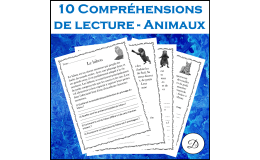
Compréhension de lecture - Animaux en voie de disparition (10 textes)
Ce recueil de lecture est pensé pour les enfants du primaire et pour leur donner envie de lire. Il contient 10 petits textes courts et faciles qui vont captiver l’attention des jeunes lecteurs.
Avec chaque texte, les élèves sont invités à observer et à réfléchir. Quatre questions suivent chaque texte, d’abord simples, puis un peu plus poussées, pour les aider à mieux comprendre. Elles les amènent à trouver les mots importants et à saisir les informations présentés dans chaque texte.
Cette ressource pédagogique aide non seulement à la lecture, mais aussi au vocabulaire, à la mémoire et à la formulation d’idées claires. En plus, il stimule l’imagination et le sens critique des enfants.
C’est un outil pratique pour aider les élèves à apprendre tout en prenant du plaisir. Le document est fourni en format PDF prêt à être imprimé.
Related resources
More resources teachers may find useful
24 related resources were found using this product's title, contributor, categories and tags.

In the classroom
Teaching tips & learning objectives

Learning objectives
Read a short French informational text and answer questions about it in written French
Locate a specific fact in a paragraph - a population figure, a habitat, a distinguishing feature - and restate it in a full answer
Explain in French why a species is threatened, drawing on causes named in the text such as la chasse illégale, le braconnage, la déforestation and la perte de leur habitat

Teaching tips
The ten sheets are independent and unnumbered, so one can be given per week across a term or several handed out at once for group work
Questions repeat a small set of stems - Où vit...? Quelles sont les principales menaces...? Quels efforts sont faits pour protéger...? - which makes the set good for teaching how to answer a French comprehension question in a full sentence
The passages carry precise numbers (1 000 gorilles, moins de 1 900 pandas, 300 kg, 2 mètres), so a mapping or graphing extension follows naturally from a reading lesson

Skills covered
Reading comprehension in French - students read a self-contained informational paragraph and answer three or four questions about it on the same page.
Written expression in French - every answer goes on ruled lines rather than into a multiple-choice box, so students construct the sentence themselves.
Locating specific detail - questions such as "Combien de gorilles des montagnes reste-t-il à l'état sauvage ?" and "Quelle est la taille et le poids de la tortue luth ?" send the reader back to a single figure in the text.
Good to know
Questions teachers ask about this resource
Which ten species do the passages cover?
Le tigre de Sibérie, le gorille des montagnes, la tortue luth, le panda géant, le lémurien de Madagascar, le bison d'Europe, l'éléphant de Sumatra, le pangolin, le lynx ibérique and le loup rouge - a spread across five continents and both land and marine habitats.
What kind of answers do the questions call for?
Written French sentences. Each question is followed by one or two ruled dotted lines rather than a set of options, and the stems - Où vit...?, Pourquoi...?, Quels efforts sont faits pour protéger...? - ask for explanation as well as recall.
Are the ten texts matched in length and difficulty?
Closely. Each is a single paragraph of well under a hundred words and each follows the same three-part shape - habitat, threats, conservation - so the sheets can be worked in any order without one being noticeably harder than another.

No reviews yet
Downloaded this resource? Tell other teachers how it went.
Resource details
Concepts & topics
Core concepts
 Core concepts
Compréhension de lecture
Texte informatif
Espèces en voie de disparition
Conservation
 Topics
Explore related searches
More to explore
You may also like