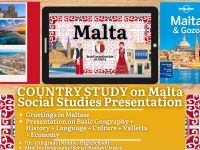
Country Study Presentation - Malta - South Europe

- Grades
- Grades 7–8, Middle School, Elementary
- Pages
- 14
- File type
- Preparation
- Print ready


- Subject
- Social Studies, Economics, Geography, History: Europe, History
- Topic
- Country Study, Social Studies
- Resource types
- Presentations
- Preparation
- Print ready
About this resource
What's inside this resource
Country Study Presentation - Malta - South Europe - Social Studies + Geography
Try this Digital Teaching Resource on Malta (Introductory Presentation Lesson), designed for Geography, European History (Southern Europe - Island State in the Mediterranean Sea), and Social Studies lessons. Perfect for Grades 7–12 (Middle school and High School students), this Introductory PDF Presentation offers a fun, informative, and ready-to-use lesson that requires little to no preparation.
Students will explore Malta’s geography, history, culture, language and economy — making it perfect for classroom instruction, homeschooling, or online learning.
📘 Within this Social Studies and Geograhy Teaching resource, teachers and educators can find the following topics dealt:
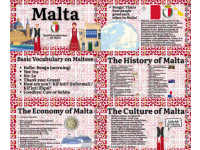
✅ Greetings in Maltese
✅ Geography of Malta (Southern Europe - Island State in the Mediterranean Sea) – Key facts, borders, and an interactive Google Maps link to its location.
✅ Quick Facts – Population, capital city, currency, flag, and other essential details.
✅ History Overview – A concise summary of Malta’s most significant historical events.
✅ Geography & Environment – Details about the country’s land area, regions, and climate zones.
✅ Malta's Economy – Insight into Malta industries, exports, and economic strengths.
✅ Valletta – Explore the capital city, its famous landmarks, and cultural highlights.
✅ Other Major Cities – A map showcasing additional important urban centers.
✅ Malta's Culture & Traditions – A look at the customs and values that define Malta (Southern Europe - Island State in the Mediterranean Sea)
✅ Farewell in Maltese
This Social Studies + Geography Country Study Presentation on Malta (Southern Europe - Island State in the Mediterranean Sea) PDF Digital Teaching Resource (14 slides) can be ideal for Middle School and High School Students from 7th grade to 12th grade to introduce Malta (Southern Europe - Island State in the Mediterranean Sea) and its culture, language, society, history and economy.
Learning with Alan is a Teaching Resource - Educational Material Store whose aim is to help Teachers, Educators and Tutors to achieve their teaching objectives while creating a fun and stimulating environment. Learning should always be fun. Never Forget!
If you want to browse more of my Teaching Resources, click here Learning with Alan!
Related resources
More resources teachers may find useful
24 related resources were found using this product's title, contributor, categories and tags.


In the classroom
Teaching tips & learning objectives

Learning objectives
Identify key geographic facts about Malta, including its location, population, and archipelago structure.
Sequence major events in Maltese history from ancient settlement through EU membership.
Describe Malta's economy by identifying its main sectors and their approximate share of output.

Teaching tips
Use the history timeline slide as a sequencing exercise, having students order events before revealing the full chronology.
Pair the economic-sector percentages with a simple pie or bar chart activity to build data literacy alongside the geography content.
Introduce the six Maltese phrases as a short greeting routine at the start of class during a Malta-focused unit.

Skills covered
Geographic literacy - students read population, area, and location facts to place Malta within the Mediterranean and European context.
Historical timeline reading - a chronological list from 5200 BC to 2004 traces Malta's invasions, rulers, and independence.
Basic vocabulary acquisition - six Maltese greeting and courtesy phrases (Bonġu, Iva, Le, Grazzi, Kif inti?, Ċaw) are introduced with English translations.
Good to know
Questions teachers ask about this resource
What non-English vocabulary appears in the presentation, and how is it introduced?
Six basic Maltese words and phrases, such as Bonġu (hello) and Grazzi (thank you), are given alongside their English meanings as part of the language overview.
How does the presentation break down Malta's economy?
It lists four sectors with approximate percentages of the economy: services including tourism and finance (~75%), industry and manufacturing (~20%), agriculture and fishing (~2-3%), and construction and energy (~2-3%).

No reviews yet
Downloaded this resource? Tell other teachers how it went.
Resource details
Concepts & topics
Core concepts
 Core concepts
country study
geography
economic sectors
historical timeline
 Topics
More to explore
You may also like