Creative Writing Checklists
- Grades
- Grades 3–5, Elementary
- File type
- Preparation
- Print ready


- Subject
- ELA, Writing, Creative Writing
- Topic
- creative writing, student editing
- Resource types
- Worksheets & Printables, Worksheets
- Preparation
- Print ready
- Standards
- CCSS.W.4.5 CCSS.L.4.1
About this resource
What's inside this resource
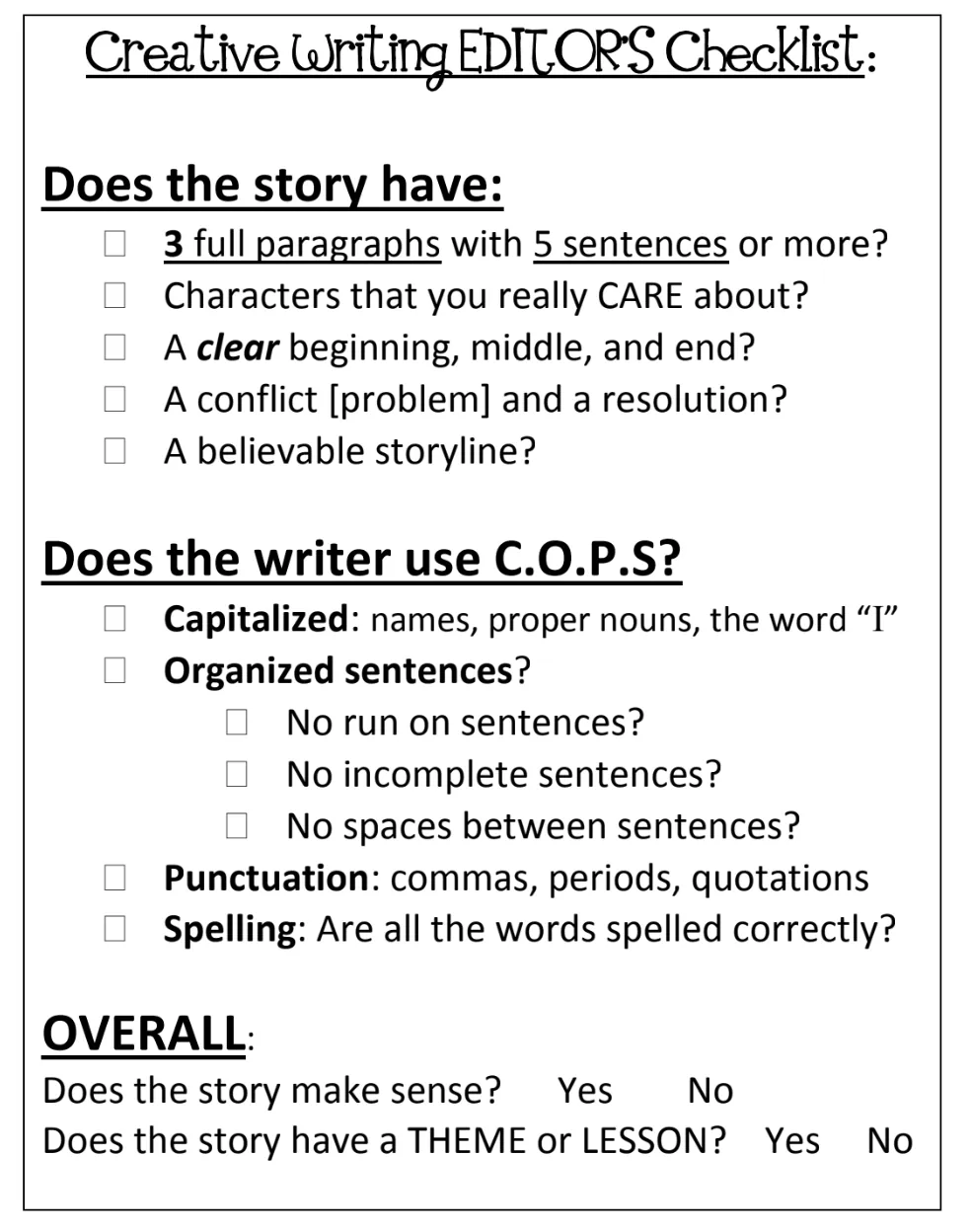
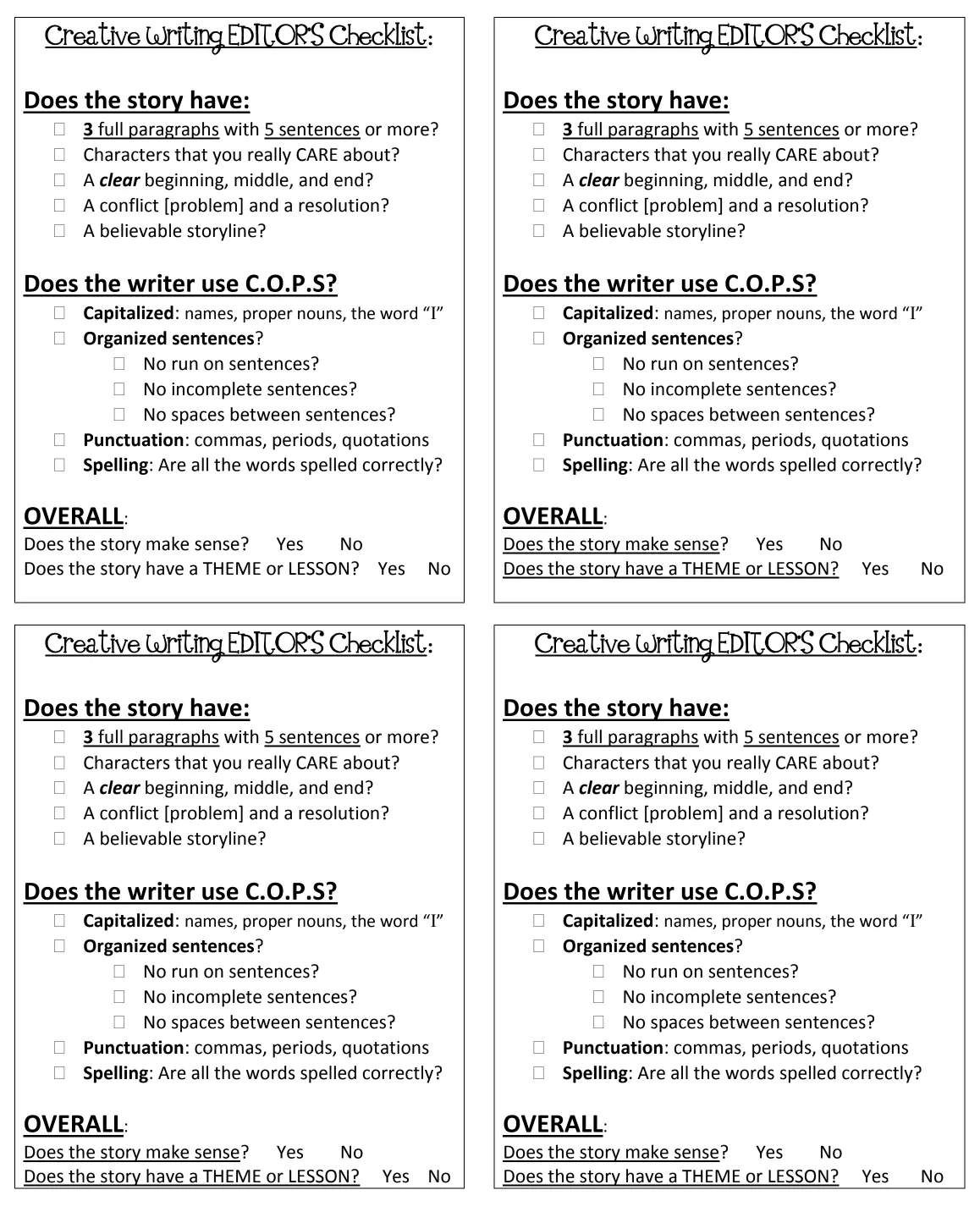
This resource is a set of Creative Writing Checklists.
These are mini checklist printed 4 per page.
These checklists are a great reference guide for students as they edit their own work or the work of a peer.
Related resources
More resources teachers may find useful
24 related resources were found using this product's title, contributor, categories and tags.
In the classroom
Teaching tips & learning objectives

Learning objectives
Student can evaluate a creative writing draft against a checklist covering paragraph count, character development, and story structure.
Student can proofread a draft for capitalization, sentence organization, punctuation, and spelling using the C.O.P.S. method.

Teaching tips
Cut the single page into its four identical strips and hand one to each student or editing pair rather than photocopying a full page per student.
Introduce the C.O.P.S. acronym explicitly before first use, since the checklist assumes students already know what each letter checks for.

Skills covered
Peer and self-editing — students apply a yes/no checklist to check for paragraph count, character development, and story structure in a draft.
C.O.P.S. proofreading — students check their writing for capitalization, sentence organization (no run-ons or fragments), punctuation, and spelling.

No reviews yet
Downloaded this resource? Tell other teachers how it went.
Curriculum
Standards, concepts & topics
Standards
 Standards
- CCSS.W.4.5 — With guidance and support from peers and adults, develop and strengthen writing as needed by planning, revising, and editing. (Editing for conventions should demonstrate command of Language standards 1–3 up to and including grade 4 on page 29.)
- CCSS.L.4.1 — Demonstrate command of the conventions of standard English grammar and usage when writing or speaking. a. Use relative pronouns (who, whose, whom, which, that) and relative adverbs (where, when, why). b. Form and use the progressive (e.g., I was walking; I am walking; I will be walking) verb tenses. c. Use modal auxiliaries (e.g., can, may, must) to convey various conditions. d. Order adjectives within sentences according to conventional patterns (e.g., a small red bag rather than a red small bag). e. Form and use prepositional phrases. f. Produce complete sentences, recognizing and correcting inappropriate fragments and run-ons.* g. Correctly use frequently confused words (e.g., to, too, two; there, their).*
Core concepts
 Core concepts
editing and revision
story structure
 Topics
More to explore
You may also like