Spanish Direct Object Pronouns Practice Worksheets




- Grades
- Grades 6–9, Middle School
- Pages
- 6
- File type
- Preparation
- Print ready


- Subject
- Grammar, Language Development, Spanish, Foreign Languages
- Topic
- Spanish Direct Objects, Object Pronouns
- Resource types
- Worksheets, Worksheets & Printables
- Preparation
- Print ready
Product description
From the author
Introduction
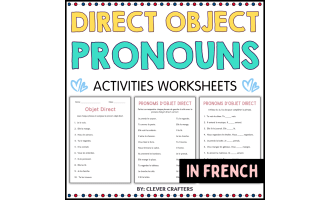
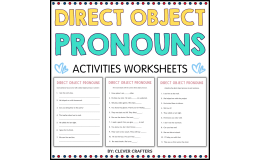
This set of Spanish worksheets focuses on objeto directo (direct object) and gives students practice using it in Spanish sentences. The activities are designed to help learners recognize the direct object and replace it correctly with pronouns.
Students should already be comfortable reading Spanish sentences before working through the pronoun-placement and correction exercises.
What’s Included:
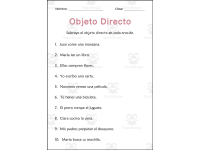
• Identifying the direct object in sentences
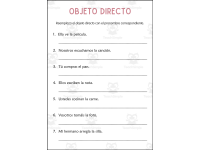
• Replacing direct objects with the correct pronouns
• Sentence rewriting activities
• Practice with common sentence patterns
• Simple exercises written in Spanish
Grades / Ages:
Choose these pages for learners who can read Spanish sentences and work with conjugated verbs, gerunds and infinitives.
Implementation Format:
These worksheets work well for:
• Spanish grammar lessons
• Class practice
• Independent work
• Small group activities
• Homework
• Review
Answer Key:
Not included
File Type:
PDF (Non-editable)
Number of Pages:
6 pages total
License:
Paid product for personal or single-classroom use only
Related resources
More resources teachers may find useful
24 related resources were found using this product's title, contributor, categories and tags.


In the classroom
Teaching tips & learning objectives

Learning objectives
Students will identify the direct object in a Spanish sentence by underlining it.
Students will replace singular and plural direct objects with the correct direct object pronoun (lo, la, los, las).
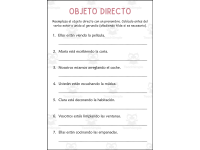
Students will correctly place direct object pronouns before conjugated estar + gerund constructions and attach them to infinitives, applying accent rules where needed.

Teaching tips
Sequence the six worksheets in order, since each builds in difficulty from simple identification to gerund/infinitive attachment and finally error correction.
Review the accent-mark rule (adding a tilde when attaching a pronoun to a gerund) explicitly before worksheet 4, since the sheet asks students to add it 'if necessary.'
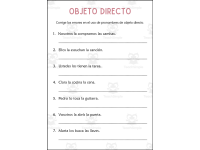
Use worksheet 6 (error correction) as a formative check after the first five sheets to see which pronoun rule needs re-teaching.

Skills covered
Direct object identification — students underline the direct object in 10 Spanish sentences (e.g., 'Juan come una manzana').
Pronoun substitution — students replace singular and plural direct objects with lo/la/los/las across 14 sentences.
Error correction — students identify and fix incorrect direct-object-pronoun usage in 7 sentences.
Good to know
Questions teachers ask about this resource
Does the gerund worksheet allow more than one placement?
Yes. It asks students to place the pronoun before estar or attach it to the gerund, adding an accent when necessary. The infinitive worksheet specifically asks for attachment.

No reviews yet
Downloaded this resource? Tell other teachers how it went.
Resource details
Concepts & topics
Core concepts
 Core concepts
Direct object pronouns
Spanish grammar
Gerunds and infinitives
 Topics
More to explore
You may also like