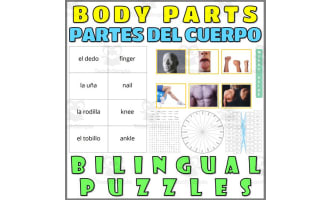
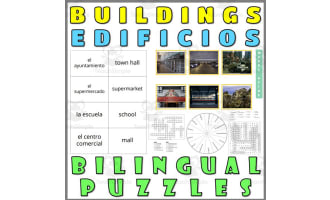
English Spanish Bilingual Vocabulary Crossword


- Pages
- 169
- File type
- Answer key
- Included


- Subject
- ELA, Foreign Languages, Spelling, Language Development, Vocabulary, Spanish
- Topic
- Thematic vocabulary, Independent work
- Resource types
- Crosswords Puzzles, Worksheets, Worksheets & Printables
- Answer key
- Included
Product description
From the author
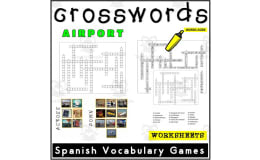
English–Spanish Bilingual Vocabulary Crosswords.
This vocabulary and word game resource is a great complement to any program teaching English and Spanish . Use selected puzzles in class or one-to-one sessions to practise themed vocabulary. It provides flexible settings that are applicable to SSL and ESL . This is print- ready material that is ready to use . Use the puzzles for vocabulary practice with ESL and Spanish learners. It is a part of a series, and the themes touch on community and daily environments and activities to organize vocabulary practice by topic .
There are two options for each worksheet activity : Spanish to English and English to Spanish .
Answer keys are also provided . Includes :
1 . crossword boards with spanish words given on the bottom of the page .
2 . answer keys for no 1 .
3 . crossword boards with english words given on the bottom of the page .
4 . answer keys for no 3 .
Note :
The clues practise vocabulary for everyday, community and academic settings. Use these worksheets :
as morning work routine .
in your centers .
as independent work booklet .
as handouts / fun homework .
Conclusion :
Enrich your teaching environment with this multi- faceted tool that aims not just at direct instruction but skill-building across various domains – a crucial aspect towards accomplishing holistic education !
Included: 169-page PDF with a theme index, 84 crosswords across 42 themes and 84 completed grids.
Related resources
More resources teachers may find useful
24 related resources were found using this product's title, contributor, categories and tags.

In the classroom
Teaching tips & learning objectives

Learning objectives
Translate themed everyday nouns in both directions, from el ganso to goose and from cabbage to el repollo, across settings such as airport, hotel, gym and supermarket
Spell answers letter by letter into crossword squares, including accented forms like brócoli, la habitación and la desesperación
Build English academic and emotional vocabulary such as psychology, physical education, confidence and disappointment from Spanish clues

Teaching tips
Choose the direction per learner: Spanish-clue grids give English-learners spelling practice, while English-clue grids make Spanish learners produce article and accent together
Build a travel unit from the airport, hotel and public transport boards, to practise vocabulary for different stages of a journey
After solving, have students copy each clue-answer pair into a two-column vocabulary journal, Spanish beside English

Skills covered
Bilingual vocabulary recall — Spanish clues prompt English grid answers (el ganso → goose) and English clues prompt article-complete Spanish answers (cabbage → el repollo) across forty-two themes and eighty-four puzzles.
English spelling — Spanish-clue grids demand exact English spellings such as cauliflower, disappointment, psychology and physical education.
Crossword logic — numbered clues, letter counts and crossing entries let students verify each translation inside the grid.
Good to know
Questions teachers ask about this resource
What do clue counts like (2,7) mean on the Spanish-answer grids?
They give the word lengths, article included. Many Spanish noun answers include el or la in the squares; follow each clue’s printed word lengths, so cabbage (2,7) fills in as el repollo — two letters for the article and seven for the noun; kale (2,3,6) becomes la col rizada.
How are multi-word phrases fitted into the grids?
Their clue counts show each word separately and the words run through consecutive squares. Hand luggage (2,8,2,4) fills in as el equipaje de mano, and door hanger (6,2,6) as cartel de puerta.
Do the completed grids show accented letters?
Yes. Examples include habitación, desesperación, brócoli and vergüenza, so students can check accents as well as letter order.

No reviews yet
Downloaded this resource? Tell other teachers how it went.
Resource details
Concepts & topics
Core concepts
 Core concepts
Bilingual vocabulary
Crossword puzzles
Spanish
Translation
 Topics
Explore more
Categories this resource belongs to
Explore related searches
More to explore
You may also like