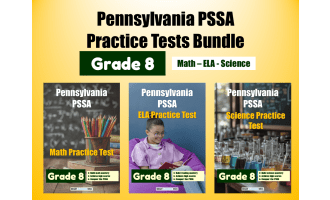
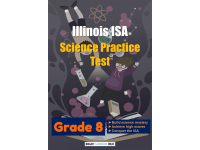
Illinois (ISA) Science Practice Test for Grade 8

- Grades
- Grade 8
- Pages
- 45
- File type
- Answer key
- Included


- Subject
- Science
- Topic
- Illinois, Science
- Resource types
- Worksheets, Activities, Tests
- Answer key
- Included
Product description
From the author
This independent Grade 8 science practice bundle contains 45 questions on matter, forces and energy, life science, and Earth and space science. Two scenario sections use a pendulum and peppered-moth population data.
Three PDFs provide a 16-page student booklet, a 10-page answer key with rationales and creator-supplied NGSS references, and a 19-page teacher guide. Use the whole booklet or selected sections; the guide offers pacing, mini-lessons and differentiation ideas.
This is an independent practice resource, not an official Illinois Science Assessment. The creator’s standards references can help organize review; the bundle does not establish complete coverage of every performance expectation.
Related resources
More resources teachers may find useful
24 related resources were found using this product's title, contributor, categories and tags.


In the classroom
Teaching tips & learning objectives

Learning objectives
Students will answer multiple-choice, fill-in, and scenario-based questions covering matter, forces and energy, life science, and Earth and space science at a Grade 8 NGSS level.
Students will interpret a multi-decade data table to explain a real-world example of natural selection (the peppered moth).
Students will analyze energy transformations (kinetic and potential) in a pendulum scenario.

Teaching tips
Use the teacher's guide's suggested six-week, domain-by-domain pacing option to spread the 45 questions across smaller, topic-focused sessions rather than one long sitting
Run the bird-beak natural-selection simulation from the teacher's guide before assigning the peppered-moth scenario questions, since it models the same selection concept hands-on
Reference the answer key's stated NGSS performance expectation for each question as a starting point for reviewing the concept behind a missed item

Skills covered
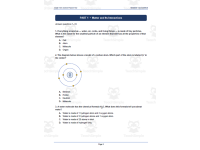
Matter and its interactions — students identify atomic structure, interpret chemical formulas and equations, and apply conservation of mass.
Life science — students explain cellular respiration and photosynthesis, trace food-chain roles, and use inheritance and environment to interpret trait variation.
Earth and space science — students connect tectonic-plate motion to geologic features and earthquakes, and interpret rock-layer sequencing and orbital gravity.

No reviews yet
Downloaded this resource? Tell other teachers how it went.
Resource details
Concepts & topics
Core concepts
 Core concepts
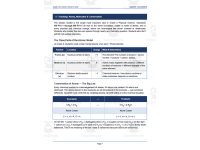
Conservation of mass
Newton's laws
Cellular respiration and photosynthesis
Natural selection
Plate tectonics
Topics
 Topics
Explore more
Categories this resource belongs to
Explore related searches
More to explore
You may also like