Make a Ten to Add - Addition Strategy Worksheets

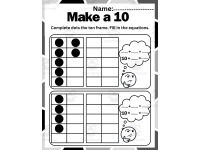
- Grades
- K–1
- Pages
- 24
- File type
- Preparation
- Print ready


- Subject
- Math, Addition
- Topic
- Basic Operations, Math
- Resource types
- Worksheets, Activities
- Preparation
- Print ready
- Standards
- 1.OA.C.6
Product description
From the author
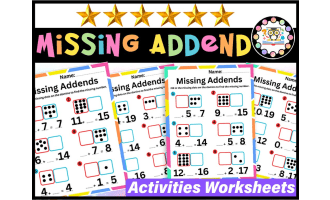
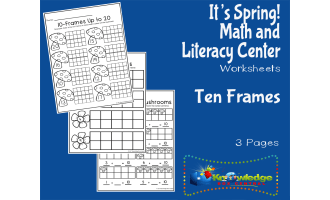
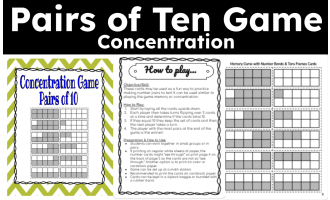
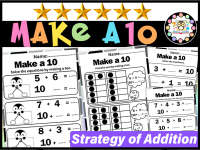
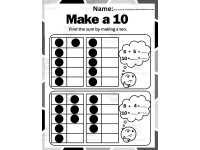
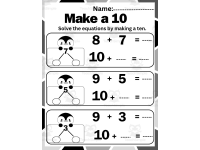
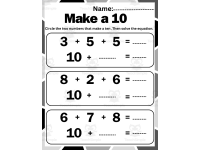
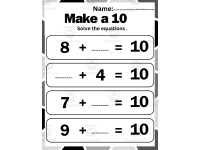
Practise making ten to add with 24 printable worksheets. Activities include splitting an addend, completing ten frames, combining three addends and finding a missing number to total ten.
Model the strategy before assigning a page and provide your own answer review. Some printed prompts need correction: the first equation on page 1 omits an addition sign; pages 13–14 include 8 + 1 under a 10 + ___ prompt; and page 21 includes 3 + 6 + 5 although no pair totals ten. Select or adapt these items before independent work.
Related resources available separately
1st Grade Worksheets
Related resources
More resources teachers may find useful
24 related resources were found using this product's title, contributor, categories and tags.


In the classroom
Teaching tips & learning objectives

Learning objectives
Decompose an addend to make a ten when adding two single-digit numbers
Complete a ten frame and write the matching addition equation
Identify which two of three given numbers combine to make ten

Teaching tips
Introduce with the ten-frame pages first, since the dot visual supports the more abstract make-a-ten equations that follow.
Use the final missing-addend-to-10 pages as a quick daily warm-up to build the automatic ten-combinations the make-a-ten strategy depends on.
Select or adapt conflicting prompts on pages 1, 13–14 and 21 before assigning them; some do not support the stated make-ten step.

Skills covered
Make-a-ten addition strategy — students decompose one addend to complete a ten before adding the remainder, e.g. 8 + 6 becomes 10 + 4.
Ten-frame representation — students complete dot ten frames and translate the visual into a written equation.
Three-addend combinations — students circle two numbers from a set of three that combine to make ten before solving the full sum.

No reviews yet
Downloaded this resource? Tell other teachers how it went.
Curriculum
Standards, concepts & topics
Standards
 Standards
- 1.OA.C.6 — Add and subtract within 20, demonstrating fluency for addition and subtraction within 10. Use strategies such as counting on; making ten (e.g., 8 + 6 = 8 + 2 + 4 = 10 + 4 = 14); decomposing a number leading to a ten (e.g., 13 – 4 = 13 – 3 – 1 = 10 – 1 = 9); using the relationship between addition and subtraction (e.g., knowing that 8 + 4 = 12, one knows 12 – 8 = 4); and creating equivalent but easier or known sums (e.g., adding 6 + 7 by creating the known equivalent 6 + 6 + 1 = 12 + 1 = 13).
Core concepts
 Core concepts
Make a ten strategy
Addition
Ten frames
Number combinations to 10
 Topics
More to explore
You may also like